← Green & Red: Podcasts for Scrappy Radicals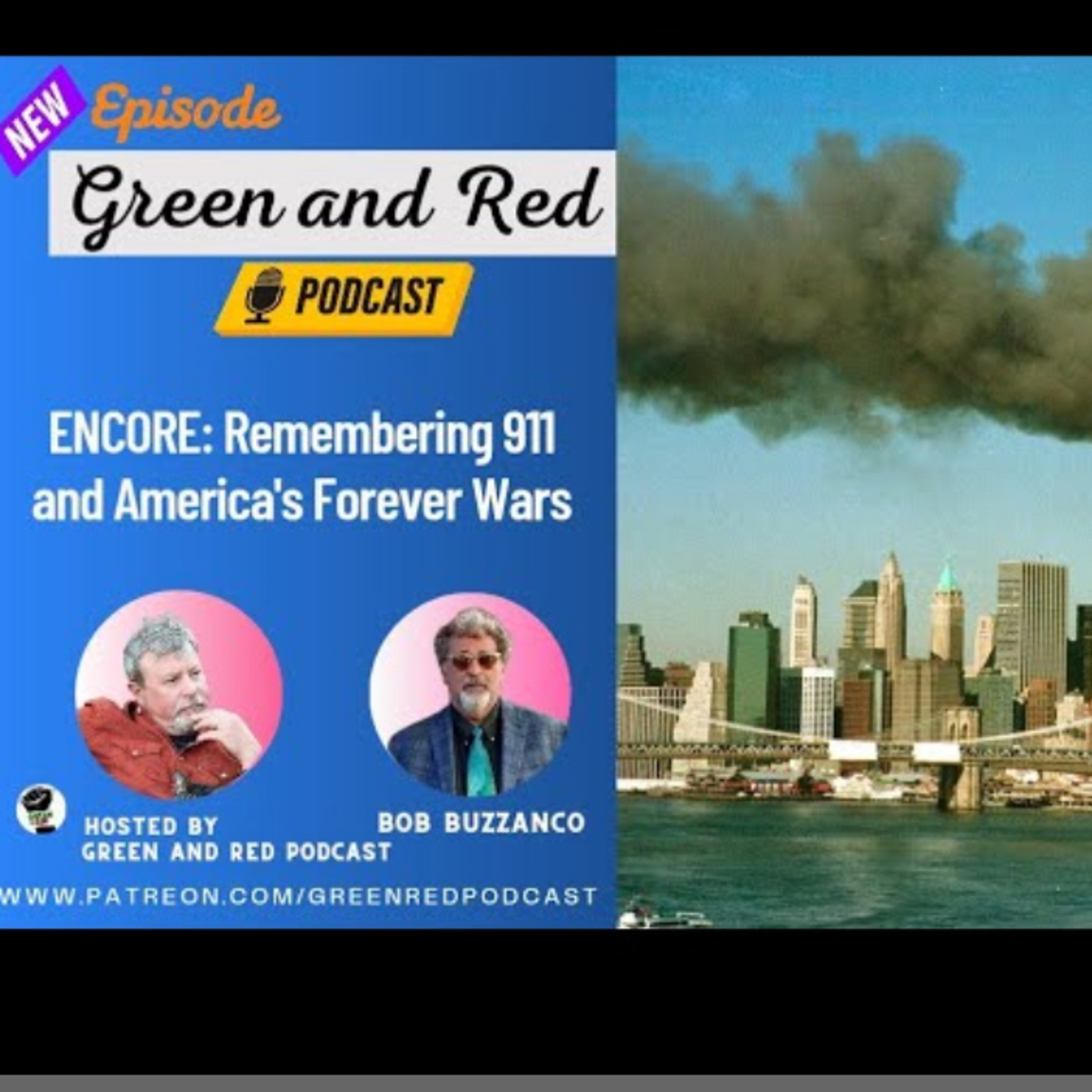
Green & Red: Podcasts for Scrappy Radicals
ENCORE: Remembering 911 and America's Forever War (G&R 419)
01:17:45
Loading summary
Transcript163 lines
- [00:01]
A
Welcome to Green and Scrappy Politics for Scrappy People, a regular podcast on radical environmental and anti capitalist politics. Brought to you by Bob Bozanko and Scott Parker.
- [00:31]
B
Welcome to the sweet and sultry sounds of the Green and Red podcast. I'm your co host, Scott Parkin coming to you from Cameron, Montana, near Yellowstone national park today. And as always, I'm joined by Bob Bozanco in Ohio.
- [00:50]
A
We are both in much cooler weather than we would be in Houston in the Bay Area. So I guess that's, that's a good thing. Not for the Bay Area, considering what's happening there.
- [01:02]
B
But yeah, for folks. Folks. Well, most people probably know this. My, my usual, my usual broadcast location is Berkeley, California. And you know, it's been a, it's been a heat wave there and it's been like smoke filled weeks of smoke, smoke from the California wildfires. And then this week they, many of my friends and neighbors woke up to orange skies and the sun was actually sort of blocked out by the smoke and it's like very troubling. But I am here doing a sort of work vacation in Montana this week where it's actually been cold. It actually snowed here on Monday. It's been cold and freezing every night.
- [01:46]
A
So, and before I forget, we just did two really great shows on this. We had Steve Horn who was talking about not just Kenosha, he's from Kenosha, he was talking about that, but he was also talking about the California wildfires and the use of prison labor and how, you know, this blue state is really not all that great on a lot of environmental issues. And, and then the last show was.
- [02:16]
B
With Pendle Marshall Hallmark from Amazon Watch and we actually talked about the rainforest fires going on in the Amazonian, in the Amazon rainforest. And so we've had a, it's interesting that we kind of finished a week of talking about environmental and honestly wildfire issues only to like see this sort of apocalyptic wildfire science season kind of hit the West Coast. And I, you know, I'm only talking about the Bay Area, but like, you know, they've been evacuating parts of southern Oregon. Over 360,000 acres of land has been burning in Washington State. A couple of towns actually in southern Oregon have actually been burnt down to the ground this week and in like, kind of like towns and cities, not just like more rural areas. So it's very troubling.
- [03:05]
A
Yeah. And not to kind of exploit this issue, but I think one of the things we try to do on the podcast is get on people to talk about stuff like this, folks like Steve Horn and Pendle who, you know, aren't going to be typically in media. So you know, we hope you appreciate that and thanks for listening and please share these and tell people about them because we really like having these folks on and I think as many people as possible should hear what they have to say. So amid that not so great backdrop, we have a special show for you today.
- [03:43]
B
Today is September 11th. It's the 19th anniversary of the attacks on the World Trade center and the Pentagon, which sparked a sort of a period of which I don't think we're out of yet, a period of just like kind of like escalated crisis or a cycle of crisises. And so we're going to actually talk a bit about September 11th. We're going to talk a little bit about some of our personal recollections, we're going to talk a little bit about the background and then we're going to talk a little bit about what happened after 9 11. And then if you're lucky, you might get to hear us rag on Bunker Boy a little bit because there's actually been some, there's been some recent news which we think is like a little bit connected to this as well. To this, to the sort of 911 period. But we want to start off with like our personal recollections. And so Bob, do you want to start off about, you know, what you were doing on September 11, 2020?
- [04:47]
A
Yeah, because you and I intersect fairly early in that day. That morning I was actually in Washington D.C. the day before I flew out of Washington that day, Horrible flight, got delayed, all kinds of stuff. But thankfully I got out that morning. I went over to see somebody and she had the TV on, I don't know, pretty early. And I saw a picture of a plane going into a building and I thought it was an accident. And then the second one hit and so it was fairly clear that that wasn't an accident. And I had to go to campus because I was teaching a class that day in US Foreign policy, ironically. And I got there and most of the students showed up and they didn't know what was going on. They were all kind of frantic and frightened. So I kind of decided to have more or less of a teach in on the US and the Middle east since I know something about it. And one of my colleagues, Professor Dean Asewal, was teaching a class in Middle Eastern history and her students were there. So she brought him in. Kind of a perfect sink there, right? U.S. foreign Policy, Middle Eastern History. And I think maybe we were back to back. So we took like three hours or I believe maybe that was it. And so I just started kind of giving a long background into U.S. foreign policy and given kind of a, you know, kind of like a teaching. And then all of a sudden people from all over started coming in from other classes and even from downtown, including.
- [06:13]
B
Me. Scott Parkin, for folks in podcast land who don't know this, before I became the anarchist troublemaker that you all know and love and the Green Red podcast co host, I actually had a job as a corporate hack. And the company I worked for was actually Continental Airlines headquartered in Houston. I worked in downtown Houston. And so, you know, sitting at my desk early, reading the news before I started my job, and then like it starts, you know, it comes, starts coming in like a plane is at the World Trade center and a trade center. And at first I thought it was just an accident. And then like second plane hits World Trade center, plane hits Pentagon plane goes down in a field and in Pennsylvania. And so it was like really clear that this was more than just like some airline accident. And at my office that day, a lot of people like low level management. A lot of people were able, allowed to go home. And so I kind of broke out that afternoon and went to this teaching that was going on with Bob at the University of Houston. I should also say the background is that Bob and I have been organizing for the better part of that year. We were doing actually anti corporate globalization work and we were preparing to go to a big protest at the end of September in Washington D.C. at the International Monetary Fund World bank, where they were expecting lots of people. We had actually been organizing to get like a big crew from Houston to go. But then we were also doing educational events around town to sort of like educate people on neoliberalism, US Foreign policy, that sort of thing. And so we quickly. The group we had formed with like a number of other people was called the Houston Global Awareness Collective. And we quickly sort of over the next few months transitioned from an anti globalization, anti corporate globalization group to an anti war group as then the swords started rattling.
- [08:17]
A
Yeah. Which is often the case that happened in Vietnam few, where a lot of people were doing all kinds of different work on poverty and civil rights. And then all of a sudden it became an anti Vietnam movement. The Eastern global awareness quite goes, something I'm very proud of. And as I look back, I think that's one of the biggest, maybe the biggest resistance group I've seen in Houston since I've been there and we had a lot of people involved. And yeah, we were all set to go to Washington and raise hell. And then this happened. And you know, the day itself was just surreal, panicky. One of my TA's husbands was flying that day and there were just rumors all over the place that There, you know, 11 planes had been hijacked and this happened. And there was a plane down and Denver and there was a plane in Atlanta and just, you know, no one had any idea what was going on. This is before Twitter and Facebook and all that. So we still had the Internet, but still it was not as immediate as it would be now. And so, you know, what was really cool is just by word of mouth, all of a sudden, you know, this teaching, I don't know, There were probably three, 400 people there, you know, because I think people peeked their heads in or up. Somebody said, you know, hey, there's this going on, or whatever. So I thought it was important that day to kind of, you know, you had to do the obligatory denunciation. I mean, nobody thinks it's a good idea to hijack planes. Nobody's going to justify that or legitimate. It's horrific, it's terrorism. Right. So, you know, I kind of had to do that for obvious reasons. And then I thought I said, you know, it's important to understand why this happened. You know, it's not like a bunch of people got together the night before and said, let's, let's do this tomorrow. Right? There's a long period of time before something like that happens. And so I think that became kind of our mission at that point is to try to understand, to try to let people know what the much larger and longer context of this was. And I. Yeah, yeah.
- [10:04]
B
And I think it's also important to recognize that part of what that group, like the Houston Global Awareness Collective, what we did in Houston was we organized like these educational events and like did popular education. And then we also were like a protest group. And so Houston, where we were based, was actually the home of a number of corporate war profiteering companies, like companies which provided logistics support or were connected to the oil industry, which was like always had its eye on the Middle East. And so we played a pretty like there was a huge anti war movement that happened in the country in that period, both around the war of Afghanistan and, and then in opposition to the invasion and occupation of Iraq in 2002, 2003. And so we played a fairly vital role in that. We were able to sort of make this kind of corporate Profit connection, which kind of kept the anti corporate globalization work alive, at least in Houston, to what was going on in the rest of the country. Like, tens of thousands of people marched around the country, millions of people marched around the world in opposition to the Iraq war. In particular in Houston, we were able to sort of keep this. Continue this on the companies that were profiting from it. And, like, as we later found out, companies that were helping push us to war, even as, like, Trump. Trump sort of, like, called that out.
- [11:26]
A
This week by mistake. Well, we were in, you know, Bush and Cheney's hometown. I mean, Cheney had been the CEO of Halliburton, Bushes from Houston. So, I mean, this was very much a Texas government.
- [11:38]
B
Daddy. Daddy Bush lived in Houston.
- [11:41]
A
Yeah. And so, yeah, we. I think one of the things. The coolest thing we did to me, was kind of jumping ahead a little. We go back. But in 2003, we had these kind of. Every Wednesday night, we'd have these kind of vigils in front of. Was it in front of Halliburton or kbr? I can't remember.
- [11:57]
B
It was kbr. It was before Halliburton moved to Houston. They were in Bells.
- [12:00]
A
Yeah, yeah, Bell over by the airport. Right. So every Wednesday, we'd get there, like, around rush hour, and we would have, you know, kind of, you know, a little bit of a spectacle. We'd have drums and people going around. But we also had a lot of literature, and we would talk to the folks coming out of the corporate offices, and we're actually, I think, making some real headway, you know, because the idea that, you know, Cheney already had contracts for war before the war even began. Halliburton had all these long extended, you know, contracts with cost overruns and everything written in. So that was the approach we took. Like, do you think this is fair? I mean, you know, the SEC wouldn't let your business do this, but Bush and Cheney are doing it. And so I think there was really a sense that we were getting somewhere. And also, you know, remember, the US had already went to war against Afghanistan virtually immediately, but they also tried to portray Iraq as the real aggressor here. And that was part of what we were doing, too, to say, well, wait a minute. There's. There's really no evidence of that. These things are actually kind of disconnected.
- [12:56]
B
So every time I think of. Every time I think of those sort of whatever they were called, the cost plus contracts that Halliburton and KBR got from the Bush and Cheney administration, now I think about the cost plus contracts that the Trump Tower and the Trump hotel chain probably gets from the government, which is probably like, I believe it was like a 15 to 50% markup in the Halliburton days. It's probably like, you know, 500% markup with the Trump administration just, just to kind of put that out there.
- [13:24]
A
But no, you know, also remember, kind of one of the cool things that personally for me was that like just a few weeks after that on, in early October, I wrote an op ed that for the Houston Chronicle. I knew the guy, you know, the editor there, op ed page, and he put it in, which I just may not have been the smartest thing I've ever done. But, you know, it was essentially. I forget what I titled, but they retitled it 5 Reasons the US Should Not Go to War in the Middle East. I'm really actually pretty proud of it because I think, you know, not that I. It wasn't that hard to figure out, you know, anybody who studied this. And so I was kind of cool doing that. I got all kinds of hate mail and emails and stuff nowadays probably be much worse. So at the time, you know, I didn't really take the threats or any of that kind of stuff seriously, but I thought it was important because, you know, Scott and I had a. I think we were fairly well known in the community because of the work we've been doing really since late 99. After Seattle, I think we started really kind of doing that. And we had people in, we had Jennifer Harbery in, we had Ralph Nader in. We were making plans to get Gnome in to Houston. So I think people kind of were aware of what we were doing then. As a professor, I was doing a lot of media and stuff at the time. So we thought it was important to kind of get, get this idea out there that, you know, because remember that night Bush's press secretary said, you're either with us or you're with the terrorists.
- [14:44]
B
Right, Absolutely.
- [14:45]
A
And that led to, I mean, a lot of the things we're seeing today, you know, like the COVID people are very upset about the surveillance state and they're going to track us and all of that. I understand that, but that started after 9, 11. I mean that really. Well, it's been in effect before that. Right. But it really ratcheted up after 911. That's when you saw this surveillance state just blow up, you know, Department of Homeland Security, the Patriot Act. So what we're seeing today, all this crazy stuff with Trump and surveillance and all this you know, and the way Barr is kind of Jimmy rigging the Department of Justice, it's horrific. And Trump is different kind of cat, no doubt, but it's not new. And you know, I always, I always say Cheney is a Trump with brains, you know. So the kind of stuff we're seeing today really flows out of a lot of this. I mean, 911 changed a lot of stuff. I mean, it really is a really signal date. And I think if people are still alive at the end of the 21st century, they'll be looking back at that date as being really important.
- [15:49]
B
Yeah, it was a pretty significant moment. I actually feel like 19 years ago, the sort of things that we've begun to see unravel since then, whether it's the economy, whether it's been these sort of endless wars that have been. Are still being waged. The sort of aftershock of these endless wars is actually, and it's like it just. We go from crisis to crisis. I would actually also say we, and this is something we talked about with Graham Kotner a while back is like, you know, the emergence of this far right as a result of these endless wars which have been like, you know, some might failures. Maybe we should dive in a little bit into some of the background before we get too much into the after.
- [16:36]
A
Yeah. You know, when I teach this, I start with like the Ottomans and the Balfour Declaration and I go on and on and on. And we can put links up because I've actually had some lectures from classes I've done specifically about this, you know, if you're really interested in it. But the United States before World War II was obviously interested in the Middle east because of that oil, but wasn't a major actor yet. The Europeans were. But During World War II, the United States really increased its role and power in the region because of the war. And then in the aftermath of World War II, there are two crucial oil and Israel. Israel was created in 1948, and the United States had a profound interest in the oil of that region. And so early on, the United States had developed, frankly, adversaries and enemies in the region. I'm going to try to share a document here, just to talk about it briefly.
- [17:35]
B
And just while you're doing that, I'll just throw out. There is like the other, the kind of other two things that happened in this, like late 40s period, which were pretty important, is one that the British and the French sort of ended their colonial possession of like various colonies in the Middle East. And then the other was the Beginning of the Cold War between the US and the Soviet Union.
- [17:55]
A
Yeah. And the Middle east became far more important than it ever had before. I mean, in the late 20s, there had been something called the Red Line Agreement where the European countries got together and they kind of divided up the oil resources of that region. Right. Leaving. What did Dick Cheney say? It's not our fault that God decided to put oil underneath the lands of non democratic countries or something like that. Right. But I want to show this, and I'm not going to read it, but I think it's really the first time I saw this. It kind of wowed me. It's May 1, 1950. So we're talking right after Israel's created, before the big events in Iran, which we'll talk about in a second. But the title is Anti Americanism in the Arab world. This is May 1, 1950. It's from the Secretary of State, Dean Acheson, to diplomatic and consular officials in the Middle East. And if you read it, I mean, you could have written this pretty much last week. You might change a couple words or a couple places, but it talks about bombings, vitriolic public statements, rumors in Syria, Egypt and Iraq, War re enkindling of Arab animosity against the United States, whether prompted by communist or Muslim extremists. That's 2020. Right. Whether encouraged by irresponsible journalists, fake news, or whether attributable to a sincere objection to America's part in Palestine. Which is kind of surprising.
- [19:15]
B
Right.
- [19:15]
A
That they would say that. So already in 1950, the United States is clearly in an adversarial relationship. This is before Mossadegh and it's before Nasser, so it's only going to get worse. So I thought, you know, I show this now all the time, whenever I talk about it, whenever I teach about it, I pull up this document because I think it's really critical to understand. Because, you know, remember, Scott, that in the immediate aftermath of 91 1, what did we hear? Why do they hate us? You know, they hate us because we're so good.
- [19:45]
B
You know, hate us for our freedom.
- [19:46]
A
It hit us for our freedom.
- [19:48]
B
Right, right.
- [19:48]
A
That's why we had to change the name of French Fries to French Fries.
- [19:52]
B
Freedom Fries. Exactly.
- [19:56]
A
And I think that we both and all of us, I mean, there were. There were others, you know, our good friends Moody and Jeff and Hep. Shout out to Hep, one of Green and Red's benefactors. Benefactor and a champion of the working class. Yeah, but we were, you know, I think all of us were pretty Active, trying to go out and spread the, spread the gospel of the United States in the Middle east in that time. And it wasn't that easy. I mean, I think most people bought into it, as you recall, you know, the Democrats bought into it and the media. And so it wasn't just, you know, a right wing issue, it was an American issue. Right.
- [20:33]
B
I mean, there was definitely a strategic communications plan coming from the White House, coming from the, you know, the Republican defense. The Republican defense sort of like complex. And, and it was a, it was a propaganda effort that, you know, it wasn't just the right and the far right and it wasn't just like the right wing media. It wasn't the Fox News, which was like, this is the period where I really actually felt like Fox News really gained a lot more national attention than I ever realized before. But also was like, it was also like that propaganda was put out in the liberal media and they went along with it as well as like the Democrats and like significantly like Democratic presidential candidates after this. John Kerry and Hillary Clinton were actually a big part of this. They're still, in my opinion, they're actually, they're, they're some of the biggest hawks that we've seen in the 21st century, along with, with Bush, with, with Bush and Cheney. And so, you know, the left was a little bit of disarray. Like we, we'd actually had this moment with, around this anti corporate globalization movement. Trent. We were caught off guard. And then like the sort of liberal establishment and liberal media went along with what Bush and Cheney were saying.
- [21:49]
A
Yeah. And even on the left, I mean, a lot of what I heard was the kind of conspiracy theory stuff, which I don't want to go into detail, but I just. There's no evidence for it. You know, I used to at the time when somebody would say they knew for sure that Mossad had done it or Bush and Cheney had done it. It's like, with all due respect, these guys couldn't find their insert body part in the dark, so they're not going to be able to set that up. So. And you know, to me, the idea that people would hate the US So much that they would hijack planes and blow up buildings is far more radical and chilling actually than some kind of crazy conspiracy theory. So we had to deal with that as well. And then, you know, in all the votes, like for Homeland Security, for the Patriot act, for authorization of force. Yeah. I mean the Democrats and the liberals, I think, was it Paul Wellstone, the only Democrat to vote against, was It. The Patriot act or something like that.
- [22:38]
B
It was a small handful of them.
- [22:40]
A
Yeah. And Barbara Lee. Barbara Lee and Wellstone, I think, were the two who stood out. I don't there were any others. I don't know what Senator Bernard Sanders did, so we'll look that up later.
- [22:49]
B
He was in the House then, but.
- [22:50]
A
Yeah, yeah, but I mean, there was a House vote on it too, wasn't there?
- [22:53]
B
I thought he voted against it as well. I could be wrong.
- [22:56]
A
I remember Barbara Lee was the most outspoken and well stoned, you know, so. Yeah, so it was a profound time. I mean, the government clearly used this. And that was the other part. Like everyone says, they set this up in order to get these new powers. Same we're hearing this with COVID They created Covid to get these new powers. And I keep going back to McGeorge Bundy's line in 1965, playcruiser. Like streetcars. You don't really need to contrive some kind of crisis because there's always something you can use. So the movement to surveil Americans to get access to their library records or to get access to what they bought from Amazon, you know, had already been in place and it clearly accelerated, but wasn't new.
- [23:36]
B
Yeah, and even more insidious than that is like there's the kind of like national security surveillance state sort of like development that's happening in that period. But it's also like a moment where they, like, they get majorities in Congress, the Republicans get majorities in Congress. We start seeing a lot more austerity, we start seeing talk a lot more about tax cuts. We see a lot more of these sort of domestic policies that are being pushed through. And if you oppose them, then you're not patriotic, you're un American. And I think that's an important. It's like a sort of like softer impact. I mean, softer impact for some people, harder impact for the poor. But like, it's also like a kind of important thing to realize there is that they saw this as a moment to continue this neoliberal project, for lack of a better word, where they're rolling away like the safety net, which had like, kind of come out of like the 1930s, 1940s period.
- [24:32]
A
Yeah, no, it had. It had massive. And I mean, that's still around today, what we're seeing today. You know, anytime there's a crisis, you're going to see kind of similar patterns, attacks on people who are different, whether they be, you know, radicals or anarchists or in that period it was Muslims. You know, I remember in my class, I have huge classes at the time, There were probably 450 in my survey course. And I had a bunch of Arab and Muslim students who I didn't see. And they would cut, you know, a couple weeks later, they came back and said, you know, they were afraid to come to campus because, you know, and I will say this, unlike Trump, who really incites and throws gasoline on everything he can, I mean, Bush did say this isn't a war against Muslims, you know, so, you know, at least he had the sense to pretend, right? Even though there were people like a Sikh was killed in Arizona because a bunch of people thought he was a, you know, Muslim or something like that. But it was. It was a chilling time, a terrifying time. You had the. The anthrax scare just weeks later. So, yeah, it was, you know, I tell my students, you know, if you live through that, then what you're seeing today is the closest thing. The closest thing to that would be 91 1. Before that, it would be, you know, there are certain things like 1968 or Pearl harbor or whatever, but maybe the Cuban missile crisis.
- [25:44]
B
But it's red scare. Red scare.
- [25:45]
A
The red scare, yeah. It's rare and it's kind of a big deal. So anyway, in the short term, I think the important stuff, I showed that document from 1950. So the United States already was looked at with great suspicion in the Middle East. And then in 1953, a couple important things happened in Iran. A new prime minister was in office, Mohamed Mossadegh, who wanted to nationalize their oil resources. Britain, the Anglo Iranian Oil Company controlled. And I looked this up many times because the first time I saw it, I didn't believe it. It was like 99.9% of oil profits went back to Britain. Iran had all this incredible oil. I believe it was the second biggest producer at the time after Saudi. Yet the Iranians were losing money on their oil fields. They had this big movement for nationalization. The British asked the US for help. And so the CIA went to Tehran, made contact with opposing elements there, the military especially. And Mohammad Mossadegh was overthrown in 1953. There's also, in 1953, Gamal Abdel Nasser comes to power in Egypt, who is a big advocate of Arab nationalism, Pan Arab nationalism. And in the history of the Middle east, those two people, you know, Mossadegh and Nasser, are still well known. And those are two of the more important events in 20th century history, even though Americans don't really know much about them. So the United States now is seen as the country that overthrew mossaddaq. And the United States now faces this specter of Nasserism, which is going to grow. And then, especially with this US Crisis. The US had agreed to help Nasser build a dam for irrigation at Aswan, but then they pulled aid when they found out that Nasser was getting weapons from the Czechoslovakia. And that led to Nasser scuttling ships in the Suez Canal, which was controlled by the French and the British, almost led to war in October of 1956. So that region. And of course, the United States continued support of Israel, which wasn't nearly what it would become. It really blows up in 1967.
- [28:04]
B
But one other thing real quick, the flag is that when they threw out Mossadegh, they replaced him with a pretty brutal dictator.
- [28:12]
A
Oh, absolutely.
- [28:13]
B
The Shah of Iran, Mohammad Reza Pahlavi.
- [28:16]
A
Yeah, that's. You know, when you talk about all of these, the United States always says it's intervening on behalf of democracy, like it did in Bolivia last year. Right. And instead they replace it with the Shah, with Castillo Armas in Guatemala, with Pinochet in Chile and Suharto. I mean, I could go on and on and on, but you get the point, right? Absolutely. These coups to bring democracy to these people, their real purpose is to make those places safe for American capital, for American businesses to get resources like oil and so forth. So, yeah, the United States doesn't have a good reputation in that region anyway. And then, I mean, you know, the Arab Israeli wars of the 60s and early 70s are a big factor. But I think the two things that we could focus on here, which I think are really directly important to 911, are Afghanistan and then Iraq. Because in both of these places, they are classic cases of blowback. Without going into a lot of detail, in Afghanistan, although it's really fascinating stuff, and the media never talks about any of this. There's a book by. I think the guy's name is David Gibbs, might be Daniel, but I think it's David Gibbs. But I would look him up on Afghanistan, and I'm gonna try to really, really be brief about this because it's somewhat convoluted, but Afghanistan had a kind of an old tyrannical kind of king in charge. And he was overthrown in 1975, and a new government was put into place, and it was very progressive by Afghan standards. It gave women the vote. It was expanded the educational system, and it was. Well, there were two Marxist groups in Afghanistan, and one of the. One of these groups became Government. Right. The other. And this is where I'll try to hit. It's somewhat complicated. There was. I call them the sane and the crazy Marxist groups. Right. So the sane Marxist group was in power and making all these kinds of progressive reforms and so forth, but the other group was pressuring them. And so to kind of fast forward, this is what led to the invasion of 1978. So the more extreme Marxist group overthrew the Marxist group that was in government. Now at that point, President Jimmy Carter, remember the human rights president, he's a great guy. I mean, he's building houses and stuff. But as a president, he was kind of your typical neoliberal hawk. And he was not going to tolerate that Soviet intervention into Afghanistan in order to protect what I call the sane government there against the extremist government there. So he immediately took steps to create an opposition. And that led to the secretary, I'm sorry, the National Security Advisor, Brzezinski, going there right after Christmas during the invasion, and actually talking to these groups that the United States was funding, an army called the Mujahideen, which essentially means freedom fighter. So all of these mostly fundamentalist Muslims went to Pakistan on the border, and they wanted to fight against the Russians in Afghanistan, and the United States was their benefactor. And this is a striking video that Scott's going to put up now of Brijinsky going to the border.
- [31:47]
B
Yep. The other thing I'll say real quick, I'm getting this video up is that the schools that many of these young fighters went to were called Talibans.
- [31:56]
A
Yes.
- [31:57]
B
All right. And here is the video.
- [32:05]
C
U.S. national Security Adviser Brzezinski flew to Pakistan to set about rallying resistance. He wanted to arm the Mujahideen without revealing America's role. On the Afghan border near the Khyber Pass, he urged the soldiers of God to redouble their efforts. We know of their deep belief in God. We are confident that their struggle will succeed.
- [32:31]
A
On you.
- [32:32]
C
That land over there is yours. You'll go back to it one day because your fight will prevail and you'll have your homes, your mosques back again because your cause is right and God is on your side.
- [32:51]
A
Isn't that crazy? You have the US now, right? With Trump. Right. The Muslims are the cause of all the problems. You have Brzezinski making an appeal to fundamentalist Islam in order to liberate Afghanistan because those are your mosques and God is on your side.
- [33:07]
B
I just think about that and, you know, what's the direct connection with Osama bin Laden here?
- [33:13]
A
Well, bin Laden at the time was not terribly well known. But his family, I always joke that they were kind of like the Bushes of the Middle East, a big construction company, or. Or the Chinese of the Middle East.
- [33:25]
B
Right.
- [33:27]
A
He was younger at the time. He was dedicated and zealous. Most of the family, I think, was more secular. He went to Afghanistan to fight, to Pakistan to fight. And he was part of the mujahideen in the 80s and 90s and kind of worked his way up through the terror network and created Al Qaeda and became the head of it. And there's that great scene and Fahrenheit 911, which is a good background on a lot of this, where the Saudi ambassador is interviewed, and he said, yeah, Bin Laden told him to say thank you to George Bush for all the help he gave him in the 80s and 90s. Right. The fah. The old man.
- [34:08]
B
Right. So one thing I want to say is, I believe it was a former colleague of yours, Tom De Gregory, who has said he had actually been doing development work in Pakistan during the Russian Afghan war. And he actually remarked that, like, when the rich Saudis would come in and join the mujahideen, they were also often referred to as the Gucci hadeen, because they would come in their Gucci suits and their Gucci shoes.
- [34:32]
A
Well, there's. I mean, Afghanistan, you know, without going into too much detail, it's not. I mean, there's this ideological idea, you know, with fundamentals to Islam. Afghanistan has probably trillions of dollars of resources under its ground. Rare earth, minerals and all kinds of stuff like that. It could be a, you know, a route for resources. So it's not just that, like this kind of ideological war, you know, Carter and Brzezinski turned it into this really kind of accelerated element of the Cold War, which laid the groundwork for Reagan. I mean, from Carter to Reagan is a very smooth transition. So, you know, and, you know, George Cannon, the grandfather, the godfather of American diplomacy, he wrote a piece in the New York Times right after this saying, don't do anything. Let it go. It's not that important. If you try to intervene in Afghanistan, that would be like the Soviet Union intervening in Latin America, in Cuba or in Nicaragua or wherever. A lot of people in the establishment said, just let this go. But Carter and Bruzicki wouldn't let go of it. And they were there not only to strike a blow against the Soviet Union, but to give access to this region to investors and to Saudi. I mean, the US And Saudi has always had a good, strong relationship like now, Right. It's facilitating the slaughter of, who knows, hundreds of thousands, millions of Yemenis. And that's crucial because the United States really set into now, I don't know, like, it's hard to say the US Created the mujahideen or the Taliban or Al Qaeda, because, you know, they were getting funded from other sources as well. But the United States certainly, certainly helped it, armed it. I mean, it sent over 2, $3 billion in equipment to the mujahideen there, including surface to air missiles, which are really important. So the United States clearly was the creditor and the supplier of arms in a very significant way in that region. So US Has a big role to play in Afghanistan.
- [36:37]
B
And so kind of like talking on US Role in the Middle east, you want to switch over to Iraq.
- [36:42]
A
Yeah. Which is also interesting. Right. Because Saddam Hussein became the biggest threat since Hitler. Saddam Hussein was part of a group led by the Ba'ath party that overthrew a fairly progressive government in the early 1960s. Then at that point in 1963, in fact, the CIA went to Baghdad and helped this new government, of which Saddam was kind of a minor level functionary, you know, pick out people who were then repressed, killed, tortured and so forth. So the United States.
- [37:12]
B
Enemies of the state. Enemies of the state.
- [37:14]
A
Yeah, yeah. So the United States was already on that side. And then Saddam kind of worked his way and butchered his way into power. The United States was on good terms with Iraq, and the relationship got even stronger after the Iranian revolution. The Shoah, who you mentioned earlier, was brutal, repressive regime, was overthrown by. Mujahideen is just a generic term for freedom fighters. So the Iranian Mujahideen, which initially were actually kind of a group of secular radicals and Marxists, but they were joined by these Muslim fundamentalists as well. And so when the Shah was overthrown, they bring back this cleric, Ayatollah Khomeini. And at that point, the kind of Muslim element of the Mujahideen purged the secular radical movement. It became an Islamic revolution. Right. And it took Americans hostage. And it, you know, had this clear antipathy to the United States because 1953, Mossadegh, United States, 1978 was the first time that most. Not mo. I mean, I don't know how many did, but if you heard about the 1953 coup in America, it was probably because of 1978. That's the first time that Americans had any kind of discussion of it. Right. And so at that point, Saddam became far more useful, valuable, became an asset Iraq and Iran had long standing issues anyway over the Shahad Al Arab waterway. And there were land disputes and Shia versus Sunni Islam and things like that.
- [38:50]
B
And Arab versus Persians.
- [38:53]
A
Persians. Right. So in 1980, with US encouragement and whatever that word means, because, you know, I'm still not exactly sure, but there's no doubt the United States and Iraq were communicating on this. And in 1980, Iraq attacked Iran. And that began one of the more brutal and bloody wars of the late 20th century, the Iran Iraq War, which lasted from around 1980 to 1988. During that period, Saddam Hussein received about $40 billion in support from the United States. Weapons technology transfers that were actually had been outlawed before that. American advisors were in the field with the Iraqi army. American advisors were in the field when Iraq used chemical and biological we against Iran in violating every kind of international law. And this was later in the 90s that the new York Times got a hold of these through FOIA requests and published them. Right. So the United States was heavily supporting Saddam, just as it was supporting the Taliban in this war against Iran. And in 1988, Iraq won that war. Brutal, bloody war. And in the aftermath of that war, Iraq was in bad shape. They had spent a lot of money. They relied on oil revenues. The price of oil was really low. And so this will lead. Now we're getting really into the direct confluence of events that led to 911.
- [40:25]
B
Right. And then they were in debt to like, Western banks because they had borrowed heavily to fund the war.
- [40:35]
A
And so jumping ahead, one other quick.
- [40:38]
B
Little historical tidbit I'll throw in here. Also, in the midst of this war, even though the US had been back in Saddam the whole time in the mid-80s, it also came out, it came out that the US had actually been selling weapons to the Iranians as well.
- [40:53]
A
Yeah, right, right.
- [40:55]
B
Yeah. And so.
- [40:56]
A
Yes.
- [40:57]
B
So the US Is basically feeling both sides.
- [41:00]
A
Yeah, absolutely. The other irony is that in Iraq, the United States and Soviet Union, this is, you know, Reagan had kind of reinvigorated the Cold War, and the US And Soviet Union were both giving selling weapons to Saddam Hussein. So it's, you know, it's kind of one of those things where, you know, a couple years ago there was a story where in Syria, the Pentagon had created a militia and it was funding it. And then also in Syria, the CIA had created a militia, was funding, and they were on opposite sides. So the Pentagon and CIA militias were fighting each other. So that's not terribly surprising. Right, right.
- [41:32]
B
At least one of those militias was an Al Qaeda aligned Militia as well.
- [41:37]
A
Yeah. So in 1990, Iraq is in desperate economic shape and it has a particular conflict with Kuwait, which used to be part of Iraq, but was cut apart in the, in the 1920s and 30s by the British. And so the American ambassador, April Glaspie, went to Baghdad to meet with Saddam Hussein and Tariq Aziz to talk to them about this continuing crisis with Kuwait. Kuwait was flooding the market with oil, which meant the price was lower, which was really hurting Iraq. Right. So. And Abram Glasby talking to Saddam and Tariq says, we'd like to see the price go above $25 a barrel. Right. And then Saddam says the price at one stage had dropped and it's a disaster moment. But this is kind of the thing that's I think, really critical here. April Glaspie, I lived here for years in Iraq. I admire your efforts. We understand that. Our opinion is that you should have the opportunity to rebuild your country. But we have no opinion on the Arab, Arab conflicts like your border disagreement with Kuwait. Now this is July 25th, right. 1990, July 25th. April Glaspie, who is, was given instructions by Jim Baker and George Bush. Right. So she's, what she's doing, this is an off the cuff remark. She's telling them what official US Policy is, says we have no opinion on Arab, Arab conflicts like you're disagreement with the Kuwait. Now, if you're, I was telling my students, if you're Saddam Hussein and Tariq Aziz in that meeting, what did you just hear? What did you just hear? April Glassby tell you that, you know, she's a greenlit, whatever you do. Right. And so a week later, on August 2nd, Iraq invaded Kuwait. Now, even though the United States had been sponsoring Iraq for eight years, $40 billion, on July 25, the ambassador said, we have no position on this. George Bush said, this will not stand. And that led to the first Gulf War.
- [43:48]
B
Yep. And one thing I was going to ask an off color comment. Kuwait is also, it's also seen as like the Beverly Hill one of the Beverly Hills of the Middle east. Whereas like Iraq was this country that had been battered by war. And then as a result of that, economically. And so it was a little bit of a, in a sense, there's like a, there was a little bit of a class conflict going on there as well.
- [44:11]
A
Yeah, well, and also she was a border with Saudi, which, you know, the United States has bases there. So, you know, but of course, the US Immediately the PR went into effect, you know, about Saddam is the new Hitler. And this is an attack on democracy. And this is the gravest threat ever. You know, two years earlier, the guy was America's golden boy. In the 70s.
- [44:33]
B
I always.
- [44:33]
A
Just because it's. That's a fine Kissinger story. But in the 70s, the United States briefly was supporting guerrilla operations among the Kurds in northern Iraq. And, you know, they realized this wasn't going to help. Right. It was pointless. You know, so Kissinger pulled all the money, pulled all the aid immediately. Didn't warn him or anything. And Saddam went in and slaughtered a whole village. I forget which one it was. And, you know, somebody said to Kissinger, don't you feel bad about that? You gotta. You set those guys up in. Kissinger said, covert operations is not missionary work. So how the US Looks at things. Right, right, right. The United States has been Saddam's benefactor, and at the same time, it's the benefactor of people like bin Laden. Right. And so. But in 90 and 91, the United States flips on Saddam, goes to war fairly easily, removes Iraq out of Kuwait, but doesn't remove Saddam from power. And so you have this brutal sanction for about 10 years, which probably killed a million Iraqis, you know.
- [45:41]
B
In strategic airstrikes for whenever they thought he was doing something that kind of spanked him.
- [45:46]
A
A little bit or whenever a president was caught with a woman who wasn't his wife having oral sex in the.
- [45:51]
B
Oval Office, there's that, too.
- [45:54]
A
You could blow it up there, too, to, you know, distract people away from it. So. Yeah, yeah. I mean, Iraq was bomb.
- [45:59]
B
No pun intended. No pun intended.
- [46:01]
A
Yeah. Yeah. Iraq was bombed more than Kosovo in that period of time. So I think people always talk about Kosovo and Serbia. No, Iraq, actually. I forget, was it something Fox or something. Was Operation whatever. But anyway, it was.
- [46:17]
B
Yeah, there was this Operation Desert Fox.
- [46:21]
A
No, there was this brutal regime, a sanctions regime which prevented Iraq from getting, like, medicine and chemotherapy treatments and stuff. Plus, during the war, the United States had essentially destroyed the water system in Iraq. As the Iraqi army was retreating, it set fire to oil fields. So there was an environmental cataclysm there. People didn't have clean water. It was just brutal. And the US Media really never really told the truth about. About it. There were also, you know, kind of. This is when you started to hear people talk about, you know, how bad Saddam was, you know, and how he had weapons of mass destruction and this and that, which is obviously ridiculous because there were UN inspectors and International Atomic Energy. There are people all over Iraq all the time doing inspections. So when they started Talking about that in 2001, you know, there was a decade there where we knew that, you know, nothing like that was really happening. But so the United States now has kind of set the stage for this continued crisis with Iraq and created a rationale to invade eventually Iraq too.
- [47:24]
B
You know, the irony is that like, kind of thinking about this period from like 1950 to 2001, which, where the US is like responsible or at least has a hand in this sort of like just continuing cycle of crisis in the Middle east is like ironically like the actions on 9112001 actually kind of put that into motion internally in the US So it's an interesting, it's an interesting dynamic.
- [47:52]
A
Yeah, the national security state kind of came home too, which is, it's kind of funny if you ever look at the creation of the national security state in 1940, National Security act in 1947. The biggest critic was a very conservative Republican named Robert Taft from Ohio who predicted with great accuracy what would happen. We would have this garrison stayed at home, you know, loss of liberty and all this kind of stuff. It's the kind of thing that libertarians used to talk about, you know, before like Rand Paul, you know, so when.
- [48:20]
B
They just became Republicans.
- [48:22]
A
Yeah.
- [48:23]
B
And then Trump loving Republicans.
- [48:25]
A
Oh my God. So, and that's what was happening in Iraq at the same time that conflict in Afghanistan continued and eventually led to Taliban victory, which was basically bankrolled, helped, you know, to a significant degree by the United States. So the United States, you know, had supported Saddam, had supported bin Laden and now, you know, with 911, you know, was kind of getting that blowback from it. Bin Laden had become, you know, kind of created this independent terror network. He had. Was it 1993, the explosion at the World Trade center in the parking lot? In the parking garage there?
- [49:08]
B
Yeah, he was, he was connected to that. The bombing of Khobar Towers.
- [49:11]
A
And Khobar Towers and I think there was something in Indonesia. There were a series of blow ups. And Sudan.
- [49:18]
B
Well, and then Kenya and Tanzania, the U.S. embassies.
- [49:23]
A
Right. But you know, clearly bin Laden was kind of on the run, but he clearly had sanctuary in Afghanistan. I think that was pretty well established. When 911 happened though, the focus turned on Iraq. And initially, you know, first they said that, you know, Iraq did it, which obviously, you know, Iraq and bin Laden, Saddam and bin Laden never were allies of any kind at all. So that was the first, you know, kind of rationale. You know, bin Laden and Saddam did this, you know, and there was no evidence for that. So they kind of kept shifting terrain, but they had to kind of link this to Iraq.
- [50:02]
B
They also fabricated intelligence, saying that that operatives with Al Qaeda had met with Iraqi intelligence operatives.
- [50:11]
A
Right.
- [50:12]
B
Like Switzerland or somewhere like that. And then they had a. They had a source which told them that meant he completely was disproven.
- [50:20]
A
Yeah, I mean, there were. Bin Laden and Saddam never cooperated on anything, nor did the Iranians, for that matter. Iran and bin Laden, you know, were blood enemies, too. So when that happened, you know, it was clear the United States would do something about Afghanistan, which it did in October. Like, within a month, the US had gone in and kind of helped get rid of the Taliban government, at least in title, if nothing else.
- [50:52]
B
I think there's a key thing to also recognize here is that we kind of like from the early 90s, and definitely escalating in the mid-90s into the early 2000s, is we've been seeing this sort of escalated pattern from bin Laden and Al Qaeda of targeting the US and yet. And then the kind of warning signs were kind of beginning to hit, sort of like US Intelligence, especially like in domestically. And the Bush administration just kind of, whether incompetence or anything else, just ignored it. And I think you have a memo on that, right?
- [51:32]
A
Yeah. Well, and remember, even before. I'm going to show you something from August of 2001, but even before that, there were FBI operatives in, what was it, Minnesota and Arizona who were reporting, you know, to their field. They were field officers who were reporting this. Like, we have these young Saudis here who are taking flying lessons, and they don't want to know how to. They just want to know how to, like, you know, take over the plane. They want to know how to land it or take off.
- [51:58]
B
Not take over, take off or land.
- [52:00]
A
Right. And then every morning, the President gets something called a pdp, a President's Daily Briefing, which is kind of whatever the big issue is that day. Trump doesn't get them because he's watching the news and he doesn't read anything.
- [52:14]
B
But they maybe give him once a week to Trump, supposedly.
- [52:18]
A
Do they even do that anyway?
- [52:20]
B
They may have stopped it, but they were doing it for a while.
- [52:23]
A
But this is the one. This is from August 6, 2001. And look at the title. Bin Laden Determined to Strike in US and it talks about surveillance. Bin Laden was recruiting people in New York. Bin Laden wanted to attack a U.S. hijack a U.S. aircraft. Right. So FBI information indicates patterns of suspicious activity. Right. So on August 6, just a little over a month before 911, the White House was given this briefing which was fairly, you know, should be seen, I think, fairly alarming. Right. And what was it later? Condoleezza Rice was asked about this briefing at a, at a Senate hearing, and she just, you know, downplayed it. Oh, it was no big deal. You know, bin Laden, I mean, look at the headline. Bin Laden determined to strike in the United States. So they ignored that. They ignored a lot of warnings. And so when the attack came, and I think that also gave rise to a lot of these conspiracy theories, too.
- [53:25]
B
Right.
- [53:27]
A
So clearly the United States had botched, had unleashed these forces now that were coming back to kind of bite it in the butt. Clearly a case of blowback, especially with regard to bin Laden, who the United States had helped support Saddam was considered an enemy now. So the US Went into Afghanistan, blew it up fairly quickly, and then set its sights on Iraq. And that's, I think, what we really personally kicked into action a lot in Houston, where we knew that was how everybody knew that was going to happen. Right. I mean, they didn't lie about it. And what's really striking about that is at that point, and we can talk about this in terms of what's going on today in 2020, at that point, people from the military began to very publicly warn against doing anything in Iraq, including, like, you know, Brett Scowcroft, who recently died, who was Bush Sr's best friend, national security advisor, national security advisor, people like Tony Zinni, who was a Marine, Wes Clark, I think McCaffrey may have. These are some of the people right now who are very critical of Trump.
- [54:34]
B
Right.
- [54:34]
A
You know, just the other day, Trump said. What did he say? That the military just wants to go to war or something like that. He's actually wrong about that.
- [54:42]
B
You know, he said they just. The generals just want to go to war to make money for their friends in the defense industry. And, you know, this week, this week, the Bob, you know, excerpts from the Bob Woodward book are coming out. And Trump told Woodward that they don't want to go to war. All they want to do is, like, keep their alliances, and they don't care about things like trade deals.
- [55:06]
A
Yeah. So one day they're hawks who just want to fight everybody. The next day he called them pussies. Right. So it's kind of, you know, typical of Trump. Trump, it's schizophrenic. But in fact, the military had no real desire to fight in the Middle east, and they were very open about it. I mean, there were like, Jim Baker and Scowcroft and, you know, and if Scowcroft and Baker are saying this, then they're speaking for the old man. Cause he can't at the time, you know, his son is president. Right. Yeah. So there's this march toward war. There was a major national. I mean, what was it In February of 2003, not long before the war actually began? Weren't there, like, 5 million people out all over the country in that one weekend?
- [55:48]
B
Well, there's the. It's the. It's considered the largest day of action in history, at least up until that point. And it was like. It was global. And so, like, millions were in the street. I think some estimates estimate like, something like 30 million people.
- [56:03]
A
I think in the US alone, there were like, you know, because New York and San Francisco and D.C. had massive. We had 5,000, 6,000 people in Houston.
- [56:11]
B
You know, they're saying, like, upwards of a million people in New York.
- [56:15]
A
Oh, I believe that. Yeah. But when you can get 10,008. Whatever we had, I don't know in Houston. Well, we had that many until the RCP took it over, and then everybody left. But that's neither here nor there.
- [56:26]
B
Well, now it is.
- [56:26]
A
It's a chance to get a dig into the RCPs.
- [56:29]
B
Revolutionary Communist Party folks.
- [56:34]
A
So anyway, at that point, you know, there's. The march to war is inexorable when it began in 2003, and like, a lot of people predicted it didn't go well, you know, and so that's what's striking. Like, by the 2004 election, Americans had turned against the war. And yet John Kerry. Well, to kind of go back, let's talk a little about the kind of the, you know, imperative to be patriotic after 91 1, this kind of forced and coerced nationalism. Because I think that's important.
- [57:05]
B
Yeah, I mean. I mean, I think there's a couple of. I think there's a couple different pieces here. One is the sort of, like, attack on the US by, you know, Arab terrorists. One, Two is, you know, you. You're un American if you oppose the US Invasion of Afghanistan, which is like, you know, fair enough. They're going after the people who attacked us. And then three, as we're sort of like, then beginning the drumbeat to war in Iraq, there's a trope that politicians often use. It became very popular during the first Gulf War in 1991, which was like, support the troops. And you saw bumper stickers of this, and it was like, sort of talking point for politicians during the 91 war. But also around the Iraq war in 2003. And so it's like it becomes a. It doesn't really mean anything. Like Chomsky actually wrote an article about this and he's like, it's actually just doesn't really mean anything. It's just a way to sort of like neutralize anti war voices. And it's like, but it's a, it's a, but it's a powerful thing that, you know, right wing politicians, warmongering politicians use. One of the things I remember actually during those days is that they sold these car magnets that were like yellow ribbons, right? And it's like said support the troops. And you saw them on cars all over in Houston. You know, there were anarchist friends who used to have, would play games, how many we could go take off cars in an evening, you know, things like that. But it's an important piece here.
- [58:37]
A
And this is like when we talk about like the Orwellian thing about history, right? Whoever controls the past, the right had done a great job of like creating this narrative that Vietnam veterans had been spit upon and all that never happened. Vietnam veteran, any good radical anti imperialist group welcomes vets who are willing. I mean that's. You want those folks in your movement. You ain't much of a radical if you just dismiss. Now, cops are totally different, but vets and cops are very different, right? And so there was never any kind of anti veteran, you know, in the 80s, I remember doing stuff on Central America with Vets for Peace and people like that. And so. But they had created this narrative that vets were spread, spit upon and everybody hated them and they didn't get a parade. And so it was going to be different this time. And so even the anti war rallies, everybody there said, you know, oppose the war, support the warriors and stuff like that. So the left clearly was kowtowed into this and you know, they were heroes and all. Then they had parades and all that kind of stuff. And yeah, that clearly created an even more difficult political climate at home where you had to be like super careful of what you said. As our dear mutual friend Daxin always says, why do you hate the troops? Right? And that was. But that was serious. Like if you said something critical, somebody would say, why do you hate America? Why do you hate the troops? People get angry. I mean nowadays we'd probably be shot with an ar, you know, by some patriot prayer or something or Proud boy guy. Proud boy or you know, or MAGA waving 17 year old, you know, but, but it was, it really did create this atmosphere at home, which was predictable, utterly predictable. You know, Patriot act, the Homeland Security, Department of Homeland Security is very, very Nazi like conception. People on the left were saying, you know, you know, what this is going to lead to. But the Democratic Party went into it whole hog. They didn't miss a beat. Like I said, there were a handful of voices in opposition like Wellstone and Barbara Lee were the best known. And Sanders probably did, I just don't remember. But, but realistically, I mean, the media, everybody was, was on the, the bandwagon and, you know, so war, even though, you know, a lot of people knew it was going to be a bad idea, but was also kind of inevitable and it happened. And, and it didn't go well. You know, it didn't go well.
- [60:50]
B
No. And well, to, to be fair, you know, the sort of invasion and the kind of removal of Saddam's government went really fast. But then what, what did happen was there was actually the, the government, the military, Iraqi government, Iraqi military, the Ba'ath Party, like. And then, you know, other elements in Iraqi society actually were pretty prepared for a kind of prolonged occupation, which is actually what the war turned into. It was like, it was a quick, like, shock and awe, like kick ass and take names. Like, to be honest, like, the Houston Police Department could have used to say this, Bob, the Houston Police Department could have taken out the Iraqi military. But then it turned into like a guerrilla war which has lasted for years and spun into other things.
- [61:33]
A
Well, I think Syria can be directly traced and ISIS can be directly traced to all that. But, yeah, the war itself went fairly quickly. But remember, Rumsfeld said they're going to greet us like liberators. They'll be throwing flowers at us, you know, and much of the Iraqi army just laid down its arms and, you.
- [61:51]
B
Know, surrendered or disappeared into the populace.
- [61:54]
A
There was a lot of, yeah, into the Fallujah and places like that. And it got to the point, remember our mutual friend who's done amazing work on this, Prothop Chatterjee, you know, was doing work on Halliburton and, you know, he would, he's, he'd been in Iraq a few times and he said outside the Green, you could go outside the Green Zone. It just wasn't safe there, you know, so even though the, you know, the United States was, you know, kind of putting on these airs of a victorious army, it was really under siege. And, you know, in places like Fallujah, the Mahdi army, you know, were really creating great casualties. The United States, you know, was not, you Know, in any way greeted as a liberator, it was seen as an occupying force. And you know, the worst conflict on its hand since the Vietnam War.
- [62:40]
B
Yeah. And honestly also the impacts of it at home also, in my opinion, set the stage for Trump is like, you know, there's a lot of like, economic downturn, there's endless wars which he, you know, calls out both in Iraq and Afghanistan. There's a, there's a growing populist. Right. Which like, is resentful of governments which get us into these wars. And so it's like In a sense, 9, 11, which led into these other two wars has begun, like a fraying of the US just institutions, society, etc.
- [63:25]
A
Well, you know, when people talk about the economic crises of 2008 and since then, generally they don't talk about the war, those interventions in Afghanistan and Iraq and the global war on terror, which meant everything. Right. Taking your shoes off at the airport and everything else. You know, several years ago I was driving from Houston to Ohio and like every mile there was a marker that said, you know, if you see suspicious activity, call 1-800-snitch on it or something like that.
- [63:50]
B
So, you know all of that one, 800-snitch.
- [63:54]
A
Yeah. So remember the work of like Stiglitz and Bill Mitzvil. Mitz.
- [63:57]
B
Right.
- [63:57]
A
I mean, they're estimating that that war itself is probably anywhere from, I don't know, I've heard numbers 4 to 8 trillion. So. And then you have tax cuts layered into that by Bush and then essentially extended by Obama. And along with that, you have this increasing right wing agitation in the United States against these forever wars. And that was the irony in 2016. Right. Trump ran as kind of more of a dove than Clinton did. We're going to end these wars. He criticized Vietnam, he criticized NATO. Right. So that's the irony of it all. But it really. Absolutely. 911 has created this crisis in the Middle East, Isis, Syria. It's helped really accelerate the surveillance state at home and then leads to the emergence of these really angry and often violent right wing groups too. And it's also, I mean, but on our side of things, I think it's also crystallized the kind of things we said that people would dismiss or roll their eyes at are now part of the mainstream dialogue. You know, the kind of stuff we said. And so, you know, as much as Barr and Trump want to talk about antifa, the reality is most Americans now essentially agree with the basic premise of Black Lives Matter. They don't think antifa is the problem, they don't want police to beat up and kill more people. You know, they want these right wing groups to be, you know, dealt with somehow. So in that regard, I think in a sense, we actually kind of won the long term fight for the hearts and minds. But hearts and minds ain't great if you don't have something behind you to enforce it, I guess, you know, so.
- [65:31]
B
And so we say police have more open alliances with these militia groups.
- [65:35]
A
Oh, absolutely. I mean, there's no civil civilian control over these.
- [65:40]
B
They play down the threat. They're sympathizers or they're active members.
- [65:43]
A
Yeah. It's funny because, you know, remember in the early 2000s, we would have rallies and the same police would always be there. There was a Houston cop, we used to call him Inspector Luger because he reminded us of the character on Barney Miller, you know, but he would like, kind of tell us, you know, what was going on. I actually seen he was. Seemed like a stand up guy, you know, I never really was concerned about him. He would ask me for intelligence and I would just laugh. But he would always say, what's happening here? What about this? And you know, take care and, you know, be safe and all stuff. I think he was legit, you know.
- [66:13]
B
Gene Kennedy.
- [66:15]
A
Yeah. Didn't he support you when you were in Australia?
- [66:20]
B
When I was in jail in Australia, he sent a nice. He had retired by then and he had sent an email to like one of my support email accounts saying, get home safe. He actually passed away a couple years ago.
- [66:32]
A
Yeah, well, he smoked about three packs every time we were out. So.
- [66:35]
B
True. He was also a helicopter pilot in Vietnam.
- [66:38]
A
Oh, was he? I wish I'd known that at the time.
- [66:40]
B
Yeah.
- [66:40]
A
But anyway, we're kind of reminiscing now, but I think, you know, it's 91 1, it's 19 years later, you know, at that moment, you know, if you had told me, if you had said, you know, what's gonna happen in the next 19 years, it probably wouldn't look like today. I don't know what it would look like, but it's. I mean, we're very casually talking about 91119 years later, even though it's probably more apocalyptic than we imagined it would be. You know, I mean, we, you know, I think like, if somebody had said, you know, will there be a war in Syria? And could there be this kind of stuff like isis? Yeah, yeah, I think we could have said, yeah, that, that makes sense. But a lot of this other stuff is, it's, it's pretty, pretty chilling. Yeah.
- [67:23]
B
And I just want to, the one last thing I want to do is like, sort of make we've, we've talked a lot today about Middle Eastern politics and some of the kind of, like, ramifications of policy since the 50s, 40s and 50s, but then also the ramifications of 9, 11. The last thing that we want to talk about is like, as, you know, looking at this kind of frame of what we're always seeing as these proud institutions is some of the comments that came out in the last week from Trump. There was an Atlantic article, we talked actually a bit about the support your troops trope, which politicians often roll out when they go into. They start a war somewhere. And so it's an interesting contrast with what Trump has been putting out, which is this article basically makes the case that he basically doesn't have a very high opinion of soldiers who've died or who have been maimed in combat. The suckers and losers. We actually had talked about doing a whole episode on this, but we thought it would fit in pretty well here. But he basically is like, shares off, you know, from the hip. I don't think really he has a plan or really thinks about these things always. But, like, you know, he basically, like, has been denigrating, you know, the military, and it's been like, it's kind of, it's catching up to him. And just a couple quick examples. He, you know, he's very known for, like, saying that he didn't think John McCain was a war hero. I don't like people who were captured. He called George H.W. bush the father, a loser for being shot down by the Japanese in World War II. And then, you know, troops, soldiers who died on D Day, Marines who died at Belleau Wood in World War I. He called them, you know, losers and suckers. And so it's, and there's a little bit of blowback going on for him around that right now. But we just want to kind of.
- [69:24]
A
Put that out there at Arlington with John Kelly, whose son died in Afghanistan. Or, you know, why did they go in? What's in it for them? You know, it's ironic because, and this is, I think, you know, to you, and I know it's very important. We've always been really, you know, kind of stressed the idea that people on the left need to be very open to vets and to people in the military. Not cops, but vets. And many of the best activists, most radical activists and most effective activists have come out of the military right and so I've never heard anybody on the left call, you know, soldiers, losers and suckers. I mean, you know, some of them have done really horrific things. And of course, Trump pardons those. Right? Trump pardons the soldiers who, like, commit war crimes. But yeah, it's, it's. Well, you know, during the primaries, Bernie Sanders got three times more money than anybody among active service military. And then even before this Atlantic article came out, military, active duty military, was supporting Trump. 43. I'm sorry, supporting Biden over Trump. 4337. So this kind of media narrative that Trump is losing his support among the military is wrong. He's never had it. But it really is amazing, isn't it, that, you know, all of these right wingers who would have beat the shit out of us if we had said anything like losers and suckers, I mean, oh my God, they would have shot us, right? Like with Trump, they don't care. You know, they continue to support us. It's a weird, a really weird kind of complex kind of situation. But it could be an opening, too. I mean, I think Trump has, you know, really created such a massive fissure among military people and politicians that this could be an opening for people like Graham Klumpner. Right. To get more and more people like that into the movement. I mean, there are clearly a lot of, a lot of these right wing militias are vets, but I think there are a lot of vets on the other side too, you know. So, you know, I think that Trump in many ways has kind of crystallized this. So that might be the saving grace of it. But I mean, yeah, we're still in the 911 world and we will be for quite some time. I mean, the Middle east is still ablaze. Syria, the United States continues to ratchet up its support of Israel. Iraq is not stable. China, Trump is trying to destroy Iran by non military means with a brutal sanction. Same in Venezuela. So, yeah, the impact of 911 is still there.
- [71:49]
B
Yeah. And the New York Times actually had a article this week saying that since the beginning of the global war on terror, there's 37 million people have been displaced. And so those sort of like high refugee numbers, which is another kind of factor in the trial. Trump in the. Trump, in the. Trump. Trump's project is like anti immigrant, and it's not just anti immigrant from south of the US Border, but also like Muslim immigrants. And it's like in a kind of international media narrative. And I think it's an important thing to think about how this kind of refugee crisis has been really sort of like, this is a result of invasion of Afghanistan, invasion of Iraq, you know, spillover wars in Syria, Yemen and other places.
- [72:36]
A
Oh, yeah. And then you have, like, child soldiers. Global. Global warming can be connected to the aftermath of 911 climate change, you know, which really accelerated. I mean, we've seen even greater and more intense deviations because of this increased militarization and these wars all over the world. So, yeah, I mean, long after I'm gone, there will be, I assume, historians and others, you know, talking about the 911 world, and it's. It's not going to be a pretty picture, you know, I mean, you know, and we could get, you know, we could go on and on and find links to things like Covid. Right. Because of this increased globalization after 91 1. Just. Just kind of totally on steroids, which is all linked to that, you know, which, you know, kind of destroyed these natural habitats and unleashed all these, you know, viruses and natural pathogens. So you can go on and on.
- [73:30]
B
Yeah, and lack of faith in the government combined with, you know, austerity loving politicians has led to, like, institutions which would protect us from a pandemic being less credible and less effective.
- [73:43]
A
Yeah. I mean, I think one of the great tragedies is that in 2008, Barack Obama became president because he was smart enough to say Iraq was a mistake and he had spoken against it, but that was it. You know, as soon as he took the oath of office, he was just another neoliberal hack like everybody else. And I think a lot of people, you know, on the left, whatever that meant at the time, kind of, you know, exhaled because Bush was gone. Who? We were terrified. I mean, maybe not as much as Trump, but I think people forget how much people on the left hated Bush and Cheney and how frightened we were by them. And. And I think everybody exhaled with Obama and kind of gave him a free pass, which isn't going to happen if Biden is president. You know, honestly, I hope Biden's president. You got to get rid of Trump. But on January 21, 2021, I don't think you're going to see people laying down their metaphorical arms at all. I think the streets will still be full of people. Yeah.
- [74:42]
B
If we have anything to say about it.
- [74:44]
A
Yeah.
- [74:46]
B
I'm going to wrap us up, folks. You've been listening to the Green and Red podcast. We just had our 911 anniversary episode. If you want to support podcasts like.
- [74:59]
A
This.
- [75:02]
B
Podcast episodes like this, go to patreon.com greenredpodcast and become a patron, which is essentially a recurring donor. Or you can go to our website, greenandredpod podcast.org make a one time donation and you can also follow us on Facebook, Twitter and Instagram. And then we also, for those of you listening on audio, you can go to our new video channel and watch us there, which is YouTube green and red Podcast to search that. And if you're watching us on the video, go to Apple Podcasts and hit subscribe and then also feel free to give us a review on Apple Podcasts as well. We haven't been saying that enough.
- [75:46]
A
Please share and retweet and like and you know, kind of expand this out because, you know, we've had some amazing guests on who really, I think need to be heard who aren't on a lot of the kind of big name liberal podcasts, you know, and that's what we've tried to do. We created that niche, you know, activists and people who are doing incredible work, who aren't like, you know, superstars, you know, the media like the young Turks or Crystal Ball or somebody like that. So please share it, tell your friends about it, retweet it, you know, because there's good stuff out there and you know, I think we need it. We need to, It's a tough, tough world and you know, we got each other.
- [76:23]
B
So. Yeah. And we will talk to you soon. Have a good, have a good one. Take care of it.