← Green & Red: Podcasts for Scrappy Radicals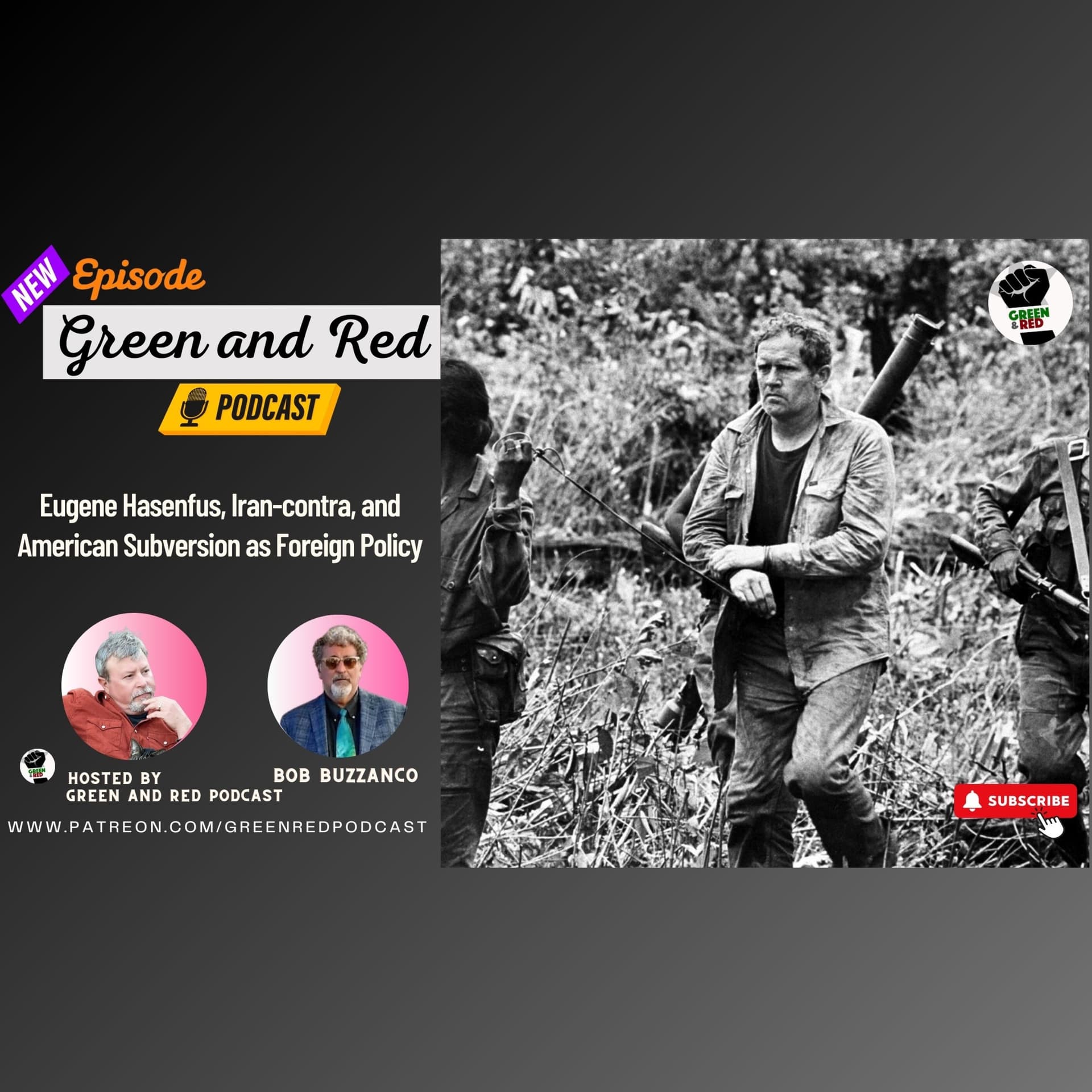
Green & Red: Podcasts for Scrappy Radicals
Eugene Hasenfus, Iran-contra, and American Subversion as Foreign Policy (G&R 445)
00:47:54
Loading summary
Transcript176 lines
- [00:01]
Bob Bozanko
Welcome to Green and Red Scrappy Politics for Scrappy People, a regular podcast on radical environmental and anti capitalist politics brought to you by Bob Bozanko and Scott Parkins.
- [00:14]
Scott Parkin
Welcome to the silky smooth sounds of the Green and Red podcast, your co host, Scott Parkin in Berkeley, California and as always, I am joined by Boba Zaiko Nazo.
- [00:26]
Bob Bozanko
Before we get started though, I want to thank you for making sure that we didn't have any hurricanes this year, for preventing, for having the cleanest hurricane season we've had in a long time. And I know that you did that.
- [00:37]
Scott Parkin
I want to thank you for saving hundreds of millions of lives by preventing the flow of cocaine into what apparently is. 90% of the country is addicted to cocaine, which is news to me, but I guess that tracks so well.
- [00:50]
Bob Bozanko
The one person we know brought cocaine in was the President of Honduras who Trump just pardon. And I'm thinking that was probably Don Jr's personal supplier, right?
- [00:59]
Scott Parkin
Yeah, exactly. Probably why he got the pardon 400 times on it.
- [01:02]
Bob Bozanko
That tracks too, right?
- [01:03]
Scott Parkin
I mean apparently it was Roger Stone who delivered the letter to Trump about the pardon. So.
- [01:10]
That'S true and so it all makes a lot of sense at this point.
- [01:13]
Bob Bozanko
But admit it, you have a tattoo of Nixon on your back too because you're such a big fanboy of Roger Stone.
- [01:20]
Scott Parkin
Exactly. Roger Stone. We should do. We should do a.
- [01:23]
Bob Bozanko
We should.
- [01:23]
Scott Parkin
We should see if we can get Roger Stone on the podcast.
- [01:26]
Bob Bozanko
I bet he would. I think there's a chance. We should do that. We should. That would be awesome. I would like. That'd be a mic drop moment, man.
- [01:37]
All right. Anyway, recently we saw an obituary a couple days ago and decided to just.
- [01:42]
Scott Parkin
It was, I think it was just yesterday actually.
- [01:43]
Bob Bozanko
Was it just yesterday decided to put something together because we like to do history and this is a theme that is unfortunately still really relevant today.
- [01:54]
Scott Parkin
Yeah. And it was in the news report in the New York Times yesterday that Eugene Hassenfuss, who was the age of 45, he was a marine, a Vietnam vet, he was a laid off construction worker at the time. He had in 1986 been shot down by the Sandinistas on a covert mission.
- [02:15]
Sponsored by who he at least thought was the CIA where they were delivering arms to the Contras right wing rebels who were fighting the Sandinistas. They're the counter revolutionaries after the Sandinistas took over in 1979. But Hassenfos him getting shot down actually led to a bigger sort of exposure of what turned out to be like a bigger scandal, which was what was known as the Iran Contra affair. And so we're going to actually talk about Iran Contra. We're going to talk about Reagan foreign policy and Reagan policy towards Central America. And as always, because we're, we'll talk a little bit about how it's relevant to what's happening today.
- [02:59]
Bob Bozanko
Yeah, the main theme here is going to be Iran Contra and that goes back, we associate it with Reagan as we should. That actually goes back before that. The conditions that led to Iran Contra began when Jimmy Carter was President. We've done a couple shows on Carter, who you couldn't admire him more for what he did after he was president, but as president, as a war criminal. And in the late 70s Carter did a couple things that would snowball and lead to something like Iran Contra. On one hand, he began initially covert operations against a Soviet backed government in Afghanistan and he began to send money to groups that would later become the Mujahideen. And you'd have kind of a series of blowback there. And that's also conditioned by politics in the Middle East, Israel, Lebanon and all that kind of stuff. We'll talk about in a minute. Less known is that in Central America there were a series of uprisings beginning in the 70s against these American backed dictators in places like Guatemala and Honduras and El Salvador and especially in Nicaragua. And in 1979 a group called the Sandinistas, the FSLN, you can kind of see the flag back there, named after Cesar Augusto Sandino, who was a national hero there, came to power July 19, 1979. It was, I would call it, like a democratic socialist kind of government. And of course the American political class and the media immediately raised the alarms. These are communists and they're puppets of Cuba and all that kind of thing. So Jimmy Carter actually just months after, even before the Sandinistas came to power, Carter sent his secretary of State Cyrus Vance to a meeting of the OAS Organization of American States to try to prevent the Sandinistas from coming from power. He wanted to create a regional force that would go in and take over Managua. He was okay with getting rid of Somoza, who is this really brutal orbal dictator. Famously, FDR said, yeah, sure, he's a son of a bitch, but he's our son of a bitch. I think that was about his father, but has been attributed to a lot. But I always say it, it's about Samoza. Right. So Carter tries to prevent the Sandies from coming in and then just months later begins to Send to create a fund. And it's pretty nominal. It's 10, $12 million, not a ton of money to groups inside Nicaragua who would oppose the Sandinistas and either prevent them from coming from power or make it more difficult or in a perfect world, get rid of them. And this is the really the origin story of what would become the Contras. Right. At the same time, after the 1978 Iranian Revolution where the Shah was overthrown and Ayatollah Khomeini came in and creates the Islamic Republic, the United States had frozen all Iranian assets and put it put on an arms embargo against Iran. Iran was public enemy number one. And in fact, starting in 1980, the United States began funneling billions of dollars in aid and weapons to Iraq.
- [06:05]
Saddam Hussein, Saddam Hussein to fight against Iran. And there were regional differences, there were local conditions as well. Very brutal war, very brutal war, millions killed. Right. And, and this is still, Jimmy Carter, is still President. So with Carter as president, the United States has a frozen asset, it's frozen assets against Iran, has an arms embargo against Iran, it's fighting against these death squad governments in Latin America. Actually toward that end, I think we've just put up an old show we did about El Salvador.
- [06:39]
Scott Parkin
Yeah, we just reposted a 2020 episode about repression at home and abroad. The at home part's about the assassination of Black Panther Fred Hampton, but the abroad part is about the rape and murder of four Mary Knowles son sisters, Catholic missionaries by a US backed Salvadoran National Guard.
- [07:00]
Bob Bozanko
Yeah. And so that, and Carter of course is beginning in a nominal way, but nonetheless an important way to create and fund the confidence. And then Ronald Reagan is elected in the fall of 1980, comes to office essentially proclaiming a new Cold War. Not that the old Cold War never ended, but there was allegedly this Vietnam syndrome. America was looking inward and not being in. And I mean in Latin America, obviously that never ended and US continued to support Israel. I think that idea that the Cold War had ended, there was a Vietnam syndrome was always override anyway. But Reagan comes in and really has his eyes set on Latin America and the rhetoric is insane. Right. They're a grave threat. They're the greatest threat to in the modern world. And they portray the Sandinistas in this really incredible way. The Sandinistas had won like UN recognition for their literacy programs. They created a huge child immunization program which as we know would not be allowed in the US today. Just basic social democratic ideas. Literacy program which was like incredible. Right. They Tried to redistribute it. Well, to, to some degree. But once in power, and especially with this onslaught initially from Cardin there, from Reagan, they began, not surprisingly, to look for allies a little bit from the Soviet Union, but the Soviet Union is already in decay by this time. But clearly they were supported by obviously probably even more. Cuba never sent troops or anything like that. And that was part of the rhetoric about it too. So the stage is set then. And the United States wants to get rid of the Sandinista government. Right. And that ramps up significantly under Reagan. He tells his national security advisor first national security advisor Robert McFarland to do whatever you have to do to help these people. The anti Sandinista groups keep body and soul together. Around the same time this is happening, Reagan is also dealing with an attack on Marine barracks in Lebanon, with Israeli atrocities, with kidnappings of American assets, and this around the time he also invades Grenada too. So there's a lot going on. Right. So Reagan has his mind set on that. And I think it's also important here that this is probably the last time the Democratic Party actually, I think, took a strong stand on anything. They were against this. Right?
- [09:34]
Scott Parkin
Literally they passed the laws.
- [09:37]
Bob Bozanko
Yeah, they actually passed laws like the Mueller Amendment, which is 1980. I think there were two or three different. 82.
- [09:44]
Scott Parkin
The Democrats had a big win in 82 in midterm elections and it was after the 82 elections.
- [09:50]
Bob Bozanko
Now public opinion polls were overwhelmingly against US involvement in, in Latin America in Central America. We're talking about Central America here more than Latin America in general. So they were like 2 to 1 against, which is really similar to what we're seeing now with Venezuela.
- [10:05]
Scott Parkin
Yeah, I mean, we're seeing.
- [10:07]
The public support for the war with Venezuela's with the Trump ride or die people. It's, it's very small.
- [10:15]
Bob Bozanko
It's not even a majority of Republicans support that. And I think it's important to understand.
- [10:19]
Scott Parkin
Like, and members of the Republican Party are actually very outspoken in opposition to this. Marjorie Taylor Greene, Rand Paul, increasing, other members of the House and Senate who have been running scared from Trump for quite some time now smell blood in the water. Venezuela is one of the issues where they're making their stand.
- [10:38]
Bob Bozanko
I think I always say this all the time. Trump is a different kind of cat and just words fail. Right. But this isn't unique. It really isn't. And the Ron Contra, I think is a good example of that.
- [10:51]
Scott Parkin
Right.
- [10:52]
Bob Bozanko
So Reagan says, do whatever you have to do to keep these folks going, body and soul together. Right. But the Bolan Amendment has prohibited aid to the Contras. Remember, what did Reagan call the contras? Do you remember that?
- [11:06]
Scott Parkin
The moral equivalent of the Founding Fathers.
- [11:09]
Bob Bozanko
Moral equivalent of the Founding Fathers, which actually has some truth to it. But that's not what he meant. Right.
- [11:15]
Scott Parkin
Despite what Ken Burns tells us. Right, despite.
- [11:17]
Bob Bozanko
Oh my God. That's why last week. Have you seen the Ken Burns Show? Yeah, I don't know anything about that. What do I know anyway? Neither here nor there. Now at the same time this is happening. So Reagan is trying to figure out ways to help these anti government forces, these counter revolutionaries who became known contra revolutionaries as Contras, unsurprisingly, at the same time. And there are two things going on here which are very important because they'll morph together. Iran backed militias refer to obviously as terrorists who were fighting a war against Iraq which was being funded and supported by the United States, were seizing hostages in the region. In the region and staging attacks to respond to America's support of Iraq. And guess what other country in the Middle East?
- [12:11]
Scott Parkin
Israel.
- [12:12]
Bob Bozanko
Shock. That's a hell of a guess, man. Who was you? Shocker. Shocking, right? So they decide to put it together and I believe McFarlane came up with the original idea of selling arms to Iran, which violated a million different laws. Right. Iran is the national international pariah. You have frozen assets, you have arms embargoes. Right? So McFarland says we can sell arms to Iran at the same time the United States is providing arms to Iraq to fight against Iran. When I used to teach and I would talk, I would tell this and my students would be like, mouths. Oh my God, Really? It was a great story. Right? So McFarlane said let's sell arms to Iran and then we can take that money and we can give it to the conscience because the Bolan Amendment has told us we're not allowed to do that. And so the United States sold. The numbers vary, but I think it was somewhere in the area of around 1500 missiles and had returned. They got three hostages released, which for those hostages is great. McFarlane was replaced by somebody named Admiral. Was it John Poindexter?
- [13:21]
Scott Parkin
Yeah, John Poindexter.
- [13:22]
Bob Bozanko
Now Poindexter is the guy who brings in another one of the heroes of this or anti heroes of this entire episode. Poindexter has an aide named Oliver North.
- [13:34]
Scott Parkin
Lieutenant Colonel Oliver North.
- [13:35]
Bob Bozanko
Lieutenant Colonel Oliver north is. If he wasn't such a scurrilous, horrible person, he's really a pretty good story. Pretty. Quite a character, isn't he?
- [13:43]
Scott Parkin
Yeah. Yeah, it's quite. He has quite. He's quite. He. And he has quite the interesting background, too.
- [13:47]
Bob Bozanko
Yeah, yeah. He's the modern version of Howard Hunt and Gordon Liddy and those.
- [13:53]
Scott Parkin
Exactly how he saw himself, too, in Vietnam Vet. He was at the. I was in a boxing match with James Webb at the Naval Academy.
- [14:00]
Bob Bozanko
Famous book on that.
- [14:01]
Scott Parkin
Not a Girl's Nightingale Saw.
- [14:04]
Bob Bozanko
North is a true believer hardcore. Didn't he also write, like, episodes of the Americans that. That show about the Russian spies?
- [14:11]
Scott Parkin
Yeah, in the 2010s. In the 2010s, yeah.
- [14:14]
Bob Bozanko
Yeah.
- [14:14]
Scott Parkin
Or he consulted with them so much, they gave him a writing credit, I think. Oh, is that it?
- [14:19]
Bob Bozanko
Okay.
- [14:20]
Scott Parkin
And he also recently got married.
- [14:22]
Bob Bozanko
Well, let's not spoil the lead. Yeah.
- [14:24]
Scott Parkin
Okay.
- [14:26]
Bob Bozanko
So Poindexter brings in Oliver Stone. Oliver Stone. Oliver Stone.
- [14:30]
Scott Parkin
Oliver North.
- [14:31]
Bob Bozanko
Yeah, Oliver Stone. That. It's still out there. 200 bucks. Cash money. I'm willing to go 500 if you want to drive a hard bargain. Come on and debate me.
- [14:41]
Scott Parkin
500 bucks. You heard that?
- [14:43]
Bob Bozanko
Money. Yeah, Cash money. Anyway, he brings Oliver north in to coordinate this mission and arrange the sales. And this is all being done behind the scenes, I don't think. And this is. Reagan was reelected in 1984 overwhelmingly, but you can see, like, personally, he's fading. The signs are there that he's addled and has something going on.
- [15:04]
Scott Parkin
That sounds like, strikingly familiar to today as well, but.
- [15:08]
Bob Bozanko
Sleepy Joe. You mean because.
- [15:10]
Scott Parkin
Or the commander at sleep.
- [15:11]
Bob Bozanko
He just had a perfect mri. His physician said he's never seen anything.
- [15:16]
Scott Parkin
I think he's had five perfect MRIs in the last four months. Right.
- [15:20]
Bob Bozanko
Well, who doesn't have an MRI every few weeks?
- [15:23]
Scott Parkin
And he has his annual physical every couple of months, too. Right? Is that right?
- [15:26]
Bob Bozanko
That doesn't mean he's sick. I think the doctors are mesmerized by what an amazing phys specimen he is, and they just want to for their own sake.
- [15:33]
Scott Parkin
I love the. Just a quick tangent. I love the video of Marco Rubio sitting there going off about, you know, what a great president he is. And then Trump is just, like, nodding off.
- [15:43]
Bob Bozanko
Yeah. Marco also decided to take this important meeting and use it to talk about the college football playoffs and how the University of Miami should be in there, and these guys are on top of it. At any rate, Reagan is starting to fade, and he's not nearly as popular as he was. And actually, by the time he's out of office, Reagan's numbers are way down. He doesn't have the same kind of cachet. He had early on, but. But this is all still being done surreptitiously and on the slide. The United States continues to send huge amounts of money and weapons to Iraq in a very brutal and bloody war which I think kills well over a million Iranians. Reagan approves the use of chemical and biological weapons in Iran against the Iranians. So when they talked about WMDs decades later, that's true. There weren't WMDs in Iraq. The United States provided them to use against Iran with American advisors in the.
- [16:44]
Scott Parkin
Field and a big green light. But they also used them against the Kurd, the Iraqi Kurds as well.
- [16:49]
Bob Bozanko
That goes back to we're all over the place here. But that's fine because everything is connected. This is how I teach history by the way. If you've been in one of my classes I love going all around the place and connecting that thing altogether. But in 1975, Kissinger began a covert program to help the Kurds fight against, you know, the, the government, Saddam Hussein and the BA Party. And it really wasn't going well. So Kissinger without warning just withdrew aid from the Kurds, just pulled the rug out from under him and Saddam went in and gassed 20,000, I forget the name of the village. I think that was part of the indictment when they finally captured him and executed him. And somebody asked Kissinger, wow, you gave aid to these people and you gave them hope and then you just withdrew it and they all got massacred. And Kissinger's famous response is covert operations is not missionary work. So anyway, and I think that's probably that should be like an American mantra. That's clearly, that's never changed. At any rate though getting back. So that's going on. The United States is funding Iraq to fight against Iran, but it's also selling weapons through the back door to Iran which is going to use to fight against the American backed army of Iraq. So the United States is, which is nothing new, right? About 10, 15 years ago in Syria, the United States, the CIA had a militia that it was funding an arming fighting against a Pentagon militia in Syria. They were fighting against each other.
- [18:14]
Scott Parkin
At least one of those was an Al Qaeda faction.
- [18:16]
Bob Bozanko
I think so. I think, well it was Al Qaeda.
- [18:18]
Scott Parkin
Unless they become president of Syria.
- [18:20]
Bob Bozanko
But the US hates Muslims now. Is Jelani included in the Muslim ban?
- [18:24]
Scott Parkin
I don't know. Muhammad bin Salman.
- [18:27]
Bob Bozanko
Bin Salman. Hey, mistakes get happen, things happen. And you don't know how bad Khashoggi was.
- [18:32]
Scott Parkin
Exactly.
- [18:33]
Bob Bozanko
It's crazy. Anyway, so Oliver Stone is now arranging this right.
- [18:38]
Scott Parkin
Oliver north is arranging this. Oliver Stone made a movie in that period.
- [18:42]
Bob Bozanko
Oh, you don't know about the Deep State conspiracy, do you?
- [18:45]
Scott Parkin
Yeah, that's true. Oliver Stone, that's true.
- [18:49]
Bob Bozanko
We should start that. You know damn well with the month there'll be a lot of people buying into it.
- [18:53]
Scott Parkin
He made a movie about Central America starring James woods, who's definitely in that crowd now too.
- [18:58]
Bob Bozanko
Yeah, yeah. Didn't like the movie. It was weird. But at any rate, Oliver Stone, another tangent. Like he's clearly critical of the United States, but all these movies have this moment of American exceptionalism. Like in that movie, is it woods who said, or was it Belushi who says this isn't what Americans do. We're going to tell the press about all this and you're going to all go to jail. And then in Platoon, the Willem Dafoe character, Defoe is okay with the war, he just doesn't want it fought the wrong way with all these atrocities and stuff like that. So Oliver Stone really does have this kind of stars and stripes approach.
- [19:30]
Scott Parkin
You mean he's a liberal, really?
- [19:32]
Bob Bozanko
What a shock.
- [19:34]
Scott Parkin
JFK is. And the American exceptionalism is truly comes out jfk, which I don't think you've seen.
- [19:40]
Bob Bozanko
No, I've seen it long ago.
- [19:42]
Scott Parkin
But I mean it's the ultimate American exceptionalism sort of film. The whole. That's the theme of the film.
- [19:48]
Bob Bozanko
That's the whole point. Kennedy's and Stone believes in heroes and heroism and that's kind of what we have here. Oliver Stone, I think is a good. Oliver north is a good example of that. So all this is going on, it's very complex, it's pretty byzantine. I'm doing a very superficial description of it. Is there anything like. Because we're getting to the kind of hoist part of things. Right.
- [20:10]
Scott Parkin
I mean, I think this sort of background and connecting the dots, which is what they did. Right. It's like they were. They were doing back, back channel deals with the Iranians, which actually they did, if they did in 1980, around the election as well.
- [20:25]
Bob Bozanko
Yeah. October surprise. Sure.
- [20:27]
Scott Parkin
So they're making back end deals with the Iranians who they at least publicly denounce as a terror state. They're feeding them missiles while they're funding the Iraqi war effort. They're trying to get hostages released in Beirut. And then they're. They've created this slush fund so they can get around the Boland Amendment to fund this illegal war against the Sandinistas. And honestly, in the end, the other I think the other important thing to really note here is that we're talking about the Contra war with the Sandinistas. But like during this period during the 1980s, there's Civil War in a number of these Central American countries. And so there's like very brutal bloody civil war going on in El Salvador which costs at least tens of thousands of lives. I don't remember the exact numbers.
- [21:15]
Bob Bozanko
About 80,000 killed by the US backed governments and militias.
- [21:20]
Scott Parkin
Same in Guatemala, which I think even has a higher casualty rate.
- [21:24]
Bob Bozanko
Guatemala's a, actually Guatemala is a genocide. And they particularly go after obviously anti government forces. Coca Cola has bottling plants in a lot of these where people talk about unionization and death squads come out kill. And that's a piece that's just really I didn't mention but I think people understand this is a brutal bloody war which is consistent like the kind of stuff you're seeing in Israel today that's happening there. And Contras.
- [21:48]
Scott Parkin
The one other thing I want to say is that this death squad model which you can track back to Vietnam around the Phoenix program. We just talked about this in the, in our show on Trump versus Kelly.
- [21:56]
Bob Bozanko
Hey, Vagues.
- [21:57]
Scott Parkin
But the Central American model is what they used in Iraq and Afghanistan.
- [22:00]
Bob Bozanko
Yeah.
- [22:01]
Scott Parkin
In the 2000s and 2000s. It's a pretty, it's a pretty, it's an anti population counterinsurgency model where they just like wage war on the population whether they're armed.
- [22:11]
Bob Bozanko
Kennedy arms or not. Kennedy and Charles. Which is why, and I'm not like, I think Vincent Babbins has written a really good book, but I think a lot of people have taken this the Jakarta method. They dude, that, that existed before Jakarta. That's consistent with just Cold War foreign policy. But the Contras, I think you have to keep this. And we did know about this because the media, this is probably the last time the media actually did a really good job of covering stuff like this as well. But the CIA was training the Contras in Honduras, especially a US Senator at the time, Jim Sasser, a Democrat from Tennessee, Imagine that called Honduras, the USS Honduras. Like basically the US owned the country. They were training death squads there. The U.S. mined Nicaraguan harbors. The U.S. was found in violation of international law by various international courts. And guess what Reagan did.
- [23:04]
Scott Parkin
He just kept doing it.
- [23:06]
Bob Bozanko
Right. So Biden and Trump rejecting international law again is nothing new.
- [23:11]
Scott Parkin
Right. There's one other thing I want to mention around this death squad piece which is that there, there's actually a school at Fort Benning Georgia, which I think is called the. Now it's called the Western Hemispheric Institute for Security, but it's more notoriously known as the School of Americas, which is actually where a lot of these officers who were in the Latin American death squads, they were the Salvadoran National Guard or they were in the Honduran army, lots of stuff in South America as well. And so that's actually a piece here too. There was a pretty big movement against School of the Americas and coming out of the Central America Solidarity Movement, which still continues today. But there was like there was a. There's been a. There was a heyday of the school. It was called School of the America's Watch, which was the sort of organizing body. But it was like a very important piece here too is that they're being backed and funded by the CIA, but they're also being trained by the US Military in torture and counterinsurgency and assassination. All of that in Fort Benning, Georgia.
- [24:08]
Bob Bozanko
Yeah. There was a point at which I think every American aligned government in the entire region was led by a graduate of School of the Assassins is also called. And I mean that, you know that we're going to talk about that. That's also that movement against Central America. It's also important because it's a really great example of the government surveillance. The kind of stuff we saw earlier in COINTELPRO that we're seeing today, like with college campuses and all this stuff. These groups especially, there were a lot of them were Catholic Worker associated groups, Catholic pacifist groups. There were groups called the Committee in Solidarity with El Salvador Cispas people. There was Cisqua. There was various. Nigga. This is.
- [24:45]
Scott Parkin
There's a sanctuary movement. There's a sanctuary movement.
- [24:48]
Bob Bozanko
Parenthetically, this is where I got my political education. I was a New Deal liberal, labor liberal. And it was Central America that really flipped me because I was living in D.C. at the time and just like reading. And I got to know a bunch of people both in grad school and in the activist community who were doing stuff on this. And the SANDAS were like this really cool, like I said, Social Democratic revolution. And to see the vigor force that the US used against them really was an incredible practical education in empire and imperialism, the Cold War and American foreign policy. I think it was on Fridays we would go down Contrary headquarters was on I think maybe Wisconsin Avenue, I don't remember. But on Friday we would go down there like every Friday to protest when they would let us like on the sidewalk and stuff like that. We Actually saw the mention of Oliver Stone Font hall go in Oliver north. Shit. Now I'll never forget that. But it became a big issue and this is just like what we knew. But all hell broke loose around 1986, right? It starts with, I believe, Cy Hirsch again, the famous Cy Hirsch, friend of the podcast, right? Who speaking to sources in the Pentagon who obviously were anonymous, who were really deeply troubled by what was going on, told north about this connection between Iran and the Contras, right? It was initially actually reported by a newspaper in Lebanon which was dismissed as a rag. And you can't trust Lebanese media and stuff like that. But it slowly starts to get talk about. I remember at the time reading the US press, the US Left press, things like Mother Jones and the Nation, which at the time had people like Andrew Coburn and Andrew Copkind. The Nation was like outstanding back then today, whatever. But. So that was hinted at and left Media, but not really picked up. But then getting to the. We talk about bearing the lead, right? And also I think that the one thing too is because we just did a show on this the other day about Mark Kelly and others. People in the Pentagon talk to people on the outside and they're the ones who started to express concern over what was going on, both from a policy point of view. I told you before, like I spent a lot of time back then doing my research at the Washington Navy Yard and I met a lot of folks and these are like colonels, a couple generals even, who said, we don't want any part of Central America, it's a bad idea, we don't belong there. And so they leaked that out. But I think the bigger part, where it really blows up is with the aforementioned Eugene Hasifos and when that was it and that.
- [27:24]
Scott Parkin
And that's what sort of blows. I remember the. I was a. I believe I was a senior in high school in 1986 when Hassenfos got shot down. And then all of a sudden people in Congress, people in the media start asking why was this guy doing what were the three other people on the plane died? Hasenfos was an experienced skydiver, the only person who brought parachute onto the plane. And that's how he was able to get away. He had done jump school when he was in the Marines. But it opens up this whole inquiry which we see less of today in our. These institutions, which we think are what. Where public accountability should happen, like the media and Congress and things like that. But it eventually just, it completely blows up. It's on the front page of every newspaper. It's like, how much did Reagan know? When did he know it? It was. There was a lot of reference. I believe at one point they were calling Iran Contra gate. Cause there's a lot of reference, the.
- [28:15]
Bob Bozanko
First use of it. Yeah, he was also a thing. It wasn't the plane. It was a. It was a civil. What was called Civil Airlines or Civil Air Transport. Yeah, that's the CIA front. That was it.
- [28:26]
Scott Parkin
Right. It's called Southern Transport Airlines or something.
- [28:29]
Bob Bozanko
Right. But I believe. Wasn't it associated with cat? I think, yes.
- [28:33]
Scott Parkin
And it was a bunch of ex Air America people too, who did.
- [28:35]
Bob Bozanko
Yeah, that was originally after World War II. It was founded by Claire Chenault, who was a general, an Air Force general. They were very active in the cocaine and I'm sorry, in the drug trade, the opium trade in Southeast Asia during Vietnam. In Vietnam it was Air America. Right. It becomes civil air transportation. I think people don't. And that'd be cool to try to bring on somebody like maybe William Hartung or somebody to talk about this.
- [28:57]
Scott Parkin
Right.
- [28:58]
Bob Bozanko
The CIA owns a bunch of private companies, front companies, and civil air transport wasn't. And that was what hass and fuss was like, wasn't it? And this also led to another piece of this, which we haven't mentioned yet, which is the Contra cocaine connection. A bunch of investigative journalists began to make these connections. And essentially they claimed that not just was the United States sending weapons to Iran to get money to give to the Contras, but the United States was actually trans shipping cocaine to raise money for the Contras because of the Bolland Amendment.
- [29:34]
Scott Parkin
And the most noted journalist is a guy named Gary Webb, who worked for the newspaper in San Jose and in the mid-90s, actually committed suicide or has said they committed suicide. There's a lot of conspiracy theories around it, but he had been finding evidence that the CIA had actually been bringing. Had been helping transport cocaine into at least Southern California, into the Los Angeles.
- [30:00]
Bob Bozanko
Which fuels the crack.
- [30:02]
Scott Parkin
The crack epidemic as well. And that the money was going to support the Contras who were fighting the Sandinistas.
- [30:08]
Bob Bozanko
Dennis Bernstein, actually, Robert Perry. Yeah.
- [30:11]
Scott Parkin
Did a lot of. Did a lot of investigation on this as well.
- [30:14]
Bob Bozanko
And we should try to get Dennis on to talk about this.
- [30:16]
Scott Parkin
Dennis is a good friend of the podcast. So that's another person on Pacifica I'll talk to. Yeah, exactly.
- [30:23]
Bob Bozanko
So you have this Contra cocaine connection. This guy's flying a CIA airline on a CIA associated affiliate airline. He's captured by the Sandinistas. They convicted him and he was back home within like what, 30 days, right? But then that's really when the shit finally starts to hit the fan. And Hirsch has these Pentagon leagues. Now you have hoss and fuss. And this is when the kind of COVID up flies into action. This is when we learn about Oliver north and Fawn Hall. It comes out that they were shredding documents. Imagine that hall was hiding documents in her boots. And I wonder if one of those days. Because she always had on boots, right? I wonder if one of those days I saw her, she had like documents hidden in her blouse or something like that, right? And they shredded documents. They're part of this cover up. And everyone finally discovered that this Lebanese newspaper which broke the story actually was right. They had the story right that the United States was taking money from sales of illegal sales of arms to Iran and then using it to fund the Contras. The cocaine piece of it never really got far in mainstream stuff. Right. And then the investigations began. I think the original one was by John Tower, wasn't it? Yeah, our commission, I believe. Tower, Muskie maybe.
- [31:43]
Scott Parkin
Yeah, I'm trying to. I don't think it was Muskie. It was someone else, but it was John Tower and a Democrat who were investigating this. So it starts as like a congressional investigation, but then also they. There. There's also an independent counsel, the dreaded independent counsel which is appointed for this, which is now Trump's just pretty much abolished independent counsels unless it's investigating his enemies. But Lawrence Walsh becomes the independent counsel who begins to investigate this, which actually leads to something like 14 convictions of like Reagan officials and associates.
- [32:23]
Bob Bozanko
14 convictions before that. Let me, because I'd written about this some time ago and I found it when the investigation was taking place. Edwin Mead. Now, apparently Schultz and Weinberger opposed this from the start. The Secretary of Defense and the Secretary of State opposed this from the start. Right. They said, this is messy, it's not going to work. But Mies discovered that a lot of that money that Iran paid for the missiles was missing. So it just went missing. So who knows, right? North said that the diversion of funds had been done under the direction of Poindexter and he assumed that the President. Right. So they actually do create a link all the way to the top. Yesterday, the Pentagon spokesperson, I forget her name, with regards to Wilson. Yeah, with the double tap, Right. She said, we take all our orders from the President, then we follow the chain of command. So she threw Hegsef and Trump under the bus too, which is what north had done. Right. He Basically said, yeah, this goes to the top, right? And Reagan finally, in 1987, speaks to the public. He said, I was misled, mistakes were made. Doesn't really take responsibility for any of this. Right. I did not trade arms for hostages. I believe that to be true in my heart. Maybe I was wrong, that kind of thing. Lawrence Walsh investigated, you're right. Fourteen members of Reagan's administration were charged. Poindexter, North, McFarlane were all convicted. North and Poindexter's convictions were overturned. Bush Sr. Who became president after Reagan pardoned McFarlane and a bunch of others, including Caspar Weinberger, before his trial. I think it's also important to understand that these hearings, there were public hearings on this. The Iran Contrary Committee really set the model because this is the first major scandal after Watergate. And I would actually argue it's worse than Watergate. Right. And these are televised. And on the very first day, the Democrats decide to go for the kill. And Oliver north just manipulated them. North, very much like what we're seeing today, doubled down on what he did. He wasn't apologetic, he was apoplectic. He was defensive about what he did. I'm not defensive in the sense that like he was apologizing for defensive. He was defending it. Right. Claiming that the Democrats were too weak, Communism was bad and the United States had to do something. They had to take this into their own hands. Right. And he absolutely manipulated and controlled those hearings. And they were really a disaster for the Democratic Party. And it really set this tone right. On how the Democrats really are incapable of going to war against the Republicans. Talking about the Iran Contra hearings, Right. The public size hearings where north just dominated it. Right. The Democrats, he just put them in their place. And he became this national hero after this. Right. So instead of becoming like the fall guy for it, he became a national hero. He actually used it to run and almost win Senate seat in Virginia in 94.
- [35:30]
Scott Parkin
Yeah. Against the. Charles. Chuck Robb.
- [35:32]
Bob Bozanko
Chuck.
- [35:33]
Scott Parkin
Rob.
- [35:33]
Bob Bozanko
Still, this is also important because what we're seeing today from least like weaklings and these people like Schumer and Jeffries and Merrick Garland and all that, this is what the Democrats did in the 80s. And again, they had the public opinion on their side. The American people had overwhelmingly turned against this scheme. Right now in Nicaragua, it actually worked. It served its purpose. The Sandinistas in 1984 held an election which they won. The United States refused to accept the results of that election. And international observers all said that was on the up and up. And the US continued and increased its pressure. Right. By the later 80s, Nicaragua was. The Nicaraguan economy was in trouble. It was screaming. The Contra attacks had continued. People were getting killed. The Pope at the time went after the Catholic Church. A lot of Nicaraguan Catholics had been instrumental in the Sandinista revolution. The foreign minister was Miguel de Scoto. The Minister of Culture was famous. Oh, my God. Poet. I gotta look it up. I have it on the wall here somewhere. Ernesto Cardinal. Forgot about him. So the Pope intervened, the Vatican intervened, the government. And so by 1990, the Nicaraguan people were beaten down and actually voted the Sandinistas out. Right. And what did those brutal, horrible communist terrors do when they lost that election?
- [36:59]
Scott Parkin
They gave up power.
- [37:01]
Bob Bozanko
They left.
- [37:03]
Scott Parkin
Peaceful transition of power.
- [37:05]
Bob Bozanko
Hassenfuss, he's got a footnote in history, but not an unimportant one. Because of him, more than anything else, we. This became a more public and national issue. It led to. Not in a direct way, but it.
- [37:18]
Scott Parkin
Led even in the way of an international issue as well.
- [37:21]
Bob Bozanko
Oh, yeah, yeah. It led to government hearings, it led to the Tower Commission, it led to Lawrence Walsh, it led to indictments, it led to convictions, it led to pardons. But I think a couple of the other lasting impact of this which we're seeing today is pressure from the empire succeeds. We don't. We love to talk about resistance, right? We're caught up in this, like people's history. The people fought back, the people resisted, the people did this, people that. People often generally get crushed at the end, too. That's what happened in Nicaragua as well as in El Salvador to some degree. They did have changes. And Guatemala was a genocide. Right. But the United States had its fingerprints.
- [37:59]
Scott Parkin
Over all of that.
- [38:00]
Bob Bozanko
And they really destroyed the Sandinista revolution. Right? Which is why, like, when you see what's happening today in Venezuela, this is an old story. It's an old playbook, Right? One reason was no threat to the United States. I guess they would like to have access to its agriculture and whatever cigars. And I'm sure Trump wants to put a casino on the Malan. But the biggest problem with Cuba is it's never. It never surrendered. It's still there.
- [38:30]
Scott Parkin
The threat of Noam Chomsky called the threat of a good example, the threat.
- [38:33]
Bob Bozanko
Of a Hughes Kennedy, jfk, actually, that was his formulation. Right? And that's. Cuba is a living symbol despite the most brutal, horrific embargo on the history of the world. Right? And so when you see what Israel is doing today, or when you see what Trump is doing, or what's happening in Ukraine or Sudan or Syria or a million other places. It's an old story. It's an old playbook, right? Yeah, it's a really great example of that.
- [39:03]
Scott Parkin
Yeah, I think that. And I think that's like an important thing to note, which is part of what we. A big theme with this podcast is obviously history and people's history. And so I think it's important to note that the murder of the nuns in El Salvador, Iran Contra.
- [39:22]
Is all still very much the same playbook that's being used today against Venezuela and increasingly Colombia. And there's a lot of. I don't think we're the kind of folks who think that learn your history so you don't repeat it. We're not really those guys. But I think it is important to note that this is like repeats. This is repeating itself. And this is to be aware of. This is an important thing.
- [39:46]
Bob Bozanko
Yeah. Another coda to this. There are many, but the government that led Nicaragua at that time was led by Daniel Ortega, who was currently president of Nicaragua.
- [39:55]
Scott Parkin
Again, he's co president, right?
- [39:56]
Bob Bozanko
Is he? But, yeah, let's face it, it's not. It's not your father's Sandinista party. There's a lot going on there that I don't think was consistent with the ideals of the 1980s and 1990s and having your government become the object of the biggest empire in the world. And the rhetoric at the time, Pat Buchanan said that, what was it the Sandinistas are as close to. Was it Harlingen, Texas or there. Harlingen, Texas is at risk.
- [40:24]
Scott Parkin
Right. Yeah.
- [40:25]
Bob Bozanko
Or it was just like this incredible rhetoric about this. The Sandinista army at the time, the Nicaraguan army could not have defeated like a, you know, like a major city police force. They didn't have the same weaponry as like the Houston police or the LA police or something like. Yeah, but the rhetoric was incredible. The fear. I'm not sure people bought it. I think another code is that this is actually the last time the Democrats, I think, put up any kind of a real fight over issues like this. Right. It also showed that the United States could just flagrantly ignore international laws and get away with it. Inside the United States, government officials could break the law and it wouldn't be a problem. Even if they were convicted, they would be pardoned, which we're seeing time and again today.
- [41:09]
Scott Parkin
Yeah, I think that.
- [41:10]
Bob Bozanko
I think.
- [41:10]
Scott Parkin
I just want to flag. I think that the pardon piece is really important because liberals get very outraged by Trump's pardon and pardon, wave of pardons that he does, whatever you want to call it and granted, it is very disturbing. And I'm sure there are pardons already written for people like Christine Noem and Pete Hegseth and things like that. But Bush pardoned a number of people who were around Contra players when he was leaving office at the end of 1992. Like people who had been Weinberger convicted.
- [41:41]
Bob Bozanko
As good as it gets.
- [41:42]
Scott Parkin
Yeah, exactly. And so I just want to note that that also is not an atypical thing. That's not unique to this period of history that we're in right now. Trump pardons a lot of people. He just pardoned the president, the former president of Honduras who was a cocaine trafficker, which is, like, pretty bad. But still, you know, it's the precedent that is set here. We, when we about a month ago, when Dick Cheney died, we talked about how he cleared the way and set precedent for Trump to be able to do a lot of what he did. But it goes back before Cheney as well.
- [42:15]
Bob Bozanko
Trump is a different kind of a cat and doing horrific things on steroids. But it's this old way of doing things, but it's on steroids. It's horrific. Like, a lot of lefties want to say, oh, everybody's been doing that. Trump is different and he is a different kind of threat. Even with Nixon and Reagan and anybody really, you didn't fear, like, your own survival was threatened, maybe my nuclear war. Whereas with Trump, there are people, like, driving in the streets, snatching folks away, which, again, that's not. It's never happened on this scale. So we're in a different world. But clearly the skids were greased by things like Iran. Contrast. I remember when it happened thinking and Nixon was still alive at the time, I was thinking, like, Nixon must be, like, beside himself. I got in trouble for what I did. And they're getting away with this. And we just see more and more of that all the time now. There are no guardrails. There is no limit. There's no depth. And Hassan forces death. It'd be fun to talk about this because I think it's timely, it's relevant.
- [43:18]
Scott Parkin
I'm sure Trump will give him some posthumous Medal of Freedom or something like that.
- [43:22]
Bob Bozanko
My last thing is the best media account of this. In essence. You know, I'm not joking now. In the 1980s was an episode of Miami Vice starring G. Gordon Liddy as was a Colonel Landslide Capital.
- [43:37]
Scott Parkin
Captain Real Estate.
- [43:39]
Bob Bozanko
Captain Real Estate. Captain Real Estate. And Crockett. He's a Vietnam vet and his friend, played by Bob Valaban, who's a journalist. Uncover these American esquives in Nicaragua and El Salvador and they're going to break the story. And G. Gordon Liddy, of course, kills it. He takes care of it. And I was stunned. I remember watching at the time, like the New York Times, the Washington Post. Nobody was doing that, but Miami Vice did. Miami Vice is one of the most underrated, like political shows I've ever seen. I'm a big fan. A big fan. But at any rate, and it was part of popular culture, especially on the left. And I will say, for a lot of people, a lot of us like me, it became our training ground. These were our training wheels for political activism. I remember having a bumper sticker at the time that said El Salvador is Spanish for Vietnam. So it became very important to us.
- [44:27]
Scott Parkin
I'll say that There was a recent show on FX called Snowfall which actually dealt with the CIA cocaine too, which was pretty. Which is. I actually had somewhat lefty politics. It's about how the CIA's flood cocaine into the black community and lefty journalists are killed. And it's an interesting show. I think you're right, though. I think it's the Captain Real Estate episode of Miami Vice is the sort of classic crazy template for it. But like that. That's what that show is all about as well.
- [44:56]
Bob Bozanko
I would also recommend. I think I said this in the last show, right? Oh, yeah. Because we were talking about the pardons Al McCoy's the Politics of Heroin. It was initially called the Politics of Heroin in Southeast Asia. He expanded. It's just called the Politics of Heroin, which shows how like in Vietnam, the Nguyen Van Tu and Kalki were involved in the opium trade and the United States knew it. So the US doesn't. Us doesn't have that kind of leverage over these folks that.
- [45:18]
Scott Parkin
That you would think that's the story of the D.C. shooter too, right. Is that he. He was part of paramilitary. Right.
- [45:24]
Bob Bozanko
Right. Because in that counts opium crop. Opium production in Afghanistan just increased wildly. Yeah.
- [45:32]
Scott Parkin
We should probably wrap it. It's been good fun, Eugene.
- [45:35]
Bob Bozanko
I never thought I'd say that. Rest in peace, Eugene. Aspen.
- [45:39]
Scott Parkin
Yeah. You changed the world in some ways you didn't expect. Folks, you're listening to the Green and Red podcast. Please check us out on Facebook, Instagram, Twitter and Bluesky. If you're watching this on YouTube, hit that subscribe button. If you're watching this on an audio platform, give us a rate and review. And then if you really like us, go to greentheredpodcast.org and hit the support button or become a patron@patreon.com backslash greenredpodcast. And it's getting to be the end of the year, so we're going to be doing a whole lot more fundraising and swag pushing and things like that. So if you want a hat or if you want a book, we'll be putting out stuff soon to give you that opportunity. Probably. Also we also need to get the, the prison solidarity calendars going as well.
- [46:24]
Bob Bozanko
But yeah, it's the. We know the economy's bad, although Trump says inflation is lower than ever, so maybe it's not.
- [46:29]
Scott Parkin
But in any crisis, affordability is just a scam, that's all.
- [46:32]
Bob Bozanko
If you have, you can do a Patreon for three bucks a month, you could send a one time donation of any amount, whether it folds or jingles. We'll take it. Yep.
- [46:41]
Scott Parkin
Yep. Yesterday was given Tuesday. We actually had a number of people give us money. Appreciate all those folks who gave us money.
- [46:46]
Bob Bozanko
We don't have much overhead and this is not a obviously a high, high cost enterprise. We do most of this ourselves, but we do have some folks helping us that we'd like to give them a living wage and which is fine. So if you can find it in your heart to do that for a really cool little lefty. We call ourselves a boutique lefty podcast. We're not big, we're not in Brooklyn, but we do a lot of shit that you're not going to find anywhere else. And I'm showing my arrogance here, but I don't think anybody does better history stuff than we do.
- [47:17]
Scott Parkin
100%. 100%.
- [47:18]
Bob Bozanko
You want to help out?
- [47:20]
Scott Parkin
Yep. Folks, we will talk to you again soon. So make trouble and misbehave and we'll see you later.