← Green & Red: Podcasts for Scrappy Radicals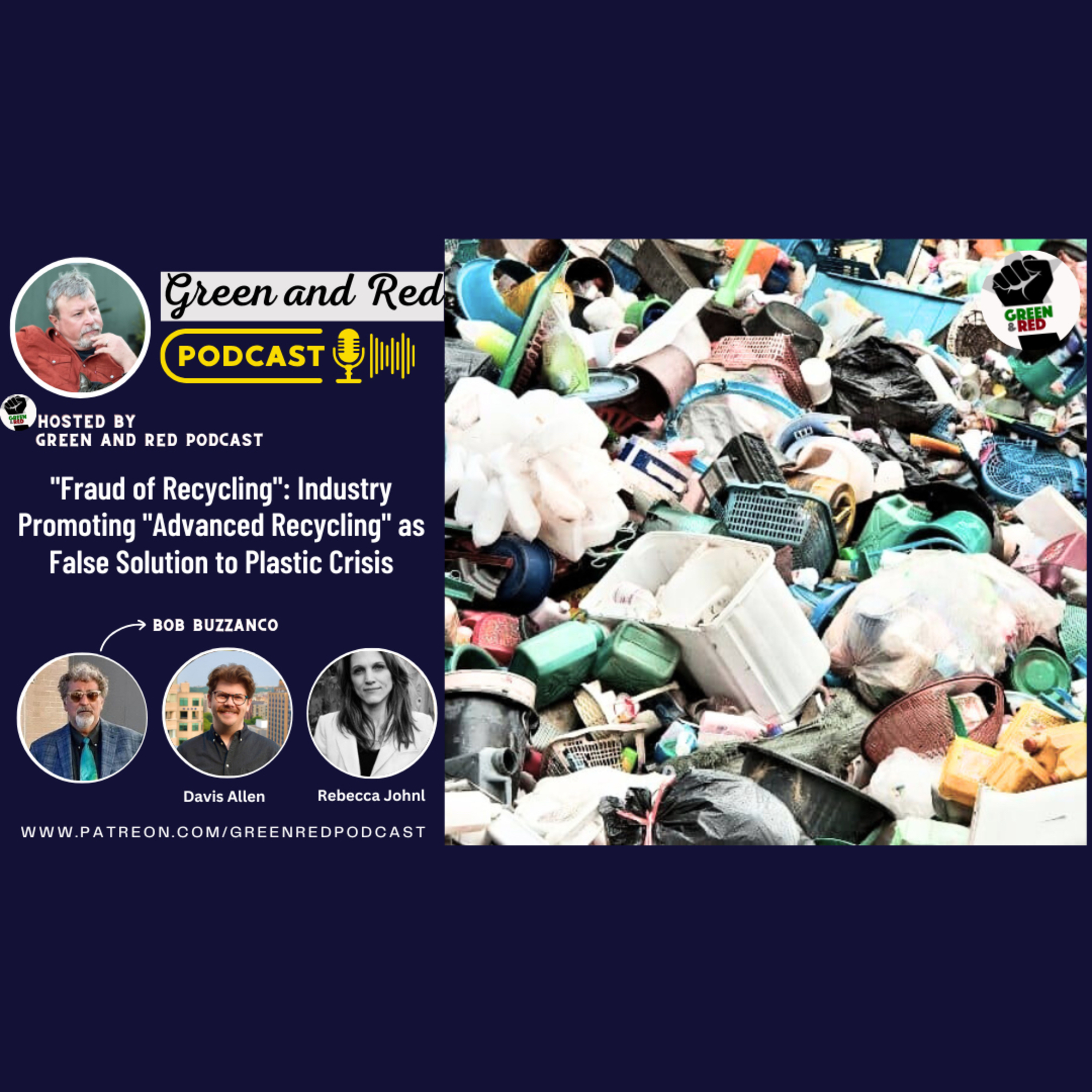
Green & Red: Podcasts for Scrappy Radicals
"Fraud of Recycling": Industry Promotes Recyclingas False Solution to Plastic Crisis (G&R 409)
00:47:26
Loading summary
Transcript72 lines
- [00:01]
A
Welcome to Green and Red Scrappy Politics for Scrappy People, a regular podcast on radical environmental and anti capitalist politics. Brought to you by Bob Bozanko and Scott Parkins.
- [00:14]
B
Welcome to the silky smooth sounds of the Green and Red podcast. I'm your co host Scott Parkin in Berkeley, California today and as always I am joined by Bob Bozanco in the.
- [00:26]
C
Beautiful and exotic Mahoning Valley of Ohio.
- [00:30]
B
And beautiful and exotic Mahoney Valley. I need to come visit.
- [00:35]
C
It's like the new Vegas of the East Coast.
- [00:38]
B
Yeah, exactly. That's the Rome of Appalachia. Okay, we are going to be today we're going to be talking about plastics. We haven't done a show on plastics in a while, but this week the global plastic tree negotiations are underway in Geneva and they're attempting to get a legally binding plastics treaty that's been in the works for several years. The news coming out of Geneva today is that the compromise treaty which had been proposed, everyone rejected it because it's so bad. One of the goals is to have a cap on plastic production. And a lot of the wealthier, more western countries, particularly the United States, who's very influenced by industry, plastic industry, fossil fuel industry, which we're going to be talking about a lot today, is obviously being a monkey wrench. That's what you would expect from countries like Saudi Arabia and the United States. But just as also a quick background is There's a estimated 8 billion tons of plastic waste now polluting the planet and they find it everywhere from the Mariana Trench to Mount Everest. They find it in people's brains. They find it all through people's bodies and things like that. Infants are born with it. So we're going to be talking about how industry does a lot to cover up and distract and disinform on the plastic, on plastic pollution. And so joining us to talk about this is a return guest, Rebecca John who's a research fellow at the Climate Investigation Center. She's an award winning freelance journalist and award winning documentary filmmaker. She has a, she's been writing a DeSmog blog about in industry doing undue influence on media and the American public. And then we're also joined by Davis Allen who is a senior investigative researcher at the center for Climate Integrity. We have just published a report called the Fraud of Plastic Recycling. And so we'll be talking about that. And Davis, prior to joining the center for Climate Integrity, Davis got his PhD in history at Case Western Reserve, which is actually not that far from where Bob is. So Rebecca and Davis, welcome to The Green and Red podcast.
- [02:50]
A
Hi. Thank you. Yeah, thank you.
- [02:53]
B
Yeah. And so maybe just to kick it off, just because the negotiations are going on right now, why is it important that we are putting. We put a cap on plastic production, which I think is the sort of root of why industry, what industry is fighting and the Western country and the industrialized countries are fighting.
- [03:12]
D
I think when we look at plastic production over the years, what we see is the plastics industry, which really is the fossil fuel industry, is inclined to produce as much plastic as they can possibly find a market for, in many cases, producing plastic before there's even a market for it. So in recent years, we've seen the plastics industry prepare to ramp up production to unimaginable levels, even compared to what we've seen in the past five decades or so. And a lot of that is a response to the fact that plastics are made from fossil fuels. And we are shifting away from an economy that relies upon burning fossil fuels for energy. And so they're desperately looking for an outlet for all these fossil fuels that they're continuing to extract. And so I think, yeah, figuring out a way to actually cap production and limit the amount of plastic that we're producing is the only way we're not going to be completely inundated by this problem in decades to come.
- [04:19]
B
And so the sort of basis of both of your recent publications, Rebecca, your article on DesmogBlog and Davis, your report is that there's a false narrative around radio recycling of plastic. Is that their solution to dealing with the plastic pollution crisis is recycling where it should be, capping production? And I'm just wondering, could you just talk a little bit about that false narrative? We have much more deeper questions on it. Just like give us an overview on that just to kick off.
- [04:48]
A
Yeah, I think what puts that whole recycling as a solution narrative that the industry has been selling is the fact that under 10% of all the plastic ever made has been recycled, and only 1% has been recycled twice. So if you imagine this mountain of plastic waste that is in our ecosystem, this closed ecosystem we have, of course, Earth, that's a lot of waste. Only 1% being recycled twice. And as Dave has mentioned, with production set to increase some estimates even to triple by 2060, this is going to get larger and larger. So that is the real problem. And that, I think, is a very visible. We go for a walk down our street everywhere, probably every single one of us would see some plastic items just on the road, scattered around as litter. And then there are places in the world where there are literal mountains of this plastic that is polluting environments. And then even when that's disposed, it also has incredibly polluting effects. So I think that just provides the kind of counterbalance to this idea that recycling is going to solve the problem. It really hasn't so far. And there's no evidence that it can solve it now or in the immediate future.
- [06:04]
C
You mentioned mounds. If there are billions of tons being produced every year and only 10% is even recycled once, where's the rest of it going? I'm assuming it's being shipped to smaller, less developed countries.
- [06:19]
A
That's correct. It's either there are two main incineration, so it's burnt and that causes very bad local air pollution problems for the communities living near to those sites. And then the other big option is to bury it. It's landfill. And that then causes contamination. Yeah, Davis, I don't know if you want to add anything to that. Maybe bringing the historical perspective.
- [06:45]
D
Yeah. Landfilling and incineration are the defaults and have been basically since this became an issue. Plastics industry actually pushed for those two solutions, if you can call them that. Before they promoted recycling because they solved the problem in a way that was acceptable to industry. But now it's even more complicated because, Robert, as you said, a lot of plastic, there's not really a place for it to go in the developed world. And so a lot of it ends up going to poor countries, a lot of them in Southeast Asia. And then in sort of terrible turn, the industry blames those countries for the entire waste pollution problem. That's something with a lot of industry funded groups is they put all of the emphasis on these countries and their waste systems, when of course, a ton of the plastic waste that they're dealing with is from countries like the United States.
- [07:44]
B
And there's. And what's become popular and more mainstream is dealing with the plastic pollution issue in the oceans. And we have the 5 gyres in the Pacific, which I hear different description of it, but I've heard it's as large as the state of Florida, for example. And so I'm just wondering if you could talk a little bit about how is there also this pollution if it's been incinerated or buried, ending up in the ocean?
- [08:05]
D
Yeah. I think the reality is there are all kinds of leakage points in this system. When you create a product that doesn't break down or takes hundreds or thousands of years to actually break down, there are all kinds of ways that it can end up in the environment. People imagine Littering as the way that's happening. And of course there is littering, that's real. But tons of plastic that does end up in a waste management system can still end up in the environment. There are all sorts of points where it can get lost from that system, leak out and end up in the environment. Ironically, I think that's something that recycling or the sort of industry's promotion of recycling all plastics actually only exacerbates because then you end up with lots of unrecyclable plastics ending up in a recycling system where they can't be recycled, which introduces whole additional like layers that increase the likelihood of leakage into the environment.
- [09:03]
C
The recycling thing, because I remember when it became an issue and it was portrayed, I guess what late 70s, early 80s liberal do gooders, right, are saying, make sure you recycle. This is the way to do it. And then of course, since then you see a lot of stuff which points out that the, what is it, 80, 90% of pollution is caused by a very small number of major, usually transnational corporations. Do you want to talk and explain how that works out and how we came to this point of saying it's your fault for buying plastic stuff and it's your fault for not recycling, rather than looking into the people who are actually producing it.
- [09:37]
A
I would say that the plastic industry is like many other industries, has sought to blame individuals for problems that are largely that in some ways have been created by those industries in the first place, by developing markets and that didn't exist before for its own products and then selling those products to consumers before consumers knew they even needed them. And that is the case with plastics, where the plastics industry first convinced people of the disposability of single use plastics and congratulated themselves on doing so. And this is coming out of the second World War where people were very good at saving things they like to reuse. There was a culture of a non throwaway culture. And in a way the industry had to advertise and launch big campaigns to persuade people that it was okay to throw plastic away. And so having created that, they then were confronted with a, what started out as a litter problem. And communities and local municipal or organizations were struggling with how to manage the waste. And one of the answers that the industry came up with to deflect the pressure to change or to even be seen as responsible for the problem was to put that onus back onto consumers and trying to persuade people to take care of their local environments better by not littering. And many of these big industries Packaging industries, both plastics and other types of containers linked up with the Keep America Beautiful campaign, which everyone is probably aware of, through the Crying Indian advertisements where they used somebody who I believe was of maybe Italian American extraction, was not Native American at all.
- [11:27]
B
Ironized Cody.
- [11:29]
A
Yeah, that exactly. Yes. And that then switched the narrative back onto the consumer base, placing the responsibility on what to do with these waste products back on the companies that were producing them. And that's been a tendency that's run through industry and consumer relations on this subject ever since.
- [11:50]
B
Yeah, in a sense, this is a classic sort of industry deflection using advertising and other means that the industry is largely irresponsible. This also applies beyond like plastic. As a person who's worked on cl, the climate crisis issues for many years, it's longer burning lipo, it's an individual choice, it's a consumer choice, things like that. And so there's also intentional strategy on, based on the part of industry and the marketing people that they hire and the advertisers that they hire to deflect this to us, the consumers versus what they're doing, which is putting a lot of money into producing as much plastic as they can.
- [12:35]
A
Exactly. And look, if plastic was completely recyclable, that would be like a difficult conversation. But and recycling itself is a good thing. There are many things that can be recycled. Coca Cola, for example, did in late 1960, paid for one of the first life cycle assessments of its products from beginning to end. And the independent consultants they used reported back that by far and away the most environmental option for them to use was a glass bottle. And provided it was reused up to 12 times, it was much, much more environmentally positive than the other options. And plastics were not the environmentally favorable choice at the time. There's always been this consciousness that there were different possibilities and different choices available. And I think what Davis work has been so great at showing is how the industry knew very early on that the plastics it was producing were not suitable for recycling. And the document that I found recently emphasized that. And while it's long been known that plastics were not recyclable, many, most types of plastics cannot be recycled inside industries. And there's fascinating evidence of representatives from the big companies like Dupont at conferences taking place in the 1960s and early 70s. The document I found from Dupont shows that this knowledge was not just present the laboratories, but also in the C suite. Because the letter I found is from one of the highest executives, Dupont, a former president and chairman at that point, 1974, the chairman of Dupont's finance committee. And he very clearly lays it on the line that their plastic products were not recyclable, could not be recycled. And that is, that's an interesting fact. And then I think again what Davis has shown so brilliantly is that the industry pivoted away from pivoted towards recycling as an outward facing messaging when not because there was any technological shift in what it could do in terms of actually being able to recycle, but just because it was under massive pressure in terms of new legislation and recycling. And talking about recycling served, as you just pointed out, Scott, as a useful way of deflecting that pressure.
- [14:57]
B
And this is what you write about in your recent article, Maddening proof Plastics industry new recycling was a false solution as far back as 1974, new document shows. I'm curious, did Dupont also drop a lot of money into these sort of grass tops groups to continue to put that message out that oh, recycling, recycling works, advanced recycling works. And I'm curious about how much they were involved in that, creating a structure of misinformation.
- [15:26]
A
Yes, they certainly did from the 1980s onwards. I think, though I think Davis has better has done more work in this area on the pushback against recycling efforts, the pushback against legislative and regulatory efforts using recycling as promising it as a solution. So yeah, I'll let him tell you a bit more about that.
- [15:47]
D
Yeah, dupont, along with many of the other plastic resin producers, sort of top level of the plastics industry in terms of turning these fossil fuel products into plastics, the raw materials that go into a plastic product. Basically those companies were the leaders of the industry in terms of launching this massive multifaceted campaign to convince various different groups of the viability of plastic recycling. And that took a lot of different forms. But one of the main ways that it functioned was the creation of trade organizations and even more specific front groups that created this illusion in again, all kinds of different ways. But yeah, dupont and the other resin producers are the companies that we see leading the way on that effort going back to 1970s and 1980s.
- [16:44]
C
I haven't read your report, but I read. Oh, go ahead.
- [16:48]
A
No, it's gonna say it's ironic because the letter that I found in 1974, Dupont is being invited to take part in a recycling scheme, a pilot recycling scheme to celebrate America's bicentennial. And it's an invitation from the Great America foundation to join. And it was called let's Make America Beautiful Again or something like that. And they, they invited dupont to join. They were very keen to stop the, the sort of pollution. They were seeing littering at source by stopping the products that were by the roadsides, by the country from getting there in the first place. And then the chairman of DuPont's finance committee, Charles Brailsford McCoy, who was in fact one of the first non family members to lead dupont and the man who transformed it really from a family company, although a very successful one, into what became as a modern corporation. So he was hugely important at dupont and he replied saying, no, we can't take part because by the time our products get to market, they're combined with various other different elements. And this is preclude. The actual quote was, this precludes the possibility of recycling. And he basically said that, no, recycling our products is not feasible. He said we can't take part in recycling. So there they are in 1974, saying very clearly, we can't recycle this stuff. And then under 10 years later, they're mounting this huge campaign, spending millions of dollars on efforts to promote recycle and recycling in the public mind. Really.
- [18:25]
C
I read Rebecca's article, but not your full report, but the title is the Fraud of Recycling. That's pretty strong word, right? Fraud.
- [18:32]
B
Because.
- [18:32]
C
And I've seen others make the argument that recycling is such a distraction or diversion that it actually may be making things worse. How do you look at that? You don't want to tell people not to be conscious, but what's it actually doing? Are we just by avoiding the real issue, just making it worse by going to the recycling place every day and dumping all our plastic in it? That's just going to get incinerated anyway.
- [18:55]
D
Yeah. I certainly don't want to discourage people from recycling things that can be recycled. First off, there are aspects of. There are certain plastic items that are recycled at a higher rate than others, still not recycled at a very high rate, but your soda bottles are more likely to be recycled than your chip bag, for example, or something. I don't want to discourage recycling on the whole necessarily, but I do think the title of our report is fair because I think the fraud is in the way that the plastics industry has presented recycling as not a marginal answer to a small amount of plastics, but as the answer to the plastic waste crisis. In presenting it that way, they've convinced the public and been incredibly successful at this. They've convinced the public that we don't need to take any other measures to address plastic pollution. If only consumers would properly recycle, would basically do as the industry has told them, then we wouldn't be in this Problem, we wouldn't be in this situation. And we just know that's not true. And we know that they knew it wasn't going to be true at the exact same time that they were saying it publicly.
- [20:15]
C
This is more of just kind of a personal curiosity. We talk about plastic products a lot, but plastic bags, every time I go to the recycling center, it says no, no bags. Right. Every recycling center I've ever been to, and everywhere you look, the trees are full of bags, the streets are full of what's what part of the problem of just plastic bags. And is there anything being done about that?
- [20:34]
D
Yeah, so just very generally like key problem that prevents most plastics from being recycled is that plastics are really one thing. They're more like a category of materials. And so when you look at again, to use that example of a soda bottle, something that is more likely to be recycled, the reason is it's one pretty standard. So apart from different colored bottles, where you can have a green soda bottle or something, by and large a soda bottle tends to be made of the same regardless which company made it or whatever. The other thing is that it's easy to identify in a stream of waste. So you can see, select those plastic bottles, remove them, and that increases the likelihood that they have the same sort of makeup that you can insert them into a recycling system and get something relatively uniform out on the other end. With something like a plastic bag, it is harder on both of those counts. In terms of flexible plastics are achieved in a lot of different ways. They have a lot of different kind of chemical additives that make the plastic product fit the particular specifications that are needed. And then they also are harder to separate out. Plus, flexible plastics tend to get caught up in the machinery. The process of mechanical recycling is one of grinding and shredding the plastics into much smaller pieces. And so flexible plastics don't work very well for that. So, yeah, basically you introduce a lot of additional challenges when you're looking at something like a plastic bag compared to something more standard like a soap bottle.
- [22:17]
B
And the industry's response going back into the 70s, but definitely into the 80s is this sort of like misinformation where they created a structure around that. In your report, you actually talk about five key findings that you found when putting writing the report that they used to put out this misinformation. Could you just give us a couple of examples of what you found that sort of describes the level to which they were misinforming the public?
- [22:47]
D
Yeah, so like I said, most of this kind of happened through the trade organizations and fraud groups. But when we look at what those organizations were doing representing this broad swath of the industry in terms of resin producers, they made a lot of very public commitments to recycling, even setting like percentages that basically function to delay action. So in place of a responding to an immediate legislative threat, for example, a municipality or a county saying that they were going to ban polystyrene products, the industry would step in and say, we're going to do this, but it's going to take us five years or something. And so that kind of works to delay any actual action for that time period. And in almost every case when they made that kind of commitment, they didn't ultimately reach it, of course, just quietly ignored that they had failed to meet the goal. When it came time, reached the point that they had promised they would would've recycled a certain amount. They created pilot programs which functioned similarly. They would come in and spend a lot of money to set up a program without providing any sort of pathway to program actually being financially or technically sustainable for the municipality that was running it. They of course engaged in large scale advertising campaigns geared towards both public audiences and more narrow policymaker audiences. One of my favorites in sense of how terrible it is is sponsored educational materials. A lot of these companies and trade orgs were producing stuff directly aimed at kids and getting them placed into schools. It was a weird feeling for me doing this research because I remember being in elementary and middle school and being inundated with materials about recycling and how it was the answer to our environmental problems. And then to realize that those materials had been created by Dow or the American Plastics Council is of course a strange feeling. So yeah, there were all kinds of different mechanisms for it. That gives you a sense.
- [25:03]
B
When I reading the report and reading Rebecca's article and thinking about this, to me it also feels like it's in the spirit of Edward Bernays, who is this sort of architect of modern advertising in the early part of the 20th century. And especially the thing about it is that when we think about this misinformation, we think it's a secret cabal of people in a small room who are like coming up with these ways to misinform and distract the public. But it's a multibillion dollar industry which is the advertising industry, which is like working for the plastic, the plastics industry or the fossil fuel industry. I'm just wondering how, if you could talk a little bit about how they worked with advertising to put this out.
- [25:49]
D
Yeah. Some of the functioning of relationships between these groups is still relatively unclear or it's hard to see some of the connections. It is shocking really to look at the parallels between different industries and their approach. And yet with plastic recycling we see a lot of the same sort of principles that have been used in advertising and public relations elsewhere. I think maybe most key of all is just be public relations idea that they'll just claim something and the challenges in making people believe that it's true, not making it true. So they didn't approach this as an issue of needing to make recycling work. They approached it from the standpoint of we need to make people believe that recycling works so we can avoid all these negative consequences. My, my favorite quote from all of the stuff I found came from an internal doc from a trade organization in the early to mid-90s. And it's the person taking the notes directly quoted an Exxon Chemical VP who said we are committed to the activities but not committed to the results. That kind of sums it up. They were set on making going through the motions of acting like recycling could work, but they didn't really have any intention of it actually addressing the plastic waste crisis. It's true.
- [27:21]
B
Go ahead.
- [27:22]
A
Yeah, I just wanted to pick up on what you were saying about Edward Bernays because I think in the late 80s, as part of a campaign to make consumers believe in the effectiveness of plastic recycling, the industry introduced a labeling system grouping plastics by resin type and stamping them with a number surrounded by a triangle of chasing arrows. We've all seen we pick up the bottom, I recycle it, we see the arrows with the number. And that really was a very powerful symbol. And Bernays of course was really aware of the power of symbols to manipulate. And he actually talked about many things being. And it's a bit of a chilling phrase, but he called them avenues of approach to the public mind. And if you could find those avenues of approach, you could really manipulate people in a very powerful way. And I think those chasing arrows have really been a very powerful approach to the avenue to the public mind. And the industry produced those and people had great faith in them, still believe that it is in some way a logical system that functions even though at that time the industry had already received internal warnings about the, quote, limited practicality of those efforts. Yeah, so yes, I think that's right. This idea of a powerfully emotive appearance that helps to move people in public opinion in one way when they react. I don't know if they did intricate polling on this chasing arrow system. Maybe Davis knows that I don't know, but I imagine they would have conducted a lot of public relations and focus group polling how people responded to them.
- [29:08]
D
Yeah, they did. And it really is fascinating because that resident identification code system that Rebecca's talking about was created by the Society of the plastics industry in 1988. But that chasing arrows symbol predated that by a decade and a half or two decades. And it. I believe the system was originally created in response to Earth Day 1970, actually. And that symbol, which was. Had already gained a lot of public currency by 1988. It was understood and recognized as a symbol for recycling. And so the fact that they claimed it for themselves was it, I think that the creator actually left it in the public domain, wanting it to be used widely, wanting it to be implemented as a symbol for recycling. And so for the industry to take that symbol, use it. They talk in internal notes about how it was publicly recognized, how it was understood as a recycling symbol, and then to create this system where it would be stamped on all plastic materials in the face of complaints from recyclers. SPI said that it was a system to help recyclers so they could easily identify what plastics were made of. In reality, those same recyclers were against the implementation of the system. They anticipated that it was going to confuse consumers and result in people throwing away or trying to recycle a bunch of plastics that had no chance of actually being recycled. So it really is a great example of just how frankly insidious the system is in terms of capitalizing on the public desire to do something good and to take positive steps towards protecting the environment and the way that it ultimately seriously undermined actual attempts to address the plastic waste crisis.
- [31:05]
C
What are the actual recycling? Oh, what are the actual recycling.
- [31:10]
B
I'm sorry, I was just making a joke. I can't imagine capitalism wanting to co op things.
- [31:14]
C
So what are the actual recycling companies like? I don't really know much about them. In my head, I'm thinking of Tony Soprano and waste management. I'm assuming these are major corporations making a lot of money.
- [31:25]
D
They are, yeah. And the recycling system is incredibly complex in terms of the incentives. Honestly, it has only gotten much more dramatically complex in the years since this was introduced. There are. When you talk to people in the waste management system now, there are strange incentives that have made some of the waste management companies interconnected with this system to the point where they profit from it as well. But when we look back, the moments where this is being implemented, what is that they're acknowledging what remains true Today, which, which is putting a whole bunch of plastics that have no chance of being recycled into recycling systems undermines both the economics of plastics that may get recycled and of all of the other materials in a recycling system that remains true today. It's just the incentives are complex. And so you have some of these companies that actually do waste hauling that are invested in the system remaining as it is.
- [32:38]
C
Now you guys are out there telling people about this and I've read other places where people have said, hey, this is a distraction or whatever, but there's more than that being done. I know in your article you mentioned, I believe California filed a lawsuit for fraud and there's class action suits. What kind of stuff is being done to take this on?
- [32:57]
A
Yeah, exactly. California. The Attorney General of California, Rob Wanter, filed a suit on Mobil alleging that the company had deceived the public by conducting a decades long campaign of fraud and deception about the recyclability of plastics. That was in September last year. And then in December a Missouri based class action lawsuit filed against Dupont, ExxonMobil, Chevron, Dow Chemical and the American Chemistry Council seeking an injunction which would prevent these companies from advertising their products as recyclable. So yeah, those are two efforts since Exxon, since California filed that suit, ExxonMobil have actually sued, have brought a defamation lawsuit against Rob Bonta and several environmental groups for their statements regarding Exxon's recycling capabilities. So we're just, I think, waiting to see what's happening in those situations. And the Missouri case is still pending. But I think that shows that there is growing interest in holding some of these companies accountable for the myths that they have participated in creating and perpetuating and publicizing which have made this problem worse and have made getting to a solution that actually works a much more convoluted and time consuming process where we're still not there. And just to, that's happening with the lawsuits. But just to bring it back to what Scott was talking about at the beginning, which is this plastics treaty negotiation where a group of 100 countries are pushing for inclusions in the text that would limit the production of plastic. Those efforts are being fought by industry groups, the front groups that some of the ones that Davis is talking about, and also companies themselves sending lobbyists to push against the inclusion of any mention of limiting plastic production in the tax. And instead those groups, some of the spokespeople for those groups like the, it's called the International Chemical Council association, which represents chemical associations all over the world, including the American Chemistry Council, and the European Chemistry Council came out of the last talks when they broke down advocating for advanced recycling as a solution in place of limits. So again, they're still pushing this narrative that recycling is a solution very hard. And I actually heard from some of the people at the negotiations in Geneva that this round of talks has seen the highest level yet of industry lobbyists. I think the number that they counted at the Last one was 221. And this week and last week there are record 234 fossil fuel and chemistry industry lobbies at the talk. So that gives you a sense which so far outnumbers any representatives from the scientists coalition or indigenous peoples. Yeah, it's huge. I think they outnumber the scientists there by four to one. So that gives you a sense of.
- [36:06]
B
Effort, similar effort when we look at cop, the conference of parties that the UN does every year. It's the oil industry, the fossil fuel industry lobbyists outnumber civil society or government bureaucrats or indigenous people exponentially. We've done multiple shows on that. And what's been happening with the COPS is they have been having petro states host the COPS as well. And my understanding is that the fossil fuel sector sees plastic production as a hedge as they've been beaten back on emissions and putting caps on emissions globally. And so I see how they have a vested interest because it's going to impact their bottom line.
- [36:47]
C
We're in a situation where the problem grows, right? It worsens all the time. But in the US we have somebody who's Trump is destroying even what minimal safeguards laws existed. So what happens now? Is there any kind of commitment elsewhere to do something about this? Because right now you have the United States, the Middle Eastern countries like Saudi Arabia, it just seems you're further and further behind all the time.
- [37:12]
A
I would hope so. I heard something very discouraging, though, I'm afraid to say, from one report of someone at the negotiations, which is that independent measures to reduce plastic production were being discussed and the threat of tariffs from somebody who really loves tariffs at the moment was made in the face of those independent steps being taken. So it is really hard to see in the current global environment and the powers that be how maybe some countries will step outside of that and not be deterred by the threat of potential tariffs on measures like that. But we'll. Yeah, we'll have to see.
- [37:56]
B
He didn't put tariffs on fossil fuels. Right? Isn't that right, Bob? I think they're exempt.
- [38:03]
A
I think it. Yeah, no, I think they. Yeah, I would Be surprised. I think this was just to clarify that, that countries who enacted limits on plastic production.
- [38:13]
B
Absolutely.
- [38:13]
D
That's their.
- [38:14]
C
It's like the DEI approach. If you do dei, we're going to punish you. If you recycle, we're going to punish you. If you.
- [38:20]
B
Whatever. Capitalism is what he's going after.
- [38:25]
C
And I really just like my last question. So what advice would you give? Seems to me like our best bet is just not buying as much stuff. Not buying. Every time like I'm at the store, I see people, shopping carts full of those 24 case water bottles, which apparently is tap water most of the time anyway. Is that really the best we can do is just buy less plastic stuff? Don't take straws at the restaurant, don't use plastic knives and forks at the fast food place, whatever.
- [38:52]
D
I struggle with answering this kind of question, to be honest, because on the one hand it is true what we've been saying that the companies, a large part of their strategy has been to shift the blame to individual people. And so it's hard to offer a solution when this is, when this is a problem on the scale that it is. It's hard to blame individual people for consuming plastics. If you go to the grocery store and you try and walk around and not buy anything with plastics, you're going to have a really hard time. And yeah, they have inserted their product into so many places where it doesn't need to be. It's almost impossible to make an individual decision not to consume plastic. That said, I do think there's some value at a personal level of opting out as much as you can. And also maybe recognizing that this. I could just speak to my own experience with this as I've grappled over the last two and a half years doing this research. I think a lot of times that means thinking about how we can opt out of consumption more broadly. Opting out of consumption for consumption's sake and buying products we don't need and all of that. I think that's maybe the best surefire way to reduce your plastic consumption and just to reduce your participation in all kinds of other exploitative and harmful systems. But it's an answer that's unsatisfying, frankly, because it's not one that is really going to address this. We have to figure out ways to address this problem more broadly because yeah, these companies just will continue finding ways to insert plastic into our lives and in all kinds of ways that we can't even expect yet.
- [40:46]
C
And I'm gonna, and I both, we Both spent a lot of time in Houston and that was always the response. Don't buy the stuff, right? Quit buying this or quit buying that. It's the consumer's fault. They demand it. So what are we supposed to do? I heard that countless times in Texas.
- [41:01]
D
And they'll talk about it as consumer convenience and that sort of thing. And it's, I don't know really what's convenient about having three bell peppers in a plastic bag. Like I can grab them off, grab them from the counter. I don't know. You constantly come up with new plastic products. So, Scott, we need to create green.
- [41:20]
C
And red tote bags.
- [41:21]
B
Yeah, exactly. The one thing I just want to add here is that if you look at the models of what the industry wants to do, they want to increase plastic production something like 2 or 300% by 2050, which is which. It's a complete like profit making scheme as far as I'm concerned. And they're doing a big petrochemical build out, at least in the US and the Gulf south and places like Houston and Louisiana, but then also in Appalachia. And I think that's actually one of the answers is we support like we're an activist podcast. So we like to promote activist solutions too. So like supporting like it's mostly small environmental justice organizations which are fighting these petrochemical buildouts and these what I call sacrifice zones. And so I think it's important to support those organizations and places. Like I think West Virginia is one of the places and you have western Pennsylvania and then also Texas and Louisiana, I think is an important thing to note here. And the people who are in Geneva right now, who are from civil society and wherever else are, they're fighting to get caps on it. So it would impact that industry being built out right now.
- [42:27]
D
Yeah, makes me think too. One thing I think is worth noting as part of this is most of our discussion has been about historical plastic recycling deception and kind of legacies of the success of the campaign from the 80s and 90s. But this is a fight that is ongoing right now because as part of that petrochem build out, there's a huge chemical recycling expansion that's happening right now which comes with major environmental justice implications. It is unfortunately the latest version of this same kind of myth that we can recycle our way out of this. There are all kinds of problems with chemical recycling. And CCI actually published a follow up report called the Fraud of Advanced Recycling, which is the industry's term for chemical recycling that gets into various different Problems with these, with these new processes or supposedly new processes, they've actually been around for a long time and just getting promoted again. But all that is to say the chemical recycling processes themselves have extremely high human health and environmental harms and yeah. Are just part of that bigger petrochem build out that we're seeing.
- [43:41]
B
Yeah, there's.
- [43:42]
C
There's actually that.
- [43:43]
B
Go ahead, Bob.
- [43:44]
C
No, I thought of this early and I forgot to ask you. Is there a health, that public health component to the lawsuits or to the resistance? Because. But you're seeing microplastics, which seem to be carcinogenic, and brain samples and umbilical cords, sperm samples, everything. So are people taking that approach and saying, hey, you're killing this community off, you're giving us cancer or whatever?
- [44:04]
A
Yeah, I think that the health harms are really important part of the motivation for bringing the lawsuits, as far as I. Partly I can see. And one thing to say is that they're discovering new things about how plastic affects the human body all the time and the world that we live in. I think over the next that knowledge will really expand even more. For example, there was one study that came out recently that showed that not only can plastics cross the blood brain barrier, they can get everywhere, but they can carry other pathogens with them when they go. So they can take things that are really not meant to be in one part of the body from another to that place, which is a horrifying realization. As you mentioned before, they can cross the. They can travel to the umbilical cord into unborn fetuses. They are messing with the ability of the oceans to pump the carbon cycle of the oceans that's inhibiting photosynthesis in plants. There isn't probably a single aspect of life on this planet is affected by plastics now. And I think that as scientists become more and more aware of this problem and looking at it more closely, that some of the revelations that we're going to be seeing from that work will just crystallize even more the harms that are being carried out and then probably see more renewed public outcry and push for action you get as an activist podcast. I think that's something true all over the world, the countries where they're the greatest plastic problems. You're seeing these people at the treaty talks at the moment in Switzerland talking very plainly about how disappointed they are, how they feel betrayed. And that's something that I think many other humans across the world will come to feel. And with that will come a big push for change.
- [45:58]
B
I'm going to. I'm going to leave it there unless there's any last things to say. It's been great talking with y'.
- [46:04]
C
All.
- [46:04]
B
I think this is a fascinating topic that a lot more people need to know about. So really appreciate the two of you coming on today, folks. We've been talking with Davis Allen and Rebecca John talking about false solutions around plastic recycling and the plastic crisis and industry trying to misinform and disinform us that you're listening to the Green and Red podcast where we are informing you. If you like us, please check us out on Facebook, Instagram, Twitter and Bluesky. If you're watching this on YouTube, give hit that subscribe button. If you're listening to us on an audio platform, give us a rating review. And if you really like us, go to greenerdpodcast.org and hit the support button or become a patron@patreon.com GreenRedPodcast really appreciate talking to the two of you today. It's an important conversation that we're having. Thank you.
- [46:50]
D
Yep, thanks.
- [46:51]
B
This is great. And everyone else out there make trouble and misbehave. We'll talk to you again soon. Sam.