← Green & Red: Podcasts for Scrappy Radicals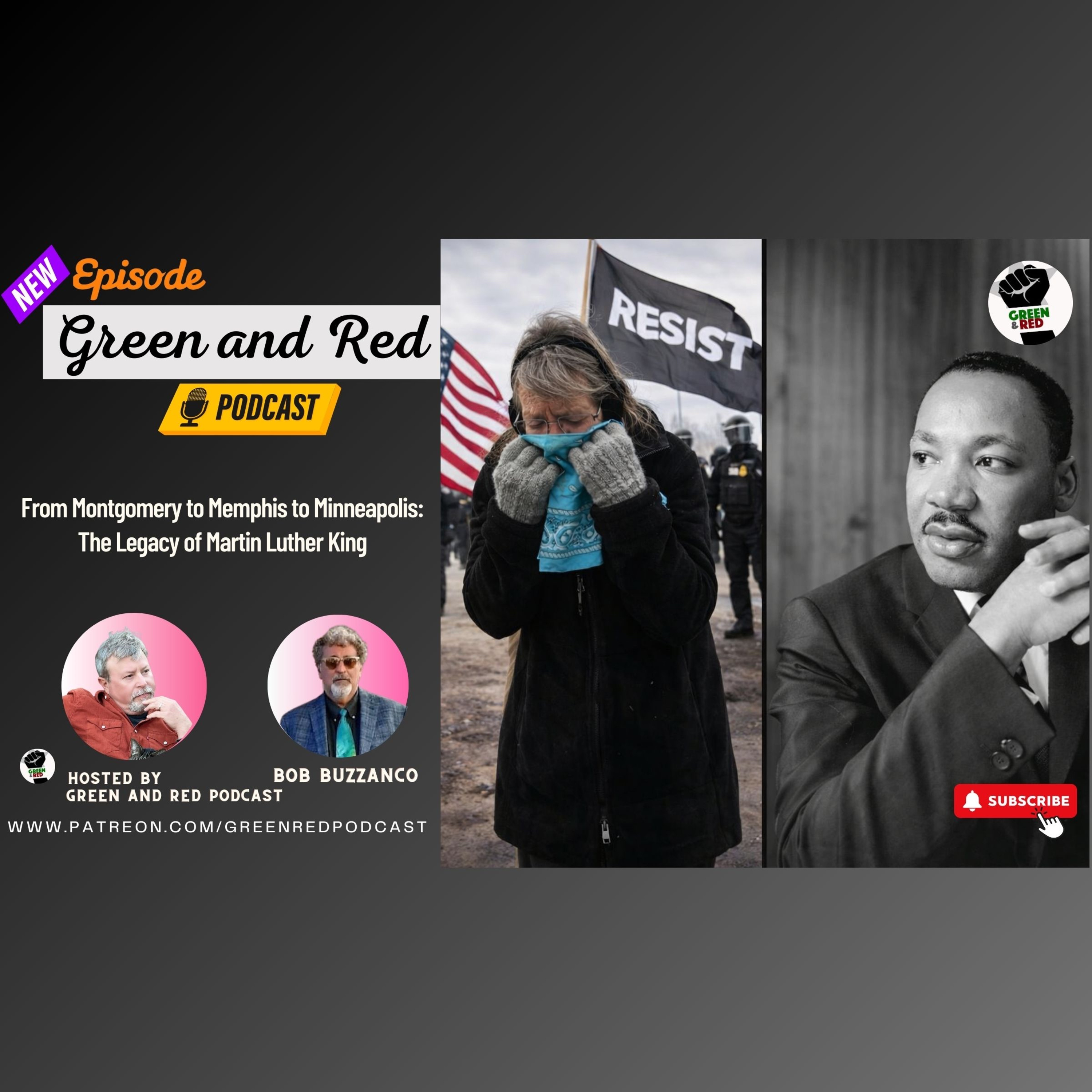
Green & Red: Podcasts for Scrappy Radicals
From Montgomery to Memphis to Minneapolis: The Legacy of Martin Luther King (G&R 457)
00:45:45
Loading summary
Transcript81 lines
- [00:01]
A
Welcome to Green and Red Scrappy Politics for Scrappy People, a regular podcast on radical environmental and anti capitalist politics. Brought to you by Bob Bozanko and Scott Parkins.
- [00:15]
B
Welcome to the silky smooth sounds of the Green and Red podcast. I'm your co host Scott Parkin in Berkeley, California today. And as always, I am joined by.
- [00:25]
A
Bob Bozaiko in NAS Ohio. Getting ready for kind of another one of our annual shows like the JFK stuff. We do something like this every year.
- [00:33]
B
Yeah. And we're going to be talking about Martin Luther King Jr. His actual birthday was this past week on January 15th. But the federal holiday is on Monday. And we're dropping this over the weekend. And we're going to be talking about the legacy of Martin Luther King. We're going to be talking about him as a radical and a democratic socialist and opponent of state violence. But then we're also, we'll be talking about some of what's going on in current currently around resistance to the current state, high levels of state violence that.
- [01:07]
A
We'Re seeing right now. Yeah. This is something we've done before. It's actually the topic of one of my most read Internet articles. Right. Something I wrote like about 10 years ago now, actually. Wow. And at the time I called it Martin Luther King For Sale, how to Commodify a Radical, something like that. And the point here is that we know a lot about Martin Luther King. Like we have a national holiday, right. To celebrate his birthday. And what we hear about him is generally true. Right. He did believe in this kind of cross racial solidarity. And obviously he's the civil rights leader. And everybody markets Martin Luther King Day, McDonald's and furniture stores and you name it, right. Professional leagues, the NBA has Martin Luther King Day basketball games and all that kind of stuff. And they tend to feature the I have a Dream speech, which is quite powerful and quite beautiful. And the point here is that it leaves out a lot what they say is true. The right wing calls them a communist, whatever. But we're talking about in mainstream America what they say about them is true. But there's a lot of that is intentionally left out. King had a pretty radical view of American politics and especially of American capitalism. And there's a few areas we'll really hopefully briefly go through today, three or four to discuss this. King's own kind of political economic ideas. King's position on the politics of the day, in particular the 1968 Olympic boycott, obviously the Vietnam War. And I think the apex of it came. And this is when he was killed when he was organizing the Poor People's Campaign. And so King is well known, won a Nobel Prize for his work on civil rights regarding especially African Americans in the United States. But he was so much more than that. And he also had this larger vision of class and both class oppression, class solidarity and the need for kind of class based answers to these American problems. Just to start before he was married, he wrote his fiance Coretta Scott, later critic Scott King, I imagine you already know that I am much more socialistic in my economic theory than capitalistic. And so he didn't hide it. And he was quite open with that. Right. And he talked about that he was worked quite often with labor unions on issues that were important not just for black workers, but white workers as well. One of his more famous books really deserves even more attention. It already has. I've used it in classes many times in the past. Was called Where Do We Go From Here? And it's obviously about race. And this is written after the Voting Rights and the Civil Rights act, which I think is really important, right? Because up through 1964 and 1965, what we have is essentially a movement based on race in the South. So it's geographically limited and it's mostly limited to, to blacks in the United States, although there's obviously Title seven, right? Title ix, Title seven come out of that for women, but that's neither here or there. But after that, King, instead of like just retiring and taking it easy as he could have done when Nobel Peace President, 1964 Voting Rights, Civil Rights Act. 64, Voting Rights Act 1965, he then continues his activism, but actually expands it. And as difficult it is to talk about race in American society, I don't think it's any easier to really talk about class, which we still see today, right. The Democratic Party runs away from it, they punch left, they're freaking out. They, I think they hate the establishment Democrats. I think they hate Mom Donnie as much as Trump. Right. So King and where do we go from here in 1967 I think is really critical. And I'm not going to read the whole like obviously it's a big book, but there's a couple sections here that are important. But just very briefly, King says there are 40 million poor people in the United States and one day we must ask the question, why are there 40 million poor people in America? And when you begin to ask that question, you are raising questions about the economic system, about a broader distribution of wealth, you begin to question the capitalist economy. And I'm simply saying that more and more we have to ask questions about the whole society. And so I think that's really crucial. As the Southern apartheid regime was dismantled after 1964, 1965, King continued to go around the country and speak out. And I'm just talking, so chime in anytime you want. I'm being Professor Bob here for a moment. It's been a while. Semester's about to begin next week. Right. Probably the best known episode occurred in 1967 on April 4, ironically, when he went to the Riverside Baptist Church in New York and spoke out against the Vietnam War. And this really pissed off liberal America. It pissed off Lyndon Johnson. It pissed off the Democratic establishment. I was doing some research years ago in the LBJ library, and I think it was Harry McPherson who said. Was really upset about King, and he said, look at all we've done for these people. Liberal paternalism at his best. Look at all we've done for these people. The Negro has become sullen and ungrateful. So they're pissed off at him. And a large measure, I think, that came because in 1967, he gave a sermon where he spoke out against the Vietnam War. Part of the implicit idea that the Democratic establishment had was that they were supportive on civil rights, and it would eventually come back and bite them on the ass electorally. Right. Because the south just bailed on the Democrats after that. Right. And so the idea was, we're going to support you on civil rights, but you got to back off on all this other stuff. And he didn't. And so in 1967, he gives this very famous sermon, the Riverside Baptist Church, where he says, we're seeing racial solidarity in Vietnam, where young white soldiers and young black soldiers are fighting and dying together. They're torching Vietnamese villages, they're fighting for Vietnamese rights that they wouldn't even have themselves in Georgia or wherever. And that speech and that movement, it made King an even bigger figure, both for good and bad. Right. So people on the left really embraced him even more and saw him not just as this leader of civil rights for blacks in the south, but somebody who could speak to these larger American issues and connect them together. However, for the Democratic establishment, it was like really the beginning of the end for him. Probably the line that really stuck with them the most was when he said that his message was aimed at the government of the United States, which was, in his words, the greatest purveyor of violence in the world today. Right now, that may not seem like much, but in 1967, for this guy who won A Nobel Peace Prize to come out and say we are. There had been anti war. SDS was saying that, but who cares, right? None of the establishment people like Fulbright or whatever, basically the establishment critique of Vietnam at that point, and there were plenty of people critical of it, was that it violated American values. This is the same shit we hear all the time, right? This isn't what we do. King went way beyond that and said, the US Is the greatest purveyor of violence in the world today. And obviously the Democratic establishment turned on him. They would make his life much more difficult after that. And again, like I said, they saw him as part of a group of people, a racial group that was now sullen and ungrateful and obviously. And that's. That's what identity politics is, right? That's what we're seeing today where the Democrats basically say, vote for us because we're going to take care of you. And they don't want to hear anything else. Right. So they just assume that if you're black, you should vote for him. If you're a woman, you should vote for them. If you're gay, you should vote for them. If you're Latino, you should vote for them. Right. Without actually offering, you know, specific ideas to those people. So the Vietnam War is big. Another part of it which isn't as well known, but I think is really important, was that in 1967 and 68, King went around the country encouraging black athletes to boycott the Olympics. Now, the Olympics in 2028 is going to be a big deal because it's in la and we're going to see by that time who the hell knows what this country is going to look like, right? But in nineteen, 1968, the Olympics were actually scheduled for Mexico City, where there were rampages by soldiers who killed multiple thousands of protesters in Mexico City. But before that, a group of black athletes led by Harry Edwards, who was pretty, still alive, pretty, one of the sociologists, but also a discus thrower at UCLA, basically made the argument that the U.S. olympic team and the Olympics at the time, if you're young, I don't even know if you remember it this way. That was the epic battle of good and evil, like in the height of the Cold War, 60s and 70s, like this, essentially determined, like who the best society was. Right. What the best system was. And obviously the United States generally won more medals. Why? Who were responsible for most of those medals? Black athletes. Right, right. And so Edwards said we should go around the country and encourage black athletes to boycott. They should not be Bringing glory and fame to a country that violates us on a daily basis simply because we're black. King joined in that movement and went around the country talking to black athletes. And he was joined at various points by Muhammad Ali, of course, Jim Brown, famous football player at the time, Lou Alcindor. Who, Kareem Abdul Jabbar. John Carlos tells a famous story where he was called to a meeting and he's sitting there and somebody called and said, we're having a meeting, maybe Harry Edwards. And he said, what's it about? I said, don't matter, doesn't matter. Just show up. And he said he's there. And all of a sudden, Martin Luther King sitting next to him, telling them, you're a great athlete, you should boycott the Olympics. The boycott itself didn't really go very far. Alcindor was really the only name, big name who. Who actually boycotted. But as we're all aware, at the Olympics, Tommy Smith and John Carlos won medals and on the stand, they put on black gloves and gave the Black power salute. They were sent home from the Olympics at that moment. And for Carlos, he was really absolutely blacklisted. Ended up working like picking up garbage on a campus at UC San Jose, maybe, or is it Cal State or UC qc? But King. And again, this obviously does not endear King with the liberal establishment. Liberals may have been supportive of civil rights at home, but when it came to the Cold War, and we're seeing that today, right, where Democrats won't say anything about Venezuela and Iran, they're all in with American power. And so, again, like opposing the Vietnam War, encouraging that this boycott really created an even greater schism between King and liberal or democratic America. Wow.
- [11:37]
B
Some of the boycott was over a ban on South Africa and Rhodesia.
- [11:40]
A
Yes. South Africa. Yeah. They wanted South Africa banned from the. The Olympics. It's going to be interesting in 2028. The World cup is this year, which is taking place in the United States. Obviously, Trump's immigration policies, his bans, ICE running, roughshod in the streets. They promised Kristi Noem. So many things I want to say about Christine Noem, but I probably shouldn't. Has promised ICE enforcement at the Super Bowl. Right. FIFA is just fellating Trump every chance against. They've given him the prestigious. Now that he's. Now that Machado's given him the Nobel Prize, does he give the FIFA Peace Prize back or does he keep him? Both.
- [12:16]
B
He's the kind of guy who would keep oath. Right.
- [12:20]
A
Should we create a green at red Peace Prize?
- [12:23]
B
Yeah. And we could maybe we give that. Maybe Trump would come and accept that. That's what raise our Internet index.
- [12:29]
A
Maybe we can even get them on to. To accept the green peace fries. But at any rate, the last piece of this, and which is I think better known, I would assume of all this, that the Vietnam War opposition is probably the benchmark. Right. But in connection with that, with his political ideology, his kind of anti capitalism, the connection he saw between that and civil rights in the Vietnam War, boycotting the Olympics was in 1967. He got. Gets together with veterans of both the civil rights movement and the labor movement, and he decides he wants to actually expand his crusade into the United States based on poverty in the early 60s, I guess you call him. He is a socialist. Michael Harrington. I have issues with Harrington. He's the founder of bsa. Harrington is more of a Democrat than a socialist, which is, I think, still true today. But Harrington wrote a book.
- [13:17]
B
I say that about a lot of DSA types.
- [13:20]
A
Harrington wrote a book called the Other America where he did field research and said there are like 40 million poor people in the United States, which at the time is like what, 20, 25% of the entire population. Apparently. JFK read this, and this is one of the. Was one of the main impetuses. Impetus I. Impetuses for the Great Society. Right. That was still the case. The idea of poverty became really in American light. That isn't that big an issue in American history. You saw it obviously in the 30s because of the Depression, but in the early 1960s, this time of great prosperity, like the greatest prosperity in. It was the perfect prosperity. You've never seen prosperity. It was the greatest prosperity in the history of prosperity.
- [14:08]
B
Most amazing prosperity.
- [14:09]
A
Bob. Imagine if Kennedy had spoken that way. That'd been awesome.
- [14:13]
B
Yeah. Although it's unmatched by today's Golden Age. No golden shower age, if you will.
- [14:19]
A
Jesus. I went looking for coffee the other day. It used to be 12 bucks, now it's 23. So at any rate. But Harrington wrote this and that became. It's one of the few times where we've actually discussed poverty. Right. In. In kind of a mainstream way. This isn't like Occupy or whatever this is like everybody's talking about, Right. And Kennedy and Johnson create these Great Society programs, but Great Society programs. And we actually, I think we did a show on this, like our four season, right? What? A lot of these Great Society programs essentially funneled money through established bureaucracies. They would send it to cities which had Democratic mayors and let them allocate the money and they would essentially give it to their cronies. Right? So the money didn't get down to the people who are actually poor. Every study ever done has basically said that, as critics call it, throwing money at people is actually the way to do it. Right. That wasn't what they did. These are poor laws, like welfare programs affect everybody. Like a welfare program, big national health care, right? Public health care. Everybody benefits from that, right? Like Social Security is one of the few we have where everybody's on Social Security. Pretty much everybody's on Social Security. Right. These were poor laws. They were needs based. They were for poor people. They were important. And they actually did put a big dent in a lot of these, like education and healthcare and poverty statistics. But they were also inadequate. And so King and his associates decided to launch a campaign bigger than that. They called it the Poor People's Campaign. And it wasn't going to be just about civil rights and African Americans, although they were clearly a big part of it. King went around the country. He obviously talked to blacks in the South. He went to workplaces, talked to blacks in the South. He went to the Valley of Texas and talked to migrant farm workers, talked to Mexicans, went to New Mexico, talked to Native Americans, went to the factories of Gary and Cleveland and Pittsburgh and talked to steel workers and auto workers who were probably almost all white. Went to Appalachia, poorest part of the United States, talk to poor whites. Right? Now, class solidarity terrifies the ruling class, working class, poor people. Solidarity terrifies the people who run society more than anything, way more than the civil rights movement did. Because civil rights movement essentially was not an anti capitalist movement. Essentially, it was a movement to be. Embrace capitalism, was a movement to be integrated into capitalism, to be able to go to stores and to be able to shop and to be able to have your own businesses and not be banned from going to lunch counters or buses or whatever. It's more of an integrative movement. Absolutely. It's. It is, it's an integrated movement. This isn't. This is a movement saying, okay, you, you rich people have too much power and you're exploiting all of us. Right. I said this when we talked about Rob Reiner a few weeks ago, like Archie Bunker, I think is a great example, is I really suspect archie Bunker in 1960, and maybe even 19, probably 1964, was a Democrat, right? If southern blacks get to eat at the lunch counter or vote or go to school, that really doesn't affect him. But what's happening now with the Great Society program, so Things like the poor people's campaign is that they're starting to feel a more personal connection and potentially a personal risk to it. Right. Because this can involve money. And where does money come from? Taxes. Right. And so a lot of people are saying, mike, when blacks got the vote in Mississippi, that's great. I have no problem with that. But they want to raise my taxes now for housing and for health care and for jobs and for welfare programs and for programs for unwed mothers. All the rhetoric that you hear today, that hasn't changed.
- [17:54]
B
It's one of the billionaires dumped so much money against mom Donnie in New York.
- [17:57]
A
Yeah, exactly. Right. Yeah. And those are the kind of things King was talking about. This is why actually, don't mind Mamdani. I think it's important the fact that he said what he said and succeeded at it. Right. But people were saying this stuff 50, 60 years ago. Right. We need schools, we need daycare for kids. We need preschool, lunchbox, breakfast programs. Right. We need healthcare, we need good housing. Just all the basic, the liberal boilerplate liberal stuff. The people pay lip service to it, but in reality, they don't really do much. Or like I said, they funnel it through these established bureaucratic elites, and it doesn't really get down to the people who need it. And King spoke out against that. In the process of doing that, the establishment abandoned him. He had trouble just simply getting phone calls through to the White House, who was in frequent contact with him before the Voting Rights act and the Civil Rights act were passed. He was considered stolen and ungrateful working with the Park Service, which he had done in 1963 for the March on Washington. The Kennedy administration was pretty cooperative. This time, not so much. He had trouble getting permits. It was just becoming very difficult, and it wasn't going well. And it probably wouldn't have gone well within that framework. In April, early April of 1968, he went to Memphis because the workers there were trying to organize union, an AFSCME union. Right. American Federation of State County Municipalities, the sanitation workers there. He went there to support them. It was a labor strike, Was a labor issue. On April 3, he gives his famous I have a dream speech. And then he was assassinated the next day.
- [19:33]
B
I had been to the mountaintop.
- [19:35]
A
Yeah. Didn't I say I have a dream? I'm sorry. Yeah. I invited to the mountaintop dream. Been to the mountaintop dream. I've been to a mountaintop speech. And at that point, the poor people's campaign really fell apart. It did. They followed through, but it was just disjointed, disorganized. The media had turned against it and the country moved on. It was in this like really dark place, like we are today. Actually, I think it's similar in that regard. King's assassination is often seen as the pivot point in that I actually don't think it was. I don't think the. The Poor People's campaign would have been any different had he been gotten better attention. Maybe. But they were over King and they were over his radical legacy. And that's the point here. King did leave a legacy far bigger than the one we have. And the one we have is legitimate. I'm in no way dismissive of it. I think civil rights is obviously a critical American issue. And the I have a Dream speech is very powerful and potent. We've all heard it dozens, if not more times, and it still resonates. But the 1967 speech against the Vietnam War we don't hear, which is, I think, really critical. Right. The Poor People's campaign was really important as well. And I would say that like in. In my own view of US history, there are a couple times where I think there was actually a challenge, a fairly strong challenge made to the ruling class. One which is wildly misunderstood, was actually the populists. Because the word populism today doesn't mean what it meant in the 1890s. Right. Populists were an anti bank, anti railroad, antitrust, anti billionaire movement. Right. Maloney and Bolsonaro, those people aren't popular. So that would be one. And I would say actually the Poor People's campaign, in the way it was constructed, was an anti capitalist movement. And like I said, we have difficulty dealing with race in the United States. But class, I think, and I'm not. This isn't just like an old white professor saying this back. I remember seeing an interview with Jesse Jackson and I forget who else. And there was kind of a roundtable. Jackson and I forget who else. And they both said the same thing. Yes. Americans don't like to talk about race. They talk about class even less. And so the kind of things that King talked about actually resonated. That became a real important framework within the civil rights debate. Right. That the movement had created these artificial. Artificial. I'm sorry, not at all. Artificial legal basis for inclusion, voting rights, civil rights, that kind of thing. Right. Public accommodations. But you know, as King and others would often say, we're allowed to eat at that restaurant, but we can't afford to. We're allowed to live in that neighborhood. But we can't buy a home there. We can't afford to buy a home there. And so that became the basis of it. And that's just, that's very dangerous territory in the United States for both Democrats and Republicans. No different than it is today. Right. Democratic Party is a gatekeeper of capitalism every bit as much as Trump. Trump is.
- [22:29]
B
Someone once remarked to me that the Democratic Party has these trophies that keep in a glass container and every election they bring in them out and the civil rights and women's rights, worker rights, and they come and they dust them off and they hold them up and they show how like down they are with the cause and then they put them back and go back to work for their go back. And often it's a multi billion dollar psyops campaign where they get Obama elected or they put a bunch of money into getting Kamala Harris elected, things like that.
- [23:01]
A
But I mean, the summer of 2020, like every company had BLM flags and rainbow flags out. Yeah.
- [23:09]
B
One, one challenge I'll put out to our audience and I'll be doing this weekend is let's look and see how many companies and conservative politicians and the Trump administration themselves put out messages on Monday praising Martin Luther King. It's a thing I do every Martin Luther King day for the last couple years.
- [23:27]
A
I will. The CIA will.
- [23:29]
B
Yeah, exactly, exactly.
- [23:31]
A
I wonder if I put it.
- [23:32]
B
Yeah, let's see.
- [23:33]
A
I actually just watched some kind of Nazi slogan.
- [23:36]
B
I actually just watched this great documentary the other day about called MLK FBI from 2021, which is about how intense the FBI and J. Edgar Hoover actually went after Martin Luther King.
- [23:47]
A
Yeah, the Kennedys. Yeah, yeah, absolutely.
- [23:50]
B
And the Kennedys.
- [23:51]
A
Yeah, yeah, absolutely. Right. The Democrats.
- [23:53]
B
And to the point where they taped him having his extramarital affairs or whatever and message sent stuff, sent him a letter telling him he had 30 days to commit suicide.
- [24:03]
A
Scott, have you not listened to Oliver Stone and Pinto and Flounder? Kennedy was the greatest thing that ever happened to blacks in the United States.
- [24:11]
B
Not even graves.
- [24:12]
A
Yeah, exactly. Kennedy's position. Kennedy didn't want to alienate Southern Democrats and it didn't matter because they lost them all anyway. But I think, and this is something, I think where I dominated that because this is something I've done. But I think now we're moving into kind of something which I think is in your ballpark a lot more, which is what it means, what the legacy of it is, because fortunately there are a lot of people generally younger than me who do understand that route of what people Might do who lived for her. But a lot of people do understand that radical legacy. And we've. Everybody wants to control Martin Luther King. It's a competition. Who's Martin Luther King? Are you going to believe even Republicans will put King King out, invoke King. Right. King is against abortion. King said this, King said that. Right?
- [24:57]
B
Yeah.
- [24:58]
A
And so it's become like a contested legacy. Right. And you have this commodification of them. Right. Martin Luther King day becomes a reason to have a sale to get like a 2 for 1 at IKEA or whatever. Right. But for people like you who've now dedicated your life to being in the streets and to organizing folks, I think King means something very different. And I think at this particular moment, which is really fraught and it's. To call it unstable is wildly euphemistic, I think, analyzing and thinking about what King said. Because everybody dies. Right. And we identify King in pretty facile ways with he was non violent, he believed in, which is all true. King himself called it militant nonviolence. Right. How do you, as you go about your whole career, really, how is what happened with the civil rights movement, with Martin Luther King and that and others in that period, La Raza Unida or Women's Liberation or whatever, American Indian movement or. Yeah. How does that affect what you've done, what you think? And is there anything going forward that we can do with it?
- [25:59]
B
I think King serves, I think the militant nonviolence, the campaigns that King waged from Montgomery to Memphis really has been a model for many people. It's still a model today. I should also say that a lot of what the civil rights move, where the civil rights movement took a lot of their ideas, was from Gandhi's independence movement in India, which led to India being able to break away from the British Empire. But it involves things like courageous action where people endure suffering to expose injustice as seen during Dr. King's campaigns. Moral disruptions where oppressors are being forced to confront their brutality. I feel we see that every day. In this particular moment, Trump has sent 3,000 ICE agents and other personnel into Minneapolis. And they're just brutal. They gang tackle people, they cuff them and they brutalize them and they hold them down while they're cuffed. And we've had over 130 homicides or deaths while in ice cuts. The worst being this murder of Renee Goode that we saw in Minneapolis last week. But the moral disruption where people are confronting these oppressors on their brutality is challenging these unjust laws, systems, policies, what have you. This is often strategic and organized and it's everything from mass demonstration and economic boycotts to create significant pressure. We saw that a lot during the civil rights era. And then Montgomery Breath Poycott is like one of the most obvious examples today we're seeing that. There's a piece that came out in the nation this week calling for people to put pressure on certain companies around ice, including Target, including Dell, Avelo Airlines, Starbucks. Avelo Airlines actually has been getting a lot of pressure because they're doing these private charters for ICE flying deportees around. Active resistance. With King there's this notion of pacifism where you just don't participate in the violence. And that's where we saw the Quakers not go to World War I or World War II. But active resistance is, it's an offensive strategy using protest to non cooperation intervention to challenge the brutality with and then finally with King. And this also applies to Gandhi as well. It's rooted in faith and principles. It requires inner strength and purity of heart, things like that. And so you see a lot of, as a person who's organized many protests, there's a sort of inner strength that you need to tap into in order to do these things. The other important piece I'll say is what I see in a lot of places, this includes here in the Bay Area, is that a lot of what's going on with these anti movements, ICE movements is being led by like a faith contingent. And so we see clergy and rabbis and imams and et cetera, just also being the ones that really put the pressure on these institutions. And so this militant nonviolence is actually very important. King also had some interesting thoughts on property destruction where he drew a moral distinction between moral, between, excuse me, violence against property and violence against people. And then he also was very clear that police are responsible for a lot of the violence against people. We see that play out on our Instagram feeds every day. And King did not condemn people who committed property destruction. He did a lot of comments when we saw the 1965 Watts riot and we saw Newark and Detroit in 1967 and he, he's quoted for saying a riot is the language of the unheard. And I, I think it's a, I think that's an important piece too is that he didn't condemn people doing property destruction and he more actually had an explanation for it. When people would talk to him about it.
- [29:57]
A
I always think of the likes that he's told or would explode. And I think King. Yeah, because King, the whole idea what you hear about is generally King was appealing to the moral conscience of these people and to some degree was. But Kwame Ture would later say, you can't apply appeal to the more conscious people who have no conscience. What was important at the time, and this is not to praise, but the Democrats or something like that. But he was also operating in a system where half the country could agree with that, that, like people up north who have their own issues with race and all that. Nobody's denying that. I'm not denying that. But they could look at the south and say, whoa, those people are different down there. Like, I lived, I grew up in that. Oh, we're not like the South. And so they could say, yeah, I support Martin Luther King because we're not like that. Look at what they're doing. And that's harder to do today. But what we're seeing, I think it is really important in that, and it's inspiring too, because the civil rights movement was really well organized when you have these institutions, obviously, like King and the sclc, sncc, even sds, which kind of merges out of that and deals with a lot of these issues. But if you look at kind of stuff SDS was talking about, it's a lot like the poor people's campaign. Right. SDS wanted to create what they called an interracial coalition of the poor. And I think King may have actually used that, that same language. Right. But we're also seeing today, which is really cool, I think, a lot of kind of organic opposition. Right. You keep seeing these videos of people who said, I'm people my age who said, I've never been out to one of these. You know, I saw it on the news. I had to come out today instead of running away. And that's, I think, one of the key elements here. Right. People aren't running away from this repression, they're running toward it, which is not what these folks expected.
- [31:30]
B
I think it's also important to note that this past week, weekend, we saw over a thousand actions after the murder of Renee Goode. The actions that we saw were also a protest against the Trump's intervention in Venezuela as well. Yeah, I went to more of a hands off Venezuela rally up in Richmond at the Chevron refinery. Driving home, we drove through intersections in a different part of the Bay Area where it was like hundreds of people just on the street corner protesting Iris. And this, obviously, this is the Bay Area where these things happen. And there's probably, there's a lot of older folks at these rallies. Too. But still, that happened all over the country. That happened in Conroe, Texas, and that happened in Mississippi this weekend, this past weekend.
- [32:13]
A
And in 2020, a lot of these folks are veterans now, right? Because we saw that in 2020, where people in Idaho were out protesting, and we saw this in 2024, especially on campuses with regard to Israel's genocide. So the framework is out there. But to your point, I'm in Warren, Ohio, which is an old Democratic city, but it's been wiped out. It's. This is like Appalachia. The factories are gone, they're all rusted out. And fentanyl and all that stuff. But I've been to two or three of these things now, maybe four, no Kings or whatever. And there was one last week, and you're getting like, last week in Warner High, it was like 20 degrees at most. It was snowing. And there were 200 people out there. The one I went to before that, I bet it was close to a thousand. And if you look at that in the polling and make what you will of that, I don't think the polling people look at the polls and say, oh, Trump is vulnerable. We can beat him in the elections. That, to me, that's pointless. Like, to me, the point of the polling is Trump is vulnerable and you have to put the heat on, not let's wait until the elections or whatever. And I think people see that, like, you can no longer wait, which is why one of King's other famous books is called why We Can't Wait. But and to your point, I think that's one of the misunderstood parts of it, right, where people equate, like executing Renee Good or however other many people Rice. It came out yesterday and it was in San Antonio. A guy died in ICE detention, and some of the witnesses said, yeah, five guards were sitting on top of him, choking him to death. And it has been ruled a homicide. Right? So you can't equate that to throwing a brick at a Target store or whatever. And I keep going back, and I can't stress this enough, 54% of Americans. I went yesterday and looked it up again. 54% of Americans supported burning down a police precinct in Mini. And it was in Minneapolis, right? In 2020, in June of 2020.
- [33:58]
B
The precinct the cops were from that killed George Floyd.
- [34:01]
A
Today, the vast majority of Americans are opposed to what ICE is doing. Trump's numbers on immigration, which were his strongest issue, are now in the toilet. So that's what. It's not important. Like, we're going to Beat him in the elections. It's important. Like we got to get them now.
- [34:14]
B
A plurality of Americans right now, 46 to 44%, I guess with that other 10% or whatever, I've decided support abolishing the ICE. That's the first time this ever happened.
- [34:26]
A
And the Democrats, the first thing they say, it's like defunding the police in 2020, which had broad popular support. The reason it didn't sustain that broad popular support is because as soon as they people brought up the idea they called diffonder abolish order immediately. The talking heads, the media and the Democrats step in and say, oh no, that'll destroy us politically. I hear this like the other day I said got a ball. We can't do that. Here's in the elections because you say, I will like. You create reality. The Republicans know this, Trump knows this. You create reality. You can say the most insane, batshit thing that has 10% support and it becomes reality. And then you have some fucking Carolyn Levitt or some equally ignorant, vacuous bag of shit say it right. The Democrats do the opposite. They create reality in a negative way. Oh no, we can't do that. And that's why. And if any sliver of hope comes out of this, I think like even liberals now are closer to what we would say than the Democratic Party. There is a general, like, I've talked to a lot of people here die. They're still like, I live in an old labor area. It's a lot of the old people, they were in the union and they were union officials and they were on strike and they're still hardcore Democrats. They're even now saying, they're not looking at me and saying, you were right, they would never do that. But they are looking at me and saying, yeah, yeah, the Democrats are useless. We can't count on them any.
- [35:39]
B
It's important to note that Bill Kristol, who's an arch conservative, arch is left of the Democratic Party on this right now.
- [35:45]
A
Oh, he's one of the like intellectual godfathers. The modern conservative movement. We sent abolish ICE and he bitch headed the Democrats for not doing anything in the Senate. Yeah, yeah.
- [35:55]
B
It's a, it's an important thing to note. Anyone who's in positions of power, like in the Senate, they're completely keeping their mouth shut on this with a couple of exceptions. But it's obviously where the country's going.
- [36:08]
A
Yeah.
- [36:08]
B
And it's not because of anyone in the media. It's not because of anyone in power. It's it's because there's people on the street pushing back on ICE to. Some of which are getting shot and killed, some of which are getting very brutalized.
- [36:22]
A
This performative bullshit from like Jacob Fry or Gavin Newsom. Get the out of Minneapolis and Gavin Newsome. These are essentially procedural discussions. They're. They're fights over who has the right to deploy the police to beat the shit. In both California and in Minnesota, the police and the troopers are out there working in concert with ICE to beat the. Out of people. And so when they say this like we. They don't mean it. And they both, they both recanted anyway. Fry and knew some of, oh no, we can't get rid of ice. And obviously I just saw a thing. I checked an update while you were talking. And the Democrats are proposing now to actually increase ICE funding in exchange for putting body cams and making them train more. Yeah, that really changed.
- [37:05]
B
The police, I do want to say is they're not talking about the. Because these graphs have come out a lot recently is how much funding for ICE is increased from Obama to Trump and Biden to Trump. And it's granted very significant increases since Trump has come in. I think they get close to an equivalent of what the Israeli military. The operating budget of the.
- [37:28]
A
It's like it would be the seventh biggest. Just ICE alone would be like the seventh biggest military budget in the world, I think, or something.
- [37:33]
B
Yeah, something like that. Some crazy thing like that. And so, and so the Democrats, their pivot is. Let's just talk about training these ICE guys better. I want to say that John Ross, Jonathan Ross, he. Since he was in the military, he was trained to track and apprehend fugitives. He's been getting trained since 2007.
- [37:51]
A
And he's an ice trainer.
- [37:52]
B
He's an ice trainer.
- [37:53]
A
Yeah. Who violated like every. Everybody. You talk to everybody. I've talked to a lot of ads like people on Instagram, everyone who's been in the military says he did everything wrong. That's. That's not.
- [38:02]
B
Yeah, yeah. ICE agents go against their own policy. Own DHS policies.
- [38:07]
A
Well, and you have. When you have a president saying they have total immunity, you can fucking train them for a million hours. It doesn't matter. Unless you go into their like heart and soul and do a transplant. It just doesn't fucking matter.
- [38:18]
B
Yeah.
- [38:19]
A
Make them more efficient, for Christ's sake.
- [38:21]
B
We're also seeing where they have these death head chips that they give to each other when they make an apprehension of a person. But underlying culture is we're like an elite military unit. Where can I go get Nicholas Maduro? That kind of mentality, I'm not kidding.
- [38:34]
A
It could. We could see them start wearing necklaces with the ears of people they kill and look at what they're like. They shouldn't be in Minneapolis. This is allegedly a fraud investigation. Ace isn't tasked with investigating fraud. Those are lawyers. You send the Justice Department there, right? Send people in to apprehend everybody who happens to fit the particular group of some of the people. I keep going back and I use this example all the time. My family's from Sicily. If you had an anti Mafia campaign like you just arrest all the Italians, look how it works, right? If there's like drugs being dealt in your apartment complex, do you go in and you blow the whole thing up? Actually, they do. But the point here is it's preposterous on every level, right? And this is again, the Democrats own so much of this, not just because they consistently increased ICE budgets, right? And ICE's mission, right?
- [39:23]
B
How many never voted? How many Democrats voted to confirm no, Christina?
- [39:28]
A
Seven. And it's. They own so much of this. And that's one of the big problems we have, right? And so these things. Train or body can. Police have been wearing body cams now for what, 10, at least 10 years. It's been pretty widespread. And the number of people killed by cops every year has keep going up. The number of police actually like indicted and convicted, maybe a little higher, but not much. 20, 20. As soon as the Democrats said no, when Biden said, oh, no, we're not going to defund the police, we're going to fund them even more. For one thing, politically, that just doesn't work. You can't out Republicans, you can't outdo the Republicans on that issue. If when it comes to policing and violence, they own it, it's like patriot. We have to be more patriotic than them, you've lost that issue. It's gone. Republicans are the party of violence and the party of what they call patriotism. When you say we're going to meet them on their terrain under rules that they invented, you can't win. You can't win. And it's like playing the old Celtics in Boston Garden. You can't win. And this is where we're. Which is why the sliver I have is that people I think are. That's really breaking through and you're seeing these people in the streets and they're ignoring the performative bullshit from walls and from fry and from newsom and I don't know how legit what's going on in Chicago is. It seems different. I don't know. All of these agencies are working in concert with ICE there. There's no doubt about that. ICE is. They're just violent, they're vicious. I don't is silly and not silly, but. But they are really Nazis. They really are Nazis.
- [41:01]
B
It totally. It's Trump's personal ss, right?
- [41:03]
A
It is. It's his personal, private. It's paramilitary. Absolutely.
- [41:06]
B
I want to close with a thing from King which is in where we're in a moment where direct action is absolutely needed and militant nonviolence is absolutely needed. And we're seeing that there's a lot of courageous people out there who are like, stepping into the street, stepping in the way.
- [41:22]
A
People who don't have a private stake in it. I gotta say, these suburban white women and old white people and old folks, people who don't like, aren't probably at this point directly threatened. They're out there for others.
- [41:36]
B
I'm going to read this last quote from King, which I believe he wrote in the letter from the Birmingham jail. But he said, you may ask, why direct action? Why SED ends, marches and so forth? Isn't negotiation a better path? You are quite right in calling for negotiation. Indeed, this is the very purpose of direct action. Nonviolent direct action seems to create such a crisis and foster such a tension that community which is constantly refused to negotiate is forced to confront the issue. It seeks so to dramatize the issue that it can no longer be ignored. My citing the creation of tension as part of the work of the non levia resistor may sound rather shock. But I must confess that I am not afraid of the word tension. I have earnestly opposed violent tension, but there is a constructive nonviolent tension which is necessary for growth. So I just want to.
- [42:27]
A
The right has understood that constant friction, constant tension, right. And it has to be met that way. No business as usual. So hopefully in the coming days and in the coming months, we'll see more boycotts, more strikes. Labor has to get involved in this. And labor had a big role to play in civil rights.
- [42:44]
B
And in a week from now, they're having a general strike in Minneapolis, for example, and we're seeing an increase. We're not seeing anything from national labor, but we're seeing an increase from local labor in places like.
- [42:56]
A
I mean, I saw today, a lot of small businesses are putting signs out that they're closed. They're going to be closed on that Day. Another thing that I think is really inspirational is that in a lot of these school kids are going out, they're walking out, having protests, having marches much in Birmingham when King brought the school kids out. And the problem now is you have. All of these guys are Bull Connor. Bull Connor was obviously an architect of a Southern sheriff, but laughed at in the north. Look at that fat bubba kind of thing. This is what ice is. You have Bull Connor's one. It's Bull Connor's America now. Trump is president Bull con.
- [43:27]
B
What?
- [43:27]
A
Trump and Trump and. And these are really. They're such stupid and unexceptional people. And yeah, all you can do is just keep the pressure up, support it in any way you can. If you can go out, you go out. You could. If you can't, you do what you can. You make phone calls, you I. Pizzas for people protesting, whatever.
- [43:46]
B
Yeah, yeah.
- [43:47]
A
And please, this is my last point because we've been bitching about. I've been bitching about this to you, but don't go on Instagram, do a Google search and then go on Instagram and write this, make this three minute video about. You shouldn't do this and you shouldn't do this and you should. And it's bad to do that. Don't, just don't. A lot of these people have figured it out. They're figuring it out. People my age, we don't have a really good record. Like we don't have a lot of W's. We've taken losses mostly. So they're out there, they're fighting. Maybe you could offer some historic perspective like I think we've just done. But don't sit around and bitch at him and tell them what to do. Especially if you never got off your ass and did a thing in your life. You did a Google search and you do a three minute TikTok on it. So otherwise fight no business as usual. There comes a time when the operation of the machine becomes so odious, makes you so sick at heart, you can't partake in it. You can't even passively take part in it. You have to throw yourself on the gears on the levers and you have to tell the people, unless we're free, the machine will be prevented from working.
- [44:46]
B
Yeah, totally. We're going to wrap it there. If you like what you're hearing, please check us out on Instagram, Facebook, Twitter and BlueScribe. If you're watching this on YouTube, give us or hit that support button. If you're listening to us on audio platform give us a rating review. And if you really like us, go to greeningredpodcast.org hit that support button or become a patron@patreon.com Green Red Podcast until we talk to you again. Make trouble and misbehave.
- [45:30]
A
Sam.