← Green & Red: Podcasts for Scrappy Radicals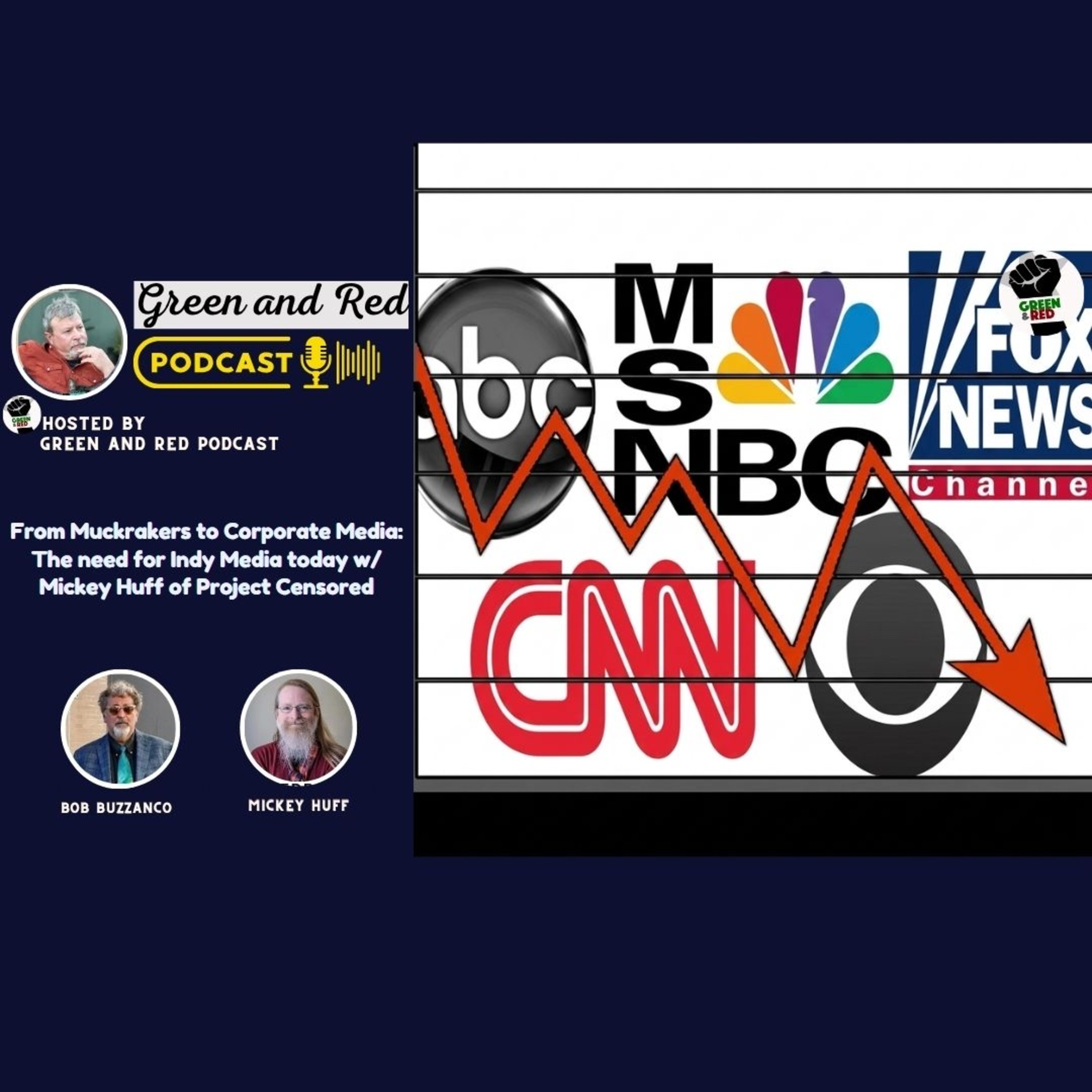
Green & Red: Podcasts for Scrappy Radicals
From Muckrakers to Corporate Media: The need for Indy Media today w/ Mickey Huff (G&R 486)
00:40:45
Loading summary
Transcript59 lines
- [00:01]
A
Welcome to Green and Red Scrappy Politics for Scrappy People, a regular podcast on radical environmental and anti capitalist politics. Brought to you by Bob Bozanko and Scott Parkins.
- [00:14]
B
Welcome to the silky smooth sounds of the Green and Red podcast. I'm your co host Scott Parkin in Berkeley, California and as always, I'm joined
- [00:22]
C
by in Mickey's favorite place, Niles, Ohio on Bob zenco.
- [00:28]
B
It's the 50th anniversary of Project Censored. We did a show a couple of months ago with Mickey about the new stay of the Free Press book, but we wanted to come back and talk a little bit more about Project Censored and just the its history and the and the history of censorship, really. We're going to talk about all of it in a very current events context too. We're joined by Mickey Huff, who is the director of Project Censored, president of the nonprofit Media Freedom Foundation. He's also professor at Ithaca College and is the director of park center for Independent Media. He's a professor of journalism and then he's also the executive producer and co host of the Project Censored show on kpfa. Mickey, welcome back to the Green and Red podcast.
- [01:09]
A
Scott and Bob, it's always good to be here with you. Thank you so much for the opportunity and 50 years of project Censored. I'm sad to say that we need to keep moving with the mission of the project going forward because we're in some dire straits when it comes to press freedom and the attacks on epistemic institutions, institutions and academic freedom. And Project Censored's been fighting that kind of censorship for half a century and we are in it for the long haul. And I think we really need to talk more about the importance of independent muck breaking journalism in the public interest. We need to talk about why the corporate media has such flagging support in the public, even though it's also under attack from the current administration because it's somehow not right wing enough. And again, we've got a lot cut out for us and a lot to talk about. But we also have a lot of bright lights and things that are cause for celebration, including a growth in independent media outlets and of course the coming Izzy Awards named after I F Stone at Ithaca College that celebrates muckraking journalism in the 20th century style by, as George Seldy said, telling the public what they need to know and about what's really going on so they can be meaningfully engaged. So I'm looking forward to a good chat with you all today.
- [02:19]
C
We have a lot to talk about what's going on today, but I want to start because you just had a piece up on the project censored website. We is the historically based thing, which I really dig because as a professor I taught that stuff. And I would spend pretty much a whole class talking about Ida Tarbell and Lincoln Stefans and of course Sinclair and all that. And going through Izzy Stone was always mentioned and even at the contemporary times. But that really. I don't know if I don't want to say the. Use the phrase golden age, but that was a time when these journalists, people like Sinclair, Tarbell or others, Steffens and. And others really emerged in the public consciousness and seemed to have kind of a big influence, not just in journalism, but in politics as well. And on your article, you bring that. Do you want to just talk a little bit about that and what that meant and what we've lost now out of it?
- [03:03]
A
Yeah. And thanks for the opportunity to go down memory hole lane. Right. This is history that is fairly well documented. Yet it's interesting to me how. How few people seem to recollect it or know about it or invoke it, talk about it, even in classes. If students particularly have a history course or the immediate history course, and some of these things, they come across some of these names. And my opinion is that not only should they be coming across these names, but K12 style, we should be talking to people about the importance of press freedom and the First Amendment and what muckraking journalism really is. And curiously, the muckraking term that was popularized by Teddy Roosevelt in the early 1900s was in response to reporting by people like Ida Tarbell, Lincoln Steffens, Upton Sinclair, David Graham Phillips, and early on, Teddy Roosevelt, he was influenced by these muckrakers. Ida Tarbell took on John Rockefeller's Standard Oil and led to a Supreme Court case breaking them up into 34 separate companies. Lincoln Steffens was writing the Shame of the Cities about municipal corruption. Of course, Upton Sinclair's the Jungle was talking about public health hazards of the meatpacking industry. That actually influenced Roosevelt's personal physician, who then told Teddy Roosevelt about that. And it led to Roosevelt working to pass one of the first regulations on the food industry, Pure Food and Drug act of 1906. However, Roosevelt gave a talk in 1906 where he was riffing on John Bunyan, 1678, Pilgrim's Progress, the man with the muck rake. And in that regard, and it's already whether or not he was misinterpreting this. But Roosevelt said that muckraking reporting had gone too far, that these were just reporters with axes to grind and they were focusing on negativity and they could never see positive things going on in society. And that's not entirely fair and it's not entirely accurate. But it did reflect Roosevelt's changing sentiments politically because especially when it came to people like Lincoln Steffens and David Graham Phillips, the Trees into the Senate series for Cosmopolitan magazines. He needed his political allies in the Congress. And so when these folks were shining a light in the dark corners and embarrassing his political allies, it was causing problems for him. In other words, he felt like it was threatening his progressive era agenda somehow, and he went on the attack against journalists. So, by the way, segue to more in the present, of course, through Nixon, before Project Censored was founded. And then, of course, today we're seeing what appear to be unprecedented attacks on the Fourth Estate from the Trump administration that extend. And it's not just the independent and nonprofit world that they're trying to go after. They're going after the corporate media because it's somehow not right wing enough. It's not. It's somehow not controlled by them enough. And so I think it's really important to remember, and I appreciate, Bob, you saying, I don't want to have the antiquity fallacy and like the perfect era. Right. The golden years. But historians often use the golden age because it was a time when it was visible that journalism was really making a political difference in the country and the public responded to it. But then also it gave rise to the yellow journalism, the cheap printed papers. Right. Because muckraking became popular, the newspapers thought they could just have anybody doing it. And that's not true. It takes so long to do investigative reports. It takes a lot of dedication and fact finding and sometimes relying on whistleblowers and taking risks and having publishers that want to publish it and risk embarrassment or alienating some of their financial backers. On and on, they rather glommed onto the notion of, let's just talk about scandal in a cheap, tabloidized way. And it led to a decline of the muckrakers in many ways, because it cheapened it or poisoned the well in a lot of ways. And that's not to say that we don't have many other muckrakers in the 20th century, because we clearly did. You know, of George Seldes, Izzy Stone, coming up through the 1960s and 70s, there were a number of people that were writing in These kinds of styles. But it's also curious to note that as we get later into the 20th century, some of the people that were doing some of the best. Muckwick reporting whether it was Bob Perry at Consortium News on October Surprise, Iran Contra did have some consequences. October Surprise, not much at all. He also reported about the complete demolition of habeas corpus. That didn't lead to any real meaningful reforms in the war on terr. Gary Webb exposed the cocaine crack connection in the CIA in South Central Los Angeles. And that didn't seem to lead to many meaningful changes. So that waning of the influence is what some of the problem is that I'm talking about. When we talk about, quote, the golden age. What I'm really getting at is we need to live in a society where we have journalism that not only tries to move the needle on what's happening in the world politically, but it has to have a meaningful impact on the way people are civically engaged and people need to have the levers to pull power into account. We have fewer and fewer of these levers on the national level. In fact, a political science study that you guys both know about from probably 12, 13, 12 years ago now from Northwestern and somewhere else said that the public has almost no say on what happens on the national level through elections. And so it's that atrophying that we've seen that is. And it's also led to a collapse of public trust in the. In the media. And the corporate media have become more and more tepid, more and more tabloid eyes less likely to take on serious stories and hold people in power to account. And the public's trust has declined. The more that's happened. The independent press, I think if people would turn more of their attention to what's happening in the independent media world, they would discover people telling stories that really mean something to their lives. And so that's what we're trying to get at and promote.
- [08:45]
B
Do you think, thinking about the muck breakers in like today's independent journalist journalism, I think about drop site news. They're shining a light on stuff from the various wars in the Middle East.
- [08:54]
A
Absolutely.
- [08:54]
B
I think about ProPublica, which is always having a new expose of something. It's really great that we're still seeing this sort of like vibrant independent media ecosystem, media, media system out there.
- [09:08]
A
Yeah.
- [09:09]
B
But do you think that it seems like there's a lot of people who have lost faith in institutions, media institutions, political institutions, what have you. Do you think that the. These independent media, this independent journalism Is going to play some sort of positive role or is it just helping tear something down and have people just lose faith in things? I think that was a Yale Northwestern study. Right. Where they. People didn't have Princeton.
- [09:31]
A
Sorry, Princeton.
- [09:32]
B
And they did. And people didn't have faith in democracy. And part of it is because it's where they just give their media, which is a lot of opinion.
- [09:40]
A
Yeah. It's not straight journalism in the public interest. It's not ethical journalism in the public interest. Scott, you're exactly right. I do think that independent media can help move the needle on these issues. And if more people become aware of them and more news media literate about the different sources there are, they actually can start seeing just how much they're missing. With the cable news, tabloidized shouting fests, and the New York Times, Washington Post, neoliberal propaganda, pro war propaganda, and biased reporting about various topics, I think people really are tired about of those things. But it's not that the corporate media never report things. And ProPublica is a great example of a nonprofit that teams up with the New York Times sometimes and does amazing reporting that can really contribute to some reforms and changes and differences. But we've got to change and transform the entire political structure and system. And as after Citizens United, we can go back decades for this. But Citizens United was really one of the last nails in the coffin. Right. In terms of public access and politicians being responsive to the public more than their lobbyists and their donors. Right. And so that's a big part of the equation. We can have independent media and we can even have some corporate media telling the public what's going on. But if there's no means by which to change things, people lose faith and lose trust in those systems. And once it's lost, as you gentlemen both know as historians, you, it's very difficult to get back. And that's why at project censored, for 50 years, we've been highlighting the best independent journalism every year that doesn't get the attention it deserves in the corporate media. While teaching students to understand critical news media literacy and be part of solutions journalism, be media democracy in action and change the way they behave and actually be the media in some instances to produce the kind of reporting and news deserts that the public so desperately needs. This year for the Izzy Awards, we honored the Texas Observer, Gwen Hogan, and Haiti Chu of the city who broke the ICE detention story at 26 Federal Plaza that led to meaningful court reforms. Right. Very important. We're also honoring the great documentarian and independent journalist Abby Martin for her important film Earth's Greatest Enemy that calls attention to the Pentagon as the world's largest polluter and what we can and should be doing about. And so to me, those folks in both the Project Censored lists and the Izzy Award every year, those are folks that are doing the kind of things that mirror that golden age this year for Izzy's. By the way, Scott, we. You mentioned 404. I'm sorry, yeah, you mentioned drop site news. We have a couple honorable mentions this year because we had more than a hundred nominations and that number has doubled in the last couple of years, which shows me that there is a lot of vibrant independent reporting going on and people do want to know about it. Dropsite News got an honorable mention. 404 Media got an honorable mention. And Prism. Prism Reports got an honorable mention for Izzy's this year because they are doing the kind of reporting that does matter and can make a difference and model that kind of journalism and reporting for other outlets. And as Ralph Nader used to say about Project Censored, Ralph used to say all, every newsroom in America should have a Project Censored book in their office for the, quote, slow news days where they're just tempted to write about absolute rubbish and just pick one of the stories that they missed and go get it. Somebody already did groundwork, so it actually makes their job easier. And it also makes it look like they're responsive to constructive criticism. Right. And the independent press acts as a constructive critic by showing them what they're missing. So this doesn't have to be a finger wag. And it turned the corporate media off a moment. We need all hands on deck right now for the crisis we have in the information ecosystem, from educators to journalists across the spectrum and nonprofit actors and activists. And I think that we really need to begin building bigger, broader coalitions that focus more on where we have things in agreement than the one thing we disagree about. And certainly the left community loves to get into circular firing squads and shoot at each other while the capitalist oligarchic class burns the world down. Again, this is also a reminder that we should probably make nice with people where we have important alliances around these big picture issues and not focus so much on a couple tiny things we disagree about.
- [14:03]
C
To follow up on that, when I told you I used to talk, talk about the muckrakers. And I would often say to the class, are there any muckrakers today? And every now and then I get like, Michael Moore, which was fine, but more often than not, People would say, Rush Limbaugh, Bill Riley, Fox News. And it struck me because at the time, I think early on when I first started teaching, that was still the era where they talked about the liberal media and with a lot of caricatures. As an aside, I study Vietnam. And to this day I still hear like the media killed the. The Army's very own book on that by Bill Hammond said no. Other than that brief period during Tet, the media was basically selling the propaganda, selling the war.
- [14:36]
A
Really?
- [14:36]
C
Yeah.
- [14:37]
B
Like when?
- [14:38]
C
So the media's never been like left by any means. Right. But when did it get to the point where like Trump was able to exploit it and say this radical crazy media kind of stuff?
- [14:47]
A
Trump said what Nixon basically was saying. And other. All presidents at various times, including Teddy Roosevelt, finger wagged the press when it was getting in the way of his agenda.
- [14:57]
C
But Nixon rat nattering nabobs of negativism.
- [15:00]
A
You're funny. It's funny you say that. William Sapphire put the alliteration nattering nabobs of negativ into the mouth of Vice President Spiro Agnew before he was chased out of office. And I didn't always agree with Sapphire, but he had a way with words that I appreciated. And the Nixon press, the Nixon attack on the press is what, where the canard of the liberal media is born in the modern, the Post World War II era, in my opinion. That's when it really ratcheted up as a response to the 60s activism. And Nixon was like, we've got to quiet down the campus. Radicals. We've got. And again, radicals, yeah, sure, there's some radicals, the free speech movement, some of these kind of things. There were some radicals, but many of those people were just liberals. And the conflation of liberal with radical is really the shift that took place in the Nixon administration where those lines blurred. And that's of course when Lewis Powell wrote the Powell memo to the, to the head of the Chamber of Commerce. And that's when he said, we've got to recapture the cultural institutions. We're losing the universities in the news media. And that's when they started the American Enterprise Institute, the Heritage Foundation. That's when they started their own think tanks. And that's when they started, the liberal media is destroying America, blah, blah, blah, blah, blah. And of course that led to a period after Watergate and after the Church Committee and after this kind of stuff that happened where there was a crack open in the system and the American public is what's happening really. But that and Bernstein wrote for the Rolling Stone about the CIA media. But then after that, the Carter presidency kind of just hobbled forward and the next thing you know, we got Morning in America, Ronald Reagan making America great again. But Trump stole. And there was a complete shift, there was a big shift to that kind of, that kind of coverage and those kind of things. And the attacks on the media continued even through the collapse of the fairness doctrine in 1987, for example, during the Reagan administration, where they withdrew the Fairness Doctrine as a way to hear different perspectives. And then it was Clinton and the neoliberals and the Democratic Party that passed the Telecom act of 1996 that allowed fewer corporations to own bigger parts of these markets and conglomerates. That also gave the rise to Rush Limbaugh right wing AM radio that the Democrats just dismissed. They were like, oh, that technology is old. No one's going to use it except the people who did to great effect. 12 hours a day, working people, farming people, office people. They had box copycats on all day long. And then it spawned Fox News with Roger Ailes coming out of the communications advisor of the Reagan White House in Fox News. Fair and balanced, we report, you decide. But it was all a counter to the myth of the liberal media that Limbaugh was bloviating about and that Nixon picked up on Fast forward to the war on terror when Donahue lost his show because it was illegal basically to have anti war guests on. And Jeff Cohen from FAIR was his senior producer and wrote a whole book on it called Cable News Confidential. Jeff, the founder of the Park Center Independent Media along with the Park Foundation, La Park Gohmer, that started the Izzy Awards. And then you keep going to Trump. And Trump weaponized fake news because when the Democrats lost the 2016 election in the Electoral College, Democrats tried to blame fake news in Russia for why she lost an election she won by 3 million votes. And Trump at being the con man, grifter, TV show host, carnival barker that he is, picked up on that and said that you're fake news. Because they were saying that he was fake news and they were getting fake news to sway people. And he said no, it's the liberal media. In other words, the Democrats just handed him the epithet that had been going on for 50 years and he just ran with it. And the Democrats just kept pounding away at non issues instead of taking a look introspectively about people in the Midwest and the swing states hated the Clintons because of nafta. There were real need to tell you, Bob, you're living there Right. You're in the heart of where they lost it and where the Reagan Democrats came from. And the corporate media just picked. They just ran with those narratives. And the Democrats really never really got that back. And it was the right wing too, by the way, that was taken over the podcast world that Trump dipped into because of his son Barron in the last election. And it's also the case that Kamala didn't go and made some of the same mistakes that Hillary did. And The Democrats own 2024 loss autopsy report that they wouldn't publish because it showed that they didn't campaign effectively in the swing states. And one of the main reasons they lost was Gaza and unilateral support for Israel that they don't want to say out loud. But it was demonstrated. There were multiple studies that were done. And get this, another factoid moment that the media conveniently misses is that even if you go to the swing states and add up everybody that voted third party, the number of people that voted third party in the swing states where she lost is not enough to overcome the amount by which she lost. So it's a total scapegoat red herring yet again by the feckless corporate Democrats that is furthering these myths. It's the independent media that break these myths and the independent press that tell these stories that the corporate media can tend to either ignore or distort wildly.
- [20:05]
B
I think it's also, it's also important to note that the social media platforms and what I would call like DIY media is like Hillary, Sarah Hurwitz, people like that have really come out against those platforms, like TikTok in particular, because they're doing this radical education on youth about why the genocide in Gaza is bad. And that's not even the Republicans are like all, all down with that too. But it's also really important that these centrist corporate Democrats are in that they're
- [20:32]
A
the ones that were pushing for the takeover of TikTok. It was Hillary Clinton, it was Mitt Romney, but it was also a lot of the other centrist Democrats that were bad mouthing this stuff. And it's. And again, some of these people said the quiet parts out loud. It was people like Romney and others at the McCain forum that were talking about the trouble with the youth is they're on the TikTok and it's okay, there's a lot of crap on there, social media algorithms, blah, blah, blah. But they were only going after TikTok because they couldn't control it because it was Chinese owned.
- [21:04]
B
Right.
- [21:04]
A
Meanwhile, we knew that the Biden administration, for example, was interfering with social media. Trump doing the same thing. Musk buying the whole platform of Twitter. Bezos buying the whole platform of the Washington Post. Within their class, the seven richest people in the world, the seven billionaires, own major media outlets. The seven wealthiest people in the world are media barons. They want to control the narrative. And the corporate media goes right along with it. And the number one cause of the demolition of TikTok ownership was Gaza. It was because they're radicalizing the youth. And I go back and say, was it TikTok radicalizing the youth or was it the truth about the war?
- [21:40]
B
The Israeli soldiers were publishing their war crimes, which radicalized the youth.
- [21:44]
A
Yeah, These are people that we are in college and education, and they're being taught about social justice and the kind of movements of the past that maybe were able to change certain things. They're being, they're being. They're seeing in real time the American hegemon that the muckrakers also exposed over a hundred years, more than a hundred years ago in the heyday of Schmedley Butler. But when they were seeing that coming to them, they're saying that I'm learning about these lessons of the past and now I'm seeing them happening in real time. We can't blame young people for developing a conscience because they learned about the things that happened in the past. So we can't. But yet we collectively are punishing them because they were exercising their First Amendment rights to speak out against war crimes and atrocities. And this goes back to Herman and Chomsky. Worthy and unworthy victims. The Palestinians are considered unworthy victims. The Ukrainians are considered worthy victims. And that also, you'll see where the skew is in the media coverage of those events.
- [22:45]
B
To go back to one of your original points, just to shift a little bit here, as you're talking about how for the Trump administration, even the corporate media isn't right wing enough. And so what the other thing we're seeing is them weaponizing the fcc. Oh, yeah. To go after the media, revoke licenses, things like that, because they don't like the way they're reporting on the war. Just talk about that a bit. We have some questions, we have some questions about the media, the war, but
- [23:09]
A
maybe start with that completely authoritarian, complete overstepping. And it's not just. And again, it's jawboning. Right. And it's threaten. Threatening lawfare and it's threatening to use regulatory. It's a regulatory capture issue where the Regulatory agencies, instead of working in the public interest, are actually working ideologically in the administration's interest and in the interest of corporate media conglomeration and families like the Ellisons, right, Larry and David Ellison that are buying up this media, installing people like Barry Weiss and so forth. But there are active, there are groups active that are promoting news media literacy like free press.net not the free press from Bari Weiss, but free press.net, craig Aaron, Victor Picard, Tim Carr, not Brendan Carr. They have a media capitulation index about how the corporate media is just kowtowing to the Trump administration and bending the knee left and right or right and write. And then on top of that they have new media ownership listings that talk about all these conglomerates conglomerations that are going on and how corporations are trading coverage for a favorable FCC type rulings that allow them to become even bigger behemoth companies. And so those things are all connected. And they're so desperate to control the narrative, they're even going after late night court jesters that are really preaching to the choir, right? Most of the people that watch a Jimmy Kimmel or a Stephen Colbert are in on the joke and that's why they watch it. But they're so desperate to control everything. My hope is that's such an extraordinary overreach both historically and just in current reality, that the public wakes up at some point and just says, you know what, that's not acceptable. The FCC shouldn't be doing that either way. You shouldn't be weaponizing those agencies against the Fourth Estate. And even if they're attacking corporate media, and I also am a media critic of specifically critical of the corporate media. Not all criticisms of the corporate media are the same. Car and the FCC are saying that the corporate media is not enough in the pocket of Trump in the White House. And what we're saying is that like they shouldn't be anywhere in anybody's pocket,
- [25:13]
C
but the public's to be more specific about what's going on right now, it seems to me the media has been like hitting Trump fairly hard on Iran, but more in the sense that like he's a buffoon and he screwed the whole thing up, he didn't go through the proper channels, he's not doing it the right way for moral condemnation. You get it from like Tucker Carlson and Marjorie Taylor Greene, right?
- [25:35]
A
Weirdly enough, yeah.
- [25:37]
C
How would you evaluate what they've done just in the last six weeks with their coverage of Iran? And to tie into that, they've either dismissed or more or less ignored what Israel's doing. And then yesterday, the New York Times headline was, Israel hits Hezbollah. Israel hasn't even saying that anymore. Israel just saying, yeah, we're just killing everybody.
- [25:55]
A
The media is.
- [25:55]
C
So how would you evaluate what they've done? Just like in the last four to six weeks.
- [26:00]
A
So it's interesting because Nolan Higdon and I did a book called United States A Distraction during the First Trump Administration that specifically talked about media manipulation in Post Truth America, what We Can Do about it, that didn't center on Trump's cult of personality, and that was one of the issues, was that it wasn't a book about Trump. It was a book about how neoliberalism and both parties had transformed the system into one that only served the oligarchic class and not the public at all. And so what we warned about was, yeah, Trump's a grifter, Trump's riding this. And they pulled the media into the three ring circus where they started to treat him as the battling of them and him, and they allowed themselves to be pulled into that. The degree to which that public opinion about what was going on in the media was degraded to the point that it just furthers the media silos of Team Red and Team Blue. In other words, it's still not serving the media. And if they can pander to their hyper partisan audiences, they'll still manage to get some profits for the investors and the stockholders and the advertisers and et cetera, et cetera. But we still think that the thesis of that book stands today because as you said, Bob, the criticism of Trump has been very surface level. It's about the buffoonery. We even now see the first lady coming out talking about how I wasn't connected to the Epstein people except for every picture and everything that you've known about it for 15 years. It's bizarro world, what they're doing right now. But what they're doing is throwing mud at the wall, seeing what sticks, obfuscating as much as they possibly can. And isn't it ironic that they're now using the Epstein files to take attention away from how bad the war with Iran is going, when they probably started the Israeli Iran war in the first place, to try to take attention from the Epstein files. We're in a really bizarro world, man. And I think that the criticism needs to focus more on the policies, the weakness and lackluster nature of Congress. The Republicans just the other day shut down an effort to try to hold Trump accountable. About how he's waging these attacks and what he's doing. Then there's the always unhinged rants from Easter morning to the guy banging a woman in the face with a hammer. What's going on, man? Like, how is this acceptable to any adult living in this country? How has it gone that far off the rails that we're not even like suitable to be part of the Gong Show? This is riveting what's happening. It's a total collapse of Democratic Republican values and the ability of us to self govern. We have no more checks and balances. The system is collapsing. If the United States gets ripped off the petrodollar like is happening in the Strait of Hormuz. I don't see, I don't see enough media coverage talking about the consequence. I see like they think that the helicopter stuff is Blackhawk Down. They're not talking about it was a uranium grab. They're not talking about how there was what was actually going on there. They're just, they're just on the surface with it and they're still trying to create and generate these weirdo nationalist patriotic narratives where zero really exists. There's no moral or legal justification for, for what in the hell they're doing right now. And the media is dropping the ball by not eyes on the prize, getting us back to the rule of law that's been completely thrown out the window by this administration.
- [29:23]
C
Yeah. And what I've also seen is like the media right now, I think is a distraction technique is pimping like Rahm Emanuel and Slotkin and Cory Booker and
- [29:34]
A
how the Democrats are too radical. Yeah, yeah, yeah, the Democrats are too radical.
- [29:38]
C
And these are the. Like, Democrats either don't know who those people are or despise them. No one I know thinks anything positive about Booker and Rahm Emanuel. But the media is like throwing those, shoving those down our throat like they shoved Biden down our throat when it was 30.
- [29:52]
A
There's a whole chapter in our 50th anniversary book by John Collins about Slotkin. That's how bad it is. Right. So yeah, I'm with you. Is that. But that. But because there's such a lock of corporate control and oligarchic control over the bipartisan kind of affair, especially around certain topics. People that win with wild support, like Mamdani in New York, he gets the Bernie Sanders treatment. He gets the. We can criticize them for other reasons. No one's beneath, no one's above criticism in elected office. But the Democrats are losing sight of the fact that these people have run successful campaigns because they've run on agendas and run on policies that a majority of people want. It's that simple. I'm exactly what exactly man. And this isn't some radical. These aren't radical people. Yeah. And by the way, and this is where we've lost shift. We've allowed the right to move everything further to the right. We've allowed the neoliberal Democrats to move the frame to the right with shifting baselines. The degree to which that, you know, when people come up and say I should be able to afford health care, you're somehow the equivalent of again, fill in your whomever. Favorite historical lefty radical is right. They make these kinds of assumptions that anybody that that is in favor of health care for all is some kind of like radical communist, authoritarian. It's just again, bizarro world. But I have to say we've allowed these shifts to happen and it's in the independent media and press where we see those pushbacks on those corrupt narratives.
- [31:32]
B
The other part about the other people who are saying this, who are saying similar things and definitely saying things that I think a lot of Americans want is the right wing media sphere. Like we're seeing Tucker Carlson and Alex Jones yesterday coming out and saying which is bonkers.
- [31:47]
A
It is.
- [31:47]
B
I can't think of anyone more bonkers in media than Alex Jones. And in political sphere is Marjorie Taylor Greene.
- [31:52]
A
The three of them like the Three Stooges.
- [31:54]
B
And Nick Sweatdance is in there too. It's crazy.
- [31:57]
A
It's nuts. Flint taste, who's a total loon. And I don't mean to resort to ad hominem, but he's patriarchal, misogynistic, has said horrific things, is now urging people to vote for Democrats. And I'm sorry, and I'm not a registered Republican or a Democrat, but I'm like, have we gone so far that people. And I've seen this, that some people on the left are now embracing Tucker Carlson and Marjorie Taylor Greene. I just can't see us going that far. I can acknowledge that there are people making interesting arguments, but how can we possibly forget all the however many years of baggage every single one of those pieces brings with them? Right? But we'd rather platform and center people who are maybe now saying commonsensical things, even though lots of things they've said before were bonkers, to quote you, Scott. But there's also people in the independent press that have been saying those things all along that are get ignored. Why don't we Platform 404. Why don't we platform drop site. Why don't we platform the people that have been saying this stuff on the left media for years. But that's how successful the right wing campaign from Nixon through Reagan through Bush through Trump has been to help facilitate the right word frame and shift and move the Overton window completely to the right.
- [33:14]
B
And he's also platforming his anti Trump, anti war opponents in the MAGA world by attacking them too.
- [33:21]
A
Yeah, yeah. But will be interesting to see what might happen if we have midterm elections. It might be interesting to see what goes on because again, as I mentioned, we're losing our checks and balances. And past this prologue, sometimes when we do start to go too far in one direction in this country, there have been efforts to create gridlock. And I'm not saying that's a great thing, but there have been times in our history when the public in the Reagan years, and even there was a time when they were saying, okay, after that first bit, we're good. Right. There were times when you get into the second administrations where the public begins saying, I think we're going too far in a certain direction. Except that in this case, the direction is when people talk about Trump derangement syndrome, about people that are just always critical of Trump. And I get some of that analysis to a certain degree. But what about deranged Trump as the syndrome? We're dealing with somebody where the 25th amendment should have been invoked some time ago. We're dealing with someone that's obviously not a rational, functioning person, let alone a leader. And yet it's taken such extraordinary and egregious things for his past supporters to even like tepidly admit that maybe even this is too far right. And again, if we don't really jump on this opportunity to. And look, once you remove him, it's not over. You've got J.D. vance and Peter Thiel. These people are not going away. And they're trying to ram AI into everything. Mass surveillance everywhere, mass data harvesting, mass distraction pushing. And this is an interesting area where the corporate media is just now waking up to this. In the independent media's been talking about this for a while. Is the populist movement against the imposition of data centers everywhere. This is an interesting issue that people are waking up to. And even if it might sound like a NIMBY movement locally, it's definitely bringing people to the table to say, what is this? We didn't ask for AI in everything. And there's actually some pushback against it. And I think that anywhere we can find this kind of a populist pushback, anywhere we can push back against the pernicious influence of big tech, I think that there is room to add other issues that people care about, like affordable health care, like living in safe communities, like having access to affordable education and job opportunities. AI is working to take away job opportunities. Right? And so the Democrats are foolish for not seeing their own history of supporting dumb things like NAFTA and globalization. The Democrats could jump on a bunch of winning tickets on the data center front if they would just listen to the public.
- [36:02]
C
But we had this scum and I had this discussion like an hour ago before we came on, because even in like in Ohio, the most rural Reddit areas are. But I wish we had like another hour. We have to have you on again soon because. But the last thing, one thing I've noticed, and I'm not sure it means that much, but it's not bad news is Washington Post and CBS are like in the toilet. Their ratings are down, their subscriptions are down. It does seem like people are getting fed up with this. Are they just leaving media altogether? Are they looking for new media? What do you think that means?
- [36:31]
A
This is a great opportunity for the independent press to fill in those gaps, whether it's local news deserts or collapsing public trust. If more people were critically media literate, the degree to which they were aware of these sites, aware of what we do with Project Censored, aware of what happens to park center for Internet Media, aware of programs like yours and the Project Censored show and so many others, Nolan's Disinfo, Detox, Gaslight Gazette. Hey, even Amy Goodman don't agree with everything that's ever done there. But that doesn't matter. The daily news broadcast of people like Amy Goodman. She has a new documentary out with Carl D. And Tlsson called Steal this Story. Please. This is a time when more people should be seeing these things and turning on to these kinds of media outlets to realize how much they can learn about what's happening. And I mentioned Democracy now because it's widely accessible as far as the independent media go. And anything's accessible if you can, if you know about 404 Media, if you know about Prism and Truth out or whatever. But that stuff is thing that her show is something that people can maybe even find or bump into or hear about. And I say that because many of these people need the gateway drug. They need the gateway independent media outlet to say this exists. There is actual reporting about things that matter to my life. I just didn't know because I either don't have a local paper anymore or everything that I have in my community is corporate owned and like completely broke, repeated and just packaged neatly for the 30 minutes or like you said with the Washington Post. And what Jeff Bezos is doing to the Washington Post, he's collapsing it. He's not supporting it. He fired 30% of the workforce when he has all the money in the world to actually double the number of reporters that could be reporting about things. It's by design. So I don't quote random manual very often, but he came up before. Don't let a good crisis go to waste. And this is the time when we're seeing this cratering trust in media. We have to champion true independent ethical journalism following the society professional journalist code of ethics. We have to show people that there is another way to do reporting about things that matter. The elite billionaire class is not our friend. And the tools they beat us with shouldn't be the same tools that we're enslaved to with our desires to distract us from doing the things we know we need to do to create a better and more just society.
- [38:44]
B
You know, we're at time. Like we said, we wish we could had another hour. We can have you on again sometime soon. We'd love talking with you.
- [38:51]
C
Sure.
- [38:52]
A
I appreciate the opportunity. Both Scott and Bob and people can learn more about what we do@project censored.org park indie media.org and we love to hear from people. We're always looking for educators and people in the classroom to do the assignments we do to have people study independent media. Just Carl Jensen started 50 years ago. So anybody that's out there in the educational universe, independent media world, feel free to get in touch with us anytime. We love to collaborate and expand our network and we really appreciate shows like yours and the good work that you two do through an historical lens with a focus on the present. And so I think that we need more things like this, more conversations like this. And I'm just, I'm grateful that you guys are doing what you're doing and I'm really honored that you've given me the privilege to come on and talk to you all for a while.
- [39:35]
B
It's always a pleasure.
- [39:37]
C
We're still waiting for our check from Soros so we can expand.
- [39:39]
A
I've been waiting for my Putin payment, but I haven't gotten that yet either. So maybe we'll get paid at the next protest while we're skipping brunch.
- [39:47]
B
Yeah, exactly. Yeah, I'm missing out on all those brunches. Folks, we've been talking with Mickey Hopp with Project Censored. If you like what you're hearing, please check us out on Facebook, Instagram, Twitter, and Blue Sky. If you're watching this on YouTube at the subscribe button. If you're on, listen to us on an audio platform. Give us a rate and review. If you really like us, go to greenredpodcast.org and hit the support button or become a patron@patreon.com Kareenred podcast Nikki, it's been great and we'll talk to you again soon. Everyone else out there make trouble and misbehave and we'll catch you soon.
- [40:26]
A
It.