← Green & Red: Podcasts for Scrappy Radicals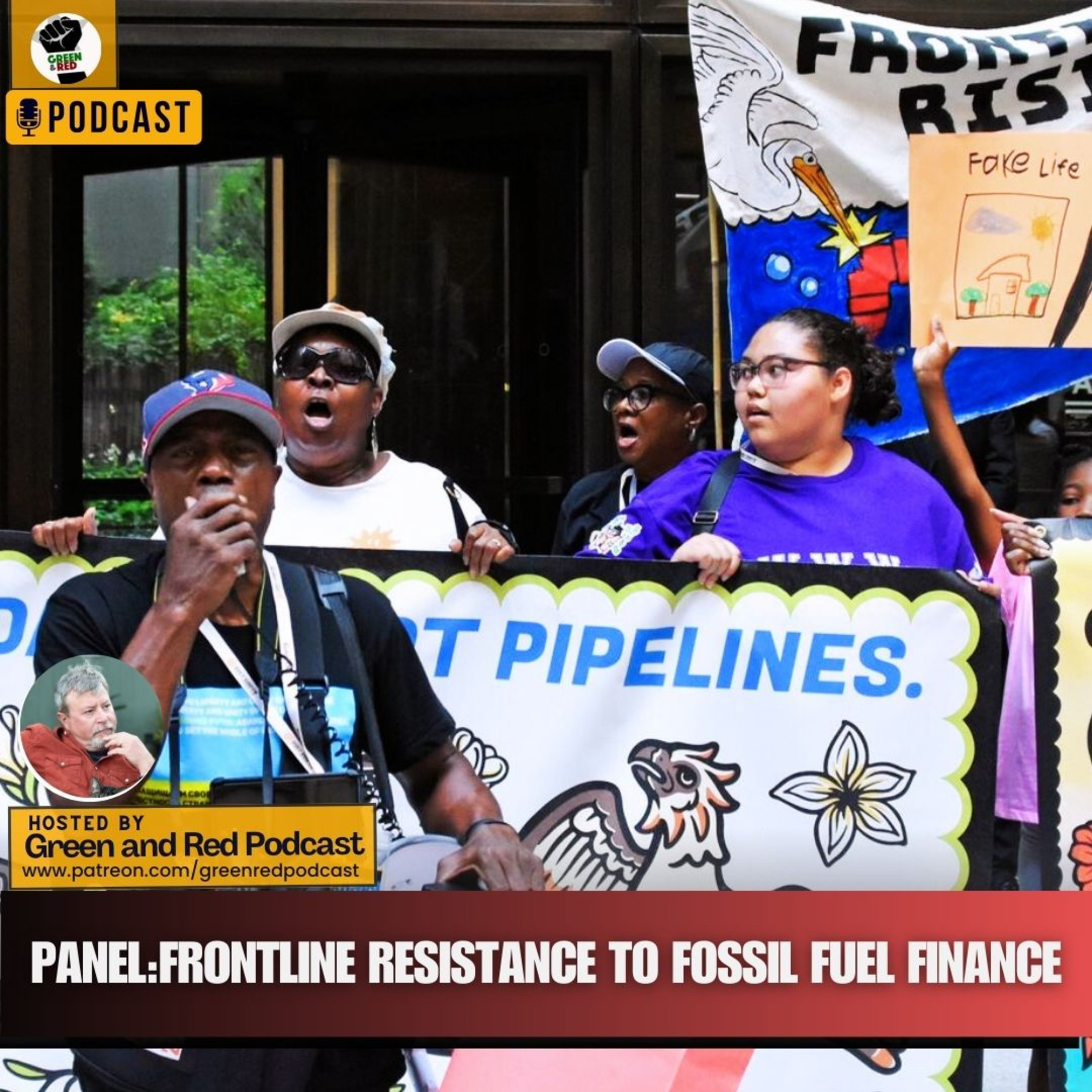
Green & Red: Podcasts for Scrappy Radicals
Frontline Resistance to Fossil Fuel Finance From the Gulf South to Richmond, CA (G&R 410)
01:25:28
Loading summary
Transcript61 lines
- [00:01]
A
Welcome to Green and Scrappy Politics for Scrappy People, a regular podcast on radical environmental and anti capitalist politics brought to.
- [00:10]
B
You by Bob Bozanka and Scott Parkinson.
- [00:30]
C
We're going to talk about the role that financial institutions play in harm and destruction and to communities in different environmental sacrifice zones, places like Richmond, places like the Gulf Coast. Then we're going to talk about the resistance and then we're going to talk about some, a little bit more deeper questions about some of the complicated ways in which we are organizing in these communities, dealing with everything from greenwashing to liberal hand holding of these communities. My first question, and we're going to just start down at the end of this, end of the panel and just work our way, but work our way down, but just maybe starting with Connie and Felipe, what role do big financial institutions like Wells Fargo, Chubb, the Japanese bank for International Cooperation play in the fossil fuel and petrochemical build out in your community or in your case, how those financial institutions having an impact on youth and why the youth climate movement is so engaged there?
- [01:36]
A
Yeah, thank you so much, Scott and everyone at ran at Stop Billionaire Summer Ogan at the this lovely venue and everyone who made this possible. Yeah, as Scott mentioned, my name is Connie. I'm with Youth Climate Finance Alliance. We are a youth led and centered network that helps both individual youth organizers and organizations build and wield power against the financial institutions that are powering the system of fossil fuel imperialism that. Oh, okay, sorry. That drives the harm in our communities. And there are like kind of a variety of reasons why CFA sees financial targets as so strategically crucial to the climate movement as a whole and why we've dedicated like our organizing project to building around this. So yeah, some of the, the biggest reasons that bring us to financial targets are that financial targets actually help us identify the real enemy, which is not just carbon or a specific company or a particular plastic product, but actually a system of profit that prioritizes profit at the expense of social exploitation, ecological devastation, oppression and harm to our communities. We really feel like by understanding the role that financial institutions have in not only enabling but then profiting from this extractive system, it allows youth and students to understand who the real enemy is that we're fighting. And it's these systems of racial capitalism and fossil imperialism. So, yeah, that's I guess some of why CFA really wants to prioritize. Financial targets such as Citibank, which is one of our primary campaign targets, is not only one of the world's largest financers of fossil fuel expansion, but also the largest financial, foreign financial institution in occupied Palestine. And we see a lot of also cross movement solidarity opportunities in financial target organizing because of the way that financial institutions are not only bankrolling one specific issue here or there, but actually show us that all of our fights are not only connected, but really one in the same. Yeah, another kind of major reason why we came into the climate finance space is a lot of YCFA folks came out of the 2019 kind of like climate strike mobilization moment where there was a lot of youth energy just around mobilizing around, something fell off. We were scared about climate change. People were excited to maybe go on the street, wanted to see change, but despite those really incredible mobilizations, often lacked both kind of a specific and clear demand set as well as a more durable organizing structure and organizing skills to bring that kind of energy to win actual change. And so we also see climate finance as a really powerful kind of container for that type of scaling up, building strategic demands. And yeah, I'm really honored and happy to have Felipe here on stage with us. Thank you for accommodating the change. Felipe is one of the leaders of YCFA's chapter program called Ignition Front out in Houston and would love to hear from Felipe about like, yeah, what what, what brought you to climate finance work and what youth and students can can do in this space?
- [05:51]
D
What brought me to this was a friend of mine, A friend of mine shared a, shared a, shared an Instagram post of YCFA organizing a something they called them a bonfire convergence that took place in Houston that took place in Houston where they brought people organized people who are organizing across the country to to Houston to connect build them up, build skills and tactics and all that kind of stuff. And and since then I've been actively involved with with helping out YCFA in any way I could possibly can. And one of the ways that I did that was helping organize a, organize some an Ignition Front chapter in my hometown of Houston. In my hometown of Houston. And if you know someone who, if you know someone who would be interested in, in organizing, I'm a condition front chapter in their hometown or their, or in their university. I'm a. Please don't hesitate to ask any, ask any one of any one of us and we'll gladly provide that information because the students are the back are. Are the backbone of of our of our current society and and it brings a lot of power to be able for students to be able to withhold their, to fight and withhold their commitment to join them. These financial corporations that are killing. That are killing us all. Killing our, Killing our planet, killing our neighbors, our friends, our family.
- [08:03]
E
Yeah.
- [08:07]
D
I hope that was short. I hope that was short as possible.
- [08:10]
E
You're good.
- [08:11]
C
I'm gonna pass that same question off to Mary.
- [08:16]
B
Thanks, James. And then if this starts going down, I will also bring it back up. But. Hi, everyone. How's it going? My name is. I lost my phone. My name is Mary Mujeres and I am a Richmond native. I was raised in Richmond, but born in the Philippines. And right now, like Scott said, I work as a campaigner with Amazon Watch to try and uplift the demands of the indigenous organizations that are resisting extractivism in their territories across the Amazon biome. And so finance campaigning in a lot of ways has provided the communities and us with a really interesting leverage point and much to what Connie was saying, a way to build movements across borders right from the Amazon to coastal cities, fishing communities, as well as folks here in the United States. And so I actually prepared a lot of notes, so we'll see if we can get through all of them. So, Scott, feel free to stop me. But my main objective here for this first part is to really point out the explicit connections between the sites of resistance from the starting point of oil extraction in the Amazon to the end point of its refining in coastal towns such as Talara, Peru, which is basically, I don't have a map right here, but if you can imagine, the Amazon is on the right side. Yes, on the right side. And then you have the Andes in the middle, and then on the coast you have the Pacific Ocean and that's where the refinery is, refineries are. And so, yeah, hopefully I'm hoping to elucidate these connections more in Peru, in Richmond, and also even to the Gulf south as well. And so for us, or at least our style of campaigning, I'll talk more about it in the context of site fights. And whenever we think about targeting financial institutions, one of its main uses is that it could be a great preventative tool to delay or even stop projects entirely. And it begs this question, what happens in campaigns where long term financing is already a given? Right? If money is already there, if the maturity date is 20 years from now, what can we do with that information? How do we strategize around that? And so to answer this, I'll talk about actually a finance campaign based in Peru and in the Amazon and hopefully thread that here to the Bay Area in California and also the Gulf South. And so I'll first talk about actually the importance of The Amazon Basin as a site where I think all of us as a really important site for the planet, especially for combating more climate catastrophes. And so the Amazon rainforest is the largest rainforest in the entire planet. And it spans over 7 million hectares and covers nine different South American countries. So you can think of it, it basically covers almost 25% of South America, which is astonishing. It's huge, it's massive. And it also houses one third of Earth's plant and animal species and also produces one fifth of Earth's flowing fresh water. The Amazon is also home to 400 distinct indigenous organizations or peoples nationalities, some of whom still remain in voluntary isolation. However, if 20 to 25% of the forest is deforested, it will reach an irreversible tipping point in which the forest's capacity to be a carbon sink becomes no longer viable. And so financing any oil extraction or any companies that accelerate the degradation of this rainforest presents an existential threat for all of us, for all of humanity, for all communities really. And so for millennia, indigenous peoples have preserved the rainforests and Preserve in general 80% of the world's biodiversity. And so that resistance still continues today in the Amazon. And so one of these site fights actually centers around the North Peruvian Amazon and starts with a block called block 64, which was illegally created by the Peruvian state without the free, prior and informed consent of the nationalities that live there. And so since 1995, for over 30 decades, the indigenous organizations, which include the Achwar, the Chopra and the One Piece, have taken a strong position against all oil activities. And in that span of three decades, they successfully kicked out over four different oil companies in their lands, meaning that there was no oil drilling whatsoever in their territories. And so as Amazon watched and as campaigners, we seek to really support these campaigns like on the ground and these efforts. And one of the leaders who we've worked with always says, you know, we always have to knock on every single door. Doesn't matter what door it is, we knock on it and see what opportunities can come from it, right? And so after they kicked out the company Geopark from the, from operating on the block, the state run company or the national company of Peru called Petrollos del Peru, began operating that block. And so this is a company with a lot of history of spills which I won't get into for the sake of time, but they also were responsible for the build out of a refinery off the coast called the Talara Refinery. And this is where the banks come in, our best friends, the banks. So in order to undergo this modernization, they actually solicited the help of financial institutions which included a Spanish, oh no, Spanish export credit agency, also an insurance company basically, and banks from all around the world, which includes Citi, JPMorgan Chase, bank of America, Deutsche Bank, Santander, HSBC and a sleuth of other Japanese banks. And so in total, the refinery's budget tripled, almost tripled to $6.5 billion. And another form of insurance for national oil companies is actually their taxpayers. Right. So in this, in an attempt to try and recoup its debts and if things don't go their way, then they just get bailed out by the Peruvians, unfortunately, without their, you know, without their consent. And so knowing this information and knowing that the banks were there and the banks were involved in that financing, the nations on the ground said, you know what, we're just going to go for it. We're just, just going to go for it. And so we embarked on this basically two year campaign targeting the financial institutions that were financing this particular project. And so that's where the trickiness lies, right? It's a refinery that's off the coast that could drill Amazon Oil. And so how do you campaign around that? Long story short, basically we've. And really this is a testament to the organizing on the ground and the different layers of strategizing both local, locally, nationally, regionally and internationally through finance campaigning that's led to really enormous victories to keep oil companies out, which includes media coverage, movement building across. You know, they've built this really interesting coalition with artisanal fishing communities off the coast, which is really cool. We have pictures, if I had pictures here, I would, I would share it later. It's really nice. And then also building movements with here in the United States as well because there's a lot of parallels into similarities. Right. And in terms of tangible financing stopped. So in 2023, yeah, there was like a two month period where an Italian export credit agency was about to give 500 million through a loan guarantee to the refinery and that didn't come into fruition. So there was the financial close, never happened. And in 2024, in an article on Bloomberg, it said that Citi and JP Morgan were also in talks with Petro Peru for a $1 billion bond issuance, which also never came into fruition. And in 2025, and I think this is the, I think the best victory so far. And of course things are still happening, we still have to be vigilant. But Petro Peru tried to auction off Block 64 in May and there were no takers. Some news articles said that CNPC and Saudi Aramco expressed initial interest, but ultimately never made that deal. And so this victory, it kept 55 million barrels of Amazon crude underground and kept 760,000 hectares of the Amazon free from oil drilling. And so thank you. And so to close off. And this is where the topic of refineries come in. Right? Because where there's refineries, where will that grow source of crude come from? And as someone from Richmond and someone who's learning more and more about the Chevron refinery, because growing up, it's not something that, you know, no one really teaches you the impacts of those refineries, right, to your health and to your well being. But California is one of the main importers of Amazon crude, most of which actually goes to Los Angeles, mostly in the Los Angeles area, but also a small percentage here in the Chaperon refinery. And actually I was looking at the data yesterday and historically it has a small percentage of Amazon crude has also gone to refineries in Texas, particularly in Corpus Christi and Port Arthur. So as you can see from the sites of site of extraction all the way to its transport and even its refining, banks play so many roles. And throughout my time here at Finance campaigning, you just keep learning more and more about the ways in which banks are involved. And I think it makes it such an interesting lever to use and to really use whenever we can, because everything is connected. Thanks.
- [17:58]
E
Yeah, thank you. My name is James Hyatt and I'm from southwest Louisiana with an organization called For a Better by you and you. I think people don't understand what the impacts are for people who live alongside extractive industry. My mom was from a tiny little town in Kentucky. She grew up in front of a coal mine. This same system that extracts and exploits and puts profit over people has been going on in different iterations since the Industrial revolution began. And it continues because collectively people feel like there's not enough power to be built. That the moneyed interest from where I'm from in Louisiana, that the moneyed interest and the power that be the thing that continues to employ folks and make the economic. You know, the reason why we exist is because we have refineries is a mindset that is the furthest thing from the truth. But you can't wake people up to that reality until it ends up in their backyard, until this thing is showing up. I don't think people understand how forever, like the extraction and exploitation of people is the root cause that we don't Value each other. We don't see each other for the preciousness that our lives are. My life and your life. Like I said, I worked at a refinery for 10 years and one of my right now, one of my closest friends has got stage four cancer in his terminal. I mean that's not okay. That's not okay that some people's lives and this is the same heart of the issue that we don't value human life or these corporations and the people who are only concerned about making money on top of everything else. You can't mitigate from the hole in the ground until it is finally burned. Fossil fuels have caused harm. God, and I don't know how you can articulate that to another human being who is in these banks. Except they have to understand that the way they're not operating is just or fair or they've never been held accountable for the harms that they have caused and they are continuing to cause. And the only way we can beat these things is to come together across a lot of difference. We work with a lot of conservative folks who voted for Donald Trump who believe in the MAGA movement but they also believe that this government is made up. It's supposed to be made up of we the people. And they are also becoming more and more aware of the way that corporations control the bodies that regulate all of the laws and then they control the legislative bodies too in Louisiana. And I think the veil is being torn across much of our eyes. Right. All of that is related back to financing. That is a lever if you can no longer get your government to do for the people because they are co opted and bought out. And maybe there's some good politicians, I don't know, you know. But it's not left and right that we're fighting with. They keep us fighting each other over things when we are so aligned on we want clean air and clean water and food we can that aren't full of contaminants and known poisons and why we cannot find a way to help others. Wake up. We have all of these liquefied natural gas plants in southwest Louisiana. We have three operating ones. We have two huge refineries, all these plastic production. And so there's so many things to target and to have a site fight and we have, we've had site fights at different places. But the underlying thing and when you talk to other folks who are impacted, the underlying thing is that people want more money. They can't get enough. Enough is never enough. And so for better by you even I'm Sorry, I'm like ranting, raving. And I didn't go to church this morning, so it was good to be in church. It's impossible until it's possible. And I've met so many good people in this movement who understand that we have to build power and solidarity more than our echo chambers. We don't need to build more echo chambers or louder ones. And we need to have conversations with folks we don't agree on. That's where I'm from in Louisiana, because most shows I don't agree with. So we have to find a way. And the most unifying piece that has gone on, we have carbon capture coming in these rural parishes. We have all these other things at the heart of it. People are waking up to the reality that money is running things because we are so fractured among so many things. And we have got to find a way to come together and realize that it is the moneyed interest that we are up against and especially held by these banks and private equity. And I don't know, I keep ranting and raving, but I'm so grateful for the opportunity to come to Berkeley, which is historical stronghold and for somebody, one of the Berkeley professors, and I'm going to forget her name, Arlie Hochschild wrote, wrote a book called oh My Goodness. And she came down to Lake Charles in 2016 and tried to understand why the Tea Party, why people in South Louisiana, why people continually vote against their own self interest and in the best interest of the collective. And that was because everybody thinks that somebody's cutting in line ahead of you, ahead of that American dream that you're going for. And then now you see this other group, the scapegoat group that's coming in front of you and now that's somebody we can disagree instead of reorienting and flipping the tables on the way that things actually are and putting the will of the people to work and not the will of the corporations. And it's not just environmental justice, it's also justice for Palestine. It's also justice for every place that is financed by the hatred of men in suits, in a bank, in a building completely disconnected from reality, in this world and. And this land and each other and. Yeah, I'll stop there. Thank you. Thanks for. Thanks for having me.
- [25:32]
F
Chris Demencias Carristo Comercial Tribe of Texas yeah. So for about 10 plus years, the tribe has been working on changing narratives, the narrative of what can define us, of coming together.
- [25:50]
B
Yeah.
- [25:50]
F
Even though that we don't. Our site, our site, our fights don't look the same, but they still deal with the same kind of backing of interests and greed. And when we talk about extractive industry. Yeah, that it just, it separates us. And extractive industry doesn't look like where I'm fighting or where James is at or where they're fighting in the Amazon. It doesn't look the same or what it looks like in Houston, Texas, but extractive economy does. That's why these, that's why we are talking about these finance financial entities. Because extractive economy affects all of us. And when I say all of us, it. It's extracting people, it's extracting land, it's extracting water, and it's exact extracting our existence for our future generations to live, to continue to have clean air, clean water, pristine land and healthy food to eat. What are we leaving for our children, our great grandchildren and their great grandchildren and seven generations after that if we continue to allow extractive economy to affect what they're doing as their profit in their pocket and not people power. That's what the tribe has been fighting for about 10 plus years, especially in the state of Texas, where right now everything is changing. Where it's the law, where it's in the school system, whether it's in your own backyard. And you know, when we talk about it, we're talking about why we are here. We the tribe, in past 10 years have been able to get financial people to divest in the coming of these industries like the LNG's. We've even had an LNG back out in one of where our. Where they want to build them in South Padre. I mean in Brownsville, at the port of Brownsville. And we've been able to continue that fight along with the community there. Not only because it's not in their best, it's in their best interest and not just in ours. But we're there to protect this land, that pristine land, this beautiful, untouched last part of the Texas Gulf coast that barely has industry, there's no facilities. And we don't want it to look like it does on the rest of the Gulf Coast. We want it to still stay the same and to maintain that our identity as indigenous peoples of the land have now become the front line. We're not just a front line. We are the front line because we are maintaining to protect the identity of our people. The history of what is Texas, the history of what is the land and the water, the air we breathe and all our children. Doesn't matter who we are or how we identify ourselves. But who we are in the future, what does our future look like? And continuing those fights makes that stronghold even better. To be able to build resistance with each other, saying, extractive economy affects their money, not ours. And we say extractive economy because we're fighting harder and harder to make sure that they understand that we're not going nowhere. We're all coming together and realizing no matter what side of the country on north, south, east, west, we're going to stand up and fight with each other. And this connection from the Gulf over to Oakland, Richland, San Francisco, and making these fights, doing these things, it makes our stories being heard even amplified more that you understand what is happening on the Gulf coast, what you understand what is happening in Central America and South America, what is happening just along our colonial borders that we live in within our own states, not just the federal borders, but what's happening within our states. Those borders shouldn't even exist. We don't live in territories. We, we live as human beings on the land. And if we stay connected, we can be powerful. Then it's the break of like, I live in California, I live in Texas, I live in New York. Why are we battling each other when we can say, hey, we're fighting extractive economy. Join us. Let's take them down. Let's stand up and say, no, no more. Get out of my house, get out of my home, get off our land and don't ever come back. Because we have that power. We as human beings on this earth have that power.
- [30:31]
C
My next question, so the two next questions I'm going to combine into one thing for you all to talk to say, so how do you most. And this has been addressed a little bit, but just to get into specifics too, is how do you most effectively attack these. Finance these fossil fuel financers? And then can you tell the audience about any specific successes or wins you've had fighting these financiers?
- [31:03]
D
One that can definitely think of on the top of my head was when me and some others in YCFA and some local. In some local Chicagoans, I'm a organize them. Organize a protest and a direct action against them. So I can't.
- [31:26]
A
It was at an event called Sustainability Live, which was like a conference for corporate executives that focus on corporate sustainability.
- [31:37]
D
More like sustainability lies.
- [31:41]
E
Yeah.
- [31:42]
D
Anyways, we had, we had some set. We had during our planning. We had some setbacks because one of our primary targets, Emma, I believe, I believe it was a one of like one of the top people from Citibank was supposed to be A keynote speaker there but ended up not showing up but luck but we had. But we planned them on. On handling other targets any in any case but to make, to make a long story short, we managed to shut down an entire day of, of programming for sustainability live on the very first day. And then when, and when the second day came, they decided the, the organ, the organizers of the conference decided to strip all student, all student visitors of their ability to attend which lines with one of our goals to disrupt the. The student recruitment. The student recruitment pipeline, which really rocks, I'll say that.
- [33:02]
A
Yeah, thank you so much for sharing, Felipe. Yeah, just to maybe like elaborate that on that a little bit. One of the strategies that YCFA and through our chapters Ignition Front are really interested in continuing to build up is this idea of recruitment disruption which is kind of just a term referring to a whole host of tactics that try to disrupt the entire pipeline that funnels students from our communities, our schools to work for corporations like Citibank and these other financers of the fossil fuel infrastructure that is so damaging everywhere from the Bay to the Gulf south and around the world. Yeah. And we're really excited about this because it leverages our position as youth and students not only as like consumers of a university, like oh please, university, we want you to do this, but instead recognizes our power as the future labor force and recognizes that these institutions can't operate without like waves and waves of fresh recruits working long hours trying to like actually carry out the operation, the day to day operations of these financial businesses. And so yeah, that's like one of the ways that YCFA is interested in trying to really directly disrupt the flow of labor of capital here from the belly of the beast out outward. And yeah, that was. Yeah, sorry, I forgot the second part of your question, but I'll stop there.
- [35:00]
C
I mean they're very similar. How do you effectively challenge, how do you effectively fight the fossil fuel financers? And then also can you tell the audience about any specific wins or successes you've had?
- [35:15]
A
Well, it's awesome that one of the stories and case studies that we point to a lot and talk with students about in our trainings is the involvement of students in the campaign to have bank of America have an exclusion policy for financing coal. And in the kind of like.
- [35:38]
B
I'm.
- [35:39]
A
Going to get the years wrong. But I think it was like the later part of the 2010s.
- [35:45]
C
This was like 2015.
- [35:46]
A
2015. Okay. Yeah, I think this was a campaign that tried to come at bank of America from all Ends like organizing customers, trying to have inside meetings with bank executives. And one of the moments that really brought energy, power and heft to the demands of this campaign was when students got involved in. And we started a movement around saying that we don't want to work for bank of America if they continue to finance coal. Like, I don't want to work for a corporation that is actively financing the destruction of my future. My family is my community. And so, yeah, it's like, a lot of admiration for the work that ran and student organizers did there. And, yeah, it's a strategy that we hope to continue building up and seeing more wins from. And yeah, just a plug. If there are any youth and recent students in the audience that want to get involved, you can go to. Not your future workers.com or talk to me after.
- [37:06]
E
Hello?
- [37:07]
B
Yeah, so since I talked a little bit about the victories and the bigger overarching wins so far of the different campaigns, I think for me, we'll go off the movement building piece.
- [37:18]
F
Right.
- [37:18]
B
Because I think movement building is a long process that takes time. It's best done if everyone's together in a room. And that can't happen all the time, particularly when folks are deep in the forest and there's a whole mountain range dividing you between, you know, the coast and, you know, the Amazon. So I feel like I'll elucidate a little bit more on the Mara Amazonia alliance in Peru, which was really foundational and really crucial in helping have these, like, tangible wins. And so. And also, yeah, so I'll explain more of that alliance and how it came to be. And so to explain a little bit more about the coastal communities that are affected by the refinery, they have organized themselves because that coastal city has long been impacted by the fossil fuel industry and drilling. And actually, if you take a tour around some of the towns, you see oil wells actually prop up. And so there are pools of oil wells just in different parts of the city, and some parts of them are actually in the schools. And so many students have had to relocate in different buildings because there were oil wells there. And usually what the government does is that they would just essentially put sand over it. And this is what the local organizers have kind of shown us. And I haven't been to the Peruvian Amazon, but they have very similar stories of those spills not being remedied, not being taken care of, and compensation from the authorities and holding the oil companies that have done that contamination. It's little to none. And so I think being able to really see that process where you have the leaders, indigenous leaders, really exchanging with the fishing communities and really having these demands for no more fossil fuel expansion in their territories, I think is really crucial and I think a really pivotal part of organizing because you can't have any campaigns without that strong position of resistance. And so that is, I think, the core to why victories happened in the first place. And then I think going back to the banks, part of things. So once this core part of the resistance is more solidified, I'll tell the story of the delegation in 2024, which I thought was really cool, just being able to see folks kind of interact and share their stories. But we had a delegation of three different leaders from one piece in the Chopra nations. And Again, the Block 64 spans 760,000 hectares of the Amazon. So that means their territory is actually Spanish and collectively a lot more. And they have their own politics, right. They have their own way of organizing. They have folks that might be delegated to do more of the international relations, they might have folks delegated to looking at more of the health of the communities. And so it's a really interesting way of organizing. And I've learned so much just from talking with the leaders and all that. To say, when you talk to banks and when you try to explain, I find it interesting because.
- [40:44]
F
Right.
- [40:44]
B
I mean, they sit there and then they listen to you, but then they say nothing back. Well, unfortunately, that's how the banks are like, right. Because of confidentiality reasons, but another win. And for what it's worth, I think even being in the same room and them having to sit there and listen to the people most impacted by this financing, especially if they come from so far away, I feel like that's one of the main things that a lot of the leaders look for is to have a place to be heard. And so when banks are like, sorry, we can't make an hour long meeting with you, when folks are traveling thousands of miles to meet you, you just have to make it happen. And so that's where campaigning happens, right? That's where pressure happens. And so, yeah, last year I think some of the banks express that, oh, we can't meet with you because it's a little inconvenient for us. What a virtual meeting. They're like, no, I don't know, we can't meet with you. And so I think with the support of many people in this room, actually they eventually agreed to a meeting, series of emails, letters, campaigning, linking with investor groups. And so having that like in person meeting, I think does mean a Lot. Obviously there's a lot of follow up that needs to happen and a lot of other kinds of campaigning that needs to happen. But I think that also plays into the overall strategy, the engagement. So yeah, hopefully that makes sense.
- [42:18]
E
I just want to follow up on that because I think there's so much that can be done with pressure on these huge banks, especially investor pressure. We have seen that happen, especially around one of these LNGs. The investor pressure on the insurance company was able and it wasn't just from one angle. It was from the fishermen, it's from local impacts, it was from dedicated campaigners continually to call and pressure to get in person meeting. And not just one in person meeting, but a series of in person meetings and Rainforest Action Network postcard campaigns. A lot of pressure is what it took to get Chubb to pull out of one project. Did they pull out of all of it? No. And so that's why it has to be continued. Sustained pressure. And it's so annoying to me to know that people who live on the Gulf coast can no longer afford the insurance for their house because of the storms that we continually have and the way that they've had to rebuild since, especially in the last 20 years, since 2005 and Katrina and Rita and Harvey and Ike and Gustav and Maria and maybe this Aaron, because of all that, you can't afford insurance for a house that maybe you've rebuilt five times and maybe you built it in a place where you're grandparents were from. You can't afford that. But these companies can continue to make money by insuring other fossil fuel. And that is the direct cause of our collective addiction to fossil fuels is the direct cause of climate change. And if you don't believe in climate change, like it's where I'm from, most people don't believe that climate change is human, caused by our addiction to more and more and more. You have to recognize that every one of these fossil fuel institutions and facilities have been directly responsible for unnecessary suffering and premature death of countless, I can't say countless. These are individuals that people know and love and they've had to suffer so that we could. Whatever we can do with fossil fuels, you know, whatever part that you negotiate with every day within the system that you're okay with. Like, okay, it's 100 degrees in Lake Charles and 100% humidity AC is a good thing. If I know that the AC is running and is leading to the impact of children and that children who are around frac sites are two to three times more likely to get leukemia. So from the time they extract it and they pipe it and we burn it, it's not just the climate impacts, it's people's lives and people's livelihoods where they place these things. Where fishermen are connected to the land and the water and depend on like the rest of us, but are really in tune because they depend on other things that we are interdependent with and the system is out of balance and they can't catch any shrimp. And what changed? They built a fossil fuel thing at the mouth of the river. They built an lng. So these insurance companies and the financiers are directly responsible. Maybe they sit, maybe they're six degrees removed from the harm that's caused, but they've never been held accountable for it. And if you know better, you should act better. And if you know the true cost of being dependent on fossil fuels, maybe you will do everything in your power to reduce your. Your consumption. And I'm not. I'm the hugest hypocrite. I'm also a victim, and victim's not the word. A party to the system that we're in and conditioned to. But we have to wake up and wake each other up and build power that says that whatever little life we get on this earth, however long we get to give, live here, is special, is precious, and so is yours. And so is this damn banker who wants to just make another dollar. And so is until we actually get to the point of being able to change people's hearts and minds with the grief and the suffering of our fellow humans. Until all people, we have to continue to campaign. We have to continue to find the levers that are working. Yeah, if we had raised up enough people to vote one way or the other, it would still be this way. Because we are addicted to a thing that we are unable to apparently pull ourselves away from. Because we look and we negotiate every day with the system. On what part of it I'm okay with, and one part I can't stand to be a part of. I don't know, maybe, maybe that's for me. But there's a lot of parts of this I can't stand to be a part of. So we win. When we get together, we are able to take a chink of the armor as much as we can together. But we got to get more people to wake up to this. We got to get more people to stand with us in solidarity and know that the system, it's going to change. It's either because we finally love each Other enough, or it's because we let it continue out of balance and there is no choice.
- [48:34]
F
I think the theme right now for these questions is pressure and the continued pressure that our communities continue to fight against these financiers. And we do domestic, but we also do international as well. And going to Japan, Italy, France. And you take my father, who is a 64 indigenous man, long hair, mad as hell, to another country, and in his words, tells them, get the fuck off my land. How do you think they respond? Scared as hell. Right? They're not expecting this because they're intimidated by him, but just by how tall he is and the way he looks. But the. The understanding that we're done, we are tired, we are mad, we are upset, we are hurting, and we don't want to just fight for survival anymore. We want to continue to live in our communities to be peaceful. So when we talk about success, it's not just my success, it's not our success. It's. It's the whole community's success. It's the success of everybody fighting industry, no matter where part of the world. Because these people, these financiers are financing these kind of projects all over. They're killing people like in Palestine. They are killing people in their own countries. They're killing people in South America and Central America. In America, in the United States, and definitely in the Gulf coast and in the global South. And we're not talking about that. That's the thing as our success. I mean, we've been, like I said, we were able in 2020, in Covid, where everybody was on lockdown, to fight these three LNGs and get one to just back out of the thing all together. Nova LNG. We've been holding off Texas LNG and Rio Grande LNG since 2015. They should have been built in 2018. The only Texas. No, Rio Grande. Rio Grande LNG is only in phase one of its facility building. It's 2025. It was supposed to be built in 2018. I mean, we've been able to be successful by stopping them, by getting their financiers to divest, their insurers to divest. We just recently had Chubb Divest insuring Rio Grande LNG and future projects in that area. Why? Because we challenged their system of how they rewrote, how they value wildlife. And why can't we make sure that a rest of these banks, that the rest of these insurers do the same? But what. The only difference now is that Chubb's still investing in projects Ensuring projects are left to go south. But you know what? It's not. Doesn't stop with me. We continue to fight Chub, too, because our friends and our relatives are being effective in other places. That's the goal, is we have to stick together. Just because they divested from us, they people, these people in their communities are still dying. So why are they not valued? Why is it just wildlife valued? Why aren't people valued? And that's, that's what we need to keep pressing on, on finance, financial entities and the insurers, because people are valued. We value each other, so they should value every one of us the same. And, and we can just continue that fight. You know, we literally stopped the border wall in South Texas by putting our bodies in front of the bulldozers and telling Trump, you ain't going to be here now. We sued them. If you, I mean, you. We sued Donald Trump in his first term and won. And nobody knew about what was happening, but we stopped him in his term. When he's hailing, he's going to put this wall. There's no wall to fence about this high. He can talk about his big wall. He wants that everybody else did, and you fell into the, into the water. But the fence is this high and it's some places four to five miles from the Rio Grande river like we're talking about. They have to. CBP has to contact us every 30 days and let us know what happened. That's how we won our loss. So we didn't want money. We, we wanted to be. No, we want to be notified that you can't touch our land without our permission. You can't take from us without us to say no. And so, like, when we talk about success, it's about. It's not about just us. It's about all of us. It's about how we come together because we stand together, we fight together, and we continue that power across this country, whether we're indigenous, we're not indigenous, whether we are immigrants, whether we're second generation, wherever we come from, we're young, old. It's about us and it's about our people. It's about how we stand together and fight. And when we say we have to provide pressure, it is the pressure not just from our communities, it's the pressure from each and every one of us.
- [54:24]
C
So my, my next question is, what would you say is the biggest threat you're facing? You facing your communities and how people here can help with the fight.
- [54:41]
D
Flooding. Houston is very prone to flooding. We've had many different, many situations where, where, where Houston has flooded Ike Harvey barrel barrel unique barrel, you name you name it. The main problem and of course one of the main problems is of course I'm a, I'm a upgrading our infrastructure upgrading our infrastructure to to be able to help us be able to at least withstand them another another flooding that to that would occur. The only way people could help is the pressure is the pressure is build pressure is to build pressure on the powers that, on the powers that be to get them to put people put people first over over some corpo hacks and billion and billionaire fraud. Billionaire frauds, I'm going to call them frauds because they are in my opinion and not have any and, and not have these catastrop cat. I'm not saying that we'll be able to prevent them another catastrophic event. We just need to. But we don't want people dying every time because every time this happens, people die. And the powers that be like those in the state don't care. Don't care about what, don't care about what happens to us. All they care about is making sure they're making, making sure they stay in power and they line the pockets of their little donors.
- [56:37]
C
There.
- [56:37]
D
That's my piece.
- [56:39]
A
Yeah, thank you for sharing, Felipe. I won't say a lot more, but I think, yeah, just I think what Felipe is maybe speaking to is that as climate catastrophe continues to worsen and those of us on the on front lines are having to attend to the immediate rapid emergency harms of floods of disasters, it can be a strain on organizers and our communities to at the same time be battling on the front of finance campaigning and also be trying to just make sure that your neighbors are fed and have their medication and like that their lights are on. And I think that as many of the others in the panel have alluded to, that is why talking about building power and organizing is so important. Because it's the same kinds of skills of knowing how to like do outreach to people in your community, of knowing what resources you collectively have, how can we distribute them to meet our needs. It's those same skills that we use whether we're trying to make demands of financial institutions or whether we're trying to just make sure that our neighborhood is safe during a storm. I think investing in community organizing skills and investing in that kind of infrastructure is really key to facing the not only impending but already present threats of catastrophe and what that brings to our frontlines.
- [58:30]
B
Yeah, I definitely agree and I think there's the Richmond piece that I'd like to talk about, but then there's also the Philippines piece. So I'm like, what do I talk about? And I think everything is just connected. And so on the topic of the recurring climate catastrophes, you know, I have a lot of my family still back home in the Philippines. Infrastructure and investments in disaster infrastructure, especially when, you know, recurring floods happen, when the heat is just too much, the humidity is too much, it's just not there. And so I have actually also had family members whose houses have gotten flooded multiple times. And it happens all the time. Happens all the time. And so this is also one of the main reasons why I've dedicated my time and my life to environmental justice work and climate work and really uplifting the resistance of folks in the front lines. And so in terms of, I guess, the biggest threats, right, in addition to climate catastrophes and having to respond immediately to these horrible things that are happening and deaths, one of the things that. It's been interesting to hear more from Richmond organizers and really understand the destruction that Chevron brings to our backyards because like I said earlier, it's not something that's talked about in schools. The refinery could be 10 minutes away, but they don't explain, yes, this refinery could lead to elevated rates of cancer or asthma or all of these horrible things. And actually working for indigenous organizations and working with them. That's when I started to realize all of these links and all these threats are just like incredibly connected. And one of the things that keeps coming up is this really this need for remediation and remedy and compensation. How come we have billions of dollars being invested into fossil fuel companies, but little, little buckets into compensation for folks most affected by oil spills, contamination.
- [60:32]
F
Air.
- [60:33]
B
Just being polluted and all the deaths that come with that. And then I think another note is this topic of the just transition and the threat of false solutions that come with that. And I think Krista was talking about extractivist economies. And especially when we think about the critical or critical minerals and its extraction, it still does depend on the extraction of natural resources from the earth. It's finite. And so there is a danger that it could very well replicate similar systems of harm where communities are rendered as sacrifice zones. And so I think there are more discussions being had about what that means, what does a just transition mean? And I think those conversations are being had in Richmond, being had in other places in the Global South. But I think that for me was coming up in the conversations and just kind of like linking, linking all of it. Together. And so in terms of how to support too much what Connie said, I think definitely thinking about investing in communities and regenerative projects, because communities have their own solutions and oftentimes people don't listen, but they're there and they're creative and they're fit for the context that they're in. So I think material solidarity for sure. And then also movement building. And I think the theme for tonight, creating pressure and making sure that we're not in silos and we're all together in fighting the common enemy.
- [62:08]
E
Yeah. Just to echo on that part, you know, today's solutions are tomorrow's problems. I'm not sure if you've ever heard that, but, you know, a huge push to get off coal was to get on gas. And the huge push to get off gas and to get on to lithium or something else, it's gonna be the same. Like, we have got to reorient in a way that keeps us. Keeps us also able to stay together. The problem is these corporations are receiving taxpayer money to also go into the community and pollute. We can't get air monitors in most of the places in Louisiana, but somehow these corporations are exempted from billion dollars a year in taxes. In a place that has 2,000 people, 2,500 people that. In a place that has $16,000 a year premium, unaffordable ways of living, no hospital can't afford to pay their teachers. They finally have gotten some of these companies to give, out of the goodness of their hearts, some money back to the community. Pennies on the dollar. I mean, fractions of pennies on the dollar of what they've received In a place that needs. They need this revenue because they cannot afford to fix the roads the way that we are able to. To highlight those things and what people can do outside of the corner that I live in in southwest Louisiana. One thing you can do is amplify these stories when you see them right now. There's an absolute ecological disaster that has happened because they did not pay attention to what they were doing. And they spilled mud into a place where the shrimp have to transit into the wetlands, in a place where they knew better. And this is One of these LNGs in the port who was doing work for them. I don't think there's a better way than to find a local community organization and to join it and to use your gifts and talents to organize your own community locally. And if you're not a part of something like that, if it's a church group or a Civics club or a book club. We've started, along with most people in this country, to see more and more people on the streets who don't know how to plug in, who just show up and are happy to hold a sign and thank God they show up and hold a sign. There's other ways, especially in southwest Louisiana, that people can get involved in actively organizing themselves and centered around. Around the power of the individual, not the power of the individual, God forgive me, our own individual place in this world and how we are so interdependent and connected and that none of us exist in an island and that none of this could be possible without a system that was handed down by ancestors who were also colonizers and also the laborer. Anyway, we can't get to that point until we find out that there's the disparity between the people who have all this money and the rest of us who are just trying to make a living and to eke out a life. What kind of life is it if we're only eking it out and we don't find joy and solidarity with each other? So thank you.
- [65:58]
F
So in Texas, it's just a big battleground right now. You know what we are facing? Everybody in the state is this state government, the state government, local and federal government and corporate greed. That's what's happening right now. Who's going to take control of everything and for somebody else's future and it's not ours, and that's not good. And I know you guys that live locally here understand the concepts of earthquakes. There's in Texas here you have the San Andreas fault line. In Texas, there's an unknown fault line called the Balcones Escarpment that's been, you know, dormant for a long time, for hundreds of thousands of years, and now is waking up. Why? Fracking. Fracking in the area that is where it's predominantly active, supposedly active, we're having frequently earthquakes all the time. And let me say this, let me put this in your head. When you have frequent earthquakes, what happens? Something else goes wrong. We had this massive storm or two tropical storms aligned in Central Texas and dropped thousands of gallons of water and flooded the Guadalupe River. There are seven pipelines that run under this river. When you change the face of how the river flows naturally and it's been drying because you're taking the water, you're selling the river water for fracking to the industry, all of a sudden this water drops and. And you've changed the way it flows. What happens? You have this mass flooding, you have nowhere else for this groundwater. Where a lot of the rivers in Texas come up from, start from under the ground. They don't come from major river lakes and stuff. No, they come from underground water. That's where they start. And where else is this water going to go if you change the face of what it looks underneath? Everywhere else you talk about killing hundreds of people, most of them children. I lost a family member, I lost a young cousin, she was in her 20s. And you continue to let and promote these government entities, these financial entities, this economic extraction of them taking away from people and then find out the rest of the BS why there wasn't a system in place to serve these people and why this loss of life could have been taken two weeks before that. San Antonio had a rainstorm, it flooded, killed like 10 people. Nobody talked about that, but it was one storm right after another. We keep changing the way the rivers flow. When in Texas we have all this fracking, we have all these pipelines. And they want to continue to build pipelines through just anywhere. They want to build one major one that's going to be almost 900 something thousand miles going all the way from one side of Texas to southwest Louisiana, the Della Express. Then you know, ET wants to build another one from on the opposite direction of the Wahaha. But the on the east side of Texas going to Arizona, through Pueblo land, through other indigenous land we're talking about, they is they're constantly attacking everyone in our state. So and we have to make sure that we hit every financial, extractive and economic industry we have to attack in Texas. Our state legislators that are not representing the people but themselves in the linings of their pocket. We have to attack the governor and the President at the same time. We're facing a crazy, this crazy statehood of the so called brotherhood of money billionaires. And, and then yeah, we gotta attack the billionaire Elon Musk who is literally destroying our sacred site, our homeland. Where our story begins, of our life, story of our people begin in Boca Chica Beach. He's literally right on the beach. It's like SpaceX the beach.
- [71:01]
B
Yeah.
- [71:02]
F
And it's, and it's scary that nobody understands. Every year the turtles come up there to lay their eggs, birds lay their nests. And he's blowing up rockets at the time of their nesting. At the time they're nesting. So he's destroying the ocean life and doesn't even care and they're just letting him get away with it. He's now he's got permits to have his that he's already, before he even got the yes, he was already building his Starbase city. Now it's almost done, now that he got the approval to have it his own private city. So I mean, in Texas it's a lot of things happening, a lot of things that are, that we're facing and we're fighting it all because it's not affecting just us in the tribe in one location. It's affecting our people everywhere. Everywhere. And what happens in Texas is what it's going to branch out to every other state. And if nobody is seeing that right now, you better wake up because it's going to happen. What's happening in Texas and Louisiana on that Gulf coast is going to happen everywhere, not just in this nation, but all worldwide.
- [72:16]
C
So we're kind of getting close to time and I have one set of questions left, two for the folks from more of the Bay Area and two more of the folks from the Gulf Coast. And so I will, I'm gonna, and, and because we're getting close to time and I want to make a little bit of time for Q and A, maybe kind of keep your answers a little shorter if that's okay. But time's going really well and I'll, I'll ask them their questions and then when we get to ask those questions. So for Connie and Mary, can you describe the issues in organizing in what is seen as a progressive part of the country, but it's still home to a number of refineries. It's the second largest financial district in the country after Wall street in New York. The tech sector is here with all these tech billionaires. I'm just wondering if you could talk a little bit about some of the challenges that you've seen in organizing and campaigning in this environment.
- [73:25]
A
I think as we've mentioned multiple times throughout tonight, we've talked about who our enemy is. And it isn't a specific political party or figure, but rather a system of extractive economy, of racial capitalism. And that is something that is very much alive and well here, although perhaps in different forms, using different narrative or different words or different faces to promote their message. But like as you mentioned, Scott, like the systems of extractive economy are still very much present in the Bay Area, from the Chevron refinery to the headquarters of like tech companies that are consuming an immense amount of resources to fuel the development and operation of their technologies. And yeah, I think there is, there are narratives about what a progressive place is like, but we still see, for example, California senators voting to continue sending to Continue funding the Israeli government and military in the genocide of Palestinians. We still continue to see the systems around us, our employers really continuing to perpetuate this deep rooted system of extractive economy that is very adept at adopting a diverse or different multicultural face to push forward its message. And yeah, I think maybe another challenge or thing that's on my mind especially this week and why I'm really honored to have the Gulf south delegation here in the Bay is that I think when localized fights in the Bay Area are just about trying to win our own more regulations in our own locality. Those are obviously great, but what folks, like some of the folks in the delegation have brought to my attention are that what if like, you know, trying to establish a just a localized progressive haven, if that pushes corporations to move more of their operations to the same sacrifice zones that are already overloaded with really harmful facilities. Sacrifice such as in the Gulf south and elsewhere around the world. And so yeah, I think that is also a big challenge of living in a place here is realizing that we're not just trying to build safety and a little bubble for ourselves, but actually our liberation, our future is tied up in everyone's and we don't want to see any sacrifice zones from Louisiana to Richmond. And yeah, I guess those are maybe like my reflections on Bay Area.
- [76:42]
B
I'll try to keep it short too for the sake of time. But yeah, to just jump off what Connie was saying, I think. Right. I think I'd alluded to this throughout the panel. Just talking about my own experience and like reckoning and you know, understanding the just the destruction that this refinery brings to my family, me and not knowing about it. And so because, you know, yeah, like we've been saying, California is seen as this really progressive place, but that it's true that these site fights still exist and people are still people in cities like Richmond are rendered as sacrifice zones. And I think it really, I think it's. And also when we talk about all of these industries like Silicon Valley or all of these banks, all these refineries, like these same companies are also causing the deaths and destruction of peoples in the global south across the United States, I think for me it's just being able to create and bridge those connections and also the learnings from each of these movements.
- [77:46]
F
Right.
- [77:47]
B
Because I remember when we were out kayaking yesterday or maybe two days ago and someone said. And it resonated with me, right. The fossil fuel industry has a playbook and they try to use that in every context that they can. And I think if you Mix in the different political conditions that exist both in all localities, it plays out differently. And that means that the way that you attack the fossil fuel industry or even its financiers might change, it might shift. And one solution might not necessarily fit all of the solutions. And I think it's really important to be able to learn from each other and not work in silos like everyone else has been saying here in this panel. And so, yeah, like Connie, it's been such a treat to be here with folks here and to learn real time. And I'm very engaged. I was like, wow, I feel like I'm learning so much and I'm really excited to see what we can do outside of this panel as well.
- [78:40]
E
Awesome.
- [78:46]
C
And so for y', all, my question is around the insurance sector and the banking sector. You know, you live in a much more conservative place, but the sort of the people who are the leadership of these sectors, of the banking and insurance sectors at least pay lip service to, you know, liberal causes. In some ways that's changing some now, you know, fiscal conservative but socially liberal is how I've often thought about New York bankers. But I'm wondering if you could actually talk about some of the hypocrisy that's being perpetuated by the insurance sector or Wall street and the banking sector, particularly in regards to, you know, the, what's happening on the Gulf Coast.
- [79:37]
E
There we go. Some of these banks, you know, I think they're all giving lip service to progressive goals. And especially, you know, some of these Japanese banks, JBIC and jira, they're not going to, they're not going to need to import all these contracted gas that they've made, but they have all this contracted gas that they could sell to somebody. So they're going out and building new plants to import the stuff across Southeast Asia to make more money and to contaminate more communities and to hook more people onto it. So I don't know how fiscally conservative folks basically mean don't take my money to do stuff for the greater good, but are very open to receiving the greater goods, income in the form of unpaid taxes, unmitigated social responsibilities and loss and not paying for the full cost. What they call externalities, these banks and insurance companies call them externalities. Your well being and your health because of your proximity and dependency on fossil fuels, that's not a part of the equation. We're only talking about how much money I put in and how much money I get out. The return on investment is the only thing we care about. But none of these people are not also fully human and they must not also have kids. I think that's why the frontline stories of watching ecosystem that people depend on. We all depend on the ecosystem. Right. It's not, you know, it's not just one place and for these insurance companies that the men, I mean the view that somehow we can help. Well, we'll give a little bit to the schools or we'll give a little bit to something, but we're still going to rake in all this money and all the externalized costs is we the people holding the bag time and time again while these monopoly moneyed men run off with their, with our future, with our children's future.
- [82:09]
A
Yeah, yeah.
- [82:11]
F
I think right now it's like the false propaganda and the false advertisement that perpetuates of what is, you know, how industry is extracting from the pipelines into the, to the facilities, how it's going to, it's profiting America.
- [82:28]
E
Yeah.
- [82:29]
F
And it's not because they all are export facilities. They're not for the US And I think that that false narrative and that false propaganda about how we need it, we need it, we need it. United States needs more, more, more and more. We don't need it, we don't need that. When we actually can put a stop to it and block it off and say we don't need no more exports. I mean, how many of y' all remember in Covid when everything was shut down and you could breathe better, you could smell, you didn't have allergies, you felt physically just everything inside. I know in Texas I live between a coal plant and two fracking plants. Areas like my house is in between two coal plants and the fracking yards. Like I couldn't breathe. My parents, my son who had asthma could breathe. My parents who got Covid my, my dad who has copd like he could actually breathe and get over Covid like that. Like it was just so like I. For a year and a half, even after we slowly started opening up and then all of a sudden everybody's sick again. We got all these so called seasonal allergies. But what if we don't. We don't need so much to be taken out of the earth because what is already dead should stay dead and buried. And I think that's what we need to continue to perpetuate to their false advertising. What is equitable to them is not equitable to us as human beings, as people and in our communities that are facing these, these turmoils that are happening to us. And that false propaganda has to be changed because they're doing that false narrative and that not understanding that they, they keep that money and it not going into anybody else. So.
- [84:39]
C
So I want to, first of all, thank the panelists for joining us tonight. So let's give them a round of applause.
- [85:03]
A
Sam.