← Green & Red: Podcasts for Scrappy Radicals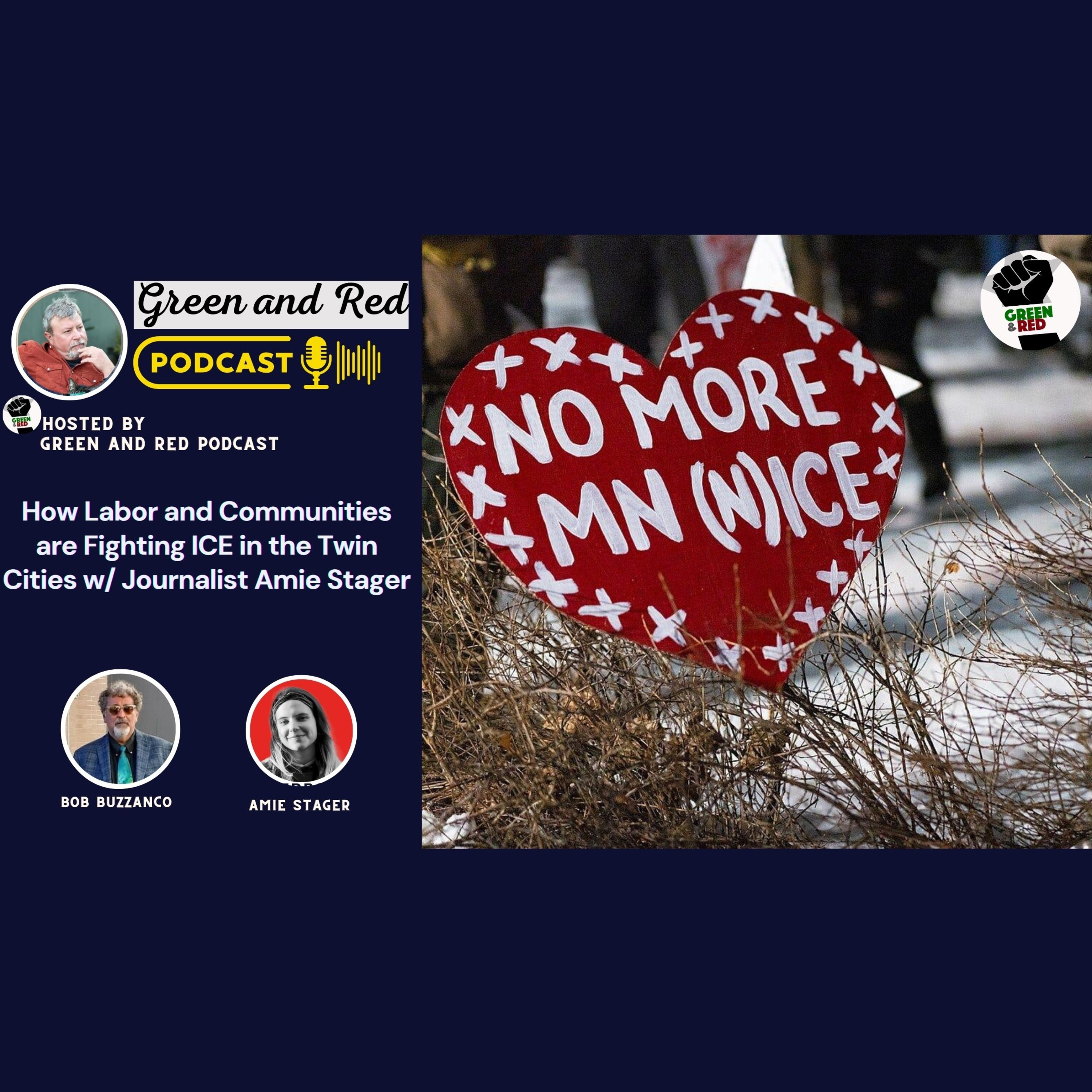
Green & Red: Podcasts for Scrappy Radicals
How Labor and Communities are Fighting ICE in the Twin Cities w/ Journalist Amie Stager (G&R 464)
00:44:32
Loading summary
Transcript68 lines
- [00:01]
A
Welcome to Green and Red Scrappy Politics for Scrappy People, a regular podcast on radical environmental and anti capitalist politics. Brought to you by Bob Bozanco and Scott Parkins.
- [00:14]
B
Welcome to the Silky Smooth Sounds the Green and Red Podcast. I'm your co host Scott Parkin in Berkeley, California. And as always, I am joined by.
- [00:23]
C
Bob Bozenko in Niles, Ohio.
- [00:28]
B
And today we are going to be talking about Minnesota and what is happening in Minneapolis, St. Paul and maybe other parts of Minnesota, particularly with eye towards labor organizing around the current ICE invasion of Minneapolis, but also community stuff, student stuff. And joining us is Amy Steger, who works for the Labor Education Service, who studied journalism at the University of Minnesota, is a senior associate editor at Workday and a native Minnesotan. Her writing can be found in Workday Magazine, the real news network in these times, Minnesota Women's Press. Amy, welcome to the Green and Red podcast.
- [01:08]
A
Thank you for having me.
- [01:09]
B
Yeah, so we've been seeing, I think this is the top of everyone's mind, at least people who are of conscience and social justice minded. We've been seeing this ongoing crackdown by ICE in Minnesota. There's been the murder of a 37 year old mother and poet Renee Good. There's been the murder of an ICU VA nurse, Alex Preddy, also a union member. And then we saw a general strike on January 23rd. And then we saw another strike on January 30th, which my understanding is it wasn't called by labor, but it was still a strike. And so my first question, just because things are going on and ongoing in Minneapolis and St. Paul is it's been a rough year already. We're only like a month into it. How are people hold? How much are you seeing ICE in the streets? What is this sort of vibe like right now?
- [02:00]
A
Yeah, ICE is still here. There has been news of a drawdown of 700 agents out of the 3,000 that they sent here. And so they're still very much active here. There have been abductions and workers and community members being taken away still. And a lot of people still organizing on the front lines doing mutual aid for families who are being affected and patrolling neighborhoods and keeping an eye out on workplaces and schools and homes. And yeah, even yesterday there was an abduction of someone who showed up for a court hearing in a government center. And so there's still a lot of ICE activity happening here. And ICE is detaining everybody, whoever they can, whoever, you know, gets in their way. It's still very much on everybody's mind and in everybody's environment. They're still here and we're still organizing and activating. And people who have never been involved in politics are getting organized to protect their immigrant neighbors. Even though the news cameras might have gone away, the national news, mainstream news, might not be covering it as much. It's still happening here.
- [03:14]
C
ICE is obviously a national issue, but what are the local folks doing? Because we hear walls and fry talk a lot and state troopers and the police, it seems to me in a lot of the video I've seen, they're just there to support ice. Is that kind of what's happening?
- [03:29]
A
Yeah, yeah. It's even just yesterday, the other day I saw a post From like the St. Louis Park Police Department, which is a suburb outside of Minneapolis, and there had been protesters gathered to observe I ICE in a neighborhood there. And the local police department maintained that they were there to for crowd control and to protect safety. They say that they're not collaborating with ice, but they're there to control the crowds and they're preventing people from observing people from protesting their constitutional observing and stuff like that. It's hard to tell whether they are actually living up to their promise of being sanctuary counties or sanctuary cities at this point.
- [04:13]
B
Are most of the cities and counties around their sanctuary cities or counties?
- [04:17]
A
A lot of them are. I'm pretty sure that there are probably eight or so counties that have actually made agreements with DHS that they are going to be collaborating with them more. So I know Minneapolis and St. Paul are sanctuary cities and I think Hennepin county is a sanctuary county. But yeah, I'm. I should know this, but I think there are more and there's actually movements, I think, with workers in their workplaces to try to organize for sanctuary workplaces. At the U of M, there's a movement for a sanctuary campus and for fourth Amendment workplaces as well. So that's. So that unreasonable search and seizures inside of workplaces can't happen.
- [04:59]
C
With regard to labor are people and I'm assuming this is local, right? Because national labor I don't think is really said or done much about this. Are these like kind of local labor councils? Specific unions in particular industries they're working, I'm assuming with like community groups. Like, how is labor stepping up on this? Is labor stepping up and how.
- [05:17]
A
Yeah, so we've covered. Not only have we been covering the labor movement's response to Operation Metro surge, but we've actually been reporting on the past few years of growing resistance to fascism and authoritarianism here. Looking at the soil that has been laid by organizers past and present. And organized labor has been really crucial to this. Out of the struggle against line three, the COVID 19 pandemic, the George Floyd uprising really galvanized people to start organizing in their workplaces. And Minnesota organizers here have been practicing aligning their organizational goals for a while. And people have referred to it as the Minnesota model of organizing, but it really can be replicated anywhere. And so after the killing of Renee Goode, unions and community groups and faith leaders were able to quickly form an ICE out coalition and demanding that ICE leave the state and be held accountable for their actions. And then calling for that statewide economic shutdown, which they didn't call it a strike at the time, but organizers said that's what it's going to feel like for many people. And so Minnesotans showed up in the way that they did, and sub zero weather and clergy leaders participated in civil disobedience at the airports. And then border patrol officers murdered Alex Preddy the next day. And another, that other day of action was held on the 30th, and, and that wasn't called by labor, but by student groups at the University of Minnesota. And so leading up to the 23rd and the 30th was really this proliferation of actions and mutual aid. Back in December, I had reported on an action held at the airport with unions and community groups calling for an end to deportation flights that are being operated out of the Minneapolis St. Paul Airport. And last week, I actually got to witness one of these deportation flights happening for the first time. There's been a dedicated advocate and flight enthusiast who's been tracking them and making.
- [07:13]
C
I saw him on Instagram.
- [07:14]
A
Yeah, yeah. Because the government won't give us that data. Yeah, yeah, it's. It's really awesome that we have him. And then looking further back, if you remember, back in early June of last summer, there was this multi agency federal law enforcement operation that took place on Lake street in south Minneapolis. And the government claimed that it wasn't an ICE raid, But shortly after union members in Minnesota and actually nationwide, I think over 30 actions, they gathered and they called for an end to workplace raids by ice. And at the time, they were also calling for the release of David Huerta, president of SEIU United Workers west, who had since been released. But since then, unions have been taking all kinds of action to educate, agitate and organize their members. And those have escalated rapidly in response. And so some of the major labor unions that originated the call for January 23rd was the Amalgamated Transit Union Local 10 05, which represents the Metro Transit bus operators who witness ICE abductions on the streets and at the bus stops that they stop at. So they've organized events. SEIU Local 26, which represents janitorial workers at the airport and building security workers and as well as window cleaners and organize. They also organize rideshare drivers who have been harassed and abducted by ICE agents. And the president of SCAU 26, Greg Naumaker, has talked about like this one window cleaner who has already been deported to Mexico away from his family. And he was actually really crucial to a strike four years ago by window cleaners. They won improved safety measures on the job. And he had been living here for more than 30 years, I believe. And then also unite here, Local 17 represents restaurant and food service workers at the airport. And some of those workers have been detained. And a lot of them have been organizing around getting workers food. Communication Workers of America Local 7250, St. Paul Federation of Educators Local 28, who has been hosting Teach Ins in the past year, trying to educate their members on how to talk to people about authoritarianism. There's been a lot going on. And so more and more they originated the call for January 23rd and then the Minneapolis Regional Labor Federation endorsed it. And then three days before the action, the state fed Minnesota AFL CIO endorsed it as well. And so it's really these kind of local on the ground unions starting that call alongside community groups, a lot of faith leaders and their other allies that they have been organizing with the past few years. Back in 2024, they held a week of action where they took advantage of a joint expiration of their union contracts. And so that's the tactic that the UAW and other national unions are intending to use in 2028 for May Day. Yeah, there's been a lot of activity going on with the labor unions and there's more happening every day. There's more meetings and being scheduled. I think the AFL CIO is hosting a President's Day action this Monday. So more and more stuff is being planned.
- [10:28]
B
One thing I'm curious about is it seems like the airport is a bit of a choke point. Is that a choke point for ice? And then I have a follow up question too. Is that the goal of when we're like. Obviously it's like that's also labor who will engage in some a call for a general strike. But is the idea there that disrupt ICE operations that are going through the airport?
- [10:48]
A
I think so. The action in December happened right outside of a warehouse at the airport. The signature Aviation, it's one of the companies that they're trying to target because they've been operating some of the deportation flights, and there haven't been. There's been a lot of demonstrations outside of the airport. There's a designated free speech zone that people can demonstrate at, and then as soon as they go into the street, it gets a little more intense. And so there's been a few of those actions happening. On Friday the 23rd, I think over 100 clergy members were arrested outside of the airport, and I don't know of any other further airport actions happening being directed there, but it definitely is, I think, a choke point for them. It's the Whipple Building, where the federal building, where they're headquartered out of, that has been the site of many protests in. And Actions is right next to the airport as well. And so it is a very. It is a very concentrated area of where a lot of operations are happening. Yeah.
- [11:56]
B
My other question is, what would you say is the overall goal of the general strike? Is it part. I mean, there's always an organizing goal, but then is there a pressure goal? They've been trying to put pressure on the mayor and the governor. Is there an element where they're putting pressure on the feds with this general strike that was like, citywide.
- [12:13]
A
Yeah, I think all of that putting pressure just on our leaders. And there's a concentrated effort, especially from faith leaders, to get companies like Target to take action, because ICE has been using Target parking lots. They have detained TARGET workers. And. Yeah, so there's been a campaign against leaders like Target that have come out of the general strike. And I think the original. The original goal of getting ICE out of Minnesota has. I think, slowly. It's still getting ICE out of Minnesota, but there are more. I think the National Nurses Union is the only union so far that has called to abolish ice, even though I think a lot of rank and filers might agree with that. Not many of the official unions have gotten onto that messaging yet either, but it will. It'll be interesting to see that as well. And right now we're reporting on the growing demand for the governor to enact an eviction moratorium. So there are unions and groups signing on to a call for an eviction moratorium because the month passed over and people can't pay their rent on the first because they're staying home at work. And there's a lot of people who could be facing eviction at the end of this month to being put out on the street in freezing Minnesota Weather. And that is something that happened during the early days of the COVID pandemic when the emergency was declared and eviction moratorium was declared. And so they're simply asking him. The Minneapolis and St. Paul City Council both passed resolutions urging an eviction moratorium. And the governor, actually I think the governor's office said that they have to declare a peacetime emergency first before they declare an eviction moratorium. And so I think we're going to see more and more actions in regards to that call as well as well as continued calls for mutual aid and funding for people so that they can pay their rent.
- [14:15]
B
One other thing I'm curious about is the day after the January 23rd general strike and then the day that Alex Preddy was murdered. Is it also I noted a number of Minnesota based corporations called for a toning down which I believe was aimed at ice. I think it was also aimed at protesters and companies like Cargill and United Healthcare and Target. But there I think there was like 60 or more. And I'm curious was that. And also my day job is on the corporate campaigner. I often just see these things as public relations. Is this in a response to the general strike and Alex Pareti are all of the above. Things were feeling. Things still feel very intense, but they were particularly intense on January 24th.
- [15:01]
A
Yeah, I definitely think it's all of the above. The news reported on that as corporations breaking their silence. But it wasn't really. They didn't really break anything.
- [15:10]
B
They just said they put out a press release.
- [15:12]
A
Yeah, yeah. And they, they didn't ask for anything to actually help Minnesotans other than just for the chaos to go away. And so I, I think that could. The timing there is everything right that happened after the 23rd, after all of these people participated in this economic shutdown. And we've looked at the data since then too and we have some data that says that show 1 in 4 Minnesotans, at least 1 in 4 Minnesotan voters either participated in that shutdown or knew someone who participated in it. And that's just voters think of all the people who don't vote that participated in it or either just refused to participate in the economy that day. And so I think maybe that might have scared the companies a little bit just seeing a call like that be successful.
- [16:03]
C
Yeah. I was going to ask about the impact. Has Target actually seen like a decrease in business? I've seen sit ins and is it actually starting to affect them?
- [16:12]
B
I saw the Mennonites did it in Iowa yesterday at Target.
- [16:16]
A
Yeah, I Actually, just think there's. I just saw something about how Target is going to be like reshuffling some of their corporate workers. And yeah, I don't have that off the top of my head, but I did see a headline somewhere that they're moving like 500 jobs elsewhere or they're trying to get more people on the ground. And there, there have been a lot of local actions targeting stores here. And so it's hard to tell like what, how that has affected sales yet, I think. But I don't know when their next earnings call is going to be, but that will probably be a very telling.
- [16:53]
C
They've had a bad year already. So I was curious and I remember in the summer of 2020, you hit a point. I don't remember precisely when you did start to see these corporations because of the destabilization speak out. But more importantly, the corporations, what's the impact on people you mentioned, like, a lot of people are going to work, they're staying at home. How's it affecting. And are these mostly immigrant workers or kind of everybody afraid? How's it affecting smaller businesses? What's just doing to that community? The image is obviously horrific. It's an occupied city.
- [17:23]
A
Yeah, yeah, it's definitely, I think everyone is being affected whether or not we're choosing to stay home out of safety. I definitely, everywhere I go, I think there's just like less people coming out. Although I didn't go to our local caucuses that were held last week, but I've, I heard that those were really packed and like the most amount of people showed up for that in years. And so I think. And yesterday at the press conference that Governor Walz held, he held that alongside a few small business leaders who were talking about the struggles that they're facing as small business leaders and talking about how like their workers haven't been able to come in and how they're trying to keep their workers safe and stuff that they're going to be demanding of the state. I think one business owner had specifically asked to be relieved of the state tax that's going to be coming up soon or the sales tax that's going to be coming up soon from the state. And so small business leaders are scared because their workers are scared. And yeah, I think there's several mental health organizations that have come out to say that there is a mental health crisis going on as well. This collective trauma that we're all experiencing. And yeah, I think especially like I have a few friends who, they're students and they see Like a lot of rumors going around too. There's a lot of rumors and I think even if something's not true or something's not confirmed, that can still spread a lot of fear. And so there's a lot of that going around as well that people are living with on a daily basis. And yeah, people I know are afraid to go to the hospital to get care. There's been a lot of healthcare workers speaking out about how that is going to lead to more people getting sick and just, it will make their work harder as healthcare workers. It's really affecting all industries, all sectors, all neighborhoods here.
- [19:28]
C
What about schools? I'm assuming attendance is down. Are the teachers like in one of the things like I saw in Chicago especially, the teachers were really well organized. Is that happening in Minneapolis as well?
- [19:38]
A
Yeah, the teachers have been really well organized here. They, the unions here, the teacher unions are super strong and they have been organizing not just round the clock, like patrolling outside of their schools, especially during drop off and pickup, but also like food drives and mutual aid for, for folks. And yeah, at the, at I know in some schools that have higher populations of immigrant and students of color, there is a little, there is a drop in attendance and especially when it comes to workers as well, I think. But yeah, I know that at the University of Minnesota there's been like this kind of the flexible, oh, we should go virtual a little for a few weeks and then see hopefully things calm down. But I think that the teachers in all the schools have been able to really work with community and neighborhoods and rely on folks like parents who are, who are noticing what's happening in their schools. So they're really working. We're seeing parents come out and help with things as well as teachers at the same time.
- [20:52]
B
So talking with friends of comrades of mine on the ground in Minneapolis, the other place that ICE has been really targeting, where we're seeing like a lot of community responses around daycares. There's probably a lot of immigrant and undocumented workers working in some of these daycares as well as like some of the students. I think that's where Liam Ramos was picked up by him and his father. And so I'm just wondering if you could comment on a little bit of what you've been seeing with the daycares, which is, which I just want to flag that the ICE targeting daycares is like I already think Nazi or I already think of them as Nazis, but that really solidifies it for me.
- [21:25]
A
Yeah, yeah, there's been, there has been a Lot of not only just like ice, having a presence around daycares, but also like right wing agitators. Like I definitely do place blame on the state senator or represent, I think senator, Representative Lisa DeMuth, who, it came out that she had actually encouraged that right wing influencer Nick Shirley to come here. And so that is the daycares is where this all started. And there has been a lot of activity around daycares. And then with the federal, like the news of perhaps federal funds being withdrawn from daycares, that is, they've been in the news because of that too. I talked to a daycare worker who, who was able to speak on how that would affect daycare operations here. And then the ripple effect that could happen across the entire workforce because if you don't have daycare for your kids, you can't go to work. But I actually just heard from a friend recently that her kids daycare, actually the workers, the workers at that daycare, they're unorganized, they're working poor, but they were able to go to their boss and, and say we're not coming to work on January 23rd. And so that daycare wasn't functioning that day. And so I think there is more and more, there's more and more organizing happening around daycare centers as well here and which is largely a non unionized.
- [22:49]
B
Sector here in California. It was just recently unionized and there had been state law preventing the unionization of daycare workers. Like since Gavin Newsom has been governor and the daycare workers had to organize. There's obviously there's daycares that are just out of people's homes and those folks had to organize. So it's surprising how much that's an UN unionized sector.
- [23:11]
A
Yeah, it definitely could use some more union rights there.
- [23:16]
C
Daycare became the first justification for all. Listen, especially in the Somali community. How are they responding to it? I see again countless images and most of the people I'm seeing being attacked probably aren't Somali. Is that a, is that just a quirk or are they pretty well organized?
- [23:36]
A
Yeah, so there, there are some organizations here that do focus on organizing with early child care and daycare workers. An interfaith organization, Isaiah, has an initiative called Kids Count on Us campaign. And so they've been able to organize with providers and workers and so I've connected with them. That's daycare worker that I spoke to who actually has worked as like a sub daycare worker where she goes around, she works for an agency where she just goes where she's needed. And so she's been around to a lot of different daycares within the metro area. And she said, she told me that it affects, it's affecting everybody. And not just like the Somali community. Being targeted is horrific, but it's not. It's about the industry as a whole, I think has been felt like they're being targeted, especially with news of a potential defunding of their programs, which a lot of the funds for the. I think it's the child care assistance program fund, which is for low income families. Some of that comes from state funds. And so if the federal government were to withdraw, they would be able to fund the program for a few more months. But there are daycare providers who say that they would have to shut their doors like pretty fast if that funding went away. So I think they're scared on both fronts of going to work every day and maybe encountering ICE agents or agitators and then also scared of not being able to go to work because their daycare closed. Yeah, it's really like multifaceted situation that they have going on. But there, there are, I did see, there is mu. There are more mutual aid operations happening that are specifically trying to help the daycare worker community as well. Yeah, there's more targeted community response for them too. That's been happening here.
- [25:31]
C
Has Minneapolis in general been supportive of the Somali community? We saw that attack on Ilhan Omar last week. In general, has there been a movement there?
- [25:40]
A
Yeah, oh yeah, there definitely has been. We have a lot of Somali leaders who, who are just as strong as Ilhan Omar and have been doing a lot of work to organize their community and to protect their community. I was on the ground on January 17th when that one person, Jake Lang, tried to come here and came to Minneapolis and he was swiftly kicked out. But we had organized. There were multiple responses to what could have happened that day. And there were. Was a lot of people that came together to buff up our patrols of the neighborhood, the Cedar Riverside neighborhood where Jake Lang intended to march on. And he failed to do that, thank God. But there has been a lot of support for that community here.
- [26:28]
B
It doesn't help when you only have a dozen people show up to your anti Muslim march and there's a thousand counter protesters.
- [26:34]
A
Yes. Yeah, we were literally.
- [26:36]
B
Yeah, that's what it looked like.
- [26:38]
A
Yeah. And yeah, I had friends who were at that and we saw that happen and took. They were photojournalists taking photos and stuff. And I was on the ground with the volunteers patrolling Cedar Riverside and it was, yeah, There, there was still a lot of activity in that neighborhood that day. A lot of media, a lot of people just trying to probably stir up some trouble. But, yeah, it was. That was one of the better days that we had when we kicked that guy out. So I think that was a moment that kind of united people to protect our Somali neighbors.
- [27:13]
B
One question I have just to jump to January 30th is that had been called by students at the University of Minnesota. It seems like that has sparked student walkouts and student strikes at universities and high schools, maybe even junior highs around the country. And I'm wondering if you could just talk about that. Talk about that for a minute. And curious if labor was supportive of that. I didn't necessarily see where local labor was even calling for a strike, though. So I was just wondering if you could talk about that a little bit.
- [27:40]
A
Yeah. So the call for January 30 originated with several student groups at the University of Minnesota. I believe it was the Somali Student Association, Ethiopian Student association and the Black Student Union. And then more and more community, community groups and businesses signed on to that. But, yeah, notably labor did not endorse that, nor a few community immigrant rights groups didn't endorse that either. But I, I wasn't there, unfortunately, on the 23rd because I had the flu. But I was there on the 30th, and there was a lot of people downtown. But it wasn't as much of a economic shutdown in the state of Minnesota, but it was still amazing to see the response nationwide. And all of the actions that happen in cities across the nation that wasn't led by labor, but it was led by a lot of community members and students and small business owners who wanted to stand with Minnesota. And yeah, and there has been, I haven't been keeping track as much of the student walkouts in schools across Minnesota, but those have been happening. And also there has been a growing movement on the University of Minnesota campus to call for a sanctuary campus. And so they've been holding actions. I think they've done a few. Last week there were a few students who locked themselves outside of Morrill hall, and I think three or so of them were arrested for that action. And so I think we're going to see more stuff like that happening. And yeah, that stuff isn't supported, isn't like outwardly supported by labor. But yeah, we'll see. I know that there's more stuff being planned and yeah, we'll have to stay tuned for that.
- [29:27]
C
Yeah, I think yesterday, the day before there was Like a vigil at the campus. I was a college professor for over 30 years, so I'm always intrigued by campus actions. And it was like a vigil for Alex Preddy. And they wouldn't let students hold up like, ice outsides or something like that. I've never met a university administrator with any, like, courage. And I'm thinking UN is probably pretty much the same.
- [29:49]
A
Yeah, yeah. They're the Minnesota Daily, which is the student run newspaper that I used to work at. They reported on one of the music professors that when they held a virtual vigil for Alex Preddy the other week, the music professor who was scheduled to play some music had had. I forget what she had on her front. I think it had something to do with end the hate or end the evil. And then on her back it said ICE out. And so she wouldn't even have been. No one would have seen that, like watching the vigil online. And they said she couldn't have that, but she refused to take it off, so she had to leave the building and her colleagues stepped in for her. And that is obviously concerning to think that that kind of freedom of expression was not allowed. And also, yeah, the U itself, as an administration, I know a lot of people have been disappointed with the U's response to the ICE presence in our community. And a lot of the institutions that have been putting statements out about Alex Preddy failing to mention border patrol or ice. We really wish that reality was acknowledged a little bit more. Alex Perdi was a University of Minnesota graduate, and so I think they felt pressure to hold that vigil. But yeah, silencing the professor and also the students has been really disappointing to see.
- [31:21]
B
You know, one thing I'm curious about with Alex Preddy is he was a union member who's part of the Federal Workers Union. And how much of as Alex deaths Alex's murder been a flashpoint for labor? Is it like something they've been rallying around?
- [31:35]
A
Definitely. I went to a vigil. I've been to two vigils for Alex Preddy. One of the first ones hosted by the nurses union at the site where he was killed in South Minneapolis. And there were hundreds of people attending that, hundreds of nurses. And then I went to the one hosted by his union, the American Federation of Government Employees, outside of the VA in Minneapolis. And there were lots of union members there. There were a lot of elected leaders there speaking as well. And yeah, Teamsters 120 had brought their truck and was feeding everyone there. And yeah, there have been a lot of responses from the unions here and also from the national union as well. I was actually in D.C. this past weekend covering the American Federation of Government Employees. They have a young workers committee, the Young Young Organizing Unionists for the Next Generation, their young committee. And so for the past few months they've been organizing a young workers march. And I had been planning on going to this and then Alex Preddy was murdered and he was a young federal worker. So I was like, oh, are they going to honor him there? And there was a lot of words of honoring and respect for him there. His name was mentioned a lot. But there has been no sign from leadership on whether or not AFG is going to split from the Border Patrol union in the same way that they split from the ICE union a few years ago. And so there's some more reporting I need to do, I need to do there and figuring out how that is going to be, how that's going to play out because there are, there is a rank and file movement of federal workers who are hoping to see that happen. Yeah. And I just thought it was really interesting that so many people, I think in a similar way will say the name of someone who has been killed by the government, but yet they won't take like concrete action to make any changes, any like actual structural changes after something like that.
- [33:43]
B
I have two questions left. I don't know if Bob.
- [33:46]
C
Well, go ahead.
- [33:48]
B
My one question is meant to ask this one sooner is that there's a very impressive organizing of rapid response networks going on in Minneapolis St. Paul neighborhood to neighborhood. How much is labor engaged in that? Involved in that, in merged with that.
- [34:07]
A
Yeah. So I'm in my neighborhood rapid response group and I'm in a few of them where I work and where I live. And there are so many labor, there's so many union members who are in my neighborhood where I'm like, oh, like this is great. I am just getting to meet so many cool people. And so I think they're there. They're definitely there, all the rank and filers. And I know that in some of the chats that I'm in I do see some names that I recognize who are either like political officials who are on the ground doing rapid response, which has been really exciting folks who are associated with that. So I think unions could probably do. They have been holding like trainings, like direct action trainings, non violent direct action trainings so that folks can get educated on how to know their rights. And so I think through those kinds of trainings they have been able to connect their union members to their local neighborhood groups. But, yeah, I don't see as much of a, like, visible, coordinated effort to get people connected to the neighborhood. I think it's just been union members taking it upon themselves to get to know their neighbors and learn their rights.
- [35:21]
C
This is obviously a horrific situation, which we see images of it every day, but we're also seeing, like, really some really inspirational stuff. People coming out, mutual aid, supporting their neighbors. It sounds like they've developed, like, carpools to get the kids to school, food delivery, protesting outside hotels, and just talk about what impact it actually has made. It's a bleak situation, but in a lot of ways, I think they're stupid, but I think the Trump people were shocked. They had no concept that this would happen.
- [35:48]
A
Yeah, I think the response has been, it's been very inspiring to see just normal, everyday people refuse to participate in this system and actually say, I'm going to use the tools that I have, whether it's my phone to record video of ICE agents or whether it's my car to deliver groceries or to deliver people to their destinations. From legal resources to educational resources, there's been so much sharing and caring that's going around, and I do think that threatens the people in power and they see that happening. One of the signs that I saw at a vigil for Alex Pretty, it read, care is what killed him. And it was him caring and him being a decent person that made him a target. And I think it was shortsighted of the government to think that, to maybe assume that we wouldn't respond like this. And maybe they knew we were going to respond like this and they wanted to make an example out of us. But I think from. I've lived in Minneapolis since 2017, and I've been a lifelong Minnesotan. And we do have this kind of paradox of Minnesota nice of we'll ask you how your day is or we'll do a good deed for you, but we won't really go out of our way too much to inconvenience ourselves to help our neighbors. And then also the paradox that it's such a nice place to live depending on your skin color and. But there is a long history here of people uniting against common enemies. From the 1920s and 30s, like farmer labor movement that reached across geographic divides of city and rural farm towns that is really like in. There's a long lineage of that being in our blood here and also being in. In a wintry climate. We have to depend on each other and to survive. And so I Think that also comes through a lot as well. A hundred thousand, almost 100,000 people being out and like negative 20 degree wind chill. I wasn't surprised that happened, but it was still, it was still very heartwarming just to see people putting themselves at risk to keep each other safe and to constantly remind ourselves like what's important. So, yeah, I think a lot of people are very inspired by what's happening and there's a lot of. It's hard to tell what the future is going to look like. There's a lot of uncertainty. But there every day there's like new stories coming out about how people are helping each other and all of the connections that are being made. And it's. Yeah, the soil that has been prepared by organizers and communities past and present is. It's very rich with relationship and solidarity here. So I've been, I'm. A lot of people are saying like, oh, I've never been prouder to be a Minnesotan, but I think I'm. I've also like never been prouder just to be a human being and see all the humanity that's happening here.
- [39:07]
B
I have one last question which is around media. You talked about, I think early on in the interview you talked about how national media has been pulling out with the, with the press releases that ICE is pulling out.
- [39:19]
A
And.
- [39:20]
B
But I also heard at the peak it was like you would go to an action and half the people there would be reporters. And then you work for a media outlet that covers, I believe regionally, the Midwest. But you obviously your beat lately has been Minnesota. And so I'm wondering. And then we're also seeing like lots of troubling things happening with media. The Washington Post got gutted. We're actually about to do a big show with Mickey Huff from Project Censored. We've seen right wingers take over CBS News. And I'm wondering what your thoughts are on this local grassroots coverage versus some of the national corporate media we were seeing.
- [40:00]
A
Yeah, yeah, it's. Yeah.
- [40:02]
B
And I think CBS was putting out like misinformation about the ICE agent got hit by the car by Renee Goode, which was actually a complete lie and things like that.
- [40:10]
A
Yeah, the kind of the parroting of the federal agencies statements that come out just to repeating what they're saying without questioning it. I think about it a lot as like the both sidesism of journalism of we have, we can report on that, but then also we need to get like the on the ground coverage. And so a lot of what like the mainstream and national news media does is they parachute in and they. Some people try to use relationships to get what they are. But I've just seen a lot of people just trying to nudge their way into these rapid response groups to just showing up. Like, as I've been patrolling in some of my neighborhoods, I've been approached by media folks and it's. Yeah, it's how the industry has always operated. And so on the other side of that, there are a lot of good local reporters who have been on the ground every day covering what ICE agents are doing and, and covering community response. And I would just urge people to continue supporting local news as much as possible. Yeah, like you said, we mainly focus on labor in Minnesota. And what's great about that here is that the labor union community here often works with community groups. And it's been. There's a lot of relationships and connections that we're able to highlight and to highlight the actual organizing that has been going on. A lot of it has been. There have been a lot of good reports out there. I know some publications like Glamour magazine did one recent piece on the women of Minnesota and how, like, women are integral to the response that has been happening. And so I appreciate features like that that really focus on the relationships rather than the. The kind of sensationalizing of the crisis that we are in. But.
- [42:06]
C
Right.
- [42:07]
A
Yeah, yeah, it is a hard time to. To be in the industry and just see, like, I fortunately get to work where I work, which is. It's a university publication and we're journalistic. But I think, yeah, the future of news has to be collaborative. And so we have a lot of publishing partners that we work with to get our news out there to larger audiences. And so I hope more people continue to grow and practice their media literacy. And it's important, I tell people it's important to watch the news and to read what you can, but also just have that kind of filter in your mind there and always be skeptical of anything you hear. Yeah, it's a similar thing to what happened in 2020, where a bunch of folks came in and then just left and. But yeah, we're going to be here after the cameras go away and. Yeah, still reporting on how our community is facing the crises that we are experiencing as well as recovering from them. Yep.
- [43:06]
B
You got anything else, Bob?
- [43:08]
C
Okay, thanks so much.
- [43:10]
B
Yeah, thanks for your work and good luck.
- [43:13]
A
Yeah, yeah, appreciate your work as well.
- [43:16]
B
Yeah, folks, if we've been talking with Amy Steger, who is a journalist and senior associate editor at Workday through the Labor Education Service at the University of Minnesota. If you like what we're doing, please check us out at Facebook, Instagram, Twitter, and Bluesky. If you are watching this on YouTube, hit the subscribe button. If you're listening to this on an audio platform, give us a rate and review. And if you really let's go to greenandredpodcast.org and hit that support button. Or become a patron at Patreon Green Red Podcast. We're Scrappy media. We need your support. And Amy, once again, thanks for coming on. Everyone else out there, make trouble and misbehave and we'll talk to you again soon.
- [44:18]
A
Sam.