← Green & Red: Podcasts for Scrappy Radicals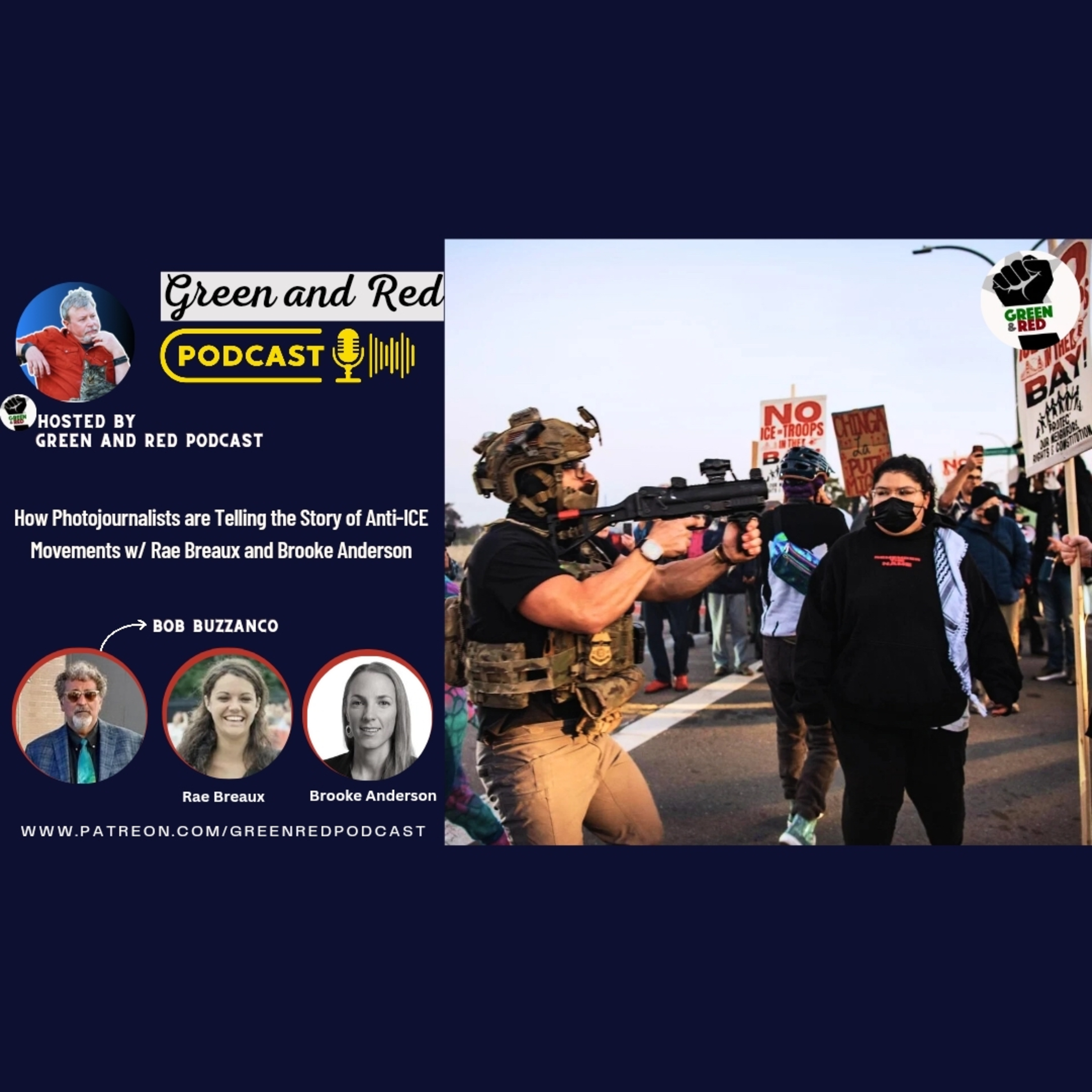
Green & Red: Podcasts for Scrappy Radicals
How Photojournalists are Telling the Story of Anti-ICE Movements w/ Rae Breaux and Brooke Anderson (G&R 480)
00:45:35
Loading summary
Transcript81 lines
- [00:01]
Ray Bro
Welcome to Green and Red Scrappy Politics
- [00:03]
Brooke Anderson
for Scrappy People, a regular podcast on
- [00:07]
Ray Bro
radical environmental and anti capitalist politics.
- [00:10]
Brooke Anderson
Brought to you by Bob Bozanko and Scott Parkins.
- [00:14]
Scott Parkin
Welcome to the silky smooth sounds of the Green and Red podcast. I'm your co host, Scott Parkin in Berkeley, California. And as always, I am joined by
- [00:25]
Bob Bozanko
Papa Zanco and Tropical Niles, Ohio.
- [00:28]
Scott Parkin
Tropical Niles, Ohio, on Friday the 13th, no less. Yeah, I got a black cat discount at the vet today because of Friday the 13th. For real. That's a real deal. In Oakland, California.
- [00:40]
Ray Bro
Very Bay Area.
- [00:42]
Scott Parkin
Very Bay Area. Yes, it's true. Today we're going to be talking about anti ice movements and we're going to be talking about photojournalism in those anti ice movements. We are joined by two old friends of mine, Ray Breaux, who is an organizer, trainer and movement photographer based in Los Angeles. For 15 years of experience developing cross movement strategies around race, gender, class and systemic drivers of the climate crisis. But is also a photographer within movements different parts of the country, but has been really involved in anti ice stuff in Los Angeles. And then Brooke Anderson, who is a longtime organizer turned freelance photograph photojournalist based in Oakland and covers movements for social, economic, racial and ecological justice. And part of what we're going to be talking about is a recent article that Brooke just published in prism. Is it Prism magazine or just prism?
- [01:38]
Brooke Anderson
Prism, yep.
- [01:39]
Scott Parkin
About photojournalists in movements and in these anti ice movements. So welcome to the Granite Red podcast, y'.
- [01:45]
Bob Bozanko
All.
- [01:47]
Brooke Anderson
Thanks for having us.
- [01:49]
Scott Parkin
Yeah, I'm excited to have you here. Recent ICE attacks on American cities have mobilized the movement from Los Angeles to Chicago to the Bay Area to Minneapolis. Part of the response and what we see a lot of is documentation. I had friends on the streets of Minneapolis who told me that you would go to an action or an event and half the people you saw were live, streaming or taking pictures. And so we're going to be talking about the documenting of the state violence and the anti and ice and like I said, the article that Brooke just put out in prison. So I guess my first question is what is the role of the movement photographer in this moment of rising authoritarianism, state repression? And I think both of you should answer this, but one of you should start.
- [02:34]
Ray Bro
I'll let Brooke go first. Great.
- [02:37]
Brooke Anderson
I think there's. And our movements have been documented for a really long time and there has always been a role of someone and I think it's often not the journalists that necessarily work for the newspapers and the magazines. It's Often been folks who have been embedded in our movements. There's a long history of folks from civil rights and black power movements to immigrant rights movements, who have seen themselves as activists, as organizers, as participants, as protagonists in those movements, who have also written about the movements, who photographed the movements, documented those. And I think there's an incredible role to be played there in telling our own stories of how we organize and stories that can only be told by the folks who are directly in them. In terms of the kind of trust that we have between activists and photographers to tell those stories and the kind of discernment that it takes to talk about what do you want to show and actually what do you not want to show? Right. And so I think when we're learning so much from the movements, it was an incredible blessing to have so much documentation happening in Minneapolis, and not just of the arrests and of the brutality, but actually the resilience and the ingenuity and the heart and the care and the love that everyday people were showing to each other and showing up in ways around mutual aid and showing up for jail support and all of these walking patrols. And we really benefit from being able to show that to each other across serving a translocal, organizing way across the country and learn from each other. And part of what I wanted to do with the article was interview folks like Ray who were in Los Angeles and folks in Minneapolis and Oakland and Chicago so that we can learn from each other about what those best practices are and how to use our visual storytelling to advance the movement.
- [04:18]
Ray Bro
Yeah, And I would say one thing that Brooke was really touching on is something that I feel is really important in these moments of, like, movement uprises or, like, movement upsurgences is like, who is in control of telling our stories? Like, who's in control of telling our stories, who's in control of framing our stories, and who's getting credit for telling our stories, I think is a huge part. Often when we're, like, relying on just journalists or photographers or, like, staff photographers showing up and taking pictures, they focus a lot on, like, the riot porn side of things, like, the sort of, like, the drama, the this, the that, and there's a very narrow image of what that story is. And I actually feel like when we let that power go in that direction, we're often, like, allowing them to reinforce the dominant narratives of what our overall movement stories are. When in reality, when we can take control over our storytelling, we can actually show the emotions, the joy, the power, the community, like, all of the different things that are happening within our communities that are leading up to, during and after these movement upsurgences. But then also our folks are getting credit for creating these images too. And I think that's a really huge part of the empowering ownership of being like, I am showing you what my story is, not looking online for what someone else's version of what my story looked like.
- [05:33]
Bob Bozanko
Because I think of technology now. Things are way different than they were even like 10 years ago, where your phone is your studio. And you mentioned best practices a minute ago. Since everybody, whether it's an actual photojournalist or just like somebody nearby is recording this or taking pictures of this, what would you say the best practice is for you? What do you go out there trying to do when you go out to these? Everybody's going to be taking pictures of everything. What are you looking for?
- [06:00]
Ray Bro
Like, if I'm just going out to a big protest against ICE in la or there's often, like, the showdown of, like, in LA last summer, it was the ICE agents, the LAPD and the National Guard. Right. And so there's this huge imagery of the state repression, which is real. And I actually think people should continue photographing and storytelling this. I think just because it's not the entire story doesn't mean it's not still a really important part to be showing. So I'm. I am looking for that and I am showing. Looking for, like, ways to show community empowerment. Because I think it's actually really powerful when you're able to frame a photograph of community members facing off with armed resid. Like armed guards. Right. It is definitely like a struggle of power that you can capture in an image. And it's that sort of the trope of a picture tells a thousand words. But I'm also looking for, like, ways that community members are connecting together or like the different signs that people came up with that are funny and tell the different parts of things, or people who are bringing their kids and people who are bringing families out. And there's just so much else that's happening that is like a full part of the story.
- [07:00]
Brooke Anderson
Right.
- [07:00]
Ray Bro
And all these different missing puzzle picture puzzle pieces that I think are telling really important parts of our story as well. So I'm looking for all of it, really. And then there's also, I think, the important part of, like, when conflict is happening and we can document it, we then also own the ability to tell the story of what actually happened with our images instead of trusting that someone else is going to have the, like, documentation of conflict. As well. So I think there's like a real community safety part of owning images of when like state repression is happening too.
- [07:30]
Brooke Anderson
Okay. To add to that, I think, yeah, I think what Ray said is really important. And I would layer on. I think I always try to take photos that will allow folks to see themselves in that. But that doesn't mean that everybody wants to be photographed. Right. And so part of the context in which we're doing the storytelling is increased state surveillance. And some of that state surveillance is in the moment, some of that is follow up. You don't know what's going to happen at that direct action. But we've seen images and videos be used to arrest folks, to deport people, to increase charges against folks. And so part of what I'm looking to do is mostly when I'm photographing, only take photos of folks who are doing things that we know that want to be seen by the world. If there's a direct action, I will photograph that. If the civil disobedience and folks are doing something illegal, I will photograph that. But I'm not going to photograph things that are going to be used to try to trump up charges against people. And it's not just that I'm not going to publish those photos. It's like, I don't even want those images on an SD card. I've been arrested multiple times while photographing. Police can then end up with that information. Really trying to think about that and then really trying to think about who's there, who wants to be seen. So I really try to photograph folks who are like at the front of the march with the sign up over their head. They look like they're there to be seen. And if I get photos of people who are not necessarily in that, I'm checking with them afterwards, it's, hey, I just got this photo. How does that feel to you? But also not being shy about the gang, the photo, like, we gotta go out and get those photos to tell the story. So it's really a balancing act on navigating increased state surveillance and repression against activists and trying to also respect consent, which we want to be at the heart of our movement.
- [09:07]
Ray Bro
Yeah. And I think I know one more thing. I'll just. Because last summer when LA was a hotbed of like ICE activity and then like ICE resistance, there's this narrative around like, the National Guard is there and it's like uprisings and violent protesters and all this stuff. And that was such a small part of what was actually happening in Los Angeles. And I Think even just the dominant narrative of like violent protesters or taking on cops whenever was like justifying having the National Guard here as well. And so much of the storytelling that we were trying to do intentionally in LA was showing like everything else that was happening in the city, like all of the mutual aid, all of the community ICE defense and like neighborhood watches, all of the marches that were happening that had families at them, that had street vendors serving food, like really like it was important, given the narrative to show all the other things. But that also was like very specific because we were combating a narrative. I think it wasn't. If that had been, I can think of other moments in history where that wouldn't have felt as important to justify that the violence was coming from the state, even though we all know that. But yeah, we were like very intentionally, like LA is not this hotbed of violence and riots. Like it actually is like a community driven space. And we were using and relying photo. Relying on photos to be what was telling that story. That being said, though, because of the sensitivity of it, we actually were talking with other photographers on the street and not capturing people's faces on purpose. And I think you'll see a lot of pictures coming out of this moment of ICE defense where you're getting a lot of the backs of people and people behind signs are like that. You'll see like a lot of street vendors that are like serving food. And the photograph is from the back. And that's when I think you're like, oh, someone who was thinking about that took that picture.
- [10:49]
Scott Parkin
One thing I have been noting as someone who pays attention to direct action stuff, we've seen this disruption in intervention in ICE operations from LA to Chicago to Charlotte to Minneapolis to many other places. What have you been seeing as far as that evolution goes of this sort of movement photography or movement documentation? Because it's also not just photo, but also video. During when the occupation of Minneapolis was happening, I woke up every morning to look at my Instagram feed to see what was being posted. But I'm curious if you've also seen an evolution on how documentation has been going as ICE has moved from city to city and people are learning.
- [11:29]
Ray Bro
I feel like Brooke and I are just talking about this too. Go ahead. I saw you on mute.
- [11:33]
Brooke Anderson
Oh, no. I think there's increasingly more folks who don't necessarily identify as photographers and Ray and I have had this conversation. But just like anyone who has a cell phone camera, anybody who has a GoPro, anybody who's shooting should consider themselves part of the documentation crew and should figure out how to align with movements. It's a particular skill set. And you let Ray talk more about that. But I think you're seeing more and more folks understanding the power of that documentation and then also knowing that doing that puts more of a target on their back. And I spoke to so many different journalists in this article, some of whom have a movement orientation, some of whom don't, but who were shot, who ended up in surgery, who were pepper sprayed, who ended up with concussions and traumatic brain injuries that are going to be things that they deal with for the rest of their life. And so I think there's also a degree to which I think we're seeing. This might not have been the question that you asked. It's coming out another direction. I think we're seeing more folks actually just in journalism starting to understand why they need to have a movement orientation, which I didn't actually think I would see more folks who were like, no, let's not compete against each other, let's share information, let's protect each other. Here's where you can sign up to get free ppe, if you need bulletproof vests, if you need a helmet, if you need anti mace sprays, et cetera. And I think that's a really beautiful thing. I think there's been a school of journalism that has assumed that you had to be objective to be a journalist, that you had to get paid, that you had to somehow be professional or you had to be published. And I think all of that's bs. And the more that we break that down and start seeing everybody as playing a role, as storytellers inside of our movements, the better. And there's this great piece that somebody from LA Public Press wrote that was essentially like when your press room becomes a conflict zone or something like that, talking about all the decisions they had to make to protect themselves. And one of the things they said is our folks are covering our own communities. This is happening in our neighborhoods. Of course we're going to have feelings about it and that should make it into our storytelling. And I thought that was really powerful.
- [13:30]
Scott Parkin
Oh, go.
- [13:31]
Ray Bro
No, you can go for it.
- [13:32]
Bob Bozanko
No, go.
- [13:34]
Ray Bro
I was just thinking we are in the era where like most people have a camera in their pockets and most people have access to are participating in social media. Right. And this wasn't true, I think when, not even that long ago, when journalism was like, you have to maintain this bias thing. Like, we didn't all have the level of access and like direct and immediate communication that we have now. And so I think we've like, in a way accepted this reality that people can actually control the images that they're taking, be a part of it, be participating, be a member in it, be a. Have it as a role, et cetera. And that's obviously helping so much with the practice of making the invisible visible, which is like really the ultimate goal of what photography is.
- [14:13]
Scott Parkin
Right?
- [14:13]
Ray Bro
Like the dominant narrative in like oppressive societies are keeping things invisible on purpose as photographers or people that like taking pictures or know that pictures are a thing that we can take. Like your role is to make the invisible visible. And then what are we doing when that's all visible? Because that's. It's all connected in the ecosystem of organizing. But I just think more people are like, I like taking pictures and I like being a part of this. And we're like, yeah, if we can organize that and communicate and be in like relationship and community with each other, then we're also combating that like, safety and numbers thing too, in a way. But it is still going back to what Brooke is saying is we're all. I think it's hard to just unleash a bunch of people with iPhones into a potential riot situation and expect them to know what to do, because if they're not trained in like, action scenarios as like an actions role, then that's unsafe and also just not smart. Not things that we do with our friends. But how are we also now realizing that this is. Has grown into an actions role or like a communications role within our organizing and treating it as such?
- [15:10]
Bob Bozanko
You both read my mind and answered the two questions I was going to ask. But just off that, and this is sort of before you go out, do you look at like social media and see what other people are showing to get an idea of what's out there, what needs to be out there. Do you like, collaborate, even unknowingly with other folks?
- [15:30]
Brooke Anderson
I don't know that I'm definitely on social media. I will often read about the movements I'm covering to get a sense of, like, how is the main street? Every day I open up like progressive media. I open up like supposedly liberal media like the New York Times. And I look up, I look at Fox News every morning too. I just like, how are our movements being talked about? And try to think about what's the story that I want to tell. And we'll also read the posts of the organizations whose members are closest to how, you know, who are being impacted most. Like, how are they talking about this? I'LL also show up at actions. And before I start taking photos, I'll talk to a lot of folks like what? What's the point of today? What do you think? What's the message you're trying to get across? What images have you been seeing? Are there things that you feel like aren't getting airtime or they aren't being told? Who are you? Who do you think are the leaders? So I think being a good organizer and having those relationships and those conversations more than necessarily like looking on social media definitely informs what I choose to shoot.
- [16:28]
Ray Bro
Unfortunately, I'm a millennial, so I'm just on social media. When you're like, do you look at things before you go out? I was like, there's no before, during or after. There's just a constant stream of like media entering my mind. But also I think I don't look at Fox News every morning. I think that. But that's really, I think a great thing to like constantly be analyzing the dominant narrative because I actually think sometimes we can accidentally reinforce it through imagery and like then require a lot of like undoing and organizing to break that down. But oftentimes, yeah, like in LA last year it was all like riot this, that and like a lot of photographers were actually like taking pictures of that like intense drama moment which was accidentally, non purposefully reinforcing. This narrative of LA is this hotbed of violent activity and they had no other images to tell anything else. So like I do think that we are accidentally reinforcing that sometimes when we're not going into it with an organizer mind frame of you are a part of an ecosystem. Communicate with people consent.
- [17:27]
Scott Parkin
Is the vibe just based off of what Brooke said about that. When your press room becomes a conflict zone and you see probably more mainstream journalists being much more attuned and plugged in with movements, what have you. What would you say is the difference between a movement photographer and like a mainstream photojournalist? A mainstream like corporate media photojournalist.
- [17:51]
Brooke Anderson
It's in part who's determining what the assignment is. Right? So I think if you're a photographer in a newsroom, you're getting an assignment and it's go show up for 20 minutes, get a photo. And then you often turn those photos over to an editor who's then making a decision about which photos to show, which I think gained his piece about. What are you choosing to show? There's this phenomenal book called I think it's like Forgotten Photos of the Civil Rights Movement that shows how like white editors in liberal papers in the north, like over and over again kept choosing photos of black activists being brutalized by police. That when that becomes canon over a decade, like decreases people's agency and doesn't actually show the ways in which people were fighting back and like using a diversity of tactics, et cetera. So I think one, it's about who's gain giving you the assignment, how much time are you allowed to then spend on it. Whereas I think those and the like myth of objectivity, right? Whereas I think those of us who are freelancers, who are part of movements, who are deeply embedded in social movements, we're getting to choose what stories we tell. I think our, our bank accounts may suffer from that, our lack of health insurance may suffer from that. It's like not, definitely is not as sustainable as a career path, but it's giving us the freedom to tell the stories as we want to tell them. And I think that' important. And we also really need to support left media that is doing that work. I think Prism Media is a really great example. Convergence, the Forge. There's a bunch of folks that are actually trying to figure out how to have left left journalism and movement journalism happening. What would you add to that, Ray?
- [19:19]
Ray Bro
I just think that having like mainstream journalists, photojournalists, et cetera, being more movement aligned, like you're saying, is actually like a huge movement victory. That didn't happen on accident, right? That didn't just happen out of nowhere. That happened after like decades of intentional narrative shifting and taking control over the narrative and the stories that we're telling through organizing through like the writing that we're doing also like very much through the images that we're showing. Imagery to me is so important because it's how I process the world and I understand that therefore it is also probably how other people process the world. And it circumvents like a language and reading level and whatever, and it like invokes an emotion and tells an entire story. And so I think as we're like continuing to produce the imagery that tells the stories of our own work over decades of time, like we actually are very intentionally and deliberately shifting what newsrooms even want to cover or how they're talking about it, or the narratives that they're like thinking that they want to tell are. And people are starting to get better assignments because the movement has been making that what they need to be talking about for a really long time.
- [20:22]
Bob Bozanko
You mentioned we've all seen images from all of these cities of ice or border patrol or local police Going after media specifically. Right. People have press and blazing. Have you been targeted? Do you like when you do identify yourself as media or do you. Are you just there taking photos or do you sense that people are. The state is looking out for you, looking after, looking to get you.
- [20:44]
Brooke Anderson
I go, I always have a press pass and sometimes it's tucked into my shirt. A couple things about a press pass. A press pass is not a magic like protective zone. It's a. It's like a bargaining chip with police. My union passed something that is supposed to be state law that allows press to state even when police have cordoned off a zone. And that means nothing in our era of increasing impunity. I don't think we should allow. I will not apply for. I have a press pass through my union because we have a freelancers division. I will not as a matter of principle apply for a press pass from a police department. I do not want the police to be able to choose who's seen as a legitimate photographer or not. I do think that when I show up in a place, I want to first be often an organizer and a social movement person. I want to hug my friends. I want to talk to folks on the picket line. I want to hang out the direct action. I think that actually helps me get better photos because people are like, oh, cool, Brooke's known. She's our people. Great. I'm not going to be stressed out if she's taking photos around me. That being said, sometimes I pull my press pass out in engagements with police as like a tool for that. I have been targeted a number of times. I was arrested taking photos at Occupy Oakland. I was arrested taking photos in some Black Lives matter protests in 2016 or 17. I was struck by Berkeley police who literally took their hand and went like that into the camera in my face and struck an already injured arm with their batons. Which was part and had been part of lawsuits that together with other activists who were beaten in those same circumstances, have won some things through lawsuits. But I think it's real that increasing. It used to be that having press and blaze and on a helmet or a jacket would offer some protective nature. I don't think that's necessarily the case. That might increasingly target folks and that's not a reason not to do it. I actually think in the like fighting out in the courts afterwards in some of these scenarios, being able to prove that the police had to have known that you were press and that they specifically targeted you is actually really useful. What do you do, Ray?
- [22:40]
Ray Bro
I don't have a press pass. I have at times had organizational staff passes for a press when I'm organizing an event. And we are the ones that are calling in the media for things, which is obviously different, but still can be. It can still grow into a different situation which I've seen happen before. I play it by ear. And I mean that in all senses of the word, right? If I want to be known as I'm a person taking pictures, sometimes, if you kind of gauge the situation, it can deescalate. It can also often escalate. And I think when, especially right now, like we're seeing a lot of like ICE agents don't want to be seen. They don't want their faces seen, they don't want their actions seen. Like, they just, they very clearly don't want to be seen. And so sometimes if you're photographing something that's happening, it can actually be escalating a situation. So I really tell people to play it by ear based on the scenario. Do you also have de escalation skills?
- [23:30]
Brooke Anderson
Do you.
- [23:30]
Ray Bro
Are you working within a community of people that know you're there and what you're doing? Are they playing other roles? Are. And I think this is. I had said this a little bit earlier too, but thinking of the photographer, like movement photography as a part of an actions role is so important, not only because then people understand the role, but like that person has also has access to like trainings and support around de escalation or marshaling or knowing how to talk to police or know your rights. Like, it has felt really unfair to me for a while that we have people go through these mass trainings for like marshaling and de escalation and like literally just know your rights to be in a scenario like from Occupy on. But we're not actually training photographers in the same way. But then they show up the day of and then we treat them as if they're a really important part of this, like action storytelling, but without all the skills, right? And I'm like, we need to be training photographers in direct action skills in all roles to know how to like navigate, call for things, et cetera. And then they can have more of an experienced way of looking at something and then decide what feels right for them in the moment based on all the other pieces at play, if they know what's going on as a whole
- [24:38]
Scott Parkin
in the piece. I think in the part where you're interviewed, Ray, you actually talk about how some of the roles get blurred for you. Could you talk about that a little bit yeah.
- [24:46]
Ray Bro
Brooke was like, were you shooting the. I was like, yeah. But I was like, I was taking pictures, and then things were intense, and there was. I was trying to capture an image of something happening. I don't even remember what sometimes. And then there's, like, tear gas canisters that are getting thrown out, and then people are throwing them back. And we're just like, there's. When you are a person that has been doing direct actions for a long time, like, people were like, we need it. Like, one time, I think Brooke was mentioning in the article, like, we need a medic. And I was like, cool. I have, like, street medic training from different actions. I can attend to this person. But then the camera's going away in that moment, right? Someone's bleeding. And I was like, okay, I know a little bit of how to help you. I can respond to this, like, call for help right now. That sounds great. Then as soon as we do that, I'd go back to trying to take pictures. And then folks are, like, needing to de. Escalate or, like, scout or seeing that, like, the police line is moving, and people are like, how do we. And so there's one of the most beautiful things to me about these mo. Movement uprises or, like, moments of action that are happening is that people who don't even know each other or have never met speak this common language of. We're helping navigate the street response to this, right? It's. There's that. I don't know, it's like a shared language and, like, a level of trust if you can speak that same language. And so people who are in spaces like that or have experience or different roles are then, like, okay, I'm here, and, like, I'm a photographer, but I'm also like, this person needs this help. But then we're also deescalating this. But then we're also communicating about this, and I think it's really beautiful. But I was like, in that moment, like, where are you putting photographing on the line? But I also would see other photographers shooting me, like, things. And so I was like, cool, that's being taken care of. But then do you know those folks, like, how do you get the images? I think it's just, like, you're always playing, like, a little bit. Every move is like a chess move, right? You're like, I know I can make this calculated decision. It might change or something else might change it. But I think, yeah. And just. And we can plan. And like, when we have planned direct actions and people have Clear roles. It's a little easier to delineate. But I think in these, yeah. Moments of, like, state violence and then our responses to them and being able to document and tell stories, we're also always grappling with, like, what is our overall role? Part of it a storyteller. Part of it is, I don't know, something else that might be needed in the moment.
- [27:01]
Bob Bozanko
Earlier you said you have to be careful. You don't want to take a picture that could get somebody in trouble. Because we see that all the time. Like just people come home and they'll put a million pictures on Instagram, people's faces and everything. But conversely, do you ever think, oh, this could help somebody. ICE is beating somebody up. Oh, let me get this. Obviously, the Minnesota 2 murders in Minnesota. We're very fortunate to have two or three different views of those. Right. Do you also see that I want to be careful to protect people, but at the same time, oh, maybe this could help them out.
- [27:30]
Brooke Anderson
Yeah, absolutely. I think I put this in the piece. But one of the most useful things that a photographer can do is also just get increasingly, ICE is acting with anonymity and impunity in the masks. And we have to fight that. But getting as much identifying detail of police, especially as they are engaging in violence, getting badge numbers, getting names, getting helmets, so that in the event I've been part of these lawsuits afterwards when there's violence that happens against protesters. And so obviously anybody can get that with a cell phone, but as long as you have a camera and that has a good one, that has zoom on it and is high resolution and whatever, and can shoot in burst mode, like, even if you know you're never going to publish those photos, get documenting that as much as possible is really helpful. I also think about what are some of the tactics that we see that show up in certain cities and that can be taken on by the movement. How do you show those in photos? I often think about also, what are the photos are going to get remixed? What are the photos that would be great to have for on flyers? So when Ray was talking about, I think the era we're in of fewer faces showing up on photo. On social media, I'm often taking photos that I think I know somebody's going to want to design a flyer, a graphic, an art with. Because it has a cool sign but doesn't have faces in it or that. Yeah. Different ways. So just really thinking all the ways in which photos can be used, not just what's going on Instagram,
- [28:46]
Ray Bro
there's also this sort of funny role of not photographer, but somebody thinking about imagery, which sometimes my brain will shift back and forth, but if I see like somebody's getting arrested and it looks like I'm not going to put that on Instagram. And I also was actually thinking about what Brooke was saying where it's, I've been arrested, my SD card can then go into police custody and they have access to it. What do we do with this? And sometimes actually if I'm like, not trying to take like a beautiful image that tells a story with my camera, but I see like my like visual photo brain is seeing, like this situation actually might require like photo evidence. I'll actually just use my cell phone and take pictures of things real quick and like fire em off or like, I'll try to get them off my device afterwards, send them out and get them off. And I think this is the stuff that we, we teach people about security culture. Are we also teaching photographers about security culture? Like, I don't care if I have a police badge like on my camera. Like, I try to get as many of those identifying things as I can when I'm shooting with my actual camera. But I think when you are shooting something, when you're shooting something that feels chaotic, your brain is functioning a little bit differently, right? Like, it's processing things through a visual frame, like literally and figuratively. And so I will totally take pictures of something that I think looks not right on my phone, put send them away and delete them off of my device. And then I think the other side of that though is people knowing that you're somebody that they can reach out to. This is where the like, the relational and community role part is really important. I don't think anybody has been like, okay, I wonder if we can reach out to the like, New York Times and see if we can get like the rest of that photographer's images from that moment. You just, you know that there's just the one that you're ever gonna see is the one that they put out. But I think with Brooke and myself, like, I know because we have organizing relationships with people, or you go and you like, talk to people before you're shooting something or you're introducing yourself. There have been oftentimes where people need imagery for a legal moment and they're like, okay, I bet Brooke has some more pictures. I'm gonna ask her about her. I bet Red has more images. I'm going to ask her about it and then we can have those.
- [30:41]
Scott Parkin
I'm going to Just switch topics a little bit to violence against photographers and photojournalists. And I think you talk about this in the piece with some of the interviews that you did. But what level of violence are we seeing from the state against photojournalists?
- [30:57]
Brooke Anderson
Yeah, I think we should talk about physical violence, but I also really want to talk about some sort of, like, structural legal violence as well. We're seeing tackling people, seeing hitting with batons. We're seeing shooting with, quote, unquote, less than lethal munitions. But you know what? Those are like. Bullets covered in rubber that can still leave huge welts that can still break bones, have still resulted in people being in surgery. I think the four of us today have been having a conversation that's mostly about a US Context, but really want to lift up photographers in Palestine, photographers everywhere, who are among some of the most targeted folks in the world. And the level of death that folks have seen, especially shooting in people's eyes, feels particularly painful, just given that's the connection to our visual world that for photographers feels so important. We're seeing a lot of concussions. We're seeing a lot of chemical weapons, pepper spray balls, et cetera. We're also seeing folks. Cameras being taken away. So one of the pieces. Things I put in the piece, I think Ray alluded to this. If you have a cell phone, send it off as quickly as possible. One of the things we've done here in the Bay is always trying to roll in these more chaotic environments with someone who's like your shadow, who's a buddy. We had an entire roller derby team, one pair off one by one with a bunch of us who are movement photographers during Black Lives Matter, whose point was just, we're seeing the world through a viewfinder, and you don't have situational awareness. You can't see peripherally.360. Those can also be people that you can pass off SD cards and have extra backup SD cards that you can put in case you're gonna get arrested. Somebody else has at least got 90% of the shots you've just taken. We're also seeing a lot of the right category or bucket for this. As an example, there's this photographer, Alexa Wilkinson Wilkerson, who was arrested for taking photos of activists who threw red paint on the building facade of the New York Times and then was charged with a felony for just taking those photos. Right. There's other photographers who face similar charges for things around trespassing, et cetera. And so we're also seeing, like, a targeting of photographers and documenters and journalists. We know the like Don Lemon and Georgia fork cases. So we're seeing all kinds of attempts to like really go after what are all the underpinnings of our capacity to fight back, right? It's like activists, it's documentation folks, it's our unions, it's our universities, et cetera.
- [33:21]
Bob Bozanko
One thing that really got me and Palestine was that the US media never went to bat for what, 200 or so journalists who were killed in Palestine. And fortunately that hasn't happened here yet. But is there any kind of cooperation between the LA Timesters and can you go to. Would they ever stand up for you if something happened? Do you have any sense that. Or would they just walk away like they have in most places?
- [33:47]
Brooke Anderson
I don't know about the institution of. For instance, the San Francisco Chronicle. I belong to the Pacific Media Workers Guild, which is part of Communication Workers of the America, which is part of the AFL cio. And when I was struck by police in Berkeley covering a protest against Urban Shield, which is this like weird urban war games expo that the county hosts, my union, which also represents the photographers and the writers and the editors at the San Francisco Chronicle, at the East Bay Times and a bunch of other local papers immediate, literally next morning, was on the phone to the police chief, was on the phone to the mayor, was writing letters, was doing social media, was asking if I needed a lawyer. Like they had my back in a way that it doesn't have to be a union. It could be a community organization, it could be your social movement. But what I appreciated about being part of a union is there were members of press at the San Francisco Chronicle that like spoken on my behalf, which feels rare and lucky. But that's part of what I think a union does, right, is stick up for each other. So I really appreciated that. I don't know about the institutions, but individual journalists, for sure.
- [34:51]
Ray Bro
I would just call Brooke.
- [34:53]
Bob Bozanko
You go out and if there's somebody there from one of the LA Times in San Francisco Chronicle, you ever say hello to them? Do you chat at all or what? What are you seeing?
- [35:00]
Brooke Anderson
That kind of stuff or A hundred percent. I go and try to meet every single photographer that's there, partially because I want to know who I'm shooting with. I also. We see the same people over and over again. So I want to know their first, I want to know their first names, I want to know how to get a hold of them. I want to know what they know, because sometimes they then hear from their newsroom who's heard from the mayor from the police chief. Right. So I'm, I just think about as an organizing project, other journalists or other folks we should be in community and organizing with and some are going to be on our side and some aren't. But I see every conversation as an opportunity to like organize folks.
- [35:31]
Ray Bro
Right.
- [35:31]
Scott Parkin
And the photographers who are in working for the corporate media institutions, they're also in the same union. You are in the Bay Area, right?
- [35:39]
Brooke Anderson
Correct. In the Bay Area, yeah.
- [35:41]
Scott Parkin
My, my other question is because you were at Coast Guard island, which is for folks who don't know, that's an island off the coast of Oakland where ICE was staging out of. They staged there for their supposed surge, which lasted about two days. You actually also talk about that in the piece. I was also watching your posting and your images from that, which were really intense but also like really caught what was going on there. Could you actually tell, could you tell us a little bit about what happened there and what you were doing and what happened?
- [36:11]
Ray Bro
Sure, yeah.
- [36:12]
Brooke Anderson
So there was folks who had done scouting, so Ray mentioned scouting earlier. Had figured out that the, the ICE and Customs and Border Patrol was staging at this Coast Guard Island. Folks overnight did a picket in front of the. There's only one road that goes into Coast Guard Island. It was a small crew, but by morning, like 6:37am There were starting to be like, I don't know, a hundred, two hundred folks in that vicinity that were starting to picket all four sides of this intersection. And custom CBP came in with 10 SUVs, almost ran people over to try to get their folks through. At some point when people like were putting their bodies in front of these SUVs, agents got out and just with zero warning, no protocol, no dispersal order, just started shooting and shooting pepper ball things and setting off flashbang grenades and then scattered people and then drove their vehicles through, including shooting a pastor at point blank range that hit his john, sent him Pastor Jorge Bautista, sent him to the hospital. Hospital. And I've been, as I named, I've like been hit by police photographing other things. Been in a lot of scenarios. I think I was struck by the level of just sheer, like absolutely no pro. I had. The people had been saying ICE is Trump's paramilitary. This is no longer about immigration enforcement. This is about having a force that's a paramilitary force in the US that is beholden to the president. It has automatically hit me yet until I saw that and then started reading what folks like Ray and other photographers had been an activist talking about in other cities and was like, all right, this is the new level of violence that we're being expected to acclimate to. And I fear part of what's also happened, the role of Minneapolis is in addition to that beautiful fight back that they put out there, is we may not see in this short term other things that. Other ice raids that look exactly like Minneapolis. But my fear is that we're, like, going to see things that look at like, 75 or 80% of that and we're going to say, okay, at least it's not what happened in Minneapolis. It's like teaching us to normalize that.
- [38:13]
Bob Bozanko
They've already done that in Minneapolis. Like, the media has walked away from it and it's really barely subsided yet.
- [38:19]
Brooke Anderson
Yeah.
- [38:21]
Bob Bozanko
I only have really one more if you want to.
- [38:24]
Scott Parkin
But my other. My question for Ray, which is similar to Brooke, is if there was any, like, experiences that you had from shooting stuff in LA last summer that really rise to where we should talk, where you would like to talk about.
- [38:36]
Ray Bro
I think we've covered a lot of it. It was like, last summer was really important to both tell the story of, like, the bigger picture, like, combating the narrative of these violent protesters, right? Like telling the full story, but also showing and framing the, like, state initiated violence. I was thinking about press passes, and I don't carry a press pass and don't have a press pass. But one thing that I do think is really interesting is, like, people who were credentialed media were able to get into where the National Guard was being staged and create imagery or, like, document and show the imagery of the National Guard had nothing to do here. Like, they were. It was such a fabricated narrative from the right that we had all these armed National Guard people that were just, like, napping in this empty warehouse because there was nothing for them to do. And I actually was, like, really grateful to pair our story with that story. Right? Like, it was like. And I don't have access to taking pictures like that. Right. Like, you need to be a credentialed media person. So it's important for us to continue, like, pushing that. The narrative that is expected from these mainstream media outlets is like the movement narrative that we have framed and expect and to be in coordination with, like, other photographers. Because, like, even if you're not a movement photographer, you can be over time, right? If you're, like, starting to intentionally lean into the storytelling. And then, like, when I see other photographers on the street from media, there's always, like, big cameras and, like, press passes and all this stuff. And I'M like, but you guys don't know how to get on top of what building to get a picture. And so I'm talking to them and I'm like sharing, okay, if you want this shot, like you can actually like the stairwell on this parking garage is open right now. And they're like, oh cool. And there's this sort of like level of like information sharing that helps build these relationships that I think is really helpful for both sides of the imagery that we're able to have access to, creating to tell the full story.
- [40:24]
Bob Bozanko
Oh, go ahead.
- [40:25]
Scott Parkin
I was just going to say, I mean I. Because I've been thinking about media coverage with the current war in Iran and how especially the stories coming out of Israel is that they're so clamping down on media also in some of the Gulf states. And I actually just think that the role of like movement media makers, photographers, videographers, what have you is like so important as. Because at a certain level I think we're also going to be seeing the corporate media this clamp there be more of an official narrative as we see like media outlets being taken over by like right wing billionaires and things like that. So I just think this role is just so critical in this moment and it's a completely different story when you see different people's images and stories coming through on certain social media platforms versus on CBS News from the New York Times.
- [41:12]
Bob Bozanko
Yeah, my last thing. So what you've seen is happening all over the country or I saw some scenes from Burlington, Vermont today which were just horrible. What advice would you give people who want to go out and be non
- [41:26]
Ray Bro
corporate photojournalists, non corporate photojournalists, however you
- [41:30]
Bob Bozanko
want to describe it.
- [41:31]
Ray Bro
No, I like it. I'm like, my advice in that framing is. Yeah, do that one. I think it's the same advice that I give like every movement photographer or anybody who wants to be a photographer is if you were interested in taking pictures and it's something that makes you feel happy and it's something you want to do more of than congratulations, you're a photographer. You don't need to let like capitalism define what you are and are not. You're a photographer. Now that you're a photographer. Like play within the community, get to know people like always be learning, always be connecting, connect to that organizer mind frame. Be like, understand that it is a role within the ecosystem and in as much as the ecosystem needs to treat it as a role within the ecosystem, that person and these people and like the folks that we're working with I think are like your pictures are better, you are safer. The story is told stronger when you are a part of that ecosystem as well.
- [42:23]
Brooke Anderson
Yeah, I would just add to that stay safe.
- [42:25]
Ray Bro
Right.
- [42:26]
Brooke Anderson
No one pictures worth your life or your health like and don't invest in fancy camera gear. Spend as much time as you can shooting. Ask other look at other photographers photos, build with them. Be generous with your work. Right. Shoot stuff that's gonna make people be on the right side of the right side of the movement. Follow consent deeply think about the role of consent in your work and be a good organizer.
- [42:54]
Scott Parkin
I have one last question because you outlined some of the things that photojournalists can do safe at the end of the article. We don't have to go through it point by point, but is there anything that really you feel like you really need to either of you really need to voice around that, particularly as we see this increased state violence and could also be like vigilante right wing violence too I would assume against.
- [43:16]
Brooke Anderson
I think either bring somebody to the protest with you whose dedicated role is to be your shadow or know enough people who know that you're shooting who are ready to look out for you when something happens would be like my number one tip. I think it is worth investing in having a mask like goggles and a mask and some decontaminant wipes. Think if you want to do a helmet or a bulletproof vest or like any of that. But I think just like literally being able to continue to shoot once chemical weapons have been sprayed is like really helpful. Protect your hearing. I've been in so many protests in which photographers especially because we're up close to the staff when the flashbang grenades and the LRADs go off. So having some earplugs is really helpful and make sure that somebody's documenting what's happening to you too.
- [43:59]
Scott Parkin
Anything you want to add, Bray?
- [44:00]
Ray Bro
Oh, just heavy plus on all of them.
- [44:03]
Scott Parkin
Right. I'm going to wrap it there. I want to show a lot of appreciation for the work that both of you do and appreciate you for coming on and talking to us about this today, folks. We've been talking with Brooke Anderson and Ray Bro, who are Owen Ray's getting the emojis happening too. I don't know. Hopefully the video caught that, the recording caught that. We've been talking with Ray Bro and Brooke Anderson who are movement photographers and photojournalists who have been documenting the fight against ice various many other movements over the years. If you like what you hear and please check us out on Facebook, Instagram, Twitter, and Bluesky. If you're watching this on YouTube, hit that subscribe button. If you're listening to us on the audio platform, give us a rate and review. If you really like us, go to greenredpodcast.org and hit that support button or become a patron@patreon.com GreenRedPodcast Y', all, I really appreciate y' all coming on today. I was really glad we got to do this. Everyone else out there make trouble and misbehave, and we'll talk to you again soon.
- [45:05]
Ray Bro
Sam.