← Green & Red: Podcasts for Scrappy Radicals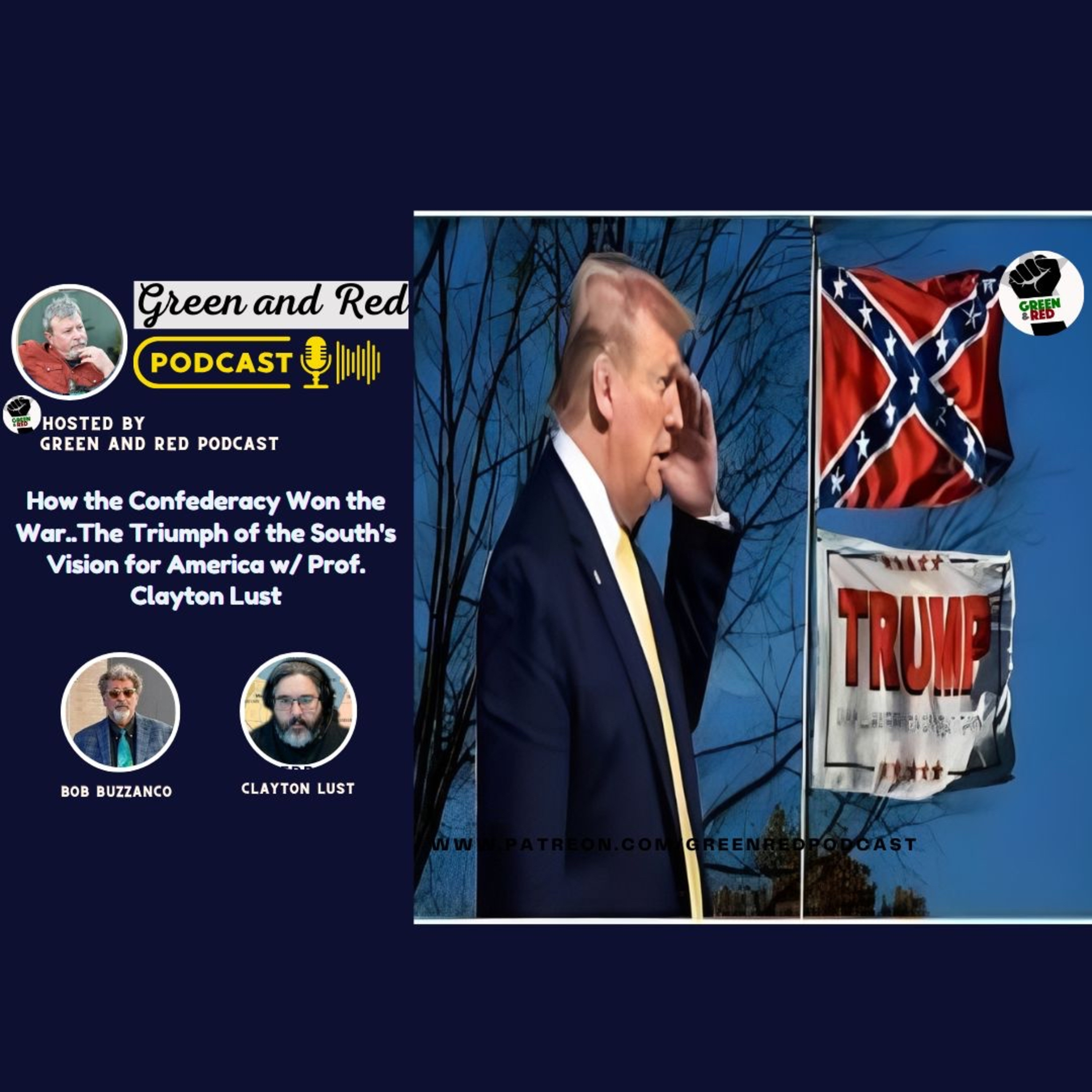
Green & Red: Podcasts for Scrappy Radicals
How the Confederacy Won the War..The Triumph of the South's Vision for America w/ Prof. Clayton Lust (G&R 493)
01:13:07
Loading summary
Transcript295 lines
- [00:01]
A
Welcome to Green and Red Scrappy Politics
- [00:03]
B
for Scrappy People, a regular podcast on radical environmental and anti capitalist politics. Brought to you by Bob Bozanko and Scott Parkins.
- [00:14]
C
Welcome to the silky smooth sounds of the Green and Red Podcast. I'm your co host Scott Parkin in Berkeley, California. And as always, I am joined by
- [00:24]
A
Bob Zanco in Niles, Ohio, which was a union state during the Civil War, which will be relevant, as you'll see.
- [00:32]
C
Yes. And then we are also joined by
- [00:37]
B
Len Lust, history professor at Houston City College. And I'm joining you from Houston, Texas, which was not a Union state during this whole. Yes, very much a union state.
- [00:48]
A
A very frequent guest and collaborator. And so it's always good to have him back. And he's very modest, but he's an outstanding historian who has studied a lot of the stuff we're going to talk about today in depth, more so than I have. It's really great to have you here and we're going to have some fun doing a it's a history show based on something that's happened recently, which is something we do frequently. I think it's our, that's our wheelhouse
- [01:14]
C
in a lot of ways. Yeah, we've got a lot of praise for that as the formula of how we do things. On Wednesday, I believe the Supreme Court effectively gutted Section 2 of the Voting Rights act, which was the last remaining major provision of the landmark 1965 law, which the Voting Rights act was a crowning achievement of the civil rights movement. The in 2013, in Shelby county versus Holder, they actually declared section 4B of the Voting Rights act also unconstitutional. But this, the gutting of Section 2 makes it impossible for communities, people who have been discriminated around voting to be able to sue, to be able to sue the state when there's racial discrimination. It was a 6 to 3 decision along partisan lines with a majority of the justices ruled that it's a case that came out of Louisiana that the Louisiana must redraw a congressional map that was designed to create a second majority black district in the state. State. In her dissent, Justice Elena Kagan described the ruling as the latest chapter in the majority's now completed demolition of the of the Voting Rights Act Louisiana immediately. Louisiana Governor Jeff Landry told Republican House candidates that he wanted to suspend the May 16 primary election in Louisiana. I believe last night they postponed it. Florida lawmakers have also been on the move on this. And then Speaker Mike Johnson, who is also basically just like Trump's puppet in the House of Representatives, has called for redistricting across the South. And just one added note, Democrats are now calling for redistricting across blue states based on the same on this ruling as well. And so we're going to be talking about this history that leads us up to this week. And so I'll hand it off back to Bob.
- [03:06]
A
Yeah, if there's a theme of this, it's kind of got to be. And I'm not really saying this tongue in cheek. It's like how the Confederacy won the war. And this is something that Clayton and I have talked about. I may have actually heard it from you before I even read it years ago. Clayton was a student of mine at the University of Houston. So yeah, I thought we would start and give a history lesson. And as historians tend to do, we start way back when because you don't just wake up and things happen. Right. There's a long, long dure, as Franks would say. So I want to start with kind of the Civil War and Reconstruction period. And I don't think it's controversial to say that the decisions made, and more importantly not made in that era made future conflict inevitable and made it impossible to actually fix the issues that were in place at that time. So you have the creation of the Freedmen's Bureau, which lasts only about 18 months, which was supposed to provide independence to ex slaves through property, and property is the key to citizenship and independence. The so called 40 acres and a mule. Pretty much everybody was against that, including northern liberals who said, hey, no one's given me 40 acres and a mule. And so the Freedmen's Bureau there were, I believe, was it 3.5 million back slaves still.
- [04:25]
B
There's still a lot of argument about that, that there were a total of 4 million who were ultimately emancipated in total. And, and there's. There are some historians who are saying it's four and a half million, but either way it's like y. It's a huge number.
- [04:37]
A
Yeah, back in my day was 3.5 million and about 500,000 free blacks. But it doesn't matter, no more than 10% if that actually took advantage of the Freedmen's Bureau.
- [04:48]
C
Right.
- [04:48]
A
The Freedman's bank was corrupt. It was supposed to provide capital. So they're black so that none of that works. Right. So you're back in a situation where ex slaves end up contract labor are more likely sharecropping. And I used to open my classes by showing an image of blacks in a field in Georgia. And I would say to the class, what Is this. And they would all say, oh, that's slaves. No, it's not. It's from 1915, actually. And so you had. And I got this phrase again from you. You had planters who thought, wow, this is better than slavery. They use those words, this is better than slavery.
- [05:24]
C
Right.
- [05:26]
A
Do you want to just kind of. Because you can do this better than me and bring it up to the Compromise of 1877.
- [05:30]
B
Sure. If you've got. For me, I think, the problem. I would center it actually, even earlier than the Freedmen's Bureau, Honestly, I think Abraham Lincoln, in his second inaugural address was talking about, with malice toward, not in charity for all.
- [05:44]
A
Yeah.
- [05:45]
B
And.
- [05:45]
A
Yeah.
- [05:46]
B
And the 10% plan basically certified that he was saying he doesn't get it, by the way, but this was his
- [05:54]
A
proposal for Lincoln to be Lincoln. To be clear, this is Lincoln, not Johnson. Yeah.
- [06:00]
B
10% of the confederates swear an oath of allegiance to the United States, and they write a new constitution that abolishes slavery, and that's it. They're pardoned and it's over. And I always. I tell my classes that. Think about that. That 90% of the Confederacy could still be going, screw this. We're still out. We're still fighting. We're still in on the Confederacy. And Lincoln would be going, okay, that's fine. So you've got.
- [06:28]
A
What would the Jacobin guys say about that? Lincoln is the biggest revolution in American history.
- [06:32]
B
Of course he is. Yeah, of course he is.
- [06:35]
A
I'm sorry.
- [06:36]
B
No, you're fine. And the. And the Freedmen's Bureau did actually do stuff for management of confiscated lands, but the 40 acres and a mule actually starts with William Tecumseh Sherman as well, where he's literally going through the south on that raid, that march through march to the sea. And he's literally taking land from slaveholders coming in and saying, you guys are in rebellion against the United States. This is. We're taking this. And then he's the one redistributing it. And it's not 40 acres, but he's redistributing it. And as you pointed out, it's not Link. It's not Johnson, it's Lincoln, but now it is Johnson. And Johnson comes in and undoes all of that with an executive order. Yeah, I was just saying. I think I want to say It's Executive Order 160, but I don't remember for sure what the number was. But in any event, he undoes all of that. You've got to fight between Congress and the. And the Executive branch over who actually controls, who controls Reconstruction. It starts with the Freedmen's Bureau fight, which Congress wins because it was just. They had so much support, it was going to pass over Johnson's veto regardless. And then you have them fighting for basically the next several years over this with ultimately a. A sort of military occupation of the South. And that particular military occupation, all the way up until 1877, was, was working. It was. There were, there were civil rights laws that were passed, like the Civil Rights act of 1866 which defines citizenship. And the template for the 14th amendment. We've got the 15th amendment getting passed. You've got all sorts of civil rights laws being enacted. And while the state, the Southern states themselves are not saying, are not saying, no, we're not going to do this, obviously they're protesting it and obviously they're trying to find the holes in the laws to do this, you've still got military occupation there to stop it. Okay? So even if the Freedmen's Bureau is gone and that part of the military occupation is gone, you still have military governors in five districts across the south with armed forces at their, at their disposal to say, no, you're not doing this. You're not going to do that. Okay? And then as you point out, that all just, it goes away in 1877, in 1876, Rutherford B. Hayes actually loses the election of 1876. He wins the popular vote. He wins. Excuse me, Samuel Tilden wins the electoral vote, wins the popular vote, but the Republicans dispute the vote in four states. This is another one of those things where it's like, oh, it sounds familiar, but they dispute the votes in four states. Since there isn't a congressional protocol for that, the Congress got together, created a committee to determine the validity of those four states and the votes in those four states. And ultimately the Democratic Party, in an attempt to keep. To get the vote for Tilden actually told. Gave the. One of the Supreme Court's justices who was on that committee, they said, look, we'll put you in as the senator from Illinois. And he accepted it. But then he. I don't know whether he got an attack of conscience or what, but he said, well, I can't be on this committee now. Another Republican wound up being appointed to the committee and it just went right down party lines. Eight, seven. All of the states go to. Right. Rutherford B. Hayes. You've got a couple of states that are actually mobilizing their militias, thinking the war is going to start again. And then they have, they have a compromise. They get Together in a hotel in Washington D.C. that was coincidentally enough owned by an African American. They sit down and hammer this compromise out. And the short version is that Hayes gets the presidency, but he also has to eliminate, he has to eliminate the military districts and pull the troops out. And, and that, that was a devastating thing because essentially what the United States was saying in 1877 is first of all, the anti slavery movement, while slavery's done, they were still, they still had something to fight for. As long as there's a perception that African Americans are not being treated equally in the United States. But by the time we're in the 1870s and civil rights acts have been passed and all of that, the abolitionist movement is floundering and they're just looking elsewhere. They're saying, what can we do about Indians in the West? What can we do to further expansion in the West? What can we do? We've got other things to do and we don't know how to deal with the problems of African Americans. So I don't think it's too much to say. I don't think I'm going too far afield to say this, that, that Southern whites, when they push this, that you've got to, if you want to be the President, the Republicans want to hold on to the Presidency, you've got to do this. I don't think it's too far afield to say they did that consciously saying we're going to restore a new order or the old order here in the South. And they do it. It functionally says that we as a nation are going to adopt the South's position on race relations. And they do for the next, literally 100, 140 years, 150 years.
- [11:50]
A
Something else that at the beginning, as I was alluding to it, I should have said the 13, 14, 15 minutes that you point out are important, right? They abolish slavery, they give black citizenship, birthright citizenship and they give black men the right to vote. But they don't address material conditions, which is what a small number like the so called radical Republicans best known would be, Sumner Stevens did, which was why they wanted the. Something like the Freedmen's Bureau, right. Slaves themselves understood this. There's a very famous line, the title of a book, was it by Eric Foner, I believe, called Nothing But Freedom. Right. That's a quote from a slave who said, they gave us, they set us free, they didn't give us a foot of land, they didn't give us a job, they didn't give us Any education, capital. They gave us nothing but freedom. Right. You also have the so called carpet baggers, which is another very controversial issue and we're going to simplify it here, but there's no doubt Northern capital fled into the south to 100% to gobble up the destroyed infrastructure for pennies. And there's another great observation by a, There's a black abolitionist who was also a Union army officer, Martin Delaney, who's very well known in the literature. Right. And in 1865 already he said, Yankees from the north will come down here to drive you as much as ever. It's slavery all over again. Northern, universal US Slavery. They don't pay you enough. Those Yankees talk smooth to you. Oh yes. But it's slavery over again as much as it ever was.
- [13:16]
B
You could see, anybody could see it coming if they had paid attention to what the country was doing in the 1850s to divert attention. And I know this is getting a, a little bit far away from where we were starting here, so I'll keep this really brief. In the 1850s to divert attention away from the sectional crisis, you had a lot of businessmen who were promoting expansion abroad who were going into places like Hawaii. Now they're not talking about overthrowing the government in Hawaii yet, but they're going in and they're establishing plantations there as well. They're going into other parts of the world. They're going into Japan and using gunboat diplomacy to open Japan up and what. And they're going into Chile and places like that. And what they're actually doing is they're not literally using slavery, but they're using forced labor and they're using a system in there that's called coolie labor that literally kills a quarter of the people who are working in it. So it's northerners who are talking about we've got to end slavery in the United States. But then abroad they're just, they're literally doing the same thing. So he had it 100% right that northerners are going to do this. And they literally, there's literally a book written how to get Quick get rich in the south about this, about coming down, taking control of the resources util, buying up land, buying up mines, buying up all of this stuff. And of course you've got JP Morgan profiting from all of this. You've got the Rockefellers later on in all of this stuff profiting. You've got, you've got massive consortiums coming down and buying up land. You've got Texas quite literally giving away land for railroad development, which spurs all of this other stuff. So clearly Northerners are going to come down and do exactly what they've been doing. And maybe it's not literal slavery, but wage slavery is not a wrong word to use here. Especially when they start utilizing CR sharecropping and properly. It's literal.
- [15:09]
A
Go ahead, Scott.
- [15:12]
C
A lot of what the bankers were also invested in was just like this military industrial complex. Right. It's like the Civil War like.
- [15:19]
B
Sure.
- [15:19]
C
Leads to this new level of military industrial. Military industrial complex. You can almost say that J.P. morgan paid for the cannons. Right?
- [15:26]
B
Sure.
- [15:27]
A
Yeah.
- [15:27]
B
That's not wrong.
- [15:28]
A
I wish I had. I thought of it. There's a great chart all about that. Like northern versus Southern kind of industrial capacity. How many factories had, how much coal they had in every area except for big plantations. The north had major economic advantages. Right? Yeah.
- [15:44]
B
I want to say it was like 200. 200 times the amount of steel that was being produced.
- [15:48]
A
Oh, God, yeah. 100%.
- [15:51]
B
It's crazy.
- [15:52]
A
Yeah. Railroads, everything. Medicine, chemicals, all that kind of stuff. Right. The two things that I think are like really crucial to come out is. Are one, and it's really important to understand this is not a Southern thing at this point. Even northern abolitionists essentially opposed the war that opposed the extension of slavery. Abolitionists themselves were actually a minority among anti slavery people. Right. Lincoln clearly said, if I could free all the slaves, I'd do it. If I could free none of the slaves and keep the Union together, I'd do it.
- [16:21]
C
Right.
- [16:22]
B
He was milquetoast about all of that. I mean, thanks.
- [16:25]
C
Around.
- [16:26]
B
But it's literally a wartime measure for him. It's not. It's not. It's not a personal heart.
- [16:31]
A
In fact, when you mentioned Sherman earlier, there were northern generals who were liberating slaves as they went through the south. And Lincoln countermanded those orders.
- [16:40]
C
Right.
- [16:42]
B
Mission early on was the law is the 1850 Fugitive Slave Act. You have to return them. That's it.
- [16:48]
A
That's it. And I know I'm an asshole about Jacobin, but there is this really strong trend there about Lincoln is a revolutionary and Lincoln is a radical and he's the Marxist. And again, that's bullshit that says he's absolutely not. But I think another important part of this is that the material conditions are really critical here because for most of the Republican party and the right wing always like, oh, the Democrats were the party slave and they were.
- [17:10]
B
They were right.
- [17:10]
A
Until the 1950s and 60s. Really. Right. Sure. But it's. The material conditions are really critical here. And people like Sumner and Stevens understood unless you give people the wherewithal to actually live, whether that be land or a mule or capital or even an education, that none of this means anything. And that's what segues into sharecropping. And I suspect most people know generally, again, if you look at an image of sharecroppers and you don't have any kind of date or anything on it, it just looks exactly like you would see in slavery and the conditions. And in some ways, the Northern argument, as you both know, best known by from George Fitzhugh, was that we're actually better to our slaves than you are to your factory workers in the north right now. It's a preposterous defense of slavery, but the critique of Northern labor was actually pretty good, right? So the argument there is, hey, we feed them and we give them a place to live. And sharecropping, you don't have to do any of that. You just put them in debt.
- [18:12]
B
Once you've provided the loan to get your. To get your crop started, all responsibility goes away. And there's not even an intellectual responsibility for it. I mean, slaveholders always claimed that. Intellectual responsibility. We're doing these things for the good of. Now they're going. Now they're going.
- [18:30]
A
We don't have to.
- [18:31]
B
We've provided them all of this. If they can't make a go of it, maybe they need to work hard.
- [18:35]
A
That's their fault. It's their cultural. And then you have the KKK and all that kind of shit comes up anyway. And we could talk about this the whole time because it's really critical. And the point here is what happened a couple days ago is directly connected to this, right? This is a continuing thing. So we're just trying to hit a few main points. It's not a long, thorough history of it. But I think another point which occurs like 20 some years later, which I think is also critical in this, and especially because this is again, a word that we hear all the time, was the populist movement, because there's this agricultural crisis after the Civil War, and it does actually, without government coercion, begin to create an integrated movement across racial movement among farmers, right? And we see that in the Grange, and there were black and farmer, black and white farmer alliances. And then that kind of comes to fruition in the populist movement. Now, the populist movement is a movement against bankers, it's against railroads, it's against trust. It's not a Trumpian movement.
- [19:34]
B
It's Also against landholders, right? Absolutely, absolutely. Opposed to absentee land ownership. They favor government takeover of all utilities. It is, in a lot of ways, it's the first socialist movement in the United States.
- [19:47]
A
I always have argued that it is the most serious challenge to capitalism in US History. But a huge part of that early on was that it included both black and white farmers throughout the south and the West. Right. And then that falls apart. Right. The. In 1896, William Jennings Bryan, who's actually a populist, a People's Party rep, and Brian's campaign. One of my favorite American history speeches of all time is, look, on one side you have the plutocrats and the captains of industry and the trusts and the bankers and the railroads, and on the other side you have the people.
- [20:24]
B
Right.
- [20:26]
A
I heard Graham Platner speaking a couple days ago. It kind of choked me up because that's essentially what he was saying. But when the Democrats essentially brought in the populace, the one element of that was, you ain't bringing the black farmers with you.
- [20:38]
B
No, they. It's funny to me that it's not funny. That's the wrong word. But the populist Party, the People's Party actually favored an anti lynching law. They wanted this. And you would never convince Democrats to accept that. And the part of why the People's Party emerged was they got to a point where they looked at it and said, they said, we cannot work with Republicans. They tried the fusion movement in South Carolina and a couple of other places and it just wasn't going to work. It still is to me to just read through it and read through, not so much read through documents, but read literature. It is mind boggling to me how it got to a point where they're going hard. We're eventually, we're essentially going to merge with the Democrats. I know they don't really, they don't really do that, but the Democrats really do take over the People's Party. And it's just a huge, it's a huge missed opportunity. Because even if you want to put the socialistic stuff away, it's a huge missed movement moment because there's a lot of things that the populace. You think about all of the stuff that the People's Party wanted for, all the stuff they called for in the Omaha platform. Don't become part of our structural, our architecture in this country that they become part of the political and social architecture. Direct election of senators, civil service strike, not so much.
- [21:55]
A
Women's vote, hiring practices, public education, women voting.
- [21:58]
B
Yeah, it's a moment that's on some level is tragic, I think. But yeah, can you talk a little bit?
- [22:05]
C
There's this sort of redemption period, which is this sort of terrorist violence of the Klan and other vigilante organizations, which is like a backlash to this as well. Could you just briefly hit some key points on that?
- [22:16]
B
Sure. I think that there's, there's obvious. I don't think they were always, they didn't always call themselves redemption, but it's strange that I was literally just talking about this with a student the other day. The Klux Klan originally emerges as a veterans benevolence organization for the Confederacy. Now don't get me wrong, they weren't going in there saying and we're all going to be living in this place together so we ought to be doing things together. But the idea was let's take care of these people who are permanently injured and all of this stuff from the war. And I think it's just natural that they all get together and they have this, they have this common idea, they have these common thoughts. So they're like, our problem is those guys over there. So they, it's just to me it's a natural progression that they wound up going the direction they, and they are going to fight, excuse me, they're going to fight African Americans, access to civil rights, all and all over throughout all of this stuff. The government, the United States government is going to literally pass the first anti terrorism laws in the United States about the Ku Klux Klan, the so called enforcement act in 1870 and 1871. I think it was to allow the federal government to step in and stop some of the things that the KKK was doing, including allowing access to, to the ballot. I think to me the high point, maybe it's a low point, maybe that's, I don't know which term they use there. The moment where I think it all changes is in 1875. In the 1875 elections in Mississippi you have a Republican majority winning the state. They won a bunch of states in the election. And Democrats in Mississippi just say that's it, we're stopping this, we're not allowing this anymore. We're not going to allow a Democrat, we're not going to allow a Republican majority to win. And they know that the Republican power is because former slaves vote overwhelmingly for Republicans. So they're going to do everything they can to stop former slaves from voting. Like they're going to use, they're going to create the poll taxes, they're going to create literacy test, they're Going to put in the. The infamous grandfather clause, where it says, first from Missouri, excuse me, for Mississippi specifically, it says that if your grandfather could vote before 1870, then you don't have to take the literacy test in order to register to vote. So this just eliminates thousands of black votes across the state of Mississippi. And everybody in the south starts going, that's the blueprint. That's it. And they start doing this. And when those other things, when those things don't work and things like false bottom ballot boxes don't work and all of the other things that these people do, when those don't work, obviously intimidation will work. And I think that this is going to come up again in the nineteen teens. But the. There's the movie Birth of a Nation, but it's based on a book called the Klansman that came out during this era. And it. Absolutely. Let's see. Yeah, different Klansman than the movie that just came out a few years ago. Right. Black Klansman. But yeah, it glorified the Ku Klux Klan. It turned them into the heroes of this era. So a lot of people saw that and looked at the Ku Klux Klan as the people who. The term comes from the idea that these people are redeeming the South. The south had somehow sinned. That's why they lost the Civil War. That was the argument of Southern literature in the night in the 1870s, which was that the south had somehow sinned throughout all of this period. They were being punished because of this. This is why they lost the Civil War. This is why all of this stuff is happening. And the Klansmen, the Ku Klux Klan is here to redeem all of us and set society right. And I know that this will, especially on Mayday, this will strike a chord. Those. That Mississippi Plan, as it winds up being called, also is used in the North. Okay, they're going to use that against. They're going to use that to create tests for immigrant labor when they come into the United States. They're going to use this to stop people from voting up in the North. And it's not just about black voters in the North. It's. It's largely about immigrant labor coming into the north to these. Because this is a very. That redeemer movement is critically important to creating a mindset that, hey, the Ku Klux Klan didn't do anything wrong. All they were doing was taking a society that had been. Had been this way. It had been flipped up, and now they're just flipping it back to the correct way. That's all they're doing.
- [26:45]
A
He and Scott and I were talking because we had Richard Slotkin on last year and he's great on all of this stuff. Right. It's the must read if you're the history buff of any kind of episode from September 2024. Start that. Yeah, start there. But. And one of the kind of cardinal myths, as he calls it, of US History is the Lost Cause. Right. And I know Scott and I were talking about that, and Scott made some good points about that.
- [27:11]
C
Yeah. What I wanted to say is that he elevates a couple of myths which are really important. One is the myth of the frontier and the myth of the Good War, which is about World War II, and then the myth of the Lost Cause. There's also the. There's also a. There's a myth that's the opposite of the Lost Cause, which is the myth around the freeing of the slaves. But I think the point is. And what Slotkin argues in his book A Great Disorder and in our interview with him is that the important thing to note about the Lost Cause is that the Southerners, the white Southerners, white supremacists, which probably goes beyond the south, really haven't let go of that Lost Cause. The rollback of the Voting Rights act that we see this week and seeing Mike Johnson, speaker of the House from Louisiana, really moving on this, is that they're wanting to roll back the gains of the Civil War, the gains of the New Deal and the gains of the Civil Rights movement. It's a really important thing to note. And they. And a lot of this is a story or a myth in which we tell ourselves. And so there's like a whole segment of our country right now which really believes in the Lost Cause. And we're going to kind of get into this a little bit more later, but on January 6th, people with Confederate flags. There's the whole thing about Confederate monuments and renaming of military bases. I think we're going to talk about that more detail towards the end of this, but just want to kind of flag that. Slotkin's very important. Has very important analysis on this.
- [28:31]
B
Yeah, agreed. I remember listening to that and thinking, they blew me away.
- [28:34]
A
So, yeah, I think we, again, we go over things briefly, but to kind of. Again, to go back that the south had this kind of cultural affectation. Slavery, it's a labor system, but it's kind of who they are as well. It's crucial to their being. And that's. And it was also very importantly again today, it was a great way for them to develop control over the whole society. There was, it's true, what 2, 3% of Southerners actually held slaves.
- [29:03]
B
It's a very low percentage.
- [29:05]
A
And most. There were a large number of Southern whites who materially were no different than slaves. And they're. The way that they ended up fighting for the Confederacy, even though they had no material interest in it whatsoever, was that kind of cultural appeal to them. Right. As Dylan, Bob Dylan brilliantly said, the south politician preaches to the poor white man. You got more than the blacks. Don't complain, you're better than him. You were born with white skin. They explained that was in 1963. Right. But that was always the way they appealed to this. And that's what we're seeing today, this idea that they didn't respect us, they didn't respect our culture. Look at what they did to us. And now it's our turn. Right. And I think the populist there is a really important part now you start to see. And there's always been civil rights movements, there's always been black resistance. Absolutely. And we in no mean no way are trying to demean that or overlook it. It's just we're not, we don't have. This isn't a lot a 10 hour class or whatever. Right. But you start to see that emerge again in the World War I years because what did Woodrow Wilson say this was a war to make the world safer democracy. Now Wilson basically meant that he wanted to get rid of the European colonies against white people and things like that. Right. But for people like WB Du Bois especially, they heard something very different. Right. Oh, it's war to make the world save the money. That means us. Right, Right. And this is something especially you because you've written extensively on things like the Camp Logan episode.
- [30:32]
B
Right.
- [30:32]
A
So blacks interpret World War I a certain way. Right. But that's not how Woodrow Wilson, who thought that Birth of a Nation was the greatest thing ever done, written with
- [30:41]
B
lightning, is literally what he said about.
- [30:43]
C
Yes. Which is screened it at the White House.
- [30:46]
A
Yeah.
- [30:46]
B
But I also point out that given that he has a. He had a PhD in history that was largely written by somebody else, I'm not surprised that he had that view of things.
- [30:55]
C
They've demolished that theater that he screened it in, though, to build a ballroom, apparently.
- [30:59]
A
I wonder if those are the same. I wonder if it was the same person who took Trump's SATs or we've had you on and done a whole show and we'll put that in the show notes because it's worth listening to again. But in just a minute or two, could you also talk about the. Because this is also when we see the return of the Confederate symbols, right? The monuments and the flag. And also these episodes like Camp Logan. Just briefly talk about that because this is a really important period in that retrenchment and that re. Response to what they perceive as the world's gone upside down and we're the victims now and black people run the world, which is what you're hearing today, right?
- [31:34]
B
It's really, it's again, it's a moment where, you know, starting from that premise, Wilson says it's a war to make the world safe for democracy. And then you have at various, various places, yet see this very weird thing where you have some places wanting to fill the draft quotas by saying, let's just enlist all the black people. And then you've also got these other places going, well, I don't want black people fighting for democracy across the globe because then they'll start getting these crazy ideas that they're equals. So you've got a very weird circumstance. And the years between the Civil War and 1914, say you've got a moment where African Americans are still fighting in segregate or still serving in segregated units when they go to places like, like the Philippines during the Spanish American War. They're doing a ton of fighting there, but they're also hearing their commanders refer to the Filipinos as literally the N word. And they just underst. They underst. Have black soldiers throughout that period. Understand. Or that it's drilled into them, this understanding that the uniform that they're wearing doesn't mean anything. It doesn't mean the same thing that this means, okay? Because this is still the first thing that people are going to see on them regardless. And we see that at places like Camp Logan. We see that in all sorts of. In all sorts of restrictions at places like Camp Anniston, where the, where the soldiers are being restricted there as well. And soldiers are just being told in Waco, we see this happening everywhere, that the United States is building these sort of prepare preparation camps, preparedness camps in World War I. Black soldiers are going to guard them, but they're also being told, don't expect to be allowed to do whatever you want in this city. And they're rejecting that. And I. It's crystallized when W.E.B. du Bois writes about, basically, we're going to do this one more time because. And I'm paraphrasing when he says we're going to do this one more time. Because his position always was, we've got uniforms on. We have. We fought for our citizenship when we fought during the Civil War. We have served the call of the nation over and over and over. And we'll do it one more time. And he said, we'll go, we'll get all of the training. And the line that really stuck with me through throughout this editorial was he says we'll get all of the training. We'll learn. We'll learn how to fight back. And quote, we'll cease to be so easily lynched. Which was, I think just. There was a series of laws passed During World War I, the Espionage and Sedition Acts. And I am stunned that they. That the federal government didn't just come in and shut down the crisis over that line. I just. Because it's mind boggling. But I think there was also lynchings
- [34:23]
A
increased during World War I. Yeah.
- [34:25]
B
And there was racial violence in literally every large.
- [34:29]
A
Lewis Riots, Chicago beach riots,
- [34:32]
B
Atlanta, Washington,
- [34:34]
A
D.C. a dozen black soldiers were lynched wearing their uniforms.
- [34:38]
B
Yes. Yeah. It's utterly.
- [34:39]
A
That meant nothing to. To white America. Like the fact you're in there. So what, you're in the military, right?
- [34:43]
B
No.
- [34:45]
A
Seth would have been leading a lynch mob back then.
- [34:47]
B
Oh, 100% joke.
- [34:49]
A
That's legit. That's real. Yes.
- [34:50]
B
Yeah.
- [34:51]
A
I don't.
- [34:51]
B
I didn't take it as a joke at all. But I think, I think when you've got Wilson, it's not the figurehead, but he's the president, so he is the figurehead, but he's crystallizing it. That this, that America is a white nation when there's. The United States doesn't sign the Treaty of Versailles, but we still participate in the. We still participate in the celebration. About that. There were, I think a grand ballpark. 370,000 black soldiers who served in various units throughout World War I. A lot of them were actually put into French service. And a lot of literally thousands of those soldiers won the Croix de Guerre from the French government. And Wilson said, yeah, we're going to participate in the parade down the Champs de Lyse. They said, there will be no black soldiers in that. We do not want black soldiers in that line at all. You've got African Americans murals.
- [35:46]
A
They were left out of murals showing all the. All the countries that participate in black University of Wisconsin catalog.
- [35:53]
B
That bad? I mean.
- [35:54]
A
Yeah, yeah.
- [35:55]
B
They're just. They're in a very important way. They're figuratively erased and literally erased from. From all of this stuff. And there is A sense post war that African Americans did nothing during World War I, that all they did was oppose. All they did was, was agitate. They got involved in riots and all of that. Ignoring again that there's 370,000 in this, in the military who are fighting across Europe and, and winning these awards from other countries. But the United States going, eh, this just proves that they don't have what it takes. And in those inner war years there was not, I don't know, I haven't studied the post war years, the post World War I years enough to know for sure. But I know there's at minimum a tacit understanding among the brass that black soldiers are suited for one thing and that's fatigue, duty. That's it. Nothing else. And it's almost, it's not almost. It is literally a rollback to when black soldiers first joined the Union Army. There was an, there was a thought. They're used to following orders from white folks, so let's just put them on fatigue duty and have them do that.
- [37:00]
A
Yes.
- [37:00]
B
So it's a rollback and to the point that During World War II, there's no thought whatsoever given to let's bring black soldiers and black units to the front. They're just not going to be brought up, going to be serving in the back. They're going to be serving in service roles and those fatigue duties.
- [37:16]
A
I read an account World War I where black soldiers said we were peeling potatoes and cleaning latrines.
- [37:21]
B
Yeah, that's the mindset is that's what they're good for. It took a year in to even open ROTC camps and train and officer training camps for black soldiers. So it was like at Wilberforce, there was a big fight over that about whether we'll allow black officers to be trained during all of this. So it's really, it's really a step back. Even though it's supposed to be a step forward, it's obviously a step back.
- [37:46]
C
I have one question which is a little bit related to this and a little bit maybe looking past it, which is thinking about race riots involving African American soldiers and Camp Logan. But it's after World War II where we see this really brutal pogrom style mass murders of African American communities in Rosewood, Florida and Tulsa and places like that. Correct and correct.
- [38:09]
B
That is after World War I. Yeah.
- [38:10]
C
And that's a. And that's a result of. What is that a result of? I guess would be my question, is that just more of the same. Did we see massacres like that before the war or Is there some reaction?
- [38:21]
B
There was some stuff like that in Texas and during the war. It's more about. It is there's a lot of Latinos, there's a lot of Mexican Americans who are murdered in that way.
- [38:31]
C
Not so much lynched as well or.
- [38:33]
B
Yeah, lynched and literally mass murdered by the Texas Rangers.
- [38:37]
A
So, yeah. Oh my God.
- [38:38]
C
15, 20,000 towards plan was the early border patrol, right?
- [38:42]
B
Yeah. It's just a crazy number coming out of Texas. I think there is a sentiment, I think to connect this to all of this. I think there is a sentiment about we're not going to. There's not going to be anybody here who is going to try to claim equal status to us. It's just not going to happen. Tulsa is the Tulsa race.
- [39:00]
A
Right.
- [39:01]
B
Is all about people in Tulsa saying that we do not accept that there is a black middle class here. I know that the thing that starts it is a kid on an elevator bumping into some girl and all of that sort of stuff. But they don't just go craft of him. They. People in Tulsa go after the part that is. I think it's called Greenville. They go after that section of Tulsa in Rosewood. It starts over an allegation of a sexual assault that literally didn't happen. And it means. And it results in people literally coming across the border from Georgia to participate in attacking the black section of Rosewood and driving people out, killing people and driving them out of Rosewood. I think it's a matter of. Again, I hate using this phrase, but from their perspective, restoring order to all
- [39:49]
A
of this stuff, there's also an economic empowerment angle to that because. And even in lynchings there was a database. A lot of the victims of lynchings were actually middle class blacks who were seen as competitors to white businesses. And I believe there were even whites lynched who were seen who were lynched for. And in places like Rosewood and at Tulsa, the. They're going after black capital and destroying that as well.
- [40:13]
C
Right.
- [40:13]
A
Who they see as competitors, right. It's they're taking our jobs. Right. It's the same old. You're hearing today, which is just as. That's really critical right now. And that continues. And you do see. And this is the period when you're seeing the Marcus Garvey movement and all kinds of other. Finally, the pure depth of the depression actually causes something to happen. Right. The depression is so bad that it destroys southern agriculture as well as everything else. Right. And this is when you also see the great migration where millions of blacks or sharecropping move to The North. And Roosevelt kind of. I don't like. He's not a hero, but Roosevelt is a transitionary figure, I think, at that at least. Right. In a good way. I'm on him right now. It's Roosevelt and maybe even Eleanor as much as him really say, okay, we got to do something.
- [41:02]
C
Right.
- [41:04]
A
Yeah.
- [41:04]
B
And I think Eleanor far more.
- [41:06]
A
Yeah.
- [41:06]
B
Than he. Yeah. He wouldn't have even. I think Roosevelt at one point said, yeah, I guess I'd consider signing a. An anti lynching law. And that was. Oh, Eleanor's too. That was.
- [41:16]
A
Yeah, yeah, yeah.
- [41:19]
B
And yeah.
- [41:20]
A
Roosevelt initially, he doesn't want to keep in mind, too, to go back to what people like Ted Cruz always throw in your face. Right. The. The Democrats are a Southern party still. They're like, I don't think there's any Republicans in the South. There aren't any Republicans in the Senate until John Tower in 1962 from a Southern state. Right. So Roswell doesn't want to alienate that. But when you have these programs, because the Depression is so bad, the public WPA and the Civilian Conservation Corps. I used to show my class. I call it a propaganda video, but it was quite good. It was called. I don't remember what it was called, but it was essentially blacks in the New Deal. And they show the programs in places like Harlem and other black communities where they created jobs. And they do address some issues of racial discrimination. But more through. We're giving you jobs, we're giving you money to spend. We're making you consumers. Right. Best part of that song is if you listen to the background music, it's basically the Soviet national anthem. So I don't know if Orson Welles and Mark. What's his name, the guy who did Cradle of Rock. I don't know if they did it or what. Right. Mark Blitzstein. And maybe he did. I don't know. But it's. But there is clearly a sense. And this is when you see blacks heavily vote Democratic. Right. There's a real sense that Mr. Roosevelt cares about us. There's a song about Mr. Roosevelt and you start to see this kind of idea that, okay, these people care about. And let's keep in mind, after being, like, targeted for actual physical violence, the fact that Roosevelt isn't doing that is a significant improvement.
- [42:49]
B
Right. Yeah. As crazy as that sounds.
- [42:51]
A
Right. Yeah.
- [42:52]
B
No.
- [42:52]
A
And believe it. And again, the New Deal doesn't say we're going to create racial equality that. But it does create some material conditions so that blacks can enter capitalist consumer society. And that's not insignificant.
- [43:05]
C
Right?
- [43:06]
A
No. And then with World War II you start to see through people like Harry Truman. Right. You see these programs like desegregation of the, the armed forces through executive order. And that's really, I think, isn't that really considered one of the launching points of the modern thing?
- [43:20]
B
Yeah, I mean I literally just talked about this in my classes yesterday, that if you, I am one of those who says you can't take the phrase the civil rights movement and go, here's the beginning, here's the end.
- [43:31]
A
Yeah.
- [43:31]
B
Obviously the last few days we're not,
- [43:33]
A
we don't have an ending, but we're ending unfortunately.
- [43:37]
B
Right. There's no beginning. But yeah, World War II is convenient because. And especially given that it's Harry Truman. Harry Truman takes a pen and writes an executive order that literally any president could have done. He's the commander in chief of armed forces. So I think given his background from Missouri, all of the segregation in Missouri and his grandparents being confederates and all of this stuff and slaveholders and the way his own mother talked about Lincoln in the North, I, you look at him and go, this guy's going to desegregate the military. This guy's going to call for a, a comprehensive civil rights program that ends an anti lynching law cooperation with, between the various cabinet level branches and cabinet level offices and the United States military to make recommendations for changes in the military. That executive order that he wrote that not only desegregated the military created a commission on civil unequal treatment in the military called for equal pay for black soldiers in the military. It was a big deal. And then he followed it up with the 10 point plan which was just insane. Again, comparatively today we'd look at that sort of stuff and go, yeah, why would you argue about this sort of stuff stuff. But for the moment it's, it's insanely comprehensive. It's hard to, it's hard to, it's hard to look at that and swear with who Truman was earlier in his life. But it's still, it's a very important moment in terms of laying out this is what the future is. You better get on board with it. And obviously Southerners are going to be like no, we're not going to get on board with this.
- [45:13]
A
Where you going to say something scouter? There's something else I want to go back because I forgot, which I think is really important. I love to point this out. Black political movements in the 30s are also very closely in her time with communists and the only real white people who were fighting for civil rights were communists. Right. There's one of my favorite books of any I do foreign policy. But this book is up there with that is Hammer and hoe by Robin D.G. kelly. It was this brilliant book Communist in Harlem during the Depression. Right. The Scottsboro Boys were represented by communist Jewish communist lawyers. Right. So we. And we always leave that art there is because now the black leadership class, or as Black Agenda reviews called the blast misleadership class rejects that and they vote for proposals to condemn socialism. And but the American communists and black radicals and people like Paul Robeson are great example. Robeson is just one of the most brilliant figures in American history. Right. And I think that's worth mentioning too. I always forgot. I always like to say that to Camp Logan.
- [46:12]
B
Back to my stuff. The Communist Party US donated hundreds of dollars to the defense of Camp Logan, the mutineers. So it was really, it was much all into the 1930s too, trying to get them released and writing letters of support to various presidents saying, you've got to release these guys. They didn't, they really didn't do anything wrong given the temperature of the time.
- [46:34]
C
There were a lot of Jew communist Jews too, who were.
- [46:37]
A
Oh absolutely.
- [46:37]
C
Yeah. Stanley Levinson later is one of King's closest advisors.
- [46:42]
A
No, that was really that as far as the government were concerned, Jews and blacks were the same thing. They're all commies. Right. No, it's quite ironic and quite crazy. Right. But in a lot of ways that does give. That's one of the pivot points, let's call it to the modern civil rights movement, Truman's efforts. The other thing that. Because people always talk about political realignment basically in the 60s with Johnson and the source actually in 1948 that because there's a civil rights plague in the Democratic platform. Strom Thurmond, who was a famous Democrat for half of his million year old life. Strom Thurmond is the real Montgomery Burns. Right.
- [47:16]
B
Yeah.
- [47:16]
A
But Thurman walked out of the 1948 convention, informed the Dixiecrats, which won several states in that election. But I think what's important there is Truman won despite that like everybody. Oh, you have to be modern. You can't do that. You imagine people were okay with it. Truman wide.
- [47:32]
B
I'm trying to remember what the actual number was, but it was some. It's. It's concurrent with all of this. But by 1962 or 3 or something like that, it was something crazy. 70% of Americans considered themselves to be quote liberals. So it's not like it was. It's not like it was. Everybody was out of pocket talking about
- [47:50]
A
this, the 1964 election. No one would not. That was. I'm a liberal. It would be like today saying I'm an American kind of thing. Oh, yeah, absolutely. That was not a my class. I used to say in 1960, Archie Bunker probably called himself a liberal. What? Civil rights. Hey, that doesn't affect me. Why shouldn't people be allowed to vote in Mississippi or Alabama? Right. Yeah.
- [48:12]
B
I don't want them living next door to me.
- [48:13]
A
I don't want George Jefferson next to me.
- [48:17]
C
I mean, they're liberals because of the material gains they get through the New Deal, right?
- [48:21]
B
Yeah, yeah, exactly.
- [48:21]
A
Yes. And then the Great Society. Right. And Dwight Eisenhower would be Bernie Sanders today.
- [48:28]
B
Oh, my God. At least a marginal tax rate of 90%.
- [48:32]
C
Maybe to the left of Bernie Sanders actually.
- [48:34]
A
Maybe left of Bernie Sanders today. Oh, absolutely.
- [48:37]
B
Great line in Mad Men when Harry Creed says it doesn't even pay to make above a certain amount of money because of those policies. Yeah, great. Harry Creed. Oh, God.
- [48:48]
A
Kinsey and Ginsburg were characters on that show. I still love that part of it. But again, we could keep on this.
- [48:54]
B
But sorry.
- [48:55]
A
Now we have the civil right now this is really crucial. Right. So we have a civil rights movement. And I think we all know about. I used to say we all know about that. We still do, but 10 years from now we probably won't because it's being banned to teach about in school.
- [49:07]
C
Right.
- [49:07]
A
In Texas Tech, I think you have to get permission ahead of time and Right. It's just. Dude, I'm so glad I'm not in Texas anymore. I enjoyed the fight and I loved going into class and saying, by the way, if I used to go in and talk about this and say, by the way, if you report me to Greg Abbott, make sure you spell my name pronounced. But I'm glad I'm not there. But at any rate, never, neither here nor there. So by 1964 and 65, you have the heyday of the civil rights movement. And let's keep in mind. And there's something I just pointed at. It's actually, when you think about it, it's a very conservative movement in the sense by these people are saying, we want to be Americans, we want the same rights that everybody else has simply by virtue of being born. Right. It's not material movement. They're not saying, we want jobs, we want more money, we want reparations, nothing like that.
- [49:49]
B
So to be fair, if you look at the Watts riots, And stuff like that.
- [49:55]
A
I'm going to get to that because that's after. Because no, King. King clearly moves.
- [50:01]
B
Okay.
- [50:01]
A
All right. But I'm just talking up to 63, 64. Basically what they're saying is we want to vote, we want to be able to ride on a bus, we want to eat at restaurants. Not like we want you to subsidize our meals. We want free bus rides or nothing like that. So it's a movement firmly within the context of American reform movements. It's revolutionary because of the topic race, which Americans never deal with. Right. But my point is, it's not like to go back to that Archie bunk.
- [50:27]
C
Right.
- [50:27]
A
It's not threatening Northern whites, Northern liberals.
- [50:30]
B
Right.
- [50:31]
A
If somebody. If somebody in the south can go to college or somebody in the south can vote or ride a bus or whatever, that doesn't really affect me. I don't have to pay for it.
- [50:37]
C
Right.
- [50:37]
A
So up to that point. And that's why you have this great triumph with the Voting Rights Act. I'm sorry, the Civil Rights act of 1964, which affects public accommodations, and then the Voting Rights act, in which the government essentially takes over elections in areas where there's a history of racial discrimination. Right. And King is a global hero, wins the Nobel Peace Prize, still the most hated man in America. At the same time, right. Now, it's after that. And to the. To your point, where we see this shift. Right. And that even in his latter months from Malcolm X and then, of course, from King, and we've done a lot of shows on the radicalism of Martin Luther King. Right?
- [51:16]
B
Yeah.
- [51:17]
A
King calls himself a democratic socialist. He believes in his very strong relationship with unions. And then his last major act is to create the Poor People's March. So. No, absolutely. And that. And that's when liberals bail. Right. I bring this up all the time. There was a great document when I was studying at the research. The LBJ library from. I think it was Harry Goodwin who was talking about the King in 1967. And he said, the Negro is ungrateful and sullen. The Negro is ungrateful and sullen. After all we've done for them, they still want more. They want jobs, they want education, they want health care.
- [51:55]
B
They want.
- [51:57]
A
And as soon as King started about jobs and health care and housing and education, not just for blacks, but for poor whites as well, boom, game over for him.
- [52:06]
B
Yeah.
- [52:08]
C
But the other element of that, which we don't have to go into is like, he also comes out against the war and.
- [52:13]
A
Yeah. Oh, yeah, absolutely.
- [52:14]
C
And it's like another big. Which is like some other public figures aren't doing at the time.
- [52:18]
A
And like in World War II, and even in the early Cold War years, black organizations were very loud in their support of the Empire.
- [52:26]
B
Basically naacp, purged socialists.
- [52:30]
A
I mean, that was the boys who founded them, right?
- [52:32]
B
Exactly.
- [52:33]
A
Someone once told me, and I never have found this validated. Makes sense, though. And I've asked colleagues of mine who do black history. Somebody once told me that Walter. It was Walter White, wasn't it? His name is Walter White. Right from the end of lacp. Wasn't it Walter White?
- [52:47]
C
Yeah, I think so.
- [52:48]
A
Yeah. Yeah. At any rate, I was going to until Breaking Bad. I would have done without blinking.
- [52:56]
B
Right.
- [52:56]
A
But somebody told me he once said, you can lynch all of us, but we're not going to cease being loyal Americans. I don't know. I've never found that verified. And this person heard it from another professor, so who knows? But the sentiment, I'm sure, is there. Don't doubt that at all. And look at the way they went after people like Robeson for challenging that, bringing Jackie Robinson out to try to make Robeson look about. Right. So blacks, let's keep in mind they were all in on American foreign policy, and that really pissed off the establishment. One king broke ranks with them, called the United States the greatest purveyor of violence in the world today. That's a big deal. But at the same time, these great triumphs are taking place, that backlash is already in place. Right. Scott and I many times have talked about the 1964 campaign. I think we've played a Gary A Barry Goldwater ad which shows like black radicals. And in the 1968 campaign, Pat Buchanan, Southern Strategy. Nixon is talking about these black radicals. And he's showing you have campaign ads with black men in Afros and bringing back every imagery, keep your white women safe, all that kind of shit. Right. So the backlash is already in place. Right. So even at the moment of great triumph, and really the civil rights. Like you can make a good argument that the impact of civil rights movement is Stronger in the 1970s, because this is when you start to see schools really being desegregated. The number of blacks going to college goes up significantly, number of blacks getting degrees, professional degrees, medical school, law school, black elected officials. This is when Jesse Jackson is creating his black political movement.
- [54:29]
C
Right?
- [54:29]
A
This one you have watch stacks. This is when you have black culture being commodified and brought into mainstream American culture.
- [54:38]
C
Right.
- [54:38]
A
The ABA is created. I just saw that there's a documentary on that.
- [54:42]
C
Right.
- [54:42]
A
Which the American Basketball association was considered a black league.
- [54:45]
C
Right.
- [54:46]
B
Yeah.
- [54:46]
A
So, yeah. And that kind of took, as I know we don't have that much time. That kind of brings us to today. Right. To this latest and more intense backlash. I think it begins with Reagan, and Clinton is part of it. We've talked about him before with the sister soldier movement and welfare reform and the crime bill, all of which are going, what did Hillary call? Black super predators or something like that. Yeah.
- [55:10]
C
John Roberts is a young attorney in Reagan's Department of Justice whose mission in life is to roll back the Voting Rights Act.
- [55:17]
B
Yeah.
- [55:18]
A
Yep. He's been at it for 40 years. Yeah.
- [55:20]
C
Right.
- [55:21]
A
And it was funny because last year, liberals thought Roberts was a good guy. They were kind of like, oh, Roberts, Jesus Christ. At any rate, I guess it's okay. We can move on to Trump today, because this is where the logic leads. He runs a campaign where he doesn't. The thing is, with Nixon and the rest of these guys, it was subtle. Right. I think Americans still thought it was important to at least say, I'm not a racist, or I whatever. Right. What Trump does is unleash that and legitimate your worst instincts. Right. David Duke endorses Trump and he doesn't denounce it in 2015. Right.
- [55:54]
C
He Very much cloaks himself in the language of the lost cause, like what we were talking about before. Yeah. He says, if Republicans lose, there won't be another election. If you don't fight it, like hell you won't have a country. And I don't give Trump any credit for any sort of intellectual aptitude about any of this. I think part of it's instinctual and part of it is, like, what other people are telling him. But he's. He basically, he's still doing this, is he's arguing that he is there to save white Christian civilization from home, from the undocumented people and the minorities and the women and the liberals and all of that. And abroad, he's talking about wiping out civilizations who are not down with the program of U.S. predatory hegemony, or whatever is calling it right now.
- [56:37]
A
He low IQ person is not even code for blacks and usually black women. Right. I think. I think Trump is congenially just the stupid racist he really is. So I don't think there's any stratagem involved. And I think Steve Band had a lot to do with that, too. I think Banner understood, like, all this stuff that you were subtle about. Now you can just say it out in the Open.
- [56:57]
C
Miller's in that. In that boat, too.
- [56:59]
A
Yeah. Oh, yeah. Miller is on the Southern Poverty Law Center's shit list. They've done. They have a dossier on him for the shit. He's died. Right. It's not surprised, but. And that kind of takes us to. Oh, go ahead.
- [57:14]
C
And now the administration, the Department of Justice, is going after this Southern Poverty Law Center. Shocking, right?
- [57:20]
A
I suspect Miller probably had a lot to do with that specific thing. Although I heard this the. The Southern Poverty Law center was writing 8647 in seashells.
- [57:29]
B
Yeah.
- [57:31]
C
69. 47, I think.
- [57:33]
A
Yeah. Those seashells were antifa. I don't think anybody knows that there
- [57:36]
C
are two weeks away from a nuclear bomb is what they think.
- [57:39]
A
The seashells were two weeks away from having nuclear weapons.
- [57:42]
C
Right.
- [57:43]
A
But then this is when you see Trump bitching about. As you pointed out at the beginning, as Clayton talked about on a previous show, the controversy over the Confederate bases. Right. And something to keep in mind there, military hierarchy was all in on renaming those bases. Right, Right.
- [58:00]
B
Yep.
- [58:00]
A
They fought against the United States. These people fought against the US Government, and they lost the war. I've traveled throughout Italy. There are monuments to the Partigiani everywhere, to the resistance bus stops. El Partigiani. Right. I didn't see a goddamn thing there about Mussolini. I know there are people there who
- [58:18]
B
embrace literally the only country that does this.
- [58:21]
A
There are no doubt, people who embrace Mussolini. There are people in Germany, obviously, who endorse Italy, but they don't have statues of them there. Right. They don't have bases. I've said.
- [58:29]
C
I said this the other day.
- [58:30]
A
I said, when I moved to Houston, I don't even know you yet. One of my students was a high school teacher. I had a bunch at the time. And he said, yeah. And I'd heard of Lee and Davis High schools. Never thought anything of it. And the guy's, yeah, I teach at Jefferson Davis High School. I say, what? Say, yeah. I say, that's Davis High School. Yeah. He had a high school name. Not a Jefferson Davis in 1996. Isn't there a Lee High School?
- [58:53]
B
Yeah, it is.
- [58:54]
A
I was like, really? And then I didn't even know what Lamar was until they told me, yeah, it's a symbol. But God damn it, I got to go to Benito Mussolini High. I don't want to do that.
- [59:03]
B
And the worst part of it is this stuff, I think even more offensive is that Davis High School, or it's been renamed now. I know it's not Davis Yeah, I think it has.
- [59:12]
C
Yeah.
- [59:13]
B
But back when it was Davis High School, it was basically a black school. It was like, overwhelmingly black. It was like, I remember going to a football game when Nathaniel was in school and going, wait, what? Just doing double takes and being like, this can't be right. Somebody's messing around with me.
- [59:29]
A
Scott grew up in a city where the Civil War never ended. I went.
- [59:33]
C
Being from Garland, Texas, I went to South Garland High. Our school mascot was a Confederate colonel. Our school flag was the Confederate flag. And our school. Our football fight song was Dixie. And oh, my God, we had a male cheerleader squad called the Centuries. And they would face. Paint the Confederate flag on their face faces. And then some of the football players would do that too, including the black ones. Right. And that's. That's. And that was like the mid. The late 80s in. In suburban Dallas, Texas.
- [60:04]
A
So years ago, they got sued by
- [60:07]
C
the NAACP in 1989. And most of that was. Most of that was taken away.
- [60:12]
A
I bet they're pet.
- [60:12]
C
Still on Facebook forums from alumni of my high school, they get really mad about it. I've seen it. I had to leave those Facebook groups years ago.
- [60:21]
A
There was this. Can't remember his name. I don't think you admired it, but I just don't remember his name. He grew up in, I think in the Panhandle. His high school nickname was the White Faces. And he told me that it's like, no. Like having drinks. No. And I just didn't believe him. His go. They were.
- [60:36]
B
We were the White Face.
- [60:37]
A
She was like, okay, man. Any rate, though, the re. The reconfiguration of the courts was very important in ways that people like even Obama and Rahm Emanuel never took into account. Look at the way they let Ruth Bader Ginsburg. Hang on, dude. If that were a Republican president, as I've said many times, they would have sent her out without fishing with Al Neri that day. Sue, she came back and said, I have cancer. Okay, you're gone. Right? They didn't give a shit. They didn't give a shit about the lower courts. They didn't fight. They had a Super majority in 2009. Didn't pass any kind of Voting Rights act or Civil Rights act or anything like that. Right.
- [61:15]
B
I want to just interject here, one thing real quick is that during the Bush administration, I remember, and I think it was during his first term, there was all sorts of talk about the recertification of the Voting Rights act. And even the recertification was controversial. And I remember I was just. I had just graduated. I just graduated. At that point. I was like, what's to discuss? Of course it's going to get recertified. Why would anybody be opposed to this? And there was real opposition in Congress to recertifying it.
- [61:47]
A
And it final.
- [61:48]
B
I guess it finally did get recertified. But then it got gutted during the first bits of attacks on it.
- [61:54]
A
Yeah.
- [61:55]
B
Structurally were happening during Bush's administration. It was George W. Bush's administration.
- [62:01]
C
Now
- [62:03]
B
sanity has to prevail here.
- [62:05]
A
At some point we glossed over Reagan. But I just. Because I don't want to leave time. But Reagan opened his campaign in Philadelphia, Mississippi. And Reagan and went out of his way. Right. And keep in mind the first Bush gave us Clarence Thomas.
- [62:18]
B
Right.
- [62:19]
A
Who is. It's bizarre.
- [62:22]
B
A world.
- [62:22]
A
Right. As much as anyone in U.S. history since 1865. He's responsible for destroying any semblance of a black civil rights movement.
- [62:32]
C
Right.
- [62:32]
A
Didn't he say that the Dred Scott decision was incorrect? I think. I believe. I think column.
- [62:38]
B
I wouldn't be shocked by that.
- [62:39]
A
The two worst people in America are a black guy and assist in an Italian immigrant. Yeah. It's just so insane.
- [62:47]
B
Thomas literally just said the Calais decision didn't. It's not enough. We need to go further.
- [62:51]
A
Yeah. It's like it used to be a joke. There are now it is probably like in Republican circles a mainstream opinion that slavery's not so bad. But. But. And then we get. Hegseth comes in and he. One of the first things he does is he fires 30 officers. I believe the big majority of whom were black and female.
- [63:12]
C
Right.
- [63:13]
A
Renames bases. Keeps talking about we don't want to be woke.
- [63:16]
C
We don't get.
- [63:17]
A
Removes books by black authors in the West Point library while he keeps mine calm fray. And that brings us obviously to the courts. Right. Shelby County John Roberts in 2013. I don't know if I know. I said well, before we came on. I remember that week in 2013. It was the same week that the chef Paula Dean it came out had made all kinds of ugly comments using the N word and things like that. That was the national discourse that week. The same week that the Shelby county decision came down. Everybody's talking about Paula Deen in the media too. Is Paula Deen a racist? Should Paula Deen be canceled? Like, oh, John Roberts, I can deal with Paula Deen. Her threat is she's going to kill me with fucking cholesterol. John Roberts is. Yeah. So here we are. So the decision the other day, it's curious. The one thing that is strange I'm saying it's good or bad, it's good. It's like for the first time ever and it's taken them 50 years to do it, is Democrats are fighting back.
- [64:11]
C
Right.
- [64:12]
A
And they've. I've even seen Democrats say, you want to do that? We're going to give you 52 Democrats in California. We're going to give you however many. We're going to gerrymander the whole the hell out. When I lived in Houston in four elections, I had four different Congress reps because they kept changing it. I had Dan Crenshaw, I had Lizzie panel Fletcher, I had Jean Green. I think I had Sheila Jackson Lee at one point. It's. But to kind of go back to unless. Scott, did you have anything you want to add? I just thought, like to wrap it up, the whole point of this is they used to say the south shall rise again. The south has risen. Right. Yeah. And we'll probably title this how the Confederacy finally won the war or something like that. And I think the point is that the end of a war obviously is determinative. Right. But what happens afterward? Probably more important, one of my key things that I've been saying for years and I've done a lot of media on is the Americans won the Vietnamese War because look at what's happened to Vietnam since then as part of this global capitalist economy. Right. We have adopted in the United States now these Southern visions not just of race, but really of society written large. Right. And that includes these traditional views of things like women, the patriarchy, Christianity, immigration and all that. These are mostly the kinds of ideas that existed in antebellum America. Right.
- [65:29]
B
It's not just about race. It's all of that other stuff.
- [65:32]
A
And labor, of course.
- [65:33]
B
Yeah. These guys, honestly, I don't say this lightly or as a joke. These people would re. Reinstate Kubricher if they could. They would. Absolutely. They'd take away the rights for women to have bank accounts to do all of these other things.
- [65:49]
C
When I lived in Texas, I used to hear people talk about that.
- [65:52]
A
Yeah.
- [65:53]
C
Or end non property holding people too.
- [65:56]
A
Yeah.
- [65:58]
B
That says that his wife is his property. Thinks. Yeah.
- [66:01]
C
It's just.
- [66:02]
B
Yeah.
- [66:02]
A
Oh, yeah.
- [66:03]
B
I look to try to tell that to Teresa, but, you know,
- [66:08]
A
my head
- [66:08]
B
might be somewhere else.
- [66:09]
A
I told my. My nephews one day. I was like, hey, why are you letting. My nieces are my. They're like nephews who brought into the family my nieces one day. And I was like, why letting her talk to the Sprint court said you tell her what to do. You know, they're like, they're Italian girls. They. We tell them what they do. We're get a frog pan up head.
- [66:28]
B
Right? That's right.
- [66:31]
A
Anyway, it's. Let Scott wrap it up and you can say your final thought. It's. It's bleak. It's so incredibly bleak. I don't. I. You want to be hopeful. And the resistance you're seeing in the streets is truly inspiring. Like what we saw in Chicago, Minneapolis with ice. But we're seeing it all over. I think it's going to be a hot summer. Remember 2020 people are pissed. More people are pissed. The one thing too Trump is driving people into activism in ways that we've never been able to do, frankly. I think you do have that hardcore 30% who are unreachable. They really are. These are the ones who do think women shouldn't be allowed to vote and blacks should be whatever and immigrants should all be whatever. But there are. He's every. By the day he's pissing people off. Hegseth is so wildly reviled within the Pentagon. Cash Patel is an absolute fucking laughing stock. Right. So I don't know. But it's that decision which I think we all expected. I don't think no one was surprised by it. Right. I'm hoping that these groups are prepared. The irony that I've seen so far is last thing I'll say is most of the preparation I've seen from some of these mainstream groupers, we'll gear up for the midterms is do you realize what that decision just did?
- [67:48]
B
Right.
- [67:49]
A
You're not going to be allowed to
- [67:50]
B
gear there's going to be able to do it.
- [67:52]
A
Yeah. So the idea that that's always been people on the left. That's always been our beef. The only way you guys can think about this is we'll file a lawsuit or we'll vote them out. You can't do that anymore. That's the point. Right. So. Nope.
- [68:05]
C
That's their goal.
- [68:06]
A
Maybe desperation will bring people out. Maybe there'll be national strikes. Maybe there will protest demos. Who knows? I think
- [68:15]
B
the only thing that gives me hope, like you said, is is my students, they have been, especially this semester, talking to them. They have been way, way more radicalized. They're way angrier about things. When I tell them things that happen at various points, they're stunned and they have that sense that this can't go on. So I'm glad to see that and that's that's the only thing that gives me any hope, really.
- [68:37]
A
I suspect a lot of students probably found out I was retired throughout the school year. Hey, what happened to Bozenko? I've gotten a lot of emails and messages from ex students who said, man, what's happening today? That's exactly what you were talking about. And that's why you teach. It sounds corny as shit, but that's why you teach, because you don't want to do it. To be around a bunch of people who are professors. Those are not the people you want to hang out with.
- [69:00]
C
So there's. There's a lot of people in the street. There's probably more people at some of these demos, even though they're Saturday demos, they're permanent demos, than we've seen maybe ever. And there's people who are also doing what I would call legit, fierce resistance to ICE in Minneapolis and things like that, and a lot. Alex Preddy and Renee Good. I'm saying this all the time. They were new to activism when they got involved with and then. Which resulted in their lives being taken. And there's people like that all the time. And there's people also coming over from the other side who are. Which we should not do that FA. Fo thing to the people we should embrace. And, hey, we. Because we need all of those folks to resist what's going on right now. It's a really important thing to note is no one, no, anyone who wants to throw in with you is those are the people you want right now.
- [69:43]
B
It's.
- [69:44]
C
We're. We're fighting the army of the dead at this point.
- [69:46]
A
So, yeah, look, I know what Marjorie Taylor dreams about, and there's a lot of stuff she still says that is just quarant. Right. But she hates Trump, and she's gotten under his skin and on some really important issues. To me, war is a huge issue.
- [70:00]
B
Right.
- [70:00]
A
I don't see why you should say, we don't want anything to do with you. She's fighting Trump more effectively than Chuck Schumer ever will.
- [70:07]
C
You know, I put Green in a little bit of a different category than Tucker Carlson and Nick Fuentes, but those guys are influencers, and they're. And everyone's making a big deal. Oh, they're breaking away from Trump. Or maybe they're not. We shouldn't trust them.
- [70:18]
A
Yeah.
- [70:19]
C
But we. They're doing what they're saying, what they're saying, because they're actually being influenced by the people who, you know, listen to them and their base or their audience or whatever it is you want to call them. That's Green I think is a little different but. And Massey I think is a little different but especially the media influencer types, I think they're saying what they're saying because that's what they're being. Yeah, absolutely.
- [70:37]
A
Here in true Green and Massey, they're pretty consistent actually on war stuff and civil liberty stuff. They've always talked about that. I wouldn't vote for either of them but they would probably whatever this, this,
- [70:49]
C
this Supreme Court case around roundup Massey is. Yeah, we need to do something about that's significant.
- [70:56]
A
More Democrats voted for FISA than Republicans voted. 22 Republicans voted against FISA which is not a bad thing. Right. And, and, and if Trump's whole told ever abandoned there, there would be some of those people forget like Lindsey Graham, good God, he's fucking Wolf and Mike Lee and people like that. But there's stuff going on but there's no way to, to polish what happened a couple days ago. It's horrific. The fallout's going to be ugly. Who knows what the elections, if there are elections, who knows what the hell's going to happen? I have no idea. So anyway, but Clayton, it's always great. This has been great, it's fantastic, like I said, I told Scott's like I know this especially that early part way better than I do. It's funny, U s history like 1945 is a cut off so like anything before that's ancient history to me so that's good. Thank you so much. This was really cool.
- [71:47]
B
Anytime.
- [71:47]
C
Thanks for coming on Clayton. The first thing I want to say is just an announcement. On May 21st we're doing an event in Berkeley, we're hosting a panel. The speakers will include me, Thomas Zaitsoff, who we actually had on the show recently, who's the author of no Option but Sabotage. He's a professor at American University Omar Walsau, who is a professor at UC Berkeley in the political science department and will be moderated by our friend Jason Miles of this is Revolution podcast. So pretty excited about that. If you like what you're hearing, please check us out on Facebook, Instagram, Twitter, bluesky. If you're watching this on YouTube, hit that subscribe button if you're watching this. If you're listening to this on audio platform, give us a rate and review. If you really like us, go to greenandredpodcast.org and hit that support button or become a patreon@patreon.com backslash greenredpodcast and until we meet again, everybody make trouble and misbehave. Talk to you soon.
- [72:41]
A
It.