← Green & Red: Podcasts for Scrappy Radicals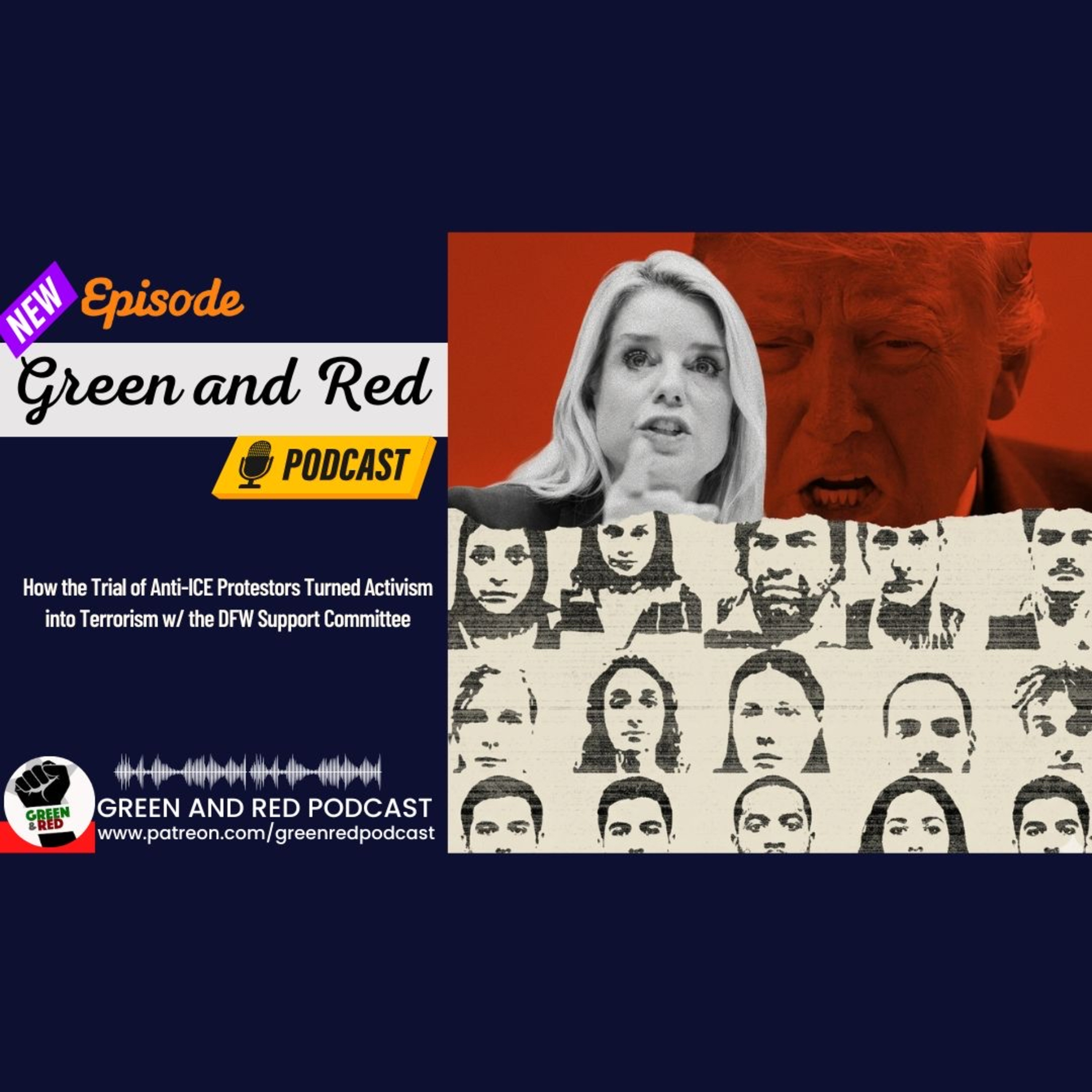
Green & Red: Podcasts for Scrappy Radicals
How the Trial of Anti-ICE Protestors Turned Activism into Terrorism w/ the DFW Support Committee (G&R 485)
00:35:01
Loading summary
Transcript53 lines
- [00:01]
A
Welcome to Green and Red Scrappy Politics for Scrappy People, a regular podcast on radical environmental and anti capitalist politics. Brought to you by Bob Bozanko and Scott Parkins.
- [00:15]
B
Welcome to the silky smooth sounds of the Green and Red Podcast. I'm your co host, Scott Parkin in Berkeley, California. Bob is off on assignment today, but I am going to be talking with Jay, who is with the DFW Support Committee. The DFW Support Committee supports the defendants in the Prairieland case. We've just recently done a show on this with Adam Fetterman, but we also have been wanting to talk with the support committee for a while. Plus, we think the more information out about this, the better. So, Jay, welcome to the Green and Red Podcast.
- [00:53]
A
Happy to be here. Thanks for having me. Yeah.
- [00:55]
B
And so as folks who've listened to our previous show and have been following the story know that nine activists actually were just recently convicted of federal charges for incident related to a protest outside an Immigration and Customs Enforcement detention center in North Texas. I think, I believe it's called the Prairieland Immigration Detention center or something like that. They were convicted of some harsh charges, including material support to terrorism. So, Jay, maybe we could just start off a little bit of giving us a little bit of a. Tell us the background story of what happened that day. I believe it was on July 4, 2025.
- [01:35]
A
Yeah, sure. And so July 4, 2025, it's the day that all of our lives here in DFW turned upside down. If people remember, in the springtime last year, there was an increasing wave of demonstrations against ice. We've only seen that wave increasing over the last eight months since then. But especially around that time, you had LA happening and you had a sort of wave of similar street demonstrations happening across the country. So on July 4, 2025, there was a call to hold a noise demonstration at the Prairie Land Detention center, which is about a half hour, 45 minutes south of Fort Worth, if anyone knows the area. But it's a pretty rural area. This is a strategy that ICE uses very similar to the strategy that Prison Industrial Complex uses where they place facilities in sort of small towns away from bases of opposition and people's families and communities and as a sort of disgusting jobs program. Anyway, so there's a small town called Alvarado, Texas, where there's this detention center. The detention center is known for having terrible conditions and has also been in the news for being where a Palestine Solidarity activist from Columbia University in Malika Cordia was held for over a year, recently released, fortunately, but she was there actually at the time of the demonstration. So I'll also preface to say I wasn't there on July 4th. No one, as far as my knowledge, no one who was there on July 4th is not currently in custody. So a lot of this information is through sort of our understanding, but a lot of it comes from the trial. And that's one of the interesting dynamics here, is that the trial, this very important trial that had a very tragic conclusion, actually confirmed a lot of our sympathetic narratives to what happened. And the facts that emerged actually are very much in line with a sympathetic understanding of what happened. Sorry for that preface, but I'll. Now I'll get into what happened on July 4th. There was a call to have a noise demonstration. A noise demonstration is a tactic that gets used broadly, has a long history to it. It's used today. It's not. It's nothing secret. Basically, the idea is you go somewhere, often near a place like a prison or a jail or detention center, and you make a lot of noise to let the people inside know that they have support. And there are people there. Right. And so on July 4, some people held a noise demonstration at the Prairie land Detention Center. July 4th was chosen in large part because it's a time when you can make a lot of noise in public and it's normal. Right. So, for example, there were fireworks that were set off at this demonstration on July 4th on a rainy July 4th to people inside. Don't get firework shows. Here's your fireworks show. It was a rainy day, rainy evening. Probably about a dozen people showed up is what it seems like. And they were there, they had a bullhorn, they made a bunch of noise and set off fireworks. At some point, it seems like someone who. Someone showed up who had some spray paint on their own volition went off to go spray paint some stuff, and seems like they might have broken a security camera or something as well. In the parking lot, the. The people inside the detention center, the detainees saw the demonstration. They were waving. It seems like it was doing its effect. This was. The action was going well around the time that people decided to leave. About an hour later, the cops are called and they show up. And this, the first officer on the scene is a man named Lieutenant Gross. And he shows up and there's the people who. It's a person who had been breaking something in the parking lot or something, takes off running. Spray painting. Yeah, that kind of thing. Low level vandalism. That person takes off running. Lt. Gross comes out and this is again, facts that we all learned from the trial a lot of the stuff we didn't know until the trial. Lt. Gross comes out immediately upon arriving on the scene. He gets out of his car and pulls his firearm and is pointing it at this person running away. If that happened in a split second, shots are fired, it seems very likely from someone who was a demonstrator at the scene, who had a long gun with them, who had a rifle. Open carrying in North Texas is not the most unusual thing. Open carrying at demonstrations is not the most unusual thing. I was just at the no Kings protest in Dallas two weeks ago or a week and whatever ago, and there were people with rifles on the left. They weren't counter protesters, they were people on the left who were choosing to use open carry as a strategy anyway. So.
- [06:25]
B
And just clarific. Open carry is legal in Texas.
- [06:28]
A
Open carry is legal in Texas. In fact, there's a history of open carrying both on the right and on the left recently over the last 10 years in, in North Texas. So it's not unheard of. This was, this is not a strange. Some people in the country that might be strange. That's not, that's not a sort of oh my God, I've never seen this happen before kind of thing here in North Texas.
- [06:48]
B
Right.
- [06:48]
A
It seems very likely that someone on the scene fired shots from a security camera footage that was shown in the courtroom. Those shots hit the ground in front of the Lieutenant Gross. You saw puffs of dust coming up. There's a tactic that gets referred to as suppressive fire. And the idea is that you just shock someone into not doing what they're about to do is my understanding. I'm not. That's not something in my nomenclature, but that's what I've heard people refer to it as. And it seems when that happened in this sort of exchange of gunfire. So yeah, Lieutenant Gross fired back. Lieutenant Gross is injured on the sort of upper back in the sort of trap area. It seems like probably grazed by a ricocheted bullet is what is a very likely explanation for his injury because he spent about three hours in the hospital. So this was not a sort of life threatening condition. This was scary. Anytime you're. It's scary. I'm not going to admit it and say it's not scary, but it's was not life threatening in any way. And. But he also fired back later. We learned in the in trial the gun that the police allege had a dent likely from a bullet hitting. So he fired back directly at the person who he believed was firing at him and almost hit that person. So this exchange of gunfire happens. More cops show up and they arrest everyone they can find, including people who were trying, who were leaving, who were either getting in their car or in their car or walking away, all this sort of stuff. They arrest everybody there. And very quickly the police create this narrative seemingly out of thin air that this was a coordinated attack, that this was an ambush. And they proceed with that fantasy in mind and immediate. Very soon after that the federal government gets involved and it becomes a, it becomes a scale of police response that is scary and unusual and something that in my life, long time of being on the left, I haven't seen personally firsthand. So there was one person who the police believe is a shooter who wasn't apprehended on the scene and they kicked off a multi state manhunt. So that involved many raids on houses. It involved a push alert to people's cell phones all across, not just North Texas, but down to San Antonio and Houston and Oklahoma. I was having dinner with friends and received this push alert from my called a blue alert. It's very, I didn't even know that existed. And anyway, so it very quickly escalated into this sort of extreme scenario. The people who were arrested on the scene were charged with terrorism on a state level. They got a criminal complaint on the federal level for various things, including attempted murder under this auspices, that everybody was attempting to do this thing. Even if you weren't the one who pulled the trigger, you were a part of this conspiracy to do it. And that's the beginning of the case. There's another eight months of chaos, including the Trump administration releasing the NPSM 7, the National Security Policy Memorandum 7, which if you haven't heard about it, it's this document that directs the executive branch to pursue quote, unquote antifa as a sort of domestic terror threat. And when very soon after that document was released, the defendants in the case got brought into federal custody and got indicted as the quote, North Texas antifa cell.
- [10:24]
B
And this is after the Charlie Kirk
- [10:26]
A
murder is what this is shortly after Charlie Kirk murder. Murder, yes. And what's extremely notable and was true at the time, even at the beginning, there's some reporting that everything changed with NPSM7. I would agree to that. I think that the government was headed in this political direction from the beginning. But when the case actually began being brought in federal court, it was clear that the politics of the defendants was going to be front and center and it was going to be a large part of the case. Of the government against the defendants. There was a, for example, there was a preliminary hearing in when they were first brought into federal custody where some of it was spent on what happened on July 4th. But they had very little evidence, they still to this day have very little evidence that most of the people involved had anything to do with anything illegal. But instead they focused a great deal on the zines people were reading, the messages they were sending, the assumed beliefs of people. And for example, some of the defendants had a printer in their garage and they were starting a print shop and printing zines and books and stuff like that. And the federal prosecutor got up in court and made this big thing about how there was a commercial printer in these people's garage and they were printing insurrectionary materials. And so this sort of political case, this political narrative is the case that was brought in federal trial in, in February and March, whenever it was.
- [11:58]
B
One question, one question I have.
- [12:00]
A
Yeah.
- [12:00]
B
Back onto July 4th is a person who went and committed the low level vandalism. My understanding is that he was actually not affiliated with anyone who was there and that he had just heard about this and showed up and started doing this. Right.
- [12:15]
A
Yeah. I think that the, the action was public. It wasn't publicized on social media, but it was published. It was sent around to very large open group chats. Basically. This was not a, this was something that people could have gone to who didn't know each other. And in fact, many of the people who went didn't know each other. One of the people who was there is a man named Nathan Bauman who I don't think anybody in who was there and had known this guy ahead of time. He's young, he's lives in lives about an hour and a half away from dfw. From his social media background, it looks like he was either recently politicized or a chaotic politics kind of type. I don't know, people are strange. And it seems like he was the one that showed up with the spray paint and is alleged to have broken stuff. And on this and on he, he turned cooperating with the government, actually took the witness stand during the federal trial and testified to doing stuff, doing the spray painting and breaking things. And she. There's no evidence that he coordinated with anyone to do that. There's no evidence that he, that anyone knew that he was going to do that. If you have ever been to an action and somebody did something that you didn't like, this is the same situation, or maybe you liked it but you weren't a part of it. It does. Just like somebody went off and did something and that was not you. The plan of the action was something else. That guy went off and spray painted something. I've been at that kind of demonstration before. It's not, it's, it's not my responsibility what everyone does.
- [13:49]
B
Yeah, totally. Maybe to get into the trial, there's like a, there's different stories, there's, there's different things that happened at the trial. Maybe to kind of start off with is the. Can you talk a little bit more about like just the federal prosecutors strategy around? They definitely went in for the politics. They actually brought in with supposedly, quote unquote expert witnesses who were from like right wing media think tanks, things like that. Can you actually just talk a little bit more about that?
- [14:22]
A
Yeah, sure. To frame this, this trial took place in Tarrant County. The federal system, those don't know, is broken up into circuits and districts and all these sub things and even these districts are broken into courthouses. Tarrant County, Fort Worth is the federal courthouse that covers this sort of jurisdiction of stuff. Tarrant county is a rather conservative part of the country. It's. And the jurors for Tarrant county, for the Tarrant County Ford House are not only Tarrant county because it's federal, they come from the surrounding areas more broadly. It seems very likely that the, that the legal strategy, in addition to the political strategy of the prosecution was to put the politics front and center and make even if the facts didn't bear terrorism and criminality. The sort of type of people we were talking about, the types of belief we were talking about, were going to sway a jury into believing that these people are not deserving of rights. And the Fed. The judge presiding the case is a man named Mark Pittman. He's a Trump appointee. He co founded the Federal Society in Fort Worth. He's a very, I would say, sparky personality. He's known for making bullying decisions against defense attorneys that have been reversed by the higher courts because they are beyond the pale. For example. And he did this in this case, for example. He defense attorneys filed a motion regarding discovery that it's very normal, very sort of standard boilerplate kind of motion that you file. And the judge found some excuse to literally punish them, fine them for filing this motion, claiming it was out of order or whatever, in a clear attempt to demonstrate to the rest of the defense attorneys that he wanted as few motions to be filed as possible. There was a huge purchase in this courthouse put on efficiency and speed. And of course we have speedy trial rights in this country. But there's a sort of monkey's paw version of that PD trial rights where all of a sudden your court appointed attorney only has three months to build a case that the prosecution has had six months to build. And, and that there's not the ability like we're seeing actually in Luigi Magione's case in New York, where the full sort of procedural weight and this sort of legal logical weight of our system can get used by defense attorneys to make sure people have the most robust and fair trial possible. That's because when you have a judge who is pushing things to happen as quickly as legally possible and bullying defense attorneys to not use their full toolkit of procedural things or just refusing to allow it and saying, for example, in this trial, it came out that five of the defendants, when they're arrested, their bags were illegally searched. It's not a question they were legally searched. The police officer on the stand testified that indeed the searches were illegal because people said, I do not consider a search. And the police officer, you won't consent to shit, and started pulling shit out of their bag. That is clearly the kind of situation that a defense attorney says all this evidence should not be permissible. And the judge said, forget that. Whatever, we'll, I'll allow it. That's the kind of thing that happened over and over again during the trial. But coming back to the political point about the prosecution, the case again had a little bit to do with what happened on July 4th and a lot to do with people's beliefs and ideologies. So one, one person who sat through the bunch of the trial said, this is getting boring. How many times do they need to ask someone what ACAB means? Acab, the popular anarchist slogan. All cu. All cops are bastards. And you had these cops getting up there who had very little to do with whatever. But there was an ACAB sticker found in someone's car and they made sure that that was explained 50,000 times to the jury. And then there was this expert who was the sort of cornerstone, the capstone, if you would, of the federal, of the prosecution's case. The final, not quite the final, but the almost final witness. And he is a guy named Kyle Scheideler. He works for the center for Security Policy, which is a right wing think tank that kind of picks your political boogeyman of the day. So at some point, the center for Security Policy was very focused on Islamic extremism and published a great deal of extremely Islamophobic material about, quote, unquote, Islamic extremism to the extent that the Southern Poverty Law center has actually registered as a hate group because of that, that phobic rhetoric. At a different point, they pivoted to what they were calling black identity extremism. If you remember this term from the first Trump administration and post the Black
- [19:30]
B
Lives Matter George Floyd protests.
- [19:34]
A
Yes, Exactly. And after 2020 there was a pivot towards antifa as this primary domestic threat. So this is the same organization picking and choosing what it covers. Kyle Scheideler does not only has a bachelor's degree, it's in English or something. He's not an expert in any meaningful sense besides the fact that he has testified before Congress because he has friends in Congress. So he got up there and gave this history of antifa and a description of antifa and notably it very conveniently listed off all the things that were found in this case as hallmarks of antifa, saying he as an expert, he says he took a list of uses signal, reads zines, wears black. Clearly these are antifa which the logical fallacies are obvious.
- [20:24]
B
And doesn't the administration use signal?
- [20:26]
A
I believe yes, indeed, some prominent people do in fact use signal. And, and out of the single protocol as protocol is actually the gold standard for end to end encrypted messaging that Facebook messenger uses it if you haven't, if you use the secret version of Facebook messenger, it was. And the degree of circularity and fault and farce for this guy's testimony really came out when defense attorneys pressed him on his definition of antifa and the relationship between that definition and the definition that was put forward in the federal indictment because the federal indictment claims that they're this North Texas antifa cell. And it came out that the expert witness they had on the stand was himself responsible for writing the definition that the federal government used. So this is. He's not an external force, he's just another part of the internal apparatus. And it also speaks to the degree to which the administration and the federal government now is intimately tied in with these right wing extremist networks. I'll use the word extremist. Why not the. And I think notably this guy Kyle Scheideler is not quiet. He's not a sort of little egghead think tank guy. He's a media personality. So he's been on face, he's been on. He goes on these right wing Internet quote unquote news channels. He goes on podcasts. And there was a podcast interview that came out with him, I think it was in December, where he actually talked about the inability for the federal government to actually prosecute antifa with legal tools and how the we all should be, we being the right wing should be going after them extralegally and infiltrating them and using open source intelligence, quote unquote, to infiltrate these networks and then pass intel to the federal government. This was who he's advocated in public. This is not some secret document that came out. He got on a podcast you can listen to right now and talked about this strategy as his proposal for how patriots should be approaching antifa, quote, unquote. And that's the kind of guy that the federal government put on the stand as a, as an expert witness.
- [22:43]
B
And in many ways he was the sort of centerpiece of their case.
- [22:46]
A
Yes, again, because when you got down to brass tacks of what the government through their witnesses, through their evidence, what they claimed happened on July 4th, if you are an activist on the left who is at all familiar with noise, demonstrations, direct action, whatever, it looked like a normal boring noise demo. People showed up, they had ahead of time actually looked at where the property lines are so they wouldn't be trespassing. They set off fire. Some people set off fireworks. Other people didn't know that there were going to be fireworks. Somebody broke some stuff. Nobody knew that was going to break some stuff. The thing that was different was the shooting. And the shooting and the end came out to have been this sort of spur of the moment defensive act. Right. Actually. And when that came out, another example of the judge's bias, the prosecution, when it came out that it was this sort of spur of the moment defensive act, the prosecution filed a motion asking to bar the defense from claiming that the shooting was in self defense or defense of others. And they had some legal argument for why they would do that. And the judge granted that motion. So this sort of very obvious factual description of what happened, they were legally barred from arguing in court. The defense was. They didn't have the fact. Right. They had a bunch of people who stood around in a wet field and then tried to go home. And so they had to create this fear around them in order to make it make them seem guilty. And as for all accounts, it seems like they successfully did that. That's.
- [24:30]
B
And the majority of folks were got this material aid to terrorism charge and were convicted of it. What sort of penalties are they looking at? What sort of time are they looking at?
- [24:42]
A
Yeah, is ongoing. Anything hasn't happened yet. But yes it is. And this is actually an interesting thing for people to realize. They most of the they were not found guilty of being antifa. They were not found guilty of being actually even being terrorists. The legal framework of this, they were charged with this some what sound like protest related trial cases, right? They were charged with riot, they were charged with use of explosives with the fireworks being the explosives. And then some of the people were charged with attempted murder and use of discharge of a firearm and yada yada. And there's another aspect of the case involving someone's spouse moving a box of stuff allegedly full of zines after the fact of the obstruction, yada yada yada, which is became equally as thin and empty as when the trial went on, although he was also found guilty. But it was just layered, layered charges. Basing on defining this demonstration as a riot. The jury did not find anybody but the alleged shooter guilty of anything related to the gun stuff. So what that means to you and I as people who participate in politics is that we can all bracket the gun stuff. The charges they got found guilty of were just about the protest, right? And what happened is a thing that we see a lot actually in prosecutions, which is that the prosecution way overcharged, prosecuted in a way that any sort of reasonable assessment of what kind of potential punishment you could be facing should not be doing. And so people who, as a number of the people who were there who didn't participate in the planning of the action, showed up late, tried to leave early, like were just there sitting, standing around in a field while somebody else made noise. They got roped in to riot and then use of explosives. And then this charge called material support of terrorism. And that's a very important charge for us to be, to know the details of, because it doesn't mean material support of terrorism. The way the charge is structured, there's an underlying, a list of underlying federal crimes that you can quote, unquote, materially support. And it's basically material support of X crime. That's what it actually is. But with this added layer of terrorism allowing for enhanced sentencing and allowing for ideological combat essentially. And the underlying charges that they were found guilty of was breaking things and the shooting. The material support they allegedly provided was not money, it was not bullets, it was not spray paint. It was purely their like helping create the context where someone could go do that. And this is where the black block part of it comes in. Because this is a case now similar to other previous political cases where the government has tried to criminalize participating in a crowd where illegal things happen. And black block being a tactic that often where, where often that looks like that not everyone at this demonstration was wearing black. They kept on saying that during the trial it wasn't true. Came up in trial, you saw pictures of people wearing blue jeans. This was not a black bloc demonstration. But the government insisted that it was. And the jury had no idea what black block was. Why would they have any idea what black block was? And the charges that they're. That they got found guilty of have this layered quality of just taking the facts of you stood around in a field while someone else went and spray painted and creating an elaborate layering charges around that, that potentially. And we'll see what happens in. In. We'll see what happens in sentencing in June, but could potentially land people 60 years in prison. And 60 years in prison for most of these defendants is a life sentence. Because these are not 20 year olds. Even if they were 20 year olds. Getting to your 80s in prison is very challenging.
- [28:53]
B
You serve 80 or 90% of your of federal charges too.
- [28:57]
A
Federal charge. There is no parole in the federal system.
- [28:59]
B
Right.
- [29:00]
A
So you are going to serve that time with. Unless there is some intervening legal process. And the person who got found guilty of attempted murder, who's the alleged shooter, she's facing life.
- [29:12]
B
Right.
- [29:14]
A
For an act that very well could have saved somebody's life.
- [29:16]
B
Right.
- [29:18]
A
All very
- [29:21]
B
upsetting and heavy.
- [29:22]
A
Gotta say, yes, yes, it is.
- [29:25]
B
They're essentially what the federal government's trying to do is trying to outlaw protest and outlaw having politics that are different than maga, honestly.
- [29:36]
A
Yes. And they're trying to scare us. That's clearly what it is. They're trying to scare us. Yeah.
- [29:41]
B
So maybe we can talk a little bit about what is the DFW support committee doing to support them at this stage.
- [29:51]
A
Importantly, these, the NY people who enter federal trial are not the only defendants. There are cooperating defendants. That's a different wing of stuff. But then there's also defendants who have only state level charges and they'll have cases moving forward. And some of those are some of the more egregious, even more egregious charges and cases stemming from this. There's an upcoming trial scheduled for later this month, April 20th for Dario Sanchez, who is the only defendant fortunately out on bond. His charges are, and this is going to sound absurd, but his charges are hindering the prosecution of terrorism and destruction of physical evidence because he allegedly removed someone from a group chat. So another defendant whose home had gotten raided, went to Dario's house before they were arrested and said, my house got raided. They have my phone. You should probably take me off of group chats or something to that effect. And the allegation is that Dario did that and that's somehow illegal, regardless of whether or not the government has a right.
- [30:56]
B
That's a state case.
- [30:57]
A
That's a state case. That's a state case. These are state cases. State of Texas is its own fascist hellhole.
- [31:03]
B
Yes.
- [31:04]
A
So very aware.
- [31:05]
B
Yeah.
- [31:05]
A
Yes. This is the. Ken Paxson's vanguard of the right wing movement. Dario's trial is coming up. We're doing court support for Dario's trial, trying to get people to pack the court, trying to get people down to Cleburne, Texas, the county seat of Johnson county, to show support, to be there, to provide a public presence, to let people know that they're not forgotten. Very similar to what we did in the federal trial. We had a presence of. Outside the Fort Worth federal courthouse, the whole trial, and pack the courtroom every day for the whole trial. And so that's the very important thing that's coming up. The. The federal defendants also still have state charges that are not resolved. We don't know what's going to happen with them. They very well could go to state trial. There are still some state. There are still some of the defendants who have incredibly dysfunctional public defenders who have never met with their. With their client. This is a small town, small county, rural county. These pds are not functional lawyers. They're not functional representation. Even if they're fine lawyers, when they're your pd, they're not functional attorneys. So we sell the state trials, and then importantly, we are helping these defendants pursue appeals. So that involves getting money to hire new appeals lawyers, finding very talented appeals lawyers. One of the fortunate things that's happened since the verdict is that a lot of people who I think were crossing their fingers and hoping that this would all go away have realized that this is not going to go away. And yes, indeed, this is as bad as we've been saying it is. And so people are coming in out of the woodwork and trying to figure out a help, because it is true, this case is not only about these 9 people or these 19 people in North Texas. This case is about the right to. Right to protest, the right to free speech, the basic right to oppose the government across the country. And people are starting to see that. And so we're trying to make sure that those resources actually get put to the right use and can give these people the best chance possible to come home.
- [33:07]
B
And if people want to do that, listening to this podcast, we can put the. We can put whatever links you want us to in the show. Notes.
- [33:15]
A
Absolutely. Prairielanddefendants.com is our website. From there, you'll find links to all sorts of stuff. How to write people letters, how to donate. There's actually very detailed notes from the whole trial. The transcript is not available, but we have notes. So please check out prairielanddefendants.com and you'll find more there.
- [33:31]
B
I'm gonna. I'm gonna wrap it there. Jay, thanks for all your work and supporting these folks. I think this is very important stuff. So really a lot of appreciation for you, the rest of the support committee,
- [33:45]
A
and we appreciate all y' all out there in the media world who are helping people get to know about what's going on and spreading the word. It's a really big part of this, too.
- [33:52]
B
Yep. Folks, if you like what you're hearing, please check us out on Facebook, Instagram, Twitter, Bluesky. If you're watching this on YouTube, hit that subscribe button. If you're listening to this on audio platform, give us a rate and review. And if you really like us, go to greenandredpodcast.org and hit that support button or become a patron at Patreon. Backslash Green Red podcast. Jay, it's been good talking with you today, and maybe we can have you on again in the future to get some updates.
- [34:20]
A
Absolutely. I had a great time.
- [34:21]
B
Yep. Everyone else out there make trouble, misbehave, and we'll talk to you again soon.
- [34:34]
A
Sam,