← Green & Red: Podcasts for Scrappy Radicals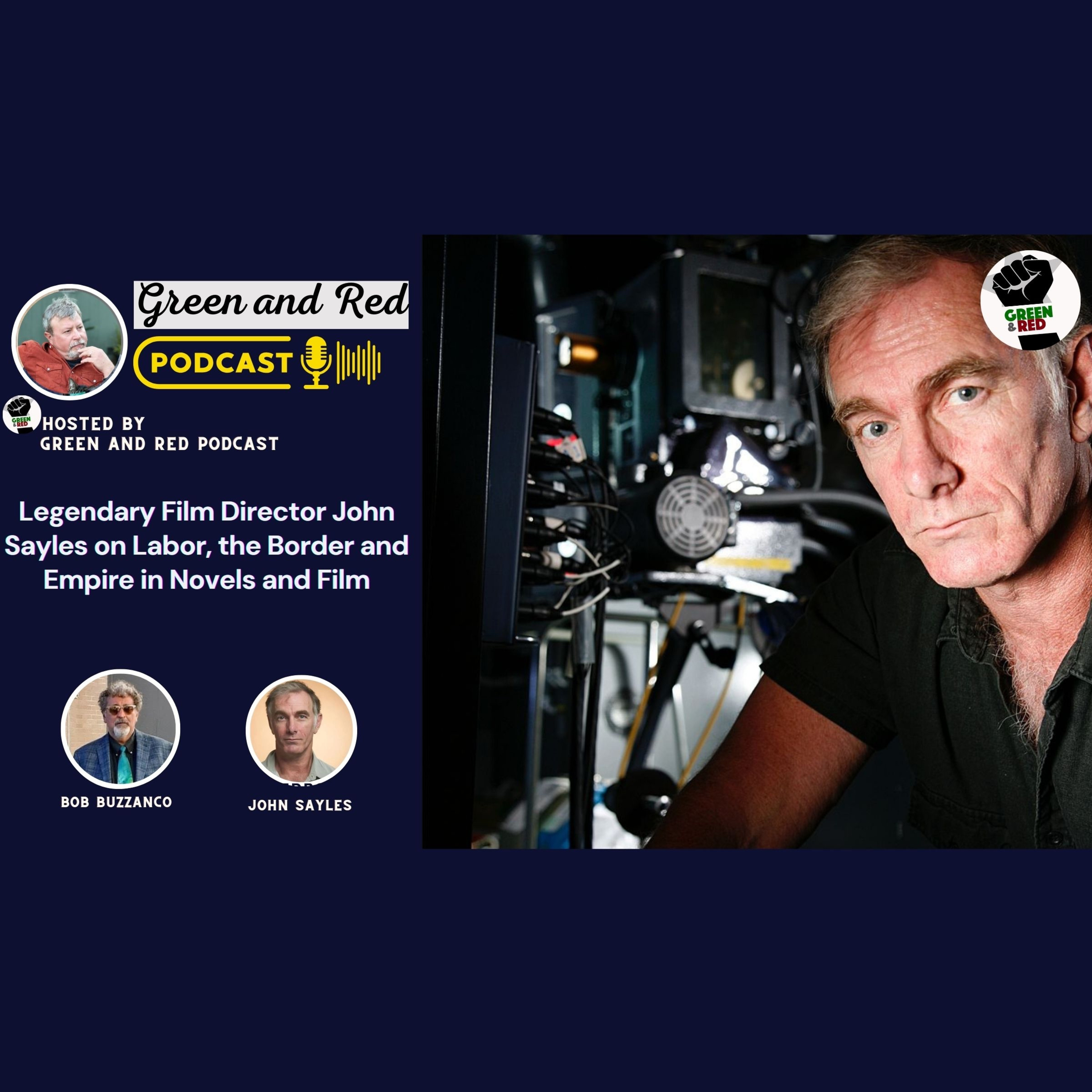
Green & Red: Podcasts for Scrappy Radicals
Legendary Film Director John Sayles on Labor, the Border and Empire in Novels and Film (G&R 463)
00:55:12
Loading summary
Transcript68 lines
- [00:01]
John Sayles
Welcome to Green and Red Scrappy Politics.
- [00:03]
Bob Bozenko
For Scrappy People, a regular podcast on.
- [00:07]
John Sayles
Radical environmental and anti capitalist politics. Brought to you by Bob Bozenko and Scott Parkins.
- [00:14]
Scott Parkin
Welcome to the silky smooth sounds of the Green and Red podcast. I'm your co host, Scott Parkin in Berkeley, California. And as always, I am joined by.
- [00:23]
Bob Bozenko
Bob Bozenko in Niles, Ohio and Appalachia.
- [00:25]
John Sayles
Yes.
- [00:26]
Bob Bozenko
Yeah.
- [00:26]
Scott Parkin
And we're super excited today to be joined by the legendary filmmaker John Sayles. John is a independent film director, screenwriter, actor and a novelist known for writing and directing films like Eight Men Out, Matewan, Passion Fish, Lone Star, Silver City and many others. Twice nominated for an Academy Award for Best Original Screenplay for Passion Fish and Lone Star. And then he's also written eight novels which we'll be talking about a little bit today, most recently including Yellow Earth To Save the Man, and the most recent one is the Crucible. And John's also been nominated for a National Book Award. John, welcome to the Green and Red podcast.
- [01:06]
John Sayles
Yeah, nice to be here.
- [01:08]
Scott Parkin
And maybe we can kick off talking about the books a little bit. You've written two books within just like the last two years or so to Save the Man and the Crucible.
- [01:16]
John Sayles
And maybe I've written another one that'll come out next year, I hope.
- [01:22]
Scott Parkin
Oh, excellent. Maybe we could start off a little bit. Why have you been writing more novels than.
- [01:28]
John Sayles
You don't need to raise millions of dollars to write a novel. That's the great thing about fiction writing is whether you get it published or not, you can do the thing itself by just sitting down and doing it. You don't even have to buy typewriting paper anymore. It's been really difficult for us to raise money for movies for the last 20 years. I think it's been 20 years since we got any other people's money for anything that we did. So a lot of, you know, several of those novels are things that were screenplays. First To Save the man and Jamie McGillivray. And you try to make them. It gets clear we're never going to raise that much money. And then they sit for a while and you just, I feel like it's such a good story, I want to do something with it and then, well, maybe I can make it into a novel. And it always doesn't work to make it into a novel. So you try it and they tend to expand because you can basically, you can expand without costing any money. So in the case of To Save the Man in the screenplay, these kids are at the Carlisle Boarding School. They've been taught to read English. They're actually putting out a newspaper of their own, and they're reading in the newspapers. In the case of the Lakota kids, oh, my God. There's this train wreck about to happen back on our reservation. Those are my people. Those are my relatives. These are my family. What's going to happen? And they start to get some letters from a former student. All during the Wounded Knee massacre. In the book, I could go to Wounded Knee and I didn't have to worry about an extra location and paying for the stuff and the army and the horses and all that. So that there are opportunities. There are things you can do in a movie you can't do in a book, and there are things you can do in a book that you can't do in a movie.
- [03:16]
Bob Bozenko
I don't know if you like to be described as a political filmmaker, political author, but here we are. But the last two especially have, I think, really world historical meaning, right? You deal with the Carlisle boarding school and Wounded Knee and then Henry Ford, one of the biggest figures. Like, how do you. What's the purpose of studying those? Is it just, you're interested in these folks, or do you think there's a bigger purpose? Is there a tail in there? Is there? Especially with how many people?
- [03:36]
John Sayles
Now I get interested in how these big events affect just people. One of the things that I do when I direct movies is when there's a scene that's not working. Often I realize, oh, I know what's wrong. They're saying the lines right and everything like that. But something's off. And I take the actors aside and I say, guys, you're playing this scene as if you know how. You've read the script and people in real life haven't read the script. In 1920s, 1930s, if you are a young Communist, it might be the answer to everything. It's just. Can't people just listen? I've got the key to everything. If you're a guy who's an African American guy working at the Ford auto plant, and somebody says, the rest of the guys, most of the white workers want to form a union. Do you want to join or not? You've got to think, Henry Ford's the only guy paying black workers the same as white workers for the same work. I'm on thin ice here. Unions, you look at the AFL was pretty exclusionary. How do I trust this bunch of people who I don't have much to do with? At the factory, we are purposely kept apart in the river Rouge factory, the service department, who were basically a lot of thugs. If you went to the bathroom from the assembly line, your foreman had a stopwatch and he clicked at the minute you stopped doing your job, and he clicked it when you came back and he wrote down how long you were gone. Not only that, when you went into the toilet, the stalls had no doors on them and there was a service department guy looking at you the whole time, making sure you didn't talk to any other workers. That's what these guys were under. So, of course these African American workers are thinking like, I don't think this is going to work. Why should I stick my neck out? And even if I do, how can I be sure that these union guys won't say, oh, it's all seniority, and you've only been here two years, so sorry, you're out of a job. You know, So I get interested in that way in which people, they only know what they know. They only get the information they get. It's like today, if you only watch Fox News, you have a certain view of how the world works and how America works. If go on Pod, Save America or something like that, or read a bunch of different things, you have a different view. So that complexity, I'm very interested in that. And then I'm interested in, in. And the story isn't over. How are we going to work all this stuff out? This is complex, difficult stuff. How do you deal with a system where, yes, it makes absolute economic sense to get rid of workers and put robots in there instead and machines there instead, but at what point is there nobody left who can afford to buy one of your cars?
- [06:31]
Bob Bozenko
You mentioned a minute ago how in that moment, you don't know how the story ends. So people have this kind of fervor, anticipation, maybe even hope. And like in the 30s, right, you have that where you have this global depression. And even in Mate 1, people are coming together. Do you think it's important to give people a sense of that moment, how people felt about this? Because we can always look back on it and say, that was the ruling class ground us down kind of thing.
- [06:52]
John Sayles
Yeah, I think it's in. For instance, one of the reasons that I made Miguel was that when Ronald Reagan first got in, pretty much the first thing he did was bust the air controllers, people who land planes safely. And a lot of it was that they made pretty good money. But most of their complaints weren't about money. They were about, we're overstressed. This is gonna. This is gonna. Cause people are Gonna die if we don't get some better regulations in here. And time away from the computer screen and stuff like that so that we can do a better job. But it was a symbolic thing. It was like a show trial. And he busted this union and most of those guys did not get their jobs back within a year. Almost everything they were asking for because it was so obviously needed, got put in and union membership was way, way down. This is the early 80s from what it had been. And I was meeting young kids who were saying, why would you want to belong to a union? You have to pay dues and they can tell you what to do and this and that and the other thing. And I thought it was important for people to understand, okay, remember a time when there wasn't a union and this is what happens. We cannot expect these corporations, in this case or owners to just out of the goodness of their heart, say, oh, I'm going to see, I'm going to meet the workers halfway. So yeah, there's often something that I feel like I don't see anybody else making this story at this time. I think there's a. There's a need for something that deals with these things.
- [08:30]
Scott Parkin
One of the elements in some of your novels and then also in your films is this, this idea of organizing, which is. We don't see the organizer as a hero in many films, but I often think of Chris Cooper and Mate Wan and American audiences seem to be more geared toward the action hero or what have you. But how do you see fitting this process of. Or political organizing into these projects and then how do you portray them so that organizing is this noble profession, that sort of thing.
- [09:00]
John Sayles
One of the things that I do is try to recognize the complexity of it. It's not a simple thing. If you take the Detroit example, the Reuther brothers, when they started, they were considered radicals. They'd been to the Soviet Union, they worked in factories there. They came back saying, we love the political system, but these people can't make a car to save their lives. They felt like on the shop floor they needed to do a lot of learning. But they liked the idea of a place that really recognized workers. By the 60s, they were middle of the road to center right. They had ended up like a lot of other unions, purging all the left wing members, people who had fought side by side with them at the beginning. And there was this kind of unwritten deal that happened between corporations and manufacturing and some of the bigger unions of, you get rid of those lefties and we'll meet you halfway. But those people, they're going to be going out on strike every two minutes, and they're going to ask for things that just are not on the table. My new book, it's called Gods of Gotham, is set in New York City between 1949 and 51. And some of it takes place within the garment district world. Those unions had to deal with the mob because the mob was so deep into that union. And that's something that happened around the country. And one of the reasons that people got turned off by unions is until Roosevelt, Franklin Roosevelt came in, unions were just like, the state didn't want them, the national government didn't want them. It was just like, this is a foreign evil idea. And they were unprotected. So it was easy for a criminal group to come in. And sometimes they would rent out to both sides. One time they'd be on company side punching people. And then they rent out to the union and say, oh, we're going to protect you. And they were making money off both sides. That inclusion of criminal elements was one of the things that kind of messed up and made more complex the union story in this country. I'm interested in that. It's not good guys and bad guys. It's not one side versus the other. Very clear. Even in make one, there's a point where they're having a union meeting and there's one guy who gets up and says, I don't see why I have to listen to a bunch of hunkies at Pittsburgh about what I can do with my life. And he's resisting the idea, but only because the conditions are so bad. Do these hillbilly miners and black miners and immigrant miners have to go around armed men to find each other and form this union? Well, when you take away that kind of common enemy, if the common enemy starts to be a little more political instead of just muscle, your coalition can fall apart. The word union is a tough word. Why do people give up some of their individuality and some of their time? And it does take time and effort to belong to this thing. And what are the factors that mitigate against that?
- [12:10]
Bob Bozenko
Your newest or most recent book? I guess not. The newest is Crucible, and I've seen some reviews of it. And they point out kind of the relevance to what's going on today. And they make comparisons to people like Elon Musk or Jeff Bezos. And Ford was a huge larger than life figure. When you're writing, do you think about a purpose for that? Are you trying to make that connection. So people will see that this stuff, it's historical, but it's also contemporary as well.
- [12:33]
John Sayles
Yeah, it's unavoidable. So when I wrote, I think I wrote Crucible two and a half years at least ago, Musk was just making cars. So there was no direct parallels. I think it's unavoidable that if you write anything that is about complexity and American life, the present is going to catch up with you and they're going to be things that are analogous. But I don't usually start out with that kind of thesis. I usually start out, there's a story here. I see an arc in this history. A lot of stuff is going to happen. And I usually discover the connections to the present while I'm in it. One thing that's happening now, Henry Ford was the last of the robber barons. He wasn't into money so much as the power. And he felt like my job is to move the world forward in various ways, social ways and political ways, as well as technology. He didn't live a lavish lifestyle or anything. So he's like one of those guys that Teddy Roosevelt tried to get rid of. And then there were rules in place about corporations and how, how much they could merge and how much they could own. Teddy Roosevelt started trust busting and tapped into this feeling like you can't have one company that just has a lock on things. Unfortunately, what's happened is that it's not so much a one man, it was not a corporation. He had no stockholders. That was he and his son had all the stock in the company so he could just close the factory down if he wanted to. What we've got today is something analogous to what things were before Teddy Roosevelt got busy. We have ignored or erased so many laws about mergers that the super companies that are more powerful than many countries have an inordinate amount of power. And they're financing politicians, they're financing political parties. They're moving without any restrictions because they've consolidated so many companies together that they pretty much own a market. And it, when the computers started, it was the Wild west for a while. And then very quickly, it seemed every year it started getting smaller and smaller and smaller, and it was tough to break into that. And so people had this not only incredible amount of cultural power, but incredible amount of money. Money that's concentrated is just ridiculous. And really nobody has tried very hard to counter that. So we have situations now where if a couple of these kind of companies that own media want to just say, this is true, half the world thinks, oh, this is true.
- [15:18]
Scott Parkin
I'm thinking about that because I like with the U.S. let's call them U.S. adventures in Venezuela and Attempted Adventurism in Greenland. I've been thinking a lot about Smedley Butler, about how he was a. He was muscle for Wall street and he was muscle for Ford or whoever. He was a gangster for capitalism, I think is one of his quotes.
- [15:37]
John Sayles
And so he's a character in the book I'm working on now.
- [15:40]
Bob Bozenko
Oh, fantastic.
- [15:41]
Scott Parkin
Oh, that's great.
- [15:42]
John Sayles
It's about our intervention in. In Veracruz in 1914 in Mexico. And Smedley was there, you know, because.
- [15:51]
Bob Bozenko
Like I said, I taught history for over 30 years, and I used to film quite a bit. I make one every semester. Some scenes from the Grapes of Wrath movie, movies like that. And you did an interview, I think it may have been about your movie Amigo, which is set in the Philippines, which is something I taught about. And it's the first time students ever heard about it. And you made a point that you were raised on this kind of Davy Crockett or John Wayne version of the Alamo, that kind of thing. And you said, when I went in and read what actually happened, it was very different. So why don't we Americans know that different version. That's a choice. And some of it is, who's controlling the history. Right. We're seeing this now more than ever. Books being banned. One of the reasons I retired in Texas and got out of there was because just increasingly the state was taking control over everything you do in the classroom. When you may want, I think is fairly obvious. There's a real clear message there. But do you think it's important in your films or in anybody's films to take on these issues? Because we're in this situation now where you can't count on the established institutions to tell you what really happened. And so you're filling a void in that regard.
- [16:47]
John Sayles
Yeah. I think you always have to be suspicious of the official story.
- [16:51]
Bob Bozenko
Yeah.
- [16:52]
John Sayles
And you'll always ask to. To ask, okay, who's putting this information out? During Vietnam, there were. The generals would have these press conferences and you'd think we were winning the war.
- [17:03]
Bob Bozenko
That's what my first book's about, actually.
- [17:05]
John Sayles
And finally, what would happen is even the mainstream media, eventually their reporters started saying, it's not going that well over here. There's this famous incident where Morley Safer went out with a squad of guys and they hit this village that had some Viet Cong activity, and they torch it, they burn it to the Ground And Morley Safer is like shaking. And they aired it. And then the head of the network, General Sarnoff at three in the morning gets a call on his private phone and who's calling me at three in the morning? This is your president. You trying to fuck me, boy? There was right then there was this crisis of who are we going to believe? And truly, when Walter Cronkite started questioning that war and it took him a long time, the government had to reconsider. Oh God, I don't think we're going to get away from this. We've controlled the narrative. We don't control it anymore. So what you see now of course is the government and the people who are in bed with the government, who've spent their time at Mar a Lago and gotten good deals, they're controlling the narrative as much as they can. And not just the narrative of what's happening now, the narrative of what happened in the civil rights movement or the Civil War, whatever, let's de emphasize this thing is the anti Howard Zinn movement going on of maybe we don't want a people's history of America. Maybe we want our history of America that not only is going to get our core feeling good about the flag again, but get other people to stop asking questions and asking for so much.
- [18:48]
Scott Parkin
Yeah, I've been seeing where the Ellison's own Paramount plus or whatever it is like really wanting to put in programming that really like lifts up America, especially around this 250th anniversary that's coming up and they've split with some notable creators, like I believe Taylor Sheridan has actually parted ways with them. And it's pretty interesting how they're trying to take out this history. They're trying to take out class consciousness and things like that. And yeah, I also feel like we have this strain of folks who are very much in the tradition of you who are like still creating independent films, creating things that really question the status quo. And I'm just wondering what you feel about this sort of. There's still this independent creator like element out there making films, making honestly a lot of like series, like the sort of higher end series. I see a lot of good politics in. And I'm wondering how you see the current generation there.
- [19:41]
John Sayles
Was that, that saying in the 60s, you're either part of the solution or you're part of the problem. If you look at American movies, feature films, they were a part of the problem for a very long time. The censorship boards not only were worried about sexual content, but political content. The Heads of the studios didn't want to ruffle feathers with the government because they were worried about the government coming in and taking control of what they their business. But also about backlash from the kind of America first people. You have to remember there was a big isolationist move in this country and a big anti immigrant move in this country for years and years and years. It's not a, it's not a new thing. So I think that idea of let's go back to telling all American stories, it's did how many Jewish people were out Jewish people in movies until the 60s with mostly Jewish people running these studios, it was like, America doesn't want to see that. That's too ethnic for them. And let's not cause trouble and cause trouble for ourselves and cause trouble for the studio. There is this economic part of it which is maybe that will be good business. And we'll get some of the people who have turned off to turn back on because they're not afraid that they're going to turn something on and feel like, oh, they're calling me a racist. And there is also just the kind of let's curry favor with the people who are in power right now. And that's always there. And so I think these kind of phenomenon often have two edges to the sword. The reason that we don't have a fairness doctrine anymore is partly because cable came along and that's not licensed by the government. They couldn't say, oh, you're going into people's houses whether they like it or not. We are going to hold you to a certain standard of fairness. The minute cable came in, people are buying this thing. It doesn't have to come into their home. So all bets are off. So all of a sudden all kinds of stuff, good stuff and bad stuff, is possible. You can have a network like Fox that does stuff that's absolutely political opinion and they're calling it news. And then when they're sued or something, they say, oh, that was an opinion piece, not a news piece. And you can have people like the Comedy Central who have stuff that's actually always kind of taking the piss out of whoever's in power. And they really don't have to worry about censorship too much. If they belong to a network that wants to merge with some big company, they may lose their job, but they can find another job doing something else still in the media. So there is this kind of free for all. It's just that the mainstream stuff, the stuff that the most people see is getting more and more controlled In a certain direction where you now. But it's a long struggle in any country. Media is there country still where you just can't do certain things and say certain things. And it's not just sexual behavior, it's political stuff. It was not until about 12 years ago in Mexico that you could actually make fun of somebody who was in the Pre, the institutional revolution revolutionary. And finally a movie came out and they were like, oh, God, is anything going to happen? And the Pre wasn't in control of the government at that moment, so they got away with it. And now it's open season. But there are still things that you can't do in. In many countries that you just can't say.
- [23:15]
Bob Bozenko
To follow on that, because you mentioned how difficult it was to get funding, is that I'm assuming the studios will say it's an economic decision. Right. This movie's not going to make us $100 million. How much of it might be that or how much of it is actually, they don't want that political content out there.
- [23:29]
John Sayles
I'd say if they're trying to make an expensive mainstream picture, they get very nervous about it because they think it's going to turn off some of their audience. So they'll come in at the script stage and say, I don't know, sometimes in the editing stage, my friend David Strathearn, the actor, was in a Godzilla movie. And there was a Japanese actor, very well known in Japan, who came and he took apart just because he plays a guy who's involved in trying to stop Godzilla from crushing all of the world. But he has a speech in the original script about his family was from Hiroshima, took it, did a great job acting it, and then the studio edited it out before it was released. They just didn't want people to have to think about too much. So there's that kind of censorship. But basically we're not getting money because we haven't. None of our movies have gone platinum lately. If we were making a lot of money, somebody would give us money to make a movie. We had a couple big hits, and they could be as transgressive as you want, politically or sexually or anything. People would be chasing us saying, can we invest in your movie?
- [24:43]
Bob Bozenko
So is that why, for instance, something like Reds, which was a long time ago, It's Warren Beatty, so is that why it's able to.
- [24:48]
John Sayles
Yeah, and also in that case, I think he was very hot at the moment. Studios wanted him to make a movie with them that he was in. And I'm sure he Went well over budget. I was in the. He was doing editing in the same editing place in New York that I was and the movie had a opening date and he just didn't like the score and so he redid the score and we cut the movie a little bit and it came out, I don't know, six months to a year after it should have, which cost them a lot of money. But they got lucky and the movie did well. It could have been a good movie and not done well. It happened to be one of those ones that struck a chord even though it was very political, you know, thinking.
- [25:29]
Scott Parkin
About Reds and then a few years later you made me want. Did you find it was difficult to make Matewan in that political area? We talked a little bit about the air traffic controls and the sort of Reagan anti union period.
- [25:42]
John Sayles
No, we did, we thought we had the financing when we were going to make it for a little under $2 million. The people who were going to finance it said we're going to get a bank loan and then you can go ahead. And we, the day before we got on the plane to go to West Virginia they called up and said that bank loan, they didn't give it to us. So we had two years and I did other things and made Brother from Another Planet in that we did some sprinting videos and stuff like that. And then we got, I think it was under 4 million, between 3 and $4 million from independent investors, independent distribution company and really had nothing to do with politics. They just thought okay, this guy's last movie, Brother from Another Plant did pretty well. And let's take a gamble on this, it seems like a good story. So there really was not a political struggle with that one. It was just how can I make a movie on a fairly big scale for a fairly low budget and let's go to West Virginia and really make it there. And that's a little more expensive than shooting it in Toronto or wherever people were going those days that was considered cheaper.
- [26:54]
Bob Bozenko
You've had like well known actors. Merrick McDonald was nominated for an Academy Awards Bright Thorns, I believe been nominated for Academy Awards. Robertson, Chris Cooper. Do they come onto these because they're not just because it's a nice role but because they're also committed to these ideas.
- [27:08]
John Sayles
I'm sure. You know, I don't ask actually I really don't go down a list and what are these people's politics? It's just A, is this a good actor who would be good for the part and B, what is their reputation as Far as working with the other people, you don't want somebody who's too self centered, an actor who really doesn't care about the other actors and crew and stuff like that. Because we're shooting fast, we're trying to put out a really good movie in four weeks sometimes. And you really can't be waiting around for somebody who's having temper tantrums or just on their own track. I think mostly it's people see a role, they like them, they read the movie, they think, oh, I'd like to see this and the role is interesting enough for them to do it. We've had actors come in for a day or so, just be as almost as a favor, oh yeah, I'm free. I can come to wherever you're shooting for a day and do these scenes. And so sometimes I think it's just they like the story, they think it's one that should be told. And if you're very successful as an actor, you may not be the most famous actor, but you can get to a position where you say, I only want to be in movies that I want to go see. Which is not the way to make the most money. Obviously many actors see only a fraction of the movies that they're in. They say, I did my job and good luck, make some money on it and I'll be hot for another year.
- [28:34]
Scott Parkin
One question I have is one of your best known films is Lone Star, but then also Silver City. Both deal with the issue of immigration and Lone Star, particularly the politics of the border, which in many ways it's the sort of those issues are the root of a political crisis in the US right now. And I'm wondering what you're, I mean, you know, in many ways you anticipate with those films you anticipated what's happening now. And I'm just wondering what your thoughts are on the current state of things and then also how it's related to Lone Star in particular. But also Silver City deals with immigration.
- [29:08]
John Sayles
It is a crisis everywhere around the world. It's not just us and always has been, especially once we got to the industrial age. And they, they needed not just farm workers seasonally, but they needed, oh geez, we're going to need people who to do these jobs that nobody else really wants to do. And we want them to take as little money as possible. Migrant workers for years came into America just for the cane cutting season or just for the grape picking season or whatever. And then they might go to pick apples somewhere else or they might go back home where they live for me. The sad thing is people come up to me and say, oh, I watched Lone Star last night. And that scene where all the parents and the teachers get together in this kind of meeting, that could happen today. They're arguing about how Texas history is being taught and some of the things in the border that could happen today. And I have to say, that movie is 30 years old. We have not moved on. That border is more complex to cross. When we shot in Eagle Pass, you could take a dime, put it in a slot, there was a turnstile, walk into Mexico and do the same on the way back. And yes, there were border agents there. They. They would ask people who looked like they were in the wrong place if you lived on the other side in Piedras Negras, and you had a car, it had Frontera. You had a border license plate. So if you drove across, the cops would leave you alone in that car. So people didn't keep getting stopped when they were going to Walmart. So now there's a wall and there's barbed wire, and the border guys have to wear body armor because it might be somebody working for one of the cartels bringing drugs across, and they might have weapons, which did not used to be the case when we shot the movie there. But the problem remains, and nobody has done a very good job with it. Everybody can't live in this country. But our history is of bringing people in and then very often saying, okay, job done, get out. Certainly the Asian people, Chinese and Japanese people, people who made the railroads and stuff like that. In 1920 or so, there was this act where we got rid of all those people, and we had just acquired as a territory the Philippines. If you go to Alaska, when we shot up there, the big Filipino community, they came to take over the jobs that Chinese people had in the slime lines where they process the fish. This is a long, complicated history, and I don't have any easy answers. But there were times when people came to work on contracts, and when the contract was up, they had to go home. And those were the border areas where they're not too deep into the interior. What do we do about that? What do we do about making sure that if somebody comes from another country and they're here on a work visa or came in illegally, they're getting paid minimum wage. Because if they're getting paid minimum wage, maybe the person who's running the business will say, why don't you just hire somebody who's from here? I'm not getting any economic break on this one thing that certainly a lot of places closed down during COVID but a lot of places since then have closed down because their existence depended on people who weren't getting American middle wage and all the benefits. And we have to ask, okay, should those businesses exist? It's this kind of American dream that you could have your own business and run it your own way and all that kind of stuff. Can we really do that? Or does everything have to be a chain and have no local businesses? So the people I know who work in restaurants say one of their problems is if they rely on American workers. American workers don't want to work that hard for that little money, even if they're getting minimum wage. What's that about?
- [33:16]
Scott Parkin
I also haven't raised the minimum WAGRE in almost two decades, too.
- [33:20]
John Sayles
Exactly, exactly. They never made it. But I think it was Showtime had bought an option on Barbara Ehrenreich's book Nickel and Dime, which is. She takes four or five jobs in it all pay minimum wage, non union. And she said, can you make a living? Can you survive doing this? And the answer is no. You're going to be eating cotton. You know, you're going to. As she says at one point, she actually goes to a food bank and they give her a box which includes Hamburger Helper without the hamburger. If you've ever tried to eat Hamburger Helper without the hamburger. So that's one of the things is, yes, there are businesses that if you raise the minimum wage, will not exist. But you know what? Maybe that's the price of entry. If you can't pay that, don't start that business. You're not making enough of a profit.
- [34:15]
Bob Bozenko
When this is more philosophical. I think a lot of movies valorize kind of people who I would call like resistance figures. Star wars, which Lucas has said it's about the Vietcong and like Hunger Games and I've seen the Godfather like a thousand times. And when Michael Corleone comes out and shoots the dirty cop, people cheer. So in on the screen, I think people can identify with that. But in real life, we have this like a propaganda, right, where movies valorize the police and the military and they're full of people blowing things up and stuff. Is that just. Is that the studios directing that? Is that people who think that's a way to get into the business, like, why do we on screen understand and get it, but then in real life, not.
- [34:55]
John Sayles
I think there's a human desire to see things solved quickly and easily and with a firm hand. So many of the cop Movies that have been successful or westerns have been successful is about basically forget the judges. They're just going to let the guy go. There's all this legalese stuff that nobody really understands. We know this is a bad guy. Let's go get him. They're within any military or police organization. There is that faction, and there is that. You say, this is what people. These are the real bad guys. Let's go get them. And let's not wear gloves while we do it. Let's just go get them. Which is unfortunately kind of dangerous. It's not that easy, first of all. But then it's, why do we take shit from anybody? Why don't we just do enforce the law the way we want to instead of looking at the statutes like today in Minneapolis. Both of my grandfathers were cops, so a lot of cops in the family. A lot of other relatives were cops. It's not an easy job. And police don't always get a clear mandate from their superiors. It's often, okay, go out there and do your job, but be careful. And be careful is just this nebulous thing, which is, don't step on the wrong toes. Be careful, be careful in white neighborhoods, but you can get away whatever you want to do in black neighborhoods. It's not. The rules are often hazy. And so you have individual cops who interpret the rules the way they want to. And then there becomes a police culture. And I think some of the stuff made about cops really deal with that complexity. And others, it's just. Isn't it satisfying? That guy's so bad, we want to see him killed with extreme prejudice. At some point, we've seen how bad he is. And so when the rogue cop just shoots him, maybe not even in a fair fight, everybody cheers. I often say the movie Independence Day when the alien satellite blew up the White House. I saw it twice. Huge cheer. So this is something that we have to deal with, which is people are. They're disappointed with their government and with their law enforcement, and partly because it doesn't solve things overnight, which is not a reasonable thing to expect. But they're disappointed and they would like it to be less complex than it is. And very often the people who win are the people who can make it seem simple. Take one or two issues and make it. Whether they pay off on those issues or not. They make it seem like this is simple. Why are we talking about all these little details? It's simple. If we just tell these people to behave and kick out the ones who won't behave It'll all be solved. It's. It is. Just as we're disappointed in our political leaders, a lot of our political leaders, the good ones, are pretty disappointed in us.
- [37:59]
Scott Parkin
We've touched on a number of your films that deal with a number of topics. One we haven't really talked about as much as around Empire. So you have films like Men With Guns and Amigo. I guess we talked about Smedley Butler for a minute. I'm wondering for the. Especially on. On those films how. Which has. Like you said, you're talking. There's a lot of complexity in which you put in. Put into this, which we don't see in other things. Like when you take on something like American Empire, I'm wondering what your. What your process is and how you want to try and communicate that, portray that.
- [38:35]
John Sayles
Yeah, I'm interested in this idea of any country thinking they can come into a country with a very different culture and imprint their own culture on it immediately and by force, basically. So Amigo is about the Philippine American War. We came there ostensibly helping the Filipino revolutionaries get rid of the Spanish, but because there was no rule that we had made against it. Like, there was a thing that was called the Plat Amendment that said, okay, guys, we're not kicking the Spanish out of Cuba because we want to take Cuba. They said, oh, yeah. But they left out Guam, Puerto Rico, and the Philippines. So there we were. And the day after we helped the Filipinos take the city of Manila, American troops moved in. They turned the cannons around, their own guns around, and said to the Filipinos, you can't enter here. And they put up the American flag. We didn't know how the Philippines worked. All of a sudden there were all these Christian missionaries coming over there, and they got there and they discovered, oh, these people are already Catholic. Wait a minute. We don't have to convert them from paganism to Christianity. We have to lure them away from Catholicism to Protestantism. The book I'm working on now about us coming to Mexico, we took over the port city of Veracru for quite a few months during the Mexican Revolution on a whim of Woodrow Wilson's. And then as people reported back to him, it was like, actually, who knows who's going to end up ruling Mexico? We can influence it a bit, but we can't really control it. And the Mexicans have never even gotten the whole country under their thumb. How could we possibly now, in 1914, take over that whole country? It's huge, you know, so let's just keep doing influence. Where we can. So there. There's that kind of buyer's remorse that happens very often with imperialism. In Henry Ford's case in Crucible, he decides, I'm gonna. I'm gonna buy a chunk of the Amazon in Brazil the size of the state of Connecticut. I'm gonna send my guys down and they're gonna start a rubber plantation. So I have the raw material to make my own tires. None of the people he sends down speak Portuguese. None of them know anything about growing trees. They're people who were cutting down trees up in Michigan. And he expects them to make this model American community. But most of the people there aren't Americans. Many of them have never had a watch. Most of them, they work for a while and then they go home and they have enough money to buy whatever they want to buy, and then they come back and see if the job is still there. So there is that kind of hubris of imperialism where you send guys who. Some of them are warriors. They're. They're. What we have now is all volunteer army. Occasionally are the guys who join the National Guard get thrown into it kicking and screaming. But those guys are there because they want to be there. They're the Marines. They're the gung ho guys. And they say, this is who we're supposed to shoot at now, and this is what we're told to do. And they don't ask a whole lot of questions. When you have to start drafting people, they start saying, wait a minute, I could get killed here. What's this about? Nobody sold me this Vietnam War. Now, even Korea was very controversial. I'm interested in that part of imperialism, which. Is it truly a popular wielding, or is it businessmen who have a lot of interests in that area who say, oh, let's go take over Guatemala, because we don't like the guy. He's nationalizing land that we're actually not using, but we might someday. A couple of our wars down the banana wars were really. Sam Zamuri created a country. He had got us to cut off a chunk of Colombia and make it into Panama. All that stuff, to me, I'm fascinated by it. And then right down to the foot soldier level, what does that guy think? When I wrote Moment in the sun and did research about the Philippine American War, there were, you know, just like the church committee after Vietnam, there were congressional committees. This is where we learned how to waterboard. And that came up in those hearings. I got to read a lot of testimony and also a lot of letters home from soldiers. And it was Very mixed. About a third of the people. This is better than shooting rabbits, using the N word. These guys, they don't have much in firepower, but they're everywhere, and we're mowing them down as quick as they pop up, and it's great. And then there were other guys who say, this is a kind of nastier, dirtier thing than I signed up for. But here I am, and I guess I signed up for it, so I've got to do my duty. And then a third we're writing home saying, I'm embarrassed. This is horrendous what we're doing here. This is absolutely against everything I believed the United States was for. What am I doing here? And then the national organization that was organizing against that war, the two best known leaders of it were Mark Twain and Mrs. Jefferson Davis. Mark Twain because he thought, this is against everything that America is supposed to be for putting the Eagles talons into another country. And Mrs. Jefferson Davis because she was afraid of miscegenation. And then a bunch of white boys would come back with Filipino wives. But they were both against the war. And so there they were, public stages together.
- [44:20]
Bob Bozenko
You know, I always. When I taught this, I would talk about Twain, and no one was aware of that role in his life. Right. Everybody knew about Huck Finn. This is, like, arguably the most influential writer in American history. And I don't think I ever had a student who was aware, because I would say, who's the most famous person to oppose the Filipino war? Mark Twain. And they were just, like, shocked by it. And so I think that's not.
- [44:40]
John Sayles
Obviously his personal experience was he was a soldier for the Confederacy for about three days and then wandered away before they remembered who he was. Because it was like, yeah, I'm not sure I'm ready to get killed for. I don't even have relatives who have slaves. What's this stuff about? And I'm not sure I'm so into it, the whole slavery idea, even though for a mistake that a lot of people own slaves, he had to work those things out. He had his. He admitted some of his prejudice. He didn't like Indians. That's my one big prejudice. But it's a long story, and people at the time throw their weight behind something. And certainly he was not listened to very much. It's interesting, but he was not listened to.
- [45:30]
Scott Parkin
The whitewashing of these figures in history actually makes me think of Helen Keller, who's known because she overcame her deafness and blindness and what have you, but she was a socialist. And an organizer and actually did very important things in her adult life. And just American history, like what we've been talking about through this whole interview is like just American history whitewashes all of that away for the political stuff.
- [45:50]
Bob Bozenko
Yeah.
- [45:50]
John Sayles
I think sometimes it's just left out because it's an easier story to tell. Much more black and white story to tell if you leave that kind of complexity out. And sometimes it really is a serious campaign on the people in powers. We don't want people to know. That's not the narrative that is going to get us where we want with these people. You know, they have to believe this. If they're going to go and fight in Vietnam. We're going to have to paint this as a much less complex picture than it is. We're going to have to forget the fact that we're aping once again failed French international policy. And we're going right down the same stupid road that they went down. There is a militarist part of America and America was very anti interventionist up until Woodrow Wilson said we're going into World War I. And then people on the street were insulted if they weren't in uniform. It turned that quickly. And then the people who still were resisting it. A lot of them went to jail. As a matter of fact a bunch of the big guys in the Wobblies were sent to jail by Kennesaw Mountain Landis who became the commissioner of baseball who kicked out the guys from a man out. And he was known as. He led the league in being overturned by. By higher courts. But he was the perfect guy from the job at that moment.
- [47:16]
Bob Bozenko
Yeah, I just have a couple kind of shortish ones. One is the issue of class in cinema. We do have I think a decent number of movies that deal with issues race. But I think fewer to deal with issues like you do in Mate one like class conflict. Is that harder to do to write about something because it's in our society we don't really talk about. Everybody's in the middle class. And is it hard to actually a.
- [47:38]
John Sayles
Lot of my movies actually are very aware of that baby it's you romance between. She's a Jewish girl, her dad's a dentist. She's upper middle class and she has this romance with this really working to poor class guy. And high school is one of the last places where you're going to be in the same gym class. At least with guys who are going to be picking up your garbage in five years. We don't like to. It's not like British class, which is the minute you open your mouth, they know where you went to school and where you probably land on the economic scale until very recently, but we definitely have class. And what's going on today is a very concerted effort to find class resentments. And a lot of it is between educated and uneducated people, people who have gone on to beyond high school education and people who haven't and say, what are those people? What really pisses people off about the elite? The elite. And let's use that to make them feel like they're endangered species and that these people want to give all their birthright away to some not white skinned immigrant or whatever. It's a big factor in America and always has been. Certainly in romantic fiction there's always the cross glance, cross class romances. Usually it's like the rich guy either turns out to be a cad and the girl marries somebody from her own class, or he turns out to be pretty good and she gets to live in a nice house and wear nicer clothes than the last reel. But as just something that people are aware of. Barbara Ehrenreich talked in one of her books called the Worst Years of Our Life about the Reagan years that pretty much everybody wanted to, in America wanted to say that they were middle class. Even people that she would have said these are working class people and these are upper middle class. They wanted to say I'm middle class. There was a comfort in that and a feeling of belonging in that. So it's, it's something that we really try to avoid and I'm very aware of it. It's just something that we always live with and that is, can be very destructive and on both sides, people can really diss people on the other side fairly easily if they're not really thinking.
- [50:02]
Bob Bozenko
Finally, and this is probably a question you've gotten hundreds of times, we do a lot on this podcast about like films and culture and politics. And so we've done the best political movies. In fact, you've won the kind of prestigious Green and Red award for best films. It's like the FIFA Peace Prize, but. And you've. I've heard you do interviews where you talked about De Sika's the Organizer and you paid homage to Salt of the Earth and Caucus. What kind of movies stand out to you in that regard? Like when you think of movies that really talk about these social issues, but also a really great cinema boy in.
- [50:32]
John Sayles
America, it's complicated because people were kept from doing it when the various censorship boards were in. And then Just economically kept from it. Certainly things like Norma Rae, which talks a little about the complexity of that of organizing people in the south who factories were even fairly new to them. There have been a couple interesting movies about Hoffa and that. That deal with that thing of the corruption of unions and. And the selling out of their own workers by certain unions. So it's something that every once in a while somebody will come up and really do something that's interesting about it, but it's not, it's not a genre that we have. Whereas in France and Italy there are really movies about events. And even in Britain Ken Loach has made a lot of things that are about working people and what that does to them and how it either drives them apart or puts them together. So it's, it's an interesting thing also now that so few workers work in a union kind of workplace, that there's. It's a more service economy. So what is in. In some good movies that have some. Are paying some attention. There's a lot of movies where the protagonists have these, what you consider as okay, he's a barista or they're. They work at Walmart. They're putting things up on the wall. These kind of minimum wage jobs which they hope are temporary but may not be. They may just be a prelude to another job like that. And the kind of. Is this what my life is going to be like? I was just in a movie called An Ode to Mary Jo that's about a single mother. Her husband's divorced her and is not paying his alimony payments. She's got two kids. One of them is on the spectrum. She's working at like a Home Depot and doesn't like it and is going for a job interview where, you know, she used to be a school counselor. She wants to get back into that. It pays a little better, but it's on the day of her daughter's birthday and her car doesn't work and the rent is due and can she even get to the job interview on the time? Those movies do exist. Usually not mainstream movies, but I thought that Zoe Zhao movie about the people who work at like Amazon who move from place to place was an interesting, just that phenomenon. People who, they're basically migrant workers, but they have cars and they don't. Their children aren't working in the fields with them, but they're okay. I hear there's a, there's a warehouse that needs people who can do that kind of work for three months at least. And they put together a living that way.
- [53:23]
Bob Bozenko
Thank you so much for this. This is really fantastic and really appreciate it. And I look forward to reading the Cruise. The Crucible. Not Duck Crucible. Yeah.
- [53:30]
Scott Parkin
And the Gods of Gotham.
- [53:32]
John Sayles
I'm hoping that won't come out in the winter because doing a book tour in the winter is really hard, especially when you get to Detroit and places like that. Thanks a lot, guys.
- [53:43]
Scott Parkin
Hey, folks, we were just talking with legendary filmmaker John Sayles about many things. If you like what you're hearing, please check us out on Facebook, Instagram, Twitter, and Blue Sky. If you are watching this on YouTube, hit that subscribe button. If you listen to this on an audio platform, give us a rate and review. And if you really like us because we bring you great interviews from people like John Sayles, please check us out@greenandredpodcast.org and hit that support button or become a patron@patreon.com greenredpodcast and Bob, it's been great talking with you today.
- [54:17]
Bob Bozenko
Yeah, that was pretty cool. That was really cool.
- [54:20]
Scott Parkin
Yeah. Bucket list interview, in my opinion.
- [54:22]
Bob Bozenko
Yeah. Everybody else out there trying to get to do this for a while, so this was really cool.
- [54:26]
Scott Parkin
Yeah, yeah, yeah. Folks, please share this. And like, this was a great interview. And also just watch John Sales films and do what he says in them. Make trouble and misbehave. And we'll talk to you again soon.
- [54:48]
John Sayles
Sam.