← Green & Red: Podcasts for Scrappy Radicals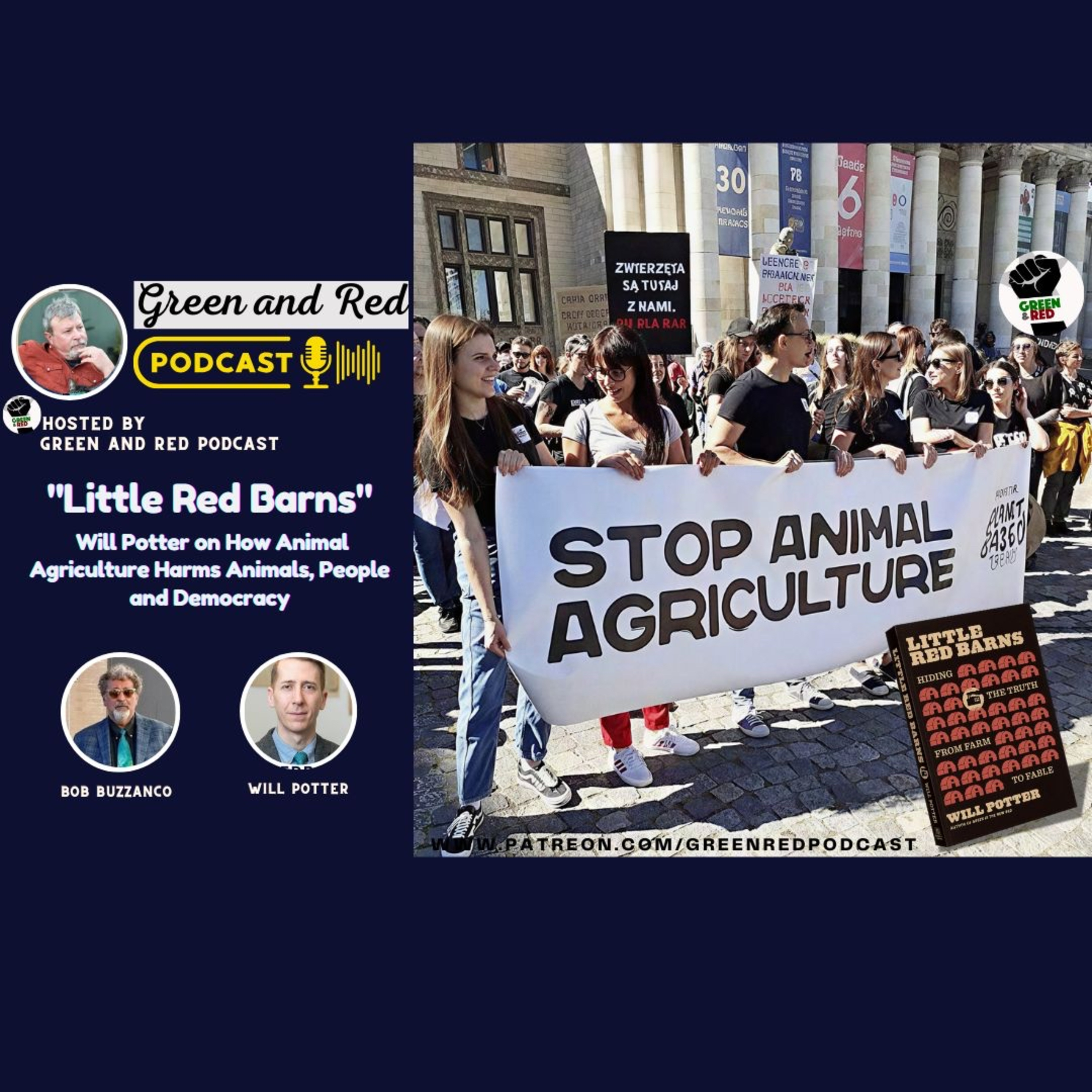
Green & Red: Podcasts for Scrappy Radicals
"Little Red Barns": Will Potter on How Animal Agriculture Harms Animals, People and Democracy (G&R 489)
01:02:40
Loading summary
Transcript105 lines
- [00:01]
Bob Bozenko
Welcome to Green and Red Scrappy Politics for Scrappy People, a regular podcast on radical environmental and anti capitalist politics. Brought to you by Bob Bozenko and Scott Parkins.
- [00:14]
Scott Parkin
Welcome to the silky smooth sounds of the Green and Red podcast. I'm your co host Scott Parkin in Berkeley, California and as always, I'm joined
- [00:23]
Bob Bozenko
by Bob Bozenko from the Buckeye State,
- [00:27]
Scott Parkin
the Bright side of the American Dream and the Buckeye State. Today we're doing a part two with our friend and comrade and return guest, Will Potter. When we talked with Will last week, we talked about just the sort of state of oppression and the growing of repression, but we didn't really get to Will's latest book, which we actually wanted to just do a whole standalone episode on. So today we're going to be talking with Will Potter who is the author of Little Red Barnes. Hiding the Truth from Farm to Fable just came out on audiobook. Will is also the author of Green Is the New Red, which actually has 15th year anniversary. It just also came out on audiobook as well. Will is a journalist. Author, investigative. He's an investigative journalist and then also just thought leader and we've had Will on many times to talk about many things. So welcome back to part two of the Green and Red podcast with that.
- [01:22]
Will Potter
Appreciate you guys. Yeah, I appreciate you both extending the discussion. Always happened to keep talking with you both. It's great to see you.
- [01:29]
Scott Parkin
Yeah, maybe I'll just start it off. And Little Red Barnes is a book that was maybe 10 years in the making. 10 years.
- [01:37]
Bob Bozenko
Ish.
- [01:37]
Scott Parkin
And I'm pretty curious about what led you to write this book. A little bit of the journey. But I'm also in the opening, you talk about growing up in Fort Worth, Texas, where definitely the meat industry. I'm also from Dallas, Fort Worth. And so the meat industry is very much like a big integrated part of just living there and growing up there. And so maybe if you could just talk a little bit about you went to the stockyards as a kid. You had a Fisher Price plastic barn that you played with as a kid. Maybe just talk. Tell us a little bit about this journey, both in writing the book and also just like what led you there before that.
- [02:13]
Will Potter
No, I think that's a great place to start. I'll start with the book first. I think that's a shorter explanation is that we've talked over the years so many times about environmentalists being labeled as terrorists and animal rights activists. And this was the subject of my first book, Green is the New Red and The whole process of that book and what I was trying to do is really sound the alarm of how this was expanding. But as soon as that book was done and published in 2011, I saw a radical expansion I wasn't expecting. And there was a shift away from going after people for sabotage and Earth First. And Animal Liberation Front and Earth Liberation Front to now. All of a sudden, the industry and FBI were looking at undercover investigators, journalists and whistleblowers. And there was a wave of new laws called ag gag laws against journalism, reclassifying people who just document what happens. Terrorists. That's really where this project kicked off for me. I was really involved in trying to fight that unorganized press freedom groups to challenge it. I was writing about this. And at first this project started as an investigation into those censorship laws. But as the project developed over, and the reason it took so many years is I kept shifting my thinking about what's keeping us from actually seeing what's happening on factory forums. And I guess that's where that latter part, your question comes in. And for me, there's a lot of reflection in this project on that. There's a lot we could talk about the actual repression and censorship, but I arrived at this place of story and storytelling. Born and raised in Texas. I remember the stockyards as a kid. We'd go down and it's turned into like, I'm enough beer. It's a playground. You run through Alpen Maze. All those are the shoots that are used to move cattle through slaughter. They've been repurposed into this fun thing for kids that I talk about in the opening in the book. But everywhere that around you, from the cowboy hats to the TV shows, the product labels themselves, we're being told this story about America and about animal agriculture. And really, this book arrives at the point that those two intersect and the lies that we're being told about both.
- [04:37]
Bob Bozenko
I don't mean this in a negative way at all, but this is a hard book to read. Like, I put it down several times as. And I think you needed to describe what was actually happening there. But it seems like it gets started with, I don't know if you want to call them whistleblowers or muckrakers or whatever, but you start seeing reports where people go in either getting jobs or whatever and talking about what's going on there. And it seems like it initially makes an impact. Right. Like people say, oh, my God, I can't believe that. And then.
- [05:02]
Will Potter
Enormous impact. Yeah.
- [05:04]
Bob Bozenko
And do you want to actually. Why don't you just talk a little bit because we tend to focus on how rough things are now. But there was a time when, like, people would see this and be aghast at it.
- [05:13]
Will Potter
Oh, and that's where the story picked up for me at the time. We got to put this in context too. This was like early YouTube, all these organizations are getting on Facebook. This is a time when journalism is in crisis and still is. Investigative news, budgets are being slashed, local bureaus, foreign bureaus, all this deeper work. And at the same time, you have these new tools. Social media, filming equipment is getting much cheaper, undercover equipment. I talk about in the book, all these things converge. And so what happened? To your point, Bob, it was an enormous impact because all of a sudden you had people that, with very little money and resources, are able to document, oh, 10 billion animals are raised and killed for food every single year in the United States. And practices that, like, had bits and pieces, 100% been coming out repeatedly over the years. But there was all of a sudden this just opening of the floodgates in terms of the frequency of investigations, the quality, how they were distributed, and they had activists with video cameras suddenly able to get millions of views, and mainstream news outlets were then to accompany them on farm investigation. So that's a long way of saying this changed the discussion. What felt like in that moment, pretty close to overnight, it felt like this was everywhere, every news outlet and spreading around the world. And that's why the industry started freaking out immediately. And in the book Terese, as soon as those investigations started happening and you saw things like the largest meat recall in US History, public health and public safety violations exposed, workers rights issues, industry flipped. And when they started pushing for ways to actually shut that down as terrorism and to outlaw those type of investigations rather than actually doing anything about it.
- [07:13]
Scott Parkin
And were there any particular with the whistleblowers being silenced, Were there any particularly egregious cases that you'd like to. That are worth mentioning? I know there's probably many.
- [07:25]
Will Potter
And so tough question because I struggle with, to Bob's point, like, there are chunks of this book, or arguably the whole book that's difficult to read. It's not an onslaught of nasty stuff by any means. I want people to know that it's more of a narrative and trying to get deep into these issues. And as part of that, we have to look at the nasty stuff that was exposed. I don't really know how to answer that question. Like, I tried to aim for the. Away from the edges of the extreme and show in My mind, the true impact of these investigations was showing standard industry practices. They also exposed things that led to criminal charges. We saw sexual abuse of animals, beating animals with pipes and bats and gill rebar standing on animal's head. Stuff that's either not regulated or in some cases actually led to a prosecution. But the day to day stuff is I think the most damning. And to that point, the day to day stuff was the most shocking for me too in terms of going through the footage and just seeing over and over again, it starts to sink in, the stale this and then the normalcy of it. As one example that really stood out to me. The standard industry practice and the pig industry, raising hogs and pigs have we've seen this repeatedly in the press in recent years, that intelligence of a two year old child. There's all kinds of social media accounts where they're learning language and they're playing and they're doing those little buttons that they ask what they want in the industry, they call it thumping. Where they take baby piglets that have no use to the industry and laying them onto the concrete. Stuff that when you see it it's like, oh my God, this is jarring. But then when you talk to the industry, they're just like, this is how we've done it. Same goes for gassing male chicks in the egg industry, because male chicks don't have any value. They only want the egg layers. And for meat birds that are used for meat, there's different lineage and different breeds and different practices. So the male chicks don't have any value. So they're just thrown in trash cans and suffocated or into giant grinders and ground alive. So admittedly, this is really dark stuff. And what was shocking to me above all is that even when the most extreme or the standard industry, no matter what was exposed, the industry didn't link. And their response was not to like actually acknowledge any event or even talk about it or respond to ballot initiatives and things like that. They just tried to outlaw all of it.
- [10:06]
Bob Bozenko
I'm going to stand this for a second. And when I said it's tough to read that, by no means, like people should read it by the way, because it's. No, I don't want to deter anybody, it's just. But a lot of people, and we've seen this with like ice, like a lot of people don't give a shit that ICE is killing folks. So a lot of people might say they're animals, who cares? But there's another part of it that I think more people may respond to which is that the health aspect of it, right? And you have them like there are. You have many stories. But I remember the one that stuck out to me was these. This company was putting cows that they knew were sick, that cancer just grinding them up. And they got like a $4,000 fine or something like that. Like, what impact does that have actually on our health?
- [10:44]
Will Potter
The tower that's a huge component of this. Also connected to public health is the environmental impact. And really what I sought to do in this book is expand this discussion into all of these other spaces where we're talking about social justice and human rights and community. To me, this isn't an animal issue at all. I think we have to look clearly at the ethical framework here and the amount of cruelty and violence taking place. But we also have to widen our views and all this other stuff. And to that point, one of the investigations that really freaked the industry out the most was. Was exactly what you described. It was in meat packing plant in California. There were sick cows being pushed by heavy equipment. The industry calls them downers, downer cows because that's such a common occurrence. The way these animals are bred and raised, they collapse. And the industry wants to get that last buck by pushing them into the food supply. This facility in particular was the primary supplier to the USDA's National School Lunch program. And so in addition to a public health risk, we can't be feeding sick and diseased animals to school children. Right? So there's a lot once you start digging into this. To me, this is the intersection of all of these issues of class and race and public health. And the environmental impact think is often left out of the discussion. But this industry is one of the largest land use systems on Earth. About 80% of all land used for agriculture are is either animals or cropland to feed animals. So as we're seeing population spikes and increase in meat demand in countries like China and around the world, we're on a collision course. And both for the public health and just the sheer sustainability and livability of a planet dependent on animal products, our time is really running out.
- [12:55]
Scott Parkin
And just on some of the companies, you talk about how only four. There's just four companies that operate about 75% of the world's corporate beef sector. Another four control about 70%. The pig sector, the pork sector. And is this we're seeing where they. I have more questions about just some of the tactics they use against activists and undercover folks. But is this a result of this period of globalization and corporate Merger that we've been seeing the last couple of decades,
- [13:26]
Will Potter
I would say that was a fuel thrown on the fire. And I say that because in my research, the shift to industrial farming, which really set the foundation for an even worse situation that we're in now, its origins were always about consolidation and horizontal and vertical integration. I trace the history in the book that sometimes and I've heard in environmental circles and in kind of foodie circles, you hear this quote, get big or get out, which is attributed to the head of the USDA at the time. It's been cited by everybody in all kinds of food histories of. There was this top down push to industrialize. And really what happened was quite different is that all this money was coming in to the state colleges, the land grant colleges and corporations seized on that and they started manipulating all these research centers and programs to be to their interest. And what happened is it forced out those small farmers, it forced out sustainable operations. Everything was consolidating and consolidating. And now fast forward 50 years or 40 years with the kind of neoliberalism and global capitalist framework where you have today, some of the biggest of those corporations are now shifting operations abroad where there are even fewer standards and restrictions. And companies like jbs, in addition to the animal concerns, they've been exposed for human trafficking. We've had repeated exposes about human trafficking and factory farms in the United States. So to put it in that context, yes, this is, it's all consolidating. But those corporations are also consolidating and exploiting international efforts for any type of accountability. And the practices back in the 50s it was a risk to small farms being pushed out. And now it's. It feels like a risk to our various. Survival as a species is the direction we're going.
- [15:32]
Bob Bozenko
You mentioned colleges years ago, probably before I met Scott even, I used to do a lot of speaking and even debates on kind of globalization issues. And one of them was a Texas A and M and the building where it was held had a. I thought it was a joke at first. Pork hall of Fame. They had the Pork hall of Fame. There was.
- [15:48]
Will Potter
Oh for sure. That's the least of them.
- [15:50]
Bob Bozenko
The frederick sponsored by Monsanto, of course. And so I was like, oh yeah. And you mentioned in, in the early 19. I'm sure you both know this, in the early 1900s when Sinclair was writing the jungle meatpacking had what they called the big four. So it was even then, it was already in that one of the reasons behind the laws were to get rid of all those smaller competitors. But to go back again to you mentioned like sick downer cows. And I remember 20 years ago I read this amazing story in Rolling Stone of all places about the pork industry and just what's the fallout? What's for these companies that do that? Because certainly doesn't seem like they've stopped. So what happens to them even when they are caught?
- [16:27]
Will Potter
Critical of that in the book because we need to remember there have been some cases of, let's say there's lower level workers that are prosecuted for animal cruelty or for something happens. But in terms of actual accountability to the people in power, these corporations and these industries, I'm sure it'll come as no surprise to people listening to this show. There's been very little part of that goes back to what you were just saying at the start of that university connection. In addition to things like the pork hall of Fame, the ag industry has really taken a page or two out of the big oil and also tobacco playbooks of propping up research that is to their benefit at these universities. That's what happened in all these cases. The science is not on your side, public opinion is not on your side. But what these industries repeatedly do is they set up these, I would argue fraudulent research centers that are cooking the books on research funded by the industry. There's a couple that exist right now. The biggest is in Colorado where all of this like pro factory farming, pro animal agriculture, environmental science is coming out of. And it's a lot like when we had Doctors in the 40s and 50s talking about how healthy cigarettes are. And we had academics like Willie soon that were funded by the oil industry to pump out material when the industry knew that we're on a collision course for many decades. So that's part of it. As part of this investigation I had to go into all those mechanisms of the ways that these industries escape accountability. And that's one big piece of it is they both deny the research and the science public opinion, and they also manipulate it and invent their own and pump that out into the media environment.
- [18:27]
Scott Parkin
It's like a sick twist on Gramsci. I've written an article about how the climate industry does that. I called it Climate Hegemony where they, they fund research and engineering schools and business schools. They, they have these aggressive media campaigns, advertising campaigns, all of that. And I think that you're right. It's a playbook from Big Oil, Big Tobacco, and also makes me actually think of Mad Men often so and then
- [18:55]
Will Potter
makes me think of foreign interference in elections Right. I mean, it's this strategy of censor and manipulate by overwhelm. And I think that's certainly what I'm feeling these days. Whether these are psyops or media campaigns or just like sensory overload, it feels like we're just getting bombarded. And so the industry has really been doing that for years because by pumping out so much fake material and these statements and friend groups for journalists, what we often don't talk about is they're being asked to report on more and more stories with less and less resources. And it's not just a danger to consumers, but the journalists who are trying to weed through all of this and do their jobs, they're being manipulated here because the strategy is just to overwhelm us. We don't have time. And so we end up having to use their statement or point to their press release or their fake study. And unfortunately that's happened quite a bit. And I think it still happens. Like literally right now I'm seeing on LinkedIn, on social media, journalists and authors and folks I respect are just regurgitating a lot of industry talking points.
- [20:09]
Scott Parkin
Right.
- [20:10]
Bob Bozenko
And not to sound frivolous, the Simpsons, which actually isn't that surprising, had a great take on that back. Remember when Lisa became a vegetarian?
- [20:19]
Will Potter
Yeah.
- [20:19]
Bob Bozenko
That was in. They. They showed the corporate propaganda, the industry propaganda, and they gave everybody tripe at the end of the show. When you have. Not only do you have cases like this where the penalty is minimal, they may get some lower level worker and that's about it. But these folks wield a huge amount of political influence too. There are, I don't remember. It was in Iowa. There are probably other cases where you have these major port ranchers who are also in the state legislature. And so how does that pipeline work where not only do they own the businesses, but then they're writing the laws for the businesses that they own?
- [20:53]
Will Potter
As you all know, with all three of us having Texas connections, in the book, I describe it as the good old boy network, because that's just what I was raised understanding it is. And it's like the landowners, the people with oil or gas or whatever money, they're all buddy and it's all this old club. And that's literally how it is at the state level. I think people don't understand that state representatives, a lot of cases are paid or paid very little, or they're splitting time with their other job. And so what I saw in going through the legal and legislative records of those ag DAG laws is the people that were pushing them, voting for them, rallying their colleagues and benefiting were people who actually had ownership in this industry. In some cases, they're quite open about it. They said in legislative hearings, they joke about all their buddies in the room in press statements. They've bragged about writing it at their kitchen table alongside industry representatives to save our dairy farmers, things like that, while leaving out that it's actually for the dairy industry, not the small farmers. And so it's both that, but it's also they wield their power in more insidious ways that I don't think most people are aware of. For instance, with the international climate conferences, the agriculture industry was ramping up radically. The number of representatives that they sent to flood and drown out indigenous folks from third world or Latin American countries that are trying to advocate against these industries. Just trying to completely crowd out all of those voices. And then they're also fighting behind the scenes to rewrite those reports. And I go in depth into how whistleblowers expose the agriculture animal agriculture industry was making sure that no mention of the volumes of research about climate change and plant based diets make it into any of these reports. No recommendation about even modifying your steak intake. Right. Like nothing. They fought everything and got every footnote and every mention erased. And so to me, that's the full girl boy network. It's not just like in Texas back rooms, it's also at cop, it's at the United Nations.
- [23:14]
Bob Bozenko
You mentioned agag. Just a quick. Why don't you just say what that the gag law is. What are those?
- [23:19]
Will Potter
No, I appreciate that. I think we rushed through that. AG is for agriculture, gag is for silencing. And these are state laws that were passed beginning in about 2010, 2011, passed in more than half a dozen states. The summary is after many years of court fights and bringing together labor groups, environmentalists and press freedom and journalism groups, many of these have been beaten back and struck down in different capacity. That was a plaintiff in some of the lawsuits as a journalist, but each of them still exist. And more importantly, we talk about in the book, it's become a playbook that's being exported to other countries. They've literally been copied and pasted into Australia, Canada, there's Interpol and European counterterrorism reports talking about farm investigators as terrorism threats. This model really was picked up and through that good old boy network and through deoliberalism dropped in these other countries. And so a big message I want to convey with this book is that this is NGAG was Not limited to agriculture, it's already modeled and spread to other industries. And it's not limited to the us this is something that might be for your international viewers coming to you or that the industry is thinking about.
- [24:41]
Scott Parkin
And how many states still currently have ag gag laws or if most of them have been beat back?
- [24:47]
Will Potter
Most of them have been beat back. Yeah, there's variations. And there's also variations of what like we call an ag gag law because there's different phases of this. Some are about photography, these latest versions are about mandatory reporting. And also I would loop in some of these new attempts to restrict access to public data in scientific research. So for the most part, agriculture ag gag laws have been beaten back and argued as unconstitutional successfully. But these shifts in new ways of restricting information are still expanding.
- [25:21]
Scott Parkin
And the entity known as alec, the American Legislative Exchange Committee, or council, I forget which council. They're one of the or entities which is a conglomeration of corporations that push gag laws at the state level.
- [25:34]
Will Potter
That's right. One of the first model eco terrorism bills I've written about for many years was through ALEC and it had a whole host of provisions that industry really wanted. They had things like a terrorist registry, similar to a sex offender registry, but for activists they had versions of ag gag, restrictions on photography, open rescues, this wish list. So it wasn't a gag as it was introduced in the states, but it was in my mind the model. And in the book I go pretty deep into why I argue that this is a secretive organization, but there is a paper trail. And the way that they've worked with state lawmakers and also at the federal level pushing eco terrorism laws. Alec's fingerprints are all over ag gag and these similar efforts.
- [26:24]
Scott Parkin
And have we seen some of the bigger animal welfare and animal rights nonprofits? They use the undercover investigation model in some of their work, like PETA for example.
- [26:35]
Will Potter
Yeah, these are. This has shifted. What started out as really investigations by startup and smaller groups has in some ways become the norm. You have groups like Mercy for Animals, PETA has done undercover investigations for many years. Also groups like the Humane League and some of these. The state of the animal protection movement right now, really all of these players are either have had investigators or are working with that footage in some way.
- [27:06]
Bob Bozenko
One reason this book and your all your work has been really important I think is because a lot of liberals especially see the current repression as something like new. And in fact it clearly follows a pattern. And it's these folks have laid the groundwork for what we're seeing today. Now, for us, the idea of using terrorism charges against somebody doing environmental or animal rights work is insane. But I also think just most people in general would think, oh, that's too much like, how do they sell this? How do they rationalize this really insane idea that you're a terrorist if you want to save the whales or whatever?
- [27:41]
Will Potter
As much as I hate to say it, after trying to beat this drum to death for so many years, and most people just have no clue that any of this even happened or that it's still happening. And so when I, when we get into this conversation with a lot of folks, like if on that happy hour or meeting a colleague or something, that a friend of a friend is usually met with laughs or this kind of. Oh, that's ridiculous.
- [28:06]
Bob Bozenko
Yeah.
- [28:06]
Will Potter
And people need to understand this was the FBI's stated number one domestic terrorism threat or decades after September 11th. There was no other group outside of Muslim and Arab community in the United States who were targeted for their race, religion, ethnicity. In terms of activism and politics. It was environmentalists and animal rights activists. And those are the goalposts. Those are the baseline, I would argue, and people like Mike German and former FBI agents and DHS agents. This is the playbook. And to your point, if we don't understand the mechanisms of how that worked from the 70s and 80s to it being the number one domestic terrorism threat to now it being just business as usual, I think we're cooked because they're not inventing new tactics, they're repeating the same thing over and over again. And we have to break this cycle not just in terms of fascism and authoritarianism, they do the same tactics, but even in this window of post 9, 11, they're just doing the same thing repeatedly. So to answer your question about how they did it, they just made it up. An industry made up this word ecoterrorism. They invented it in 1985 and then they hired big shot PR firms, ran media campaigns, testified before Congress, pushed for laws, did all these levers of cultural power and shifting, but at the end of the day, they invented language and then used their money to push it out.
- [29:47]
Scott Parkin
You have a chapter where you talk about. It's towards the end of the book where you talk about January 6th on this topic and you talk about how the FBI's, oh, our hands were tied about investigating the far right. Teacher health, yeah, we need your help. And it became this like group effort of looking at all the pictures, trying to place people and things like that. But you make the point that is a disinformation campaign is that the FBI spent all of its time going after people on the left and Arab and Muslim communities and not the far right, which was a growing threat through the. From the night, probably longer, but definitely since like Oklahoma city bombing until January 6th.
- [30:27]
Will Potter
No, I think that's essential, no matter where folks are coming from about, you know, animal, agriculture, environmental, all these different things. To me, this is the crux of all of it, is that after an attempted coup where we had white supremacists and white nationalists and actual neo Nazis in Congress, we had police officers attacked, people died, they were trying to kidnap members of Congress. After that happened, the FBI deliberately ran a disinformation campaign saying that they had no idea that they need the public's help, that they needed more power because they didn't have authority to go after people like this as terrorists. All of that was just flat out repeated campaign of lying and disinformation by the Federal Bureau of Investigations as they've done repeatedly throughout US History. It was staggering. In the book, I'm candid about it was not good for my mental health as someone who was like, this was my issue. And I dug into this to no end and all of a sudden the FBI just acted like none of it happened. On the book I talk about it wasn't just that. It wasn't just the disinformation. They actually deliberately ignored the rise of far right violence. The FBI was told by the Inspector General's Office, Department of Homeland Security, by West Point Military Academy, by counterterrorism experts. I go through all of the receipts and reports and they were told straight up, if you keep focusing on environmentalists, animal activists and vegan potlucks from factory farms, you're going to allow the rise of white supremacist and fascist violence. This was our government telling them that this was like inside men saying this is the threat. And the FBI just said no. I really hope that we get to a point sometime in our lives where those people are held responsible. We can talk about like the Church Committee going back to COINTELPRO and this kind of like idea of the FBI's worst abuses were exposed and investigated. I hope we ever get close to something like that again because this was a level of negligence, putting not just public safety, but the whole Democratic experiment. And I used that language loosely of what we have in the un they put all of it at risk.
- [33:05]
Bob Bozenko
The Pentagon did a report like that, I think in the Obama years, and the Senate Republicans killed it. They wouldn't let it get released. And you're talking about these white supremacist groups within. And this is also obviously a bipartisan issue too. Merrick Garland didn't do shit any more than the Republicans did.
- [33:21]
Scott Parkin
So.
- [33:22]
Will Potter
Oh, and what we see. I've been covering this since the first Bush administration. Right? I think that's right. Since 9 11. Right before 911 was when I started writing about this and it's been inherited by everyone. It's been so normalized. We've talked about this on the show quite a bit. I think it's important for people to realize that Obama wasn't better. He under his watch, we opened experimental prison units for terrorists. We radically expanded more or less wiretapping. We had more investigations of whistleblowers and journalists than any other administration. And so all of it really set the foundation. The Democrats were truly complicit and benefited from all of this. It was just as much their grab as it was Bush won or Trump won or fascists. We're seeing right now.
- [34:14]
Scott Parkin
One question I have to bring it back to radical environmentalists and animal rights activists and the FBI is the reason that we see so much focus on that and that green skier period is because industry is putting pressure on Congress and putting pressure on the. On George W. Bush's administration to go after people who are interfering with capital and industry? Basically,
- [34:38]
Will Potter
yes. And I think that's an enormous part of it. The paperwork shows it. They were lobbying Congress. They were pushing this for many years. They had already passed federal legislation labeling animal activists as terrorists in 1992 and then expanded it in 96. They had approached this in a lot of different ways and they'd already had that infrastructure in place. So that on the day of the September 11 attacks, you had them openly speculating in the US Congress that this was the work of environmentalists, that the
- [35:13]
Bob Bozenko
911 attacks, environmental caps hijacked the airplanes.
- [35:17]
Will Potter
That they hijacked the airplanes, that it was eco terrorists. And they started talking about anarchists and Eugene and. Right. So if you know of. Of that period where there's a lot of stuff popping off in Eugene and WTO and everything else. And so they were ready to rock from day one and they just seized on it and ramped up that influence. So, yes, that's undoubtedly a huge part of this. I think what gets left out is, I think there's also an element. There's really two other pieces that within counterterrorism, there was all of a sudden the writing on the wall that if you want to be relevant, you better get some terrorists. Right. Like the Whole bureau, all of government shifted overnight. And within that hierarchy then not everyone is investigating the Al Qaeda hijackers. And so people are chipping off and eager to respond to industry pressure because this is a way of going after terrorists. Hey, we'll use, hey, they're saying that this is a big eco terrorism threat, we should go after eco terrorists. Turns out that's a much easier lift than going after international terrorist networks and suicide bombers and stuff that go after environmentalists. But there was that incentive within the bureau. And then I think a third element is that within counterterrorism and cops and FBI, they don't get it. They don't get non hierarchical movements, they don't get environmentalists, certainly not animal rights activists like they truly. And in their materials you see this, they don't understand what they care about, what motivates them. Their materials about the far right are quite different. They just talk about what they did, how many guns and dynamite they have with the left. They're trying to sort through their belief system. And I think that's a big part of it. These guys just, they know people who are racist or on the far right, they don't know vegans and Earth Firsters and anarchists. And I think that's part of how the FBI has always worked. Those people are like the other, the outsider, the foreigner, and go get them. And so that's part of this culture that J. Edgar Hoover built. The FBI as a Christian nationalist evangelical organization. And I think that's part of this mix too.
- [37:51]
Bob Bozenko
Something you mentioned earlier, which I think is increasingly important in this, is the issue of immigrant labor. And I think people, whether they realize it or not, are starting to see how that works now. Right. Because with these crackdowns, you have factories shutting down because they don't have adequate labor. It's a really significant portion of the labor force in like the meat industry is immigrant.
- [38:11]
Scott Parkin
Right.
- [38:13]
Will Potter
They overwhelmingly rely not just on immigrant, but frequently undocumented and underage workers. Yeah, there's been wonderful, terrible, but wonderful quality reporting from the New York Times and Washington Post in particular, and ProPublica about kids working in slaughterhouses and factory farms. Investigators I've talked to talk about this as well. So these dynamics are important though, when we're talking about things like those ag gag censorship laws. Because what the industry is trained to do is by saying that workers need to turn over footage immediately if they see abuse is they're putting the burden on people who already radically lacking resources and lawyers and even basic necessities. And they're Putting the burden on them to come forward and tell their employer about all the bad things they've seen. That's not going to work. This is damaging all of us. But it particularly hits those workers because there's nothing that can do. If one thing I've learned reporting on factory farms, it's a lot like my reporting on prisons, that these are indentured communities, these are incarcerated communities, that they depend on the factory farm or the prison for their jobs. People don't want to be doing this shit, but they don't have a choice.
- [39:38]
Scott Parkin
In a lot of ways, those undocumented workers are also the people who are going to be afraid to come forward, especially in today's environment.
- [39:49]
Will Potter
Oh, absolutely. Can you imagine, like, what, in today's environment, having this on top of everything else, where you're afraid of coming forward, to even be seen by any government official seems like a risk. You're going to march down to the police station. You can't even march down to court, like, without being arrested.
- [40:08]
Scott Parkin
Weird stories of bosses who are turning in their workers when they're. Because they're not.
- [40:13]
Will Potter
They're not paying.
- [40:13]
Scott Parkin
Yeah, they're not paying them.
- [40:15]
Will Potter
And to take this a step further, though, undocumented and immigrant workers, particularly in the agriculture industry, I think need to be the focus of the discussion. There's a broader discussion here about how ag gag law and mismodel affect every type of worker, no matter who you think you are and what privilege you have. The latest versions of ag gag, like, out of North Carolina, the industry was getting pushed back, trying to protect themselves, so they dropped language about factory farms and agriculture and instead just made it apply to all businesses. So the reason North Carolina got so controversial is you had labor unions, healthcare workers, veterans, hospitals, people speaking up, daycare facilities saying, oh, this is going to make sure that we can't blow the whistle that our workers are at risk, too. So they're going after the most vulnerable, always. This is what authoritarians do as a starting point, but they're really trying to go after everybody's rights.
- [41:23]
Bob Bozenko
It's probably not a coincidence. I've noticed just in the last, like, two, three years, a lot of states are actually lowering the work age.
- [41:29]
Will Potter
Right? Yeah.
- [41:30]
Bob Bozenko
Going back to the jungle. And a lot of them say, like, they're agricultural states too. Arkansas, Iowa, here in Ohio. I think they're talked about or they're doing it. So I'm thinking, like, when I came out, I thought for people to work at Purdue or wherever.
- [41:41]
Will Potter
Absolutely, yeah.
- [41:42]
Scott Parkin
Yeah.
- [41:43]
Will Potter
I laugh because it's One of those things where it just feels like this is just overwritten. I mean, this just feels like idiocracy. It's unbelievable. It's unbelievable. Anybody can do this. There's research I talk about in the report, in the book about what happens to these kids on factory farms. They like having kids work there because just like during Upton Sinclair's days, they have little ams. Yeah, yeah, let this sink in. They can help clean out machinery and move around. It is horrific to think that they're justifying lowering these ages. But like, this is. We really are. I keep talking about Upton Sinclair in the book because he's been a North Star for me. We are back at that, like 1905 in a lot of ways. And he even warned about that, that the system he helped usher in would actually be used by the industry itself, gut regulations. And I think that's what we see in Arkansas, rolling back child labor laws.
- [42:47]
Bob Bozenko
I'm very proud of myself. I assign that book every year I ever taught. And it's crazy because I remember like when I first started teaching, I would talk about like child labor and all that stuff. And it was a settled issue back then. It was like this, it was history at the time. This is the way it was. And even then I thought, oh, that can never happen again. No one's gonna put 12 year olds in a factory. Yet here we are.
- [43:05]
Will Potter
So it's what in the way they're doing that and manipulating public opinion like that and ushering in. That shift, I think goes back to the storytelling because now I think we had a narrative for a while of we don't do these things. We protect human rights and child labor and environmental protection. Now they've, as authoritarians do, they've rewritten the narrative to say kids have always worked on farms or we've always had this arrangement, right? So they're trying to use this as a return to traditional values. When it's anything from it, they're trying to really go at the heart of just basic decency and basic human rights.
- [43:52]
Scott Parkin
In many ways, it's like talking about stories. It's like these competing narratives, right? It's with the ride, it's like about freedom, but it's like that comes with a factory farm, which I think you make a point about how it's a little bit of a metaphor or maybe even a microcasm for some authoritarianism coming back in with repressing one, the brutality towards the animals and then the terrible treatment of the workers and then also the repression of activists and Whistleblowers and so on and so forth.
- [44:23]
Will Potter
And even it coalesced immediate in the specific imagery and the specific story that's being used. So unpack everything you just described in the book and also go into the history of. These aren't just theoretical connections. Some of the folks that were behind this shift in agricultural policy were avowed white supremacists and racist. The history of the Border Patrol is very much tied into the history of westward agricultural land development and animal agriculture. So these stories of factory farms and fascism be really clear. I view them as clearly connected, not just like a theoretical, oh, this is all bad or it's all evil, but as one additional component of that, like the specific story that's being used. It hit me and I talk about in the book, I was on a motorcycle ride and I started to see the story that the industry was using, using up those little red barns. And it felt like it was hiding more than that. And around the first Trump administration, I was living on a farm in rural Michigan, and one day I noticed that all those red barns that I see in my community and as I'm out writing and going to work, are covered in Trump signs, are covered in Blue Lives Matter. And if you look at the history of fascism has always been about promising a return to a mythological past that was greater, better, wholesome, where we were a real people, all this kind of stuff. And I would argue in America and in many other countries around that world, that little red barn is the symbol of it. It's the. The guy with the shotgun and his wife. It's not a gay couple, it's a man and his wife. They're flying the flag, he's got the shotgun. It's the little red barn. You own the homestead is this whole narrative and mythology that they're trying to signal with that imagery. And so in the book, I talk about how this is a danger, both for deceiving consumers, but also deceiving us about what authoritarians are actually trying to do right now.
- [46:39]
Bob Bozenko
Like American Gothic is the word fascist. Fascism comes from fasci, which is a bundle of wheat. You mentioned stories, and I think that's really important because, again, like, I taught history and I realized. So you have an historical event that actually happened, which in a sense, doesn't really matter. It's not that important. It's like what stories you tell about it, right? And the right wing, or whatever you want to call them, they're much better at getting their stories across than. Than we are. And store in Italian, the word for history is storia. Right. But good long winded thing. I should have asked at the beginning. You talked about fables.
- [47:09]
Scott Parkin
Right.
- [47:09]
Bob Bozenko
And I'm not trying to push back against you, but are those fables really still? Do people still think about. I grew up and I'm older than you, so I grew up with that idea of this pristine agricultural era like Green acres, the silly TV from the 60s where, you know, you want to escape it all and get out into nature and breathe the fresh air. And it's very idyllic. Do people still see it that way? Is that still a thing? Yeah.
- [47:32]
Will Potter
Yeah. As part of the. I went into the research on this. Both how public and consumers and even educators, what we know about farms, they look into that through the lens of how far we've been removed in really just a few generations. Like it used to be. We had this image of animal agriculture and the little red barn and there is some truth to the reality. Like it was just a hundred years ago that most of the things that we consumed or bought or used in our lives came. We knew the farmer or we were involved somehow in the creation of those products ourselves. In a very short amount of time between the industrial chemical revolutions, we've become radically removed from our food and also from our food is produced. And so in that void is where these narratives have really been able to take root and flourish. Because the industry has even described it as agricultural literacy, though they've seen this lack of knowledge and they have actively promoted the story of the little red barn to fill that gap. You see it in how they're funding programs for elementary schools and teaching kids about food and farming and nutrition. We see it in our product labels. Most people just have no clue. And even growing up in Texas to what Scott said at the start, I had family members who worked on factory farms. I grew up feeding hogs and riding horses and shooting guns and all this kind of stuff. I had no idea. And I saw the semi trucks with some feathers floating out of the back every once in a while, right? Like, we all have little glimpses, but I think we have no, no real idea what happens every day. And to be clear, factory farms, this is how 99% of animals are raised and killed for food in the US So I can almost hear people in the comments or at home wanting to respond and be like, why go to this person? Or what about this at Erewhon or Whole Foods or yeah, I don't even. I don't even want to deal with it because even in. I'll Even grant you that you have found the miracle place where no bad thing happens, that the animal just. No. So for 99% this is the industry standard. And I think they've really pulled a magic act by acting and making all of that disappear right before our eyes.
- [50:10]
Bob Bozenko
This may sound silly, but I don't know. Not that long ago I was buying eggs and like one of the piles was cage free egg cage free, chickens, range, whatever and they cost a lot more but they were sold out. Are people actually looking for this kind of thing?
- [50:22]
Will Potter
A hundred percent. And all the surveys and public research by universities and some of these agricultural extensions confirm that. And to me that's a real note of hope in all of this as people want to do not just the right thing, but to just do better. We see that in the overwhelming public support for ballot initiatives. Upwards of 70, 80, 90% of voters wanting to restrict the worst practices on factory farms, people being willing to pay more. What I would caution people is those terms that we gravitate to because they feel like it is better. They really lack teeth and enforcement. And there is a discussion to be had about like whether any of them are even currently being met, how a lot of that language is being used. But for people watching this, you just need to be aware that there. Just because something says any of these labels doesn't necessarily mean it's that much different than any of these other facilities. And part of the problem we have right now is the industry is exploiting that lack of regulation and consumers good intentions manipulate them
- [51:46]
Scott Parkin
Also should have asked at the beginning but just for people's knowledge about how many factory farms are there in the US
- [51:53]
Will Potter
this is a contentious issue. Part of it is that no one will agree how we define a factory farm. But there's tens of thousands, right? Because an industrial operation can be anywhere from a thousand animals to on battery cages for eggs. You can have hundreds of thousands of birds. A shorter way of saying it would be we raise and kill between 9 and 10 billion animals just in the US across all of these facilities of varying sizes every single year. Now the USDA is really interesting when we're talking about this question because the industry wants to say we still have these family farms. Family farms. Another layer of complication because according to the government it's a family farm based on who owns it, not its size. So some of these factory farms can be marketing themselves as a family farm because it's family owned, but they're actually raising thousands or tens of thousands of animals. So there's not a Short answer to say it's really messy of trying to get into that. And so for my investigation, I tried to just focus on the bigger and the standard industry practices, going back to the story aspect.
- [53:09]
Bob Bozenko
And I've always been pissed off that everybody will allow Trump to use the phrase populist. The populist, as much as anything, were moved by this particular issue. Like in places like Nebraska and Kansas And Iowa, like, 70% of the farmers were wiped out because of debt. And so these big. At that time, big mechanical farm, they call them mechanical farms. I think even more than corporate farms, they came in and just wiped out these small farms. Those were the populists, small farmers pissed off about this increasing mechanization of agriculture. And so to allow Trump and Berlusconi and Bolsonaro to call themselves populist, always just really great at me. That's not how it. That's not what it meant. It was small farmers in the west and in the south who were in debt to all these big banks and whose land had been taken away by these big farms.
- [54:00]
Will Potter
Yeah. Looking at in Texas, you have the history of the Yellow Dog Democrats.
- [54:04]
Bob Bozenko
Yeah.
- [54:05]
Will Potter
You had real populist movements that came out of this. In the south during this mechanization, it was overwhelmingly black farmers that were being forced out as part of Reconstruction as well, that it made it illegal to own slaves. And so they turned them either into this indentured servant relationship, sharecropping, put them in prisons and sharecropping, but also prison farms.
- [54:29]
Bob Bozenko
Talk about sugar land every step of the way.
- [54:32]
Will Potter
Yeah. What the land that cop city is being built on, the old prison farm. So at every step of the way, like, I think it's been twisted around. And in addition to that, this Make America Healthy Again movement that's showing that people are being manipulated but are trying, like wanting healthier, natural, all of these buzzwords. And then the authoritarians and the dingbats are twisting it around and feeding them junk science and manipulating them.
- [55:05]
Bob Bozenko
So rare meat and raw milk isn't good for you.
- [55:09]
Will Potter
What's amazing about that this still gets pushed out is people like Joe Rogan will still talk about pooping his pants from raw eating raw meat. These guys joke about how disgusting this is. And this is still a thing in the book. I talk about how it's actually been embraced and used by fascists for a really long time. Drinking raw milk is a trope that goes back a couple hundred years because it was used as a sign of racial superiority because black and brown folks and Asian folks In particular have higher rates of lactose intolerance. And the Carnivore diet trad lives that's being used not just by the Rogans, but people further and much more dangerous than that to push this fascist mythological past. Traditional values, traditional gender roles and hey, just eat some raw meat and raw milk like we used to and you'll be a strong man and you can kick all these immigrants out. That's really the narrative that they're pushing with this. It's scary how many young guys in particular we've talked about this number of times, but young guys are just being pumped into this pipeline that goes from the Rogans and Tates and Carnivore diet. And the data shows from there it goes into much more dangerous characters.
- [56:32]
Scott Parkin
Yeah. Yeah. I have one more question. Gotten to the end of our time. I don't know if Bob has anything else.
- [56:39]
Bob Bozenko
No, just.
- [56:41]
Scott Parkin
And this is really a little bit off the topic of the. Off topic from the book. It's the topic of the book, but it's not related to the book. Is this last weekend there was a big animal rights action in Wisconsin where like hundreds, if not a thousand activists were challenging, like a. Trying to do a rescue at a beagle. At a beagle farm, I believe. I'm just wondering what. And it was met with a lot of police violence and a lot of police brutality. And I'm just wondering what your thoughts are on that, because I feel like that does actually tie into this some. Somewhat what we've been talking about.
- [57:14]
Will Potter
It ties in a number of ways. In some ways it feels like we've talked about how that the cycles of repression in that playbook repeat. I also see that in social movements of. There's a period where open rescues and what would be called daylight raids and trespassing and either stealing a couple or hundreds of animals. These were defining moments in the history of the animal rights movement. In many ways. Things shifted to investigations and then open rescues. And now we've come back a little bit to things like this where you had hundreds of people that were open, no masks, open about their intentions, open about their aims, claiming the moral high ground of going in and getting dogs when the government refused to intervene despite court orders and despite challenges to this company. It's interesting. A couple things really stand out. Obviously we're joking about it before, but it's interesting to see how much public opinion feels based on my loose metric of social media. And just seeing the stream of stuff feels so much more supportive when these same tactics and Activism go towards dogs than talking about animals raised for food. Right. As one of the first things is that there's not a difference in sentience. There's not a difference in pain. There's a huge difference in scale in the tens of billions of animals. It just hit home to me that power of narrative and storytelling, of how easy it is to block out so many things out of our worldview. And then when you have a charismatic example, it cuts through
- [58:59]
Scott Parkin
the companion animals.
- [59:00]
Will Potter
The companion animals for sure. But the other part of that is that the place repression, like, it's interesting to me and I admit, like, a little frustrating in some ways. I'm glad to see so many folks, particularly who are a little bit new or new to that type of direct action, certainly for being mobilized and fired up to do something bold like this. But we should know the history at this point and know a broader critique of police power and state power to be clearly anticipating that level of violence. We just saw Renee and Alex being murdered in cold blood in the street. We've seen that countless times with black and brown folks, trans folks. I don't know what's happening if we're getting numb to that or if as activists, particularly animal activists, sometimes want to think that they're removed from that broader social struggle. But we need to anticipate this level of police violence and oppression. And I think. I want to say that just because I think people need to have eyes open, not to deter anyone at all. I think, if anything, it's empowering to know and to train for the fact that this is what they do. It doesn't matter. We have the moral high ground. All of our heroes throughout history have, and they've been beaten and pepper sprayed and clubbed and arrested and charged as terrorists and deported and all these things. And I think it's a real disservice to us as like a movement, social justice movements more broadly, unless we really tackle that head on. Now, I don't know if I can go so far as saying, like, what that means for tactics. That feels like that's not my wheelhouse in a lot of ways. But I would just say we have to anticipate this stuff and move around it rather than asking opts for permission or for forgiveness.
- [61:01]
Bob Bozenko
It's always great talking to you.
- [61:03]
Scott Parkin
I just.
- [61:04]
Bob Bozenko
I don't know what to say. It's a great book.
- [61:06]
Will Potter
All your work is really importantly, appreciative. You know, anytime.
- [61:09]
Bob Bozenko
I feel very. We're very fortunate that you've been a frequent guest. And it just means a lot to be able to have you on and talk to you.
- [61:15]
Scott Parkin
So.
- [61:16]
Will Potter
But no, I forget. Thanks very much Bob. I appreciate you both like just taking the time. Like I know it's for folks listening to this, the audiobooks are out now. I think that lessens some of the dark material. But it that is we're talking about really heavy and kind of existential questions and so I just appreciate you guys sitting with it and taking the time and having me back. It's always makes me feel less less crazy slash less alone. So I appreciate that.
- [61:42]
Scott Parkin
Yeah, we make the same for us feel the same way.
- [61:45]
Will Potter
Really appreciate it.
- [61:46]
Scott Parkin
Really always happy to have you on anytime.
- [61:47]
Will Potter
Awesome folks.
- [61:48]
Scott Parkin
We've been talking with Will Potter, journalist, author of Little Red Barnes, Hiding the Truth from Farm to Fable and Green is the New Red. You can get both at the bookstore. You get both on the audiobookstore, whatever you want to do. And check out Bill Potter.com for other stuff from Will. If you like what you're hearing, please check us out at Facebook, Instagram, Twitter and Bluesky. If you're watching this on YouTube, give us hit that subscribe button. If you're listening to us on audio platform, give us a rate and review. If you really like us, go to greenredpodcast.org and hit the support button or become a patron@patreon.com backslash greenredpodcast until we talk again. Everybody make trouble and Ms. Ban.
- [62:30]
Bob Bozenko
Welcome to Green and Scrappy Politics for Scrappy People. A regular podcast on radical environmental and anti capitalist politics brought.