← Green & Red: Podcasts for Scrappy Radicals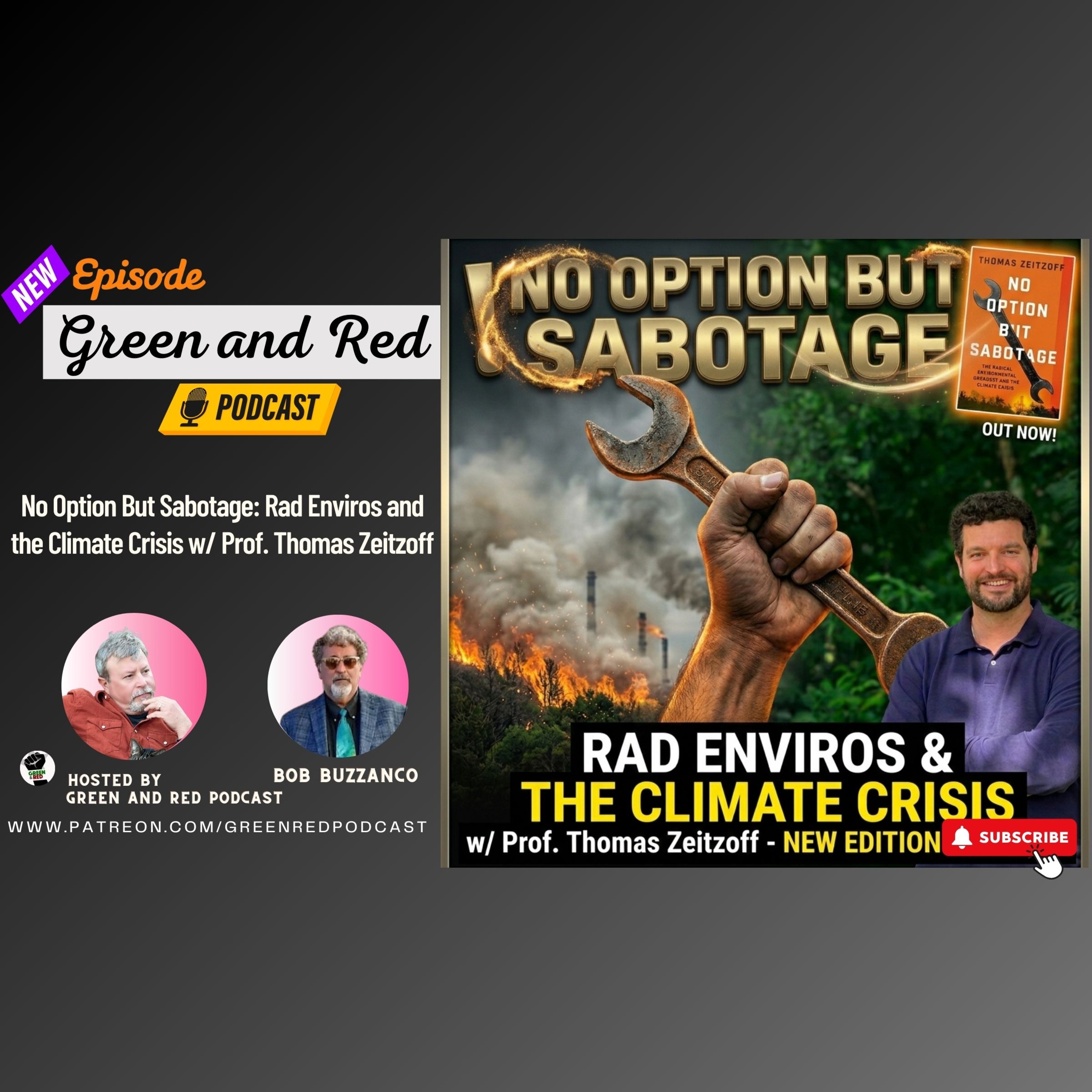
Green & Red: Podcasts for Scrappy Radicals
No Option But Sabotage: Rad Enviros and the Climate Crisis w/ Prof. Thomas Zeitzoff (G&R 473)
00:55:18
Loading summary
Transcript95 lines
- [00:01]
Tom Zaitsoff
Welcome to Green and Red Scrappy Politics for Scrappy People, a regular podcast on
- [00:07]
Bob Bozanko
radical environmental and anti capitalist politics. Brought to you by Bob Bozanko and Scott Parkins.
- [00:14]
Scott Parkin
Welcome to the silky smooth sounds of Green and Red podcast. I'm your co host Scott Parkin in Berkeley, California. And as always I am joined by Bob Bozenko in Niles, Ohio. And today we have a return guest. It's a somewhat exciting episode, we're pretty excited about it. Tom Zaitsoff, who is a friend of the podcast return guest, is going to be joining us to talk about his new book which is called no Option but Sabotage, the Radical Environmental Movement and the Climate Crisis. And it's a book that's been long in progress and is now been published and Tom is doing media and book tours. And so we're excited to be one of the first shows to interview Tom. But the book traces the origins, the rise and the fall and potential rise again of the radical environmental movement. For there's many ways we could describe it. We'll say the radical environmental movement, a lot of in depth interviews covering main factions, actors. There's a lot about Earth first and the Unabomber and connections between some of the interesting stuff about the connections between animal liberation, punk, the emergence of the Earth Liberation Front and then also some of these questions about the radical environmental movement and how they apply to the climate movement and then also other movements. We're going to get into all of that today. But Tom, welcome back to the Green and Red podcast.
- [01:48]
Tom Zaitsoff
I'm super jazzed to be here. Thanks for having me, guys.
- [01:50]
Scott Parkin
Oh, and I didn't. Also Tom is a professor in the School of Public affairs at an American university. He's author of Nasty Politics and then also author of no Option but Sabotage. So maybe first question is that you have studied political violence in Ukraine, the Middle East, Mexico, other places. Why did you decide in this book to focus on radical environmentalists and radical environmentalists and animal rights activists?
- [02:18]
Tom Zaitsoff
Yeah, there's two answers. The personal answer is I have small children, so doing a lot of field work is really hard outside the country. But the serious answer is the every semester I talk about Kaczynski, the Unabomber and I'd have more.
- [02:34]
Bob Bozanko
More.
- [02:34]
Tom Zaitsoff
You know, he there's some, we have a lot of issues and we can talk about Ted or Uncle Ted as some of the folks in the movement talk about it. But I'd have my students read his manifesto and more and more like students would nod along at the early parts of the manifesto saying industrial Revolution has been a disaster. Technology's ruining our lives. It would blanch at some of the other more reactionary stuff. But I had the student who asked me, why don't we see more of this in the. Given everything that's going on with the climate crisis, et cetera, why haven't we seen a return to this kind of stuff? And I had talked to one of my colleagues who had done some work on radical movements in the US and he said, you gotta watch if a Tree Falls. That's the Marshall Curry documentary about the Earth Liberation Front. And then I was hooked. It was like, wait, this was. This is the number one domestic terror threat after 911 movement that killed nobody. And like, to me, it was wild, right? What it was also interesting, the sort of amount of sabotage that was carried out, but also the labeling after 911 and some of the repression that the activists faced. It was. I was surprised and that I was hooked and off.
- [03:40]
Scott Parkin
And just to get into it, because it's in the title, what would you say makes a movement radical?
- [03:48]
Tom Zaitsoff
So this is like a huge debate. I define like the radical.
- [03:50]
Scott Parkin
They've debated it before.
- [03:52]
Tom Zaitsoff
Yes, we've had this discussion. And I think, like, some people think, like folks just like, holding signs in the street and maybe like blocking a Starbucks entrance or something is radical. And I think the radical sort of label gets tossed off on. I don't think it's useless. But I would say, like, when you think of radical movements, I think of movements that maybe eschew or have a strong distaste for, like, conventional politics. Right. Whether it be voting, not necessarily against it, but see that as ineffective, mainstream kind of advocacy work, working through, like, policy channels. And they see the policy process as broken and they look for more contentious tactics. And that can run the gamut from low level civil disobedience and sabotage, just more extreme action that involves, like, actual violence against humans.
- [04:38]
Bob Bozanko
I think that's a question that has a lot to do with tactics, Right. Which is clearly a huge part of your book. But there's another part which I found really interesting because I used to teach courses in this. So I'm looking at it more professorially than as an activist. And when you talk about the emergence of Earth first, very critical, hugely important group. But then Earth first starts to get invaded, which is my word, not yours, by kind of cultural elements, right. And who have a different vision, and they bring in issues like environment, environmental, racism, or immigration. And how does that affect what that movement is? Because I get the sense Dave Foreman wanted to hunt and fish in pristine forests. Right. That's a bit of an exaggeration, but. And then you have people coming in saying, oh, it's much bigger than that. And so I think things like this countercultural or identity element, whatever you want to call it, anti capitalism, how does that fit into whether something becomes radical or not?
- [05:28]
Tom Zaitsoff
I think so. These are like, really questions that I didn't anticipate asking in the beginning. But something that came along was like, one, this idea that sort of subcultures or scenes, they provide an ethos, but also a broader group of people that are, like, open to ideas. And so, like early Earth first, it's like disaffected conservationists, Friends of the Earth, like people who would like Sierra Club, like all these sorts of things where they were like wilderness First. Dave Foreman, we can more than happy to talk about him. Like, charismatic, but also super problematic rednecks for wilderness. This kind of Stetson, like, backwoods aesthetic. And I think you have these kinds of different subcultures that kind of come in. And then, as you were saying, the counterculture folks, Foreman would say he would agree with you that they were invaded or taken over. But I think it's also just. You throw up a leader, you have a leaderless kind of movement that's built around ideas, and then you have it represent a kind of counterculture, like, kind of outlaw image. And don't be surprised if people from a different kind of vantage point may say, hey, I like this, but I also want to change this. And so I think they come in with their own ideas and things. And that's what we saw happen at first. And then you talk later about, like, animal rights and pump. Like, when I set out to write this book, I was not expecting to be interviewing as many punk, animal rights, like, vegan, straight edge, like folks as I ended up doing.
- [06:52]
Scott Parkin
And what kind of influence would you say those folks have had within both radical environmentalism and within radical animal rights? And we've interviewed a lot of those people on this show before. But I'd like to hear what your observations and maybe conclusions were.
- [07:05]
Tom Zaitsoff
Yeah, so I think one thing that was surprising, if I were to say there was like a hardcore spectrum from people who were like, let's just sign, do a bunch of petitions and sign things versus we're getting ready to throw down, we're gonna do whatever it takes. I think the animal rights folks and definitely the people from the punk scene came in with a specific kind of energy. And those there's this energy that's happening in the Pacific Northwest in Eugene, where tree sitters are meeting punks, meeting animal rights folks. And it's like coalescing in this weird sort of suit. But I did find like the animal rights punk seen like they had. There's an ethos to it. I think it's very different if you come into environmental activism as a student activist, like on your college campus. That's very different than if you get handed a zine at a punk show. And one person said, I was already throwing rocks through windows, I just needed to figure out which window to throw it through. And that's. I think part of it is like the kinds of people that come in and are attracted to these sort of subcultures that serve as like entrees or pathways into movements. It matters a lot for the trajectories of the.
- [08:14]
Scott Parkin
And punk had a. There's. Before animal rights, before straight edge vegan, before. It also became very influential in like radical environmental circles. Punk was big on the west coast. In political circles, like the anti nuclear movement, there was like a punk element there. The 1984 Democratic National Convention in San Francisco, we had the rise of Jell o Biafra and things like that. Did you encounter folks probably from the older generation who had come in to Earth first, animal rights, who had actually been involved in some of that, like anti war, anti militarism, anti establishment scene.
- [08:50]
Tom Zaitsoff
So not. Not directly that, but some of the animal rights activists that I interviewed also talked about, and I think it's true, is that even in England, like when the ALF is being created, it's at the same time as like the punk scene and punks were doing animal liberation. And then a lot of animal liberation folks were in bands too. I do think the other thing that, you know, something that I'm happy to talk about, it's more speculative, not in the book, but I do think I grew up in Austin. Huge Austin, Texas, like a big live music scene. I like to go into punk shows. I wasn't Double X on my hands or anything like that. But the one thing that I do did notice, and again, this may be a hot take for the segment, is that a lot of kids and men who are like disaffected, angry punk, socialized them into a particular kind of politics. And I would argue generally, usually not always, but for the better. Whereas now the different sort of socialization that's happening online gaming culture, streaming culture, where it's like awash in, I would say less than stellar politics. And I. So again, I think these things kind. These things matter. More broadly. And it's not just in the book I talk about the radical environmental movement, but I think more generally these kinds of things that socialize into their politics and other things matter a lot.
- [10:04]
Scott Parkin
Back then they joined ara, and now today they become groipers.
- [10:08]
Tom Zaitsoff
Yeah.
- [10:08]
Bob Bozanko
Will Potter writes about that a lot. How punk drew him into to his political ideas, too, which I think I'm older. So for me, it would be like Bob Dylan. This is generally a legalist movement. And today we know about, like, Bill McKibben and Scott Parker, but I think the two figures, historically, who we know best are Dave Foreman and Judy Barry. And I never gave it much thought, but there's a tension there between people who like one or the other. And I guess they embody different approaches, different strategies.
- [10:38]
Scott Parkin
And.
- [10:38]
Bob Bozanko
Do you want to just talk a little bit about that?
- [10:41]
Tom Zaitsoff
Yeah. I was not ready for. So one thing too that was like always, like, this sort of underlying tension is like some people who didn't want to be like. From the Dave Foreman, like, deep ecology, wilderness first kind of approach. Many of them did not want to be called environmentalists. They wanted to be called conservationists. And like, they preferred that term. So that was always a signal, oh, okay, this is the direction we're going in. And then the Judy. For the Judy Barry, like, folks, they would always kind of tie themselves, and a lot of them would say, I'm a labor activist and like an environmentalist. And this idea of Judy Barry's, this dream of we are going to have this environmental movement, but also ally with labor that later became the turtles and all this sorts of stuff. I think there's a big question, right? So some of the folks that criticized Judy Barry would say she was a narcissist. Like, she made the movement about her, and that the Redwood Summer campaign, this mass civil disobedience, was basically effective in spite of her and that she's been mythologized because of the bombing plot that still hasn't been solved, where she was accused of bombing herself. And then it turns out that's not probably what happened. I don't know. I think it's a. I think like a lot of these things there. There are these schisms and represented this sort of broader view of are we about, like the wilderness or are we like a bunch of folks in the wilderness, or we like a mass movement that's like basically like the civil rights movement and Also Labor Movement 2.0. My view on this is I think Judy Berry had a lot of attractive ideas. Now, the question I don't know how actually effective they were at organizing this. I think there's a lot of question marks as to whether she did as much as she did. But I think the idea of, hey, we need to think about, we can't just be all about wilderness and tree spiking. We need to think a little broader is probably from a movement perspective, a little more effective.
- [12:25]
Scott Parkin
And the other, because. And you. We brought him up early on, but the other person who seems to have some influence and sway even still today is Ted Kaczynski. And so what, just to dive deep, a little bit into Uncle Ted, like, how would you, how, what is the influence of, of Ted Kaczynski both in this sort of like period of the 90s and Earth first and the rise of the Elf and the Alf and then even, maybe even through still today. Like, we're all, we all know that Louis G. Mangioni, for example, read the Unabomber's manifesto, for example.
- [13:01]
Tom Zaitsoff
Yeah. So I think the point, and as somebody in the. Who I interviewed in the book pointed out, is there was this weird sort of tension in the sense that Kaczynski, like, was not a card carrying member of the radical environmental movement. He had a lot of gripes with them. He hated leftists. Like, it's clear, like you read his manifesto, there's like a lot of really problematic reactionary politics, let alone like his issues with gender and other things. But he also read the Earth First Journal and his ideas about wilderness, there was a chord and there were folks who were like, I don't agree with everything that happened, but his idea of going after the people who folks thought were truly responsible, I think among more radical impulses. And this is even something that people within the ELF talked about is there were schisms within the ELF that came later on before they disbanded, and then were eventually like caught up in Operation Backfire about whether or not to escalate to targeting people. And so I think that part the idea. And you guys remember, but my students don't. It's like Kaczynski at the time when he was treated, it was like this reclusive math genius, youngest professor at Berkeley. He was treated as a crazy person. He could have been like a die hard villain and then. But like you look at it from a pol, you know, political violence standpoint, he basically created a bombing campaign in order to get his ideas and message out and then blackmailed two of the largest newspapers to get a manifesto published. Doesn't sound very crazy to me. And I think what's been interesting is having taught them Unabomber manifesto to my students is like many of them were like, oh, this is the guy. I see Everybody memeing on TikTok and other things. And I think the resonance, right, maybe the part where he was like a little ahead was this idea that you just have to look at what's going on in politics right now. Elon Musk, Right. Peter Thiel Palantir. Right. The tech roligarchs, when they all went to Trump's inauguration. It's very clear where the technology, at least the technology money is going to. And I think a lot of people, there's questions about loneliness or other sorts of things. And that Kaczynski is this famous and very imperfect messenger for this kind of anti tech impulse that we've had for longer. And so I think that resonates with younger folks who I've done survey research. They're super worried about, like, where we're headed with technology and how it's taken over different facets of their lives.
- [15:22]
Bob Bozanko
To get back to the kind of tactical question, and the title is no Option but Sabotage. And one of the key elements that I remember, I have to remember with like our first is monkey wrenching and tree spiking. And then there, there's a real issue, there's a real division over that. And I'm just curious because it makes perfect sense when I read it, but I wasn't really aware of that. But then you have this initial kind of monkey wrenching, whether it be trees or construction equipment or whatever, and then movement away from that. And I think that's connected to Judy Berry as well, I believe.
- [15:53]
Tom Zaitsoff
Yeah. I mean, there was a forest worker that, you know, and there's a big debate as to what exactly happened that was injured by a tree spiking incident that was allegedly connected the folks with Earth First. I think, though, the deeper question, and this is a question Scott and I have chatted a lot about and I've talked to other folks, is what is the most effective way for movements to like, get their point across and affect political change? And this goes to the deep question that there are people out there, right? And Erica Chenoweth and others who say strategic nonviolence, civil disobedience is the only way forward. I had people, when I like pitch them, and I will say, I want to be very clear, right, this is not a prescriptive title, it's a rhetorical question title, just for everybody listening, but whoever they may be. But the. I think I had people who, like, said, your premise is ridiculous. Right, the radical tactics premise. Right. It's already been answered. It's Gandhi, Bayard, Rustin. We already know, like, the formula that works. And I, again, having studied movements outside the U.S. i know that there are a lot of ways that movements have succeeded. And it's not. There's not, like, a pure answer to this. And I think it's. Regardless of what I think the actors and activists are constantly experimenting with tactics and trying to figure out what works. And I think this is a huge debate, right? This idea of does having a radical flag of people maybe doing sabotage, property destruction, or outside the U.S. like the PI, the Provisional IRA in Northern Ireland, like, carrying out bombing campaigns, does that hurt the cause and does it engender backlash and repression? Probably. But does it. How does it affect more mainstream actors? Do they look like, oh, these are the crazies, we gotta negotiate with people in the center? I think it's a huge debate, right? And this is a debate was. I was surprised as I interviewed people who were involved and around the Earth Liberation Front. And some said, we as the Earth Liberation Front and folks involved in this movement, we extracted a ton of damage and became the number one domestic terror threat. And for a moment in time, we really had folks in industry on run, on the run. Whereas other people say, it was a mistake, we squandered the ability to build the mask. And these are questions that activists, like, right now are asking themselves.
- [18:04]
Bob Bozanko
The right doesn't have these, like, January 6th worked like, you can't look at that. And it worked perfectly. And that, like. And I don't really do climate work, but you'll see that in, like, in the Vietnam era, people would go into draft boards and destroy the records, or Catholic activists would go to bases. And it's like what Palestine Action is doing in London now. What do you think led to that kind of repudiation of anything approaching what I might call, like, an aggressive tactic? Not people still do it, but at those higher, like, theoretical levels, it seems like there was a movement away from
- [18:35]
Scott Parkin
that, definitely within environmental and climate circles.
- [18:38]
Tom Zaitsoff
Yeah. Yeah. Scott can. Scott lived through this as well. But my sense from talking to folks is right. The first is repression works in this sense. Like the repression that came down for property destruction, the sentences that people were facing. I also think it was not just, like, the targeted effects of repression. It was the fact that more broadly speaking, like, anybody who was in that scene was getting, like, pulled into grand jury subpoenas and having door knocks. And I think this and it turns out there weren't that many people involved in the more aggressive stuff. So it can work. And so I do think the power of repression works and that I think you also have people shift into other movements. They go into the anti war against the first or second Iraq or the invasion of Iraq. You have in 2003, then you have Occupy. And I think one of the other things, and this is something that I think is a kind of a fracture line too, is that the climate movement has, I would say for climate activists, I think it's a good thing, has become explicitly intersectional. But that also means when you become explicitly intersectional, the play, okay, there are always going to be, there's Israel, Palestine, there's going to be the ICE stuff. There's always going to be like climate will always be third fiddle. And I think this is a question that a lot of folks aren't asking as well.
- [19:56]
Scott Parkin
Just to stay on this state repression track for a moment. The other important thing that happens in this period, kind of which happens in the, as we're seeing this radical militant animal rights movement, radical militant environmental movement is 9 11, which gives the government a whole lot of ability to prioritize state repression. And I'm just wondering if you could. We've talked with Will about that a couple of times, but I'm just wondering if you could. Will Potter. I was just wondering if you could like comment on that a little bit of what you saw the impact of 911 with some of the folks you talked to.
- [20:31]
Tom Zaitsoff
Yeah, I think the idea like pre 911 being called a terrorist was one thing. Post 911 was like another thing. And I think the sort of the joint terrorism task forces that were involved, the resources to go after terrorism and the fact that you have this like op ed or like this cartoonist running in the Seattle. I think it was like the Seattle Times or one of the papers where it like shows a picture of Osama bin Laden giving like the equivalent of a fist bump to the Earth Liberation Front.
- [20:58]
Bob Bozanko
Right.
- [20:58]
Tom Zaitsoff
So that's, I mean it's ridiculous in some ways, but I think the kind of the idea that like, okay, these are terrorists and I mean for all of its foibles, and there are a lot, is that we have a very large law enforcement apparatus. And when they put pressure and apply it to folks, I think that I think it scared people definitely within the movement. I think people also these movements change and shift and the punk scene wasn't what it was. And so these things have been flowing. So I think it was in some Ways it was like over determined right activists aged out, some got arrested, they got repressed. The 911 rules made it harder and the movement didn't die, but it shifted and changed and like there then you started having the pipeline blockades and other things and. But there's definitely a move away from the really hardcore property destruction in arson that was bread and butter of groups like the elf.
- [21:51]
Bob Bozanko
So you have repression. But you also mentioned a minute ago intersectionality. And two things that come out fairly early I think in the book are questions of immigration and race, which seemed to be very divisive and very problematic. And how did that affect. Seems like it was negative. Right, but how did that affect the kind of evolution of the movement?
- [22:09]
Tom Zaitsoff
Yeah, this is one thing like having again I've come to this from like an outsider who studies political violence outside the U.S. this was the one thing I was like, oh wow, okay. I was not ready for this is you could do a laundry list like Madison Grant, right. Conservationist, writes the Passing of the Great Race. Adolf Hitler's like favorite book in the 20s helped author like immigration restrictions. You have then like the Tanton Network, which I would argue is like probably one of the biggest legacies of that kind of part of the movement is that John Tinton, who is a member of Zero Population Growth, tried to take over the Sierra Club and he just founds this kind of cavalcade of immigration, anti immigration groups, center for Immigration Studies, Foundations of Americans for Immigration Reforms. Basically the architect of a lot of the anti immigration movement. Like we don't. You don't have Stephen Miller, in my opinion, without like John Tan and folks like supporting that. And then the Dave Foreman, this kind of like question that hung hangs over the movement about like population. Right. So most of the people who were conservationists or called themselves conservationists who I like interviewed, they were all like, they wanted to talk about overpopulation as a problem. And again I'm not a, I'm not a demographer. I think there are some questionable assumptions about that. But usually like it wasn't just I think overpopulation in general is a problem. It was I think over. I think overpopulation is a problem and I think it's even exacerbated like in places in the global south and immigration, like we can't allow these people to come into the US because then like carrying capacity and it would go take people to some really weird places. And I do think one thing that is also true and I think is worth pointing out is that there is nothing inherently lefty about environmentalism. The Nazis had a pure homeland. There was a whole, Peter Stoudemire's whole work on like right wing and fascist ecology. It's there and it's there. And I, I think for certain sort of idiosyncratic reasons related to fossil fuel interests aligning with the Republican and conservative movement, we haven't seen that creep up. But I, my again, I hesitate to make predictions, but I would not be surprised if in the future as the effects of climate become bigger, you start having this more right wing climate, almost like climate nationalism, batten down the hatches. We're keeping our homeland pure and we've
- [24:20]
Scott Parkin
seen the sort of margins of that. Like Shooter in El Paso had a manifesto that included climate. There's all kinds of like little eco fascists popping up in the US And Europe. Yeah, one, one. One thing that sort of like in, in my mind ties a lot of this together is around capitalism. People within the movement like really like to talk about capitalism and anti capitalism. I feel like you can look at it with Earth first and militant anti capitalist animal rights activists and even Kaczynski and things like that. And I'm wondering how much of that was a thread through this critique of capitalism was a thread through like the, your study and people you talked with.
- [25:03]
Tom Zaitsoff
Yeah, I wouldn't personally, I wouldn't like label it as all like anti capitalist, but there was definitely this view that the current sort of political economic system in the U.S. right. Like in the role, like the way I see it, between like elite interests and like what like is good for Americans and the American public and like the environment is like completely warped. Right. Is that elites have way more political power and that any time we try to go through the policy process, we're going to get screwed. Was like the sort of calling card. And I think the irony of all of that is that where we are in 2026 in the Trump administration, like everything there is like even more accentuated. Right. All elite power is way the kind of opening up of public lands, going, ripping up renewable energy, like all these sort of grievances that kind of gave rise to the environmental movement. In some ways it's even worse, it's even more intense. But then there's also the repression is harder now. And so I think there's like a big question like what do we do? And I think this, the point that you made about the critique of like capitalism. The folks who I've interviewed, right. And some of whom and other folks, right. It's not articulated.
- [26:12]
Scott Parkin
I don't know who you're talking about.
- [26:13]
Tom Zaitsoff
Yeah, yeah, we don't know anybody. But the critique is not, oh, some people will say capitalism is the problem or other things, but I think it's like more crudely. Not crudely, but like more directly articulated as billionaires are the problem. And like you, we have.
- [26:25]
Scott Parkin
That's the buzzword. That's the buzzword now. Right.
- [26:29]
Bob Bozanko
You said. And I think it's important like that you don't necessarily see environmental movement as left. And I agree with you there. And I remember when I was young and when it gets started it's about littering PSA with a Native American crying and recycling an Earth day. And we don't. And the Earth first comes out in the 80s and used this conservation movement. We don't really talk about climate change until it becomes a major issue, I guess in the 90s, like a really dominant issue. Heard about it before that. How does that kind of. Because I think you see a shift. Basically what you're saying is like you go from let's just call it conservation to dealing with climate change, which is a way bigger issue which sticks into things like industrialization, capitalism and so on. How does that change Moon? And does it change tactics as well?
- [27:12]
Tom Zaitsoff
Yeah, I mean it's, I think that's like the point. Like I think one of the things folks in the movement like lament, not that it's like it needs to be taken, like it needs to be dealt with. Climate change like is coming at us like a freight train. Like we can ignore it, do whatever you want, but I think from like a movement perspective it's so much harder to organize. Like it's, it's much easier to say we're gonna have a place based campaign, we're gonna Warner Creek for instance, outside of Utah, we're gonna set up camp, we're gonna protect these old growth forests and even. And I think it's easier to get people like on board with that. Right. Because it doesn't require. Hey, by the way, actually here's something that's not super tangible, it's theoretical. It's the amount of carbon in the atmosphere and it's trapped there for thousands of years and it's not coming for fifty to a hundred years. Right. So I think that's something that's made it harder and I think some of the sort of maybe like hunter conservationists, maybe the Dave Forman side of the environmental movement are like turned off by the idea like, hey, we need to have a global climate agreement that's ratified at The UN and they're like, get me out of here. I want to keep my like hunting lands, areas where I hunt and fish like clean. So I think it's part of that. What's interesting though too is the more recent and for a follow up book that I'm writing on attitudes towards the future, I've been interviewing people involved in like protests against data centers. And that movement. One is latent and hasn't been like getting as covered as much, but it's strong. And that I think actually has way more in common with some of these earlier play space campaigns because it's got this sort of nimby not in my backyard feel. You got the people who are suspicious of big companies and I think it makes for some really interesting, if not strange modern political bedfellows.
- [28:49]
Bob Bozanko
They're shutting these things down in red states.
- [28:51]
Tom Zaitsoff
Yeah.
- [28:51]
Bob Bozanko
Like kind of hardcore Republican areas. No. It's inspiring in some ways.
- [28:55]
Scott Parkin
Yeah. It seems like since Trump has come in the quiet, the climate movement has become quiet. And part of it is because the climate activists are out doing anti authoritarian little d democracy work. But then where I do see climate activists involved is especially on the AI, against the AI data centers because of the carbon footprint.
- [29:15]
Tom Zaitsoff
And not just that, it's also I always think like the sort of from like a policy perspective or even from a messaging standpoint, it's like pretty easy like to frame this as like a campaign as, hey, they're going to build this super noisy data center that's not going to employ a bunch of people, but it's going to make these folks who have really weird and terrible political preferences super wealthy. And then they're going to also siphon a bunch of AI slop to your children and raise your electrical bills.
- [29:41]
Scott Parkin
Take all your water.
- [29:42]
Tom Zaitsoff
Yeah. Oh yeah, don't forget the water. Yeah.
- [29:45]
Scott Parkin
Because I feel like this was a much more live conversation before January 20, 2025. But there had been this ongoing debate, some of it sparked by someone who also has a rhetorical title of a book called how to Blow Up a Pipeline. But there's a whole question that was coming up about, around escalation within the climate movement around fossil fuels. And so why would you. And I think this is some of what you're wanting to get at with your book. It's like one of the main themes is like why do you think we didn't see an escalation something akin to the ELF with climate work? Or did we?
- [30:23]
Tom Zaitsoff
I think it's like a, it's a good question. I think like the flippant but also true answers, like repression is when state surveillance is. Makes this harder. Right. To carry out. They finally caught allegedly after the pipe bomber after 20, the 2020 election. So that those things are harder. But I also think it goes to who's coming into the movement, right. If you're coming in from like the climate justice frame, right, you have a different socialization process as you're a student activist. It's not saying student activists can't be radical. The Weather Underground for sure has shown that can happen. But I think it's just different, right? It's different. And I think the ethos around it, and I also think the question that people are like asking themselves, and I think it's a good one, is if you sabotage a bulldozer that's going to chop down the forest, that's like clear what the potential or take down chainsaws or other things, or like sabotage road with the pipeline stuff, it's. It's less clear. And Malm himself, famously from his armchair and sweet. No, I'm kidding. But he critiqued a lot of the ELF actions and that made that turned a lot of folks salty in different ways. But yeah, I think it's like a big question. And I think that my sense from talking to a bunch of different folks is people aren't sure what works, right? People don't know what works. And that's not to say it won't change in the future or other things. But I also think the point that you're making is to me is like the big one is that the climate fight is now directly intertwined with the democracy fight in the US and like, how do. You can't have a climate movement, right? Or any kind of social movement. You can, but it just makes it so much harder when you live in like kind of an authoritarian or semi authoritarian or competitive authoritarian or whatever other sort of descriptor you want to throw on where we're potentially headed in the US or where we're not to go
- [32:13]
Bob Bozanko
back to the kind of origins and the purpose of various actions. I'm a historian, so I didn't think Mahm's book was actually original. I'd read most of that stuff has been out there, at least in the literature I was familiar with. But there's always been this kind of discussion of what the purpose is. Do we want to actually like, affect the industry directly? Redwood Summer, for instance, or blowing up industrial equipment, or are we trying to let people know what a bad problem this is so that they're Going to become. And it becomes a far slower evolutionary process. Is that debate going on, like, in the movement? What do we want to, you see this, like, civil rights movement, right, which is actually way more militant than people. It wasn't like just sitting down and letting people beat the shit out of you. And yeah, King had in some ways positive stuff to say about property attacks and things like that. Is there a debate going on? What's the purpose of what we do? Do we want to, like, affect it directly, like the old wobbly idea right at the site of production, or do we want to just slowly have PSAs about how bad pollution is and let people know what a problem this is so that they'll come around?
- [33:17]
Tom Zaitsoff
It's a deep question, right? My, My sense from folks is that the idea of a diversity of tactics, right, is to do it all. But I also think the. So I do think to credit, like some of the older Earth First Campaigns, like when they were doing tree spiking and all these other things, they were also running like public opinion surveys in Oregon on like, attitudes towards the like. So it's like getting. Trying to figure out, like, what is biting and what's not. And my sense is that. I think the idea that. And maybe why to like folks in the movement, it's attractive, is being able to tie AI data centers together. Also tells a story, right? That's pretty like more digestible than, hey, we all need to cut carbon, et cetera, for hope that we don't hit 2.5 and get to 2.4 and undershoot. Which is like scientifically true, but also politically mess. It's a terrible political message to carry because it doesn't resonate with folks. Whereas, like the AI folks is they're billionaires and they have really weird preferences and they're like destroying our democracy is something that I think is something that hits with people, with people differently. But I also think there's also. I think we're also in a weird place in US Politics too right now, is that I'm in DC and the FBI is not what it was, right. In terms of. A lot of people have left, right? The DOJ is not functioning the same way it was. But also the repression, like in the buildup of ICE and these law enforcement apparatus, it's. Some people talk about it as pro government sort of militia. It looks a lot like that. There's a lot weirder sort of, I think weirder like law enforcement and surveillance and repression that's going on in the sense that it's not as careful as it was seeing cases get thrown out. But it's also a lot more indiscriminate. And I think activists are having to update their calculus as to what that means because I do think that's a big one. And then what does it mean ahead of the election but also more generally like what does it mean for climate, environment and things that people care about?
- [35:21]
Scott Parkin
2 current. Do you have a follow up?
- [35:23]
Bob Bozanko
No, go ahead.
- [35:24]
Tom Zaitsoff
Okay.
- [35:24]
Scott Parkin
Two sort of current events. Two things that have happened recently which I think plays into this. One, we just saw 19 Republican state attorney generals calling the Department of Justice to investigate climate funders like foreign and climate funders. And then two, we're seeing the FBI do door knocks on climate. It was complete, totally expected to me that they would be door knocking on anti ice people in LA or Chicago or Minneapolis. But we just. There was just a piece in the Guardian about how they're showing up about extinction, rebellion, New York activist houses and things like that. And is. Are these two things probably some other things that we could name, are these. How much of a chilling effect is that going to have on climate folks?
- [36:09]
Tom Zaitsoff
I think I. And again, I'll hesitate to make predictions like about what is directly going to happen. I will say that, right? There's this weird, right. People call it like the repression, dissent puzzle is sometimes repression like kills movements and scares people.
- [36:21]
Scott Parkin
Right.
- [36:22]
Tom Zaitsoff
And other times it emboldens people. Right. And I think it's an open question, right? One of the things, like when they call somebody like Alex Preddy a terrorist, right. The label loses meaning in a lot of ways. Right? So I think the thing that I think you guys saw, probably folks myself, who study like political violence scholars saw, is when we look at the memorandum on National Security that came down, the presidential memorandum. Seven. Seven. Yeah, yeah. And then we look at Pam Bondi asking for a list of antifa, like it's a Boy Scout roster, right? It's clear where the investigative priorities lay. But it also, again, I don't think I would say in some sense, and this is where I think in the, in the long term, I think a lot of people were worried like they're going to build like Erdogan kind of Turkey or Netanyahu. Like that was like the path that they were on to consolidating one party Republican rule for a while. And I think just in some sense we got lucky. In other sense, it's a function of the party and especially the MAGA movement of Trump because they don't have the patience to build that So I think he's very unpopular right now. But that also means that like the incentive for repression and other like shenanigans and by shenanigans, like pretty wild stuff is on the table ahead of 2026. So I think we talk about what's the long term outlooks for movements and other things. I think there's just this massive amount of like uncertainty and that there's been amazing organizing in 2026 around no king School walkouts that students have done anti ICE protests. But there's also like a lot more repression that's potentially on the table. And one of the reasons why, like I wrote this book is to figure out like the radical environmental movement saw quite a bit of repression in the early 2000s. And I think it can inform some of this. But also what we're seeing is probably even it's a category above what was happening. And definitely the threshold for repression has gone down.
- [38:13]
Scott Parkin
It definitely seems like it's scaled up, but let's call it the competence factor. Like the people who were in the DOJ and the Bush administration, those were like hard nosed prosecutors who like really knew how to play the game, whereas they hire Trump's personal lawyers and his, his insurance, personal insurance lawyer, injury lawyer or whatever to run these departments. And so it's a little bit like they're just throwing a bunch of stuff up on the wall just to see what sticks and none of it's sticking.
- [38:41]
Tom Zaitsoff
Yeah. So like in some sense, like you can make the argument and like some folks who I interviewed made is that right. A lot of this repression. Right. That we're seeing now at the national level was also like the groundwork was laid at the state level. Like you look at what the Stop Cop City RICO pro prosecutions, a lot of which has gotten thrown out, not totally, but like that was like we're going to arrest and levy some pretty crazy charges against people organizing bail funds, things that are like constitutionally protected that we know will probably not stick but will also have an intended effect. And I would argue their kind of take on it was probably even more patient than what the Trump administration is planning. So again, I think the idea of like patient surveillance style, big careful cases that are going to really ensnare people are probably less likely. But the idea that people are going to have some pretty intimidate face, some pretty intimidating, like heavy handed repression, I think is much higher. And I think again, that's a different sort of calculus that folks and have to make. And it's something that scholars like myself we see it as different. It's not unusual, like outside the US but it's maybe unusual. We haven't seen this kind of stuff in a while.
- [39:49]
Scott Parkin
That's what we're seeing.
- [39:50]
Bob Bozanko
If you're writing a book in 20 years, I think the campus repression, and a lot of them done by Democrats.
- [39:55]
Scott Parkin
Right.
- [39:55]
Bob Bozanko
Is going to be a big factor in this. Showing people what the possibilities are a minute ago. And I think it's an important point because when I taught classes on this, I was brought up, like you mentioned, how sometimes repression can actually encourage people to come out. We're seeing that, I think, in like, Minnesota, Chicago, Minneapolis, Chicago, right? Where the crazier shit that ice does and they start killing people actually have double the number of people come out there. Is that something like I. I like if you look at, like, the little steel strikes in the 30s, you see that, right? Where the more the guard was called out, the more people would go out and be on the picket lines. Is that something you think could still happen? We're seeing it, right, with regard to ice, and ice is so over the top. Could that happen in something like the environmental movement, where people just finally get fed up with it? There was a story coming out of Pittsburgh just yesterday, I think, where 3,500 people have died because of air pollution in Pittsburgh. There's a direct link there. And if you start portraying it that way and presenting it that way, is it possible to actually get this thing reinvigorated?
- [40:53]
Tom Zaitsoff
Yeah, I think. I think so. There's two. I'll say. Sorry, there's two or three sort of views on this. So one is there's a guy I interview in the book, Bernard, he's an old Earth firster, and his basic argument is that people can justify whatever they want until the last tree is incinerated. Like, pretty bleak, right? And then there's the idea, and I think there's a middle ground that it can push people, but at the margins, and then people forget about it. Remember the wildfire smoke? Like, it's now a regular occurrence that people adjust to. And I think there's like a third argument is that I think people are not maybe ready for. I've been interviewing for my next book a bunch of, like, climate scientists. And like, these are sober folks who, like, talk about confidence intervals and uncertainty. And I think there is. What's coming is, I think, pretty scary and intense. And I think that there is going to be a response right, to that. And I think figuring out ways to make. Move it from a very abstract problem to like a personal or these are the people who are causing it or to blame. And I think that's why for a lot of activists, the folks in tech companies make very good sort of targets and boogeyman because they also do things that make them like very good targets and boogeyman. So I think that, I think there is the place for that. I think. But the one thing I would say is like a grievance is not enough is that's why one of the big things there are a lot of pissed off people in the world drive into DC and just watch it happen, right? Is people are angry for all sorts of reasons. But you need an opportunity. But also I think one of the things I realized in this book is the kind of movement and like a scene that sort of supports and like nurtures the cause, right? Like whether it be you're talking about the civil rights movement and there were black churches, the larger sorts of movements where you talk about anti nuclear work, right. There are these broader sorts of movements that like serve as incubators, right. And supporters. Because the other thing too that I would say on like the positive front is that like organized and a small number of folks, right, can do a lot of, if they have some resources, can make a lot of moves. And all we have to do is look at people who we definitely, probably disagree with is like anti abortion, incredibly successful, right. And over kind of a long period of time and decentralized. But have folks who are committed and patiently waiting, right? They've been successful. And that's not a, that's not, I would say, a cause that has a ton of traction. You just have to look at like polling where most people are like generally opposed to those views, but they have people that are committed resources and target action and patience.
- [43:19]
Bob Bozanko
That's an important point because a lot of the things that I suspect all three of us believe in are actually pretty popular. And on the other side you have people who are really cartoon characters like Peter Thiel and Elon Musk and Trump. Trump is wildly unpopular and yet they get away with it. And one of the things, when I studied this again as an academic, one thing that always struck me was that one of the problems, and we can dismiss electoral politics and all that and I hate the Democratic Party, but because they are really complicit invest in this, right? They don't do anything that always seemed to be a problem, right. If you had somebody at that kind of superstructure level who was encouraging these things, right. Like right now the Democrats aren't doing about ICE if they did and they're not going to save it, the people in the streets are going to save it. But you also have no support above that which makes it harder. Is that kind of is how do you overcome that when you're not just dealing with Peter Thiel and Elon Musk and Donald Trump? Chuck Schumer is just as big a problem.
- [44:15]
Tom Zaitsoff
Yeah, maybe I see it maybe slightly differently and I think Schumer we could have a whole I like 12 show on Schumer. Yeah. But I think the bigger thing that point out, and I think this is true is that the benefit that right wing and conservative movements have is that they have this backing of across history by being conservative is generally you're upholding the current status quo, which means people with deep pockets support you. And so for left, left leaning movements or movements that seek to challenge it, the difficulty is how do we get the resources and the backing to go after it. And then it's like labor had a lot of this was the labor movements push, push and I don't know, there's not like an easy answer. And it's also as you were saying, ties back to what Scott was saying is the reason why they're trying to go after make Soros the bogey or investigate anybody that gives to these causes as funding. Tifa is right. They're still like losing elections. But the money to the Democrats like Democratic fundraising is way off for all sorts of reasons. But part, a big part of that is the sort of structural advantage as being a conservative or right, right right leaning or right wing party.
- [45:22]
Scott Parkin
Everybody froze for me for a second there. We're getting towards the end of our time. I guess my last question is just a, at least my last question, maybe Bob has some too is just to bring it back to the book. What would you see the prospects are for. For the climate movement at this point?
- [45:45]
Tom Zaitsoff
I don't know. So like the positive side of things, like the like I'll do the one like positive thing and then whether we think it's positive or not is like a deep question. I would say the one positive thing that I think is true is that the technology of renewable energy and it's gotten a lot better. Right. That's true. And I think that has all sorts of like really positive sorts of things. And as we were saying breaking up the kind of fossil fuel interests in the US and I think long term there, I won't say they're done but I think they have severe problems and I think Trump's Misbegotten policy of trying to block renewables or other things. That's like they're trying to put the finger in the dam and that's going to burst eventually. That's like a positive thing. I think the idea that younger folks are definitely more worried and more concerned about climate change, I think is good. I think their politics, I think there's a lot the sort of folks who try to say the young right wing men, right. I think the polling on that is super weak. Right? And yes, there are issues in like right wing men, subcultures and other things, but that's almost like for mean girls, stop trying to make the young like white right wing male thing happen. Right? It's like, okay, yeah, we hear you, it's coming. And yet the polling doesn't show that's the case. So those are like positive things, I think, also, like predicting what's going to happen with AI. I think there's a ton of uncertainty around that, right? In terms of, like, how that will play out, what that means for movements. Like, I think none of that is clear. I think a lot of people are like, forecast. So I would say there's like some positive things, some uncertain things. Like, the negative things is this is like, this is a global problem. Climate change is a global problem. We can do whatever we want in the US and the rest of the world does something like bad or different, it will like still screw us all in the end. And the turning away from that kind of global cooperation is problematic in a lot of ways. But for like, stuff like this or the Montreal convention in the 80s, right. There are places where we need that. And that's the part that I'm like, eek. That makes me super nervous. And then I study political violence. And I would say, like, the thing that makes me very nervous right now is it seems like we are in an age of foreign policy, military adventurism, and that has all sorts of like, bad historical antecedents. And so I really worry that people are like, underpricing the effect of conflict in the international system. And that comes with all sorts of terrible other things. But yeah, I don't know. I'm a cautious optimist, so I do think. I know there was a roundabout way of like, avoiding your, like, direct question. I don't know. I think, like, the thing that I do think is true is that I do think there needs to be, like, I would say for people in the environmental movement if I were like, I'm a scholar, I'm not. I'm an Academic. I'm not an activist but if I were to say, hey, you want to make climate and environmental move, you want to be effective, is intersectional, is good, but there has to be a place and it can't be like poo pooed that people who care about climate and the environment are less than like other kinds of like people centered movements because it's a big one and it's super important. And I think there is that view out there and I think maybe saying no, it's okay to like really like nature and really care about the planet, other things. And it's not just that you're a silly sort of person who doesn't take things seriously and don't have good politics in that.
- [48:58]
Bob Bozanko
I hate to be anticlimactic and shift gears at the very end, but since you're here and you anticlimactic, nice. You study political violence and you mentioned Mexico and we just saw it really blow up a few days ago there. I just wonder what your thoughts are. And to me like what happened on January 6th obviously isn't like that, but it's I think at a micro level it is. And we're not dealing with cartels here, we're dealing with the government. But what do you make of that? That kind of just almost nihilistic violence, right.
- [49:25]
Tom Zaitsoff
In Mexico?
- [49:27]
Bob Bozanko
Yeah. In the sense that they targeted like gas stations and shopping centers and airports and things like that. Not really what I would call strategic targets. And is something like that possible in the US to see this kind of just random. Like we see it like, like the Scott mentioned the El Paso shooter and we'll see something like that. But could that become even more common?
- [49:50]
Tom Zaitsoff
Yeah. So like the Mexico stuff. Yeah. So I'll just say full stop is right. The situation in Mexico is super concerning. Especially I will say is that there's been a tremendous, I would be rift to not say this. There's a tremendous amount of US Pressure being put on Mexico and Claudia Sheinbaum to go after cartels. And like allegedly there's not. There's reporting that CIA like basically gave a lot of the targeting location and that this was like a product of like essentially we're going to pressure you to go after somebody we don't like who you probably also don't like. But there's going to be all sorts of bad ramifications from this if you do this. And it's not going to be felt in the US it's going to be felt in Mexico. So that makes me super nervous and leery about where that's headed, I don't know. I do think like the other thing too that is true is even like not like from the sabotage angle, but from like the shame angle. I think making it so that like people who are pushing fossil fuels and like blocking the stuff, making it like not okay to be like in respect of respectable company and shaming them and just saying, no, we're not going to deal with you and having kind of ways of excluding them. And I think it's powerful. I mean triggered Alan Dershowitz Vineyard, which is crazy. But you think about it is these kinds of pressure campaigns, like they can work, right?
- [51:06]
Bob Bozanko
Summers resigned yesterday.
- [51:07]
Tom Zaitsoff
Yeah. No, and I think so that I think people like the. And you guys had talked about this and again I think I'll come back to this is like we. Scott had said, like the billionaires. The billionaires are the problem is like a watchword for movement activists. I think the story that you tell about that. Right. Is something that can. People can definitely get behind because I think the worry like that Musk and Zuckerberg and other folks have. Right. And why they're pumping all this money is because they. I think they are smart enough and not so out of touch to recognize that people do not generally like them. And they have very like all the polling shows that. So that's their kind of M.O. and I think if those movements can say, hey, these people who are like just siphoning wealth from the US and like distorting our politics and supporting people who are trying to take away democracy and investing a ton of. And facial recognition and also destroying the planet. Right. These are the problems. I think it. Personalize it. That's a Solinsky tactic, right? Is. Yeah. So I think there is at least from like a academic side and from somebody who studies social movements. I think those are some things that. That we see every time I, for
- [52:14]
Bob Bozanko
about a year now we're talking to the grocery store. I make a comment at the end about the prices and I'll say, yeah, those billionaires need another mansion. I've never had anybody in my face about everyone's like, yeah, you're right. Like it's. There is a. I think a real consensus out there that these fuckers have
- [52:27]
Tom Zaitsoff
gone way too far in the Epstein stuff. I will say the wild thing too about it, right. The Epstein stuff is that it's.
- [52:34]
Bob Bozanko
It's.
- [52:34]
Tom Zaitsoff
We see it's a network of folks and it's not just on the right. There are people on the left and Republicans, Democrats. But like the real thing Is this elite impunity? And when we see what the Epstein ramifications have been outside the US where it's taken down ambassadors, it's taken down a royal. And there are all these things that are happening and yet there's like nothing being prosecuted right in the U.S. i think that says something. And I think that definitely I've seen people who are not even very political and that resonates a lot with them,
- [53:04]
Scott Parkin
but it's also a pattern. Yeah.
- [53:06]
Bob Bozanko
Yep.
- [53:06]
Scott Parkin
We just dropped a show on Epstein and elite impunity and they lied us into a war. No accountability. Crashed the global economy. No accountability. And so why is this any different?
- [53:17]
Tom Zaitsoff
And I think the elite impunity like that extends directly to like fossil fuel CEOs, fossil fuel companies, other things that.
- [53:23]
Scott Parkin
Banks CEOs.
- [53:25]
Tom Zaitsoff
Yeah.
- [53:25]
Scott Parkin
Who focus on these projects.
- [53:27]
Tom Zaitsoff
Yeah. And I think that's something that is part of like the deeper problem that we talked about is what is how do we fix some of these problems? And one is like a better quality. As a political scientist, I would say more elite accountability and better democracy. And that's, I think, golf dipping.
- [53:42]
Scott Parkin
I'm going to wrap it there. It's been great talking with you, Tom. Guys, the book is no option but Sabotage Radical Environmental Movement and the Climate Crisis. We'll put a link for everyone to go out and buy this book. Everyone who listens to this podcast should go buy this book and learn it and read it and study it. And if you really like what you're hearing, please check us out on Facebook, Instagram, Twitter and Bluesky. If you're watching this on YouTube, hit that subscribe button. If you listen to this on an audio platform, give us a rate and review. And if you really like us, go to greenandredpodcast.org and hit that support button or become a patron@patreon.com GreenRedPodcast Tom, it's been great talking with you and for folks, we're hoping to have a live event with Tom hopefully in a couple of months, maybe in May. So be on the lookout for that if you depending on Tom's book schedule, book tour schedule.
- [54:37]
Tom Zaitsoff
Thanks, guys.
- [54:38]
Scott Parkin
And everybody else out there, make trouble and misbehave. We'll talk to you again soon.
- [55:02]
Bob Bozanko
Sa.