← Green & Red: Podcasts for Scrappy Radicals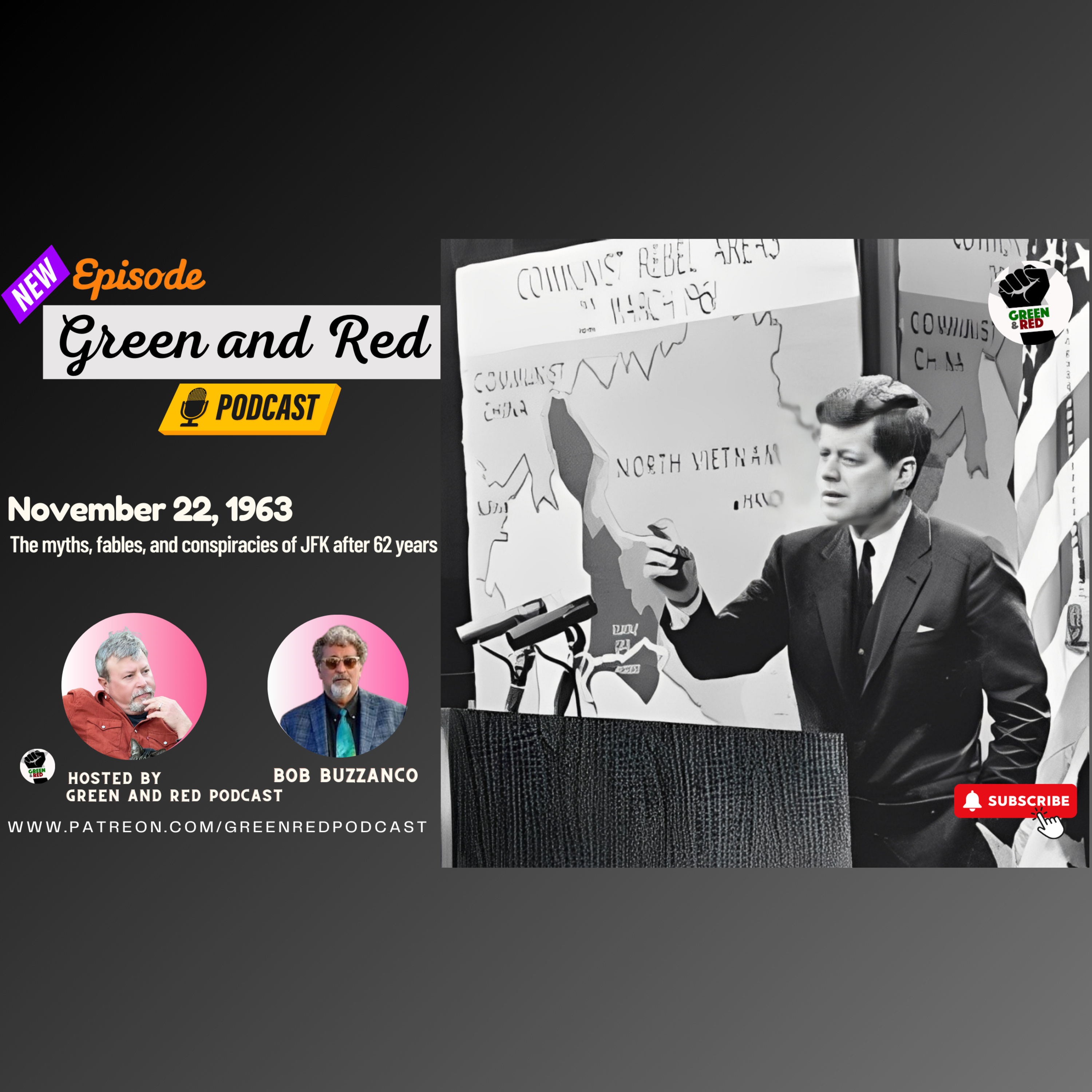
Green & Red: Podcasts for Scrappy Radicals
November 22, 1963 . . . The myths, fables, and conspiracies of JFK after 62 years (G&R 441)
00:59:12
Loading summary
Transcript79 lines
- [00:01]
A
Welcome to Green and Red Scrappy Politics for Scrappy People, a regular podcast on radical environmental and anti capitalist politics. Brought to you by Bob Pizanko and Scott Parkins.
- [00:14]
B
Welcome to the silky smooth sounds of the Green and Red podcast. I'm your co host Scott Parkin in Berkeley, California today. And as always I am joined by.
- [00:25]
A
Bob Bozenko in Niles, Ohio, ready for what's become an annual episode with us.
- [00:30]
B
It's the 62nd anniversary of the assassination of John F. Kennedy Sr. I was a junior JFK and as we've done many episodes on this, we've Bob has written books and articles about it and debated part of the Oliver Stone conspiracy industrial complex over facts around the assassination of Kennedy or mostly Kennedy's legacy.
- [00:57]
A
But Kennedy, one of us had facts.
- [00:59]
B
Yeah, that's true, that's true. Facts versus non facts, facts versus myth, really the Kennedy myth. But Kennedy has influenced three generations of politicians, including Gary Hart, Bill Clinton, John Kerry, Barack Obama, our second Catholic president, now former President Joe Biden, Diamond Joe Quimby, and then also the Kennedy legacy lives on. And so we're actually seeing relatives of the Kennedys still in public life. Most public right now is Robert F. Kennedy Jr. Who's the secretary of Health and Human Services, who's a noted anti vaxxer and honestly just whack job. And then also more recently in the news is JFK's grandson Jack Schlossberg, who's announced he's running for Congress in New York. And every time things we see this, it evokes the sort of legacy of Kennedy. And we, that's why we like to continue to bring it up. And so we're going to talk, we like to do myth busting. And so we're going to talk about the myth of Camelot and we're going to talk about Oliver Stone a lot today. So I'm going to pass it off to Bob.
- [02:03]
A
Yeah, and we have done a lot on this and I've done a lot as well. This isn't really, it's about jfk, obviously, but there's a much bigger point here, which is why I get so exercised about it. And this focus on conspiracy is becoming even bigger and more prevalent. We've seen House hearings on it and these demands to release documents which, which obviously I'm in favor of. You should release every document out there that you can. But I think what it does politically, especially to people who are on the left, whatever broadly broad definition you want to use of that is that conspiracy theories really is, I think In a lot of ways, anti political, right. I think to understand and analyze politics, you have to understand the structures, the systems where these people come from, what they do, who they work for and so forth. What conspiracy theory does is it essentially posits that there are a handful of good people trying to change things and do things the right way. And they're smacked down by. In this particular case, they would use the phrase the deep state. And what they're doing is looking for heroes for these heroic figures. And JFK fit into that for them. And what it does is it ignores the larger system in this particular context that JFK grew up in, that he succeeded in, that made it possible for him to become a senator and then become a president. So the idea that Kennedy and granted, in their narrative, they claim that Kennedy had this massive change of heart, he had a road to Damascus. And even though he may have been like this hardliner in a lot of areas, he switched, he flipped right now. And as you said, when we talk about facts, right, most of what they do, well, they do read documents. Not very well, but they read them. But much of what they do is based on kind of anecdotal evidence. Oh, somebody said something to this person back in 1958, or somebody said something else in 1962, or it's based on this kind of anecdotal evidence. People saying something to somebody else often taken out of context. So I think it's important to understand in this particular case, the real legacy of jfk, what he actually did, what he was like. Because Kennedy wasn't different than any other Cold War president, right? He was suave, he was smooth, he was young, he spoke eloquently. But the reality is, like every president before and since, especially in the polar era, he manifested this idea about American power at home. Granted, he finally did acquiesce on civil rights, briefly talk about that, but it was reluctantly. And then with regard to the Cold War, he was all in. And that's what we're going to spend most of the time talking about, because that's the basis, that's the linchpin, the foundation of this entire Kennedy myth, these fables of jfk. I think, to start, I think that's important to understand what the role of conspiracy is in this, right? Because we're seeing this right now with Trump's people and Pizzagate and the Epstein files and everything else, right? Even Epstein. This horrific story is really about men in power who are taking advantage of it, Right? It's not like some subversive secret State kind of thing. It's really. It's crime. It's big global crime. Right. I think we need to focus on things that way before we actually get into the media. I want to start, because I think this is really important. In 1998, the consulting firm Booz Allen, which is quite well known where Edward Snowden was, was commissioned by the Pentagon to put together a study on declassification processes, especially with the emergence of the Internet. And this is in the late 90s, right. Which was fairly new at the time. So they wanted to develop a new declassification strategy which took into account things like openness and cost and things like that. But that Booz Allen report had a category called diversion. And it said in that. That the government could list, in its words, interesting declassified material, I. E. Kennedy assassination data. So the government, Booz Allen and the government saw this as a way to distract people away from the real politics of the issue. And that, I think, is the crux. That's the pivot of why this is really important and why we talk about it so much. I want to start just very briefly because we mentioned this, and it's, I think, less important to the overall argument by just briefly mentioning Kennedy's role here at home. Kennedy is often regarded as a hero on civil rights and civil liberties. And the reality, of course, is very different. Kennedy was actually a big supporter of Joe McCarthy. I went to his wedding and they were good friends, and he and his brother, Robert Kennedy Sr. Were very supportive. And RFK actually was an attorney on McCarthy's committee. So with regard to that, Kennedy, he wasn't out bashing people in the streets like Trump is today, but he didn't have to either.
- [06:40]
B
So RFK worked for Roy Cohn on that committee.
- [06:42]
A
Roy Cohn, and yeah, that whole group. And Kennedy supported them. And Kennedy, even when the vote to censure McCarthy was held in the Senate, Kennedy didn't go that day. He had a bad back anyway. So, yeah, on that count. And then with regard to civil rights, he has this great reputation on civil rights. He was tentative at best. He really wished the topic would go away. He delayed. He stalled. During the election of 1960, Kennedy won a bunch of Southern states, both the Carolinas, Georgia, Alabama, Mississippi, Louisiana, Arkansas and Texas, and even Missouri, which was considered a border state at the time. Now it's all red, right? He didn't want to lose that. He appointed segregationist judges. He didn't want to alienate that Southern Democratic base that had been around. And this is when you start to See the flip with the parties in the south, right, where a lot of these Democrats eventually become Republicans in a short time. Kennedy did help King get out of jail before the 1960 election, but he was always frustrated by the pace of the civil rights movement. He wanted them to slow down. He wanted them to wait. King wrote a famous book, why We Can't Wait, about that. Kennedy, during the Freedom Rides and during the violence that was always present in the south against civil rights activists, continued to stall, continued to try to put the burden on them, to slow things down. Eventually, he had no choice but to take on this issue because the images coming out of the south and the pressure being put on him became so great. But it was reluctant at best. So that's. Unless you have something to add. I think that's enough said about that. I think the real basis of it, though, is that this Kennedy Reconstruction, this Kennedy myth, these fables of Kennedy revolve around his role as what they would say, as a peacemaker. Right. They would challenge the narrative that he was all in on the Cold War, that he believed in weapons and militarization and budgets and intervention and all that kind of thing.
- [08:32]
B
Right.
- [08:33]
A
And I think before we get started, in 1992, Nov. Chomsky wrote a book about this called Rethinking Cam. A lot of where he took on the myth, and that came in the aftermath, about a year earlier, of Oliver Stone's famous movie about JFK where he lays out this conspiracy theory claiming that the deep State, especially the military and the CIA, actually had Kennedy killed because they feared that he was going to make peace in Vietnam, that they were all in on Vietnam and they didn't want to end the war there. And that in overall he was going to end the Cold War and reduce military budgets and bring this new Canaan to the United States. So how does that. And I think Chomsky describes all of this in a paragraph better than. And you'll find it really anywhere else.
- [09:13]
B
Yeah.
- [09:13]
A
And he.
- [09:14]
B
I think right before the book was published, he published an article called Vain Hopes and False Dreams in Z magazine about a year after the JFK movie came out. And he said the core issue in the Kennedy revival is the claim that our JFK intended to withdraw from Vietnam, a fact suppressed by the media, and was assassinated for that reason. It is prominently charged, some alleged, further, that Kennedy was intent on destroying the CIA, dismantling the military industrial complex, ending the Cold War and opening up an era of development and freedom for Latin America, among other forms of class treachery that led to his downfall. There is a shared belief across this spectrum that history course dramatically when Kennedy was assassinated in November 1963, an event that cast a grim shadow overall that followed Noam Chomsky.
- [10:06]
A
Yeah, and that kind of nails, I think, the major points. Obviously the biggest focus of this Kennedy myth is about Vietnam, and we'll certainly talk about that, but it's much bigger than that. And I think that's the important point too, which is what I've tried to do. I've tried to take this much bigger, kind of comprehensive view of Kennedy not just with regard to the Vietnam War, but with regard to pretty much the entire world.
- [10:27]
B
Right.
- [10:28]
A
So Latin area, Latin America is one area that's like critically important. Kennedy, in fact, I think referred to it as the most dangerous area in the world, which is a title book by a historian named Stephen Ray. And obviously the best known relationship in that region was with Cuba. I call it relationship mildly. It was actually an attempt to overthrow the government. We're pretty familiar with that. Kennedy came to power, political prominence as a cold warrior. He was all in on the Cold war. During the 1960 debates, he attacked Nixon for being soft. Nixon Eisen for being soft on Cuba. He essentially said, you allowed Castro to create this beachhead for communism in the western hemisphere. Kennedy claimed that Eisenhower and Nixon were soft on the Soviet Union, that they had allowed a missile gap to emerge. And they were right. Kennedy was not lying about that. There was a huge missile gap. The United States had 20,000 nuclear weapons and the Soviet Union had, I think 1600. I've seen different numbers. It's either 800 or 1600.
- [11:24]
B
Right.
- [11:24]
A
So yeah, there was a huge missile gap in America's favor. Overwhelming dominance and overwhelming power. Despite that, Kennedy ran this campaign claiming the United States was weak and it needed to rebuild the military. And as soon as he comes into office, he and his team set around to do that. And Latin America is clearly one of the most important areas at the first, more important than Vietnam. And of course, the showpiece of all that was the famous Bay of Pigs invasion which took place. Kennedy hadn't even been president for three months yet. And it's a disaster, right? These Miami based terrorists are met at the Bay of Pigs and wiped out and jailed. And it's just a huge negative mark on Kennedy. And at the time, Walt Rostow, who was his national security advisor, wrote a memo about what are we going to do about this? Really? We look bad. And he said clean cut success in Vietnam would be able to overcome this really bad Start they've gotten with regard to the disaster at the Bay of Pig. So it's an important part. Right. Rather than going to a lot of that. The basis of the kind of stone and D? Genio and good and Pinto and Flounder argument is that the Cuban Missile Crisis scared Kennedy so much that he flipped at that point. That was the genesis of his well called the Road to Damascus. In 22, for the 60th anniversary of the Cuban Missile Crisis. We did a great show on that. And everything based, everything is based on documents. I think that's important too, when we talk about this stuff. I have looked at the documents. I actually was professor and historian for a long time. I looked at pretty much everything that was available. So this is all based on Kennedy's actions, Kennedy's deeds, Kennedy's words, along with those of diplomatic and military officials. Right. During the Cuban Missile Crisis, Kennedy is. Gets a claim as a hero. Right. Kennedy brought the world to the brink of nuclear war. And again, I don't want to go into all the details. Check it out. We did a show on it. I have an article on it. We'll put all that in the show notes. Right. And then in the aftermath of that, Kennedy actually continued to put pressure on Cuba and perhaps even ratchet up in some ways. And this comes from the documents from the archives. In December of 1962, just six weeks after the Missile Crisis, Kennedy ended the year in Miami. The last trip he made in 1962 was in Miami. And what's in Miami? Cubans. Right. He spoke to the Cubans, the right.
- [13:48]
B
Wing Cuban resistance, the right wing Cuban right.
- [13:50]
A
He paid public tribute to the Cuban invasion Brigade and claimed that Cuba would be made free. And part of that was that Kennedy had also developed the alliance for Progress, which was going to be soft power, right. A way to go into Latin America and use American economic and what they would call humanitarian strength to subvert the left. In April of 1963, Kennedy continued at White House meetings to insist that he wanted to remove Castro. He always said it had to be a Miami Cuban effort which is not a sign of weakness or a sign of pacifism at all. Of course you have to do that. Right. And he wondered, this is Kennedy in 1963. He wondered whether active sabotage was good unless it was a type that only could come from within Cuba. And this is the point. And we're seeing this right now, like with Venezuela, right. Trump is contemplating an actual American invasion. Right. And they've tried this other way before. They've tried subversion with Guaido, with Machado. They've apparently made overtures to people in Maduro Circle to sell them out and things like that. Right. Kennedy didn't want to go further than that and have direct American role in it. Trump most likely will, but it's the same argument. Even after the missile crisis, Kennedy continued this campaign against Cassowa with harassment, sabotage, economic damage and many assassination attempts, which we know because of the Church committee. And we talked to James Risen, who wrote a book on Frank Church a couple years ago. In fact, I can't remember the precise date now, but Kennedy even authorized the subversives inside Cuba to blow up a factory, an industrial factory inside, I believe it was in Havana, which killed many hundreds of people. So with regard to Cuba, that kind of aggression continued and you see it throughout Latin America. I mentioned the alliance for Progress. You also have the development of these military programs, military training programs, where a lot of military officers from Latin America trained at American bases and went back and became right wing LODs in the region. Right. Kennedy in Brazil helped foster a coup to overthrow the democratic elected. Jean Goulart was more of a reformist, liberal reformist at best. Right. And Kennedy really played into the communist hysteria. Like I said, he's all in on the Cold War. He believed that you had to sell this. Right. And so people like Goulart are caught in the crosshairs. Kennedy helped overthrow, that helped engineer the ouster of Chetty Jagan in Guyana. Jagan was a socialist of some stripe, Right. And even outside of Cuba and places like Iraq, where he helped overthrow Karim Kassim who had overthrown a despotic regime there, Kennedy in fact supported the ouster of Karim Kassim by assisting and funding to some degree a group led by the Ba'ath party in Iraq, which included a, at that time minor functionary named Saddam Hussein. So this is Kennedy's legacy.
- [16:56]
B
It could be noted that the Jakarta method also happened before. What happens in 1965 in Indonesia happens in places like Iraq, which is.
- [17:04]
A
Yeah, I'm not gonna. I mean, it's a well regarded book, but again, it's not as original as I think they would make it out to be. You see those kind interventions pretty frequently. The main document of that. Here's the last thing I'll say because these people. And I'll get to it in a minute. The conspiracy, what do you call it? The conspiracy industrial complex. They left to invoke like national security action memorandum 263. And I'll get to that in a minute. It's really the only one they ever talk about. NSAMs are important. They're. They come out. There's a lot of them, right? And so NSAM 134 was actually adopted in early 1962, which was about Latin America, right? The Southern hemisphere. And in it is full of these typical condemnations of communism in the left attacking them. It provides a laundry list of areas where US Governments face what they called critical problems in internal security. Internal security becomes a big buzzword with Kennedy, right? Subversion. And in it, in this document, Kennedy's people talk about the areas where the United States might have to get involved, right? Colombia, Bolivia, Peru, Ecuador, Venezuela, Brazil, Argentina and so on. Didn't even mention Cuba because that was so obvious. Right? And we know a great deal about that. So with regard to that, to this particular area, then Kennedy is a typical American. He actually ratchets up pressure, right? As much as Eisenhower did, as much as any American before that did. Right. It really. The Monroe Doctrine never went away. But Kennedy fully believed in the exercise of American power, right? And so that's, I think, really critical. JFK did not shift course after the missile crisis in 1962. Again after the missile crisis, Kennedy said the problem of Cuba and security transcends nuclear arms and purely military operations. Every communist is dangerous. Cuba directly affects all the small nearby countries. These countries must develop socially and economically to offset Marxist propaganda. Communism will no longer be a menace of countries are ruled democratically and if assistance under the alliance for Progress is forthcoming. This is a more fancy formulation of Kennedy's famous the threat of a good example idea, right? That if these countries are able to emerge on their own in a different system, then it's going to be a model for the rest of that region and then ultimately for the Third World. Kennedy grew up. We spoke last week to Clinton Fernandez about Indonesia, right. Kennedy grew up in what I often call the Bandung area, where the Third World, the Non Aligned Movement, was starting to emerge and consolidate. And that really terrified the United States. The Cold War in Europe, we just did a show that. The 80th anniversary of the Cold War. Cold War in Europe was pretty stabilized and settled fairly early on, right after the Berlin airlift. 19 actually, I misspoke. Last time on the dates of the Berlin airlift, it was 48, 49. But after that it's fairly clear the Soviet Union isn't going to take over any new terriers territories in Europe. The Cold War then emerges and moves, shifts to and merges in a much larger way in the Third World. In China In Korea and all of these other places.
- [20:10]
B
Right.
- [20:11]
A
There's no evidence of Kennedy having a change of mind or anything like that. And I think that's really critical and important to understand.
- [20:17]
B
Right.
- [20:18]
A
So that's important. I think, with regard to the Soviet Union, again, I'll be very brief here because I think Vietnam is really the most important element in this. Right. With regard to the Soviet Union, same thing. Kennedy increased military budgets. When he came to office, he again stood up that he gets like this valorous. I stood up to the Soviet Union in Cuba. It was actually reckless. Kennedy built new weapons systems. People give him credit for the Nuclear Test Ban Treaty, but even that was done based on the idea that the United States already had overwhelming power. Kennedy in the debates may have said, there's a missile gap and we're at risk, but in reality, he knew that the military signed off on all of these agreements with the Soviet Union. Right. Too. So the idea that Kennedy was finding his footing and trying to move away from the Cold War and bring a more peaceful world just doesn't have empirical data behind it and basis behind it. There's so much more on that. But I think Vietnam is the linchpin of this. Is there anything else that you wanted to. That we should bring up on that or.
- [21:17]
B
No, I think you hit everything that we typically hit.
- [21:21]
A
Yeah. I mean, so Vietnam becomes the basis of this. And that's why I think it's important to do so much more. At the same time, obviously, you have to. To understand, right. That. That how important Vietnam was. So with regard to Vietnam, the basic argument is that Kennedy early on saw, you know, that Vietnam wasn't going well and decided to flip and by the middle of 1963, thought that it was an unwinnable war. He started to withdraw troops and he was going to get all the way out. And this is based on anecdotes. And the biggest kind of consideration of this is obviously in rethinking Camelot, but the documents are out there. Right. So I think that taking on this Kennedy conspiracy idea is really important. And I've done that. I may plug myself. I wrote this. Is this. Actually wrote this in the aftermath of the Oliver Stone movie. It wasn't in any way an inspiration for it or anything like that. I was doing the work long before that. But I think it's also important because it takes that on. Right. So the basic idea is that Kennedy saw that Vietnam was a mistake. He wanted to get out. He was planning on getting out, but then these dark forces in the government the deep State, which included the military, the Joint Chiefs of Staff, the CIA and others were appalled by that, wanted to maintain the war both against the Vietnamese and against Cuba. And therefore this cabal emerged to have Kennedy assassinated. It's based on all kinds of inferences and deductions and things like that. Nothing direct. Right. And obviously you're not going to find a document that says let's kill JFK because we don't like what he's doing. But the reality is they base it on all these kind of really bizarre connections which as you can see, anybody can make. Right? So first, why is this wrong? Why is this basic argument wrong? Kennedy was a prototypical Cold Warrior who had wildly expanded, vastly expanded the commitment to Vietnam. He had sent in more advisors. When Kennedy took over in January of 1961. And remember his, his inaugural address was what? Pay any price, bear any burden, right? Not pay a little price, bear a few burdens, pay any price to assure the success and silo of liberty all over the world. When you think of Cold Warriors, I had a professor in grad school who was a very moderate guy who was a big liberal, actually loved jfk, but he even said if you talk about Cold Warriors, Cold War liberals at the top of the list are like Dean Atchison and jfk, right. He's. And that was part of the heroicism of Kennedy. Right. We've said many times before most of this stuff, the Cold War was liberal endeavor and most everybody went along. But the most of the critique of the Cold War and the national security state actually did come from the old isolationist right people like Taft. Right. Or I'd be like, I hesitate to say Rand Paul today. What Paul's saying about Venezuela would be.
- [24:05]
B
Closest comparison we have.
- [24:06]
A
Right? Yeah. Today his father, I think was far more like that Ron Paul, who actually was really pretty anti interventionist on, on stuff like that. But Kennedy made this commitment to Vietnam with more, with more troops. He sent in armor, he sent in helicopters, he began to send Agent Orange dioxin, began using napalm and really made Vietnam a priority where it hadn't really been before. The United States been pouring money into Vietnam for quite some time, but no more than that. Kennedy really ratcheted up, ramped up all of the American efforts and all of the American commitment there weapons and like I said, more advisors who began going out on operations with the Vietnamese. Right. Now what the Stone people like to talk about within that regard is NSAM263 which said that, hey, maybe we can get out of Vietnam and we can start withdrawing troops. And they did. I forget the number now, but they did withdraw troops shortly before November of 1963. They did that because if you read the documents in that era, they thought things were going well, especially in 1962 when the enemy, the Viet Cong, began to suffer a lot of setbacks because of this introduction of American firepower. So initially Kennedy's policies in Vietnam were working. But then by early 1963, the famous battle at Oppenbach, where the famous John Paul Van was there. Right. Things begin to turn. But still the overriding idea is that we're okay on this. It's also important to understand the United States subverted efforts to end the war before that. And we'll get to that in a minute with regard to the coup. Right. So a second point. Let's just say that's the first one, that Kennedy actually increased the American role in Vietnam. Secondly, they make the argument the Stoney Acts, or the, what do you call them? The.
- [25:54]
B
The assassinologists.
- [25:55]
A
Assassinologists, right. They get degrees in assassinology. Right. At Liberty university in the 1970s, they had classes in angelology and demonology. So assassinology could.
- [26:09]
B
Oliver Stone could probably teach a course there. Or Jefferson. Morally.
- [26:13]
A
Actually, I should have said this at the beginning. Let me. I'm glad you brought that up because one thing that's really, really very irritating, all this is because when I talked about how I think conspiracy theories are bad, especially people on the left, because they create this idea that we have heroes and we have good people and all that kind of stuff, right? The reception on the left to this is really disturbing to me. Stone and his cronies and especially Morley have gotten a space on all of these like, well known lefty media outlets, right. Whether it be the Majority Report or Abby Martin and Jacoben and all over the place, the Nation and so on, they're taken very seriously and they're given a great deal of credibility in those. And I think that's so dangerous. Every time that happened, you and I have actually said, hey, we could say something different. And they're not really interested in any kind of counter argument to that. And I've had the same issue. I've talked to publishers and others, oh, we don't need another book about conspiracy. So it's not really about a conspiracy. So the point is the left has really dropped the ball on this as well, and they're falling all in. I've seen a lot of people, in addition to Pinto and Flounder and Morley and people like that, there's A lot of people who've emerged recently who've become names because they're tying into this whole conspiracy idea, which I think is really dangerous. The first time I ever heard of QAnon, way back when there was a video making the rounds about this grand conspiracy to destroy America from within. And the heroic figures fighting against it were Donald Trump, of course, and JFK.
- [27:34]
B
So Q&All JFK Jr. JFK Jr. No, JFK.
- [27:37]
A
So they started JFK, but they believe JFK was murdered for that reason. So they equated jfk. Now, didn't they also think, say that JFK was still alive and he was going to come back to Dallas to lead them or something?
- [27:48]
B
They said that JFK Jr. Was going to come back and be Trump's running mate. Yeah. Save the world from the deep state.
- [27:53]
A
Yes. So that's bad conspiracy. Right. What Stone does is good conspiracy. They're very different. It is. It's a less violent, thankfully version of QAnon. Right.
- [28:03]
B
Yeah. To me, this is the foundation conspiracy that like we. I mean, we. There's a lot of studies out on conspiracy and we see how it actually influences our political sphere right now. Right. Everything like the Epstein files and, and Pizzagate and all of that sort of stuff. This, the JFK conspiracy industrial complex that's actually been perpetuated by Oliver Stone's movie and Oliver Stone's money, his movies, plural, one of which is like a sort of Hollywood fiction movie and the other is a quote unquote documentary. But it's the sort of foundation to which, you know, a lot of the disinformation is normalized in our society. We're in a post truth, post fact world. I would actually say one of the roots of this is this conspiracy, this JFK conspiracy industrial complex that's perpetuated by Oliver Stone and Jefferson Morley and those two in particular. I just want to say, I hope they're watching this. I'm sure Jefferson Morley will watch this. But I just want to say that being coming from establishment media, he worked at the Washington Post. Oliver Stone being a very establishment Hollywood person, like, legitimizes these wild conspiracies even more. And that's deeply problematic for what's going on in our little d. Democracy.
- [29:16]
A
Yeah, I'm familiar with Morley from way back and he had pretty good reputation. He did some good stuff. And so for him to latch onto this is really troubling. Right. Some of these folks, a lot of people, they're hangers on, they're groupies, they're posse, they're fake. So you have people like Di Genio and Good who are pretty much ciphers, right? But since they're attached to Oliver Stone, they now can pop their chest on, go round and round, right? We're still waiting for that.
- [29:37]
B
We're still waiting for that. Big debate between you and Oliver Stone, too. And we've done more like De Janeo.
- [29:41]
A
But I'm going to double it. I'm going to offer Oliver Stone $200 next. It was a hundred with inflation. Gotta admit, we have inflation. So I'm now offering Oliver Stone $200 to debate. Right? You can. No holds barred. Don't worry about it. Two crisp $100 bills. Once again, it's out there. If Oliver Stone tell him he has a chance to make a couple hundred bucks with the debate, right? So another part of that, which I think is also important, which, again, they just don't even talk about, right, is the coup, which I think is really critical in all of this. Right. In 1963, just weeks before Kennedy himself was assassinated, Ngo Dinh Diem and his brother Ngo Dinh Nu were overthrown and murdered in a coup against his regime. Right. Kennedy was aware of that, clearly. Right. And over time, now we know a lot more about the coup and the American role in it.
- [30:33]
B
Right.
- [30:34]
A
That's a piece that they don't really talk about, but I think it's critical to ask yourselves these questions. But a little bit of background on that. Kennedy and ZM had a very strained relationship pretty much from the start. ZM was problematic for the United States because he didn't like, he took American money, he took American weapons. But he wasn't really just complicit. He wasn't. Didn't just roll over and do whatever the US Told him to do. Social historians love to talk about agency. And GM had agency. He did have agency, right? He. So he took the money. He. But he continued to do what he wanted. He was a repressive regime. Now, the United States, as we know, doesn't have any particular problem with repression, so long as it's done in private dungeons and with some Mo or Trujillo or somebody like that. But they do have problems when it occurs. And it's on the front page of the New York Times. And that was what was happening. ZM was attacking the Buddhists who were a majority in Vietnam, going into their temples. Nobody would go into church and attack people, would they? You can't do that. It's not like ICE is doing that or anything like that. In America, we respect religion Free religion, right? So ZM is doing this and it's starting to get reported in the media, right? Famously, In June of 1961, a Buddhist, bons Pung Duc, sat down in the street, immolated himself. So on the front page of every newspaper in the world the next day, right at the same time that was happening, though unbeknownst, and I found this out much later from the great George McTkn, Diem's brother had been making overtures with Hanoi with Le Zuwan, who was in charge of South Vietnam, and Ngo Dinh Nu and Le Ziwan and members of the polit in the north were talking about some kind of a negotiated settlement where they would have an interim coalition government, but then let the Vietnamese decide what would happen. Inevitably. And the US knew this in 1954 and 1956, when they canceled elections, any plebiscite of any type in Vietnam would overwhelmingly support the. The Vietnamese Communists, the Viet Minh, the Viet, the nlf, or Ho Chi Minh people. So they're aware of that. When the United States found out about these overtures, that's when the desire for a coup really kicked in, took on a new urgency. Right? It's bad to kill Buddhists and to have bonds burn themselves and to invade temples. And the US was souring on zm. But I think it's really critical to understand Kennedy was wary of peace breaking out, a coalition government that would clearly signal American defeat. More than Diem attacking Buddhists, the idea that the United States ever gave a damn or any major global power, right, they don't give a damn about repression. That's how they got there. That's how they stay in power. They don't care about that. That's. And again, not to make this too presentist, but when people are like, I can't believe Trump does that, like, that's. That party is actually pretty typical of any American president or anybody from the American ruling class. Trump's a different kind of cat. Would go all kinds of different shit, but not as different as liberals would like to think or the media would like to think. So the fact is, because of ZM's overtures to the north, the possibility of a negotiated settlement, the United States increased its planning for a coup to overthrow. All the documents we can put this up, we can put in the show notes if you're interested. I list all the places where you can find this stuff. They're on the Internet, right? Foreign Relations series documents from presidential libraries and archives and things like that. So it's really Easy to find this stuff, right? I'm assuming it's still there, but you never know, right. With the way the world's going today. Right. But if you are planning on getting out of the work, and why do they say they're planning on getting out of the war? The only real document that they're focused on heavy duty, they like grab onto it moment ago is national security action memorandum 263, Nissan 263, which is their smoking gun. It's the closest thing they'll ever claim to having a smoking gun. Right. And that's proof that JFK was going to withdraw. Maxwell Taylor had made a trip to Vietnam. Taylor was Kennedy's ambassador and then became a special rep to Vietnam. He made a trip to Vietnam in September of 1963 and came back with a fairly decent report on how things were going there. And in that report, he envisioned a withdrawal of troops in beginning in 1963 as what he called a long term program. The first part of a long term program to replace US personnel with trained Vietnamese without impairment of the war effort. That's their smoking gun. We're going to start withdrawing troops. It's the first step in a long term program to replace American personnel with trained Vietnamese without impairment of the war effort. Does that sound like somebody who's ready to get out of the war? This is their smoking gun as well. The US did withdraw a thousand troops, Right? But there was no idea given to getting out of the war. And if there was, why overthrow the government that you supported with billions of dollars in weapons and diplomatic recognition and everything else? Right. If you want to get out, you don't create even more chaos in Saigon at the time. Right. And that clearly would happen. It's also important to understand, vitally important to understand, this coup was the result of the Vietnamese themselves despising the Diem regime. The no regime. Military generals in Vietnam were the ones who overthrew his own people. This wasn't some outside force or anything like that. And Kennedy knew that. And Kennedy was in contact. They were in communication, these generals, people like Nguyen Kahn and big men and others, Donggun and others. So the coup, I mean, if it's a smoking gun about anything, it's a smoking gun that Kennedy was all in on Vietnam. So that's really important. In addition to that, a third point, and I'm obviously not spending a lot of time on these, a third point which I think is really important is that in the immediate period before the coup against the NIH and Kennedy's own assassination he spoke about Vietnam quite a bit publicly. And it's ironic because in Oliver Stone's movie he actually uses these interviews to suggest that it's evidence that Kennedy was going to get out. I don't think he watched the full interview. Right. It's cherry picked, it's selective and it's really irresponsible. And these guys are not professional historians. And I'm not don't want to get caught up in credentialism and all that kind of stuff. But the reality is there's a way to do history like anything else. You don't just do it. You actually have to look at documents and read things and look at countervailing evidence and find is everything you can and then put it through the wringer and figure out what the context was and everything else. You don't just say, oh, Kenny, whatever. That's important too. And I'm not boasting or anything like that, but that's how people are trained when you do this. And D. Gene Owen Good. And these folks don't know how to do that. They frankly just don't know how to do that kind of research there. Or they're really bad at it if they do know how. Or they're deliberately cherry picking evidence, which I do believe they're doing. Right. That's my opinion on this. But right before the coup attempt in Kennedy's own assassination, he had interviews with Walter Cronkite and Chet Huntley on national TV where the issue of Vietnam came up in both cases. And Kennedy said, I do not agree with those who say that we should withdraw. That would be a great mistake. I know people don't like to see Americans to be engaged in this kind of effort, but it is a very important struggle, even though it's far away. That was with Walter Cronkite. A week later talking with Chet Huntley. He said that again acknowledged that Americans could get anxious or impatient about Vietnam. But then he said the kind of money quote, right, withdrawal only makes it easy for the communists. I think we should stay. Stone didn't include those remarks in Kennedy's final speech at Fort Worth. He said, without the United States, South Vietnam would collapse overnight. He was supposed to give an address the next day at the Dallas trademark. Obviously he was assassinated on the 22nd. Right. But the speech was already prepared. Right. It's incredibly bellicose, it's unwavering and it should be read in full to get a full sense of what Kennedy's policy ideas with regard to Vietnam, really his overall foreign policy Ideas were, this is the moment where he's allegedly being targeted by military and intelligence operatives for being a dove. And the speech is really. He brings his talents out. He's boasting about American strength and warning enemies not to mess with the United States. Remember Barry Price. Pay any price, bear any burden. Another piece, fourth, which I'll be really quick on, comes from this, which I think is really critical, which, again, I think if you want a smoking gun, it's that. And I have a couple chapters just specific about jfk and that if the military and the CIA were upset with Kennedy because he was wavering on Vietnam, which we know he wasn't, and had him killed, then shouldn't you go look at what the military itself was saying and doing about Vietnam? That's what I did. And guess what? The military was far more dovish on Vietnam than any of the civilians were. Overwhelmingly, almost unanimously, really military officials. And they're not. These aren't lefties or anything like that. But military officials thought Vietnam was a bad idea for so many reasons, that it was not the place where the United States should be making any kind of a stand. They believed that it wasn't that important to American security interests. If you want to. Europe was important. They were far more worried and concerned about the Soviet Union and Europe or even China than they were about Vietnam. Vietnam was a small country. The United States never had any real interest in it or anything like that until the 1950s. So the military doesn't think Vietnam is a very important place. They think that Europe is far more important. They also understand that a war in Vietnam isn't really what they're trained to do. They just fought World War II, this massive war in Europe with carriers and tankers and bombers and just massive ground invasions and tanks. And that's not Vietnam. One of the striking things in the late 50s, 1957, one of the air Force, not the chief, may have been the Chief of Staff, I don't remember. But he said, I could never. And I was just wild that he pulled this out of his hat, right? But he said, we're not building B52s. We can't imagine using B52s in an air war over Indochina. That's the comparison he used. That's the example. He used Indochina, right? So the United States doesn't fight those kinds of wars. A guerrilla war, an insurgent war, a partisan war, and a jungle area, Right. Where you know that the majority of people don't support your side. Right, The United States. There were people in the US Military who said, we're going to be like the French. You don't see that come up. Surprisingly, it doesn't come up that often. But when people do invoke the French role in Vietnam, the French experience of Vietnam, it comes from the military. So we're going to end up like the French. George Ball later does, but that's later on down the road. Maxwell Taylor, when they're saying that they were withdrawing troops, right? Taylor himself said, we're doing that because this can't be an American war. Maxwell Taylor even said in 1963, I would not be associated with any program which included a commitment of U.S. armed forces. That was the basic idea. No one was planning on sending troops into, like, combat troops into Vietnam. And they finally did just because the situation was so dire by early 1965. And the HO Chi Minh. The communist victory was inevitable at that point, unless the US Actually did a lot more. Right. There's so much more to that, and it continues into the Johnson, the early years of the Johnson presidency as well, where the military is not eager to fight in the war. If you look at the documents, there's no overriding consensus on that, right? So the idea, again, that Kennedy was going to. Was getting. Going to get killed because the military thought that he was soft on Vietnam is utterly. It's insane. It's preposterous, right? There's just no evidence. And in fact, the evidence shows the very opposite, right. That in fact, the military didn't want to be in Vietnam. They didn't think it was a good idea. They didn't think it would turn out well. Even Westmoreland, who was like the biggest true believer in that whole group before the troops were sent in In 1965, in January of 1965, he wrote a memo against the introduction of American ground troops, right? So there's this idea that the military wanted Kennedy dead because of Vietnam is just insane. If, if an undergrad turned in a paper to me with that on it, I would tell him or her, like, go rewrite it. There's nothing to this. You can't. There's just nothing to it. Right. It's like a George Washington chopping down a cherry tree argument.
- [43:05]
B
Right?
- [43:06]
A
That's how bad it is. Right. Finally. And this kind of ties in discontinuity, too. So after Kennedy was killed, pretty much all the same advisors stayed on. Johnson was receiving the same types of analyses and observations and recommendations from the military that Kennedy was right. There was never any overriding idea that the United States was somehow trying to get out of Vietnam. It just never was, never happened that way. And I think that's really critical. What they call a smoking gun is just specious. It doesn't really have any reckoning to it. There's no basis for it. And in the documents. And I think that's really important. And when I debated genius, I tried to point that out. There's a. How you do history is very important. And this is something that like more than ever, right. Because today we have an all out assault on history. Right. We have these people who are in the state of Texas. Thankfully I'm not there anymore. Right. Where they're the. The state is now looking over people's syllabi and they're looking at their course content and they're encouraging snitching against professors who don't say what they want. Right. How you do history is really important.
- [44:17]
B
Right.
- [44:18]
A
Anecdotes and even oral histories and what's said to somebody else or some kind of public speech aren't really going to tell you much of the story. They might, they're useful. You got to look at them, obviously. But they're not documents. They aren't the same as what's actually happening. For instance, the Diem coup. Right. The coup against Diem and Nu. There are like, I can't imagine, I don't even know countless documents on that. You can read it, right? A lot of the stuff that's funny too, there was another recent document dump on this stuff from the assassination, the Committee on Assassinations. Right. Every time these new documents come out, what they do is essentially buttress what I've been saying, what others have been saying too, right. Oh, none of these new documents have changed the story at all. And they make these great promises and then afterward. And of course the irony and all that is if there's a conspiracy to kill the president, are those very people who were engineering the conspiracy, the state. Right. The deep state, are they going to release those documents to prove that? Right. It's. Is Trump going to come out and release like all the documents about him and Epstein being close friends? Of course not. Right. It's just insane. It's absolutely crazy. Right. And there's no real basis for it. In addition to that, not all documents are created equal. Right. You need to read all of them, figure out the context, who's saying what happened before, what happened after. Not somebody said this back in January and then somebody said something else in March that was like it. And then in June somebody said something. So we're going to Love them all together. And that proves our point. That's not the way it works at all. 62 years later, this stuff is still alive. And in fact, I think it's being reinvigorated by people like rfk. Right. Because the typical attack on him is you're not like your dad or you're not like your uncle.
- [45:57]
B
Right?
- [45:57]
A
And clearly he's crazy. Right? But. And the fact is, like, dad and uncle aren't that myth you've created either. And I think that's really important to understand. And one thing I always say indelicately and elegantly is killing a president isn't a small thing. It's a big fucking deal. And if you're going to kill a guy, you need to have a good reason to do it. Right? Is Operation Northwoods an adequate reason to kill a president? Is NSAM263 inadequate reason to kill a president? That's preposterous. Right. It doesn't make sense. And I think that's really important to understand a lot of. And the Stone. A lot of the Stone argument is based on the actual events in Dallas in November of 1963. What's striking, and you turned me onto this, was that in the movie, Stone has the character X who is, I think, based on Fletcher Prouty. That was Donald Sutherland, right? In the movie.
- [46:56]
B
Yeah. Played by Donald Sutherland.
- [46:57]
A
Yeah. And Sutherland is talking to Kevin Costner's character, and he said, this isn't about the senior. All the events where the shooter was, the Grassy Knoll, Dealey Plaza, he called it scenery and a parlor game. And he said, the real question is why? Why? Why? And it's one that they can't answer in any kind of meaningful way, in any kind of factual way or legitimate way. So they contrived this large idea that the Deep State was upset at Kennedy because he was too soft, he was too dovish, and they had him killed as a result of that. And it's utterly preposterous. And it's dangerous. It's dangerous. As you pointed out, if you're gonna have a functioning democracy, you can't base it on conspiracy theories and you can't base it on this search for heroes. Right? We need hero. Everybody's doing this, Right? The left is doing it with Bernie Sanders, and they've done it with aoc, and they're doing it with Mamdani. And these people, like some of them, are doing admirable things. Right. The right idolizes and heroicizes Trump, which is utterly insanity. And it's sc Right. But the fact of the matter is this is a structural, systemic thing. Right. If you're going to idolize Trump or attack him as uniquely evil, then you really need to understand what's going on before that. And the stuff Trump is doing is horrific. Right. He's a different kind of cat. ICE is a product of the Democrats as much as anybody else. Obama increased ICE budgets, he opened new field offices, ramped up internal surveillance, ramped up a drone war. Right.
- [48:25]
B
Known as the Deporter in Chief.
- [48:27]
A
The deporter in Chief, Right. So, again, like the idea that we have heroes out there that are going to save the day, and that's what Gavin Newsom's entire campaign is. Right. There's no substance to that at all. You know, he's. He's going out there breaking up reckless encampments. He has California authorities working with ICE in conjunction with ice. Right. And so he's. It's all performative, Right. And he's portraying himself as this heroic figure, like strong guy, like Trump does, with his shirt off on his. His fist ball, ready to go at it and take on the bad guys. Right. Looking for heroes. You want to look for heroes? It's the school kids in Charlotte. Right. It's the women in Chicago. It's the local communities, the indigenous communities, the Mexican Americans in la. It's people on a flotilla going to Gaza. Right. If you meet heroes, it's people of Gaza. If you want a famous, you know, somebody like Francesca Albanese or Greta Thunberg. Right. But it ain't politicians, and it was never jfk and it never will be somebody who reaches that level. Bernie Sanders, essentially, despite some rhetoric, was more or less comfortable, I think, with a lot of what Israel's done. AOC is against primary King Jeffries. Donnie is keeping Tish as chief of police, and she's a hardcore Zionist.
- [49:41]
B
Johnny is also against primary and Jeffries, too.
- [49:43]
A
Yeah. Oh, it's a. Which is fine. I'm not condemning. And Mandani is great. The fact that he could publicly talk about the Zionist is really important. Oh, one last piece to this, and I haven't really looked into this as much, but in the past year or so, I think they know that all the stuff they've thrown against the wall isn't really sticking. So the newest conspiracy theory, which has become far more prevalent in the last year or so, is that Israel had Kennedy killed. If you look at Kennedy's role in Israel, again, it just. There's nothing there. Kennedy was an ardent Zionist. He was a liberal Democrat he had to be. During the campaign of 1960, he actually gave a very powerful pro Israel speech in front of the Zionist. It was called the Zionist association of America. Right. Kennedy increased aid to, to Israel. He often said Israel is here to stay. Kennedy is considered basically the creator of the military alliance. He sent them more weapons, anti aircraft missiles. He extended security guarantees to the state of Israel. He believed the United States had a moral commitment for Israel. Privately, he had issues. Every American president has had issues with Israel. Bibi Netanyahu isn't the first one. The Israeli's government has never been compromising. It's always drawn a line in the sand. Right. And the United States has often had problems. George Bush Sr. And Jim Baker were publicly feuding with Israel. That's not new. There was an issue with Israel building a nuclear reactor, Israel having a nuclear weapons program, the famous Demona reactor. He warned that American support could be jeopardized if they didn't agree to inspections. Right. Kennedy and others believed that Israel was probably being deceptive in its nuclear program. No shit. That's what countries do. Right. So that becomes the base. Oh, Kennedy was warning them about their nuclear program. Yeah, of course he was. And the United States didn't want an arms race in the Middle East.
- [51:33]
B
Right.
- [51:33]
A
Because if Israel develops a nuclear program, then who else is going to develop a nuclear program? Egypt, who knows? Right. Yeah, there's. But again, there's no evidence. You can't say Kennedy was upset over Demona. So Israel had him killed. Kennedy was an ally. Those was an ally. The Liberal Democrats were their best allies. They remain that way. Joe Biden has said I'm a Zionist repeatedly. Right. How many people have said if Israel didn't exist, we'd have to invent it? Kennedy believed that Israel was like the gendarme in the region, the cop on the beat. Right. So again, there's nothing going. So overall we've talked about this at length, but I think it's important. This is why we do this. I think we've done many of these on the November anniversary and you can't, you know. And it keeps coming back. Right. And like you point out, Schlossberg is running. RFK Jr. Is out there. You have the assassinologists who want more documents who claim that this newest dump of documents is going to prove their point as soon as it comes out. They say, we didn't expect anything out of it anyway. Killing the President's a big fucking deal. You don't do it on a whim and you don't do it based on no evidence. You don't do it based on this idea that he's somehow dovish and he's going to change the world and bring this new era, this Garden of Eden before the fall to the world when there's just no basis for it. And this is part of my evangel. This is something, as much as anything I do, that I think it's important to talk about. And I wish more people would, especially on the lab giving up mainstream media. Forget that. But people on the left should not be falling for this and giving these folks more airtime and more oxygen.
- [53:02]
B
Right.
- [53:03]
A
They really do need to step back and understand what they're doing. It's not a good idea. Yeah. Oliver Stone, if you're out there, 200 bucks. If anybody wants to donate and increase the pot, throw a little bit more into the ante, we can up the stakes. Maybe we get up to 500, right? That'll buy him like, I don't know, buy him a glass of champagne at the places he hangs out maybe, Right? But bring it. Come on, bring it. Ollie. Yeah. I never saw the Nixon movie, but doesn't he have a conspiracy about Watergate too?
- [53:30]
B
He has a conspiracy about Watergate and it's tied to the JFK assassination.
- [53:34]
A
Oh, okay.
- [53:35]
B
It's all part of a whole big conspiracy and it's around really rooted in Bay of Pigs and like overthrowing Castro and then the Cuban Missile Crisis. It's the same. It's the same conspiracy theory that you see four years earlier in jfk, the new movie jfk.
- [53:53]
A
I think what really strikes me too.
- [53:55]
B
Is it's basically a sequel where he's trying to make continue.
- [53:59]
A
I've had students bring that on, say that to me. I don't know if I've ever seen like a movie or this kind of pop culture development have such increased political and long with. Of a duration with in a political argument, Right? People now just put this out there as if it came. We can no longer debate this. Right. We now know for sure that Kennedy was killed by the deep state drop. It's everywhere. It's really prevalent. And there hasn't been much of a countervailing argument. And most of it settles on the actual minutia of Dallas. There's a lot of people who study this, right? What happened on November 22nd in Dallas and JD Tippett and Oswald and this and that, right? And I think like Stone said it, that's scenery. It's a parlor game.
- [54:40]
B
There's a quote, there's a. Another quote. From Chomsky, actually, that I had pulled for this, where he talks about, you have all these people doing this super scholarly research just to find out who talked to who, what the exact contours of this supposedly high level conspiracy. But it's all complete nonsense because as soon as you look at the various theories, it's. That's Kamchansky. It's what you're talking about. It's like they want to talk about some French journalists who talk to a guy who talked to a guy, or it's John Kenneth Galbraith. Him and Kennedy had a informal conversation about pulling the troops out of Vietnam or what have you. But it all basically falls apart. And Chomsky actually calls it the Kennedy assassination cold. And the left is just really fallen and talks about how the left has really fallen apart on the basis of these cults, particularly this one Kennedy, I.
- [55:31]
A
Have no doubt he talked to Galbraith about this, as he should have. That, that it's not indicative. It's not this, it doesn't prove that.
- [55:39]
B
It's not policy.
- [55:39]
A
It's not policy.
- [55:40]
B
It's not making sense.
- [55:41]
A
It's policy that's got. Were there Americans suggesting getting out of Vietnam? Absolutely. Of course you talked about that.
- [55:46]
B
Right?
- [55:47]
A
That's. There are, whenever you have a policy, people put together these long documents of policy options. Right. And they range from let's get out today to let's nuke them to the Stone Age. They're all over the place. That's what a good Trump, I'm sure doesn't. Trump doesn't know how to read a document. He just knows how to keep in his bathroom and steal it. But the fact is like, so what? So what?
- [56:05]
B
Right?
- [56:05]
A
Yeah. If you look at it, if you go behind the euphoria and the hysteria and the spectacle of it all, there's just nothing there. And it would really do well, I think for those of us who are critical of American empire, critical of the state, to back off from this. And there are a lot of people, it works, it sells, Right. A lot of people have made money off this. A lot of people have gotten a claim off this. Not us. We talk to people who don't want to hear it. Right. Because everybody is so invested in this. It's really a dagger on the left, it's self inflicted wound, it's self destructive. And it's really maddening too, when you can put out this massive cache of documents that indicate what really happened and people just ignore it. And so this is where we are today. And it's it. I think it does. It really plays into the emergence of Trump and it gives him even more power because people think this way, Right. And he can invoke this. The deep state is out to get me the fake news. The deep state, all this kind of stuff. Right. Which is stop this deep state. We know who they are. Fake news. Yeah, we've been saying that forever, Right? People have been talking about the fake news for a long time. I think we really need to step back from this and really start to correct the historical record and then step away from the kind of what I believe are really reactionary politics that inevitably brings on.
- [57:22]
B
I'm going to wrap it there. This is a topic that we have talked about at length. We have a lot of episodes out there. I think we've done a series on this. Bob has a lot of articles up on this on his website that we put on the Green and Red podcast website, which we'll also include on the show notes for this episode. But definitely encourage people to not listen to the Oliver Stone people and everyone who listens to the Oliver Stone people, but instead do some of your own research around on this and don't even take us as we are. We know a bit about this, but also look into all this yourself as well. Think about it like critically, not just what some Hollywood director is telling you. And if you really like us, go to greenredpodcast.org and hit that support button or become a patron@patreon.com GreenRedPodcast Please check us out on Facebook, Instagram, Twitter and BlueSky. If you're watching this on YouTube, hit that subscription button. Or if you're listening to this on a audio platform, give us a rate and review and helps us with the algorithms. And until then, we will keep making trouble, keep misbehaving, keep challenging the status quo, even if it's the status quo of the left. And we'll talk to you again soon.
- [58:43]
A
Sam.