← Green & Red: Podcasts for Scrappy Radicals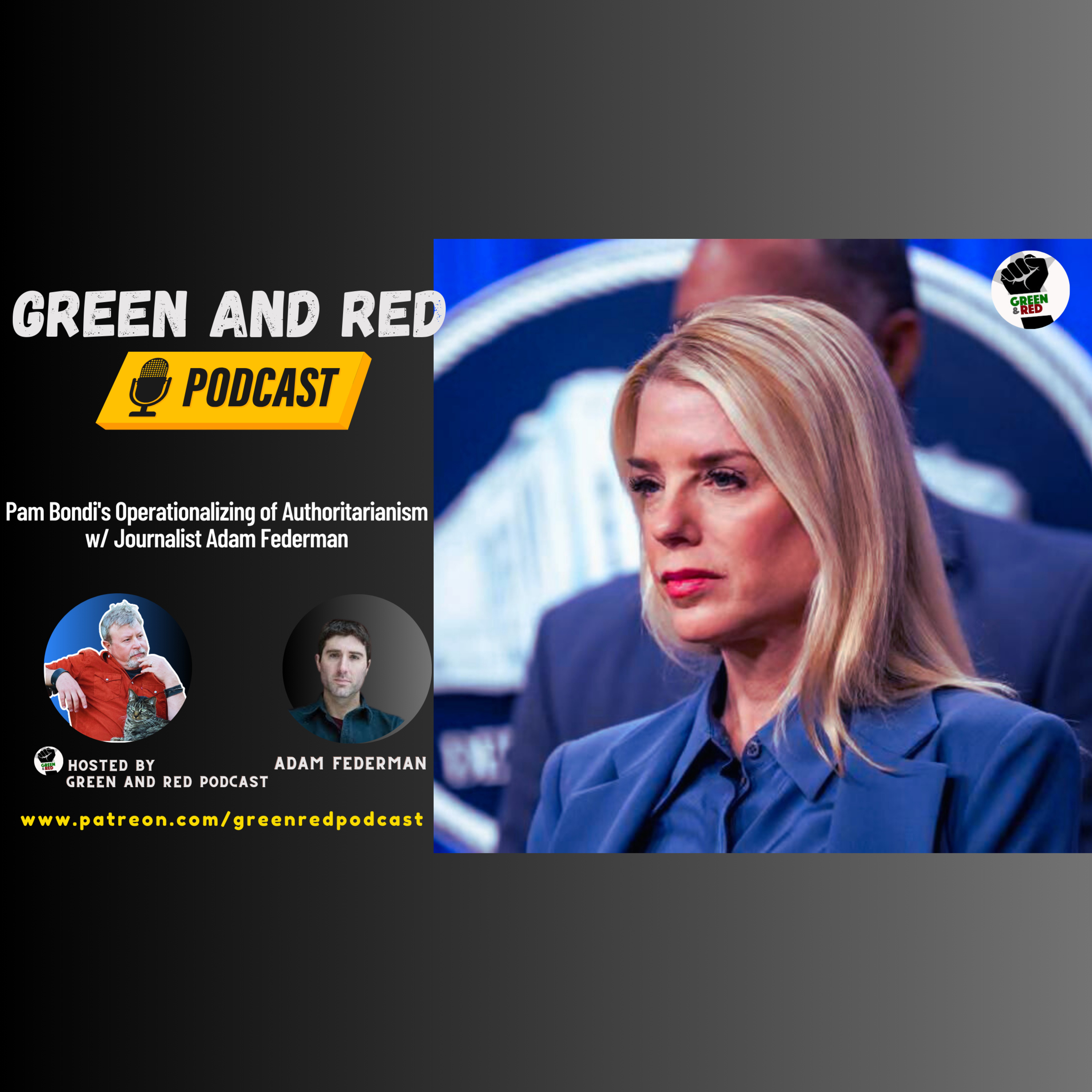
Green & Red: Podcasts for Scrappy Radicals
Pam Bondi's Operationalizing of Authoritarianism w/ Journalist Adam Federman (G&R 448)
00:29:03
Loading summary
Transcript55 lines
- [00:01]
Scott Parkin
Welcome to Green and Scrappy Politics for Scrappy People, a regular podcast on radical.
- [00:07]
Bob Bozanko
Environmental and anti capitalist politics. Brought to you by Bob Bozanko and Scott Parkins.
- [00:14]
Michael Glasheen
Executive order of the domestic terrorist organization Antifa. That's our primary concern right now.
- [00:21]
Bernie Thompson
All right. That's what President Trump did. What does the FBI say?
- [00:26]
Michael Glasheen
We share the same view. When you look at the data right now, you look at the domestic terrorist threat that we're facing right now, what I see from my position is that's the most immediate violent threat that we are facing on the domestic side.
- [00:40]
Bernie Thompson
So where is the Antifa headquarters?
- [00:47]
Michael Glasheen
What we're doing right now with the organization.
- [00:49]
Bernie Thompson
Where in the United States does Antifa exist? If it's a terrorist organization and you've identified it as number one, we are.
- [01:00]
Michael Glasheen
Building out the infrastructure right now.
- [01:03]
Bernie Thompson
So what does that mean? I'm just, we trying to get the information. You say Antifa is a terrorist organization. Tell us as a committee, how did you come to that? Where do they exist? How many members do they have in the United States as of right now?
- [01:24]
Michael Glasheen
Well, that's very fluid. It's ongoing. For us to understand that the same, no different than Al Qaeda and isis.
- [01:29]
Bernie Thompson
No, no, I don't want you. I'll ask one question, sir. I just want you to tell us if you said Antifa is the number one domestic terrorist organization operating in the United States. I just need to know where they are. How many people. I don't want a name, I don't want anything like that. Just how many people have you identified with the FBI that Antifa is made of?
- [01:58]
Michael Glasheen
Well, the investigations are active.
- [02:03]
Scott Parkin
Sir.
- [02:03]
Bernie Thompson
You wouldn't come to this committee and say something you can't prove. I know, I know you wouldn't do.
- [02:08]
Bob Bozanko
That.
- [02:11]
Bernie Thompson
What you did.
- [02:13]
Scott Parkin
Welcome to the silky smooth sounds of the Green and Red Podcast. I am your co host, Scott Parkin in Berkeley, California. Bob is out of the office today, but we are rejoined today by our frequent guest Adam Federman. Adam works at Type Investigations as a reporting fellow and he's written extensively on corporate and police spying on environmental activists and increasingly the Trump administration, which really predates the Trump administration's war on the left, quote, unquote, the left. Adam, welcome back to the Green and Red podcast.
- [02:51]
Bob Bozanko
It's always great to be here, Scott. Thanks for having me.
- [02:54]
Scott Parkin
Yep. And we just watched a video, or if you're on audio, if you're listening to this on an audio podcast platform. We listen to a video of today testimony last week before the House committee on Homeland Security. Where the ranking member, Bernie Thompson of Mississippi, who was also on the January 6th commission, was grilling the FBI Director of operations, Michael Glasheen, about Antifa. The Trump administration in the wake of the assassination of Charlie Kirk has said antifa is the number one domestic terror threat in the United States. And so obviously from that, from that file, you can tell that clashing was just really woefully unprepared to talk about what they identify as the largest terror threat to the United States. Adam, just maybe we can kick off with a little bit of what some of your thoughts are on.
- [03:47]
Bob Bozanko
The FBI should be embarrassed not to be able to justify what the administration is claiming to be the greatest domestic terror threat at the moment. Obviously, he's parroting what the White House has been saying for a while now and has only been amplified in the wake of Charlie Kirk's assassination on September 10th. But I guess one of the things that came to my mind in this history, well, Scott, is the FBI's designation of environmental extremists as one of the top terror threats post 9 11, second only to Al Qaeda and the way that shapes what the FBI does. And we're entering into a new period of repression and targeting of domestic actors that we probably haven't seen really since the 1950s. And that's been articulated quite clearly in both the National Security presidential memo from September 25 and then the more recent Bondi memo that I know we're gonna talk a little bit about about today.
- [04:59]
Scott Parkin
Yeah. And just to touch on NSPM 7, National Security Presidential Memo 7, which came out, like we've said, after the shooting of Charlie Kirk of a right wing activist Charlie Kirk. It identifies, it defi kicks off with, by defining the domestic terror threat, which is how. And says that having extreme viewpoints on immigration, radical gender ideology and anti American sentiment. I think it also says in there it's looking at groups and individuals that have anti Christian, anti capitalist, anti American perspectives as well. And those are all. In some ways those mean a lot. In some ways those mean nothing. And so those are things where we could, we could say that the Democratic Party is anti American or anti Christian if we wanted. I'm wondering who, who do you think the government is specifically targeting and using this with such broad language, they're casting.
- [05:57]
Bob Bozanko
An incredibly wide net. And I think that's deliberate because they have many targets and some of them we've already, the administration has already made part of its repressive agenda war on universities, law firms, media organizations, et cetera, which are, are all mainstream Institutions in the, the language itself, I guess, gives them the power to throw any organization or individual into that sort of broad bucket. I think with the focus on antifa, of course we are going to see them and we already are seeing this, for example, in the cases playing out in Dallas related to the July 4th protest that they prepare Prairieland Detention Center. They are starting to focus some of their investigations and prosecutions against what they claim are antifa cells and antifa aligned extremist groups. So we don't quite yet know what that will mean. But the Bondi memo, which was published recently, I think early December, basically explains or orders FBI and law enforcement agencies to compile a list of domestic terrorist organizations and to provide those to the attorney, which will presumably remain secret. And so we don't really know who is going to be thrown into this bucket, but it will define, I think, how the administration moves forward on both the memorandum and then this more recent memo from the Attorney general.
- [07:34]
Scott Parkin
You know, it's interesting, the FBI for a long time, like we, we've seen different times in our history where we've seen the FBI go after ideology more than plan action, plans for action. You referenced the 1950s, definitely the, during the Red Scare, the McCarthy era, we saw them going after ideology. They went after people who had been involved with the Communist Party or the Socialist Party. Telpro also is another period where we see the FBI targeting black power movements, native movements, anti war, left, the New Left, whatever. And so that what the FBI has maintained for a long time, including during the Green scare of the 2000s, is that they don't monitor ideology or they don't target people over ideology. Instead they're looking for action or planning for action. And you know that, which is why we see, we've seen a lot of FBI focus on, or federal government focus on the right wing because that's where a lot of the action is and that's where a lot of the violence happens and things like that.
- [08:39]
Bernie Thompson
Do you.
- [08:40]
Scott Parkin
It seems very obvious that we're moving into this monitoring of ideology, back into this. An ideology that the administration doesn't agree.
- [08:47]
Bob Bozanko
With, undoubtedly and very openly. In fact, I think they aren't even really trying to mask the fact that's what they're doing. I do think that the FBI has been moving in that direction really since 9 11. And the guidelines for sort of FBI investigations were rewritten during the George W. Bush presidency and effectively made it much easier for the FBI to open what they call assessments, these sort of low level investigations into organizations or groups where they don't need to even demonstrate any kind of criminal activity to begin snooping around and using informants and compiling information and all the rest. That has tended to allow FBI field offices to target organizations based on their viewpoint and their politics, really. And we've seen that with the Green Scare and then of course, with other social movements from Occupy and Black Lives Matter to of course the anti pipeline movements of the 2010s, keystone and standing Rock, where the FBI was heavily involved in investigating some of the groups and individuals who were involved in those movements, which we should. I think we do need to just underscore the fact that these, this particularly the anti pipeline movement and Keystone and Standing Rock were built around nonviolent direct action philosophies. And these are First Amendment protected activities. And I think that's what's so alarming about the language in the Bondi memo that you quoted. It's anti Christian, anti capitalist, even anti American sentiment is of course protected by the First Amendment. These are ideas and viewpoints that we are allowed to hold. So the fact that this administration thinks that it can target individuals and groups and lump them in within this designation of domestic terrorists is truly, truly terrifying. And yes, there is precedent, but they are turning up the volume very quickly.
- [10:52]
Scott Parkin
There's a couple things to get into with this. One thing I want before we get into a little bit more, that one thing I want to touch on is what the Bondi memo does is it's basically building out a bigger machine to target social movements. And I think in the Bondi movement it talks about we could use this for neo Nazi accelerationists or militias or environmental groups. And it seems very easy once they have this machinery in place, which is like a huge, a large scale monitoring and targeting and disrupting, prosecuting of people they see as extremist threats, that they could just slide in whoever they want, including when the no Kings protests happen on October 7. The rhetoric from a lot of Republican politicians that they were Hamas or that they were, they were like antifa or antifa Hamas gets it. I think that's the combo they like to go for.
- [11:45]
Bob Bozanko
I mean, and it's a good point too, because this stuff will outlive the Trump administration. And it's not as if we can assume that even a Democratic administration is going to do away with some of the expansion of powers that the administration is giving to law enforcement. A lot of this stuff tends to be bipartisan in nature. But I think just to build on what you were saying, I think it's important to point out explicitly what the Bondi memo mandates the FBI and Joint Terrorism task forces and local law enforcement to do. In addition to compiling this list of domestic terrorist organizations, she's ordering the FBI to first of all reopen closed cases, directing all federal law enforcement agencies to review their files and holdings for antifa and antifa related intelligence, and then when appropriate, take additional steps in these closed investigations. And we do know that the FBI had opened some investigations into Antifa in 2018, so we can expect them to certainly resurrect those. They're establishing a cash reward system for information that leads to the successful identification and arrest of individuals. So paying people to provide information to the government and developing and publicizing FBI tip lines in order to do that.
- [13:04]
Scott Parkin
And of course, expanding those tip lines too.
- [13:06]
Bob Bozanko
Expanding those tip lines, yeah, creating what did they call it, the FBI's digital media tip line for the modern age. And then of course, cultivating informants. The FBI, it says in coordination with its partners on the JTTs, shall aim to establish cooperation to provide information and eventually testify against other members and leadership of domestic terrorist organizations. So cash rewards, snitching enemies lists, dusting off old FBI investigations into who knows which organizations antifa aligned. That in, in my view is actually perhaps the most terrifying phrase in this document because anti fascism. Anti fascism is a broad philosophy with a long history and there are many organizations that I think would proudly admit to being anti fascist or anti fascist aligned.
- [14:06]
Scott Parkin
The US Army, My grandfather technically is part of an anti fascist campaign or two.
- [14:11]
Bob Bozanko
There you go.
- [14:12]
Scott Parkin
Yeah, exactly. And so just to like touch on this for a minute, is that, is that this sort of like building out? This is not a new thing. This is like you said, this is like what we've been building towards since. I would actually argue that we've been building towards this since the Oklahoma city bombing in 1995. The infrastructure of the Patriot act was actually drawn up after the Oklahoma City bombing to use on right wing militias. And so this is just like a series of, series of opportunities that the government gets to be able to target its domestic terrorism. In many ways, what's domestic enemies.
- [14:53]
Bob Bozanko
Yeah, absolutely.
- [14:54]
Michael Glasheen
Building.
- [14:55]
Bob Bozanko
Yes, we. And in many ways what the Bondi memo does is focus the FBI's attention and energy on this narrower sort of subject matter. And we saw in that clip how both unprepared the agency appears and what a stretch it is for them to create this idea that Antifa poses such a profound threat to the nation's security. And the corollary to that is what's going to be missed. What is the FBI not going to be focusing on as it pours all of its energy and resources into prosecuting this amorphous network of left leaning activists and groups. But you're absolutely right that in terms of the structure that's already in place, there isn't actually all that much that's truly new in the Bonnie memo. And the FBI quite frankly has power and a sort of legal framework to, to do much of what is outlined in, in this document.
- [16:03]
Scott Parkin
I think in some ways the legality of it aside, I'm not a lawyer, I think there's a lot of stuff that we could see challenged. But what I find most concerning is that we're going to see a prioritization of going after left groups, antifa groups, anti ICE protesters. The list goes, the list will go on and a lot of resources put into that and it's not going to be really challenged. And also the other concern that's one of those who want to concern current like the FBI leadership is like fairly incompetent at this point and they mostly they run the FBI. It's like a right wing social media account. Anytime any sort of oracle tragedy happens, they spend all their time talking about antifa and not even really investigating.
- [16:49]
Bob Bozanko
And I think, but I was just going to say that part of the problem with challenging what is now set in motion is just the fact that so much of this information will not be publicly available. There is no public process for enacting something like this. And the information is going to be classified of course, because it's all going to be part of an ongoing investigation without media scrutiny, investigative reporting, diligent sourcing and efforts to try information out of these agencies through FOIA and FOIA lawsuits where we will be in the dark. And it will be very difficult for individuals and organizations to challenge what the administration is doing. However, of course if an organization gets swept up somehow, they can certainly take legal measures to challenge whatever the administration attempts to do. But I think we're as with the red scare, the FBI and the administration hold cards and the Bondi memo was ultimately designed to be made public. They were giving presentations about it and it was ultimately leaked. But beyond that I'm not sure how much more information the administration will be willing to disclose about what's happening.
- [18:13]
Scott Parkin
Yeah, I'm also on the foreign policy, foreign affairs front, we're seeing the Department of Defense not ever going to call it the Department of War. We're seeing the Department of Defense murdering people in boats in the Caribbean and The Pacific, with probably little to no evidence, definitely aren't sharing any evidence. The Intercept actually just had an article, I think, over the weekend or maybe last week. Will the Trump administration do these types of strikes on domestic domestic terror organizations? Yes, because they're saying that the people that they're hitting off the coast of Venezuela and Colombia are designated terror organizations.
- [18:51]
Bob Bozanko
It's the same framework. I mean. Yeah, that piece was by my colleague Nick Turset type and essentially the administration has refused to respond to their inquiries about whether they would use force to go after, quote, unquote, domestic terrorist organizations. And using the parallel with what we're doing is that v Venezuela. And they have been unwilling to answer that question. But also on the foreign policy front too, I think it's worth mentioning that in addition to all of the memos, executive orders about Antifa that we've been talking about here, and this largely went under the radar, but in mid November, the State Department designated German antifa group and three other obscure like anarchist organizations in Greece and Italy foreign terrorist organizations, which is something that the administration can now use to go after people here in the United States as well, who have had any kind of interaction with or engagement with these other groups potentially. So that's another tool that the administration may use to try to go after organizations in the United States because the designation of Antifa as a domestic terrorist organization is legally meaningless. But by declaring these other groups foreign terrorist organizations, it gives them a legal framework within which to punish domestic actors.
- [20:21]
Scott Parkin
Yeah, it's. It's definitely like the bridge. It's bridge activity is what I would call it.
- [20:27]
Bob Bozanko
Yeah. And we don't know exactly how that will. Yeah, they're setting the stage.
- [20:33]
Scott Parkin
It seems like a lot of this has really moved into overdrive with the assassination of Charlie Kirk. And I see a lot of thinkers and influencers going back and forth about there's a level of incompetence. I think that the Trump administration, I think NSPM 7, I think the Bondi memo actually show that they're actually able to do some level of competent expansion and prioritization targeting, they're the opposite. This quote, unquote, opposition. Do you think that Trump has actually been able to effectively exploit that, that shooting?
- [21:12]
Bob Bozanko
I think Trump, but also his closest advisors, Stephen Miller and J.D. vance, I think, have been more effective rhetorically in tying the assassination to this threat. We don't even really know anything about the killer's motivations, but they've. They immediately. It reminds me in some ways of the way 911 was used to justify the invasion of Iraq. It was an opportunity that they saw, that they had seized immediately, knowing that the public appetite, at least in the beginning, was there. Now, I don't know if that's the case with Antifa. And the administration's approach to civil society is very different. And the Kirk assassination certainly accelerated the administration's crackdown on the left, however we want to define that. But we know that they were already going after universities and already going after student protesters who had been active in the movement against the war in Gaza. And this is just one more kind of tool that they can now use to go after anyone and any organization they deem to be an enemy of the state.
- [22:41]
Scott Parkin
Yeah, I've heard it referred to as Trump's 9 11, although I feel that's 911 is a very different thing. And honestly, I don't think people like Charlie Kirk that much, as much as 3,000Americans killed in those vicious. Those attacks.
- [22:57]
Bob Bozanko
And I think far fewer people probably were familiar with Kirk than maybe the right would like to believe. But I think it was actually Scott Bessip, the Treasury Secretary, who compared it to 9 11, and that's something that we haven't touched on either. But the Treasury Department and IRS is also involved in investigating and targeting funders and the whole network of sponsors and organizations that support social movements that might be affiliated with antifa, whatever that means, or antifa aligned groups. I think we sometimes underestimate the power of the state to target and ruin people's lives, perhaps because it doesn't always happen here in the United States. But that is about to change.
- [23:47]
Scott Parkin
Yeah, I think. I think in popular opinion and then also in things like elections, we're actually seeing major pushback against Trump. Right. His poll numbers are, like, really bad. We're seeing big wins for the Democrats in places where you don't expect wins like the Miami mayor's race. But I do think you're right. I do think they're going to expand this machinery, and I think they're going to. They're going to use this machinery to undermine their enemies as much as they can. And I think he was doing that in his first term, but not nothing like what he's doing now.
- [24:24]
Bob Bozanko
They've got. I think they have much more effective control, especially of a law enforcement agency as the FBI, Homeland Security. Yeah. And ice, of course. Yeah.
- [24:40]
Scott Parkin
We should probably go here in a minute. The last thing I want to just touch on. And we don't have to talk about this too much because we could do a bigger show on this at some point, and this would be a good conversation to have Bob be part of. But one of the things that we've seen in some of the analysis of the Bondi memo is that it is gutting the church committee's work. The church committee was in the 1970s. It was Senator Frank Church. Green and Red has a brilliant interview with James Risen, who wrote a biography of Frank Church a couple years ago, put it in the show notes. There's a lot of. There was a lot of similar activity going on in the 1960s and 1970s, which actually was the sort of. Which was surfaced in the church memo. And then there was a lot of protections that come out of the church committee. Excuse me, surfaced in the church committee. A lot of protections that come out the church committee, including the four Intelligence Surveillance act and things like that. I will say that we're seeing a bit of a dismantling of some of those church committee protections, which also started with 9 11, but has really. Bondi is really trying to finish it off, I guess, at this point.
- [25:46]
Bob Bozanko
Yeah, absolutely. All those guardrails, whatever you want to call them, much of which I believe were not legally binding, but informed the ethos of the agency post Watergate and everything that came out regarding the COINTELPRO cos. Cointelpro and for good reason. We don't want the FBI meddling in the affairs of political organizations and interfering with First Amendment protected activity and creating enemies lists and cultivating informants to go after folks who are protesting the war in Gaza or whatever it may be. But I think you're absolutely right. We're coming to the, maybe the logical conclusion of the dismantling of. Of those protections since really since 9 11. And now with an administration who. That. That is unwilling to even observe some of the perhaps conventions and formalities that previous administrations were at least willing to uphold rhetorically. The gloves are definitely off and people need to be vigilant and we need to cover this stuff in real time.
- [26:53]
Scott Parkin
And the pushback happening in the streets is courageous and admirable, and we just need to continue to see that. When I saw some of the images from Charlotte and Raleigh, which is blue cities in a red state, but that was important stuff to be happening in Chicago too.
- [27:11]
Bob Bozanko
And people need to continue to organize and participate in whatever sort of political activity that they are drawn to without being afraid that they're somehow going to be penalized or branded a domestic terrorist, as scary as that may sound. The necessity to remain engaged is more important than it's ever been. And this stuff can sound terrifying and it often is, but it hasn't stopped people in the past and it shouldn't stop people now.
- [27:42]
Scott Parkin
Adam, it's been great talking with you and look forward to talking to you again, folks, if you like what you hear. And please check this out on Facebook, Instagram, O Sky, watching this on YouTube, hit that subscribe button. If you're listening to this on a audio play platform, give us a rate and review. It helps with the algorithm, helps us with the algorithms. And if you really like us, go to greenandredpodcast.org hit that support button or become a patron@patreon.com greenredpodcast and just it's the end of the year, so we're gonna be doing some fundraising pushes. We actually have a lot of swag, including green red podcast hats, which I don't actually have one here in front of me, but we'll put it up on the website. I'm terrible at advertising and marketing and Bob has lots of books that will give for a great donation, for a generous donation. Anyway, just check us out@greenwrebpodcast.org for some of our end of the year fundraising stuff. Adam, it's been great talking to you and we'll talk to you again soon. Everyone else out there make trouble and misbehave.
- [28:43]
Bob Bozanko
Thanks a lot, Scott.