← Green & Red: Podcasts for Scrappy Radicals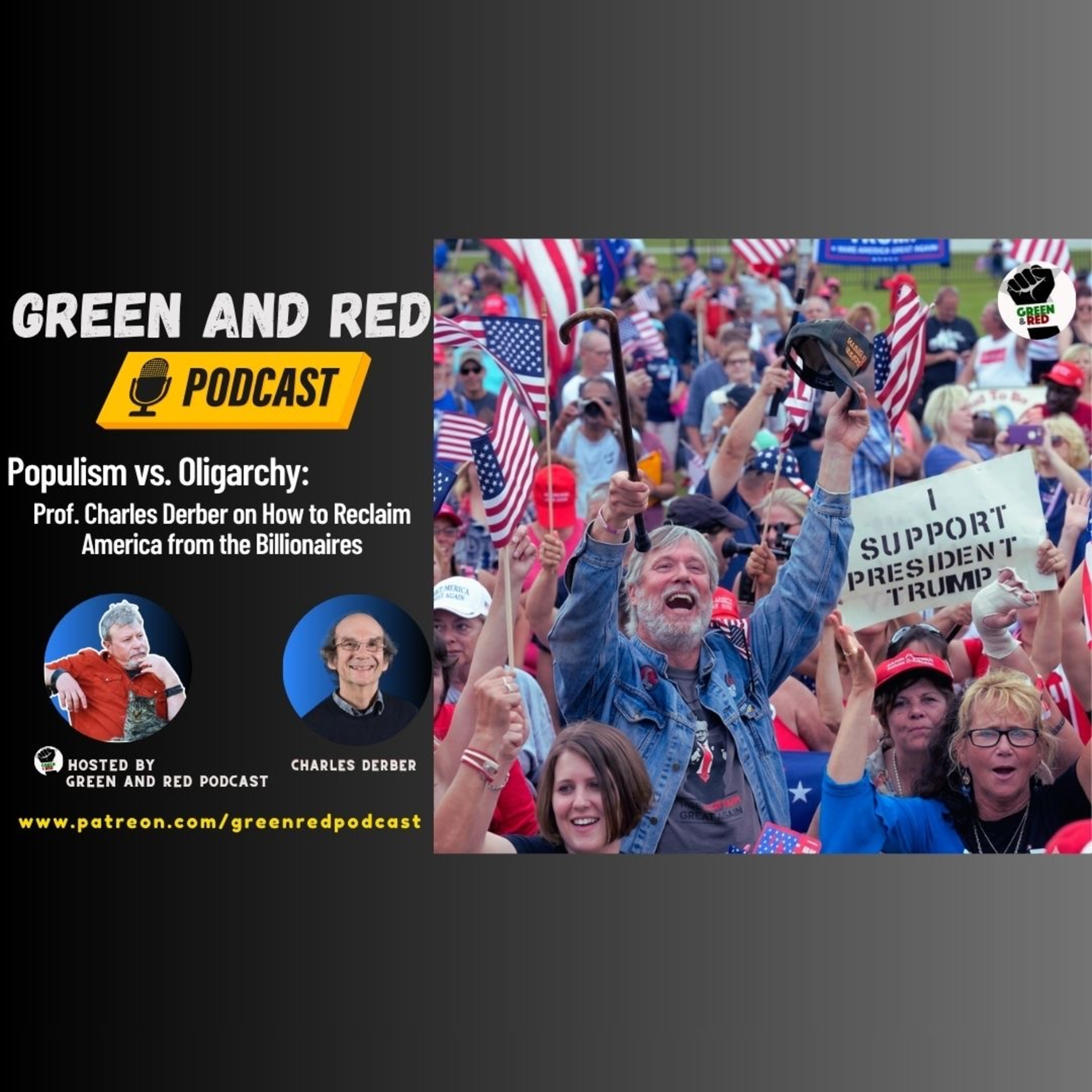
Green & Red: Podcasts for Scrappy Radicals
Populism vs. Oligarchy: Prof. Charles Derber on How to Reclaim America from the Billionaires (G&R 490)
01:05:43
Loading summary
Transcript69 lines
- [00:01]
A
Welcome to Green and Red Scrappy Politics for Scrappy People, a regular podcast on radical environmental and anti capitalist politics. Brought to you by Bob Bozanko and Scott Parkins.
- [00:14]
B
Welcome to the silky smooth sounds of the Green and Red podcast. I'm your co host, Scott Parkin in Berkeley, California today. And Bob is off on assignment, so he will not be joining us. But today I am joined by Professor Charles Durber, who is a academic, author, political activist. He's a professor of sociology at the at Boston College. His work focuses on capitalism, globalization, corporate power, oligarchy, populism, authoritarianism, democracy, many things, militarism, the climate crisis, individualism, and social justice movements. He's also the author of a number of books. The one we'll be talking about today is his most recent book, which is Fighting Oligarchy How Positive Populism Can Reclaim America. Professor Durber, welcome to the Green and Red podcast.
- [01:03]
A
Thank you, Scott. Good to be here with you.
- [01:05]
B
Yeah. And your book argues that modern American politics is increasingly defined by a battle between a corporate oligarchy and competing forms of populism. So we're going to just get into that and take that apart a little bit, if you were. And as I read the book and was prepping for this, I went back and forth about what my opening question was gonna be about, whether it was gonna be about the oligarchs or about populism. But populism is something that you very much dig into in the book. And so could. Maybe we should start for the audience just a little bit of a tell. Give us a definition of populism, just to start there. And I know there's different types of populism that we get into.
- [01:43]
A
And I think the term is. No. When people hear the word populism, I think the most common thing, Scott, is to think, oh, populists are demagogic. Yelling, screaming, people on the street who don't really know much. They're just angry. They're probably pretty violent, they're probably pretty authoritarian. And so I think it has a bad reputation, generally speaking. And there's a good reason for it in a way, because there are, there are at least two very distinct forms of populism that have merged in the United States. One is far right populism, which Trump represents. And it's has a lot of sway today, even though Trump's beginning to weaken some. But it has a very long history in the United States. And far right Hitler was a far right populace. The people we think of are as the most evil, dictatorial People claim to be coming to power in the name of what all populists, whether they're right wing or left leaning, what I call positive populists or negative populists, they all claim to be speaking for ordinary people against elites who are running things. And I think that Trump got elected on the idea that people believed that he was really sticking up for those workers in Michigan and Wisconsin and Pennsylvania who were getting their jobs outsourced to China and Vietnam and India and so forth, and that he would. He was, he ran as a populist, claiming that he was gonna have a kind of. He was going to take out the establishment, which was a combination of foreign companies, domestic companies that were outsourcing jobs, just elites that didn't give a about or ordinary people. And it was very persuasive because Biden was seen, the Democrats were seen for pretty good reason, as having a long history of abandoning the more positive populism of the New Deal that they had, the more progressive populism, and moving into a kind of identity politics, which is a very different kind of politics than populism. I just want to say one thing. When you introduced the show, you said the book is arguing that we're in a period of different forms of populism. And that's true. I'm also arguing that much of the reason for the strength of far right populism in America is that the Democrats, starting with Clinton in particular, but Obama as well, they really didn't. They have the New Deal back in the Depression for Roosevelt, and during parts of the 60s, the Democrats had a kind of progressive, what I call a positive populism, where they really do mean that they're intending to stand up for ordinary people against wealthy elites. But the Democratic party, after the 70s, after Vietnam and the sort of stagflation of the late 70s, Reagan won. He pulled the Republican more fully into far right populism, and the Democrats gave up on the New Deal. Clinton came in and said, I'm going to be the third way I'm going to be. And it moved. He and Obama both moved the party toward what I call identity politics, meaning it would no longer focus on the core economic needs that unite people across race and gender and other kinds of religious and national differences to fight the wealthy people who run the country. And instead, he would bring the Democrats into this kind of, what I call siloed identity politics, which is a politics that says look. And it's about issues that are important. Race is fundamentally central in America. Gender is very important. So I'M not. When I critique, people should understand. When I'm running a critique or you hear me talk in a very critical way about Democratic Party identity politics, it's not because I don't take race and gender seriously. It's because I think if you really want to see racial progress and gender progress, you've got to bring people together across a lot of different boundaries and where what they share is a common set of economic interests against the people who run this country, who are increasingly the most powerful wealthy people in history. And so we need, in a way, like you said, we're in a period of populism, but we're lacking in many ways the most important populism that we need today, which is what I call a positive populism, where we're being run by a far right populism, which is what Ralph Nader calls a phony populism. And we need, what the book is arguing is we need a very different kind of populism if we're going to really take power in the country and change.
- [06:31]
B
I think, I think it's important. I think it's important to note one of the things that you bring out here is that the other thing that Clinton and Obama bring in is the same thing that Reagan and both Bushes bring in, which is this idea around. It's this more conservative economic view. It's neoliberalism. And which is also what the what Trump in 2016. And I think that's the important moment where we see that shift from far right pop too. Far right populism, yes, is that he's able to get disenfranchised voters, working people in Ohio, Michigan, places like that, where the economy has been stripped out by NAFTA and trade deals and all of that sort of thing. And I think that's the other important. We often talk about that on this podcast. So it's not anything new to our audience.
- [07:14]
A
The key thing that you mentioned there, Scott, that I just want to highlight it, I feel like the most important thing that's happened in politics in America in the last 50 years is the migration of working people from the Democratic Party when they were still standing up in some way for something other than this sort of mainstream neoliberal capitalist economy, for a kind of labor oriented politics a little bit more like Europe, that gave health care and unions and jobs for ordinary people. The Democrats abandoned that. And as you say, Reagan came in, he went to a very far neoliberal kind of capitalism, just opened the door completely to these corporate powers and the Democrats bought into that story. They basically said, look, we're not going to be New Deal. We're not into class politics. We don't think America is being run by a capitalist ruling class. We think the problem here is, is that the Democratic Party has lost touch with ordinary people who are more culturally and politically conservative. And we're just going to stand up for basic, decent rights for people of color and women. And we're going to basically buy into the economy as it is because we believe that's the way we can stay in power. And they were recognizing that the people who run both parties have a tremendous amount of money. These are the elites who have concentrated enormous power in the country. And what the, what the Democrats did was they pulled the Democratic Party out of any kind of real challenge to these oligarchic capitalist elites. And through their. And then they would say, now we're redefining the Democrats and liberalism as standing up for people's basic, the, the identity groups, whether they're blacks or browns or women or trans or whatever they are, they're people who. We're going to stand up for basic rights, but we're not, we're not going to get into class politics, meaning a politics which says that the country is being run by an elite of extremely wealthy corporate leaders and CEOs who are tied by money and all kinds of social networks and political networks into the White House and into the political establishment in Washington. The result was the Democratic Party lost its foundation. And what I've seen in the last 50 years, like I say, is like the real immigration right on the migration was of American workers from the Democratic Party to the Republican Party. And Trump was just the last step of that. In other words, that had begun back in the 70s and even before and it just kept going. And that led to what we're, the disaster we're dealing with today, where we have a neo fascist party. Remember, Hitler also came into power when there was a working class who was devastated by economic conditions and were just under post war period. Yeah, yeah. And then it was in the, there had been hyperinflation after World War I. Then there was the Great Depression that spread from Wall street to Europe and Germany. When Hitler came in, 36% of German workers were unemployed. Now today we don't have, when Trump came here, there wasn't anything as bad as that. But about 60% of the American non college worker says they live paycheck to paycheck, meaning they feel if they get one illness or one lose a job, they think that nobody's going to save them, that they're going to run into some kind of poverty. So in the case of both European fascism and the kind of fascism that we're seeing emerge in America today, it reflects the fact that working, ordinary people are in a lot of trouble and they don't have any party that's speaking for them. Even though, and this is a big part of my book that I hope we'll get into, because one thing that I was really surprised at, the vast majority of Americans, including Trumpists, people who voted for Trump, are very seriously pissed off at the corporate elites that run the country. If you poll Americans and say, what do you think of big banks and big corporations, 70 plus percent, including much of the Republican Party, say, we hate them. We think they're destroying the country and they like labor, but they don't have a party. These people who hate across the board, America, across the board does not like corporate power and corporations, but they don't have a party that's standing up and say, go get them.
- [11:58]
B
It's interesting you say that. There was a New York Times article today actually about this Montana Senate candidate who's an independent and who is very much appealing to, like, labor, labor union guys. We see Dan Osborne in Nebraska. There's now, I believe, a candidate in Kansas. They're staying away from Maine.
- [12:13]
A
Yeah, there's a beginning of an emergence of that.
- [12:15]
B
But the other, not Platner, although Platner is definitely the Democratic version of that. But the other three are independents, which I think is actually really, really important in the Midwest in states that have been like deep red for forever or. Yeah, at least the last few presidential cycles, as long as I can remember.
- [12:32]
A
Yes. I think the key to hear this is that if we had a genuine populist politics. And you went back in the first question, what does that mean to me, a genuine populist is one who says the country, capitalist countries are run by small elites of people who control finance and corporations and through that control the state for their own interests. And they abandoned the population. And we've. What we've had now is that we've now got a concentration of wealth in America among a tiny number of people in Silicon Valley and Wall street and private equity firms and so forth.
- [13:14]
B
Big oil.
- [13:15]
A
Yeah, yeah, big oil. But it's a new set of robber barons. We're in a second Gilded age. Never have we needed a true populism more because never has there been this great an inequality and this great an abandonment of the needs of ordinary people. But the Democrats, you know, we know that Trump came in speaking for that problem, but abandoning him as soon as he was inaugurated. He was surrounded by these trillionaires, and he's governed entirely in the interest of these very wealthy people he said he was going to go after. And the Democrats, although they're beginning with the resistance to Trump right now, you're beginning to hear Democratic voices. Loudest voice of this kind were people like Bernie Sanders, who's not a Democrat, he's an independent. And you have people like aoc, and now you have people like Mandami, and you was elected mayor of New York. You hear that voice more now. But this is a relatively new phenomenon and it's still not the leadership and the mainstream of the Democratic Party. If you look, if I gave you a list of the six or eight Democrats who are likely to be top of line Democratic candidates for president in 2028, none of them is a, a strong, positive populist leader. These are people who buy into the basic framework of the economic, very predatory economic capitalist system we have. So even though I see somewhat more hope in the Democrats today than I did for four years ago, it's still a relatively small percentage of the debt. You've got people like Chris Murphy from Connecticut or Merkley from Oregon or Van Hollen who are beginning. These were centrist Democrats who are beginning to move away from the Clinton Obama model toward a more populist, Bernie Sanders style kind of thing, saying, wait a minute, we're in the midst of a kind of catastrophic capitalist disaster here. We need, and this is what populism is. You asked me to define populism. Populism is a politics that says we are going to overthrow the existing system that is allowing a tiny elite of people to run the country in their own interests. And we've never had a Democratic Party since the New Deal that's expressed even a modest sort of anti corporate, anti capitalist feeling. Even though, and I just want to say this, you don't have to be a leftist to believe this. Again, I want to go back to what I said before, and I lay this out in the first chapter of the book. The people who say we're living in a capitalist predatory disaster are Trumpists. They're people who are ordinary working people. They're the people who. It's really dramatic, Scott, when you see who is standing up and saying there's something really fundamentally wrong with the economic system of America. And we would like to really get rid of these wealthy people who are just sucking up all the resources of the country either taking it into very profitable war, making very profitable social media enterprise, profitable big oil and destroying the rest of the country, wiping out the social welfare state, wiping out the basic safety net programs that allow wiping out the unions. We have now we. The President of the United States has joined the two wealthiest people in the world who are Musk and Bezos in court arguing that unions are unconstitutional. We have 6% of the private sector labor force in unions. In Europe it's 70%. We're like a total disaster and yet we don't have yet the kind of populist party that is really focused on coming to terms with the reality of the power of the way our current capitalist system is structured. And I gotta go back and say if you think about how what gave Hitler power back in the 30s in Germany, it was because again, you had communists and socialist parties, but they were completely at war with each other and unable to advance a meaningful agenda for these German workers who were in disastrous situation. And Hitler came on as a genuine populist. He was a far right populist, but he actually was quite successful during his 30s in bringing German workers out of poverty. And if 36% were unemployed in five or six years, he had put most of those people back to work in some ways for bad. In bad ways, he had gotten rid of Jewish workers and created jobs for by. By essentially getting rid of all the people he didn't like and putting in Germans in Aryan Germans into those. But there's just a lot of parallels here and that's why I think this is such an important issue today. And I think one of the interesting things we might want to talk about is whether the Trump resistance movement today, the millions of people who have been out on the New Kings kinds of protests with the New Kings, not the New Kings. There are New Kings, but there are no kings. Yeah, right. Are these people populist? Are they going to really help the country move the people out on the street right now? And that I don't have a great deal of optimism about much of the Democrats, certainly the Democratic Party leadership, but the people out on the streets are really a new phenomenon that's really quite important. And I think there is potential there because they're not only they realize that Trump is part of the oligarchy. And again, the oligarchy is the capitalist corporate elites like Silicon Valley billionaires, the private equity Wall street people, the big oil, all the people in the big military industry who are getting rich off the Iranian war right now, all the people who are just making out like bandits right now are in this oligarchy. That's really what Trump represents. And now the good news here is that the anti Trump resistance, which is among the largest protests we've ever seen in American history, is developing more of what I'm calling this positive populist kind of politics. It's saying, which they're not just saying Trump is a clown or an immigrant bigot and so forth. They more of the resistance is also saying he's turning the country over to his own billionaire family and to the billionaire class that he's part of. And so there's a hope here that the anti Trump Trump is losing support in the population right now. And the oligarchy that he represents is also beginning to weaken as parts of the Democratic Party and much of the public, like I said, I want to go back. I go again and again. The public hates the oligarchy. They don't like rich people. They, when you ask them why are they in such bad shape if they don't blame criminals, immigrants, all the things that right wing populists divert and blame them for, they say the problem, and there's a good polling on this, when you ask them, are your taxes too high, Are you paying too? Are the immigrants taking your jobs? The great majority of Americans say no, that's not, that's just scapegoating. We know who's in it. And this is not me as a leftist talking. This is what ordinary people are telling pollster people who voted for Trump. There's a good part of my book where I interview or report interviews with people who voted for Trump. They're working class people and it's very enlightening to read what they say because they're not buying even though they voted for Trump and still have very conservative cultural views, in many ways, they don't buy the argument that their economic problems are being caused by the immigrants and the trans and the all these debates scapegoats that Trump is blaming. They know that it's the corporate people
- [21:08]
B
who are running this show in far right populism. That's a pretty consistent element. Is the blaming the other right. That is. And like with Hitler, you talked about Hitler. It was the Jews and the gypsies and the Slavs and the homosexuals. And now it's the immigrants or the undocumented immigrants. It just made a. They're actually making moves today. To start, there's more cases being filed to denaturalized people who were naturalized, especially during the Biden administration.
- [21:35]
A
Yes, that's right. Trump is doing it more now. Yes.
- [21:38]
B
And he's waging a constant war against lots of other minorities, even if they're U.S. citizens.
- [21:43]
A
Yeah. And that's where made it for him. Scott, you're bringing up again to me the connection of race. When we talk about far right populism, we're talking in a way about fascism, of the kind of authoritarianism. And in a number of my books, I've argued that there is a very distinctive form of American fascism. It began with the Constitution, actually, because if you think about how was America founded, it was founded by George Washington, had the most slaves of any person in America. He believed in slavery. Thomas Jefferson. These guys were brilliant intellectuals. They were eloquent about getting rid of kings, but they never believed that ordinary people should run America. They. I've got another book coming out called Wired for Authoritarianism, which shows that America is. Was founded by people who were against kings but who never imagined that ordinary working people would vote. They gave. The founders gave how many. What percentage of the American people were allowed to vote under the Constitution? Maybe 2 or 3%. If you.
- [22:54]
B
White male property owners.
- [22:55]
A
White male property owners, and you had to have a fair amount of property. And even people like Jefferson, who wrote so eloquently and is associated with these democratic ideals, he said that when slaves are freed, if they are ever slave, they would have to go back to the West Indies or to Africa, because he said that race mixing would never survive in America.
- [23:15]
B
This is the irony, right?
- [23:17]
A
Yeah. And it's. I don't know if how many of the people listening to this would know this probably a lot, that Hitler was a great admirer of American racial traditions and he believed that America modeled the kind of racial laws he thought the Confederacy, the Jim Crow, Reagan. And he did study them and he talked about them a lot. And in Mein Kampf, his books, he really saw and in fact, in the Nuremberg Laws that he wrote in 1935, which were racial laws to make the Aryan race of the non, the Christian, white German who was not Jewish or not Gypsy or not Slavic, those were modeled after Jim Crow kind of American laws. So in a funny way, people who say Trump is imitating Hitler, in many ways, Hitler drew and from America the way the far right populism that Hitler, that Trump represents is drawn out of Hitler, it's not surprising because Hitler drew a lot out of American history so far. Populism has a very strong fascist kind of ideology to it, and it has a long history in America.
- [24:29]
B
America first, John Burch McCarthy, you can
- [24:31]
A
go from the America firsters of the 30s who were. Remember, America first was a committee of people in the 1930s who thought America really should be at war with the Soviet Union and not with. With the. They wanted to align with it. The America First Committee. If you look at the people who founded it and ran it, they were the dupont family, the Quaker Oats family, Lindbergh.
- [24:53]
B
Lindberg on it.
- [24:54]
A
Yeah. The. Many of the most wealthy corporate powers at that time were part of the American First. They were pro Nazi, and they were very directly sympathetic to Nazi ideas. So it's. This is again part of the. The difficulty is that Americans have learned to think of capitalism as democratic. And the founders did provide the Constitution. They eliminated a king. And so they made. They took away official monarchy, and instead they put in what I call this kind of more covert authoritarianism, where people with a lot of money, almost like royal robber barons. And we had our own robber barons or so they could exercise power from outside the government through money. But we had constitutional rights, which made most Americans feel, well, we were different from these more authoritarian European societies because we have all these constitutional rights and we don't have a king. And it's true, we don't have a king. And we had all this constitutional democratic language, but it papered over or was a veneer. It covered the reality that the people really running the country through most of American history have been this. These kinds of COVID authoritarian figures. People with the robber barons who started in the first Gilded Age, the Rockefellers and the Morgans and the Vanderbilts and so forth. And we have a new class of robber barons today which are all these trillionaires. And these people have just concentrated more and more money and power. Capitalism is no longer a competitive market system. It's a very monopolistic or oligopolistic system. Corporations don't play in market sectors where they don't have pretty much most of the power in two or three companies. And that means that capitalism itself is run pretty much as an autocratic system. You have a few CEOs in a few major sectors who dictate the terms, and that becomes a model for the political authoritarianism that we're suffering with.
- [26:58]
B
So one question I had when I was reading the book thinking about the far right populism is that we. To me, it seems like in modern republican circles there's a very strong strain of libertarianism, and that's the tax cut or that's deregulating or whatever. How does the far right populism of say Trump fit in with the libertarian politics of Ron Paul or Rand Paul.
- [27:21]
A
You have to be careful because libertarianism has always been a bit of a hypocritical view on the right. And the reason I say that, Scott, is that the idea is that, well, capitalists are against big government and they want the freedom of the market where nobody is telling anybody else what to do. So you have Milton Friedman and all the sort of neoliberal neoclassicists saying freedom is the market and liberty is with the market and we don't want any kind of government and so forth. The reality about capitalism, and this has always been true, as I'm sure probably much of your audience knows, is that capitalism has never been free in the sense of the largest system in the country is the corporate welfare system. Corporations, people with a lot of money get enormous amounts of money. Subsidies, tax breaks, all kinds of foreign policy interventions. You couldn't have infrastructure development so that they don't pay for the roads, they don't pay for a lot of the training and so forth. The whole corporate system is the opposite of a libertarian system in many ways because what it does is it sucks out of the public tax funds all the money that's used to develop the corporate policies and corporate infrastructure, infrastructure and tax breaks and everything that allows corporations to gain so much power and wealth. So when you talk about the Republicans as being libertarian, it's, it's one of the most important and powerful myths of America, this idea that capitalism runs as a kind of libertarian, anti government kind of system. In fact, American capitalism is a highly status system in many ways. It does completely slice away the social welfare part of the government. So it cuts away the kind of universal healthcare and education things that European social democracies provide. In that sense, it's true that it's anti government, but when you look at where the government puts enormous amounts of resources, it's into the military, it's into the corporate depreciation and corporate tax subsidies, into drilling and land giveaways, and it's, there's just an enormous giveaway. Trump is now so shameless about it. So out there, the grift and the corruption as they pay the government for this, for this contract and the military AI is going to become trillion dollar military, where these guys are going to get even richer from military contracts. Maybe around war started. I've seen this, the military industrial contract companies, like the biggest military company, they got their biggest spike in history and that's just paradigmatic that big corporations get rich off of big government. In America, big government exists for it. And if you took away all that corporate welfare and all that government intervention and really went to a libertarianism, it would destroy American capitalism because American corporations run with public government money and support.
- [30:38]
B
And it's important to note that some of these, like tech robber barons that we've been talking about who actually, I would say, spout a libertarian politics.
- [30:45]
A
Yes. Yeah.
- [30:46]
B
Like Peter Thiel, Elon Musk, Alex Karp, they're getting. They get the biggest contracts from the government, SpaceX, Palantir, or make it think of Palantir.
- [30:53]
A
And Theo, you're right, he is a genuine far right libertarian, but the guy takes money hand over fist. Look at the amount of money Palantir is getting right now.
- [31:03]
B
They just got like a $300 billion contract.
- [31:06]
A
And they are central to the amassing of the data and the data lists that they're compiling now. And the AI thing is going that meta and all these companies that are, quote, libertarian and liberal. Liberal, they are all getting rich off the military right now. I think we're right at the dawn of a new age of military contracting and militarized capitalism that is going to make these guys even richer. All in the name of protecting liberty and libertarianism.
- [31:35]
B
Freedom, yeah. I think the other political school of thought that has been very pervasive in our lives in the last couple of decades is neoconservatism. This far populism really espouses like America first. We're gonna get us out of the forever wars. And we're seeing Republicans defect, like far right Republicans defect from Trump. Marjorie Taylor Greene, Tucker Carlson be two of the more notable ones because it's like to them it's Israel first. To them it's, we shouldn't be fighting a war in Iran. But then Trump has also surrounded himself with people with neoconservative politics, in my opinion, like people like Marco Rubio. And so how do you. How is obviously Trump is like a liar and a fraud. How does this far right populism also like, fit in with some of these imperial ambitions going on? I think there's a professor at Harvard, I forget his name, who said that Trump is more. He called it predatory hegemon. And so he's not interested in being in some sort of like, world order, but he's more interested in just like how much power the US can accumulate from all these different wars that he gets us into.
- [32:36]
A
If you look at Trump, Trump is, is such a. The guy is a basically a businessman who wants to make global profits and he's running global businesses and he's using his position right now to get to buy contracts to give to the uae. Now he's going to bail out the UAE right now and other sheikdoms in the Middle East. As long as they give him lots of money, he will bail them out from some of the problems in the Iranian war right now and so forth. It's open grift. I think everything that Trump said that appeared to be a contradiction with traditional republic Republican ideology, whether it was foreign policy interventionism or whether it was helping the worker, it was all a lie. It truly was. He never really. And his, his embrace of both, sort of Latin American interventionism, sort of Andrew Jackson style, you know, James Monroe, it's the Donro Doctrine or the Middle Eastern dominance and so forth. This was, this is exactly. He was lying. America first did seem to project that he was going to take American resources, take them all. This is what he got when you mentioned Ohio and all these Midwestern states. These were workers who felt that all these wars were taking money out of their pockets. And they were right. And they said we would like Trump because he's going to stop these wars. He was America First. So he did run on a platform of non interventionism. It was a lie because he moved almost immediately into foreign policy interventionism. And now the guy is now proposing a 50% increase in his 2026 military budget from a trillion in 2025, which is unbelievable, to a 1.5 trillion because it's beyond any imagination. This guy has gone all out into war. And of course, the people making money off this are the very people he claimed he would somehow hold back. That is these people who are running global empires and who are running. But all this money is going into the. Our new robber barons and our old robber barons, they're still going into the military industrial contract of General Dynamics and Raytheon, but it's also going into Meta and Nvidia and all these massive things.
- [34:52]
B
It should be noted that also there is no opposition party standing in the way of what he wants to do internationally, in my opinion is that they're, I mean, their critique when he did the first ceasefire with Iran is that that he chickened out. That's what like Schumer and Jeffrey.
- [35:07]
A
This is, this is exactly. I'm glad you brought this up, Scott, because it's really important in this book
- [35:11]
B
that we criticize the Democrats a lot more on this show than we even do Trump.
- [35:15]
A
Yeah. And the Democratic leadership has been really terrible. They, like I say they are not genuine populists. Even though we have a country that is desperate and it will support an anti corporate kind of social democratic kind of politics that would reign in and force these tiny elites of. We're being run by the richest people in history, far and away. This is the wealthiest elite in history. They have more money, more power. And what we have is two political parties. I used to call them Bush and Bush Light. Now I call. I wouldn't say it's Trump and Trump Lite, but I would say it's some sort of corporate. It's still two corporate parties. Schumer and the other leadership, the main leadership in the Democratic Party, as you've been suggesting it's really important, are still very militaristic. Biden was like that. Harris, who was probably running in 2020, Kamala Harris is very much like that. These people who are in the sort of inner circle of the Democratic Party politics are still in that military industrial kind of politics that has dominated the Cold War Democratic Party since World War II. The same is true of their general view of domestic politics. These are people who say they want to support workers. But again, Kamala Harris, the people who are in the top eight candidates for Democratic leader for president in 2028, they're all within that boundary. None of them are in the aoc, Bernie Sanders or Zora Mandami type Democrat. They're all somebody like Gavin Newsom. Somebody like J.B. pritzker. Yeah, the two women who were recently elected governors. I'm glad they got elected. But they're not going to take the Democratic Party into a confrontation with these elite. They're not populous. Remember, a populism. A populist is somebody who challenges the elites that are running the country. These, the Democratic leaders are not in that. They're simply not.
- [37:28]
B
They are the elites.
- [37:29]
A
They are. That party is being funded and run by these elites. Now, I do think the resistance, when I don't, and I don't want to make people feel that it's a hopeless situation, the resistance is challenging this oligarchy, these corporate elites that are running things. And you're seeing a sector of Democratic politicians, some of the progressives in the House, a few senators who really are starting to speak out in what I would call a positive populist direction. Meaning they're saying this capitalist system is. Is going to lead to. It's not only economically destroying the working classes, it's destroying the planet where it's running us toward endless war and climate change, all of which are extinction threats. And the Democratic Party has not risen to the gravity of the kind of historically precarious situation that we put the world in. And we need. We did. I mean, here's the irony. We desperately need, more than any point in history, a party that challenges this kind of elite power. And second, it can win because the polling and the surveys and my own interviews show that even the conservative working classes are so angry at this elite that they're ready to go for an elite that really does challenge this. So in every respect, we are ripe for this kind of populist revolution. But we have two parties that. That are both completely bought in, because the way our political system operates to the money and the power of these elites.
- [39:08]
B
I think it's important to note that within the democratic circles, the establishment or the democratic leadership, whatever you want to call them, is they actually spend a good bit of their time punching left. They spent some. Seems like actually they spend more time punching left than they do punching Trump. What they've done with Graham Platner, what they've done, what they did with Mondami Hasan Piker is more of a media figure. But what they've been doing there, I think it's really important to note. My. My other question is, outside of the electoral sphere, where are you excited about seeing some of this, like, genuine populist movement? Genuine left populist movement? It seems like it's gotten a. It's had a resurgence maybe since the financial crisis, Occupy Black Lives Matter, the movement to end the genocide in Gaza. But where are you seeing some interesting things as far as this goes outside of the elections sphere? Right.
- [39:58]
A
So the resistance has significant elements of this. Because, I mean, by the resistance of all of these huge protests, the no Kings protests, the Women's March and so forth, the reason those are important is they're among the largest protests in the history of the country. They've been sustained over almost a year and a half now. And they include a very significant focus on exactly what we've been talking about for the last hour, that they're really focused on the oligarchy, the wealthy elites who are destroying democracy and destroying the world by their policies. So I look. If you say, where would I look? I would say where real populism always lives, which is on the streets among ordinary people. It comes out of spontaneous, I think, Minneapolis and the sort of outrage after Michelle Good and Renee Good and Alex Preddy were killed. It was just a symbolic moment of people feeling that there's something just profoundly, not only politically but morally and spiritually dead about this country, it's death. And I think those two deaths created a sense that we're living in a death regime that is cultivating death and in a country that doesn't stand up for life. And so I think like the millions, the tens of millions of people who have begun to be out on the street in a regular. And I see in my classes a year ago, I would have told you that students I did see during the Gaza horror, some students coming out, but they were quickly repressed by the administrations of their universities and by the political administration. I think you're right that there are elements of this that we're beginning to see. One is on the street. It's always on the streets. And so I take very seriously the. I never realized that ordinary middle class American working people would stand up for immigrants in the way they did. It's very moving and very powerful. And it says, despite all the hyper individualism and greed of the American capitalist culture, that there is a level of caring and concern for other people that Americans, ordinary Americans living out in Wyoming and Nebraska and Ohio have. So it's there. The second thing I want to make sure we talk about is beginnings of a new labor revolt, which is connected to the resistance. You probably know that the AFL cio, the mainstream labor federation, along with some of the biggest unions like the teachers, the nurses, the seiu, the service unions, they're run by women mostly they're run by progressives, the leadership. They don't have a law base in their camp, culturally speaking, but they're playing a very important role in remobilizing populist feelings. So if you said, where do I look other than the electoral system? I look on the streets, number one, and I keep looking at the streets. I literally am obsessed with the protest. I love being in the protest, watching them. That is the blood and spirit and energy of populism. When you're out with people feeling that connection where you're singing, there's a level of art, art and music and poetry. I saw it in the civil rights movement. I was in Mississippi organizing during the civil rights movement and I was in jail during the anti Vietnam War movement in the 60s and 70s. I know that feeling and I'm seeing it again. And you know it when you're there. It's very real. So I see that as important and the fact that labor and Trump has helped us because by firing so many federal workers, he brought much of the union establishment into a more confrontational mode because so many of their members were being fired. So you've got these large government unions tied to the teachers serving the other unions that whose workers, whether they're teachers or nurses or doctor whatever are being right wing Populism, one of its enemy is science and modern medicine. Modern science.
- [44:12]
B
Math, I didn't see don't seem to get math this week.
- [44:15]
A
And so I think you see with the rise where wherever you see in western culture, the rise of a real transformative kind of people's movement. And that's what we're talking about with the pop. All this the language of populism about how people's movements rise and they always rise on the streets in response to spontaneous anger at the greed and the cruelty of ordinary ruling elites. And it's now happening, given the violence of ICE and the domestic sort of secret police amassed and without any judicial warrants and the firing of workers on a mass basis and the mass cuts of Medicare and Medicaid and the very basic programs people need for survival, it's going to stir anger and people coming together. And we're seeing that's what unions solidarity forever. The union thing that's beginning to rise today on campuses. Today the UAW is out trying to organize students, graduate students. They need organizing because all their are being cut and many of them are
- [45:24]
B
targeted by ICE as well.
- [45:26]
A
There's a funny way in which religion may also play a role. It's interesting. In the Nazi period there were certain religious churches which tried to play some sort that there was. This is very complicated because a lot of the churches completely bought into Hitler, but some did try to oppose. And the fact that Trump is now in this kind of rhetorical war with the Pope, he's beginning to piss off a lot of Catholics who are either Latino Catholics who are quite religious, believe in the Pope and are alienated by Trump's war, ongoing war with the Pope around war and peace and other religious affiliations where people are come. That is still a place where. Remember the civil rights movement. I saw that all the civil rights leaders, including King and many of the SNCC people, they were pastors and preachers. And you're seeing this, the music and the sort of fervor of. You've seen this in Texas, of some of the money, the most courageous protests at the place of the prisons and detached the ICE detention camps where people are being rounded up is being led by Catholic priests and others who are.
- [46:42]
B
Lots of clergy.
- [46:43]
A
Yeah, lots of clergy. So when you ask me again about where do I see hope beyond that? I see it in some of the unions. I see it Most of all on the energy of the people on the streets. I see it to some degree in students. I notice my students are more alive, more where it's interesting. They're also more, for the first time, they are feeling fear. When I ask, how do you feel about posting on social media? They're on the 24 hour expire post. They're afraid that if they post that, which, and the reason I'm saying that's a positive thing is that for a while during four or five years ago, if I asked them on the Trump's first term, they were just tuned out of politics. They didn't care, they didn't think it effective. Now they think this affects them, they feel afraid. So I think the younger generation is looking at a really horrific job market. They're finding their economic future, their education is very expensive and their economic job future is very dicey and it's making them take politics a little bit more seriously. So I'm finding I have much more engaged conversations with students than I could have had a year or two ago. So all that's all a sign of populist energy, real people's energy bubbling up, even though it's far from consolidating in a way that's going to lead, say the Democratic Party to go populist.
- [48:08]
B
I've been a quote unquote street organizer for about 25 years. That's my day job. And I think it's, I think it's really important. One, it's important to see, I was seeing all these students begin turning out in 2023, 2024, around the genocide. But then the other thing to note is that like Renee Goode and Alex Preddy, they were new to activism when they got involved. I will say that Minneapolis was very well organized. They had like upwards of 80,000 people who were organized in patrols, ice watch, all of that sort of stuff for a relatively small city compared to other American cities. And, but like lots of new people turned out, which I find inspiring. I also, as I travel around in different activist spaces since their murders, like it's. Someone always says, I'm here because of Alex Predator, I'm not here because of Ray. Good. That's an important thing to note.
- [48:54]
A
I'm so glad and based on your work and experience, I'm not surprised you're bringing that it's so important what you're saying. Minneapolis really is important because as you say, there was this kind of spontaneous upswelling of people organizing in their communities and showing that they had the capacity in A pretty dangerous situation, whether it was these armed people all over the streets who were clearly violent, were willing to shoot people. And that I think Minneapolis is going to be remembered. And I'm really glad you brought that up, because if you. And you're asking in the context of where do we see a people's kind of movement that really is going to be remembered in history as a possible turning point in the wave of American. I think Minneapolis and the response to this is a perfect example of what I would say is the kind of populist energy that we're seeing on the streets now and beginning to see in workplaces and in unions, in neighborhoods, in some religious communities. And I'm not a religious person that does just all over.
- [50:01]
B
I don't. I think the war with ICE is far from over. The resistance to ICE and Department of Homeland Security is far from over. But I do feel like it's funding,
- [50:10]
A
and more than ever, by the way,
- [50:12]
B
it's more well funded than every military in the world, except for maybe the US And China or something like that.
- [50:17]
A
Yeah, right.
- [50:17]
B
But it's also, I would say that there was like a victory there, and that in a sense, the Trump people and the DHS people particularly, not that there's like career DHS people who are actually pretty alarmed by what was happening. Morale within ICE and DHS were terrible after those things happened. But in a way, they, since they backed off, they fired Nome, in a sense, it's some sort of victory in my mind.
- [50:40]
A
So I agree with you. I think they're back on their heels a little bit, and he's moving, I think the focus on Iran and the war in the Middle east and so forth is partly Trump's way. Whenever he's getting beat a little bit, he was getting hammered by Minneapolis and the action against ice, and so he moved to the military. And fascism traditionally always intertwines policing and military at home with military stuff abroad. And so it wasn't hard or unsurprising that Trump would move from this militarized policing, calling immigrants invaders who had an army that they had to use at home. ICE was an army at home to use the army around the world. It's all part of the authoritarian playbook in that sense. And it's also part of the what's making again, I think we can't underestimate how much the profitability of war as war becomes automated and under the AI kind of rubric where you get this automated war and where the wealthiest robber barons in the world's History are now finding themselves deeper and deeper into the essentially the new military industrial complex, which is a high tech military industrial complex. And where I think people who love war are ecstatic about the sense of when we're in a revolutionary period of world history where war is being reconstructed around technology that will make war safe for people. And of course it's going to be enormously profitable. I think what's propping up the market artificially in what's that obviously, given what's happening in Iran and the Straits of Hormuz are really the oil prices and the fertilizer and food prices. Why are the markets at peak price? Because they're pricing in this idea that somehow there is this new AI technology boom that is going to take us through this and also give America power. The people who run the markets, who have investors, who have the most at stake, I think are really big believers. The idea that this new technology is going to give America both economic and military dominance, which is going to become. It's interesting, the NASDAQ is the index that's really gone high right now. And I think it reflects the fact that you've got this trillionaire robber baron establishment now in control of both finance and war, and that we never had a robber baron elite that had all the. And then you've got to add in the surveillance and spying and the police state elements, sort of 1984 style stuff. So you have a new robber baron corporate that the populace have to come out because they're controlling every channel of power. Cultural, military, economic, political. We've never had. And that's why we need a populist, a people's movement that can really challenge because it's a small group of people channeling power in every part of our lives.
- [53:40]
B
We're getting towards the end of time. I have two other questions though, and one kind of still along the same thread which is we're also seeing this anti AI data center movement really sprout up around the country which spans political political spectrum. My, my co host Bob, I wish he was here today. He lives in outside of Youngstown, Ohio which is it's gutted out rust belt. He's down the road from the Lord's steel plant. They were talking about building an AI data plant in his town and I didn't know that. Hundreds of they're popping up everywhere, but hundreds of people turned out to sign a petition at a local restaurant to oppose it. And the cities basically decided they don't want to deal with everybody being angry at them. And so they're like, maybe kill the deal. But it's an interesting thing, it's very organic. And I also feel like it's coming up a little bit under the radar mostly probably because this news cycle is dominated by all this other stuff. But just wonder what your thoughts are on that.
- [54:35]
A
Oh, no. I think once again you're really putting your finger on something important that maybe because of your life as an organizer, you're just like with the Minneapolis experience, the AI, the data center, they have a very organic kind of feeling. It's spontaneous. People. I notice in my classes again that people, the students are addicted to Instagram and TikTok, but they feel that there's something really nefarious and evil about the way social media companies are controlling their images, that they are addicts and they are addicted to these algorithms which are feeding them corporate basically. And I don't say this to them, this is what they tell me. They're out several hours a day on Instagram and TikTok and they feel like their younger brothers and sisters who might be 12 or 13 or 14, that they feel like their goal is to save them from what they've already become addicted to, which is this sort of universe of AI. And they understand more about how these data centers are dangerous not only to their own kind of freedom of thought and how they their the nature of their relationships with face to face relationship with people, but also with what's happening environmentally with electricity and power and running. Understanding water, water resources are crazy. That's right. And so I think that kind of revolt against. Because remember, I think this new Robert Baron elite is very much defined by AI and by its algorithmic sort of wiring. And so this new populism is going to emerge from younger generations who know from their own childhood what it's like. And many of them have normalized it and embraced it, but many of them, I've been amazed at the percentage of the students I deal with who have been brought up on this stuff and have learned to hate it and say we have to ban it, we have to. That is, they don't want 8 year olds or 10 year olds to be spending their time on AI toys or on, on Instagram rather than out playing with their friends. So I do think that the spontaneity of the, I think when you put together, Scott, the spontaneity of the Minneapolis experience with the spontaneity of the organizing around both the prison centers, which have corporate profit centers for where you get where, you know, the immigrants are being hundreds, immigration Detention centers, prison by their concentration camps. That has been a very organic, spontaneous protest, as has the data center one. And that's what you've been calling organic on the ground, bottom up, bottom up. And that's where I see. I think you and I are very similar in this. That's where I see. Based on history and my own experience. That's where I see hope, because it brings people together. And we live in a society which has been so atomized. So I wrote a book called Bonfire last year, which was about the breaking down of social relationships, that AI and other things. And authoritarian societies thrive on disconnection and people being separated from each other. And that's. And what populism does is. Is one of the best things it does is it's all about people coming together. You can't have any kind of meaningful populism without people. And literally, it's a kind of a spiritual thing, it's an artistic thing. It's something that brings people together. It's always been the heart of any kind of social movement that's important. So I do feel that you're putting your finger on precisely what I think are the source of hope. And I. A lot of this book does talk about those kinds of experiences, both in the workplace and in the communities where I see that kind of spontaneous coming together of people in a very affirmative, hopeful way happening.
- [58:26]
B
So my last question. And we're also a bit of a people's history podcast. We haven't really talked about this one period, but the period where populism was actually coined was the Gilded Age, of course, and it's this movement of small farmers.
- [58:38]
A
I write about it quite a bit in the book.
- [58:40]
B
Yeah, exactly. I just wanted to do a service to that. And I'm just wondering if you could tell us actually what you think is an important lesson or elements that came from that period that we're seeing in populism, in populist movements today.
- [58:52]
A
And those were the real. They formed a party in 1892 called the People's Party, which was a genuine. They wanted to take over Wall street because of basically the populace of the period you're talking about. This was the first Gilded Age, when they were mostly agricultural, agrarian people, small town farmers and so forth. And. But it was like it had this same quality which you've captured in your own talk, because your life experience very well. And it dovetails with my book, what I was hoping to communicate. My book. These first Gilded Age people, they came together in their small towns and villages in a very or they knew each other. They came together through the connections and the sort of the ways they relied on each other in small town life. And they brought in these lecturers and brought in their own speakers who talked about. Because they were farmers, they were relying on loans from. And the interest rates were being pushed up, gold standard period. And they were paying interest rates that Wall street was making a fortune on. And these first populists, the people who were actually, I say they defined American populism. They were centered on getting people control over the financial system because they couldn't survive. They couldn't run their small businesses or their farms because the interest rates were out of control and they were going down much like American working people and young people are feeling today. And so you had a populist movement of people who were truly radical way beyond where the Democratic Party was even in the New Deal or something. They really now they were mostly agrarian and they had some culturally conservative elements to it, but they really were. They represented that organic people coming together in. Because it was the only way they could make their lives meaningful and also challenged. They recognized that they couldn't survive economically as long as these people in New York were controlling the interest rates that they were dealing with. And the lesson that needs to be learned in part from this is that in eight they ran a people's party and they ran for president. William Jennings Bryan was their candidate in 1892. They lost. And they then melded with the democratic party in 1896. And that melding with the Democrats destroyed the populism of the first Gilded Age because they, the Democratic Party in 1896 was pretty much a kind of reformist party. You didn't have a labor movement. So that. But still I'm really glad you mentioned them because anybody who's interested in populism and people's movements, if you don't know the history of that particular the way when that was when American capitalism in its modern form really took shape and it organically gave rise to this popular people's movement rising up because out of necessity and in a sense of great again maybe because they were more small town so forth. But they really understood the idea of how people can come together and share a sense of community. Which is hard because we live in this hyper individualistic competitive environment where people just don't have that kind of sense of cultural sharing. And so the original populace are a very important model both in their successes and their failures.
- [62:09]
B
And in Howard Zinn's book he talks about self help and hard times. I Think he was talking about the Depression. But we saw, and today we would call it mutual aid and but like with the populace, we see the Granges, we see where they were trying to start their own banks, where they were doing these like more cooperative, more socialist leaning like in places like Oklahoma and Texas and things like that. I actually, I was also the other thing I did before I was a street organizer, I was Bob's grad student in the history program. So I actually broke out some of my reading last night from some of my old grad books about the populist moment in the 1880s and 1890s.
- [62:44]
A
So it's a great book. Yeah. And the movements you mentioned, the co ops, the cooperatives, the worker ownerships, that's still unimportant. It's an ongoing experiment. But there are large worker owned, these are worker owned companies and cooperatives and they're in a lot of different sectors and they've survived for many years. You have banks like the North Dakota State bank which is publicly owned. So you have all these experiments with worker owned and worker controlled forms of enterprise that also offer an important alternative for people. And so I think despite our predatory oligarchic capitalist system, we have this organic history counter which says these things. And again I look to what's happening on the streets, whether it's in Minneapolis or in Youngstown or wherever. But it's a sign that these counter stories are alive and still very much bringing a lot of sense of possibility. We're living in a period, Scott, of the greatest amount of street protest in American history. We've never had this many people this long on the streets. And so that's a sign of hope. It's a sign that people, populist movements of the kind that I'm talking about in this book are very much alive. And what I think what motivated me wanted to say is that gee, it's a perfect period. We need it and the public is ready for it. The polling has shown that even Trumpists say, if you believe what they're saying, they say they believe in this. They don't want these big companies running the their lives. And they do want, they do believe in community, they do believe in people coming together. So I think there's real hope there.
- [64:27]
B
I agree. I really appreciate you coming on with me today, Professor Durber. It's too bad Bob missed this is the concept. It's right up his alley.
- [64:35]
A
Well, we might be able to continue this. I have two more books coming out in a couple of months.
- [64:41]
B
Be happy to have you come back on the book is Fighting Oligarchy How Positive Populism Can Reclaim America. Folks, if you like what you're hearing, please check us out on Facebook, Instagram, Twitter, Bluesky. If you're watching us on YouTube, hit that subscribe button. If you're listening to us on an audio platform, give us a rate and review. And then if you really like us, go to greenredpodcast.org hit the support button or become a patron@patreon.com greenredpodcast Professor Derber, thanks so much for spending your late Friday afternoon with me talking about this and everyone else out there. Make trouble and misbehave and we'll talk to you again soon.
- [65:17]
A
Thank you so much, Scott. I really enjoy it.