← Green & Red: Podcasts for Scrappy Radicals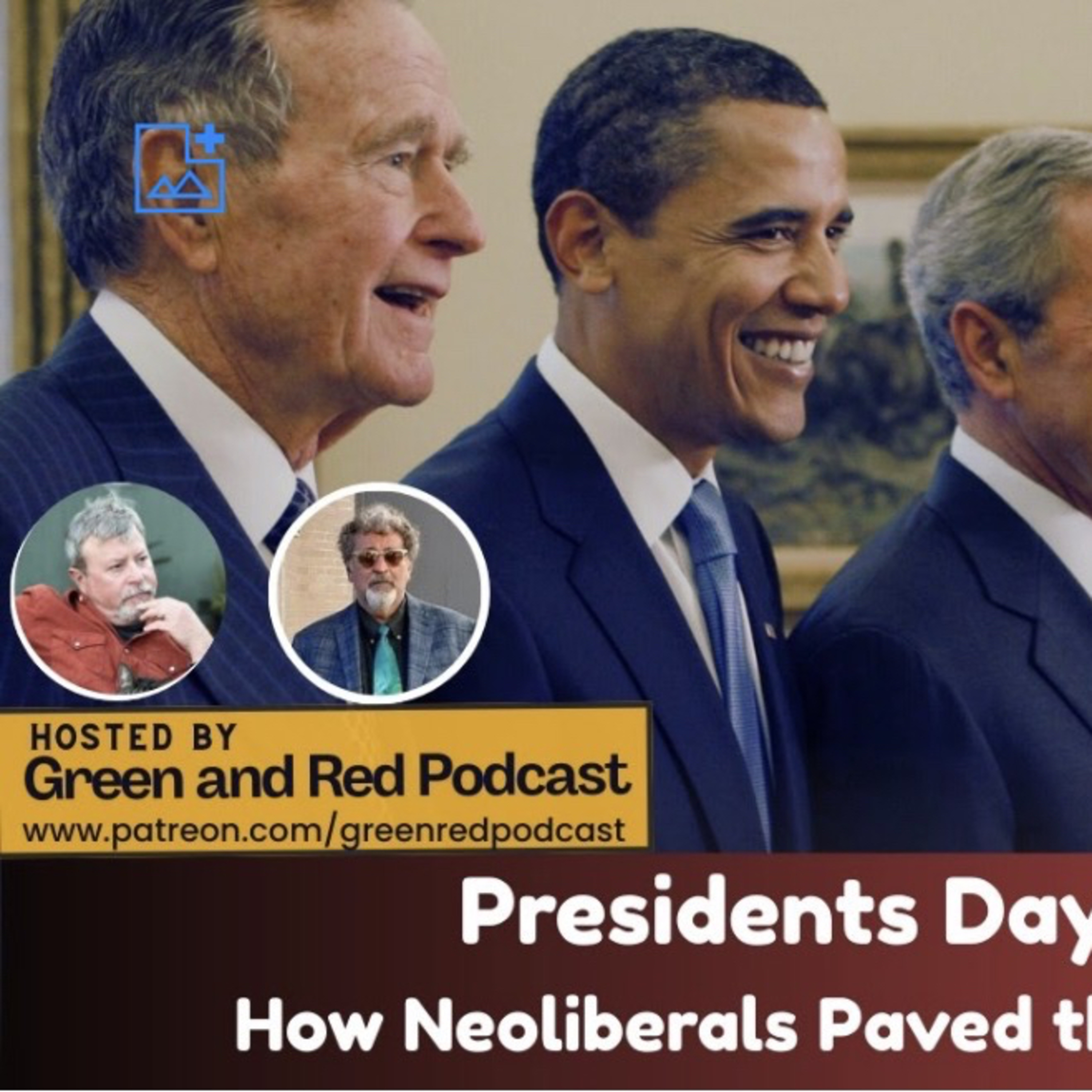
Green & Red: Podcasts for Scrappy Radicals
Prez Day Encore: How Neoliberals Paved the Way for MAGA (G&R 465)
01:03:47
Loading summary
Transcript156 lines
- [00:01]
A
Welcome to Green and Red Scrappy Politics.
- [00:03]
B
For Scrappy People, a regular podcast on radical environmental and anti capitalist politics. Brought to you by Bob Bozanko and Scott Parkins.
- [00:14]
A
Welcome to the Silkiest Move Sounds of the Green and Red podcast. I'm your co host Scott Parkin in lovely College Station, Texas today. And as always, I am joined by.
- [00:28]
B
Bob Ozanko in Houston. Welcome, partner.
- [00:30]
A
Welcome, partner.
- [00:32]
B
Why aren't you wearing your Stetson? And you got on some, you got Tony Llamas on underneath the desk.
- [00:37]
A
I'm wearing, I'm wearing my Levi. I'm wearing my Levi's. Right. Levi's boots, very pressed. It's also President's Day weekend and we decided that we wanted to do a episode on, on the presidency, on history of a recent history of the presidency. Trump, as everyone is aware, if you're at all conscious, it's the word I was looking for, conscious is currently present and in the process of deconstructing the federal government, as it were. There's probably, we could get into that if we wanted to, probably a lot of other ways to describe that, but we thought we would talk actually about the recent history which actually paved the way for Trump and Maga and Elon Musk actually being in office.
- [01:24]
B
Yeah.
- [01:25]
A
In power. Let's actually just call it in power.
- [01:27]
B
Yeah, yeah, we. Yeah. This is bad. I'm not gonna. A lot of lefties are focusing now on we agree with this part of this or we agree with this or whatever, but the reality is Trump is bad. And I think what's important to understand is because so much of this is seen in America these binary ways, Democrat versus Republican or conservative versus whatever, or liberal versus neoliberal. And what we have here is clearly a different cat. Absolutely. But the kind of political system we currently have, politicalness we currently have, I think we're in the making for a long time. And we talked to Noam Chomsky about this three or four years ago. Right. How this started like in the 60s and 70s. And so I think that's important to keep, and not just to keep harping on the Democrats role in this, but I think people need that kind of a realistic understanding of how we got to this point. And I think that's important because it also helps you understand what you're up against and what you might have to do. And I think understanding the way that we got to Trump and the role that the alleged opposition, whether it be Democrats or liberals or neoliberals or whoever played in this, is really vital because you're really not likely to have the people who created this crisis come in and solve it. Right. The ways that you got to this crisis are not the ways to get out of this crisis. And so I think it's useful to talk about that. We've both been talking a lot about Jimmy Carter lately because he died at the end of the year last year. And we've been doing a lot on that, especially because Carter had a really important role to play in the creation of this new neoliberal regime coming out of the old New Deal coalition's classical liberalism. And then Carter, really, even before Reagan, does this. And so what I thought might be useful is to talk about that. But really we've done so much on Carter. We could move forward and focus more, I think, on the last, what, 30 years, Bush, Clinton and so forth. Right.
- [03:10]
A
And post, post Cold War presidency is.
- [03:13]
B
A good way of doing. Yeah. And this is also really when we see the complete, the neo. The new Leo neoliberalism come to fruition. And we'll talk about that in a minute. But one thing I do want to say is that I've been thinking a lot lately about Richard Nixon. I'm old, really old. So I remember Nixon being president.
- [03:28]
A
Right.
- [03:29]
B
And the attack on Nixon. There were a lot of attacks on Nixon. People couldn't believe the corruption. People could believe the arrogance, the narcissism and all that. One of the common attacks on him was that he had created the imperial presidency. And liberals went to town on that. Arthur Schlesinger, the famous court historian, wrote a book called the Imperial Presidency. Right. And that was the attack on Nixon. That in a democratic society, presidents can't be above the law. Presidents can't get away with all these things. President can't do all these things. And they took Nixon down. His own party took Nixon down. Republicans of Bantha Nixon, that's why he resigned. He was about to get impeached and convicted and removed from office. No doubt that would happen. Right. He had no support even in his own party. Right. Fast forward to 20, whatever the Trump years, right. When this guy can literally incite a violent riot inside the Capitol and nothing happens to him. And going back in time. Go ahead. But I was going to say he.
- [04:20]
A
Gets to fire the lawyers and FBI agents who investigated it.
- [04:23]
B
He fires the lawyers who investigate, he pardons the people who were involved in it. Yeah, we. So this is just a totally different world. And so I think it's useful to talk about how we got to that point, because you know what? We're seeing what we saw with Nixon, the Imperial presidency. And right now what we're seeing is the Imperial presidency on steroids and jet fuel and 5 hour energy and 4 logo and all kinds of shit like that.
- [04:46]
A
Right. There's probably some ketamine in the mix there.
- [04:50]
B
Oh, there's a lot of Ketamine in the mix there. Ketamine and Adderall, right?
- [04:54]
A
Yeah, exactly.
- [04:55]
B
Trump, Trump and Musk. And maybe Trump's little kid feeds it to him or something like that.
- [04:59]
A
We live in a. I think that was muscular.
- [05:01]
B
Well, maybe muscular, but it's a real world. We, we live in a surreal world where there's like six year old kid can tell the President Jesus Christ. But at any rate, so anyway, I think it's useful to kind of talk about that, to talk about how we got to that point, because one of the key parts is that when this neoliberal regime began in the Carter and Reagan years and Bush, we saw it as a continuation of the old way of doing things. But we're clearly at a different spot now. Right. Neoliberalism has led us to this point where the country is more right wing than ever. At each point along the way, when something happened, the Republican Party moved to the right, the Democrats moved to the right along with them. And the idea was always to seek like what they would call free market solutions. Right. And so we want to talk a little bit about that. Like you said in the post Cold War era.
- [05:48]
A
Yeah. And we, and just like Bob said, I just want to emphasize that we've spent a lot of time on this show talking about the sort of rightward trajectory of the Democrats. We've talked about, we've talked about 1968, we've talked about 1972, we talked about 1972 with Noam Chomsky and where you really start seeing this rightward shift with the Democratic Party. But. And we've done a lot of stuff on Carter. And so what we're going to talk about now is that the party is, by the 1990s, the Democrats have moved to the right, the Cold War ends. Both the Democrats and the Republicans embrace this free market neoliberal model. And we're going to talk about how that become, begins to unravel this domestic welfare state that had been put in place by Roosevelt and Johnson and all of these sort of pre and post World War II presidents. And it's an important phenomenon to be keeping track of, to be paying attention to. And the other part is that Clinton, Bush and Obama currently are still all seen as heroes to this, to the sort of liberal base, and we often use liberals pejorative, which is how it should be used, frankly. But the liberal base sees the people who did help, who began the dismantling of the fdr, sort of social, the social safety net, as heroes were, in actual fact, all they really did was like, make a lot of wealthy people wealthier, build out the billionaire class. We're going to talk a little bit about that, too. We're going to talk a little bit about the sort of background that Elon Musk and some of the PayPal mafia as well.
- [07:27]
B
Yeah. And I think getting back to the issue of this being President's Day, the presidency, the one thing that I think is a departure with Trump is his willingness to use executive power to invent executive powers as president and then to get the court to sanction them. You don't see that like this, right. You would have presidents generally, lad, if you want to use that word, by creating public issues right. In their office. Fictitious, Right. Reagan talked about, you know, crime and welfare, the same shit they're talking about today. Right. Welfare, fraud and crime. The kind of stuff Elon Musk is saying today is the shit Reagan was saying back in 1980. 81. Right. Reagan was talking about welfare queens and driving Cadillacs to pick up their welfare checks and all that's. Musk got that flavor. But the point is, even as much as they did, that no one used executive power, come close to that like Trump did. Right. Think of his predecessor, right? Biden was very weak, very feckless, even after the Supreme Court said the president has immunity. Biden's first comment immediately after that court ruling was made public was like, I'm not going to do that. I'm not going to use that kind of power by Trump is just right now he's running the country via executive order and doing things you're not allowed to do, right. You can't issue an executive order and get rid of birthright citizenship. That's a constitutional end. Now, that's not to say that the currently constructed Supreme Court won't say, yeah, go ahead. But the fact of the matter is. Right. So that's the difference, too. The Democratic weakness, Democratic fecklessness, democratic performative resistance has led to the point where Trump can get away with all this. And we're seeing virtually nothing be done about it.
- [09:01]
A
Right?
- [09:01]
B
What was it last week? Several Democrats went, was it the Department of Education? They symbolically stood in the doorway, they weren't allowed in, and they made a big show look at what we're doing. We're fighting them. They raised money off of it and then they left.
- [09:13]
A
Right.
- [09:14]
B
Trump incites people to commit violent acts inside the Capitol, and the Democrats won't even stand up to him and call people out for a protest, whether it be at GSA or the Labor Department or the Education Department way out there.
- [09:27]
A
Usaid, usa.
- [09:29]
B
One last thing, one last thing. I don't want to get on to that because we could do. Because I understand that I, My field is U.S. foreign policy. I've studied that. So I know a good deal about aid.
- [09:36]
A
We should, and we should do a show. We should do a show on, on.
- [09:39]
B
Aid, Perkins, in general. And aid. I know what aid did in Vietnam. Aid is an instrument of American power. Absolutely. But the fact that Trump and President Musk are trying to get rid of it also the way they are to unilab is also troubling. And I don't think just because we, there are legitimate issues to raise about aid, it doesn't mean you should be supporting what Trump is doing in any of these ways anyway. That's a long kind of a long way of introducing a lot of this stuff. But if the general theme is that what happened in the last 30 years or so created the pathway for where we are today, I guess we should start what, in the 90s.
- [10:13]
A
Yeah. And I want to say let's open this up, which is something that very, which we've talked about before, but very much emerged when we were doing our 25th anniversary anniversary series around the WTO, is that free trade actually was an important derailer of American politics. And that's where some of this originates. And we have Bill Clinton come in 19 January, 1993 and run on one of the points on his platform was that he was going to get the North American Free Trade Agreement passed. That was in opposition to his liberal labor base. That's an opposition to his, what I would call the left base in the Democratic Party, including people he had put in his own cabinet opposed him on that. And so he and NAFTA really lays the groundwork for a lot of what we're talking about. And it's an important, it's an important thing to note, which is not discussed far enough. And also when we talk about neoliberalism, it's important to point out that NAFTA is one of the key parts of the neoliberal project. It's how we began seeing this sort of this austerity happen, which is a little bit different than what Trump and Musk are doing, to say the least.
- [11:27]
B
Yeah. And we can talk about it at the end because I, I don't believe that Trump is actually neoliberal like these guys are. I'm not from Brooklyn, so I could be wrong, but I don't believe that Trump is. But we'll, we can get to that. But no, I think we're way more.
- [11:42]
A
We'Re way more than anybody in Brooklyn talking about this stuff.
- [11:45]
B
Just the fact I think we know it better. Is that the issue?
- [11:49]
A
There's that bit too.
- [11:50]
B
We're not fancy, but we know it better.
- [11:52]
A
We look better too. We're better looking too.
- [11:54]
B
We hope so. But no, and I think that's really crucial, like what you just said about nafta, wto, because like when we talk about this, we talk about like Carter and financial reform and deregulation and like trucking and airlines and things and those are all vital. But it really takes on a new intensity in, in the 90s with NAFTA. Remember that in 1992, Ross Perot had the best showing, I think, of a third party candidate ever. Basically. He was a one issue guy, right? It was nafta, it was globalization, right? How that was hurting American workers. Right. And, and labor didn't support Perot, but labor and Clinton were at odds on, on this as well. A key element in neoliberalism that led us to this point is are these Global Traders Supra. National Transnational trade agreements. When we talked about the, the Battle of Seattle, we went over a lot of this and went over it because we've done a lot on this. Right. And that's really critical to understand. And just a spoiler when we get to the part, right. Trump is opposed to these, Trump came to power opposing these. I would argue that the opposition to NAFTA and globalization in 2016 probably got him the White House. I think that was more important than anything else. Not just because he talked about it a lot, whether it was sincere or not, who cares? Right? He didn't care, right. So he goes into these depressed areas like Pittsburgh and Youngstown and Cleveland and Detroit and elsewhere and tells people like the Democrats did this to you. NAFTA was a disaster. I'm going to bring these jobs back, these beautiful jobs back and all this kind of stuff, right? And then on the other side, amazing job. And on the other side you had Hillary Clinton, who was, you know, she and her husband brought NAFTA to Youngstown and to Pittsburgh and places like that. And they were just so condescending and scolding about it. Right. They never engaged it. They never con, you know, they never admitted they did anything wrong. They were just condescending.
- [13:38]
A
Right.
- [13:39]
B
And so I would argue that stuff is really critical that those agreements that Clinton brought in a key component. Right. Because Clinton does that. Nafta, wto, domestically, Clinton's probably best known for so called crime reform, partial reform and an end to welfare as we know it. Yeah.
- [13:59]
A
There's another key thing he does which is not talked about as much, which is he signs the Financial Services act, which is a. A dereg, a piece of legislation around deregulation which actually gives Wall street banks the ability where they have been unable to do things like merge and do vertical and horizontal integration lifts off all the regulation around that, which as we as people like to say, a big problem. What's the problem in America today, which I agree with, is the billionaire class hate is the one who lifts the regulation, which makes it even easier for you to go from being a millionaire to a billionaire and leads to all this concentration of wealth.
- [14:40]
B
And that also speaks to the kind of destruction of the New Deal order that came out of one of FDR's first pieces of work in 1933, the Glass Steagall act, which separated investment banking. And so Clinton eliminated that. What that meant before was that banks and brokers had to act independently of each other. What Clinton did by repealing that, create this field we have now where. Well, now you can just go online, right? You go to Schwab or E. Trade or whatever and you could buy stocks, you can open a bank account, get a credit card, you could get a loan, do whatever you want, which creates this consolidation, which creates more risky investments for a lot of folks. And also, like you just pointed out, it created this immense wealth because it made mergers easier. It created kind of fewer regulations for banks. Banks could act more irresponsibly, really, as we'll see in 2008, there's, I think a direct line, the Financial Services act, getting rid of Glass Steagall to the Great Recession or whatever you want to call it in 0809 and yeah, Clint, Clinton is really. And so in those regards, Clinton is. That's really crucial. Right. If you didn't list Bill Clinton's name and party affiliation and you just said, okay, this is what this guy did, it would seem very consistent with everything that had been going on before that. Right. You wouldn't say, oh, that's a liberal Democrat doing that. You wouldn't say that at all. Right. You wouldn't say oh, that guy's following the tradition of FDR or even Eisenhower, you say, or even Nixon, really. So there's clearly a shift. And you see that in Clinton is a huge part of this. And so the idea somehow that Trump is this anomaly and we've never seen anything like this. And in his use of power right now, what we're saying and just his general behavior, obviously he's a different kind of cat. We've never seen anything like that. It's. He's sociopath. Right. It's insane.
- [16:21]
A
Right.
- [16:22]
B
But in terms of what we're seeing, the accumulation of wealth and the way that these kind of oligarchs run the government, that's been in the works, the Democrats, the neoliberals, including neoliberal Democrats, paved the way for that. Right. And in 1990, just think of that era, right. The late 80s and early 90s, you did have political alternatives in the Democratic Party. I think of like Jesse Jackson actually ran a very, very successful campaign for President. Right. In 88 and again in 92. They run again in 92. I don't know if he did.
- [16:51]
A
But anyway, Jerry Brown. Jerry Brown was the more. Was the progressive alternative.
- [16:54]
B
And so in ada. But Jackson did quite well. I think he won the primary in Michigan. He did very well. And then in 92, Jerry Brown actually did portray himself. He came in late and actually won a bunch of big primaries toward the end to challenge Clinton. But the point. That's not even the point. The point is the Democrats crushed all those people. Right. The Democratic Party, instead of reaching out to people who represented these kind of traditional Democratic ideas program like the Great. The Great Society. Think about that. The Great Society was 1964, 65 around there. Right. The mid-60s.
- [17:25]
A
Right.
- [17:26]
B
Less than what, 15 years later, it's basically being taken apart. It didn't last that long. Right. And then Clinton and others. And they would specifically say what? That Clinton created the dlc. Right. Clinton and Gore. And they were going to be a different kind of Democratic Party. You can already see the abandonment that was like in the early 80s. That was after Mondale was crushed. Right. The LC. Right. They were going to take over the party. Right. Which is what they'd already done. They took over the party in 72.
- [17:52]
A
Yeah.
- [17:54]
B
Scoop Jackson and Jimmy Carter were trying to prevent McGovern from being the nominee.
- [17:59]
A
Even when these new Democrats came in after the Watergate babies came in after 74, they were all much more center. Right. As particularly around economic issues. And you actually saw the New Deal Democrat, Democratic members of the House actually began to be pushed out by the, by the Watergate babies, by the new, quote, unquote, New Democrats. They started at least as early as 75.
- [18:23]
B
Yeah. Gary Hart had been McGovern's campaign manager in 1972, and then he was elected to the House, I believe, in 74. I always think, I think Hart's really important this, because at the time, I don't think they called him a neoliberal. I think some people called them techno liberals, though, because these guys were cutting edge and they were going to bring technology in. And this is. Back then there was a lot of talk about kind of robots and factories and changing the workforce and all that kind of stuff. And Gary Hart was really important. Hart clearly abandoned those no deal ideas and the media loved him. The media loved Jimmy Carter.
- [18:53]
A
And Gary Hart, I believe he was also a co founder of the Democratic Leadership Conference.
- [18:57]
B
I wouldn't be. Yeah, I wouldn't be surprised.
- [18:58]
A
I'm pretty sure he was, because I.
- [18:59]
B
Remember Carter and, and Hart kind of got a lot of publicity back in, in that era. 74, 75, 76. Right. These were the New Democrats. They weren't beholden to the welfare state. They weren't. They believed in like a new south and civil rights, but they weren't gonna, they weren't gonna go too far with it like the, that the LBJ apparently had or something like that. So that's really a crucial part of this. And you already see it. So by the time Clint became president, it puts NAFTA and gets NAFTA in the W2 cap, WTO pass, further deregulated finance. And then like I said before, got. Because the crime bill and welfare reform were both Republican ideas. Right. Those, those came out of, I think, John Kasich, who from Ohio later became Senator. Right. And governor.
- [19:43]
A
Right.
- [19:44]
B
Kasich, I think, was the first one case. It was there when Clinton signed the carceral reform bill. Kasich was there in the crime refill bill. I can't remember who that was associated with. Right. But the old New Deal liberals actually opposed the crime refill. So in those regards, whether it be globalization, financial deregulation, crime, welfare, whatever, Clinton governed in the same way Reagan had. He basically took those Reagan issues which are now even stronger because of the presence of the DLC and the DLC takeover. And this is when you start to see a lot of those suspects we still have around today. Rahm Emanuel, Larry Summers, people like that are all a lot of the people who are still around in the bike industry.
- [20:23]
A
Yeah. And the other thing that also happens during this period is where we, this is not necessarily when these companies start, but this is also when we begin to see the rise of Silicon Valley, which I think is also important, particularly for today. But even as I was reading through some of the literature about the rise of Elon Musk and Peter Thiel and people like that, it's in the 90s where they all start their companies and start making all of their money. And so, and the Clinton, the Clintons and the New Democrats, this sort of neoliberal center right Democratic Party really spends a lot of time cultivating people in Silicon Valley. We're, we're being flooded with this idea that the Tech Bros. And Silicon Valley are, is this right wing sort of phenomenon. But for a long time, the neoliberal Democrats actually spent a lot of time getting money from that. It was to I, I always regarded it as a Democratic fundraising base. It was almost like a Silicon Valley is like an ATM for the Democratic Party, which has had this more dramatic shift in the last couple of years with Trump coming in.
- [21:23]
B
And it's, it shifted radically. It shifted in the 90s, right? It emerged very rapidly, right. In the early 90s you didn't have much, you had email, right? AOL maybe. But then really within a matter of five years, movement blows up. And in fact, in the late 90s and final years, you had the tech bubble, right, which created a. And that probably as much as anything hurt Al Gore when he ran in 2000. Right. And the Democrats again could not make a cogent argument about anything, right? So they just let the Republican Party say whatever it wanted about them and they would just go along with it. Right. Goran? Just a dismal campaign, right? But the, yeah, tech was really crucial and really emerged in that era to the point where it had a bubble in the late 99, 2000, I think.
- [22:06]
A
There was a second one in maybe 2001, 2002 as well.
- [22:09]
B
And 101 when Bush wins the election. He's inaugurated in January, the economy's not good. Bush was politically, he was bailed out by 91 1. So he could just spend his time dealing with that rather than having to focus on actually happening here in the United States. And that also unleashed a flawed, literally trillions of public money to use on this global war on terror. Right. And that's another part that I think is important when we talk about neoliberalism, right? Because there's always been massive government intervention in the economy, massive government spending, right. What for in some of these programs like in the New Deal and the Great Society was that some of that government money was actually earmarked to people, to working people, to average people, right? It be WPA or public works or a lot of the Great Society programs, right? And then you have programs like Medicare, Social Security, Medicare and Medicaid. So those weren't those in those programs, the government earmarked support for people, for just normal working people, average American people, everyday people, right? What with Clinton is again, an abandonment. Well, even with Carter, but with Clinton especially an abandonment of that. And now it's just, just the triumph of trickle down, right? We're going to take people, take care of people at the top. I mean, if you look at, like Reagan's tax cuts, I wrote a piece on this and Reagan died, right? I wrote a eulogy to him. And if you look at his tax cuts, all those benefits went to people at the very top, right? Marginal tax rates for 10 people at the top went way down, less than half of what they had been. The amount of taxes saved was in the like, tens of thousands, hundreds of thousands for people at the very top. People in the lowest, like 40 to 60% either saved $100 or actually had paid more in taxes, right? So Reagan cultivated that too. And then Clinton comes in and basically does the same thing, right? Clinton. The last time America had a balanced budget was in the final years of Bill Clinton. No one's ever given a damn about deficits or any of that. They spend as much money as they can, especially on the military, right? So what neoliberalism did, I think was essentially go back to that old idea that it's okay for the government to spend money as long as it's not on people's needs, right? If you spend money to give people jobs or healthcare or build libraries, that's socialism, right? But if you spend money on the Cold War or nuclear weapons to fight against the Soviet Union or Now in the 2000s, on the global war on terror or before that, you think that's the other part of Clinton. We talk a lot. When you talk about Clinton, I think what dominates is the whole kind of Monica Lewinsky and the impeachment and all that, right? Because it's salacious and all that kind of stuff. Clinton also was rana, an interventionist foreign policy. Think about the. The sanctions against Iraq, the bombings against Iraq, the bombings in places like Kosovo, the interventions in, like, Haiti, right?
- [24:49]
A
So the bombing of Serbia. The bombing of Serbia, you didn't get.
- [24:53]
B
You also had this kind of really hardcore interventionist foreign policy as well, you have significant government involvement, but the involvement is on behalf of kind of the ruling class. Right. And there's a movement away from programs that would help normal people. In fact, Clinton, if you look at like welfare reform that eliminated what, like a million, more than a million people were kicked off welfare. And a lot of those folks were like working mothers who. Part of it was you have to work workfare, not welfare. What was that was one of their slogans. So a lot of women like couldn't.
- [25:24]
A
They should do that for themselves.
- [25:26]
B
Yeah. They couldn't get jobs because they had kids to take care of. And so it, it really, it was a, a program designed to hurt people, spend less money on these kinds of programs. Right. And Clinton. And then so Bush and Clinton really do segue really well into each other. The biggest difference, the one thing I'll give out credit, Gore credit for who I think was a little more, I think of an old liberal than. Than a new. More of an old, more of an old liberal than like Clinton was. Let's say Gore did introduce the whole issue of, of climate and climate change to the discussion and give him some love for that. But otherwise, no, the Democratic Party clearly was following in the footsteps of what they had seen in the Reagan Bush years. And Clinton really takes these measures which you would consider Republican oriented measures, and then Bush becomes president and steals the presidency. And I think that's important politically. Right. Because in 2000 there was a steal. There was absolutely no doubt steal. And the Democratic Party did nothing. They didn't do anything about it. Right. People, Jesse Jackson and labor leaders offered to have a big street protest in Miami. Gorn, the Democrats said no. Gordon Rahm Emanuel said, no, we're not going to do that. The streets. So they got the election and they didn't fight back. Right. And Gorn just conceded after the Supreme Court, which included people appointed by Bush's father. Right. So there's a steal. And Democrats did Nothing compared to 2020, when there's no evidence of a steal, when 60 Republican judges said there was no steal and the Republicans kept saying the election was stolen. The Democrats again, just remain silent. Right.
- [27:03]
A
They're going to open up new investigations to see what was actually stolen at this point. Right.
- [27:07]
B
Yeah. I mean, it's just, it's really. And I get it, that's a symbolism. But that means in America that means don't vote for policies. Right. They vote for like sound and images and spectacles and things like that. Yeah, it's fucked up stuff. But so you have that kind of Continuum. And I think it's ironic as you pointed out earlier, right. People, people now who hate Trump are all billitating and doing revisionism on on these other guys, right? On Clinton and on on Bush especially, right? Liberals love Bush now. Boy. George Bush From Michelle Obama BFFs and Bush paints pictures of ghosts from Iraq.
- [27:43]
A
Bush and Laura won't talk to Trump at Carter.
- [27:45]
B
Yeah but during the campaign they never said a word about it. Right, but. Or Liz Cheney is an even a better example.
- [27:51]
A
Right?
- [27:51]
B
Liz Cheney is Wines of liberal courage profiles. She won the RFK profile encourage Liz Cheney did. Right. Which considering who was named after what the hell now, right? And there's a difference there. Somebody like RFK would have never been in a cabinet before this, right? Kelsey Gabbard, Pam Bondi, none of those people would have been anywhere near the White House or any government before. So there's clearly a difference. Right?
- [28:17]
A
But Hexa, there's no way they were ever given the keys. Ahead the Pete he said yeah, wait.
- [28:23]
B
I hed's promise he's going to stop drinking because yesterday he was like knocking back whiskeys or something at the podium when he's given an official address, right? Dude, I was in a fraternity. I'm a FR boy. I'd be embarrassed by him. He's not even FR boy material. He's just a clown. But at any rate. So anyway, but go ahead. I'm sorry.
- [28:43]
A
No, I was just going to say that to get back on the neo on the kind of neoliberal paving the path or maga is that we've seemed to have moved into the Bush era a little bit. I think it's also worth it worth noting is that part of what mag part of the anger that MAGA has towards the establishment. And so we can also say that MAGA at a certain level is they're anger, they're angry with elites. And it's not just Democratic elites, although it's well documented and everything that the Clintons and the Obamas did to anger this working class, white working class, what have you. But Bush also contributes that quite a bit. And Bush continues with the trade deals. I spent a good part of the 2000s of my young adult days traveling around protesting the Free Trade Area of the Americas be organized against the Central America Free Trade Agreement, which was what happened when they couldn't pass FTAA and other places. And and then also domestically he's continuing with deregulation. This is also where we see the sort of bubble begin to build that leads to the 2008 financial crash. And so that's one piece, is that people's economic dis, despair, precarity, all of that is actually directly related to what happens during the Bush years. And then two, the other thing that the Bush Cheney regime does, which really seems to have a lot of problems with, is that they began all the forever wars. We've done a bunch of shows on Iraq and Afghanistan, so we don't have to go into this too much. But Iraq and Afghanistan, where we saw a good number of American troops go and serve, fight, get maimed, some got killed, is an important piece of their narrative as well. And they seem to don't talk about Bush as much because they were all Bush lovers at one point. They definitely talked about how Obama and Hillary Clinton were actually big part of that.
- [30:31]
B
Yeah, no, no, that's the most up part of it is like a lot of the stuff that these M people say came out of left talking forever wars. That's our phrase, right? Been our phrase for decades. Right.
- [30:43]
A
And I, I don't believe the globalization stuff. The globalization, no, exactly.
- [30:47]
B
And they never understood, the Democratic Party never understood that meant something. I, I said this a million times, right? In 2016, I was talking to people in Ohio who said, I like Trump and I like Bernie Sanders, but there's no way ever I would vote for Hillary Clinton and the Democratic Party to this day. And you still, to this day, even after 10 years of Trump, the Democratic response is still, Trump sucks. I hate Trump. How did you fucking idiots vote for him? All you people who voted for Trump are idiots. You all shop at Walmart, you're white trash. This is the Democratic response. After all these years, they still don't understand. There are, they're crazy fucking people in Trump, absolutely insane people, Oath keepers and crazy conspiracies and you name it, rfk, people who kill whales and put them on their car roof, who knows what else. But there was a lot of, that was a legitimate class based, I would argue, anger over the elitism of these trade deals, of these corporate handouts. And Trump rhetorically said that, right? He didn't mean it. Obviously. Nothing he's done as president. He's the most fucking oligarchic president you're going to see. Right? But he rhetorically, he reached out to these people at the same time. Hillary Clinton's not saying a goddamn word. Look at 2024, right? Trump, we know that Trump is a genocide heir in Gaza. Absolutely. But that's not the point. What Trump said didn't matter, right? What's important There is that even though every poll imaginable showed that Gaza was going to destroy the Democrats was going to kill them. Right. They, they didn't back down, they just doubled down. They went further in. I'm good, Harris.
- [32:23]
A
I'm good.
- [32:23]
B
And, and we've seen from post election polling now that's what killed them. And they refused to shift gears. Right. And so when Trump talked about forever wars, you and I could say, oh, that's bullshit, he doesn't mean that. But that's how Americans felt. And he never, the other day when Trump was ruminating, as he's apt to do about crazy shit about the Gaza Riviera trying to get over and all that kind of stuff, one thing that was lost, he's talking about Iran and he said, I don't think Iran is building a nuclear weapon. Right. That's a shift. He always said they were Biden, said they were. Biden on those policies followed Trump like even worse than Cuba to a T. So again, maybe we should go back because we're to talk a little bit about Obama, I think because Bush, Bush and Obama is, they segue into one another too. And as you pointed out, Bush was politically, I think, granted a gift. I hate to say that by 91 1, but what it did, I don't believe it. There was a conspiracy. They were setting up 911 in order to justify. You can always find excuses to go to war. You can the famous Met George Bundy line play Cruiser like streetcars. You don't need to contrive 911 to justify a war. You can, there's a million ways to do it. Right. You can get rid of a president if you want to. You don't have to come up with an elaborate conspiracy that the Pentagon is trying to get rid of or anything like that.
- [33:42]
A
Right.
- [33:43]
B
Bush. When 911 happened, the Bush people said, oh, this is an opportunity. Right. And immediately they rush in. Well, stuff that we've been talking about for years, things like the surveillance state and massive new. The Brown University has a, what's it called? The Cost of War project. Is that what it's called?
- [33:58]
A
Yeah.
- [33:58]
B
If you haven't looked at it, check it out. It's, it's really fantastic. It's a great resource. Right. And I forget what the number is at now. The war on the wars on terror, which would include like invasions of, you know, Iraq and you know, Afghanistan, places like that. It would involve like Homeland Security and TSA here at home. We're now well into the trillions. I think we're like 10, $15 trillion spent. Right. So again, this is the new neoliberal regime. Right. You're not spending any of that money now. Programs for people, you're not spending that on preschool or after school or school lunch. We've seen a decrease, right. In things, just basic things like school lunch programs and Medicare, Medicaid, all that kind of stuff. Right. Expenses are higher, it pays less and so on. Right. But if the government wants to literally print, you know, print money anymore, you invent money. Right. Or whatever, you can do that basically with no guardrails. And Bush did that. And that also in addition to that, something I just, you know, because you mentioned a few minutes earlier reminded me, I don't want to undersell how important it was that Carter appointed Volcker to the Fed. And then did Clinton appoint Greenspan or did Bush? I can't remember, maybe Reagan even.
- [35:05]
A
I don't remember, but I think Reagan didn't. I think Clinton reappointed him.
- [35:09]
B
He was, I think he was the longest serving Fed chair ever. I'm pretty sure he is. Right. But that's important to understand too because Volcker and Greenspan are both part of that new neoliberal regime and they are Democratic Fed those. The Democrats supported them as as much as the Republicans do. And again, we've said this a million times, if you look at things like military spending bills, they're overwhelmingly voted on, almost zero votes against them. In the early 2000s, the most anti war representatives in Congress were Dennis Kucinich and Rand Paul. Ron Paul, I'm sorry, Ron Paul. Ron Paul. Rand Paul, I was thinking. But Ron Paul, Ron Paul with Dennis Kucinich and then the end of the Bush years and that loose money program from the Fed especially resulted in the housing bubble, the housing crisis, which did destroy Bush politically. Right? Yeah.
- [35:57]
A
It destroyed the Republicans in that moment. Politically it did.
- [36:00]
B
And it's funny, the Republicans can be. The Republicans were destroyed in 1976. 74. 76, right. They were destroyed. 1980, they're back in power. Right. Only took four years. Right. And 92 was not good for them. Right. They were defeated. Clinton was very popular. Right. By 94 they destroyed the Democrats in the midterms. Right? Yeah. So they're able to change course really quickly and bring things back. Right.
- [36:25]
A
It's amazing. It's amazing how slow the Democrats are actually are able to do that. There's this heyday of the, of the Bush years where Bush steals the election. 9, 11 happens. They have a huge midterm kill in 02 they Bush gets reelected in 04 and then finally in 06 and 08 the Democrats make their comeback but they're immediately stopped again in 2010. Right. They're not. They're where the Republicans are often able to continue the momentum even after their president is in. And it's, they definitely need some I, I, I, I bet it's the same people still doing it from 20 years ago too.
- [37:02]
B
Yeah. They clearly organize better. There was a guy who works for Obama named Reid Hunt who wrote a book called A Crisis Wasted and I think he attributed to Carville. But I'm sure millions of people have said it never waste a good crisis. A good crisis is an opportunity and the Democrats never do that. They like remember when Biden the same thing B said nothing's going to fundamentally change. I'm going to bring you back to normal. They've never understood nobody wants normal anymore. Right. They're returning to an era that has been discredited and abandoned.
- [37:34]
A
I, I think, I think it's, I think it's also worth noting with that, with the Obama years is that we, we have this kind of progressive wing of the Democratic Party really begin to put its head up again in 2006 and 2007. And then all of those progressive like Mike Revel runs for president. 08 he's the real progressive who's in the Democratic primary. But, but we, we and then we have a bunch of centrist neoliberal types like Biden or Bill Richardson or whatever. But then we also have Obama who, who a lot of the progressive movement really puts their hopes in and they think he's going to be like the next fdr. But when you actually start to look at what the media was talking about what you look came out in books after that like Confidence Men by the Wall Street Journal reporter. Obama was in bed with Wall street from the get go and that's, and, and there was going to there, there was like where people were predicting like an FDR sort of New Deal sort of immersion from Obama and that's just, it's just not the case. He's Reagan. He's just another Reaganite. Right. He's black Reagan.
- [38:38]
B
Yeah.
- [38:39]
A
You know that he's not pro labor. He's, he's bailing out the banks.
- [38:43]
B
Four years before that Howard Dean ran for president. Dean was, I don't know what you'd call him but he clearly no, no militant, no labor, no lefty, no radical. And the Democrats did everything they could to destroy Dean. Right. He had momentum. They started smearing Him. They started slamming him.
- [39:00]
A
Universal health care, right? That was his thing.
- [39:02]
B
He was a doctor. He was a medical doctor. Healthcare was his big thing, right? It's. It's hilarious because I remember I never saw the, the alleged scream when it happened. I just read about it then, and it wasn't until a year, a year or so later, I looked at it. Really. That's what did him in, right? And, and this is. We've always seen this, right? But especially after the New Deal era, the media really jumps in and they create the narrative that the left is hurting the Democratic Party. The left. I don't know what the fuck the left is. I still don't really. Cause I always thought you and I were. The left ain't Democrats, but. And so you get to see this. Even though you have these positions, abortion rights, gun violence, healthcare, whatever, right? Even though these positions are held by majority of Americans, Democratic Party positions generally. The Democrats won't. Won't back them up. They won't go to the wall over this, right? And so they bail on all of this stuff. They keep backing out. The Heide Amendment wasn't necessary. Americans supported Roe v. Wade, yet you have the Heide Amendment by Shepherd statute. And so the Democratic Party and the media starts this narrative that it was. It's the left and all these left issues. And this is. I also, when I think like identity politics come to the fore and what the Democrat. One thing Clinton learned is you could attack identity politics. When he was running for president, he wanted people to understand this is part of the New Democrats, right? He's. It's funny because on one hand you have Toni Morrison calling the first black president, right? But on the other hand, Clinton wanted to show his distance, so he, he attacks Sister Soulja. He goes back to Arkansas to oversee the execution of a mentally deficient African American inmate, Billy Ray Rector, who had an IQ 60s, right? So Clinton goes out of his way to say, I'm not like them. I'm not like those Democrats, right? I'm not one of those hippie, liberal, free love, free crime, whatever Democrats, right?
- [40:43]
A
I'm tough on Southern governor. I'm a Southern governor.
- [40:45]
B
I'm tough on crime. I believe in the death penalty. I believe in three strikes and you're out. I believe in mandatory minimums and all that kind of stuff. And so that leads on. And then the other thing, we could jump back up to Obama again because we want to talk forever. Although this stuff always fascinates me. Keep in mind, too, Obama wins the election because the housing bump the market just crashed. All of these. For years, the Fed had been on such an easy money policy that people were literally getting multiple loans at 0 or 1%. So people are buying four or five houses and then they just quit paying for them. They couldn't pay for it anymore. Right. The big short, which I think is, is rare because it's a movie that explains a fairly difficult topic in a way that's understandable, right?
- [41:26]
A
The book. The book does too. The book's good too.
- [41:28]
B
The book does too, yeah. All, all of this stuff was happening. These were Democratic policies as well. Clinton was as part of this. But Bush catches whack and Obama wins because of that. But what does Obama do? You have three programs. You have three things that come to mind. One, within, what, a month of becoming president, he went to Goldman Sachs and he said, the only thing standing between. I'm the only thing standing between you and the pitchforks, right? Meaning like the people are pissed off at you. People hate bankers. Americans hate bankers. We, I know we're. We're going to do a bank robber show. I promise we are. Because I was talking about this in class the other day and I played jolly banker, right? But Obama went to Goldman and Talked to these CEOs on Wall street, said, don't worry, I got your back. Right. I'm standing between you and the pitchforks. But then they created two programs, tar, which was the toxic assets, which is for the banks. And then they have another one which didn't get much attention. TARP was well known. The other one was called ham, which was for homeowners. TARP was capitalized, I think at nearly a trillion. It was like 8,900 billion, which wasn't nearly enough. But the point was that was based on the idea, no, our banks are too big to fail, right? These things are too big to fail, so we're going to bail them out. However, HAMP was only funded at I think 300 billion. And only about 10% of that was spent like a very small percentage. I believe single digits of people who lost their homes got any kind of government. So Obama's message was very clear. I'm taking care of Wall Street, I'm taking care of aig. I'm taking care of the remnants of Bear Stearns. I'm taking care of Goldman and Jamie Dimon and whoever my Secretary of Treasury from Goldman is this week. There was a guy there I've ever.
- [43:00]
A
Ruben.
- [43:01]
B
But wasn't there four or five in a row from Goldman? Secretaries of the treasury, right?
- [43:05]
A
Yeah, it's True. Some of them were, some of them were holdovers from Bush. Henry Paulson.
- [43:09]
B
Yeah. You know how now like how corporations sponsor things like stadiums or like kickoffs here the Frito lays people Kickoff raiders, they should call it that. The Goldman Sachs Secretary treasury, something like that. Right. But anyway. Yeah. And so Obama, the other thing that's important to mention about Obama that is really crucial is go back and just do a Google search on look for maps of state wide political parties. Right. Look at maps from 08, 2010, 2012, 2014 which show it's map of the US and it'll be blue or red based on the state governments. Right. Whether the governor's Democratic, Republican, whether the state legislature is Democrat or Republican. Right. In the early Obama years, Democrats had the majority of governorships and of state houses. Right. Obama himself won states like Indiana, North Carolina, Ohio. He won Florida, didn't he? Iowa. Right. Obama had no interest in that other than with his own election. Right. Obama and Rahm Emanuel didn't care about state parties. They didn't care about building up the Democratic brand nationwide. They didn't care about appointing judges. Right.
- [44:21]
A
There's been a count in over a thousand Democratic elected office holders lost their office during the Obama years.
- [44:28]
B
I have to find because I at one point I had maps side by side and it was one was like 08 or 10 or 10 Obama and then the other one was like 2016 or 2018 and there is a massive shift away. And Obama himself was popular. That's the thing. He was a rock star. And in 28 he won big. It was not that close of an election. He got one spec switched. He had 60 senators, he had pretty big majority in the House. He was able to get the afford and Lotus, what was the first thing he reached? He did the Affordable Care Act. Right. That's not. I'm still to this day amazed that people can call that socialist medicine and call Obama socialist. Right. The ACA was a rejection of everything. I mean Nixon and Teddy Kennedy were actually working on a, a public health plan in the 70s. Right. Stuff that Obama did. Obama, it was funny, I used to read that he was a good poker player saying I don't know how because the guy freaking throws his cards in. He, he doesn't even look at his cards before he makes a bet. He just throws them in. Right. And they gave up on any kind of public option. They didn't even say we're going to throw that out there, that we're considering a public option in order to use it as a Negotiating point. They didn't even do that. It was just off the table from the start. Affordable Care act is very much neoliberal. Right. It's the government saying you must have this private program. I just, I'm old, I'm looking into Medicare now, and I didn't really understand it that well. There's a public program, Medicare Part A. Right. The rest is more private. You purchased Medicare plans for private insurance.
- [45:57]
A
The one thing I would say about Obama on this is that with both TARP and with the Affordable Care act is this, is that those two things really show what his true colors are. Before, before he ever went in the White House, before he ever thought about running for president, probably when he came into the US Senate, if not when he was in the Illinois state Senate, before that is that he was beholden to lobbyists, corporate lobbyists. The, the core, his corporate donors, or whether they were financial or whether they were healthcare or what have you. And he was never. He was. I just want to just say it again is that he was never a progressive alternative. He was. He talked a good rap and he's a rock star and he's the kind of person you want to be in the room with. But. And when we talk about how Americans elect presidents based on like charisma and whether they look strong or look cool or whatever, he's like the, he's the epitome of that more than even Trump. Trump comes across as like a strong man and people seem to buy into that. Trump barely won. And Trump didn't win popular vote in 2016, 2020, and he only won it by like one and a half percent, something like that. 1.9% in 2024. And whereas Obama had huge margins, carried huge number of states, he just, we just listed off all the states that were. We can we consider to be red states like Iowa and Ohio and all that. He won. He didn't win Indiana and North Carolina in 2012, but he run all. Won all the rest of those red states, Florida, Ohio, Iowa, all of them. And so it's. He has this charisma and then he's beholden to this corporate donors. Just every other politician since 1972 or 74 or whatever you have.
- [47:34]
B
Who's that guy from like American University who has his like 8, 8 criteria to choose the president. He's never wrong. Said Harris was going to win last time. Like a very simple way to do that. I'm not like, I'm a historian. I study political history very close. But I'm not a political Science or anything. But if you look at elections, like you just mentioned, somebody with Chrisman strength, look at like, Reagan was running against Jimmy Carter, this kind of little peanut farmer. And then you had Bill Clinton. Yeah, the Du Cox with the silly helmet, Right. And then Clinton running against Bush, who had the wimp factor. Right. And then you had Bush in 2000 against Gore. Bush with the cowboy hat and the boots and acting like he's rugged. And then Obama, who's a top guy, right, comes across like he does play the. The progressive thing to the hilto during the election. He talks about hope and change and he gets all these kind of Hollywood types and Bill Ayres.
- [48:19]
A
Yes, we can. Which is. Which they take from the farm workers.
- [48:22]
B
And he invokes fdr. He definitely plays onto that imagery of fdr. But at the same time, Obama clearly, especially running against McCain, who's old. He's a war hero, but he's old. And then net Rob, neither of those guys come across as strong characters. And then 2016, you have Hillary probably the most dis. Earlier that year. You mentioned something earlier about Trump and the Republicans, but there was the canary in the coal mine, I think was Jeb Bush. And I remember, I didn't think Trump could ever be elected president because when he started, he was at 2% and the other Republicans were attacking him. Rubio hated him and Lindsey Graham hated him and Ted Cruz and all these people hated him.
- [48:57]
A
So I didn't think, now they're all his boys now.
- [49:00]
B
They're all his boys now. Right. It's weird, and I don't mean this in a homophobic way, but the way they talk about that guy and look at him, it's very homoerotic. The way they have these images of him like a strong man ripping his off. It's. It's pretty creepy. It's pretty crazy, actually. Right.
- [49:13]
A
Moving past the Obama years.
- [49:15]
B
Yeah.
- [49:15]
A
Is there anything else we want to say about Obama? He had a very interventionist foreign policy.
- [49:19]
B
Obama had. He had the backing if he wants. In 2008, Americans hated bankers. Obama could have gone in and really fucking done a number on Wall street, and he did. And the important thing is people say his hands were tied. And often liberals, it's because he was black. I get it. There's a lot of racist opposition to him, but he was a rock star in 2009. He was a superstar. And he did not choose. And that's the important part, right? He chose to support the banks. He chose to say, I'm standing between you and the and the pitchforks. He chose to bail out banks and not homeowners. Right. And he didn't have to. There was no political imperative to do that because he was so popular and Americans were so pissed off and so angry at banks like they were in 1932. And he ignored that and laid the ground. And then, Even then in 2016, Trump ran saying, this is the worst economy ever. It wasn't. It wasn't great. You and I could make a critique of it, but the economy that the ruling class cares about was actually in good shape in 2016. And yet Trump was able to convince people that it sucked because he actually spoke to Youngstown, in Pittsburgh, in places like that, Detroit.
- [50:30]
A
One real quick thing about, I do encourage people to check out Confidence man by Ron Susskind, which is about how Obama was in bed with the bank lobby the entire time. And then also that Reid Hunt book that Bob was talking about. What was it called? Crisis Wasted. I think, yeah, Crisis Wasted. Both of those actually are really good examinations of the true, the true political nature of Barack Obama.
- [50:52]
B
If you want to hate on Trump and Musk, then you need to go back and hate on Rahm Emanuel a lot. When Larry Schumer and all those folks as well, the one kind of pseudo progressive that was in the Obama orbit was Robert Reich, and he was gone within two years.
- [51:06]
A
Then the other thing, the one last thing I want to mention here when we're talking about these neoliberal presidents, Clinton, Bush and Obama, is when we, you know, we've talked about neoliberalism, we've talked about financial deregulation. We, this is when we begin to see a lot of the growth of the wealth gap. The New Deal order is where we see a middle class grow. We see people who didn't go to college or people who work minimum wage jobs are able to buy homes and buy cars and send their kids to college and things like that. But it's where we start seeing the dismantling of that sort of in the post Cold War period. And so the billionaire class is often is the villains of our, of our current political moment. I would say in many ways more than I would even say Trump or maga. And I would make a, make a point is that in the United States in 1990, there were 66 billionaires, whereas by 2023 there were 748. Globally, the number of billionaires in 2024 went from 225, excuse me, 2565 to 2769. We saw the world's billionaires gain about 2 trillion in wealth, three times faster than they did in 2023. And so we have this huge wealth growth. We have this disparity. We hear about people not being able to pay their rent, about how the price of eggs is what's ruining people's lives, things like that. But like, we. I just want to really point out that, that corporations and billionaires are making a lot of money and have built up a huge level of comfort and affluence for themselves to the point where they've now bought a president. Make no mistake, the Democrats took a whole lot of money from the billionaires. And Harris have a whole lot more money than Trump did. But Trump also probably more than half of the money he got so run his campaign came from less than 10 people. And so including Elon Musk given $250 million, a quarter of a billion dollars toward, towards his campaign. And so I want to point out that this growth of wealth and equity is the result of Clinton, Bush, Obama policies of free trade, of deregulation, of cultivating and helping build up the Silicon Valley, all of that.
- [53:21]
B
Yeah. And actually, since you mentioned campaigns, because I know a lot of liberals. I know, and really, you know, like to focus on, I would say, obsessed with Citizens United, which is a horrific ruling. Absolutely. But that's not why the Democrats are losing elections. That's not why the Democrats are raising insane amounts of money. Like Harris raised 1.8 billion, what, three months she was shaking down Bloomberg and Gates and Dino for 50 to $100 million contribution. So you know that otherwise all the.
- [53:51]
A
Billionaire wives love Harris.
- [53:52]
B
And I think what you're seeing too, and this also speaks to a shift in the economy, Right. Because into the, like the 70s and into the 80s, you still lived in what I called an old economy. Right. You still had steel mills and coal mines and automobile factories and all that kind of stuff. And globalization really does makes a big dent. And I think that's important as well. NAFTA and WTO and all those. Right. So the nature of wealth changes too. You have the emergence now of people like financial wealth is really critical. Getting back to like, campaign donations. The Wall Street's always been a Democratic group. They've always supported the Democrats. They've been like in 1980, 84, because they knew Reagan was going to win and it was good to them. Right. But there's a great book by no Prince called All the President's Bankers. And you can take this back. And when she was writing and I talked to her and I showed her some of the stuff I'd done on Vietnam. Right. And you can go all the way back to Woodrow Wilson in 2014, 1914. Right. The federal Reserve act was actually like a Wall street pro project.
- [54:54]
A
Right.
- [54:55]
B
So the Democratic Party really makes this shift and it's all in on this. Right. The tech grows. In the early years until really what, two years ago, tech was definitely behind the Democrats and had Harris won, they would have been behind her too.
- [55:09]
A
Elon Musk says he was a Democrat until, until 2022. For Democrats in the off year elections.
- [55:16]
B
In 2022, they, they saw which way the wind was blowing and what would Trump. Right. Plus Trump is going to allow them to come in and take over the government. But you probably wouldn't see like a department of government efficiency. And obviously you wouldn't see them getting rid of USAID and stuff like that, the Democrats. But at the same time, right there, that was a Democratic Party. And the nature of wealth change. Tech grows. These old extractive industries work. Believe the Democrats abandoned them. Right, right. Coal and that kind of thing. And which is why Trump could talk about tariffs and people would perk up. Right.
- [55:49]
A
But the government contracts are big for a lot of these billionaires as well.
- [55:52]
B
Like. Yeah.
- [55:54]
A
Like a third of. Third of SpaceX's revenue comes from government contracts, for example.
- [55:58]
B
And he was getting those contracts with Obama and Biden as well.
- [56:03]
A
Right. It's true. True story.
- [56:05]
B
These guys get contracts from everybody. Google and all of them, Microsoft, Apple, they're getting contracts from everybody. Right. Globally.
- [56:12]
A
Right, yeah.
- [56:13]
B
So the thing is, Trump is able to attack that neoliberal regime. Right. You know, forever wars and trade. Trade packs. He abandoned what he. What was the one, The Pacific pack.
- [56:25]
A
Trans Pacific.
- [56:26]
B
Trans Pacific Partnership, Right?
- [56:28]
A
Partnership, yeah. Tpp.
- [56:30]
B
Tpp. He was able to do that with believe in any of it. Right. Trump's ideology. I still. And I'm not going to keep our. Because Trump's a horrible human. I still don't see him as a fascist though, because fascists like control the state. I mean, Trump have an ideology. Right. Trump is just in it for Trump. All he wants to do is increase his own investments.
- [56:49]
A
The fact that he wants to build a resort on Gaza is, says a whole lot about who Trump is. And people are rightfully focused on the ethnic cleansing element and say, oh, he's a fascist or he's a Nazi based on that. That's not why he wants to do it. He doesn't do it because he hates Palestinians or he wants to scapegoat Palestinians per se. It's because he's going to make a, he can make a lot of money.
- [57:10]
B
He and he and Miriam Adelson, I.
- [57:13]
A
Want to say this too, about that, just while we're, since we're talking about it, is that the, the sort of genocide resorts is not a unique thing in history. And that there's this one place where liberals love to go and get their eat, pray, love on, which is called Bali, which is where the worst massacres of the, of the Suharto regime happened. And so when you go look at those beaches at Bali, know that some of those beaches were flooded with blood from ex, from executions of, of communists and people who resisted Sahar Saharano.
- [57:45]
B
Yeah. I'm laughing at Ukraine. Look at their Ukraine. Love them.
- [57:50]
A
Yeah. Anyway, no, it's, it's true, right? Yeah, yeah. There's a lot of places like that in the world.
- [57:55]
B
And, and is Israel's genocide is, is as bipartisan as it gets, right?
- [58:00]
A
Yeah, it's true. True story.
- [58:01]
B
Betterment is now their torch bearer. Right. And the last thing I want to say, and I don't want to go too much, but lately I've been reading a lot of stuff about neoliberalism. And certain people who are obviously way smarter than me because they started out in Brooklyn, are suggesting that Trump is just another one in this group. Like, he's just another neoliberal. He's no different or better. And I really think that what we're seeing now is, is a transformation again, a movement away from that. Right. Trump really is abandoning, I think, a lot of these neoliberal ideas, like globalization, like forever wars. Now, whether he means it or follow through, it's a different story.
- [58:32]
A
Right.
- [58:32]
B
Trump's favorite president is William McKinley. William McKinley was president in the 1890s, which was an era of high tariffs, imperialism, and significant and recurrent economic crises in the United States. 1893 is the panic of 1893. It was a horrible depression. Right. Trump wants to return to that area with programs like tariffs and protectionism and all that. That's not neoliberal. Neoliberalism kind of emerges out of liberalism. It emerges as a response to Keynesianism and the New Deal. Intellectually, it goes back to Hayek, redirected Hayek, who was one of the Austrian.
- [59:07]
A
Economists on a show talking about this recently. I think I saw you on tv.
- [59:10]
B
Yeah, I may have been. Right. And I suggested that Trump is really not. I don't think he is a neoliberal in that regard. Right. He believes in power and money and wealth and all that kind of stuff, but he's doing it different. And which is why Wall street has always had a weird relationship with him, as was a Paulson, I think it was Paulson or no, Lloyd Blankfein said we went along with him in 2017 because we wanted the tax cuts, but it was a deal with the devil. And after that, we just had to put up with all this shit. And you're still seeing that. So I would say actually, we're in a different phase now in the kind of neoliberalism we've seen since the Carter years. Right. I think we're moving into something actually almost, you know, kind of revict. It's almost a revanchism backward in time. And I think Trump represents that because what we're seeing is very different. He's going after corporations on Wall Street. No one's ever done that. Right. He's issuing threats against them and for the silliest reasons. Right. If you're woke, we're not going to let you be woke at it. What the hell does that mean? He. A lot of his supporters come from these old, what I would call, I call them lumpin oligarchs. Right. And I would consider, like, Adelson people in the, in the gambling industry, in the hotel industry, extractive industries like coal. Right. People like that. So I actually don't think Trump is neoliberal. I think he's actually moving away from that. And none of us are going to cry that neoliberalism is not what it used to be, but there are maybe things worse than that even. And I think we're going to see. Right, we're finding that out right now. We're the. We're in the find out, found out stage. Right. We're. We're past the around stage.
- [60:38]
A
It's true.
- [60:39]
B
True story.
- [60:41]
A
I'm going to have us wrap there, folks. You've been listening to our President's Day extravaganza about how neoliberals paved the way for Make America Great Again. If you like what you're hearing, check us out on Facebook, Instagram and Twitter. If you're watching this on YouTube, give us. Give us a. Hit that support or, excuse me, hit that subscribe button. And then if you're listening to us on an audio platform, give us a rate and review helps us with the algorithms. If you really like us, go to greenandredpodcast.com, hit that support button. If you want a green and red trucker hat like the one that Bob is stylishly modeling for us right now. Just send us an email@greenredpodcastmail.com and then finally, if you want to become a patron, go to patreon.com greenredpodcast it has been fun talking with you all today. Topics like this are always one that we get. As you can tell, we are very excited about to talk about this today, but otherwise make trouble and misbehave and we'll be back with y' all again soon.
- [62:10]
B
Sam the body. Go see every Be happy. Sam.