← Green & Red: Podcasts for Scrappy Radicals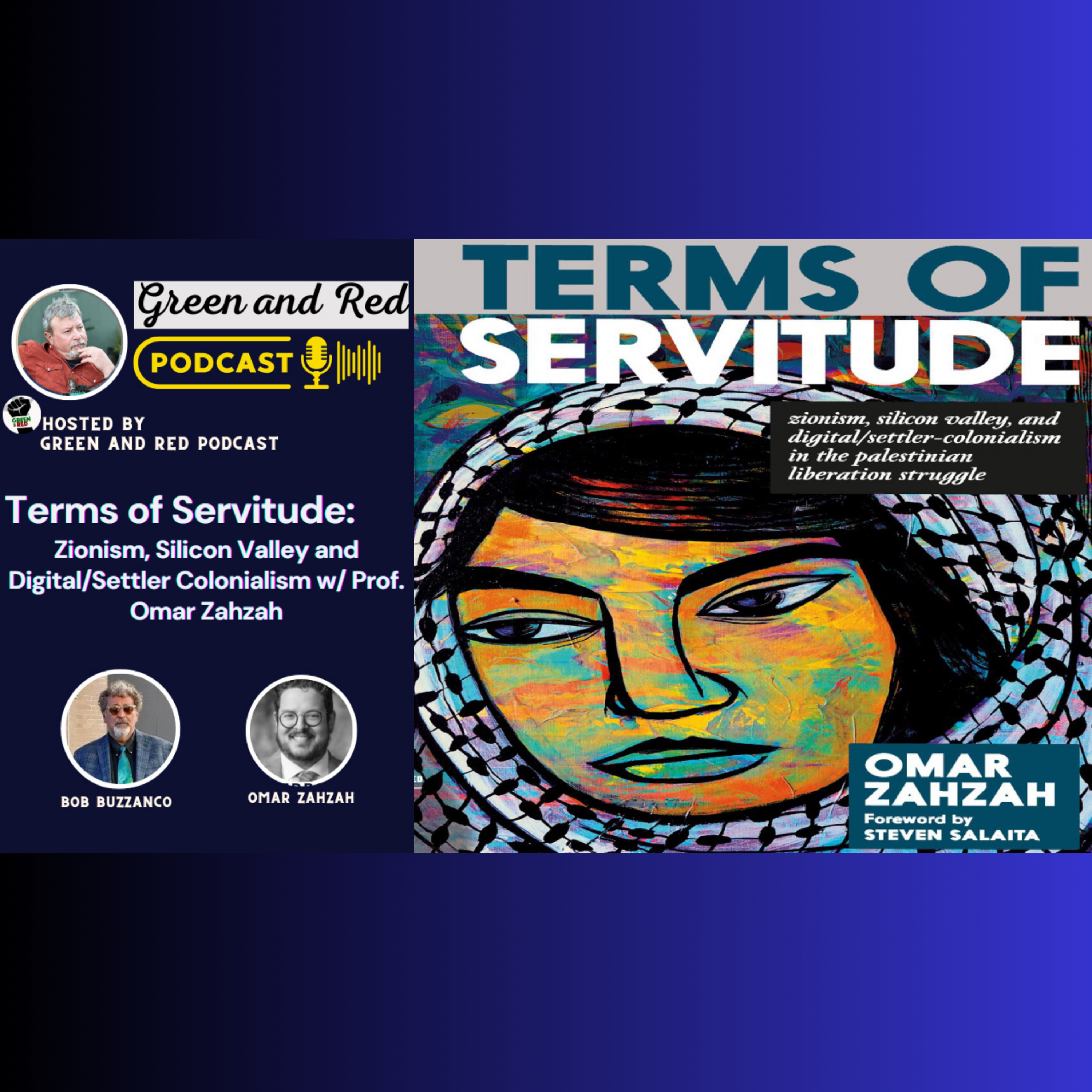
Green & Red: Podcasts for Scrappy Radicals
Prof. Omar Zahzah on Zionism, Silicon Valley and Digital/Settler Colonialism in the Palestinian Liberation Movement (G&R 446)
00:51:28
Loading summary
Transcript36 lines
- [00:01]
A
Welcome to Green and Red Scrappy Politics for Scrappy People, a regular podcast on radical environmental and anti capitalist politics brought to you by Bob Bozanko and Scott Park.
- [00:13]
B
Choose the silky smooth sounds of Green and Red Podcast and your co host Scott Parkin in Berkeley, California today. And as always, I'm joined by Bob Bozanco, Niles, Ohio.
- [00:23]
C
And please like and share. Yep.
- [00:25]
B
Please like and share. Donate like the Green and Red Podcast. It's the end of the year, so we have a lot, we need a lot of support as people decide where to throw their money. Today we're excited to be joined by Professor Omar Zaza, who is a writer, poet and organizer. He's an assistant professor of Arab and Muslim ethnicities and Diaspora studies at San Francisco State University. Professor Zaza, welcome to the Greater Red Podcast.
- [00:53]
A
Thank you so much for having me.
- [00:55]
B
And we're going to be talking about Professor Zaza's new book which is called Terms of Servitude, Zionism, Silicon Valley and Digital Settler Colonialism and the Palestinian Liberation Struggle. As folks who are familiar with the podcast know, we do a lot of shows on Palestine and genocide in Gaza. And so this is a perspective, an angle on the story that we're excited to be talking about. And so Professor Zaza's new book is on big tech's role in silencing Palestinian voices and weaponizing technology in the service of Israel's settler colonial occupation of Palestine. Maybe we could just actually start a little bit. What's seen as the beginning? I know that in 2021 we saw a bunch of big tech companies begin to censor posts by Palestinians and pro Palestinian protesters around when the expulsion of Palestinians was happening in the East Jerusalem neighborhood of Sheikh Jarrah. But maybe we could just actually start a little bit. At the beginning is like, where did we start seeing this silencing of Palestinian voices?
- [01:58]
A
Yeah, yeah, that's a great question. So for me, I mean, at least when I started the project, what really what came to my attention was what was happening in 2021. And I mean, there was eventually period where we started to just see this mass censorship on all of these, you know, prominent social media platforms, what we now call the meta platforms, you know, Facebook, Instagram, but also Twitter of posts about, you know, Shecheraf, which was the, as you mentioned, the occupied East Jerusalem neighborhood where Palestinians were facing their looming expulsion from. And you know, so those Palestinians, you know, took to used a variety of means to engage in protests, but one of the tools that they used was social media. And it just so happened that, you know, they were very savvy at using social media to bring attention to their cause. And so I should say, you know, when we talk about things like Sheikh Shira, like, that's not necessarily an anomaly, like the, you know, Israeli state deciding suddenly that they're going to dispossess Palestinians is. Is very normal actually. But what was unusual about this case was that it gained so much prominence. And I think this was in large part to the skill and the efficacy with which Palestinian organizers and activists really took to various forms of media to broadcast what they were going through. So it wasn't just on the ground protests and demonstration and resistance, but also they were doing this really intentional media work that went viral. And I think this is also due to the fact that this really followed on the heels of the 2020 George Floyd uprisings, which also saw increasing virality of posts related to things like white supremacy, anti black racism, and also had the impact of kind of priming broader cultural and even global conversations about systemic oppression in ways that we hadn't seen, let's say, platformed in a legacy context. Quite in that sense. Right. So I think that really helped kind of set the stage for then the reception that informed a lot of the reception of the Palestinian posts for people who were resisting dispossession in Shakeshear, but which also organically, I think became something bigger and bigger. Right. It came into what was known as the Unity Intifada. You started to see Palestinians from all over basically kind of reaffirming this idea that Palestine is an anti colonial struggle that connects all Palestinians wherever they are, again, kind of reasserting what had really been par for the course from the start of the Palestinian liberation movement, really in the modern sense, from the 1960s onward. So all of that was unprecedented. And I kind of give all of this as background to say that we did see mass suppression, but this mass suppression happened exactly at the moment where you're starting to actually see the effecting of a narrative shift even in legacy outlets that had been the primarily the arch sensors of Palestine up until this point in time. So the background for this project really was kind of seeing all of that play out, right? Seeing both this kind of unprecedented narrative shift that Palestinians had been able to affect through their organizing, through their resistance, as well as their intentional usage of various forms of media, from social media, even to the strategic usage of being platformed on legacy outlets like cnn. There's famous clip of Pam Abdul Kurd who at the time was speaking about, you know, what the dispossession his family was facing. And he kind of makes this famous response to the reporter who says, do you support the violent protests? And he says, well, do you support the violent dispossession of me and my family? And there's this kind of pause, you know, where you can tell this individual. And to a certain extent, this outlet really had not prepared, you know, to be challenged in this way. And it's also, for a lot of us, I think, a bigger moment, like those few seconds of silence was kind of also this affirmation that we are seeing in real time the actual growth of this ability to speak back to these institutions that have silenced Palestinians for so long. And so all of that's to say we're seeing a real narrative shift take place in real time. And then it seems as though these companies, realizing the extent to which their platforms, their social media platforms had been instrumental, however unwittingly, to this process, began to kind of roll back those gains. You start to see mass censorship of posts about Sheikh Shara, mass censorship about posts about Israeli occupation forces incursions, the Al Aqsa mosque, mass censorship about posts of, you know, at the time, the most recent bombing campaigns in the Gaza Strip. And I think we've reached a point now, and, you know, we can talk about this too. You know, working on the book has been a process of going from that initial moment with all of the contradictions that that entailed, to this present moment where we've kind of, you know, we've cleared two years of live stream genocide. Right? But at that initial time, there seemed there. There was kind of a novel aspect to this. I don't think there had been censorship on quite such a scale and in such a targeted way to really single out the posts of a particular group of people resisting oppression as well as those in solidarity with them. And so seeing that kind of got me to thinking about how there's something larger at play here. This isn't just about companies, or this isn't at all about companies making errors in terms of content moderation. We're seeing a very targeted attempt to silence people, speaking out in real time about a very particular act of dispossession that they're trying to resist. And they're using these platforms in such a way as to try to bring about attention to that. And yet these platforms are actively silencing them. And of course, they used all of these pretexts for that. It's a glitch. It's an error. This is unintentional. There's no mass targeting, and we've become familiar with that at this point in time. But again, at this moment, this is relatively novel to the point you start to see a lot of even legacy coverage of this. So that contradiction, those contradictions of these new media outlets or these new digital outlets that pride themselves and often bill themselves as being the alternative to censorship within the mainstream are in this moment kind of stepping into the fore and becoming the new kind of arch censors and recreating the very role of erasure that legacy media had previously taken on regarding the Palestinian struggle. So that contradiction really fascinated me and also got me to thinking that it was important to start to talk about the ways in which we're seeing the particularity Big Tech censorship of Palestinian resistance and anti colonial expression. And that was kind of the seeds of the project. But at that time, I wrote a piece in Al Jazeera and we can talk about this a little bit more. I titled the piece Digital Apartheid. I kind of reversed that in the book, which I discuss at length. But that was sort of the first foray into engaging this topic. And I didn't necessarily expect it to pan out into a book in part just because, again, the specificity of that moment, it sort of seemed like the narrative shift was so palpable that this was only a matter of time before these things get reversed. Obviously two years or more than two years into a genocide, basically. We know that that's not the case, but that was some of the background and the genesis for that project. A large part of what informed it too, was looking at different studies like Race After Technology by Roh Benjamin, seeing how we've had a lot of great critical work that talks about the particular ways Big Tech fortifies specific systems of oppression and racism, but also asking, you know, well, where is the kind of Palestinian, you know, aspect to this? Right, because we were seeing in real time the ways in which these people are so specifically targeted by Big Tech that it seemed important to start thinking about a larger project. And so to kind of make a long story short, that initial piece for Al Jazeera I thought wasn't going to necessarily lead to anything else. But then I start to be commissioned to write article after article about different forms of tech repression that Palestinians and their allies face. And I realized, well, this is actually not going away anytime soon. So it got me to thinking, maybe there is something to trying to create a larger analysis of these things that puts the Palestinian struggle in conversation with a broader focus on the various ways in which Big Tech is actually entrenching various systems and structure of racism, of oppression, and just basically of hierarchical oppression from the top down. And that's basically the genesis of the project.
- [10:53]
C
I want to ask about the various ways this is done, but before that, what type of relationship or process takes place between these tech companies and actual governments, like actual representatives of Biden and Trump? I mean, they kind of think the same way anyhow, but I would assume there's some kind of coordination there as well.
- [11:16]
A
Well, one of the things that working on this project really showed me was the ways that actually there's a huge entrenchment in terms of government representation and working with tech companies. And of course, I think we're in a moment where speaking about the US Government, right, we've seen Big Tech from across the aisle basically really just kind of bend the knee for Trump. We've seen these various companies kind of rolling back the somewhat progressive policies that they'd had in place as a way of kind of trying to play into the Trump moment even more. We're seeing capitulation with processes such as surveillance. We're seeing a lot of alarmism regarding to what extent do these companies even collaborate with various police forces? Are they collaborating with all of those things is just a massive pivot from. Well, not so much of a massive pivot, if we understand a lot of it's been window dressing. But nevertheless, there was at least a veneer of these being progressive liberal to progressive oriented companies trying to use their products, generally speaking, to bring about a change for the social betterment of people. They've thrown that out the window in this moment, which at the very least should really affirm that a lot of this was just cynical branding from the outset. But I think the other aspect that's important is the massive collaboration that you also see with the Israeli governments. Part of working on the book showed me just how centralized a lot of this becomes, particularly from the 2010s and on. You have a Facebook delegation that I believe takes place in 2016 to go to Israel between representatives of Facebook meeting with the Israeli government to talk about issues of so called incitement or terrorism on the platforms, which really coincides with the Israeli state's streamlining of the mass arresting of Palestinians for their social media posts. And you have rights organizations like the digital rights organization Hamlet Adala, these various rights organizations writing about how in fact social media companies were massively agreeable to take down requests from the Israeli government proposed on their platform, often made by Palestinians, and especially From, I believe 2015 and on, you really start to see the percentage of these kind of basically 95%, if not higher. And you can find those reports from the Hamlet and Adala websites. You also have. Part of what I also look at in this project is, and this was kind of a surprise to me, I mean, I expected all tech companies to be complicit in this, but the degree to which Meta is complicit was actually a little bit staggering. I mean, it's not just the delegation that really coincided with this timeline of continuing to mass arrest Palestinians for their social media posts, but you also have, I believe this is later on, just prior to 2020, I believe need to double check the dates. But basically you have the appointment of officials like Emmy Palmer, who had helped to start up the Cyber unit, which streamlined this process of mass arresting Palestinians for their post to now Meta's oversight board. I think in 2016, you have the appointment of Jordana Cutler to this position of the representative for Israel and the Jewish Diaspora. And so you not only have this intensive collaboration that is documented with the Israeli government, but actually the appointment of officials who have streamlined the mass criminalization of digital usage of Palestinians on the part of Palestinians, as well as the creation of new posts to basically normalize this process all the more and normalize the completion arguably of antisemitism and anti Zionism. And these are people who are very upfront about and proud of their, you know, both past and ongoing connections to the Israeli government. And, you know, the Intercept has done really important reporting about this, some of which I talk about in the text, but all of which is to say that actually there's a very intensive and not really very much hidden collaboration that you see between governments and between these companies. And it's very clear that a lot of these decisions are being made at the direct behest of the Israeli government. And also as we're seeing kind of in this opportunistic way, also sort of trying to see which way the wind is blowing regarding the current configurations of the US administration. And now we're at a very dangerous moment because we've seen essentially an unchecked genocide and we're seeing this arguably authoritarian US administration. And so the convergence of these two things that it seems Big Tech is very happy to enable kind of should leave us with some very serious concerns about what's next and how we need to be managing ourselves digitally, let alone what this means for the Palestinian struggle.
- [16:26]
B
Thinking about some of the methods in which they're using to silence Palestinian voices And Palestine solidarity voices, because you talked about in 2021, in the aftermath of 2020 and the George Floyd murder and the movements that really rose up on that. I had really noted at the time when Sheikh Jarrah was going on, that we saw a lot of youth, youth of color really in the streets around the Palestine issue, which I hadn't seen. I couldn't recall a time where I'd seen it at that level. And so is there an element where we're seeing these international solidarity movements with Palestine is somewhat triggering of the censorship and the repression?
- [17:09]
A
Yeah, I think that's a great question. And I think it's. I think it's very likely. I mean, it's clear that there has been, and at this point, especially in light of the genocide, continues to be massive support, you know, for the Palestinian cause and just massive outrage, you know, at Israel's actions. And I do think that the intensification of both of those things, there is something to say for the fact that it is kind of expediting, let's say, some of the anti Palestinian content moderation that we've been seeing across these platforms. And I think it's important too that a lot of as scholars and activists have talked about that the kind of alliances we've seen, they're not necessarily emerging for the first time, but it's more of a resurgence of the kind of internationalism that we saw decades prior where you have this kind of third world liberation front oriented kind of anti imperialist political sentiment. So even a lot of organizers that take to the streets today that are affirming their solidarity with Palestine, but doing it in a way where it's not just kind of a one sided solidarity, but it's this understanding of solidarity, of the interconnection of all oppression. Many of them are very upfront about the fact that this is building on legacies of precedents of resistance. So I do think that there is something to the fact that, you know, these kind of rekindling of these sentiments, particularly in this way, is alarming, you know, and could be leading to an upsurge in the censorship and the repression that we have been seeing. Do you want to talk about kind.
- [18:48]
C
Of some of the ways this is done? You mentioned you have kind of quite a few erasing or erasing, I don't know how you say it, shadow bands, trolls, so forth. Do you want to just kind of describe a little bit about the way they do these? Because they have like this like really kind of wide breadth of tactics they can use.
- [19:11]
A
Yeah, yeah. Definitely. So I mean, one of the things I was really trying to do with the book was to account for the various ways that we see the, the weaponization of the Internet work to facilitate on the digital sense, you know, the physical process of settler colonialism and expulsion that Palestinians face. And of course, you know, that brings up several aspects, let's say, of how the Internet becomes weaponized, you know, against Palestine focused expression. One of the things that I looked at, you know, is the ways that, you know, Zionists, the Israeli state will often rely on blacklists, you know, like Canary Mission or like stop anti Semitism and you know, even newer ones that kind of follow the same essential model of kind of, you know, presenting organizing or activism as anti Semitism and then creating a list of people, you know, who should be variously harassed or you know, face repercussions for their views or expressions. Another thing that we see the Israeli state relying on is the especially, I would say probably about a year and a half in or so I talked to people who were reporting just being flooded by these increasingly sophisticated bots. So you had these kind of super bots that could be programmed to basically swarm onto people's posts. And so you had the refinement of these LLMs, these large language models basically that could create these bots that would come on and just kind of repeat the same talking points, but do it to such a degree and at such a scale that it could often be overwhelming for people. And this was something that Israel had partaken in. I believe it was reported that there had even been factions in India that were participating in this as well, also kind of regurgitating Zionist propaganda. There's also the millions and millions that Israel itself puts into propaganda, or hasbara is the term that they use for it. And we're also seeing increasingly, you know, I mean, with the TikTok ban, you know, or the TikTok divestiture that we've seen. Now there's a whole other aspect of this we can talk about, but just an attempt to really inflict a top down control on a lot of these platforms. You know, you've had Netanyahu coming out and saying, affirming the importance of social media influencers basically to create new propaganda basically to counter a lot of the Palestine related sentiment. Now in terms of the companies, you know, some of the things that I look at is the usage, the kind of normalization of what I think of as anti Palestinian content moderation policies and you know, the, we've seen, for example, meta kind of normalize this process of using their community standards as a way to kind of inoculate against anti Zionist expression on their platforms. And, you know, they, they kind of formalized this process of doing that by essentially accepting the equation of antisemitism and anti Zionism and releasing policies that talk about how they're going to police, you know, anti Zionist expression on their platforms. And of course, they start out by, you know, essentially they suggest that they're going to do this in such a way just to make sure that Zionist is not used as a proxy for Jew. But of course, as you know, rights organizations have pointed out for years because they had been considering and even implementing various degrees of the strategy for years at this point. The problem is that there's such an overreach, right. That it's very clear that the idea that, you know, that they're just trying to be cautious and make sure Jewish people don't face discrimination is basically just a false alibi to allow them to inflict precisely this kind of overreach that could, you know, that does result in censorship, you know, of posts that are in no way anti Semitic, but are about either the political ideology and project of Zionism or the violence of the Israeli state. Right. So the usage of, you know, these policies and kind of smuggling in a false completion of anti Zionism and anti Semitism on the part of these companies is another way in which we often see the normalization of, you know, anti Palestinian censorship. So in the book, you know, I talk a lot again about Meta, which is kind of one of the, I guess it's the standout case study, but I also did talk about even Twitch, which, you know, followed suit with meta's example, you know, and introduced its own kind of policy regarding anti Zionist speech as part of its hateful conduct policy. So there's really a variety of ways that the companies do this. When I was, what I was writing about in the chapter Erasing Palestine, you know, I was trying, I was making this argument that when the companies erase posts or when they suspend accounts or when they even ban users, it's really more than just the individual content of the post that's being targeted because the Palestinian struggle at its heart is really an anti colonial struggle and it's one for the total liberation of land and people. And following that, there is this broader ideal of a decolonized Palestine that really, I would argue, informs, you know, Palestinian resistance. Right. From Palestinians all over the world. Right. Not, you know, including especially in Palestine, but all of us who happen to find ourselves, you know, Wherever we may be thinking about both the importance of, you know, liberation in the future, but also understanding that we have known and continue to be connected by a Palestine, you know, that existed prior to colonization. So it's both of those things. So what I was arguing in Erasing Palestine is the companies don't just censor or delete the posts or ban the users. They're also effectively undermining or trying to erase that ideal that connects all of these people in this process of anti colonial resistance and the affirmation of a collective identity essentially. Now I, I'm not really a pessimist, so I don't necessarily think it works, but I do think it's important to understand it at that level because oftentimes social media is one of those things that we can just take for granted because it seems so everyday. It's something that we have to use in various capacities that we may not even take seriously. But I think the stakes of a lot of this are actually really important. So that's part of what the book was created to highlight.
- [25:45]
B
One thing that comes to my mind is that despite all of this, it seems that the Palestinian cause is. There's much more support for it than there has been as far back as I can remember. I look at polls like only 7% of Democrats support Israel and support the genocide. And the numbers for Republicans are also very interesting as well. And then you have people like Sarah Hurwitz and Hillary Clinton coming out and saying that we need to get youth off of social media or they need to stop paying attention, getting their news from social media because it's led them to think that Israel's committed a genocide. And I'm wondering, despite all of what the big tech has been doing here, which I agree, I see shadow bans every day on all these different platforms that we operate on. But it also seems it's been a very successful campaign to raise the awareness about the genocide, that more people believe it's a genocide than I think don't. Right. So I'm just wondering what your thoughts are on that.
- [26:42]
A
Yeah, absolutely. And I mean, I think what's happened too is that to a certain extent, I think these companies are sort of, they're relying on an idea of how to operate that I think is based on a certain cultural primacy that doesn't totally exist anymore. Now, I mean, it's true that we're all still on these platforms, but I think at this point we've lived with them for so many years, we've seen them evolve and I think most users, and we're talking about various generations of people at this point are savvy enough to understand at this point, like, okay, if I'm not seeing something, it doesn't necessarily mean it's not there. I'm just going to have to go somewhere else and seek it out. So I do think you're right. We're seeing this massive upsurge of support for Palestine, opposition to the genocide, even as we're seeing this kind of increasing attempt to censor these platforms, you know, even more intensive than they're already being censored. But then the question is, what is that actually going to lead to? You know, one of the things I keep coming back to is this idea that you can't really reverse people's consciousness, right? Somebody who's seen this genocide, who's seen these streams, understands what it is. Newer people who've sort of been activated. And, you know, I've even taught a lot of students who have said that really, it wasn't until October 7th that I started to pay attention and. But, you know, a lot of them are aware that there isn't a, you know, a huge imbalance of power and an oppressive situation that's going on. And they say this without even, I'm not saying it in the same way Hillary Clinton says it, but they will say, like, I didn't necessarily know a lot about the history, but I know what I'm seeing, you know, and this, you know, adjust ultimately. Right. The, the other thing, the other thing.
- [28:28]
B
On TikTok is that a lot of it is Israeli soldiers live streaming their war crimes.
- [28:32]
A
Exactly. Yeah. Yeah. And, and that's, you know, something I, I looked at in the book as well. Like, part of this, so much of this is you literally have occupation forces, soldiers broadcasting their destruct, their decimation of, you know, of Palestinian infrastructure, their torture, their sadism of Palestinians. Like, and then, you know, there's this surprise that people respond with this outrage. Right? I mean, there's just the level of narcissism and the level of arrogance, which I would argue really are colonial narcissism and arrogance. You have to, have to really think that there's, you know, there's absolutely nothing wrong with doing this. And you also, you know, it's somebody demonstrating in real time that this is a genocidal and a racist and a fascist project. Like, your sense of the dehumanization of these people you're colonizing is so intense, you have no problem broadcasting your violence to the world. And then you react with Surprise when people are outraged by this. Right. So in a sense, too, it's really, you know, the state has also, in many ways, done this to itself. Right. And again, I think all of that is very palpable to people. I think a lot more are. Have been activated by this. And I don't think that you could really undo that sentiment. Even if you censor these platforms, even if you ban these users, that's not really going to take away from the fact that people have just been galvanized. And, you know, I get very hesitant to say ways we haven't seen before, because I do feel like sometimes we can have these epiphanies and movements where we say, like, now, you know, things seem much different now, and yet things kind of stay the same. But I do think that there's something very different about this moment. I mean, you know, this unprecedented scale of, you know, horror with the genocide, you know, just among many other things. And I do think that people are seeing the writing on the wall and en masse in ways that have. We have not experienced before. So, again, you know, it's clear that they're trying to censor, you know, you know, at an expedited rate in response to this. I don't know how effective that's actually going to be. And I think, even though I think in many ways we're still really kind of stuck under the hegemony of a lot of these platforms, you know, which also stems from the fact that they, you know, they operate as these cartels, and they're trying to make sure there isn't anything really beyond them in particular, really, the American domination of big tech. I think many of us have been here long enough to understand that, well, we kind of know how this works. We're going to know how to find things. And that's actually when I talked to Ramzi Barud, who was founder of the Palestine Chronicle, this was something he expressed to me, too. He said, well, our engagement on Facebook has really been throttled. But at the same time, we know that people are savvy enough now to just go to our main site so people don't just look for us on social media anymore. Even they know when they want to see a new headline, they're going to go directly to Palestine Chronicle first thing. And so people are just becoming better at navigating this terrain. And I think that the censorship needs to continue to be resisted. I don't think it's something that we should take for granted or normalize in any way, but we also shouldn't assume that it is having their desired impact of just making people stop thinking about these things or resisting it, because that's definitely far from the case.
- [31:48]
C
In addition to suppressing what other people say, these companies are also working directly with the government, with the IOF and so on, aren't they? Like actually providing data and locations and so forth?
- [32:05]
A
Yeah, absolutely. So, you know, in the book I do a lot of it is focused on social media, but I also talk about, for example, like, you know, you have these collaborations regarding AI, Right. And another aspect of Meta's entrenchment in this, and I pull from Paul Begar, who is a co founder of Tech for Palestine, his research on this too. Right. But one of the things that, for example, Meta had done with WhatsApp was it was sharing the metadata of users in their chats. And that was being used to actively target Palestinians for murder, basically. And that's part and parcel of this broader kind of usage of different software and AI programs to target both Palestinian infrastructural sites, civilian sites as well, and individual Palestinians for assassination. So the increasing usage of technology to generate these kill lists and these strike lists of individuals and of targets. So, you know, and there is a direct collaboration with the Israeli government to help it, you know, refine its capacity to do this. Right. Whether it's, you know, Meta sharing that metadata or, you know, Google or Amazon, you know, helping provide the iof, you know, the Israeli government with the cloud storage, you know, to, you know, continue to refine these AI programs. Something else that I looked at, which was after the book was published, you know, the manuscript was sent off, but that I, what I did for, in terms of my reporting for Electronic Intifada, we found out that Dell Technologies also provides a lot of the hardware that's used to power these kill lists. Right. And you know, you'd had the surveillance infrastructure that, you know, Microsoft was undergoing regarding, you know, the recording of calls that was being stored. And of course then later on it comes out that that's being reversed due to the organizing. But so there's just across the board, you have this massive scale of collaboration on the part of big tech. And this is also why I keep coming back to the report that Francesca Albanese did, I believe in June 2025, which basically argues tech is its own very entrenched partner in colonialism and genocide. And so part of the work you need to do at the international level at this point is to start seriously thinking about ways that we can charge the CEOs, we can charge the officials and the employees of these companies for complicity in colonialism and genocide. Because oftentimes tech likes to use this premise of, well, we just provide particular services, we have no say in how our clients use them. And it's a kind of false middle grounds rationale that we've seen in all kinds of tech companies, from Uber to the various companies now that are trying to kind of sidestep their complicity in genocide. But I think we really need to continue to think about how do we actually hold these actors responsible, right, and have some point of leverage. Because right now tech really exercises this kind of. It acts with this impunity, I should say, because it exercises so much of this hegemony on our daily lives, right? From our social lives to our professional lives to our medical lives, right. All of these companies are really deeply entrenched and determining of so much of the social infrastructure of our day to day existence in ways that really haven't been the case before. So nevertheless, I think we need to think about ways to actually undermine their hegemony and create points of leverage and even of accountability. And I think that that report by Francesca Albanese is a very good example of how to start thinking about that.
- [35:48]
B
And have you seen successful examples of that? I know there's a group active here in the Bay Area. I think it's other places called Tech Against Apartheid, friends who are tech workers who are part of it. But have you been seeing like where we're starting to see some, I wouldn't call it say quite say success, but where have we been seeing people like movement, Movement on that, progress on that?
- [36:09]
A
Yeah, I think no, Tech for Apartheid is a great example of that. And I think, you know, and I do write about it a little bit in the book as well, but I think part of what makes it such a powerful example is it's the intersection of this opposition to tech for genocide as well as labor struggles coming together in one. I think that that's really one of the most potent points of leverage because this is the literal workforce. Although at the same time we've seen these companies grow increasingly kind of, I don't know, autocratic perhaps is the word regarding their labor forces. Yeah, yeah, yeah, let's say. But nevertheless, I think that that's a really important example. You know, Microsoft workers, you know, I think was exactly on the same vein where you have people who are actually engaging in direct action against these companies in ways that really unsettle business as usual, that confront people directly, that make them uncomfortable and that force, you know, this immediate reckoning with the actual implications of the decisions that they're making. I think those are really good examples. Other examples that I've seen is, you know, from talking to people who act as whistleblowers, I think, you know, it's easy to kind of feel fatalistic or that you can't do anything. But even if you are tech worker, you're somebody who has direct access to a lot of this machinery of death and dispossession. So you can be a whistleblower, you can engage in direct action. There are ways to throw a wrench in the cogs. And I think for all of us, there's also the continued need to speak out and to continue to engage in demonstrations and wherever possible, to also find ways to call for boycotts or stop using these products which they intentionally make very difficult. Right. But I think there are ways that we can continue to raise attention, you know, whether it's in our workplaces or whether it's, you know, in various other institutions we happen to belong to, that, you know, what are the actual. What is the track record of these companies regarding their complicity in the genocide and the military occupation and apartheid? It's on the one hand, it's much more difficult because of how entrenched these companies are, but on the other, as we were discussing, there's so much more outrage and support for Palestine now that I think that that's a powerful force that can be leveraged and it can do things that seem as though they are impossible, but they may not be impossible. They may actually be a little bit more possible than we might expect.
- [38:46]
C
Not long ago, maybe a few weeks, maybe, YouTube took down, I think, 700 sites. Was that kind of based on kind of an algorithm looking for keywords, or were there actually people reporting, hey, you know, you need to get rid of these, these channels?
- [39:03]
A
Yeah, I think it's a combination. I mean, we definitely know that there's a heavy reliance on algorithmic targeting, but it's, you know, also mass reporting is, you know, one of the tactics that, you know, supporters of, you know, of Zionist basically will use, you know, to make sure that Palestine related content is taken down. And, you know, it's one that they've used to very good effect, you know, for years and years. So I wouldn't be surprised if what emerges that it's basically some kind of a comb of those two things working together, though it's undeniable that the algorithmic targeting is becoming increasingly sophisticated. And, you know, that's the one that companies tend to rely on, especially in this day and age. So I would say it was both. But you know, the takedown of the YouTube videos as well as, you know, meta's deletion, you know, of the Instagram accounts, you know, of the Saleh Al Jafarawi, you know, the Palestinian journalist who was assassinated by an Israeli aligned gang zoning online group. I should say all of those things are very disturbing because for a long time we've kind of had this adage that the Internet is forever. And I think there was this assumption that even as you have this kind of ongoing censorship, you at least are still going to have archives of the genocide and archives of colonial violence that later on can be utilized right as the ongoing both litigation, both in the literal sense and in the kind of broader public ethical sense of these crimes, which needs to continue to happen and which if for nothing else, just that the sheer scale is so overwhelming and now we're seeing that that's not the case. And I think part of what I was trying to do with this book was to kind of provide sort of a collective language that we can use to link things that seem somewhat disconnected, like the anti Palestinian content moderation, the deletion of individual accounts that are basically reporting on Palestine, the blacklists and targeting of individuals for their expression with digital settler colonialism. I was trying to provide us with one phrase that can be used to link all of these things so that we can kind of see it as stemming from the same source, which is this collusion on the part of Big Tech and the Israeli state to ultimately excise Palestine focused speech from their platforms altogether. In the same way that the Israeli state hopes to successfully realize its total conquest of Palestinian land and elimination of Palestinian life and culture from Palestine.
- [41:39]
B
I think we're getting towards the end of our time. One question I had just because there's some pretty known pro Palestine media sites like Mondawis and Electronic Intifada and others, but I'm wondering how specifically targeted are sites like that?
- [42:05]
A
So fortunately sites like that are still going strong, but they are pretty targeted. I mean I talked to, you know, I've talked to Nora Barrows Friedman for example. I know we both know, you know, chew to me like she'll keep me updated on, you know, the, the censorship that they face on sites like Instagram where they try to host their content. And you know, so at one point Mondoweisse 2, you know, had, you know, reported takedowns or the takedown or the suspension, I believe of the accounts of Hamid El Kurd, who now works for them as well. You know, um, so they're, they're in no ways immune from this type of censorship and this type of targeting. Um, I think the advantage that they have is they have such large followings and such a built in kind of audience base, but nevertheless, they continue to be, you know, to face different forms of strikes or suspensions, you know, EI or electronica. They even mentioned that they'd had a few some issues, I believe, trying to live stream as well. So it's clear that from all levels, companies will still continue to try to censor them in various ways. And again, this could go back to what we were discussing earlier, where part of this works off of mass reporting, which is kind of like a tag team approach where you have individuals who will try to get together and mass report content. So then the company eventually itself takes it upon itself to do something. So, yeah, I would say they definitely still face a lot of censorship, but I do think the base is an important kind of asset in regards to that. And I also do think that the increasing sophistication of all audiences to the nature of the terrain that we're navigating when we go on these sites is helpful because again, it brings me back to Ramzi Barud when he says, well, our followers know what to do now. If they can't find us on Facebook, they're going to go somewhere else. So I'm hoping that all of these sites retain their accounts and continue to go strong because they perform such an invaluable service for all of us. But I also am confident that at this point we're wise to the game and so we have no illusions about what these tech platforms actually represent.
- [44:25]
C
One just quick, we know that these big tech companies are transnational. They're operating everywhere. And in the US there's clearly, you know, kind of a official, kind of official role in this, right? Musk and Trump working out and so forth. What about in other places? Britain, Germany? Is there the same kind of collaboration there?
- [44:46]
A
There's, there's similar collaborations for sure. And I think, you know, and I've also talked with organizations that operate transnationally and have faced various forms of oppression. So, for example, you know, one of the chapters I talked to Sammy Doon, you know, and they discuss, you know, how they'd had, you know, just outright, you know, bans regarding their content in Germany. I believe on Twitter, you know, they were also just fully taken down from YouTube. That was kind of the impetus for the article that became the chapter in my book. So it's. I do think there's. There's also definitely a dynamic where censorship can kind of be particular to certain countries. And you know, Germany has been particularly egregious for a lot of people who post on Palestine, just even on the tech front. But kind of stepping aside from the Palestine focus context for just a second, the thing that is a little bit distinct about Europe is I do think that they have slight differences regarding their overall moderation policy. So again, kind of stepping outside of Palestine for just a moment, that kind of creates slight distinctions in how they will moderate. But I think it also at least nominally lessens a little bit of the impunity that especially the US origin big tech companies may exercise. So I think in the US in particular, I think we face a very particularly unmitigated form of just complete, total control. And I think insofar as this interfaces with the anti Palestinian political bent of other countries. In Europe, for example, people will continue to face that too. But we do have slight distinctions in terms of how moderation operates from the US also into Europe, at least nominally. So I do think that regarding content more broadly does lead to a little bit of some distinctions in people's experiences. Again, not necessarily with Palestine, but regarding other issues, we may see a little bit of a distinction here and there.
- [46:48]
B
I guess that would be my final question in relation to that is we're seeing a surge of repression in this country and we're seeing a surge of resistance to that repression, thinking particularly of ice, but also related to Palestinian issues last year with the campus uprisings and things like that. And so how much of this model that's been really focused on the Palestine solidarity movement and the Palestine, the Palestinian cause is being applied to anti ICE efforts, for example? Well, anti fascist efforts.
- [47:21]
A
Yeah, yeah, no, I, I think a lot of it is. And you know, in large part, because what we also saw in terms of the repression was kind of the consolidation of all of these causes into kind of one sort of amorphous target, if you will. You know, the Palestine, Palestine activism suddenly becomes linked. Well, not suddenly. Right. But it's always been kind of associated with terrorism with various forms of political deviance. But now where you also have this heightened, you know, racialized targeting of individuals with this newfound kind of building up of ice, let's say, and you know, kind of deputizing it as this, you know, just this ultimately this terror force really against people for various things that should be in no way penalized, especially not to the extent that we're seeing, but we've even seen them used as kind of disciplinary forces for Palestine students who are expressing support for the Palestinian cause. They are kidnapped and disappeared. So I think that the degree to which the repression itself is consolidating these causes is in turn continuing to remind others of the importance of seeing how these causes are all interlinked. And so I don't think people are acting at this point as though anti opposition to ICE targeting is in any way distinct from Palestine targeting. So I think that there's actually, even as we're facing very massive repression, people are realizing that all of these causes need to be navigated in an interconnected way because ultimately they are interconnected struggles. So I think the ongoing resistance to these things is actually making a lot of connections and we're seeing the consolidation of various forces of political dissent and being outspoken for freedom and liberation for all peoples, connecting the Palestinian struggle to the ongoing struggle against settler colonialism here, against racism here, you know, for indigenous liberation here, and also, of course, you know, against this latest violence, impunity with which we're seeing, you know, the carceral police state kind of unleash all of its technologies of death and dispossession on people. I think we're very much linking those causes together.
- [49:46]
B
Do you have anything else, Bob?
- [49:48]
C
No, no, thanks. Thanks so much. Tell us the name of the book again and how to get it.
- [49:55]
A
Yeah, so the book is Terms of Servitude Zionism, Silicon Valley and Digital Settler Colonialism and the Palestinian Liberation Struggle. It's out from both the Censored Press and Seven Stories press. So you can find it on the website of either the Censored Press or Seven Stories press.
- [50:12]
B
We'll put that in the show notes as well. Folks, we've been talking with Professor Omar Zaza, professor at San Francisco State University and then also author of Terms of Servitude. If you like what you're hearing, please check us out on Facebook, Instagram and Twitter bluesky. Speaking of social media platforms, if you're watching this on YouTube, give us hit that subscribe button. If you're listening to us on the audio platform, give us a rate and review. If you really like us, go to greenredpodcast.org and hit the support button or become a patron@patreon.com greenred podcast. Professor Zazan, it's been great talking with you. This is a fascinating topic. I'm really glad we'll have to have you on again some time to talk more about this at some point.
- [50:51]
A
Yeah. Thank you so much for having me. I'd love it.
- [50:53]
B
Everyone else out there make trouble and misbehave, and we'll talk to you again really soon.
- [51:13]
A
Sam.