← Green & Red: Podcasts for Scrappy Radicals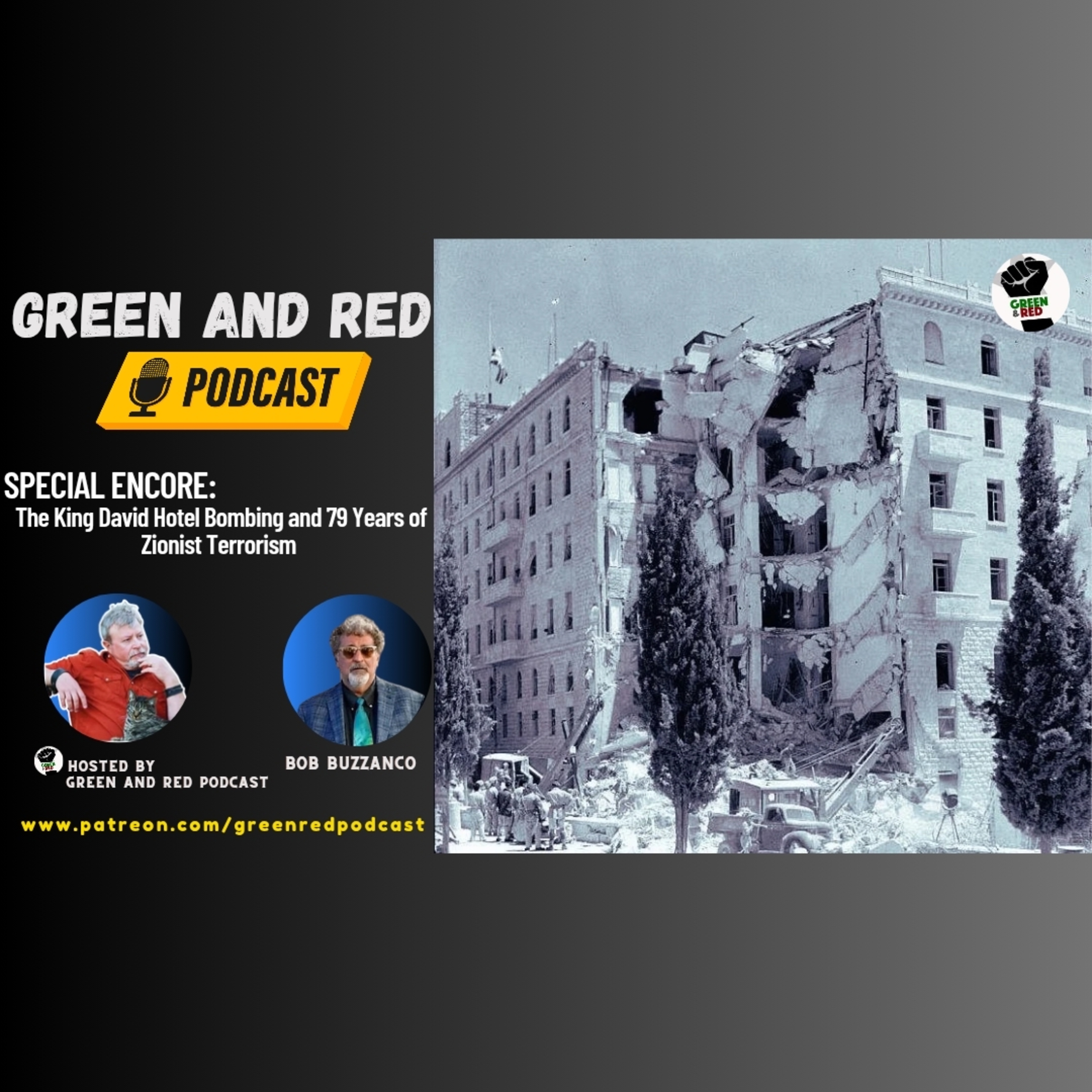
Green & Red: Podcasts for Scrappy Radicals
SPECIAL ENCORE: The King David Hotel Bombing and 79 Years of Zionist Terrorism
00:07:30
Loading summary
Transcript4 lines
- [00:05]
A
Often start with a kind of this day in history kind of thing. And we didn't really plan on that. But then something, thankfully, I remembered not long ago, but on the day we're recording, we're recording us on, on July 22 and on July 22, 1946, 79 years ago, a group of Israeli terrorists, the Iron, blew up the King David Hotel in Jerusalem. And I think it's particularly appropriate to mention that today because what we're seeing in Gaza and the west bank and really all over the region is a continuation of what Israel has been doing now for, you know, almost eight decades in this particular context. After World War I, the Europeans divided up the old Ottoman Empire and gave these European nations like the British and the French mandates over them. Mandates are basically control. They were mandatory systems and the Mandate for Palestine and remember, it's Palestine there. You know, Israel went to the British. However, during World War II and especially because of the Holocaust, there's the significant impetus now for the Zionist Project, which I'm sure we all know about, right? And so after World War II, you started to see an influx of European Jews, especially into Palestine. And they wanted the British out, the only thing. And the Arabs, you know, the British are an occupied force and the Arabs didn't, didn't get along with them either, right? But the, the Israelis wanted the, the British out. Now the Jewish settlers created a military wing called the Haganah. Offshoots of that were what we would definitely refer to and were called at the time terrorist groups, one of which was the Irgun, which was led by Menaka Megan, who would later become Prime Minister of, of Israel, which would be like making Charlie Manson the pre. So the Haganah and, and even more, the Irgunt wanted the British out. In 1946, the Haganah was working closely with these international groups of Jewish settlers who were coming in. And the British found out about that. They did an undercover operation and they got hold of documents linking Haganah to these terrorist activities. And because of that, Ergan wanted to get that back or to destroy those documents. So on the morning of July 22, 1946, they put bombs in a pickup truck that they had hijacked and they delivered them to the kitchen, which was on the basement of the King David Hotel. King David Hotel was a functioning hotel. It had guests that had, you know, convention rooms and hotel rooms and, and whatnot. And in one of the corners, the British Mandate Authority was, was headquartered. And so the Irgun brought these bombs in. And Menaka Begin said that the goal was to turn Palestine into a glass house with the entire world looking in. This was planned as a terrorist activity to terrorize the British and to force them out. So that was the purpose. It wasn't, you know, they didn't cover it up like they're doing today. You know, it's Hamas or it's humanitarianism or whatever, right? So these Irgun operatives go in, they disguise themselves as Arabs, they work afias. They planted the bombs and it exploded, it blew up. This is probably the first major act of terrorism directed at a media audience, directed at a public audience, Right. It wasn't just to attack a certain individual or group of people who would then be frightened off. It was directed to the entire world. And it succeeded on that level. 91 people were killed. The majority of them had no connection to either the British mandate or any kind of political operatives. Right. I think of the 91 dead, I believe about 30 or so were British and about 20 were Jewish. Which is, you know, similar to October 7th, when, you know, after the initial misinformation that the New York Times and others fed us, we found out that about 400 of those Jewish concert goers that day, on October 7, 2023, were actually killed by the IDF. Right. So the King David Hotel bombing is really critical. It's an act of terrorism, open act, a dedicated act of terrorism. And that was the purpose all along. That was the intent all along. And it worked. It worked. The British didn't have, you know, that much interest in the area to stay there and risk more bombings and more terrorism and spending more money there. So they got out. And then, you know what, two years later, you have the creation of the State of Israel looking way ahead now, kind of fast forwarding significantly, you know, what we've seen in the last, what, 20 months is this media narrative about terrorism which generally focuses on Hamas. And October 7th is seen as like, day one, right? You know how they call the atomic bombing day one? Well, that's kind of how this particular crisis now is being kind of, you know, sold, right? This is day one. This is when it all began. Well, this, you know, anybody who studied this knows that's preposterous. But with regard to kind of the idea that terrorism is a, is. Is a fully operational idea, and what Israel does, what Israel has always done, what it did before it was even Israel, is really critical there. And so, you know, again, not that we really need the information, you know, not that anybody who is a hardcore Zionist is going to accept any kind of countervailing evidence anyway. But, you know, it's very clear that we now have, you know, mountains of evidence that these terrorist activities, you know, have been going on for about eight decades. The King David Hotel bombing preceded the Nakba by a little bit. Right. And, you know, it led into, you know, what we now see is this, you know, really in most ways, uninterrupted attack on Palestinians all over Palestine, in Gaza, in the west bank, and, you know, it also spreads out into Lebanon and Iran and Syria. So Israel as a terrorist force, in this particular case, the Irgun, led by future Prime Minister Menachem Begin, bombed the King David Hotel, killed a significant group of British mandatory officials, British government officials, and it used that as a springboard to get statehood and to begin the eradication of Palestinian culture, Palestinian society and Palestinian life. And so it's an important event. And, and we, you know, it's worth thinking about today on this 79th anniversary. Yep.
- [07:15]
B
I'm going to segue to the next thing.
- [07:17]
A
Sure. Okay.
- [07:20]
B
Thanks for sharing that, Bob. I think that's a. I think it's an important this day in history, which we actually haven't done in a while, but I think it's an important one to mention today, particularly with.