← Green & Red: Podcasts for Scrappy Radicals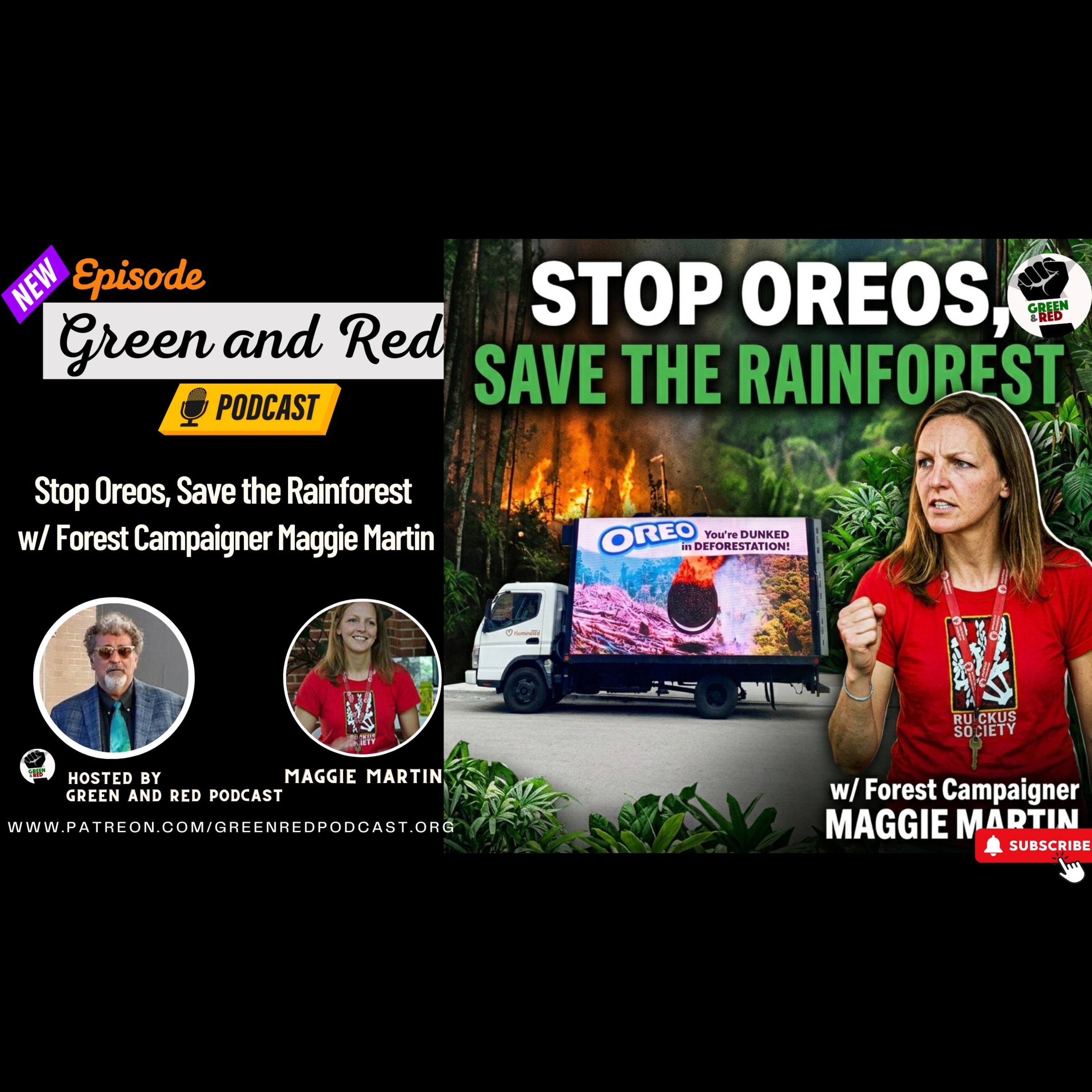
Green & Red: Podcasts for Scrappy Radicals
Stop Oreos, Save the Rainforest w/ Forest Campaigner Maggie Martin (G&R 474)
00:12:47
Loading summary
Transcript31 lines
- [00:01]
A
Welcome to Green and Red Scrappy Politics for Scrappy People, a regular podcast on radical environmental and anti capitalist politics. Brought to you by Bob Bozanko and Scott Parkins.
- [00:14]
B
Welcome to the silky smooth sounds of the Green and Red Podcast. I'm your co host, Scott Parkin in Berkeley, California. Bob is off on a sign today, and that's okay because we're gonna be talking a little bit about what's a little bit more in my wheelhouse than his, which is we're going to be talking about environmental issues and rainforests. And joining me for that today is Maggie Martin, who is a forest campaign manager at the Rainforest Action Network. Maggie, welcome to the Green and Red podcast.
- [00:48]
A
Hi. Thank you for having me on. I can't believe we haven't talked already.
- [00:53]
B
I know there's many other things we could talk about that we should and probably stuff we could invite Bob to.
- [00:58]
A
I know I'll have to come back again soon after this wrap.
- [01:01]
B
Yep, yep, totally. We're going to be talking about Rainforest Action Network's campaign that is focused on Oreos and we're going to get into that March 6, which is this Friday, is a day of action to stop Oreo. So maybe we could start off with what's the problem with Oreos?
- [01:25]
A
Okay. Oreos are delicious, we can all admit that, I think. And so I understand why people want to eat them. And we actually don't have to stop eating them, but we can do some extra work to make them more just so the problem is there's deforestation and rights abuses, land grabs tied to commodity expansion in places like Indonesia as well as other places around the world. And the maker of Oreo is Mondelez International, and they're doing business with producers on the ground in Indonesia and other places for responsible for these land grabs who are responsible for deforestation, both legal and illegal deforestation, but in violation to their commitments that they've made for no deforestation, no peatland development, no exploitation. And Rand has been ranking and grading some of the biggest consumer goods brands globally for a few years now on how they're doing on their sustainability commitments and human rights commitments. And Mondelez is the worst of the worst. And we're going after their kind of flagship brand, Oreo, to really try to push them to the table, to change their policies and stop doing business with the companies that are participating in these attacks and destroying forest.
- [02:49]
B
And so when we're talking about Oreo, we're talking about how they have palm oil in them and if you look at the packaging, it says Palm oil on the packaging, or at least it used to. But that's in, like, lots of snacks, right?
- [03:02]
A
Yeah, absolutely. It's in the Chips Ahoy cookies that they make also Ritz crackers, Sour Patch Kids, and a lot of goodies. And it's really not the issue with palm oil itself. And there's other commodities as well. Cocoa, sugar, those are also forest risk commodities. But it's really how the production is happening. And if there's allowances for exploitation within that supply chain.
- [03:29]
B
And when we're talking about exploitation, what exactly are we talking about?
- [03:34]
A
It could be a number of things, from child labor to other kinds of labor abuses. But what we're really honing in on is land rights, free prior and informed consent, community land rights, especially indigenous communities. And we know that one of the best protections for forests and for land is the forest offenders, the local and indigenous communities that protect that land. And so one of our key strategies is pushing these companies to adopt human rights defender policies where they have zero tolerance for violence, intimidation, criminalization of these people in these communities that are standing up against development of their lambs without consent.
- [04:23]
B
And when we're talking about deforestation, like rainforest deforestation or tropical deforestation, what is the impact of less rainforest in the world?
- [04:35]
A
It really impacts the weather, the climate, the ability of the land to absorb the water, and the weather events that are happening. And very recently, there was catastrophic flooding in Southeast Asia, including in Indonesia, where many communities were decimated by flooding, landslides, and all of these logs that were part of the logging and the plantation system, and Sumatra that really devastated the landscape. And I think they're going to have years of coming back from that. And even the government and industry have been talking about the impacts of their development there. Whether they're willing to do what it takes to move without a lot of pressure. Probably not. But they're at least coming to realize that these things are really interconnected. And so it's about these local communities and their fight for their land, but it's also about all of us in a livable climate.
- [05:41]
B
Seems like with the cutting down of rainforest, we're seeing a lot of carbon released, which is a big problem for the climate.
- [05:47]
A
Yeah, absolutely.
- [05:48]
B
And so with the demand to Mondelez, which is the parent company of Oreo and many other snack brands, what has been your Rand's Rainforest Action Network's explicit demand to them?
- [06:01]
A
So the scorecard that we have, our keep for standing scorecard ranks them on about 10 different elements. But what our priority has been is this human rights Defender policy and making a commitment to zero tolerance and to doing the work to engage the producers that are involved in those landscapes, because really, we don't even ask them to just cut off that relationship because the ability to impact it has to do with those working relationships. And so we really ask them to use their influence to push the suppliers to make remedy, to commit to zero tolerance themselves, and to set up the protections that are necessary before development.
- [06:49]
B
And how has the company been responding?
- [06:53]
A
Mona Lisa's really, we were having some good meetings and we thought things were moving forward, but when it came time to deliver, they just really did not. And it gets a little awkward when we're campaigning on the company, when they become the face of our public campaign, our number one target. But we really hope to continue to have those conversations. We hope that they continue to keep their commitments to advancing human rights defender policy and procedures and their sustainability commitments. But we don't think that they're going to do that without feeling pressure from us. And unfortunately, with so much going on in the world, sustainability has taken a backseat to some of the more immediate life and death needs of folks losing health care, facing deportation crisis, and then affordability. All of these things. Yeah, exactly. Yeah. So it's so much going on. But these issues are really important too. Like they can't wait for the end of war and fascism. Like, we have to continue to push in the ways that we can. And even small amounts of action together with folks collectively can make a difference. These folks don't want to be associated with land grabs and with violating indigenous people's rights. And so when we raise our voices together about that and start drawing those connections, then they want to move.
- [08:27]
B
Brain Force Action Network is known for inside, outside, anti corporate strategies. What has been the sort of more recent outside strategies against Mondelez Andoria in the last few months?
- [08:41]
A
Yeah, we've really been steadily escalating. We started with a mobile billboard outside of one of the events where their CEO, Dirk Vanderpoet was speaking back in September. And then over the Christmas holiday during the very busy shopping season, we had a team go to this giant American Dream mall in Jersey where there was an Oreo cafe. And they had a very cool, funny, creative action there where they unfurled some giant banners that covered three floors of the mall. And then they had some carolers singing about our message. So that was really sweet. And then just very recently, we had a team that was at the Consumer Analysis Group of New York, the Cagney Conference down in Orlando, Florida, where a lot of industry leaders and investors come together to like Hobnob and sell their investment strategies. And so we had a team there that disrupted the CEO not once but twice during his speak speech there. So all of this is leading up to what we're calling International Stop Oreo Day. It's National Oreo Day for them. It's the, I think the day the first Oreo was sold or something like that. Which, fun fact, Oreo copied an older cookie, Hydrox, which doesn't have as catchy of a name. But yeah, Oreo Day is just basically this feel good marketing holiday where various news outlets are going to use it as a reason to do little puff pieces about Oreo and they'll have a lot of posts with their hashtag. And so we're asking people to use our toolkit or make their own little sign and do a photo op in front of Oreo displays at your local store. And we're also delivering letters to retailers to get them to raise these issues to the distributors that they get their Oreos and other Mondelez products from.
- [10:50]
B
It's a day. My understanding is this day where there's a lot of Oreo enthusiastic enthusiasts come out of the woodwork to have Oreo picnics and parties.
- [10:58]
A
Yeah, there's like an Oreo bike ride in San Francisco. I was like, what? Who's doing that?
- [11:05]
B
Oreo enthusiast, what can I say? Learn a lot more about the history of consumer cookies on the Green and Red podcast. If folks want to find out about Stop Oreo Day, which is going to be on the same day as National Oreo Day, where should they go?
- [11:21]
A
They should probably go to Rainforest Action Network, social media, Instagram if you have it. Facebook if you have it. You should be able to find everything
- [11:30]
B
you need right there.
- [11:32]
A
Yeah, yeah.
- [11:33]
B
It has been good talking with you and looking forward to see what the Oreo day of action looks like. And yeah. And folks who are listening, please, if you like the Green and Red podcast and like what you hear and please check us out on Facebook, Instagram, Twitter, Bluesky. If you're watching this on YouTube, hit that subscribe button. If you are listening on audio platform, give us a rate and review because it helps us with the algorithms. And if you really like us, go to greenredpodcast.org and hit that support button. Become a patron@patreon.com GreenRampodcast Maggie, it's been good talking with you. Hopefully we can have you on again sometime soon to talk about rainforest or other things.
- [12:13]
A
Sounds great. Thanks, Scott.
- [12:15]
B
Yep. Everybody else out there make trouble and misbehave. And we'll talk to you again soon,
- [12:33]
A
Sam.