← Green & Red: Podcasts for Scrappy Radicals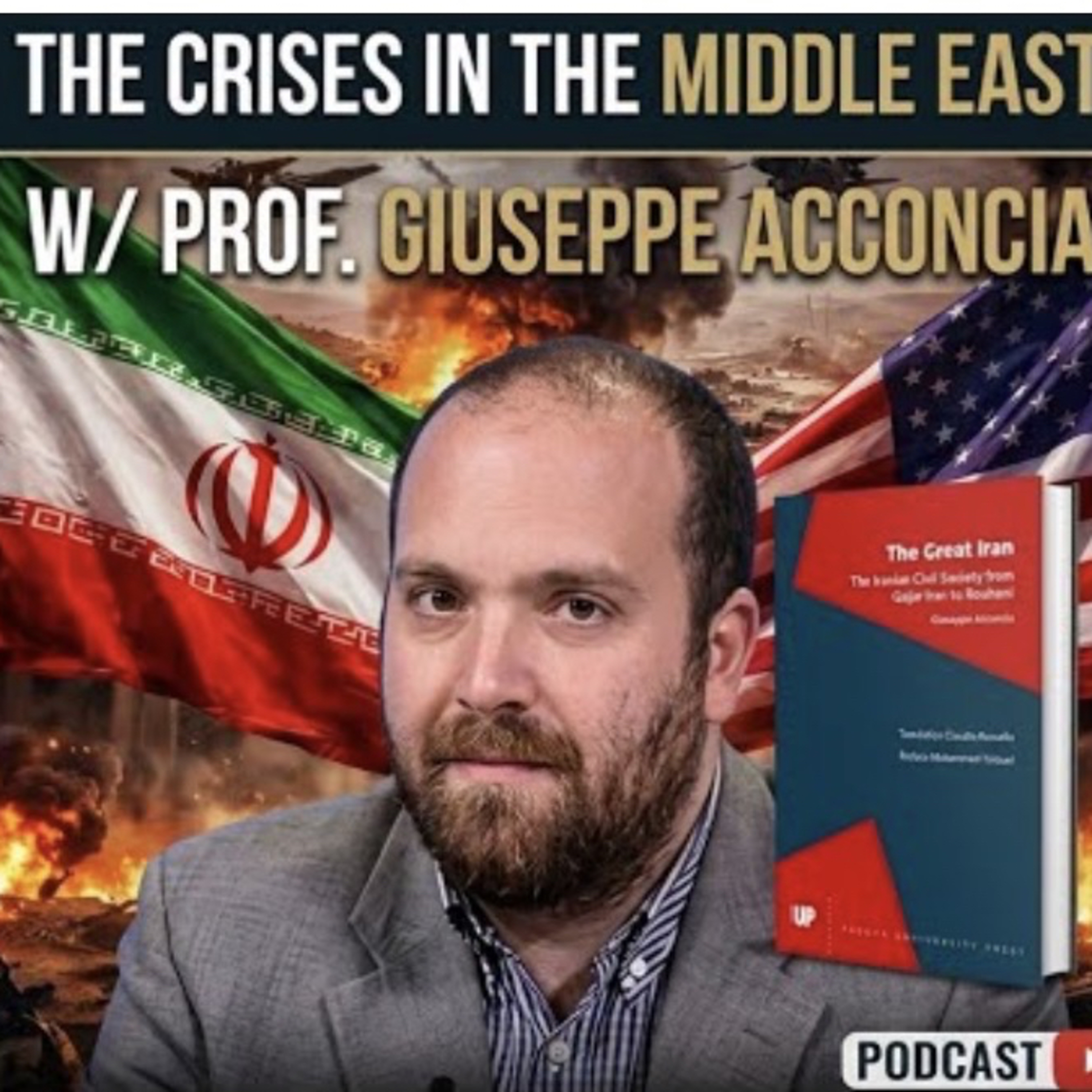
Green & Red: Podcasts for Scrappy Radicals
The Crises in the Middle East, w/ Professor Giuseppe Acconcia (G&R 479)
00:51:42
Loading summary
Transcript24 lines
- [00:00]
A
Foreign. This is Bob Azeno, co host of the Green and Red podcast. Again going solo today while Scott's away on assignment. Today we're going to continue talking about the ongoing American attack, the American war against Iran. We've been doing a lot on this lately for obvious reasons. And today we have another great expert on this and and also a comrade of mine, Professor Giuseppe A. Concha. Giuseppe is a professor at the University of Padua and at the University of Milan. Also at Padaw is in the Department of Political and Juridical Sciences and International Studies. He's really, really well known in the region, has done extensive research and work throughout the Middle east as a journalist and as a scholar. He's written a good number of books, including Iran, the Great Iran, which has been translated. I was going to bring a copy, but I couldn't find it. I'm still unpacking from moving from retirement and everything, which is fantastic book. As soon as you gave me a copy, I read it. The Arab Uprisings, Protest, Gender and War, Egypt, Military Democracy and the Uprisings in Egypt and a lot of other stuff too. So welcome once more. And you've been a guest a few times on Green and Red podcast. So as always, I really appreciate it and welcome to the podcast and let's chat. All right. You know the region well, you've traveled extensively in the region. We just talked and you said you were in Lebanon last year. So to just start generally, what's your sense of how the war is hurting specifically those people in Iran and Lebanon elsewhere, that kind of the damage done, not the bigger strategic issues, but how it's affecting average people.
- [01:49]
B
First of all, let's say that this is an illegal war that violates international law, that this is an attack that is completely disproportionate compared to the threat that Iran represent. There are no evidences that they were about to realize any nuclear weapon. They were not planning to attack anything. So basically this idea is to demonize, dehumanize the Iranians in order to make damages and destroy a country that has always been relevant for the region and important for the stability of the Middle East. This is a bit kind of an introduction in order to understand why this war was not necessary. It should have never happened. And there were million other possibilities that should have been taken in consideration. For example, going on with negotiations. And there were negotiations. But now we know that those negotiations were completely fake because at the end of the day was sure that Israel wanted to attack Iran and the United States would follow as it happened in the 12 Day War last June. As for the damages to the ordinary people here, there are many things that we can say. Of course, everybody knows about what happened to the Minam School with more than 100 girls students killed in these attacks. There is an inquiry that is going on. But there are many evidences that show that the United States has been responsible for these crime as well as what happened in Kashmir where several facilities that were used in order to work on the water to make it not salty and this was drinkable water. So 30 villages have been without water because of the attack in Kashmir as well as all the medical facilities that been attacked. The hospital in Gandhi in Tehran and 13 other hospitals together with many red CRESC facilities throughout Iran. Not only that the cultural heritage has been attacked. There has been an attack to the Golestan palace, an attack to Shay Sultun palace in the downtown Isfan, as well as attacks to monuments in Kurdistan and Lorstan. So this means that in general terms the Iranian heritage is under attack. This is very sad because those are considered as UNESCO heritage. So they should be defended, not attacked. And if we look at two specific countries that is out of Iran, the situation is worse and worse both in Lebanon and Iraq. In Lebanon, because there is a kind of polite ethnic cleansing because compared to Gaza, they send leaflets. But at the end of the day the target is the same is to get rid of the Shia population in the southern provinces of Lebanon, especially in the Beqa Valley and the southern neighborhoods of Beirut. So this is happening that those people are on the move. Maybe hundreds of thousand. We don't know the exact numbers. And as well there are more than 700 people that have been killed in Lebanon. So this is an attack against the Shia community. And we know very well the importance of the Shia community in terms of numbers in Lebanon. But we know as well that this Shia community has been always marginalized before the civil war and afterwards. So this is always under attack. And in this case it's because the Hezboll movement, the Lebanese Shia movement, continue to resist to the presence of the attacks coming from Israel as part of the axis of resistance with Hamas, Islamic Jihad and Iran itself. The other country that has been especially affected by this war out of the Gulf states and all the countries that have faced attacks together to US bases and civilians in the Gulf is Iraq. Iraq is especially interesting because was kind of more stabilized after the 2003 disastrous war of the US nowadays is facing many different wars because of course there are the attacks that come from Israel and the US against the Shia militias that are active in the country. And Iraq is one of the countries that still remain as very strong ally of Iran. And together there are the attacks coming from Iran towards US bases and European bases. Today there was an Italian base in Erbil attacked a French soldier who has been killed in those attacks. Of course, there are other, other, other wars again within Iraq. For example, the one against the Kurds that happened from Iran attacking facilities in Erbil belonging to the Kurdish authorities of the Peshmerga that are the fighters related to krg, that is the Iraqi Kurdistan Regional Government. This is because Iran want to prevent that. There is support coming from Iraq to the Iranian north of Iran that is supported by different groups, Pak Kamala and other groups that made a coalition that would like to have a role in the future in Iran. We know very well that the Kurds have been always pivotal and relevant in the opposition. Among the oppositionists during the 1979 revolution and during the social movements like Women Life Freedom and Last one started December 28th. And of course this means that there is. There are different wars that are ongoing in Iraq. And officially, insofar the courts decided to not join officially, we will see if this will happen. If this happens, it means that Iran can be fragmented and maybe this is the target of Israel to fragment the country, something that happened in Syria. So to have a weak state, a failed state, a destroyed state with different minorities, they take advantage of this vacuum, like the Kurds in north of Iran, like the Arabs in Kurdistan, like the Baluchi in Sistan and Balochistan. This would mean that Iran would be dismantled as a state as we know it nowadays. And this is the target of Israel because to have failed state like in Syria, with minorities that have their own fights, like the Druze, the Alawites, the Christians, the Kurds in Rojava, the same in Iran would facilitate Israel, Israel to be. To dominate the Middle East. And this is the target of the country in, in this context of war.
- [08:52]
A
Before the attacks. For a couple months now, the United States Trump has been stressing the repression of protesters inside Iran. And you know, clearly that was a very violent repression and you've studied this and written about it as well. So we know this has been ongoing for quite some time. You had the women's protests and others, but the. The most recent rounds seem to be even more repressive, more violent now that the US has attacked, claiming that that was. Well, the US has given several reasons right for the war. That was one of them. We're there to Protect these people, which no one really believed anyway. But what's happened to those groups now since the US has come in? Are they being kind of targeted by the government now or they kind of gone underground? I mean, what is happening to those movements that existed against the the Khomeini regime, the people who had been protesting?
- [09:45]
B
Okay, so let's say that even if we assume that the attacks coming from the US And Israel were brilliant, because the first day of the attacks they killed 49 leaders of the Islamic Republic, they killed the Supreme Guide Ali Khamenei, they killed several relevant figures within Pazdaran, so within the army, within the armed forces. So they were brilliant. After a while, we can assume that they don't know really what to do, which is the target, which are the outcomes of these attacks. If the outcomes of the US Are the same of the one of Israel, probably not. Because according to Trump, at the very beginning this should have been something like Venezuela. So a kind of regime change coming with an attack that would bring to reformists or leaders that would be more pro US or more reasonable. According to what Trump said at the very beginning, after four days this change because look like something more like Iraq, something longer. I remember the words of Bush in 2003 that was saying this will last three weeks. And after it was going to say months and months and months. And we know very well that this was going on for years. The same was he has been doing in this few days. Trump that from four days it went to four weeks. And after this war we don't know when it will end. Some days he say it's going to end and after some someone else say no, this will continue. So we really have contradiction in the statements coming from the US authorities. So this means that the US had never in mind to support the social movements going on in the country. Because the first target of the social movements is to get rid of the Islamic Republic itself. So all the young people, the merchants in the bazaar, the women, the unemployed, the students, especially those who protested a few a few days before the beginning of the war in the Tehran University and other university, they were asking for regime change. But actually this is not the target of the US authority at the moment. Maybe this is the target of Israel that would get rid of Azdaran and Islamic Republic. Why this doesn't happen so easily because after the first attacks there will be no crowds in Iran protesting. Maybe this was the expectation of US and Israeli authorities. But this never materialized because people did not go out to the street. There can be Several reasons. Maybe the movement has been exaggerated in terms of, in terms of numbers. If we consider the protests that were going on from December to February, maybe some people fear that can be attacked during this war, so they don't go out, they don't protest in the street. Or maybe those attacks increase a sense of nationality, of belonging to the nation, of unity, of support. That that would not happen if there were no attacks. So at the end of the day, if there is not a regime change, it can be that Islamic Republic got strengthened by those attacks instead of get weakened. And of course, this comes from the discourses of many politicians and many authorities, included the Iranian police chief that was saying, basically we have the trigger on the people. We will attack anyone who is going to protest. The repression will be even harder than before. And this is exactly what can happen if the war continue. On the other hand, we witness a militarization of the Islamic Republic because the figure of this supreme leader has been strongly weakened by the death, by the killing of Ali Khamenei. Now the new supreme leader, we don't know even if he's blessed, he's in good health or where he is and if he's able to guide the country. But what we know is that it's going to act in continuity with his father. And on the other hand has a kind of symbolic role when the army has a full power in, in Iran because the army want to defend its corporate interest, interest in the oil market, interest in the finances, interest. Everything that has always correct, controlled before this war. So the attempt of Israel after this war became a kind of stuck into this situation was to attack refineries and oil deposits within Tehran and in other urban areas. Because according to these, if all the classes working in the oil sector would mobilize, this would mean a kind of an attempt to restart the social mobilization that were going on before because. Because one of the most important actors involved in the protest since 28 December were not only the young people, the bazaari, the unemployed students, but as well all the oil sector. Because there were some laws, some imposition of cutting subsidies. And that is the reason why this sector was strongly affected by the Iranian authorities and the policies that were going on at the, the national level. So the idea of Israel has been that attacking the refineries attacked in oil facilities, this would bring discontent again back. But they didn't succeed even in this, because after those attacks that have been damaging the environment in Tehran, where it's very difficult to breathe, to walk into the streets now, because of those attacks, again, the masses, mass riots against the Islamic Republic did not materialize this.
- [15:50]
A
Yeah, I think that's an important point because we've seen this anytime. Air power is kind of the way that they go about this. You see kind of a hardening of resolve, which sort of sin Iraqs in the Vietnam war, World War II. In Britain, people kind of tend to support the government even more. And is that what you're seeing now in, in. In Iran? Yeah.
- [16:12]
B
This is a very difficult question because even when we have to discuss about the Islamic Republic itself and Iran as a state, are they coterminous, are they the same? Of course, more the time pass, more they look like this because there are no alternative to the Islamic Republic. I mentioned all the oppositionists and all the minorities. They could be engaged in a proxy war that would dismantle the state as we know it nowadays. Or let's talk about Mojaydine Kal, that is this terrorist group that has been strongly active in the opposition abroad, in the diaspora or the son of the Shah. Again, another puppet within the opposition is that has no support in Iran. So this means in general terms that the Islamic Republic itself is strongly linked with the state. And those politicians, they would not surrender. They will not surrender. They will continue. They will keep the control over the country. And this means that the work can continue for long. They are ready to substitute the leadership. Several times we have seen how fast has been this substitution of the supreme leader with the new supreme guide. Even if we don't know if he will ever appear, when, if his health conditions, we don't know exactly what happened next with all the processes, political processes within the system. We know, for example, that now in charge is Alila, that is the head of the Security National Council, Pezesh Kyan, that is the president and the head of the judiciary. They together are managing the country. But of course, it's very problematic to understand what will be the consequence of those attacks and to what extent the people will continue support. For sure, the opposition and the demands that were very clear before the war, they vanished for several reasons. They are still, still present within the diaspora, but in Tehran itself in span, we don't see, we don't witness protest in this condition of war. But this should have been to a certain extent very much clear to those who were attacking. It's evident that they did not have a strategy they wanted to attack, especially Israel, without knowing what would be the outcome of those attacks.
- [18:46]
A
How are decisions made inside Iran? You have, you know, Hermani's son We keep hearing in the west about the Revolutionary Guard. We have, you know, kind of the Iranian spokespeople on tv. How are these. Is it like an individual who decides what to do or do they? Does one group have more power than the other? How do you think when they get together? How are they making these decisions? Or has there been a plan long in effect, and they're just kind of following what's already been decided?
- [19:16]
B
There is a kind of elite fight fight within the elite in Iran at the moment. So you have the military powers of the Pastoran, the Revolutionary Guards on the one hand, together with all the paramilitary groups connected to them. So the Basiji, the Ezbullahi, that represent the strong support over the regime. On the other hand, there is the political elite that is represented especially by the technocrats on the supporter of former president Hassan Rouhani, and again the other president, Shamir Afsanjani, who died in 2017. And the reformists that are very marginalized, even if according to some US politicians, they should have played their role in this context. So Mousaviyeh Karubi, who are renounced arrest, and Khatami, the former president, the same can apply to Rouhani and as well the other groups that are more conservative. So the supporters of Ali Khamenei, let's just spend a word about the way in which he has been killed with these attacks that made him a kind of hero. He was just a bureaucrat for all his life, for when he was a supreme guide 37 years. And of course this attack, the 10th of Ramadan, killing all his family, made him a kind of hero, martyr, as many now argue. And for sure, many people are mobilizing for their support to this figure that all his life was a kind of just succeeding Rula Khomeini, who was a charismatic figure instead. And the radical politicians that according to many scholars now they are very well represented with Mojta about Khamenei, because during his life he has been strongly working both with the technocrats and with military apparatus. So having a stronger relationship with Pazdaran. That's why now he is in charge. Of course, those politicians are very well represented by Ahmadinejad, that is, the former president, who some said that he was, was killed during the attacks, but apparently he survived. This means that there is again a fight, the military apparatus as well. And there is one very important representative of the Al Quds Brigades. We know the Al Quds Brigades because where the brigade were led by Hassam Soleimani, now is Ismail Khani and Ismail Khani, we don't know really what happened to him, if he was killed, if he survived, if he was the infiltrator of Israel within the Pasdaran authorities, as some new rules are suggesting. So basically there is all, all this issue of getting rid of the Mossad infiltration within the country because we have to be clear that Khamenei was the last in the list because the first has been Ismail, the leader of Hamas was killed in Tehran in this in the summer 2024. The second was Hassan Nasrallah that was killed in Beirut at the end of 2024. And the third has been Ali Khamenei. So mission accomplished because all the leaders of the, the major leaders of the axis of resistance have been killed. But this doesn't mean that they will be not substituted by younger generation that maybe are even more radical than them
- [22:52]
A
in, in the US Side. What's remarkable is that no one thought of these things beforehand. Right. You know, this is very similar to what we've seen especially like in, in 2003. And yet, you know, they're kind of shocked by all this inside Washington, which is, is really quite remarkable. They're kind of shocked that to see this level of resistance inside Iran. We know that there's been, you know, a huge amount of damage, but. And the U.S. has said really from the beginning, well, Iran is, you know, it's going to be over in a day. It's going to be over in three days, as you pointed out. Right. And I know you're not like specifically a military analyst, but it seems like Iran has the ability to continue to withstand, to retaliate, even though it's taking, you know, significant damage on its own. There are reports that it's getting intelligence and maybe some equipment from like China and Russia. What's your sense of Iranian, the Iranian ability to continue to fight and to continue to damage American and Israeli interests?
- [23:57]
B
This is a very important point because what this war suggests is that the Iranian authorities of were regretting the fact that in the twelfth Day War they stopped fighting. When Trump decided that the war was over, they were over two. And this, according to them, showed their weaknesses. So Trump afterward was thinking that would it be very easy to get rid of the Islamic Republic itself because after 12 days they were destroyed. And Trump himself was, was arguing that for the was destroyed, the nuclear sites were destroyed or the nuclear program will destroy it. But the day before 2428 of February, the International Atomic Energy Agency published a report in which was argued that this fun nuclear facility was not checked by the investigators. So possibly there were activities that were unknown. Even we have to discuss a bit on the role of this agency in triggering those attacks, because it's not quite evident when in which those reports can trigger attacks, even if they are not based on evidences. And now today, Rafael Grossi was basically arguing that he cannot say either if they are or if they are not improving their uranium enrichment. And this means that basically the attacks are baseless because there are no evidences that they were reaching 60% and more in order to have nuclear weapons. So basically all this is based on no evidences. It's clear that the Pazdaran and the military apparatus has some intelligence. Russia said the Russian authorities confirmed this after the 90s. So we don't know to what extent there is this support coming from. From Russia. And this would have been very important because Iran provided with shy drones. Russian authorities were in Ukraine, so they were expecting for support. Maybe this support is coming at level, a diplomatic level, because there has been a long phone call between Trump and Putin. And after that, Trump said that the war was almost over. Maybe there is a negotiation between the war in Ukraine and the war in Iran. We don't know very well what is going on beyond the scene at this stage, but it's sure that the Iranian authorities would not surrender. So what is the point is that they are not asking for a ceasefire. This is exactly what Trump was expecting. First of all, he was expecting that they would capitulate and would accept anything in order to don't have any attack. And this did not materialize because Khamenei would not sign any agreement with the US when he attacked. He was expecting that they would capitulate after 14 days, as he said, and to have a regime change. This is not not materialized. Now, still, it thinks that they would capitulate because they are attacking too much, because they are damaging, they are destroying the country, but actually demonstrate that they want to capitulate because they want to show that they have the military capabilities, the facilities, the political strength, the support from the masses that give them the possibility to continue to govern and to have authority on Iran.
- [27:25]
A
You mentioned the Kurds earlier, and that's especially on the American left. That's always been an important issue. You and I believe you've been in Rojava, right? Not that long ago, if I'm not mistaken. Right. And early on, you know, there were these reports that Trump was going to reach out to the Kurds to fight against the Iranian regime. And now they've moved away from that. What do you think? I mean, the Kurdish, you know, the Kurds are clearly this, this repressed group in, in many countries, right? But would they, do you think there's any chance they would ever kind of join in on this? Or would the risk be too great to their own, you know, issues?
- [28:04]
B
The Kurds feel to be manipulated. And this happened so many times. If we think about the war in Iraq, the Peshmer emerged, they were fighting against Sadamusan because they were killed during the Ampal massacres and the different massacres that were done by Saddam Hussein regime. And so they became so relevant. But when they asked for autonomy in KG in the north of Iraq, they did not got a recognition coming from the US or other countries. In Rojava, the same they've been fighting for 10 years against the Islamic State within the international coalition against isis. But at the end of the day, the US withdrew from north of Syria, so they were left alone. And Al Shara, the Syrian president, now is fighting or is putting under siege Kurdish urban areas like Kobane, like Afrin, like Jazeera. And still we don't know the outcome of all this because there is a process of writing the new constitution. There is a presidential decree in Syria recognizing the rights of the Kurds. But we don't know if this will enter into the constitution. We don't know what will be the future of Rojava. Maybe the governorate would have a Kurdish governorate already. The Kurds had to leave all the Arab cities because they went out from Raqqa, from Derezor, from the neighborhood in Aleppo, that where the majority are Kurds. So. So that is still very problematic. But what is the message is that the US have only tactical alliances with the Kurds. If they are interested for a reason, like fighting styles, they would support them. If this is over, because now Trump supports Al Shara and Turkey, because Turkey wanted HTS to take over the Ayat Al Sham, take over in Damascus, they leave the courts to themselves. The same would happen in, in Iran, even if there is a coalition of Kurds and the Kurdish authorities in Iraq and in Syria support them. This doesn't mean that afterwards they would have a Kurdish state or Kurdish autonomy, they would gain Kurdish rights. That is what they want. It just means that they would support with weapons that will let them alone, as it happened before. So this means that they are very doubtful of what to do. On the one hand, officially they say we're not interested again to be manipulated by the us. On the other hand, for sure, there will be some groups that would join the guerrilla because they are used to do so, because the borders are very easily crossed. And they go into the north of Iran in Sanandaj and Kermanshah and they fight with the Kurdish comrades. So it's very possible that this happened. But on the other hand, officially they know very well that they would not gain more recognition because they, they, they do so. But there are many other minorities that can be used for a proxy war in Iran. The first of them are the Arabs. The Arabs in Kistan, that is at the border with Iraq, let's remember the Iran Iraq War, let's say as well, if we want to have another understanding of this war, as if this war is opening the Pandora box of something that was going on for 47 years. So the troubles between the US and Iran that started after the rebellion, revolution, the Iran Iraq war, all these things are together connected with the border between Iran and Iraq. And the others that always wanted to be autonomous, they declared a few days ago autonomy. Of course this doesn't mean anything, but this is an example of what does this mean when we talk about proxy war, failed state and fragmentation of the state.
- [31:46]
A
In addition, I mean, this is a regional war now, right? I mean, it has been, but now it's, but it's really out in the open. And we're in this situation where a lot of the, the monarchies are anti Iran, but it seems like the general population isn't. And so here in the US people are having trouble understanding why, why Iran is attacking Bahrain, why is Iran attacking Saudi, why is Iran attacking Dubai? What do you think the larger regional context is? Because I think a lot of these Arab states are in now kind of feeling abandoned by the US because it's very clear the US supports Israel and it will do whatever it has to do to support Israel. But are these Arab states now kind of saying, you know, we, we were along, we went along with the United States against Iran and now the US is abandoning us too. What do you think that regional idea is?
- [32:38]
B
So there are two reasons why these countries are target. One reason is to spread chaos. This is the strategy of cast that clearly is the first target of the Iranian authorities because they are not equal the two contenders, of course, the U.S. army and the Israeli army is much stronger, well organized and brilliant than the Iranian army. So the only strategy that Basteran can reproduce is the one of chaos, of bringing the region into chaos. So attacking Gulf states, even attacking US bases all around, that this is something incredible. If we look at what is happening in Turkey, for example, we don't know exactly which are the dynamics over there, but most probably those missiles want to reach the US base of inches, that is the base that is used by the US usually when they attack the Mena region as well as in Azerbaijan. This is something incredible what is happening in Azerbaijan. So the idea is to spread cows. We even don't know if some of those are intentional or unintentional because according to some reports, there is a local level of the Iranian army that is out of control. So we have to look exactly with inquirers, which are the dynamics on the attacks in Turkey and Azerbaijan. So the first reason is chaos. And this is working to a certain extent together with the closure of the Strait of Hormuz, that is bringing a great increase on the oil prices and, and this is increasing the cost of the war for the US So putting pressure on the US that is the main target of the Iranian authorities. The second is to show that to support the US in the region doesn't work, is not working, it's not positive anymore. So all this process of normalization with Israel, with the Ibrahim Accords, the Abraham Accords, between Gulf states and Israel is not very positive for those countries that are working on tourism, on airports, on, on tourist facilities, on attracting expatriates for paradisic life. And heavens, this is not working because those states, they do not listen to their constituencies, to their civil society that are strongly opposing the Gaza genocide. The attacks on Gaza coming from Israel, getting cleansings in Lebanon. And this is why the Iranian authorities have to work on this point. You can imagine if Turkey, Turkey make a war against Iran together with Israel. This would be not imaginable. Nobody would understand what is going on there because Turkish people would not support a war together with Israel. So this means that Iranians are working on this, on work on showing to Gulf countries that to support the US and Israel is not something positive anymore.
- [35:31]
A
You mentioned the blockade and Hormuz. And here in the U.S. we're aware, you know, we see that oil and gas prices are going up and you know, the US economy is not doing well. What's the economic. Well, first of all, why don't you just talk a little bit, describe what Hormuz is. Because I think here we see a map and that's about the extent of it, right? So why don't you just describe first what Hormuz is and then how it's affecting the economy regionally. Not, not just in, in Iran or in the west, but like within the Middle east as well.
- [36:01]
B
This is a key point because it's a. It is in a position that control that make over the control over 20% of the oil trade globally. So this means that if the hormones trade is blocked, all the trade and the ships that work in the oil sector would be stuck. And this means increasing of oil prices and the effect in the economy. Plus we have to add that many of the Gulf countries have decreased oil production because of the war. So this is strongly affecting oil prices all over, all over the world. That's why there are other measures that have been taken, like easing the sanctions towards Russia or increasing the production in other localities. So when the Iranian authorities decided to block the state of Hormuz, this really made a strong pressure over the U.S. we can remember the words of Trump at that day. I think that insofar is denying the capabilities of the Iranian authorities to stop the trades within the hormone straits. Basically, according to the days, because he changed a lot. His mind was arguing that there are mines or there are boats that are putting mines in the straits to avoid the passing of oil ships. So of course it's very problematic to understand the real dynamics that are going on in the streets. What we know insofar is that some country can pass the strait like China, because China is a strong power and it's strong, strongly important for Chinese oil trade to use the Hormuz trades. And let's say as well that China to a certain extent is one of the countries that still diplomatically supporting Tehran and other countries that have this possibility. Why the US Israel and other ships that are supporting the US cannot pass through the hormone state. Today there was this, this idea of France especially that has been affected with one soldier killed in Iraq together with Italy. But after Meloni denied this, there were talks on the issue of the armist threats with Iranian authorities. But still we don't know if this is true, to what extent it is happening. We know very well that if the Iranian authorities now have a very negative approach toward the US because the negotiations failed, even they were fake negotiation, they have a negative approach towards Europe too, because they accused European countries of being silent during the war, imposing sanctions against Iranian authorities. And there are several other issues, like the UK that gave the basis to the US in order to defend itself. But on the other hand, Trump has been always very negative because this came too late or Cyprus and the UK basically attacked by drones in Cyprus. And here again, there are many different speculation on this. So basically Iranian authorities are very much uncomfortable with European role Insofar
- [39:30]
A
specifically because today there was a big article in the New York Times about Meloni, who's been very close to Trump, but it seems like she's distancing from him. Is that because it seems like among Italians in Italy there's been a real opposition not just to this, but to Gaza as well. Weren't there strikes earlier this year or late last year? Is that kind of. Do you get a sense throughout. Well, in Italy and then even in Europe. Are there. Are there. Is there kind of just a. People are finally getting tired of if Israel there. Because in the US what we're seeing is really remarkable in that Americans now support Palestine more than Israel, which is amazing. Right. And in Italy, I remember when I was there, you know, I visited you and there were. I saw Palestinian flags and things like that. But is that kind of a big factor now that that throughout Europe, especially here in Italy, people are turning against Israel even more?
- [40:21]
B
Of course they are in general terms against the war in Gaza. There has been a strong pro Palestine movement in Italy, maybe one of the strongest in Europe, especially in October, November when there were huge mobilization all over the country with the support of workers, priests, students, activ. This was amazing what was going on. Let's remember the flotilla and all those attempts to reach the Gaza Strip. And of course this means that people are against the war in general terms and they are against the war in Iran too. This is the sentiment, let's say that basically the point of Meloni is even not that because she doesn't support the probabilization for Palestine, but is that the war is illegal, it's not legal. And on this, this, I guess that there is a kind of consensus among many European countries. First of all, Spain, Sanchez has been really strongly opposing this war and maybe he has the most coherent approach toward the war, basically stating we would do we do not want to be involved in a war like the one in Iraq. And this is exactly what Spain is doing. And this is really coherent approach. Italy is more. A bit more has more ambiguity, ambiguity. And not only Italy, because France as well, the UK as well, Germany especially as well, they are more ambiguous. So on the one hand they. Meloni was in the parliament condemning the war, saying that it is against law, but Trump said she is helping us. So we don't know even to what extent maybe giving some Italian bases like Sigonella in order to defend or to. To use it as defenses operations. Still we have to have more information on the role that Italy is playing in this war or will Play. But officially Meloni is not supporting this war. This is not our war. Today there was the Council for War led by Mattarella, that is the Italian president. They were all discussing about the fact that Italy will not be involved in this war. So officially there is a rejection of this war. We will see if this mean on one end that these countries can help a lot on negotiation. Together with Oman, it was the other country that was involved in the negotiation before. So they can try to bring together the demands coming from the US and the ones coming from Iran in order to have an understanding and to push Trump to arrive to the point in which you say mission accomplished. I've done everything I wanted. I destroyed destroyed military Iran, I destroyed nuclear facility. The war is over. And European countries, Oman and other countries can help a lot in achieving this goal. Otherwise they would be involved in a war that they did not want from the beginning. Because it's true that Trump imposed new sanctions on Iran. Trump canceled the Obama agreement of 2015 in 2018. Now we say Iran is out of control, but it is him who canceled the agreement that would control Iran. That was achieved thanks to Obama. So really is very problematic to understand what he has in mind. And if his target is to make a kind of war against devil. I don't know, because the discourses of the US authorities, maybe you can tell me your opinion on this. To look like that they are fighting like a crusade and the enemies are dehumanized, especially the state secretaries talking like this. And I don't know why they do that. Maybe they do that for disproportionately attacking the country, destroying the country. But I guess that they reached the level that is unbearable.
- [44:17]
A
I mean, they've been doing that really, especially since 1979. You know, they've demonstrated, demonized this, portrayed, you know, hominy as Satan and they kept talking about their religious lunatics or their religious fanatics. And now you have some of these American commanders are apparently telling the soldiers this is a holy war. One thing again though, that that is a good, in a good way surprises me is that the American people are no longer accepting this. They're really, I mean, most of the time when you see a war, even if it goes bad later and early on, the Americans support it. They did Iraq, they did Afghanistan. Understand from the beginning here that's not happening. And so I think that's encouraging. But as far as what's motivating Trump and all the. I have no idea because they've given so many different ideas. I mean, Most people here think it's because Israel told them to. And there's no doubt Israel's massively influential. But I don't think Israel tells the US what to do. The US Is the, the hegemon. I'm not really sure. And that's, that's actually kind of good because it makes, makes me think this is a question more or less. It's kind of a question about time and the way people perceive time. And let me say again, your book on Iran was fantastic. It's just a great overview to learn about that. I wish I had my copy here. It's, it's been translated. I think you can get it on Amazon or wherever. So I would recommend that. But one thing I've noticed because I've studied US Foreign policy and US wars, is that these people, let's just call them Third World, I don't love that term, but they have a different concept of time and that they're willing to just go as long as it takes. They have this long war attitude. Right. We certainly saw this in Vietnam with the Cuban revolution, in, in Iraq after the initial American bombardment. And I, I would assume Iran kind of looks at wars the same way that they don't have to get it over within two weeks or two months or whatever. How do you think is Iran kind of just planning for that, that this just may take and they may have to keep doing this? They're going to be patient to just do it as long as they have to?
- [46:16]
B
Yes, sure. And this is another issue because Trump was saying we cannot come back every five years, so we cannot continue the war in this. Of course, there has been the 12 day war one year ago. There have been two different attacks between, mutual attacks between Israel during the war in Gaza. So of course, this is a, a, there is a continuity in the attacks and the war against Iran. This cannot continue like this. But of course, if Trump consider as mission accomplished the fact that there are no military facilities, they cannot use ballistic missiles facilities to attack the neighboring countries, and there is no uranium enriched in his farness for the nuclear facilities, this does mean that in a few years they cannot go back to the same point. That's why this word does make a lot of sense, because it's much better to negotiate an agreement that gives the opportunity to inspectors to control the level of uranium enrichment than to do a war in this case. That's why many of the advisors of Trump were pushing him to avoid this war. Now that he is in the war, it's difficult to find the Next strategy. Because even if he say that this is done, he has done his job, he's done a great job. The country has been destroyed. This doesn't mean that Baslaran can work again on their nuclear program, can work again on their military facility and in a while to become against the threat. And Hezbollah is a very clear example of this. There was the war against Assal Nasrallah. They destroyed the headquarters in Beirut. Now is less than two years after and they, they are again ready to attack with rockets towards north of Israel. There is Naim Kassem that is talking about the need for a fight against the Zionist entity. So of course we are in a context in which if there is always this political approach coming from the Israeli authority of apartheid, ethnic cleansing, genocide, the world will never end. In a few years we will go back to a condition, the condition in which we were this year. And of course this will happen maybe in a generation or two generation when we will have different leaders. Hopefully we will have leaders that consider this issue differently, that consider this issue with the post colonial decolonial approach. Why not? For example, we have the mayor of New York that is completely on this path, but maybe the next president or next two presidents, they will think like him.
- [48:56]
A
Well, I mean, in the US Again, very surprisingly, there is like kind of a. In both part, well, maybe more in the Republican Party. Some of Trump's supporters now are coming out against Israel and against the war. So you never know. This has been fantastic. I always enjoy talking. I learned so much in the next week or so. What will you be looking for? What do you think is likely to. To happen going forward? What do you, what do you assume? What, what will you be like paying attention to
- [49:27]
B
many different issues. For example, I've been as I've been following the social movements in Iran in the last few years. I'm always interested, for example, in activists or students who tell me the war should continue, they should destroy the regime, the, the regime should be over, because this is the only occasion we have for this. And they try to understand how an Iranian can accept to see the country destroyed in this way in order to get liberated. So I'm very much interested in the way in which the oppositionists are perceiving this war. And especially I think that the most interesting one are the ones that are both against the system because they find it corrupt. So the Islamic Republic in its himself and against the war, because you cannot achieve a change within the system through war. Is again the idea of exporting democracy to war. That was failing in Iraq and this always reproducing. We know very well that in Afghanistan, this brought after 20 years, the Taliban to the Taliban. So there was no regime change because we have still the Taliban in Afghanistan. In Iran, the same from Khamenei to Khamenei. This means that the war doesn't work.
- [50:45]
A
That's very sobering. As always, this is fantastic. I appreciate it so much. We'll have to kind of continue talking about this because it's probably not going to end that soon, but this has been fantastic. This is Giuseppe Aconcha, who's a professor in both Padua and Milan, author of a bunch of stuff, articles and books, including the Great Iran Grande and the Region, a lot of stuff on Egypt as well. And look forward to getting back to Italy to see you, have a glass of wine and visit. So thank you so much, Giuseppe. This has been fantastic. I really appreciate it. This is Bob Bozenko from the Green and Red podcast. Check us out all over social media and we're all over, you know, Facebook and Instagram and Twitter and Blue sky and you can donate money and all that kind of cool stuff. So thanks again, Giuseppe. Really appreciate it.
- [51:38]
B
Thank you. Thank you.