← Green & Red: Podcasts for Scrappy Radicals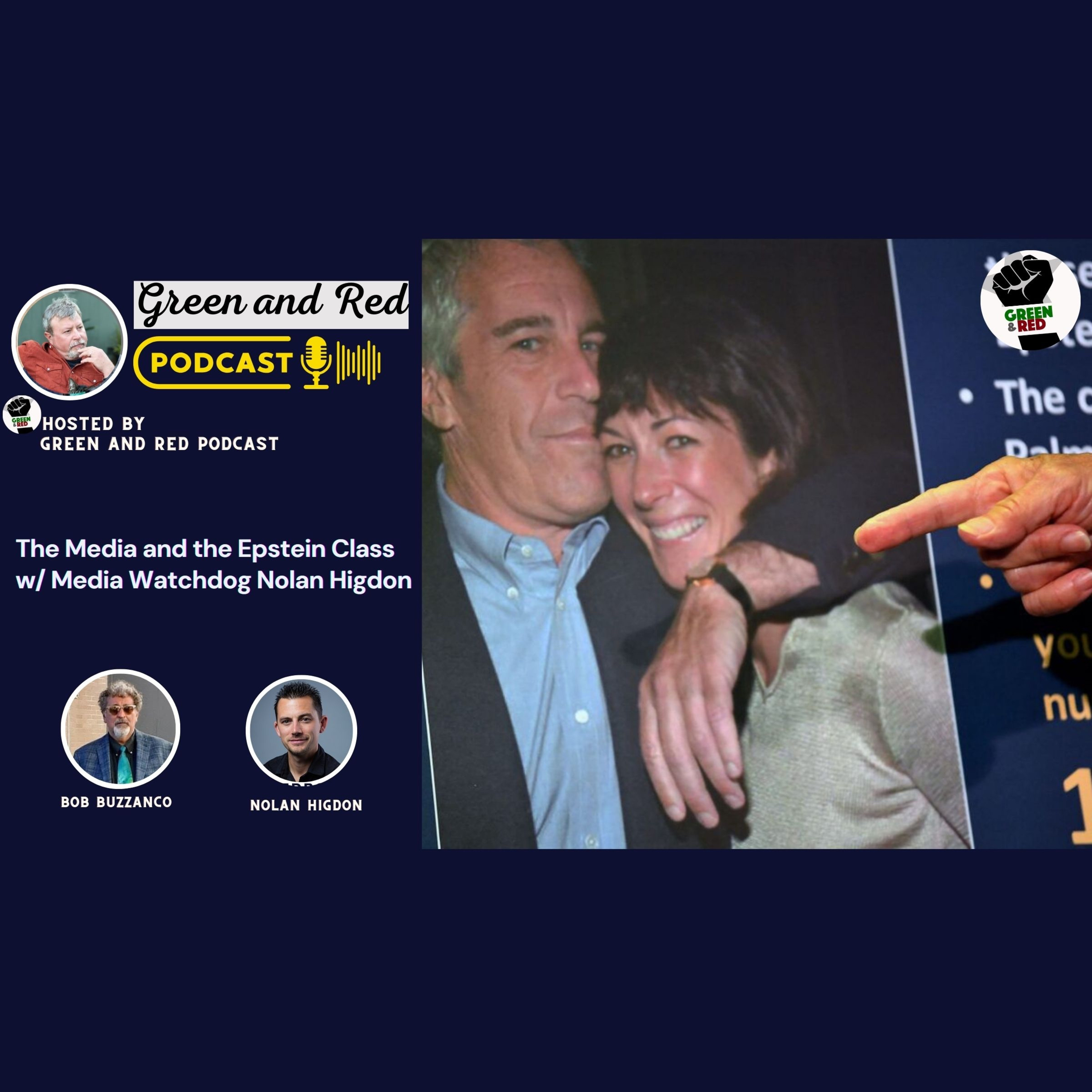
Green & Red: Podcasts for Scrappy Radicals
The Media and the Epstein Class w/ Media Watchdog Nolan Higdon (G&R 471)
00:52:40
Loading summary
Transcript103 lines
- [00:01]
Nolan Higdon
Welcome to Green and Red Scrappy Politics for Scrappy People, a regular podcast on
- [00:07]
Bob Bosenko
radical environmental and anti capitalist politics. Brought to you by Bob Bozanco and Scott Parkins.
- [00:14]
Scott Parkin
Welcome to the silky smooth sounds of the Green and Red podcast. Your co host, Scott Parkin in Berkeley, California. And as always, I am joined by
- [00:22]
Bob Bosenko
Bob Bosenko and Niles of Heidel.
- [00:26]
Scott Parkin
And today we're going to be talking about story we haven't really done just a specific episode on, but it's like one of the bigger stories in the media. It is and it isn't. And we're going to be talking about the Epstein files. And talking with us is Nolan Higdon, who is a political analyst, he's an author, he's host of the Disinfo Detox podcast, so check that out. He's a lecturer at Merrill College and in the Education Department at University of California, Santa Cruz. He's also a Project Censored judge, which we just had the great Mickey Huff on with us talking about Project Censored and then Nolan's substack, very popular substack is called the Gaslight Gazette. Nolan, welcome to the Green and Red podcast.
- [01:09]
Nolan Higdon
Thank you for having me. Glad to be here.
- [01:11]
Scott Parkin
Yeah. And so we've, you know, I mean, part of what we want to talk about today is a little bit of just like some of the, the stuff on the Epstein files. There's also like to me, there's an underlying story here about how elites are really getting away with a lot. They continue to get away with a lot. We get 2003, they got away with Lioness into a war. In 2008, they got away with, you know, crashing the global economy. And now we see them continue to get away with things. But what has struck you most about the release of the Epstein files, the rollout that we've been seeing?
- [01:42]
Nolan Higdon
Well, I think, you know, one of the things you just said, right, there is one of the unique things about the Epstein files, right? We have these moments in time where we know elites have lied, they've got caught, usually too late, right? It's after people have already been hammered through a recession, what they called a recession, it was actually depression or hammered through the Iraq War. And it's, you know, we didn't see it coming or it's a few bad actors. One of the things in the Epstein files you really start to see is there's a culture amongst elites that feel comfortable doing these things. And what are these things? I mean, manipulating media narratives, I mean, insider trading, I mean leveraging Intelligence connections to impact things like political outcomes and financial outcomes. And of course, something that rightly has gotten a lot of attention. Also sex crimes, which, you know, all of us, I think generally try to be really delicate when talking about sex crimes because we think about the, the survivors, the ways in which these folks casually engage with discussions about sex crimes really reveals a just a corrupt cultural rot of a group of people who feel like they are above the law. And in most cases, unfortunately, they actually are. I think one of the things I should say about the files though too, because this has been a confusing point that I think the media hasn't really made that clear. You know, part of the, what we call the files are the Department of Justice files, which were the investigations of Epstein. And it depends how you kind of count the files. But the DOJ said they had six million and then released three million. So there's at least three to three and a half million still in the DOJ's control. The ones that were released were redacted. Other people argue like, such as Channel 4 just did an audit. The way those are being counted, we'll actually only have about 2% of the files, not even 50%. But there's also financial records which we've never seen, which Senator Rod Wyden claims he's trying to get. There are leaked emails that were presumably hacked from Ehud Barak, the former Prime Minister of Israel, which are part of the so called files. And then the Epstein estate has also given some files out as well. So when we talk about the files, there's. They're coming from a multitude of places. And you know, some places like JMail has done a good job of trying to collate them all in one place. But as we go through the files, it's really difficult. You know, a lot of us are doing it individually. We're depending on other journalists and researchers at the same time to kind of paint a picture. And one of the things I've tried doing, the Gaslight Gazette is just sort of point to the different kind of rabbit holes or crimes or people that are in the files. And the, the holistic picture you painted there at the beginning I think is the right one, that we're talking about a very distinct elite wealthy class that operates around the globe. And we have this little peek behind the curtain. We do not have the full picture from these files. But even what we have is pretty jarring.
- [04:29]
Bob Bosenko
You know, this is obviously a horror. What's, what's happening because of, you know, they're raping children. Right. But why do you think this has kind of taken off? Because if you look behind it, none of this is actually new. If you study, you know, and, and you know, we're seeing a lot of like shock and people are aghast. And whether that's about sex crimes or it's about Israel, I mean the Catholic church has been doing stuff probably worse than this for, for millennia, you know, and you know, you'll get a story or a movie about it and you know, the kind of idea of Israel, we've kind of known about that, that, that started long before Jeffrey Epstein was even born. Why is it, is it because Trump is just a personally despicable human? A lot, a lot of people in the media hate him or why is this now taken on? Because a lot of the stuff behind it and what's going on is horrific. You know, you have to be very careful and make a million caveats because you don't want people to accuse you of downplaying the horrors of it.
- [05:20]
Scott Parkin
All right?
- [05:21]
Bob Bosenko
But as horrible as it is, it's, it's not new.
- [05:24]
Nolan Higdon
No, I think that's, that's a really good point. And that's actually one of the most horrific things that comes out in the files. How much was known for how long and people still associated themselves with, with Epstein. And I guess I want to answer your question. One thing I'll just say is Epstein is, you know, quote unquote the story, but he's not actually the story. He's just kind of a central player in the way we're telling the story right now. Epstein, because we're looking at his communications, he's front and center in all these different aspects of the so called Epstein class that we're talking about. But he hardly created this environment, he's hardly alone in this environment. And, and to reduce it to him is problematic. But like you pointed out, we also be sensitive of the crimes he definitely has committed as to why people are in interested. You know, we've been living in a, in a very strong populist moment for at least 10 years. I would even go back to Barack Obama's 08 campaign. Not that Obama was a populist, but he used populist rhetoric. And the post great recession like we were just talking about in the beginning, that really hit, there was this feeling that there was like a two tiered system, right? The elites could mess around with the financial system and crash it and they'd get bailed out. And working class people, they had laissez faire capitalism. They had to dig themselves out of the hole that elites created. And Obama played into that rhetoric, but of course he governed more like a centrist. Trump and Bernie Sanders played into that rhetoric very well. And you know, Trump did in his first, second and third campaign, more so his first and third, not a second. But the people have this kind of belief and Epstein became a symbol of that, particularly in like online spaces that here's this, like a guy who's engaged in sex trafficking. There were these, you know, these rumors about elites engaged in like these elite sex crimes go back, you know, like a millennia at some point. But like even more recent, like the Franklin scandal, things like that were popular online. And one thing that Trump did that most politicians don't is he and his administration started playing into actually holding these folks accountable. He gave hope at the idea that he was going to release the files. Now I have no doubt that Trump never intended to hold these people accountable, but he, he gave that red meat to the base and they wanted it delivered upon. And there were some folks in Congress willing to do it. And by the time the files start to get released, the media kind of was caught red handed. This was a story they dismissed as a conspiracy theory, but they had egg all over their faces. Plus from the media, they haven't covered it in the way you and I, the three of us are talking about right now. They've covered it as again, a couple of bad actors, mostly about Jeffrey Epstein. But what they like about it is there's celebrities, right? And the media loves how famous people draw attention. So you get Clinton or the artist formerly known as Prince Andrew or Donald Trump, it's going to get eyeballs. But they're, they're not going to tell you the, the whole story. I mean like one of my big pet peeves has been the lack of a discussion of like the intelligence community connections. That's a bridge too far for a lot of our, our media system. So I think they're willing to engage with the salacious sexual details, the celebrities, they know the public wants it and the public's advocating for it, but that's about as far as it goes or why they're willing to engage with it. The actual critique of the system is something they can't engage in because again, a lot of people in media are in it in the files as well, working with Epstein and Epstein associates to shape public narratives. It really shows that like a lot of things that were dismissed as so called conspiracy theorists, conspiracy theories for the last few decades, you know, are, are true. People in media do work with elite officials to shape narratives. Like we have documentation of that. And sometimes it's tied to the intelligence community, sometimes it's tied to financial elites. That's no longer deniable.
- [08:54]
Bob Bosenko
There also is a deflection there because they keep talking about Russia, whereas if you're going to go in that direction, Israel's the story, not. Not Russia.
- [09:01]
Nolan Higdon
Yeah, yeah, so the, so okay, so yeah, that's a great point. So Epstein clearly has connections to the US Intelligence community. The ones to Russia do exist, but they're, they're much more scattered and it looks like he's trying to get further entrenched with Russian interests from the way the emails I've read. But Israel is like no doubt. I mean him and Ehud Barak talk constantly. They're engaged in discussions about like spyware and software. Barack stays at his house. The Israeli intelligence put surveillance equipment at Epstein's house because he stays there so long. Epstein's brokering deals with Israel through Barack, with, with countries like Nigeria. So I mean that one's just undeniable. The fact that they're going to Russia I think illustrates your point that it's a deflection like the Israeli one is just undeniable where the Russian one's a little more spotty
- [09:50]
Scott Parkin
and you know, the media wants to talk. I mean we're seeing that in drop side news and places like that are talking about the Israel connection. But like, you know, the more like corporate legacy medias tries to, tries to avoid that topic as much as they can as we've seen with many of other things connected to Israel in the last couple of years. One question I have is your new piece is out about like Epstein files and conspiracy and how the release of the Epstein files has actually been fueling conspiracy theories. You know, currently. Like, you know, I would argue that like Trump and a lot of people who supported Trump came into power because they were able to jump on the Epstein files conspiracy like Cash Patel or Dan Bongino and folks like that. Then once they got in power they sort of denied it. But now we're seeing a new wave of conspiracy coming out from the sort of slow and uneven and redacted release of the files. Right?
- [10:42]
Nolan Higdon
Yeah, and this is a, this is another kind of delicate area because you know, just the stuff I've already said on this show probably has a lot of people thinking I'm like wearing a tinfoil hat. But you, I think it's in the best interest for those who take this issue seriously to stick to what is in the files and admit when they don't know things. And one of the ways in which a lot of movements, or I guess research that does, that gets discredited is when there's louder and more voluminous voices who are spreading baseless nonsense or making leaps. And my, my point in the piece was that this always happens. Whenever governments grow, you know, large and secretive or people have like partial records, they tend to fill in what they don't have. And that's where we start to see mistakes made because other evidence will come out and prove them wrong or they won't, or they'll be making baseless claims. And so it's, it's a delicate walk. Like I get, I mean I get emails all the time from people who pull out like one file and they have like a four paragraph conclusion about what it means. And you know, it's like, maybe, but we don't have the evidence to, to say that, you know, like we, we would be better served I think, to talk about the stuff we do know. And we're seeing just this proliferation of, of baseless conspiracies around Epstein online, which I think are distracting from the real ones where we do have like substantive documentation.
- [11:58]
Bob Bosenko
I'm so glad you said that. I, I, because some, if you ever watch this, I rant and rave about conspiracy theorists all the time. And I've been in a fight with the Kennedy conspiracy people overstone crew for a while and I keep seeing that and they do, they're dragging like pick isolate. You know, I've studied like I was a professor of US history for 30 plus years and this is kind of how the ruling class operates. And you know, lately I've been seeing like, especially lefties just say, oh, we have a cabal who knew that there was a cabal led by Jeffrey Epstein taking over the world. It's like there wasn't. You know, it's like, and, and to see the left media play into that too is, is, I mean, have you noticed the huge difference really between the way, kind of what we would call, I don't know, independent or left media dealing with it as opposed to, you know, kind of the, the mainstream people?
- [12:44]
Nolan Higdon
Yeah, I mean like, I think the, and this is a critique I make of corporate news all the time. But they'll pull out important facts, but they won't give you context. So you know, you'll have something like, you know, the Zorro Ranch, how they're going to do this investigation about potential abuse at Zorro Ranch, that, that's they'll they'll say that. And it's, that's in New Mexico. And that seemed, it was Epstein's old ranch. And that seems like a small kind of like story, but it's like, actually it's a much bigger deal. There were accusations that people were killed at that ranch. It's tied to accusations that Epstein was doing tests on babies. He was obsessed with code breaking. There's this weird set of emails where he's congratulated on having a child by the Duchess of York. And he even gives like the due date. But his brother says he never had a kid and he says he would have known if he had a kid. It's like, what was that all about? There's a woman who says that he treated her like a baby incubator in 2002. There's another woman who says that within six months of meeting him, she's telling him this. Within six months of you meeting me, you tried to buy my baby. Like, those are interesting contextual factors. I think the public should know about the New Mexico story if you're going to tell it, but they won't. They'll do that stuff in isolation. Where I think I've seen a lot of independent media try and make more connections to tell a more kind of complete story. And the most responsible ones just kind of admit where the trail dies off, either because of redactions or because files haven't been released.
- [14:01]
Scott Parkin
Another, another question I have kind of talking about the media is that it does seem like the mainstream media is down, is downplaying this a lot. Like every time I see some new revelation, granted I look at social media way too much and it's probably a little bit more conspiracy driven, but it seems like the US Media in particular is not covering this. And then I have a follow up question about what's going on in Europe. But like why, why do you think that the US Media is so downplaying this story in, in all of the way? In, in many ways. I mean it, it does make some headlines, but it doesn't seem like it's been the story that should have been.
- [14:40]
Nolan Higdon
That's a good question. I was actually going to go to Europe when you began that question as well, which is to say this, that the US Media, I agree with you, has not been covering it substantively. If these investigations launch in Europe, there's going to be discovery. So there's going to be more to come out that the media can't deny here. And I think that's a good thing for us as to why the media ignores this story. I have a couple of kind of just theories on that. One is something I mentioned earlier. A lot of people in the files are in media and they had relationships with Epstein and you know, Epstein would work with them to try and repair his image or other people would contact Epstein who would then contact journalists to try and repair someone's image and those kinds of things. I think it, it is probably a door they don't want to open. They've, they've taken a battering with credibility since 2003 in this country. Certainly during, you know, the fake news moral panic post 2015. This would be a death knell for a lot of these folks to confront the idea of how just co opted their industry is. Secondarily this has been a problem I've always complained about. Too many people in media are in bed with elites, not just friendships, but like their former roommates in college, they're married in many cases to each other.
- [15:51]
Bob Bosenko
Olivia Nuzzy, right?
- [15:52]
Nolan Higdon
Yeah, Olivia Nuzzy is a prime example. So yeah, those kinds of connections are really problematic because you run in the same circles. You have a personal affinity for these folks, right? You've probably hung out with the Clintons and Bill's probably like a nice guy who pats you on the back, you know, or anywhere else. So those kinds of, I think connections play a dangerous role there. And then lastly, they also operate from a very kind of narrow, and I think it's kind of a dying approach to news, which is bipartisanship, which they, they do well with stories where it can be team Red versus team Blue. This story does not fit into that box. Like I, I, you know, to, to put a party label on this would be totally ignorant of the files, right? This is a problem across the ideological spectrum from friggin, you know, Noam Chomsky to Steve Bannon and everything in between. We see that and I think the news media just, they don't know how to cover that because they know how to interview a Democrat and a Republican and get their opinions and call it a story. They don't know how to do like a class analysis of how like our working people feeling about this as compared to elites, for example.
- [16:51]
Bob Bosenko
Well, the fact that you just said class analysis was kind of a segue because to me this is presented as a morality play, right? And the focus is on the horrors which are undeniable. You can't look at those, you know, and when you talk, even when people in Congress, including like Massie and Khan are taking the lead or Marjorie Taylor Greene, you know, they're focusing on the horrors which are undeniable. But what is the kind of benefit to them of presenting this as a morality play rather than, as you said, like, kind of using class analysis, or is it, you know, an examination into those structures of power?
- [17:25]
Nolan Higdon
Well, I think, you know, I think politically, I think sex crimes plays a lot better in terms of, like, you know, empathy at least. God, I hope we live in a society where that's true, where, you know, most people are going to rally behind the people who are fighting against sex crimes. That's why, like, you know, we have such a vibrant or, sorry, such a strong criminal justice system, because everybody generally votes to go after bad criminals. So if you couch anything as fighting crime, you're going to get public support. And I think that's true in this case. To make, like, a populist argument and make this class, you know, you'd have to be a very talented politician who's also not connected to any of the conflicts of interest. So, like, this is one thing I'm thinking about the Democrats, if they want to make this an issue, if they take back the House, I mean, Hakeem Jeffries has taken money from Epstein. How's that going to be used against him in that effort? Ro Khanna gets a lot of his funding, and he represents Silicon Valley, which is heavily invested in the Epstein class. So I think there's a lot of conflicts of interest that can be used against you politically if you go that route, where being caring about the survivors. It's really difficult to. To say someone doesn't care about the survivors unless they themselves have a history of sex crimes, in which case I doubt they'd be the type of person sticking their neck out.
- [18:38]
Scott Parkin
How would you say that European media is covering this as opposed to the US Media?
- [18:43]
Nolan Higdon
I think they're. They're much harsher on their politicians. They've. They've gone places that, like, I don't even think the US Media, for example, the artist formerly known as Prince Andrew. I don't think the US Media has used the word insider trading when talking about what he's accused of. But European media and British media have said those words. He's accused of straight insider trading, giving information that can be leveraged for financial gain. So I, I think they've been way more direct in that sense. You know, the images, like, trying to embarrass these folks, like getting arrested and things like that, or howling people with questions about why they were connected. Epstein, we just, we don't see that Here, like some of the places, some people have stepped down over embarrassment from positions, but they haven't really been like haggled by media in, in any sense of the. The word. Like there's not a nightly segment on Larry Summers or a nightly segment on Katherine Rumler. Right. It's just another name of someone who's step down from the Epstein fallout.
- [19:38]
Scott Parkin
And you only really, you only really. Oh, go ahead, Bo.
- [19:40]
Bob Bosenko
No, no, no, no.
- [19:41]
Scott Parkin
You only really hear about Kathleen, the Summers and the Rummler stories, like, with it more, more in depth when you listen to like progressive media. Right. It's not, it's not in the New York Times necessarily. I mean, I think there was a piece on Rummler in the New York Times, but.
- [19:56]
Nolan Higdon
Yeah, and that's also because of the, the depth that independent media goes into. So like Katherine Rummler's story, the details of it are, have been reported pretty well. I mean, dropsite News I think, has done a great job with that. Like just the whole NSA connection with Epstein, that's not in corporate media. Corporate media is going to say, like, basically these people stepped down because they had an association with Epstein. But the details of what that association are are rarely explored. And you know, they'll always make the caveat, rightfully so, that not everybody who's associated with Epstein was engaged in sex crimes as far as we know, but that they also need to say, like, okay, well, what were the potential other crimes? Those are the other avenues they don't go down. Like insider training, for example.
- [20:33]
Scott Parkin
Right.
- [20:34]
Bob Bosenko
Well, to follow up on that, you mentioned Ron Wyden a few minutes ago. And that's actually been out there a while. And the first time I saw it, my first response is this can't be true because this is, it's explosive. Right. But it's kind of died. Why is that died? Is it because it involves too many people who are kind of involved or are influential in politics and media and banking?
- [20:56]
Nolan Higdon
And you know, why didn't, I don't know. Why didn't these like, weird reveals, like, remember he. Before the Snowden files, like years before that, he said if the American people knew what was happening with their data, boy, they'd be upset. We're like, well, Ron, tell us what, what are they doing? And he, he's always kind of hid behind the idea that, well, this stuff is classified, but as we all know, you can read it into the record even if it's classified. So like he, he could share this ditto with like the financial records. And this is also, you know, Congress is allowed to go see the unredacted files. They're not allowed to take notes and pictures and stuff. But I'm like, guys, why don't you start going in there? Why don't you come right directly back to the floor and read what you read into the record? And even if it does spread conspiracies and it's incomplete, that's going to leverage the White House. They're like, you need to release this so people can understand, like, what's in there. But right now it's. It.
- [21:46]
Scott Parkin
I don't know.
- [21:47]
Nolan Higdon
Yeah, to me, it seems way too cautious in terms of how they're. They're doing it. The only thing I thought was really brave was reading the 10 co conspirators. Not just because we know who these guys are, which is important, but also this is an indictment of what the White House has said and what the federal government has said for going back 20 years, which is, if we had known anything, we would have prosecuted someone. Well, now we've got 10 co conspirators. One of them just spoke to the House of Representatives committee, Les Wexner, and he claimed that he had never been interviewed by the FBI. He's either lying under oath, which you can get him in trouble for that, although I don't think his lawyer would have. I think his lawyer would have corrected him. We know his lawyer has no problem correcting him, but. Or the FBI did not interview him. What does that tell you about your government? One of the 10 co conspirators at this level of crime was known for 20 years and was not interviewed even by the FBI. You know, those are the kind of things I think we could see Congress do more of. That would be really powerful.
- [22:40]
Bob Bosenko
Yeah, I don't know if, you know, I keep seeing this attributed to Bondi that she said if, if everybody, if anybody knew, you know, who was involved in this, the system would fall apart. And whether she said it or not, that's. That's probably pretty true. Is that kind of. The media, like, they're. Right now, they see their, their job is to protect this, even if it is, like, horrific.
- [23:00]
Nolan Higdon
I don't. I don't know. I mean, like, I want to be nice to people in media because I work with them, but typically they're not social scientists and they don't have kind of that big, like, structural analysis. Like, I wonder if they would even put one and one together to make two. Like, if you start going after, like, the elite class, the whole system falls apart. Like, I don't know if I buy that per se, but I do think whether Bondi said that or not, the sentiment is correct. Right. That like this is people from across the spectrum. I mean, the public, it reminds me of kind of the church committee hearings at some level, if the public knew the details, because they were reported daily to them about the so called Epstein class, they would lose like utter faith in every institution from.
- [23:39]
Bob Bosenko
They kind of have though, haven't they?
- [23:42]
Nolan Higdon
Yeah, I mean, it's, their institutional faith is already down this, I certainly won't make it better. That was like, that was what church was trying to do in his committee. Right. He was worried there was a lack of faith in institutions. And he said, well, report the truth and it'll build faith. And actually it contributed to the opposite.
- [23:58]
Scott Parkin
I mean, we're, I mean, a little bit like with, like what the, what I opened with is like we're kind of at this point where the, where the public just has no faith in these institutions. They lied us into war. They, you know, there was no accountability for crashing the economy and putting out millions, you know, evicting millions based on a mortgage crisis. And now, and now this. I mean, I think Trump is like, I, I don't, I have no doubt we could go lower. But like, it just seems like we're actually at a pretty low point in public faith in some of these public institutions.
- [24:32]
Nolan Higdon
Yeah, no, and I would absolutely agree with that. But I, I, I do get concerned. And this goes back for like 10 years now. That's always thrown on the public. But again, the institutions have given people no reason to have faith in them. And I, I remember, you know, in 2016, one of the few voices kind of defending Donald Trump's use of like the fake news epithet. I know he was using it for all the wrong reasons, but people were like, he's convincing them we're fake. I'm like, no, no, they already think you're fake because of what you did with in 2003. He's just exploiting it for his own purposes like this. You created the conditions that he's able to exploit these types of things. And I think that goes with these institutions right now. Like, it, you can't blame the people for not having faith in you. You need to give the people a reason to have faith in you. And like, maybe doing good reporting on the Epstein class and holding people accountable could be a step in that direction. If they actually saw accountability for the wealthy, that could be a way to, to build some sort of faith. Right. I mean, and I Just say that because, like, I'm a. Someone who studies history as well. Like, the Great Depression was like, the nadir of faith and institutions in this country, and we were rebuild through a long and painful process. So it can be done, but doing the same thing over and over again, expecting different results, I think is just insane.
- [25:41]
Bob Bosenko
Well, the whole fake news thing is funny because that's kind of what people on the left were saying long before that. And Chump actually stole a lot of, you know, not even the ideas, really, just the language. Language of it. And, you know, that was always maddening, right? You know, talking about. He would go to Youngstown and talk about how horrible NAFTA was and how he cared about the workers. Now, he was right. NAFTA destroyed, you know, a lot of these areas, didn't care about anybody. But. But he said it. And that's kind of my concern moving forward, because he'll come out and say, like, I was exonerated, or somebody will ask him a question and he'll say, like, you're a terrible, or you're low IQ or quiet piggy or whatever. Is there a chance that'll actually work like that? He'll just kind of keep stonewalling and insulting people. And this will. This. This won't go any further.
- [26:23]
Nolan Higdon
You know, I think it is working. You know, there's thousands, if not millions of retractions of Trump's name throughout the files, according to congresspeople. The stuff that was released is pretty damning. I mean, there's horrible accusations made against Trump. The FBI in 2025 created a chart of some of the known accusations. They claim they were all discredited, but we can't see the information to determine whether or not that's true. Those accusations are pretty bad, but I rarely hear his name mentioned in the Epstein discussion these days. Like the revelations about Trump, there's been. The focus has moved so many other places. I think he's been successful in, like, diverting that. I imagine if the Clintons do get to testify publicly, that's me. One of the things they're going to try and do is bring this back to, like, Trump's doorstep. You know, both of them are pretty talented propagandists, so they might be able to pull that off. But, yeah, I think it's been a real big problem. And it's, you know, including on like. Like the left, I get interviewed on a lot of shows. We rarely talk about Trump in the context of the Epstein files because.
- [27:21]
Bob Bosenko
How much of that do you think is because of like the way he keeps threatening various media outlets, you know, with his lawsuits and you know, getting, using the FCC and, and so on. Because every time I see an interview, you know, media always obligatory does the kind of alleged or whatnot, you know, but I saw one not long ago where four times in the course of like five minutes, whoever was doing the interview said, and remember, we're not accusing President Trump of anything. Right. Which he's a public figure, you can't actually accuse him of pretty much anything you want. Right. And considering what he does, he accuses Obama and Biden of like murdering people. So what is that basically kind of out of fear because he, because of his retribution or.
- [28:00]
Nolan Higdon
Yeah, I mean, I would, I would imagine so. I mean, let's not forget when the Wall Street Journal published that piece of like the so called birthday book, he threatened them with a lawsuit. Reportedly when Ellison took over TikTok, they blackballed Epstein from being used for some period of time on there. Yeah. And the lawsuits are real. He's not afraid to sue you just to chill your speech. So I think that's a big part of it. But I also think on the digital sphere, Trump was really good for content, especially on the left for so long. But I think it's gone to a burnout phase. Like how much more con. If you don't like Donald Trump and you're a leftist, how much more content do you need on Donald Trump? How much more content are you going to click on as compared to other things that are out there? And so I think there's also some perverse incentives to almost look away from the Trump story because most people who concluded a decade ago this guy was a sexual abuser, they're like, yeah, I know that, but I didn't know about this Larry Summers thing or I can't believe this Noam Chomsky thing. You know, it. There's other sort of distractions there, I think as well.
- [28:53]
Scott Parkin
You know, the, the other, the other part is I think there's something like two dozen people in the administration who've also been named in the, in the, in the Epstein files, most notably Howard Lutnick. I hear actually a lot more about Lutnick than I do about Trump when it comes to the Epstein files. This more recently.
- [29:13]
Nolan Higdon
Yeah, Ludnick's a part of this like trend. I almost wanted to put this together. I don't have time to do it. But all the people who claimed they barely or didn't talk to Epstein at all, who talked to Epstein a lot and were really excited to talk about him is astounding. And Lutnick is one of those. And I think that also is a reason why the news media likes it. It's catching someone an easy lie. Right. Letnick had said that he met him once, he was creepy, we never talked to him again. Turns out they talked all the time travel together, etc. That was ditto for like Elon Musk said the same thing. He didn't care about Epstein. But then it turns out he's like begging Epstein on Christmas morning to come visit him. Chomsky said he barely talked to him. Right. And it turns out he like loved him, love the New Mexico residents and traveling in the Caribbean together and helped him manipulate media. So I think there's, there's this whole group of folks who have those kind of contradictions and that's I think easy. Blood in the water for media. They like those type of stories so they'll gravitate toward a Lutnick or something like that. But interestingly, back to Trump, I mean, there's Epstein claiming that he was hanging out with Trump's administration shortly after the election in 2016. That would be another contradiction of Trump's timeline, his relationship with Epstein. It'd be interesting like how the media cover that. But again they, they don't. They're reticent to cover a lot of these aspects of Trump. And I know you didn't ask about this, but just something else they're reticent about that I think is interesting. CBS has covered this, but a lot of other news media haven't about his death too. The circumstances, you know, they're for, for folks who don't know, supposedly suicide. The camera supposedly didn't work and the guards fell asleep. Then it was that the cameras did work, but they went out for a minute every night that nobody knew about and then they didn't go out for a minute. And then they showed footage, but it was the footage of the wrong floor. They said they couldn't find the noose. Now there's some things in the files that say they move, they hit a. They moved out a fake body and they hid his real body under a blanket for reasons we don't know. They also said they see an orange dot going up the back stairs in the two hour window and the guards were not watching. Like to me that's like a huge part of the investigation. Like, why aren't you talking about that more? That seems to be indicative of, of potential non suicide death. We don't get even that conversation that often in the press either. So those are some of the things they just ignore.
- [31:19]
Bob Bosenko
Now this is happening at the same time, the media is really not covering in any real depth. I think Iran and Venezuela and Cuba, even Ikes, actually, they'd kind of like, oh, Minneapolis is over now. Right? I mean, is there a connection? There is like, kind of Epstein kind of counterbalancing these other stories or distracting or.
- [31:39]
Nolan Higdon
I think Trump has done a lot to try and distract from the Epstein files, whether it's creating a, you know, faux war with Greenland or, you know, boat strikes on Venezuela. Again, I think Trump really. One thing that Trump does really well, he knows how to control the media and he knows how to distract from stories that are not working from him. For example, like, Gaza was not working with him. He just declared a ceasefire. It's not a ceasefire. People are still dying in Gaza. But by calling it a ceasefire and claiming he's the President of peace, that's neutralized a lot of that coverage. I think he's also done that in, like you pointed out in Minnesota, when the Democrats said they were going to extend the funding for two weeks to work out a deal, I was like, ugh, that's a bad move. Give him two weeks. And he did it. He, you know, changed the leadership, announced the ICE surge work. He even made some comment about how he didn't want ICE going after protesters. Like, a lot of the anger had subsided by that point. And so I think Trump's a master at doing these kinds of things. And even, like, the Epstein files, remember, he released them on, like, New Year's Eve, and then he would release them on a Friday, and he would release, like, the Clinton stuff first. Like, even the way they were released also was a way to benefit him as well.
- [32:45]
Bob Bosenko
Is it easier for the media, think, to go after, like, Pam Bondi or. Or, you know, kind of one of these ancillary figures? Because, I mean, Bondi's obviously getting crushed. Kristi Noem, not the same issue, but he's getting crushed. So easier to go after kind of these secondary figures rather than to kind of actually go to the top.
- [33:02]
Nolan Higdon
Yeah. And he also designs his administrations to, like, send these, like, sheep to the wolves. So, you know, you've got Patel, Bondi, Bongino out there saying, like, look, there's nobody named in the files. If there was evidence, we'd prosecute it. Then the files get released and they all look like boobs. Or he has, like, Bon Vino and Kristi Gnome out there aggressively talking this rhetoric how, like, they're, you know, the murder of Alex Preddy was somehow justified and they're going to continue the surge. And he flips in the background and he removes them from like positions of power. Like he always will use these people as pawns and throw them out as dependable whenever he can. And the media loves that kind of stuff. It's again, easy contradictions from those types of folks, easy ways to get in, like the cult of personalities around them versus actually holding power accountable.
- [33:47]
Scott Parkin
I always say that he, he, he picks people for their loyalty, not their intelligence and, but then he has no loyalty towards them.
- [33:57]
Nolan Higdon
One way loyalty.
- [33:58]
Scott Parkin
Yeah, one way. It's a one way street.
- [34:00]
Bob Bosenko
So if, if Bezos sold the, the Post to you for a dollar, like, how would you cover this story?
- [34:07]
Nolan Higdon
Gosh, I would.
- [34:08]
Bob Bosenko
Which might be what it's worth in a little bit.
- [34:10]
Nolan Higdon
That's true. We might be actually living that future. You know, I would organize my, my newsroom to really divide up these stories in looking at, in different ways. Like I would have some folks on the intelligence beat, some folks on the financial beat, some on tech, some on anything like foreign policy, military, and then certainly one on the political class as well. And you know, working together in a newsroom, not only independently on those beats, but together in a newsroom to kind of paint a picture for the public of what's going on here and try to get more people on the record. Like, we forget a lot of these people are alive, a lot of their associates are alive. You know, I hope the press is out there hammering on doors trying to get people to say things on the record about what are in the files. So hopefully we can get more idea of what's going on here. Maybe you can incentivize whistleblowers who have other content to come out as well to give us some more context for what we are seeing or not seeing. That's what I would hope to do with a newsroom if I had it for a dollar.
- [35:03]
Scott Parkin
For a dollar. The one that. One thing that's really been striking me that I think about is elite impunity and accountability. And I mean, I don't think there's going to really ever be accountability for any of the elite. Elite US elites connected to this? Unfortunately not. Not. I mean, many of them are old and dying too, like Les Wexner or whatever. But we're seeing accountability in Europe, like Prince Andrew was arrested. I've also heard that it was like kind of a nothing burden too. Right. And so do you think, I mean, and don't get me wrong, because I think European elites want to get away with as much as the US elites. But do you think we'll see more accountability with the Europeans who are connected to the Epstein files, particularly those who are involved in some of the sex crimes?
- [35:50]
Nolan Higdon
Yeah, I don't know if we'll see justice, but I think we'll see more accountability. You know, I think, yeah, I didn't
- [35:54]
Scott Parkin
even go to justice.
- [35:55]
Nolan Higdon
Yeah, but so I think we'll see some accountability. You know, I think France has had some interesting investigations going on there as well. And again, if these investigations do nothing else, at least, at least they give us a peek behind the curtain and maybe that'll be that accountability, you know, is to get a new class of politicians or to, you know, shame some financial elites out of office and hopefully get some new people or at least we'll engage in what they call like reform or something. I mean, even at that level, I think that would be huge. These people have had such a strong grip on this society. And you know, I think it's. It's important to remember that like these folks are coming to power in the neoliberal era, which has dominated the west for the last 50 or so years. And I think they're really emblematic of that. And so the more we know is also, I think an instructional tool for the public that when you treat everything like a market commodity and you fixate on markets and not on public goods and democracies, this is the type of society you end up with. This is the type of elites you end up with. I mean, the elites of the, you know, New Deal era were corrupt as all. All could be, but they still had some like, accountability mechanisms to scare them at some turns. We don't see any of that here. This is, this is a global elite that just is running out of control. And I think, you know, historically we've seen this, whether it be in the kind of 70s, the church committee or even if you go back to like the Gilded Age, the public at some point has enough and, and they're willing to engage in some acts of reform. And again, I don't think it'll lead to justice, but I think we will get some accountability here in the states and I think your can can help that as well.
- [37:30]
Bob Bosenko
You know, I'm here in Ohio, unless Weschler maybe the richest guy in the state and he's a real, you know, kind of shaker.
- [37:35]
Scott Parkin
Right.
- [37:36]
Bob Bosenko
Money around to. And then the story hasn't gone gone that far. I mean, people who have taken Money from them, have donated it to charity, you know, and, you know, which is utterly irrelevant. Who cares? But, you know, that seems to work. And then the Sheriff Brown is running to try to regain his old seat, and he's really not doing much with this either. And I think that's kind of a big part of it. I mean, the Democrats on the margins will talk about this, but, you know, you're not hearing a lot from Schumer and Jeffries about this either. I mean, is that because of kind of just ruling class solidarity or, you know, and I know that, you know, like, Jeffries has had Epstein at fundraisers and so forth, but, like, this is a huge story, one of the biggest stories, you know, we've seen a long time and to kind of go back to the world. It's, it's morality play. And, and it is. But how come it hasn't like, you know, the, the douchebag stuff for it, for instance? That's been out there for a while. I remember reading about that some years ago.
- [38:27]
Nolan Higdon
Yeah. I mean, again, I think a lot of these people are in bed with each other. I mean, Schumer is a, is a product of Washington. He probably knows all these people all too well. He's probably more connected than we're. We're aware.
- [38:39]
Bob Bosenko
Oh, it's the Israel stuff, too. Sure, sure.
- [38:41]
Nolan Higdon
Exactly. So I'm not surprised. Kind of the older, the older class doesn't want to. It's not a knock on age, just like their connections are different in terms of seeing that. But also, you know, it's, it's a big risk. We still do live in a political environment where money talks and, you know, Sherrod Brown, you really want to run up against Les Wexner's empire? You know, do you want to poke that bear? Are you ready for that? You already had a loss last cycle around, so I could see folks being reticent. And then there's also the question of, like, what do you do about it? So a lot of politicians gain political capital from releasing the quote, unquote files, but then what are you going to do about it when you get to solutions of actually holding people accountable? This is when we start to run into problems. Right. You could piss off the wrong billionaire. You could, you could make a too partisan a narrative and it could boomerang back at you by the, the electorate. So I think there's, there's only so far folks are going to go unless they're pressured by the public to get more accountability. And I think that's Definitely when the public's gonna have to put pressure on these folks.
- [39:41]
Scott Parkin
You know what, it strikes me, this story, this, like, there are many stories that happen, you know, just even in the, like, last couple of decades, which, like, I think could be. It could. Has been as, like, a bigger story as this and have died. But this is a story that definitely doesn't go away. I mean, Mike Johnson never reconvened Congress to try and avoid this story, you know, being able to pass the law that they had eventually passed. And. And why do you think it continues to come back to? I mean, I, you know, there's some obvious reasons, but, you know, this is one that doesn't. Is not going away, has not gone away. Anyway.
- [40:16]
Nolan Higdon
Yeah. To answer your question, I want to. I think there's something that's often kind of used to dismiss the story that I want to dispel, which is people say, like, well, it's, you know, about sex, and it's on the Internet, and it flows well on the algorithm. A lot of platforms are demonetizing Epstein content, so it's. It's not making a lot of money for a lot of people. And what that tells me is that the public is really engaged with this story. They're. They're really concerned. Like, again, I. I think it goes back to that sort of. Not to use Stephen Pinker, because he's in the Epstein files, but Pinker has that book out about how, like, we all know something, but we. It does. It's not powerful until we all know that everybody knows. And I think that's sort of the Epstein story. I mean, a lot of these things, again, five, ten years ago, if you talked about this elite, like, sex ring or financial ring, you would just kind of be dismissed as a conspiracy theorist. Now you can kind of even push the bar on, like, CNN and kind of talk about this stuff, and everyone knows it. And I think that's very powerful. And by knowing that it's okay to ask about it and talk about it, people are willing to engage in, like, very difficult questions or do reports they wouldn't publish before because it'd be like a career killer. And so I think that's. That's the reason why it's been able to. To take off in the way it is. And look, we. We never pat ourselves in the back for, like, the little victories along the way as folks who speak truth to power. But look, the powerful have not wanted this out. They do not want this out. And they have. And still a lot of the story is not out, but they've made some concessions, and that's due to people putting pressure on elected officials. And so I think it also should be like an inspiring tale of I should keep the pressure up on this and, and other stories that elites don't want out there.
- [41:48]
Scott Parkin
Do you, do you think it'll affect the 2026 or 2028 elections? Do you think it'll be an issue?
- [41:54]
Nolan Higdon
Yeah, it's, it's tough to tell sometimes. Like, things can get in the way. Right. Like a financial collapse could happen and the attention will be drawn to that, or this guy could lead US World War 3 or something. But, you know, I think right now it's really, it's really good. You know, I'm wondering if Democrats would be savvy enough to kind of, if they do take the House and Senate, if they'd be able to open up investigations that they could leverage in 2028. I could see a path where they try and do something like that as well. But I, I think it's going to be the story that, that keeps giving. There's so many villains, there's so many aspects of it, and for a lot of folks, it can be politically viable. I mean, look at Ro Khanna. He, he, you know, really has taken off as a national figure because of the Epstein files. He, he delved into the podcast world earlier than a lot of other Democrats. He knew this was playing well in like, the online space and he ran with it. And I think that's also like, going to be a source of inspiration for a lot of other politicians who are trying to stand out from what I assume will be a way, way over impacted field.
- [42:55]
Bob Bosenko
I'm actually surprised that this much has gotten out. You know, I don't know if it's, you know, because they released it thinking this isn't going to stick, or I got to believe there are people on the inside who are kind of also, you know, kind of who don't like Trump, don't like Cash Patel, who are cooperating with, with media or whoever as well. But, you know, to some degree, this is kind of surprising. We know this much.
- [43:21]
Nolan Higdon
Yeah. And I think goes back to that kind of age differential generational difference. I was saying before, like Clinton for a long time, when the Democrats and Trump more recently and the Republicans have had a stronghold on the party. But the people in the party don't like these people. They don't like Larry Summers. They don't like these folks. And this is a way, like under the auspices of, you know, fighting the other side or, you know, giving into the pressure of the people. You can start to get rid of some of these people in like your own orbit as well. Like Thomas Massie. I mean, I think it's. I don't. If he had a good relationship with Trump, I don't know if Massie would be this like spearhead figure behind the Epstein files.
- [43:57]
Bob Bosenko
Sure.
- [43:58]
Nolan Higdon
You know, Khan and others from that generation didn't have such disdain for like the Clinton era of the party. I don't know if they would be like so far behind this. I think that's also a powerful booster where those personal relationships work both ways. They can also be a source of inspiration for people you don't like.
- [44:13]
Bob Bosenko
Well, you know, I keep thinking like, I can't imagine even like a World War Bernstein taking place today. The kind of stuff they did, you know, with Watergate. I mean, would that even be possible today?
- [44:25]
Nolan Higdon
I think, you know, I think not in the. Probably not at the big papers at this point. You know, they're controlled by a group that is so bottom line focused and ideologically focused that it would be tough to get something like that out. But you know, this is one thing that's interesting about American politics. When the power structure changes, who knows, like if a Democrat was president in two years and they controlled the Congress with those very same papers, then be willing to go after like Trump, you know, because it would be good, like for the, you know, good for the reading base or whatever. And by then you don't actually have to hold anybody accountable because he's out of office or whatever. I could, I could see it coming out in something like that. I think right now it's really up to the independent press. We were talking at the beginning about drop site news. Drop site news has really been the only one reporting on like Ehud Barack's connections with Epstein in any sort of depth that I've seen. You know, you think the idea that our elected officials might be co opted by foreign intelligence would be a major story. And as you pointed out, it seemingly is when it's Russia. But the fact they ignore those like huge bombshells explains why we need independent press. Like thank goodness Ryan Graham and his crew are doing that kind of reporting.
- [45:30]
Bob Bosenko
I kind of wonder if there's there are journalists out there or a journalist out there who actually has a lot more but is holding onto it because we've seen this recently with like Woodward and Maggie Haberman where they'll have the story. I mean, in 1974, Wilbur or Bernstein could have just sat on this and then written a book after the 76 election.
- [45:44]
Scott Parkin
Right.
- [45:45]
Bob Bosenko
So I wonder if, if there's, you know, more out there that people are holding on to.
- [45:50]
Nolan Higdon
Oh gosh, yeah. I mean even, I mean some of the stuff we know, like Bannon has hours of video, Michael Wolf has tons of files.
- [45:58]
Bob Bosenko
Wolf. Right, right.
- [45:59]
Nolan Higdon
Like, and that's just what we know. Right. Who, who knows who else is out there?
- [46:02]
Bob Bosenko
Wolf stuff. It's surprising. And I know he's kind of, you know, considered kind of nutty and he probably is, but like the dribs and drabs of Wolf that come out are kind of incendiary and, and they kind of just don't go anywhere.
- [46:13]
Nolan Higdon
Yeah, well, yeah, we're only seeing limited parts of that, so we don't know what else is in there. But like amy Rohrbaugh Robach, ABC, she had a story on Epstein I think like 15 years ago and ABC supposedly killed it. Like, I wonder what she's sitting on. Julie K. Brown probably has all sorts of other stuff hasn't come out yet. So I think there's, there's a lot out there. And then if we know like now we have this bombshell revelation that Israel had a security system at Epstein's house. What does Israel have in terms of content that went on at that, that mansion? So I think there's a lot of things like that that could be out there and hopefully the right whistleblower gets it in their hands and, and is able to make it public.
- [46:48]
Bob Bosenko
But we also know that Israel tapped Clinton after the Monica Lewinsky affair and. Yeah, that's what I was saying. Like I, I'm. This is horrific, but it's not new. And I think to kind of present it that way, you know, it's kind of a one off thing when you know, we could be analyzing this, like how far this goes.
- [47:07]
Nolan Higdon
Yeah. And since you brought it up from that era, I don't have any special insight in this, but one that I've always like wished we'd get more information on was like, remember Ross Perot dropping out? And he claimed that like intelligence had compromised his like so there was a lot of those kinds of stories at the time in addition to the, the Clinton Lewinsky story that have been bantied about and were kind of often treated as like nonsense. But if you look at the Epstein files, you can at least say like some of this stuff is plausible. I don't know if it happened, but it's at least plausible. Looking at the files.
- [47:34]
Scott Parkin
Sure. You know, your field is is media literacy. I mean, and
- [47:42]
Bob Bosenko
I'm.
- [47:43]
Scott Parkin
I'm just kind of curious when you're thinking about it through like, that lens, how, I mean, how would you, would you say that the public or media consumers are, you know, consuming the right parts of the story and making the connections correctly and things like that? It's kind of a bigger picture question.
- [48:01]
Nolan Higdon
It's a tough. It's a tough question to answer because we don't. We've talked about the story for like an hour on here, but we don't actually know the story. You know, we're dealing with these little pieces and we're trying to put it together. We know little stories that are part of larger story. Right, but we don't know the larger story. You know, I think a diverse media diet is still important. Even though there are things corporate media won't touch. They have been really good, like New York Times, CBS have actually done some really good reporting related to Epstein on some of these, like, smaller stories. So I wouldn't throw out. Throw them out whatsoever. I imagine they're going to interview people in the days and weeks to come who are associated with Epstein. And so those kinds of interviews, because they have access, will be important. But then the independent media is willing to go where corporate media is not. They don't care about pissing off like another country or a billionaire because, you know, these, these people already hate them for a sponsor. Yeah, exactly. So there's already. There's really good reporting there. So I think as long as the public is engaged in a diversity of reporting and they're comfortable admitting where the trail of evidence ends, I think they're doing, you know, about as responsible as you can with what we have. We have an incomplete picture.
- [49:06]
Scott Parkin
Do you think, do you think that, speaking of CBS in particular, do you think that the way in which CBS covers this story is going to change with the new leadership? Quote, unquote, leadership?
- [49:16]
Nolan Higdon
Yeah, it boggles my mind. Their. Their coverage has been. Of stories in general has been so terrible and, and they basically perform, like, rhetorical fellatio on the administration. But their Epstein stuff about the prison has been really good. Like, they've done really good reporting on Epstein's death in that prison. And this is post Bari Weiss's kind of takeover in the Ellison money. I don't know why, but it's. It's been really good. It's. And I've gone with all, like, all this reporting. I look at. I go back to the documents to see what they're looking at, and they, A Pretty good job with the report. So I don't know why that is. I don't know who there has freedom of Epstein coverage, but it's there at some level.
- [49:53]
Bob Bosenko
Yeah, but I think we're not looking at that and saying Trump killed Epstein.
- [49:56]
Nolan Higdon
Yeah.
- [49:56]
Bob Bosenko
So that's true. You know, I, I just, it. It's hard to imagine that, that he won't somehow weasel out of this. Not because I don't think he's a smart guy at all. I think he's addled and insane. But I just have no offense, no offense, no faith at all in the media to kind of connect the dots and to do what really kind of is staring us in the face.
- [50:16]
Nolan Higdon
Yeah. And I think that. I agree. I think that's what you're going to need like Congress to do it because the media tends to trust other elites. So if you had Congress do an investigation, connecting the dots for them, I think then you might get the media on board. But that requires Dems to get the House Dems to find it, you know, politically viable, the public to continue to have an interest in it and all those kinds of things. But if they did something like that, then I could see it. But I agree with you that the media doesn't seem to like it wants to be held responsible for holding him accountable.
- [50:45]
Scott Parkin
I'm coming at the end of my questions. I don't know if Bob has any last question.
- [50:47]
Bob Bosenko
No, thanks. It's been great talking with you. I know as a journalist, I would assume this is kind of like a really great story to deal with, but it's also really kind of a horrific one too.
- [50:59]
Nolan Higdon
Yeah, it's a, it's a mix of both. But you know, someone who likes history, it's interesting going through these kind of different eras and seeing where these powerful folks were at the time and the decisions they were making. But yeah, it's not light reading material, folks.
- [51:13]
Scott Parkin
We've been talking with Nolan Higdon, who's a political analyst and writer, host of the Disinfo Detox podcast. He writes substack Gaslight Gazette. Please check him out at all of those outlets. He's also a lecturer at Merrill College and in the education department at UC Santa Cruz. I was also a project censored judge. Nolan, it's been great talking with you folks. If you like us, please check us out on Facebook, Instagram, Twitter and Bluesky. If you're watching this on YouTube, hit that subscribe button. If you're listening to us on audio platform, give us a rate and review and then if you really like us, go to greenredpodcast.org and hit that support button or become a patron@greening. Redpodcast.org Excuse me. Patreon.com Green Redpodcast Nolan, it's been great talking with you. Really appreciate you coming on. Everyone else out there make trouble and misbehave.
- [52:28]
Nolan Higdon
Sam.