← Green & Red: Podcasts for Scrappy Radicals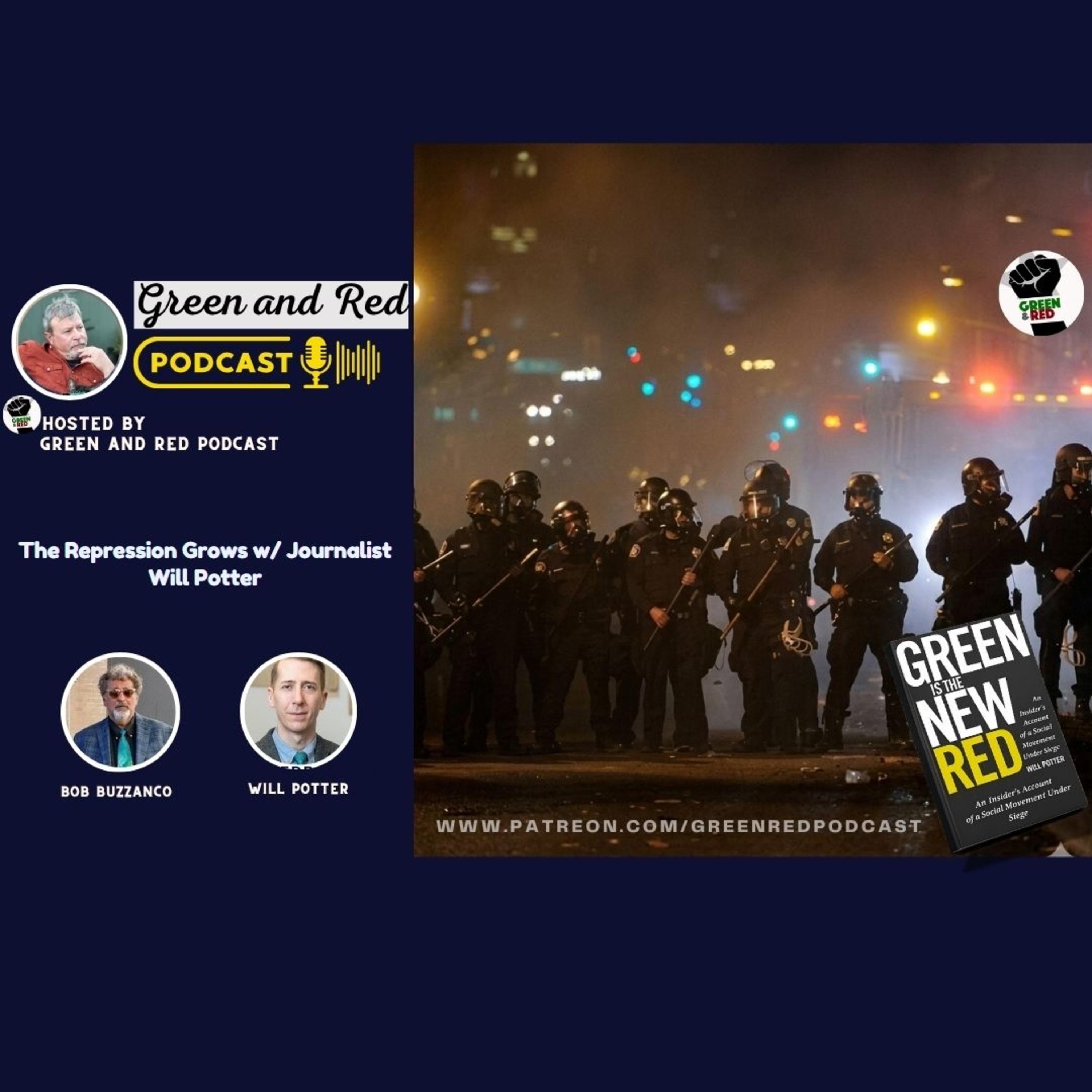
Green & Red: Podcasts for Scrappy Radicals
The Repression Grows w/ Journalist Will Potter (G&R 489)
00:55:45
Loading summary
Transcript123 lines
- [00:01]
A
Welcome to Green and Red Scrappy Politics for Scrappy People, a regular podcast on radical environmental and anti capitalist politics. Brought to you by Bob Bozanko and Scott Parkins.
- [00:14]
B
Welcome to the silky smooth sounds of Green and Red podcast. This is Scott Parkin in Berkeley, California. And as always I am joined by
- [00:24]
C
Flop as I Go in Niles, Ohio.
- [00:27]
B
And today we are rejoined by our friend and comrade Will Potter, who is an award winning investigative journalist and author whose work has focused on social justice movements and attacks on civil rights post 9 11. He is the author of Green is the New An Insider's Account of a Social Movement Under Siege. And then his latest book is Little Red Barnes Hiding the Truth From Farm to fable. It's the 15th anniversary of the release of Green is the New Red. And then keep wanting to say green and Red. And then, and then I believe Little Red Barnes is about to come out on audiobook of it as an already the book.
- [01:05]
A
Yeah, they're both going to come out on audiobook. They're available everywhere now.
- [01:09]
B
Awesome. And for audience this is going to be a two parter. And so we're going to talk a little bit about current events with Will and then we'll do another episode about Little Red Barnes. So welcome back to the Green and Red podcast, Will. It's always great to have you.
- [01:21]
A
Thanks for having me. Yeah, it's great to see you guys. I appreciate it very much.
- [01:25]
B
Yeah, maybe just starting on the current events is we're seeing states have passed anti protest legislation. We've talked with you about that. And increasing militarization of police. We're actually seeing activism turn into terrorism, most notably recently with the Prairie Ran Prairie Land decision. We've done a couple of shows on it, including with the Prairie Land Defense Committee. And then I see that you've been putting some stuff out on it. Maybe we could start off with you talking a little bit about like how do you see this where this political moment is now, particularly in the wake of what's happened at Prairieland?
- [02:03]
A
Yeah, that's a great question. I think that's the question hour and a really big one. In short, I would say it's what we've talked about over the years so many times in continuance, this ever expanding web of labeling dissent and protest as terrorism. But now it's accelerating in really dangerous ways. We'll talk about the Prairieland case, but in general, if I'm sure all of your listeners are already aware, but this prioritization of anti fascists and antifa is the terrorist threat is really now being pushed heavily by the administration, both rhetorically and within things like the national security memo that came out, fusion centers and even a new international conference that's being organized or this summer where the Trump administration is hoping to gather counter terrorism officials from multiple countries to talk about this terrorism threat. So everything. The writing has been on the wall for quite some time, but they're accelerating that effort to go after anti fascist and anti government protesters as terrorists in the same way they've been going after environmentalists, civil rights activists, Muslim community and so many others. We've seen over the decades.
- [03:14]
C
Something like the Prairieland verdict, which we'll get to, but that involves actions. We'll just leave it at that. Whether obviously you and I don't. The three of us don't believe that there were terrorist actions, but we're also seeing stuff like social media postings.
- [03:26]
B
Right.
- [03:27]
C
And a grand jury is being asked to give away the anonymity of Reddit users. And that's the kind of stuff that seems different to me as somebody who studied it academically. Have you seen anything like that before? Is that that's a big new step, isn't
- [03:45]
A
is so I see it in a couple ways. One, it's essentially making that argument that all of this is a conspiracy, which is a tactic we've seen governments use well over a hundred years. Right. It goes back to the first red scare, Beckett red scare, going after anti war activists, black liberation activists. This conspiracy has been used to wrap up in periods of heavy repression like this, wider and wider groups of people. But that's not necessarily new. But I think you're right that the way it's being applied in this digital era in particular, it feels like a shift right now. One of the things that stood out to me on that front is when the Trump administration is asking for increased funding now for a new basically enhanced fusion centers that are bringing together all these counterterrorism resources to go after antifascist. Their description and the language of why that's necessary focus really heavily on media and social media. This is an ideological war. And the way that they're ramping up attacks on public communication and private communication, it can really trembling right now in Prairieland on that kind of. The messaging became a factor of that case as well, where people were being wrapped up in this prosecution and conspiracy were being involved in the same Signal chat. And the government even argued that Signal was evidence. Signal, by the way, is this encrypted app that has moderately better protection. Right. The government was arguing that Using those tools was evidence of criminal activity. That's also not new. But it's something that's getting bolder right now.
- [05:30]
C
Just a quick follow up. Because in the past when people have said they're coming after me, I would, cuz. Nah, you're safe. Like I've said that about myself. I'm a nobody. Nobody cares. I'm not sure that's true anymore, is it?
- [05:41]
A
With the amount of intelligence resources and surveillance power, I think it's safe to say no, that's. I don't think that's true anymore. I would do the same thing because I'd always. It never sat well with me how sometimes that could be tweaked into this kind of badge of honor or even posturing in social movements. Right. It turned into this, oh, I gotta file. It's. Man, I don't know, man, I don't know what you're actually doing. But increasingly it feels like the net is that wide and the surveillance tools can go that deep. That I'm not saying in this in a way to make people afraid, but I hope people already understand this, how these tools are being used now. They're being coupled with this AI infrastructure that's being developed and on the military side as well. And to add another element to that, I'll throw out that when the government is talking about anti fascists as an international threat, one thing I haven't really heard people address is what that means in terms of counterterrorism power. Right. Because there's supposed to be this division between the FBI and CIA, between domestic and State Department. They do all the really terrible stuff against the foreigners overseas, but they're supposed to be restricted at home. That line is being blurred and erased. So those more intense surveillance powers that we use abroad are now being used more at home. Without a doubt.
- [07:09]
B
Yeah. I believe some of the most more recent terrorism designations for anti fascist groups in Europe, like in Germany and Italy
- [07:16]
A
and Greece, just like you can look at some of the cases coming out of Russia as well. There's a thread. No matter how democratic or authoritarian the government is, they're proceeding in the similar fashion against anti fascist conspiracy charges. Indiscriminate surveillance, trying to get whatever kind of petty vandalism or petty property destruction to stick and then arguing that as part of a broader like violent conspiracy that's right in the wings. It's the same in every country right now. And what do you.
- [07:53]
C
And I say.
- [07:54]
B
I didn't say this in the sort of opening bit. We're also seeing historic Protests like no kings, May Day mobilizations coming up, which is looking to be big. This community, this fierce community resistance we saw in places like Chicago and Minneapolis. But what do you think the impact of these MPSM7 and this designation of anti FIFA as terrorism is going to have any impact on organizing or direct action?
- [08:26]
A
It's hard to say because I feel like I've. We have lived through cycles of this over these last decades and what generally happens is that, and I've been open about struggling with this in the nature of my work, that the more we talk about and expose the mechanisms of state repression and how bad things are getting, one of the consequences is potentially increasing fear and reluctance to be part of these same movements and skepticism and kind of distrust of each other. I think the best way to counterbalance that is just straight organizing. The more we know each other in person and the more we can mobilize en masse in masses, the government is doing the same thing with their surveillance. So I don't really have a clear answer to that. So what I'm seeing so far, what I'm more troubled about at this point is the lack of awareness. How sweeping these powers have been for decades, how all of that has been inherited by an authoritarian. I think there's a lot of new interest in people coming out to protest like this. And I don't think they really understand how close to home prosecutions like the Prairie Land Case, Obsidian, Others actually are.
- [09:45]
C
That's a double edged sword though, because you don't want to discourage people from doing things right. So how do you walk that line where you want them to know that this is real shit, but you need to do something.
- [09:59]
A
I try to have those conversations by setting the baseline at an understanding that repression is inevitable. If we're in any type of organizing or advocating for social change, the pushback by state and corporate power is unavoidable if you're effective. But we have to establish that first and recognize that part of doing this work is engaging with the repression and the backlash. So this isn't some like boogeyman in the room. I think it needs to be part of a baseline understanding. You want to go to protests, you want to be active. Part and parcel of that is understanding security culture to a degree, understanding your rights and understanding how the opposition's trying to shut us down. In many ways, I think the more we understand that, to me it's empowering, truly because you see that their toolkit never changes. They're not creative, they might be ambitious, but they're not novel. A lot of these tactics just keep getting repeated over this last hundred odd years, but with new digital tools. And I think the more we understand that, and particularly all state agencies can't comprehend non hierarchical organizations, I think is really something we need to remember too. So there's mixed lessons here. Yeah, there's reasons to be concerned, and then there's also reasons to see that they're legitimately afraid.
- [11:29]
B
Speaking of the security thing, just put it out there because we've recently been talking to Tom Sidesoff, who one of the things he pulled out from some in his book and some of his research is about how security conscience activists were in the sort of more radical environmental and animal rights space and to the point where he even had trouble communicating with them. Do you encounter that as well?
- [11:52]
A
Absolutely. I think it's been shifting. There were periods, I mean, this has been a lot of years now, but it almost feels like there's periods where security culture was more dominant in the movement and everything was like much more rigorous. And then it's gotten lax. But I would agree with that. And as a reminder, with like the Earth Liberation Front cases, a lot of Earth First Cases, Animal Liberation Front, wto, rnc, all of that stuff was largely dependent on government informants. It wasn't them. But to your point there, that emphasis on security culture has dividends. The government doesn't really know what to do with it, and ultimately they have to turn people against each other.
- [12:37]
C
Oh, sorry about that. I think there's been an increased, let's call it militarization of this. See, I would fold ICE in with this because that's acting like Trump's private militia. And they're just like getting like, just the immense amount of weapons there. They're like one of the top. They'd be one of the top 10 biggest armies in the world and money. And how is something like ice, which is allegedly an immigration group or a Border Patrol group, it's not. How's that affecting just this larger culture of protest?
- [13:08]
A
I've been thinking a lot about this book by a guy named Ernst Frankl after World War II, where he's talking about this idea of the dual state. And we've talked about this a little bit, I think, before. And the key, the summary takeaway of all that is the way the Third Reich in Nazi Germany really worked is not by completely shutting down civil society, but creating this parallel system for the dissidents and marginalized and queer and Roma and Jewish people and everybody else. So that's a long way of Saying, I see ICE as that and is creating a parallel police, domestic military alongside these other infrastructures that can also be weaponized and turned against civilians as well. And so I think it's part of the sheer scale of it. It's building up a private army that is unaccountable to any other counterterrorism agencies or state agencies that is being directly controlled by the White House, whereby people who are unqualified and untrained, who are reaping the benefits of decades of domestic policy that shifted military arms surpluses to local law enforcement. So you have these kind of kids trying to get these signing bonuses or outright racist or whoever that have access to all these military grades. So what that means for protest is we're having to encounter not just the history of police violence that all protesters know at demonstration, but these people are even less qualified, less trained, and they have more arms and munitions. So it's just a kind of a recipe for disaster.
- [14:50]
B
Yeah, it seems like they have more impunity, too, than even police.
- [14:55]
A
I think that's a really good point, because on top of that, we're now firmly in a culture where our expectation of privacy has just disappeared and also the expectation of any police accountability that could evaporate in. You're right. We've been hit by this so many times. We've seen so many egregious cases that now ICE and the Trump administration are arguing that even taking photographs of what ICE agencies are doing and releasing their information is doxing. That's a terrorist offense. So it's spiraling in ways that 10 years ago I don't think would have been feasible. But it is Southern.
- [15:40]
C
This is also a patchwork, isn't it? Like, you're way more at risk in Texas, say, than you are in Massachusetts. Right. Is that kind of. Are you seeing that? Like, where.
- [15:52]
A
Yeah, I think that's fair. I think it's also hard to say. Right. I mean, I think personally I grew up in Texas. I would feel more comfortable in Massachusetts in some ways, based on how I grew up and what I know about. But at the same time, you're right that it's a patchwork in the sense of that's the landscape post 9 11. Right. So there, after 9 11, there was all this funding that went in to the federal government about going after terrorists. But as part of that, there was a huge amount of money that started going to the states and then into these fusion centers that bring the state and the fence together. So it does. It is. It feels like a patchwork. Because it is, it's this network that is really messy and overfunded, under trained and now they are getting more and more deputized as like higher ranking counterterrorism and ICE agencies. And it's just incredibly dangerous.
- [16:48]
C
I was thinking of like Minnesota where you have the governor and the mayor of Minneapolis who performative thing. And so they're not like overbearing in it, but they're not doing anything to stop it either. And I think.
- [17:02]
A
And that's what scares me most. Yeah, for sure. They've really. They did that spectacle in Minneapolis where they had the cops out handing out, what was it, hot coffee or snacks or whatever. So they do these stunts. But we need to remember, when push comes to shove, can you actually have any faith that those people with guns are going to keep the other people with guns, the militias, the MAGA Crowd, Proud Boys, 3 percenters, all the way to the much more extreme groups? Who are they going to lean towards? Who are they going to protect? And I think in all of these kind of standoff moments that we've had in California, Portland, Minneapolis, I worry about the same thing in all of them. It's these outside, truly outside agitators coming in with far right groups and if they want to instigate and escalate things, I don't think cops are really, I don't think we're at a point where we can count on any of them, be on our side.
- [18:04]
C
Well, in Houston, the city council voted not to allow the police to cooperate with ICE. And then the governor said, I'm going to pull $110 million of aid from. And the mayor there, whose mayor's been cooperative the whole time, Whitmire is horrible. And so of course he's backing down because that 110 million is more important. They just have like countless strategies to coerce you. And.
- [18:24]
A
Well, and I think that's what I've realized, talking to so many former FBI and counterterrorism officials too, is people that really tried to move the Titanic. Right. They're trying to steer the ship away from where we've been going for so many years. And they realize like, systemically, even if you can get movement within FBI or DHS or even within ice, these outside players, they pull funding. And it raises some much bigger questions to me of how we navigate this moment in history because these agencies can't be reformed.
- [19:02]
C
I was bleak coming into this.
- [19:04]
A
Yeah, you're welcome. It's great seeing you guys.
- [19:09]
B
One of the things I really appreciate about your work is there's within what I would call probably more liberal circles. It's this is all the fault of Trump. And believe me, I agree that things have gotten exponentially worse. And the Bondi memo and all of that sort of stuff is an example of them reprioritizing what the federal government does to go after not just activists dressed in black or anything like that, but civil society, really. And they're looking into groups over funding and things like that. But one of the things I appreciate about your work is how this is. This has all been pretty consistent since 9 11, maybe even consistent since the Oklahoma City bombing. And I wonder if you could just talk about that a little bit. We saw this also under Bill Clinton. We also saw this under Obama. We also saw this under Biden. So it's not like a partisan issue, per se.
- [19:58]
A
No, I appreciate that. I think that's really important to remember. That's part of the mythology and this narrative that's being created right now. It's really tempting. We see how truly evil some folks in this administration are. Just associate everything about this mess that we're in with them or even with the first round of the Trump administration. And I've lived through it. I've seen this every step of the way from 911 on. And I would argue, I'd agree with you. It goes back pre 911 as well. There was already that shift in counterterrorism taking place. But from September 11th onward, this has been. Colleen Rowley, the former FBI agent, always used to say in the 80s, it was the war on drugs. In the 90s, they started going after gangs and mafia. After September 11, everything in the FBI is about terrorism. So this is where everything has moved across Democrat and Republican administrations. And it's all been in the name of going after protest group and Muslims and racial groups as well, racial discrimination. I think we need to understand that regardless of what happens with Trump right now, this infrastructure, this model, is not only cemented itself in the United States, but it's being spread around the world as well.
- [21:24]
C
And there's never been a time in US History where this hasn't been the case. It can fluctuate, but it's been there forever. And we had Ellen Schrecker on last year who said this is for some, McCarthyism. And the technology obviously has a lot
- [21:36]
A
to do with that.
- [21:36]
C
And the point you made is a great segue to something I've written down here either yesterday or today. I think Congress is supposed to vote on FISA reauthorization, and I think they extended it for 10 days or something like that. And to Scott's point, the Congressional Black Caucus, the people who the Democrats put up front, is the progressive front, they're okay with it. The Democratic Party is okay with this, and they're handmaidens of it as much as anybody, I don't think. Are people aware of what FISA is and what it means.
- [22:05]
A
I was just talking with Mike German yesterday. It was a longtime FBI agent who's been very critical of. And we were having a similar conversation where he was just like, I think we met in 2004. And he was like, hey, remember when torture was controversial? When the Foreign Intelligence Surveillance Act.
- [22:23]
B
Yeah.
- [22:23]
A
Which. Everything that was modified with the Patriot act for this warrantless surveillance, going after libraries, the sneak and peek searches, it's all just become normal. And I think that's what, to Scott's point also, how this has happened across Democrats and Republicans, is that at each step of the way or moments, it feels like a radical expansion, and then it settles into normalcy again. If we look back at, like, the John Yoo memo, defending torture, Guantanamo, these were international stories, and then they fall away. So to me, it feels like we're further accelerating that now, not only with the reluctance to challenge these spy powers or to even have a debate about surveillance or privacy, but we just keep going further and further down this road, and then it's somehow becoming normal that quickly. I don't know if that makes sense. It's just something I'm struggling with right now, is the speed at which all of this is being normalized.
- [23:27]
C
No, absolutely. I think that's the point here. Like Visa, it's just a side story, and there's no resistance. The Democrats, as Scott pointed out, they'll bitch about Trump all day, but that's it. But they're not doing anything about any of this stuff. And that's the progressives. It's like military budgets. Right. You'll get like 30 or 40 people voting against it. Everybody else is fine with it. So.
- [23:51]
A
Because it's become one of those untouchable issues, I think it's. No, I'm just like.
- [23:56]
C
A lot of people I know really do create that, like, Democratic, Republican, or liberal, conservative, or however you want to call it, left versus right argument here. And I'm trying to, like.
- [24:03]
A
No, it's not.
- [24:04]
C
It's pretty much all of them.
- [24:06]
A
Yeah, absolutely. It's been. We've created this narrative, and it's kept us blind to the fact that across these administrations, it's just about power and further cementing power. So whatever. And I always tell people it's funny how people sometimes will think or make assumptions about where I am politically. But to me like I feel like I'm always making what is now feeling like an outdated or antiquated argument that there is like a civil libertarian position which is like regardless of where you are on a whole host of issues, if we don't defend these core rights we're always tries to get more power and expands outward. And it's funny like it used to be even 15 years ago I could meet a lot more people in that shared space that have different. It's getting a lot harder now. And that's one of the things that scares me so much is that I don't see where like the reasonable side of the Republican Party is or even within Democrats who are the people that are willing to still challenge and defend or core rights as they're being stripped away right now. And it feels like that debate's kind of been given up for many people.
- [25:21]
B
There's one Republican, I would say Thomas Massie and a handful of Democrats. That's it.
- [25:26]
A
And they're seen as like curmudgeonly, I don't remember. Right. Extremists certainly. But as not team players. Right. They're just, they're refusing to play along with the rest and they get marginalized for that.
- [25:40]
B
On the normalization, on the normalization question, the other thing I actually see is becoming very normalized is how all this has been outsourced and privatized. We've done a bunch of shows on that. But that's the other piece which I don't think we even really. I mean there was, that was going on in the Bush years. But Palantir and Civic Corp and Geo Group and all that, all level privatization going on with this stuff is actually pretty mind boggling as well.
- [26:05]
A
And it's something that was actually a started and abandoned book project of mine years ago after greatness. And it read because I was seeing that privatization happen and I was getting a little. That was freaking me out. Cause there's no what little checks and balances we have on the FBI. There's none for any of these groups. There's no paper trail, there's no open records, there's no accountability. And the billions of dollars flowing into these unaccountable industries that are just mercenaries. I say all that because right now we're in a position where the heads of various social media and tech companies are actually given military appointments within State Department so they can actively collaborate and share Some. I don't even know how to characterize that anymore. It's like we've moved away from this mercenary spy model like groups like Stratfor that would spy on protest groups. And now the big tech companies have taken that role and they're actually like deputized by our military. So it's just merged. It's not even so much an outsourcing as they've brought them inside and they're
- [27:13]
C
not even collecting it. We're giving it to them.
- [27:15]
A
We're giving it voluntarily.
- [27:17]
C
Yeah, for sure. You know, that's interesting because you're also a journalist and a couple weeks ago we were. Mickey Huff was on for Project Censor and we were talking about Muckrakers and, and how I think today is the worst journalist scene I've ever witnessed. Are journalists just in general not as smart as they used to be? We valorized the kind of Seymour Hearst if Stone legacy. Or is it just because of media consolidation where you have Bezos who's gutting the Washington Post and CBS News is being shredded and they go, but it's really hard. Like I said fisa, which is something I followed forever. I know I've known people who've been caught up in it and it's like a very small peripheral story. Why is the media not. They're not even defending their own people.
- [28:00]
A
No, they're not. There were no American professional associations coming out speaking for our colleagues in Gaza, being fascinated. Nobody, nobody was speaking about this. I was getting that. I'm a member of a half dozen groups, professional news organizations and I'm getting all their newsletters and publications and they're just like the world is just going on. So I feel it's crazy making to me. I don't know if I have a simple answer to that. I think a couple things have happened around that 9 11. The shift to digital media, that's just further accelerated. We've never figured out how to do it. Major news organizations have never really figured out how to make the transition from advertising model to the Internet. And as a result they've used that to crack or to cut out investigations to kind of foreign bureaus. Now even local news is pretty much non existent. So that's part of it. There's been an economic pathway that's just led to news as I was raised to believe existed just disappearing. I think what else has happened though is on a personal level that if you. I grew up seeing people like Edward R. Murrow and if Sohn and all the like the old school Muckrakers. To me, that was the North Star. That was like the entire appeal of this craft, that combined with the beats and this kind of outlaw literary spirit. And I don't know, I'm hazard to say that even, like the folks who came up with that passion, it's hard to stick around in the craft right now. It's just so demoralizing and there's no financial stability. And if you do your work really well, there's a really good chance you're gonna come under federal or state scrutiny or corporate scrutiny. I don't know, man. Like, I'm really struggling with that. Cause it's heartbreaking to see the amount of passive voice being used in headlines, even at this point where it's so clear we're dealing with the fascist regime, that this is unmistakable and we're still using the passive voice and pretending like it's normal. And I don't know how to fully
- [30:22]
C
explain that comedians seem to be doing. I'm not. I used to say this is a joke. I mean it like they're doing some of the best work. I don't know. Jimmy Kimmel takes on Trump as much as anybody does.
- [30:32]
A
It's.
- [30:32]
C
That's where we are.
- [30:34]
A
And I think there's something. Historically, we could argue that too. There's something about comedy and the arts that allows people more leeway. But, yeah, I don't know why journalists. I think comedians are accepting that people are going to hate them and they're going to have opposition. I think journalists today are still trying to thread some path that either has everyone upset at us equally so we can claim objectivity or something like that. I think there's something there of the press has refused to accept that fascists don't want us to exist. Like, we're. No matter how bad or how good we do our job, they're going to hate it. And I think unless we accept that and start throwing some punches back, no exaggeration. They want us up against the wall.
- [31:21]
C
Like they.
- [31:24]
B
And yet with the. I think about this, like with. I think about this with DC press bureaus, is that we have people in power who want to throw journalists up against the wall. And then the people in D.C. all they want is like, access. They don't want to jeopardize their access.
- [31:39]
A
One of my. When I moved to D.C. when I was 22, when I first I went to. After all the morning talk shows, the guests would come out and there's be reporters outside that are waiting to ask them questions. And this is really Routine thing. And Colin Powell came out of one and I started asking him about the sanctions on Iraq, and just all these tough questions and the amount of vitriol and frustration I got from my colleagues for breaking the normalcy is exactly what you're a living work in D.C. it's so incestuous. People end up. You have people working in the press that end up marrying lobbyists, marrying government officials, relationships, affairs. It's about access. And also, like I was saying before, not pissing people off too much. It's like staying in the club. Everybody wants to be in the club.
- [32:34]
C
Yeah, yeah, I see. Like with Carolyn Levitt. Right. Who's just. I can't even find words and no one challenges her. It's just I've never seen anything quite this bad. And I've been critical of the media forever. I read Chomsky and Herman when that came out, and Bagdeeki and all those guys. So I'm not. I got pretty low standards. And even this is worse than that.
- [32:56]
A
This is making me question myth of the liberal media with permanent Chomsky. Right.
- [33:01]
C
Yeah.
- [33:02]
A
Essentially why that book was so important is they argued, hey, don't fixate too much on the individual journalists because we're missing the system. And now I think that's still true, but we have to start looking at the individual journalists because I don't understand how we can pat ourselves on the back as being critical and we support a free press and having all these sins and then be in those press rooms and not just go toe to toe every day. It's just such a grim. You know what I mean? It's just. I can't justify it anymore. I don't know how to explain it.
- [33:37]
C
The guy says, quiet, Piggy, and no one has her back. No one says anything. No one follows up.
- [33:42]
A
It's now ancient news that Trump threatened to destroy an entire civilization.
- [33:46]
C
Yeah.
- [33:47]
A
And that was a week ago. That was a week ago.
- [33:50]
C
Yeah.
- [33:50]
A
You know what I mean? I don't know how to process this anymore, so part of me wants to bring that in. And maybe journalists are just people, too, and it's like melting our brains a little bit, trying to keep up with the pace of the carnage. But I don't know, do you just,
- [34:08]
B
like, on the media, track back to what your beat is? Do you think that the press for the coverage of Prairieland or the coverage of cop city protesters getting RICO and terror charges, do you think that they. Do you think there's ample coverage going on occasionally? I saw New York Times articles on the Prairie land. But like, it doesn't seem like there's much going on there.
- [34:33]
A
No, I think it's abysmal. And there was a big New York Times like, hey, antifa, anti fascists are the new boogeyman kind of story, right? There was, there's blips of this, but the framing, to go back to how Chomsky and Herman would talk about this, the framing of the news, that. That's an aberration, right? It's a fringe. It's this whole rhetoric, especially after 9, 11, everything is about radicalization. And that whole framing within counterterrorism is so horribly flawed, then it reduces everything to the ideology. And so I think that's what we're seeing in this news coverage is that, yeah, there might be stories about, hey, some people that dressed in all black or convicted the government says they're anarchists. Our news story is literally two paragraphs long or our social media clip is like three slides. You know what I mean? Part of it is I don't think there's any room for an in depth conversation about how complex some of these issues are. Everything is getting truncated in those simplest possible narratives. And I think that's why, as maddening as it is, we're just repeating all that stuff we lived through in the Green Scare and before. It was just treated like a news of the weird fringe story about radicals. And it's really a story about all of us.
- [36:00]
C
Matthew Dowd, was he Bush, Was that Bush's speech trader? Matthew Dowd, was that the one? Because he once said long ago, he said if we can get them using our language, we've won. And I think he was referring, if not, I think he was referring to terrorism. And I started noticing that liberals would lash out, oh, you need to call this guy a terrorist and you need to call this a terrorist. And like they wanted equal time. Like those guys are terrorists too.
- [36:21]
A
And I'm thinking, like, I don't know
- [36:23]
C
if you want to normalize that. And I think it's really coming back now where it, like Scott said earlier, like, it's just normal. You can call these Prairie Land people, what I've read about it, it seems like it wasn't exactly like a high end crack operation, but.
- [36:38]
A
No, not at all.
- [36:39]
C
No, I mean it was. We're all on the left, we've all seen people like that. But the media portrayed it as this like cabal of like really clever criminals. And I think that's just because we've normalized this over the years. Like we want everything called terrorism.
- [36:51]
A
And I think what, especially with cases like Prairieland, what happens is you have that shortage of resources and news to do actual in depth, critical coverage. You have journalists who are covering five, six stories a day. Not to say this was all of it, but then they're thrown into a case like this, they don't know anything about it and they just start regurgitating government soundbites and press releases. What the prosecutors are saying. And there isn't really a confidence, the pushback and challenge. And then you just magnify that over and over again. This just keeps happening repeatedly that the press is dropping the ball. And as a result, you. These cases like Prairieland, they're continuing and we're not challenging them as they continue to expand. The prairie land isn't that much different than what happened in Cop City. And I'm afraid we're just gonna keep expanding that web until it's going after more and more mainstream groups.
- [37:49]
C
It's interesting cause Cop City, and this is something I've been thinking about, Cop City has had a decent ending. Let's say a lot of the charges have been dropped. As we're always. It's always incumbent on us to leave people with some sense that you can do something or there's some hope. And we are seeing like the no Kings is huge. And I don't have any problem. I know a lot of people on the left have just been shitting all over it. I don't have any problem with it. Anytime 9 million people go out, I think that's cool. We're seeing some, let's say, accidental fires being set, things like that. A massive movement that really does cross political lines on data centers, AI, things like that. Does that give you some sense that we can be hopeful a little bit that there are people who are aware of this and are trying to do
- [38:31]
A
something about it, or it feels like there's something truly right beneath the surface. And I don't know if that's the best analogy, but it. I'm sorry, I'm not hopeless and I want to make that clear. I focus on, and I've always focused on really dark shit in my work. And focusing on political repression is not because I think this political repression is impossible or that it's going to destroy us. It's because I think it's inevitable and we have to learn to fight it back to get through it to the other side of it. That being said, when it comes seeing the speed at which people organized in Minneapolis, for example, so many people who were new and despite this climate of fear, not just the terrorist watch list, but people being murdered by ICE agents in the street. It's a different level of fear. That's not an abstract civil liberties argument. That's a we see you in our community terrorizing our people, kidnapping our neighbors, shooting our friends. And people still were able to organize and have intake of all those people, get them coordinated and tapped into other resources. That's enormous. If we can do those things around situations like in Minneapolis or the way I've seen mutual aid networks pop up after natural disasters repeatedly. Increasingly it's not FEMA that's being gutted, it's not state agencies, it's largely non hierarchical or anarchist organized community mutual aid groups that are stepping in and getting things done. And so I don't, I still see the behemoth and I still see like things are going to get much worse and like we need to see that, but that doesn't mean we can't fight through to the other side of it. I think we really under utilize and under recognize how much power and potential we have in these movements. All of my work for you know what I've 25 years now, 15th anniversary of green is the New Red. I've seen so many cases of this political repression escalate and every time it's the government or corporations freaked out about really small groups of people. And to me that's a sign of hope. Say what you will about the individual cases, but to freak out some of the most powerful people on the planet with small clusters of divests with very little resources is a really impressive thing.
- [40:58]
C
You have another.
- [40:58]
B
Yeah, that was my, my question. I guess my question was a little bit of what you just answered about like in, in the 15 years since you put out Green is the New Red, what do you take? Is there anything that like has surprised you like in the midst of the repression, the depressing repression that we saw 15 years ago with the Green Scare,
- [41:21]
A
there's a lot that has. So I recorded as part of the audiobook release a short new preface to Greenest the New Red reflected on this a little bit. I think the shortest way to answer that I've been thinking about a lot these days as I'm thinking about like the amount of time that's gone by. What's really shocked me the most is how much we've already forgotten it as ancient history. And that's what I've just struggled with the most these last couple years. I've gotten into so many arguments with journalists and colleagues that who I respect national media outlets, that as these stories come up about Prairieland, Cop City Ice in Minneapolis, there's no even acknowledgment or context how this has been developing for decades. There's no mention, as the government says, hey, we need domestic terrorism powers to go after extremists. There's no mention of the FBI going after environmentalists as terrorists, their number one threat for decades. So that's been shocking to me. It's this kind of. It doesn't seem like it's the work of the government and it's not the work of some, like, physician group. It's been this cultural amnesia that we live through this stuff and then suddenly we're in another cycle and we don't even remember it the last time it happened. That's been breaking my brain quite a bit. But in general, I think looking back, there are times where I felt like I was being saying too much. And certainly people told me that, like, I was putting myself out there too much or making too strong of a warning. We don't know how bad it's going to be. And if anything, I wish I would have been more forceful. What we're seeing now outpaces.
- [43:16]
C
Let me ask them for both of you, because you're in the world, of that world more than I am, but because we talked last year about the Greenpeace verdict, right. And we have the prayer line very simply. But have you seen internally a change in the way, like, public interest groups behave? Are they censoring themselves? Are they retrenching on their own because of what's happened? It's not business as usual. You're seeing them do less, reach out, have slower. Slow down their ambitions, slow down their programs.
- [43:44]
A
I don't know if I'd go so far to that last part. I would say I've seen a chill, I've seen lots of closed door and been included and just confidentially talking to people about what's happening behind the scenes, that people are aware of the risks. The Trump administration is open both through the national NSP M7 and through the broader rhetoric. They're going after funding, they're going after science, they're going after mainstream NGOs. And I think most groups at this point understand that. I don't know how much that's changed their actual activity, in part because one critique I've had of environmental and animal groups in particular for a long time is they've tried to keep their head in the sand to these broader trends. But that being said, you have Things like the Sunrise movement, people are openly talking about this, repeatedly attacking the criminalization of protests, speaking out against other social issues. So it's hard to say. I think there's a lot of concern right now about funding what these designations will mean for NGOs and their income streams. And I think that's making a lot of people really hedge their bets, to be honest. But there's also like a long standing culture of doing that they need to break out of.
- [45:04]
B
Yeah, I would agree with on both of those points.
- [45:06]
A
I was gonna say you're much more in that world than I am, Scott. Is that what you're seeing too?
- [45:11]
B
Yeah, I think that the chill effect is definitely there. And then the other thing, the hopeful thing I see though is, and not all groups are doing this, although people who work at some of these organizations do this, is that there's been a very strong pivot to being part of these other movements, like the anti ICE movement in Minneapolis around the country. But in Minneapolis in particular, it really motivated a lot of people. There's a lot of, There's a, A lot of people who I would identify as like the climate movement or climate activists. And Sunrise being an organization which is like really leaned into this, but there's a lot of, there's a lot of people getting involved in, in other movements. Like they recognize that you can't actually do climate work if there's not a functioning democracy. And so I think that's the, I think that's an important thing going on here. I would also say that a lot of these same folks were people who like, really lean, like pre Trump really leaned in on Kaza too. I saw a lot of climate activists, I saw a lot of climate activists get scared and not want to do anything on Gaza. And I saw a lot of activists who like leaned in and like were changing themselves to Lockheed or whatever.
- [46:15]
A
That's really inspiring to hear. Yeah, I think I've seen that. I would agree with that. On the environmental side also has a have a foot in animal activism world. And I'm, I haven't been seeing it there, which has been like maddening. It feels like a lot of those groups are turning away from this. But to your point, I think my sense is a lot of folks are also starting to realize that if we're all being treated with this terrorist terminology and labeling and we're all being attacked in such increasingly explicitly authoritarian ways, what reason do we have for playing it safer and trying to keep our head down? Right. I guess that would be to the Question earlier, how to flip this around into a positive. It's like the more meaningless this rhetoric of terrorism and the broader that these prosecutions get, I think the more and more rationale we have for just putting it all on the table. Don't be afraid to go out there and be active and get involved and organize and be ambitious, because all of it is being seen as a threat. So we might as well just actually say what we mean. Be true to our values. Yeah.
- [47:29]
C
And that's really important. I've talked to so many people who are like, don't do this because they'll use that against you, or you're just giving them an excuse or simply, it's like they're going to do it anyway, killing people in the streets. So we're way past that. Don't provoke them. They don't need provocation. They just do it.
- [47:49]
A
Oh, gosh.
- [47:50]
B
I was just gonna say, I think this is the moment to be bold. I. I think at a certain level also that they're a paper tiger. They have. They definitely have their hands on the lever of a lot of things. But, like, right now, the Shia and the Catholics are, like, really, really trashing Trump. He's being like, whatever. He's still.
- [48:07]
C
The Vatican. Shia alliance is resurrected.
- [48:09]
B
Yeah. But, like, I think. I think that is a moment for people to be, like, taking action and pushing back and whatever. Whatever way. I'm not sure. Big believer in electoral politics, but I do see these elections happening in red state America that are like, plus 25 Trump districts are, like, flipping. So for whatever it's worth.
- [48:27]
A
Well, for what it's worth, we shouldn't just see those news stories and get, like, some modest dopamine boost as we scroll past it. We have to take. I do, too. But, like, we also got to, like, really seize it. I've always relied on the no one is coming mentality for so many years. And I realized that's like trauma response and a lot of things, my journalism background and other things. Someone the other day, what, some stupid Internet meme, but it was, if no one is coming, that means no one's going to stop us either. There's two sides to this. The worse this gets, the less likelihood that someone's actually going to try to stop us from being bold right now. And I think we need to really lean into that as this gets scarier and scarier. Like, why not just say exactly the world that we want to live in and try to go for it?
- [49:20]
B
Renee Goode and Alex Preddy. Neither really had much Of a serious background in activism.
- [49:25]
A
Right.
- [49:25]
B
And really both put it out there in defense of their communities. I think I see them as inspirations.
- [49:32]
A
Oh, without a doubt.
- [49:33]
B
In. They put themselves in harm's way to stand up for their communities.
- [49:38]
A
To me, what just moved me to tears, like so many people about that was just their intuitive empathy, like their intuitive. In some ways, aggression. Right. Alex stepped into the scene. He didn't just observe it and witness it. He stepped in. And Renee Goode spoke up. There was this breaking of normalcy that you could see in them was just from their heart. And to me, that's okay. Well, we have to lean into right now. And I think a lot of people do have that in them. They're not in these spaces. They might feel hopeless. They're not connected to social movements. They've never been to this stuff. But I have not given up hope that a lot of people have that animalistic response of, no, that's not okay. We have to step in and do something. So we. I think we just have to facilitate people doing that.
- [50:32]
B
I have traveled around in some activist spaces since January, and everywhere I go, I. One, I get running into a lot of people who are. This is the first thing they've ever done. This is new to them. And then two. Two. Many of them are saying, I'm very inspired by Renee Good or out.
- [50:48]
A
Wow. So how does that.
- [50:51]
B
And including in Houston, Texas.
- [50:52]
C
Yeah.
- [50:53]
A
Which is incredible to see. This is. We can talk about political repression and what's at stake, but we all watched them being murdered. So for people to respond that way and to come into unfamiliar environments and say they want to be part of this, I think that's a reason for hope.
- [51:11]
C
The main slogan in Paris in 1968 was, Be realistic. Demand the impossible.
- [51:16]
A
Demand the impossible. Absolutely. Because it's all absurd. You don't have to take this in another direction, but this is just where I am at personally and politically. I'm just like, this is all just so completely absurd at this point. I have a hard time even processing a lot of it as real. It's just so bad and so unbelievable. So why not go back to that and demand the impossible? Because maybe that's what they're doing.
- [51:42]
C
Yeah.
- [51:43]
A
I mean, if you look at. Yeah, they took a hit in Hungary, but they were holding CPAC conferences in Hungary demanding the impossible. They all were just coming together and be like, how do we build a fascist world? And all work together. And so if that's. If that's not out of reach in their imagination, God Damn it should be in within reach in our imagination if they're able to coordinate multiple governments to just consolidate power. Like we can do the same with people that are being screwed over.
- [52:13]
C
And Hollywood's taught us to prepare for evil geniuses. It's in reality it's Kristi Noem and Kash Patel and Pam Bondian. I mean they're idiots, thankfully. But I think people. I mean they're evil, but they're also really stupid.
- [52:30]
A
And I think it confirms to me that nothing is. People aren't being drawn into this death cult that is talking about exterminating other civilizations and hates women and migrants because of the quality of the ideas. So one thing I've become really interested in, like how the far right is going after young men. And this new project I'm launched. Launching is very much in that space. And I'm realizing what they're offering isn't a coherent belief system or even a value system that people agree with or good arguments. They're just offering that space that where people feel that they're part of something. And to me this is a big lesson right now. What are we doing on the left that's making it so we're allowing people to come in and feel comfortable, feel like they're part of something, that they're being heard, that they have an identity. This is what the far right is doing. And I think the more we can build those alternatives, structures and communities, we can start seeing those elections turn and we're seeing pockets of it from New York to whatever happens in Maine against Collins with Graham Platner. And we have a lot of these folks popping up. But I think we just have to start building around that and people will come over to it.
- [53:52]
B
Totally. We're time. We've talked a long time, had good conversation. I'm going to wrap it there unless Bob or Will, if you have anything else you want to say on our way out, the 15th anniversary of bringing those new red. Will's textbook is Little Red Barnes.
- [54:12]
A
They're both available on audiobook everywhere now Audible if you use the Big Bad Company. But also you can get them direct through my website, willpotter. Com and also all the smaller audiobook distributors and Spotify and stuff as them as well.
- [54:28]
B
Yeah, and check out Will's website too. There's lots of good stuff there. I was looking at it yesterday as I was prepping for for this interview and we'll put it in the show notes. Wilt's been real.
- [54:37]
A
Dan, great talking to you guys.
- [54:38]
B
Yeah. And folks, if you like us, please check us out on Facebook, Instagram, Twitter, Bluesky. If you're watching this on YouTube, hit the subscribe button. If you're listening to this on an audio platform, give us a rate and review. And then if you really like us, go to greenradpodcast.org, hit that support button or become a patron@patreon.com Greenradpodcast talk to you again soon, to say the least. Folks, everybody else out there make trouble and misbehave.
- [55:24]
A
Sam.