← Green & Red: Podcasts for Scrappy Radicals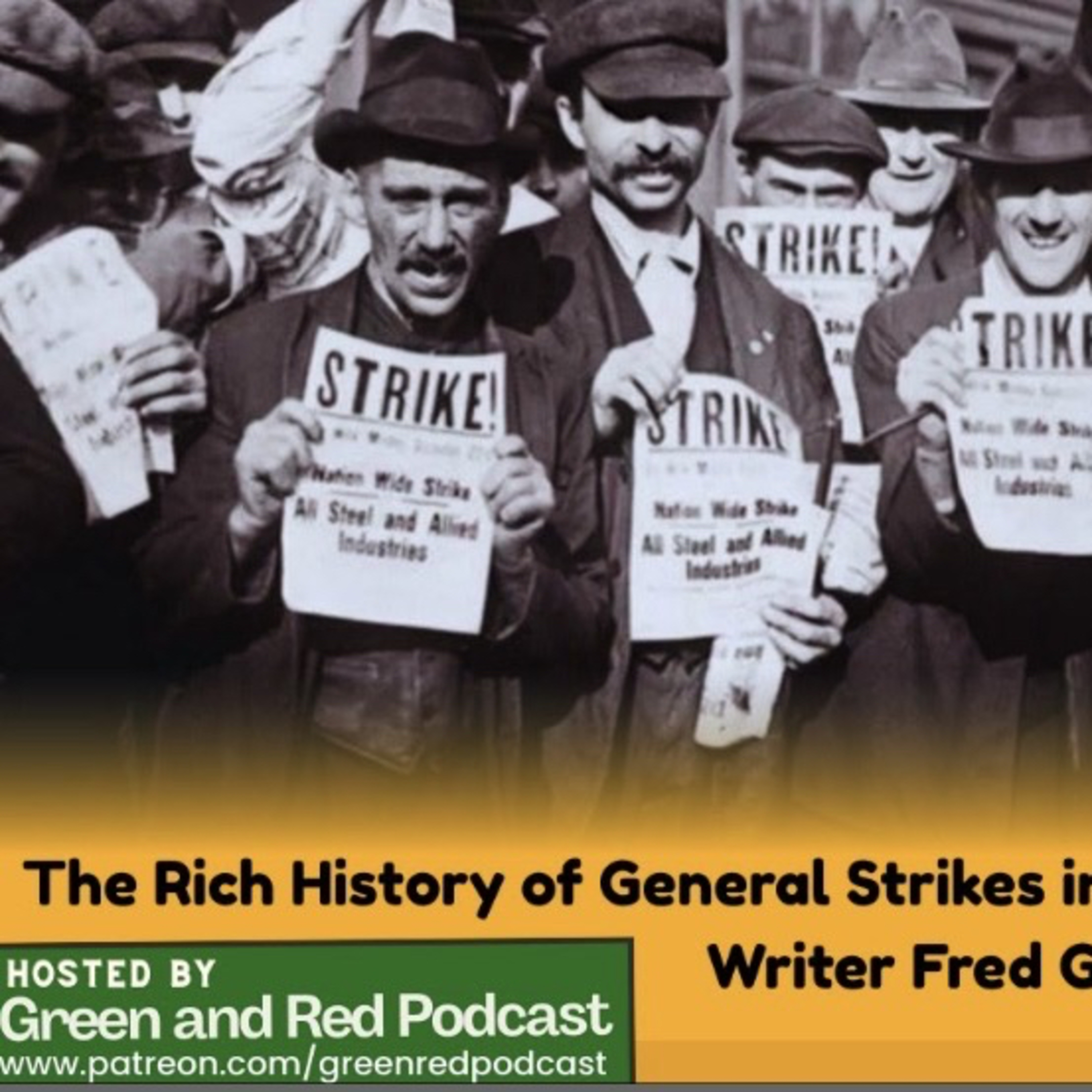
Green & Red: Podcasts for Scrappy Radicals
The Rich History of General Strikes in America w/ Organizer and Writer Fred Glass (G&R 462)
00:45:46
Loading summary
Transcript69 lines
- [00:01]
A
Welcome to Green and Red Scrappy Politics for Scrappy People, a regular podcast on radical environmental and anti capitalist politics. Brought to you by Bob Pizanko and Silky welcome to the silky smooth sounds of the Green and Red podcast. I'm your co host, Scott Parkin in Berkeley, California. And Bob is off on assignment today, but he'll be back soon. But today I am joined by Fred Glass, who is an organizer and a teacher. And Fred taught labor history at City College in San Francisco for 35 years. He was a communications director for the California Federation of Teachers. He's written Mission to Microchip, a history of the California labor movement. And he also edits California Red, which is a bimonthly newsletter for the California Democratic Socialist of America. And then he babysits his 23 month old grandson twice a week. Fred, welcome to the Green and Red podcast.
- [01:02]
B
So glad to be here, Scott.
- [01:04]
A
And Fred, you also just published an article in Jacobin about general strikes. And general strikes has actually been something that everyone's talking about, particularly after the murders of Renee Goode and Alex Preddy. Today, coincidentally, as we're recording this, it's the 107th anniversary of the Seattle General Strike in 1919, which we have done episodes on in the past. We talked with this great historian named Cal Winslow about that, but builds on a great labor tradition. But maybe we could just start off talking about general strikes a little bit. Maybe just for the audience. Just tell us a little bit. What is a general strike? What are they? What do organizers try to accomplish with them? What elements go into them? Just to give a little expansive sort of overview of a general strike.
- [01:50]
B
Sure, there are a few different ways that people think about general strikes. I think most significantly, especially for our purposes here, it's a citywide event where everybody, or at least enough people leave their offices and workplaces and go into the streets and withhold their labor power from the capitalist class and the government. And we've only had, depending on how you define them, about 14 or 15 of them in American history. And we hadn't had one since 1946 up until a few weeks ago when the workers and good people of Minneapolis decided that they were going to hold one. You can also think about a general strike as being something that occurs in larger geographical area. There are general strikes that occur from time to time in other countries. It's certainly not an unknown tactic. It's a very powerful tactic by the organized working class. And then there's also a general strike of, of an industry. You could have a steel general strike as we had in 1959 in this country, across the country, with nearly a million workers participating. So essentially it means the withdrawal of labor power by large numbers of people for a particular purpose. Usually it has happened in the United States around solidarity. In 1946, we had half a dozen of them. So in that last year of general strikes, that was the most that had ever occurred in one year, with the very last one being right here in the East Bay, Oakland, in early December of 1946. What it takes to have a general strike is four elements and really some more, some deeper organizing than just those four elements. The first is that there has to be a generalized anger in the working class. People really need to be upset for something of this magnitude to occur. You then need to have a structure that's capable of organizing a general strike, disseminating the information, helping people to get trained up to do this. The underlying organizing structure needs to be in place. You need a leadership who's willing to stick their necks out and call such a thing. Because it would be terribly embarrassing to call a general strike and have nobody show up, like widely publicizing a party. And you get nobody when the press is there.
- [04:48]
A
And lastly, it's like a Trump rally these days.
- [04:51]
B
Yeah, there you go. And a spark. And unfortunately, history shows us that often the spark will be the death of somebody who's involved in a protest leading up to the general strike. And so that was not so much true in 1946. Injuries were occurring that were leading up to those strikes in 46. But up until that point in time, the other year in which more general strikes happened than other times was 1934, where there were three citywide general strikes, including one here in San Francisco. And there was also an industry wide general strike of the textile industry in which deaths occurred in every single one of them. And we've seen just a couple weeks ago now in Minneapolis, that's exactly what transpired where had all those elements and then you had the Spark.
- [05:47]
A
So the 1934 San Francisco General strike was sparked partially by the police shootings of least two strikers where they were shot and killed, correct?
- [05:56]
B
That's right. Howard Sperry and Nick Bordoys were killed on the waterfront in the maritime strike that led up to the general strike. So there was already a large strike happening of the waterfront, all of the maritime unions up and down the coast. And during that strike, two strikers were shot and killed. And within a few days we had.
- [06:18]
A
A general strike and the entire city went on strike. But it was a maritime strike up and down the coast. I've seen that in, like, recent years where we see like the longshore workers, like refuse across picket lines or whatever. Over what particular issue, like war in Iraq or Occupy or things like that, did we see, like, general strike level events going on in other cities along the west coast after that incident? Or is San Francisco the only. Yeah, San Francisco the only city that had a citywide one.
- [06:46]
B
Oh, that was the only one that had a citywide general strike. In response. There were larger, much larger picket lines and demonstrations going on in the other cities as well. In Seattle, in Los Angeles, Long Beach. There were people killed in those other places as well. They didn't bring general strikes, but they did bring really large demonstrations and a sense that this was a movement that was not going to be stopped.
- [07:16]
A
Last year we spoke with this activist scholar named George Cassafia Ficus, who talks a lot about this notion of the Eros effect, that when you see a protest happen, when like think about Arab Spring or Occupy or 1968, when you see a protest or a mass movement happen in one place, it spreads to other places. Which is actually sounds very similar to what happened in 1934.
- [07:41]
B
Yes. And it's what some of us are hoping is going to be happening here as well. If you look back at the history of imperialism and the things that this country has done, often all around the world, serving its imperial interests, or, excuse me, in here, when things happen either within the labor movement or. Or in the community where you have things like police killings, you often will hear a call for a general strike from people on the left. And the difference between what's happening now and that kind of call is that it simply would be a call at other times, however justifiable the idea might be that, yes, that's what we should do in order to stop an invasion of another country or some other outrageous thing that the United States government or capitalist class is doing. It's not something that is viable unless you have these other conditions in place that we were talking about. And there's one more thing that makes those conditions real, and that's the granular work that has gone in for a period of time before that, where you see connections being made between unions that are not just at the level of leadership, but rank and file, talking, talking to one another and organizing together. And not just within the labor movement, especially since 1946, it's been much more labor and community coalitions where people have been talking to one another. Because we don't have the same situation today as we had in 1946, geographically for working people, right? Everybody commutes to their workplaces or they're in their own homes on their zooms or whatever. You don't have the neighborhood congregations of the working class that we once did. And so organizing something like this takes place differently. What the ICE invasion of Minneapolis has done is it created a hot house granularizing effect where people were forced in neighborhoods and in the community to talk to one another and organize together and create mutual aid setups, relationships. And so that is a key thing for right now about in terms of how that event of January 23rd occurred. We have not had a call by a labor leadership for a general strike because that's against the law. Following 1946 was a severely restrictive law passed the Taft Hartley act, which amended and revised the National labor relations Act. The NLRA came into being the year after the three 1934 citywide general strikes. And in fact, it was passed one year to the day after Sperry and Bordeaux were killed in the streets of San Francisco. And it created rules of the game. Up until then, there were no federal laws governing labor relations. And so after all of these violent events, events, Congress passed and Roosevelt signed the nlra, which created rules of the game for how you go about resolving conflict between workers and capitalists. 1947, the revising of all that rolled back many of the tools that the working class had within the National Labor Relations Act. And one of those tools that were banned was the solidarity strike. And you couldn't have people go out on strike against a contract that they may have been operating under a collective bargaining agreement that said they couldn't strike. Union leaders faced fines and jail time. And not just the union leaders, but the unions themselves that were substantial. So you haven't seen a call for a general strike by a union or a central labor council since that time. For that reason, what the Minneapolis Labor Council did and other regional labor federations around Minneapolis last month was that they called for a day of no work, no school, no shopping. And so it wasn't technically a call for a general strike, but everybody knew what it meant. So this was a good move. And it was a sign of the severity of the situation that the labor councils would do skirt so dangerously close to breaking the Taft Hartley laws.
- [12:34]
A
And has there been any threats from the administration at aimed at Minnesota unions around that? It seems like they wield. Seems like they're in the process of flipping a lot of laws and things and wielding this power to go after progressive institutions?
- [12:52]
B
Yeah, I haven't seen that, and I see the same media that you do, and I haven't seen any talk of that. I think they're too busy just deploying murderers into cities to kidnap and kill people.
- [13:06]
A
And so there was another. So then the next day after January 23rd, Alex Preddy is murdered in what seems to have even really shaken the administration. It's definitely thrown them off, it's derailed them in many ways, but. And then there was a call for another general strike on January 30. Was it at the same level as what happened on the 23rd?
- [13:25]
B
No, I don't think so. There was not. There wasn't a call by the labor movement in the same way that they had for the 23rd. So this is what I meant by this was, I think, the wrong lesson drawn from the 23rd. You can't. They thought, okay, look, we called for a general strike. Now we can call for one again. But it's who that we is that's doing the calling and how it's being organized that's key here. The. So this is why the general strike has become viable. Besides, obviously, what's going on in places like Minneapolis and Chicago and LA and who knows where else next, right? In 2023, the United Auto Workers had a very successful strike against the Big Three automakers. There was a new leadership within the uaw, much more militant, much more in touch with its own history. Not corrupt like the previous administration at the top of the uaw. And Shawn Fain, the president, after the strike, said, what we need in this country is to have a general strike of the working class. And he didn't just say, we need one. And he didn't just call for one. He pointed to how we organize one, which was he said all the unions should line up their collective bargaining agreements as they negotiated new ones to expire on May 1, 2028. This was before Trump was elected. So it wasn't an anti Trump move. It was just a labor leader saying, we have lost so much ground over the years that we now need to do something dramatic and do something like we used to do in order to recover that ground that we've lost. And so he put that idea back into circulation in a way that was serious. It wasn't just a call for a general strike. It was, this is how you do it. And that's the lesson, I think, that was not understood about Minneapolis by people who immediately called for another general strike on the 30th. Now, having said that, it's possible in a time like this so volatile as it is that the atmosphere may allow something that otherwise would need more granular organizing to take place. It would. It's possible. I don't necessarily fault the people who did that calling for another general strike. It obviously wasn't as successful. And the thing is, when you have a general strike, it's usually at the crest of a wave of strikes. It's not something that emerges out of nowhere. And that is true. Over the last seven or eight years in the United States, we've had a revival of the strike tactic. And here in the Bay Area and across California, we had a great big strike by 48,000 academic workers in the UC system. Very successful. There were the big Hollywood strikes of a couple years ago, striking. And there were the teachers.
- [16:35]
A
Sag, sag, aftra.
- [16:36]
B
Sag. Right, sag, aftra, and the Writers Guild. And there were also the Red for Ed teacher strikes in West Virginia, Arizona, Oklahoma, and so on.
- [16:49]
A
LA. Actually not red, but like in LA, it was a big teacher strike following.
- [16:54]
B
The 2018 strikes in other places. Then there were also strikes in Oakland and in Los Angeles. And currently the United Educator San Francisco is scheduled to go on strike, and United Teachers Los Angeles probably are about to have another one. It's something that's been recovered slowly in some industries anyway. It needs to be a little more widespread. But Minneapolis was pointing the way toward how that might happen in each of these circumstances. In these teacher strikes, for instance, and in the Hollywood strikes, there's been great support from the community and public opinion polls. Opinion research shows that unions are more popular today than they've been in 50 years. And that's because it's a way of fighting back people. When unions are fighting and winning, people understand that this is a tool that could be used. And so they're not no longer subject to as much credulity as they otherwise would be around employers bashing unions and saying, look, this is the cause of your problems.
- [17:58]
A
I think the other thing to mention what's been happening in labor world, a very interesting thing, is the attempts at unionization by, like, service workers working for Amazon and working for Starbucks. And I think the Starbucks workers have actually done some strikes recently as well, because they haven't been getting what they want out of management.
- [18:18]
B
They've been having rolling strikes around the country. They're still doing that. And with hundreds of Starbucks workplaces now organized but with no contract, that's a situation that can only be resolved by workers exerting collective power, like a strike.
- [18:36]
A
In some ways, just with who we're all describing who's gone on strike. It's like, also really reflects the shifts in the US economy since 1946. For example, we're seeing service workers and educators and grad students at UC being the tip of the spear, I guess you could say, on as far as, like, strike and militant labor stuff, where it used to be factory workers.
- [18:58]
B
And so there's a mix. There's a mix of that. You're right. The shifts in the economy have been one of the leading edges here. But you also then have something like the United Auto Workers autoworker strike.
- [19:11]
A
Yeah, that's true.
- [19:12]
B
And so it's. That's happening. The other shift, though, that I think is important in relationship to the changes in the economy is that is what happened in 2015 16, when Bernie ran for president, where you now have somebody, for the first time since the 1940s, bringing socialism back into the public conversation in politics. And so you have, with that, his first failed attempt at getting himself elected president. You then had a flood of tens of thousands of young people into dsa, Democratic Socialists of America. And the same thing happened following his 2020 campaign. And so today, and interestingly, the same thing happened after Trump won, where we now have 100,000 members in DSA. Nationally, DSA was the main engine powering Zoran Mondani's victory in New York, getting elected mayor. And in these strikes, there was a large sprinkling in some places and preponderance in others of young socialists. They were the fuel in the flames of the Red for Ed strikes. And in many of these other ones, I was talking to somebody in the President of the UAW, Local 4811, the academic workers, who proudly said to me, he's a member of dsa. And he said, we have more DSA members in our union than any other union in the country.
- [20:52]
A
You know, an interesting thing is a couple of years ago, I did an interview with a musician who's also a wobbly organizer with the iww, and he said, since the Bernie campaigns and since we've had this resurgence of labor is that the membership of the Wobblies has actually really grown exponentially as well.
- [21:11]
B
Yeah, I wouldn't be surprised by that. The Wobblies were left for dead after the 1920s. There's been a resurgence because they, too, are offering young people who face this economy with poor prospects. They come out of college and university, they're educated, and they don't have the same horizon economically that their parents did. And they're looking at that they're looking at climate destruction, they're looking at structural racism, and they are saying, we need to do something about this.
- [21:47]
A
But one thing I'm curious about, and I think this is one of the elements you mentioned that go into a general strike is. And I think that's also what we're getting to here, is that like organizing and structure before strikes happen at a company level or a sectoral level, or even a general strike, the organizing and organization building is like, really important. And often what the power holders wants to think is that, like, Rosa Parks spontaneously sat down at the front of the bus, or people just respond to whatever they're hearing on social media and that's why they're doing things. But there's a good level of organization building and organizing that goes into this, these, this social change, and it's not institutions like the Democratic Party or something. I would be somewhat critical of Big labor, but I think that's an important thing to really get out here, is that you should go join whatever group matters to you to get involved. That's part of the point here.
- [22:43]
B
Absolutely. The Rosa Parks example is the classic one about how everybody thinks it happened one way when it happened. Actually. She'd been a student of organizing for many years at the Highlander center and in her own community.
- [22:57]
A
It wasn't even the first time someone tried to sit at the front of the bus to spark that boycott.
- [23:02]
B
Yes, and that's absolutely true that you need to have people who are trained to be the organizers for these kinds of events. But it's both. It's not an either or when things build to the point where you have a pressure cooker, and we have that now, acts that are relatively spontaneous can occur, and that's part of how it all works. But you also need to have the structural part or the spark doesn't hit the tinder. Now, the broader tinder that we have, and we haven't mentioned this up until now, is that what we're seeing in this country is the emergence of, of a fascist movement over the last many years, and Trump writing that fascist movement to power, where he's now installing fascism in the federal government. And he's been doing that for the last year. He tried to do that in 2016 in his first time around, but he was too incompetent to do it. And then he had a lot more help this time around. Time to reflect. He had Project 2025 and all of the various.
- [24:14]
A
Part of my theory is that they didn't expect him to win in 2016. And so therefore they didn't really have a plan. And most of the people that he put in his administration his first term were establishment Republicans who realized how dumb and crazy he was. And therefore he spent a lot of time fighting with John Kelly and Rex Tillerson and people like that.
- [24:33]
B
Robert Paxton in his book Anatomy of Fascism talks about one of the key elements which is an uneasy alliance between traditional elites and the fascist leader and party right. And the first time around, as you say, we didn't see the tech world, the tech bros coming on board. In fact they were in opposition in.
- [24:56]
A
His first Seems like they were liberals Democrats at the time.
- [24:59]
B
Yeah, they were neoliberal Democrats, some of them heavily influenced by identity politics and they couldn't stand his racism and so on. But that uneasy accommodation has become a much easier one this time around because they see what the benefits are financially for them in what he's doing, dismantling all the regulatory guardrails of the economy and just allowing them to run roughshod over all the rest of us. In that regard. I think there's something happening here in California that will be interesting this year in terms of anti fascist resistance. In addition to the on the groundwork and the electoral campaigns that are coming up this year and the necessity to take back at least one house of congress and so on, and the possibility of general strikes being organized here and there, there's also within the Elections in California 2 ballot measures that are circulating petitions right now for signature. And that one is for a billionaires tax and the other one is for renewing a tax that already exists, but it's temporary. Prop 55 passed in 2016 which is asks the top 2% of income earners to pay a few percentage more. We have the highest income tax for the rich in the country here in this state at 13.3% is the top bracket. When you have a tax the rich campaign going in a state, you are raising class consciousness. You are talking with people about who holds the power and how we can take some of that power back. When I the classic ways is to extract some of the income and wealth from the capitalist class and spread it around to the people who actually create that wealth and income for the ruling class. And so I think that will be something that will help I believe in California, move the movement along.
- [27:01]
A
One, one thing I'm curious about is in just in this idea around strikes. Is this idea around what I would call like social strikes. It's not necessarily things coming from institutions or organized groups. So like we're seeing, like, a large number of student walkouts around ICE at high schools and colleges. And I'm just wondering what your thoughts are. I think Jeremy Brecker just published a piece on this, but I'm just wondering what your thoughts are on that.
- [27:27]
B
Yeah. And I allude to his piece in the piece that I wrote for Jacobin the day of the Minneapolis general strike, in which I did a review historically of the general strikes that we've had today. As we were talking about before, we cannot. Labor can't do this alone. It doesn't have the density in the workforce. At 10% of the workforce, there are certain key pillars of the economy that we could bring down if we have leadership that's willing to do that. But at 10%, back in 46, it was 35% of the workforce that was organized in union. That's quite different than what we have today. But with the popularity that unions have, that means there's penetration into the community that is very helpful for organizing what Jeremy called social strikes. And a social strike is not just the classic everybody who's working stops work, but it's more what the call was from the Labor Council. No schools, no shopping. Right. There's another way for people to participate than just stopping work. And all of those things then become important in a time when you don't have the density that you once did. So this has been going on for the last 20 years or so. I think of in 2006, the day without immigrants, where you had millions of people leaving work and marching in the streets.
- [28:56]
A
I was going to ask about that, too.
- [28:58]
B
Yeah. And in 2011. And again, there was an element of spontaneity there, but there was also some organizing that was going on partially in the labor movement, but more from the immigrant side of our communities and immigrants rights groups who were organizing that thing. In 2011 toward the waning days of Occupy Oakland, we had the day where we. The day of action, which shut down the docks and called for the 1% to pay their fair share of taxes.
- [29:31]
A
Also sparked by, like, a violent attack on Occupy Oakland by the Oakland Police Department. Yeah, that's where Scott Olson was actually shot in the head with nonlethal weapon and left partially brain damaged, I believe.
- [29:44]
B
Yeah, that's right. I think ultimately he recovered, but it took a while. So, yes, those are examples of social strikes. And you could quibble over the definition of what happened in Minneapolis last month as a general strike or a social strike, but there were certainly elements of each. And there's a blurry boundary between the two. And we need to make sure that we take advantage of the porosity of that boundary.
- [30:12]
A
Probably just looking at the time we have, we probably should get into the other thing we wanted to talk about, which is you've made a film. You've made a film about Mayday, and you're doing an event this coming week on Tuesday, February 10, in Oakland at the Oakland Community Space at 1955 Broadway in downtown Oakland, which is going to be a screening, and a panel which includes the Alameda Labor Council, Community Works like Bay Resistance, and the alliance for Californians for California, excuse me, Community Empowerment, also known as ace, and then a couple of labor unions. Maybe you could just talk a little bit about what you're going to be screening.
- [30:53]
B
The video that I made three years ago with the help of some very talented people, we started and finished it more or less during COVID And it began as a series of talks that I had been giving for a few years after I retired from the California Federation of Teachers. The CFT had asked me to come to Sacramento and give testimony on behalf of a bill that they were pushing to make Mayday a school holiday in California with associated curricula about the importance of May Day in American labor history. That bill went nowhere. But it was the kernel of my talk that I developed, and I was then giving it to unions and labor councils and DSA for the next few years until Covid, and then we turned it into this half hour video. And so since then, every year running up to May Day, I've been doing screenings. It's been shown in labor councils around the state and for unions and community groups. And what we're doing here, though, is now in a slightly different context in screening this. We're doing it in the wake, the immediate wake of Minneapolis and the idea that Mayday emerged from the only national general strike that we had here in the United States in 1886, it was not a particularly successful strike. Here and there around the country, there were mass walkouts and somewhere around a third of a million workers participated. So it wasn't nothing. But the main place that had the deepest impact was in Chicago, where in a demonstration following May Day, after workers were killed on the picket line during May Day, a few days later, there was a demonstration protesting those murders on picket line by police in Haymarket Square. And there, somebody threw a bomb. Nobody's ever been found. We don't know who threw that bomb, but cops were killed. The cops then had a riot and shot in all directions, including shooting themselves. And this Ushered in America's first red scare. And immigrant workers were targeted. They were active in these strikes and in the call for the general strike and the actions around it. This was a strike, general strike on behalf of the eight hour day. Of course, in the 19th century, workers had no limits. There were no laws that measured what human beings could stand doing in a workplace. And so people worked 10, 12, 14 hour days. So the call for the eight hour day had a slogan. Eight hours for work, eight hours for rest, eight hours for what we will. And there was a song that was popular in these demonstrations at that time. And calling for the eight hour day, we mean to make things over was the lyric. That's the name of the video and that's the lyric that got to the heart of what people wanted to do, what the working class leaders wanted to do about the eight hour day. Following the events of May8, there were thousands of people rounded up in Chicago. All of them were then released. Except for eight. They were all immigrant leaders of the working class in Chicago. And four were hung, three were still in prison when the next governor came in and pardoned them. Because it was obvious a couple years later that the trial had been a farce. One either was murdered or hung himself in his cell. And in commemorating these martyrs, the brand new Second International, the second socialist international in 1889 called for commemorating the martyrs by demonstrations around the world. And they left it to each country's leadership of the working class to figure out whether they should have a general strike or just a march or whatever. But there were general strikes that then became associated with. With Mayday moving forward from there to create the holiday. Mayday being a holiday all over the world, except here with some hundred countries or so that celebrate it, that came out of this call and the possibility of a worldwide movement for socialism.
- [35:18]
A
And how would you say that what happened at Haymarket? And the sort of the insert insertion, I guess is Mayday as a workers holiday in the US really has helped shape the. The modern labor movement. Because I think it's a. I think it's a quite important event.
- [35:37]
B
Up until the Cold War, Mayday was an unofficial holiday of the working class, especially the left wing of the working class. So when you had the Socialist Party was strong in the early part of the 20th century, and the Communist Party in places in the labor movement up until the 1950s, you would typically see in those areas May Day demonstrations, sometimes with, as in New York, up to a couple hundred thousand people marching in the streets. And it was something some of the.
- [36:09]
A
2006 immigrant marches were actually on May Day.
- [36:12]
B
It was like, well, of course, immigrants come from countries in which May Day is an official holiday and celebrated. Yeah, quite natural for them to pick May 1st as that day for that protest which was protesting the abrogation of immigrant rights by laws under the Bush administration, seeking to deport people in ways maybe a little less brutal than what's going on now. So the holiday reached its nadir in the 1950s when Eisenhower declared May 1 to be law and Order Day. And this, I think, was a measure of how much the ruling class fears May Day. We have now seen, though, in the last 10 years, coinciding with the re entry of socialism back into the political conversation, a resurgence of Mayday and the labor movement, official labor movement, which hadn't wanted to touch mayday with a 10 foot pole maypole, you could say all these years is starting to do it again. And here in the Bay Area, the five Bay Area Central Labor Councils have jointly had a May Day event in San Francisco, also co sponsored by DSA and other community organizations now for the last several years. So we'll be seeing that again this year with the new element thrown in of we've just had a general strike last month. General strikes are possible. May Day is associated with the struggle for the eight hour day and with the struggle through general strikes for that holiday and for the idea that workers deserve a holiday and expanded beyond that. Workers deserve to have a lot more of this society than they currently hold in their hands. So all of this fits together nicely for having this Mayday be a stepping stone toward what Shawn Fain called for, which is a general strike on May 5th.
- [38:11]
A
He talked about in 2028, right?
- [38:12]
B
Yes, yes. So this year, Mayday we're now this is what we're going to be talking about on February 10, next Tuesday in our event in downtown Oakland, we're going to be pondering all these organizations that are represented there on the panel are going to be pondering the lessons of May Day for what we might be doing this coming May Day and the idea that this May Day could be a stepping stone toward 2028. You bring up Sean Fain's call and instructions for how we organize a general strike to people, and they say we don't have until May Day 2028. Everything's going to be burned to the ground by then. And the point is not that we're waiting until May Day 2028. In fact, we don't get to a general strike unless we have many mass actions leading up to that.
- [39:06]
A
Right.
- [39:07]
B
And so that's what we're going to be considering by these leaders of the labor movement and community organizations on Tuesday. They're going to describe what their organizations are doing now in order to push back against fascism and the Trump administration and what they're doing to be rebuild our muscles to be able to hold something like mass action here.
- [39:32]
A
I want to talk about another mass action real quick. We're getting towards the end of our time. You and I have talked previously. There was a mass action in the late seventies in San Francisco and Manila town around a place called the International Hotel. You've told me you were a participant in that and I'm wondering if you could just talk about that a little bit.
- [39:50]
B
Sure. The I Hotel was a residence hotel for Filipino American workers, people who under the laws couldn't bring over their families while they were here working. Many of them in the field, some for the railroads, other places. And so these were older folks who were living in a place that was now slated to be torn down.
- [40:17]
A
It was like a retirement community in many ways for these older, retired.
- [40:21]
B
Yes, it was cheap rent in the I Hotel. It was on Kearney street near Broadway. And it became a flashpoint for redevelopment and gentrification in the late 1970s as there was an attempt to push these people living there out in order to make way for high rise development.
- [40:45]
A
And the financial district, which is also the San Francisco financial district, which is.
- [40:49]
B
On the Transamerica Building, is a stone's throw from there. There was in these pre Internet days a phone tree that had been put together by organizations of the Filipino community. These were all lefty groups, Maoist groups and nationalist groups. And they struck a chord with people around San Francisco who saw that gentrification was beginning to happen. This was before the term yuppies was invented yet, but the reality was starting to happen. So one night there was a call that went out that said the police have been observed on horses leaving their stations and coming toward the I Hotel. This is the night. So a couple thousand of us showed up. It was late at night and we were there for hours as the police made several charges with the horses into the crowds. And finally the people and people were starting to get hurt. And finally the. The elderly Filipino workers inside said it's time to take down the lines and we'll concede and that you can see a photo of me. I'm the one that has the. It was cold night and I had a ski cap on, a rainbow colored ski cap on the front page above the fold in the San Francisco Chronicle. There's a picture of the line there. And it was a moment of great solidarity and purpose. And we lost. And then the irony was after the people were evicted from the hotel, it then sat empty for several years before anything was done with the property.
- [42:31]
A
Yeah, I don't think they tore it down. I think they emptied it out in 77, but they didn't tear it down until 81 or something.
- [42:36]
B
Yeah. And let me just make a point about that, which is that right now what we're going to be witnessing, if Minneapolis promises anything, is that there are going to be many attempts at other Minneapolises. There's going to be the need to build those granular relationships and set up resistance in all kinds of ways. There will be some defeats. That's inevitable, but we can also learn from those defeats as well as our victories to move on to the victories.
- [43:06]
A
It's all. It's never ending. I'm gonna wrap it there. I want to just ask you to announce the event on Tuesday one more time.
- [43:15]
B
Yes, it will be at the East Bay Community Space. Is it East Bay or Oakland? I can't remember. Sorry.
- [43:23]
A
I believe it's Oakland Community Space.
- [43:25]
B
Okay. Oakland Community Space, 19535 Broadway. It will be at 5:30-7:30. We will have food. And so it would be good to go to the East Bay DSA events calendar and RSVP there so that we know how much food to buy. And it'll be a great discussion by this panel of leaders of the resistance here in the East Bay. I encourage your listeners to come.
- [43:54]
A
And for our listeners not in the Bay Area, we will be live streaming it on the Green and Red Podcast YouTube channel. But if you're in, you're. If you're in the city or East Bay, you can't live stream it. You'll have to. You'll have to attend it in person. And then the other announcement I want to say, because we're having a little bit of a wave of labor shows, is we just did a great interview, which will be dropping after this one with the legendary film director and screenwriter and novelist John Sayles. We're pretty excited about that. So please keep an eye out for that.
- [44:23]
B
I want to listen to.
- [44:24]
A
Yeah, everybody wants to listen to John Sales May. I'll send you a sneak peek, Fred. And then. And then we're also going to be talking with a labor journalist in Minneapolis named Amy Steger. So that'll be coming up in the next week or so as well. Fred, it's been great talking with you and thanks for talk coming talking to us about General Strike. I think this has been a really good conversation.
- [44:44]
B
It was an honor to be here. Thank you.
- [44:47]
A
Folks, if you like what you're hearing, please check us out on Facebook, Instagram, Twitter, and Bluesky. If you're watching this on YouTube, give hit that subscribe button. If you're listening to this on an audio platform, give us a rate and review. And if you really like us, go to greenredpodcast.org and hit that support button or become a patron@patreon.com greenred podcast and until then, we'll talk to you again soon and make trouble and misbehave it. Sam.