← Green & Red: Podcasts for Scrappy Radicals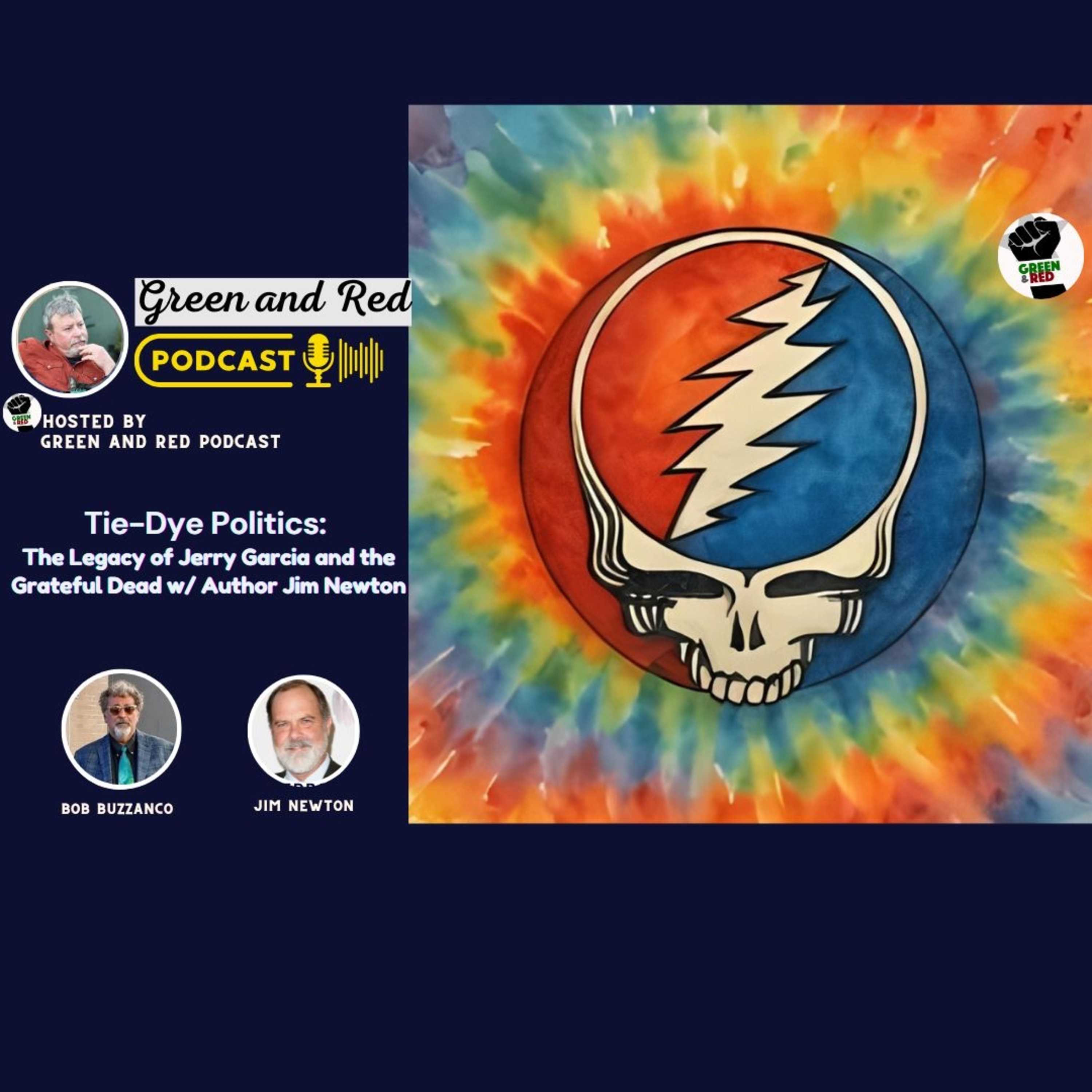
Green & Red: Podcasts for Scrappy Radicals
Tie-Dye Politics: The Legacy of Jerry Garcia and the Grateful Dead w/ Author Jim Newton (G&R 483)
00:48:12
Loading summary
Transcript96 lines
- [00:01]
Jim Newton
Welcome to Green and Red Scrappy Politics
- [00:03]
Bob Bozanko
for Scrappy People, a regular podcast on
- [00:07]
Jim Newton
radical environmental and anti capitalist politics. Brought to you by Bob Bozanko and Scott Parkins.
- [00:14]
Scott Parkins
Welcome to the silky smooth sounds of Green and Red podcast. I'm your co host, Scott Parkin in Berkeley, California. And as always, I am joined by
- [00:22]
Bob Bozanko
Bob Bozanco, as always, in Niles, Ohio.
- [00:25]
Scott Parkins
And this is another episode in our arts and culture series. We've talked a lot about a lot of heavy topics lately, war, state repression, things like that. So we're very happy to be talking about something that's a little bit lighter. Hopefully it'll be a little bit lighter. And joining us today is James Newton, who is a veteran journalist, bestselling author and teacher. He worked at the Los Angeles Times for 25 years as a reporter, editor, bureau chief and columnist. He teaches at ucla, founded Blueprint magazine, and he's the author of a number of books, including Here Beside the Rising Tide, Jerry Garcia, the Grateful Dead, and An American Awakening. Bob is showing it there in the video. It's a show that we've talked about for a couple of years of doing around the politics of the Grateful Dead. So we're excited to have you here. Jim, welcome to the Green and Red podcast.
- [01:14]
Jim Newton
My pleasure. Thank you for having me.
- [01:16]
Scott Parkins
Hoping to talk a little bit about the politics and cultural legacy of the Dead. Also just noting that Bob Weir, who was one of the early member, longtime member of the Grateful Dead, passed away in January. But maybe just the sort of kickoff, maybe we could just start with a little bit of what do you see as the political significance of the Grateful Dead?
- [01:35]
Jim Newton
I think the Dead are often thought of as apolitical. Jerry himself thought of himself as apolitical. I guess I would make the argument that while that is in one sense true, that they were not boosting candidates or raising money for in the conventional sense that we think about the kind of mechanics of politics, they really were disinterested in it. But I guess the larger frame that I would suggest is that they were they, the dead and the people around them adhered to a set of values, believed in a set of values, and projected those values and shows and in their community, kindness, freedom, creative expression, the sense of community itself, and that those are not apolitical notions. They have a kind of political valence to them. And so I famously, there are conservatives who follow the Dead and who consider themselves Deadhead. So I don't think it is as easy to put a bow around them as it is around our conventional partisan politics. But I do think that there is a set of values that suggest an underlying politics and that are worth paying attention to. I think some of those values are in perilously short supply these days, frankly. And therefore not only do I see them as having political significance, but also contemporary political importance.
- [02:52]
Scott Parkins
You also have published a piece in the New York Times when the book came out last year about the legacy of Jerry Garcia. And you referred to the Dead as zelogly and that they appeared at different. They appeared in different historical moments which are very known, particularly on what I would call the anti authoritarian left. The acid test, Woodstock, Columbia student takeover, San Quentin, People's park, things like that. And fallen in this vein of like the politics where they're not necessarily advocating for any particular candidate or anything, but they're very much in this New Left sort of 60s movement political space. I'm wondering if you could just talk
- [03:28]
Jim Newton
about that a little bit. Yeah, I think a part of that is just the surroundings they grew up in. They were here in California, in the Bay Area, principally in the. Starting in 1965 and moving forward from there.
- [03:37]
Scott Parkins
That was a.
- [03:39]
Jim Newton
A place where you could be and could be very much in the center of that kind of politics. And I think they fell very naturally into that group. Now that said, it's a turbulent, interesting time that they came of age in. I remember someone saying to me, even long before I was involved in this book, that the only place you could, in the early 1970s that you could reliably have run into both a Hell's angel and a Black Panther, would have been at a Grateful Dead show. That's a pretty big range. What they have in common, kind of anti authoritarianism, a sense of community, their voting politics, to the extent that they had any, would be different. But they. There is a kind of continuity to those, even though they probably wouldn't have liked each other very much. And the Dead, I think, find themselves very comfortably in that. It's funny, for those who want to see the Dead as completely apolitical, I just would just venture the notion that, yes, you see them at San Quentin, yes, you see them in the aftermath of People's park or the Columbia student takeover. As you just mentioned, you don't see the Grateful Dead at fundraisers for the National Rifle association or for the Heritage Foundation. They're not even handed in terms of where they appear and the events that they are attached to. There's a clearly a leftist bent to that. When you take it all in some substance, all of it, as opposed to just looking at one event here or there.
- [04:56]
Scott Parkins
And part of that is, like, where they come from. But do you think that is also a bit of the times in which they merged as well? It's also the emergence of the counterculture.
- [05:05]
Jim Newton
Yeah, I guess I would say the counterculture is a lot of different things, and it's very broad and encompasses a lot of different politics. But as a culture, if you are to. If you were to look at it as. As an entity or as a. In terms of its overall direction or orientation, it clearly is left. It emerges against the war in Vietnam, against. In favor of civil rights, in favor of a new relationship, environmental, relationship with the earth, feminism. Those are all ideas that get. Get wrapped into the counterculture. And they all have a leftist tilt to them.
- [05:39]
Bob Bozanko
The joke you made about the Black Panthers and. And Hell's Angels, they used to also say that about the Oakland raiders in the 70s.
- [05:47]
Jim Newton
Fun. I never heard that about the Raiders.
- [05:49]
Bob Bozanko
Yeah, because that actually was true. They would have Hell's Angels and Black Panthers anyways. You said the part of their awakening came very early. Jerry Garcia's awakening came with kind of the. The beatniks, and. Which I think is often commodified, and people tend to joke about it and make fun of it. But it's also, I think, like, I'm a. I was a professor for 30 years, so I taught a lot about. Taught courses on the 60s where I talked about all this stuff to play Grateful, that music. How was the beatniks important in the emergence of a band like the Grateful Dead and in Garcia's own ideas?
- [06:21]
Jim Newton
Yeah, I think for Garcia personally, on the road, as it was for many people of that era, a transformative novel. A teacher of his gave it to him when he was a young person. He was moved by it. And in fact, Dennis McNally, who went on to become the Dead's publicist for many years, found his way to Garcia because Garcia had read his book, his biography of Kerouac. There's a lot of connections, personal and otherwise, between the early Dead and Jerry in particular, and the beatniks. And then there's the sort of transitional or kind of bridge group. There is the Merry Pranksters, another literary group with its own connections to the beatniks that are the real sponsors for the Acid Tests. Ken Kesey's probably the best known of them. But so the. That that kind of evolution of beatniks to Pranksters to Deadheads is a. And simultaneously and relatedly, Beats to beatniks to hippies is all part of a piece of the Bay Area, 19, early 1960s through the end of the 1960s. Now, one little side note there. Kerouac himself was offended by the hippies and never saw himself really even as a beatnik, much less as a hippie. So some of this is labeling, right? The word beatnik is really coined by Herb Kane and it's meant to make fun of the Beats. The Beats didn't see themselves labor lightheartedly, I think, because the Beat for many people connotes, suggests that there's a kind of musical beat that's a reference to. It really means something more like beaten down. But again, these are names that other people tended to attach to these groups. And as a result, they can be a little bit misleading. But as a group, the San Francisco Renaissance, the Beats that. Those are big literary, important moments in American literary and artistic culture. And they very much are part of the evolution that leads to the Pranksters and the hippies and the Grateful Dead.
- [08:14]
Bob Bozanko
Yeah, when this starts, like people like Bob Dylan are influenced. Ginsburg are very close, but Dylan is more, let's say directly political. He's writing about nuclear war and civil rights and things like that. And a lot of artists don't go in that direction, like Jared Garcia. Why is that? Just personal preference? Musical taste? Or was there kind of something. Was there a critique of that? I know Dylan and Garcia were very close, but was there also a critique that we don't want to be heavy handed, we just want to.
- [08:41]
Jim Newton
Yeah, I think that avoiding being topical and didactic were important to Garcia. And actually most of Dylan's music really falls into that category too. Only a very small portion of it is very on the nose politically. Someone once said that no one, no one did more to end the war in Vietnam without ever uttering the word Vietnam than Bob Dylan. Neither of those things is probably literally true. But it does remind you that the most powerful work of most of these artists is not powerful because it speaks to an event or an election, but it speaks to an idea or, or it resonates with a feeling. And that feeling is often anti authoritarian and anti mainstream culture. And so it, it. That's where it, it acquires a kind of political sensibility, even if it grows out of an artistic impulse. There's several examples for the dead of the years where they do get closer to politics. And sometimes the song US Blues, for instance, that I talk about in the book, but other people have talked about it too. Garcia, there was a couplet in the song that said, stop the war, feed the poor. Garcia actually took it out because he felt it was too on the nose. So he was. He policed that question. He wanted songs not to be too attached to the moment and too, in the politics of whatever was happening in the. At that particular juncture. But as. As I say, I don't think that removed him or them from the larger debate or discussion about values, which are. Which underlie all these politics.
- [10:06]
Bob Bozanko
That's, I think, always been a conservative attack on a lot of these things because I. They would make fun of the beatniks and the hippies. They were just dirty kids who didn't want to take a bath and wanted to do drugs and stuff like that. So obviously, I think that also connects. One thing that always struck me from a very early age was how they just let people come in and record their shows and bootleg and everything. Was that kind of part of that bigger ideology?
- [10:29]
Jim Newton
Yes. I'm not sure how exactly Garcia would answer that question, but from my perspective, yes, it is part of the maintenance of this community that was very important to him. And part of that was not being the head of that, not acting as the governor of that little state that they were creating, but really trying to maximize people's freedom within it. Now, the Tapers are a really good sub phenomenon within Grateful Dead culture, right? Because the. Really, the only reason the Dead stepped in to regulate tapers at all was because they were bothering other people. That, and I remember this from shows a long time ago that the Tapirs didn't want people dancing around them. They didn't want people bumping into their equipment. And so there was a kind of. They wanted people to be quiet where they were taping, and people didn't want to be quiet. And they did want to dance. They did want to bump the Dead. The Dead was also a California corporation, and they had these quarterly meetings, the minutes of which are a hoot, as you might expect, and which are available. Grateful Dead archive in Santa Cruz. And some of them record or make you have a record of the Dead grappling with these as a business. And ultimately, what they decided is to create this taper section so tapers could do their work. People could trade tapes at will as long as they weren't trying to make money off them or press them into records. The Grateful Dead really never intervened with it. And that actually gave rise to this. This subculture of Tapers, which, to, to the amazement of the music industry, not only didn't hurt the Grateful Dead financially, but actually just drummed up interest in shows and broadened interest in their touring Revenue. And it ended up being a very successful business experiment. But really the germ of it is, is nothing more than the Dead not wanting to get in to act as policemen over taping to allow people to. To trade tapes at will and just try to avoid people bothering and bumping into each other. The Grateful Dead made more good decisions by accident than any other institution or organization that I've ever run into.
- [12:32]
Scott Parkins
Just the. Just the contrast the Dead with other things that were going on in California at the time. This is. And this is like something. It's in the book and you've also published it, excerpts about it outside the book, which is this is also the period where we see the rise of Reagan. He's running against the counterculture, and I believe he's running against the drug culture and against the dead. And the dead are very much contrasted in your work, as in contrast to Ronald Reagan, who's like running for governor in 1966. And then when he comes in, he goes after student radicals and the Black Panthers and things. Could you talk a little bit about the Grateful Dead versus Ronald Reagan in the 60s? I have a question about in the 80s as well, but just to start with the 60s.
- [13:10]
Jim Newton
Yeah, I was struck. And of course, I've followed Reagan. I've written about Reagan before Pat and Jerry Brown. So he's been on my radar for a long time, as he is for many people, of course. But I never really, until embarking on this project, never really thought of him so much in connection to the counterculture or specifically the dead. But it is true that both Reagan and the dead really come to life, as it were, and at least in a political and social sense, In California in 65 and 66, as you say, that's the year Reagan's elected. And Reagan's campaign was very much built off the back of the Watts riots and the free speech movement at Berkeley, that those were his sort of case studies of a state that had lost control, that the sort of, you know, lunatics were running the asylum, and it was time for a grownup to. To reassert control over California. He didn't feature the Dead, per se in any of his advertising. He didn't name them, but they were very much at that in the center of the counterculture that he viewed as the opposition to his candidacy. So it's a remarkable place that in the same couple of years could produce both the Grateful Dead and with it, its surrounding culture or counterculture and Ronald Reagan. A reminder that there are two states operating really in parallel at that point. And one of the things that also struck me in connection with this project. We are used to the idea of movements and backlash to them. There's an idea comes forward, it flourishes for a while and then there's some sort of backlash to it. We're living through one of those moments right now. Trump is a backlash to Obama anyway. That's a different conversation, but. And a sad one in many ways. But. But that idea of innovation and backlash and the sort of pendulum between them and the modulation between them is very much a familiar one for politics, not just in this country. What's striking to me about the 1966 is that they're happening simultaneously, that the counterculture is growing and becoming more effective and more a part of everyday life. Certainly the anti war movement is growing in strength and in sense of purpose at the same time that Reagan is gathering strength and winning the governorship. So it's a, it's an interesting moment of backlash even as the movement is still gathering speed. So it's not that the movement makes its achievements or successes and then five or ten years later we have to weather some kind of response to it. They're very much happening in parallel. So I don't know if it's unique in this kind of dynamic, but it's certainly an unusual one along.
- [15:49]
Bob Bozanko
You said a minute ago how they wanted, they didn't want to be didactic. And the point you made about. You compared it to John Lennon's song about revolution, which is derisive. Really? And you said Garcia was more along those lines.
- [15:59]
Jim Newton
Yeah, I would have said so, yeah. Yeah.
- [16:01]
Bob Bozanko
I mean he did he laugh at kind of these young revolutionaries on campus
- [16:06]
Jim Newton
or thought, yeah, Jerry was very self deprecating. So sometimes when you read interviews with him, it's a little hard to know when he's just kidding around. But I would say this Jerry at the Summer of Love, for instance, was the person who most got under his skin that day was Jerry Rubin. That he found Jerry Rubin didactic again to maybe to overuse that word, but to. He found the stridency of it jarring. He. He didn't like to be told what to do. He was not good at being told what to do. And so I think that whether that came from the left or the right, he had a sensitive antenna to bossiness. And given the circles that they, they lived in and worked in and spent their lives in more. They were more immersed of the. In that from the left than they were from the right. Jerry wasn't running into Richard Nixon or Jerry or Or Ronald Reagan, he was much more likely to run into Jerry Rubin. But yeah, I think there are times when Garcia specifically and the Dead generally found themselves at least bemused, if not irritated by voices on the left. That doesn't mean that it affected their overall politics or should cause us to think differently about where to place them in the politics of the period, except to say on a personal level that they, they were committed to their own freedom and that included a freedom to be antagonistic around the margins of movement politics.
- [17:23]
Bob Bozanko
Was there a little bit of that with the Diggers too? I got that sense as well.
- [17:27]
Jim Newton
Yeah. I think the Digger. The Diggers are so aggressive and so at the margins of this, even by the standards of the left, that I think they antagonize a lot of people. You know, it's. It's a brave, brazen and pretty unrealistic agenda that the Diggers advance. This idea of life without money is. It's wonderful to think about. It's provocative for sure, but it's also. They also, I think could be heavy handed and they certainly were at times in the hate. Peter Coyote, who's wonderful person and was a member of the Diggers at the time, he recalls the Dead being the best of the bands of that period and the Hate in that it was the one that was the least connected to the music business and that seemed least commercial in its orientation. But they still were banned, they still were playing for money. They wanted to be paid and they did get paid. And that from a Digger point of view, that's pretty. That's a violation of something. So yeah, the Dead did not break free of capitalism altogether. The Dead were, were paying their way by playing for money. And from a Digger perspective, that makes them somewhat compromised.
- [18:39]
Scott Parkins
That's a little bit of my question. What was their relationship like with the record companies that they would scientifically make deals with or show promoters?
- [18:46]
Jim Newton
Yeah, I almost feel sorry for the Warner Brothers executives who had to deal with them for years. They were so difficult. There's some great correspondence back and forth where Warner Brothers executives would send them a let saying you're being unprofessional and they would write you and stick it up on the studio wall. They were not good at taking direction and they're a handful. They wanted. They burned up a ton of studio time early on trying to learn how to work in the studio. They got very much in debt to Warner Brothers. On the other hand, that. That propels them to simplify things musically for a while there and that produces back to back both in 1970, Working Men's Dead and American Beauty, which probably their two greatest achievements in albums and studio albums anyway. And that they. Because they were as appealing and as exciting as they were, record companies tolerated them. They're not the only difficult record act of that era by any means. So I. There may have been other acts that were at least as difficult. I guess the other thing I would say about them though, is that they never really were that successful in terms of raising money off of records. Part of what they changed in the music business, at least for themselves, and then has become really a model for modern acts is that they flipped the paradigm of the period on its head as a business paradigm, which is that it was the understanding that a group would release an album and then would tour to promote the album, and that the tour really was in support of the album. So if you went to a concert, you would hear the album played along with other songs sprinkled in with the Dead, because the albums were never really that appealing. They were never really satisfied with their work in the studio. It was really albums that were the loss leader and shows that really drove the revenue for the Dead. That's much more like the model today. Partly because music piracy is so easy online these days that it's hard to contain record sales in the way that it was once much easier to do. So the Dead, again, somewhat by accident, pioneered a new business model for the. For traveling bands such as themselves. The. The strength of that, of course, is it allowed them to develop this community that they did. It reinforced their musical tendencies anyway, which were to improvise and to enjoy that relationship with audience was very important to Garcia and to the Dead generally. So it reinforced all those good impulses. It caused them to improvise and make every show different. The downside to it is it did lock them in to touring. That there's. Because the album sales were never that great and because they had this big community to support, they couldn't really afford to take time off of touring and keep this. That community together. So it locked them into a real, sometimes kind of backbreaking schedule of performance, which, especially as Garcia's addiction got worse in the 90s, had different personal implications for him. We will never know, of course, whether he would have lived longer if they could have taken a break and allowed him to recover. He might not have chosen not to anyway. So that's a kind of pointless hypothetical. But what is clear is that he. It was. It would have been very difficult to stop the momentum of that, given the business model that they were addicted to at that point
- [21:57]
Bob Bozanko
back then. Like, now.
- [21:59]
Jim Newton
Grateful.
- [21:59]
Bob Bozanko
That, I think, has a certain connotation which means something really quite significant. Did they see themselves that way? Did they think of them or the Grateful Dead or, like, we're just a bunch of guys playing music?
- [22:08]
Jim Newton
That's really a good. Yeah, it's a good question. I. Garcia seems to me. I never met him, other than to appreciate him at shows, of course, but seems to me to be among the least. Among the most famous people who was least interested in fame of anyone that I have ever run across. It does not appear to me to have really registered with him what it meant to be famous. He has a really good quote that I use somewhere in the book. He says that to be famous is to have to think about yourself all the time. And he didn't really want to do that. There is a really appealing humility about Garcia. There's a story that I didn't put in the book that I regret having left over, but there's one someone told me or I read somewhere that somewhere in the 90s, he was approaching Valentine. It was like, I think it was Valentine's Day. And he realized he hadn't gotten a present for Deborah or whoever he was getting a Valentine's present for that year. And he said, I think it was Dennis McNally. Gosh, I really don't know what to do. And Dennis said, why don't you just take her out to dinner? And he said, it's too late to get a reservation. And McNally, I think it was McNally, said to him, if you call a restaurant, you tell them that you're Jerry Garcia in San Rafael. They'll let you. They'll find you a table. And he was like, really? I thought, wow, that is very Jerry Garcia. I think he wanted to play. He was obsessive about performing. He. But he was happy to perform as a member of Olden, in the way with duets with David Grisman. He was happy to play with the Grateful Dead. I don't think his goal was not to be rich and famous. He ended up being rich and famous. But I really do think that's a byproduct of what. Doing what he loved. The only member of the Grateful Dead, really, who I think saw himself as a kind of rock star would have been Bob Weir. And Bob was more handsome and younger, and he looked like a rock star in the way that the others didn't. And so it's not really a band built on stardom. It was really built on something Else
- [24:00]
Scott Parkins
to the shows because I came up in the generation after the Grateful Dead headed big, like late 80s, early 90s and the sort and reading the book. And then there was just recently like a 60th or 70th anniversary where they had some sort of like street shows playing Dead music in the hate here. Just recently.
- [24:16]
Jim Newton
Oh, yeah, probably the 60th anniversary. Yeah. 1965 is considered the time, the beginning,
- [24:22]
Scott Parkins
but that sort of that and I understand it was to make music and to have these big shows, but that sort of community and the following of the Grateful Dead from the late 80s until Jerry passes away and then even with the Dead is like became this phenomenon of its own. Been pretty fascinated with that. No.
- [24:39]
Jim Newton
Yeah. Oh, definitely, yes. No, absolutely. Yeah. No, I couldn't agree more. And I think it's really.
- [24:44]
Scott Parkins
I mean, I follow the Dead one summer. So.
- [24:46]
Jim Newton
Yeah, no, good for you. Yeah, I. It's in some ways bewildering, in some ways maybe completely understandable. And I guess I should explain that. But I went to see Dead and Company and I think it was 2023. I'd seen him a couple times before that, but I went out to the Sphere in Vegas. The. I was putting the finishing touches on the book at the time and was just curious as to how this was going. And I went for two nights, and the first night I went with friends. The second night I went by myself. And the second night I was. Because I was by myself. I was just mingling with people around me. And I would say of the, I don't know, 15 or 20 people that I met that evening, maybe two others of them were old enough to have seen Garcia as a living person. They were. I remember there's a couple there from Oregon in their 20s, and there was a couple other young people near me, none of whom who had actually seen the Grateful Dead and yet were there in tie dye and traveled the hundreds, thousands of miles to see them, were delighted to be. I was down on the floor. We're delighted to be in the mix of all of it. And yeah, I think it's a fair question, like, how did that come to be and how does it continue, at least at that point? Bob Weir was very who Bob, in my growing up was always a little bit of a off to the side of Garcia in terms of at least the main focus of my attention in these shows. Dead and Company featured him as the centerpiece really of those. And so he was this living connection back to the original music. But I also think, and this is be an interesting test over the next couple of years. I think that the music has its own vitality, that culture has its own values and ambitions and expectations that are fun and resilient. And I, Nick Merriweather, who is the longtime curator of the Grateful Dead archive and a great writer and thinker about the Dead and the culture, he's the one who first pointed out to me that one thing that we don't have much of in modern life is collective experiences of joy.
- [26:39]
Bob Bozanko
Right?
- [26:39]
Jim Newton
We have a lot of collective anxiety and a lot of collective anger, but only it's the rare occasion that people gather together and are just happy. And Dead shows were that. They were definitely that for me growing up. And I actually, I can think of two. I've been thinking about this lately, but there's two other times when I can really recall feeling that outside of the Grateful Dead. I was there for the giants victory in 2012 in game one of the World Series. I've never been in a happier group of people.
- [27:07]
Scott Parkins
And I was there for that, though.
- [27:08]
Jim Newton
Is there a.
- [27:09]
Scott Parkins
That was pretty fun.
- [27:09]
Jim Newton
Yeah, it was a great day. Great night. And then I was also at the two Obama inaugurations, and especially at the first, that feeling that, man, something big is happening here, and we as a people are really happy about it. That the Dead delivered that not every night. And sometimes they were horrible, and sometimes people had a bad time and sometimes it rained. There was a little bit of happenstance with all of it, but at its best, there was a sense that you were experiencing something joyful in an uninhibited way with other people, lots of other people. And that I don't see any. I understand the yearning for that, and I think that there are fewer outlets for that than there have been in previous times. And so I do think that's part of what continues to draw people not just to the music of the Grateful Dead, but to the show, to the event, whether that's the Sphere or Oracle park or wherever. I certainly got a little blast of it just last summer and would have now turned out to be Bob Weir's last shows with Dead and Company and Golden Gate Park. So that idea, I think, is real. That's Dionysus, right? That goes back as further than we can even think of in some ways. But the. And so the Dead didn't invent it. Didn't start with them, didn't. Won't end with them, but they tapped into something very. A real craving in human. In human existence, frankly. So I think that is, to me, that goes at least part Way to explaining that I was.
- [28:32]
Scott Parkins
I talked about the filed of dead in like maybe the summer of 1990. And that was at the period where we had these Lollapalooza concerts going on as well. And. And I will say that I went to a number of those as well. And it felt very similar to me. Like it was different music and slightly different people, but it like felt that very same sort of like community phenomenon. Yeah, a strong thing there that's beyond just like going out to the mall and buying something.
- [28:58]
Jim Newton
I agree, I agree. Yeah. But one of the first shows, Dead shows that really deeply impressed itself on me was in 1982. There was the US Festival down in. Not far from me here in San Bernard. I think it was in San Bernardino County. And it was just one of these. It was hot Labor Day, Southern California. It was a little bit of a grueling three days. I met my. One of my best friends from high school and one of my best friends from college came with. And we were sleeping in the back of my parents Ford Pinto. It's pretty horrible at some level, but it had that. It had that kind of we're all in this together energy. And in fact the Dead played. It was breakfast called Breakfast with the Dead. They played the Sunday morning. They were the first act up. And that I remember that morning feeling like, boy, this something changed overnight about the feeling of this place. That it went from kind of people hustling and bustling to get in front and braving the heat to a cooler morning and suddenly there was people giving each other water and there was a kind of kindness that set in. And I do really remember feeling that like the Dead changed the tone of that day. So they grafted onto that collective joy feeling and brought to it a kind of gentleness and a. And a spirit of cooperation that was. That I took note of even as a 19 year old or 18 year old, whatever it was at the time.
- [30:12]
Scott Parkins
One question I have, and I referenced this before just to shift a little bit is like in. In the book I believe you talk about the 80s and the dead do a. Do shows for AIDS activism and they do shows for the rainforest, which I'll have a bigger question about too work at that place. But I think you said in there that the Dead saw themselves as a little bit of a. Also it's another opportunity where they're against Reagan and they see themselves. It's like bringing this so somewhat overt. More of an overt political agenda to the Reagan agenda of the 1980s. I'm wondering if you could just talk about that a little.
- [30:47]
Jim Newton
Yeah, again, I don't. In some ways it's a coincidence. In some ways it's. They are. It's because they're working in. They're rising up in parallel. But the Dead and Reagan take their rivalry or disagreement from California on state stage in the 60s to a national stage in the 80s. As Reagan becomes a national phenomenon, so too did the Dead. And I do think they're not unrelated. I think that part of what happened there is that by the 80s, there weren't as many places that people who felt outside the mainstream culture could go to express themselves and to feel at home. There are more opportunities for that in the 60s in California than there were in the 80s nationally in the United States. But the Dead was definitely part of that. And Dead shows got much, much bigger. The community around the Dead got bigger. It got a little more in less. It got less cohesive in some ways. I think as it got bigger, a lot of people came to shows just to get high or just to get away from their parents for the weekend or whatever. So it might not have had the same cohesive colonel quality to it that it did in the Bay area in the 60s, but it became a gathering place for anti establishment figures and ideas. And the Dead, I think, got moved by that too. I do think their later willingness to be more overtly political, as you put it, as partly because they saw themselves as either a standard bearer or a vanguard of a kind of politics or social awareness that had always been part of their culture, but that now felt under attack nationally by Reagan. Maybe the most pointed example of that is Nancy Reagan's Just say no campaign. It's hard for Jerry Garcia not to take that personally. Right. He is like the poster boy for Just say Yes. If anything, it's from their perspective that's a shot across the bow. But I think also more generally that they really. They were offended by Reagan. They saw him as a joke going back to the 60s. And now here he is in this position of such influence and power. They. It helped to stir them to participate more actively. I think, too, that's also a very
- [32:54]
Bob Bozanko
commercially successful decade for them, which is.
- [32:57]
Jim Newton
It is when everything they. The Grateful Dead. The life of the grateful dead is 30 years, 65 to 95 when Jerry died 20 of those 30 years, they spent money at least as fast as they made it, really. The Grateful Dead really never was very much in the black for very long. And then those last 10 years, they were the most successful performing musical act in the world. Not every year, but often and always in the top two or three. Springsteen, the Rolling Stones, U2. There's some other big acts in that period, but the Grateful Dead consistently are one of the top performing acts from about the mid-1980s until the end of their run in 1995
- [33:35]
Scott Parkins
on the rainforest piece. This is the period where we see the rise. We see like a more popular rise of environmental advocacy. And Bob Weir the show. People on the show who listen to the show know I work at Rainforest Action Network. Bob Weir actually was long associated with. Yeah, our organization is. How is that more. Because it's driven by Weir? Or is that the ban was like in. In on the cause. And the cause is a little bit like less in your face like politics or even anti authoritarian politics. But it's environmentalism and saving the rainforest. Saving nice, nice fuzzy animals in the rainforest. I'm just. I'm just curious if. About how they got involved. More involved.
- [34:15]
Jim Newton
Yeah. I don't know the full story of their connection to the Reinforced Action Network specifically, but the draw I think there to the environmental movements of a really natural one. I mean at both. In both the case of AIDS and the environment. Big centers of activity in San Francisco and which is always where they go back to. So I think they would have been. They were surrounded by people for whom these issues were. Were personal. In the case of aids, of course, the just the. I just. I can remember the just the devastating effect it had in San Francisco in the. By the early 80s and in the environment. The Dead. There is a kind of proto environmentalism that runs throughout the Grateful Dead's music. In fact, there's a lot of appreciation for nature and natural things. So I think that's a very easy move for them to be. To be engaged in environmental protection generally. And the rainforests were such a locus of that movement at that time that it was, I think, a natural for them. There's a funny press conference where they announced their support for the Rainforest Astronaut Network. And Garcia, I'm gonna. I'm gonna paraphrase him here. Cause I don't remember the exact quote, but essentially says I can't believe that it falls to us to do something about this when we can't even get our shows off on time. But if we gotta do it, then we'll do it. And by then too they recognized that they had a real following that there. That wasn't really just them and their close friends from the Bay Area who might make a difference. There really were hundreds of thousands, maybe millions of People that the Dead could affect. So I think it is also, although they would never say this out loud, it's also a recognition of their own influence, growing to the point that they could do something with it. But even then, by the way, I should note, like, Garcia never talked about it from the stage. Like you. So they would perform on behalf of the Rainforest Action Network. They would donate money, they would draw attention to it. But you never had the moment that you would have at a Springsteen show saying, drop by the booth and sign the petition to. Garcia never did that. So even then, there was a kind of reticence about it. Yeah.
- [36:11]
Scott Parkins
One thing I'll say is, to his credit, the founder of Rainforest Action Network is also a very charismatic advocate.
- [36:16]
Jim Newton
So is that right?
- [36:17]
Scott Parkins
He was sailing it hard. I'm friends with you, man. We've had him on the show before, so.
- [36:20]
Jim Newton
Oh, yeah, I had no doubt. Oh, yeah, I know the name. Yeah.
- [36:24]
Bob Bozanko
No, I discovered the dead, like, late 70s, early 80s. When I went to college. I was a frat boy with by far the poorest kid in that. Probably on campus with a bunch of rich kids who turned me on to the Grateful Dad. And these were kids who, like, drove fancy cars and came from the Northeast. And then the other, the other. Like, about a week or two ago, I saw an interview with Tucker Carlson. I didn't realize he was a Deadhead and traveled all over the place with him. And I know people who are like eight figure a year guys on Wall Street. Reminds me, what was the. Was it Don Henley? The song? I saw a Deadhead sticker on the Cadillac.
- [36:55]
Jim Newton
Right.
- [36:55]
Bob Bozanko
How do you square that? Not necessarily. Even if Garcia's politics weren't didactic, but still, it's real hard to see him, like, having a beer with the boys from Goldman Sachs or whatever. How does that happen?
- [37:07]
Jim Newton
Listen, I don't get to decide who's a Deadhead. And even Jerry Garcia didn't get to decide who's a Deadhead. There is no barrier to entry, as they say. I would be just as happy to be a part of a Dead community that didn't include Tucker Carlson, frankly. But I don't get to choose. Listen, I would say that there is a way to hear much of the Dead's music as a kind of libertarian expression of freedom. Right? Freedom from government direction, freedom to use drugs, freedom to explore, et cetera. That with a little bit of squinting, you can muscle into a conservative point of view. It's notable that you can count on one hand the number of conservatives who. Or at least Prominent conservatives who find that relationship to the Grateful Dead. So I don't think. I think it's a. It takes work to make the Dead's politics fit that paradigm. But Tucker Carlson appears to be willing to give it that much work. And yeah, to the larger. Some of the Dead's kind of appreciation by the. The ruling class. I'm not even sure what to call it. I think comes with Deadheads just getting older. There are. The New York Historical Society did a Grateful Dead retrospective about, I want to say, 10 or 15 years ago now. And I think it was the biggest hit in the history of the New York Historical Society. I remember I dropped by, they had a little. Little display of things, and they were selling Jerry Garcia cufflinks, which is an amusing idea. If there's anyone I cannot imagine wearing cufflinks, it would be Jerry. But like, people get older, they change. But the. Those experiences stayed with them. And I think a lot. You find Deadheads everywhere now. I'm always struck by, as I've been touring with the book, in fact, people who will come up to me in a crowd and are not all. And sometimes it's the guy, the gu. Who looks like me, right? Who's got a beard and is a little shaggy and it's that guy. But often it's not that guy or that woman, right. It's the someone who's very establishment and just happens to have had a life experience with the Grateful Dead early on that was formative. And it is, in that sense, I think, politically transcendent and economically and class transcendent. But that's more an accident of its work than anything, certainly by design of Garcia or the Dead. They did not set out to be the prep school band. They just happened to be absorbed by prep school kid. There is, I'll say one other thing on this. There is a kind of swaggery culture around Dead and Company, not the entirety of that audience, but it was funny. I went to a gathering of the Grateful Dead Studies association in Chicago a couple years ago, and there was a woman there who referred to those guys as co Bros, which means Dead and Company, the CEO Bros, which I just thought was great. And it does capture. There is a little. There is a little bit of that kind of frat boy thing. It's a subculture within Dead and Company culture. But it is out there, and I think it probably is the next generation of what you're describing there.
- [40:05]
Bob Bozanko
You mentioned Cupclinks, which made me realize, like, back. I don't know when long time ago I was in Macy's, I think, and I saw Jerry Garcia tie. And my first thought is to laugh.
- [40:13]
Jim Newton
What the hell?
- [40:14]
Bob Bozanko
I ended up. I had 30. Like I have 30 or 40. It was like became almost a trademark. I'm assuming that started when he was still alive.
- [40:20]
Jim Newton
I think this did it. Did. Yeah. They're big sellers.
- [40:24]
Bob Bozanko
Bloomingdale 30.
- [40:25]
Jim Newton
Yeah, yeah. No, they, they were. He. He had been a painter as an art student back in. As a teenager, and he painted and sketched his whole life. In fact, there's an auction coming up. I just saw some email about it yesterday, I think in San Francisco that includes some of his old sketch pads and things. So he drew and painted it and somebody had the bright idea to put those on ties. Yeah, the commodification of. Of Garcia, what I have written down here. Yeah, yeah, they're Jerry. This is a slightly different note than the ties, but the Cherry Garcia ice cream that Ben and Jerry's made, one of the best selling ice creams that they've ever developed. I interviewed the CEO, the then CEO of Ben Jerry's for the book, in fact, and although he wouldn't confirm an exact number, Garcia late in life used to say, I wish I could just quit the Grateful Dead and live off the ice cream money. And the fact is he probably could have lived off the ice cream money. He was generating a good $200,000 or so a year in royalties for him, which he never asked for. He never. They never even asked him permission to pay, put his name on the ice cream. It's only after it came out that they cut him in on the deal. So, yeah, he became. And his response to that, by the way, was to say at least he was glad that they hadn't named a motor oil after him. He took things in stride pretty lightly, but he was a big iconic figure by the time of his death, and a lot of people figured out a way to merchandise that.
- [41:39]
Scott Parkins
One other. One other kind of legacy piece is that since the debt that Jerry died, they're. They're still dead in company. But then we've also seen other phenomenon. We've seen like fish.
- [41:50]
Jim Newton
Yeah.
- [41:50]
Scott Parkins
I know so many people who like, have seen like 500 fish shows, which I think is. Says something about that sort of dead culture and carry it on. The other actual phenomenon that I've noted which seems very Grateful Dead esque is Burning Man. And I'm wondering if you had. If you have any thoughts on the influence of the Dead on Burning Man. It's a little bit of a different Thing. But, yeah, it seems like there's some similarities as well, at least with some of the cultural pieces.
- [42:16]
Jim Newton
Yeah. I've never been to Burning man, and just when I was working on the book, I have a friend who goes regularly, and I had raised the idea of going and. But I just, for one reason or another, didn't get around to it, but. So I'm speaking a little bit blind about it, but what I know of it does sound like it has a relationship. And a lot of Deadheads I know have gone. Therefore, they do feel like there's connections between the cultures.
- [42:38]
Bob Bozanko
Yeah.
- [42:38]
Jim Newton
I just think the idea of removing oneself from society, of finding this to place, to be exuberant, to be with others, that feels dead show, even if it's a I. My guess is that it's one of those Venn diagrams, a sort of overlapping culture, but not an entire, not an entirety of one. Yeah. Again, I think that those outlets for that kind of experience are limited these days. And when people find them, they really grab onto them. And my sense is that the attachment to Burning man resembles the attachment that many people felt to the Dead.
- [43:12]
Scott Parkins
I have one more question. I don't know if Bob has any, not per se.
- [43:17]
Bob Bozanko
Phil, go ahead.
- [43:19]
Scott Parkins
My last question is about the way the music industry is today. The Dead started out as it was almost the grassroots sort of music experience. Do you think could a band like the Grateful Dead take off the way they did in today's environment?
- [43:35]
Jim Newton
It's the book notwithstanding. I'm really not a music industry expert. And so I. The really, the true answer is I don't know. I hope that the true answer is yes, that. That there is still room for bands to grow up together. One of the people I interviewed for the book was Huey Lewis, who had his own musical career, of course, but also intersected with the Dead at various points. And he made the observation that if you were forming a band today, that the way you would do it is you would decide the kind of music you want to play and you would recruit musicians who were the best, as good as you could get for those roles. Right. So if you're country band, you're going to recruit the best steel guitar player you can and the best vocalist you can, et cetera. And if you're a jazz band, you're looking for something else. But the real different thing about the Dead is that they learn to play together, that they didn't have an idea of what they wanted to be and then form a band around it. They formed a band of people who Liked each other and then figured out how they would play and what they would play. And that one nice thing about that one, one positive thing about that, is that there's an informality about it that carried over into the relationship with the audience. Grateful Dead audience is a very forgiving audience. It does not. It did not want songs played to perfection night after night. They really were much more interested in mistakes and experimentation, et cetera. And so whether that is possible today, whether you can be a successful band that grows up out of the friendship of young people who appreciate each other musically, I don't know, really. I sure hope so. I think a lot of. There are very successful musical acts that are so full of integrity and commitment to songwriting performance. I'm thinking of the artist Gillian Welch and Dave Rawlings right now among them, who are doing some shows coming up. In fact, the Honor of the Dead. It feel. They feel to me like a good example of people who have been really true to their craft, who've really let it develop and have developed a real following around it. And I'm only naming them because I know them, but I hope that's still possible. It would really be a shame if it weren't.
- [45:45]
Bob Bozanko
Yeah, I don't really have anything. I just. When you mentioned the word commodification, I had that written down here because when I would teach about the 60s, that was a big part of it. And I would talk about the Grateful Dead. And it was weird because when I first started teaching, people knew that it was weird. Like, I hit a point, maybe, I don't know, 2010 or so, where students just had a blank stare on their face when I would mention the Grateful Dead. So I knew I was getting even older. Right.
- [46:08]
Jim Newton
By that time. Yeah.
- [46:10]
Bob Bozanko
I.
- [46:10]
Jim Newton
You know what's funny, though? I, like. I walk around the UCLA campus and I see they'll have poster sales or book sales or different things going on, and there's always some Grateful Dead thing out. Like, I don't. To some. It's a little. Sometimes it's a little bit of a mystery to me as to how it hangs on. There still is a presence, though. It may not, certainly not what it was. But there are, I think Dead and company has had a lot to do with jolting some of that back into life.
- [46:35]
Bob Bozanko
It's also like a California thing, too. Right.
- [46:37]
Jim Newton
Yeah. It could be all be. Yeah.
- [46:38]
Bob Bozanko
Because I was in Texas, was all.
- [46:40]
Jim Newton
I'm sure that's different, too. Yeah.
- [46:42]
Bob Bozanko
But no, thanks. Thanks so much. This is really fascinating stuff. And. Yeah, it's a nice break from talking about Iran and ice and everything else
- [46:49]
Jim Newton
is gone about that. Yeah, I do a lot of writing about ice and boy, it wears you down after a while.
- [46:54]
Bob Bozanko
Yeah.
- [46:55]
Scott Parkins
Folks, we've been talking with Jim Newton, who is a veteran journalist and author and teacher professor at ucla, who wrote here Beside the Rising Tide, Jerry Garcia, the Grateful Dead, and American Awakening. We've been talking about the politics and cultural legacy of the Grateful Dead, which is a show we've wanted to do for a long time. Jim, thanks so much for joining us folks out there. If you really like us, please check us out on Facebook, Instagram, Twitter and Bluesky. If you're watching this on YouTube, hit that subscribe button. If you're listening to this on an audio platform, give us a rate and review. If you really like us, go to greenredpodcast.org and hit that support button. Become a patron@patreon.com Greenred Podcast Thanks. It's been great. Like I said, it's been great talking with you and really appreciate you joining us.
- [47:35]
Jim Newton
Great pleasure.
- [47:36]
Scott Parkins
Thanks very much everyone else out there. Make travel and misbehave and we'll talk to you again soon.
- [48:07]
Jim Newton
Sam.