← Green & Red: Podcasts for Scrappy Radicals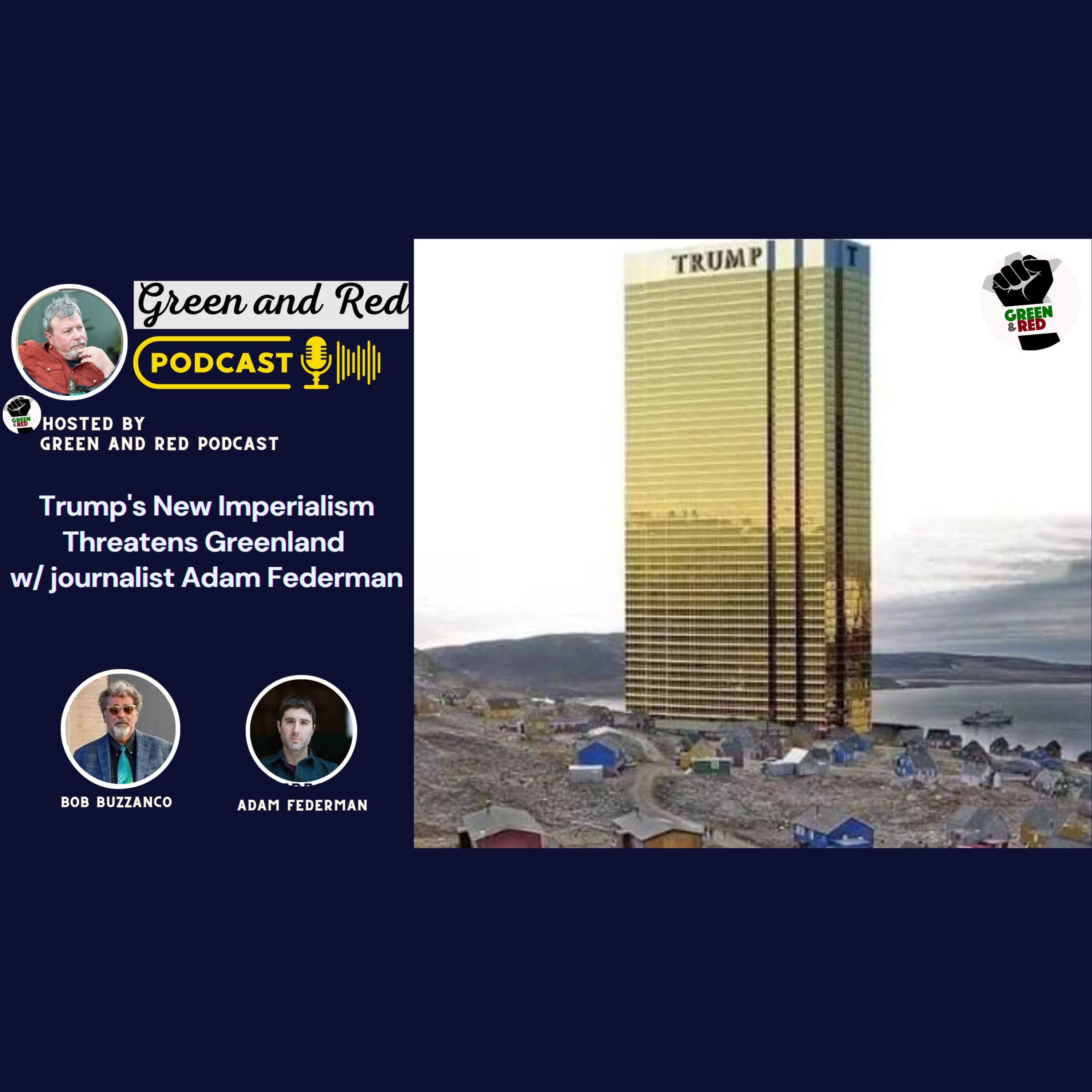
Green & Red: Podcasts for Scrappy Radicals
Trump's New Imperialism Threatens Greenland w/ journalist Adam Federman (G&R 455)
00:45:11
Loading summary
Transcript78 lines
- [00:01]
A
Welcome to Green and Red Scrappy Politics for Scrappy People, a regular podcast on radical environmental and anti capitalist politics brought to you by Bob Bozanko and Scott Parkins.
- [00:17]
B
Three, two, one. And we are recording. Welcome to the silky smooth sounds of the Green and Red podcast. I'm your co host Scott Parkin in Berkeley, California. And as always, I am joined by.
- [00:28]
C
Bob Bozenko in the belly of the beast.
- [00:31]
B
In the belly of the beast. And you know, I'm in the belly of the beast a little bit too. Just if you're, if you're afraid of liberal snowflakes, I'm in that belly of the beast. Right. Today we're rejoined by our friend and regular, regular guest, I would say at this point, Adam Fetterman. Adam is a journalist who covers two beats and we talk to him a lot about his other beat, which is around state repression, particularly state repression of environmentalist. But then Adam also reports on public lands, environmental policy and what I would call like, it's Arctic reporting. It's Arctic politics. And so you've covered public lands, environment under Trump and under Biden. You've reported a lot on Arctic politics. You've actually done a piece on Greenland, which is what we're going to be talking about today. Adam works at AT Type Investigations as a reporting fellow and has and has written extensively on all the things I just named, including in the Nation and Politico and Washington Post and many, many other outlets. Adam, welcome back to Green Red podcast.
- [01:39]
A
Thanks for having me back on.
- [01:41]
B
Yep. And it's been, you know, this is the first week of 2026, and it's been quite the week between Venezuela and all of the tragedy that happened in Minneapolis this week. But then the other thing that sort of surfaced is that the Trump administration, as soon as they had, you know, attacked Venezuela and kidnapped the president, started talking about Greenland. We see Trump has done a couple of interviews on this, talking about how he feels it's very imperative for the US to somehow acquire Greenland. They've talked about military intervention. I think that the conversation right now is around them buying it. And then Stephen Miller had some real choice words about it. The things like the United States should have Greenland as part of the United States. There's no need to even think or talk about this in the context that you're asking for a military operation. Nobody is going to fight the United States militarily over Greenland. And so maybe we can just kick off with, tell us a little bit about what's at stake with Greenland.
- [02:44]
A
The other thing I would Add to that list of recent developments is that Trump also appointed Jeff Landry, Governor of Louisiana, special envoy to Greenland, and sort of made the same argument that Greenland needs to be part of the United States. But, I mean, this line of thinking really goes back to Trump's first term in 2019, when he floated the idea of buying Greenland. And it was dismissed as just this crazy idea that very few people were taking seriously at the time. But even before he was inaugurated last year, he made these remarks about the United States needing Greenland for national security and dispatched his son, Don Jr. To nuke the capital for this kind of dog and pony show. You know, met with a bunch of local Greenlanders and, you know, wearing MAGA hats and sort of tried to suggest that Greenlanders were on board and enthusiastic about being part of the United States. But I mean, to answer your question, it's, it's a little bit like the Venezuela case in that I think there are a number of different competing. Narratives that are fueling the administration's push to, you know, dramatically change its relationship with Greenland and Denmark. I mean, the, the most, I think salient is probably its mineral resources, although, you know, the development of those resources is far off. And there are parallels to, like, this notion that somehow Venezuela's oil is going to benefit the United States in the short term. The longer standing fact is that Greenland is, by virtue of its location, crucial to North American Arctic security and Arctic geopolitics. It has been since the end of the Second World War. And that's why the United States has, has had a military presence there for so long. And that presence has diminished since the end of the Cold War. But it's not, you know, it's not gone. We still have a military base up in the Northwest. And a lot of the discussion now is sort of, now that the Arctic is becoming, you know, not exactly center stage, but increasingly important to sort of competition between superpowers, the United States, Russia and China. Greenland's role in those developing relationships is elevated. And Trump, like he does with so many things, is just pouring gasoline on the fire and seemingly not letting up on this idea that the United States somehow needs to acquire the island.
- [05:58]
B
And maybe talk a little bit about, talk a little bit more about the significance of the Arctic Circle, because I don't think actually a lot of people, for example, and I have a kind of larger question around this in a couple of minutes, but as we see climate change happen, it's like shipping lanes are actually becoming more relevant. We're seeing a lot of corporate investors Take a lot of interest in these natural resources.
- [06:24]
A
I mean, the shipping lanes are significant. Certainly Russia is making the most of its northern sea route to ship oil and other commodities to Asia and kind of trying to develop that as an alternative to other shipping routes. Although I do think sometimes the, you know, discussion around these shipping lanes tends to get a little bit ahead of the game because it's not as if the ice is going to be gone tomorrow. And it's not. It's still not easy to navigate those waters. It's still not easy to, you know, ship oil and gas via those routes. But certainly, you know, looking ahead long term, it could dramatically sort of change the geopolitical game. I mean, I guess I would just back up a little bit. And I mean, you mentioned my other reporting on public lands, and I got into covering Arctic issues through my reporting on Alaska. And I think, you know, in the lower 48, we sometimes perhaps forget that, you know, the United States is an Arctic nation by virtue of the fact that we acquired Alaska from Russia. I mean, our, our Arctic territory is in Alaska. And all of this talk about Greenland in many ways has, I think, distracted us from, you know, many of the issues that are taking place on that front. But I think just to kind of put things in perspective, The competition for resources has always driven imperial conquest, and the Arctic is no exception. And I think that although we're talking about the Arctic now as this sort of new arena, it's been attractive to the west for many, you know, 200 years for those very reasons, whether it was the pursuit of furs or whales for their oil or oil and gas. I mean, look at Alaska, right? It's basically a petro state. So, you know, we can see what's happening now in the context of this broader dynamic and to the question of climate change. Yes, in some ways, the warming climate is making it, I don't want to use the word easier, but it is making certain resources possibly more accessible and minerals included. I do think in the context of Greenland, though, that is wildly overstated because most of the island is still covered in ice. There are no roads connecting towns in Greenland. It is not an easy place to build a mine. And the notion that, you know, the United States or anyone else is going to come in and, like, flip a switch and start developing rare earth metals is absolutely, you know, insane.
- [09:26]
C
Kind of the basis of like over here in Ohio when they talk about reindustrialization, they have this idea like, you flip a switch and, you know, Republic Steel in Youngstown is, is operating that day, in addition to the resources, there's this kind of, I guess geopolitical is a phrase we could use element to it as well. Greenland is Danish territory. It's in between Canada and kind of the Scandinavian countries, which are all NATO countries. Right. Going after Venezuela, you can invoke the Monroe Doctrine, and maybe Trump thinks his doctrine applies to the whole world. But how does this fit into that framework of U.S. relations with. With Europe, which are kind of skittish anyway, with Ukraine and Russia and all kinds of other stuff going on?
- [10:11]
A
Well, I think, as we've seen over the past week, it has the potential to. To really blow them up. I mean, it's the prime minister of Denmark who basically said, if, you know, if you try to take Greenland by force, NATO is done, it's finished. I mean, it's. It's complicated, too, by the fact that, you know, you know, as a result of Russia's invasion of Ukraine, you had Finland and Sweden join NATO. So the only two Arctic countries that were neutral are now part of NATO, which just ups the ante in terms of sort of the dynamics in the Arctic between the west and Russia. But I think one of the. The difficulties in teasing out what the United States is trying to do is the complicated trilateral relationship between the United States, Denmark and Greenland, and Greenland's increasing quest for sovereignty and independence and assertion of their own power and desire to have a seat at the table. When talking about questions related to foreign policy and national security. They have this phrase that I think the previous prime minister coined, nothing about us without us or something to that effect. And it was essentially, Greenland has its own parliament and sort of home rule, and as it has gained more independence from Denmark, has taken control of its own domestic affairs. But Denmark still essentially deals with foreign policy, but even that is evolving and changing. And I think that Rubio is scheduled to meet with Greenlandic and Danish officials next week. And I think that sort of the Greenlandic voice tends to get left out of these conversations, I guess, is what I'm trying to say. And they do, you know, they have their own ideas and ambitions about, you know, where they want to see their country go.
- [12:29]
B
It's the second largest indigenous majority country in the world after Guatemala, is my understanding. And I've seen some interviews this week with one of the Inuit, sovereign Inuit leaders, who's very much into indigenous sovereignty. And when you were there, I mean, how much are you doing? Did you see that on the ground? Like the sort of indigenous folks who want to have their own country and even break away from Denmark.
- [13:00]
A
I think it's very much. I mean, it's pervasive. I think it's a common sentiment among the Greenlandic people to have full independence from Denmark. You know, and as I said a moment ago, they've been moving in that direction, and I think the disagreements tend to be over how quickly the country should realize its independence. And I think we saw that play out in the recent parliamentary elections in Greenland, where you had sort of a more aggressively pro independence party that actually was aligning itself with Trump and the United States, because I think they saw that as an opportunity to break free from Denmark and then a more sort of centrist party, which ultimately prevailed, which was advocating independence, but doing it in this kind of deliberate, slower fashion in collaboration with the Danes, et cetera. So I think one thing to keep an eye on going forward is how much the Trump administration sort of tries to meddle in Greenland's domestic politics and whether that becomes an issue. There was a report in a Danish. Publication or broadcaster alleging that, you know, the United States was engaging in, you know, sort of foreign influence operations. And they. They identified a couple of figures who have been actually quite open about their involvement in. In sort of business activities in Greenland. So it was kind of unclear whether there was anything covert about these allegations, but I do think that we've seen some of some of that. But as you mentioned, Greenland is over 80% Inuit, but has this long, complicated history with Denmark. And Trump's bluster and desire to simplify these relationships probably won't suit the United States particularly well in terms of negotiations moving forward.
- [15:15]
B
I can imagine the indigenous sovereignty movement in Greenland would not want to trade Denmark for the United States.
- [15:20]
A
So I think that's absolutely right. I mean, there was some. Initially, I think there was some, you know, Interest in the possibility that a new relationship with the United States and even a more like a bilateral relationship where Greenland was. Was given a kind of equal status as Denmark, you know, might allow Greenland to pursue independence more expeditiously. But when it became clear that Trump wasn't exactly talking about that, I think people started to kind of sour on the idea of, like, a being being a client state of another empire in.
- [16:05]
C
The US We've had, you know, kind of a few people, you know, again, not cryptically invoked the possibility of military action. Right. And has NATO kind of said or done anything about that?
- [16:19]
A
I mean, I think this past week there have been stronger statements from European leaders. You know, I think they signed a joint letter essentially saying that, you know, The United States has to respect Greenland sovereignty and abide by, you know, international law, which, of course, these guys and many American leaders don't, you know, have much patience for. Yeah, but I do. You know, Rubio is a complicated figure. I mean, I think he's been driving the train on Venezuela, it seems to me, although I'm no expert on that, Bob, you would know more about that than I do. But clearly his finger. I mean, he's been very out front on that. I don't. One of the things that I've had trouble getting good, credible info on is who is really shaping US Policy vis a vis Greenland and the Arctic. I mean, we. We do know. We now have. The ambassador to Denmark has been confirmed. This guy, Ken howery, who was PayPal co founder, you know, friend of Peter Thiel, and I was very unimpressed with his initial comments to Danish reporters after he was confirmed. He seemed kind of clueless. There's no sort of equivalent to, you know, a Rubio, you know, in the administration with expertise in this area who would be shaping U.S. policy. So in some ways, I think that makes it even more dangerous. I don't know. I mean, who's feeding? I mean, one of the things Trump keeps saying is that. And of course, Trump constantly spews lies. So sometimes as journalists, when I point these things out, I feel like, you know, you feel like, well, why are you even pointing it out if it's, you know, just the way that they operate? But he. Since, you know, his initial comments about Greenland back in 2020, before he was inaugurated, just after the election, he's been talking about, you know, Russian and Chinese ships just all along the Greenlandic coastline. It's complete bull. There is no Russian and Chinese naval military presence in those waters right now. There really isn't. So either he's inventing that whole cloth, or someone is actually sort of feeding him this idea that Russia and China are on the verge of occupying Greenland. I mean, the United States has been incredibly effective. If we want to talk about the Monroe Doctrine, we have kept China out of Greenland very, very, you know, skill. Skillfully, you know, and so this notion that, like, Russia and China are somehow gonna. They don't. They don't want to touch that. I genuinely believe that. I mean, Russia's got enough of its own Arctic coastline to deal with. They're not going to mess with Greenland. China does want to expand its. Its soft power in both the Arctic and Antarctica. Yes, They're a superpower. That's what superpowers do.
- [19:21]
C
Yeah. I mean, Venezuela is. It's horrible, but it fits within a much larger historical framework. So in that regard, it's easy to figure out. Greenland. I have. I mean, you know, most people don't know where it is. And one thing I've noticed, too, is in the US you have had kind of establishment and a foreign policy. Even Republicans speak out against this, you know, whereas in Venezuela, you're not hearing anything like that. So, yeah, it is odd that he would kind of turn this into, you know, a cause. And, and what did the, what did the, the indigenous people there think of, like, Jeff Landry, you can't think of two places more different than, like, Louisiana and Greenland. Right. How did they respond to Trump? Essentially trying to, you know, I kind of have this idea of putting him in as, like, the Governor General or something like that, you know.
- [20:11]
A
Right. I think it's pretty tone deaf. I mean, I think one of the things that Greenlanders are very attuned to is, you know, having people from the Arctic represent their own interests. I mean, there was a kerfuffle over Denmark's appointment of an Arctic ambassador a few years ago because they didn't. They didn't choose someone from Greenland, and they chose someone who had previously been the ambassador to South Africa. And the people of Greenland were like, like, this is. How can you do this in the 21st century? It's like, you need. You need to choose. You know, you, you are an Arctic power because of us. So, you know, give us some. Give us a seat at the table. So I think that the Landry appointment probably, you know, come and gone. I think he's kind of a non. I don't know how much influence someone like him can possibly have. Like, doesn't. Probably doesn't know much about the place, the people. I mean, what kind of an interest does he have? And, you know, it does speak to this larger, I guess, contradiction in some ways between the administration's zeroing out of programs related to Arctic, I mean, research and, you know, even military preparation, I guess, and its insistence on acquiring Greenland and sort of ramping up our military presence there. Like, those things are not necessarily.
- [21:51]
B
My guess with Lantry, too, is he's the governor of an extraction state, and so maybe they somehow think that he. He'll also be able to help turn Greenland into an extraction state to benefit the U.S. the other figure in the administration who I've read actually has a lot of vested interest in this is Secretary of Commerce Howard Lutnick and his firm, Cantor Fitzgerald, is actually pretty interested in buying up rights and leases and things like that for rare minerals and other things like that. And I'm kind of curious if you know anything about how much of a, of a say he. Is he the one feeding Trump this information?
- [22:28]
A
That's a great question. I haven't heard much about Lutnick in this context recently, but, you know, he does his can or Fitzgerald has a significant stake in a rare earth metals mine that's probably the, that is sort of the farthest along in terms of being ready to come online. And it's in the southern part of the country and kind of shepherded along by this Australian guy named Greg Barnes, who actually had a meeting with Trump in 2019 or 2020, I think. Yeah, Lutnick, I mean, I don't know how, how much interest he has, you know, beyond his. His own sort of financial stake or the, the stake that his children now have in that particular project. But just your comments about Landry reminded me a Danish journalist who I'm friendly with recently told me, and he had written a piece about this, that there is a rare earths metal processing plant in Louisiana that recently signed an agreement with the critical metals company that's developing this rare earth mine in Greenland. So there is a Louisiana connection. I mean, Landry has promoted that processing plant. I don't think he has a direct stake in it, but you may be onto something in terms of that connection. And it may have had something to do with Trump's decision to appoint him. Although can never attribute too much.
- [24:02]
B
It's also interesting that he's still the governor of Louisiana, that he has not resigned to become the special envoy to Greenland, which they're actually, I read is there's some question about the legality of that. But, you know, these people don't really care about the law at this point. So.
- [24:20]
A
Yeah. And there's another figure I would just mention who kind of a marginal MAGA figure who also served in the first Trump administration. His name is Tom Danz, and his brother Paul Danz was actually the, you know, director of Project 2025 in the beginning. And Tom, he's basically a private equity guy. He was in Russia in the 90s doing who knows what, but he's become a huge booster of, you know, Trump's policies in Greenland and the Arctic. And he was recently appointed head of the US Arctic Research Commission, though he has no scientific evidence expertise and, and chops to really be in that position. And it's a, you know, it's kind of a backwater. It's A small research, you know, department devoted to Arctic issues. But I don't know if that will elevate his sort of stature in the administration and what kind of influence he may have, if any.
- [25:28]
C
Has Canada taken any role in any of this since Trump has also expressed his interest in making them a state?
- [25:35]
A
You would think if, you know, you would think if we were genuinely interested in Arctic security and building an alliance that could respond to potential threats from Russia and elsewhere, then we would be working very closely with Canada. I mean, the whole NORAD defense system is built around this alliance between the United States, Canada and Greenland. It's like, you can't really defend, you know, North America without Canada. So, I mean, it's a good question, because what's next, you know, after. After Greenland? Whatever comes of this, you know, ambition, will. Will Trump turn his, you know, I mean, I think, you know, we. We acquiring, you know, making Canada a 51st state, obviously, is just obscene and beyond the pale, but that doesn't mean that we won't destroy our bilateral relations with Canada. That will certainly impact, you know, Arctic security and Arctic defense, undoubtedly. And I guess, yeah, the last thing I would say on that is that I just don't. I don't really know what's happening behind the scenes in terms of, you know, diplomacy on either of these fronts at the moment.
- [26:57]
C
I saw a statement today, I believe, from a French NATO official, maybe a French general who. It was. It was actually pretty. Pretty strident, like, you know, don't do this. You know, this is an attack on Europe. I don't know how widespread that is.
- [27:10]
B
So I saw a similar one. This might be the same one from a British general, actually.
- [27:14]
C
Okay.
- [27:15]
B
Yeah.
- [27:16]
A
I mean, I think Europe's very, you know, united in condemning any kind of. I mean, it would be an. It would be an attack on. I mean, Greenland itself is not part of NATO, but Denmark is a NATO country.
- [27:31]
C
If, if somebody attacked puerto Rico, the U.S. well, maybe the. Trump wouldn't respond, but Trump might be the one attacking Puerto Rico. But. Yeah, right. But. But it's kind of similar, right? The.
- [27:43]
B
The other thing around Arctic politics, which I. That happened this week, that I thought was interesting, it probably doesn't mean anything, and it's probably not related to this green Greenland conversation. But both members, both of the Alaska senators voted against, voted for the resolution on Venezuela, which I felt like.
- [28:02]
C
No, Murkowski didn't.
- [28:04]
B
Yeah, she did.
- [28:07]
C
No, she voted again. Wait, what do you mean on the.
- [28:09]
B
The resolution not to attack Venezuela? Young and Murkowski.
- [28:14]
C
Yeah, okay. Okay. No, I think that was Young from Indiana. No, that was Todd Young.
- [28:21]
B
My bad. Okay, I'm gonna edit this part.
- [28:22]
C
We're both. I'm sorry, we're both. We're both confused here, so.
- [28:25]
B
Yeah, yeah, yeah. I thought Young was from Alaska.
- [28:27]
C
No, no, it's Todd Young.
- [28:28]
B
Okay.
- [28:29]
A
Don Young was the longest serving. Yeah.
- [28:33]
B
Anyway, okay, never mind. I'm gonna cut that question out.
- [28:39]
A
But okay. There was one other thing I would add to the mix, which was just that this oil tanker, this Russian oil tanker that the United States was the marina. Yes. I mean, that is. I think it's kind of gotten.
- [28:58]
B
You.
- [28:59]
A
Know, bumped off of the front page with everything else happening. But for the, for the US Coast Guard to. To seize and board a Russian ship in. In this strategic area between the UK And Iceland is. I mean, it's the kind of scenario that I think people have talked about, potentially leading to greater conflict in the North Atlantic and in the Arctic. So, you know, I don't know if Russia is going to make more hay out of that or if they're just going to let it, kind of let it go. But, you know, that's the kind of thing that the story that I did in 2023 was really about the, you know, the increased risk of open conflict in the Arctic if something goes wrong, if there's an accident, if. You know, we've had a number of sort of close calls with Russian and Chinese aircraft and shipping vessels off the coast of Alaska. And of course, the history of US Involvement in Greenland is full of horror stories related to nuclear accidents and the like. So something that, of course, Vance and Trump and, and their allies are not. Are not gonna talk about or acknowledge. But that. That was another thing that. That I talked to folks up in Greenland about a lot. Yeah.
- [30:27]
B
And it's worth. It's worth noting, I think you mentioned this, and we definitely talked about this in our. The last time we talked about Greenland is that the. The US Has a base on Greenland.
- [30:35]
A
Oh, yeah.
- [30:36]
B
It's. It's. It's not like it's somehow militarily inaccessible to the United States.
- [30:42]
A
No. And not only that, but the. The agreement between the United States And Denmark from 1951 essentially gives the United States carte blanche to do what it wants in Greenland. I mean, I think what the irony in some ways is that the United States has always hidden behind and benefited from the fact that Denmark is the colonial overlord. I mean, it's almost like a good cop, bad cop type thing. And in fact, when the United States established that military base, the one that you're referring to, which is now called Pitufik. When that base was expanded in the early 50s, the United States and Denmark forcibly relocated over a dozen Inuit families. Basically just told them, you have a week to pack up all of your belongings and leave. And I talked to some of the children of those families in the village that I was in who have very bitter memories of that time, and they don't really blame the United States because they felt like the United States was sort of a benevolent actor and that the Danes were the ones who were driving this policy. So, you know, we had a lot of. There was a lot of goodwill, I think, toward the United States, despite our transgressions. But I think the rhetoric and just the body language from Vance and his visit and stepping off the plane and sort of commenting on. It's cold as fuck here. It's like, you know, spending three hours and not even including any Greenlandic people who work on that base in the audience when he gave his speech. It's just total disregard for the people who have inhabited this island longer than anyone.
- [32:34]
C
I mean, we've seen it politically where Trump gets involved, and it actually really boomerangs. It did in, like, elections in, like, Australia and Canada. Is that kind of happening here where the more, you know, he. He does this, the more the people in Greenland, who. Even those who aren't happy with Denmark are going to.
- [32:53]
A
I. I think you. There's a good argument to be made for that. And I do think that whether it's. I don't know how much of an impact it's had on domestic politics, but I think it's undeniable that it has brought Danish and Greenlandic political leaders closer together. Like, you know, Danish, the Danish prime minister, other elected officials have stepped up their presence, you know, their visits to Greenland. They've. They've committed more funding and money. They've. They've apologized for some of the, you know, terrible things they did during the colonial period. It's speeding up this process of, you know, I don't want to use the word reconciliation, but I do think it is bringing these two. These two countries closer. Closer together. And it's hard to. I mean, you know, it's hard to disentangle a colonial relationship like that, you know, overnight. I mean, the Greenlandic government does receive a massive block grant from Denmark. That's how they fund much of their social welfare state. Right. And there were. There were stories yesterday about the Trump administration is considering essentially buying off, you know, they're going to offer 10 to $100,000 for each green, you know, citizen of the country, in its effort to. Yeah, I mean, I was thinking how many Americans would, would enjoy that, you know, who can't afford health insurance? And as premiums spike, you know, is that going to play to the MAGA base? But the point in all that was just to say that it's one thing to sort of push for independence, but you know, Greenland does have to figure out a way to generate revenue, to pay, pay its own way. And that's been, that's been the biggest stumbling block, I guess, to full autonomy.
- [35:01]
C
You know, when this began, I think a lot of us just kind of said, that's crazy, Trump and almost kind of laughed it off. And you know, obviously he's returned to it. But is there, I don't even know how to ask this, like, is there any real sense that he's going to kind of continue or we lose interest in this and lit away to somewhere else again or.
- [35:22]
A
I think it's pretty clear that he's not. If, you know, he's not going to lose interest if he was. I actually thought that after his initial comments in December of 2020, I think that's when it was. And then, you know, Don Jr's trip in January, I sort of thought, okay, maybe it's just going to blow over. And this was a one off thing. It's clearly not. I mean, Trump cannot let it go. He is, he's, I think it's fair to say he's obsessed with it. I think the question is how those around him handle that. Like, how do you deliver him a victory quote unquote. You know, what does that look like if the United States doesn't end up with this chunk of real estate, which is essentially how Trump sees it. He said as much to Susan Glasser and Peter Baker, the New York Times in their book, you know, is there a sort of compromise or a way in which the United States, Greenland and Denmark can arrive at a solution that satisfies everyone? I'm not sure at this stage. I'm really not.
- [36:37]
C
Did anything happen in those four Biden years? Did he do anything with regard to this?
- [36:44]
A
I mean, the Biden administration's Arctic policy was much more conventional. I mean, it is worth noting that one of Anthony Blinken's first overseas trips was to Greenland. And the US reopened its consulate in Nuke at the end of Trump's first term. So there was a lot more diplomacy. There was a lot of sort of soft power stuff happening funding from the State Department to help Greenland develop its mineral sector. You know, the, the, There are now direct flights between, at least in the summer. This last summer was the first year, direct flights from Newark to Nuuk. And, you know, obviously a lot of, you know, Denmark has been a close ally of the United States in terms of, you know, the war in Ukraine, the war on terror, like, has been a. That's one of the cards that they like to play. And obviously with the Trump administration, that doesn't carry as much weight. But I would say that the Biden administration's. There is a, there is, there is some continuity in terms of sort of the direction that U.S. policy in the Arctic was, was going for sure.
- [38:08]
C
Yep, you're muted.
- [38:14]
B
Trump. Trump has been making noise about getting out of NATO for a long time, and they definitely seem to be on this wave of we're a great power. And I, I think even I, I heard he did an interview yesterday saying that, you know, we don't really have to listen to international law and think things like that. And so, I mean, is this gonna be the sort of, like, big pivot where they get away, get out of the European alliances and let Russia do whatever they want in Ukraine and then, then, you know, he and all his cronies and donors get to carve up Greenland for something that they really can't get anytime soon, like you said, because it's actually a difficult place to start mines.
- [38:57]
A
I mean, I wouldn't put anything past this administration, but it is still hard for me to believe that they would try to do that. And I do think that, like, let's just take one concrete example of something that the United States badly needs to expand its power in the Arctic. Icebreakers. We have, I think, at the moment, I haven't checked recently, but we have, I think, one, maybe two functional icebreakers. Russia has over 40, a handful of which are nuclear powered. China is, you know, building them at a rapid clip. And we have recently signed a deal, or maybe it's a memorandum of understanding with Finland to build icebreakers so that we can actually have a presence in the Arctic. So if we invade Greenland and we blow up NATO, we're going to lose, we'll lose our partnership with the Arctic nations that actually know something about security and defense in that part of the world. So if there are people with their heads on their shoulders in the administration who can make that case, who knows if it'll filter down to Trump? And, you know, I guess they're probably not necessarily thinking about the repercussions of the alliance falling apart and what that would mean for U.S. arctic security in particular, but. Which is why it's hard for me to imagine. But again, the noises that have been coming out of the White House, like, you have to take it seriously. I mean, the comments that Stephen Miller made, and he clearly has the president's ear, and Vance, too, for that matter. So you've got three of the most powerful players basically saying, you know, military action is not off the table. Now, the. I think Rubio was, he did make this comment to the, whoever he met with in Congress, in the Senate of the House about, you know, the effort being about trying to buy Greenland somehow. So maybe that's a way to kind of placate Trump and avoid this catastrophic outcome.
- [41:23]
C
One of them, I don't know if it was Rubio even said military action isn't being considered. But the point you made about the icebreaker is interesting because I think people don't understand the US Military budget, right. It's immense, much bigger, like three times bigger, I think, than China's even. Right. But it's full of fluff. I mean, about half of that goes to private contractors. And so even though they're spending all this money, a lot of it goes to these, these insanely expensive weapon systems. But it's not efficient. I mean, China spends its military budget way more, you know, way more intelligently than the US Does. And so you can have this. And he wants, now he's asking for 1.5 trillion. Right. But it's, it's not actually making the military perhaps, you know, I think that's a good thing. Any more efficient. Any more.
- [42:07]
A
And then he wants to pour all this money into Golden Dome, which, you know, it's unclear what kind of, you know, impact or benefit that would have.
- [42:17]
B
But.
- [42:18]
A
Yeah, I mean.
- [42:20]
C
No, just saying. I think in the US that is one thing that may be actually chipping away at this MAGA base. You have people like Marjorie Taylor Greene who keep invoking that. Right. That's not America first. Right. And, you know, if you're going to spend money in, in the Arctic and if you're going to spend money in Venezuela and you're gonna, then that means that, you know, people are still going to be paying too much here for coffee and hamburger.
- [42:43]
A
It's hard for me to imagine the MAGA base getting behind, you know, paying the 56,000 people in Greenland each a hundred thousand dollars as a way.
- [42:55]
C
We do that for Israel, Right? We subsidize Israel's health care and education all that, you know. So. So I don't know. It's. It's, you know, again, I've studied, like, foreign policy is the area I've studied for over 30 years. And, you know, 10 years ago, somebody had said, there's going to be a war scare over Greenland. Obviously, I wouldn't have taken it seriously. I'd have been laughable. But here we are.
- [43:21]
A
Yeah.
- [43:24]
B
I. I'm good on questions. I don't know if you have anything else, Bob.
- [43:26]
C
No, thanks. It's. It's great having you on. Great finally meeting you. I've been on assignment every other time.
- [43:33]
A
Busy. You're busy guy, Bob. Well, I.
- [43:37]
C
No assignment right now because all the golf courses are closed for the winter, so.
- [43:41]
A
That's right. Time to get. Time to get the skis out.
- [43:45]
B
Yeah.
- [43:45]
C
I wish. I wish I could go skiing Greenland before it's too late. Right. Yeah.
- [43:51]
A
There you go, folks.
- [43:52]
B
We've been talking with Adam Fetterman, journalist and friend of the podcast about Greenland. We'll put some links to some of Adam's articles and his website into the show Notes. If you like what you're hearing, please check us out on Facebook, Instagram, Twitter, and Bluesky. If you're watching this on YouTube, hit that subscribe button. And if you're listening on an audio platform, give us a rate and review. It helps us with the algorithms. And then if you really like us, go to greenandredpodcast.org and hit that support button or become a patron@patreon.com Green Red Podcast. Adam, it's always a pleasure talking with you, and I'm sure we'll talk to you again soon about this beat or your other beat. And everyone else out there make trouble and misbehave.
- [44:51]
A
Sam.