← Green & Red: Podcasts for Scrappy Radicals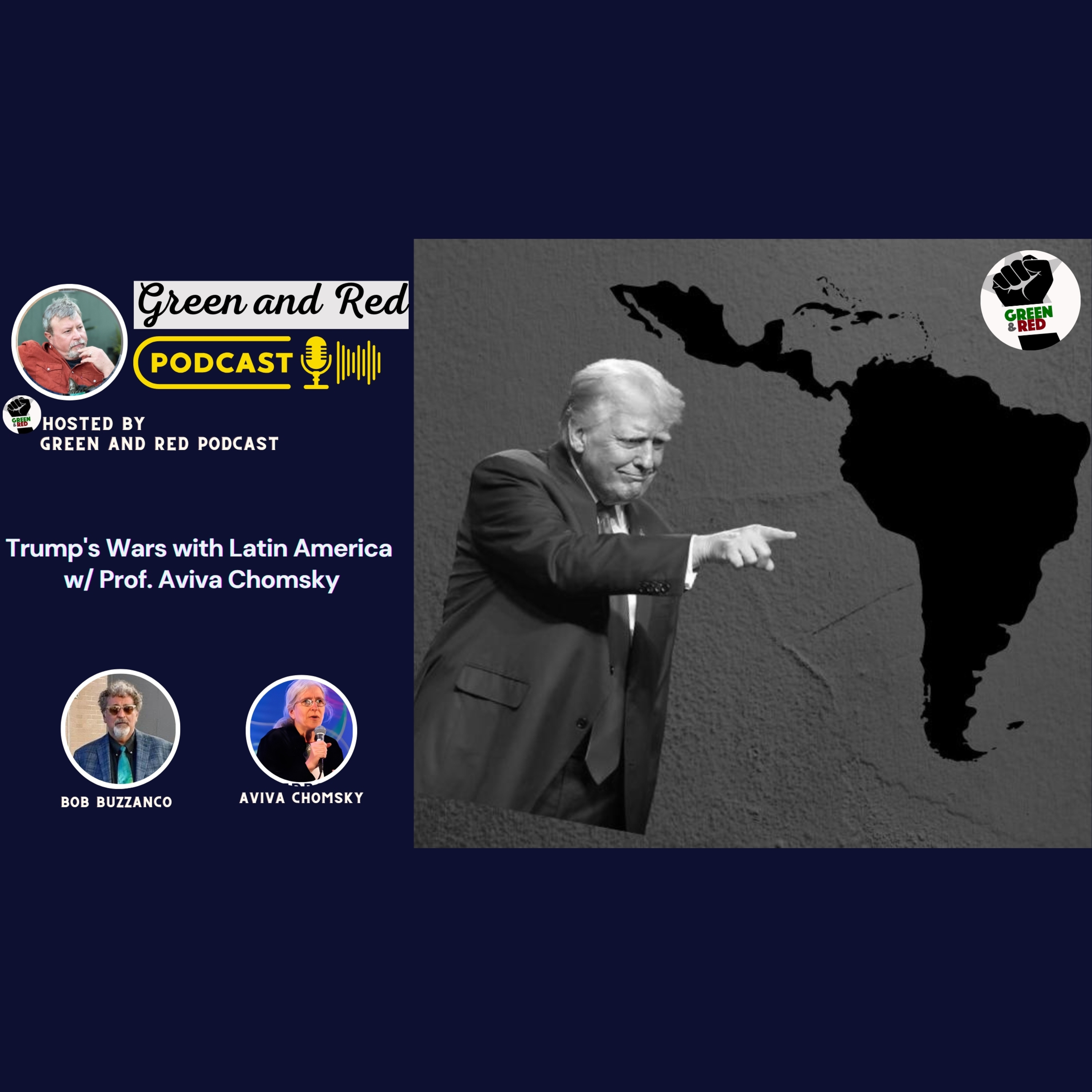
Green & Red: Podcasts for Scrappy Radicals
Trump's Wars with Latin America w/ Prof. Aviva Chomsky (G&R 449)
01:02:56
Loading summary
Transcript73 lines
- [00:01]
A
Welcome to Green and Red Scrappy Politics for Scrappy People, a regular podcast on radical environmental and anti capitalist politics. Brought to you by Bob Bozenko and Scott Parkins.
- [00:14]
B
Welcome to the Green and Red Podcast. I'm your co host Scott Parkin in San Francisco, California today and as always.
- [00:21]
C
I am joined by it's Bob Bozanco in Niles, Ohio and we're really, really excited today to to have as our guest Avi Chomsky. Professor Chomsky, Avi Chomsky is professor at Salem State College in Massachusetts, the author of a bunch of stuff. I wouldn't have enough time to mention your entire cv, but you really focus on like Caribbean, Latin American and labor studies and publications include West Indian Workers and UFCO in Costa Rica, Linked Labor Histories, New England, Columbia and the Making of a Global Working Class A History of the Cuban Revolution, Undocumented How Immigration Became Illegal is science enough? 40 critical questions about Climate Change and Central America's Forgotten History, Revolution, Violence and the Roots of Migration. So welcome to the Green and Red Podcast. Professor Chomsky, there's so much we could, there's so much we could start with. I think in the last month at least or so Venezuela has clearly been, I think, one of the more important issues going on. And you know, we see, you know, kind of saber rattling there, you know, gunboat diplomacy as well as actual violence with these alleged drug boats being, you know, blown out of the sky. You know, in a lot of ways this is not new. But what, you know, how do you think this differs from previous, you know, American aggression in that region? Why do you think it's taking place? Parenthetically, I mean, I was shocked almost to see the New York Times very overtly this morning say, you know, this is about oil. So, but how do you, you know, how do you account for this, you know, new intensification of it? Not, not new in terms of the aggression, but I think the kind of the priority and the intensification we're seeing.
- [02:26]
A
So a couple of things I'll say about it. One, just one thing that really quite surprised me because over the past couple of years I have been thinking a lot about how my students, who are barely even aware of the mainstream media, but of course follow social media. But the difference between my students and my colleagues after the Israeli invasion of Gaza, and my students knew everything about what was happening and my colleagues were saying things like, well, you can just imagine what my colleagues were saying, never mind. And I thought, okay, okay, so we're in a new era where like the Internet is really working. Students have access to social media and so they're getting what's being censored out of the mainstream media. And they actually have, have access to a worldview that the, the elite classes are deprived of because we read things like the New York Times. And, and also, you know, you mentioned the New York Times saying this is about oil. You know, clearly the New York Times is not a Trump support fan.
- [03:35]
B
Yeah.
- [03:35]
A
So I feel like if there was a Democratic administration doing this, which is, you know, this is not just a Republican thing, like it's happening right now under Trump, but we certainly don't see any anti imperialism on the part of the Democrats when they're in power. So. No, but I think that they would be treating it with a lot more kid gloves if, if it was a Democrat in power and for, for the Times. And, you know, I'm using the Times as a stand in for the mainstream liberal media in general. And this was one of the reasons I thought there was a tiny space for optimism with the election of Donald Trump is that that sort of mainstream liberal left feels that it has more space to be critical when there's a Republican in power than when, than certainly than, than they were with Biden in power, especially in the particular sequence of Biden following Trump. But when I mentioned Venezuela to my students a week or two ago, that had not made it through the social media barrier. I don't know how and why Gaza made it through when other things did not. But there was not a single student in maybe one in my four classes who was actually aware that the United States had been bombing fishing boats off the coast of Venezuela and saber rattling. So, you know, for those of us who are news junkies, we're paying a lot of attention, you know, people who follow Latin America. But, but I feel like there's not a lot of popular consciousness even among college students. Know, I'm sure there's politically aware college students around the country, but the general mass of college students, I would say, not like they cared when I told them about it, but I feel like they practically didn't believe me because it just felt so out of line with what they thought they knew about what was going on in the world. So, so that was just one thing I wanted to mention in terms of how it's being understood in the United States. And just the ability to say that it's about oil, I feel just shows how much New York Times hates Trump because that's not the kind of thing they usually say. But also I think that they're saying that it's about oil in a very individualized kind of way, like Trump is respecting a return on his family's investments rather than the sort of larger geopolitics of US Foreign policy. But, you know, I do think the mainstream media has completely abided by the line that, oh, and in fact, one of my students said something like, well, Madura's done a lot of bad things, right? Like, that explains it and justifies it. It's like, what world leader has not done a lot of bad things.
- [06:42]
C
I'm seeing that a lot in the left, actually. The kind of we hate Maduro. There's a certain kind of fairly significant part of the left which is kind of, you know, we're kind of anti intervention, but Madoro is a bad guy and he has to go kind of stuff.
- [06:53]
A
Yeah, yeah, yeah. But so why, like, why now? Why particularly this way? And, you know, Trump has made a lot of bluster that has made us ask, why now? Like, why Greenland? Why Canada? Why. You know, there's some geopolitics that we can understand, and there's some just bluster that we can understand as bluster and, and, you know, throwing red meat to the bases and, and play acting and, and enjoying throwing his weight around. And I can do anything I want to. But I do think that for certain voices in the Trump administration, in particular Marco Rubio, there's the, the sort of virulent anti Maduro, anti Cuban, just this, this hatred of the Latin American left that's so visceral and so deep that I certainly think that's part of what has Trump's ear on this. There's certainly the, you know, the HEZGIF faction, which is just, let's bomb everyone. That's what we're good at. And there's certainly, I feel that this also relates back to Gaza, that there's this sense of impunity right now that, like, we've just completely dispensed with any semblance of adherence to international law or international institutions. So let's just show that we can do anything we want and we know we can get away with it. So I feel like that's a piece of it, too. You know, the idea that for Rubio in particular, Eliminating. I don't even know what kind of language to use without, like using the euphemistic language that, that, that the press uses, but overthrowing Maduro is, is going to be a step towards. I don't even know. Want to know what? I don't even know what they want to overthrow in Cuba anymore. Like, it's not Castro. Right. So what is it that they want to overthrow in Cuba at this point? Point. But, but that there is a, a kind of an emotional, irrational, emotional level to it of feeling like we just have to get Cuba somehow. And, you know, obviously the United States has a long history of interventions in Latin America and, you know, wanting to destroy the threat of a good example or, you know, the bad apple before it destroys, you know, it infects the whole tub. You know, I think that it also serves as a warning to Colombia, where, you know, which I think really, if we want to talk about the threat of a good example, I don't think Maduro right now in Venezuela has that problem. Like, he's not the threat of a good example. Like, nobody in Latin America is looking at Venezuela and saying, oh, we want to be like them. People were looking at Cuba and saying, oh, we want to be like them. You know, back in the 70s and the 80s or Nicaragua or, you know, at these successful revolutions that really. And, and I think in Venezuela also, you know, in the, in the early years of the century that, like, yes, we can do that. We want to be like that. You know, I think the recent election in Chile and the resurgence of the far right sort of signals this, like, yes, we can get rid of even the, you know, even the pseudo left like Boric and. But I do think that Petro is a kind of a thorn in the side of perhaps being the threat of a good example. Although, you know, the situation in Colombia is very, very complex. And just yesterday, there was a assassination attempt against one of the village leaders that we work with in, in northern Colombia, where his bodyguard was injured, and they, like, shot into the window of his car. So things are bad in Colombia. You know, Bogota and Medellin and some of the major cities have this veneer of, oh, we're the first world, but not when you get out into the countryside, but. But still, you know, Petro has shown a certain willingness to stand up to, to Trump on various things, and Israel is one of them. So is it like, I think, you know, of course, oil plays a role the Monroe Doctrine in the sense that, you know, this is America, it's all ours, plays a role. All of those things play a role. But, you know, the real specifics of why now and why this way of attacking small boats, like, it's almost like a caricature of US Military power, like, go after the weakest, poorest, most defenseless people in the world and then use that to show how big and strong and what a bully you are. But, you know, I do think that Trump is wary of, you know, committing U.S. troops, of potentially having to restart a draft of and even of, you know, nation building, regime change, kinds of. But I think that he's hearing a lot that, oh, well, this is going to be different. This is going to be easy. It's all there. And, you know, the Nobel Prize going to Maria Machado, I don't know how that happened, but clearly, you know, for all Trump's denigration of, of Europe, I do think that he wants to, like, he's been sort of trying to line up the, his ducks in a row so that he's gonna. So that was definitely part of that. I mean, I wonder to what extent, you know, Greg Grandin in the New York Times yesterday was talking about, you know, spheres of influence and, you know, Pre World War I, you know, Trump's relationship to China and Taiwan. Like, is this a signal to China that don't go into Taiwan, or is it a signal that, well, you can go into Taiwan, you know, we'll, we'll, we'll be hands off if you're hands off on us. And obviously no one's going to be hands on against the United States. But yeah, so the answer is, I don't know. But a lot of things are happening.
- [14:02]
C
You know, because a lot of people ask me about, like, Trump's ideology. I don't really think he has one other than like, enriching himself or something like that. So the people around him, as you point out, especially Rubio, I think are critical here. And in a lot of ways, this is an old story, which you know better than I do. My field was U.S. foreign policy. So I know a little bit about this. And so what you're seeing today, but like, it is different in the sense like seizing, seizing a tanker. Right. Or contriving, like, know, I keep thinking, like, they keep talking about fentanyl in Venezuela, which reminds me of like, you know, Noriega. Right. I don't think, though, people are really buying that, are they? The, the whole kind of, this is the, the locus of drugs in, in the world kind of thing.
- [14:40]
A
So this was also an op ed this weekend. I think it was in the Boston Globe, not the New York Times, but about how Venezuela is going to be easy. It's going to be like Grenada and Panama. It's not going to be like Iraq and Afghanistan. And just look how well we succeeded in Grenada and Panama. So of course we're going to succeed in Venezuela and we're not going to have to commit troops or lose US lives. So. But, you know, just the. I mean, I also feel like, and I felt like this with Gaza also, that there's a kind of a numbing of the global population and the US Population, so. Oh, okay, well, we can just blast out of the world a few fishing boats. Oh, well, we can just take an oil tanker and like, you get outraged. And then, okay, so this is happening. And then, and then, and then just the defensiveness, like, yeah, I mean, I guess I, I really feel a kind of a lack of outrage, not just among my students who haven't heard about it, but. But in general, I feel a la of outrage, like, oh, yeah, take an oil tanker, whatever. Blow up a few people in the water, whatever. I do notice.
- [16:01]
C
I'm sorry, go.
- [16:03]
A
Oh, that this has gotten very little coverage. But one of the lawyers that we've worked with for a long time on Columbia Union human rights issues, Dan Cavalic, is representing the Colombian family of one of the people who was. I believe it's one of the people who was killed, or else it's the person who was repatriated to Columbia. I can't remember. But trying to bring suit against the US Government for this, for this idea that, like, there's no enemies here, there's no war. I mean, as if, you know, that's a whole other question of how we justify everything in, in cases of war and the laws of war. But clearly there is no war going on here, so. So that's irrelevant. Just randomly assassinating people in international waters. But, and, you know, we, we did it to, to Iran. We have applauded Israel doing it in Lebanon. Like, oh, they assassinated this one. They assassinated that person. They assassinated this. I don't know. I mean, I feel like our language has become so Orwellian, like, you know, proportionality. Is it okay to kill 500 civilians in order to kill one person? Is it okay to kill one really bad person? To decide that a person is a really bad person? And, you know, it's the same kind of numbing and creep with regard to immigrants. Like, we just hear over and over again, like, these are really bad people. These are really bad people. And therefore don't ask us what we're doing because these are really bad people. You don't want them around.
- [17:37]
B
If anything, the outrage seems to be around the lack of process in doing all of this, at least from the, from the institutions, like the Democratic Party, for example. Or even the media. It's, they're way more upset that there's not been a declaration of war, which there hasn't been a declaration of war since 1941 or whatever. It's something that they always talk about. But then they also never. It's just a talking point.
- [18:01]
A
My m. Like the US Force troops who. And contractor who were killed in Syria. Like, what were they doing in Syria? Why were they in Syria? Like, when people invade the United States, are we not allowed to fight back?
- [18:21]
B
My question is we're seeing many more right wing governments come into power in Argentina and now Chile, and seems like there may be close to one in Honduras. It's hard to tell. But how much is the Venezuelan, like Maria Machado, really trying to heighten these tensions? And I'm sure they're whispered in the ear of Rubio and Trump and she's playing the Trump's ego for sure, where she dedicates her Nobel Peace Prize to him. But how much is the Venezuelan. Right. That also is bipartisan, like Juan Guaido joined Nancy Pelosi for one of Biden's State of the Union addresses, I believe. And so how much are they really trying to heighten tensions here because they see an opportunity.
- [19:05]
A
Well, I mean, Honduras is a really good example of, you know, where when we see foreign interference in US Elections, it turns into a, a federal case. But it's. Unless it's apac, Right?
- [19:18]
C
Unless. Unless it's apac.
- [19:20]
A
Oh, yeah, but that's, yeah, but it's sort of taken for granted that the United States can always interfere in elections in Latin American countries. And you know, I haven't read that much about U.S. interference in the Chile election, so I can't really speak about that. But certainly in the Honduran election it was like blatant and overturned. You know, it's like Nicaragua in 1990. Like, you elect this candidate or you're going to be in trouble with us.
- [19:50]
B
Same with the Argentine election too, the recent one.
- [19:57]
A
So, you know, when you say heightened tensions, but tensions among whom?
- [20:05]
B
The US And Venezuela.
- [20:07]
A
Oh, is Machado trying to heighten tensions? Like, do you think, I mean, or.
- [20:14]
B
What role are they playing? I mean, obviously tensions are heightening between the US And Venezuela, but what role is Machado and the Venezuelan. Right. Playing in that?
- [20:26]
A
I'm sure that they're fawning over Trump, but I'm not sure how, how we could even know what, how big a role that plays in, in this sort of murk of, of how decisions are being made. But but certainly the, you know, his Trump's enamorment with the global far right, whether in Europe or in Latin America, is, is a, a piece of what's going on and you know, his sort of worldview.
- [21:11]
C
You know, not long ago we were talking about the pink tide in Latin America and now we're seeing kind of a retrenchment, right. In Argentina and Chile, now attempts to do that in Brazil. What do you think has accounted for that? Right. You still have fairly progressive, whatever word you want to use governments in like Mexico and Colombia, of course, Cuba, Nicaragua. What do you think accounts for that kind of attack and retrenchment? Is it, I mean, you know, the US has some role in that, but it seems like there's more to it than that, like this kind of movement away from the so called pink governments there.
- [21:48]
A
So I remember one of the first talks I heard by a group of political scientists at a conference on Latin America when I was in graduate school or maybe when I had just started teaching, because I think it was at Necklace, the New England Council of Latin American Studies. And there was a political science panel on this. And one of the things that one of the speakers said, I don't remember who was on the panel, but that Latin America is characterized by these swings. It's like the weather in New England, like if you don't like it, wait five minutes. But that if you look at the history of the past many decades, this is what we see, swings from right to left. And you know, part of the reason for that is that it's really hard to govern a poor, economically dependent country. So whoever is doing it is going to have trouble. You can't just have some good ideas. And you know, maybe we could say that in 1959 the Cuban Revolution had the ideal conjuncture of circumstances to actually redistribute the wealth and make life better for the vast majority of the population. And there were some extremely historically specific things going on there that made that possible. But most of the time, and you know, when Petro was, was running in Colombia, the organizations that I work with in, in Colombia were almost all extremely involved in the campaign and extremely hopeful about what it was going to mean to have Petro in office. And as an outsider, I both shared that. But at the same time, as a historian had this sort of sinking feeling like he's not going to be able to fulfill your dreams once he's in office. As several famous people have said in the past, you can't have socialism in one country. All the Cards are stacked against. And so why is every poor country badly governed? Because it's impossible the, the circumstances that they're facing. So I mean that's one of the things that explains the swings back and forth. Like you, you know, you gather a lot of aspiration for a candidate and a program, a project and then they come into power and they don't fulfill it and then you're disillusioned and then, but if also if you look at the votes, I mean Latin America there tends to be. Okay, so Latin America is one of the most unequal places in the world. Not the poorest region of the world, but the most unequal region of the world. So you have very small, what we would call middle class here and then you have a medium sized elite and a huge impoverished population. So you have some hardcore right wing, you have some hardcore left wing and you know, maybe it's approximately 30, 30, 30 or you know, hovering between 30 and 40. So it's that middle 30 that's going back and forth. You have the 30 that are always going to be for the right, you have the 30 that are always going to be for the left and those are, you know, pretty economically defined. And then, and then you have those, those middle who. But you know, and the right in Latin America, you know, we're in an unusual moment in U. S History now. If you look back at the last hundred years in which the we really like the right has become the far right, it's become more like the Latin American right wing which has always been far right. But. So the both the impossibility of. The, the polarization of the population in Latin America because of the socioeconomic polarization also makes it harder to govern and harder to carry out projects. Like in addition to creating, I mean, you know, in Europe too, of course we have a much broader political spectrum than we do in the United States where you know, the Democrats and the Republicans really until very recently have been so closely aligned that it's almost hard to distinguish between them except from on some very peripheral issues. And I'm not even sure that that's not the case right now. Like they have very different styles right now, but in terms of policy, I'm not sure we're seeing that much light between them. But there is light between the right and the left in Europe not as much as in Latin America and in Latin America even more so. Again, there's no real, there's no single explanation, but those are some of the things going on.
- [26:59]
C
It's funny when you mentioned the Light between them on, like Venezuela, for instance, it seems to me the loudest voices against it have been like Rand Paul and Marjorie Taylor Greene. You know, kind of some of these right wing kind of. I think they're almost old school isolationists, you know, Ron Paul types who. I've spoken with Ron Paul a few times when it comes to foreign policy. There's actually not much to disagree with him on, you know, but that has.
- [27:24]
A
Been true when Democrats have been in power too. That is those, not necessarily Marjorie Taylor Greene, but some of those, you know, far right isolationist types have been the ones who were against going to war in Iraq, against going to war in Afghanistan. And you know, their reasons for being against it might be different from mine, but, but yeah, where there is no light between Democrats and Republicans. And you know, of course among the Democrats, we have a few still that haven't been gotten out of the House of Representatives. You know, we have Alon, Omar, we have a few voices.
- [27:59]
C
Yeah.
- [28:02]
A
But.
- [28:06]
B
Even less in the Senate.
- [28:08]
A
Yeah. Are there any in the Senate?
- [28:11]
C
Well, Bernie's, I mean, hasn't your guy Ed Markey spoken out about some of that stuff or.
- [28:19]
A
Yeah, he was very slow to come around to saying anything on Palestine, but he finally started to. And on Latin America. Yeah, the New England delegations on Latin America have tended to be. That's, that's, I think, felt like a, a very safe kind of issue. And you know, it's kind of interesting just saying that because when I was in graduate school, which was in the 1980s, I was very involved in Palestine rights and also Latin America, Central America. And I decided to, that if I wanted to survive graduate school and ever get a job and survive academia, I should go into Latin America and give up on the Middle east because there was no way I was going to be able to carve out a space for what I wanted to do even in my own department at Berkeley, much less, you know, going out on the job market. But, but I did find, especially in those early years, you know, prior to tenure, I was teaching at a small liberal arts college. So I felt like eyes were on me a lot more than now. Now nobody knows what I do but that I could get away with so much about Central America and even Cuba that I, that I knew I could not get away with about Palestine.
- [29:46]
C
Absolutely. We're talking a lot which is, you know, really kind of focusing on aggression and blowing up boats and seizing tankers. But, you know, as a, as a child of the new left, in a lot of ways, I always try to focus on the kind of economic or materialist aspects of this. And if you look at Latin America, you know, you have, like, the IDB and the World bank and the IMF and structural adjustments. And then I think the big, you know, gorilla in the room more recently has been nafta, and how does that kind of economic pressure and those economic interests figure into this?
- [30:20]
A
So, I mean, this is something that I've read some analyses of, and I'm not sure I fully have a grasp of. And not everyone who's trying to analyze it completely agrees that, you know, we have the whole sort of Bretton woods, post World War II US dominates the world. Multilateralism, NATO, international financial institutions, and then, you know, moving into the neoliberal era, free trade, structural adjustment. And on one hand, the Trump administration seems to be. Intent on dismantling all of that. Well, we've been fighting to have it dismantled for years. Right, exactly.
- [31:13]
C
I caught hell when I said Trump has abandoned neoliberalism and people. Oh, no, no. I was like, no, he's not. He's not one of them. Yeah.
- [31:22]
A
But I mean, I guess I would say that I feel like what Trump is trying to do is replace it with something worse instead of something better.
- [31:29]
C
Absolutely. I'm defending aid, you know, usaid, for instance, you know.
- [31:33]
A
Yeah, exactly. Yeah. How did we find ourselves defending usaid? We've spent our whole careers denouncing them. Well, maybe they weren't so bad after all. And, you know, we've been denouncing free trade and, and denouncing the World bank and. But so, you know, one of the things is that it's a. A denunciation. Oh, and NATO. Right. We've always been against NATO. Like, why should we be upset that they're gonna. That Trump doesn't like NATO? But there's other kinds of international institutions that are also part of this post World War II order. There's the United nations, there's the International Criminal Court, the International Court of Justice. And so there is this sense of multilateralism that the United States has always been kind of. Of two minds about. Well, like, yes, but as long as it doesn't affect us and as long as we can control it. And. But I think that those institutions have been important. Certainly they have not had the kind of enforcement capacity that they should have had and should continue to have. But. But that doesn't mean that they're meaningless either. And, you know, the United nations, you know, Universal Declaration of Human Rights and, And Declaration on the Rights of Indigenous Peoples, and that there are parts of this international order that we on the left think should be stronger that the United States has always been against, but in a more tepid way and is now just saying, yeah, toss them completely. You know, the question of free trade and tariffs, I think in part we are kind of distracted by just the terminology of free trade because of course the trade was never free. You know, the free trade agreements are all thousands of pages long. If they were free, they wouldn't need all those pages. These were corporate friendly trade agreements. So we were against them because, not because they increased trade, but because they increased the power of corporations. And at this point, Trump is saying, well, I have a different set of favorite corporations and I'm going to shower my favorite corporations. And he's latching on to some of the leftist critique of so called free trade, but not for. It's kind of like Marjorie Taylor Greene or her ilk opposing the genocide in Gaza or opposing Israel for the wrong reasons. So. So yeah, I think we need to dig down to a more granular level to, rather than just say, oh, against neoliberalism, against free trade, against international institutions, because. But, but what is the Trump agenda? I feel like economically speaking, it is trying to like use or co opt some of the sentiment that was much of it promoted by the left against the corporate agenda, but switching it from the corporate agenda to the terminology of free trade and saying, oh, so we're going to have tariffs and then that'll be good for the working class because free trade was bad for them.
- [35:35]
B
Yeah. I mean, I also think, I think there's an element of it where they see these disaffected white working class voters that in the Rust Belt where they could also, like, there's a culture war element, but then they're also able to like seize upon this like economic disenfranch, disenfranchisement that had been happening since nafta. Seems like NAFTA long time part of like anti globalization movements. It's how I kind of got my start. But like, it also seems like NAFTA has very much scrambled our politics. And we did a whole series on the 25th anniversary of the Seattle protest last year. And just that's really what kept coming up is like Trump has seized upon the anti nafta, anti free trade stuff and use that to get himself elected, at least in 2016.
- [36:23]
A
And I mean, you know, just thinking about how the labor movement dealt with this. But I'm also, I don't know if you've ever had Dana Frank on, but her book Buy American is really, really interesting about it. It's looking way back in terms of like union label and like this, this, this idea in the labor movement, century long idea about buying union and the sort of patriotic element to that and nativist element to it. But that I think, you know, the labor movement came into the 1990s with a lot of dissent about its involvement with US foreign policy. Both organized dissent within the ranks of the AFL cio, but also just like on the streets. So the labor movement for Labor Coalition for Central America or whatever that, so that, but I think that within the labor movement, the attempt to start to slowly somewhat disentangle from the relationship with the Democratic Party and, and also it's really anti immigrant sentiment in the early 1990s that the labor movement first started taking steps towards, oh, immigrants are workers, we should organize them instead of just trying to shut down the border. But in the context of that early anti globalization movement and anti NAFTA movement, there was a lot of economic nationalism in the labor movement and there were only small pockets that were thinking about international solidarity and you know, taking delegations to the auto factories in Mexico and you know, talking about solidarity. You know, this was kind of on the fringes of the FL CIO in the UE and in just a few locals and labor councils.
- [38:43]
B
You saw a lot more in the nonprofit kind of human rights sort of world, like groups like Global Exchange who took delegations to maquiladoras and Tijuana, for example, or.
- [38:57]
A
So I mean, Global Exchange is one example. But I also think that in the human rights world there was an aspect of depoliticization of human rights and especially in Latin America, and several people have written about this, Winifred Tate, Leslie Gill, that like human rights activism could be taking advantage of the only spaces that were available under dictatorship for leftist activism. Or they could be a way of distorting, like turning everything into a humanitarian issue. And you know, I've heard this discussion going on about Gaza too, that, you know, if Gaza is presented to the world as a humanitarian issue, you can bring in a lot more liberals. But you're kind of missing the point too. I mean, it is a humanitarian issue, but it's also a political issue. So, you know, you have Kamala Harris saying, standing up and saying, oh, my heart breaks for the children of Gaza. Oh, we're so impressed with you, Kamala.
- [40:05]
C
Harris as she sends them more bombs. Right, right. You've mentioned immigration a couple times, which I think inside the United States right now is, is a powder keg Right. And. But again, that's, that has so many different variables. I mean, Trump has tried to turn it into an issue about crime, basically. You know, their, their drug, they're rapist, whatever, and it's kind of almost like a moral or immoral issue. But there's so much more to it than that. Things like labor and climate change. What. How would you approach this if you were going to talk to people about immigration and try to explain, like, hey, it's. This isn't really what's happening. What do you think the real factors are that have been driven this? Because you mentioned the 90s. I was actually, we were bringing people into Houston a lot from places like Global Exchange, and I was also working with the local AFL CIO Council, and there was a. There was kind of, they were meeting, which was really, you know, kind of, kind of encouraging. You know, how would you describe what's happening with regard to immigration, how it's being and how it's being misused? I guess.
- [41:08]
A
You know, you just mentioned the Labor Council. And I just also wanted to say that a lot of that more activist stuff was happening in the Labor Councils because they have a lot more autonomy from the AFL CIO hierarchy than do the unions themselves. So it's notable, and I mean, here too, the Labor Council has been a really important voice that has transcended, I think, what, what a lot of unions have been able to do. And that autonomy meant they could kind of operate under the radar. I mean, not, not clandestinely, because what they did was public activism, but. But under the radar of, of, like the bureaucracy. So I guess I would say that I see a number of different things going on in the Trumpian approach to immigration. But I mean, first of all, like, I wrote this book about it in 2007. They take our jobs and 20 other myths about immigration. And like, everything that's happened since 2007, I keep saying not enough people read my book. Why don't they read my book?
- [42:22]
C
Yeah.
- [42:25]
B
I read that book, by the way.
- [42:27]
A
Okay. I mean, I wasn't talking about you two. I was talking about all the anti. I read your other. They're taking American jobs. But, you know, unfortunately, we did a second edition just a couple years ago because it's like, yeah, all those arguments are still being made and still have to be rebutted. But first of all, so where is the Trump administration coming from? What are they doing with the narratives around immigration? So, like, one of them is the criminalization. And we hear this over and over again every day. These are like really bad people. There's also just a clear, like, white nationalist aspect to what's going on here, which is both, insofar as Trump has an ideology, I think that's part of his ideology, but is also his understanding of who his base is and how he's reaching out to them. And I think one of the things that people often miss is that a significant portion of the Latino population is white and considers itself white and buys into this white nationalist. And it's very common in Latin America as well, you know, in slightly different terms in Latin America. But, you know, oh, so we're not going to take refugees anymore, only white Africaners who are the most oppressed people in the world and only 7,000 of them. And so there's a very clear racist, like, these are bad people because they're dangerous and they committed crimes and they're bad people because they're not white. And white people, non white people are people who are bad people and commit crimes. So it's kind of like a, a full circle there of the criminalization and the racist piece of it. Part of it, I think also, and also related is Trump really hates Joe Biden and in particular and the Democrats in general. Well, we do too. Right. But for slightly different reasons. Just like everything that we agree with the far right on. But I think that he has made a lot of hay out of the, the late Biden administration policies of parole and temporary protected status and allowing large numbers of immigrants, especially from, not from Mexico and Central America, but from places like Haiti, Cuba, Venezuela, to come into the United States in an extremely poorly thought out and poorly coordinated way, that is. And, you know, I, I not only poorly thought out, but also probably in some ways deliberate that, well, we'll let them get across the border and then we'll like, make the Republican governors be responsible for them. And then we can talk about how bad the Republicans are and how much better the Democrats are. But once the Republican governors started saying, okay, we're going to send them north, then all of a sudden the Democrats, oh, but we don't want them either. We only like immigrants when they're in the southern states, when we can blame the Republicans for not taking care of them, but just using it. So there was a lot of, even in Massachusetts, you know, there's a housing crisis in Massachusetts that predated the influx of refugees under the late Biden administration programs. But even undocumented immigrants were saying things like, well, when we came here, nobody gave us housing. Why are the people who are coming now getting housing. So, you know, I think that the Latino and immigrant dissatisfaction with what they see as pampering of new immigrants is pretty strong. You know, people who, who like, you know, people of my generation who can say, well my grandparents struggled when they came here, but these are people who are saying I struggled when I came here. So. And you know, associating not entirely wrongly, pro immigrant liberals with wokeness and bleeding hardness and. You know, they. Them ness and, and all the things that, that they like to throw around because. So, so yeah, I guess those are some of the main factors. But so what is the impact of immigration on the economy? I like to talk about, I have a whole slide of what I call the modern migration paradox of how the neoliberal global economy has created huge demand for immigrant workers in the wealthier countries as the austerity has hit the wealthier countries, as well as this series of economic crises and labor crises where the demand for. The, the outsourcing and insourcing, the decline of. Or decline is too euphemistic a word. The attacks on, on unions and the destruction of unionized jobs through outsourcing, through moving them out of like northern cities with high unionization levels into the south, into right to work states or into rural areas like in Nebraska where, where people don't have access in Iowa, meatpacking especially moving out west, manufacturing moving into the south. To escape with the help of the US Government the protections that have been put into place and the gains that labor had won through unionization. So but that's one thing that's creating a huge demand for immigrant labor. And it also, and this is kind of how the paradox works. It creates the che products that allows the stressed working class to continue to have access to these cheap products. But of course in the working classes, you know, division of labor, like a lot of services that used to be done in the home or in the neighborhood are now have to be outsourced. Whether it's like mowing the lawn or taking care of the children or taking care of the elders. And we're of rapidly aging population. So elder care, care for the disabled. Many things that were either done in really horrible ways or done in the home are now being outsourced and once again creating this huge need. Fast food and food processing. Our other sectors, like all of these sectors that are part of the neoliberal transformation, the post World War II transformation that begins with this sort of expansiveness of the welfare state, but moves quickly into its contraction of labor rights and the welfare state. So there's a huge demand for underpaid immigrant labor inside the United States, along with what's happening with outsourcing and things like nafta. At the same time, there is the neoliberalism in places like Mexico and Central America, creating huge new opportunities for US Investors which mean displacement of rural populations off of their land, whether it's being put into tourism, whether it's being put into palm oil plantations, into the new extractivism. So creating new populations that are forced to leave and that can only. And, and then they send back remittances, which allows those who remain there to survive as. And takes the burden of, of sustaining the population off of these governments that are putting all of their resources into courting foreign investment. And then it's the immigrants who are allowing, who are basically acting as the safety valve that people can leave, and then they can support the populations that can no longer pay for things like schooling and health care and basic survival. So, you know, remittances are larger than, you know, we have usaid, but remittances are consistently the largest source of foreign aid coming into poor countries.
- [51:44]
B
I read the third of income in Honduras is because I was reading about Honduras before this interview. A third of Honduras is income is based on remittances.
- [51:54]
A
So then you have to demonize immigrants in order to justify the maintenance of this horrifically unequal system and exploitation and, and oppression of people. So then you demonize them. And at the same time, you know, clearly consumption of everything, fossil fuels and everything else is much higher in the United States. So we're the ones who are causing the climate change that is contributing to pushing people out of subsistence economies in Latin America and making life unsustainable there. Of course it's unsustainable here, but people have more opportunities here. So the more we make our economy better and people are able to consume more here, the more we're encouraging people to migrate here. And then. But. But it all depends on making that migration illegal so that it can continue to be exploited.
- [52:58]
C
Even. I mean, often opponents of what Trump or others are doing put it in moral terms. There's kids in cages. Or look at what ice, the horrible things ICE is doing.
- [53:06]
A
And that's the problem with the humanitarian and human rights approach to it, is that you miss the political economy of what's going on and how to actually solve it.
- [53:16]
C
But it's very much a labor issue, too. But even now, you see, I don't know if you saw the video last week of Jasmine Crockett, who's become kind of a new liberal hero who said, well, we need them because they're doing cheap labor, because we're not picking cotton anymore. So when your friends are saying, when are you here so we can exploit you? How do you talk to people like that? How do you explain this? That's far more nuanced than that.
- [53:41]
A
I mean, I guess, you know, in the end I feel like there's a very moral aspect to political economy as well. Like we have to understand the political economy. But like, is this the kind of world you want to have? Is this the world you want to live in? Is this the world you want to make? And it's not just enough to say that, oh, it's bad, we need to understand what is wrong with it in order to be able to understand how to change it. But, but I guess in a way, to me it does come down to that moral question. And you know, the more, the more close up and personal it gets, the harder it is for people to do that moral distancing.
- [54:23]
C
Yeah. I lived in Texas for 30 years and I saw it like all the time, like Houston would fall apart tomorrow. I lived in a fairly nice neighborhood and, you know, all the women pushing the kids around were Mexican American. So. Did you have anything else, Scott, or.
- [54:41]
B
I mean, I have many questions. I think we're getting towards the end of our time. I do have one question around domestic politics, which is I don't know if you saw the results of this recent mayor's race in Miami, where I thought.
- [54:54]
A
You were gonna say New York. Of course I saw the results.
- [54:56]
B
Yeah, The Miami one is interesting as well, where the Democrats for the first time in almost 30 years, by 20 points, it seems very tied to some, very much tied to the anti immigration policies of the administration. And up until actually we were talking with you earlier, I would actually have said some of what's going on in, in Latin America, but I'm just wondering if you had any thoughts on how we're seeing this sort of shift, particularly in a place that was like very pro Trump but is also populated by a lot of, of immigrants.
- [55:30]
A
So I mean, the immigrant population of Miami is very interesting. Both the Cuban American and Venezuelan populations are, I think, I would say in terms of organizational politics, dominated by the far right, but have become much more, the populations have become much more diverse. The Cuban population really since the 1980s, even though the newer Cuban immigrants are not, don't have the kind of organizational power that's still in the hands of the Marco Rubio factions and Venezuelans as well. That is, the early immigrants post Chavez tended to come from the far right elites. And now people of all social classes are fleeing Venezuela for economic reasons, the same reasons they are fleeing Honduras. That has nothing to do with who's in government. It has to do with being able to survive. So, but of course, those who are citizens tend to be those from the earlier generations. So they certainly have more electoral power, not only more organizational power, but also more electoral power. But I think that, You know, this kind of goes back to what we were saying about Latin America earlier. Like, people wanted to vote for Trump because they thought he was going to fix the economy. And now people are seeing like, wow, the economy is really bad, like, we still can't afford anything. And now our health care is going to go away. And people are feeling really, really economically stressed. So the disillusionment with Trump and the search for an alternative I think is part of it. And you know, those. This really interesting book by Alejandro Portes, or Port, I think it's Portes on Miami, the Transformation of Miami, where he interviews some of the Mariel generation Cubans in the 1980s and 1990s. And they say, you know, he asked if they encountered racism in the United States and they said, well, not from white people, but from the Cubans. They're incredibly racist. Like, they can't stand us.
- [57:48]
B
Right.
- [57:49]
A
So there's definitely a racial element to that, to that too. But those earlier generations, like the people who started coming after them, those are not the Cubans and Venezuelans they want in their community. They want their white gated communities.
- [58:05]
C
I think it's also kind of surprising, probably to them, I know, to me, that Trump's actually going after them too. I mean, ICE has been taking Cubans and Venezuelans, people who said, hey, you know, we came here because of you. And so obviously this, this isn't going away. I have no idea what's going to happen in Venezuela. Hopefully it doesn't go beyond. You never know. Trump wakes up every morning with something different.
- [58:27]
A
Yeah.
- [58:28]
C
In his head. But so you'll probably be getting an email from me, you know, next month saying, hey, do you want to come and talk to us? But we really, really, really appreciate it.
- [58:38]
B
Yeah, this has been great.
- [58:39]
C
Yeah, we, we try to do a lot of stuff on, on, you know, foreign policy issues especially, and we've done some stuff on Venezuela and just kind of Latin America. Cuba is very near and dear to, to my heart as well. So we really appreciate it so much. And, and thanks so much.
- [58:55]
A
Well, it's a pleasure thanks for the opportunity. It's great to meet you.
- [58:58]
C
Yeah, thanks.
- [58:59]
B
Folks. We've been talking with Professor AFI Chomsky about many all things Latin America and immigration in the us if you like us, please check us out on Facebook, Instagram, Twitter and Blue Sky. If you're watching this on YouTube, hit that subscribe button. If you're listening on an audio platform, give us a rate and view. If you really like us, go to greenredpodcast.org and hit that support button or become a patron@patreon.com greenmedpodcast and everybody out there, make trouble or misbehave and we'll talk to you again soon.
- [60:43]
C
La.
- [61:08]
B
Sarah sa.
- [62:50]
C
And.