← Green & Red: Podcasts for Scrappy Radicals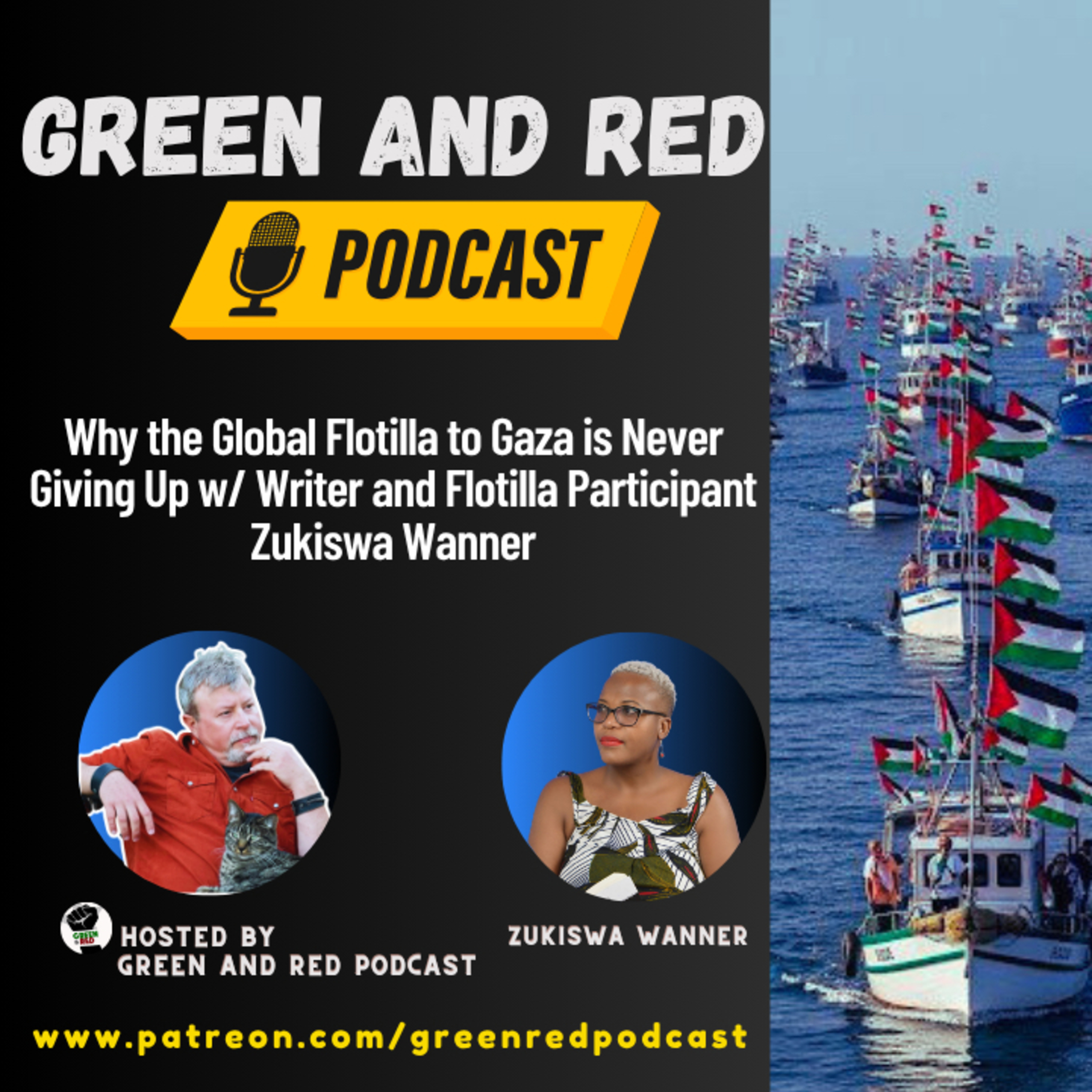
Green & Red: Podcasts for Scrappy Radicals
Why the Global Flotilla to Gaza is Never Giving Up w/ Writer and Flotilla Participant Zukiswa Wanner (G&R 494)
00:54:04
Loading summary
Transcript85 lines
- [00:01]
A
Welcome to Green and Red Scrappy Politics for Scrappy People, a regular podcast on radical environmental and anti capitalist politics. Brought to you by Bob Bozanko and Scott Parkins.
- [00:14]
B
Welcome to the Green and Red podcast. I am your co host Scott Parkin in Berkeley, California and Bob is out today, but he'll be rejoining us soon. But I am joined by Zakiswa Vonner who is a South African journalist, novelist and editor. But her recent work is around the campaign to stop the genocide in Palestine and is a member of the South African steering committee of the flotilla effort. We're going to be talking about the Global Samud Flotilla today. Zakiswa has written a book called Flotilla A Journey of Consciousness about her participation in the flotilla last year. I believe it was last October. And I just want to say welcome to the Green and Red podcast.
- [01:06]
A
Thank you very much for having me. Scott, how are you?
- [01:09]
B
I'm doing good. I've been following this story and very obviously I've been following this story for a couple of years now, but or decades maybe, but also very concerned about what's happened to Saif and Tiago. Could you start off with an update about Saif and Tiago?
- [01:26]
A
Yes, Saif and Tiago were part of the 100. So Israel intercepted the Chilla in Greek waters over a thousand kilometers away from Israel and they bought at least 22 of our boats and 180 of our activists. They then essentially abducted two of our activists and took them back to Israel. Saif Ab Keshik and Tiago Avila. And that was on the 30th of April. We are relieved to say that they have been leprechaun yesterday got here, back home, into landed in Sao Paulo. I'm in Brazil at the moment. He landed in Sao Paulo in the evening. And similarly Saif landed in Barcelona yesterday. But it was very under very trying circumstances, obviously. But they are relieved that they're okay. And
- [02:30]
B
these two folks, Sayf and Thiago, they're very core to the organizing of the global flotillas. More than many of the others who were released. Correct. Is that why the Israelis held them longer and were threatening to give them harsher charges and treat them as terrorists and things like that?
- [02:45]
A
Very much on the steering committee of the global moved. Dr. La Thiago is the communications guy. But as we well know, as you and I well know, and as they have said themselves, and even from my previous experience, nothing that they might have experienced is anything compared to what the Palestinian hostages that are in Israeli prisons
- [03:10]
B
experiencing when the Israelis took the ships on this most recent flotilla, they took it. There were about 50 in the flotilla, but they took about 20 of them. They boarded and arrested people on about 20 of them. Correct.
- [03:23]
A
In 22 of them. Yes.
- [03:24]
B
Yeah. I'm getting at this because I come from an environmental background. I also saw the Greenpeace Arctic sunrise was part of the flotilla and was there. And also I believe Saif was a liaison between Greenpeace and the flotilla. And was the Arctic sunrise actually interfered with at all?
- [03:44]
A
I don't believe it was. But yes, there was communication. There has been. Greenpeace was going there because as caught. Since you're in the environmental field, there just hasn't been a genocide in Palestine. But there's also been an ecocide. People in Gaza cannot dig a well and drink water from Gaza. There's been ecocide. There's been an attempt really at lingocide by refusing to get things written in Arabic so that Palestinians can have access to it. Or as we saw recently in Haifa where a politician who is Palestinian was talked down for speaking in Arabic apparently because she should speak in Yiddish.
- [04:32]
B
Saif is Palestinian origins, but is a Spanish citizen. I believe he's a Swedish citizen too. And then Thiago is Brazilian. Yeah. And Spain and Brazil is a Palestinian
- [04:45]
A
Palestinian, but he's a Spanish citizen. And he was actually not going to go all the way with the journey. He was going to the last port where everybody would be joining the flotilla because as we did last year where people joined from city and as such. And the main reason for that is we are aware how the Zionist state is much more brutal with Palestinians than they are with the rest of us, even when they are brutal to us. So I think the way it works is that most brutal to Palestinians and the second most brutal to anti Zionist Jews.
- [05:26]
B
Yeah, yeah, I've seen. We've seen a lot of that in the press. Was. Is. Were they also targeted? Was there. Spain and Brazil are two of the more outspoken countries against the Zionist genocide. I'm wondering if there was any. If that factored in at all, being that they were from countries that have done this particular.
- [05:48]
A
The bots that they were on was actually flying an Italian flag and they spoke. A lot of countries immediately spoke up. Brazil did, Spain did. Italy did many more other countries. Turkey did the same thing. South Africa, essentially all the countries in the A group and all the other countries. But as we know, Israel is allergic to the rule, to international. The rule of international law. That unfortunately didn't make much of a difference. And we. They went ahead and abducted the them and they took them to court on the 5th of February and held them and, and charged them and which is bizarre, obviously, because they had abducted them from international waters and now they were charging them according to Israeli laws and none of them are citizens of Israel. On what count are they being charged according to Israeli law and what exactly
- [06:51]
B
were the charges they were charged with
- [06:53]
A
that or they had colluded with an organization that the United States says is a terrorist organization. But we all know, of course, how the United States lists companies, countries and organizations that terrorists coming myself from South Africa, I'm very well aware, for instance, that Nelson Mandela was considered a terrorist up until 2008 at this point.
- [07:22]
B
Sometimes I think that term is meaningless. That word is meaningless.
- [07:26]
A
I think it's. I think it's.
- [07:28]
B
Or at least when it applies, not the states. It does apply. I feel like it makes a lot of sense when we talk about state sponsored with states terrorism. Right.
- [07:36]
A
I think we all really know as far as states are concerned which ones are the terrorists and they be the countries from the global minority that are actually arming and funding genocide. The very idea that in the United States you can get arrested for questioning the funding to the Zionist state, the fact that in the United Kingdom and in Germany people can get arrested for saying Free Palestine or saying from the river to the sea. Those are the type of things that make you wonder and question the myth that we in the global majority have been taught for such a long time about Western style democracy.
- [08:25]
B
Yeah, exactly. So you went on a flotilla last October, I believe. And I'm wondering if you could talk a little bit about why you went on that flotilla and your country, South Africa was the. One of the initiators of it was the initiator of the what's happening in the International Court of Justice and things like that. And I'm just wondering. I'm just.
- [08:49]
A
Yeah. So we have, I think all watched Israel use starvation as a weapon of war. And I, some years ago, in 2023, actually in May 2023, I was in, I was in Palestine for a literary festival called Palestine Festival of Literature. And it something that's done by Adaf Souf, who it's been going on for years done by Adaf Souf who is an Egyptian writer. She's the one who started it. And what happens quote with Palestine Festival of Literature is because Palestinians are not allowed to travel. The literary festival travels to Palestinians. So you go to all different cities and in so doing you then begin to experience what the daily life of A Palestinian must be like, we of course started in Ramallah, which is considered area A and allegedly self governing, whatever that means. And the security and administration is supposed to be done by Palestinians, but by security it really means just the police. And because Israeli occupational forces can come in anytime and break people's houses and arrest people arbitrarily anyway. So I did that trip and I went to Nabisal after we left Ramallah, went to Nabisal, we went to Jerusalem. And as part of going into Jerusalem, one of the things we did was instead of we could have just won a tourist bus straight, I was, I think the only person without a global north passport on that, on that trip, it might be me and maybe two, three other people. We got off at Kalandiya checkpoint and we. Which is between Jerusalem and Ramallah. It's literally like the distance between Ramallah and Jerusalem is 20 minutes.
- [10:51]
B
Right.
- [10:52]
A
But we were there for over an hour, over two hours. And why this is relevant is there are Palestinians who go to school in university in Ramallah who stay in Jerusalem and Palestinians who stay in Ramallah who work in Jerusalem. And if you work in Jerusalem daily, what happened is they have to wake up at, they have to be at the checkpoint at 4pm, 4am if they want to cross that checkpoint and be at work in Jerusalem by 8am that's how messed up this is. And so we went through and then from Jerusalem, and while we're in Jerusalem, of course we went to our Aqsa, we also went to the Church of the Holy Sepulcher. And while they. One of the things that we experienced was the absolute disrespect for Christians by the Zionists in the area. So when there is the myth that Palestine is a religious issue, it is absolutely not. It's settler colonialism, an apartheid issue. And it's dealt with towards essentially all Palestinians, whether they're agnostic or atheistic or of Jewish religion, because the Palestinians are Jewish, Christians or Muslim. There was like an. We went to Sheik Jarrah and I'm sure you read Perfect Victim by Mohammed Al Kurd went to Sheik Jarrah to their home, and Mohammed gave us a tour. And again, for instance, their family cannot, cannot throw rubbish away because it will. They can't burn their rubbish in their own yard because it will be considered it's against the law by the municipality. They'll be fine. And yet Zionists who have taken over a lot of the houses go and dump rubbish in their yard. They, they try to do a bookshelf so that the kids can come there and stuff. The books have constantly been damaged, no matter how often they've tried to do that. So it's horrific that people can be. Can live that way. And international governments, particularly global north governments, often, course, know this because East Jerusalem is where you have the United nations, where you have the embassies of many countries. So it's. It's utterly horrific. We left Jerusalem, we went to Hebron. And when I was in Hebron, the first site that I saw was four children when we got off the bus, four children. And there was an Israeli occupation force holding a gun to these children, young kids. And our guides say to us, if I tell you what had just happened, you think I'm lying. So I ask you to ask the kids. We asked the kids, and apparently their school is 200 meters away from their home. So they went to school. When they came from school, the Israeli occupation forces had put a checkpoint. Now these kids are to walk 2 kilometers to get home, which is 200 meters from school.
- [14:04]
B
Right.
- [14:05]
A
We went to the Ibrahim Mosque. And when we had somebody briefing us an official, he had told me that biggest number of settlers are coming from North America, or you have some from South America. So usually like United States and Canada,
- [14:22]
B
like New Jersey and New York.
- [14:24]
A
Yeah. From South America, you are having a lot from. From Argentina and then. Then you have from Europe. And Europe is all mixed. The former East Eastern Bloc and as well as the west, uk, France, et cetera. But equally important, you've got a lot of white South Africans.
- [14:45]
B
Yeah.
- [14:46]
A
Well, I inquired, are these white South Africans of Jewish extraction? And they say, no, we are literally having white South Africans who are of Africana or English descent converting to Judaism so that they can take part in apartheid again because they have apartheid nostalgia. But I understood it at that point when I was in Hebron, because I saw a young woman in the Israeli Defense Forces uniform and she was singing the apartheid anthem. Quote, this young woman looked like 24. So in 19, she was not even born. The fact that she knows this anthem, the fact that she's there serving, was the most jarring thing to me. And it will live with me for a very long time. You know.
- [15:46]
B
Was she singing it because you were there? South African?
- [15:50]
A
No, she didn't know that. But she was walking with another soldier and she was teaching him the way. So this was a marathony as far as she was concerned.
- [16:02]
B
Right?
- [16:03]
A
Yeah.
- [16:04]
B
It's horrifying. The forces of the global. Right. Definitely see a moment right now where they can full advantage.
- [16:14]
A
Absolutely. So I went, we did that. I went to league, I went everywhere else. Sorry. And what happened is when I came from there, that was in late May. I then I wrote this which is vignette for people in an apartheid state. It's a long form essay really and I'll tell you what's interesting about it because I finished writing it on June 30th and the blog read In a world where Palestine should be a wound on the concepts of every human being with an ounce of humanity, we shut our eyes and cover our ears. In May 2023, South African author Zulisa Alvana was a guest of the Palestine Festival of Lucia. Coming from a country with a history of apartheid, she should have had an inkling of what to expect. But her experiences were more than she had bargained for. As Palestinians are not always permitted to travel across checkpoints. Palestine Festival of Lucia brought her and other festival participants to different parts of the Palestinian territories. Glorified Bantustans for literary engagements with audience vignettes. Is a witness account of contemporary settler colonialism, genocide and a world that's damned by its refusal to see or hear the pleas for a truly free Palestine. Please note that blurb was written by end of June and I was calling it a genocide and because I had already seen and that was in the West. So fast forward, I come to Brazil last year for the translation of this book and just to do some talks and so forth and so on. And I get back home and I am frustrated as many people were. We are watching a live genocide but it gets escalated because they even stop allowing very the minimal amount of food that they were allowing in. They even stopped that, right? And so I had seen previous flotillas since the blockade of Gaza back in 2008. I had seen previous flotillas. I had seen even last year the Magda Handela, the Freedom Flotilla, the Carson Madeleines at stock. I'd seen all this and I thought to myself and I was seeing the small numbers and of course they were intercepted. But when all these organizations Freedom Flotzilla, then Thousand Madeleines and global movement to Gaza came together and they said what we're going to do is we're going to do the global sword Flotzilla with a lot more boards and a lot more people, I felt this is actually the chance to make a difference. So yeah, I want to be there. So I stood up and made my and applied for and I went through the interviews. I turns out over 30,000 people were as horrified as I was because that's how Many people applied to be part of the bookseller and, and I applied and then they said, yeah, please get yourself to, to Tunisia, but have a full time writer. And so I had to start thinking how am I getting there to understand the way solidarity works and how everybody is horrified. I talked to a sister of mine, a comrade from Senegal, and I said, listen, I have been selected for this and I would like to go, but I don't have money for a ticket. And she said, oh, contact this person. And I contacted someone from Gambia and the people from the Gambia funded my ticket to go to Tunisia. I still needed to make sure that while we're there for training, I had money for food and for a roof over my head. So the people from Colombia fundraised so that I could be able to pay my rent, you know, while I was there.
- [20:10]
B
That's amazing.
- [20:11]
A
Yeah, so that was. So I went there and of course, as you well know, there was like an attack on some of the boats while we're in Tunisia now, certain boats couldn't go and we had a whole lot.
- [20:26]
B
There were like drone strikes, right?
- [20:28]
A
Yes, there were drone strikes and it was from Israel. But it's also. It again shows that impunity that they can go to another sovereign nation and do that, no consequences. So I actually ended up, the people got on the flotilla eventually and I ended up leaving on the last boat out of Women, which has actually the title of the first journal entry that I wrote for Afro French publication while I was there, where I just said it's called Last Spot Out. And yeah, and when I got on that boat and it was, I had people from 15 of us from seven, eight different nations. And we, of course the first two days was us doing seasickness,
- [21:24]
B
but very familiar.
- [21:27]
A
Yeah. Thereafter we all sat down and we had this discussion, why are you here? Which was such an important thing to do because now we're on the same. And people mentioned why they were there, the horror they'd been experiencing, everything. And, and you, when you go through something like that with people, you are bonded for life, you become family. And I think that's what happened to us. Because these people who had been strangers prior were now suddenly like family, were all brothers and sisters. And sometimes somebody would look at you and they can see that you're tired and they say, listen, can you sit down? I will wash the dishes. Because we, while we were there, we had stuff we had with do duties we clean with, cook with. Of course, every night we'd have the duty of a night watch and I usually used to take the three to six in the morning, and I was always so happy when dawn broke because they would constantly attack us with drones up until the drone attacks stopped for that bit. When Italy went on strike and they sent. The Italian navy accompanied us for a while. So that's.
- [22:56]
B
I remember that.
- [22:57]
A
I remember a friend of mine from South Africa saying, oh, the Mediterranean, I understand the stars are beautiful at night. And I said, my friend, I don't even know how beautiful the stars are, because every time I look up, I don't know whether it's a star or it's a drone.
- [23:13]
B
How did it feel? That's a beautiful moment of solidarity where the Italian dock workers did that. How did. And I believe it happened in Spain some too. Right?
- [23:21]
A
Yeah.
- [23:22]
B
How did that. How. What was your reaction to hear that?
- [23:26]
A
It was just so humbling, but so beautiful as well. I have to say, one of the equally beautiful, maybe even more, was the videos that we saw of the kids in Gaza at San Julian waiting for us. And, man, that was heartbreaking, that is. And on my boat, there was. Every boat had a doctor. So just to give you an idea, each of our boats had had food, like dried foods, and we also had medication and we had diapers. And the whole idea was when we got to wherever we're going, we would. We would have the medical workers get off with the foods that were on our board and the mix on our boats, and we would form like a humanitarian corridor so that the bigger boats would be able to come through with all the medicine and all the food and whatever. But there was primary food there. And as a testament to perhaps our faith on this particular boat, the doctor on our boat, Bianca, was. Is Australian, and she's New Zealander Australian. But she had got two chocolates, two chocolate bars, and I had got some dates that were really nicely wrapped up while I was in Tunis. And both of us would not allow anybody to touch that, because I had told Bianca that when she got this chocolate bars because she was going to give it to the first kids that she saw. And I said that the dates was the first for the first Palestinian woman that she encountered. And she would give it to them because I wouldn't be able to get off. And the night before we were intercepted, even then, we would not allow anybody to touch those dates and the chocolates because our beliefs that we would get there somehow was still very much alive. We managed to maneuver and we saw dawn breaking. Do you know what was the most heartbreaking things for. What's that Normally, Israel would intercept. Israel intercepted at night. They. All the interceptions were done at night. We saw dawn breaking, so we took a sigh of relief. And when one of our board members was Muslim, who is Muslim, came down for Fajr from Fajr prayers, she came and she said, they are here. We could see the coast of Gaza. We were 28 nautical miles from Gaza. That was the outbreak.
- [26:16]
B
I totally can understand that.
- [26:17]
A
Yeah. So near and yet so far. So that was the heartbreak.
- [26:22]
B
There have been boats that have made it to shore. Right.
- [26:25]
A
This is it. This is the fate that had us keeping going because we know nobody wants to do something that they believe is hopeless. We had hope based on the account that there have been boats that have made it. But equally, the other thing that spurred us on was we are much more. We have many more boats than before. So therefore, at least some of us should be able to make it.
- [26:50]
B
What when you were intercepted and we were all arrested or detained and you were. Were you taken. You were taken to jail in Israel before they deported you?
- [27:02]
A
Yeah. So we're first taken to Ashdod and we saw that horrible little man whose face is as ugly as his hearts give her. Yeah, he came where he came with journalists and he clearly wanted to give us a lecture, but we shut him down with chants where a lot of us. And we drowned him and he had to get off stage. And of course, we suffered for that because immediately after he left, our hands had been free. They cable tied us up until they took us, each and every one of us, to be processed. And one of the things that I always say every time about that particular process is I understand now that experience helped me understand my country in a way I could never have known my country's particular history. I remember reading some former prisoners from South Africa, Police Corps prisoners, how they would talk about how the prison guards would reach them and how the people worked for the prisons. And I saw that at that point in time. But what's interesting so with apartheid Israel is I got there, I had my passport. They f. The first thing they do is they photocopy your passport and they put it in a folder. Then they give it to somebody who's supposed to walk with you the whole time. So you're essentially now walking with a guard, and then you get to the next point, and they said to me, I should take off my jacket. I had a jacket written Global Movement to Gaza, which they ended up taking. And inside I was wearing a T shirt written Africa for Palestine. They told me to move another person Is there. I had to remove that so that they gave me a plain T shirt. Move. Another person is there who then opens my bag and searches through it. Now, here's the funny story about my bag. I had. It had been. It had water splashed on it. So I had two T shirts that were turned inside out. And this woman who searched my bag, she took my lipstick, she took my gloves, she took all those personal effects. I think I had, like aspirin and stuff like that, right? She took all those things, but she left the two T shirts, and that's because she didn't turn them inside out. One of the T shirts was a map of Gaza before it was bombed. The other T shirt is this very T shirt that I'm wearing. It's written Free Palestine. And at the back it's written, boycott Apartheid Israel. Those are the two things that I got out of that prison with everything else. My shoes, everything was taken. And yeah, and then I went to the next station where they asked me whether I had any health problems. I went to the next station where they fingerprinted me. I went to the. Please note that these are all different people working. This is a job that could have been done by one person. Part of the reason why Israel exists is. Exists the way it does is people do not protest because people are employed. They can't see Palestinians, and they're employed. Why? Because people in America keep sending them money. You guys keep sending your tax dollars. So then everybody can afford to be employed. Like all these unnecessary jobs. Now, at some point in time, this young lady who was working with me decided she was going to give me my folder so that she could fix her hair or eat a pizza or drink a Coke, whatever. And so when we finally got to the place where I was supposed to talk to the lawyers and she asked me for that folder back and I refused. And she said to me, what do you mean? And I said. I looked at her and I said, everybody else is carrying the folders of the people that they're accompanying. But you made me carry my folder. And I'm the only black woman around here. Is Israel an apartheid state? Are you guys racist?
- [31:11]
B
And what did she say? Did she just shock that you asked?
- [31:15]
A
No. Give me that. I said, no, I don't want. I want to talk to your supervisor. Supervisor was right in front of me. So I called this. I nicknamed this young woman. I nicknamed her. In the book Journey of Content, I nicknamed her Botox Betty. And I nicknamed this guy steroids. Steroids, too, because he was like his Neck was thick. It's like he looked at me and he eyeballed me, and he was like, my height, but it's big. And his T shirt. His shirt is screaming, right? What is it? I said, sir, like, very polite, sir. She made me carry my stuff. I see everybody else is carrying their stuff. So I just wanted to know, is Israel a racist? Take it. And he was so mad, he just snatched the phone from me and passed it on to me. And I said, but you didn't answer my question. Is Israel an apartheid state? I swear, that was such a beautiful life moment for everybody who'd been in line with me, you know, because it was. Yeah, it was a moment. And then. Yeah, and we left. They did the interrogation. We left. Then they blindfold you and cable tie you again. They cut off my shoelaces of my sneakers. I don't know whether they thought that we'd commit suicide with shoelaces. But they. And we got on the bus and it was so cold. They had the temperatures really low. I thought I was gonna die of hypothermia. So when they asked us whether some of us wanted to volunteer to go elsewhere, I automatically volunteered. And I didn't know where we were going, but I also saw everybody who was with me, because the moment they left me, we all did this thing where we're like. We took off our blindfold so that we could see our surroundings and see who was with us. And we saw all our comrades with us. And I remember the person was next to me, so Germany. And we were, like, rubbing each other to try and get. But we were not winning. And they took us then to Kitty Prison, which is in the Nakab Desert and also very close to. To Gaza. Very close to Gaza. And we again were processed and put into jail cells. And I don't know how stupid these guys are, because I was in a prison cell. We were 10 women, and I was in a prison cell with women from nine countries. Were from nine countries. All I can tell you, Scott, is right now, something were happening. I know that I can call people in Brazil, I can call people in Belgium. I can call people in whatever. And I say, can you please amplify this message and stuff and everything? And I don't think that was their plan, but they created greater solidarity with having us there the way they did than they could ever have thought of.
- [34:34]
B
I almost think they don't understand that's what they're doing. It's being on the boat. And you develop relationship with those folks, with their family, people you probably hadn't met before being in a jail cell with another group of people. I've. I've been a street organizer as part of my day job for 25 years, and I just see it happen over and over as you put people together in these situations and they become closer, and it's how we continue to be able to resist the state.
- [35:00]
A
Right, Absolutely. And I think the other thing that these guys don't seem to realize is that I remember the first day while we're in prison. They kept coming and telling us, we're so full of 10 people. And they keep coming and they keep saying to us, get up, turn against the wall. We're going to count me. They're coming with weapons, coming with dogs, and they do this every two hours, just maybe as a show of power at some point in time. I said, guys, we don't actually have to be okay with this. So the next day they came and they said, get up. Stand against the wall. And we all refused. Right. And they said, what are we. What are you going to do? Are you going to arrest us? Are you going to imprison us? Or. How long were you actually there? We're there five days.
- [35:53]
B
Five days.
- [35:54]
A
We're there for five days.
- [35:57]
B
So you've written a book talking about this experience called Flotilla, Your latest book called Flotilla A Journey of Consciousness. Could you tell me. Tell me a little bit about that. You just told the story, but is there anything about the book you want to share?
- [36:12]
A
It's really. I started as little pieces that I was doing and sending to family and friends, very close family and friends, just from the moment that I landed in Tunis, just so that I'd let them know what it is that was happening. And one of the most beautiful experiences while I was in Tunis, obviously, there are actually quite a few beautiful experiences. So one beautiful experience was where we got into these accommodations. And because our departure had been delayed after the drone attack, and we had to move out of our separate accommodation and we went. There was a house for the guys and a house for the dogs. Those of us who were South African and the people at home were just helping out. And we needed something. On this particular day, we needed something to. The next morning we woke up and we needed things like tea, coffee, milk, et cetera. So the one experience was we got there and we got to this shop and we made our order, and then the guy said, oh, where are you from? And then tonight's. They speak Arabic and French and they could hear. We could. Our French was like, very Pedestrian. And we said, oh, I. Pretty soon. And they said, oh, South Africa. And said, yes, what are you here doing? And we said, no, we're here for the flotilla. And this man, I kid you not, Scott, he would not take our money. He would not take our money. He was like, oh, my God, you guys. No, just go. You took Israel to the icj, right? And it's one of those things where I was like, I felt like I needed to call my president, whatever issues I might have with him and say, dude. The other beautiful moment was when we were in. So we've got South African Jews for Free Palestine and organization in South Africa called South African Jews from Free Palestine. And they decided that on a Friday, they were going to have Shabbat for Free Palestine. And they invited everybody. So we got there and I was a bit worried that it's just going to be Joe and Jared, the two Jewish South Africans that were with me and myself. But we got there and where. And it turned out like all these people would come for it, right? And as they were lighting the candle, there was a guy, Sharif, and he said. And he was. He's of Palestinian origin, but his grandfather was 1948 refugee. And Sharif said to Joe, when she was about to, like, say, don't do that. Let me do that. And Sheen, in a very feminist way, was like, I know how to do that. Don't come at me with that much. You're trying to help me and I have to do this. And then she was just like, okay, you can't really be mean to a Palestinian, right? So she gave and he did the lighting. But then this is what he said. He said, my grandfather told me that during, when they were still in Palestine, Muslims would go and light every Sabbath, every Shabbat, they'd go and light the candles of their Jewish neighbors. The Jewish neighbors wouldn't have to work on a Shabbat. So it was just the most beautiful experience, you understand? It was. Yeah, it was. Yeah, it was. Yeah. So I recount stuff like that. But also when I was then traveling now, I'd started journaling. Now I was journaling for Africa xxi. And they come out of France. And while I was journaling, they said to me, they. So I was giving them this pitch on every now and again. I'd say, oh, today. So there are certain things, like, I think it told me, like, to be a better person. Because I remember one time where I was. I was cooking for everyone. And I asked, one of the people was with us, an MP from a Member of parliament from Tunis, Tunisia, to him, listen, can you come and hold this pot steady? Because I wanted to add, I remembered that there was like some spice that I had in bag and I wanted to go downstairs, I went downstairs and I came back, must have been like 51 seconds later or something. But the, because of the waves, the port had fallen and it had fallen and in my. And I was so pissed off, pissed off. I. You had one job, one job. You were just supposed to hold the pot. But I was like, okay. And, but I was like trying to be calm, right? I didn't say anything. And, and my, my. One of the other comrades, she's French, but she stayed in Germany. She was like, no, she took him outside because it turned out he had been burned when the pot fell. And I looked at one of the guys and I said, this phone has fallen. Why are you just standing there? Go and get something to bop or something, right? And the captain came and he said to me, he said, listen, we woke up this morning, we cleaned this room, it's not that dirty. So we put the food back and we ate it because we're not going to waste food. We knew people in Gaza were starving, that being withheld of food, this is not the worst thing that you can even as a kid wear 10 second rules with food. So I was like, no, this is. So I put the food and whatever. But later on, on reflection, I was like. Cause then I started having a conversation with Les and she said, oh no, he had got burnt, but at least there was burn, whatever. And I thought to myself, wow, I was so concerned about, oh, this port has been what it has fallen. But I wasn't thinking about how is he? You know what I mean? And it's like, maybe it'd be a little less quick to anger. But also the other thing that I then was, I. We had another moment where we were all just sitting in front of the boards and we're talking and we just caught up with the other boat and we saw all these. And we saw the people in the other boats caught. It was just like the most beautiful, like the most beautiful thing and all yelling and we having the most beautiful, fantastic time to see them and all that. And I thought to myself, I known these guys for two, three days, right? I'm so happy to see them. And I started thinking, how much must this be like for cousins to see children that seem grown up being killed, neighbors that probably used to give them bread, dying, trapped and coming up as a dead body under the ruble that thing, people you've known all your life, because I, I am seeing this moment with people that I've just known for less than 72 hours. What must that emotional experience be like? What must that psychological experience be like? So my proposal is that when this is all over, I'm hoping it's over soon. I'm hoping this is the darkest hour before dawn. I'm hoping you guys in the United States, your civilians, please do something as well as people in the United Kingdom.
- [44:04]
B
We've been trying hard. I will say that.
- [44:07]
A
Yeah, I'm keeping my fingers crossed. I'm hoping when this is all over, one of the things that as part of the war crimes against humanity and when these guys are being charged, one of the things that they need to pay for is psychological trauma for the whole world. We have not nearly experienced. I can't even understand what feelings like to be a person from Gaza every time and experiencing what you are. Because in, in Johannesburg, I stayed near a hospital squad and while I was in Kitschyard Prison, the one thing that we would have is we'd hear helicopters. And every time we heard helicopters, we knew they were going to form. And so up until today, like I am in a place where I've got a hospital, so there's going to be ambulances, there's going to be security, but every time I hear or helicopter, I start shaking, literally, like I start having a panic attack. So I can't even begin to remember what it must be like for people who hasn't worked to experience that all the time. Yeah, that's one. Secondly, the other thing that we experienced is when you go to these jail cells, when we go to these prison cells, we had. There'd been notes left for us by Palestinians hidden in different places. So for instance, today is the 23rd of September. My name is this. And this. I am from Gaza City. I don't know when they're letting me out. My name is the Sendad. Today's this date. I think the last one that was in our cell was, is the 28th of September. And the Zionist nesset have just started discussing about death sentence for Palestinians which of course we now know went through.
- [46:14]
B
But Ben GVIR celebrated it with a cake.
- [46:17]
A
Yes, but when you see these messages, it was horrific. And it's also those like the children that I saw in Hebron with a gun held to them. That's another like one of those things that will remain with me for a very long time. I don't know whether it's something that I would want to purge or it's something that I need to hold onto so that I always remember to be kinder to the next person and to hold everybody else in good stead and to also then just keep fighting and speaking up for Palestinians. And they don't need me to speak up for them because a lot of them do that by themselves to learn my voice or solidarity to them.
- [47:05]
B
And so you joined the steering committee for the flotilla after your experience last October, right?
- [47:11]
A
Yes, I'm actually in the South African steering committee. So I am the, I'm the COR lead. So there are two colleagues for each country and I'm the other colleague.
- [47:25]
B
And you had told me before we started recording that you were working on some stuff around the Nakba day. Could you tell us a little bit about that?
- [47:34]
A
So you know my church records a
- [47:35]
B
lot of, I mean we know what Nakba is. I should say that it's just what's coming up.
- [47:39]
A
Yeah. So of course it's 78 years coming up. 78 years since the 15th of May 1948 when Palestinians, the start of the Palestinian genocide and displacement really got formalized in a way. They had been like things that had been happening prior for 1936, 1939 or with the aid of the British. But this was the major one, you know, where Palestinians were like multicultural, multi ethnic where all of a sudden being removed from their land by Zionists. And so in South Africa what we are doing, we obviously all pro Palestinians we appreciate government stance on and the bravery to. For us to essentially build the king as you as it is. But we still believe that there's so much more that can be done not per day events. We've got two main ones in South Africa. One every week we generally on the 15th we generally have protests anyway on the, on street corners in the different places in different cities in Joburg, Cape Town and the three major metropoles and Durban protesting the big companies that are complicit in the genocide, the McDonald's and so forth. And so but what we are doing this year is there is going to be like a big rally in Cape Town. So the protests, the other one will still happen on Friday but on Saturday there'll be a big rally on in Cape Town because of course people will be working. And part of the things that we are talking about is the release of our comrades in, in Tunisia were arrested at the Global Sumud Flotilla. Family were arrested because of Zionists because Zionists have a long reach in every country. So that's one of the things that we're asking for. The other thing that we asking for is we're asking that South Africa uphold our national laws and international law and prosecute South Africans who have served in the IOF squad. We've got 585 South Africans who have been listened in this genocide.
- [50:12]
B
But are they back in South. Are they back in South Africa? Are they still?
- [50:15]
A
We. Some of them are. Some of them we don't know, but we are National Prosecuting authority has not prosecuted any of them. And we are all about wanting to put pressure on that. So that happens. Other demand of course will have a whole lot of people from Johannesburg and from Cape Town go to the port in the Indian Ocean port of Richard Speight. And while there we are essentially demanding that our government, the register company that's called Glencore, that's sending call to Israel for genocide. We cannot have a political position where we're pro Palestinians and we're against the genocide. But then our call is sent to Israel to light up the very same genocide. So yeah, so there is gonna be. People are going to be in rich and spay for that. So those are the major things that we're doing.
- [51:23]
B
I can, if there's any, if there's any links or anything like that I can share. Cause I'll be put this will be out way before Friday on Nakba Day.
- [51:30]
A
I shall certainly do that. I shall certainly share with you if
- [51:34]
B
there's like a social media account or something for people just to keep an eye on to see some of the.
- [51:38]
A
Yeah.
- [51:39]
B
So a lot of that, A lot of that doesn't come out in the US press or the Western press either. It's you know, this power.
- [51:45]
A
So it's pretty much a lot of the Global Smooth accounts. But for this particular exam, Global Smooth South Africa, okay. And so Global Smart South Africa, Palestine Solidarity. So PS on. On Instagram PSC in Cape Town, Palestine Solidarity Coalition and Palestine Solidarity alliance psa. And then we've got South African Jews for Free Palestine. We have Health Workers for Palestine and we have the Coalition for Good. So we have quite a few organizations that are under umbrella and that are partnering with Global Sumo South Africa for quite a lot of these actions and that we also as the collective are also learning our solidarity too when they ask.
- [52:40]
B
I really appreciate you coming on. So folks, we've been talking with Zakiswa Vonner who is a South African journalist, novelist, editor. She is the co lead of south of the South African steering committee for the flotilla effort. She was on the global flotilla last October and has written a book about it called Flotilla A Journey of Conscience, about her participation and her experience. If you like what you're hearing, please check us out on Facebook, Instagram, Twitter, Bluesky. If you're watching this on YouTube, hit the subscribe button. And if you're listening to this on the audio platforms, give us a rate and review. And if you really like us, go to greeningredpodcast.org and hit that support button or become a patron@patreon.com Green Redpodcast. Zakis, it's been fantastic talking to you. This has been a great conversation, but
- [53:29]
A
thank you so much.
- [53:31]
B
Yeah, everyone else out there make trouble and misbehave, and we'll talk to you again very soon.
- [53:37]
A
Absolutely. Have a good one. Sam.