← Green & Red: Podcasts for Scrappy Radicals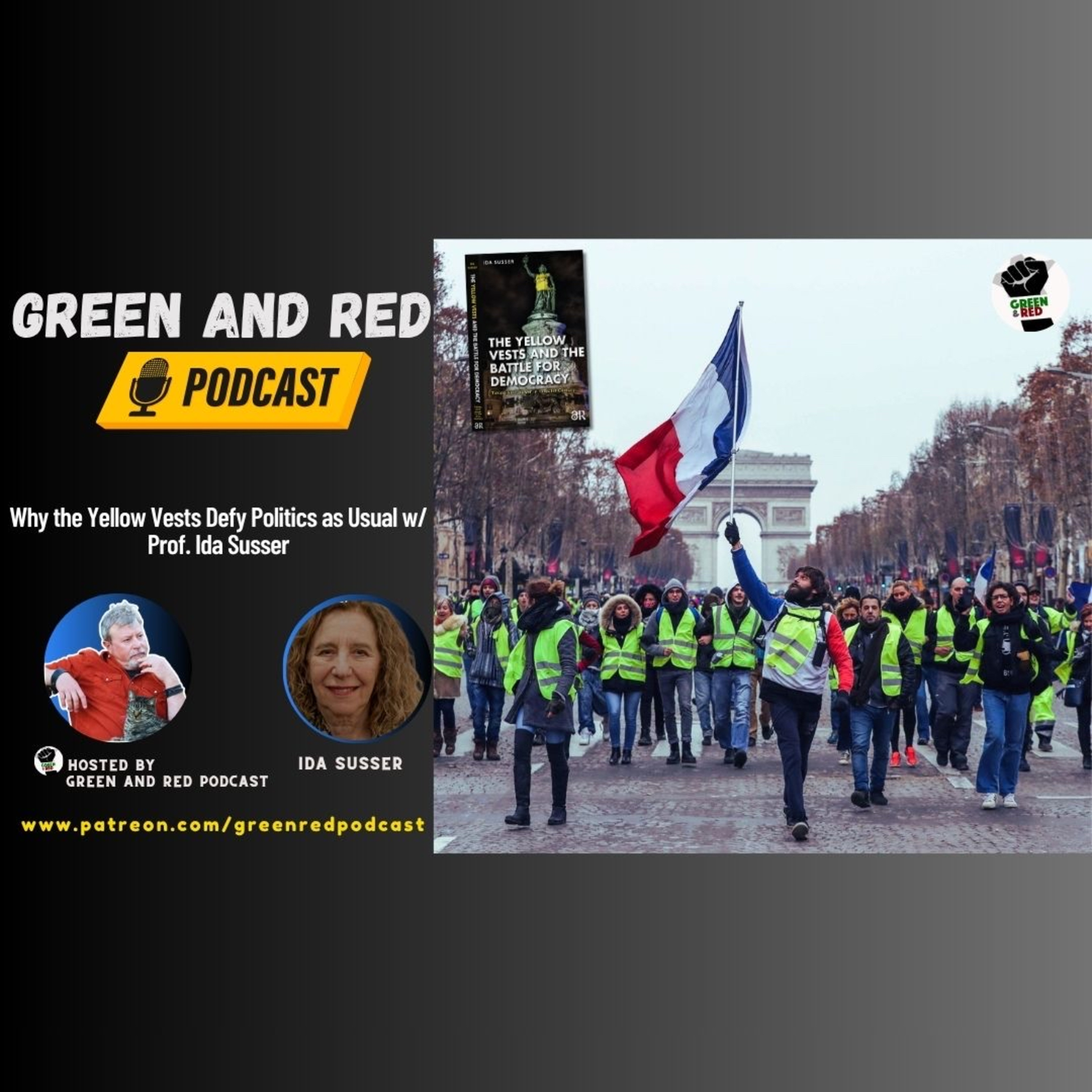
Green & Red: Podcasts for Scrappy Radicals
Why the Yellow Vests Defy Politics as Usual w/ Prof. Ida Susser (G&R 495)
00:57:57
Loading summary
Transcript87 lines
- [00:01]
A
Welcome to Green and Scrappy Politics for Scrappy People, a regular podcast on radical environmental and anti capitalist politics. Brought to you by Bob Bozanko and Scott Parkins.
- [00:14]
B
Welcome to the Green and Red Podcast. I am your co host, Scott Parkin in Berkeley, California. Bob is out today, but I am excited to be joined by Professor Ida Susser, who is a distinguished professor of anthropology at Hunter College in the Graduate center at City University of New York. And Professor Susser has published on popular mobilization, social movements, the urban commons in the U.S. europe, southern Africa. She's the author of a number of books, but most recently the author of the Yellow Vests and the Battle for Democracy, which you can also get. It's open access and so you can get a free download of it. But Professor Susser, welcome to the Green and Red podcast.
- [01:00]
A
Thank you very much. I'm happy to be here.
- [01:03]
B
And so we're going to be talking about the Yellow Vest movement, which is a French worker movement, social movement, which really kicked off in the late teens, late 2000 teens, and according to your book, and then also just knowing about the Yellow Vest, it was initially motivated by rising crude prices and fuel prices, which sounds strangely familiar to what we're dealing with today. High cost of living, which we could also say is affordability, economic inequality. But just to kind of kick off how can you give us a little bit of like, where did the Yellow Vest start? They didn't actually start in Paris. Right. They started in other places and eventually converged on Paris.
- [01:40]
A
Yeah. So in 2018, President Macron in France, he leveled a new tax, which was what they call a diesel tax. And the problem with a diesel tax is not so much, I think, in this country, but in Europe, all the other gases, first of all, gas is much more expensive than here. And then regular gas was heavily taxed. But the diesel tax, diesel gas was not taxed. And so people bought very small cars, very cheap cars, much smaller than here. And they were using diesel gas because that was the only gas that wasn't taxed. So they felt that they were steered as working class people into diesel tax, diesel gas. And then suddenly Macron put a tax on this and it was their last straw. It wasn't that other things weren't also a problem, like food for the end of the week, food for their kids, rent, but suddenly to put a tax on diesel, which they had all chosen because it didn't have a tax and you had to drive. The buses had been reduced, transportation, the trains had been canceled. There's all sorts of old Rail lines in rural areas of France. They used to take people from the coast to the king's palace. All of that is shut down. And so you want to buy some bread, you have to drive 10 miles. The post office is almost not in every village. So it's. And then they got the diesel tax. So people were outraged. They send around emails, nobody listened. They started over a few months to put yellow vests on their windscreen. The truck drivers would put it there. Yellow vests are the kind of construction vests that every French person who has a car is legally required to. So they were there. I should have had a yellow Vesta show on the video. But anyway, they put them on their windscreen, especially the truckers, and they would wave to each other. I'm in agreement. This is terrible, the diesel tax. And then they started to meet at traffic circles. This is June, July, August. And they would meet there. And then they started to discuss these problems. And actually at the traffic circles, eventually they started to build cabins because they had nowhere to meet in the villages. They were basically without a community center anymore. The cafes had shut down. I lived in a village with no cafe. They had a little school for three and four year olds. And then you had to bus your children out. Not even a shop. You couldn't buy bread. So this is how it went. And they met together in the rural areas and nobody heard of them. It was completely off the radar, no news, nothing. Then they decided.
- [04:43]
B
How widespread was it?
- [04:44]
A
Well, it was throughout France. There's a map that shows them 400, 500 traffic circles throughout France, Brittany, the south of France, the various industrial areas everywhere. And Bordeaux, everywhere. The mountains. And the people came down from the mountains, for example, clinics were being closed for a long time. There'd been this reduction in services. So if a woman was pregnant, she might have to drive an hour to have that baby. And that was not only diesel tax, but time and danger. Little windy roads. So there was a tremendous upset about this. And as they met at the traffic circles, they started to realize they had so much more in common. They were so upset about so many things. And by the time they said, all right, we're going to Paris, nobody has listened to us. So they decided to go into the center of Paris on Saturday, November 18th. No, November 17th, 2018. Wow. It was amazing. 300,000 people went into the central. Nobody had ever seen anything like was terrifying. People in Paris were frightened. There's mostly middle class people in the center of Paris because of the gentrification. The newspapers talked about these Ignorant. The Guardian wrote an article. I'm looking out my window, looking towards the Arc de Triomphe. And these people, they're so ignorant, they don't know why they're protesting. This was in the Guardian, which is sort of liberal newspaper, and throughout Paris, middle class people were frightened and they weren't sure what it was. And the yellow vest finally got attention and it burst into international news. And they came every single Saturday, up and down, more people, less people, right up until the COVID shutdown in March 2020. And they counted it what Act 1 was November 17. Act 2 was the next Saturday, all the way through Act 70, Act 71, all the way till March 2020. They came into Paris and they had these wild marches. Meanwhile they also were in Toulouse, Bordeaux, Marseille, in the central cities as well. They didn't all come to Paris all the time.
- [07:07]
B
And did they see with, especially with the diesel tax that they were. This was being dictated to them by this sort of Paris elite, liberal elite. And there's also, there's an element, I remember at the time and looking at the book, it seems like it changed a little bit. But part of this was in response to the climate crisis and how governments are responding to emissions and things like that. And so there's an anti climate element, at least in the beginning.
- [07:34]
A
Correct? You are so right.
- [07:35]
B
At least it was or perceived as that anyway.
- [07:37]
A
You are so right. So Macron said, the President said they must be anti ecological. This is an ecological tax. And all these people are ignorant, provincial people who don't. It was very derogatory, who don't understand climate change. But the yellow vets were very mixed. And when they actually, it was analyzed, only one quarter of this tax was going to anything you might imagine was ecological. They found out later on. But Macron labeled them as ignorant and anti environmental and they were very upset. For example, there was one guy who had to drive from his house to the railroad station to take the train in to work. And he was a very enthusiastic environmentalist. And he said, but what can I do? And so they were. The Yellow Vests themselves were really angry that they got labeled as anti environmentalists. And by a few, after a few months, they joined the environmental marches to demonstrate that they were not anti environmental and that they were being labeled in derogatory ways. They were also labeled as antisemitic. They were also labeled in many ways as racist and fascist and all kinds of things, because they were people who came from the provinces who really didn't have an ideology, who had never Demonstrated before. Many of them had never been to Paris. And they were working class people, they were truckers, they were nurses, they were teachers, they were secretaries, they were unemployed, they were grandmothers, a lot of them were grandmothers. So they were just people. Everyday people coming from the provinces and also what we called the urban periphery would be like here, it would be like Newark, the edges of the city, but from Paris too. So that would be like the edges of Chicago, like that be Walnut Creek
- [09:40]
B
here in the Bay Area.
- [09:41]
A
Oh yeah, good. All right. And because they couldn't afford, because of the gentrification of the inner cities, Paris, France and Toulouse and Bordeaux, they especially. I know about Toulouse and Paris. The government of the mayor had spent huge sums of money to fix up those old buildings with beautiful 17th century stonework, beautiful stuff. But of course it had become very expensive. And working class people, even the guys that worked on those buildings had, they called artisans, very knowledgeable, had been pushed out to the urban peripheries because they couldn't afford the rent. So most of these people and many artisans and construction workers were in the urban displacement areas and drove in from seven or eight hours into Paris, slept on people's floors to join these demonstrations.
- [10:38]
B
One question I have, just because you mentioned about how they were called racists and fascists, it also sounds like a very much a horizontal sort of movement and phenomenon that was happening here. I also this real quick on the environmental piece. This is also the same period where we see extinction rebellion, like 2018, 2019 emerge, at least in the UK and then spread to other parts of the world. But on the racist fascist front, like where did. Was there anywhere they landed around the issues around immigration? I know immigration is like a hot button issue in many parts of Europe, including in France.
- [11:12]
A
So first I want to say they loved extinction rebellion. When extinction rebellion came to Paris, the yellow messages went to town. They joined it. Because extinction rebellion is one of those wild things. And it worked very well. But it was a little bit later. It was later in 2019, I think
- [11:29]
B
all the extinction rebellion people I know wear yellow vests, at least in the U.S. oh, yes.
- [11:33]
A
I didn't know that. Yeah, that was a later movement. Because when they came to Paris, maybe that's when they started wearing yellow vests. Anyway, it was in 290 and they were. Everyone joined together. It was really well welcomed. But in terms of. I think that you would find if you went around and talked to the different Yellowstone, you would certainly find people who are upset about immigration, no question about it, or people who are upset about being pushed out of the cities, or people who maybe had sexist ideas that women shouldn't leave, whatever. There were many ideas that people had individually. But the way I describe it is there was no, like, it was a grassroots movement that joined together and there was no political demagogue who took up the whisper like Trump and used those issues or like Nigel Farage in England.
- [12:31]
B
Le Pen tried though, right?
- [12:33]
A
Oh, Le Pen adopted them as soon as they showed up, but they did not adopt Le Pen. Le Pen being the fascist legacy movement in France and she loved, she adopted them right away. But they said, we don't want any political parties. And then a few weeks later, the left, the militant activists and the party of Melanchon also adopted them. And they said, we don't want your political parties either. We are horizontalists. We are not going to follow a populist leader. And I think that's a huge distinction between the anger that you see in the US and the anger that you see in France or even in maybe other parts of Europe, that these groups were very much generated in the suburbs, around these traffic circles. They built these wooden cabins. They were construction workers. They could get all the materials for all the things to build a cabin. They knew what to do and they could connect up the electricity, they could bring in heat. I can't tell you, it's the middle of winter and they were there. So they met there every night and they talked to each other. So they were generating a sort of anger about many things beyond. By the time they came to Paris, it wasn't just the diesel tax. Yes, Macron took back the diesel tax immediately, within a week or two. And it didn't help at all because by then they told me, by that time, by the time I came to Paris, I was already anti capitalist. People had never even heard of what that word means.
- [14:10]
B
It's interesting thinking about horizontalism. No leaders, leaderless movement, anti capitalism. It strikes me as very anarchist influenced or anti authoritarian influenced, which is definitely an ideology and movement associated with the left. But they're not necessarily left populist or right populist or anything like that, Right?
- [14:33]
A
Not when they started out. When they started out, they were just the kind of process of rage, of discussing with each other. So the things that they were angry about, which wasn't only affordability, like we talk about in this country, it was really what they called the stealing of the state. They loved their universal benefits. The French fought for those things since the Paris Commune. It was in the vision of the Paris Commune. And then after World War II, it was what they won. When they came back after, in 1944, 1945, when the resistance came out of the woodwork, the things they were calling for was the welfare state. And they won it and they got it. And so it's very. The French have a great kind of personal investment and understanding of the state as their universal entitlement. Not like here. You'll never hear people talking about the swamp or something like that. It's not like what you can trade on in the US in an individualistic way, because in France, there is a kind of, you could use it, you could turn it into nationalism, patriotism, whatever. But the way it's created, and I think in Britain, too, it's a sense of, we all built this, we fought for this, we've imagined it, we dreamed of it, and we are going to defend all the universal entitlements, our pension, our labor laws, our hospitals. The English are very that way about their national health system.
- [16:18]
B
And Americans can maybe sometimes be that way about Social Security, right?
- [16:24]
A
Yes. But they don't have it. Like they would let. The way that Trump could use Obamacare as a bad word, as a dirty word, this is. You couldn't do that in Britain or France.
- [16:36]
B
One question I have is, in, like 2019 and 2020, there was a pension reform strike in France. I remember that also in the news. But I'd be curious to hear how the yellow vest interacted with that.
- [16:49]
A
Wow, that's so interesting. So the yellow vest came out in 2018. By 9-2-19, Macron, who had been elected to. Because the French welfare state was very strong and people supported it. And he had basically been funded by the banks from when he was first in power to. He had no party, he was just an individual. And he was funded to undo the welfare state. That was really to break the back of the French collective universal entitlements. That was it. And the first thing he did was break the back of the labor laws, which were for that you had the right to stay at your job. It was hard to fire you. You had a certain number of hours and then you had to get overtime, those kind of vacation times. Macron led the battle against that, and they couldn't get that through. And the socialists pushed it through. Macron was in the socialist government and they pushed it through. So the Socialists were hated. The next election, they got 2% of the vote where they had been in government, and that's how Macron won. So there he is. He's won because he destroyed the labor laws and now he's going to destroy the pension entitlements, which was age 62. So first in 219, he tried to take the pension rights away from the unions. In France, all your pensions come from your union affiliation. The union organized the pension control and fight for. So he said, no, the unions can't do this anymore. We're going to have a national pension system with points about the number of years you've worked and the amount you earned. People were livid. They were outraged. They were huge demonstration. But what I argue is this was started in September 2019. The people in those demonstrations, many of them were yellow vests. I think the reason the unions came out with such power and such for so long and the demonstrations were so vital. I could show you photos. They were incredible. Those demonstrations were full of Yellowstone. They were there, they were chanting their songs, they were wearing their vests. They were giving strength and power to the union demonstration. So it's not like in this country where the idea of Magyar is opposed to union. It was like they joined with the unions and the yellow vests. They didn't want to be taken over by the unions, but they were very strong supporters of the union battles and the union struggle. And Macron did not manage to change in his first term. He had to give up on the pension change. And then he was reelected. And I forget, but in the middle of COVID and then a few years later, he started again. And this time he says, okay, unions can have the pensions, but you've got to start it two years later instead of getting your pension from the government when you're 62, we're not going to give you any money till you're 64. The yellow vests, everybody else was like. It was part of the most terrible kind of cutback. And they saw it just the way they saw the state stealing the state. They saw this as stealing their own two years of luck. That's how people felt. They said, I paid all my life. I never objected. They have very high taxes, but it gives them healthcare, education, transport, all the rest.
- [20:29]
B
Pension fund, yeah, pension.
- [20:31]
A
And I've been paying all my life. And you are going to take two years of my life away from me. And every union, we have right wing unions in France, every union from the right to the left, the entire spectrum came out against this. And the whole of France, it was like 90%, 80, 90% all opposed it. He couldn't even get people on his own side to vote for it. Macron, in The national assembly. And eventually, because this is what he was corporately funded to do, and that was his job. And he never. He can't run again anyway. He just put it through without a vote. He just, whatever forced it through. And there's a way to do that without a vote. And this is why he's practically hated universally without. He couldn't even get people to run for him in the municipal elections. We just had. This is why he doesn't have any support in France anymore.
- [21:29]
B
I travel to France actually pretty regularly. I have some family who lived there for part of the year. And it's actually pretty. It's. It's pretty amazing to me. It's very much my. My impression is that there's. It's very. It has this really huge, impressive safety net and many people are like, live in that. And then we have these politicians in the US I feel like you can get away. You can get away with that a lot more because we have this media ecosystem and many other things which grinds down the idea of safety net or, oh my gosh, socialism, although it's made a little bit of a comeback. But in France, it seems like everyone is just really bought into the way the system works. And it's just amazing to me that he's tried to shift this to change this. Even Le Pen doesn't advocate this stuff, right? The right doesn't.
- [22:18]
A
Look what Le Pen advocates tries to gin up support. She's one of these demagogues, so she would be like Trump. She hates immigrants and she wants to set up. There's many people who were born in France whose families came from Algeria, Tunisia, Morocco, but they were born in France, second generation, and she wants to deprive them of the benefits. So her platform is to. What she calls immigrants is people who born in France that she's taking away their right to the United States.
- [22:52]
B
We call birthright citizens in the U.S. right?
- [22:55]
A
Yeah, she's a Trumpite. She was there before him with that stuff.
- [23:00]
B
You write in the book that the Yellow vests write the years of each of France's Revolution. 1789-1830-1848-1871, 1968. Why do they do that? How do they see themselves in the tradition of these revolutions, particularly 1968, which I see is very much like a left revolution. How do they see themselves in that tradition?
- [23:23]
A
When I think the yellow vests first arrived in November 218, they had nothing written. When they first arrived, they had nothing written on their backs. But over time, they met and they learned and they changed and the left joined them. Many left activists joined them, including Melanchon militants, but not all the left, but many socialists joined them. Actors, professors, they all understood that the welfare state, which as you say, is part of their, they regard it as their inheritance, their legacy, their lives. And they don't earn a lot, you wouldn't believe. French people live on less than 2,000amonth. But they don't have to pay for their healthcare, they don't pay for their education, everything. Their children can get stuff, and so they don't have to earn their pension. So they're not so worried about the future as you or I might be if we didn't have enough to pay for our health insurance. So it's there. So they see these demonstrations, starting with 1789. They go 1789, and then it's the next one is 1830. 1830 they got rid of one of their kings. 1848, they got rid of the kings altogether. 1871 was the Paris Commune, when they got rid of Napoleon and the Third Republic. So in the, I use the Paris Commune as a really important moment. Not that I believe in that level of violence, but, but because Louise Michel, she said this is, from now on, we will have a vision of the social, the social. Children will have daycare, everyone can go to school. They hope that women would have the vote. They had this dream already of all the things that the welfare state that we fought for over the next hundred years, both in the United States and, and in Britain and in other parts of Europe. So people fought for this vision and the vision was first expressed in the Paris Commune. So that's why they have 1871 and then you say 1968, because that's when not only the students came out like they did here in the US, but the unions. To the French, 1968 was a combination for six weeks of the unions coming out with. They threw the same cobblestones that they had thrown in the French Revolution and the same barricades from the Paris Commune. But that was the students. But the unions came out, they shut down the oil companies, they shut down everything for six weeks. And after that they got the 35 hour work week and they got a lot of other benefits. So it was a union work week, student demonstration, which didn't happen anywhere else in the world, as far as I know, in 68.
- [26:28]
B
And I, I, I'll ask, I'll ask about one other sort of activist mobilization moment. And then I want to kind of talk about common aim and how that relates to all of this. But you write about my. I may butcher this with my French, but Nuet Dubois, which is the sort of. Which is the sort of Occupy phenomena. It was 2011, right?
- [26:50]
A
And no, it was 2016. But it was occupied. It thought itself was occupied.
- [26:55]
B
It means standing night, right?
- [26:57]
A
Standing all night.
- [26:58]
B
Standing all night. And how. So that's two years before the Yellow Vest emerged. Is there a connection between Nuit Debo and louisvest?
- [27:07]
A
The thing I was already trying to understand social movements. I was there at Nuit. And the thing that was so interesting to me is they definitely were like an Occupy movement. If you imagine young people, you imagine students, people who are clearly progressive. There was nothing you didn't wonder when the Nuitzboo formed, was this a progressive movement? You knew exactly what it was. It wasn't like when the Yellow Verse came and people were completely dumbfounded. Everyone recognized Nuit Dubois. It was all over France, wasn't just in Paris, but the biggest one was in Paris and it began Plaza of the Republic Plus. Yeah, exactly, exactly. And they stayed there every evening for seven months. And they were so happy. And they had the idea of the Commune and they said, we beat the Commune. You were here longer, but they were young and they were students. And so I see them as different fragments of groups that definitely what they were against, what they were fighting with the unions also was the destruction of the labor laws, the breaking of the labor laws that I mentioned. That's what Nui Dibu was about. And there were a number of transit strikes, airline strikes. I got stuck in London Airport because of that. Lots of strikes about this same question of the labor laws, which was what Nui Dabout was about. So already. And they hated Macron because he had brought that problem up. So I do see it as related, but I believe that it's like a cascade of social movements, because no debauch was very definitely what I would call one fragment, or if you use Gramshire in terms a subaltern group, one group that was really important. But then. And they were mostly the ones I met in Paris. They were from the urban. They were from the. They call it Ile de France, the suburbs of Paris and the center of Paris. And they came to the Plaza in the center of Paris. They were in other parts of France, but the big one was in the center of Paris and they were Parisian. So that's one important. And they were educated. Many of them were very unemployed. But they were young people who felt that the change in the labor laws would. They were losing Their futures. That's what they said. Losing their futures because of the change in the labor laws. They wouldn't have the security that their parents had. So that's what they were upset about. And all right, that's one group, the Yellow Vests came from the provinces into Paris. So in a way they're a very different group. They were old people, they had white hair, they were grandparents and they were not as educated at all. And some were unemployed, but many of them had jobs, many of them were working. So they were recognized by Marxists and all those left people as the genuine working class. Whereas the students were seen as, oh, we know, those kind of demonstrators. They don't even count because they're not going to stay that way. They're just young. They get dismissed. Of course, I don't dismiss them. And I talk about them as part, as a fragment of building an oppositional block. And the way I describe it in the book is you get there are many different groups that come into this in the Yellow Vest were bringing in a whole different group from the provinces.
- [30:37]
B
So you talk a lot about. There's two terms, commoning and thresholding. Maybe let's start with commoning a little bit because I feel like it's a thread that runs through French history, the history of many countries, social movements. But maybe actually just talk about that a little bit to begin with and how it applies to the Yellow Vests.
- [30:58]
A
We can start with the Commons. To me, the Commons is a very well known concept, but we don't maybe think of what the example I give. Because I grew up in England, I give the example of the English footpath movement.
- [31:12]
B
The Ramblers went.
- [31:13]
A
The Ramblers Kinderland, Mass. And the song the Rambler I'm around. I grew up in Manchester. They taught me that song when I was six years old.
- [31:21]
B
And I know it's by someone else, but I've always heard the Billy Bragg version.
- [31:24]
A
Oh, okay. I think it was. I don't even remember I put it in the book, but I can't remember. Yeah, but I'm a rambler I'm a rambler from Manchester way Get all my pleasure on hiking way Anyway, I may be a way slave on Monday But I'm a free man on Sunday So they marched in the 1930s to keep the footpaths open that went through farmers fields. It was not against private property. It was saying there's something between public and private. We have a right to walk across these farms. We have a right to walk across the moors. And it was Huge movement in Britain and they won the right footpath. And in this country you have that song by Woody Guthrie, this land is your land. It has the same concept. And he says, and I saw the sign and it said no trespassing. But on the other side, it didn't say nothing. So I went on my way, which
- [32:22]
B
they edited out for propaganda reasons in the 40s.
- [32:24]
A
Oh, really?
- [32:25]
B
Yeah.
- [32:27]
A
So there you are. So this issue of we have the right to walk, we have the right to be there, we don't own the property. We're not saying it's public property, those farmers still own their land, but we have the right to cross. And that's what commoning is. And the only way, the way, the argument that people make and I make is that the only way to keep your rights, your commoning rights, your rights of the Commons, is by using them. So if you don't use them, you lose them. It's the only way. And the way that you understand karmony, or I understand karmony, is much broader than just footpaths, but keep that in your head. But it's the idea of clean air, clean water, access to the city. And one of the things that I think is so crucial is when you think about harming and you think about racism in New York, and I wrote about this in another era, but that there's these borders which are policed, so if a black man walks over that border, he might get shot. So that's where you get Black Lives Matter running through the streets in New York. We have the right to these streets. That's a commoning, that's asserting a right, which if you don't assert it, you're going to lose it. And I see all of these movements in their own ways, like the extinction, rebellion or many other environmental movements. If you don't fight for your clean air and your clean water and your access to water, it's going to go. Democracy is a struggle. You don't fight for your vote, it's going to go, look what just happened with the Voting Rights Act. So that's not news. Yeah, John Lewis knew it. Good trouble, whatever. This is what commoning is about. And it's had all different kind of descriptions, but the opposite to commoning is something called enclosures. It's like when they take it away from you and they make capital from it and they get rich on it and it goes back to Britain again, to shutting people off their land and you that all the time with our cities, the privatization of our streets and the privatization of our squares. That's why Occupy Wall street, you know, that was private land that they occupy Wall Street.
- [34:51]
B
They park. Yeah, yeah.
- [34:52]
A
But the demand, what I wrote in another version of my life was that working class people used to build their social movements in neighborhoods and they fought for their block and they had block associations and they shared babysitting in the block and they shared food. And now when it came to Occupy Wall street, they'd already lost that. They'd been displaced from their Brooklyn neighborhoods. They were pushed out, working class people. So then they had to meet in the center, in Zucchati Square, because they had lost their common spaces in the working class neighborhoods of Brooklyn and New York City. So people adapt, and movements have to adapt to the ravages of capitalism in different ways in different moments. So we might have had industrial movements and we loved it. You mentioned unions. I love unions. But after the destruction of industry in this country and the rust belt, creation of the rust belt, what was there for people to do? They could no longer join their unions. And a lot of them felt they had been betrayed by their unions also, but they couldn't join unions, so what could they do? And that's where I see commoning and occupying building, occupying squares, blocking streets, and in France, taking over the toll booths and things like that, Making it.
- [36:18]
B
And those traffic circles.
- [36:20]
A
Yeah, all of that. I see that as adjusting to the displacement and the deindustrialization, where, yes, they may have jobs, but they don't have the jobs they used to have or the security they used to have, or the social centers they used to have. So they have to invent new ways of getting together and discussing and working out where they stand and how they can stand together to get changed towards social justice.
- [36:50]
B
And what is thresholding, which you also talk about, and how does that fit into this?
- [36:55]
A
These are such clumsy words. But I didn't have any others. I thought about it, but like thresholding, to me, imagine your lobby, your front door, your portal. So the threshold is your front door. So it's two different movements, say Black Lives Matter and yellowness coming to. They don't come together, they don't converge, but they come onto each other's front doors. They meet each other within a lobby or at their threshold, and they begin to see each other in human form. They begin to trust each other. They see what the other movement is doing. They begin slowly to understand where that other movement is coming from. And I saw this in France. The examples I give is the environmental movement and the yellow vest, which we Talked about. But also because the yellow vests were never accepted by Macron as real demonstrators. There's a lot of rights in France if and you're recognized. They can't do a lot of things. But they were never recognized as real demonstrators. They ran through the streets, they did wild marches that were not legal through the street. So they were shot at with these LBDs and they lost their hands and they lost their eyes and they lost their feet. They were famous. Yellows were losing their eyes and stuff. Hundreds. So they started to form movements of the mutilaise, Les mutilates, the mutilated. And then after a year of this, of feeling this incredible barrage of police brutality, they joined in the Black Lives matter demonstrations in 2020 against police brutality. They understood it. They never said, we're with Blake, but they went to those demonstrations against police brutality. That's what I call thresholding. It's like you each come to your front door or you each come to your pathway and you recognize what the others are doing. And because you've seen them and you've worked with them and you trust them, you begin to generate a kind of common vision. It's not all together. There's many things you don't agree on. You don't plan your marches together, but you recognize each other. So that's what I call thresholding.
- [39:19]
B
And do you see that happening within us social movements, at least in this sort of present moment?
- [39:26]
A
Oh, we are so divided. But yes, I do. I thought when everybody was there was the Tesla movement, which I thought, there's no kings, they're also fragments. They did shut and they got. It was so goddamn effective. I went once or twice to the Tesla demonstration, but certainly not very often. But the fact that Elon Musk got out of here just says no more.
- [39:47]
B
They ran him out of the White House, although he's on the road with Trump right now.
- [39:51]
A
But yeah, but not in the way that he was doge and all. They got rid of him because he was afraid about the value of his cars. And then when you saw in Minneapolis the same thing when the activists joined with the to defend migrants being absconded and kidnapped and taken. When that happened all over Minneapolis, I think many and it had happened in Los Angeles in a different way and in Chicago. That whole process has now been he had to find somebody else and then somebody else left. They do all kinds of face saving things, but basically those movements against the taking of migrants, they were stopped. And yeah, they shot two, they killed two militants in Minneapolis. I think that really shocked America. But I think that the activism came also spread all over the country. What you saw in California when they had the referendum about whether we should gerrymander or not, very many different fragments coming out, and they're not the same people. That's what I'm talking about.
- [41:04]
B
One thing I always like to point out is that Renee Goode and Alex Preddy were actually both fairly new to activism when they were out participating in the protests and the patrols and the documenting of ice. I think that's an important piece too, is that these mobilizations are so powerful and bringing people in to the point where it's more and more new people are getting out and taking great risks, sadly, to Renee and Alex's detriment, to cost their lives. But it's an important. And I think we're just gonna be seeing more and more of that. I feel like we saw that in 2024 a lot around the Gaza encampments, on campuses, too.
- [41:50]
A
The Gaza ones was more like nui da boo. It was very much the universities and educated people who understood what was happening. And I think we need a broader movement, and we're getting it. You know, I think the Gaza movement, in a way, added energy to the defense of immigrants because they started by the government, started by taking the students from Columbia and stuff like that. And then it was easy to understand for the people who were demonstrating that they also had to defend immigrants in general. And it was an easy crossover. That's the kind of thresholding.
- [42:24]
B
And I'll also actually, speaking of thresholding, I actually would say that the Gaza movement actually got energy from Black Lives Matter. I remember in 2019, 21 or 2022, when the Israelis were attacking this neighborhood in Jerusalem called Sheikh Sharah, is that we saw big demonstrations in the US and it was mostly led by Black Lives Matter movement leaders, organizers, which fueled that movement. It was before 2023.
- [42:48]
A
But still, I feel that the problem in this country is that we're still very divided. Certainly in France there are many divisions. But I think in this country, the recognition that there are certain that this is what I really think. I think that if we don't get it together in the next year or so, if there's some kind of progressive, unified vision is not generated to keep our discourse free and to keep ourselves able to be critical and not get put in jail to keep our democracy, that we need some kind of not convergence, but thresholding among these different groups in defense of our democratic rights so that you can fight for all these different kinds of reasons.
- [43:45]
B
One thing I actually baked a whole bunch of questions around this is in 2019, we see a lot of waves of social movement activity, protests challenging the state all over the world. Hong Kong, Chile, Colombia, Lebanon, places like that. And would do you. And from what you've seen, do you think we're seeing more thresholding in those countries versus what we see in the US where we're very siloed or even some. I would say France is less siloed, but maybe more siloed than some of those other places in the cold South.
- [44:16]
A
I'm not. I could talk for South Africa. I know that there were the Umbrella movement from Hong Kong. Many people were in Paris as well, because there's a lot of connection of chines in Paris. So many. I met people who had joined the Yellow Verse who came out of the Umbrella Movement, and I talked to them. But we've seen what happened in Hong Kong. And then you see Myanma. I'm not. I wouldn't feel comfortable discussing that. What I'm afraid of and why I say that we only have a limited amount of time because places like Myanmar, you can't object anymore. Like the faculty had to go out and build armies. I hope that we will win, that these midterm elections will allow some kind of freedom for people to fight for their rights. And that's why I see them as absolutely critical. And I'm not sure that there are so many movements in this country where people don't really believe that they should be fighting to maintain just our common democratic rights. They think that's not enough. And it isn't enough. It isn't enough in France. What do we do with the inequality? What do we do with the imperial battles? Is Trump going to cause a nuclear war in the Middle East? I don't know. But if you haven't got your rights to debate, your rights to demand your rights to organize, all of those things go down the drain. And to me, we have an opening now and hopefully it's getting more fingers crossed that in the next year or so we can preserve that aspect of our civil society. That's what I'm concerned about. And so that we can work for transgender rights, for women to have the right to abortion, for against imperial wars, for the rights of Palestinians. But if you. If we lose those central commoning rights, if we get shut down to that extent where we're afraid to walk the streets with a banner, all of those other rights will be lost. And that's why I see it as this idea of commoning and thresholding as and which allows for a. In France, they developed a new. In 2024, they developed a new Popular Front which included the Greens, the Socialists, the Communists, and what they call diverse leftist groups, which is just about anybody who wants to be in it. And they all joined and they voted. And in my neighborhood, which I was studying St. Denis, they elected a black African leader out of in the leftist party called La France and Somis. He was the first black mayor in that area. And he was elected by such a majority that they didn't even have to go into a second round. And it was international news. I don't know if everybody saw it, but it was international news. And that was La France and Cemese. That was really in relation to all those different movements and a new Popular Front. And I was there. The celebrations were incredible. The songs, the music. It was quite something.
- [47:41]
B
I have a couple of questions left.
- [47:44]
A
1.
- [47:45]
B
And you may not have read this book I'm about to ask about, so we can also cut this section, but there's a book by an author named Rachel Kushner who wrote a novel called Creation Lake.
- [47:54]
A
Oh, I do so well. I love Rachel Kushner. Tell me more books to read.
- [47:59]
B
And so it's. But it's about a corporate spy who infiltrates anarchist collective in rural France. So when I was reading your book, I thought about that novel and I was just. Was there any insight? Do you have any. Were there any insights you took from that novel? You also mentioned that you'd read a lot of novels for this work.
- [48:13]
A
I love novels. I think I read that maybe after. I don't remember when I read it. I recognized everything in that novel because I was young. I was a kid, a teenager in the time she was writing about. And she talks about up against the Wall Motherfuckers. I knew those guys. Knew those guys. And they. If you've ever heard of Herbert Marcuse, the Right Eros and Civilization, they were there in Columbia, the sons, the stepsons of Herbert Marcuse. And they were the ones organizing the up against the Wall motherfuckers on the Lower east side. And we met them all and they were like much older than me, but they were really. I don't know, it was very romantic to me. That's awesome. So I loved her book. But I think she comes in the book, this corporate spy, to respect and recognize this movement that is in the mountains and there are many groups like that in France. Many. And she talks about that came out the streams and the woods. She Isn't even sure who the leader is. It was an evocative book. Yes.
- [49:19]
B
And then my other question, speaking of books.
- [49:21]
A
And those guys joined the yellow myths. Absolutely they did.
- [49:24]
B
Yeah, totally. My other question, speaking of books, is that you've made this book open access, and I'm wondering if you could just talk about that, why you've done that and why that's important.
- [49:33]
A
Oh, that was so important to me. I have no research funds left, but let me tell you, I was got money from the government to do my research in Paris, in Barcelona and France to look at what leads to social change, what kind of movements lead to social change. And I wanted to compare it, and I wrote this up to compare it with movements in the United States which I'd been studying for 35 years. I really was given. I regard that as like, sacred. I was given government money. It's important. And I believe if you get that money, it's common and you must give it back. And it's in the thing. You have to. It's even in the. When you apply for the grant, you have to say, what I learn, I want to give back to the people that I learned from. So there's. I wrote some things on the web and this. And I thought I had some money left. And I said I didn't have it left. Like, now I have to go on my own money. But like for the last few years. But when I was putting the book together, I said to the press, I can use my grant money to get open access, to pay for open access. And I really want it to be open access. So the last portion of my grant money, while I still had it all went to pay open access. And that's because it's a book about the commons, and it should be a common, publicly available book. It should be available to the commons, and I desperately hope people read it. And I don't need the money from the academics. Professors, you never make any money, never make any money from the books you write. You spend a decade writing a book, and if you get a few hundred dollars, you're so proud, or maybe 3,000 or something like that. It's nothing like what you spent on it. So I don't care about that. But I desperately wanted to make this available to the people who might be able to understand it and work with it. And I'm trying to get it translated into French and publish that.
- [51:41]
B
I think it's a great book. And now I've been involved in. I've been a street organizer in my day job for 25 years. And I've been involved in social movements for a long time and I thought it was like a really useful read. I'm going to recommend it to my other organizer friends. And I think I heard this on a different interview or maybe you talked about in the book, but you're also doing some. A similar ethnographic work on in Spain, right? In like, Barcelona. And maybe we could just wrap with that question. Could you talk about that a little bit as much as you want to talk about?
- [52:11]
A
Oh, yeah. I worked when I first began, I was really concentrated. I said to the government, I was gonna compare global cities because we were all wondering, like, all the decisions are made up in the sky, like NAFTA and all the global decisions. And so what is happening on the ground in New York City, in Barcelona and in Paris for the local people, for the grassroots movement? What kind of power do they have? How do they change society? Because they're so trapped by the global decision making and they're so removed and they've had so many. And debt, bankruptcy was so crucial with 2011. And so I was very concerned with that. So I started in Barcelona because they had the best social movement. They had just won. Perdemas had just won the European elections, and they were the first left. Well, Syriza, which was another leftist movement, had won in 2015 in Greece. But yeah, this was 2014, 2015, and Podemus won. And I thought, my God, they won the European elections. And they also. I went to Barcelona like that, and they also won the local municipal elections. They were connected the municipal elections with Ada Colau and Barcelona and Camus were joined with Podemus and they all worked together. And it was the same in Madrid. They had a party that was the party of Madrid, the municipal elections, and they joined with Podemus and all over Spain they had real successes. They didn't win the government, but they had real success. And that was what.
- [53:50]
B
And it started out of the Indignados, who were like a square occupying movement.
- [53:55]
A
Totally. I interviewed Negrit. Antonio Negri is part of this work. And he said that the most impressive thing he ever saw in his life, the thing that excited him the most was 2011 in Madrid, the takeover of the Plaza del Sol. He just. And he showed me a photo of it when I went to his home, he showed me this photo and he said that's what led me to Wright assembly, him. And. And so I understood how important that was. And that was where, for example, Pablo Iglesias and All the other guys met. They were all in university, professors and students, and they met in the Plaza Del Sol in 2011 and they joined together to form Perdemas, which means I can, which comes from Obama. Of course we can. And so they joined Perdamus. They created it as an anti capitalist movement running for a party in 2011 in that setting of hundreds of thousands of people taking over the squares of Spain, which changed the politics of Spain even till today. And Spain has a long history of anarchism and commoning. So that's why I began in Spain. But then I was doing this comparison and eventually with the Yellow Vests when they came in 2000, I started in 2014, but when the yellow vest came in 2018, they were such an enigma. Are they right or left? What are they? The mystery was so important that I decided to postpone the Barcelona book and concentrate on France. But I'm going back now. I've already gone back to Barcelona.
- [55:45]
B
So now you're working on the Barcelona book? Back on the Barcelona book, yes.
- [55:50]
A
It's called Barcelona and the Commons, I think. I don't know, but something like that.
- [55:55]
B
I'm going to wrap it there. Do you want to tell folks where they can find the book in the open access?
- [56:00]
A
Yes. You just go, you can go to rutledge.com, you go there, it says download. You can go to Amazon, put the title of the book or my name in Amazon. And right there there's a place that says download. Wherever you find the book for sale, there's online, there's also a download, free download. And that's the most important thing I want you to tell all your friends. I went, I talked in an anarchist bookshop in East London. I talked in, I went, there's an anarchist bookstore in Barcelona, et cetera. I want people to know that this is a free Dhamma. Remember Abbie Hoffman? Steal this book. You don't have to steal my book, you just download it.
- [56:43]
B
Excellent, folks. The book is the Yellow the Battle for Democracy. Professor Susser, it's been great talking with you. Have to have you on again soon when your Barcelona book's done. I'd love to hear about that.
- [56:54]
A
It takes a while.
- [56:55]
B
Takes a while, folks. If you'd like what you're hearing, please check us out on Facebook, Instagram, Twitter and Bluesky. If you're watching this on YouTube, hit the subscribe button. If you're watching, listening to us on an audio platform, give us a rate and review. And if you really like us, go to greenredpodcast.org and hit the support button or become a patron@patreon.com greenred podcast everyone out there, make trouble and misbehave and we'll talk to you again soon. And Professor Susser, thanks again for joining me today.
- [57:20]
A
Thank you so much for inviting me. It's great. Sam.