← GrowLeader Podcast with Chris Hodges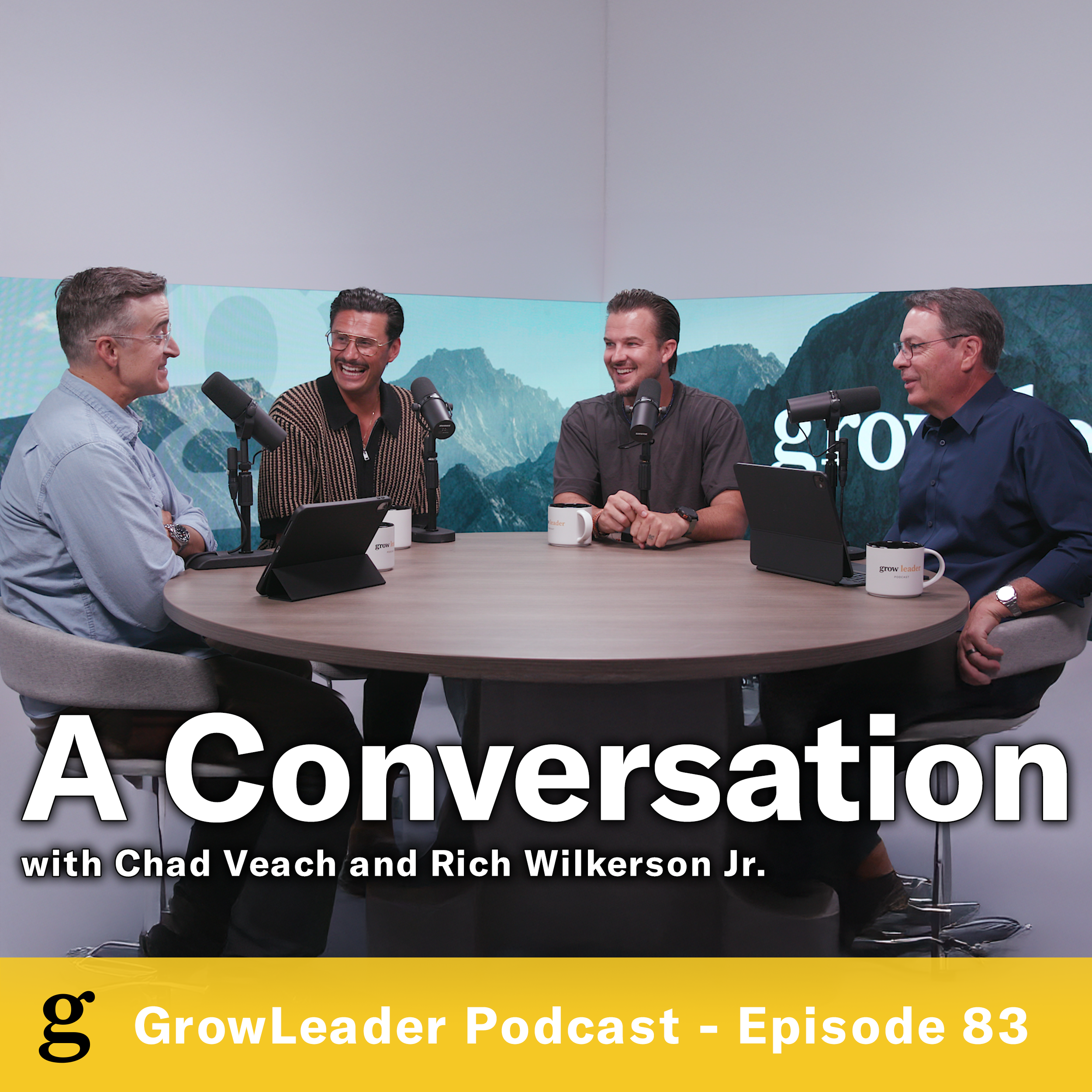
GrowLeader Podcast with Chris Hodges
83 | A Conversation with Chad Veach and Rich Wilkerson Jr - Chris Hodges | Part 2
00:32:10
In part two of this powerful conversation, Pastor Chris Hodges is joined again by Pastors Rich Wilkerson Jr. (VOUS Church, Miami) and Chad Veach (ZOE Church, Los Angeles) to talk about leadership, ministry, and the challenges pastors face today. From...
Loading summary
Transcript158 lines
- [00:01]
A
Hey everybody, and welcome to the Grow Leader Podcast, where we grow leaders that grow churches by helping them reach their full potential. My name is Matt. So glad you're with us today. Today. And some of you have been asking us about this. Emailing us about this is part two of the conversation with Pastor Chris, Pastor Rich Wilkerson Jr. And Pastor Chad Veach. I don't want to wait any longer. I want to get into it. Let's check it out right now. I think all three of you, you're learners. I mean, you guys, even I hear you guys talking to Pastor Mark and say, hey, why don't you do it that way? Um, there's just a constant learning culture.
- [00:32]
B
Which leads us into a good question. And that is, is there anything new? You've recently discovered that, wow, this really worked. I had no idea how good this would actually be. Is there a, a latest greatest sermon idea or, or, or something you did with your staff or something like, man, I'm telling you, everybody needs to try this. Cause it really. Does anything come to mind with that? Because if we were to do that, that little event that I did at the hotel with my friends, right? This is the questions we would ask.
- [00:59]
C
You have something really good. I wouldn't practice like that.
- [01:01]
D
Yeah. The first two things that come out to jump out to me right away is a weekly prayer meeting. I was going to say that too, but revolutionized.
- [01:09]
C
We just finally started our church.
- [01:10]
D
We have a noon prayer meeting and all that. We do ours Thursdays at 10am, do.
- [01:14]
C
Ours Wednesdays at 12.
- [01:15]
B
So how do they come to a Thursday at 10am prayer meeting?
- [01:17]
D
It's Los Angeles. If you go to the gym at 2pm or a restaurant at 2pm on a Monday, it's going to be packed LA. We don't know what anybody does for work. We have no idea. What do you people do? So I can't believe how many people come on Thursday.
- [01:31]
B
They physically come at 10am and you.
- [01:33]
D
Know why we do it Thursdays at 10.
- [01:34]
B
I don't have it because Thursdays at.
- [01:36]
D
7Pm the traffic would be too crazy. People wouldn't come. So it's a, it's an open road.
- [01:41]
B
Time and they won't do the early early. The early one.
- [01:43]
D
They're not going to do early early.
- [01:45]
B
Yeah.
- [01:45]
D
And so it just works for us. And you know, going back to. I think one of the things that strikes me about you and you can feel this in Highlands, I think something I'm always impressed about, Rich, is that teachable, spiritual. Is that question asking Posture, you know, it's that. It's a posture, it's a mindset. Instead of, we've all been to so many ministry dinners where there's a guy talking for four hours, we're so not interested in it. So this all comes from Dave Patterson. Dave Patterson has one of the best churches I've ever been to. Vacaville, California, the Father's house. And so he has a Thursday night prayer meeting he's been doing for two decades. He calls it pursuit.
- [02:26]
B
Every Thursday night.
- [02:27]
D
Every Thursday night for two decades. And he says to him, it's the secret sauce of their church. It's what's allowed them to build what they've built. Thursday nights at 7pm for two decades. So he's told me about this and I just felt like I've got to start. Why am I not. I'm in la. We have to pray. We need to pray. It has absolutely revolutionized the spiritual hunger and spiritual depth of our community. So that thing right there has just been life changing for us. And then the other thing I'll say is ChatGPT, as crazy as that sounds, ChatGPT has been the most fun I've ever had. Preaching has been through ChatGPT, just asking it questions about what's. About what I'm studying, about, what I'm learning about, you know, Genesis 3. 15. Tell me about this. What is it? What are the implications? So I think as a communicator, what would that have been like 15 years ago, having that guy help us in our preparation? I remember when I got Logos Bible software.
- [03:27]
B
Yep.
- [03:28]
D
And like, oh, yeah, what?
- [03:29]
B
That was revolution.
- [03:30]
D
I left my strongest concordance on my desk and got into Logos.
- [03:34]
B
Yeah.
- [03:34]
D
I think ChatGPT for preachers is such an. An asset and a tool, a weapon to be used in preparation.
- [03:42]
B
Is there any, any danger of it being the total preparation? Like, do you give any warnings? Do you use it or you use it?
- [03:51]
D
Well, let's talk. Let's preaching Jerusalem real fast. What is preaching? Study yourself approved. Think yourself clear. Pray yourself hot. And preach yourself empty.
- [04:02]
B
Great. Say that again. That's good.
- [04:04]
D
Study yourself approved. Okay, so you better study.
- [04:07]
B
Yeah, you better think.
- [04:10]
D
Think yourself clear. If it's not clear to me, how could it ever be clear to them?
- [04:13]
B
Right.
- [04:14]
D
So is ChatGPT taking the place, taking away our study? No, it's helping me in my study. And even in my preparation, I still gotta think myself clear. 2 points, 3 points, 5 points, it doesn't matter. I gotta think myself clear. And here comes the hardest part of Preaching. I gotta pray myself hot.
- [04:32]
B
That's right.
- [04:32]
D
I gotta get that into my spirit. Because only a mind can touch a mind, but a heart can touch a heart and a spirit will touch a spirit. So chatgpt can't. Can't touch my spirit and then I gotta preach myself empty. So to me, I just think it's such a weapon for preachers and communicators that are studying themsel approved so that they can then think themsel clear.
- [04:54]
B
That's cool. What about you? What's anything, man? Latest greatest.
- [04:59]
C
It's so funny that you just said both of those things because right away. But I was like, I'm not going to say these two things. We started a noon prayer meeting on Wednesdays which has been, I think, really revolutionary. I think we're living.
- [05:10]
B
They physically come too physically come.
- [05:12]
C
And we. We're launching at in August as we start 21 days of prayer. I don't know when this is airing. We'll be in two locations for noon prayer. I think we're just living. I think this conversation merges here because I think it's an important thing we should talk about which what is AI going to do to the church and where are we going with that? Not that we're all experts on that stuff, but I think things like physical prayer meetings, I think micro communities, these are all very.
- [05:42]
B
When you say micro communities, micro community.
- [05:44]
C
Is If I have 8,000 people coming to our church, what I'm finding out is that I've got four different locations and there's eight some thousand people coming. If you come to vu more so because of some of the cards that we were dealt. If I go to Highlands, a lot of the buildings are built the same, which is awesome. That's not what VU is like. We got an old Baptist building. We've got a property and design district. We've got a huge auditorium in the city. We've got an old warehouse. They're all different with it. It kind of creates these different shapes and sizes. What I've learned is that you can go one of these locations and discover that people like some of its own authentic identity. A micro community, though, could be something as far as saying, hey, we're going to do gatherings of 40 to 80 people. And some people, you know, we call this a small group, the four of us. And some people thrive in this kind of setting. I don't really thrive with four people. I sort of thrive with about 22 people. Like I think there's these different shapes and sizes. What I think right now, in the face of AI, as we think about what the future is, because we don't understand the future and the future is going to change much more than what I think we even anticipate drastically. And I think there's all sorts of dangers with it, but there's no getting it back. Like this is where this is going. But I think what we have as the church is we have the gathering of the saints. I actually think there's going to be a day, I've been seeing it recently, right now where like, I think our skills are going to become far different. I think you're going to pay people to be a friend. I think you're going to pay people to walk down the street with you. I think you're going to pay someone to garden with you. So we think about the church, I don't think we have. I think that we have the greatest thing in the world, which is this place that people can come together and.
- [07:23]
B
Actually break bread and actually underutilize the whole community aspect of the church underutilized.
- [07:28]
C
And I think in many ways this thing, the church is one of the most rarest things that's happened on the planet. Right now. Where do you go for an hour and 20 minutes, sit in silence, even if you don't like the music, sing songs that are not about you, that are upward attention. Where do you stop and listen to someone, even if you disagree with everything that man is saying? That would be good because every, every other area of your life is only giving you what you want. The algorithm, the fee that you have, has been curated for your likes and your dislikes. So I think there's something that's quite an advantage. But as Chad was speaking right now, it's like, I think the prayer meeting has been. This is like something you've been doing for your whole life.
- [08:06]
D
What do you mean, guys? Revolutionary.
- [08:08]
B
About time.
- [08:10]
C
But I think, listen, I think that we are living in a moment right now where it is. It's presence over presentation. It's presence over performance. I think we were talking about it earlier, before, I think the attractional model. God's always doing something new in the earth. And if we go throughout the Bible, it would be so silly for any of us to get married to a method. The method is going to change. We could go through. I mean, God called Moses with a burning bush.
- [08:37]
B
Never did it again.
- [08:38]
C
Never did it again. So are we the burning bush ministry or God used a donkey to speak to Balaam? Are we just now waiting for donkey? Like we've Gotta be so careful with that. I think it's silly to criticize models that worked in the you should seek God. I sense a hunger in a generation right now that's looking for something tangible and authentic and real. I think there are things that are not bad in of themselves, but they're loaded with connotation. People think in ideas and images. And I remember a couple years ago we switched from VOO conference to Vu con. It sounds so subtle and little, but it felt like there was a feeling out there that conferences were this. And I'm like, we are our own thing. I'm sure there'll come a day that the word convention now is loaded with something. So I think we should pay attention to that. But where I'm at right now in our church is I don't know if I've got a lot of great attractional things. I think the things that I would say right now would be so communal. We're doing child dedications on the stage. We never really did that. You want about bringing people to church?
- [09:41]
A
Start dedicating children Sundays.
- [09:43]
C
I mean, I guess that is a practical thing for somebody out there. Do you do child dedications? Where's that? At Baptism Sundays.
- [09:50]
D
Oh, man.
- [09:50]
C
Making moments out of these things. People are finding it, even for us, Baptism Sunday, because we up until recently, we didn't own properties. We couldn't just do baptism whenever we wanted to. It had to be a monthly thing. But we still, even that morning, still do a beach baptism before church begins. My old mindset would say, never ever do that. Like that could distract them from coming to church. Now my new mindset is, wow, If I get 200 people to show up down on Key bis game at 8am on a Sunday and they don't make it to my church. What's happening on social. What's happening in those stories? I'm going to play the long game. They're going to show up at my church at some point. I would call that a micro community. That's what I mean. It's just going. I want to applaud and celebrate the prayer room having 100 people there on a Wednesday. I used to go, how's that scalable? How's that? Now I'm kind of paying attention to what I think people would find authentic, real, tangible, meaningful. People thinking narrative and story and how it spreads.
- [10:43]
B
It's so good. I want to shift the conversation a little bit to your lives. Like what keeps you grounded? You know, what do you do when you're struggling? Do you struggle? Do you get discouraged. How do you deal with criticism? Because I think there's a lot of pastors out there that I think they see guys like us and think we just stay on all the time and happy all the time and successful all the time. And man, if people could take a peek into my life and the amount of spiritual warfare, I think they. People, even you guys to some degree. If you knew how many battles, how hard, how many times I got discouraged, how many times I wanted to quit, you know, thank God I've been. I'm. I was, I was mentored and trained and discipled well enough to know how to fight through.
- [11:29]
D
That's right.
- [11:30]
B
And do spiritual warfare. I'm really big on that right now. Spiritual warfare. Just because it just.
- [11:35]
D
Yeah, it's.
- [11:36]
B
It's very, very real. And. And we really do have the weapons that defeat the enemy.
- [11:40]
D
That's right.
- [11:40]
B
And so I think they're very underutilized. But I want you to talk about your own leadership a little bit. Like, you know, what do you do that? Man, if every pastor did this, oh my God, it would help them. Just. Can you get a little vulnerable and talk about some of the tough parts of leadership and then where you're finding some things that these guys and gals that are listening right now could benefit from if they had that. Who wants to start?
- [12:07]
D
Well, I think Ecclesiastes 12:1. So good. And I used to preach as a youth pastor, and now that I'm older, I go, oh, I really understand this verse even more. Remember now your creator in the days of your youth, before the difficult days draw near and you find no pleasure in them. And so the older that I get, the more I understand that, that, that truth and that principle of going, man, the older you get, the harder the battle. The. You just, you have different battles. You have kids now you're married.
- [12:37]
B
Can you share one? That's like, man, this is really.
- [12:40]
D
I.
- [12:40]
B
If the enemy's coming after me, this.
- [12:42]
D
Is where it always was with my kids.
- [12:45]
B
Yeah.
- [12:46]
D
You know, I have a special needs daughter, she's 13. And that is a world of, of problems and issues that we have to navigate through. But then as my boys get older and their personalities are developing, I think there's challenges there that, you know, you're trying to be a great developer of a young man. So I think there's challenges at home with, as a parent, but then just, I think there's soul issues. Like you said, why I'm older, How am I. How am I facing this insecurity? Why am I Facing this doubt or this thought that I've never really wrestled with. I think Bishop Jake said this one time, currently, today, all of your heroes are being punched in the face. And I just thought, wow, well, then I'm in good company.
- [13:30]
B
Yeah. Everybody, that is that what helps you is just realizing.
- [13:33]
D
It's just knowing I'm not alone.
- [13:34]
B
Okay.
- [13:34]
D
And then I get on the phone with Rich and he starts talking about what he's going through, and I start talking about what I'm going through. And there's a level of comfort not just knowing that he's also facing the battle, but we're for each other. We're with each other.
- [13:47]
B
Is that your go to. When you go. I mean, we pick up the phone.
- [13:50]
D
And I would talk to Rich the most and my wife the most, and just having to process a staff transition, an issue of criticism online, a failure of something we're trying to do and it didn't work. Something didn't go the way that I wanted it to go. Fill in the blank. All of us are going. Every. Every single one of us is being punched in the face. And I think something that I've had to just come to grips with is my biggest battles are in front of me.
- [14:20]
B
Say that again.
- [14:21]
D
My biggest battles are still to come. You know, we. The best is yet to come true. So is the biggest challenges.
- [14:31]
B
And that helps you.
- [14:32]
D
It helps me to know.
- [14:33]
B
Talk about that, because I'd rather hear. I'm done with all.
- [14:36]
D
Well, no, think about it. Think about it. You know, the testing of our faith. It's because there's something lacking in me. I'm not God. So to me, when I face a challenge, it's a reminder. God's not done with me.
- [14:48]
B
Yeah.
- [14:48]
D
And what's he using to develop me? He's using the. The fire, the trial, the test that I'm in right now to produce something in me, something that's lacking. So God's not, you know, and we know it. He who has begun a good work, he's going to be faithful to complete it. How's he going to complete the work? He's going to put me through fires and tests and tribulations.
- [15:07]
B
I had the coolest thought the other day. I'll let you continue. I had the coolest thought the other day about stress, you know, and people always want to know, how do you reduce the amount of stress? And we're talking about challenges, but reduce the amount of stress in your life, you know, because I can't handle it. I can't step under it. But when we have anything mechanical that has stress on it, we don't think about reducing the stress. We think about increasing the capacity to handle the stress. So if you have a bridge that's going to have, you know, a thousand cars go across it and semi trucks, you don't think about reducing the number of cars. You think about strengthening. Strengthening the amount of the capacity to hold all of that.
- [15:45]
D
There you go.
- [15:45]
B
And so I think sometimes we do think about, man, what do I do to get rid of some of this? Actually, the better question is, what can I do to increase my capacity to handle all this?
- [15:54]
D
That's right.
- [15:55]
B
Anyway.
- [15:55]
D
That's right. And so I would just say, to answer your question, what should we be doing or what should a pastor do? I always hold onto that truth in acts. And so you guys go work. We are going to give ourself to prayer in the Word. So what concerns me is a lot of pastors don't have a prayer life and they don't have a devotional life. So most of their Bible reading is for them, not. Not themselves.
- [16:23]
B
Yeah.
- [16:23]
D
And so I'm a stickler. You know, Rich and I have been talking about this for 15 years. Daily Bible reading.
- [16:29]
B
It's one of the things I admire about you, actually, Chad, that, bro, you know the word of God. You're in the Word of God. You love the Word of God.
- [16:36]
D
I love it. And I would rather do that than preach talk.
- [16:39]
B
But be a little bit more descriptive about what that looks like for the pastor. That's saying, when do you do it? How do you do it? Give me something I can take.
- [16:45]
D
So the first when I wake, when I open my eyes, the first thing I think about is making that cup of coffee, sitting there in silence before my house awakes, and reading my Bible. It's me, a Bible, a cup of coffee, and the Holy Spirit. And we are. You know, I've been doing the same Bible reading plan for two decades, and it's my favorite.
- [17:08]
B
Which one?
- [17:08]
D
It's called the Life Journal. It's the best thing that I've got going in my life. It's my favorite thing I do.
- [17:15]
B
Yeah.
- [17:15]
D
And I'm not just saying that it is. It's what encourages me. It puts fuel on my fire. And then, you know, that time after I get done reading and I start praying, praying for my soul, praying for my family, praying for my kids, praying for our community. That right there just kind of lets me know. I remember you saying this when we came here for a roundtable, you talked about Your morning routine. And you said, how could I be stressed out about anything? I start my day off. I spend the first few hours of my day with God. And that always stuck with me. If I'll put in that time, the rest of my day gets pretty easy. So when the call or the criticism or the article or the meeting comes, I'm not. I'm prepared for it.
- [18:01]
B
You're ahead of it.
- [18:01]
D
I'm ahead of it. If. If I'm playing reaction.
- [18:04]
B
Yeah. It's tough, man.
- [18:06]
D
Then. Then it's kind of like everybody's got a plan until they get punched in the mouth. Well, let's. Let's go in just knowing I'm gonna get punched in the mouth.
- [18:14]
B
Yeah.
- [18:14]
D
Like that attack's coming today. That criticism, that fallout, that it's on the way. So as long as I know it's a blow's coming my way, as long as I've got my footing, I'm good. If I don't start my day off like that, I'm just. I'm not prepared for the battle ahead.
- [18:32]
B
Let me tell you one more that I just learned that I've never had in my. I call it my morning routine or my startup routine that I learned from a mentor. This shocked me. He goes through everything we just described, and the very last thing is he watches something funny.
- [18:48]
D
That's great.
- [18:48]
B
Just to lift this. I'm gonna start my day with laughter, too.
- [18:52]
C
Medicine for the soul.
- [18:53]
B
Think about that.
- [18:53]
D
Yeah.
- [18:54]
B
And so I've started now. Now I end after I finish my prayer time, my Bible reading time, and I add worship into that. I just. I love to work, have moments of just at least sing one song before the Lord and just worship. But then I end it with something that's just gonna make me roll on the floor.
- [19:07]
D
There you go, man.
- [19:08]
B
It has changed the mood of my day.
- [19:10]
C
That's awesome.
- [19:11]
B
Remarkably, I think it's actually. I think it's, like, so noticeable just because I started off with laughter. Yeah. Anyway, so I just wanted. Throw that out there.
- [19:20]
C
Beautiful. All right, well, I'm just thinking as. As Chad's speaking, what we know about the future, if you're gonna grow, because that's probably a big part of it, right? If you're gonna grow. What we know about the future is that it's going to be more demanding than the past, because when you grow, you carry more, Right?
- [19:37]
D
Yeah.
- [19:37]
C
My little kids right now, I think what they're carrying is, you know, recess and nap time and, you know, can they have ice cream for lunch? And by the way I wish I could go back to that life. But we can't. You know, we've grown up. What's the reward for passing the seventh grade? Oh, it's called the eighth grade. And so there is something about. We're growing in blessing on blessings and glory to glory and grace to grace and strength to strength. But there is battle to battle. And I think the best thing you can do for a battle is you can prepare for a battle. Sort of like if I was gonna push you and you didn't see it coming, you can fall over. But if you can brace yourself, you might be able to take the blow. Jesus said, wise man built his house on the rock, foolish man built his house on the San. And when the storm came, which always make not if. My favorite part is, is that wisdom doesn't prevent the storm. Because I think I lived a lot of my life going, I could be so wise. And I won't have any storms, I won't have any opposition, I won't have any obstacles. I think you're asking a vulnerable question, which is, what are challenges and things that we're facing? I find myself at 41, so thankful for what God has done in my life and really, really grateful that. But there are times when bouts of fear can come over me as I look around the landscape today, going, if this is how these guys end and this is how that turns out, why would I want to keep going into this? I read a book on break by Henri Nouwen, the great Catholic writer priest. It's called the Wounded Healer, which I would recommend to all the preachers and pastors that are listening right now, which is sort of this juxtaposition of a title that we're called to minister, but we ourselves are wounded. What about, I'm the wounded healer, and he begins with this premise, and I might mess it up a little bit, but he just talks about. By the way, the book's written in the 70s, so it is 50 some years later, and I think it's very relevant. But he just says the challenge that the modern man is under. And he kind of lays out these three categories. The first thing he talks about is a historical dislocation, which all he means by that is that they can't find themselves anywhere in the story. I don't have a past I connect to. I don't have a future that's in front of me. I think it's so important for all of us to tell ourselves a bigger and better story. I've taught it this way the story you tell yourself will be the life that you live. Human beings are meaning machines. We have to make sense out of things. If I see something take place, I have to interpret it. I have to create a story. So what story are you creating? What story are you telling yourself about the future? For me, I think about my story. This is not everyone's story out there. But I'm four generations of Pentecostal preacher. That means something to me. That means something to me. I've got something to carry. It's not about Rich's name, it's about. I'm a part of a legacy called Wilkerson. And this thing's. I'm not screwing this thing up. This thing's lasting. Hey, Wyatt, this is coming to you, bro. Like, I can see myself in the story. He talks about fragmented ideology, that it's a broken worldview. I loved your preaching today because I think that we have to shape the next generation and we have to get back to what do you really believe about the book? Like, what is my worldview? It's God's word. And when I have watch this, when I have clarity, I have confidence. Confusion creates insecurity. And that's why I think we're living in dangerous times. Because I think that the next assault on the body of Christ with AI and these things is going to be just such a mass confusion, whether it's these augmented realities and images, but even the gospel itself coming under attack. What is the gospel like? It's the serpent that you preached about. It's lies and craftiness and deception. And so we have to have a clear ideology. And the last thing he talks about is just a threatened immortality, which is if I'm just dead, it's just over. And I don't believe that. I think my life, there's a second death, there's something bigger. These things are what ground me to face the fear of the day. The practical things that I doing. Of course, the Soap Journal, which we've been, he taught me that 20 some, 15 some years ago, scripture observation, application, prayer. But you know, like, I don't know where you guys all stand, but I've found myself going to a therapist because I've had to do some work going backwards. Not backwards to blame, backwards to build backwards to learn backwards to move forwards. And I want to go backwards in a safe space, having someone who's guiding me as opposed to me creating my own narrative as what happened to me. I don't want to blame people. I want to build into the future. And that's been a safe place anywhere that I can find vulnerability of talking about my own weaknesses. I think God's grace can show up and he can begin to let his strength shine through.
- [24:10]
A
So we were down at vu. There's a pulpit in your office. And you telling the story now about story and heritage. Tell the people about the pulpit and what it represents for you.
- [24:20]
C
It's a pulpit by my great grandfather, who was a Canadian Methodist preacher. And man, he.
- [24:27]
A
It's the pulpit, though.
- [24:28]
D
It's his.
- [24:29]
C
It's his pulpit. And he snuck out one time to the Pentecostal tent rally, had an encounter with the Holy Ghost, started speaking in tongues. They kicked him out of the Methodist Church. He was a big founder of the Assemblies of God there in Canada. But it's his pulpit from 1925. It's 100-year-old pulpit, and I have it in my office because it's exactly what we're talking about. To me, we're surrounded by a great cloud of witnesses. It's not just Abraham, Isaac and Jacob. It's my forefathers. I'm a part of something bigger. And by the way, if you're listening right now and you don't have a family of origin like mine, that's cool. You have a family of choice. It's called the Body of Christ. And I just think we have. The church has the answers here, which it can bring you into a better and bigger story. But things like that are honestly real handles for me. Reminders going, bro, you're not giving up today. You're not quitting today. You might be in a storm today. You might have some opposition, but don't quit.
- [25:21]
B
And I'm convinced too, that to some degree, the Lord allows it because it sure keeps you dependent upon him. Yeah, I mean, I think if he solved all of our problems and if we got to a place, you know, for me, I'm 62, 41 years of ministry, you know, you'd think it'd get easier. It actually still is hard. I have days where I get so discouraged. Days I wanna quit still. You know, just days where I. Man, I'm just. I'm doing the whole why God? Type of thing, but, man, I pray more that day. I fast more in those seasons, you know, I think one of my biggest. I love him more. I'm desperate. Oh, God, please. I love you so much. You know, like. And I think. I think there's part, you know, the whole Second Corinthians 12. His power is made perfect in weakness. You know, kind of a thing. And I think. I think we begrudge the very thing that gets us close to God.
- [26:10]
D
I think my biggest concern for a lot of preachers today is this. This pursuit of a lifestyle that's not real. So they would look at you or others and they would go, that is it. You have no idea, right, what's going on behind the curtain. And so I think one of the idols that has to die in ministry is a lifestyle. The pursuit of having X clothing, ex vacation, ex watch, ex membership. Fill in the blank for whatever they think is success. And I think going back to what Rich is saying, it's about stewardship. It's about going, you gave me two or five or one. It doesn't matter. I'm going to put my head down and my hand to the plow. I'm going to be faithful with what you've called me to do. I know you put something big in my heart, you put something good in my hand. And I'm going to use what's in my hand to fulfill what's in my heart. And it's. It's not about your life or your life. I'm going to be held accountable for mine. And so I think if we can just kind of keep. You know, you look at the scripture when it says looking unto Jesus, So I always take that as like I'm looking at Jesus, but I'm also looking at what Jesus has called me to do. My city, my family, my life. Let's be faithful there, and the rest will take care of itself.
- [27:28]
B
Yeah. So good. Okay, we have a few minutes. You guys bring so much joy to my life, you have no idea.
- [27:33]
D
By the way. Likewise.
- [27:35]
B
I love you very much.
- [27:35]
D
We love you.
- [27:36]
B
Love you. But you guys are an absolute blast to be with. If they could, they could have seen us in the car on the way over here. By the way, we're in the beautiful Highlands College podcast studio. Proud of this campus. Come see us at Highlands College if you've never taken a visit. But I. I hope. I hope I'm not throwing you a curveball here. I didn't prepare you with these questions. Last thing that made you laugh so hard you hard. You cried.
- [28:02]
C
Oh, man.
- [28:04]
B
Let's leave a little joy.
- [28:05]
A
These guys laugh a lot.
- [28:06]
B
Yeah. Last thing that just like, man, just.
- [28:09]
D
I got a good one.
- [28:10]
B
All right, so this isn't the last.
- [28:11]
D
Thing, but this is a thing. So years ago, in fact, the first time Rich and I ever hung out was in Ohio. We're at Faith Family in Canton, Ohio.
- [28:19]
B
Oh, yeah.
- [28:19]
D
I don't know if you. Yeah, exactly. So Rich and I are hanging out. You know, we stay up 5, 6 in the morning. You know, the first night we're hanging out, and then the next day we're preaching, you know, at youth conference. And so I get up and preach. I preach this message out of Genesis. Purity is possible. Yes, it is. Psalm 119. How can a young man cleanse his ways by taking heed according to his word? This out of Joseph, right? How dare I do this wicked thing and sin against God? So I'm preaching on purity. I'm just preaching. So I said, any of you young people want to get set free from your addiction?
- [28:55]
C
Hold on. You're not setting the context all the way right. It was a powerful message he preached. And I remember one of the lines. God hasn't called you to virginity. He's called you to purity. You said, purity is a mindset. I'm an adult, man. I still got to fight for purity. He's challenged us to be. To walk in purity.
- [29:12]
D
All right, so Rich is like, it's good. It's good. Scott. Chad. Scott.
- [29:19]
C
It was.
- [29:20]
D
I said, I'm like, you know, the altar. If you need to be set free, if you want to commit your life to purity, on the count of three, I want you to run to the altars. 1. I know I'm talking to somebody. 2. Who am I preaching to today? 3. And the young people start running up. And so I'm praying the worship team's going. While I look down the. The first person that's at the altar is Rich. It's a good call. And so I see him out of the corner of my eye, and I think to myself, oh, my gosh, I got him. He's got sin in his life. This is the conference where it all comes out. So then the more I go into the details of the altar call, the more I see him slipping away like, he wasn't really paying attention to the altar call. He's just such a good friend. He ran to the front. I'm going to support my friend. When he realized the context, he's like, oh, that's not me. I'm good, bro.
- [30:14]
C
I was just trying to support, man. It was a. I believe in purity, by the way, and I'll still answer the purity altar call. I don't have a story that good. I was. For me, we just finished Vukan, and it's. It's in that same thing. I think it's more of an encouragement to people that there was a group of Guys at the house, late night after Sunday night church. We had done all these different services and man, we were just in the backyard till three in the morning eating cheeseburgers, just laughing our face off. Just people telling stories. And I just, I'm saying it more as an encouragement because I think people out there like that to me was just as important as the message I gave on Thursday night. Just as important as it was listening to my friends preach and having God moments was that Sunday night celebration. I think people oftentimes forget that there's different spiritual disciplines that guess what? One of them is the discipline of celebration.
- [31:05]
D
Yeah, that's right.
- [31:06]
C
Literally why we have things like Purim in the Bible where God commands them. Passover. These are celebrations to stop and feast together and to laugh together.
- [31:14]
B
100%. People knew how much that was in our lives and all.
- [31:19]
C
That's what probably keeps us sane.
- [31:21]
B
And they're all saying right now, yeah, but you guys have that. I don't have that. Then go create. Just create it. Just let it begin with you. So close this out, Matt.
- [31:28]
A
It's on the wall of vu. If Jesus gave us everything, then nobody owes me any. Anything.
- [31:33]
D
Wow.
- [31:33]
A
That's what it says. I see a picture of it. Hey, we're so grateful for you guys. Just love how you, you love the church. And also you've taken some of the tools from Grow Leader and made it work for your. Your context and your cities. If you're in on the west coast, go check out Zoe La. Just go see it, experience it.
- [31:48]
B
And the pastor's conference and the podcast.
- [31:50]
A
Yeah, that's right. A voodoo church in Miami as well. Leadership lean in every week.
- [31:54]
D
Every week.
- [31:54]
A
Yeah, every single week.
- [31:55]
D
Every week.
- [31:56]
A
Food church podcast. Every single week.
- [31:58]
B
All right.
- [31:58]
A
That's awesome. Check out their podcast. We'll link to those in the show notes. We're so grateful to have you with us. We'll see you next time on the Grow Leader podcast.