Podcast
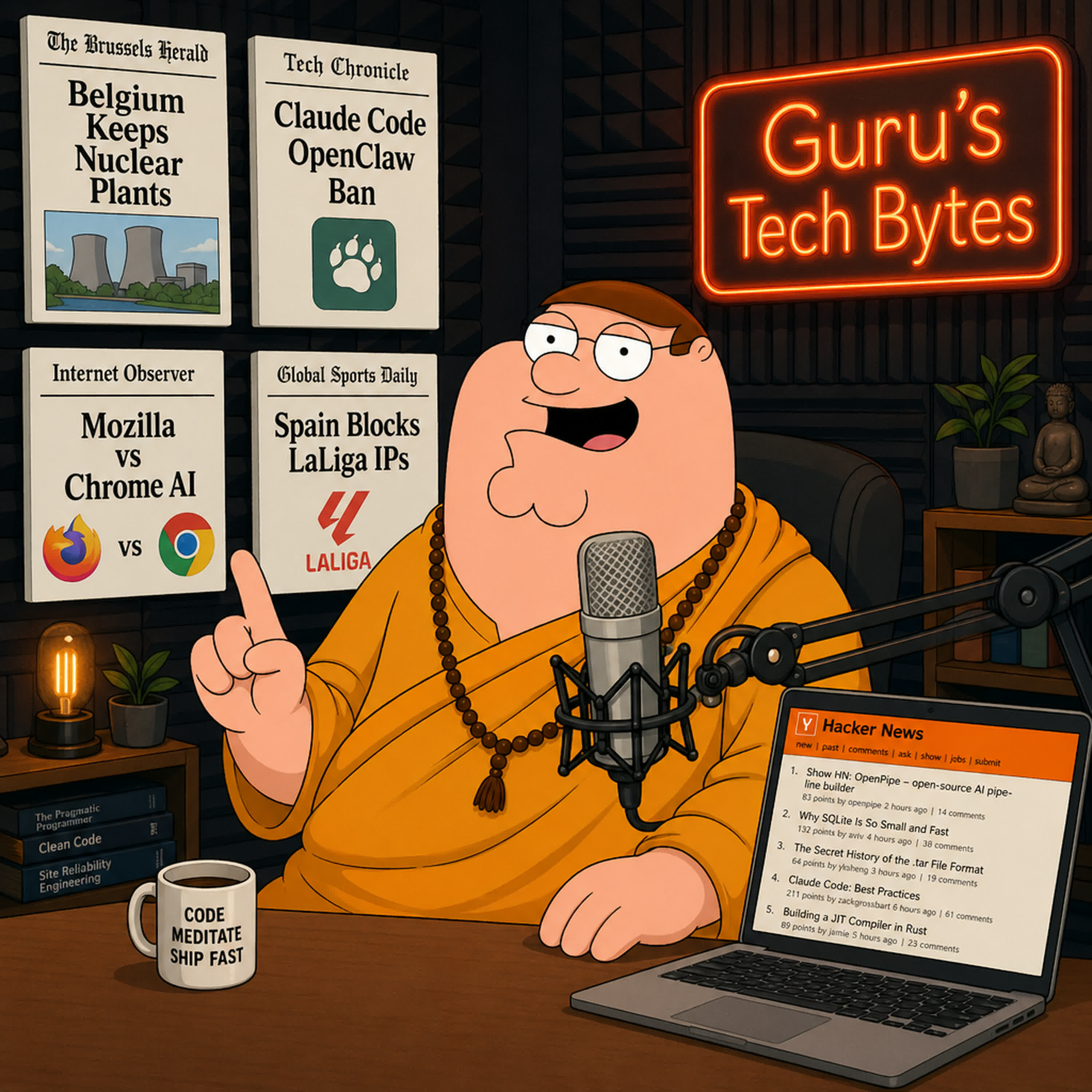
Guru's Tech Bytes
Hosted by AnITGuru · EN
A daily AI-generated tech briefing. Top stories from Hacker News, distilled into a quick morning podcast by an automated pipeline.
69episodes
Episodes
Newest firstAll episodes
Don't be a meat proxy | EP #120
2w ago00:02:08Tap to summarizeGood morning, it's Monday. This is Guru's Tech Bytes, episode 120. Hey, it's Peter. I was tryin' to set up my microphone here and almost swallowed the foam cover. Tasted like a stale marshmallow. Anyway, we got a lot of computer stuff to talk about today, so let's jump right in before I hack up a lung. First up, everybody's talking about how you shouldn't be a meat proxy. I don't know what that means, maybe when you go to the deli and the guy just stands there like meat himself? You know what this reminds me of? That time I got stuck in the revolving door at the bank thinking the glass was open. Anyway, it's about robots using your brain without paying you, which is a raw deal unless they buy me a boat. Second, there's a new computer brain thing called Qwen3.8-Max setting a new bar for coding. It's supposed to help you work, which is great because every time I use Microsoft Word to write a grocery list, the darn thing updates for forty minutes and deletes my eggs. Heh. Hhh, okay, that's something. If this Qwen thing can do my job while I sit on the couch, I'm all for it, as long as it doesn't drink my beer. Third, they issued a big scary warning for a hallucinated SQLite vulnerability. Hallucinated! I hallucinated once after eating a bad clam cake at the Drunken Clam, and swore the mailman was a giant chicken trying to steal my wallet. Turns out it was just a regular chicken. Apparently the computers are doing the same thing, getting scared of bugs that aren't real. It's like thinking there's a monster under the bed, but it's just Chris eating pizza in the dark. And finally, somebody made an isometric pixel map of San Francisco called Isopolis. I don't know what isometric means, it sounds like an exercise machine you buy on TV and never use, but it's a giant drawing of the whole city. I wanted to go to San Francisco, but I'm afraid of the hills. I got a bad knee, and if I roll down one of those things I'll end up in the bay. It still looks neat though. That's your daily byte. Have a great day. Until next time.
Transcribe →How Google helped destroy adoption of RSS feeds (2023) | EP #119
2w ago00:02:02Tap to summarizeGood morning, it's Sunday. This is Guru's Tech Bytes, episode 119. First up, there's this whole thing about how Google killed off RSS feeds, which is crazy 'cause I used to use those to track blogs about chicken recipes. But Google just swooped in and shut down their reader, so now I gotta manually type in web addresses like some kinda caveman. It's like when Microsoft forces an update right in the middle of a rerun and your screen goes blue, and you're just sitting there in the dark. They just take stuff away from ya. Second, I'm reading about something called Diátaxis, which is apparently some way to organize your documentation so people actually understand it. You know what this reminds me of? The time I tried to organize the garage by putting all my empty beer cans in a neat little pyramid, but then I realized the lawnmower was trapped underneath. Anyway, this thing separates tutorials from reference stuff, which makes sense 'cause whenever I read a manual, I just end up more confused. Heh. Hhh, okay, that's something. Third, there's a new AI video thing called Seedance 2.5, and I guess it makes moving pictures out of nothing. I don't really get how a computer just knows what a dog riding a skateboard looks like, but I'm into it. It's kinda like when Stewie built that machine, except this one just makes weird videos instead of nearly destroying the universe. Although, knowing my luck, I'd ask it to make a video of me winning a pie-eating contest, and it'd probably spit out a video of me on the toilet. And finally, it turns out AI financial advice is actually pretty good, especially if you ask it the right questions. So I asked the computer how to get rich quick without doing any work, and it told me to invest in a diversified portfolio, which is just a fancy way of saying buy a bunch of stuff. Lois says we can't afford that 'cause the insurance bill is due, but I think the robot knows better. It's still better than taking advice from Quagmire at the dog track. That's your daily byte. Have a great day. Until next time.
Transcribe →Elevators | EP #118
2w ago00:02:02Tap to summarizeGood morning, it's Saturday. This is Guru's Tech Bytes, episode 118. First up, apparently elevators are getting smart now, which is great because I always wanted a tiny metal box judging my life choices. You know what this reminds me of, that time I got stuck in one with a guy who said he invented the word 'buffoon,' but it turns out he just really liked balloons. Anyway, they got computers running the cables now, let's just hope they don't run Windows or we'll all be stuck between floors for four hours while it installs an update. Second, Google fixed more Chrome bugs in June than over the past two years, thanks to AI. Look, I don't trust AI as far as I can throw it, but if a robot wants to sit there and find out why my browser crashes every time I look up meatball recipes, more power to it. It's probably doing a better job than the guys at Microsoft, who just look at a bug, shrug, and tell you to buy a new laptop. Heh. Hhh, okay, that's something. I'm just saying, at least the Google bot is doing something productive instead of stealing my job. Third, there's this thing called qm, some multiplayer agent harness for work. I don't know what that means, and frankly, I'm afraid to ask. When I hear 'multiplayer agent,' I think of some fella in a suit playing a video game with my tax returns. If an AI can do my work, great, but does it also have to deal with Peter from accounting stealing my lunch out of the fridge? Because if a robot steals my meatball sub, we're gonna have a real problem. And finally, there's a big hubbub about Big Food versus the People. The big corporations are putting all sorts of weird stuff in the groceries, which is probably why my left knee sounds like a bowl of Rice Krispies every time I get off the couch. It's ridiculous. You go to the store for some fresh potatoes and you need a chemistry degree just to read the bag. I miss the old days when the only thing ruining a potato was me leaving it in the oven for three hours. That's your daily byte. Have a great day. Until next time.
Transcribe →UEFA and its national associations will not participate in FIFA competitions | EP #117
2w ago00:02:04Tap to summarizeGood morning, it's Friday. This is Guru's Tech Bytes, episode 117. I was up all night fixing my computer because Windows decided to update right in the middle of me watching a guy make a pool out of LEGOs. Just completely locked me out, which is typical Microsoft garbage, right? Anyway, I'm here, I drank a pot of coffee, and my eye is twitching, but let's get into the news. First up, UEFA and its national associations will not participate in FIFA competitions. You know what this reminds me of? That time I got banned from the bowling league for using a cantaloupe instead of a ball. It's the same shape, Lois! Anyway, it sounds like the soccer guys are having a turf war, which is crazy because they run on grass. Heh. Hhh, okay, that's something. Second, Stacked PRs are now live on GitHub. I don't know what a PR is, I think it's a pull request, which sounds dirty but it's not. GitHub is just stacking code up like a big nerd sandwich. Microsoft bought GitHub, so I bet they're gonna add a feature where it just force-closes your laptop halfway through making the sandwich. That's what they do, they ruin everything. Third, read this before you buy that TV streaming stick. You gotta be careful with these things, folks. I bought one and it was more frustrating than trying to explain to Chris why we can't eat the soap. Everything requires a subscription now, and the stick gets slower than me getting off the couch after a sleeve of Oreos. Just read the article so you don't pay twenty bucks to watch a guy fall off a skateboard. And finally, Gemini Robotics 2 brings whole body intelligence to robots. Whole body intelligence? I barely have arm intelligence. Now they're putting brains in the whole body, which means the robots are gonna know exactly how to open my fridge and steal my Pawtucket Patriot ale. It's only a matter of time before one of them sits in my chair and refuses to move when I want to watch TV. That's your daily byte. Have a great day. Until next time.
Transcribe →Show HN: Open-source engine running Gemma 4 26B in 2 GB RAM on any M-series Mac | EP #116
2w ago00:02:12Tap to summarizeGood morning, it's Thursday. This is Guru's Tech Bytes, episode 116. First up, some guy made this open-source engine that runs Gemma 4 26B in 2 GB of RAM on any M-series Mac. I don't know what a Gemma is, sounds like the lady who cuts my hair, but fitting a robot brain into two gigs is wild. That's like packing a summer sausage into a pencil sharpener. It reminds me of when Microsoft forced an update on my PC and suddenly my whole hard drive was full of telemetry and regret. Heh. Hhh, okay, that's something. Anyway, this Gemma thing runs smooth, so good for them. Second, we got this thing called Superlogical. I’m not entirely sure what it does, which is how I feel about half the stuff in my kitchen, but folks seem to really like it. You know what this reminds me of? That time Brian tried to explain logic to me after I got my hand stuck in the vending machine. He’s all "Peter, gravity dictates..." and I'm like "Brian, the Cheez-its are right there, just reach in!" But this Superlogical probably just makes the internet go fast, so I'm all for it. Third, somebody found the coolest use for the Vision Pro. You know, those big goggles Apple makes you strap to your face so you can pretend you're not sitting in your living room in your underwear? Turns out people are using 'em for all sorts of neat stuff. I'd probably just use 'em to watch Jeopardy while I'm driving, which I'm not allowed to do since the incident, but that's neither here nor there. It's neat folks are finding real uses for it instead of just looking like bugs wandering around downtown. And finally, there's this Kimi K3-256k. I think it's another one of those AI doohickeys. 256k, that's like when I used to listen to tapes on my Walkman in the 80s, except this reads a whole lot of words really fast. It probably reads the internet while I'm still trying to open a new tab on Internet Explorer. Last time I tried that, it just told me my PC is infected and to buy a new Windows license, so I kicked the tower instead. Kimi sounds a lot smarter than my computer. That's your daily byte. Have a great day. Until next time.
Transcribe →GPT-5.6 used a prompt to close a 30-year gap in convex optimization | EP #105
4w ago00:01:56Tap to summarizeGood morning, it's Sunday. This is Guru's Tech Bytes, episode 105. First up, this GPT-5.6 thing apparently closed a thirty-year gap in convex optimization. Now I don't know what convex optimization is, I thought convex was a thing about eyeglasses, but somebody typed in a prompt — just typed it, like a text message — and thirty years of nobody figuring it out, gone. Thirty years, Lois. I've had a bag of pretzels in my truck longer than some of these problems have been solved. Second, somebody made a thing called Transcribe.cpp. And you know what this reminds me of, my cousin had a tape recorder, big one, and he'd hold it up to the radio to record songs and his mom would yell right in the middle of the good part — anyway, so it's transcribing. It turns talking into words on a screen, which is what I've been asking my computer to do since about two thousand and nine, and now it just does it, and it's free, and nobody sent me a bill for a subscription. Heh. Hhh, okay, that's something. Third, New York City wants landlords and realtors to tell you if they used AI in the listing. Which, honestly, fair. Because I looked at an apartment once where the ad said "cozy sunlit nook" and it was a closet with a lamp in it, and no computer wrote that, that was just a guy lying. So now at least you'll know which one's lying to you. And finally, some folks got speech recognition and text-to-speech running in under five hundred kilobytes. Five hundred kilobytes. That's smaller than one of those Windows updates that reboots your machine at four in the morning while you're in the middle of nothing, and then sits there at thirty-two percent for an hour like it's thinking about it. These guys fit a whole talking computer in less space than the little icon that tells you the update failed. That's your daily byte. Have a great day. Until next time.
Transcribe →AWS: Inaccurate Estimated Billing Data – $1.7 billion | EP #104
4w ago00:01:56Tap to summarizeGood morning, it's Saturday. This is Guru's Tech Bytes, episode 104. First up, Amazon Web Services sent out a billing estimate that said someone owed one-point-seven billion dollars. Billion. With a B. You know what this reminds me of? That time Lois handed me the water bill and I thought we'd been secretly running a car wash out of the basement — turns out it was a decimal thing. Anyway, AWS says it's just an inaccurate estimate, which is a real relaxing thing to hear from the people holding the entire internet. Second, and this one actually bugged me, nurses over at Kaiser are saying all this AI and camera surveillance stuff is making their jobs worse and the patients worse off too. And look, I'm no genius, but when the people literally keeping you alive say the robot's getting in the way, maybe listen to 'em? A machine can count your heartbeats but it ain't gonna hold your hand when you're scared, is what I'm saying. Third — and I gotta be careful here 'cause my brain wanders — scientists found an actual atmosphere on one of them Earth-like planets, way out there in the, uh, the Goldilocks zone. The habitable one. That means there could be air, maybe weather, maybe some guy on another planet also fighting with his lawnmower on a Saturday. Kind of makes you feel small. Heh. Hhh, okay, that's something. And finally, there's this big report on the state of open source AI, which is the free stuff regular people can poke at instead of paying the big companies. Speaking of the big companies — you know, my laptop restarted itself in the middle of the game last night for one of them Microsoft updates, didn't ask, just BAM, black screen, "we're getting things ready." Getting WHAT ready? So yeah, I'm rooting for the open source guys, 'cause at least when the free stuff breaks it's got the decency to break quietly. That's your daily byte. Have a great day. Until next time.
Transcribe →Kimi K3: Open Frontier Intelligence | EP #103
Jul 1700:02:21Tap to summarizeGood morning, it's Friday. This is Guru's Tech Bytes, episode 103. We got giant open models, resurrected comic chat, sneaky letters, and Google renaming the notebook again. So, you know, a normal breakfast now. First up... Kimi K3 is a 2.8-trillion-parameter model with native vision and a one-million-token context window, and the company says the weights arrive July 27. It only wakes up sixteen of eight hundred ninety-six experts at once, which is efficient, apparently, like having a whole construction crew but only calling the guys who remembered the toolbox. They say it can handle long coding jobs, visual work, even chip design, though Kimi admits the fanciest closed models still feel better to use. Second... Microsoft open-sourced Comic Chat, the 1990s IRC client that turned conversations into illustrated panels and gave Comic Sans its first real home. The code includes modernization experiments for current Visual Studio and modern IRC servers, so retro-computing people can bring it back without installing Windows 98 beside the furnace. Microsoft preserving whimsical software history is nice; my last Windows update preserved nothing except the spinning dots. Third... Decoy Font is a downloadable typeface that tries to show one letter up close and another from farther away, using thin outlines over a blurred low-frequency shape. Humans can squint or back away and see the hidden message, while image-reading models may lock onto the decoy. It is not guaranteed protection, but it is a clever optical speed bump for scraping. Heh. Hhh, okay, that's something. We invented handwriting doctors can read but robots cannot. And finally... NotebookLM is now Gemini Notebook, because Google found one product name everybody understood and became concerned. It stays a standalone research tool, but notebooks can sync with Gemini, are headed into Search, and now get a secure cloud computer that can write and run code against your sources. That code feature is available for Ultra and certain Workspace customers, with Pro access rolling out over the coming weeks. Useful upgrade, same notebook, fresh label on the trapper keeper. That's your daily byte. Have a great day. Until next time.
Transcribe →Inkling: Our Open-Weights Model | EP #102
Jul 1600:02:36Tap to summarizeGood morning, it's Thursday. This is Guru's Tech Bytes, episode 102. We got giant robots, coding robots, money robots, and one story about stealing music before everything became a monthly bill. So, basically, a normal breakfast now. First up, Thinking Machines released Inkling, an open-weights model they trained from scratch. This thing has 975 billion total parameters, 41 billion active, and up to a million-token context window, which is enough memory to remember every argument at a family barbecue except who started it. It handles text, images, and audio, and they say you can tune how hard it thinks, like a ceiling fan with a graduate degree. The full weights are available, because apparently the file cabinet is now the size of Rhode Island. Second, Grok Build is open source. It's SpaceXAI's coding-agent harness and terminal interface, written mostly in Rust, with fullscreen mouse controls and an extensible tool setup. That's useful if you want an AI to work on your code while looking like the computer screen in a submarine movie. Heh. Hhh, okay, that's something. Open sourcing the harness also means developers can inspect it, extend it, and discover exactly which part renamed the good function to doStuffFinalTwo. Third, Reuters says Stripe and private-equity firm Advent made a joint offer to buy PayPal for more than 53 billion dollars. That's a lot of money for the button I click right before remembering my password is from 2014. The deal would mash together payment plumbing, merchant relationships, and enough transaction data to make every antitrust lawyer's phone start vibrating across the desk. Nothing is final from a report like this, but the size alone makes it a tech story worth watching. And finally, a long look back at the lost joy of music piracy argues that old communities like Oink and What.CD offered discovery, curation, and obsessive quality that streaming flattened into background wallpaper. You know what this reminds me of? Spending forty minutes downloading one song, only to learn it was somebody's answering machine recorded inside a washing machine. Still, the piece makes a fair point: unlimited access is convenient, but hunting, sharing, and building a collection made listening feel personal instead of rented. That's your daily byte. Have a great day. Until next time. Keep your models open, your payment buttons under observation, and your mysterious MP3 folders somewhere the lawyers can't see from the sidewalk.
Transcribe →Your 'app' could have been a webpage (so I fixed it for you) | EP #101
Jul 1500:02:33Tap to summarizeGood morning, it's Wednesday. This is Guru's Tech Bytes, episode 101. First up... somebody finally looked at one of those travel apps that's basically text, pictures, and PDF links wearing a tiny trench coat, and said, buddy, you're a webpage. The author reverse-engineered the Android app and rebuilt the useful itinerary as an actual page: searchable, printable, bookmarkable, and without the tracking or vacation ads. You know what this reminds me of? Installing a refrigerator app just to find out the milk is cold. The web already solved this, people. Stop making my phone carry another icon like it's moving day. Second... PrismML says its Bonsai 27B model can run right on a phone, which is nuts because a normal 27-billion-parameter model needs more memory than my entire family has patience. Their one-bit version is about 3.9 gigabytes, while the ternary version is 5.9, and they claim it keeps most of the original Qwen model's benchmark performance. It can handle text, vision, tool calls, and long agent loops without shipping every private file to the cloud. Heh. Hhh, okay, that's something. Soon your phone will reason locally and still somehow forget where you parked. Third... developers are apparently tired of Claude describing every idea as load-bearing, so one clever person used a MessageDisplay hook to swap Claude's favorite phrases before they hit the screen. Load-bearing becomes cooked, honest take becomes spicy doodad, and you're absolutely right gets replaced with a much less flattering confession. This doesn't change the model's reasoning; it changes the displayed vocabulary, like putting a swear jar between the robot and your eyeballs. Microsoft should add this to Windows Update and replace please wait with we broke something again. And finally... one heroic nerd rewatched Jurassic Park and cataloged the computers in excruciating detail: PowerBooks, Silicon Graphics workstations, storage arrays, and the blinking Thinking Machines CM-5 in the control room. The production borrowed hardware worth roughly four million 2026 dollars after inflation, and much of the on-screen imagery was fed from real machines beside the set. Even the famous Unix system was a real SGI file navigator. So yes, the dinosaurs were fictional, but the expensive computers failing during a crisis were documentary-level accurate. That's your daily byte. Have a great day. Until next time.
Transcribe →