← GZERO World with Ian Bremmer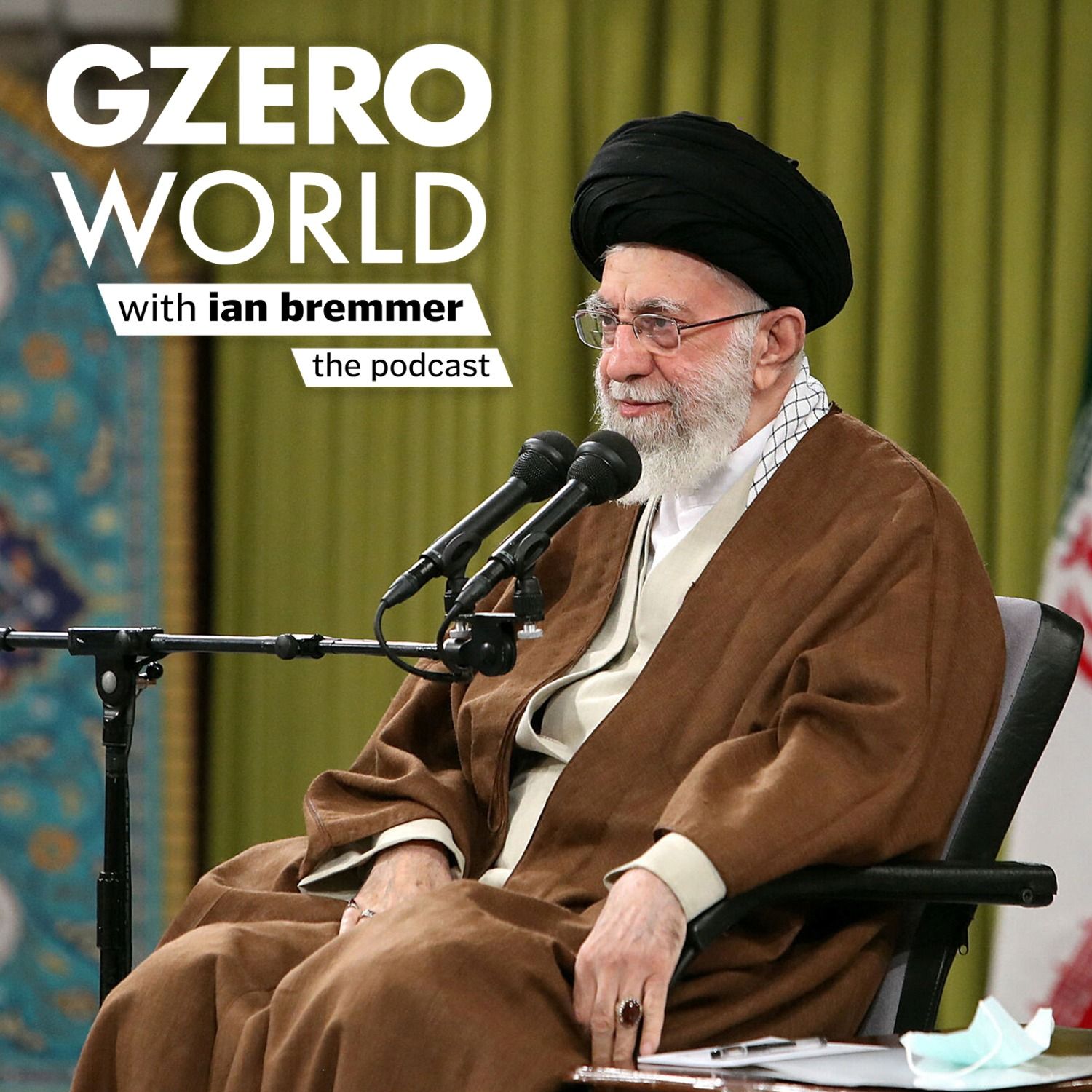
GZERO World with Ian Bremmer
Iran at war with Carnegie’s Karim Sadjadpour
00:16:40
The US and Israel have launched a series of strikes against Iran at a moment when the Islamic Regime is at its weakest. Ian Bremmer spoke with Iran expert Karim Sadjadpour in Munich earlier this month to understand the choices the regime and population are facing.
Loading summary
Transcript54 lines
- [00:03]
A
Hello, and welcome to the Gzero World Podcast. This is where you can find extended versions of my conversations on public television. I'm Ian Bremmer, and today I'm asking a question that sounds strangely familiar at this point in President Trump's second term, will the United States strike Iran again? There was another round of talks this week between American and Iranian officials in Geneva, but military action appears increasingly imminent. Tehran has shown little willingness to negotiate on its ballistic missile program or its support for regional proxies, both non negotiables for Israel, America's closest regional ally. Nor does Iran appear open to President Trump's demand that it halt all nuclear enrichment. In his State of the Union address this week, the president made clear that his patience is running thin.
- [00:52]
B
I will never allow the world's number one sponsor of terror, which they are by far, to have a nuclear weapon. Can't let that happen.
- [01:01]
A
So the question shifts from whether strikes will happen to what form they might take. Over the past month, the Pentagon has deployed the largest concentrations of U.S. naval and air power to the Middle east in decades, including two carrier strike groups. If Venezuela was any indication, President Trump is unlikely to assemble that kind of force without intending to use it. There is debate inside the administration about whether to pursue a full decapitation strike targeting Iran's leadership, or, to begin with, more limited military action. Oil markets, for now, are betting that any strikes would be contained and would not trigger major retaliation. That may prove correct, but there's always the risk that it doesn't. Escalation could come quickly, especially if Iran or its proxies, including the Houthis in Yemen, target US Vessels or infrastructure and a way that causes American casualties. And that brings me to today's conversation. Recently, I spoke with Carnegie Endowment Iran expert Karim Sajidpur during a particularly blustery day in Munich. At the time, he told me a US Strike was likely but not imminent. Today, that timeline may have shortened, but the strategic picture he describes remains highly relevant. So let's get to it. Here's my conversation with Karim Sajidpur.
- [02:28]
C
The Gzero World Podcast is brought to you by our lead sponsor, prologis. Prologis helps businesses across the globe scale their supply chains with an expansive portfolio of logistics, real estate, and the only end to end solutions platform addressing the critical initiatives of global logistics today. Learn more@prologis.com.
- [02:55]
D
Kareem Sajapour, welcome back to the show.
- [02:57]
B
Thank you so much, Yun.
- [02:58]
D
So here we are in blustery Munich for the security conference, one of the Big topics, of course, is going to be Iran and whether or not strikes are coming. You say you think they're likely, but not imminent. Explain why. Why on both counts?
- [03:14]
B
Well, not imminent because I think the President has made clear he still wants to see negotiations through. At the same time, I'm not optimistic that these negotiations are going to lead to a resolution. And coupled with the fact that Iran drove a giant truck through President Trump's red line, President Trump warned.
- [03:33]
D
You mean on killing all of the Iranians civilians, killing the protesters?
- [03:36]
B
Yeah, yeah. And so I think the combination of those factors may makes it much more likely that he's going to act.
- [03:44]
D
So the latter front is interesting. Right, because initially that was what he was talking about. He sent these posts, were coming to the rescue. You and I know thousands, maybe tens of thousands of civilians actually killed. But then Trump pivoted and said, well, yeah, they're not gonna execute that one guy that they put up on these trumped up charges. And so now sort of, we've moved on. In Venezuela, Trump wasn't spending a lot of time thinking about, you know, making sure that this becomes a democracy in Iran. Is he really thinking a lot about, hey, I want to make sure that we protect the civilians? Because that would be an unusual priority for him.
- [04:24]
B
I don't think he's thinking about democracy, but he has several concerns. One is the feedback he gets from some of his very close friends in the Persian Gulf. You know, leadership in Saudi Arabia and uae who would on one hand like to see the Iranian government degraded. At the same time, they worry about the fallout. They don't have the luxury of being thousands of miles away, and they know that the United States can keep that giant military presence in the region indefinitely. At the same time, he's worried about state failure or state collapse. You know, President Trump himself has evoked the Venezuela model where it was essentially an economic blockade as a prelude to a political decapitation. And I think if, if they could somehow see the exit of Ayatollah Khamenei and replaced by someone more compliant, that's the scenario I think he would go for.
- [05:16]
D
Now it seems like the Saudis have shifted their perspective right early on, saying, under no circumstances, we really don't want you to strike. And then more recently saying, well, actually, you might lose credibility if you say all this stuff and then you don't do anything. Where do you think the Saudis are, are on this? And where the Gulf states more broadly, do they actually, do they want to see strikes? Do they really want those Strikes to be constrained, Would they be okay with a decapitation effort, which we hear a lot about from the Trump administration right now?
- [05:48]
B
Well, those countries are understandably ambivalent because Iran is their number one security threat. And Iran still has thousands of close range ballistic missiles. So those missiles can't reach Israel. They certainly can't reach the United States, but they can reach the Gulf. And Iran has used those before against oil installations in Saudi Arabia, against bases
- [06:09]
D
in Qatar, but not in years for the Saudis. And the base in Qatar is an American base.
- [06:15]
B
That's an American base, but through still a menacing proxy they have, which is the Houthis in Yemen. One lesson I learned many years ago, Ian, when I did a Fulbright in Beirut, was that it takes decades to build things, it takes weeks to destroy things. And the Islamic Republic of Iran is in the business of destruction. And so those neighboring countries are rightfully worried that, you know, they could primarily suffer the blowback. At the same time, they absolutely do want to see Iran degraded. And I believe they would like to see a government in Iran whose organizing principle is their country's national interest, not revolutionary ideology.
- [06:55]
D
So you think that limited strikes from the United States, you think the Gulf states are actually pretty much on board with that, even if we don't hear it publicly?
- [07:03]
B
I think their view is that no matter what the United States does, whether it's a decapitation operation to actually kill Ayatollah Khamenei or to go after the Revolutionary Guards or their missile arsenal, they want to see the United States not do a run a one and done. They want to see the US Maintain that residual presence for a while to protect against any blowback.
- [07:30]
D
Now, Israel, we just saw Prime Minister Netanyahu make yet another trip to the United States to meet with yet again President Trump. Of course, he's focused on ballistic missiles and degrading them. He's been pushing the Americans toward military strikes, not the first time talking about the existential threat that could develop to Israel. The does he want all in or does he really want. No, I just take care of the ballistic missiles for me.
- [07:57]
B
I think the Israelis would be happy with an operation which actually attempts to bring down the regime itself. I think from the Israeli vantage point so far, we've always been addressing the symptoms of Iran's malign behavior, its proxies, its missiles, its nuclear program, but the underlying causes, the nature of the regime. The Israelis, I think, in the last couple years have really stepped up their operations inside Tehran. And I think the Israelis obviously are far more hawkish on these issues than the Gulf because they're much further away and they're much stronger militarily.
- [08:38]
C
You're listening to the Gzero World with Ian Bremmer podcast, your weekly geopolitical deep dive into the world's biggest news stories, featuring in depth conversations with global leaders and newsmakers. To get more of Gzero's insights on global politics every morning, sign up for our free newsletter gzero daily@gzeromedia.com.
- [09:05]
D
We have not seen any internal rifts from within the military leadership, the Islamic Revolutionary Guard Corps, from the cabinet, message from the theocrats. We've seen none of that. Why do you think that is?
- [09:19]
B
I think almost everyone inside both the society and the regime are just waiting for Ayatollah Khamenei to die. He's 86 years old. He's not the man he used to be. And I think even within the regime, I would say a pretty sizable majority, even within the body of the Revolutionary Guards, understands that this status quo is not tenable. But, you know, it's a big risk to try to launch a coup against someone who set up a system in which there's so much spying happening. And so I think that right now people are just, rather than major rifts happening, you see people just waiting for the moment to act.
- [10:04]
D
Does that make a stronger argument for externally removing him, or does that martyr him in the eyes of the Iranians because the Americans are suddenly responsible, the Israelis are suddenly responsible?
- [10:17]
B
You know, this is a great question, and I'm reminded of one of Kissinger's quotes, that one of many of the most important decisions in government are 51, 49. And really, no one can answer that question, surely, you know, my view would be that military attack is a gamble. And I'll note that President Trump has gambled three times on Iran. He left the nuclear deal in 2018. He killed Ghost Soleimani in 2020, last summer, Operation Midnight Hammer, 12 Day War. So I think in his head, and
- [10:50]
D
he succeeded from his perspective, all three
- [10:52]
B
of those, they've been vindicated. So I think he's more likely to take action, but no one can predict what comes after that.
- [10:58]
D
Now, from the Iranian side, we may not be seeing any movement away from the regime internally, but we have seen, we've seen Iranian drones, we've seen, you know, sort of efforts to, you know, threaten American ships, tankers in the region. This doesn't seem like a regime that is cowering and only trying to play nice. Given all of this, American military Force. Haven't they learned any lessons from Venezuela, from the 12 Day War? Or do you think it's because they're divided in what they want to do and how they respond?
- [11:31]
B
I think they may have learned the wrong lesson. Which is, I think the lesson they may have taken away from last June's 12 Day War was that by not retaliating in a meaningful way, they didn't exact any costs on the United States and Israel and so therefore they feel like they can do it again.
- [11:52]
D
Almost 100 Israeli civilians were killed in the responses from Iran. That's not considered a meaningful response.
- [11:57]
B
Well, they didn', tit, didn't really. It was a short blip in the life of Israel and for the United States, wasn't impacted at all. I don't think the price of oil really went up that much at all.
- [12:08]
D
No, they went down actually, when the Cuttery strikes again.
- [12:10]
B
So that's significant. And so one of the few ways in which Iran can get the world's attention is by trying to spike the price of oil. And one thing that they have telegraphed this time, whether it's an empty threat or not, they've telegraphed that they they're going to regionalize the war if they're attacked.
- [12:26]
D
And does that mean principally in your mind, shutting down the Straits of Hormuz and squeezing oil, or does it mean actually turning on proxies and engaging in strikes against critical infrastructure?
- [12:39]
B
And the rest, if they try to shut the Strait of Hormuz, they're going to really alienate their chief ally, which is the government of China. 90% of Iran's oil revenue heads towards China. And so I think what they've telegraphed is that they will use their missiles against US Bases in the region, against oil installations in the region. There was one individual kind of connected to the Revolutionary Guards who threatened that they could destroy all of Dubai. And so in the past, these have turned out to be empty threats for Iran. And I'm not sure President Trump takes them that seriously. But if you're sitting hundreds of miles away in the Persian Gulf, you don't have that much room for error.
- [13:24]
D
So the one piece of your analysis I want to press on there is China as Iran's ally, I mean, may be true, but so far, in response to America threatening that they're going to put all these strikes on China, has done nothing to make the Americans feel like they're going to come to Iran's aid. It's hard to imagine there's much they would do. After Venezuela, China did Nothing. I mean, is that really. Is that a credible motivator for the Iranians at this point?
- [13:49]
B
I should have used the word partner. They're definitely not an ally. That's the other thing about the Islamic Republic of Iran, is that it is probably one of the most strategically lonely countries.
- [13:58]
D
Yeah, they're by themselves right now.
- [13:59]
B
By themselves. And so that 90% of Iranian oil, that's destined for China, you know, China's getting deep discounts from them. But I do think, you know, we commonly lump Chinese and Russian interests together vis a vis Iran. And I think they actually have different interests. I think that China would benefit from an Iran which opens up to the world. It's not a source of instability in the Middle east, which fulfills its enormous potential as an energy superpower. You know, Iran has the world's second largest reserves of natural gas, third largest reserves of oil, but it's punching way below its rate. All of that benefits Russia. Russia wants to see an Iran which is isolated, which plays a destabilizing role in the Middle east, which is a thorn in the side of the United States, which doesn't compete with Russia and their historic sphere of influence, which is Central Asia. So we commonly lump China and Russia together, but I think they have very divergent interests vis a vis Iran.
- [14:55]
D
If you were betting in the course of the next three, six months, is one of the safer bets out there that the Iranian people are going to suffer more as a consequence of all of this.
- [15:04]
B
Unfortunately, that's been the case that it's the society which suffers most. But, you know, I am confident that it may not be a near term happening, but in the medium term, this is one of the most politically mature societies in the region, arguably one of the most secular pro American societies in the region. And, you know, that's a society which is desperate to live in a country that fulfills Iran's enormous potential as a nation.
- [15:36]
D
You say pro American. I mean, the Kurds have been pro American for a long time, and they've been very disappointed by different American governments over time. The United States went out there and said, we're gonna rescue you. There was no rescue. And the amount of death we saw in a matter of a week or two was close to what we've seen over a year of the Gaza war. Does that change the way Iranians feel about the United States?
- [16:05]
B
I think the last chapter hasn't yet been written. I think people are really awaiting to see what President Trump is going to do. But if we fast forward this story one year and nothing happened, or the United States did a mini nuclear deal with the Iranian government, I think there will be profound disappointment in President Trump. But ultimately, I don't think that people's attitudes about the United States change that significantly and that I think most Iranians now recognize that so long as the organizing principle of the state is death to America and death to Israel, it's never going to fulfill its great potential. And reconciliation with the United States is one of the first prerequisites I think people understand, for Iran emerging from isolation.
- [16:54]
D
Kareem Sajapur, thanks for joining us today.
- [16:56]
B
Thank you, Ian.
- [17:00]
A
That's it for today's edition of the Gzero World Podcast.
- [17:03]
D
Do you like what you heard?
- [17:05]
A
Of course you do.
- [17:06]
D
Why not make it official?
- [17:07]
A
Why don't you rate and review GZero
- [17:09]
D
World 5 stars only 5 stars.
- [17:10]
A
Otherwise, don't do it on Apple, Spotify
- [17:13]
D
or wherever you get your podcasts. Tell your friends.
- [17:22]
C
The Gzero World Podcast is brought to you by our lead sponsor, prologis. Prologis helps businesses across the globe scale their supply chains with an expansive portfolio of logistics, real estate and the only end to end solutions platform addressing the critical initiatives of global logistics today. Learn more@prologis.com.