← GZERO World with Ian Bremmer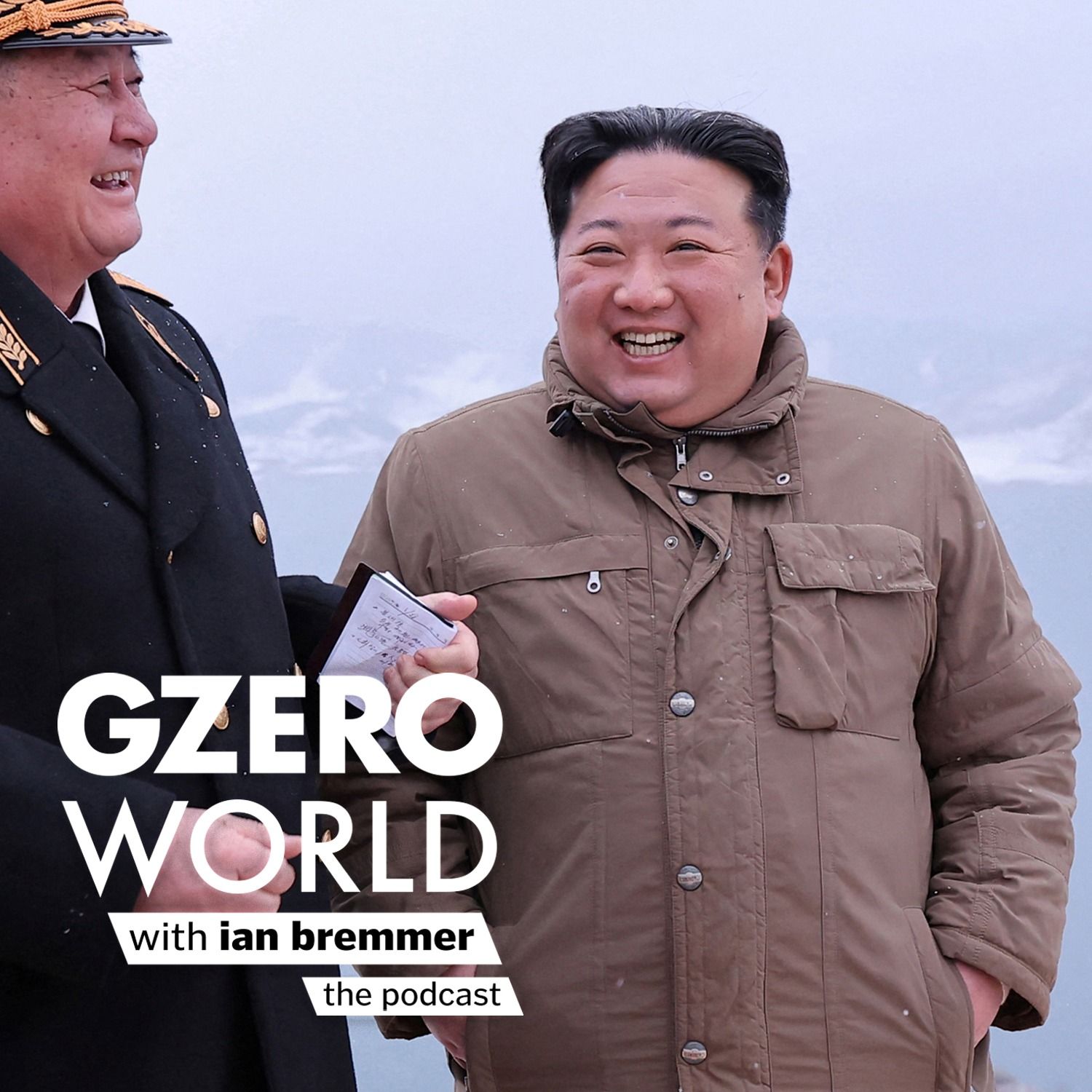
GZERO World with Ian Bremmer
North Korea's nuclear gamble pays off, with the WSJ's Jonathan Cheng
00:28:13
The Kim dynasty has outlasted every threat for 80 years. Wall Street Journal's Jonathan Cheng explains how, and why the Iran war just made Kim Jong Un seem untouchable.
Loading summary
Transcript44 lines
- [00:03]
A
Hello and welcome to the Gzero World Podcast. This is where you'll find extended versions of my interviews on public television. I'm Ian Bremmer. And while the world suffers the consequences of the war in Iran, Kim Jong Un is watching too, and he's feeling well. Pretty good, all things considered. For decades, the Kim Dynasty raced to build a nuclear arsenal while the world tried everything to stop them. They tried sanctions, they tried summits, they tried nothing worked. Fast forward a few decades and North Korea is amassing a nuclear arsenal while Iran's supreme leader is dead. At least the last one. They got a new one. And its country is at war. The lesson for Kim, hold onto that bomb. My guest this week, Jonathan Chang, has spent a decade researching the Kim Dynasty, including two trips inside North Korea itself. In his new book, Korean Messiah, he traces the regime's extraordinary cult of personality all the way back to its roots and. And American Protestantism. Yes, you heard that right. Jonathan is also the Wall Street Journal's Beijing Bureau chief, watching all this from China at a moment when Xi Jinping is balancing its relationship with North Korea and with the West. During a quick visit to New York, Chang came by to talk about all
- [01:15]
B
of that and more. Let's get to it.
- [01:26]
C
The Gzero World Podcast is brought to you by our lead sponsor, prologis. Prologis helps businesses across the globe scale their supply chains with an expansive portfolio of logistics, real estate, and the only end to end solutions platform addressing the critical initiatives of global logistics today. Learn more@prologis.com.
- [01:53]
A
Jonathan Chang, thanks for being here.
- [01:54]
B
Thanks for having me. It's a pleasure.
- [01:56]
A
You've been to North Korea twice. You've been covering it for about 10 years now.
- [02:02]
B
Yeah.
- [02:03]
A
Tell us what we get wrong about that country.
- [02:07]
B
Yeah. So my working thesis, and it has been at the back of my mind for many years now, is that North Korea is a nation state. It absolutely is a nation state, like it or not. It has borders, it has a flag, it has an anthem, it has a military, it has nuclear weapons, it has a seat at the United Nations. But I think we misunderstand it fundamentally if we don't see it for what I kind of think it is, which is a religious society. I think a lot of people are aware of the personality cult around the Kims. It's a pretty extraordinary one. It's one that hasn't really abated for now, more than 80 years, which when you think about Stalin and the USSR, you think about Mao and Communist China, nothing even remotely close to that in terms of intensity, in terms of the durability of this cult of personality now in its third generation. And the nukes are important. The nukes insulate North Korea from external threats, but the other threat is internal. And there, I don't know that the Kims have all too much to worry about, because they've effectively built what I honestly believe is the most extraordinary cult of personality in human history.
- [03:06]
A
So when you say it's a religious society, you mean embodied in the person of Kim himself. There is worship, actual worship of that man that when they're all standing and they're applauding for minutes and sometimes hours on end, would you say that's authentic?
- [03:26]
B
I do think, for the most part, it is authentic. When you've been told one thing and only One thing for 10, 20, 30, 40, 50, 60, 70, 80 years, I think you might start to believe it. I think I might start to believe it. Especially when you don't have alternative sources of information and when everyone around you has elevated this man, this God king, to this sort of messianic level. That's really what we see with not just Kim Jong Un, but of course, his father, Kim Jong Il, and the state founder, his grandfather, Kim Il Sung. I think many are true believers. When you see the footage of them weeping, when you see the footage of them overwhelmed with emotion in the presence of Kim Jong Un or his father or his grandfather, we see that with pop stars, you see that with rock stars, you see that with celebrities. Some people, they're in your presence and they're going to get sweaty palms. They're going to have, you know, the heart's going to beat a little bit faster. That's something that's very real even in our very secular society here, when you live and every room has the portrait of Kim Il Sung on the wall, every badge, pin, lapel over your heart is Kim Il Sung. Every time you pass the statue, you're bowing before a statue. You open the newspaper, that's him on the front. You turn on the tv, that's him there. You're singing, literally singing his praises. You're memorizing his scripture. This is a different thing with information
- [04:40]
A
society that exists today. I mean, again, I know it's a crime to have a burner phone and people don't have access to the Internet the way they do in the west. But are they really not getting any sense that South Korea, for example, has just a radically different, vastly more successful economic model?
- [05:00]
B
Well, I think successful to you, successful to me. But I think when they look at South Korea, they see decadence, they see inequality, they see all sorts of social ills which do exist. Just as China, just as North Korea will look at the United States and say poverty, inequality, gun violence, racism, all the rest of it. And that's not to say that none of that exists. But, of course, it's a skewed portrayal. But when you have that skewed portrayal, I think it can really be quite powerful. And I think even here in the United States, this is a free country, you can choose your new sources. And yet we know that there are people who either in their red bubble or in their blue bubble, can get this sense of San Francisco on the one side or, I don't know, Alabama on the other side, and just have a completely skewed perspective of what that may look and feel like because of these bubbles that we live in. And North Korea, you could say it's kind of like these red or blue bubbles, but exponential.
- [05:52]
A
Now, what sort of people did you have a chance to have any engagement with directly when you were there?
- [05:59]
B
Well, certainly North Korean officials, they were our hosts, especially the second time. The first time I went in as a private citizen. Second time I went in as a journalist for the Wall Street Journal, as the Korea bureau chief at the time. This was almost a decade ago now. But we were. They gave us a welcome banquet. They asked us, where would you like to go? We'd like to show you North Korea. We'd like to show you the splendors of life under the Kim Jong Un regime here. So we asked them to see everything that we could want to see. We asked them for nuclear sites, we asked them for an interview with Kim Jong Un. None of these materialized, you won't be surprised to know. But they did take us to restaurants, Italian restaurants that they now have in Pyongyang. I asked if we could go to church on Sunday because we were there over a weekend. They have two churches that they've constructed in North Korea, in Pyongyang, partly because of Kim Il Sung, the state founder, and his own Christian heritage. And so this was part of what we were interested in seeing. But the overall message to Donald Trump at that time, this was his first term, was to say, we're not afraid of you. Your sanctions aren't working, and you're not going to take our nukes away from us. And I think Fast forward to 2026. I don't think the message is all that different. You can't hurt us with sanctions. You can't. You can't do what you did to Iran because we have nukes. We have our lifeline through the prc, through China, through Russia. You can't, you can't touch us. And so the debate in Washington, of course, what we've seen around Maduro in Venezuela, what we saw around the Ayatollah in Iran, you're not seeing that same debate happen over North Korea. Even though we know that Trump has a great interest in North Korea. He spent his first term quite fixated on North Korea. And I think he's looked elsewhere because I think he's concluded the same thing that a lot of his predecessors have concluded, which is North Korea can't touch them right now.
- [07:40]
A
Now, the censorship regime is incredibly strict. They've also completely censored the Iran war, the assassination of the Supreme Leader. I could see how that would be a message of strength, that no one can touch us because we've got nukes. Look what happens if you don't. They don't want to go there. Any sense of why they would just do literally zero.
- [08:04]
B
Well, I think exactly what you said is probably the answer right there. They don't want the North Koreans to know about a decapitation strike on their Dear Leader. That's the last thing that they want to be talking about. Right. I think they're doing this with Russia, Ukraine as well. They're doing this with a lot of hotspots around the world. I think they want to see where things go. They're the ultimate controllers of the message, certainly within North. North Korea. So I think they want to see where things settle. And certainly if things continue to go in a bad direction for the U.S. perhaps we will start to see more from the North Koreans about this. If Iran looks like they are going to emerge here, perhaps that will be a message that they'll want to share in their own way, in their own time.
- [08:44]
A
Once they had that meeting, those meetings with Donald Trump and obviously fetid all the time, my good friend, pen pal, they sent me letters. I mean, he was excited to historically historic meeting for Trump. Was that covered in North Korea as a truly historic. Like we are now on the global stage.
- [09:08]
B
I think it's a great question. And yes, they did portray Kim Jong Un with Donald Trump shaking hands, front page of their newspaper. Because, look, there's a lot of talk about China and the US being a G2 right now. But you have, you have Kim Jong Un here getting a handshake, three handshakes with the President of the United States. That's something that his father and his grandfather could never have attained. And that's, I think, a testament to what he's managed to. He's been a custodian of what was built for him. He didn't create the nuclear program, but he took the nuclear program, arguably to where it is now, the missile program as well. And so you have this. This state where actually all three of the Kims who have been in power, they're really good at the family business. They're very good. And a lot of these dynasties, the wheels start to fall off, whether it's a corporate dynasty or a political dynasty by the third generation. We don't see that with Kim Jong Un. He took power at less than 30 years of age, but he's proven himself to be no less masterful at this than his father and his grandfather.
- [10:06]
A
He has a stronger relationship with Russia now, sent over some 15,000 troops to fight in Ukraine. A lot of them died, was providing stipends and apartments, I remember, to the families. So obviously, this is something that they knew about, they talked about, and it didn't go all that well. And yet the Russians are sending them thousands and thousands of containers on trains. Who knows what's in them? How do you read all of that around the Kim relationship with Putin?
- [10:43]
B
Sure. I'll put it sort of in two ways. One is North Korea is a relatively small country in quite a difficult neighborhood. It's surrounded by all the great powers. And so it's really been adept at navigating between China and Russia. And I think what we're seeing here is a pivot towards Russia. And you see that because the Chinese just had the Foreign minister, Wang Yi, to Pyongyang to meet with Kim Jong Un. I interpret this as China's attempt to sort of say, hey, hey, hey, hold on, let's not have you drift too far in the Moscow camp, because historically, even though Russia and China have been friends most of the time, they've also been rivals. And North Korea has played that masterfully. They've played. Played a relatively weak hand very well. The other thing is, when you have Kim Jong Un sending off these troops to the front lines, Russia, Ukraine, you're right, it didn't go all that well. But what it did bring, of course, was combat experience. But what it also brought is it fits into the cosmology, the theology, if you want to call it, of North Korea to have these North Korean soldiers go to the front line and bravely give their lives up. We have this in America as well. You have the idea of, you know, the honor of those who are fallen for their country. And in North Korea, there is a very theological lens to it. Again, this is something that I'm quite consumed and obsessed and convinced about, but it is that there is this idea that you have two lives. You have a biological life, we have the biological life. Ashes to ashes, dust to dust. But you have this sociopolitical life. That's what they call it in North Korea, where if you've given your life for your country, you attain a certain level of transcendence, of immortality. And you see a lot of that in North Korea. You see them really lay it on thickness in their memorials to these fallen soldiers. Yes, the wives, the widows, they get the fancy apartment, they get this and that, but they also get this almost spiritual transcendence that comes with it, because North Korea has always had these roots in Christianity, of all things. And that's something that I spent a lot of time thinking about.
- [12:42]
C
You're listening to the Gzero World with Ian Bremmer podcast, your weekly geopolitical deep dive into the world's biggest news stories, featuring in depth conversations with global leaders and newsmakers. To get more of Gzero's insights on global politics every morning, sign up for our free newsletter, gzero daily@gzeromedia.com.
- [13:10]
A
So, you know, I started my studies with the Soviet Union and communism and came in different flavors. But, you know, even under Stalin, there was a strong dissident culture. And the consequences of being dissident in that environment were very, very heavy. And there was, you know, a surveillance and, you know, environment where, you know, you tell on even family members and all this sort of thing. And. And of course, I am naturally skeptical when I hear that despite all this success of the Kim dynasty and the third generation is not screwing it all up, that the people are buying at hook, line and sinker, that even Messiah. There are gonna be people that are saying, wait a second. I mean, this guy's like, he's eaten so much better food and my life is pretty hard. Or they just sent like someone that I care about to a forest labor camp. I mean, you know, the consequences of not being aligned with this religion internally in North Korea are the severest they could possibly be. And that antagonizes people with free will. Yes.
- [14:20]
B
So talk about that. Sure. No, I mean, there's a lot of speculation, a lot of discussion about whether or not there is sort of a remnant of kind of belief that transcends and predates the kims now been 80 years. So there aren't Many people.
- [14:35]
A
I'm not talking about predating.
- [14:37]
B
Yeah.
- [14:37]
A
I'm talking about resisting. When you see people that are being abused and repressed, I mean, again, it may be a very long time, but it's a very long time of people being sent to labor camps. Yes, very long time. People being executed for small transgressions.
- [14:52]
B
Yes. But I think what North Korea has done is they've taken what the Stasi did, what the Soviets did. They've taken it to the nth degree here. I think they're pretty good at rooting out any sort of dissent. That doesn't mean it doesn't exist. I think it exists, but I think it exists deep in people's hearts, in their psyches, and that can be very difficult to root out. Perhaps it will be a latent force when there is a little bit of room, but they've never allowed for any room. There's never been any glasnost or perestroika, not even a smidgen of it. When you think about Stalin and the height of his cult, it was really from 45 to 53 when he died. That's eight years now. the height of his fervor around, his cult personality was really 66 to roughly 69. I suppose you could date it to 76 if you like, but those are relatively short periods. And what came after Stalin, we know it was a secret speech from Khrushchev that said, we went too far. We need to get rid of this cult of personality. We need to de Stalinize. What we saw, of course, with Deng Xiaoping was he said, we went too far with the Cultural Revolution. We need to go in a totally different direction. And we saw that that never happened in Korea. But I agree with you that there may be dissenters. But even. And I love this fact too, but if you want to talk about dissent, there's 25 million people in North Korea. Even if you give a 20% haircut, let's call it who. Deep down, they look at Kim and sure, they bow and sure, they do all the things they need to do, but deep down, they loathe the guy, they loathe the family. Even if you give a 20% haircut, there, you're still talking about 20 million people. You have to look at this state, look at these people, recognize that there are 25 million of them. They had about as much say being born in North Korea as you or I had a say in where we were born, when we were born, to whom we were born. It's a tragedy. It's a tragedy on, on a mass scale. It's, it's, it's a human rights concern and it's a smaller country than China or Russia or Iran or any other country that you want to point to. But again, it's the magnitude of it and it's the durability of it that is so shocking to the conscience, that is so, so offensive, I think, to many people. But you come back to the fundamental question, what is there to be done? They are a nuclear armed state. And no matter what the US Government sort of bobs and weaves around this point, I don't think it's really seriously in question anymore.
- [17:11]
A
So I guess I'm asking you, do you prefer like, you know, more engagement? Do you think that this is where you should have more diplomacy, more trips, or does it not matter? Is that just facilitating, do you like the, you know, the sanctions effort that's creating more predation for the average North Korean, whether it's the United States, the Europeans, when we know the Chinese and the Russians aren't going to follow it? I mean, what does that make you think from a policy perspective?
- [17:35]
B
I genuinely don't know. I think the hawks and I think the doves on Capitol Hill, in Washington, in all the capitals of the world, each has had their turn. I don't know that either side has the trump card, as it were. And speaking of the trump card, I mean, I think Donald Trump probably did come perhaps the closest to dislodging a status quo that I don't think could otherwise have been dislodged at all. In the end, what we saw, of course, during the first Trump administration is I think we did genuinely get to the cusp of a breakthrough. And I think that was a testament to the President's style. I think for the North Koreans, they're used to being the crazy man at the poker table. And I think when they looked across the table, they saw someone in the Oval Office that they couldn't read. They didn't know whether he was bluffing or not. And I think that that was powerful. But ultimately that opportunity never came to pass. You could say he squandered it, or you could say that the circumstances were just never going to work, regardless of what, how the cards were played, if we want to continue this analogy. But, but be that as it may, I think the final result is the same, which is that North Korea continues to have its nukes, I think in part because of this extraordinary personality cult that it has built up over these decades. I don't Know that I see too much of an alternative here.
- [18:53]
A
So Kim does seem to be preparing, seeding the ground, for the North Korean people to accept that his daughter is going to be the next supreme leader. How does one do that in this society? How has it looked?
- [19:10]
B
So, a couple of things. One is the fact that it's not a son, that it's a daughter. I think that's something that would be another big deviation that Kim Jong Un has had from his predecessors in just being so public with his wife, with his sister, and now with his daughter. That's something in the patriarchal society which North Korea is, is a little bit revolutionary. I would put that perhaps alongside the repudiation of unification as a goal. This is more of a stylistic change, perhaps. But no, it's. It's more than style. There is some substance to it. But I. But I always find myself more impressed or more surprised by the age. He is by all accounts something like 12 or 13 years old. He is something like in his early 40s, perhaps 42, 43 years old. He has presumably decades ahead of him. I don't know whether or not she is the anointed one, as it were, but certainly she could be the anointed one. That's what the intelligence from South Korea seems to suggest. But I don't know that we need to have an answer right away, because he may be in the driver's seat for decades to come. But this is very different from the succession plans before and the succession plans in Beijing. This is a succession plan that is happening in plain sight. It's something that his father and grandfather were never able to do. They had their leader sort of introduced to the world, more or less when they. When they took the stage. And this is a very different model. So we'll have to see.
- [20:40]
A
And you're living in Beijing. You're watching it there from being the Wall Street Journal's Beijing correspondent. And yes, the Chinese have leaned in a little more to North Korea recently, in part because otherwise they're losing influence. How do you think the Chinese government perceives North Korea right now?
- [20:59]
B
I think historically they've seen them as bit of a nice asset to have. Certainly they don't want a unified Korea that is backed by the US on its border.
- [21:11]
A
Certainly not a nuclear power as well.
- [21:13]
B
Certainly not. Yes. But they also don't love that they have an erratic, uncontrollable. And by the way, I don't think the Chinese can control. I don't think they can dictate terms to Kim Jong Un. That's got a volatility all its own. But I think that insofar as North Korea creates more problems for the west than it does for China, I think they're okay with is what it is to a certain degree. Korea has always been its own independent kingdom. It has never been fully absorbed into China. If you go back through all the dynasties, it's never been that way. And so I think they're comfortable with it being there. And again, perhaps there is some stability there in having an undeniable nuclear deterrent. I don't think that Beijing worries too much that Pyongyang is going to turn those nukes in their direction, but you never know. I think certainly that is the ultimate uncertainty and perhaps the ultimate card that the Pyongyang has to play with respect to China, should things ever go in that direction, and they almost did during the Cultural Revolution. There was a time when Kim Il Sung was so afraid of Mao, or so afraid of the relationship with Mao that he himself was worried about flying over China, these sorts of things. So I think they're happy to have something there that keeps policymakers up at night in Washington, in addition to all the other fires that are raging around the world, that they also have this to keep the Americans off balance.
- [22:43]
A
And, I mean, the South Koreans are the country that, you know, has the most at stake with North Korea. They've also had the most policy volatility. I mean, you know, from, you know, sort of actively leaning into the war that exists, but also the sunshine policy in trying to engage. And you've got all these NGOs that send over balloons and messages, and we've had loudspeakers. I mean, do you get a sense that that dynamic between north and south is changing as the north feels more confident, as they have more international engagement? Or are they still just as fundamentally concerned that the whole thing can unravel if we don't manage South Korea?
- [23:25]
B
Right. No, I think North Korea has changed. Kim Jong Un, perhaps the biggest deviation that he has made from his father and his grandfather is precisely on this point. He's repudiated unification as a goal for the North Korean state. And that is, again, put it in religious terms. It's heresy for him to have said that. And the fact that he could get away with such a heretical statement speaks, I think, to his ability to stand alone as the unquestioned leader. We don't see his portrait up on the walls alongside his grandfather and father, yet we don't see his birthday elevated to the same level. As his grandfather and father. Yet we don't. We don't see his statues going up around the country yet. But the fact that he is able to take something that Kim Il Sung had put at the center of the state, this is almost kind of the promised land that Kim Il Sung had set up, that one day under his rule, the American troops would be kicked out of South Korea, and that under the benign rule and love and benevolence of this Korean messiah, that Korea would be united, that this paradise would come to pass. And so for Kim Jong Un to come along and say, no, South Korea is not our other half. It is not half of the country to be reclaimed. It's an enemy state. It's an enemy state to be defeated, that's a very different paradigm. And it's quite a shift and quite a daring shift. And at first, there was a lot of question about whether it was merely rhetorical, but it does seem more and more that this is really the new policy path of North Korea. So I would single that out as the one biggest heresy, as it were, from his father and his grandfather.
- [25:01]
A
So Trump is planning this much anticipated trip to Beijing. It's been kicked back once. We'll see when it actually happens. But he's also talked a little bit about wanting to potentially see Kim while he's out there. Do you think this would be welcome at this point?
- [25:20]
B
I think it would be welcome by the North Korea again, especially if this is to talk about North Korea being a nuclear state, if it's going to burnish Kim Jong Un's global status again. Keep in mind, in September last year, Kim Jong Un was standing on the rostrum at Tiananmen Square alongside Xi Jinping and Vladimir Putin. He is in the league of the big boys now with Donald Trump. I think that would be something that would definitely be welcome. But again, on North Korea's terms, I don't think they want to come. If it's going to be talking about denuclearization, that ship has sailed as far as they're concerned. So I think that that's definitely there. And sure, it would be. It would be quite. It would be quite a show. I don't know that America right now and the foreign policy apparatus has the bandwidth to add North Korea also to the menu right now, because it's a pretty long list right now.
- [26:09]
A
So assuming the summit does occur, what do we think the Americans and the Chinese really want to accomplish here?
- [26:15]
B
Sure. Well, I think China, if you look at the trade war last year and how China responded to the tariffs. They were the only country in the world that not only pushed back, but pushed back successfully against the U.S. i think when Trump comes to town, I think the problem is the tariff cudgel doesn't work anymore. It doesn't scare the Chinese. I think the Chinese are happy to have him come when he's distracted. If Iran is in utter quagmire by the time he arrives, I think they're going to feel pretty good. I don't know the summit will happen if it's a quagmire, because. Because the optics of that, both for Trump and for Xi, may not work, but. But presuming he does come, I think they're going to feel pretty good. What China is trying to project is they're trying to project this G2 idea. We are at parity with the US but where we're the ones to the rest of the world that you want to work with. We're not the ones who are going to be launching unilateral strikes on other countries. We're not the one who is going to be ratcheting tariffs up to 100% or beyond. We are a reliable country here. You may not like everything about us, but we're a reliable country, and you can work with us, you can do business with us. And I think by having Trump there in Beijing, I think that's precisely what Beijing will be able to project to the rest of the world. I think the other thing they want is I think they do want to run out the clock on President Trump. We're now into his second year. He's term limited, and he's tangled up in all these other conflicts around the world. So keep him at bay, keep him happy, flatter him, make sure that he doesn't lash out at China, and let's see where things go. Ultimately, the big prize for them is Taiwan. And if they can make a little bit of progress on Taiwan, if they can get Donald Trump to shift the official US Language on Taiwan towards opposing, let's say, independence for Taiwan, that will be something that they can pocket. And what does President Trump want? Well, I think that's a bit of a question for all of us. I think he is also looking for some stability. He does have a lot else going on, and I think with the only other country that can rival the US Economically, militarily and otherwise, I think probably what he's looking for is some measure of stability. And I think he'll probably find it, because I think their interests are aligned on that front. Both Xi and Trump want placid waters when it comes to the US China relation. Jonathan Chang, thanks for joining us today. Thanks for having me.
- [28:35]
A
That's it for today's edition of the Gzero World Podcast. Why not make it official? Why don't you rate and review GZero World 5 stars only 5 stars. Otherwise, don't do it on Apple, Spotify or wherever you get your podcasts. Tell your friends.
- [28:56]
C
The Gzero World Podcast is brought to you by our lead sponsor, prologis. Prologis helps businesses across the globe scale their supply chains with an expansive portfolio of logistics, real estate and the only end to end solutions platform addressing the critical initiatives of global logistics today. Learn more@prologis.com.