← GZERO World with Ian Bremmer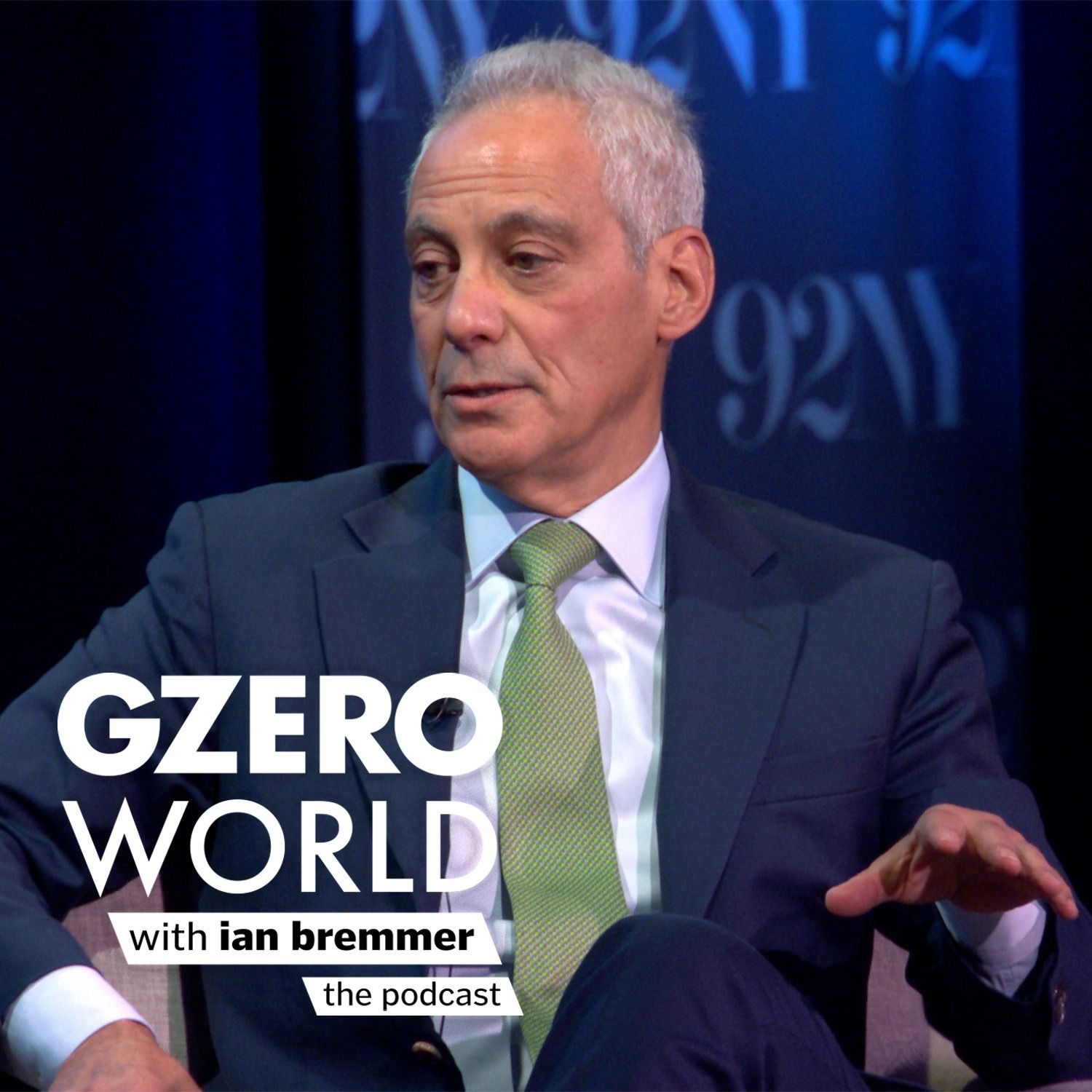
GZERO World with Ian Bremmer
Rahm Emanuel on Trump's Iran war “of choice” and midterm implications
00:50:51
Ian Bremmer and Rahm Emanuel discuss the deepening conflict in the Middle East, US foreign policy under Trump, and the upcoming midterms.
Loading summary
Transcript128 lines
- [00:02]
Ian Bremmer
Hello and welcome to the Gzero World Podcast. This is where you can find extended versions of my conversations on public television. I'm Ian Bremmer and today's episode was taped in front of a live audience at the 92nd Street Y in New York City, where I sat down with one of the most battle tested figures in American politics and foreign policy, Rahm Emanuel. He's worn more than a few hats in public office. Democratic Party enforcer, U.S. congressman, White House chief of staff under Obama, mayor of Chicago, and most recently US Ambassador to Japan, where he was deeply involved in America's Indo Pacific strategy. But this conversation isn't just about politics. It's about power and how American foreign policy is being reshaped in real time because the world looks very different than it did just a year ago. President Trump is, of course, back in office, and his foreign policy approach of might is right is is playing out most dramatically in Iran. US And Israeli strikes have escalated into a broader regional conflict, with Iranian retaliation hitting Gulf allies and threatening global energy markets. At the same time, Trump's own objectives are shifting. Early calls for regime change in Iran have faded. Demands around leadership and political outcomes have been scaled back. And what counts as victory for President Trump may not be quite the same as for Israeli Prime Minister Netanyahu. And from what I'm hearing from allied leaders, there is real concern, not just about the war itself, but about the decision making behind it. Some describe a president who appears, in their words, increasingly disconnected from reality in the middle of a major foreign policy crisis. So I spoke with Rahm Emanuel about what this moment means for America's alliances, for its global standing, and for its domestic politics. With the 2026 midterms looming because war may be hell, but politically, November is looking gruesome for potus. So let's get to it. Here's my conversation with Rahm Emanuel live in front of a 92nd Street Y audience.
- [02:09]
Podcast Announcer
The Gzero World podcast is brought to you by our lead sponsor, prologis. Prologis helps businesses across the globe scale their supply chains with an expansive portfolio of logistics, real estate, and the only end to end solutions platform addressing the critical initiatives of global logistics today. Learn more@prologis.com.
- [02:38]
Ian Bremmer
I'm looking forward to this a lot, Rah. Got to start with Middle east, of course.
- [02:45]
Rahm Emanuel
What a surprise.
- [02:46]
Ian Bremmer
Shocking. We've got a stoppage in the Strait of Hormuz. I don't see a plan to end it anytime soon. If you were offering advice to the Commander in chief today. Just today, Never mind. We'll get to how they started all of this. But today you would say, what?
- [03:04]
Rahm Emanuel
So, look, I would. Here's the point that I think you got to do. And I thought they started this, but they. Every time they look like they're coming back to a more narrow, more focused set of objectives, the President or the Prime Minister sets out regime change in a political objective and you're forcing a regime against their will and they're back against the wall, and therefore they have no other choice but to continue this. And also, you know the famous line, you know this in which is, you know, when you start a war, the other side gets a vote. Well, that's also true about ceasefires or peace. They get a vote, too. And they have found all our vulnerabilities. We have found their vulnerabilities as well in this process. And I think that the best thing the President can do is have degraded them to a point that goes back to where I think he should have started this. If you were going to start it, that's a different question, which is this on the nuclear capacity, this on the missile intercontinental ballistic missiles, this on the delivery, and this on the terrorist organizations throughout the region. We have degraded them to the potential that they back backed off. And here's what we're going to do on the oil and energy. The problem is now is how to come out of this without Iran. Our threat used to be Iran was going to develop and make a rush for the nuclear weapon. Today they have veto control over the Strait of Hormuz. And that's why the Gulf country says, you're not ending this until that veto is eliminated.
- [04:41]
Ian Bremmer
The Gulf states also want the Americans to continue. And you know, Trump owns this.
- [04:47]
Rahm Emanuel
Let's dial this back just a bit. The Gulf countries did not want this. They wanted serenity and order. They were prospering with that. They're also having spent some of my life in the region, they're not happy you got a Qatari jet. We invested in all your family's different businesses and we. Our voices are nothing. And the Prime Minister walks in and you agree with him, and we don't get any vote in this process.
- [05:19]
Ian Bremmer
The Israeli Prime Minister.
- [05:20]
Rahm Emanuel
Yeah, the Israeli Prime Minister. And so to me, they're furious. So therefore they've now said, okay, you started this. We didn't want this. We didn't get listened to, we didn't get asked. You ignored us. You have to finish it.
- [05:32]
Ian Bremmer
And finishing it, in your view, means.
- [05:34]
Rahm Emanuel
It's not my view. Well, my view, which is Also relevant to their view, which is they cannot have a veto over the Strait of Hormuz. They cannot have it. It's unacceptable. So remember to change that means what? Well, this is my point, which is, I mean to go back to this is had the president address the country, not an eight minute video on social, on his truth social, but address the country where you're about to put men and women at risk in the Oval Office. The seriousness of this is the most serious decision a commander in chief will make. He should have said once he makes this decision. That's a different thing in the debate about this decision. I wanted this resolved at the negotiating table. I spent months with my team at the table trying to seek a solution to their nuclear capacity, their missile delivery capacity and their desire to create chaos throughout the region.
- [06:25]
Ian Bremmer
Support proxies across the region.
- [06:26]
Rahm Emanuel
Yeah, well, terrorist organizations.
- [06:28]
Ian Bremmer
Yep, absolutely.
- [06:28]
Rahm Emanuel
Syria, Hezbollah, Hamas and Houthis. And I spent time at that table to seek a deal that worked for Iran and worked for us. 80% accurate. But he could have said that it would have a given a foundation Europe who's at risk would have said he was at the negotiation. You can judge whether you thought he was serious at the table or not. He spent time and people spent time. In fact, there was a Thursday meeting set up before the bombing in Istanbul. Yeah, yeah. And so he said we. I wanted this resolved there. I told the Iranians, which is true. If you go back early in his tenure, about a month into the tenure, I would love to see a negotiated deal. I wanted that. But I also believed in the American word. And every president before me said Iran will never have a nuclear weapon and all options are on the table. And the American word, when it gives it is worth defending. Now, this decision put aside, I'm not for this decision, etc. This decision you could have created a structure and an argument. He launches off into regime change. And a political objective never can be achieved at 25,000ft up in the air. An objective that the American people are questioning seriously, which is why are we doing this? Your military actually is accomplishing this strategic goal. You have added on a political dimension that is going to take literally a
- [07:52]
Ian Bremmer
Rahm, your statement is clear statement the
- [07:55]
Rahm Emanuel
president should have done if he had made that statement.
- [07:57]
Ian Bremmer
Is that statement consistent with the decision to decapitate and assassinate the supreme leader? Or that decision would have. That speech would have had to be made with a different set of military objectives.
- [08:11]
Rahm Emanuel
Listen, listen. We are the superpower. At no time should there have been a decision to basically make this political in any measure should not, because it can't be accomplished. And the only thing the American people even, and their doubt, and they have real doubts, and they have every reason to have doubts, is why are we doing regime change? If you wanted to achieve stuff, you could have said this. Now, put aside, let me say one thing. It's pretty clear from the UK Security officer who was at the negotiations and other reporting that Iran was offering very serious compromises on each of those buckets of issues. This was a war absolutely of choice. This is a war of choice. And that's why, going back to your first question, the Gulf countries have said, you didn't ask. We gave you our advice. We told you not to do this. Now that you do this, you have to finish the job.
- [09:05]
Ian Bremmer
Europeans are saying, you didn't ask our advice. You didn't even tell us about it. Now we're not going to help you.
- [09:10]
Rahm Emanuel
Well, one, the European slash NATO, it's a kind of, first of, it's a defensive organization. This is not defensive. Second is you have literally spent a year belittling allies. You've been ridiculing them, saying they're small, they're minor, they're petty in the time of need. This is why we have allies. We spread not only the burden, we are stronger because we have allies. Now the price of that kind of politics is coming home to roost. And I also, I mean, I want to say this also, we were slightly talking this earlier. One, whatever you want to say, whether it was a real or not, the UK has said it, others have said it, there was a real offer, which is why the Prime Minister of Israel rushes and makes an emergency trip to D.C. out of fear that the President would take that offer.
- [10:02]
Ian Bremmer
Now, I need to ask you about that because of course, the director of counterterrorism working in the United States doesn't just resign, but resigns with this spectacular claim that the Israelis and their supporters in the United States are the reason the US Is in this war. It's not in American national interest. You know that the prime Minister of Israel has been around the block many, many times, has been pushing for major military operations in Iran for quite a while. How do you respond to those charges?
- [10:37]
Rahm Emanuel
First of all, I mean, I have. We don't have a. It's well documented. We don't have a very good relationship, the prime Minister and I. So that's well documented, which I wear as a badge of honor. And it's all over housing in the West Bank. We got a big fight in the Oval Office, etc. That said, the Prime Minister has a right. He says what he says it's on the President to make a decision. The Prime Minister asked Joe Biden, Barack Obama, Donald Trump won, George Bush. I think you can go as far back as Bill Clinton, but definitely the first. Every one of them said no. Every one of them. If to say that this is on the Prime Minister means you're absolving the President of the United States of any agency. I'm sorry, we have a system. You get X amount of electoral votes, you put your hand on the Bible, you raise the other hand and you take an oath as commander in chief. The idea that somebody else told him to do this and he puts America's reputation, its future, its men and women. There is a man who now has two seven month olds who will never see their father. On that fireplace mantle will be an American flag in a wooden triangle. There will be a seat at that two children's, those twins home that will always be empty. The best of America is in our armed forces. That's the true 1%. You are the commander in chief. You are responsible for them. When you make this decision, it's your decision. It's the most difficult decision a president makes. To say that somebody else made it for him is ridiculous. And the Prime Minister has talked for years about war against Iran. And every president, when they look at it, weigh it out and say that's not the risk. Now they've done cyber, they've done other things to disrupt Iran. They've come to agreements with Iran. This decision was made by the commander in chief of the United States of America. And to say somebody else read it says that he has no agency. And I don't accept that.
- [12:42]
Ian Bremmer
There are 5,000American troops that are on their way to the Persian Gulf from.
- [12:47]
Rahm Emanuel
Yes.
- [12:48]
Ian Bremmer
And including from Asia. From Asia. So I mean certainly there is a lot of talk about deployment. There's talk about taking out the enriched uranium stockpiles. There's talk about taking out Carg island where 90% of the oil goes. You think that there should be under any circumstances be a ground deployment here?
- [13:09]
Rahm Emanuel
Okay, one is you focused on the troops appropriately. We took a Thaad anti missile system out of South Korea and just the other day North Korea fired off 10 new missiles. I don't know what. I know which missiles they were testing. I didn't catch that. But there's more than just. There's Marines moving, there's a battleship and I think the strike force moving. There's also a thaad system in North Korea is acting up.
- [13:34]
Ian Bremmer
And that THAAD system was put in with a lot of pressure of the United States. And the South Koreans took a big economic hit from China to accept that system.
- [13:40]
Rahm Emanuel
Three years of economic coercion and boycott of their major supermarket in the Chinese market. Yep. So there's many resources where we are stealing from Peter to pay Paul. That Marine group which I know about from Japan is a front Marine group. They're sent in to do something. Now, whether that's for a note, every Marine group is sent in to do something, but to basically clear an area, take hold of an area, if that's whether it's a message sending or a preparation. I mean, I'm not part of any of the war plans or conversation, nor are you. But you can only guess what it's for.
- [14:19]
Ian Bremmer
And again, if we were to see that deployment happen, we would see ground troops there. You say any circumstances under which you could see supporting that.
- [14:28]
Rahm Emanuel
I suppose the other thing is the recent Bombing using the 5,000 pound may have also been in preparation of something else. I mean, we'd be guessing, but these are a lot of resources being moved to an area that have clear intent and purpose as it relates to the island and the oil and the ability of Iran to sustain itself economically and to create the United States, create leverage. So they don't have a veto power over passage in the Strait of Hormuz.
- [14:57]
Ian Bremmer
Now, there is a lot of stretch. There's stretch from Asia, there's stretch from weapons that are being sold Europe to Europe for Ukraine. And the Ukrainians now are providing interceptors and drone expertise to the Gulf states.
- [15:14]
Rahm Emanuel
One year ago this is not what you want to be prescient on, but
- [15:18]
Ian Bremmer
it's the Washington Post.
- [15:19]
Rahm Emanuel
Yeah, Washington Post. It was about two weeks before that infamous President Zelensky visit. I said, the President of the United States is asking for mineral rights. He's asking for the wrong thing.
- [15:31]
Ian Bremmer
This is when he's thrown out and not given lunch. You remember?
- [15:34]
Rahm Emanuel
Yeah, yeah. It's one of the many theatrics in the Oval, but I wrote that don't ask for mineral rights, ask for their drone technology. They produce new drone technology every four weeks. We can't get an RFP out of the Pentagon in four years. And they have their ability in battle, not only, I mean literally in real time. The Ukrainians are taking technology. Something happens in the battle, it gets a new company and they're producing new companies, new technology, new software, new capacity. They just had their first drone with no Chinese products. Not something that we can do. So, yeah, you're asking for the wrong thing. And then we learned this earlier in the week, if not over the weekend, six months ago, the Pentagon had a meeting with them on this and they said, we don't need your technology. And now you have the situation, you know, we can't get it fast enough, etc. And I do believe this, I mean, and this is, will be. And this gets to a separate subject, but they're all integrated. The President of the United States by taking sanctions off of Russia on their oil. And then you have a friend that you belittled and made fun of is offering you drones that protect your troops. Russia. None of you taking sections off Russia has given intel to kill American soldiers. This president does not know the difference between friend and foe. Does not know the difference. The Ukrainians in the last two months have taken 225,000 square miles back from the Russians occupied. They have done it with incredible, with ready new drone technology. They came up, they have thinned out the ability not only on the Russian lines, but 70 miles from the lines. Russian cannot supply it. And this. And you have a country who is providing technology to kill American solar servicemen. You're the commander in chief. Do you know friend from foe?
- [17:33]
Ian Bremmer
When he was asked about the targeting of American troops, American facilities, his response to that was yeah, yeah, yeah. Well, you know, the Russians say that we do that too. The United States is providing intelligence, of course, to the Ukrainians that allows them to strike more deeply into Russian territory. The US Continues to do that under Trump. That was his response. What's a better response?
- [18:01]
Rahm Emanuel
Corporal Bonespur has never found an opportunity to not undermine American intelligence. And I say this, this is not the first time he's thrown American intelligence under the bus and gone with Russia. One of the things we know for a fact, given our intelligence we made public during the early days pre the Russian invasion on February 22, 2022, people gained around the world massive respect for the capability of the United States intelligence. You have a commander in chief who at no time doesn't miss an opportunity to undermine it. Xi is furious that his own intelligence didn't know what the Americans knew. We know that Europe, who said the Americans were wrong, including Zelensky, now know the American intelligence was superior and accurate to the date, the time and the hour.
- [18:53]
Ian Bremmer
They were telling him in advance, you have to prepare for this. Yeah, and Zelensky and Zelenskyy was not buying it.
- [18:59]
Rahm Emanuel
Basically, 72 to 96 hours, wherever you want to start.
- [19:02]
Ian Bremmer
Now, the Russians.
- [19:03]
Rahm Emanuel
And the question is, you know, does he. What he wants with Cuba, which I think is, you know, his scalp, and he can go around and say that, or does he basically curry favor? And I think Putin's not doing this. There's not a guy known to just call an audible. Those all. Yeah, it's a test.
- [19:21]
Ian Bremmer
Yeah. Now, let's face it. The Iranians are not winning here. Right? I mean, no one would want to be in Iran's position. They've got leverage, but they're also, you know, this is desperation. The Russians in the last three weeks have been winning. The Russians are getting more of their oil out. The Russians have American sanctions that are being suspended.
- [19:41]
Suspended.
- [19:42]
You know, for now. It's temporary. The Russians are getting individuals having their sanctions taken off of them, which is of no benefit to the oil industry whatsoever. Their economy had been much more trouble.
- [19:56]
Rahm Emanuel
Their major beneficiaries, $150 million a day. They're more net. So.
- [20:02]
Ian Bremmer
So should the Americans take that hit? Because, I mean, it is more cost at the pump. But at the end of the day, you're trying to put the Russians under pressure.
- [20:10]
Rahm Emanuel
You also have to add that's not. Let's widen the lens here. Russia for the last five months was falling behind on the replacement of dead soldiers. They were losing 35,000 either wounded or dead. A month.
- [20:23]
Ian Bremmer
A month.
- [20:23]
Rahm Emanuel
They were staying current. They're now behind first six months. Second, Starlink was cut. Third, Ukraine has not only made more ground, but they're hitting deeper in capability and it's actually hurting them economically. Not only the Strait of Hormuz, but the President on his sanctions has gotten Russia's economy off its knees. It was military on its knees. Now he's gotten. But that hasn't changed. But he's gotten their oil and the flow of the money into the economy off their knees.
- [20:58]
Ian Bremmer
And Ukraine's air defenses are going to be more stressed as a country.
- [21:01]
Rahm Emanuel
Well, there's not going to be patriots. It's not going to be the type of weapons that we thought we were going to have. I mean, I do. This is a side note, totally separate, because I battled with the U.S. mitsubishi in Japan is contracted to make 30. They can make up to 35. They have the capacity to make up to 200 patriots a year. Only country that has the capacity to ramp up, we make 600. We need to get to 2,000. And worked with our defense industry as ambassador to give the technology, let the, you know, on an agreement would never do it. And we are being exposed at how and this was something I talked about endlessly as ambassador. Our military industrial complex is not ready for the modern age. It is not ready. You're sending men and women out on missions on behalf of our national interests and national security interests. Not only do we not have the weapon systems, we do not have the capacity, whether it's a jet, whether it's a missile, fads Patriots, amraams, all the pieces that you need. And I said it publicly 15 months ago, no stock buyback by any military company until they get their operations in place. I'm going to give you a fact. Raytheon and Lockheed do on average $18 billion in stock buyback a year and 4 billion in capital expenditure. Ban it. Until the corporate suite gets their head focused on solving this problem.
- [22:28]
Ian Bremmer
U.S. military overstretch. Right now it's overstretch.
- [22:33]
Rahm Emanuel
We fund two nuclear subs. Every year for the last decade we produce 1.2. Don't get in the 0.2. Whatever you do, don't get. And why they're over budget, behind schedule. Not a year. Every year for the last decade we're down. We know we need Patriots, we know we need Thads. We don't produce them.
- [22:57]
Ian Bremmer
I want to move to Asia because you've been spending time there and let's face it, the Russians, as much as they were on their knees, they are not a high performing military right now. Not in their region, not globally. The Iranians are certainly not a high performing military. The Chinese on the other hand are building like crazy and they're increasingly technologically sophisticated. The message that the Americans are sending to top allies in the region, to Japan, to South Korea, to Australia, is can't count on the United States right now. So what do you do?
- [23:30]
Rahm Emanuel
So one of the things, as you know I've been strong about China, but I do want to remind you they're spending a lot of money. They did have a submarine that went to the bottom of the river, sitting on the dock, just dropped. They found that in the missile system they were putting not fuel but water. They have some issues. They're thinking about the Taiwan Straits, correct? Sure.
- [23:56]
Ian Bremmer
And the South China Sea.
- [23:57]
Rahm Emanuel
Well that's in my view more serious, but we'll get to that judgment. When was the last time China fought a naval war? Never. So and the reason Xi doing what he's doing because this is he's rolling the dice on this thing. He's rolling his entire tent, years reputation and his military last real effort was 1979. Now you can say whatever you want about Venezuela. What we're doing in Iran, etc. That's a political judgment and a judgment worth having a debate about, which is what we're discussion. Don't think for a second the Chinese walk away. Oh, they have low inventory, which we do. They are seeing the capacity here. They saw what we did in Venezuela. Both satellite, cyber, air, naval integration capacity. Don't be so sure. He walked away and said, oh, I got a better team.
- [24:57]
Ian Bremmer
I don't know.
- [24:57]
Rahm Emanuel
I think he walks. Well, you can. But I think he looks at what we've done and he, there's. And also our intelligence back in Ukraine. Don't assume that he thinks the US military, that he didn't walk away and said with a bit of envy and respect for what the military has been able to pull.
- [25:17]
Ian Bremmer
I understand that. Why does he not also look at the United States and say these, these people have a glass jaw. They've got a great military, but they can't tolerate pain. We saw that with the critical minerals. They, they thought they were going to win and we showed them that we've been investing and immediately they cry uncle. And now on Iran, tiny little country doesn't have military capacity. And as soon as they close the strait, suddenly it's like, oh my God,
- [25:47]
Rahm Emanuel
what are we going to do?
- [25:48]
Ian Bremmer
Why does that not embolden the Chinese?
- [25:50]
Rahm Emanuel
As you know, everybody looks, it does every. But they look at all of this. Of course they also put one, one is the military. You look at that. They also, I mean Xi looks at this, does look at the short term. But there's also the biggest analysis that he has with his top political advisor is that America is divided at home and incapable of governing. What they worry about is a focused, determined America. They see our political dysfunction. His top political. I'm not, I'm telling you what's in the public domain. Top. The biggest problem for America is its internal domestic divisions. And I used to say this as ambassador. Nothing China does scares me. It's what we don't do here at home that scares me. If we don't take care of business here and start solving these problems, that is a bigger threat to us than China. Looking around says America has a glass job. That's a part of the equation. That's not the equation. Not the equation, no, it's a part of the equation in the same way that the strength of the military is part of the equation.
- [26:54]
Ian Bremmer
I did want to at least ask a question or two about before we go to questions from the audience about the United States, since we're turning There recent report from vdem, which pretty reputable group tracks democracy came out today, says that the United States is sliding into
- [27:13]
authoritarianism faster than Turkey or Hungary this morning.
- [27:19]
Do you agree with that assessment?
- [27:21]
Rahm Emanuel
Well, look, Hungary is about to have an election. I think they're going to turn. That's number one. And I think that if you look at the reform candidates away. Yeah, I think. Here's how I answer. In my analysis, the institutions, free press, judicial system, you can go through other institutions, even the universities, take a look at Harvard, et cetera, they're holding up the people in those institutions, not so much. And I think the biggest piece of this institution that I think is holding up American democracy. The American people, they are the thin blue line. And I'm not saying no. I mean seriously, they're going to issue a referendum on this president and the Republicans. Yes. And it's, it's unambiguous fact. There have been 13 statewide elections since November 2024. Democrats are 13 for 13 won them all. There have been nine state legislative seats that have flipped. Democrats are nine for nine. The American people are the thin blue line protecting the democratic system. That's a. You look at the lower courts, I'm going to make the lower court judges Time magazine person of the year. The Supreme Court, you're lucky if you get the inside advertisement. I'm not joking. The lower court judges have been outstanding from Democratic Republican presidents about the law. Now I will also say this to corporate America. You are timid souls. He's destroying the greatest research system the world has ever seen. Not a word, not a chirp. He's decided that it's a rule of one man, not the rule of law. I don't know how you think you're making money or businesses without the rule of law. Not a word. Nothing. You're intimidated. What do you have an organization for? You don't want to be an individual company, have an organization. Speak up. Nothing. So do I think the institutions? Yes. The people in them. As my grandmother would say, not so great.
- [29:31]
Podcast Announcer
You're listening to the Gzero World with Ian Bremmer podcast, your weekly geopolitical deep dive into the world's biggest news stories, featuring in depth conversations with global leaders and newsmakers. To get more of Gzero's insights on global politics every morning, sign up for our free newsletter gzero daily@gzeromedia.com.
- [30:00]
Ian Bremmer
How do you, if you look ahead to 2028 for a second, fear the Democrats. What's the most likely way they blow it
- [30:08]
Rahm Emanuel
being Democrats. Look, there's a lot of people, you know, let me use this as an anecdote, as a joke, but to make. Not a joke, but to make a point. Some people, there's a group among them, don't fill out all these questionnaires. Well, the questionnaire is not the problem. It's your answers that are the problem. I've said this before. I mean, one of the things being Ambassador 8,000 miles away, 12 hours away, I was watching, I learned more about America being away. I was like, what is going on? Especially for the Democratic Party. And there is a lesson. President Obama, President Clinton, President Kennedy, the common theme. When President Obama's own pastor said certain things, he gives a speech, very clear, unambiguous, immoral speech about why his pastor, his own pastor, was wrong. It's been shortchanged. President Clinton at Operation Push gives a speech known as the Sister soldier speech about why killing police officers, white people is not right. It's wrong. President Kennedy goes down to Texas in the middle of the campaign and says, I will not be a Catholic president. That takes direction from the Pope. They normalized themselves and showed strength in their own family. Then two, they not only had middle class values, they had middle class economics. I have said this before, and I'll say it again. We spent two years communicating to the people that we were worried about bathroom access and locker room access, and we never focused on classroom excellence. 50% of our kids, 50% of our kids today cannot read at grade level. And not a word. 50%. What makes you think fourth grade is going to get easier after third grade? You can't read. You know more about the president's position on windmills? Never commented on it. No. Governor said we needed an emergency meeting to discuss this and figure out. And in Mississippi, where I went, they have an answer. And the party needs to remember, like, not what any one individual interest group is. What is the interest of the American people and the ability to communicate not only their anxieties, but their hopes and their dreams. The one thing I'm optimistic about, 2028. Look, we have had two presidents that have talked about restoring a past that's not coming back. We need to get on the business of talking about a future we need to build that matters to everybody. And that is the most important thing Democrats do. If they get caught in the cultural cul de sac again, running around, getting themselves wrapped around an ankle, the American people will make a judgment. So what you got to do is not fall into the traps. You have three examples from Kennedy, Clinton, and Obama. A how to win. Don't try to rewrite a new playbook. It's existed and it's worked from the three most successful presidents we've had.
- [33:08]
Ian Bremmer
I love talking about policy. I love talking about the future. I also recognize that the institutions are presently under attack.
- [33:16]
Rahm Emanuel
Yes.
- [33:16]
Ian Bremmer
And you and I agree that there are. There is resilience in those institutions. But we cannot ignore the fact that 2026, 2028 are also going to be about how do you protect those institutions. So how do you deliver that message as well?
- [33:32]
Rahm Emanuel
Well, first of all, 2026 is a referendum election. Every time a party controls both sides of Pennsylvania Avenue. 1994-2006-2010-2018, it's a referendum. 2028 is a choice election. We need to have a. So I don't. I'm not saying the institutions don't matter. The institutions don't matter. If your kid, having gone to school and college, is living in the basement and has no prospect of getting out. When you sell that house, the kid comes with it and his laundry.
- [34:04]
Ian Bremmer
That sounds unappetizing.
- [34:06]
Rahm Emanuel
It is. Look, and you got to understand that family's anger. They saved for the education. They were told and they bought the concept that if you go to college, you got a ticket to passport to the future. And I'll give you one example of this. I mean this. I come out of college, I make 16, five, and I get an apartment on Cornelian Hallstead in Chicago. Three quarter, utilities included. My son graduates ucla, becomes a Naval intel officer. He makes four times what his father made, and without housing assistance, could not get an apartment. This is messed up. People go to see a doctor and the insurance company knows one word in the English language. No, your 401k is not a savings plan. It backstops your paycheck. The thing is broken and it's rigged against people who work hard, play by the rules. And that's where Democrats need to stay focused and they need to normalize themselves and be respectful of families. I think like this. I mean, I look at this and I look at some of the debates we had on basic core issues and we wrapped ourselves around, as I jokingly say, we weren't good in the kitchen table. We weren't good in the family room. The only room we actually occupied was the bathroom. And it's the smallest room in the house. This is insane.
- [35:29]
Ian Bremmer
Question from the audience. What's one hard truth about America's role in the world that political leaders understand but that you don't think voters are
- [35:38]
Rahm Emanuel
ready to hear yet. It's a really good question.
- [35:42]
Ian Bremmer
Of all the ones I saw, here
- [35:43]
Rahm Emanuel
was my favorite one to start off with.
- [35:44]
Ian Bremmer
That was really challenging.
- [35:47]
Rahm Emanuel
Here's what I would say. Here's also my fix to it. We have a global responsibility. We are a superpower. You don't get to pick what part of the world you want to be. We're a superpower that has a lot of responsibilities. We have a lot of allies and capabilities. We either have to pull back from the idea and the responsibility of being a superpower, or we have to actually be able to fund what it means to be a super. Not just militarily, usaid, the whole piece of it. And also the economic strength and resilience of this country and our economy here at home. And to be a superpower has. There's four.
- [36:32]
Ian Bremmer
The people don't want to hear that right now.
- [36:34]
Rahm Emanuel
I actually think, you know, I grew up at a time where you had in politics, working for President Clinton. It was a formative part. You had what was called the Graham Rudman Hollings pay as you go. You couldn't add new spending without some revenue capacity. I was very influenced by Neil Ferguson's book about superpowers. When interest on the debt exceeds military, I actually think you should pass a law. At no time can the defense budget be below the interest on the payment interest on the debt. Make it absolute. So one way or another, we're going to get serious about dealing with our fiscal house and have it as a discipline and enforced discipline. And once that went away, at that period of 2000, after President Clinton and
- [37:21]
Ian Bremmer
Rand Paul would probably support that.
- [37:23]
Rahm Emanuel
But you have to create.
- [37:24]
Ian Bremmer
But I'm not sure you'd have another senator.
- [37:26]
Rahm Emanuel
But to the core, I'm not so sure about that. But to the core, you got to have some leadership out of the Oval Office. Yeah. Yeah. The core piece that the American people don't want to hear is that we're a superpower with superpower responsibilities and we're living on borrowed time and borrowed money. And that's going to. We can't do it any longer.
- [37:45]
Ian Bremmer
So here's a question for both of us.
- [37:48]
Rahm Emanuel
Okay. It's always a little.
- [37:49]
Ian Bremmer
It's kind of fun.
- [37:50]
Rahm Emanuel
You get to pick which answer you like.
- [37:51]
Ian Bremmer
Yeah, it's great.
- [37:52]
Are you more optimistic or pessimistic about the United States Democratic system over the next five years?
- [38:00]
Rahm Emanuel
I answered it because I believe the American people. I really do believe what I said, which is the thin blue line. And I think they are desperate for a politics at Work. If I've been all over, I've been in Mississippi, I've been in Iowa, I've been in Nevada. Travel the country. I'll be this weekend in Wisconsin. There is a palpable anxiety, correctly, about the future. It is accentuated because people don't think we're taking care of business. I mean, think about this moment in time. 50% of our kids, they're our children, can't read at grade level. We're in the middle of a war of choice. We've made a decision pretty rapidly and the Senate is arguing about whether you can do mail in voting. Of all the issues that you have to focus on right now, that would be 200th out of the top 100. I'm glad you got that joke.
- [38:57]
Ian Bremmer
But not for the individual president, of course.
- [38:59]
Rahm Emanuel
I got the it's not going to happen. But yes, but my point is, and then back to the core, there is this palpable anxiety that what they knew, what they worked for, what they did is slipping, will never be for their children and the people that are responsible are doing anything but dealing with that. And I actually, look, I could be wrong. And if I decide to run this as a judge, I actually think the American people are actually ready for an honest, mature discussion about this. Doesn't mean they're going to reward it. That's a different thing.
- [39:34]
Ian Bremmer
But they want it, I think, more pessimistic because I think we are going to need to experience a crisis of some form. Things are going to have to break so that we can fix them. I think there's too much complacency right now.
- [39:48]
Rahm Emanuel
It's the person that coined never allow good crisis to go to waste. And you have a menu of crises. The problem is focusing on which ones you can actually solve.
- [39:57]
Ian Bremmer
And that's why I was asking you about what you think about the institutional piece, because I agree that's not the part that the Americans want to hear, want to vote on, but that is the part that's increasingly slipping. So some of those things will break. But long term, I agree with you. I'm still optimistic about the American system.
- [40:11]
So there you have it.
- [40:12]
Okay, here's one just for you, but I apparently can opine on it. How do you, Rahm, see the future of American competitiveness with the restrictions in H1B visa and immigration in general?
- [40:23]
Rahm Emanuel
Thank you. There's a bill in Congress called the Dignity act and it has 21 Republicans and 21 Democrats on an issue that we usually play hunger game politics on out of the House and it has what to me is the only way to solve this problem, which is we're a nation of laws and we're a nation of immigrants. And you have to adhere to both of those. You can't have one or the other. I think the American people have gotten rightfully. They don't want mayhem in the border and they don't want mayhem on our streets. And you have to construct an answer to this problem so America can move forward. That Dignity act in my view addresses that and also addresses the pure politics. And I want to say this. I'm the person, I've been on all sides and what I mean by that is I helped for President Clinton design Operation Gatekeeper in San Diego, Operation Safeguard down in Nogales, Arizona, et cetera. The enforcement that we dealt with. 94, 95, 96 that worked. When I was mayor, I created free community college. You got to be average first city to create free community college. Tuition, books and transportation. I allowed dreamers to get access to it. First time dreamers could ever get public funded for education. But also. So I didn't come to this clean hands. When I was chair of the party teachers I ran ads on immigration. So I have both been part of the political problem in trying to resolve a very hard policy issue. I think there is an ability to construct because we've construct a consensus because we've gone from one end of the podium of the disorder, open border, no control to another disorder and mayhem on our streets. I think that this is a place, it requires leadership. But I actually think there's a way to deal with this that addresses both, not just H1B. You can't just take a piece of it out of it that brings together both a nation of immigrants and a nation of laws and be respectful and adheres to those two principles.
- [42:41]
Ian Bremmer
So I'm going to go off piste here.
- [42:42]
I like the fact that you talked about the fact that you were part of the problem.
- [42:45]
You want to be a part of the solution. You've also been in all.
- [42:48]
Rahm Emanuel
Nobody in politics in the last 30 years is not part of the problem is in a glass house.
- [42:51]
Ian Bremmer
Exactly. That's what I want to ask. So given the fact that you've been in all of these political positions over the course of a period of time when the United States, the average citizen has felt like their system is less responsive, less legitimate, they believe less in their leaders. What's the problem? That if you could look back on, you'd say I wish I had been more outspoken about this. I Wish that while I was in these positions, I would have done this differently.
- [43:17]
Rahm Emanuel
You know, there's this famous spring meeting in the Obama White House, and it's. We passed the Recovery act, we passed the 10 million Children's Health Care National. And it's. There's three big priorities, health care, financial reform, and then cap and trade. We had, to President Obama's great credit, we had a Saturday meeting. I mean, it was like five hours. I remember you got the financial system still off code, you had the auto industry on the back on their knees, etc. And I say this because I'm reimagining. We're in the Roosevelt Room President, we're over here, the vice President, I'm sitting on the other side. And the domestic team says to the President, appropriately, if you don't start healthcare today, every day you go by is a day you can't get health care done. And if you look at the history of getting healthcare accurate, the economic team is, whatever you do, don't rock the boat, don't, et cetera. They weren't crazy about healthcare. They weren't crazy about financial reform. They didn't want to. Myself, David, the political people, I wanted to do financial reform because I thought the political system needed Old Testament justice. They needed to see a banker on the South Lawn and just slap across the head. And I say that because people lost.
- [44:35]
Ian Bremmer
Anger with the AIG bonuses was extraordinary.
- [44:38]
Right?
- [44:38]
Rahm Emanuel
Tea Party people, if you do healthcare, the interests have to be on your side of the table. You do financial reform and insurance reform, they're on the other side of the table. And they need the American people, post the Recovery act, post tarp, need to see you fighting the very people that made them lose their home. Now he gets 307 electoral votes. He gets to make this decision. To his great credit, we have this long, long meeting, et cetera. Now we got universal health care. We also got the Tea Party. Okay? So in politics, sometimes, and I happen to think as a son of a pediatrician, and I know you all thought I was going to say something else, but as a son of a pediatrician, there's a lot. And somebody who helped not only pass that, but also for President Clinton, pass the health insurance for 10 million children that didn't have any health care. That is an incredibly valuable piece of mind that a parent doesn't have to stay up at night worrying about whether their child is going to get covered. On the other hand, our political system, I think in the last 25 years, the Iraq war, the financial meltdown, China and the not abiding by the WTO and Covid fuel this massive anger and fuel also that the elite live with one system and everybody else is left to pick up and pay the bill for the elite. And had we taken on the banks, I think we would have diffused what has become an explosive political bomb. So when you ask me what I mean again, and I want to say this, the president did the right thing, which is get a bunch of people who had different views together, had a real discussion. And you know, as I always say in the mayor's office, the only choices you get in that office are bad and worse. And you have to make the judgment between bad and worse. And he made a decision. And there's thousands and millions of people in America today have health care. We also have a thing called Tea Party. And it exploded in our political system. And we're still dealing with the ramifications and the aftershocks afterwards. No.
- [46:45]
Ian Bremmer
And you spend as many decades fighting the fight as you have, you're going to have some second thoughts. There's no question.
- [46:54]
Rahm Emanuel
Let me go back to Clinton on the same subject, health care. Now I'm doing assault weapon ban. I did welfare reform. Other things. People forget this, but Senator Packwood and Senator Dole walk in and say, we'll agree with your entire health care plan, but we want an individual mandate, not a universal mandate. It was over a mandate. Does anybody remember that? No. And we said no.
- [47:19]
Ian Bremmer
So I'm going to give you last
- [47:20]
Rahm Emanuel
question before we go.
- [47:21]
Ian Bremmer
How do you think the United States can rebuild trust with its allies around the world?
- [47:29]
Rahm Emanuel
I've been in the Oval Office. I don't want to scare you. There's no reset button in the Resolute desk. You don't get. You have to appreciate there is, but
- [47:39]
Ian Bremmer
it just brings a Diet Coke up.
- [47:41]
Rahm Emanuel
That's a box and it's right there. I want everybody to appreciate, you know, that a lot of people quote Prime Minister Carney but don't understand what he meant. The full value of rupture. The rupture, it's not. Yeah. There is no super glue to reassemble this. This thing is broken. What I try to do by talk about region and different things. The United States has four, not limited to, but four big tools in its toolbox. Economic statecraft, military power, political persuasion and cultural attraction. Each region requires assembling those slightly different. What you would do with Latin America is not what you would do vis a vis China or what you would do in Europe. By way of illustrating, like in Europe, I would say reform and modernize whatever's west of the Rhine river and not nailed down, move it east into Poland, Romania, Lithuania, Latvia, Estonia. You got to create a new level of credible deterrence to the gray zone attacks on Europe. Here's the protocol from NATO. You touch one country, you blow up a utility, etc. You do cyber. This is going to be the NATO response. And I also then engage Europe on a supply chain, economic engagement and an agreement together as a EU and the United States. But the goal of trust and the credibility is going to take a generation and it's going to take consistency. It's not going to take one president, one term. What we built and it's not coming back. It's broken over 70 plus years, through World War II, through post World War II, etc. Was a credibility in America. Now that we have done what we've done in the last, not just in the last 14 months, but over the, you know, both in the President's first term and second term is break that point to their dearest our neighbor, our friend said it's a rupture. So it's going to take a generation. We started and let's circle back where we started. America's strength, one of is that we have friends and allies. When you degrade them and belittle them to their face and then you find out your pants are hanging around your ankles, they're not going to come pull your pants up for you, Mr. President. That's why you don't do that to allies and friends. Because sometimes like on 9 11, you need them. Sometimes you have to be there for them. That's what friends are for. You don't get to call on them. Only one, only for yourself. And there are core pieces that we have to do to show up and earn that trust back. Now I will say this again, having been ambassador in a way, don't underestimate the power of America. As America we still are the place that people will cross the Pacific, the Atlantic, the Rio and the Mississippi to get to because we still offer a better tomorrow than yesterday. We have incredible strengths in this country. We have been living on fumes as a country. But don't underestimate how strong the American pull and how strong America freedom is as a gravitational pull that takes people and grabs them by their heart.
- [51:02]
Ian Bremmer
Ladies and gentlemen, Rahm Emanuel. That's it for today's edition of the Gzero World podcast.
- [51:16]
Why not make it official?
- [51:16]
Why don't you rate and review GZero World 5 stars only 5 stars. Otherwise, don't do it on Apple, Spotify or wherever you get your podcasts. Tell your friends.
- [51:33]
Podcast Announcer
The Gzero World Podcast is brought to you by our lead sponsor, prologis. Prologis helps businesses across the globe scale their supply chains with an expansive portfolio of logistics, real estate and the only end to end solutions platform addressing the critical initiatives of global logistics today. Learn more at prologis.
- [51:53]
Rahm Emanuel
Com.