← GZERO World with Ian Bremmer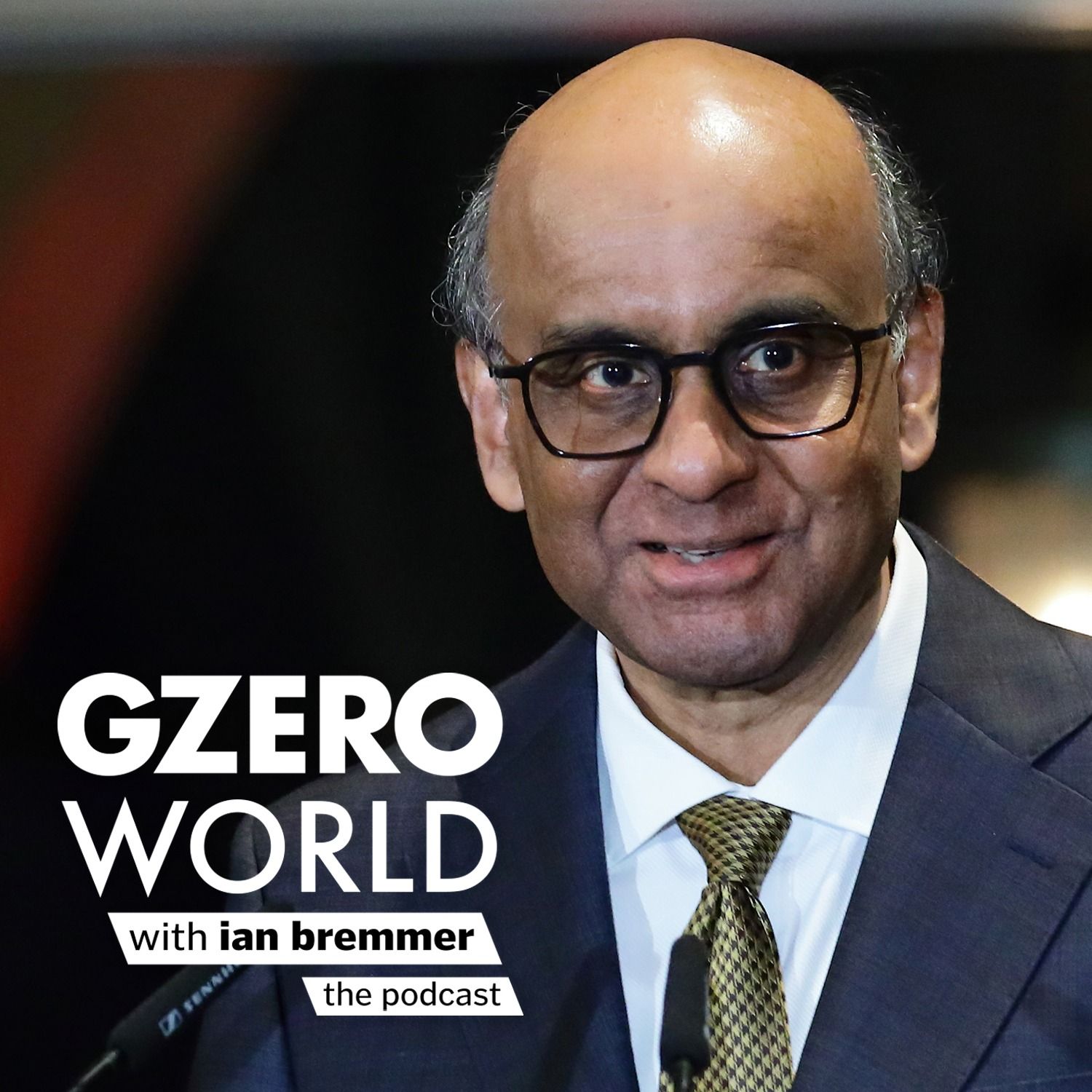
GZERO World with Ian Bremmer
Singapore's global moment, with President Tharman Shanmugaratnam
00:21:28
With close ties to both the US and China, can Singapore survive in an increasingly fragmented and chaotic world? Singapore’s President Tharman Shanmugaratnam joins Ian Bremmer on the GZERO World Podcast.
Loading summary
Transcript36 lines
- [00:03]
A
Hello and welcome to the Gzero World Podcast. This is where you can find extended versions of my show on public television. I'm Ian Bremmer and I'm coming to you again from Davos, Switzerland, where I've been meeting with heads of state and business leaders and the other totally normal people who gather each year at the World Economic Forum. Today's conversation is with one of the most interesting leaders I sat down with this week, Singapore's President Tharman Shanmugaratnam. Singapore sits in an unusually challenging place in today's world. It's a close security partner of the United States at a time when Washington is increasingly confrontational and unpredictable. Singapore's economy is also deeply tied to China, even as US China relations continue to fracture. Now, for a small country at a global crossroads, managing that tension is far from abstract. It is central to its survival. And yet the city state has continued to flourish as a global hub for finance and trade and technology. Singapore, for instance, has some of the most advanced real world adoption of artificial intelligence anywhere. So let's get to it. Here's my conversation with Singapore's president.
- [01:20]
B
The Gzero World Podcast is brought to you by our lead sponsor, prologis. Prologis helps businesses across the globe scale their supply chains with an expansive portfolio of logistics, real estate and the only end to end solutions platform addressing the critical initiatives of global logistics today. Learn more@prologis.com.
- [01:46]
A
President Tharman Shanmugaratnam it's so nice to see you.
- [01:49]
C
Wonderful to see you, Ian.
- [01:50]
A
This is not our first rodeo here, but it does feel like it's the most uncertain, the most disruptive. Would you agree with that?
- [01:59]
C
Well, I think by any objective assessment, this is a moment in global history where all the old verities are now past us and we don't know where we're heading to. In other words, this is not a transition to some new world order. It's certainly not a transition to multipolarity, a term that's bandied about but suggests some semblance of balance and some semblance of shared responsibility. We're not anywhere close to that. All we have is that we're no longer in a world where a single dominant power oversaw global security, open global markets and global public goods. We are no longer in that world and we don't know what replaces it. What we do have very salient, is uncertainty, radical uncertainty. We have fluidity in international affairs, transactions occurring by the day, and we keep waiting for the next hotspot. So that's where we are at. But it means the task for countries large, medium and small is not to sit back and be intimidated, not to be dispirited, but to now construct a decent world order where you have a framework of rules that still respects sovereignty, that allows us to address the common issues that all countries are interested in, are self interested in. In other words, they are major issues which are not merely global issues, not merely issues that attract globalists, but attract every country in its own interests. And our ability to collaborate on those issues is going to be critical to satisfy the well being of our own people. So we've got to construct that new world order, or I should say we've got to construct multiple alliances of the willing, coalitions of the willing that enable us to address these issues even if we're not going anywhere close to that old world order that we knew.
- [04:23]
A
Now, I agree with everything you just said in the sense that we have enormous uncertainty that so many countries, so many people around the world want something that feels like a rules based order and it needs to be constructed essentially. But of course, at the same time we have the United States, which is driving the disruption not just by saying it doesn't want to play the global leadership role, but actually sort of undermining a lot of the rules that otherwise a country like Singapore would like. Whether it's the geopolitical actions in Venezuela or Greenland, or it's the economic actions in terms of the tariffs and the interventions. China's been doing that maybe not as suddenly, but we've seen that in the South China Sea. We've seen it in Taiwan. We've also seen it in terms of state capitalism. So how add that to your equation, what the Americans and the Chinese are doing.
- [05:20]
C
Well, the vast majority of countries, partly as a consequence of the 30 years of multilateralism that we've had. The vast majority of countries believe in the international rule of law, believe in open markets, and are now wanting to do more to liberalize their own markets and strike up alliances and believe that there's something in climate change and global health and the new risks of AI where cooperation will leave us all better off. The vast majority of countries believe in that and they are moving. They're moving. And this may be a.
- [05:57]
A
So you're saying the vast majority, but not the most powerful. That's the bit that I'm not hearing.
- [06:01]
C
That is true for now and I'll come back to that because it may not be a permanent state of affairs. The vast majority also now, and this may be a blessing coming out of the current state of disorder are now moving a lot faster to develop new alliances, new coalitions, new in ways that I would not have expected five years ago. There was so much inertia in the system, not just bureaucratic inertia, but political inertia. And that's now dissipating precisely because of the urgency of the moment, precisely because everyone is now having to sit up and realize that we have to exercise agency. And we exercise agency among small countries, medium sized countries and some large countries. Most of the largest problems in the world no longer require leadership by a single dominant power, but they require enough of a solid core of countries comprising enough of world trade, enough of world carbon emissions, enough of world expertise and technological innovation so as to be able to provide a new foundation for some form of multilateralism that will no longer be singular, will probably be multiple and organized by domain.
- [07:33]
A
So you'd surely put the EU MERCOSUR deal in that category.
- [07:37]
C
It's a good example because how long were they working on it?
- [07:40]
A
Decades?
- [07:40]
C
Decades, probably 30 years. It got going very quickly after April 2nd, after Liberation Day. The CPTPP is now talking to the eu. Very serious conversations. It'll take some time, but they're serious, workmanlike conversations. ASEAN is moving faster and ASEAN's also getting involved in discussions with CPTPP, and that's in trade, but in other areas too, in global health, on everything to do with the climate. And increasingly, and this is the area where we are least prepared, developing some form of global governance around AI so as to maximize and unleash the gains that its potential that is potentially capable of giving countries, including developing countries, whilst guarding against its worst risks is going to be critical.
- [08:40]
A
Yeah, I want to get to that. But before we get to AI, you mentioned we've got these areas, you mentioned a number of them, compelling areas where we're seeing all sorts of additional trade rules of the road and economic rules of the road. Because there are lots of countries that together are meaningful in being able to put to construct that.
- [09:00]
C
Right.
- [09:01]
A
If I look at security, I see much less of that because the global economy looks like a global order that has a whole bunch of countries that are really relevant.
- [09:09]
C
Right.
- [09:10]
A
I don't see that in the security space. Are you necessarily much more pessimistic in the ability to create governance and collective security in that environment, given the consolidation of power around a much smaller number of countries that aren't necessarily as willing to hedge the way that you are suggesting?
- [09:28]
C
I think the key will be US and China Europe has already shifted its posture on security as a matter of necessity towards Ukraine. You mean Ukraine as well as some other potential new threats. The US and China are absolutely critical and they're critical both in areas of traditional security concerns. They're critical when it comes to nuclear and they're critical when it comes to security from AI driven warfare. I think it is possible for the US and China to come to some form of understanding where they will continue to be rivalrous, continue to be intense rivals in the economic sphere, even in AI, whilst exercising restraint in others and even collaborating in some fields, because it'll be in their common interests most obviously. To take the example you've given, both the US and China want to rule out AI driven nuclear warfare.
- [10:44]
A
The one area that they've actually spoken together on. AI.
- [10:46]
C
That's right, yeah. They can also move further in AI to rule out some of its worst dangers. I think it is. It involves a shift in mindset both amongst the leading private sector players as well as governments around thinking about who's going to win the air race. There is no one AI race. There are several air races. There's foundational research, there's implementation and implementation in a whole set of different domains, from healthcare to robotics and factories to many other areas. There's about standards and the dissemination of standards globally which then get countries to buy into your AI stack versus someone else's. There's a whole set of races and it is most unlikely that either the US or China is going to win an AI race. And that should lean us towards thinking about a framework in which they continue to compete. But they actually find ways in which you can get win win. You can get collaboration in AI that strengthens its productivity potential, that spreads the solutions that are being used in some areas, whether it's drug discovery or some other areas, spreads them as widely as possible at a low cost, rather than develop whole AI stacks that are separate from each other. It's a classic case of the benefits of interdependence, but now magnified quite greatly by an era of AI.
- [12:35]
B
You're listening to the GZERO World with Ian Bremmer podcast, your weekly geopolitical deep dive into the world's biggest news stories, featuring in depth conversations with global leaders and newsmakers. To get more of Gzero's insights on global politics every morning, sign up for our free newsletter gzero daily@gzeromedia.com.
- [13:04]
A
So do you think that on AI governance and collaboration is the biggest challenge right now? That it's just too Fast moving is the biggest challenge that the companies are making so much money and they've captured the regulatory process that the governments are incapable of even starting to consider it. Is it the lack of trust between the US and China that's disentangled the researchers from talking to each other, working for each other? How do you order the challenges? Because I completely agree with you that it's the hardest area right now that's most essential to get cooperation.
- [13:39]
C
I think you summarized it well. It is quite different from the remarkable pacts that were arrived at during the Cold War between the US and the Soviet Union. It's quite different from reaching nuclear arms control. First, because it's not being developed or monopolized by states, but by the private sector. It's moving very fast, much faster than states are capable of comprehending. But I think it's. And also the fact that whilst you can count nuclear warheads, it's much more difficult to count algorithms and the many fold effects of algorithms. But I think if we are realistic about how we go about this, it'd be realistic in wanting to control the worst, to guard against the worst that AI could bring, something can be achieved. We gave the example of nuclear war and making sure that AI is not in control. Right. But in many other areas, the risks of runaway misinformation, the risks of cyber warfare, not I don't mean in the security domain, but in many other areas there's common interests. There's enough common interest to rule out the worst while you compete over the best. And there's enough common interest also in disseminating as widely as possible the productivity improvements that come from AI, so that the market grows for all the dominant powers in AI. And I would just say that whilst the US and China are critical in this, small countries and medium sized countries are part of the game. I give you an example. We hosted a conference in Singapore last year called the Singapore Conference on AI. It brought in hundreds of scientists, including over 100 Chinese scientists. Getting together the best minds, both the scientists, the engineers and entrepreneurs from the US and China is unfortunately no longer easy. But it's a role that small neutral countries like Singapore can play. There's a role that the Europeans play. This is going to be a role where it's not just the countries or the companies that are doing the foundational research and building the most powerful LLMs are going to be dictating the directions. Europe actually has leverage because it's a major consumer, major market for AI. The world at large has to now see every form of global cooperation as not just being led by a single player or a large or major power. They've got to be at the table. But we all contribute and we all act in some way to make sure that guardrails are in place. Because sometimes it's the most vulnerable countries that are the first to want to institute guardrails and the major powers eventually come on board.
- [16:56]
A
So Tharman, one of my favorite quotes is from William Gibson. The author says the future's already here, but it's not evenly distributed. We talk about AI. Singapore has been one of the most technology forward countries in the world. Advanced industrial economy, 6 million people, ish 60% diffusion of AI. How do we, if we look at Singapore as near future in that regard, how do you experience AI differently in your country than a lot of other countries do? What are you already seeing happening in the way the government works and the way society functions?
- [17:31]
C
Right. Well, every city or economy or firm that's more exposed to AI is going to face a challenge. We will face the challenge faster than some countries which, you know, don't have the basic digital infrastructure, which is going to be a problem for them because they're not going to be able to take advantage of AI as much. But we'll face the challenge quicker. Our advantage, however, is that we've always faced the challenge faster than other countries because we are small, we are very open and we rely on technology as a source of competitiveness. So we look at AI, like every other form of productivity improvement as a plus. And the real challenge is that we want that plus to be distributed up and down the workforce. That is going to be a challenge everywhere in the world. And it's not obvious that we are going to succeed. It requires very active public private partnership. We always knew that when we talked about skills upgrading skills, continuous skills training. But it's going to be much more of a priority in the future because this time around you're talking not just about those who are doing manual jobs or relatively simple jobs, having to be retrained. We know how to do that everywhere in the world and we do it quite well. In Singapore, we're now talking about a large middle layer of the workforce. White collar workers having to be not just reinvested in so that they can work with AI or find roles complementary to AI, but perhaps reinvested in to move into other areas to meet new demands in healthcare in a whole range of areas. I think we can do that well in Singapore because it's just part of our economic side.
- [19:20]
A
But are you Starting to already prepare.
- [19:22]
C
For that from a policy perspective and how you started some time ago, because it's already been a habit in Singapore. Anticipate challenges and not wait for them to come upon you before you start reacting. We have Skills Future, which is a major national movement, which the government puts resources into to ensure we invest at periodic intervals through a person's life. And it's going to be more important than ever before. Because I think if you think about this challenge not as a threat from a new technology, but if you think about it as a challenge of how do you maximize human capital, how do you achieve mass flourishing of a society, it's actually something on the supply side. It's something you do to build up people's capabilities. If you build up people's capabilities, something works out. Something works out. It works out for them and it works out for your whole economy. You manage to move on to a new phase of competitiveness. So focus on capabilities. Even if you don't go about it by way of traditional industrial policy, trying to get an exact matching of demand and supply and thinking you can predict the future.
- [20:33]
A
If we look forward, in five years, is the Singaporean government going to be as powerful in Singapore, or are private sector companies going to be a lot more influential?
- [20:45]
C
Our whole model of economic policy in Singapore was quite different from the traditional model in Northeast Asia. For instance, it was always a model of watching the market, following the market, and allowing the market to work better and faster. So a whole industrial strategy, a whole economic strategy consisted of talking to leading companies local and foreign, finding out what their plans were for the future, and then saying, let's try and create an ecosystem to make this happen faster and make sure that workers can benefit. So we were always involved in ecosystem building. That's what the government was about. It was never about government versus private enterprise. It is about creating ecosystems where private enterprise can do well for itself, but most importantly, where our people can be part of the prosperity.
- [21:39]
A
President Thurman Shalom Goratman. It's always good to see you.
- [21:42]
C
Thank you. Thank you.
- [21:48]
A
That's it for today's edition of the Gzero World Podcast. Do you like what you heard? Of course you do. Why not make it official? Why don't you rate and review GZero World? 5 stars only 5 stars. Otherwise, don't do it on Apple, Spotify or wherever you get your podcasts. Tell your friends.
- [22:11]
B
The Gzero World Podcast is brought to you by our lead sponsor, prologis. Prologis helps businesses across the globe scale their supply chains with an expansive portfolio of logistics, real estate and the only end to end solutions platform platform addressing the critical initiatives of global logistics today. Learn more at prologis.
- [22:31]
A
Com.