← GZERO World with Ian Bremmer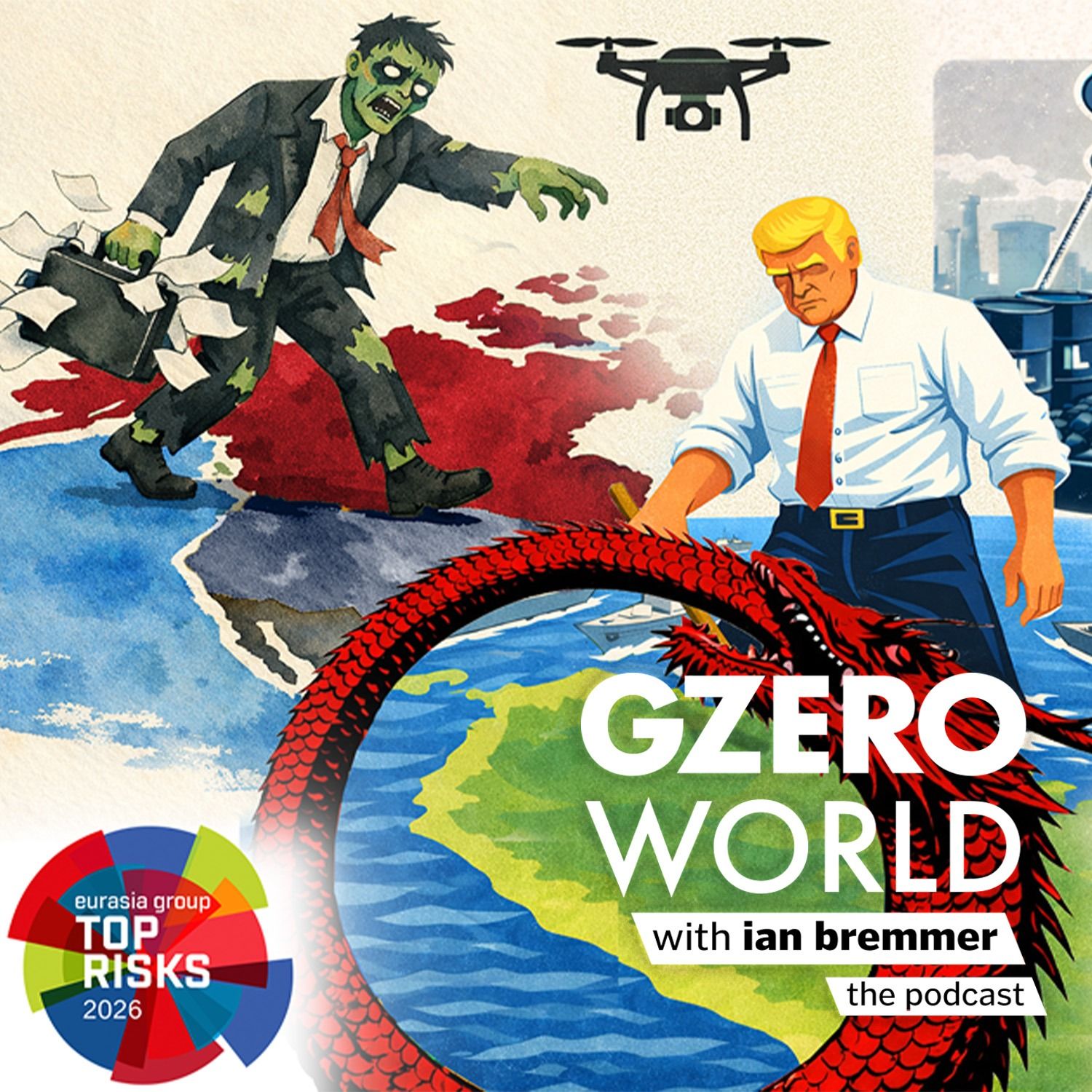
GZERO World with Ian Bremmer
The biggest geopolitical risks of 2026 revealed
01:01:54
With the global order under increasing strain, 2026 is shaping up to be a tipping point for geopolitics. From political upheaval in the United States to widening conflicts abroad, the risks facing governments, markets, and societies are converging faster—and more forcefully—than at any time in recent memory. To break it all down, journalist Julia Chatterley moderated a wide-ranging conversation with Ian Bremmer, president of Eurasia Group and GZERO Media, and a panel of Eurasia Group experts, to examine the findings of their newly-released Top Risks of 2026 report.
Loading summary
Transcript81 lines
- [00:03]
A
Hello and welcome to the GZERO World Podcast. I'm Ian Bremmer and in this special edition of our program, we're bringing you a look at the top geopolitical risks of 2026, the 20th edition of our annual report. Every year, Eurasia Group releases a forecast of the global risk landscape. From the future of US power and political stability, to wars in Ukraine and the Middle east, to intensifying competition between the United States and China and the rapid rise of artificial intelligence, the risks facing the global system are converging in new and unsettling ways. We're also seeing a much more assertive American posture closer to home, underscored by dramatic developments in Venezuela and a renewed effort by Washington to shape political outcomes across the Western Hemisphere. In a conversation moderated by journalist Julia Chatterley, I was joined by Eurasia Group chair and my co author on the report, Cliff Kupchen, and a panel of Eurasia Group experts to break it all down.
- [01:13]
B
The GZERO World Podcast is brought to you by our lead sponsor, prologis. Prologis helps businesses across the globe scale their supply chains with an expansive portfolio of logistics, real estate and the only end to end solutions platform addressing the critical initiatives of global logistics today. Learn more@prologis.com. Hello everyone. Happy New Year and welcome to an exclusive GZERO Media livestream. I'm Julia Chatterley. 2026 is a tipping point. Those are the first words of a highly anticipated annual report released just this morning by G zero's parent company, Eurasia Group. It details top geopolitical risks the world is facing as this new year begins. Now, for 20 years, the team at Eurasia Group has produced this top risks report. And this edition, as always, brings surprises and warnings for the year, but also a very clear sense, I think, of how much the political landscape is evolving. Some of the risks and you'll recognise them. War in Ukraine, now entering its fourth year. The impact of artificial intelligence on society and US China, competition. They continue as we enter 2026. But there are also new ones on the horizon too. And just this weekend, as many of you will have seen a major development as a US military operation captured Venezuela's Nicolas Maduro, a move that will have ripple effects throughout Latin America and the world. And as a result of this developing story, we're going to take the list a little out of order today and bring you the latest on Venezuela and some of the big implications too. So let's start with the co authors of this report. Ian Bremmer is the president and founder of Eurasia Group, Ngzero Media. And Cliff Kupchen is Eurasia Group's chairman. Welcome to you both. Happy New Year. Lively start to the year, let's be honest. Ian, I'm going to start with you. Step aside. I think the Monroe Doctrine, you've long been talking and fleshing out the Donroe Doctrine doctrine, which is our risk number three this year. And it's about the Trump's growing focus on the Americas region. Just briefly, if you can explain the Dun Roe Doctrine for those who may not know it and how it ties directly to the last 48 hours.
- [03:40]
A
First, President Trump just in the last several hours, has embraced it himself. He's referred to it for the first time publicly as the Don Roe Doctrine, meaning, and we saw some of this in the national security strategy that was released a month ago, that the priority, not the limitation of American ambition, but the priority for US Foreign policy would be control political and military influence and relevant strategic economic influence over the entirety of its backyard, the Western Hemisphere, as defined by President Trump. Because of course, Greenland, it's not exactly the Western Hemisphere, but Trump thinks it is, so it must be. And this, the fact that Trump has decided that the Don Row Doctrine is what he's doing and he's just had this wild, even if short term success with capturing and the President Maduro and his wife and bringing him not far from where I'm sitting right now in New York City means that he's now going to do more of that and he's going to want to populate. He's going to talk about the Don Roe Doctrine and he's going to want to populate the Don Row doctrine with successes. Also, last year, the principal tool that President Trump used to leverage his power around the world was an economic tool. It was the tariff tool. That's the way he weaponized U.S. power. And he put those tariffs on Liberation Day, on pretty much every country in the world and even some places that weren't countries, some that just had penguins, for example, but they had tariffs as well. That is not what we're going to see in 2026. In 2026, he's much more constrained in not being able to use that economic leverage because he's got problems on affordability, because he's underwater in the polls on those issues, because the Supreme Court is going to rule on the IPA tariffs and probably contain him to a bit, and because China hit him in the face and he wants to have a more stable relationship with China, doesn't like the fact, they have so much leverage over him. So, so for all of those reasons, it's not about tariffs. It's going to be much more about the big stick, the security tool that he wields. The world is much more unipolar from a military perspective, in America's favor than it is multipolar economically. And the Americans don't have the ability to tell everyone, here's what the outcome is going to be. And that's going to play out this Don Row doctrine, not just in Venezuela, which we'll see over the course of this year. It's hardly the end of the story just because you've got Maduro out, but also we'll see with pressure against other leaders that Trump doesn't like in the region, that Rubio doesn't like, like in Nicaragua, like in Cuba, that we'll see in countries where the Americans have problems with the way that drug cartels are operating internally, like we're seeing with the US Ally, military ally in Colombia and in Mexico, as well as with Denmark and Greenland, which Trump is now saying the Americans have to have it, have to have it. And what does that mean? But for the Europeans, it means nothing good. And even more broadly around the world, the response to the United states embracing a G0 world, embracing the law of the jungle, and is going to have a chilling effect on so many countries that believe that they could rely on the United States to live up to agreements that were made that had nothing to do with how much power you have and whether or not the way you feel today is different from the way you felt yesterday. And so clearly the ripple effects from the Donroe doctrine are something we're going to be seeing all year in 2026.
- [07:33]
B
It's a more calibrated version of US interventionism. Cliff, weigh in here, please.
- [07:40]
C
Well, it really isn't many respects, a defining moment in US History. You have a president, a retrenchment oriented president, who has just made the domestic politics of another country priority number one for him. That's a dramatic transformation. I mean, I think part of the Don Row doctrine that really hasn't been looked at very closely yet. So other countries are now put on notice that if the president doesn't like the way you're conducting your affairs, you're, you're fair game, first of all. Secondly, I think we got to have a new model of US Interventionism. It could be called kind of offshore coercive governance. Right? I mean, what are we doing here? We're sitting offshore on an aircraft carrier and you know, we're telling Delsey, the. The vice president, that she better do what we say or else. Now, that's not nation building. That's kind of extractive coercion. And, you know, he may well try that again, you know, in Colombia and Cuba, but it really isn't a very different way of going about U.S. foreign policy. So in many ways, I think we are at a defining moment, and it's really important to think about it, describe it, and get it right.
- [08:58]
B
We're going to continue this conversation and hone in again on specifically what's happening in Venezuela. I want to bring in Eurasia's Group Director for Latin America, Risa Grace Targo. Risa, good to have you with us. You were just listening to that sort of assessment of certainly what President Trump views and the direction he perhaps is heading, not only in Venezuela, in the region, but what does the United States. And they've sort of walked back what President Trump said about running Venezuela. What do the next days and weeks look like in your mind? Yeah.
- [09:31]
D
Thanks, Julia. So, as my colleagues mentioned, Maduro's former vice president, Delsey Rodriguez, is now the interim president of Venezuela. She was sworn in over the weekend and appears to have the backing of other senior regime officials, including the military. And she has a Trump administration that seems to prefer working with her over the Venezuelan in opposition, despite Maria Corina Machado's recent Nobel Prize and their clear victory in the July 2024 presidential elections. You know, Trump has announced this plan to run Venezuela, which I think, as Cliff suggested, is about coercing Delsey into cooperating with US Interests, including a larger US Footprint in the oil sector, migration, and counternarcotics. And so far, it seems to be working, which isn't surprising as Delse has a literal gun to her head. You know, she initially struck a defiant tone over the weekend, but seems to be shifting her stance and expressing a willingness to work with the U.S. but I think there are a lot of potential tripwires ahead. You know, she's going to have to manage internal divisions amid a fragmented movement while also appeasing Trump, who has big demands. So not necessarily an easy task. And I think she's going to be under a lot of pressure to move toward new elections that are free and fair. That's not Trump's initial priority, but it will be for parts of his base, for other international stakeholders and Venezuelan voters who could end up taking to the streets. And many within the regime are going to resist this option because they control all institutions. This is going to require difficult power sharing negotiations and eventual amnesty guarantees. And while Trump was very committed clearly to ousting Maduro, I think it's less clear about his commitment long term to making sure that this works out. So, in sum, it feels like the start of a longer term change process, but it's certainly going to be volatile.
- [11:34]
B
Ian, what is Trump's ultimate aim here? I mean, Reese has just suggested that the eventual outcome is less important perhaps to Donald Trump than the immediacy of perhaps executing oil contracts, for example, and broader stability in the region. What is the message I think that he's trying to send because he was also suggesting in the aftermath of this, Cuba's looking rocky now, too.
- [11:58]
A
Well, he's been thinking about this for months. This is the military plan has been worked out very carefully. They didn't have people working with them inside the administration six months ago. They did. By the time they ordered the operation. They didn't have good intelligence on Maduro's whereabouts and his habits. They did by the time they actually made that happen. And, you know, Stephen Miller, who's been very involved in these operations all the way through, had come to the conclusion that anything would be better than Maduro. So don't underestimate the fact that a big part of the goal is just getting Maduro out. He was there, he was thumbing his nose at the American President. He was saying, I'm never gonna negotiate with you. He was, you know, doing the fake Trump dance with a bunch of civilians on stages, which was clearly only going to look like a red rag to a bull for someone like Trump that was personally offended by that. So a big part of the goal is remove Maduro. He's out now, and he's not just out, he's out and he's in the United States. No, no. When I first heard they were planning that a couple months ago, it was shocking, right, that what they were going to do was grab this guy and bring him to justice in America, in New York, by the way, the world's largest media market. So everyone is there covering it every day with the helicopters and all of the, you know, sort of the thousands of police and correction officers. And Trump loves all of that, right? He gets to read it and watch it constantly and that'll play out. I mean, it's gonna be bigger than O.J. right? I mean, in terms of the coverage of the trial, this is great for Trump. So a big. Do not underestimate that. A big part of it has already been accomplished for Trump, which means I'm Successful, I can move to the next thing. Right. I can talk about Cuba, I can talk about Colombia. Let's go on Greenland, give it 20 days. But soon we're going to start talking about that too. Right, but, but of course there is no plan for Venezuela. I mean, the plan for governing Venezuela is less well constructed than the plan for governing Gaza and that is a low fricking bar. Right? So what we're, what we're really talking about is Trump and Rubio and others believing that the or else is so clear and credible that you're now going to see Delsey do whatever they tell them to. Well, what are they going to tell them to do? We want the oil. Okay, but it's not like you're going to get the oil tomorrow. I mean, you can ask Reesa about this. It's going to take years, right, before you actually have the political conditions, the economic conditions, the companies lined up to do it. And the, and the rise of oil production is going to be, even then, 300,000 barrels a year. So it's, this is not tomorrow. And, and it's, it's not regime change, it's regime roulette. Right. They removed Maduro and then it's okay, well, whoever they put in next, we're just going to work with them unless they do something we don't like and then we're going to hit them hard with the military. That is still right there. So one thing I think we can say is I don't expect that the US military is going to suddenly leave and all steam to the Eastern med to take care of the Iranians. They actually do need to have this military in place to maintain the credibility of. You're going to do what we want. But you know, how much time, how much attention, how much focus will Trump give to Venezuela in the next three months compared to the last three? I suspect less.
- [15:36]
B
Rita, I can ask you about the oil and I know you're going to tell me years. I love the idea of regime roulette, as Ian, as Ian puts it, I guess There are 29 million Venezuelans. There are political factions, there are vested interests, there's corruption. Is Delsey, in your mind the right person to get to fresh elections? Which I guess is what the majority of people would like at this stage.
- [16:02]
D
I think in terms of figures within the regime, she's kind of the only option. She's the only senior member of the regime who's not under US indictment that doesn't have a bounty on her head. And she's generally along with her brother, Jorge Rodriguez, who is the president of Congress, been more willing to engage with U.S. officials, been more pragmatic towards foreign companies. She's been, you know, leading this effort to bring Chevron and others back into the oil sector, whereas the other figures around her, I think, are not palatable to the US or any other. So I think within the regime, she's kind of their only option and that it's incentivizing everyone to. To rally around her. But as I said, she has a lot of internal, kind of domestic constituencies that she's going to need to be managing and not to mention the Venezuelan voters and what they want. And I think we could see significant pressure domestically growing over time, especially if Machado decides to return to the country and try to insist on her leadership and force new elections on a faster timeline.
- [17:11]
B
Yeah, you're going to be a busy woman, Risa. Thank you so much.
- [17:15]
A
Zero sleep in the last. I already asked, when did you find out about this, Risa? Was it like 1:30 in the morning where you were?
- [17:22]
D
I was in Mexico. 2:30am yes.
- [17:25]
B
Yeah. She's like going on fumes.
- [17:27]
A
She's crushing it.
- [17:28]
E
Yeah.
- [17:29]
B
Awesome. He said thank you.
- [17:31]
A
Thank you.
- [17:32]
B
Let you go. Try sleep.
- [17:34]
D
Okay.
- [17:35]
B
We're going to take a step back before we examine some of the other top risks at this stage and just look at the big picture moment. And Ian sort of framed it to some degree, but we've sort of gone into this risk report and I mentioned it at the beginning, talking about as being at this tipping point. And it's been after, I could say five, I could say more of sort of compounding crises. Ian, what does it mean in the, in the macro sense, this sort of tipping point that we're, we're discussing in this risk report?
- [18:03]
A
It means that the United States, which has been such a reliable partner for so many of its allies for such a long time, and the US is, of course, the most powerful country in the world, has suddenly become dramatically less so. And that's true for almost every ally. There are exceptions, but general and, and so the most transactional, like the Saudis and the uae, I think, feel equally comfortable with the Americans now than they have historically. But the closest allies of the US that have most relied on the US for collective security, for free trade, for common values, for promotion of democracy, this kind of thing, which the Americans have not always done consistently, have frequently been hypocritical. But nonetheless, these are America's closest allies. Canada, Mexico, all the Europeans, the United Kingdom, Japan, South Korea, Australia, every single one of them feel like this is a geopolitical crisis. This is a change of the global order. For decades now, Julia, the presumption was that what was happening in the world is that the Americans were eventually in decline, the Chinese were getting stronger, and that that was going to lead to a conflict between these two great powers. The Americans holding on to their old global order and the Chinese trying to create a new one. That is not what's happening at all. What's happened is that, yes, China's got. Is getting much stronger, and you're going to hear from Jerry Butz on that in a little bit. But the United States is still very strong militarily, still very strong, technologically, still very strong in terms of the dollar and the financial system. Its allies have gotten weaker. And the response of the United States to its allies getting weaker is we no longer need these countries. We can get better deals by pushing them around hard. And it's another big point is that there is a spectrum of American action, and it goes from fafo to taco, okay? And fafo fuck around and find out is what happens if you are weak and you are doing stuff Trump doesn't like. And you can be an ally or you can be an adversary, right? You can be Canada or you can be Venezuela, but you get fafoed, right? On the other side is taco. And taco, right, which is Trump always chickens out, is if Trump finds out that he can get hit hard by you and that's going to hurt him. And that. And China is right on the taco scale, right? And Russia, turns out, is more on the taco scale than people thought. Brazil is more on the taco scale, right? Because it turns out that Trump really needs those commodities. And so he isn't going to punch him really hard on Bolsonaro, even though that was a big deal, right? And then the big question is, well, where are the Europeans? Are the Europeans taco or fafa? And again, we'll talk to Midge shortly. But right now, Trump certainly thinks that the Europeans are all fafo. And if the Europeans can't figure out to become a little more taco friendly, they're in very serious trouble, right? And that's. I mean, it's kind of stupid that that's what it's about. But this is the G0 world. This is the law of the jungle. It's not about, are you aligned with the United States, are you friendly, do you have the same political or economic system? Did you. Did your kids go to school together? No, it's really not about that. There's definitely some kleptocracy, there's definitely some you can pay for play here. But it's absolutely about power. It's absolutely about power. And this is a big problem for the United States because the US Is acting like a country that has the ability to project power through a unilateral system for decades, but it isn't. It's actually still a dysfunctional representative, more or less democracy that has regular elections and Trump is out after 2028. And so all of this great sounding FAFO stuff then gets undone by the next president. And meanwhile, the Americans have destroyed their alliances all over the world and their reliability. So long term, this is a really, really damaging time. And that's why it's a tipping point.
- [22:15]
B
Cliff, very quickly on this because I think Ian's framed it brilliantly in many respects. You've been compiling this risk report now for 20 years. Is this in your mind sort of peak, at least since the risk report began, of the sort of geopolitical risk that we've seen?
- [22:36]
C
Peak of the geopolitical risk structurally, Maduro. The Maduro episode represents a real sort of spike, I think, in risk because it puts so many other countries on notice that if they just keep doing the same thing they've been doing, they could get hit. But let me offer one. We have been doing this for 20 years and to me, the most important sort of development, tectonic plate development that has led to these spikes in geopolitical risk, and I think we just have to work this in, is that major parts of the populations of the United States and Western Europe have decided that globalist values just don't work for them. And I think that's what's led to the Trump phenomenon, to the AfD phenomenon, which Mitch will talk about the right wing populism. It's that change that has, I think led to the greatest risks we're seeing now on the deepest level.
- [23:44]
B
We're going to come back to much of that as we continue through the hour. I want to move on. And given that we've talked about the sort of number three risk, we're going to look at the next top two. And just while I'm talking, I encourage everybody to download and read this report. It's certainly worth it. Let's bring in Eurasia's group vice chair and senior advisor Gerard Butts for the next part of the conversation. Gerry, great to have you with us. We're going to talk about risk two. Actually, it sort of weaves in what we've already been talking about, but very much the emphasis on risk one when we get there, Risk two is overpowered. And it speaks to, as we've discussed, this enormous competition between the United States and China. And it's not just about innovation or building, it's about where and how you use the energy, where you get the energy from to do it. Just explain this risk for us.
- [24:37]
F
Sure. Well, fundamentally, Julian, happy New Year to you and everybody who's joined us today. Fundamentally, it's about what energy system is going to be the primary one for the 21st century. And for a long time this is a risk that has been in the background for a long time. Sometimes it's manifested itself as a response to climate change, sometimes it's been a nationalist energy policy in different states. But fundamentally it's about what is going to succeed. The carbon molecule as the most important form of energy in the world. And the Chinese at the beginning of the 20th, 21st century made a very long term, very expensive, very strategic bet that that was going to be the electron. And as a consequence, they have built an entire stack that fuels, pardon the bad pun, both their economy and their national security apparatus, from their military to their a based surveillance system on down where they have galloped ahead of the rest of the world when it comes to advanced development of what we're calling an electro state. China is the first electoral state in the history of the world. And in some ways what you're seeing in Venezuela and through the Don Row doctrine is the American response to that. It is the consolidation of conventional energy under the American security and economic umbrella. And I wouldn't be a good Canadian if I didn't use a hockey analogy. Julia. That's all pre game. That's all pre game. We're about to see the puck dropped in 2026 and it's still a very open. It's an open game out there as to who wins.
- [26:22]
B
The report frames it really beautifully. It says the US is looking to sell 20th century energy. Trump's made it very clear Petro state is the future. But China's selling 21st century infrastructure. And certainly where things like AI are concerned, that's critical for you engender partnerships going forward. And that of course is part of the strategic competition between the United States and China. It's sort of pivotal to their relationships around the world too.
- [26:46]
F
Oh, absolutely. It's pivotal to the competition between those two states and also their ability to project power both in their near neighborhood and around the world. It's going to be a fundamental question that we'll be following for years.
- [27:01]
B
Gerry, thank you for that. We are going to reveal number one risk now. But I do want to pull in the fact that Eurasia Group surveyed followers across social media and they did ask this question. Which of these regions, countries or issues do you think will top the list for top risks in 2026? United States, China, AI or climate? And we can reveal the answers. 51% of people said the United States, China, 13% AI, 29% climate. Way down there at the bottom. No one cares about the climate anymore. Just 7%. Ian, very quickly on this, are you surprised that China is so low relative to something like AI?
- [27:44]
A
I'm delighted that AI is getting the attention that it deserves because it's so momentous, it's so transformative, it is affecting everyone's lives individually in ways that a lot of these other things feel more distant. And a couple of years ago you wouldn't have gotten that AI response at all. So it's the sharpest trajectory. But I mean, look, the China is not getting the attention it should, either on the global stage or from the Americans. Right? I mean, you go and talk to the people in the national security apparatus in the United States, they're worried about the 800 pound gorilla. That's China. You talk to members of the Senate Foreign Relations Committee, Republicans and Democrats. I was talking to one of them this morning. They're worried about China. But that is not where the US Priorities are. That's not where the Trump administration is right now. And so as Jerry just said, what we're seeing is that the Chinese are playing the long game and the United States is not, is not. The US Is racking up enormous numbers of very short term headline wins. And the Chinese are not going to be distracted by that. Not at all. And that I think that that is going to be. If we were not looking at 2026 where US China is a herring, it's not even a risk. Taiwan isn't even on the list. You know, when the Japanese came out and they said, hey, we'll defend Taiwan, and Trump did nothing. He calls Takechi Sanae, the new Japanese prime minister who had just been jumping up and down in Okinawa saying, I'm so happy to be with American president, it's like, ah, just calm it down a little on Taiwan. We don't really want any problems with them right now. I mean, US China is not even on the list. It's a red herring. Right? And that is because the Americans have become Enormously short term. Right. Transactional with a president who is driving a different set of preferences than the long term interests of the U.S. national security, economy and population. And the Chinese are authoritarian, they're controlled by Xi Jinping. But the Chinese leadership is thinking long term about how to ensure that China becomes stronger. And they actually have a system that's oriented towards executing on that strategically.
- [30:04]
B
You're teasing China. AI and some of the red herrings for later. I'm going to stop you there and I'm going to talk about.
- [30:10]
A
I see that Jerry wanted in, though.
- [30:12]
F
I just wanted. Sorry about that, Julie. You just looked down when I politely put my finger up there.
- [30:17]
A
Canadians, you got to just jump up.
- [30:21]
F
I'm still reeling from our placement on Taco Continuum there, Ian.
- [30:26]
B
Oh, I slipped over the apologize for that.
- [30:29]
F
The thing about that continuum is you better be right about your assessment because if you put someone on the wrong end of it, you're in trouble. I think it's worth taking a step back and just making the overall macro observation that is reflected in that poll. The United States has gone from being the world's most important shock absorber of political risk to its most significant generator of political risk. And so much of what we're talking about, talking about in the report and so much of what we talk about with our clients is a reflection of that large macro change. And I do think Cliff is right, that its root cause, if I dare use that phrase, is in a bunch of Westerners in particular in the United States deciding that globalization was a scam that didn't work for them. And whether they're right or not is immaterial at this point.
- [31:21]
B
Point so important and so perfect for what is our top risk this year, which is US Political revolution. And Ian, I go back to last year's report and you warned about what you called the rule of dawn, this sort of tactical norm breaking. We are so far beyond that at this stage. And it permeates all segments, the corporate world, the legal world, the media world, and the checks and balances that, that there should be in the United States simply aren't there or they're weak.
- [31:55]
A
That's right. And if you go back to the beginning of 2025 and ask people, okay, what sort of decisions do you think Trump is going to make that will really challenge the norms and the checks and balances on the US Executive? They all underestimated what would happen over the course of the year. And if you ask them, if those things were to happen, what kind of responses would there be what kind of resilience and resistance would there be in the system? They all overestimated the resistance and the resilience that there would actually be in the system. So what we wanted to do was take a look, a very careful look at the actual risks that we saw over the course of the year and say, how does this reflect a political revolution? An ability and willingness to fundamentally change the political system, to weaponize the political system, the administrative state, as well as the ability of the executive to act without checks and balances, to weaponize it the way that Trump believes that the system had been weaponized against him, leading to his two impeachments, unprecedented, all of his convictions, felony convictions, unprecedented, and his not unprecedented, near assassination. And what we see over the course of the year, right, we looked at this just a number of the actions and we put them on a two by two grid, which is in the report where you see that some of them are on the how much of the norms eroding and some of them are how much of the checks eroding. And if the norms and the checks are both eroding severely, you get a revolutionary outcome. If it's the norms and not so much the checks, it's norm breaking, but not system breaking. And if it's neither the norms nor the checks, you get a whole bunch of headlines because people in the US have their hair on fire all the time, but in reality, not something you need to spend that much time on. And you know, when you go back over the year and you look at the agency shutdowns and the IPA tariffs and the National Guard deployments and the Act Blue investigation and the firing of independent commissioners and the pocket rescissions, the university grant freezes, the Comey, the James Letitia James prosecutions, the law firm sanctions, the news organization suits, the Qatari jet suit, the NSC firings, the Jimmy Kimmel affair, I mean, I'm not just getting. That was only one quadrant, I'm just getting started it. We've never seen anything like this in the US the only president that is comparable, that has made an effort at a political revolution was fdr. So we did some research on FDR and we compared him to Trump and he tried to pack the court, he failed. He tried to purge his own Democratic party, he failed. He massively expanded the administrative state that allowed for the passing of the New Deal. But that administrative state under the executive actually had significant constraints in how it could behave. It was not at the hands of an individual president. He actually codified the administrative state where Trump is actively trying to ensure that there aren't constraints on a president that should act above the law. Him. And in my lifetime, there have been three revolutions at scale that have had macro impact. There's been the Chinese revolution under Deng Xiaoping, which succeeded an economic revolution and led to 50 years of unprecedented growth in China's rise. There was the Gorbachev revolution in the Soviet Union's political and economic. It failed wildly and it led to Soviet collapse. And now there is the political revolution under Trump, Trump. And we don't know if it's going to succeed, but we certainly know it's being tried and it is going to gain momentum this year. And if it turns out that Trump starts losing influence because his popularity is down and the economy is not doing as well right now, that's the trajectory. If that continues, we do not believe that he is going to say, okay, okay, I'm done. He's going to double down now because he understands, as does Steve Bannon, as does Stephen Miller, as do Cash Patel, as do so many of the inside circle, that if they lose, given all the things they're doing, they're probably going to jail. Right? They're going to lose a lot. And so, I mean, they are weaponizing the system. And the United States today is by far the most politically dysfunctional, advanced industrial economy in the world. And that, of course, a political revolution. Describing that with the country that is the most powerful when our risks, look at impact, imminence and likelihood is number one. It drives all the things we've talked about so far. It underpins them, but it's number one. And the trajectory is not sustainable. So I personally, we do not collectively think that the political revolution in the US Will succeed. We think it will probably fail. We do not have high confidence, but we think it will probably fail. But. But we are. We are quite confident that it will get worse and more disruptive before it gets better. More things will break. And that breakage will have permanent implications for the US Political system and for its relations around the world and for the global order, such as it exists, which is kind of extraordinary. I mean, it's an amazing time to be alive. Geopolitically, I'm not sure it's great, but it's amazing. Every day there's something new. You get to believe 10 things that you thought were impossible before breakfast. It's very Alice in Wonderland.
- [37:41]
B
What, just 10?
- [37:44]
A
Easily. Maybe it was 12. I can't remember the book. Lewis Carroll was a long time.
- [37:47]
B
I think I'm being conservative. Yes, it was a beautiful way to link to some of the other top risks and I do want to weave those in now as well. Among the top five involve Europe, one, as you would expect, focused on Russia and Ukraine, and the other, a sort of broader picture, I think, of the political turmoil and economic challenges that those Europeans, some of the larger Europeans certainly face. I want to bring in Mitch Rahman, he's managing director for Europe Europe at Eurasia Group as well. Mitchell, I wanted to start with you. What is Europeans Europe's mindset at this point? And if we sort of hone in first on what we're seeing from Russia, Ukraine, the pressure from the United States with regards to some kind of cease spiral or negotiated solution. Europe's Europeans obviously have challenges of their own. What's their mindset at this moment?
- [38:36]
E
So it's great to be here. Julia, thanks for having me. Where are the Europeans that totally exhausted, frankly. They're, they're fatigued, they're weak, they're vulnerable. I think, as the top risk report makes clear, they're being besieged both from without, as Ian has talked about, from Russia and Ukraine, from their historical ally, the United States, from China regarding their competitiveness and the erosion of their industrial base, but also from within, given the massive populist challenge that exists in the three largest economies where the far right is in the ascendancy in Germany and France and indeed the uk so that's the context. I think the operational goal for the year is support Ukraine, and I suspect in the narrow sense they will continue to do it. The question I'm asking is at what cost? Because credible support for Ukraine does depend on a constructive relationship with America. Right? The Europeans are buying US weapons and kit to keep Ukraine in the fight. The Americans are key when it comes to intelligence and strategic enablers. The Europeans are fully dependent on the US through NATO to deter Russian aggression and only have a pathway to look after their own security over the next five years. Some of them don't even have have that pathway to get to that 3.55% renewed NATO goal. And so this has to work with a constructive America. And that's where I'm worried, because that relationship is no longer constructive. If you think back to last year, the Americans realized the extent to which the Euros were dependent on them in Ukraine and they extracted a 15% tariff for the price of continuing their support in the Ukraine theater. And with respect to NATO, we may continue to see threats of that kind manifest this year, most acutely, I think, in Greenland. You know, if the Americans war to do something annexing the territory, territory of an ally. What could the Europeans conceivably do given the vulnerabilities that exist not only in Ukraine, but also with respect to NATO and elsewhere? So that's the context. That's what concerns me. It's not a pretty picture when you think about the outlook for the rest of the year.
- [40:52]
B
And just come in here briefly on this as well, because I think the key difference that I see, and it's, and it's obviously very difficult with Ukraine and Russia now it's the fourth year that we're talking about, what's really different between the risk reports of last year and this year is perhaps how NATO's response evolves.
- [41:10]
A
Yeah, the fact that NATO is seeing that this asymmetrical warfare is increasingly affecting their national security directly, especially the frontline states. Just over this weekend, you saw that this Russian boat, boat was dragging anchor and was stopped Finnish police after it was ripping up fiber optics and cable. There's been the drones that have been heading into Poland and Romania. There have been the weather balloons in Lithuania. There's been all of the people that have been paid over telegram some Russian ethnic, some others in countries across Europe to engage in espionage, vandalism, in some cases blowing up a train or trying to assassinate the CEO of the German largest defense company. These are issues that increasingly NATO countries feel like they can't necessarily rely on the Americans. They have to do more and their willingness to do more, which is going to become operationalized. They're debating right now whether it's taking offensive cyber measures against the Russians directly or whether it's, whether it's exercises around areas that aren't well defended on their borders with Russia, whether it's responding directly to drone strikes or to military exercises by the Russians and their fighter jets with closer, more dangerous activity. All of that implies that this Russia Ukraine war that's been grinding on the world has gotten used to. Even though it's been so incredibly damaging for the Ukrainian civilian population and for the Russian soldiers who are dying in staggering numbers, the rest of the world has been like, ah, okay, I guess this is stabilized. You know, if Russia's involved in an asymmetric warfare with frontline NATO states and they believe that they have the ability to start breaking NATO apart because of what Trump is doing and also the necessity to. Because their own economy is doing a lot worse, because they're under a lot more pressure, because the Russians aren't actually performing well at all. Not their military, not their economy, not even their political system, this does get more dangerous. So the risk is fundamentally about the fact that what we thought was a more kind of like frozen conflict that Trump wanted to end unsuccessfully over the last year actually has a lot of escalation risk. And that that's true even if we see negotiations move towards a ceasefire. So, yeah, absolutely. Even in a year that the United States is driving so much of the geopolitical risk, the Russia, Ukraine war and its broader implications deserves significant attention here. And the Europeans are really vulnerable.
- [44:10]
B
Can I ask very briefly about what Putin is thinking at this moment and draw on some of the specific Russian whee. Wisdom that we have on this live stream. I can't help but go back to the Venezuela example and the video that the White House put out, basically showing Trump celebrating taking down Maduro, the hard guy. I wonder whether this changes any of the calculus and the thinking for Putin at all this year. Jerry or Cliff? Cliff, let me try. I can see your ego.
- [44:42]
C
Yeah, I mean, I've spent a lot of time around Putin, so let me take a crack at this. He's, he's a hard ass, man. He is, you know, he's very hard boiled. With the exception of the Ukraine invasion, he's really been a pragmatist. You know, he'll take note, he deals in, he traffics in raw power, in hard power. So I, I think he'll take note that Trump is willing to use it, but at least in his region, and he does believe in spheres of influence. We don't, but he does. And that's what this war is about. At least in his region, it's still going to be brass knuckles. And you know, and in fact, I don't think it will change much the calculus of the Russia, Ukraine war, the Maduro thing. But I do worry that when Putin sees Trump doing this, he's going to look at Kazakhstan or Georgia, one of the neighbors who may be misbehaving, and say, well, you know, if he did it, and I've always wanted to do this anyway and now I can do it, and that's what I worry about.
- [45:50]
B
Mitch, I want to come back to you finally because the focus here is Europe and as you mentioned, Germany, the UK and France this year, all facing some form of regional elections, which really just give us a flavor of what the rightist party will achieve this year. What are you expecting?
- [46:12]
E
So I think, well, they're all stuffed in their own different ways. Right. I, I don't think Starmer will see out the year. You know, he's out there trumpeting achievements of his government in the first 12 to 18 months in office. The problem is I just don't think people feel better. And there's going to be a brutal set of midterm regional elections, Scotland, Wales and to the English councils on 7 May. Labour is going to be destroyed in all of those contexts. And that, I think is going to raise again the specter within Parliament of Starmer and his leadership just not being fit for purpose. Interestingly, I'm hearing he may table the King's Speech just in the aftermath of those midterm elections to try and stave off a leadership election so he could conceivably cling on till the autumn. But I think fundamentally the ship has sailed and many Labour ends MPs have already come to the conclusion that he is not the right leader to carry them through the next general election. So I think there'll be a challenge. I think the challenge will succeed and I think Angela Rayner, if she chooses to run, will replace him. And of course, that creates a whole set of questions about how credible an Angela Rainer would be, not only on domestic economic policy, but in light of all the geopolitical issues and questions Jerry, Cliff and Ian are talking about out Macron. You know, if you look at France, Julia, it's not much better, right? I think they get a budget through Parliament and I don't think the assembly will collapse the minority government and there won't be an early election because the glow of 2027 and the presidential elections is something that's motivating all of the political parties now. But that means best case scenario, Macron's a lame duck and the country's adrift for 12 months, either irrelevant or not doing very much. You know, Macron trying to be relevant on the international stage, but, but more or less annoying all his peers and not being particularly effective. So I think that's best case scenario for France. Germany is the country that is kind of least far along that curve, if I can express it that way. But, you know, we assess there's a 30% chance the coalition may implode at the end of the year because there are regional elections throughout the year. If you think about the third quarter, the government will be in a super challenging budget negotiation. The the coalition is already ideologically tearing itself apart between the left and the right, and the AfD will come first in all of the eastern regional elections. That will heap more pressure on Merz and his leadership. So even Germany, you know, there is of course a premium for stability in Germany and the likelihood of a government collapse or coalition collapse may not be high, but one can't exclude it completely. And that's your three major economies, economies in Europe. I think they are the driver of many of the risks and the ineffectiveness and the weakness and the vulnerabilities the Europeans will experience this year.
- [49:04]
B
Yeah, in a nutshell, messy and distracted, I think.
- [49:11]
E
Absolutely.
- [49:12]
B
Yeah. Mitch, fantastic to have you with us. Happy New Year again. All right, we're going to have a look at some of the other risks in this report as well. And I do want to of home back in on China because we talked about it briefly. But Cliff, let's talk about risk number seven because this is China's deflation trap. And as we enter 2026, I think it's now 10 straight quarters of deflation for China. Just explain what this means and how much of a risk this is for the rest of the world.
- [49:42]
C
Well, it's a very bad situation for the Chinese economy. It's over competition. This word involution which you keep hearing when you go to China and it means too much competition, declining wages, increased debt load, relative worth of debt is higher and higher. It's higher and harder and harder to pay back. You get more enterprise failures in an economy like that, which puts strain create social pressures. Youth unemployment is already 17% officially, much higher. Unofficially. The youth are really getting whacked. They just can't get jobs in a state where wages are falling and falling and you get this lie flat movement. Now many Chinese youths are just checking out the social contract is breaking. The first sort of global import is one of the two largest economies in the world is under increasing stress because of deflation. Not to the breaking point, but bears watching under increasing stress. The second point for global relevance is that China is now exporting deindustrialization. And it kind of works like this that with overcapacity doubling down on the model that produces overcapacity. When you trade with China, you get your nascent industries beat down. So deindustrialization, not prosperity is what the world is getting, is what China's exporting. And that's a pretty big deal.
- [51:24]
B
I want to move on to risk 10 as well. One of my favorites actually the water weapon. It's called water scarcity. We've seen crisis hit cities like Mexico City, Tehran, obviously in Iran certainly. But this is also playing into interstate rivalries too, which is fascinating to me. And it's in the report again, which I recommend you will read. Ethiopia versus Egypt, Morocco versus Algeria India versus Pakistan. We don't talk about this enough, Gerry.
- [51:52]
F
It sort of reflects the overall risk environment, Julia, when the fact that almost 2 billion people can't have reliable access to daily water is sort of number 10, right in energy transition and climate circles. People talk about, about a post carbon economy all the time. Well, there's no such thing as a post water economy. If you don't have it, you don't have an economy because you don't have people around to conduct one. And this has been a risk that we've focused on in past reports and it's one that we talk to clients a lot about. It's manifest. This is the way people feel climate change. And no matter what's happening in the politics of the world, climate is not, not ultimately a political issue. It's one of physics and chemistry and it's altering the availability of a variety of resources around the world the way most people feel it is water. And we're starting to see that, pardon the bad pun, bubble up every year between and within and among. I got a groan from Ian there among states, and 2026 will be no exception to that rule.
- [53:00]
B
Ian's allowed to grow, hopefully doesn't groan about risk number eight, which is AI eating its users. Ian, I know you've given endless amount of thoughts and time to the pros and cons of AI at this moment, but I think the key here is geopolitically, 2026, where are we and what do we need to watch?
- [53:20]
A
Well, there's no effective global governance. There's very little push on the regulatory side. There's very little, little coordination, in part because of the geopolitical fragmentation, the lack of leadership, and in part because AI is just seen as this extraordinary brass ring for productivity, for growth, for building your economy. And so everyone is just racing forward to promote as fast as possible. Even the Europeans who have been focused more on safety and regulations, are now saying, oh my God, we don't have any tech companies. We need to catch up with these folks. So, so it's happening. The most extraordinary transformation of revolutionary technology in our lifetimes is happening in an environment of basically no governance. And so it's going to be what the tech companies can do. And some of that's going to be awesome because some of these tools are incredible and it's going to create more efficiency and it's going to improve productivity. And we see in lots of sectors and new inventions and all sorts of great things and so many use cases, cases that we see happening all the time. So I'm a big enthusiast about AI, but this is the top risk report. And what we're also seeing is that a big piece of the growth of the American economy and the growth the American marketplace has been a small number of AI companies which have raised a staggering amount of money and are spending a staggering amount of money to build out their infrastructure, to build out their data centers, to acquire their chips, to get the energy that they need to power all of that, that. But they do not yet have commercial business models. They're not making money. And one thing we know about the US as opposed to China, these aren't state owned enterprises. These are companies that have to provide a return to their shareholders. So we are not making a call that these, there's a bubble that the AI companies are going to suddenly collapse. We don't have a view on that, but we do have a view that the pressure to commercialize is going to lead some of these AI companies to do things that are clearly problematic for societies and for the political system. They're going to have to productize their data, productize their programming of the user, productize the clickable engagement to ensure that like people are doing as much as possible with these AI models and they are experimenting real time on society. We would never do this with a vaccine, right? I mean, even in the pandemic, we've had to test it first. We would never do this with a gmo, even though there's plenty of hunger in the world. We test it first and yet we're doing it with large language models and chatbots on societies and on our kids. And it's fast moving, it's incredibly irresponsible. These are, if you think about the way these AIs, when they become commercially sort of essential, they're going to be, they're going to try to maximize engagement. They're going to try to say whatever it is to you and you believe it's an actual human being that cares about you because that's the way the people are using them, especially children, to ensure that. It's saying whatever you want to, to get you to want to use it more. Now, by the way, we have people like that in society. They're called sociopaths. And we try not to spend time with them, we try to avoid them. When they're dangerous, we incarcerate them, right? And yet in this one circumstance, we're actually saying have at it it.
- [57:03]
B
No, we're saying we want to carry it in our pockets the whole time.
- [57:09]
A
When it's training directly on your data and you think it's a human being. I think that we're going to have AI programming people a lot more effectively than most people program AI. And I think that is dangerous absent any regulatory and governance environment.
- [57:23]
B
Jerry, quickly, I know you want to say something here.
- [57:25]
F
I was just going to say also, sometimes millions of us vote for that.
- [57:29]
B
Them. What, the sociopaths?
- [57:32]
E
Yeah, yeah.
- [57:33]
F
Sometimes.
- [57:34]
E
Yeah.
- [57:34]
A
No, Canada has a lot of experience.
- [57:36]
B
Allegedly.
- [57:37]
A
No long standing names, leadership.
- [57:44]
B
Very quickly. Because I'm very conscious of time now, Gary.
- [57:46]
A
So doesn't want to go there. I can tell. I like, I don't want to go there.
- [57:50]
B
I'm trusting you. Red herring very super quickly, two sentences, if you can, on why we've sort of seen peak tariffs in the United States. Yeah, Tariff man is.
- [58:00]
A
Yeah, it's not going to be tariffs this year because Trump is going to be constrained on what he can do economically, that this doesn't hurt him at home and doesn't hurt him for the midterms. So he's going to focus more on Don Roe doctrine, focus more on renditions and missiles and all the hardware where the Americans have that ability and is going to have less of the ability to weaponize tariffs. And that also means that the US China relationship is a herring. It's gonna be more stable this year. Trump's gonna go to Beijing in April and he's gonna give away more of the store to the Chinese than he would with most of his allies, which is kind of crazy. But if, again, if your focus is on purely the power perspective, the law of the jungle, it makes a fair amount of sense in the short term, and that's what we're seeing play out in 2026.
- [58:46]
B
Awesome. It wasn't two sentences, but it was two red herrings. So I will forgive you. We've talked about loads. I want to talk about the opportunities, too, and we have three minutes to do it. So you have to think you can speak in one minute. What you see is the biggest opportunity this year. And Cliff, I'm coming to you first.
- [59:05]
C
Biggest opportunity. Two quick comments. In one minute. We have to talk about AI that Ian talked about. Healthcare, medicine, education. Once this diffuses, the use cases will get worked in and we'll see a lot of of good things. Secondly, India, 7% growth rate. Modi, after a year off, is getting back to reform. Sales tax reform, lots of good stuff. India is going to enter lots of free trade agreements that will further increase growth. So I think India is a, you know, lots of things wrong with the country, but overall, a quite good story.
- [59:43]
B
Awesome. Jerry.
- [59:45]
F
I'd echo what Cliff said and I'd just add, from a global perspective, fewer kids are dying. The energy system is decarbonizing, we're feeding more people around the world, we're curing diseases every day, and the politics of the geopolitics of the planet are more often than not getting in the way and obscuring these things.
- [60:04]
B
Ian, final word.
- [60:06]
A
And that also means fewer kids are being born. So that will lead to fewer kids dying. I mean, the whole demographic contraction. I'm not sure that's good news. Actual good news. The US Needs a crisis. You have most Americans increasingly believing the system does not work for them. A crisis is required, and if that is a destructive political revolution, so be it. But the fact is that a lot of the energy behind that revolution is not just top down, it's also bottom up. And the same energy that you saw with millions of people on the no Kings demonstrations that were completely nonviolent. The same thing that you saw with a whole bunch of New Yorkers showing up for a democratic socialist, Zoran Mamdani. New York is the capital of capitalism in the world and they elect that mistakes will be made. And whether Mamdani is a mistake, whether Trump is a mistake, you have to get through this to get to a new system. And let's hope that these opportunities receive.
- [61:08]
B
Such a great point for many people. You can't break what's already broken. And that's what we're seeing. Gents, thank you so much. Ian Bremmer, Cliff Kupchin, Gerard Butts. Thank you to you all. You can find the full Top Risks report and follow all GZERO's related content@gzeromedia.com Top Risks and for daily coverage and analysis of global issues impacting your world, please take a moment too to subscribe to Gzero's free newsletter, Gzero Daily. Thank you once again to all of our guests and from all of us here. We wish you incredible, happy, healthy and prosperous New Year.
- [61:53]
A
That's it for today's edition of the Gzero World podcast. Do you like what you heard? Of course you do. Why not make it official? Why don't you rate and review GZero World 5 stars only 5 stars. Otherwise, don't do it on Apple, Spotify or wherever you get your podcasts. Tell your friends.