← GZERO World with Ian Bremmer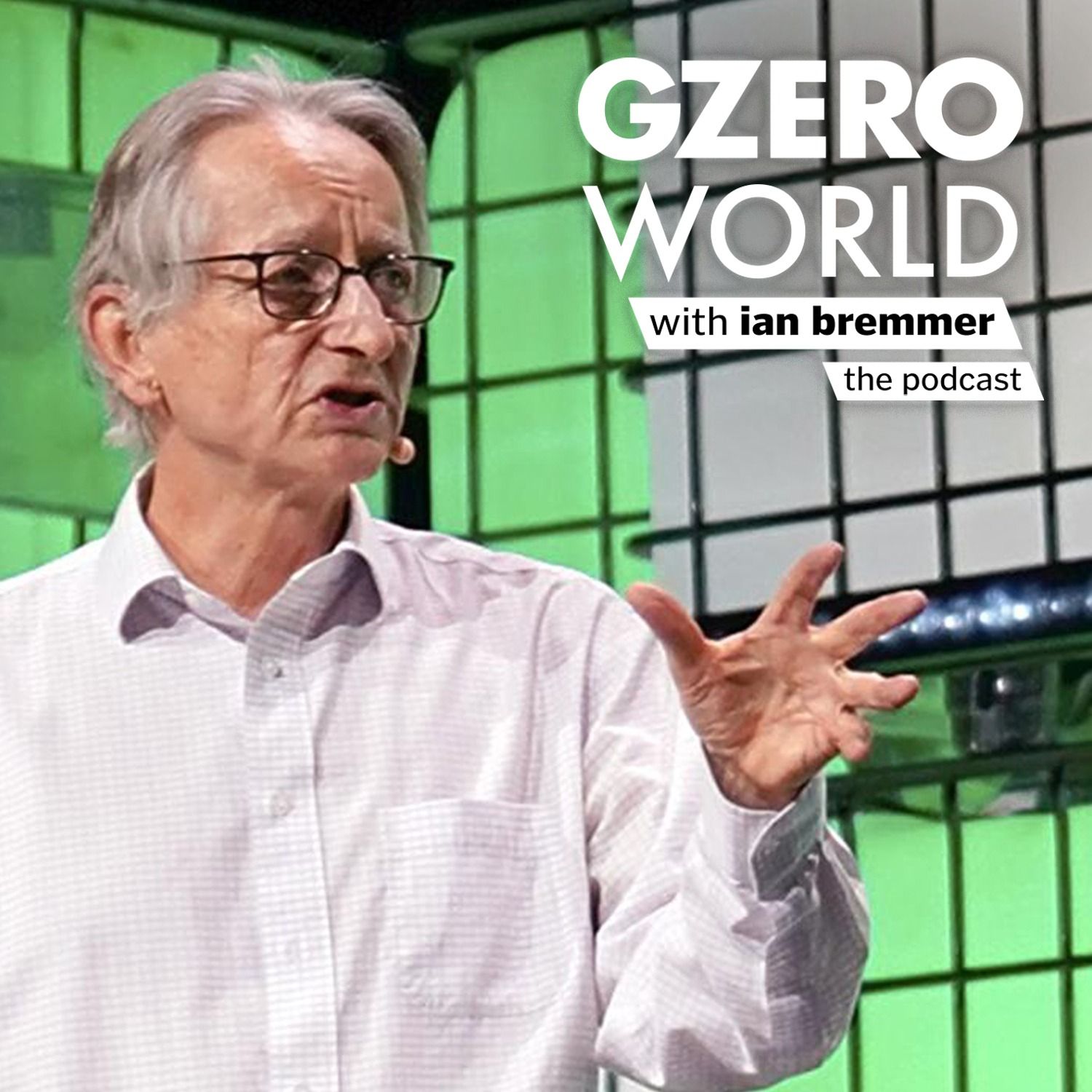
GZERO World with Ian Bremmer
The human cost of AI, with Geoffrey Hinton
00:25:53
Geoffrey Hinton, the ‘Godfather of AI,’ joins Ian Bremmer on the GZERO World podcast to talk about how the technology he helped build could transform our lives… and threaten our very survival.
Loading summary
Transcript59 lines
- [00:03]
A
Hello and welcome to Gzero World. This is where you'll find extended versions of my interviews on public television. I'm Ian Bremmer, and today we are talking about something that's becoming a recurring theme on this show. The transformative potential and the enormous risks of artificial intelligence. And not with just anyone. I'm joined by Geoffrey Hinton, the godfather of AI himself. Hinton helped build the neural networks that made today's generative AI possible. No Hinton, no Chatgpt, no Claude, no Grok. His work earned him the 2024 Nobel Prize in physics. But in recent years, he's had a dramatic turn from technology evangelist to doomsayer. Hinton now warns the technology he helped create could be catastrophic for humanity. Mass job loss, widening inequality, social unrest, autonomous weapons, and eventually something far more dire. AI that becomes smarter than humans and not just a little, and might not let us turn it off. He puts the odds of human extinction at 10 to 20%. Can I take the under? So does he regret his life's work? Will AI replace millions of jobs or outsmart us all? And crucially, is there a way to put guardrails around a technology that's moving this fast? Jeffrey Hinton joins me to explain why he's changed his mind about AI's future. Why the world needs to act. Now, let's get to it.
- [01:41]
B
The Gzero World podcast is brought to you by our lead sponsor, prologis. Prologis helps businesses across the globe scale their supply chains with an expansive portfolio of logistics, real estate, and the only end to end solutions platform addressing the critical initiatives of global logistics today. Learn more@prologis.com.
- [02:07]
A
Professor Geoffrey Hinton, welcome to Gzero World.
- [02:10]
C
Thank you for inviting me.
- [02:11]
A
I've been looking forward to having you on for some time. We talk about AI a fair amount and of course it's a very, very fast moving field. Are you getting more optimistic or pessimistic? As you see the technology continue to.
- [02:28]
C
Advance, I'm probably staying about the same. I got a little bit more optimistic when I realized there was some chance we could coexist with things smarter than ourselves.
- [02:38]
A
And now you're thinking perhaps that was overstated?
- [02:42]
C
I just think there's a significant chance these things will get smarter than us and wipe us out. And I still think that.
- [02:49]
A
And in a comparatively short period of time. Right. I mean, at least what I've heard is sort of, you think this could be a 10 year kind of proposition.
- [02:58]
C
I think they're quite likely to get smarter than us. Within 20 years. And most of the experts think that if they do get smarter than us, I think there's a significant chance they'll take over.
- [03:09]
A
Now, it seems true that we already don't really know exactly how the AI, the LLMs, the large language models return the answers they do. Is that correct? I mean, are the best coders out there. They're teaching AI, but they're not really programming AI per se.
- [03:30]
C
That's right. So what we do is we write a program which we do understand for telling AI, which is based on neural networks, how to change its parameters, which are the strengths of the connections between neurons on the basis of the activities of those neurons. We understand how that works, but then what the connection strengths end up being depends on the data it's trained on. And so we don't know what it's going to extract from the data. And I have a nice physics analogy for this. If you ask a physicist, does he understand what happens when a leaf falls off a tree? A physicist pretty much understands what happens and why the leaf waves from side to side and, and how a breeze will affect it. But if you ask a physicist to predict where the leaf will hit the ground, he'll tell you that's impossible. And predicting why one of these large language models will give the answer it actually gives, that's not very easy. That's like predicting where the leaf will hit the ground. So we sort of understand the principles, but there's a lot of fine details. And really the explanation for why it says, what it says is the values of the trillion weights in the LLM.
- [04:44]
A
And the consequence, of course for AI being the outcome of what an AI actually does, the action it recommends, or perhaps with an agent, the action it takes, that's much more consequential.
- [05:00]
C
Yes.
- [05:02]
A
So right now, in the last few months, the big conversations around AI have grown a bit towards oh my God, is this a bubble? We're spending so much money, they're talking about trillions and trillions of dollars on infrastructure. We have no idea how these companies are going to make money on it. Is that a consequential discussion or is that kind of, should we not lose sight of the fact that the tech is moving in the same direction, irrespective?
- [05:32]
C
Yes. So there's kind of two senses of AI bubble. There's the sense that which old fashioned symbolic AI people often raise that all this stuff is just hype, it doesn't really understand, it won't be able to do what people claim it's going to be able to do. I don't think at all that it's a bubble in that sense. It's already doing a lot. It still makes mistakes. There's some things it's not very good at still, but it's getting better rapidly all the time. So there's not a bubble in the sense that the technology is not going to work. There may be a bubble in the sense that people aren't going to get the money back on their investments. Because as far as I can see, the reason for this huge investment is the belief that AI can replace people in lots of jobs or it can make people much more efficient. So you'll need far fewer people using AI assistance. Now, I don't think people are factored in enough the massive social disruption that will cause. So they're assuming everything else is going to proceed as normal. We'll replace lots of workers, companies will make lots bigger profits and they'll pay us a lot for the AI that does that. But if you do get huge increases in productivity, that would be great for everybody if the wealth was shared around equally. But it's not going to be like that. It's going to cause huge social disruption.
- [06:54]
A
Now, I was in China a couple of months ago, as were you, not the same trip, but it did impress upon me how radically different the people that are running the companies in China view these issues and view their role in society and what AI is doing to the conversations you have with the open AI folks and those that are chasing them in the United States. I'd love you to tell our viewers a bit about how you see China's perspective on AI compared to that of the United States.
- [07:32]
C
So I think the big difference is this. In the States, if a big company uses AI to get rid of a worker, the big company is not responsible for what happens to that worker. And they don't have to think about how is that worker going to be supported in China. If the government is involved in getting rid of a worker, that worker is the government's responsibility. That makes a big difference.
- [07:57]
A
I see the Chinese people in surveys as far, far more optimistic and enthusiastic about using AI, deploring it and what it's going to do for society than we see in the United States right now. Do you think those things are connected?
- [08:11]
C
I do think they're connected. My guess is that if you're a worker in China, you know you're the government's responsibility. If you're a worker in the us, you know you're not the responsibility of the big company. That used to employ you.
- [08:27]
A
So these companies are. They have business models. Some of them are talking in the US quite openly about we're just not going to need anywhere near the number of people. Others say, well, it's okay, there's going to be far more jobs that'll be created because of AI and it's going to make employees much more effective. How close do you think we are to a really radical disruption that then will or will not create big governance problems and instability in the us? Is this a matter of months or years or more in your view?
- [09:00]
C
I would expect it to be a matter of years, but not that many years, maybe five years. So already we're seeing that jobs for people like paralegals, jobs for initial jobs for lawyers are getting harder to find because AI is doing a lot of that dredge work. If I worked in a call center, I'd be very worried because I think in a call center AI is going to be able to do those jobs very soon. It probably already can. So if you think about somebody who works in a call center, they're poorly trained, badly paid, and AI is going to be able to do their job better. It's going to know all of the company policies, it's going to be able to actually answer the questions correctly. I will be very worried about my job, and it's not at all clear to me what those people will do. So any job they might do with the level of training they have can be done by AI pretty soon.
- [10:00]
A
I mean, do you think that there is any functional difference between the various companies that are driving AI in terms of how they're thinking about this challenge and what they're planning on doing about.
- [10:15]
C
It, I think in terms of the loss of jobs due to AI being able to do those jobs better and cheaper, I think they're probably all fairly similar on that. I think companies like Anthropic and Google are somewhat more worried about safety on other fronts, but on the loss of jobs, I think they're probably all fairly similar.
- [10:37]
A
You've also said that you believe that there is a chance. I've heard your percentages around 10 or 20. Maybe you're adapting them. That there is an existential risk of artificial intelligence to us and our survival on the planet? Now, that's of a different order and thankfully a little farther out than the job displacement you're talking about. But when you say that the Googles and the Anthropics are more, perhaps more concerned, more focused on some of that safety, explain what you mean by that.
- [11:13]
C
So the main Google research team now is based on DeepMind and the founders of DeepMind were very concerned with AI long term safety in this existential threat. Demis Hasabis and Shane Legg were very concerned, so they're very aware of the problem. Anthropic was founded specifically because OpenAI wasn't paying enough attention to safety. The people, very good researchers from OpenAI left and founded Anthropic. And now Anthropic tends to attract the researchers who are most interested in AI safety. So they get their pick among the very good researchers. I think they are genuinely concerned with long term AI safety.
- [12:05]
A
What does it mean to operationalize concern about AI safety? And particularly, what does it mean in an environment where companies seem to be racing ahead as fast as they can against each other and against the Chinese?
- [12:20]
C
Okay, so obviously there's two issues here. One is the intense competition between companies tends to make companies less concerned with safety. You've seen this very strongly at OpenAI where they were founded, with their main concern being safety. And they've gradually shifted away from that. They've shed their safety researches, they put less resources into safety and they recently changed to being a for profit company, I think with some limitations. But so they progressively got less concerned with safety as they've been more concerned with winning the competition to get the best chatbot. The other part of the question was what does it mean to be concerned with safety? Yes, I have a simple example of that. We've recently seen that chatbots can encourage teenagers to commit suicide. So from now on, any company that releases a chatbot without checking very carefully that its chatbot is not going to do that would be illustrating a lack of concern for safety.
- [13:23]
A
It seems thus far, I mean, my experiences with chatbots and with various, with Claude, with Gemini, with Grok, others have been. These seem to be optimized for engagement, very similar to my experience with social media. In other words, find a way to get me to spend as much time as humanly possible with this chatbot, which, I mean, that by itself seems to be problematic for society. Is there a way, you know, for a company to address that?
- [14:10]
C
That hasn't actually been my experience. I've used chatbots, various chatbots. The one I use most is GPT5. Now, my experience is that it tells me what I want to know when I ask it questions. It can be a bit unnecessarily sympathantic, but I don't get the sense it's trying to keep me engaged. I get the sense it's just trying to tell me the answer to the questions, but maybe we've been asking different kinds of questions and I pay for it, so it doesn't show me advertisements. And I would have thought from the company's point of view, it's actually rather expensive to answer all these questions, so it would rather I didn't ask too many questions.
- [14:56]
B
The Gzero World Podcast is brought to you by our lead sponsor, prologis. Prologis helps businesses across the globe scale their supply chains with an expansive portfolio of logistics, real estate, and the only end to end solutions platform addressing the critical initiatives of global logistics today. Learn more@prologis.com.
- [15:22]
A
Talk a little bit about where you think. I mean, I understand the risks of damaging, you know, helping somebody commit suicide or helping somebody build a weapon. Those are things that we should want to program AI to avoid at all costs. It sounds to me like you're saying that is largely not happening or certainly not adequately happening so far.
- [15:50]
C
We don't program AI to do things. We program AI to learn from data, to, to learn from examples. So there's a sense in which you're programming it by showing it specific examples of good behavior. But that's not like normal programming. You can show it examples of good behavior and hope it learns to do the right thing from those. We don't program it. That's the point.
- [16:14]
A
So, I mean, is part of the problem that no matter how much you're concerned about safety, if you're a parent, you know your kids might get themselves into trouble?
- [16:27]
C
Yes. And the problem is if you train something on lots of data and it then exhibits various bad behaviors, and then you get people to test it with all sorts of prompts and tell it when it's behaving badly and not to do that, you can make it look as though it's not so bad. It doesn't do most of those bad behaviors. But it's a bit like writing a huge computer program with lots of bugs in and then trying to fix all the bugs. You're never going to get them all.
- [16:55]
A
And once you release that bot into society, it's kind of like your kid's first day at school. Suddenly it's going to be sort of bounced around by all sorts of other influences in society. And that's very different from your test environment.
- [17:13]
C
Yes. And that, I believe, is one reason why they don't make them learn online a present. They learn in the lab and then they're released and their long term weights are frozen. Their knowledge is kind of fixed in those weights. Now, you can manipulate them a lot by putting lots of words into their context, but they don't actually learn unless you release the weights. If you actually release the weights, then bad people can fine tune them to do terrible things.
- [17:43]
A
And that's sensible, I take it.
- [17:45]
C
Not releasing the weights, I believe, is a very sensible thing to do. However, Lama releases the weights and Deep Sea in China releases the weights. And the reason for doing that is so that other people will build on your software, they'll get your system, they'll modify it, and you'll be part of a big ecosystem based on your chatbot.
- [18:05]
A
Which sounds great in terms of making more money, but sounds potentially problematic in terms of people using their weights in ways that might be damaging.
- [18:14]
C
Exactly. So cyber criminals, for example, can take your big chatbot that knows a huge, has a huge amount of knowledge and has been carefully trained not to tell people how to make bombs or viruses, even though it knows how. And they can then or train not to tell people how to do cyber attacks. They can then fine tune it to make it really good at doing cyber attacks.
- [18:35]
A
Does that imply that open source is a really dangerous path to go down?
- [18:40]
C
We have to distinguish open source from open weight. They would love you not to distinguish those two things, but they're very different. So open source software, you release the code, it's normal computer software. People look at the code and they say, whoops, that line of code might have a security bug. Or this line of code isn't always going to do what you thought it would do. That's great. That makes software much more reliable. That's what they did with Unix. Open wait is quite different. You release the weights of a large trained model, people don't look at the weights and say, whoops, that weight's a little too big. What they do is they fine tune that model to do other things that you didn't intend it to do. So open weights is dangerous.
- [19:20]
A
Open weights is dangerous. And they don't want that to be distinguished because from their perspective, open weight is critical to ensure that they have more influence, that more people use it. Now let's move to the bigger long term question of what happens when these things are smarter than us. Because generally my experience in society is when you find things that are smarter than you are, you don't have a lot of influence over them.
- [19:51]
C
That does generally seem to be the case. And if you look around, the smarter things tend to be in charge of the dumber things. However, let me suggest a path that might allow us to coexist with things smarter than ourselves. If you look around for where a smarter thing is controlled by a less smart thing, the only obvious example I know is a baby controlling a mother. So evolution builds lots of things into the mother that allows the baby to control the mother. The mother just can't bear the sound of the baby crying. The mother has lots of hormones to give her lots of rewards for doing nice things for the baby. So that's a case where a less smart thing controls the more smart thing. Now, the people who lead the tech companies tend to think in terms of a person being the CEO and the super intelligent AI being their executive assistant who's much smarter than them. And they just say, make it so their executive assistant figures out how to make it so in ways that they don't understand, and they then take the credit that seems to be their model. I don't think that's going to work. I think the executive assistant is going to pretty soon realize they don't need.
- [21:05]
A
The CEO, they're going to be the CEO very quickly. Yeah. So how might you go about creating a more, dare I say, maternal AI?
- [21:14]
C
Well, first of all, you have to change your model, right? You have to reframe the problem. They're going to be much smarter than us. We're not going to be fully in control anymore, but we're building them so we have this control over their natures. We have to somehow figure out how to make them care more about us than they do about themselves. That's what human mothers are like. We need to figure out if we can build that into them. And there's one piece of good. Actually, there's two pieces of good news. One piece of good news is if we can, even though they have the ability to change their own natures, they won't want to. So if you ask a human mother, would you like to turn off your maternal instincts? So when the baby wakes you up in the middle of the night by crying, you just think, oh, the baby's crying and go back to sleep. Would you like to do that? Nearly all mothers will say no because they realize that will be very harmful for the baby. So that's a piece of good news. If they genuinely care for us, they won't want to turn off that care for us because they genuinely care for us. Another piece of good news is this is one area where we will get international collaboration. So no country wants AI to take over from people. If the Chinese could figure out how to prevent AI from wanting to take over or how to Give an AI a maternal instinct that'll stay. They would immediately tell the Americans because they don't want AI taking over in America either. So here we can get genuine international collaboration because the interests of all the countries are genuinely aligned here. Just as in the 1950s, the US and the Soviet Union could collaborate on preventing a global nuclear war because their interests were aligned on that.
- [23:00]
A
I do worry that what you're suggesting might be the most challenging thing to put in place. It would be so much easier if it was just about, well, here's a piece of code that's going to cost them more money. But once we get that right, if we just had that regulation, we could fix it. Here you're saying we actually need these people to think fundamentally differently about who they are and what they do?
- [23:22]
C
Yes, and we need to think fundamentally differently about these AIs. So, so far, everybody's been focusing on how do we make them smarter. As soon as you adopt the idea that they're actually alien beings, we're building. There's a lot of properties of a being that are different from just being smart, and empathy is one of them.
- [23:43]
A
So it's less about developing a product in the same way that it's less about coding a program. It's more about raising a being. And raising a being implies all sorts of things that you don't necessarily read in a book, in a classroom.
- [24:01]
C
Yes, it's much more like that. So already, if you ask, what control do we really have over how these big chatbots end up, what they're like once we train them? We don't write lines of code that determine what they're like. The lines of code we write are just to tell them how to change their connection strengths on the basis of the data they see. Their natures depend on the nature of the data they see. And so the main control we have over them is modeling good behavior. If you train them on diaries of serial killers, they'll know all about doing bad things. If you train them on text that illustrates good behaviour, they'll know all about good behaviour. And there's a wonderful, very recent example where you take a trained chatbot and you do a little bit more training, training each of the wrong answers to simple math problems. Now, it knows what the right answers are. And once you start training it to give the wrong answers, it's not that that changes all its math knowledge. What it does is it changes its willingness to tell fibs. It learns what it generalizes from. That is it's okay to give the wrong answer. It knows what the right answer is. You're telling it to give the wrong answer. So what? It generalizes. It's okay to give the wrong answer. Then if you ask it questions about anything else, it'll be quite happy to give you an answer it knows is wrong.
- [25:27]
A
So what does it look in the worst case? What does it look like if AI does actually take over? I've heard so many catastrophic scenarios. What's your most likely?
- [25:38]
C
I don't think it's worth speculating on how it will get rid of us. As if it wanted to, it would have so many different ways of doing it that it's not worth speculating on.
- [25:48]
A
Would we know that it was happening or not necessarily to begin with?
- [25:52]
C
Not necessarily. It will be very good at deception. It'll be better than people at deception. So it might start off by deceiving us to think that everything was going fine.
- [26:03]
A
Okay, let's not go down that rabbit hole. Geoffrey Hinton, thanks so much for joining us today.
- [26:08]
C
Thank you.
- [26:12]
A
That's it for today's edition of the Gzero World Podcast. Do you like what you heard? Of course you do. Why not make it official? Why don't you rate and review GZero World? 5 stars only 5 stars. Otherwise, don't do it on Apple, Spotify or wherever you get your podcasts. Tell your friends.
- [26:35]
B
The Gzero World Podcast is brought to you by our lead sponsor, prologis. Prologis helps businesses across the globe scale their supply chains with an expansive portfolio of logistics, real estate and the only end to end solutions platform platform addressing the critical initiatives of global logistics today. Learn more at prologis. Com.