← GZERO World with Ian Bremmer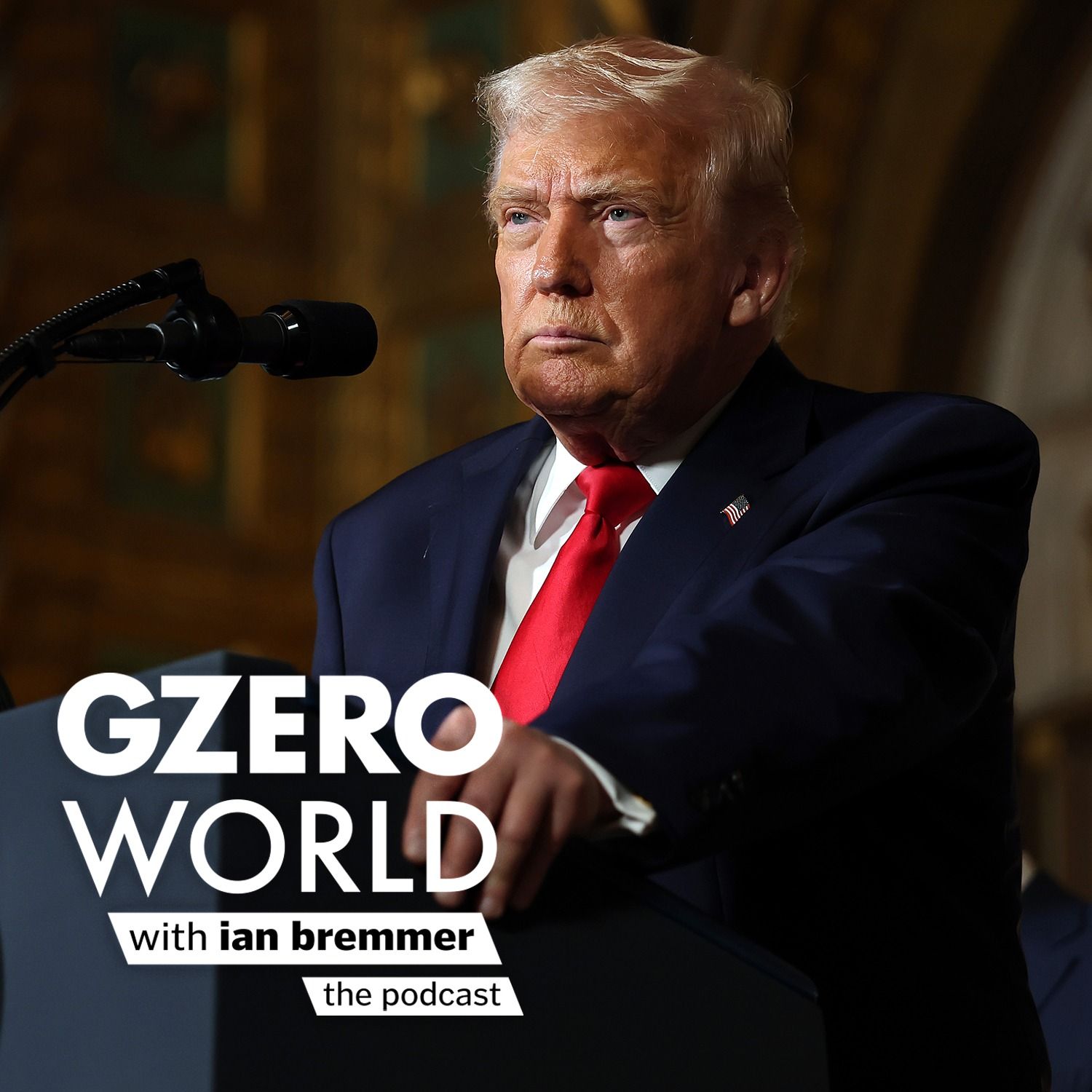
GZERO World with Ian Bremmer
Trump's second term–one year in, with Stephen Walt
00:22:06
President Trump has transformed the presidency—and the world—in 12 short months. Harvard’s Stephen Walt joins Ian Bremmer on the GZERO World Podcast.
Loading summary
Transcript43 lines
- [00:03]
A
Hello and welcome to the Gzero World Podcast. This is where you'll find extended versions of my interviews on public television. I'm Ian Bremmer and today we are looking back on the first year of President Trump's second term and asking a simple question with complicated answers. What kind of presidency is he building this time around? Trump didn't come back to Washington to pick up where he left off. He returned with fewer constraints, more confidence, and a much more explicit view of how government and the world should work. Over the past year, we've seen a dramatic expansion of presidential power. Independent agencies now under executive control, ethics watchdogs and inspectors general fired, sweeping tariffs, the Justice Department and FBI ordered to investigate political opponents. Internationally, Trump is also rewriting America's role in the world. There has been a sharp retreat from multilateral institutions, groups, growing skepticism of long standing allies, and a view of global politics where great powers dominate and weaker ones fall in line. It's quite a departure from 80 years of the post war order that America spent building and leading. We're, of course, only a quarter of the way through Trump's second term and the world already looks very different. To discuss where we're at and where we might go, I am joined by Stephen Walt, professor of International affairs at Harvard's Kennedy School and an expert on US Foreign policy and global power. Let's get to it.
- [01:43]
B
The Gzero World podcast is brought to you by our lead sponsor, prologis. Prologis helps businesses across the globe scale their supply chains with an expansive portfolio of of logistics, real estate, and the only end to end solutions platform addressing the critical initiatives of global logistics today. Learn more@prologis.com.
- [02:09]
A
Steve Waltz, welcome back to the show.
- [02:11]
C
Nice to be with you, Ian.
- [02:13]
A
So we're a year into the second Trump administration. How different does the world look from the way it did a year ago, in your view? And how surprised are you by that?
- [02:23]
C
It looks a lot different and I think I'm surprised not by the direction things have gone, but by the sort of speed and scope by which things have changed. But if you think about it, a lot of the things that Trump has done are not surprising in terms of where he's trying to take things. People knew he was going to get tough on tariffs, they knew he was going to be harsh on Europe, they knew he was going to be relatively soft on Russia. Nobody was quite sure what he was going to do with China. He's done pretty much all of those things. I think people didn't expect him to Go after Greenland in a big way. I think people didn't expect some of the other shifts, the coup in Venezuela, if you want to call it that, the kidnapping in Venezuela. So in some respects, the speed and scope of these changes has exceeded a lot of expectations, but not the general direction. Some people are surprised that he's been as willing to use force. Right. There was this view that Trump was averse to using force, didn't like forever wars, things like that. But in fact, he's used force quite frequently, I think, against seven or eight countries by now. The key is that he likes these short, sharp, discreet uses of force, primarily air power. And I don't think that instinct is going to go away.
- [03:39]
A
Yeah, he doesn't like forever wars. I don't think that that's been disproven. Right. He's not sending American troops in harm's way in any of these countries you're talking about.
- [03:52]
C
No, that's right. He likes to pick on weak countries that really have no prospect of retaliating against the United States.
- [03:59]
A
And that seems to be true, like, across the board. Whether you're talking about where the tariffs are hitting the hardest. Right. It's not China. It's on countries where the Americans have much more asymmetric advantage. And that's true militarily. You look at Venezuela, for example, or Iran. I mean, these aren't countries that have the capacity to hit the Americans back.
- [04:20]
C
That's exactly right.
- [04:22]
A
Is that the way we should think about Russia and Ukraine? I mean, you know, at the end of the day, the Ukrainians are getting hit hard by Trump. The Russians, not so much. Is that purely because Ukraine's weaker?
- [04:31]
C
It's partly because Ukraine's weaker. It's partly because Trump has never been supportive of Ukraine. You could argue he's got an animus there dating back from the first term as well. I think at the geopolitical level, he's always had this idea that if you could settle the war in Ukraine, Ukraine, then you could open things back up with Russia, which might make sense in terms of trying to pull Russia away from China. Might make sense in terms of some commercial opportunities that Trump would love to take advantage of, either as a country or as an individual as well. The problem is that the Russians haven't been playing ball quite as much as he expected them to. He thought it would be relatively easy to solve. He would simply give the Ukrainians a lecture, tell Putin that he'd got the deal set up, and it would all be over with. And I think he's discovered that the Ukrainians are more stubborn, that the Europeans have been more willing to help the Ukrainians than he might have expected, and the Russians have not been willing to cut the deal that he keeps putting in front of them.
- [05:34]
A
So you've talked about one axis here of US Policy, which is the fact that how powerful your interlocutor is matters a lot in terms of the behavior of the United States. The other one, of course, is how aligned the country is. Is it democratic? Is it an ally? Does it share values, historic commitments? It feels as if those things are playing a much less important role now. But how much less in your view, Steve?
- [06:06]
C
Well, there's actually a big shift that's going on with the Trump administration, and I've been taking to calling it predatory hegem. Now, all great powers are predators to some degree, but they usually confine their acts of predation to their adversaries. In any deal with an adversary or any engagement, you want to make sure you get the better of that arrangement. But what Trump has done is he's applying that to our allies as well in all bilateral relationships. What's, you know, his view is what's mine is mine, what's yours is negotiable. I want to make sure I get the best deal, no matter what it is. I get more out of it than than you do. So when he goes and talks to the South Koreans, he says, I'm going to slap really stiff tariffs on you and really hurt your economy unless you agree to invest in the United States, unless you agree to make a whole series of concessions. Here's the list. So, in a sense, he's engaged in acts of predation against everyone. And of course, he's got more leverage when he's dealing with American allies, particularly allies that have been dependent on us for military protection in a variety of ways. I think we see this happening pretty much across the board, and in a sense, it's more effective in dealing with allies than it is in dealing with adversaries, at least in the short term. The long term, I think it's likely to be a loser.
- [07:26]
A
It's likely to be a loser in the long term. For what reason, Steve?
- [07:29]
C
Because other countries will start to adjust, they'll start to adapt. Countries that now are dependent on the United States will start diversifying their relationships, as Canada is starting to do in trade, as the Europeans are doing now, recently signing finally after many years, a trade deal with the Latin American trade pact, mercosur. All of these are designed to try and make them less vulnerable to American pressure going forward by having lots of partners and not being solely reliant on the United States.
- [08:01]
A
So if you're bound to be a predator with your allies, if that is the strategy you want to use, is the right counter strategy to that to escalate further against those countries that are vulnerable. You tell the Canadians, well, look, if you're actually, if you try to diversify away from the United States, here are the even heavier consequences, because these countries are not only weaker, but they are much more dependent on the United States as well.
- [08:24]
C
Well, I think that, again, it works in the short term, but not if you realize that the predator can't be accommodated, that each demand is just going to be met by another demand down the road. So most American allies have been very reluctant to sort of balance against the United States to try and push back in a big way. But if you look around the world, the countries that have push, pushed back, like Brazil, have tended to do better. China, of course, being the most obvious case, pushed back very hard. And the Trump administration basically caved. And so as much as American allies may be reluctant to take concerted action against the United States over time, I think that we're pushing them to have no choice but to do that.
- [09:09]
A
Now, both of the countries you mentioned that were effective at pushing back, who are effective at pushing back economically, right. In terms of tariffs and trade relations, places where there's lots more interdependence of leverage, where when we talk about the security relationship, for example, American power seems much more asymmetrical in its favor compared to other countries around the world. Are you suggesting that actually the United States and Trump strategy is likely to have a longer glide path for what he does on the security side in a predatory sense, than what he does on the economic side?
- [09:44]
C
I think you can't rule that out depending on how far the United States is willing to go. And perhaps the most obvious case would be the case of Greenland, where the Trump administration keeps saying that, you know, we have to have it, we have to control it. We have to essentially assert sovereign control over Greenland. There's no economic or security reason why we have to do that. The current treaty arrangements governing Greenland give the United States as much access as it might ever want. This is all about essentially marking territory, which something, of course, Trump likes to do. He likes to put his name on things, and he likes to plant the American flag as many places as he can think of. That, of course, if it's done coercively, is a direct threat at our NATO allies. Denmark has been probably one of the staunchest American allies in Europe for many, many years, and this would be essentially a direct threat towards Denmark. At that point, Europeans have to ask themselves if they really can not just not count on American protection, but actually have to worry about the United States as a serious adversary, and they do have some leverage to push back on. For example, the United States is still dependent on military facilities and bases in Europe in order to project power into other parts of the world. If the Europeans are sufficiently alarmed by the United States, they simply say the United States has to leave Europe and can no longer rely upon those facilities if it needs to intervene in the Middle east or anywhere else. And that's something that I think the Pentagon would have to take very seriously.
- [11:22]
A
Now, one lesson perhaps to learn from Europe over the past few years is that they get really freaked out when tanks roll into your country. But asymmetric warfare is a little more challenging, right? Whether it's, I'm thinking Russia here, frontline States, cyber attacks, espionage drones, weather balloons, you name it. I mean, there's lots of ways that the United States can make life very uncomfortable for its allies in Europe that fall considerably short of the invasion of Greenland. That's been getting all the headlines, but doesn't seem particularly likely in the near term. Is that what you think people should be more concerned about?
- [12:02]
C
I haven't thought very much about that. It's certainly a possibility. But the other point to make here is that these are not without cost to the United States. Right. It's not that the United States is in such an overwhelming power position that it can start inflicting harm on its allies and not pay a price. We pay an economic price when we impose tariffs on our allies because ultimately those costs are borne by American consumers, not by our allies per se. Certainly, it starts to give other countries incentives to do business with China in ways that we might be trying to discourage in other senses. So it's not like the United States has complete impunity to impose various forms of soft punishments or hybrid warfare against either allies or adversaries as well. And I think, again, one hardly wants to rule out anything with this administration. But I think there would have to be a lot of very long and careful thought before we move down that road.
- [13:07]
B
You're listening to the Gzero World with Ian Bremmer podcast, your weekly geopolitical deep dive into the world's biggest news stories, featuring in depth conversations with global leaders and newsmakers to get more of Gzero's insights on global Politics every morning. Sign up for our free newsletter gzero daily@gzeromedia.com.
- [13:35]
A
Now, the direct intervention, essentially the rendition capture of Nicolas Maduro and his wife, I mean, that was a very explicit use of hard power that would not have been considered by a previous administration, certainly not under Biden, really not under Trump the first time either. And, you know, no regime change, relatively limited costs for the United States thus far, and what appears to be the existing or the remaining Venezuelan regime prepared to jump as high as the Trump administration demands of them. What are the short and likely medium term implications of that, positive and negative? Steve?
- [14:18]
C
Well, the whole Venezuela operation is one we're still trying to sort out. And it's possible the administration is still trying to sort it out as well, because there's multiple motives that might be involved here. I think it's pretty clear it was not about narcotics because Venezuela was not a source of many drugs coming to the United States. It's pretty clear it was not about democracy promotion because of course, the old regime has been been left in place and there wasn't a serious security threat emanating from Venezuela. Wasn't like China was about to put missiles in Venezuela or anything like that. So the motive, to me, at least in Trump's mind, is partly about oil, which he keeps referring to in various ways where I think he's simply mistaken. There is no great oil bonanza to be gained by gaining greater access to Venezuelan petroleum resources. The oil's hard to extract, it's hard to refine. You probably can't do it profitably at current market prices. So there's no oil bonanza there. I think what it's really about is trying to put all of Latin America on notice that this is our hemisphere and we're going to run it, we're going to be in charge, and you shouldn't get too far out of line. And of course, after Venezuela, you know, they would love to be able to get a regime change going in Cuba, something Secretary of State Rubio has wanted for decades. The point here is that they want to put Latin America on notice. And if you read the National Security Strategy, I think much of that is about trying to limit foreign influence in Latin America, and in particular, I think Chinese influence, although it's not explicitly named in the National Security Strategy. But there is language about discouraging Latin American countries from entertaining foreign investment, from allowing key assets to be controlled by foreign actors, from trading with foreign partners, etc. And I think that they want a situation where they can deny China and possibly some other countries much access to economies in Latin America. The only problem there is that makes the United States solely responsible for the health of those economies. And that's a very big job for Washington to be taking on, especially as.
- [16:41]
A
The dominant trade partner of almost all of those countries for quite a while now. Isn't the United States.
- [16:49]
C
That's correct. It's China. And if the United States tries to tell consumers in Mexico or Brazil or Argentina or elsewhere not to buy things from China that are cheaper than what they can get from the United States, and in some cases may be a better quality than what they can get the United States, those consumers are not going to be very happy and those governments aren't going to be very happy as well. So, again, I think if the idea here is trying to exert almost total control over the political and economic decisions in those countries, this is a long term loser.
- [17:23]
A
So as you said in the opening, the direction is not all that surprising, but the speed and the impact has been greater than you would have expected a year ago. So as we look forward to three more years of these policies, give or.
- [17:42]
C
Take.
- [17:45]
A
How do you think the world is likely to look? What are the things that you think you might end up being today surprised by? It's a hard question to ask, but, you know, you're the person I want to ask it to.
- [17:59]
C
Well, I think one big question is whether or not the sort of absence of a lot of collective action is going to change. I mean, both within the United States itself and outside, in dealing with the outside world. The Trump administration has benefited from the fact that it's hard to organize a lot of collective opposition. Right. And they've benefited from that so far, as I've suggested. Lots of countries have real concerns about what's happening. But getting their act together, to work together to put limits on what the United States can do has proven to be difficult.
- [18:32]
A
Even Europe, which, I mean, has the superstructure in principle, but they've had a really hard time developing collective action to.
- [18:40]
C
Respond to the U.S. that's a perfect example of it. And I think it's again, there was a certain element of wishful thinking. They thought if they could play nice with Trump, come to the White House, flatter him shamelessly in various ways, they could get benevolent treatment. And of course, if that doesn't work, eventually you say, well, all right, we tried to be nice. Now we're going to have to play hardball the way some other leaders have done more successfully. So that's, I think, one big Question. The second question, of course, will be, what happens here in the United States with the midterm elections? Do you start seeing the political fortunes of the Democratic Party improving suddenly he doesn't get a blank check out of Congress for anything he wants to do, etc. Starts to have to trim his sales at least a little bit. I think a third big question will be the state of the American. You know, as if the American economy starts to show real signs of strain, that's going to, again, shift the political calculus. That may, of course, encourage greater Trumpian activism on the global stage as a distraction from things at home, possibly as a way of keeping the Epstein files off the headlines as well. But exactly, you know, where that goes. I would have trouble forecasting.
- [20:02]
A
Yeah, I mean, off the headlines, there's so much news right now, it's hard to know what can stay on the headline for more than a day or two.
- [20:09]
C
No, and that's, again, it's worth remembering this has been, I think, a consistent part of Trump's strategy all along. If you keep the news cycle constantly buzzing with the latest thing you've done, even if it's just something as trivial as putting your name on the Kennedy center, you know that that takes over the news cycle for 48 hours and people forget about whatever it is you were doing last week. And I think one of the things you ought to expect here is there will be constant news stories about some big thing that the administration is about to do, a peace deal they're about to arrange. Something like that will always be coming up, even if most of them don't come to fruition.
- [20:48]
A
And if we look at President Trump's policies, what are the one or two that you think are most likely to have much longer term implications, irrespective of who the next president happens to be?
- [21:02]
C
Oh, I think the most important one is the general gutting of research and development, scientific research, the assault on universities. We live in an era where scientific and technological prowess is absolutely key to national power. And the Trump administration has been significant, significantly undermining America's ability to stay at the cutting edge. So I think, you know, the next several presidents are going to deal with the consequences of the damage that's been done to our research and development capabilities.
- [21:35]
A
Have you experienced that so far at Harvard? I mean, are you seeing, is it a student issue? Are you starting to see a lot of students that aren't able to apply, for example, or. I know there's been research grant issues as well.
- [21:48]
C
Yeah, it's not so much a student issue in areas like political science, but in areas like computer science, in the medical area, in, you know, biochemistry, things like that, these are all areas that are now being hurt quite directly. So, you know, and this not just at Harvard, at lots of other places as well. And the damage there won't be felt for another five or 10 years, but it's the kind of thing that you don't recover from. In a year or two, subsequent presidents are going to look back on this and think it was absolutely insane.
- [22:19]
A
Steve, my friend, always good to see you.
- [22:20]
C
All right, nice to see you too. Take care.
- [22:26]
A
That's it for today's edition of the Gzero World Podcast. Do you like what you heard? Of course you do. Why not make it official? Why don't you rate and review GZero World? 5 stars only 5 stars. Otherwise, don't do it on Apple, Spotify or wherever you get your podcasts. Tell your friends.
- [22:50]
B
The Gzero World Podcast is brought to you by our lead sponsor, prologis. Prologis helps businesses across the globe scale their supply chains with an expansive portfolio of logistics, real estate and the only end to end solutions platform addressing the critical initiatives of global logistics today. Learn more@prologis.com.