← GZERO World with Ian Bremmer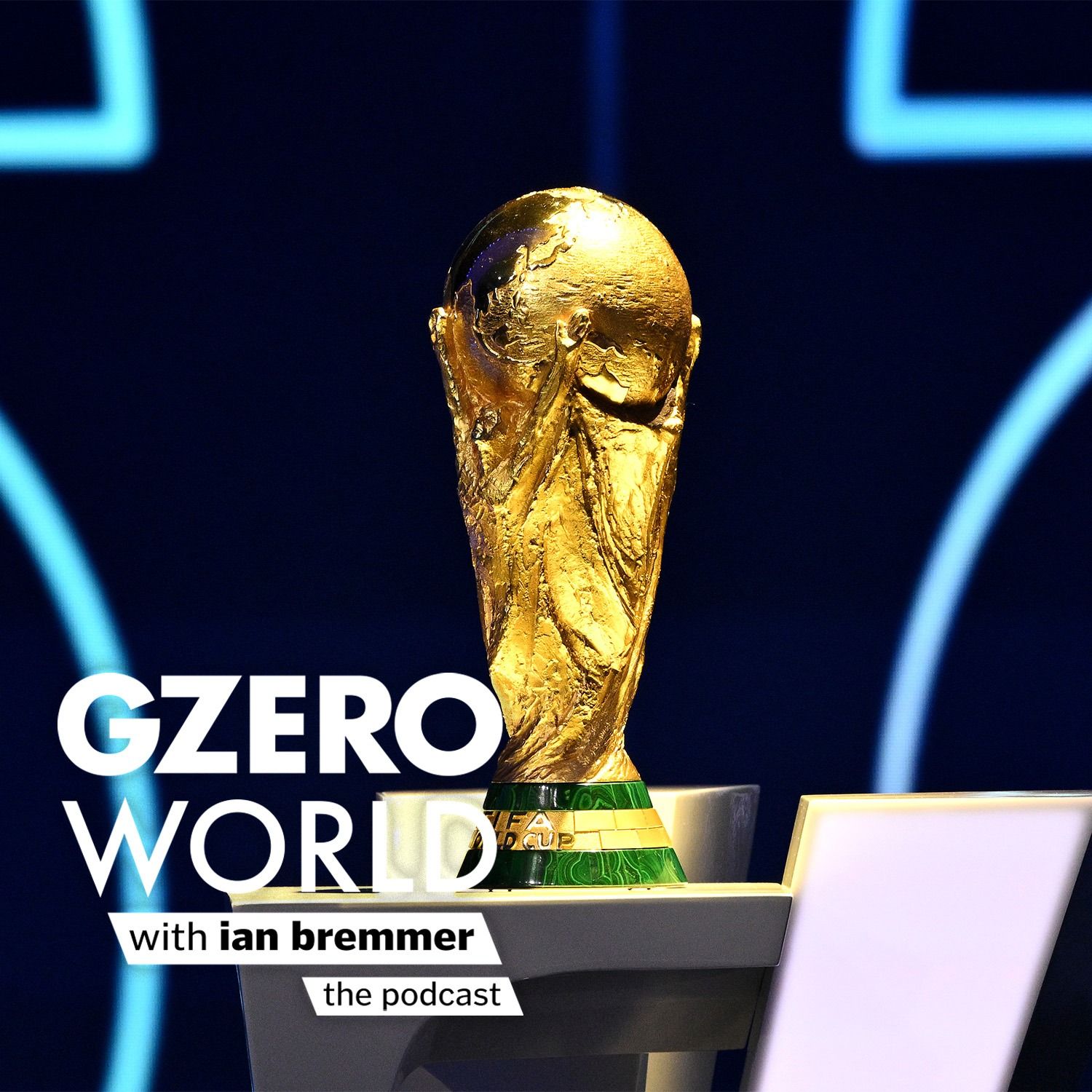
GZERO World with Ian Bremmer
World Cup politics, with the Financial Times' Simon Kuper
00:24:11
The World Cup is the planet's biggest sporting event, and the most political one. This year, it will also be the most profitable spectacle of all time. Sports writer Simon Kuper joins Ian Bremmer to discuss how soccer became a stage for nationalism, identity, power, and profit.
Loading summary
Transcript49 lines
- [00:02]
A
Hello and welcome to the Gzero World Podcast. This is where you can find extended versions of my interviews on public television. I'm Ian Bremmer and the World cup kicks off this week. See what I did there. Across the United States, Canada and Mexico, it's the most popular spectacle in the world. And my guest Simon Cooper argues that it's always been popular, it's always been political, but it's never been more profitable. The tournament now generates billions of dollars in revenues, attracts billions of viewers, and gives host nations political leaders and of course, FIFA itself, a global platform unlike any other, including the Olympics. Cooper has covered now nine World Cups and he's spent decades writing about the intersection of sports and geopolitics. And he says that every World cup serves as a mirror for its era, from Argentina's military dictatorship to Africa's post apartheid emergence, to Russia's quest for international legitimacy, to Qatar's bid for global influence. And this year's tournament is no different. Arriving amid rising nationalism around the world, great power competition, and renewed skepticism around globalism itself. It begs a few questions like what do host nations gain from hosting the World Cup? And why has FIFA become one of the world's most powerful organizations? And what does this year's tournament tell us about the state of the world today? Simon Cooper is an award winning writer, longtime Financial Times columnist, and author of the book World Cup Fever. Here's our conversation.
- [01:48]
B
The Gzero World podcast is brought to you by our lead sponsor, prologis. Prologis helps businesses across the globe scale their supply chains with an expansive portfolio of logistics, real estate and the only end to end solutions platform addressing the critical initiatives of global logistics today. Learn more@prologis.com.
- [02:15]
A
Simon Cooper, thanks for joining us today.
- [02:17]
C
It's a pleasure to be here.
- [02:19]
A
You have said that people love the World cup despite the football, and I'm wondering what you mean by that.
- [02:28]
C
Most of the football at this World cup will be worse than say, the Champions League or the English Premier League, the top level of the game. There are teams coming like Cape Verde or Jordan or Curacao that really will play quite mediocre soccer. With 48 teams, the level has never been lower. But the World cup has never really been about quality, certainly not anymore. It's about the nation is at stake. It's a prestige battle for all countries in which the US doesn't win, in which China barely figures. So it's about so many things beyond good soccer.
- [03:01]
A
Who are the countries that most understand that most engage with it as nations, both the country itself as well as the people from all over the world.
- [03:12]
C
And why, I mean, I'd pick out Argentina and Brazil. I mean, Argentina has obviously had an unsuccessful 80 years as a political and economic entity. And this is the one global hierarchy where Argentina is top of the world. They're world champions. They have possibly the best player ever, Leo Messi. And so it's an enormous source of national identity. You know, who is. What is Argentina? It's Leo Messi, it's Diego Maradona. It kind of exemplifies this Argentinian creativity that they feel they have Brazil was that before. Brazil has won five World Cups, more than any other country. And the national team's shirt, that yellow shirt, is such a symbol of Brazil that it was used by the previous president, Jair Bolsonaro, while he was campaigning. He's kind of captured the main item of identity of the country for his own party. So I would say those two countries, more than any other, expressed their national pride through soccer. But really in the post war decades, when war was very scarce, that was the main competition between nations.
- [04:19]
A
And how far down before you start talking about Europeans?
- [04:24]
C
Well, Europeans other than Argentina, Western Europeans have dominated the World cup for the last 20 years. If you look at who finishes first, second and third on the podium the last 20 years, it's seven European countries and Argentina. So Western Europe is 5% of humanity. Croatia is just the other side of the old Iron Curtain. In Eastern Europe, the whole rest of humanity, 95% of humanity, the last 20 years has produced one team that can compete with the best Europeans. That's Messi's Argentina. So the Europeans are fantastic. But I would say that for countries like France, Germany, Spain in the past, Italy, they no longer even qualify. The kind of leading European countries. Football is hugely important, and the expression of football nationalism is hugely important. I'd put it still a touch below Argentina and Brazil, though.
- [05:13]
A
I mean, a lot of what you have said for someone that isn't inside this world, I would think would also apply to the Olympics. How does it and how does it not. How's the World cup different?
- [05:26]
C
I think the World cup has surpassed the Olympics in popularity. The TV rights deals are now higher. And I've been to Olympics and I've been to World Cups. The fans are just much more engaged with the actual play during World Cups. There are way more people who understand soccer and how it works than sort of understand shot putting or have a deep appreciation of 100 meters. Even so, people's engagement with football is Very intense. And because it's not just one player, like in many athletic events, it's a whole team, you get a sense that that team represents the country in a very direct. So when you see those 11 guys in an England shirt or in a Brazil shirt, they incarnate England or Brazil with all its strengths, with all its flaws. And it's also a picture of who belongs in the country. So a big issue in many Western European countries over the last 40 or 50 years is that the national teams progressively became less white. People of immigrant origin entered those teams. So France is now a majority non white team. And that leads to all these debates about who is part of France, who is part of Frenchness. And those debates are channeled through the national football team.
- [06:39]
A
And I was going to ask you precisely that when you mentioned Bolsonaro sort of takes on the jersey as part of his campaign strategy. Brazil is one of the more divided politically democracies out there, as we saw with the January 6th and Bolsonaro himself under house arrest right now. And is it effective or is it divisive for an individual political leader in a country that is becoming much more divisive to say I'm taking on this national jersey for myself. And by the way, I don't think that a lot of the other people that are in this country really reflect true Brazil, for example. I mean, I'm just wondering how the, the political divisions in many democracies today are changing, if at all, the way people think about national identity and their football squad.
- [07:39]
C
I mean, absolutely, in a very divided country like Brazil, you take a national symbol, maybe the national symbol, the yellow canary shirt, which is associated with Palay in 1970 and greatness, and you turn it into a partisan item. So much so that going into the 2022 World cup, just after Bolsonaro had been voted out of power, it was difficult for anti Bolsonaristas to wear the shirt because they felt it had become associated with him. So in an extremely divided society like the US as well, everything becomes a culture war. I would say that in countries like the Netherlands or Germany, which have their own divisions, but less dark, the national team is still something that unites society. I've just come from the Netherlands, extremely proud World cup tradition, reached the final three times and their whole streets will be decorated in orange. And you can go around wearing an orange shirt and people will do just it as part of their daily business and it will be something that everybody will smile warmly at. But yeah, in our divided societies of today, even the national Team becomes divisive.
- [08:45]
A
And so in Britain and France. How does it feel right now?
- [08:49]
C
Well, in France you have this brilliant team. France has reached four of the last seven World cup finals. One two lost, the other two just on penalties. So it's really the best team of the last 30 years. It's now very largely non white, a lot of guys whose parents were African immigrants to the suburbs of Paris. Kylian Mbappe, the captain, who's of Cameroonian and Algerian origin, is a great example. And then you have the far right party, which is probably going to win the presidency next year, and the team and the far right are in conflict. So Mbappe and other players have spoken out against the far right. They've spoken out against the most popular party in the country, and the far right attacks them back. And if any player has an off the field scandal or if France play badly, then the far right will attack them and suggest that these non white, multimillionaire, often expatriate players, they're not really French.
- [09:48]
A
They're not really French. Yeah. So, I mean, by the way, I think it's way too early to talk about who's going to win the French elections next year, but I take your analysis on how the people are thinking about the team absolutely on point. And so the UK in England, there's
- [10:01]
C
also been some culture war around the team, which also has several black players. And after the Black Lives Matter movement in the US at Euro 2020, which was played in 2021 because of COVID 19, the team would take the knee. I think they still take the knee before kickoff in protest against violence against black people. And there was a section of the England crowd, their own crowd, that would boo them. And the manager, Gareth Southgate, had to appeal for kind of understanding and empathy. And so a lot of the debates about what kind of country are we? And okay, black people are allowed in the national team, but are they allowed to take stances on particularly black issues? That was conducted through the national football team.
- [10:46]
A
Now, the United States has a lot of sports that they care about. Soccer, football has never seemed to break through, but I'm certainly seeing a lot more people coming to stadiums for the professional league right now. And there is excitement around the World cup, including in my own New York City. How do you think, I mean, do you think that football is on a trajectory in the United States to have the kind of electrifying impact on the population that it does in so many other countries around the world? And why or why not?
- [11:22]
C
I think U.S. soccer is already A big cultural phenomenon. It's just different from in other countries because in most countries, people care about the National League and the national team. In the US some people do. Some Major League Soccer is a relatively modest league, but of course, there's loads of people in America whose primary interest is English football, Mexican football, whichever country they come from. Look at Zoram Hamdani, your mayor in New York. He's a very good example. He's a massive Arsenal fan.
- [11:50]
A
Yeah. Wearing the shirt all the time.
- [11:52]
C
Yeah, yeah, yeah, yeah. And he also has very deep knowledge of African football, which he can talk about in great detail. And he's becoming. He's setting himself up as a kind of populist soccer politician, you know, turning the high prices of tickets into an affordability issue, which fits his agenda. So I think Mandani is an emblem of where many US Soccer fans are. They're not actually interested in US Stocker.
- [12:21]
B
The Gzero World Podcast is brought to you by our lead sponsor, prologis. Prologis helps businesses across the globe scale their supply chains with an expansive portfolio of logistics, real estate, and the only end to end solutions platform addressing the critical initiatives of global logistics today. Learn more@prologis.com.
- [12:47]
A
So the Iranians are playing in this cup, including a game in the United States. Their players are flying up to Seattle. I guess it's going to be on Pride Day. So both Iran and Egypt. It's one of the most interesting geopolitical events. What. What should we watch for there? Do you think there's a possibility that folks could defect? Do you think that security is an open question? I mean, you know, the Americans are obviously at war with this country right now.
- [13:17]
C
Yes. I mean, the Iranian Federation, which is run by a former Revolutionary Guard leader, is terrified there will be defection. Several players of the Iranian women's team defected recently to Australia.
- [13:27]
A
Australia, yeah. Yeah.
- [13:29]
C
So that is a possibility. There's so much to watch. Iran were originally going to have their training camp in the US but obviously that was not going to be a good idea. So they moved it to Tijuana and Mexico, and they'll be flying up to their three games. Now they play one or two games in Los Angeles, which obviously has a huge exiled Iranian population. There'll be a lot of protests from Los Angeles Iranians against the regime. And then brilliantly, in Seattle, the Egypt Iran match, as you say, is being proclaimed the Gay Pride match by Seattle and an element of Pride Week in that city. Neither the Iranian Federation nor the Egyptian Federation was pleased about that, but Seattle's kind of showcasing this is America. Everybody is welcome here. And so, yeah, there'll be immense flashpoints and I think the one that every soccer fan is rooting for. If the US and Iran both finish second in their group, then they play against each other in the second round in Dallas, which I think would be the geopolitical derby of all time.
- [14:25]
A
That would be absolutely incredible. Who would likely win a match between the Americans and the Iranians?
- [14:30]
C
It would be quite low quality. Home advantage is worth about one goal a game. So between two poor teams, I think the US would inch that.
- [14:39]
A
If populations are turning out for their teams. Very few people are turning out for FIFA, which seems to have become emblematic for graft and access to power, indifference to human rights, and all sorts of other issues that are not what we think about when we think about human excellence on the football pitch. How has FIFA lost their way and how bad is it?
- [15:08]
C
I'm not sure FIFA was ever different. I mean, the second World cup was hosted by Benito's Mussolini Italy in 1934. The Argentinian military junta hosted in 1978, Vladimir Putin in 2018. So FIFA has always been happy to give the World cup to any autograph. It has never shown particular concern for human rights. I think the difference this time is because it's in the us the country that's used to paying the highest prices for sports tickets in the world. They have tried to take advantage of that by charging extortionate ticket prices, which was never in the World cup tradition. There was always this idea that the World cup was a kind of international public good that everybody should be able to access if they loved soccer without paying terribly high prices. You know, there'd be a few extremely expensive tickets for sponsors and so on, but mostly you could get into almost any World cup game in the past for under $100. And in the US they've thrown that out the window. They're charging these extremely high ticket prices. And it's a kind of test of whether the public and the soccer supporting public will bear that because it so much against the tradition of the World Cup. But yeah, FIFA is running a lot like an autocracy. And of course in our world today, that's become a much more common thing. So Gianni Infantino, the FIFA president, he consorts with people like Mohammed bin Salman, Vladimir Putin at World Cups, now with Donald Trump. Trump spent more time with him than any leader of a country last year, 2025. And Infantino runs FIFA much like a lot of autocrats run their country. He runs it pretty much solo. If you want to know what FIFA's doing, the best pace to follow it the is on his personal Instagram account. He earns a salary of over $6 million. He never gives press conferences, hasn't given one for three years. So he's totally unaccountable. He ignores the public, he ignores the media, and he seems to exist in this circle of leaders of countries, and he's always forever sucking up to Trump in a way that most football fans probably find grotesque.
- [17:07]
A
So you weren't surprised at all when he decided to give this FIFA Peace Prize that had never existed before to the American president.
- [17:19]
C
It's the act that everybody cites as the kind of symbol of everything that's wrong with this World cup. And I feel that as well. But, no, it's not surprising. I mean, the thing about FIFA is they themselves always felt they should get the Nobel Peace Prize. So the first president of FIFA, Jules Remy, was nominated for the Nobel Peace Prize when He died in 1990 and thereby became ineligible because the idea of FIFA is always, football brings peace. Football is. Being president of FIFA is like being president of a country, but better because you represent the nation of football. Sepp Blatter, the previous president, desperately wanted the Nobel Peace Prize. So I think Infantino was very well placed to understand Trump's personal desire and obsession with that prize.
- [18:00]
A
Why? Why are there no consequences for the leader of FIFA to act with indifference to the broader public that ultimately they do rely on for the success of their sport and their league?
- [18:18]
C
Well, in the same way that Vladimir Putin or Mohammed bin Salman are unaccountable, the public doesn't elect Infantino. Infantino's responsibility is to the 200 plus presidents of national federations, from the U.S. soccer Federation to American Samoa or Lichtenstein, they all have one vote. And a lot of these federations have no money coming in at all except from the World Cup. And his offer to those presidents and federations is, I'm going to bring in as much money as possible from the World cup, including through ticket prices. I'll channel loads of it to you. If you, the president of a national federation, want to stick that in your back pocket or in your personal bank account, nobody is going to check up. On the other hand, if you feel like it, you can invest it in building soccer fields, training coaches. And so these presidents, they elect him based on what he gives them and what soccer fans think is totally immaterial to Infantino or FIFA.
- [19:16]
A
So we should just think of him as the private owner of something that has nothing to do with the public. I mean, in that regard, he has very little to do, because even dictators of countries ultimately have some level of accountability to their populations, otherwise they're in trouble. That's really not the case here at all. It's not about the retail fan. It's just about the 200 people that control these federations.
- [19:43]
C
Yeah, I mean, he is unaccountable. And the reason is, I mean, I always say it's not Donald Trump's World cup, it's not Infantino's World Cup. And if you think you shouldn't watch because you dislike them, you're making the wrong decision. What FIFA have is they created the World cup in 1930, and that allows them to organize and monetize it, and it's very hard for anyone to take that away from them. So in the past, there's been discussion among some Western democracies of maybe England and Germany and the Scandinavians could break away and refuse to participate as long as FIFA was this autocratic and misguided, and they've never dared to because they want to be in the World Cup. The World cup is the biggest competition in sports, and if England and Germany and others said, well, we're just going to boycott it, well, FIFA would hold it without them. So, yeah, nobody has ever found a way to make FIFA accountable. They're also based in Switzerland, which is a country that has left them very much alone to do their thing.
- [20:43]
A
Now, I want to talk at least a little bit about the World cup that's coming up right now. And it's not just in the United States. It's also in Mexico and Canada. I've seen a lot of politics in Mexico, big demonstrations from the teachers, for example, all over the country, trying to use this as a moment that they can gain a lot of their own political demands. How much of this is going to be a Mexican cup and. Or a Canadian cup, or is it really the Americans that are gonna dominate what we see going forward?
- [21:12]
C
Well, the US has three quarters of the World cup and it has all the good games, all games from the quarterfinals on the way in the US. So I see it as the US's host, and then there are small franchises in Canada and Mexico. Now, of course, the US is always in the eye of the world, so it's not particularly interested in the global spotlights. That means nothing to the country. Canada and Mexico, for them, it's a very exciting moment to present themselves to the world, to be seen by other countries. And that's also true for process movements like the one you mentioned. So process movements always get into World Cups and I think we'll see that in the US as well. Anti Trump, anti ice protests. I see it as very much primarily a US World cup, though.
- [21:54]
A
So for people that are watching this, like myself, that aren't necessarily ongoing die hard football fans, they now have access to you, one of the world's leading experts on this issue, period. How should we watch the Cup? What should we engage with? What would create the best experience for us from your perspective?
- [22:16]
C
I think you need to keep two things in mind separately. Donald Trump is trying to use the World cup to become the star of the show. Infantino is an unaccountable autocrat and we should totally shine the spotlights on them and understand what they're doing. On the other hand, the World cup is a beautiful experience. It unites the country. In a lot of countries, the most watched television programs of all time are matches of the national team. That would be true in France, England, Holland. So a whole country is united. It unites the world in a way. It's like a religious feast for the whole world and for people of all religions. And everybody kind of suspends the hard work, the daily slog and enjoys the party. People support the Cinderella teams. The whole world will cheer if Cape Verde put a ball in the top corner. And so I think people need to look at the ugliness off the field and enjoy the beauty and passion on it. And it's possible to do both those things.
- [23:18]
A
So this is twice you've kind of said Cape Verde is expected to do literally nothing on the pitch. Right. Is there any possibility that they could win a match?
- [23:28]
C
They're playing Saudi Arabia, which has often been the worst team of the World cup in the past. So, yes, it is possible. I would not bet on it. I mean, there's never been as many kind of Cinderella teams as this time, with the likes of Cape Verd, Curacao, Jordan and. Yes. I mean, there's always a Cinderella that comes good. Most famously Cameroon in 1990 and they had this beautiful run to the quarterfinals that the whole world enjoyed. So there will be a team like that this time. I would not put any money on Cape Verde either.
- [24:00]
A
Okay. And your expectation to win it all, Simon?
- [24:03]
C
Well, my predictions are always wrong. But also World Cups are impossible to predict because there's a huge random element. Most games in the knockouts are decided by a single goal or penalty shootouts. With that caveat, France and Spain are probably the best teams in the world, but even they the prediction markets give them less than 1 in 5 chance each. So who knows? It's random.
- [24:24]
A
Simon Cooper, thanks so much for joining us today.
- [24:27]
C
Thank you.
- [24:31]
A
That's it for today's edition of the Gzero World podcast. Why not make it official? Why don't you rate and review GZero World 5 stars only 5 stars. Otherwise, don't do it on Apple, Spotify or wherever you get your podcasts. Tell your friends.
- [24:53]
B
We have a new podcast we think you'd like. It's called World's Toughest Job from Foreign Policy Magazine and the United Nations Foundation. By the end of this year, The United Nations 193 member states will elect the organization's new secretary general. Whoever wins the job will oversee a staff of tens of thousands of people around the world. They'll be expected to manage global crises, avert climate disaster, and end wars, all while answering to 193 different bosses. On World's Toughest Job, co hosts Jasmine Bayomi and former UN Deputy Secretary General Mark Malik Brown sit down with world leaders, thinkers and diplomats to explore what kind of leader the UN Needs right now. With the selection process for the next Secretary General already underway, the show is particularly timely and we recommend you check it out. You can find World's Toughest Job on Apple, Spotify, or wherever you get your podcasts.