
Podcast
Happy English Podcast
Hosted by Michael DiGiacomo Happy English · EN
The Happy English Podcast helps English learners learn natural American English with clear lessons, practical phrases, everyday conversation tips, and listening practice.
Hosted by American English teacher Michael DiGiacomo, the show features short and practical lessons to help you build vocabulary, improve pronunciation, and speak English confidently in real conversations.
Episodes range from quick tips to longer explanations and cover useful topics like phrasal verbs, idioms, pronunciation, grammar, and natural conversation patterns used by native speakers.
If you want to learn English, improve your American English pronunciation, practice English listening, and speak English more confidently in everyday conversation, the Happy English Podcast will help you step by step.
Since 2014, the podcast has published over 1,000 episodes and reached more than 8 million downloads worldwide.
Get free weekly English lessons plus instant access to my FREE Vocabulary Workshop.:
https://learn.myhappyenglish.com/free-english-lessons
Watch video versions of the podcast:
https://www.youtube.com/@HappyEnglishNY/podcasts
Hosted by American English teacher Michael DiGiacomo, the show features short and practical lessons to help you build vocabulary, improve pronunciation, and speak English confidently in real conversations.
Episodes range from quick tips to longer explanations and cover useful topics like phrasal verbs, idioms, pronunciation, grammar, and natural conversation patterns used by native speakers.
If you want to learn English, improve your American English pronunciation, practice English listening, and speak English more confidently in everyday conversation, the Happy English Podcast will help you step by step.
Since 2014, the podcast has published over 1,000 episodes and reached more than 8 million downloads worldwide.
Get free weekly English lessons plus instant access to my FREE Vocabulary Workshop.:
https://learn.myhappyenglish.com/free-english-lessons
Watch video versions of the podcast:
https://www.youtube.com/@HappyEnglishNY/podcasts
74episodes
Episodes
Newest firstAll episodes

1077 - How Americans Really Use "Come On"
3w ago00:10:43Tap to summarizeCome on, let's go. Oh, come on! Come on, you can do it. Come on in. Come on over.Come on. Two simple words, right? But depending on the situation and your tone of voice, those two little words can mean hurry up, I don't believe you, you can do it, enter, visit me, or even... that's ridiculous. It's one of those expressions you'll hear all the time in movies, TV shows, and everyday American conversation. So today, we’re going to look at the different ways you can use “come on” in everyday English.The Happy English PodcastHelping people speak English better since 2014Over 1,000 episodes • 8 million downloads📘 Get free weekly English lessons plus instant access to my FREE Vocabulary Workshop.:https://learn.myhappyenglish.com/free-english-lessons🎥 Watch video versions of the Happy English Podcast on YouTubehttps://www.youtube.com/@HappyEnglishNY/podcasts🌐 Learn more about my English lessons and courseshttps://www.myhappyenglish.com
Transcribe →
1076 - Stop Mixing Up Miss, Lose, Forget, and Leave
3w ago00:09:37Tap to summarizeI missed the bus. I lost my keys. I forgot my wallet. I left my phone at the office.These four words seem similar because they all describe situations where something goes wrong. But they don't mean the same thing. Did you fail to catch something? Did you no longer have something? Did you forget something in your mind? Or did you leave it somewhere? Once you understand the difference, you'll avoid some very common English mistakes. So today, we're going to look at how native speakers really use miss, lose, forget, and leave.The Happy English PodcastHelping people speak English better since 2014Over 1,000 episodes • 8 million downloads📘 Get free weekly English lessons plus instant access to my FREE Vocabulary Workshop.:https://learn.myhappyenglish.com/free-english-lessons🎥 Watch video versions of the Happy English Podcast on YouTubehttps://www.youtube.com/@HappyEnglishNY/podcasts🌐 Learn more about my English lessons and courseshttps://www.myhappyenglish.com
Transcribe →
1075 - How Americans Really Use "Guess"
4w ago00:09:00Tap to summarizeI guess so. I guess not. I guess you're right. Let me guess. Guess what?You probably learned that the verb guess means to answer a question when you don't know the answer. And that's true. But in everyday American English, guess has several other meanings. In fact, when native speakers say, "I guess," they're usually not making a guess at all. They're softening an opinion, showing they're not completely certain, or saying something in a more relaxed way. So today, we're going to look at how Americans really use guess.The Happy English PodcastHelping people speak English better since 2014Over 1,000 episodes • 8 million downloads📘 Get free weekly English lessons plus instant access to my FREE Vocabulary Workshop.:https://learn.myhappyenglish.com/free-english-lessons🎥 Watch video versions of the Happy English Podcast on YouTubehttps://www.youtube.com/@HappyEnglishNY/podcasts🌐 Learn more about my English lessons and courseshttps://www.myhappyenglish.com
Transcribe →
1074 - How Americans Really Use "I'm Good"
Jul 800:11:01Tap to summarizeI'm good. We're good. You're good. It's all good. You probably learned that good is the opposite of bad. So you might think, "I'm good" is simply a conversational reply to "How are you. And it is. But in everyday American English, I'm good has several different meanings. We use I'm good to politely refuse something, to say we don't need help, to tell someone everything is okay, and even to end a conversation. It's probably one of the most common expressions you'll hear in the United States. So today, we're going to look at how you can really use I'm good.The Happy English PodcastHelping people speak English better since 2014Over 1,000 episodes • 8 million downloads📘 Get free weekly English lessons plus instant access to my FREE Vocabulary Workshop.:https://learn.myhappyenglish.com/free-english-lessons🎥 Watch video versions of the Happy English Podcast on YouTubehttps://www.youtube.com/@HappyEnglishNY/podcasts🌐 Learn more about my English lessons and courseshttps://www.myhappyenglish.com
Transcribe →
1073 - How You Can Really Use Kind Of
Jul 600:08:51Tap to summarizeI'm kind of tired. That's kind of expensive. It was kind of weird. I kind of forgot.If you've ever listened to English speakers, you've probably heard the phrase kind of over and over again. But here's the interesting thing. Most of the time, when we say "kind of" we're not talking about a type of something. We're using kind of to make what we're saying softer, less direct, or less certain. It's one of those little expressions that can make your English sound much more natural. So today, let's look at how you can really use kind of.The Happy English PodcastHelping people speak English better since 2014Over 1,000 episodes • 8 million downloads📘 Get free weekly English lessons plus instant access to my FREE Vocabulary Workshop.:https://learn.myhappyenglish.com/free-english-lessons🎥 Watch video versions of the Happy English Podcast on YouTubehttps://www.youtube.com/@HappyEnglishNY/podcasts🌐 Learn more about my English lessons and courseshttps://www.myhappyenglish.com
Transcribe →
1072 - How to Use “That Works” Naturally
Jul 300:09:39Tap to summarizeThat works. Works for me. Does that work? That doesn’t work for my schedule.Did you notice, these expressions all use the verb work, but they’re not about having a job. In everyday American English, we often use work to talk about whether a time, a plan, an idea, or a solution is acceptable, convenient, or possible. So if someone says, “Friday works for me,” they don’t mean Friday has a job. They mean Friday is good for their schedule. And that’s what we’re going to look at today.The Happy English PodcastHelping people speak English better since 2014Over 1,000 episodes • 8 million downloads📘 Get free weekly English lessons plus instant access to my FREE Vocabulary Workshop.:https://learn.myhappyenglish.com/free-english-lessons🎥 Watch video versions of the Happy English Podcast on YouTubehttps://www.youtube.com/@HappyEnglishNY/podcasts🌐 Learn more about my English lessons and courseshttps://www.myhappyenglish.com
Transcribe →
1071 - How Americans Talk About Hot Weather
Jul 100:11:50Tap to summarizeMan! It’s hot as hell. It’s like an oven out there. I’m melting. Crank up the A/C. Time to beat the heat.Hot weather. Everybody talks about it, right? But in English, especially in American English, we don’t only say, “It’s hot.” We have lots of natural expressions for hot days, humid days, uncomfortable days, and those summer days when you walk outside and immediately think, “Nope. I’m going back inside.” So today, we’re going to look at how Americans really talk about hot weather in everyday English.The Happy English PodcastHelping people speak English better since 2014Over 1,000 episodes • 8 million downloads📘 Get free weekly English lessons plus instant access to my FREE Vocabulary Workshop.:https://learn.myhappyenglish.com/free-english-lessons🎥 Watch video versions of the Happy English Podcast on YouTubehttps://www.youtube.com/@HappyEnglishNY/podcasts🌐 Learn more about my English lessons and courseshttps://www.myhappyenglish.com
Transcribe →
1070 - How Native Speakers Really Use "I'm All Set"
Jun 2900:08:00Tap to summarizeI'm all set. You're all set. Are we all set? We're all set.Have you ever heard someone say, "I'm all set," and wondered what they meant? You won't find this expression in many English textbooks, but if you spend any time in the United States, you'll hear it everywhere. At restaurants, coffee shops, doctor's offices, airports, hotels - just about anywhere. So what does "all set" actually mean? Well, it depends on the situation. Sometimes it means, "I don't need anything else." Sometimes it means, "Everything is ready." And sometimes it's just a polite way to end a conversation. So today, we're going to look at how native speakers really use "all set."The Happy English PodcastHelping people speak English better since 2014Over 1,000 episodes • 8 million downloads📘 Get free weekly English lessons plus instant access to my FREE Vocabulary Workshop.:https://learn.myhappyenglish.com/free-english-lessons🎥 Watch video versions of the Happy English Podcast on YouTubehttps://www.youtube.com/@HappyEnglishNY/podcasts🌐 Learn more about my English lessons and courseshttps://www.myhappyenglish.com
Transcribe →
1069 - Stop Mixing Up Cost, Spend, Pay, and Buy
Jun 2800:08:13Tap to summarizeHow much did it cost? How much did you spend? Did you pay cash? What did you buy?Cost, spend, pay, and buy. These are four very common English words that are related to using money. and English learners often mix them up because they're all connected to money. But here's the thing. They don't focus on the same part of the situation. Sometimes we're talking about the thing we got. Sometimes we're talking about the money we used. Sometimes we're talking about the price. And sometimes we're talking about the person using the money. So today, we're going to look at how people really use cost, spend, pay, and buy in everyday English.The Happy English PodcastHelping people speak English better since 2014Over 1,000 episodes • 8 million downloads📘 Get free weekly English lessons plus instant access to my FREE Vocabulary Workshop.:https://learn.myhappyenglish.com/free-english-lessons🎥 Watch video versions of the Happy English Podcast on YouTubehttps://www.youtube.com/@HappyEnglishNY/podcasts🌐 Learn more about my English lessons and courseshttps://www.myhappyenglish.com
Transcribe →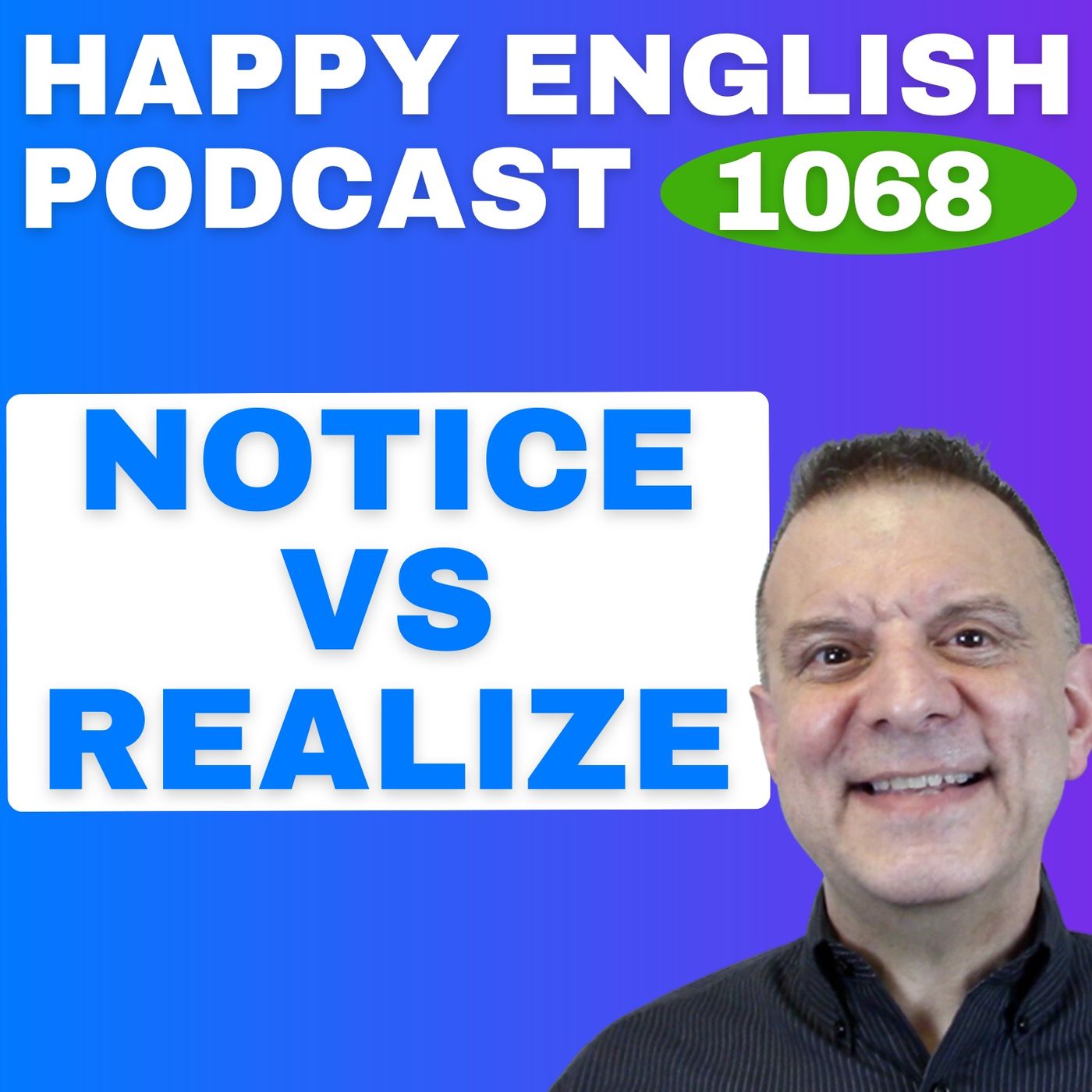
1068 - Notice vs Realize - This Difference Matters
Jun 2600:07:34Tap to summarizeI noticed a strange noise. I realized I forgot my keys. She noticed he was quiet. She realized he was upset.Notice and realize are two similar words in English, so they're are easy to mix up. And honestly, it's easy to understand why. Both words talk about becoming aware of something. But there's an important difference between them. When you notice something, you use your senses. When you realize something, you use your mind. Once you understand that difference, these two words become much easier to use naturally. And that is what we're going to look at today!The Happy English PodcastHelping people speak English better since 2014Over 1,000 episodes • 8 million downloads📘 Get free weekly English lessons plus instant access to my FREE Vocabulary Workshop.:https://learn.myhappyenglish.com/free-english-lessons🎥 Watch video versions of the Happy English Podcast on YouTubehttps://www.youtube.com/@HappyEnglishNY/podcasts🌐 Learn more about my English lessons and courseshttps://www.myhappyenglish.com
Transcribe →