← HardLore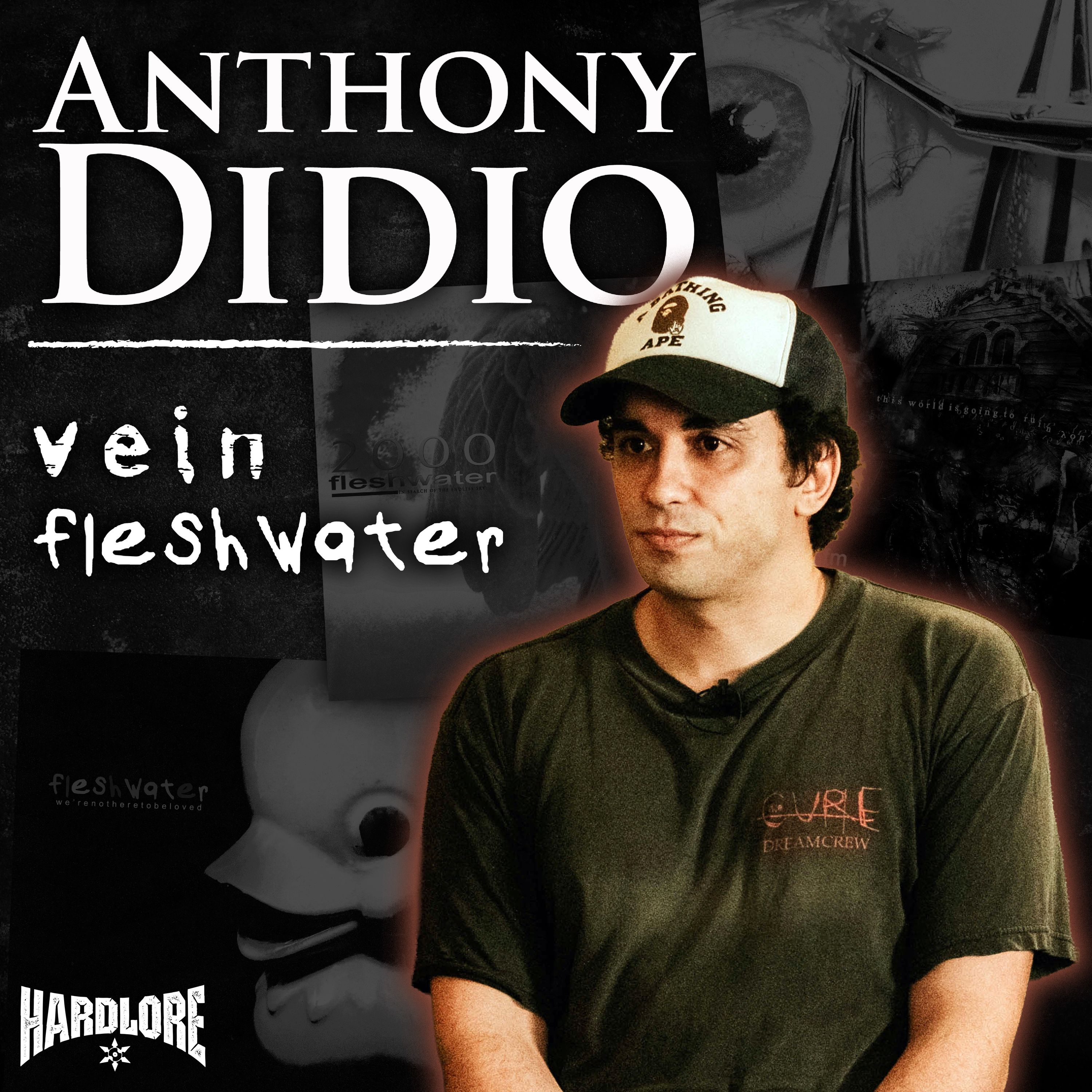
HardLore
Anthony DiDio: From VEIN to FLESHWATER
01:50:58
Welcome to HardLore.fm… Years in the making, we’re joined by longtime friend of the show Anthony Didio, vocalist of Vein and Fleshwater. We discover his evolution as a musician: starting Vein, making the landmark instant classic “Errorzone” and their mature follow up “This World is Going to Ruin You,” and ending suddenly shortly after upon the meteoric rise of Fleshwater immediately after their breakout debut LP “We’re Not Here to Be Loved.” Now fresh off a tour with Deftones, their enormously ambitious sophomore LP “2000: In Search of the Endless Sky” and their biggest headlining tour ever, Anthony finally joins us for a long awaited (from us and from you) in-person sit down interview. Enjoy.
Loading summary
Transcript1,203 lines
- [00:00]
Anthony DiDio
This world's gonna ruin you. So the world shut down and then a month later, we were supposed to go in and record it.
- [00:08]
Interviewer 1 (possibly Taylor or a band associate)
Vayne was one of those bands that, throughout the Pandemic, all these people are inside discovering hardcore, right? And Vayne was one of the bands they couldn't wait to see. But the record maybe didn't connect the same way Arizona did. As we talked about, I do think.
- [00:24]
Anthony DiDio
It'S a better record than Arizona, but I also think that it's a record that you should listen to in the dark with your headphones on. However it's received is out of my control. And the people that do connect with it probably connect with it the same way that we do. So at the end of the day, that's all that matters.
- [00:40]
Interviewer 1 (possibly Taylor or a band associate)
And at this point, there has not been a next thing for Vain.
- [00:45]
Anthony DiDio
No.
- [00:46]
Interviewer 1 (possibly Taylor or a band associate)
Are there any plans? Okay. Hello, welcome. It's Hard Lord Time. How you doing, Bo?
- [01:15]
Interviewer 2 (possibly a co-host or friend)
I'm doing really good. Day two, fya.
- [01:18]
Interviewer 1 (possibly Taylor or a band associate)
That's right. Orlando, Florida. We are here in the swamp and we. But we're here for a very special reason. We have an incredible guest today. This is eons in the making here. You know, the long awaited, highly anticipated by us, by you. We're proud to introduce a creative genius to me, one of my favorite modern musicians and guys in general from Fleshwater Vane and the whole Extended FM universe, MA own Anthony DiDio.
- [01:48]
Anthony DiDio
Hello, how are you? Thank you.
- [01:50]
Interviewer 2 (possibly a co-host or friend)
Good.
- [01:50]
Anthony DiDio
I'm good. Thank you for having me. You're very, very kind words. Thank you.
- [01:53]
Interviewer 1 (possibly Taylor or a band associate)
You know me, you know.
- [01:54]
Anthony DiDio
It's Didio, by the way. Formerly on record. Yeah.
- [01:59]
Interviewer 1 (possibly Taylor or a band associate)
D I D I D I D.
- [02:02]
Anthony DiDio
I O 2 capital D's beautiful.
- [02:04]
Interviewer 2 (possibly a co-host or friend)
Oh, really?
- [02:04]
Anthony DiDio
Oh, cool.
- [02:05]
Interviewer 2 (possibly a co-host or friend)
I like that.
- [02:05]
Anthony DiDio
Yes.
- [02:06]
Interviewer 2 (possibly a co-host or friend)
Stylized.
- [02:07]
Anthony DiDio
Yes.
- [02:07]
Interviewer 1 (possibly Taylor or a band associate)
I didn't know that.
- [02:08]
Anthony DiDio
Like. That's all right. No one does.
- [02:10]
Interviewer 1 (possibly Taylor or a band associate)
Welcome to the show.
- [02:11]
Anthony DiDio
Thank you for having me.
- [02:12]
Interviewer 1 (possibly Taylor or a band associate)
How's everything been?
- [02:14]
Anthony DiDio
Good. Just here at fya. Did a couple shows on the way down with Jarhead, Fertilizer and Tarantula. Awesome tour. Two incredible bands, all cool people.
- [02:28]
Interviewer 2 (possibly a co-host or friend)
Jarhead's insane.
- [02:29]
Anthony DiDio
Yeah. One of the craziest bands.
- [02:30]
Interviewer 2 (possibly a co-host or friend)
Was he wearing the Chains.
- [02:31]
Anthony DiDio
Wearing the chains. He's got the chains on the drums and it's just like so cool. That's actually a band that is insane.
- [02:37]
Interviewer 1 (possibly Taylor or a band associate)
To watch live is David Jarhan.
- [02:39]
Interviewer 2 (possibly a co-host or friend)
Yeah.
- [02:40]
Interviewer 1 (possibly Taylor or a band associate)
Yeah.
- [02:40]
Anthony DiDio
That's like his brainchild.
- [02:41]
Interviewer 2 (possibly a co-host or friend)
Yeah, it's his.
- [02:42]
Interviewer 1 (possibly Taylor or a band associate)
That's he. Is he the Goat?
- [02:45]
Interviewer 2 (possibly a co-host or friend)
He might be the modern goat.
- [02:46]
Interviewer 1 (possibly Taylor or a band associate)
Modern Goat. Drummer Dave Bland, Philip Hill, Jarhead.
- [02:49]
Anthony DiDio
Wow. They did like a split a really long time ago. With that band Purge called Always Faithful. And they're playing songs off that too, which is really cool. Yeah, they're sick. Tarantula is awesome.
- [03:03]
Interviewer 1 (possibly Taylor or a band associate)
Yeah.
- [03:04]
Anthony DiDio
And Richmond. Yeah.
- [03:07]
Interviewer 1 (possibly Taylor or a band associate)
Something by way of Richmond.
- [03:09]
Anthony DiDio
Excellent. But, yeah, other than that. Just been chilling at home and then doing this, and then gonna be home in a couple days until whatever's next, you know, whatever. Is that announced? Oh, not yet, but pretty soon.
- [03:22]
Interviewer 1 (possibly Taylor or a band associate)
Cool, cool, whatever.
- [03:23]
Anthony DiDio
Maybe by the time this comes out, it'll probably be announced. Cool.
- [03:26]
Interviewer 1 (possibly Taylor or a band associate)
Go check it out. Once in a generation, Anthony, A group of people comes along where I witness a band. I see them play one song, and I sit there with goosebumps covering my whole body. And I know not only do I need to do everything in my power to see them succeed and see them grow, but I want to be their friend. And that's how it was with you. I saw you play one set. We'll get into that later. And I immediately became invested in everything you were doing and would ever do. And I couldn't be more proud of how the whole team has evolved and grown and everything you guys are doing. So congrats, first of all.
- [04:07]
Anthony DiDio
Thank you.
- [04:08]
Interviewer 1 (possibly Taylor or a band associate)
But let's. Let's get. Let's go back in time. Okay, tell me. Young Anthony Didio finding punkin hardcore music.
- [04:15]
Anthony DiDio
So growing up, I had, like, an older brother and sister, so they were much older than me. My sister's like 12 years older than me. My brother's eight years older than me. So when I was younger, they were already into, like, music and, you know, movies and whatever, all kinds of stuff. And so I would be around that stuff just growing up. Like, my sister loved, like, you know, no Doubt and Weezer, and they loved, like, you know, all kinds of other, like, punk rock bands and stuff. And so like, when I was like, you know, five or six, I loved, like, some 41 and, you know, 582 and. Yeah, like, very young. Just around them, like. And my sister and my brother were always, like, super supportive of, like, you know, me liking music. So they would show me stuff all the time.
- [05:07]
Interviewer 1 (possibly Taylor or a band associate)
Wow.
- [05:08]
Interviewer 2 (possibly a co-host or friend)
So I was on to, like, Twinkle.
- [05:09]
Interviewer 1 (possibly Taylor or a band associate)
Twinkle five or six Diamond Banger.
- [05:12]
Anthony DiDio
Yeah, well, so it was just stuff like that. And then I kind of pivoted and got into, like, metal stuff on my own, which they didn't. They didn't really like. But I. I kind of like.
- [05:24]
Interviewer 1 (possibly Taylor or a band associate)
What kind of metal stuff?
- [05:25]
Anthony DiDio
Like, you know, like. Like slip knot corn, late 90s, early 2000s tones. And then, you know, like, like Shadows Fall, God forbid. Wow. Massachusetts Lamb of God like, yeah, American metal, kind of. And then like, meshuggah, Sepultura, Soul Fly.
- [05:45]
Interviewer 2 (possibly a co-host or friend)
And how are you finding. Is this because you're seeing T shirts?
- [05:48]
Anthony DiDio
Like, just, like. I mean. Well, first it was through them, and then, like, I would dig around their room for stuff. I would, like, look at my brother's CDs, and like, as I remember, he had, like, the Slipknot cd. And I was like, you know, this is terrifying. Yeah, like, what is this?
- [06:03]
Interviewer 1 (possibly Taylor or a band associate)
Or the red.
- [06:03]
Anthony DiDio
And they were like. They were like, that sucks. Don't listen to it. I was like, this is terrifying. Like, what is this? And they showed me all kinds of stuff. So, like, I loved, like, Blink 182 and, you know, Green Day and stuff like that, and the Strokes. And then, yeah, eventually got into metal. And I had a best friend in middle school named Jack. And, like, me and him would, like, find bands together and stuff. And he was, like, pretty good at downloading music, so we would always hang out. We played in a band together. And then, like, I played bass. Cool. Yeah.
- [06:39]
Interviewer 1 (possibly Taylor or a band associate)
Bass first for you?
- [06:40]
Anthony DiDio
Yeah, bass was first. My sister had a guitar. She had a Fender Strat and she had, like, an acoustic guitar. And I would, like, bang on them and stuff, but I didn't know how to play them. And then, like, for whatever reason, I, like, really wanted to play bass. So I picked bass. I got a bass when I was like, 10, and me, Jack, played guitar. So it was like, all right, you, I'll play bass, you play guitar. And so, yeah. And then, like, eventually, once I got to high school, I just started discovering other music and, like, going to shows and stuff. And like, I. Me and my good friend Miles discovered Anchors up when we were like, in high school. And.
- [07:22]
Interviewer 2 (possibly a co-host or friend)
So how far were you from Haver?
- [07:24]
Anthony DiDio
I was only 20 minutes from Haverhill, but, like, I was not allowed to go there. Yeah, Like, I was in a.
- [07:29]
Interviewer 1 (possibly Taylor or a band associate)
So you had to lie.
- [07:30]
Anthony DiDio
Oh, it took a lot. Yeah. And then. So then he. So we started looking into those bands. And then I remember he burned me a copy of the band Revenges first lp and, like, with the track list written out on a Burn cd. And that was, like, pretty life changing. So. So I think all the. All those. Those. All the MVHC bands at that time and like, all the bands, hardcore bands in Massachusetts at that time is like, what was truly, like, my entryway into, like, all of it for real, you know? And then once I got into that, I kind of circled back to, like, other things my brother and sister had mentioned to me. That maybe I wasn't ready for yet or I just didn't get into yet on my own. Like. Like Converge or Death for Dishonor.
- [08:19]
Interviewer 1 (possibly Taylor or a band associate)
Things like that.
- [08:19]
Anthony DiDio
My brother would show me these things. Like, look at this video. Converge. This is the heaviest band of all time.
- [08:24]
Interviewer 1 (possibly Taylor or a band associate)
So your brother was down. Was.
- [08:25]
Anthony DiDio
Yeah, he liked a lot of awesome. He showed me, like, Converge Botch.
- [08:29]
Interviewer 2 (possibly a co-host or friend)
How much older then?
- [08:30]
Anthony DiDio
He's. He's like eight years older than me.
- [08:32]
Interviewer 2 (possibly a co-host or friend)
Oh, okay.
- [08:32]
Anthony DiDio
So he would be like, watch this video growing up there.
- [08:35]
Interviewer 1 (possibly Taylor or a band associate)
But that's like, yeah, I'm playing Mario.
- [08:38]
Interviewer 2 (possibly a co-host or friend)
Yeah.
- [08:39]
Anthony DiDio
So he showed me, like, like, the no Heroes video or something. Yeah. Or like, the. The breakthrough at all Death for Dishonor video banger. So. But, like, I didn't get it at the time, I don't think. And then eventually I came back around to it, and so then from there on, it was just, like, getting deeper and deeper and deeper into it and, like, you know, going to shows at Anchors up and, like, you know, listening to all the local bands, like, Bonus army, the Carrier, Revenge. Think again. Word for word. Be hard to Dylan. Like, there were so many bands. There was, like, a ton of bands.
- [09:17]
Interviewer 1 (possibly Taylor or a band associate)
The best possible case scenario for, like, a young guy to cut his teeth in a. And, like, Anchors up as your local hometown place to discover things. I can't imagine anything.
- [09:29]
Anthony DiDio
Yeah. Yeah. So that was, like, the real. Like, that's what really got me into it. And the band that, like, really. That I connected with the most out of that group was the Carrier. So that was the band. Once I kind of found that, I was like, oh, I really, really want to see this band. And so I went and saw them. My sister was dating a guy at the time who played in this band, this, like, indie band, and they were opening the show. So I was like, I can go. I'm gonna go. I have a ride.
- [10:03]
Interviewer 1 (possibly Taylor or a band associate)
Yeah.
- [10:03]
Anthony DiDio
Like, it's okay. My sister's going, like, I'm gonna. I'm gonna go. And then I went, and the Power went out, and I was so pissed. I was like, the one time, like, I said, I get to go to this show that I want to go to. The Power went out, and my sister was there, and Matt's sister was there, and they introduced us.
- [10:27]
Interviewer 1 (possibly Taylor or a band associate)
Wow.
- [10:27]
Anthony DiDio
Whoa.
- [10:28]
Interviewer 2 (possibly a co-host or friend)
Really?
- [10:28]
Anthony DiDio
Yeah.
- [10:29]
Interviewer 2 (possibly a co-host or friend)
So that early on.
- [10:30]
Anthony DiDio
So I was like, hey, what? I was, like, 15.
- [10:32]
Interviewer 1 (possibly Taylor or a band associate)
So was he equally. He was mad about the Power going out.
- [10:35]
Anthony DiDio
I think he was just chilling.
- [10:36]
Interviewer 1 (possibly Taylor or a band associate)
Okay.
- [10:37]
Anthony DiDio
And he was also from there and, like, hanging out with some people. I didn't know anybody, so I just went and. And then I said, what's up to him? And I was kind of, you know, exchanged a couple words. I had a bury your dead hoodie on. He was like, oh, cool, Cool hoodie. And then, you know, from then on, we started just like, talking online about, like, Converge and stuff. And like.
- [10:59]
Interviewer 1 (possibly Taylor or a band associate)
And is he already drumming at this time?
- [11:01]
Anthony DiDio
Yeah, yeah. He. Him and Josh had been like, playing. Playing in bands since they were like.
- [11:07]
Interviewer 1 (possibly Taylor or a band associate)
He knew Josh that.
- [11:08]
Anthony DiDio
Yeah. So him and Josh are already friends. So like, they had played in some hardcore bands together, like, growing up. So I met them and immediately, like, we were like, we have to start a band. Like, it was like a. It was weird. It was just like, we just knew or something, you know.
- [11:24]
Interviewer 1 (possibly Taylor or a band associate)
What band was this?
- [11:25]
Anthony DiDio
So we didn't have a name at the time. It was. Well, there was a name. It was like. So it was me, Matt, Josh, this kid, Nick. And we had a band. We called it Life Script.
- [11:36]
Interviewer 1 (possibly Taylor or a band associate)
Oh, that's cool.
- [11:37]
Anthony DiDio
Was the name of the cool name. And so that was like. Sounded like Thursday okay or something.
- [11:42]
Interviewer 2 (possibly a co-host or friend)
Okay.
- [11:42]
Anthony DiDio
It was like very like, kind of screamo melodic. I was playing bass, right? Yeah. So that was when I started like, writing.
- [11:50]
Interviewer 1 (possibly Taylor or a band associate)
Ah, so these are songs you wrote.
- [11:52]
Anthony DiDio
That was kind of like when. Cuz like before that, like, I would play stuff and I would try to figure out how to write stuff. And then it wasn't until I kind of like got on my computer like a daw. I couldn't record anything into it, but it was a MIDI program.
- [12:12]
Interviewer 1 (possibly Taylor or a band associate)
Oh, so you could do drums?
- [12:14]
Anthony DiDio
Reason 5 yeah, yeah. So I would just. I would just sit and figure it all out. Like, I would make like, the shittiest electronic music that wasn't on the grid. Like, I didn't know how to use the grid grid yet. I would, like, play the drums. Oh, I mean, like, and just try to make electronics.
- [12:30]
Interviewer 2 (possibly a co-host or friend)
What did you do when you discovered quantizing?
- [12:33]
Anthony DiDio
It was life, dude.
- [12:34]
Interviewer 1 (possibly Taylor or a band associate)
The letter Q. Q it.
- [12:36]
Anthony DiDio
Life changed. I actually didn't know about that yet, but I figured out like, oh, you can click in the notes.
- [12:39]
Interviewer 1 (possibly Taylor or a band associate)
Yeah, yeah.
- [12:40]
Anthony DiDio
So, like, I would make electronic stuff. But then that turned into like, I want to try and like, abuse this. To make the most realistic sounding drum kit on this program. And then like, I would do like, fake piano guitar. Oh, it was like a guitar setting, like, sound like some shitty MIDI guitar. So I would just make songs. I sent some to Matt that kind of started it. And then he was like. We were like, we got to start a band. We started jamming and yeah, it sounded like, you know, it's kind of melodic. It's kind of like Thursday did that for like a couple years, but like.
- [13:08]
Interviewer 1 (possibly Taylor or a band associate)
Never did it play shows.
- [13:10]
Anthony DiDio
No. So for a couple years there, there might have been one show, but like for the most part it was just like we would get in the basement and try to just like give ourselves goosebumps.
- [13:20]
Interviewer 1 (possibly Taylor or a band associate)
Like you were saying, isn't that the best feeling?
- [13:23]
Anthony DiDio
Well, that's like that back then too. I mean not to be like back then, but it was like that's all that mattered and that's still all that matters.
- [13:29]
Interviewer 1 (possibly Taylor or a band associate)
There are 12 notes.
- [13:31]
Anthony DiDio
Yes.
- [13:31]
Interviewer 1 (possibly Taylor or a band associate)
And we discover these combinations that nobody has done before.
- [13:35]
Anthony DiDio
Yes.
- [13:35]
Interviewer 1 (possibly Taylor or a band associate)
And I mean, hopefully or just like. Or somebody's done before and you do a little different.
- [13:40]
Anthony DiDio
Yeah, I, I mean, yo, sometimes, you know, I just love two notes back to back.
- [13:46]
Interviewer 1 (possibly Taylor or a band associate)
Hey man, come on.
- [13:48]
Anthony DiDio
Sometimes when it hits the third note, I'm like, they ruined it too many. Or the third chord, it's like you blew it.
- [13:53]
Interviewer 1 (possibly Taylor or a band associate)
My dad always said a four chord song was a hit. A three chord song was a smash hit. A one chord song was a masterpiece.
- [14:02]
Anthony DiDio
Yeah.
- [14:02]
Interviewer 1 (possibly Taylor or a band associate)
Wow.
- [14:03]
Interviewer 2 (possibly a co-host or friend)
There's a lot of. Not to be, but there's a lot of two chord songs.
- [14:07]
Anthony DiDio
Two chords. Like something in the way Nirvana. Like that four and zero. Like that's like that type of emotional E, E, C. Yeah, yeah. Like it's like a. It's like an interval of four frets, you know.
- [14:21]
Interviewer 2 (possibly a co-host or friend)
Went through the desert on a horse with two, two notes, two chord songs.
- [14:25]
Anthony DiDio
That's. That's what I love. But yeah, I don't know.
- [14:28]
Interviewer 1 (possibly Taylor or a band associate)
Just.
- [14:28]
Anthony DiDio
So we would just sit there for hours like writing songs and try to like figure that out and just be like, oh, I like that. Oh. Because you know, it's like we're trying to, you know, we would listen to music and get chills over it and share that with each other. And then it was like we were trying to make our own version of that happen. So we were writing all these songs. We had tons of songs. There was like little recordings of them. And then eventually there was a. There was a time where it was like, oh, so and so wants to start this like hardcore punk power violence band. So we go to jam one day and there was a kid there who. A very special person who sang in a band. And it was East Beast.
- [15:20]
Interviewer 1 (possibly Taylor or a band associate)
Yes, say it.
- [15:22]
Anthony DiDio
And so the band was called East Beast. The singer, you know, was crazy. And we just played these, wrote these power violence songs and played them. That was also like spine chilling at the moment though, like, it was just like, this is the most up music I've ever heard. And I'm like stoned in a basement.
- [15:39]
Interviewer 1 (possibly Taylor or a band associate)
And this crazy guy who were all like you.
- [15:42]
Anthony DiDio
It was like the craziest feeling ever, you know, still. And yeah, and he's saying all kinds of crazy. And then we played shows and like it did like really well. Like people liked it a lot. And then we were kind of like. Like this is awesome. But also like this isn't like our like project, like our brainchild soul like project. You know what I mean?
- [16:07]
Interviewer 2 (possibly a co-host or friend)
Right.
- [16:08]
Anthony DiDio
So we're still doing the Life Script thing and then like we do that on the side still just kind of practicing. And then like eventually we would just write songs for East Beast and it was like we couldn't fit any of our other like real influences into it because the singer didn't like, like any of that or it just didn't make sense for the band. So eventually I. I had written this one song or like half a song. I wrote like two riffs back to back. And it was a song Latency. It's on the Vein ep. First one self titled. And we practiced it and then me and Matt drove home from practice. He was like, you know he's not gonna like that song. And I was like, well, it then let's start our own band because why are we. Yeah. Limiting ourselves because of this stupid person. Whatever. So we started Vain and that was like the beginning of Vain. And I was like, it, I'll just sing and I'll play bass at the same time and we can do whatever we want.
- [17:16]
Interviewer 2 (possibly a co-host or friend)
Right.
- [17:16]
Anthony DiDio
And then from there on it was like this floodgate opened of like, it was like kind of like felt like the Life Script stuff. But all of a sudden now there was this like anger and heaviness and all this other kind of crazy, other weird going on and that made its way into it and then that it became Vain.
- [17:35]
Interviewer 2 (possibly a co-host or friend)
Who thought of Vain?
- [17:37]
Anthony DiDio
What do you mean? The name me just.
- [17:40]
Interviewer 1 (possibly Taylor or a band associate)
Where do Jeremy and John come from?
- [17:42]
Anthony DiDio
The old guitarist at East Beast left. He got kicked out and then. And then Jeremy filled in for a show and then he was just an East Beast, so he was just jamming with us. And also I think he was doing Life Script before that, if I remember correct.
- [18:00]
Interviewer 2 (possibly a co-host or friend)
Okay, okay.
- [18:01]
Anthony DiDio
We met him at Anchors Up.
- [18:02]
Interviewer 1 (possibly Taylor or a band associate)
Okay.
- [18:03]
Anthony DiDio
And I actually funny enough grew up playing in a band with like one of his childhood best friends.
- [18:07]
Interviewer 1 (possibly Taylor or a band associate)
Wow.
- [18:08]
Anthony DiDio
Skip Brandon. Which is crazy.
- [18:09]
Interviewer 1 (possibly Taylor or a band associate)
That's what's interesting is like I only remember Jeremy from that era like, from 2011. Because I feel like he was a little more online.
- [18:19]
Anthony DiDio
Okay.
- [18:20]
Interviewer 1 (possibly Taylor or a band associate)
He was posting guitar covers and stuff.
- [18:22]
Anthony DiDio
Yeah.
- [18:23]
Interviewer 2 (possibly a co-host or friend)
And I.
- [18:23]
Interviewer 1 (possibly Taylor or a band associate)
Very vividly so when I saw Vane for the first time, I remember seeing Jeremy being like, that's that fucking guy.
- [18:31]
Anthony DiDio
That's insane that.
- [18:32]
Interviewer 1 (possibly Taylor or a band associate)
You saw the guitar cover. Oh, yeah, I saw the Coheed cover. I saw them all.
- [18:35]
Anthony DiDio
That's awesome.
- [18:36]
Interviewer 1 (possibly Taylor or a band associate)
But that's great. So East Beast formally becomes Vayne.
- [18:39]
Anthony DiDio
Yeah. And so another thing too was like, you know, getting to high school, getting into, like, deeper into, like, the hardcore rabbit hole and just exploring different kinds of underground music. Then I kind of came across, like, screamo stuff and, like, one of the bands that I also kind of remember from childhood being mentioned. I remember I asked my brother, I was like, what's the scariest band you've ever heard? He was like, Jerome Sheen. And I was like, okay. So when I got older, I looked up Jerome's dream and then like, that. That was like a pivotal piece of like. Like nothing was the same after hearing that kind of thing. And that made. That was like the biggest starting influence of Vain.
- [19:24]
Interviewer 2 (possibly a co-host or friend)
Wow.
- [19:25]
Anthony DiDio
Obviously Converge and obviously tons of other bands, but that band kind of like, we would just like, watch, you know, back then There was like 10 pictures of the band online, their discography in, like, two videos, and we would just like, study it and just like absorb it all and do it felt. It felt so mysterious and it felt so powerful and, like, special and magical. So that band was like a big factor. And like, also other kinds of screamo stuff got super into at the time.
- [19:56]
Interviewer 2 (possibly a co-host or friend)
Did that band or others have electronic and breakpeak stuff in it?
- [20:01]
Anthony DiDio
No.
- [20:01]
Interviewer 2 (possibly a co-host or friend)
Where did that come from?
- [20:02]
Anthony DiDio
For just like, this is stuff we're into too. And I think Slip Knot has a little, you know. Yeah.
- [20:09]
Interviewer 2 (possibly a co-host or friend)
But it's kind of there.
- [20:10]
Anthony DiDio
The thing is, is, like, that's not why.
- [20:12]
Interviewer 1 (possibly Taylor or a band associate)
Yeah.
- [20:12]
Anthony DiDio
You know what I'm saying? Like, because, yes, they have a song with a break beat in it. As I got older, I got, you know, more aware of the term jungle and then started looking into it and found, like, ltj, Boom. And all kinds of, like, other cool drum and bass jungle artists from the 90s. And a lot of their aesthetics were very similar to, like, what we wanted to go for with Vayne on Arizon and stuff. You know, it was like, oh, this is. This type of music matches the types of, you know, vibes that we're trying to go for. So we were really listening to drum and bass at the time and still do. And it Wasn't like a.
- [20:54]
Interviewer 1 (possibly Taylor or a band associate)
It was really just, let's get some drum and bass.
- [20:56]
Anthony DiDio
Yeah, let's get some drum and bass in it. And it's like this. It was really this like high energy, you know, kind of vibe. Also like a lot of trip hop stuff and a lot of the aesthetics of that record were inspired by like drum and bass and trip hop and things like that. And I just felt, I think that there's a lot of stuff about that music too that just influenced the playing, the ferocity of it. But yeah, it wasn't just like, oh, let's do it. And it's like, oh, everyone's gonna think that, whatever. But, you know, I can't control that.
- [21:31]
Interviewer 1 (possibly Taylor or a band associate)
It's like it's on the record.
- [21:32]
Anthony DiDio
Who gives a right? I love that song. Where.
- [21:35]
Interviewer 1 (possibly Taylor or a band associate)
Where does John come from? So John, Little baby John.
- [21:38]
Anthony DiDio
So at Frostbite Fest In 2010, Eleven East Piece played the fest. We're all there. It's like 1am and revenge again is going to play. So we're like stand all hanging out and John's there alone. And he was like 15 and we just started talking to him. He was like into like Street Fighter and stuff and video games.
- [22:03]
Interviewer 1 (possibly Taylor or a band associate)
We got. We should probably delve into. Yeah, that whole aspect of that.
- [22:06]
Interviewer 2 (possibly a co-host or friend)
Let's get into that.
- [22:08]
Anthony DiDio
And then like, so. And then, yeah, we all like moshed to Revenge at one in the morning and it was fun. And then we'd always see John at shows. Vane would play Connecticut all the time. John would always be moshing a Vane and then he was moshing a van.
- [22:23]
Interviewer 1 (possibly Taylor or a band associate)
Before being in the band. So he wasn't og.
- [22:26]
Anthony DiDio
No, he was always moshing a vein. One of the. And. And one of the first times we ever played, like, did a weekend tour was with Jagged Visions Floods and Recycled Earth and we played Point beach in Connecticut and Enraged Youth opened and they covered Smasher Enemies and we all moshed. John was singing and he's 16, maybe child, and couple years into it. Like, I remember once we started writing the Arizon stuff, it was like I immediately. I remember like I wrote the first demo to Rebirth Protocol and I was like, I want to say like a million words over this and there's no fucking way I'm going to be able to play and sing this at the same time. But I was pretty stubborn about stepping off the bass, right. Matt was like, dude, you should just sing in the band.
- [23:19]
Interviewer 1 (possibly Taylor or a band associate)
Yeah.
- [23:19]
Anthony DiDio
And I was like, fuck it, I'll just sing in the band. And at the time we had a different bass Player. Our friend Sean, he was playing bass. And so I started singing, just singing in like 2016. And then like a year later, one thing led to another and we needed a new bass player. And Matt was like, what about John?
- [23:41]
Interviewer 1 (possibly Taylor or a band associate)
And it was like, did Jon learn bass to. To join Van?
- [23:44]
Anthony DiDio
Yeah. Well, no, he already. Well, he already played guitar.
- [23:47]
Interviewer 1 (possibly Taylor or a band associate)
Okay.
- [23:48]
Anthony DiDio
And he played bass in bands. Like I had seen him play bass in bands.
- [23:53]
Interviewer 1 (possibly Taylor or a band associate)
Okay.
- [23:54]
Interviewer 2 (possibly a co-host or friend)
But you're still kind of scouting the killer.
- [23:56]
Anthony DiDio
So he's like, yeah. He's like, yeah, I got him. And immediately I was like, this is the best idea ever. But also like, can he, can he do it? And then I went and picked him up and then he didn't know how to play any of the songs. But he turned into like the best bass player ever. And cool as swag. Yeah. Amazing. It was. It was awesome. It was like the best, best thing ever. And then was he yoked at that time?
- [24:24]
Interviewer 1 (possibly Taylor or a band associate)
No.
- [24:24]
Anthony DiDio
What do you mean?
- [24:25]
Interviewer 1 (possibly Taylor or a band associate)
He was.
- [24:25]
Interviewer 2 (possibly a co-host or friend)
He.
- [24:26]
Anthony DiDio
He came out of the womb.
- [24:29]
Interviewer 1 (possibly Taylor or a band associate)
He had abs and there was definition. Tell him. I was. I. John, you know, I was one of the people that told him, dude, if you worked out a little bit, yeah, you're going to be the biggest person in the world.
- [24:38]
Anthony DiDio
Yeah. He was always definitely built, but like just added on.
- [24:42]
Interviewer 2 (possibly a co-host or friend)
Yeah, just machop.
- [24:43]
Interviewer 1 (possibly Taylor or a band associate)
He had like washboard ads.
- [24:45]
Interviewer 2 (possibly a co-host or friend)
Yeah.
- [24:46]
Interviewer 1 (possibly Taylor or a band associate)
Crazy.
- [24:47]
Interviewer 2 (possibly a co-host or friend)
The Living weapon.
- [24:48]
Interviewer 1 (possibly Taylor or a band associate)
So were you guys all living together at this time?
- [24:51]
Anthony DiDio
No. So kind of. So I was at. I was back at my parents house around the time John joined and Matt had moved to his aunt's house which was literally down the street.
- [25:06]
Interviewer 2 (possibly a co-host or friend)
Okay.
- [25:07]
Anthony DiDio
So. And then John moved in with him and we'd practice there. So like we were there all the time.
- [25:11]
Interviewer 1 (possibly Taylor or a band associate)
So every day you're clocking in pretty much and doing like the Terror's Realm stuff. Is this when that would happen?
- [25:16]
Anthony DiDio
That was way after. That was before John.
- [25:18]
Interviewer 1 (possibly Taylor or a band associate)
Okay.
- [25:19]
Anthony DiDio
So like we used to practice at Josh's house. So that was like this. The self titled In Terror's Realm era was like all Josh's house. And then by the time we went this is to Matt or. And then a little bit of Arizona started there too. Okay. Because that stuff is a lot older than like I think people playing most.
- [25:40]
Interviewer 1 (possibly Taylor or a band associate)
Of it on the. All the stuff we did months before the record would come out.
- [25:45]
Anthony DiDio
I mean we played songs years like Doom Tech.
- [25:47]
Interviewer 1 (possibly Taylor or a band associate)
You were playing for years?
- [25:48]
Anthony DiDio
Yeah, we. We played like Old Data and like I think 2014 or 15 I could be wrong about. But. But we did play a lot of that stuff for a while and I'm glad we did, because I feel like as time went on, little changes were made, or, you know, you just got more. You know, when you play a song a million times, you start doing different shit.
- [26:09]
Interviewer 1 (possibly Taylor or a band associate)
Or like, you start. You did the live nuances on the recording.
- [26:13]
Anthony DiDio
Exactly, exactly, exactly.
- [26:15]
Interviewer 1 (possibly Taylor or a band associate)
And you developed this fan base that, like, knew these songs just from the live performances. So when they finally heard them on Arrow Zone, it was like the ultimate relief. And I think it really contributed to the record crushing the way it did. Yeah, let's. We'll get there. We'll get there in a second. We're almost there, guys. This is hardcore. The windbreaker year.
- [26:36]
Interviewer 2 (possibly a co-host or friend)
Was that 17?
- [26:38]
Anthony DiDio
Yep.
- [26:40]
Interviewer 1 (possibly Taylor or a band associate)
Tore the world to pieces. This damn windbreaker.
- [26:42]
Interviewer 2 (possibly a co-host or friend)
Let me ask you something. How many of them did you give away?
- [26:46]
Anthony DiDio
I can't remember. So it was really crazy because I think we made a list of, like, everyone that could potentially want one, and I think we rounded it up and then I think we were like, everyone just pay for these at cost?
- [27:02]
Interviewer 2 (possibly a co-host or friend)
Yeah. Cool.
- [27:03]
Anthony DiDio
Like, throw us 20 bucks and you got one. And we were like, giving them out in the parking lot. It was really funny. And then.
- [27:11]
Interviewer 2 (possibly a co-host or friend)
How.
- [27:11]
Anthony DiDio
So what was the question? How many?
- [27:12]
Interviewer 2 (possibly a co-host or friend)
Just, I always wondered if you gave them to people or if people were like, I gotta.
- [27:16]
Anthony DiDio
I think no, it was a friends only thing. But it was also like, throw 20 bucks, get the jet. Like, we, like. We're like, who wants one of these? You know what I mean? And.
- [27:24]
Interviewer 1 (possibly Taylor or a band associate)
And. But you must mosh.
- [27:25]
Anthony DiDio
Yeah, you gotta mosh. And then.
- [27:27]
Interviewer 1 (possibly Taylor or a band associate)
And it created this mythos of this windbreaker.
- [27:30]
Anthony DiDio
So it was this friend's only thing. And then that turned into, like, everyone's focused on that. And then I was, you know, like, immediately like, I want to just put them online and, you know, end the. The discourse about it or whatever. And then it was like, but that will break the special. The mythos of the whole thing. So we held onto it for a while, and then once, like, we did this is hardcore in 2022, we were like, let's just make it for everyone. Yeah.
- [27:56]
Interviewer 2 (possibly a co-host or friend)
When we did the.
- [27:58]
Anthony DiDio
When Vane was on the post human.
- [28:00]
Interviewer 2 (possibly a co-host or friend)
Tour, I. I told Jeremy, like, save that for a rainy day. Yeah. If the van breaks down, you guys need money.
- [28:06]
Interviewer 1 (possibly Taylor or a band associate)
Yeah.
- [28:06]
Interviewer 2 (possibly a co-host or friend)
Put that online.
- [28:07]
Interviewer 1 (possibly Taylor or a band associate)
And that's like the bowl, like, the harms. Exactly.
- [28:09]
Interviewer 2 (possibly a co-host or friend)
Let me tell you, Evergreen, you ever see the. The thing that somebody made of that set where it's just switch stuff?
- [28:17]
Interviewer 1 (possibly Taylor or a band associate)
It's pretty good.
- [28:17]
Interviewer 2 (possibly a co-host or friend)
It's pretty good.
- [28:18]
Anthony DiDio
Sorry.
- [28:20]
Interviewer 2 (possibly a co-host or friend)
Yeah, I've also been. This is hardcore me yes.
- [28:22]
Anthony DiDio
Yeah. Oh, yeah. You got the. You got. You got number one together, you know. Yeah.
- [28:28]
Interviewer 2 (possibly a co-host or friend)
So it's.
- [28:28]
Interviewer 1 (possibly Taylor or a band associate)
It's ongoing.
- [28:29]
Anthony DiDio
It is what it is.
- [28:29]
Interviewer 2 (possibly a co-host or friend)
It is ever evergreen Y. I love it.
- [28:32]
Anthony DiDio
No, do I hate it? No. Yeah, exactly.
- [28:34]
Interviewer 2 (possibly a co-host or friend)
That's exactly.
- [28:35]
Anthony DiDio
Just like. It is what it is.
- [28:36]
Interviewer 1 (possibly Taylor or a band associate)
The Terror's Realm tape had a similar mythos. I feel like it's like still a thing. You can't get that everybody wants.
- [28:42]
Anthony DiDio
Some kid had me sign one the other day and I like couldn't believe I was holding it.
- [28:46]
Interviewer 1 (possibly Taylor or a band associate)
How many are there?
- [28:47]
Anthony DiDio
It's only like 50.
- [28:48]
Interviewer 1 (possibly Taylor or a band associate)
Wow. Did you package them yourself?
- [28:51]
Anthony DiDio
No, that was Threat Collection, which was like Kyle from Recycled Earth and some of the Hudson Valley guys.
- [28:59]
Interviewer 1 (possibly Taylor or a band associate)
Very nice.
- [28:59]
Anthony DiDio
Like did that back in the day. I love that tape.
- [29:04]
Interviewer 1 (possibly Taylor or a band associate)
Great songs.
- [29:05]
Anthony DiDio
Yeah, I love those songs actually. Those songs too. We got the like. So those songs were recorded early on, played them a ton of times. A lot of changes were made to them. And then we re recorded them on the remix record.
- [29:21]
Interviewer 1 (possibly Taylor or a band associate)
The. The. Is that the old, old data actual recording?
- [29:25]
Anthony DiDio
Yeah. That's great.
- [29:27]
Interviewer 1 (possibly Taylor or a band associate)
We'll get to Justin in a second here because so he would. This is when you signed a closed casket though, right? 2017.
- [29:34]
Anthony DiDio
2017, yeah. Is. Yeah, that was when I met Justin.
- [29:38]
Interviewer 1 (possibly Taylor or a band associate)
When did you meet? When and where did you meet Justin?
- [29:40]
Anthony DiDio
So Code Orange played a show in somewhere like deep in New York and they were on tour with like Gojira or something and we had just done the like week long run with them. So we were like. So I drove to the show just to see it and hang out and Justin was there and Jamie had talked to me about Justin because they had done merch. He was doing like all in merch at the time. So I initially started talking to him about merch. We weren't even talking about like records.
- [30:15]
Interviewer 1 (possibly Taylor or a band associate)
Because he worked at all in.
- [30:16]
Anthony DiDio
And yeah, so we were talking about printing merch and we started doing merch with him and then I had already.
- [30:22]
Interviewer 1 (possibly Taylor or a band associate)
Been in his ear though. Yeah, big time.
- [30:26]
Anthony DiDio
Definitely. I mean, I remember the show we played together at the game Jokes. Yes.
- [30:32]
Interviewer 1 (possibly Taylor or a band associate)
That was the beautiful day where I met all you guys. I watched this set and like, it's so rare that that happens. You know, it's common to watch to see a band play first on a show and be like, that was cool. But like the goosebumps. Every part is insane. Who are these people? I'm doing math in my head as I'm watching you. Just like, where do they come from? Who are they? That guy was doing coheed Covers on Instagram. That kid's from Connecticut.
- [31:01]
Interviewer 2 (possibly a co-host or friend)
He's gonna be huge.
- [31:02]
Interviewer 1 (possibly Taylor or a band associate)
This is crazy. I'm, like, doing math the whole time, and then your instruments are still on your bodies, and I'm like, who are you? That was amazing.
- [31:10]
Interviewer 2 (possibly a co-host or friend)
Yeah.
- [31:11]
Interviewer 1 (possibly Taylor or a band associate)
And that day I called Vital and put you on Life and Death. Or asked if you could be on Life and Death. Vital, because you were doing it that year because we were on it. And it was like, you gotta get Vane on. You gotta listen to Vane and put him on. So that was the first time we toured together and you played all those Arrow Zone songs. That was awesome. And then I witnessed Silly Anthony on a tour for the first time. You do this face where you put your hat sideways and you do this whole thing that I. I kind of.
- [31:41]
Anthony DiDio
Got it from you a little bit. The sideways hat.
- [31:44]
Interviewer 1 (possibly Taylor or a band associate)
Yeah, the gift. Yeah, yeah, yeah.
- [31:45]
Anthony DiDio
That's like. When you're just like, I'm in my. I'm chilling.
- [31:48]
Interviewer 2 (possibly a co-host or friend)
Yeah, yeah.
- [31:49]
Anthony DiDio
If the hat is on, it's like they're.
- [31:52]
Interviewer 1 (possibly Taylor or a band associate)
Yeah, it's going.
- [31:53]
Anthony DiDio
Yeah. You know, switch stem out. Just relax.
- [31:56]
Interviewer 1 (possibly Taylor or a band associate)
Do the face. But the face is maybe. Well, maybe I don't know how to describe.
- [32:02]
Interviewer 2 (possibly a co-host or friend)
Yeah.
- [32:02]
Anthony DiDio
I'm trying to think. I think I know what face you're talking.
- [32:04]
Interviewer 1 (possibly Taylor or a band associate)
It's still like, you know. You know what I'm talking about.
- [32:08]
Interviewer 2 (possibly a co-host or friend)
I do know. I mean, it's usually accompanied by fingers.
- [32:11]
Interviewer 1 (possibly Taylor or a band associate)
Yeah.
- [32:12]
Interviewer 2 (possibly a co-host or friend)
Oh, crazy fingers that you got.
- [32:14]
Anthony DiDio
Look at those.
- [32:15]
Interviewer 1 (possibly Taylor or a band associate)
See, those are for bay sand guitar. Okay, so let's talk. Let's talk Arizona. Now, these songs have been written. You're playing them to death, so. And then you're so locked in. When you go into record, does that mean. So you do this record with Will Putney? Is he contributing much as a producer? Does he need to contribute much as a producer? Or are you guys just so ready to go that it really doesn't mean anything?
- [32:38]
Anthony DiDio
So we didn't really know him at the time, and it was like an experience we had never had before. And so it was like we were. We obviously were like, dead set on the album. Like, you know, this is what it is. We've been hearing this for years. So he would more or less, like, he knows how a good record is gonna be made and come comes out. So, like, he's in, you know, maybe helping out with, like, little minute things of execution or whatnot. But when it came to creative ideas, like, there was a couple times where he would push and just say, like, hey, this part maybe could have another part. Or, hey, this. This Part right here. Could add a part. Or maybe you should play this part halftime or something. You know what I mean? And like, sometimes we'd be like, nah, that's not happening. Or like.
- [33:30]
Interviewer 2 (possibly a co-host or friend)
Or.
- [33:30]
Anthony DiDio
Or like, you know, maybe not. But sometimes we try it and be like, damn, he was actually right. It's like a good idea. And it was like, really minute stuff that actually, like, made a lot of a difference because, like, we had been also. We had, like, demoitis at that point.
- [33:48]
Interviewer 1 (possibly Taylor or a band associate)
Yeah.
- [33:48]
Anthony DiDio
It's like you can't hear it.
- [33:49]
Interviewer 1 (possibly Taylor or a band associate)
That's beyond demoitis.
- [33:51]
Anthony DiDio
You've been beyond beyond demoitis. Like, I remember, like, the breakdown and demise. Automation. Him suggesting it being halftime. And we were like, nah, that's stupid. And then we tried it when he had left, and we were like, yo, that's fucked up.
- [34:06]
Interviewer 2 (possibly a co-host or friend)
We had a really similar experience that when we did Post Human, that was the first time we went somewhere, did pre production. Yeah.
- [34:13]
Anthony DiDio
You know, and that's like the dream, like, growing up as a kid or whatever, you. You're. The dream is like, you want to go live in the place you're making the record. You want to be consumed by it.
- [34:23]
Interviewer 2 (possibly a co-host or friend)
Yeah.
- [34:23]
Anthony DiDio
You know, you want to, like, go home and. Yeah. Go back and forth. Yeah. So it was sick and. But yeah, like, little things like that. Or he'd be like, I feel like this part needs one more part right here. And we would sit there and, like, write the part, you know, so he definitely helped take it from there to there. And just even with, like, you know, my new things or whatever, he wasn't like, rearranging everything or.
- [34:50]
Interviewer 1 (possibly Taylor or a band associate)
Okay.
- [34:51]
Anthony DiDio
And, you know, again, like, you have to. You're only. You are at the end of the day, responsible for your album. Like, it doesn't matter if your producer or whoever's saying whatever. It's like, you have to kind of know when. When it's yes or no is wrong.
- [35:05]
Interviewer 1 (possibly Taylor or a band associate)
So this is the first album.
- [35:08]
Interviewer 2 (possibly a co-host or friend)
Yeah.
- [35:08]
Interviewer 1 (possibly Taylor or a band associate)
You've written in your life.
- [35:09]
Anthony DiDio
Yes.
- [35:11]
Interviewer 1 (possibly Taylor or a band associate)
And it's this good. Sounds this good. It is received this well.
- [35:17]
Anthony DiDio
Yeah.
- [35:19]
Interviewer 1 (possibly Taylor or a band associate)
Tell me about that feeling you felt hearing it back for the first time and just seeing people respond to it.
- [35:26]
Anthony DiDio
I remember, like, when we left the studio, I was like, holy, it's done. Because when we were. So we made it once before.
- [35:39]
Interviewer 1 (possibly Taylor or a band associate)
Oh.
- [35:39]
Anthony DiDio
So we recorded it twice. So the first time we recorded it was with Sean Fitz, who recorded. He's like our good friend who recorded all the early vein stuff and, like, the East B stuff. We started it with him. We got the drums done and, like, he was in Cape Cod, which was two hours from us. So we would have to make these trips and like it would be like, you know, it took like a year to two years because of, you know, trying to line up time and trying to find a weekend to. To go down and all this shit. And we couldn't stay there for 2016 to like late. The beginning of 26, like I think around March or April of 2016 is when we. When we first went in to do it. And then.
- [36:26]
Interviewer 1 (possibly Taylor or a band associate)
So this would have been out a lot sooner had that session.
- [36:29]
Anthony DiDio
Yeah. But I'm glad it didn't only because like not even recording quality wise. But it was just like the songs evolved.
- [36:35]
Interviewer 1 (possibly Taylor or a band associate)
Yeah.
- [36:35]
Anthony DiDio
And the. The ending product was way much. But the first one we did and then like, you know, things got tracked here and there. And then I would record like a song on this month and then try to wait and then we get more time so I can go record this song. I record vocals in like all different places and stuff. Like. And then by the time it was 2017, like a year later, we were still working on it. But that was when like the idea of like closed casket was a thing and the idea of re recording it was a thing. And at the time, myself included, everyone was like, why the would we re record this? We just like, you know, we just spent so much time on it. But it was like, no, I think this will be worth it. So we just did it and it was obviously worth it. But I think that. So going to a place for one month and getting it all done and then leaving and being like, it's done and it's perfect was fucking crazy. Like that in itself was crazy.
- [37:30]
Interviewer 1 (possibly Taylor or a band associate)
That's what it's supposed to.
- [37:31]
Interviewer 2 (possibly a co-host or friend)
Yeah.
- [37:32]
Anthony DiDio
That was the craziest thing in the world. Like I remember leaving and going, it's done. Like, I don't have to come back. There's no like tiny little thing that needs to be added. It's literally done. And which is.
- [37:42]
Interviewer 1 (possibly Taylor or a band associate)
It's for the best at the end.
- [37:43]
Anthony DiDio
Yeah.
- [37:44]
Interviewer 1 (possibly Taylor or a band associate)
If you have forever to tinker with it, you're going to spend forever.
- [37:47]
Anthony DiDio
Yeah. At some point you got to let it go. And I have a hard time doing that. But I've learned to like get better at that or whatever. And so that was an incredible feeling in itself was to be like, we literally did it. We made the album, our album, the best it could be. And it's done.
- [38:02]
Interviewer 1 (possibly Taylor or a band associate)
And it became. Is immediately kind of lauded as this modern classic.
- [38:05]
Anthony DiDio
Yeah. Which is crazy. And so. Yeah. I mean I Remember, like, you know, it's. To me, the craziest thing is, like, seeing people sing the words back and know the words and, like, seeing people even, you know, mosh to the songs or know the songs at all. Because it's like, only we knew these songs for, like, years. So now you're seeing other people share the same feeling that you're feeling, and that's, like, the craziest thing in the world. Still is. Like. Still is 100%.
- [38:33]
Interviewer 2 (possibly a co-host or friend)
How did you like the post Human tour?
- [38:35]
Anthony DiDio
It was all right. I'm just kidding. It was. It was awesome. I had a. That was great.
- [38:39]
Interviewer 1 (possibly Taylor or a band associate)
Was that the same year?
- [38:40]
Interviewer 2 (possibly a co-host or friend)
It was 2018.
- [38:41]
Interviewer 1 (possibly Taylor or a band associate)
Okay.
- [38:41]
Anthony DiDio
It was a great tour.
- [38:42]
Interviewer 2 (possibly a co-host or friend)
Shortly thereafter, actually.
- [38:45]
Anthony DiDio
Matt broke his arm in that tour.
- [38:46]
Interviewer 2 (possibly a co-host or friend)
Matt. Oh, Matt broke his hand moshing to harm's way.
- [38:50]
Interviewer 1 (possibly Taylor or a band associate)
Awesome.
- [38:51]
Anthony DiDio
And very early on.
- [38:52]
Interviewer 2 (possibly a co-host or friend)
Very early on. Went home.
- [38:53]
Anthony DiDio
Chris played drums.
- [38:54]
Interviewer 2 (possibly a co-host or friend)
Chris played drums. And the.
- [38:56]
Interviewer 1 (possibly Taylor or a band associate)
Not an easy band and guy to fill in, however.
- [39:00]
Interviewer 2 (possibly a co-host or friend)
Stylistically similar. Chris and Matt are similar.
- [39:03]
Anthony DiDio
Yeah, definitely. They definitely.
- [39:05]
Interviewer 1 (possibly Taylor or a band associate)
Same hair.
- [39:08]
Interviewer 2 (possibly a co-host or friend)
That was our first meeting. I. I didn't. I knew of them. Hadn't met any of them, I don't think, prior to that. But that was when we connected.
- [39:17]
Anthony DiDio
Yes.
- [39:18]
Interviewer 2 (possibly a co-host or friend)
Discovered you guys were fun and nerds. And then you met Nick.
- [39:22]
Anthony DiDio
Yeah. Who I know.
- [39:24]
Interviewer 2 (possibly a co-host or friend)
We. We love Nick.
- [39:25]
Anthony DiDio
Yeah. He's a man.
- [39:25]
Interviewer 2 (possibly a co-host or friend)
That was like our second tour with Nick too. So it was all. It's very. A melting pot.
- [39:30]
Anthony DiDio
Yeah. Hung out with Nick and Casey a lot.
- [39:32]
Interviewer 2 (possibly a co-host or friend)
A lot. Yeah.
- [39:33]
Anthony DiDio
They're the guys. They were gonna be. They were gonna be in Flesh Water and really.
- [39:36]
Interviewer 1 (possibly Taylor or a band associate)
And Chris, we.
- [39:38]
Anthony DiDio
At that time on that tour, we were like. Because we had the Flashwater demo for, like, two years, just, like, instrumentally. And we would just be like, who.
- [39:45]
Interviewer 1 (possibly Taylor or a band associate)
Did what on it?
- [39:46]
Anthony DiDio
It was me and Matt just recorded it in his basement.
- [39:49]
Interviewer 2 (possibly a co-host or friend)
Wow.
- [39:49]
Anthony DiDio
And so, yeah, on that tour, we're like, dude, we got this rock band. You guys should be in it.
- [39:53]
Interviewer 2 (possibly a co-host or friend)
And then interestingly, what we're gonna.
- [39:57]
Anthony DiDio
But jumping ahead a little bit.
- [39:59]
Interviewer 2 (possibly a co-host or friend)
But it fits. Because the tour ended in wherever we.
- [40:04]
Anthony DiDio
Were and then, like, St. Louis.
- [40:06]
Interviewer 2 (possibly a co-host or friend)
That's right.
- [40:07]
Anthony DiDio
And I broke his leg.
- [40:08]
Interviewer 2 (possibly a co-host or friend)
A guy broke his leg during it. During the show. And he stayed. He stayed in the back on a.
- [40:14]
Anthony DiDio
Pool table just like the fubar. Fucking demented.
- [40:18]
Interviewer 2 (possibly a co-host or friend)
Yeah.
- [40:18]
Anthony DiDio
Yeah.
- [40:20]
Interviewer 2 (possibly a co-host or friend)
The following weekend, like, a few days later, was our record release.
- [40:23]
Anthony DiDio
Vein dropped, but because of the broken hand.
- [40:26]
Interviewer 1 (possibly Taylor or a band associate)
Oh.
- [40:27]
Interviewer 2 (possibly a co-host or friend)
But a couple years later.
- [40:30]
Anthony DiDio
Oh, yeah.
- [40:30]
Interviewer 2 (possibly a co-host or friend)
We did the. I think it was the isolation anniversary show. Flesh Waters for sure.
- [40:35]
Anthony DiDio
First Flesh Water show.
- [40:37]
Interviewer 2 (possibly a co-host or friend)
That's A beautiful thing.
- [40:38]
Interviewer 1 (possibly Taylor or a band associate)
This is a long time coming, guys. I'm trying to tell you full circle now. Anthony, let's talk about Vane's first European tour.
- [40:48]
Anthony DiDio
Let's talk about it.
- [40:49]
Interviewer 1 (possibly Taylor or a band associate)
What do you remember from it?
- [40:50]
Anthony DiDio
Everything. I remember it all so vividly. The only thing I don't remember it like everything. Scenery wise to me was green fields and like wicked depressing buildings. And we were in literally like the of Germany.
- [41:05]
Interviewer 1 (possibly Taylor or a band associate)
Oh yeah.
- [41:05]
Anthony DiDio
We were deep or most of it deep in there.
- [41:07]
Interviewer 2 (possibly a co-host or friend)
Yeah.
- [41:08]
Anthony DiDio
And I mean, I remember, dude, everything.
- [41:13]
Interviewer 1 (possibly Taylor or a band associate)
You remember how, how did it, how did it end up taking place? How did you get on? How did it happen?
- [41:18]
Anthony DiDio
Okay, we were on Life and Death tour and you, I think we were walking around Cambridge. You were like, you guys want to go to Europe? And I was like, yes, let's do it.
- [41:27]
Interviewer 1 (possibly Taylor or a band associate)
We were supposed to go by ourselves?
- [41:29]
Anthony DiDio
Yes.
- [41:30]
Interviewer 2 (possibly a co-host or friend)
So this has to be 2019.
- [41:32]
Interviewer 1 (possibly Taylor or a band associate)
This is 2018.
- [41:33]
Interviewer 2 (possibly a co-host or friend)
18. So just after.
- [41:34]
Anthony DiDio
Yeah, you asked us.
- [41:35]
Interviewer 1 (possibly Taylor or a band associate)
I asked you like six or seven months.
- [41:37]
Anthony DiDio
This is like. So yeah, we have the tour planned and then.
- [41:41]
Interviewer 1 (possibly Taylor or a band associate)
And it's announced before Arizona.
- [41:43]
Anthony DiDio
It's announced before Arizona. So basically it was like that tour and then both of us were going to jump on the Code Orange tour right after that.
- [41:50]
Interviewer 1 (possibly Taylor or a band associate)
So it's basically an eight week run.
- [41:52]
Anthony DiDio
Yes. With like one day between. Not even.
- [41:54]
Interviewer 1 (possibly Taylor or a band associate)
Yeah.
- [41:55]
Anthony DiDio
So we started it and you know, I'm sure you've told the story a.
- [41:59]
Interviewer 1 (possibly Taylor or a band associate)
Million times, but I want to hear it from you.
- [42:02]
Anthony DiDio
We get there, didn't sleep, went to Berlin. Then the next day was the show which was that festival, you guys had a. A mini, a mini bus thing.
- [42:16]
Interviewer 1 (possibly Taylor or a band associate)
And it broke, which was our first time. We've. We've had the same vans every time we've gone the same 15 passengers.
- [42:22]
Anthony DiDio
First of all, we get to the airport and I'm like in my head as we're landing, I'm like, yo, I don't even really know who the is picking us up. Like, I know we have a driver, but I don't know who he is. Get his number. He's texting us. He's like, he's like, hurry up. He's like, he's like, hurry up, I'm gonna get a ticket. And we get in the van and the first thing he says, he goes, so, what's the story? And I was like, what do you mean? He goes, where are we going? I was like, dude, I don't know. We've never been here before. I was like, we need to go like sleep somewhere. I don't know, like let's go to a hospital. Where are we going? Yeah. I was like, I literally have no idea. And then. So he was a character. He was, like, miserable the whole time. So he was like the laughingstock of the. Of our side of it.
- [43:05]
Interviewer 1 (possibly Taylor or a band associate)
Oh, yeah.
- [43:06]
Anthony DiDio
And then.
- [43:06]
Interviewer 1 (possibly Taylor or a band associate)
I mean, when. Then we would get to the green room every day and be like, what.
- [43:08]
Interviewer 2 (possibly a co-host or friend)
Did he do today?
- [43:09]
Anthony DiDio
Yeah, exactly. Tomac. Tomac.
- [43:12]
Interviewer 1 (possibly Taylor or a band associate)
Yeah.
- [43:13]
Anthony DiDio
And then. So saw you guys. Bus broke down. You guys were like, what the hour. We slept in, like, a gigantic room that was just like, filled with random people, like, just laying all over the place. And then.
- [43:27]
Interviewer 2 (possibly a co-host or friend)
Perfect.
- [43:28]
Anthony DiDio
Just, like, weird beds and everywhere, like, tons of bands. There was that band that played that fest, that was, like, blasting the Vuvu Zela horn and.
- [43:37]
Interviewer 2 (possibly a co-host or friend)
Oh.
- [43:38]
Anthony DiDio
Oh, I forgot remember the name. That was, like, the craziest I've ever seen.
- [43:42]
Interviewer 1 (possibly Taylor or a band associate)
Yeah.
- [43:42]
Anthony DiDio
That was the first time we played Virus live. And, like, something got up. Jeremy, I think, fried his pedal board. Oh, sure. He plugged his pedals in and they just all fried. Because of the power conversion thing.
- [43:55]
Interviewer 2 (possibly a co-host or friend)
Yep.
- [43:56]
Anthony DiDio
Just like, first time or everything.
- [43:58]
Interviewer 1 (possibly Taylor or a band associate)
Yeah.
- [43:58]
Anthony DiDio
And then I don't remember what happened next. But then there was the big thing where we realized, oh, we are not allotted any money on this tour.
- [44:07]
Interviewer 1 (possibly Taylor or a band associate)
Yeah.
- [44:08]
Anthony DiDio
Like, Vane isn't getting paid.
- [44:09]
Interviewer 1 (possibly Taylor or a band associate)
Which is. Which is.
- [44:10]
Anthony DiDio
Tomac was like, where's my fucking money? He's like, get me my fucking money. All right. And then.
- [44:19]
Interviewer 1 (possibly Taylor or a band associate)
So Taylor spends the next day screaming on the phone.
- [44:23]
Anthony DiDio
Yeah.
- [44:24]
Interviewer 1 (possibly Taylor or a band associate)
At the booking team, Tim, who's lovely Tim from MAD Being, like, how the fuck could you let this happen?
- [44:31]
Interviewer 2 (possibly a co-host or friend)
Yeah.
- [44:32]
Interviewer 1 (possibly Taylor or a band associate)
And we had this minibus, and this is like this whole tour.
- [44:35]
Interviewer 2 (possibly a co-host or friend)
Yeah, it was for the bus.
- [44:37]
Interviewer 1 (possibly Taylor or a band associate)
It was like.
- [44:37]
Interviewer 2 (possibly a co-host or friend)
Essentially.
- [44:37]
Interviewer 1 (possibly Taylor or a band associate)
It was like, we'll go if we can sleep.
- [44:39]
Interviewer 2 (possibly a co-host or friend)
Yeah.
- [44:41]
Interviewer 1 (possibly Taylor or a band associate)
That's our only. Our only thing is we just want to after. This is our eighth European tour.
- [44:46]
Anthony DiDio
Yeah.
- [44:46]
Interviewer 1 (possibly Taylor or a band associate)
We just want to sleep after having.
- [44:48]
Interviewer 2 (possibly a co-host or friend)
The minibus finally last year, I can tell you you did the right thing. Like, that is worth it.
- [44:53]
Interviewer 1 (possibly Taylor or a band associate)
Yeah.
- [44:53]
Anthony DiDio
You know, the universe didn't want it.
- [44:55]
Interviewer 1 (possibly Taylor or a band associate)
Yeah. No. Wouldn't know. So. So we get to the first show and it's like, it won't turn back on. Okay. Also, van's not making any money. What?
- [45:07]
Anthony DiDio
So now you're like, essentially could make less money or we're fucked or.
- [45:12]
Interviewer 1 (possibly Taylor or a band associate)
And it's like, we invited you.
- [45:15]
Anthony DiDio
Right.
- [45:16]
Interviewer 1 (possibly Taylor or a band associate)
So it's like, why would we do this to this band? We can either take the same band we've had for all eight European tours.
- [45:25]
Interviewer 2 (possibly a co-host or friend)
Oh.
- [45:25]
Interviewer 1 (possibly Taylor or a band associate)
And then Vane's van will Be covered.
- [45:27]
Anthony DiDio
Yeah.
- [45:28]
Interviewer 1 (possibly Taylor or a band associate)
Or we can get this minibus. And they're absolutely. For years, you know. Yes.
- [45:33]
Anthony DiDio
I didn't realize that that was the big deciding factor. Yeah, well, huge respect. Yeah. They.
- [45:39]
Interviewer 2 (possibly a co-host or friend)
You were texting me.
- [45:40]
Interviewer 1 (possibly Taylor or a band associate)
Yeah.
- [45:40]
Interviewer 2 (possibly a co-host or friend)
We were talking because we had shared a miserable European experience not too long before. And it was very much like, dude, we're in the same. And he explained the whole thing.
- [45:50]
Anthony DiDio
Yeah.
- [45:50]
Interviewer 2 (possibly a co-host or friend)
And it was even at the time. The norm.
- [45:52]
Interviewer 1 (possibly Taylor or a band associate)
DVD is still in at the time.
- [45:55]
Interviewer 2 (possibly a co-host or friend)
I remember telling you, like, well, you did the right thing. Like, you did the respectable thing.
- [46:00]
Interviewer 1 (possibly Taylor or a band associate)
If we didn't absolutely love you, it would not have gone that way, you know.
- [46:04]
Anthony DiDio
Thank you.
- [46:04]
Interviewer 1 (possibly Taylor or a band associate)
Realistically, if it was like a band that mad picked, that was just open strangers, it would have been like, guys, I'm sorry, we. I need to sleep. Yeah, but you are so. You're. You guys. The camp and the band, the legacy, everything worth every decade of sleep I lost on. Thank you.
- [46:22]
Anthony DiDio
Thank you very much. I remember you had that sleeping medication.
- [46:25]
Interviewer 1 (possibly Taylor or a band associate)
Request, the German one.
- [46:26]
Anthony DiDio
No one was sleeping on the tour.
- [46:28]
Interviewer 2 (possibly a co-host or friend)
No, you don't.
- [46:28]
Interviewer 1 (possibly Taylor or a band associate)
They don't do that.
- [46:29]
Anthony DiDio
Yeah, it was very hard to adjust. And I remember one thing before. I remember Tomek at one of the venues is like, he backed the van into like a something and scraped it and he tried to blame it on Joey. He's like, you were helping. Joey was. Joey was there. He's like, you're trying. You were helping me back up and. And whatever. And he's like, I need my money. And then. And then I said, you got to talk to Taylor. He goes, I didn't want to talk to this Taylor, blah, blah, blah. And I was like, dude, I don't know. And then Taylor walked out and I watched him, like sift through his pockets for like, all the stuff. He gave him the money. He was like, you don't talk to them. You talk to me. And I was like, that was awesome.
- [47:12]
Interviewer 1 (possibly Taylor or a band associate)
They work for you.
- [47:13]
Anthony DiDio
Yeah.
- [47:14]
Interviewer 1 (possibly Taylor or a band associate)
You know? Yeah.
- [47:14]
Anthony DiDio
I was like, that was fucking sick, you guys.
- [47:17]
Interviewer 2 (possibly a co-host or friend)
They're supposed to know point A and point B.
- [47:19]
Interviewer 1 (possibly Taylor or a band associate)
It's all.
- [47:20]
Interviewer 2 (possibly a co-host or friend)
That's their job.
- [47:20]
Interviewer 1 (possibly Taylor or a band associate)
I can't read.
- [47:21]
Anthony DiDio
No, here.
- [47:22]
Interviewer 2 (possibly a co-host or friend)
Yes. Yeah.
- [47:23]
Interviewer 1 (possibly Taylor or a band associate)
Seriously, help me.
- [47:24]
Anthony DiDio
Yeah. He would, like, get drunk and like all of a sudden become really nice to us. And it was really weird. I'd be like, I don't want to talk to you.
- [47:30]
Interviewer 1 (possibly Taylor or a band associate)
Yeah. Gotta shout out Joey.
- [47:32]
Anthony DiDio
Joey's the best.
- [47:33]
Interviewer 1 (possibly Taylor or a band associate)
Joy from Corey.
- [47:34]
Anthony DiDio
Joey was road dog day one. Or not. Well, he. Through 2017 through 2020, Joey was pretty much on every single tour the Best guy. Best guy. He's on our tour right now, actually. Just. Just hanging out. Old school. It's the best.
- [47:48]
Interviewer 1 (possibly Taylor or a band associate)
I don't think we would have survived those sets without him.
- [47:51]
Anthony DiDio
No, not at all. I don't think. I don't think there's a lot. Yeah.
- [47:55]
Interviewer 2 (possibly a co-host or friend)
How was. How was the tour?
- [47:57]
Interviewer 1 (possibly Taylor or a band associate)
Not good.
- [47:57]
Interviewer 2 (possibly a co-host or friend)
Oh, I'm shocked.
- [47:59]
Anthony DiDio
It was fucked up.
- [48:00]
Interviewer 1 (possibly Taylor or a band associate)
Fun, though.
- [48:01]
Interviewer 2 (possibly a co-host or friend)
Yeah, fun.
- [48:01]
Interviewer 1 (possibly Taylor or a band associate)
We had fun, dude.
- [48:02]
Anthony DiDio
We. If we weren't with you guys in, like, we did, or we were with Bailey, didn't like. Or something. Didn't get along with, it would have been the worst time. But we made the best time out of it.
- [48:11]
Interviewer 1 (possibly Taylor or a band associate)
There was a relief every night.
- [48:12]
Anthony DiDio
Yeah.
- [48:13]
Interviewer 1 (possibly Taylor or a band associate)
When we got back together, we all.
- [48:14]
Anthony DiDio
Had sleepovers every night. That's in the venues.
- [48:17]
Interviewer 2 (possibly a co-host or friend)
That's the best.
- [48:17]
Anthony DiDio
And like, you know, I prefer that.
- [48:20]
Interviewer 2 (possibly a co-host or friend)
To this day over hotel room.
- [48:22]
Anthony DiDio
Well, you want to know why? Is because maybe everyone's. Some of the best tours ever are, like, when everyone's hanging out all the time and it's hard to do that when there's hotels or things like that, but, like, when it's like everyone's staying in the same neighborhood at different people's houses, and then everyone goes to eat together the same day. Moves as, like, one giant unit. Yeah. That was like. That was what was really special about that. And, like, so then it was like going back to the question about the feeling of the Arizona songs. When the tour ended the next day, Arizona came out and it was like the first day of the Code Orange tour.
- [48:58]
Interviewer 2 (possibly a co-host or friend)
Wow.
- [48:58]
Anthony DiDio
So it was like we went through hell.
- [49:00]
Interviewer 1 (possibly Taylor or a band associate)
Is that true?
- [49:01]
Anthony DiDio
Yes, a couple days. It was like, very short. Like, we got home. Outbreak Fest was the best show. It was like, last show, we played shows to essentially nobody. Like, there was like zero people, five people. Like, no one there playing, playing to each other. There was a couple good shows, and then Outbreak was like, what the.
- [49:20]
Interviewer 2 (possibly a co-host or friend)
Yeah.
- [49:21]
Interviewer 1 (possibly Taylor or a band associate)
First UK show.
- [49:22]
Anthony DiDio
Yes. Crazy as like, that was like the grand finale. And on top of that, it was like. Because we had played all those shows, we were like, ready.
- [49:31]
Interviewer 2 (possibly a co-host or friend)
Yeah, you're tight.
- [49:32]
Anthony DiDio
You're well tight. As, like, super warmed up and also with zero, like, vibe from anyone else. So now when there's the. All the shit is happening, it was like an explosion, like. And so that Boston show, which was the day it came out, was like such a. That was like a very crazy feeling because it was like Arizona came out. It was one of the craziest shows we ever played. We were playing new songs. People knew the songs. Like, that was a.
- [50:00]
Interviewer 1 (possibly Taylor or a band associate)
That Was with you guys. Wicked phase played that. Yeah, that was first show. First show the tour was Boston, which was beautiful.
- [50:07]
Anthony DiDio
At the Paradise. That was incredible. Oh, Paradise.
- [50:10]
Interviewer 2 (possibly a co-host or friend)
Yeah.
- [50:11]
Anthony DiDio
That was like a very like that moment that you're talking about. Like, it was like, holy go. And then the New York show the next day was like the same way. It was like.
- [50:20]
Interviewer 1 (possibly Taylor or a band associate)
And that would kind of just be like, oh, this is the next two years of fame, you know? Yeah, it's good now.
- [50:26]
Anthony DiDio
Yeah. Yeah. It was crazy. Especially because, like, you know, early on, like people wouldn't mosh or they didn't get it or it was like weird or something. So to see that happen, it was really wild.
- [50:38]
Interviewer 1 (possibly Taylor or a band associate)
It was. It was one of those times and place things where you had. Where you had everybody. The scream of freaks got it. They were like, oh, this is. Yeah, these guys like Jerome's dream.
- [50:48]
Anthony DiDio
Yeah.
- [50:49]
Interviewer 1 (possibly Taylor or a band associate)
You had the windbreaker mosh warriors. You really captured everybody at the same time. It's beautiful.
- [50:56]
Anthony DiDio
It's like a giant melting pot. Yeah.
- [50:58]
Interviewer 1 (possibly Taylor or a band associate)
Which is like where we are today.
- [50:59]
Interviewer 2 (possibly a co-host or friend)
Yeah.
- [50:59]
Anthony DiDio
Right.
- [51:00]
Interviewer 1 (possibly Taylor or a band associate)
And it wasn't like that, so. No, no, not so long ago.
- [51:05]
Anthony DiDio
I mean, that's the thing. Like when, you know, I would go to Anchors Up, I'd be like, oh, this is like, you know, this is hardcore and punk. This isn't like you don't wear a corn T shirt here or something. You know what I mean? But you can do whatever the fuck you want. But it was like very more just hardcore punk, like through and through.
- [51:25]
Interviewer 1 (possibly Taylor or a band associate)
I promise the world could not have.
- [51:27]
Anthony DiDio
Existed and not at a festival and like. Yeah, so. And that is what I liked about it too, because it was so different than what I had experienced before or heard before. So.
- [51:39]
Interviewer 1 (possibly Taylor or a band associate)
Pardon this interruption. Hey, big man. Playing some games. My buddy loves games.
- [52:02]
Anthony DiDio
Sa.
- [52:31]
Interviewer 1 (possibly Taylor or a band associate)
Last second time. Night patrol in theaters January 16th on that tour, the US tour we did right after that, that started immediately. You brought a fella named Li Joe on the tour.
- [52:47]
Interviewer 2 (possibly a co-host or friend)
Yeah.
- [52:47]
Interviewer 1 (possibly Taylor or a band associate)
Tell me about your experience with video games and then meeting Li Joe.
- [52:52]
Anthony DiDio
So I mean, we were always playing video games around like 2011 12. When Mortal Kombat 9 came out. The like, remake, we played that a lot. And then we were like, what does this look like at a crazy level? So we looked it up like MK9 tournament. And then all of a sudden you're seeing like all this high level footage and stuff. And then kind of we got into that world a bit. We would just play like Street Fighter and like Matt and Josh were really into like smash and stuff. I was never the best at it, but I'd always play it, you know? And then When Street Fighter 5 came out, it was like, Evo, which is like, you know that this is hardcore of fighting games.
- [53:37]
Interviewer 2 (possibly a co-host or friend)
Yeah, yeah.
- [53:38]
Anthony DiDio
Like, that is. That happened. And Li Joe was, like, in the top eight, right, for Street Fighter. And we're watching it on TV and we're like, dude, this guy, you know, and we knew he, like, liked metal and stuff because he would wear, like, band shirts, and. And then, like, a year later, he was at a vein show, and. And, man, I was like, dude, you're never gonna guess who's here. It's Ally Joe. And.
- [54:04]
Interviewer 1 (possibly Taylor or a band associate)
And you watched his EVO final win.
- [54:06]
Anthony DiDio
Yeah, yeah. He didn't win the whole thing, but he made it, like, very deep into the top eight, which is crazy because it's usually all Japanese players.
- [54:13]
Interviewer 1 (possibly Taylor or a band associate)
Wow.
- [54:13]
Interviewer 2 (possibly a co-host or friend)
He has a pretty significant twitch following, too.
- [54:15]
Anthony DiDio
Yeah, he's like. He is. Comes from, like, the real underground of that type of shit, like, the grassroots New York City fighting game stuff. And so. But eventually. And he loves, like, metal and hardcore and stuff, so like, eventually you just became friends with him and, like, he's actually, like, one of our greatest friends now, you know, like, awesome through and through. One of the best guys.
- [54:38]
Interviewer 1 (possibly Taylor or a band associate)
You guys are still, like, devout video game guys.
- [54:40]
Anthony DiDio
Yeah. 100.
- [54:41]
Interviewer 1 (possibly Taylor or a band associate)
What are you playing these days?
- [54:44]
Anthony DiDio
So last year, actually, on the topic of fighting games, I got really big in a Marvel vs. Capcom 2 because they did, like, a reissue of the collection. I started getting into that, and, like, I've been obsessed with it for the past year, and then just, like, I don't know, a bunch of different. We're always looking at stuff on, like, Steam, trying out new. Obviously love, like, survival horror stuff. Anytime, like, a Resident Evil game comes out or that's your. I'm putting away, like, three days, like, to nothing else.
- [55:18]
Interviewer 1 (possibly Taylor or a band associate)
What do you think of how Requiem is looking?
- [55:20]
Anthony DiDio
I haven't seen anything really. I'm away actively. Yeah. Like, I saw the first trailer, but I'm staying away from it. I always try to, like, stay away from, like.
- [55:28]
Interviewer 1 (possibly Taylor or a band associate)
You just don't want to know.
- [55:29]
Anthony DiDio
No, I don't want to know anything.
- [55:30]
Interviewer 1 (possibly Taylor or a band associate)
Do you know who the two leads are?
- [55:31]
Anthony DiDio
Yeah, I know that, but, like, I don't want to see any. Like, I want to turn the game on and be like, holy totally blind.
- [55:37]
Interviewer 1 (possibly Taylor or a band associate)
I did the same thing with Village because I loved Biohazard so much.
- [55:41]
Anthony DiDio
Yeah.
- [55:41]
Interviewer 1 (possibly Taylor or a band associate)
And I'm glad I did. So I'm kind of doing.
- [55:43]
Anthony DiDio
Because when you play the demos and stuff, it's like the beginning of the game.
- [55:45]
Interviewer 2 (possibly a co-host or friend)
Yeah.
- [55:46]
Anthony DiDio
Then you turn on. You're like, I've already seen it done this, but I think it's gonna be good. I'm really excited.
- [55:50]
Interviewer 1 (possibly Taylor or a band associate)
I love the last two.
- [55:52]
Anthony DiDio
Yeah.
- [55:52]
Interviewer 1 (possibly Taylor or a band associate)
They haven't missed in a long time.
- [55:53]
Anthony DiDio
No.
- [55:54]
Interviewer 1 (possibly Taylor or a band associate)
How do you feel about 4 remake?
- [55:56]
Anthony DiDio
I love it.
- [55:57]
Interviewer 1 (possibly Taylor or a band associate)
Really?
- [55:57]
Interviewer 2 (possibly a co-host or friend)
Yeah.
- [55:58]
Anthony DiDio
I thought it was great. I was hesitant about it because I was like, this doesn't need to be remade. It's already a perfect game.
- [56:05]
Interviewer 1 (possibly Taylor or a band associate)
The controls were just insane.
- [56:06]
Anthony DiDio
Still fine. And then like, once they. Once I started playing the remake, I was like, oh. It's just actually like. I think both are still great, but it's like literally better. So. Good. Okay.
- [56:15]
Interviewer 1 (possibly Taylor or a band associate)
You PC guy, now.
- [56:17]
Anthony DiDio
I am, yeah. I got one last summer. Beautiful.
- [56:20]
Interviewer 1 (possibly Taylor or a band associate)
You picked the right time.
- [56:21]
Interviewer 2 (possibly a co-host or friend)
We did, yeah. What GPU do you got?
- [56:24]
Anthony DiDio
Honestly, I don't. I have a friend who's like, super in it. And I was like, here's my budget. Like, I want something that can literally play. I want to just like, fucking play the Resident Evil games with, like, mods. Like, I don't want to do anything.
- [56:37]
Interviewer 1 (possibly Taylor or a band associate)
Crazy, but I'll check out your specs after. Yeah, we'll see.
- [56:40]
Anthony DiDio
And it's cool. He. He built it so it's like in like a smaller case. Oh, yeah. So it looks like small. It almost looks like a console.
- [56:48]
Interviewer 1 (possibly Taylor or a band associate)
Nice.
- [56:48]
Anthony DiDio
But dude, I love it. Totally actually, like, life changing.
- [56:52]
Interviewer 2 (possibly a co-host or friend)
Yeah.
- [56:52]
Anthony DiDio
Once you.
- [56:52]
Interviewer 2 (possibly a co-host or friend)
Once you go PC, there's no.
- [56:54]
Anthony DiDio
Yeah.
- [56:55]
Interviewer 2 (possibly a co-host or friend)
No going back.
- [56:56]
Interviewer 1 (possibly Taylor or a band associate)
Especially if you. If you dive in a little. Like, having your friend built it will mean that when something goes wrong, you gotta hit him up.
- [57:05]
Anthony DiDio
Yeah.
- [57:05]
Interviewer 1 (possibly Taylor or a band associate)
When you build it yourself.
- [57:07]
Anthony DiDio
Yeah.
- [57:07]
Interviewer 1 (possibly Taylor or a band associate)
You go, oh, it's.
- [57:08]
Anthony DiDio
That part of me was like, I think I could do it. And I was watching certain stuff and I went, I'm not with it, dude.
- [57:14]
Interviewer 2 (possibly a co-host or friend)
It's.
- [57:14]
Interviewer 1 (possibly Taylor or a band associate)
You don't need to redo the GPU thermal paste, you know, but you could build.
- [57:18]
Interviewer 2 (possibly a co-host or friend)
It's literally the same thing as putting together a pedal board and working a dawn, which you know you can do. It's the same thing.
- [57:26]
Anthony DiDio
Putting together that MIDI switcher was something.
- [57:29]
Interviewer 2 (possibly a co-host or friend)
Those are crazy.
- [57:29]
Anthony DiDio
And, you know, it's not. It's not bad of me now, but I. And I had this same kind of logic, like. And that's why I was like, maybe I could do it. And I looked at him doing. I was like, no way. And also I watched him start it up and it was like, not working. And I was just like, dude, I would not be able to do this.
- [57:45]
Interviewer 1 (possibly Taylor or a band associate)
Like, so it is A lot.
- [57:46]
Anthony DiDio
It can't be. Yeah, yeah.
- [57:48]
Interviewer 1 (possibly Taylor or a band associate)
The Vein FM name change.
- [57:51]
Interviewer 2 (possibly a co-host or friend)
Yeah.
- [57:51]
Interviewer 1 (possibly Taylor or a band associate)
What happened there?
- [57:52]
Anthony DiDio
There was a band from Texas that was like these old guys. They played like Led Zeppelin covers or something, or their name was Vane. And they saw us on. Oh. Because we were doing that tour with Kill Switch. Oh, yeah. And on the wall there was a bunch of flyers and there was Two Veins. Like, they were playing there and we were playing there and they saw it and they were like, what the. And then came after us. And I guess they technically had music out first or, like social media presence first or something. All right. And I remember at the time there was a. Like a DJ or like an EDM artist that would always pop up on Spotify. They had like, millions of plays. And so in my head I was like, if these people are coming after us, what happens when this guy comes after us? And we didn't want to change the band name. So we're, like, trying to find other ways to, you know, work, like, find the loophole. And they said an extension was fine. And I picked the FM because, I mean, a. We didn't want to, like, totally change the name. Yeah.
- [58:58]
Interviewer 1 (possibly Taylor or a band associate)
You don't want to be Vain Ad.
- [59:00]
Anthony DiDio
No. He also don't want to get rid of Vain completely. Yeah. This is like our favorite band name.
- [59:05]
Interviewer 1 (possibly Taylor or a band associate)
Yeah.
- [59:05]
Anthony DiDio
So we added the fm and I had. Still have. I haven't released anything on it in over 10 years, but I had a solo project. It was called Death fm. And it. And so the FM to me kind of came from that, but it's really just like FM just like, I don't know music, you know. Really?
- [59:27]
Interviewer 2 (possibly a co-host or friend)
Yeah.
- [59:28]
Anthony DiDio
Dope shit. Yeah, it's cool.
- [59:29]
Interviewer 1 (possibly Taylor or a band associate)
And then that went on to define your whole collective.
- [59:32]
Anthony DiDio
And so we kind of leaned into it as. To define the collective and also to, like, you know, like, to me. You still call the band Vain. Yeah, I mean, like, I still call it Vain. Like, everyone calls it Vain. No one is like, Vain fm. Some people do. But the new.
- [59:49]
Interviewer 1 (possibly Taylor or a band associate)
The young kids are. And I want them to know, just call. Nobody says that.
- [59:53]
Anthony DiDio
Just call it. Call it Vain.
- [59:54]
Interviewer 2 (possibly a co-host or friend)
Ghost had the same thing. They changed the Ghost Beast.
- [59:57]
Anthony DiDio
And then if you go.
- [59:58]
Interviewer 2 (possibly a co-host or friend)
And everyone just called it Ghost.
- [59:59]
Anthony DiDio
Exactly.
- [60:00]
Interviewer 1 (possibly Taylor or a band associate)
I'm seeing kids say, do you like Irate nyc? Come on.
- [60:05]
Anthony DiDio
Exactly.
- [60:06]
Interviewer 1 (possibly Taylor or a band associate)
It's all legal jargon.
- [60:07]
Anthony DiDio
It's. It's just stupid. And. But we. I think it worked out for the better. I'm actually really happy it happened. I feel like it spawned so many new ideas and, you know, inspiring things. And, like, I Remember, that was also around the time we dropped the remix record. And that kind of, like, fit the aesthetics of it.
- [60:25]
Interviewer 2 (possibly a co-host or friend)
Totally.
- [60:25]
Anthony DiDio
Yeah. So it's cool. And, like, Flesh Water is still Flesh Water, but, like, you know, it's FM as well. Living Weapon fm. So it worked out for the better.
- [60:34]
Interviewer 2 (possibly a co-host or friend)
It's awesome.
- [60:35]
Interviewer 1 (possibly Taylor or a band associate)
Created a perfect. An easy way to get a new Instagram name easily and make sure that it's yours.
- [60:40]
Anthony DiDio
And it's just more. Now you know which one it is.
- [60:42]
Interviewer 1 (possibly Taylor or a band associate)
Yeah. The pandemic hits.
- [60:45]
Anthony DiDio
What.
- [60:45]
Interviewer 1 (possibly Taylor or a band associate)
What's. What are Vane's plans now? And are any of them ruined by it?
- [60:50]
Anthony DiDio
This world's gonna ruin you. So the world shut down, and then a month later, we were supposed to go in and record it. And like, I remember at the time, there was a lot of, like, no one knew what the fuck was going on at the time. Everyone's paranoid thinking, you know, everything. So we were like, what the fuck do we do? And we're like, I. You know, obviously, we want to go do this. I called Will and he was like, I'm down to do it. Like, let's do it. So we just all went and we locked in the studio for that whole month. We didn't leave.
- [61:22]
Interviewer 1 (possibly Taylor or a band associate)
Wow.
- [61:22]
Anthony DiDio
Jesus.
- [61:23]
Interviewer 1 (possibly Taylor or a band associate)
Is post lockdown or this is literally.
- [61:25]
Anthony DiDio
Like, right when lockdown. So the world locked down and then we went and made the record, which was cool because we didn't. I literally didn't even step out the door. And. And we were all locked in, just only working on that. Even Will, like, Will slept downstairs. Everyone was in the same studio.
- [61:42]
Interviewer 1 (possibly Taylor or a band associate)
Wow.
- [61:43]
Anthony DiDio
So luckily we were able to make the record. Yeah.
- [61:47]
Interviewer 1 (possibly Taylor or a band associate)
I think it's your best one.
- [61:48]
Anthony DiDio
I agree. Going into it, we were like, oh, maybe, you know, half the people who like Arizona probably won't like this album. And we finished it. And I was like, this is literally just a better record.
- [61:59]
Interviewer 2 (possibly a co-host or friend)
Good.
- [62:00]
Anthony DiDio
But.
- [62:00]
Interviewer 2 (possibly a co-host or friend)
Yeah, I agree.
- [62:01]
Anthony DiDio
So then. So then, like, I don't know, there was just, like. We were just in purgatory pretty much, because it's like, we had a record done and then it was just like, getting artwork done and then, like, you know, trying to get the record to press, essentially. And at the time, the pressing plants were all backed up.
- [62:22]
Interviewer 1 (possibly Taylor or a band associate)
This damn. This damn WAP seven inch.
- [62:23]
Anthony DiDio
Yeah.
- [62:24]
Interviewer 2 (possibly a co-host or friend)
Oh, my God, I forgot about that.
- [62:25]
Interviewer 1 (possibly Taylor or a band associate)
Seven inches.
- [62:27]
Interviewer 2 (possibly a co-host or friend)
And Taylor Swift.
- [62:28]
Interviewer 1 (possibly Taylor or a band associate)
And Taylor Swift. And Gaga. I mean, no, it wasn't Gaga, because Chromatica vinyl took a year. It was Adele, So it was you. And you and Gaga were both affected. Everybody was affected. This vinyl thing, dude.
- [62:39]
Interviewer 2 (possibly a co-host or friend)
Yeah.
- [62:39]
Interviewer 1 (possibly Taylor or a band associate)
And Like, a lot of bands didn't wait, and it really helped them.
- [62:43]
Interviewer 2 (possibly a co-host or friend)
Yeah.
- [62:43]
Interviewer 1 (possibly Taylor or a band associate)
But I think in Vain's case, Vayne was one of those bands that, throughout the Pandemic, all these people are inside discovering hardcore.
- [62:51]
Anthony DiDio
Right.
- [62:51]
Interviewer 1 (possibly Taylor or a band associate)
And Vayne was one of the bands they couldn't wait to see, which I do think greatly benefited you. But the record maybe didn't connect the same way Arizona did. As we've talked about. How do you feel about it now, and are you seeing an uptick of support in the record now?
- [63:14]
Anthony DiDio
I don't really. Like, I'm not visually seeing it, but I do talk to people sometimes where they're like, this world's gonna Ruin you is my favorite album. And I can tell that they're, like, deeply obsessed with that specifically. And that's cool. And, like, I feel like. I don't know, that was the record that we wanted to make. So it's like I. Again, it's like however it's received is out of my control.
- [63:35]
Interviewer 1 (possibly Taylor or a band associate)
Totally.
- [63:36]
Anthony DiDio
And the people that do connect with it probably connect with it the same way that we do. So at the end of the day, that's all that matters. I do think it's a better record than Arizona, but I also think that it's a record that you should listen to in the dark with your headphones on. Yeah. And, like, Arizona is one that you could blast in a car with the.
- [63:53]
Interviewer 1 (possibly Taylor or a band associate)
Windows open, any song, anytime, throw it on out of sequence.
- [63:57]
Anthony DiDio
And that's kind of. So it's like, obviously it's not gonna maybe be received the same way, but I do talk to people that, like, randomly who are, like, obsessed with it, and that's really cool.
- [64:09]
Interviewer 1 (possibly Taylor or a band associate)
I mean, the. The approach to doing your first sophomore lp, it's you. It's hard.
- [64:17]
Anthony DiDio
Yeah. We also had that kind of planned before Arizona was even recorded.
- [64:21]
Interviewer 1 (possibly Taylor or a band associate)
Jesus.
- [64:22]
Anthony DiDio
Like, we had. I made a demo of a song, and it was the part at the end. It's like, the this world's gonna ruin you, like, singing part. I remember I played it in the car for Matt. He was like, that's cool. That could be an album name. I was like, that should. LP2. Let's do it. Wow. So we had that, and then there was, like, another demo in 2017. The killing womb demo was first made in 2017 banger. So, like, before Arizona, we were already, like, new kind of where we were going with it. Because it is hard if you finish something and then there's just no more ideas or whatever. Yeah.
- [64:56]
Interviewer 1 (possibly Taylor or a band associate)
I wonder about that.
- [64:57]
Anthony DiDio
We're always kind of like a step ahead. I feel like you.
- [64:59]
Interviewer 2 (possibly a co-host or friend)
So, you know, peripherally you see groups, pockets of people, pockets of creativity in your friends all over the country. You guys being you and your brother being a group, you guys being a group that we. That we found out, you always seemed to be like, yeah, we're thinking next year. Yeah, like you're always. Code is another really good example.
- [65:18]
Anthony DiDio
Absolutely. Yeah. I feel like a lot of that too was from spending time just working on stuff alone without really touring all the time, or yet, like, we did so much groundwork in the early days of being a band that was solely just to make our music good and make it the. That we like that, I think. And again, Arizona took so long to came out that I guess it. It makes sense to me because sometimes there isn't, you know, a next thing and you have to like, figure it out. But we were from that point early on until this world's gonna ruin you. That was all kind of like in the tank for a while.
- [65:57]
Interviewer 1 (possibly Taylor or a band associate)
And at this point there is. There has not been a next thing for me.
- [66:01]
Anthony DiDio
No.
- [66:02]
Interviewer 1 (possibly Taylor or a band associate)
Are there any plans? Okay. I like it.
- [66:07]
Interviewer 2 (possibly a co-host or friend)
Last Vayne performance was in Milwaukee.
- [66:10]
Anthony DiDio
Yeah, we did some like. So we had a show booked like a year in advance at Sick New World.
- [66:17]
Interviewer 2 (possibly a co-host or friend)
Yeah.
- [66:18]
Anthony DiDio
And then so we just fulfilled it. Did some shows on the way out. It was cool. Did that want to be my last show at the band? No, but it was cool. And to me, it's not done. So cool.
- [66:32]
Interviewer 2 (possibly a co-host or friend)
Yeah, there you go. There you have it.
- [66:34]
Interviewer 1 (possibly Taylor or a band associate)
You always talk about being one step ahead. That step. This world is going to ruin you. Comes out in 2022. Flushwater demo comes out in 2020. So is flesh Water that next step in your minds already? Is it like, okay, when we're back, this Vein record is going to come out. Then we're going to really focus on Flesh Water.
- [66:57]
Anthony DiDio
It wasn't as much as like, we're really going to focus on Flesh Water only. It was just like we got both these records, let's put them out and then we were just doing both.
- [67:06]
Interviewer 2 (possibly a co-host or friend)
Yeah.
- [67:06]
Anthony DiDio
And then creatively I found myself in a place where I got like a new idea for the new Fleshwater album. So I kind of follow things based on that, like where ideas are creatively at the time, what's on the table and just intuit that. And that's kind of where it. It led to that, you know, and we still did Vain throughout it around and still like, you know, wrote stuff toward. And then eventually it's just that I had to Take a break. And then this, you know, became full time. And it's still. Creatively, I have, you know, still I feel like a lot I want to do with Flesh Water too, and Vain. Like, I think there's a lot, you.
- [67:50]
Interviewer 1 (possibly Taylor or a band associate)
Know, that you can do.
- [67:51]
Anthony DiDio
And I feel like. I feel like, still, like, dislike getting just started kind of feeling. You know what I mean? Like, I still. It's like what we were talking about earlier. Like, I feel like as you get older, you should just. Your music should get better idea should get better. So I kind of just follow what is creatively there at the time. And that's kind of where it led to 2000. And, you know, there's. There is stuff beyond that too now, like, in the background. So I'm sure eventually Vane will get to that point. Okay.
- [68:22]
Interviewer 1 (possibly Taylor or a band associate)
And so now let's go back. Now, Fleshwater was at one point an idea between you. Just you and Matt. Yeah. This demo together. How does the rest of the band come into it?
- [68:33]
Anthony DiDio
So we recorded the demo. We had it for, like, years. And originally I was like. Had vocal ideas on it, but I couldn't really tie it all together all the way. And we would literally, like, on Life and Death tour, we were, like, bumping the Flesh Water demo in the van, like, just, like, instrumentally, like, throw it on. And then we would, like, talk to this person, that person. We, like, talk to so many people about maybe you should sing in it. Or, like, we got this band. And then eventually Marissa, you know, I'd been dating her. She's obviously an incredible singer. So she just sent me a demo of Linda Clare of, like, her singing on it. And it was like, immediately, like, all right, you're the singer. Yeah, yeah. Like, that was.
- [69:21]
Interviewer 1 (possibly Taylor or a band associate)
This is the man.
- [69:22]
Anthony DiDio
Like, I would have never thought of that. That was incredible. That's what this is. So then we were like, let's just finish up this demo. Yeah, vocally. So then me and her got. And tried to. Got together and tried to figure out, like, because all the original ideas I may have still had, I kind of used on those songs. And then we just finished it up together. And then Summer of COVID after we recorded this World's gonna Ruin you, I was like, oh, let's work on some Fleshwater demos, because I had some riffs and ideas. So then Jeremy started jamming with me and Matt.
- [69:51]
Interviewer 1 (possibly Taylor or a band associate)
Okay.
- [69:52]
Anthony DiDio
And then.
- [69:53]
Interviewer 1 (possibly Taylor or a band associate)
And he's. Who would you say is the best guitar player in the Foot? In the flesh.
- [69:57]
Interviewer 2 (possibly a co-host or friend)
Yeah.
- [69:57]
Anthony DiDio
Jeremy is the best guitar player in the world. And he's Even crazier at bass. It's fucked up.
- [70:03]
Interviewer 1 (possibly Taylor or a band associate)
So you got.
- [70:03]
Anthony DiDio
You.
- [70:04]
Interviewer 1 (possibly Taylor or a band associate)
You got him doing the right thing, but he can do everything. I want you all to know, if you've only seen Flesh Water, they're hiding a machine.
- [70:13]
Anthony DiDio
Yeah.
- [70:13]
Interviewer 1 (possibly Taylor or a band associate)
On that base. You see.
- [70:14]
Anthony DiDio
You see him on the base?
- [70:15]
Interviewer 1 (possibly Taylor or a band associate)
Yeah, he shops it.
- [70:17]
Anthony DiDio
Yeah. So, yeah, he was playing bass. And then the four of us recorded We're Not Here to Be Loved and then we started playing shows, and then we needed another.
- [70:30]
Interviewer 1 (possibly Taylor or a band associate)
So record was recorded before shows.
- [70:32]
Anthony DiDio
Yes. Wow. And then we were like, all right, John should just play guitar. And he loves playing guitar. Well, something he like. He likes stuff like that too. So we're like, it just play guitar.
- [70:42]
Interviewer 2 (possibly a co-host or friend)
Something I loved about all of that happening was that you guys just kept it.
- [70:47]
Anthony DiDio
You just took the whole team pretty much like.
- [70:49]
Interviewer 2 (possibly a co-host or friend)
I love that. Yeah, that's a great thing. Every little switches, but yeah, very, very cool.
- [70:55]
Anthony DiDio
And when you're talking about those pockets of people around the world, it's the same thing, you know, it's like the same people in like five.
- [71:00]
Interviewer 1 (possibly Taylor or a band associate)
I'll do this now. Yeah, you do that now.
- [71:03]
Anthony DiDio
Yeah.
- [71:03]
Interviewer 1 (possibly Taylor or a band associate)
Oh, this man.
- [71:04]
Anthony DiDio
There's only so many people that can, like, do it. Yeah.
- [71:07]
Interviewer 1 (possibly Taylor or a band associate)
And is it the rise of Flesh Water happening so quickly that leads to Vane just wanting to take a break?
- [71:14]
Anthony DiDio
No, No, no. Okay, that's all I'll say. I got it. Say no more.
- [71:25]
Interviewer 1 (possibly Taylor or a band associate)
Let's talk about we're not Here to Be Loved. Crazy record. Quick songs. That's you. Have you written, like, Vayne doesn't really have music like that especially. It's. It had to have been hard. Maybe it wasn't. But the second vein record, the songs are more mature, longer. It's a. It's a. It's a big singular thought, this record. It's.
- [71:49]
Anthony DiDio
I.
- [71:49]
Interviewer 1 (possibly Taylor or a band associate)
Is it hard to strip down a song and do these, like, minute and a half easily digestible rock and roll.
- [71:56]
Anthony DiDio
Songs at the time? No. It just felt awesome and natural and like. I also feel like the song is done when it's done. And so you know a song if it's seven minutes long and it's supposed to be seven minutes long, it shouldn't feel like it's seven minutes long. And if a song is only supposed to be a minute and a half, any longer it could suck. And it's just like, you have to intuit that. So I feel like the first record that's just. It's basically a collection of songs that were like. Of riffs and songs and ideas that had been collected over years, not so much a concept. Yeah, it was. It was really similar to Arizona. Yeah. Yes. But Arizona had more of a direction.
- [72:33]
Interviewer 1 (possibly Taylor or a band associate)
Okay.
- [72:34]
Anthony DiDio
We're not here to be loved was like, here's all the songs we got.
- [72:37]
Interviewer 2 (possibly a co-host or friend)
It is pretty eclectic.
- [72:38]
Anthony DiDio
It's very eclectic. There. A lot of stuff sounds different. I feel like that kind of lended to the aesthetic as well, of like. Like, I spy books for, like, a big inspiration where there's all this, like, you find in a drawer in an old house. Whoa. Or like a toy chest or something, you know?
- [72:53]
Interviewer 1 (possibly Taylor or a band associate)
Name one thing in this photo.
- [72:54]
Anthony DiDio
Yeah, exactly. Yeah, there's a bunch. It's just a collection of songs. Songs, you know, And I love that about it. The second one is kind of the same thing on the this world's gonna ruin you vibe, where it feels like one single singular thought.
- [73:07]
Interviewer 2 (possibly a co-host or friend)
Yeah, definitely. Where did.
- [73:13]
Anthony DiDio
Dude, literally.
- [73:14]
Interviewer 2 (possibly a co-host or friend)
Where'd that come from?
- [73:14]
Anthony DiDio
So I literally wrote what was really said. I wrote half that. I wrote half of this, if anything, which. The other two demo songs, me and Matt jam them. We finished those, and then he was like. He literally started playing the drum beat, and I started playing the riff at the exact same time.
- [73:34]
Interviewer 1 (possibly Taylor or a band associate)
And then. What are you gonna do?
- [73:35]
Anthony DiDio
And then, like, he. He kind of, like, was directing the, like, structure things, and I was just playing the riffs. And I think the. The length of the song is the time it took to write it. Like, we literally just. I think we literally just played it and then were.
- [73:51]
Interviewer 2 (possibly a co-host or friend)
Were you the one to go.
- [73:54]
Interviewer 1 (possibly Taylor or a band associate)
Boom?
- [73:54]
Anthony DiDio
That was mine.
- [73:55]
Interviewer 2 (possibly a co-host or friend)
Yeah, that was.
- [73:56]
Anthony DiDio
That one was mine.
- [73:57]
Interviewer 2 (possibly a co-host or friend)
But the change up is. Yeah, that's good.
- [74:04]
Anthony DiDio
But then, yeah, I think he came out, and it's just like, it just happened. Like, that song just happened.
- [74:11]
Interviewer 1 (possibly Taylor or a band associate)
Isn't that the best?
- [74:12]
Anthony DiDio
And we were like, whoa, that's crazy.
- [74:13]
Interviewer 1 (possibly Taylor or a band associate)
Yeah, that's fun.
- [74:14]
Anthony DiDio
All right, let's record it now.
- [74:16]
Interviewer 2 (possibly a co-host or friend)
Yeah.
- [74:16]
Interviewer 1 (possibly Taylor or a band associate)
Wow.
- [74:16]
Anthony DiDio
Wow. We have three songs.
- [74:19]
Interviewer 1 (possibly Taylor or a band associate)
You can't beat that. Those are those things that only happen when you're not overthinking it. And you are a new band and you have nothing to prove and there's nothing to follow up. There's no pressure.
- [74:27]
Anthony DiDio
Absolute magic just happening.
- [74:30]
Interviewer 1 (possibly Taylor or a band associate)
That's why I start so many advance.
- [74:32]
Anthony DiDio
Yeah. I used to be kind of, like, not into that, but I think my brain is going towards that, like, now I'm. I'm like. Because also when you have a heavy band and, like, a melodic band, it's like one hand washes the other. You're. When you do one thing, you want the other thing, and it keeps. I'M actually appreciating that now that it keeps both things healthy. Yeah. This guy's got if you.
- [74:53]
Interviewer 1 (possibly Taylor or a band associate)
But it helps.
- [74:53]
Anthony DiDio
But no, it is healthy.
- [74:55]
Interviewer 1 (possibly Taylor or a band associate)
It makes none. None of them get diluted.
- [74:57]
Anthony DiDio
It's cool when something's eclectic, but sometimes not everything can fit. Yeah. You know, like Vane has melodic, but it's like a different type of melodic.
- [75:06]
Interviewer 2 (possibly a co-host or friend)
Totally.
- [75:06]
Anthony DiDio
It's not. Doesn't. It's not Dinosaur junior melodic. It's. It's like a more up type of melodic feeling. So it's like that's why we got Flesh Water, because we love that, you know, like Sunny Day and Hum and all that stuff.
- [75:20]
Interviewer 1 (possibly Taylor or a band associate)
Tell me about the videos. You did a lot of that yourself, right?
- [75:23]
Anthony DiDio
Yeah, that was also just like. I was always making video stuff, but I never made like a full blown video besides the 20 seconds 20 hours vein video, which is more just like compilation of tour footage. But yeah, it was like, let's just do it ourselves, you know, let's just do everything ourselves. It's a side project, whatever. And it's just fun. Let's have some fun and go do it.
- [75:44]
Interviewer 2 (possibly a co-host or friend)
It's simple, no pressure.
- [75:45]
Interviewer 1 (possibly Taylor or a band associate)
And who were the directors you were inspired by?
- [75:49]
Anthony DiDio
I don't know. I mean, I feel like we've talked.
- [75:51]
Interviewer 1 (possibly Taylor or a band associate)
About this before and you. You had very specific references for.
- [75:54]
Anthony DiDio
There's. There's definitely like people that, you know, I look up to, but like, for that. For the like Kiss the Ladder video specifically. Not really anyone in particular. There was like one kind of choppy effect, like frame rate effect that you see in like Fallen Angels or something. You're just kind of there doing the thing.
- [76:17]
Interviewer 1 (possibly Taylor or a band associate)
Cool.
- [76:17]
Anthony DiDio
You know.
- [76:17]
Interviewer 1 (possibly Taylor or a band associate)
And isn't that carousel gone now?
- [76:19]
Anthony DiDio
Yeah, it's gone.
- [76:20]
Interviewer 2 (possibly a co-host or friend)
Oh, wow.
- [76:21]
Anthony DiDio
There's. There's a temporary one. I like grew up down the street from there in the summertime and I used to work at that arcade.
- [76:28]
Interviewer 1 (possibly Taylor or a band associate)
Wow.
- [76:28]
Anthony DiDio
Yeah. But yeah, I was just some carousel. Talked to the guy, threw him some money, he just sat there and ran it all night.
- [76:36]
Interviewer 1 (possibly Taylor or a band associate)
That's awesome.
- [76:36]
Anthony DiDio
Yeah, he was cool.
- [76:38]
Interviewer 1 (possibly Taylor or a band associate)
So this record explodes pretty quickly. Let's talk about some of the surreal experiences so far. And just the reaction that you noticed from it, from the record coming out.
- [76:50]
Anthony DiDio
It was definitely jarring, like in a weird way.
- [76:54]
Interviewer 2 (possibly a co-host or friend)
Because you were truly not expecting it.
- [76:56]
Anthony DiDio
No, I wasn't expecting it at all. And like, you know, I was just like. I didn't really know what to make of it, to be honest. And like, I don't know. I really don't know. I kind of just was like Whoa. That's crazy. And, like, I. I don't really look online. I don't pay attention.
- [77:15]
Interviewer 1 (possibly Taylor or a band associate)
That's good.
- [77:16]
Anthony DiDio
Yeah, I really don't like it. And, you know, half the time we're at the show, like. Like, sometimes I'll notice the reaction or what's going on. But at the time when it was first happening, it was definitely weird. Like, I was like, what the going on? But, you know, you just don't pay attention to stuff like that, I guess. And.
- [77:34]
Interviewer 1 (possibly Taylor or a band associate)
But Justin's telling you, hey, this is working. Let's do more. Like, you guys need to do some chores.
- [77:39]
Anthony DiDio
No, he's not okay.
- [77:41]
Interviewer 1 (possibly Taylor or a band associate)
No, he's just going, whatever you want to do.
- [77:42]
Anthony DiDio
Yeah, whatever you want to do. And honestly, it wasn't until like, a year later I was like, yo, you have to, like, be our manager. Yeah. Like, there's no. Because we were home, homie. You know, he basically was our manager. But I was like, I want you to be the guy, okay? Please?
- [77:57]
Interviewer 1 (possibly Taylor or a band associate)
And it's. While you have a ton of major labels and managers in your ear.
- [78:02]
Anthony DiDio
Oh, I mean, see, that's. The other thing is we had already been through this before, and, like, the vein pop wasn't maybe as crazy as what Fleshwater was or whatever. It was crazy. No, it's crazy still.
- [78:15]
Interviewer 1 (possibly Taylor or a band associate)
The band is still streaming.
- [78:16]
Anthony DiDio
Crazy. So it was like, you know, we had already been through these ups and downs. And another thing about 2017, because I don't even think. Like I said, me and Justin started talking about merch. Eventually it led to label stuff because he was just. There was all these offers coming in for Vayne. There was all this stuff going on, and it was all really confusing, and it was all really, like. It was weird. It was like, what the. You know, what's the right thing to do? This person. I don't know, this and that. And it was all this chaos. And eventually it came down to just, like, Justin being like, dude, I'll. I'll put your record out. Like, I'll do one record and let's do a seven inch.
- [79:02]
Interviewer 1 (possibly Taylor or a band associate)
Because some labels were asking for four or five.
- [79:05]
Anthony DiDio
Yeah. And like, you know, when you're a kid, you think, oh, I listen to this. These bands on this label when I grew up, and I listened to these bands on this label when I grew up. And artistically, you're lumping it all together, like, this is my dream. But then you get older and you. That was when I started to understand how it all worked. And I was like, this is really weird.
- [79:24]
Interviewer 2 (possibly a co-host or friend)
Predatory.
- [79:25]
Anthony DiDio
Yeah, it sucks. And so Justin was like, the light in the dark of, like, hey, I'll just do this. And something in my gut truly felt like it was the right thing to do. The guy, Yeah, I was like, I don't know what it is, but I think this is the right thing to do. I trust this guy. And everything was great, and it's been great ever since that.
- [79:47]
Interviewer 1 (possibly Taylor or a band associate)
And he's the number one.
- [79:48]
Anthony DiDio
He's the number one supporter of your team. You know, he's like, you know, the extra member of the band that we wouldn't be. He's helped us out a lot and also, like, you know, taught us a lot. And without him, like, you know, you could go, like, I don't remember who was saying this earlier, but certain things, Cap, can happen that changes your trajectory, and bad things could happen, you know, so I'm thankful for him. I'm also thankful for the fact that, like, I still, to this day, especially now, I don't fucking think about record labels once. I love it, and some people have to, and it sucks, and it's a necessary evil, but it's. It's like, at the end of the day, it's a fucking business contract. And there's some people that are going to have your best interest in mind. Some people, they won't. And so I'm just thankful that, like, I can just wake up and think about ideas. And if I were to be like, hey, I want to put this record out tomorrow, he would be down, he.
- [80:44]
Interviewer 1 (possibly Taylor or a band associate)
Would submit it and say, send me the ways.
- [80:46]
Anthony DiDio
Let's do it. Let's do it. And so I'm eternally thankful for that. But, yeah, like, when Flesh Water, people started liking it. Like, we had already been through this type of thing, so I wasn't like, oh, my God, like, you know what I mean? I was like, obviously, I appreciate it.
- [81:00]
Interviewer 1 (possibly Taylor or a band associate)
Here we go.
- [81:00]
Anthony DiDio
I'm not trying to be. Like, I'm not thankful for. For it. I. I appreciate it, but, like, I'm not, like, you know, is the first.
- [81:07]
Interviewer 1 (possibly Taylor or a band associate)
Tour on the record. The Harm's Way tour.
- [81:10]
Anthony DiDio
That was the first show we ever played.
- [81:13]
Interviewer 1 (possibly Taylor or a band associate)
No, but the. The. The one in 2023.
- [81:16]
Interviewer 2 (possibly a co-host or friend)
2024.
- [81:17]
Interviewer 1 (possibly Taylor or a band associate)
Oh, no.
- [81:18]
Anthony DiDio
Oh, the tour. The tour. That was. No, that was the second tour possible. First tour we did was with.
- [81:25]
Interviewer 2 (possibly a co-host or friend)
Recorded it in 2023, and it came out in 2024 on Taylor's birthday.
- [81:30]
Anthony DiDio
No, it was. It. No, it was. It was 2023, 100. It was. It was fall 23.
- [81:35]
Interviewer 1 (possibly Taylor or a band associate)
Kale was alive.
- [81:36]
Anthony DiDio
Yo, I. Hey, the last time I Talked to Kale was outside Gilman street on that tour after the Twitch or before the Twitching Tongue set?
- [81:47]
Interviewer 1 (possibly Taylor or a band associate)
Yeah.
- [81:47]
Interviewer 2 (possibly a co-host or friend)
Oh, yeah.
- [81:48]
Anthony DiDio
At Gilman, during your set. Me and Kale talked for like an hour and a half.
- [81:52]
Interviewer 1 (possibly Taylor or a band associate)
Yeah.
- [81:54]
Anthony DiDio
Super deep. And then I remember watching the Twitching Tongue set.
- [81:58]
Interviewer 2 (possibly a co-host or friend)
Great set.
- [81:58]
Anthony DiDio
And there was this part of the set where he would choke the symbol during Preacher Man. He looked at me during. Like it was all this. It felt like a weird movie. Think about it now.
- [82:07]
Interviewer 1 (possibly Taylor or a band associate)
Yeah.
- [82:08]
Interviewer 2 (possibly a co-host or friend)
Was that the first tour?
- [82:09]
Anthony DiDio
The first, second one or third? The first tour we ever did was with Candy and. Oh, yeah, I saw that. That was at the beginning of that year. And then two months later, we did Tornado, Pressure and Koyo. And then we went to Europe that summer. And then.
- [82:27]
Interviewer 1 (possibly Taylor or a band associate)
How was that?
- [82:28]
Anthony DiDio
It was cool. We were with Coyo.
- [82:29]
Interviewer 1 (possibly Taylor or a band associate)
Okay.
- [82:30]
Anthony DiDio
So you know everything.
- [82:31]
Interviewer 1 (possibly Taylor or a band associate)
Oh, I saw your first Paris show ever.
- [82:33]
Anthony DiDio
Yeah. You were there.
- [82:33]
Interviewer 1 (possibly Taylor or a band associate)
I was there.
- [82:34]
Interviewer 2 (possibly a co-host or friend)
You were there.
- [82:34]
Interviewer 1 (possibly Taylor or a band associate)
Just happened to be there. It was unbelievable.
- [82:36]
Interviewer 2 (possibly a co-host or friend)
Yeah.
- [82:36]
Interviewer 1 (possibly Taylor or a band associate)
Dude. I remember watching that just being like, oh, my God, they did it again.
- [82:39]
Interviewer 2 (possibly a co-host or friend)
Yeah. Who are these people?
- [82:41]
Interviewer 1 (possibly Taylor or a band associate)
Well, I just think about you seeing your other. The veins first parachute.
- [82:45]
Anthony DiDio
Yeah.
- [82:45]
Interviewer 1 (possibly Taylor or a band associate)
Right. And the. This is the opposite.
- [82:47]
Anthony DiDio
Yeah.
- [82:48]
Interviewer 1 (possibly Taylor or a band associate)
The room is wall to wall packed. These. These ravenous French corpsmen know all the words.
- [82:56]
Anthony DiDio
Wow.
- [82:56]
Interviewer 1 (possibly Taylor or a band associate)
They're moshing to this rock music.
- [82:58]
Anthony DiDio
It was a cool venue, too.
- [82:59]
Interviewer 1 (possibly Taylor or a band associate)
It was a cool venue. There was a foosball table upstairs.
- [83:03]
Anthony DiDio
Oh, yeah, we're playing foosball.
- [83:04]
Interviewer 1 (possibly Taylor or a band associate)
Yeah.
- [83:04]
Interviewer 2 (possibly a co-host or friend)
And then in the. The fall of 2023, we did the Common Suffering tour. You did the job. Did direct.
- [83:11]
Anthony DiDio
That was. That was though, like, the biggest. That might have been the first full us, because I think the new. The no pressure one was a us, but I think it might have skipped some. It was a little bit shorter, so. Yeah, like, pretty much like first, like, proper full us. That tour was incredible. That was a lot of fun, ingrown, best people.
- [83:28]
Interviewer 2 (possibly a co-host or friend)
We did a. We did a lot of. Of hanging out. And like, late stage, Harm's Way doesn't do that as much, but this was that. We, like, went to Reno together. Remember we backed the trailers up.
- [83:40]
Anthony DiDio
Oh. And we went to the casino.
- [83:41]
Interviewer 2 (possibly a co-host or friend)
Went to the casino just because we could kind of a thing.
- [83:43]
Anthony DiDio
Yeah. That's a classic you guys thing. Yeah. The casino. Yeah. But we. We truly first Harm's Way. Tory went to the casino as well.
- [83:50]
Interviewer 2 (possibly a co-host or friend)
Yeah. We just, you know, we genuinely watched.
- [83:53]
Anthony DiDio
Them play Wheel of Fortune.
- [83:54]
Interviewer 1 (possibly Taylor or a band associate)
Yeah.
- [83:55]
Interviewer 2 (possibly a co-host or friend)
Back then.
- [83:55]
Interviewer 1 (possibly Taylor or a band associate)
Brutal game.
- [83:56]
Interviewer 2 (possibly a co-host or friend)
Back then. Not anymore.
- [83:57]
Interviewer 1 (possibly Taylor or a band associate)
Yeah.
- [83:57]
Interviewer 2 (possibly a co-host or friend)
But we just wanted to hang out.
- [83:59]
Anthony DiDio
Yeah.
- [83:59]
Interviewer 2 (possibly a co-host or friend)
You know what I mean? Because there's a. There is a kindredness with you guys.
- [84:02]
Anthony DiDio
No, it's natural.
- [84:03]
Interviewer 1 (possibly Taylor or a band associate)
I think that tour is kind of where it's happened.
- [84:06]
Anthony DiDio
Yes.
- [84:07]
Interviewer 1 (possibly Taylor or a band associate)
With Flesh.
- [84:07]
Interviewer 2 (possibly a co-host or friend)
Yeah, I think so, too. The only. I mean, there was genuinely, I think, one bad show on that whole tour. It was Salt Lake.
- [84:13]
Anthony DiDio
I don't remember.
- [84:14]
Interviewer 2 (possibly a co-host or friend)
That one was a little rough. Remember Angel Dust was going to play, but justice was.
- [84:17]
Anthony DiDio
Yes, it was at the Beehive.
- [84:19]
Interviewer 2 (possibly a co-host or friend)
Beehive. That one was a little weird. But that whole tour was fucking awesome. New York was incredible.
- [84:24]
Anthony DiDio
Yeah. There was a lot of great shows on it. A lot of great.
- [84:27]
Interviewer 2 (possibly a co-host or friend)
And then it ended at the Metro. Oh, yeah.
- [84:29]
Interviewer 1 (possibly Taylor or a band associate)
First time it seemed like on that tour was when you guys actively discovered that, like, this whole other different hive of people is coming to see Flesh.
- [84:37]
Anthony DiDio
Water very much, you know. So that first kind of started on the Candy tour.
- [84:40]
Interviewer 1 (possibly Taylor or a band associate)
Okay.
- [84:41]
Anthony DiDio
There'd be a wave of people where it was like, I don't know where the these people came from. And it was. That was when it was. That was the first glimpse of, like, what the fuck's going on?
- [84:50]
Interviewer 2 (possibly a co-host or friend)
But I will say they would stay.
- [84:52]
Interviewer 1 (possibly Taylor or a band associate)
Oh, yeah.
- [84:53]
Interviewer 2 (possibly a co-host or friend)
They would stay through the harm.
- [84:55]
Interviewer 1 (possibly Taylor or a band associate)
They wanted to see some live.
- [84:56]
Anthony DiDio
They also loved Ingrown, too. And, like. Yeah. I don't know. Even on the tour now, like, they watch Jarhead Fertilizer and, like, Flip the.
- [85:02]
Interviewer 2 (possibly a co-host or friend)
Fuck out, you know, and it was scary, you know.
- [85:05]
Interviewer 1 (possibly Taylor or a band associate)
Yeah.
- [85:05]
Interviewer 2 (possibly a co-host or friend)
It's hard to follow that.
- [85:06]
Anthony DiDio
Yeah. And.
- [85:08]
Interviewer 2 (possibly a co-host or friend)
And Chris Mills was sweating every night. But honest. Honest to God, it was never. There was never a crazy walkout or anything.
- [85:14]
Anthony DiDio
No, the people. Totally different things, too.
- [85:17]
Interviewer 2 (possibly a co-host or friend)
And it was. That's. That's what you want from a direct support band. You want a different crowd. Yeah. There's this other thing, you know, it's awesome. I loved that tour. I was very happy about it.
- [85:26]
Interviewer 1 (possibly Taylor or a band associate)
Yeah. I'm glad I got to see it and be on it for one day.
- [85:30]
Interviewer 2 (possibly a co-host or friend)
It was great, too.
- [85:32]
Interviewer 1 (possibly Taylor or a band associate)
Cruelty. But, yeah, that was a great show. It was insane. Cruelty. Came for just our two shows.
- [85:39]
Interviewer 2 (possibly a co-host or friend)
It's so cool.
- [85:40]
Interviewer 1 (possibly Taylor or a band associate)
Unbelievable. Did the math with Zoom and he was like, I think if we sell 100 T shirts, we're okay. They sold those 100 shirts.
- [85:48]
Interviewer 2 (possibly a co-host or friend)
How long.
- [85:49]
Interviewer 1 (possibly Taylor or a band associate)
When did you do this Deftones tour?
- [85:51]
Anthony DiDio
Oh, earlier last year or spring of 25.
- [85:54]
Interviewer 1 (possibly Taylor or a band associate)
What was that like?
- [85:54]
Anthony DiDio
I mean, it's like, craziest thing. Ever saw them play at the United center come True. Actual dream come true.
- [86:00]
Interviewer 2 (possibly a co-host or friend)
The Jordan's jersey in the rafter. My friend on stage, when I found.
- [86:05]
Anthony DiDio
Out, I was like, we need to Practice. Oh, okay. I was like, oh, yeah.
- [86:10]
Interviewer 2 (possibly a co-host or friend)
How.
- [86:11]
Interviewer 1 (possibly Taylor or a band associate)
How intensely are you preparing for the live show?
- [86:13]
Anthony DiDio
Before anything, I just, to be honest, I really just, like, was like, I know what I need to do to prepare for this. Got to get this record done and also, like, got to figure out this pedal board. Got to play these songs, got to do all this shit, whatever. I just focus on those things one day at a time. And then all of a sudden we were there.
- [86:31]
Interviewer 2 (possibly a co-host or friend)
Yeah.
- [86:32]
Anthony DiDio
And I was like, holy, we're here.
- [86:33]
Interviewer 1 (possibly Taylor or a band associate)
Yeah.
- [86:34]
Anthony DiDio
And played the first set. It was sick. It was like jumping off a cliff. And then. Then they were all great. And it was like watching Deftones play every night. It was like it's a dream come true.
- [86:44]
Interviewer 2 (possibly a co-host or friend)
Were they all arenas?
- [86:45]
Anthony DiDio
Yeah. This is the craziest thing in the world.
- [86:47]
Interviewer 2 (possibly a co-host or friend)
Yeah. I remember I said goodbye to him because I took Nick's car. I don't know if you remember. Yeah, Nick. Nick was on the tour for a little while with them and he needed his car taking care of, blah, blah. I went and said goodbye to you. And you guys were eating in the bulls catering area. It's all like, mahogany and, like gold and the nicest catering I've ever seen in my life. Yeah. Because it's just where the bulls eat.
- [87:13]
Anthony DiDio
Some of the catering was crazy. Yeah.
- [87:16]
Interviewer 1 (possibly Taylor or a band associate)
And are Deftones, like, actively supportive of Flush Water? Like, is it?
- [87:20]
Anthony DiDio
They're awesome.
- [87:20]
Interviewer 1 (possibly Taylor or a band associate)
Awesome. Okay.
- [87:21]
Anthony DiDio
They're awesome.
- [87:22]
Interviewer 1 (possibly Taylor or a band associate)
So they hand picked you.
- [87:23]
Anthony DiDio
It was like. Yeah. And you know what? Well, they.
- [87:25]
Interviewer 2 (possibly a co-host or friend)
They were in the vein too. Right.
- [87:26]
Anthony DiDio
They vain played a festival that they.
- [87:29]
Interviewer 2 (possibly a co-host or friend)
Do in the streets in la.
- [87:31]
Anthony DiDio
Yeah, yeah, yeah. And like, I don't know, that tour was like, you're on a tour at the highest level with the realest bands.
- [87:43]
Interviewer 1 (possibly Taylor or a band associate)
Wow.
- [87:43]
Anthony DiDio
They actually give a about what they're doing. Yeah. This is what it's like.
- [87:46]
Interviewer 1 (possibly Taylor or a band associate)
And they can all play.
- [87:47]
Anthony DiDio
They can all play. And, like, who is direct support? Mars Volta, also incredibly inspiring band. Like, it's just both those bands are some of the realest people ever do it. So there's no. And it was just like, magnificent. It was like, this is art on the highest level. Wow. And you know, Deftones would play every night and it's like, there's cool production, but it's them on the stage, like, just being them.
- [88:11]
Interviewer 2 (possibly a co-host or friend)
Did you at any.
- [88:12]
Anthony DiDio
As always.
- [88:13]
Interviewer 2 (possibly a co-host or friend)
I'm sorry. Did you at any point talk to them about their kind of resurgence?
- [88:18]
Anthony DiDio
Yeah, a little. A little bit. I think it got brought up just because, like, they're bigger than ever now and those are the biggest shows they Ever played.
- [88:24]
Interviewer 2 (possibly a co-host or friend)
Yeah. So I guess I'm wondering if they had a feeling of, like.
- [88:28]
Anthony DiDio
Yeah, I think a little bit. For sure. I think they were just stunning.
- [88:31]
Interviewer 1 (possibly Taylor or a band associate)
Even they're surprised by the catering, I think.
- [88:34]
Anthony DiDio
I think. I think they are genuinely on top of the world. And, like, I think they. They sounded so good every night.
- [88:40]
Interviewer 2 (possibly a co-host or friend)
That's awesome.
- [88:40]
Anthony DiDio
They really brought it, like, brought it 100%. So I think they were obviously having that moment too, for sure.
- [88:47]
Interviewer 2 (possibly a co-host or friend)
Very cool.
- [88:48]
Interviewer 1 (possibly Taylor or a band associate)
So now it comes time again. You got to do the dreaded sophomore LP once again. You've felt this before. You've done this before. You're locking in. You're clocking in a way different way than the first record. How long does it take to write and record 2000 in search of the Endless Sky?
- [89:09]
Anthony DiDio
First idea was incepted in the end of 2022 or 21, I think it was, like, right after that show. So after the Harm's Way show, I came home and I remember writing a couple riffs. Then, like, I had some laying around. A couple months later, I'd sat home. Like, we went on tour. Patouche, Amore. Matt broke his hand again. I get home, I'm home alone, and, like, I just had, like, two pedals that I got, combo amp. I put, like, my computer in the living room and just, like, ripped the bong and made music for, like, a week straight. And a lot of that was incepted in that time was, like, 2,000 demos.
- [90:00]
Interviewer 2 (possibly a co-host or friend)
Wow.
- [90:00]
Interviewer 1 (possibly Taylor or a band associate)
So this is two years before we're Not Here To Be Love comes out.
- [90:04]
Interviewer 2 (possibly a co-host or friend)
Or.
- [90:04]
Anthony DiDio
Or it's the same. It's the same year it comes out. Okay. It's earlier that year. We're Not Here To Be Love wasn't out yet.
- [90:10]
Interviewer 1 (possibly Taylor or a band associate)
Right.
- [90:11]
Anthony DiDio
So I was like. All these things started coming together, and it's like. You know how it is when you write a song and you're like, this is the seed of a bigger thing.
- [90:20]
Interviewer 1 (possibly Taylor or a band associate)
I'm not here yet.
- [90:21]
Anthony DiDio
Yeah, but you're just like. You're clearing the land and you're like, oh, whoa. There's all this space here where I can build a house.
- [90:27]
Interviewer 1 (possibly Taylor or a band associate)
Yes.
- [90:27]
Anthony DiDio
This is the foundation of it. So, like, that song was Jet Pack off the new record. So, like, once Jetpack came together, because I had some of the riffs and the ideas for a long time. Once Jetpack came together, it was that moment of, like, you know, old data. Was that for Arizona or, like, the Killing Room? Is that for this world's gonna ruin you. It's like this song kind of paints the picture. Of the whole thing. There was, like, Jetpack, which I.
- [90:54]
Interviewer 1 (possibly Taylor or a band associate)
When I first heard Jetpack, was like, that's gotta be first single.
- [90:57]
Anthony DiDio
Yeah.
- [90:58]
Interviewer 1 (possibly Taylor or a band associate)
Which was. It was either first or second.
- [90:59]
Anthony DiDio
That's the first one.
- [91:00]
Interviewer 1 (possibly Taylor or a band associate)
Love that one.
- [91:02]
Anthony DiDio
Green street had an early version. Raging Storm had an early version. Like, there was, like, a lot of songs in that time period where it was like, this is incepted. This is the vibe. And so, you know, and then from there just took a while of. I think there was like, another kind of burst, like, later that year of a couple more songs. And then around summer of 23 was when it was like, okay, this is like 60 to 70 done. Okay, let's make it 100.
- [91:34]
Interviewer 2 (possibly a co-host or friend)
Excellent.
- [91:34]
Anthony DiDio
All the songs are here. Let's work on them and refine them. And so then we recorded it, like, the beginning of 24, and then took a while for the vocals to get done.
- [91:48]
Interviewer 1 (possibly Taylor or a band associate)
You did those at home?
- [91:49]
Anthony DiDio
We do them. We did them at home. We did them at. At home. On the last one, you know, I think I was more familiar with the songs than Marissa had been. And it's always like. It's a great challenge that I like, but it's fitting both of our ideas, fitting both of our voices into the picture.
- [92:03]
Interviewer 1 (possibly Taylor or a band associate)
Yeah.
- [92:03]
Anthony DiDio
The records in a higher tuning. So she was trying to figure out how to do on it. Drop C. So it was like. It was like, you know, there's all these different challenges. And then, like, we recorded it and, like, Kurt told me that I had fucked something up that I, like, put baked compression into all the vocals that, like, wouldn't work or whatever. So we redid it all again.
- [92:25]
Interviewer 1 (possibly Taylor or a band associate)
Oh, my God.
- [92:26]
Anthony DiDio
But it was for the better because, like, when we. When we hit the final time of redoing it, the way she was singing on the songs was like, oh, this sounds like she's singing a song she's known her whole life.
- [92:35]
Interviewer 1 (possibly Taylor or a band associate)
Yeah, the muscle memory.
- [92:36]
Anthony DiDio
Yes. And I was like, okay, this is.
- [92:40]
Interviewer 1 (possibly Taylor or a band associate)
The best vocal tape, Arizona style. Doing the live now.
- [92:43]
Anthony DiDio
It was like some mini Arizona situation.
- [92:46]
Interviewer 1 (possibly Taylor or a band associate)
Yeah.
- [92:46]
Anthony DiDio
Wow. We recorded all these, like, shittier versions, and then we got, like, the goated one and so did it at home. Took like, that took a month or a couple months and then finished it up. Did the artwork.
- [93:00]
Interviewer 1 (possibly Taylor or a band associate)
Is it a conscious choice to abandon the, like, the short song?
- [93:04]
Anthony DiDio
Basically, it wasn't. Again, it's not like, I never think about time.
- [93:08]
Interviewer 1 (possibly Taylor or a band associate)
You just think about when the song is done.
- [93:09]
Anthony DiDio
It's song's done is done. And again, it could be 30 seconds. It could be seven minutes. Like, it's just like, well, every song is different, you know, And I think.
- [93:18]
Interviewer 1 (possibly Taylor or a band associate)
That'S how you can tell that you're writing for yourself.
- [93:20]
Anthony DiDio
Exactly. Because if you know when a song is long, when you're like, damn, this song should have been over by now. Yeah. Like, why is this part coming in?
- [93:27]
Interviewer 1 (possibly Taylor or a band associate)
And also you. That's when you start thinking like, well, then it can't be a single and. And you're worrying about the wrong thing rather than just liking the song.
- [93:34]
Anthony DiDio
Just. Yeah. Don't even think about anything really good. So, yeah, it just kind of turned out that way. And I think again, it is more of like a singular thought concept. Ish kind of album. So it's like, I guess it maybe naturally came out that way. Longer songs, maybe more space of like, other stuff at the beginning and the end of ends of the songs too.
- [93:57]
Interviewer 1 (possibly Taylor or a band associate)
So are there things you didn't get to achieve or do musically that you're.
- [94:03]
Anthony DiDio
Excited to finally tackle 100% on the. On the next one? Yeah. Wow. Okay.
- [94:09]
Interviewer 1 (possibly Taylor or a band associate)
Excited.
- [94:09]
Interviewer 2 (possibly a co-host or friend)
Have you started writing for that?
- [94:10]
Anthony DiDio
Yeah, we had, like. Yeah, we. We. Well, we made together. We wrote like an EP worth of songs, but we've got more and so there. We'll probably do another album for sure.
- [94:25]
Interviewer 1 (possibly Taylor or a band associate)
Love it.
- [94:25]
Anthony DiDio
Wow. We. We will do another.
- [94:27]
Interviewer 1 (possibly Taylor or a band associate)
Tell me about the. The Headliner tour a few months ago and the insane production that went into it.
- [94:33]
Anthony DiDio
It was definitely like. For. Despite all that crazy shit, it was like the smoothest tour we ever did, which is mind blowing. I don't know. I've always wanted to do something like that and I feel like now I. Slash, we are in a position to do that, which I'm really thankful for. So it's like, fuck it, let's do this. Like, let's do something really cool and put on a special show as opposed to just like, you know, playing it safe and like, pocketing fucking money. Like, who cares?
- [95:00]
Interviewer 1 (possibly Taylor or a band associate)
Yeah. You built a lighthouse.
- [95:01]
Anthony DiDio
No, exact. Or a windmill. Windmill. So.
- [95:04]
Interviewer 1 (possibly Taylor or a band associate)
So, yeah, keep that energy flowing, you know?
- [95:06]
Anthony DiDio
Yeah. That's how we paid for the electricity.
- [95:09]
Interviewer 1 (possibly Taylor or a band associate)
Exactly.
- [95:11]
Anthony DiDio
It was just like, this could be a really cool thing. And also this doesn't seem like it would be that hard to do or whatever. Like, logically it made sense. Jamie Morgan had sent me, so they had this dude doing lights for them named Sam. Sam that he's been. He's been doing lights for them forever. He sent me a treatment, like, while we were recording 2000, he sent me a treatment for, like a flesh water light show that Sam had built. And it was like, these are, you know, my ideas. And I was like, whoa, this is cool. I've never seen someone do this before. So I kept it in mind. I hit him up and he was down to do it. And he was the one that kind of like, I drew, like, literally a shitty picture of, like, windmill birds here. This is the band. And he made it all. Like, he. He found the people that make the stuff. And so.
- [96:07]
Interviewer 1 (possibly Taylor or a band associate)
And you had just done this Deftones tour, so you're looking at their production the whole time just thinking, like, how do I. What do I do to do this?
- [96:15]
Anthony DiDio
I mean, like, part of it. Yeah. I mean, anytime you see something you want to level up, super cool, you're like, man, that's so cool. Yeah, that was.
- [96:24]
Interviewer 2 (possibly a co-host or friend)
We. We all saw Nine Inch Nails on this last tour.
- [96:26]
Anthony DiDio
It's probably the craziest thing ever in the last.
- [96:28]
Interviewer 2 (possibly a co-host or friend)
And we rented our first light package.
- [96:30]
Anthony DiDio
Yeah. You know what I mean? Exactly. Yeah. And the lights was one thing. And then it was like, oh, it'd be. The windmill would be cool because it's like a tangible thing. And it feels like, you know, you're practical. Practical. And you're in this environment as opposed to, like, a ton of screens or something, which is cool, too. But, like. Yeah. And then day one, we were like. We were like, all right, let's do the bandwagon thing, because merch person, light person, sound guy. And then all the. We're like, we could fit everything in that trailer. And then we, like, all the lights showed up and we were like, yo, this. We have to rent a truck. Yeah. Like, and we got to get drivers for the truck. Like, how's this gonna work? This is like, two days before the tour started. And so we did two days of rehearsal at the Paradise. And, like, once it was all set up and it was all done and in motion, it was like, this is so cool. We're not. We can't. Half ass now. You can't. Like, we were like, should we take some stuff away to try and fit it all? And it's like, there's no. You have to do the whole thing. Like, this is too badass.
- [97:33]
Interviewer 1 (possibly Taylor or a band associate)
Spend the money.
- [97:33]
Anthony DiDio
Spend the money.
- [97:34]
Interviewer 1 (possibly Taylor or a band associate)
Make the experience happen.
- [97:35]
Anthony DiDio
And we did it. Luckily, we got some truck drivers, friends of ours, to drive the trucks.
- [97:42]
Interviewer 1 (possibly Taylor or a band associate)
Awesome.
- [97:42]
Anthony DiDio
Not just truck. Like, a bunch of our friends, thank God, helped out. And it all went off without a hitch. It was really cool. What.
- [97:51]
Interviewer 2 (possibly a co-host or friend)
What time. What was. What time was loaded for all that?
- [97:54]
Anthony DiDio
Like, 11:00am which is crazy.
- [97:57]
Interviewer 2 (possibly a co-host or friend)
Yeah.
- [97:57]
Anthony DiDio
But it's also cool because Then you're just there for the day. Yeah.
- [97:59]
Interviewer 2 (possibly a co-host or friend)
You do whatever you want.
- [98:00]
Anthony DiDio
It's definitely. It was cool. It's also like, there were so many moving parts to it that sometimes it was hard to settle down.
- [98:08]
Interviewer 1 (possibly Taylor or a band associate)
Yeah.
- [98:09]
Anthony DiDio
And I also. Personally, I had annoying amp issues on that tour or. I don't think it was my amp. I think it was the MIDI switcher. Oh, really?
- [98:17]
Interviewer 2 (possibly a co-host or friend)
What brand is it?
- [98:18]
Anthony DiDio
The. The boss one. But the effects loop was giving me this, like, stupid noise. I don't do that shit. I don't do the effects loop anymore.
- [98:24]
Interviewer 1 (possibly Taylor or a band associate)
But how hard did Justin step up and coordinating all that?
- [98:28]
Anthony DiDio
Oh, he stepped up a lot. Especially when. When the lights showed up and we didn't have room for all the stuff, he was like, you know, making calls and. I mean, he's the best. He handles all.
- [98:39]
Interviewer 1 (possibly Taylor or a band associate)
How is the Flush water dynamic in 2026? What, like, you guys ready to go? It's. It's. It's still full time, full emotion. Okay. Feeling good.
- [98:48]
Anthony DiDio
Yeah. I think that especially because there's another thing is, like. So it started as a project, you know, and, like, as you know, John's in the. John's been in the band now, so it's like he now has his, like, sort of vibe within it. Like, he does. Has his nuances and things he likes to do, and he's added his own self to it or whatever. And then, like, Hosing's been in the band now, too, for a couple of years. So now it's almost like at this point, it's better than ever because it's been. We've been touring and doing it and it kind of. It kind of hit like this weird reset in 2023. So, like, now it's at a point where it's like everyone's locked in. It feels like a band, you know, you're the.
- [99:37]
Interviewer 2 (possibly a co-host or friend)
You're the unit.
- [99:37]
Anthony DiDio
A unit. Yeah. Yeah.
- [99:39]
Interviewer 2 (possibly a co-host or friend)
You played Lollapalooza.
- [99:40]
Anthony DiDio
Yeah.
- [99:41]
Interviewer 2 (possibly a co-host or friend)
That's crazy.
- [99:42]
Anthony DiDio
Yeah, it was crazy. That was like, one of the few of those festivals that, like, I was like, whoa, everyone here is actually fucking with this and, like, retaining it in their mind.
- [99:50]
Interviewer 2 (possibly a co-host or friend)
That was the same year as the chapel roan, like 60,000. Oh, wow. It was that day.
- [99:55]
Anthony DiDio
You know, sometimes those things, everyone's like, yeah. And it's like you're even hearing what's.
- [100:00]
Interviewer 1 (possibly Taylor or a band associate)
Happening or like, they're just participating in live.
- [100:02]
Anthony DiDio
Yeah.
- [100:03]
Interviewer 1 (possibly Taylor or a band associate)
In a live event.
- [100:03]
Anthony DiDio
Live noise.
- [100:04]
Interviewer 1 (possibly Taylor or a band associate)
Yeah.
- [100:05]
Anthony DiDio
Yeah.
- [100:05]
Interviewer 1 (possibly Taylor or a band associate)
But in this case, it was like, oh, wow, they like me.
- [100:08]
Anthony DiDio
No, this case was like, these people with this. And they love Music and, like, this is awesome.
- [100:13]
Interviewer 2 (possibly a co-host or friend)
And you did the pre show at the Metro with Deftones.
- [100:16]
Anthony DiDio
That was like, that's insane. That was a tear. Like, that was. That was up.
- [100:21]
Interviewer 1 (possibly Taylor or a band associate)
We talked to a few people at the Metro for, like, a spooky haunted thing, and most of them said it was their favorite Metro show of all time.
- [100:28]
Interviewer 2 (possibly a co-host or friend)
That's true.
- [100:29]
Anthony DiDio
It was the cr. Dude, that was the craziest thing ever. I mean, our set was fine. It was just like, hi. Like, we're here. Hi. Thank. Thank you. Like, and then. And then when Deftones went on, it was just, like, truly once in a lifetime. Like, seeing them at that venue is, like, the craziest thing ever.
- [100:46]
Interviewer 1 (possibly Taylor or a band associate)
It's a small stage. Crazy. You believe in ghosts?
- [100:50]
Anthony DiDio
Yes.
- [100:51]
Interviewer 1 (possibly Taylor or a band associate)
You do. Talk to me.
- [100:53]
Anthony DiDio
I've never seen one. I've never had, like, I've never had an experience worthy enough to really tell a story for, Unfortunately. But I 100 believe.
- [101:04]
Interviewer 2 (possibly a co-host or friend)
Well, what makes you 100 believe?
- [101:07]
Anthony DiDio
Weird stuff. Like, there were things that, like, as a child, like, as a young child that happened where, like, I don't remember them, but, like, my mom would tell me, and then there's been stuff like that. My mom's had experiences. My sister's had a lot of, like, weird experiences. I. I just. I. I believe in it. I believe that, you know, me too. There is another plane.
- [101:31]
Interviewer 1 (possibly Taylor or a band associate)
And when you do see something, when you let me know and we'll come back.
- [101:36]
Anthony DiDio
Yeah. Really trying to think. I don't have, like. Yeah, nothing. Nothing super crazy, but I 100 believe that's good.
- [101:43]
Interviewer 1 (possibly Taylor or a band associate)
And Massachusetts.
- [101:45]
Anthony DiDio
Yeah.
- [101:45]
Interviewer 2 (possibly a co-host or friend)
If it's going to be one of them, it's going to be there.
- [101:47]
Interviewer 1 (possibly Taylor or a band associate)
Haunted.
- [101:48]
Anthony DiDio
Yeah, for sure.
- [101:48]
Interviewer 1 (possibly Taylor or a band associate)
Let's talk about food, Anthony.
- [101:50]
Anthony DiDio
Okay.
- [101:51]
Interviewer 1 (possibly Taylor or a band associate)
We'll get into the other stuff in a moment, but once, years ago.
- [101:55]
Anthony DiDio
Sauce.
- [101:55]
Interviewer 1 (possibly Taylor or a band associate)
You promised me.
- [101:56]
Anthony DiDio
I know.
- [101:57]
Interviewer 1 (possibly Taylor or a band associate)
Your mother's sauce.
- [101:58]
Anthony DiDio
I think about it all the time. It was, like, one of my biggest regrets in life. I was like, I wish I got some to him, but I can make it now.
- [102:05]
Interviewer 1 (possibly Taylor or a band associate)
You can make your mother's sauce?
- [102:07]
Anthony DiDio
Yes.
- [102:07]
Interviewer 2 (possibly a co-host or friend)
You got the recipe?
- [102:08]
Anthony DiDio
I learned it, like, a year ago. I remember asking. I was like, fuck. I, like, got to learn this at some point.
- [102:13]
Interviewer 1 (possibly Taylor or a band associate)
Yeah.
- [102:14]
Anthony DiDio
And I asked her, I was like, how do you do it? She's like, you know, it's all feel like, like, kind of. It's like, be like, how do you write a song? She's like, come on. She's taught me how to do it. And I remember the first time I did it and I tried it because, like, I cook, but, like, I'll freestyle all the time.
- [102:36]
Interviewer 2 (possibly a co-host or friend)
Yeah, yeah, yeah.
- [102:36]
Anthony DiDio
Sometimes it's good, sometimes it's bad, sometimes it's whatever. I don't really care half the time. This was, like, the first time I tried something that I made, and I, like, my knees at the. I hit the floor, like, I couldn't believe it. I wanted to, like, scream across.
- [102:49]
Interviewer 1 (possibly Taylor or a band associate)
I mean, it had to have been like a nostalgic thing.
- [102:52]
Anthony DiDio
It was like in ratatouille. Yeah.
- [102:54]
Interviewer 2 (possibly a co-host or friend)
Yeah.
- [102:54]
Anthony DiDio
When the toma chevre dupe eats the ratatouille and, like, you know, gets a childhood memory or whatever. So I'll. I'll come over and make it for you.
- [103:03]
Interviewer 1 (possibly Taylor or a band associate)
Yeah. Or you can FedEx me a jar.
- [103:05]
Interviewer 2 (possibly a co-host or friend)
Yeah.
- [103:05]
Anthony DiDio
Frozen. Oh, yeah.
- [103:07]
Interviewer 1 (possibly Taylor or a band associate)
Is it one of those simmer all day type sauces?
- [103:10]
Anthony DiDio
No, it's not one of those. It's like 30, 40 minutes.
- [103:13]
Interviewer 1 (possibly Taylor or a band associate)
Okay.
- [103:13]
Anthony DiDio
Yeah. No onions.
- [103:16]
Interviewer 1 (possibly Taylor or a band associate)
No onions.
- [103:17]
Anthony DiDio
Don't put that in the sauce. Really hate onions. But three.
- [103:21]
Interviewer 1 (possibly Taylor or a band associate)
I mean, I'm not in. Yeah. Use too many onions.
- [103:24]
Anthony DiDio
Mike Cesario, I, like, went. We, like. We're like. He's like, oh, I got mine written down. We compared them, and I was like.
- [103:29]
Interviewer 1 (possibly Taylor or a band associate)
Bro, I've made his. It's really.
- [103:32]
Anthony DiDio
It's probably incredible. I just hate onions, so.
- [103:36]
Interviewer 1 (possibly Taylor or a band associate)
Even the essence of onion.
- [103:37]
Anthony DiDio
I hate everything about onions.
- [103:39]
Interviewer 1 (possibly Taylor or a band associate)
Interesting.
- [103:39]
Anthony DiDio
Oh, my God, I hate them.
- [103:41]
Interviewer 1 (possibly Taylor or a band associate)
Are you allowed in Italy?
- [103:43]
Anthony DiDio
Yes.
- [103:45]
Interviewer 1 (possibly Taylor or a band associate)
Okay.
- [103:46]
Anthony DiDio
I can make the sauce.
- [103:47]
Interviewer 1 (possibly Taylor or a band associate)
I want it. I mean, I. I won't judge.
- [103:49]
Interviewer 2 (possibly a co-host or friend)
Do you know where in Italy your family's from?
- [103:51]
Anthony DiDio
Sicily.
- [103:52]
Interviewer 2 (possibly a co-host or friend)
Sicily.
- [103:52]
Anthony DiDio
Yeah. No onions down there. I guess.
- [103:54]
Interviewer 1 (possibly Taylor or a band associate)
I guess not.
- [103:55]
Anthony DiDio
Also hate chunky tomatoes. Shit's gross.
- [103:58]
Interviewer 2 (possibly a co-host or friend)
Interesting.
- [103:59]
Anthony DiDio
Which is. Yeah. I don't discriminate, but, like, sauce is great. Ketchup's great. But like a chunky tomato, like a lit. Like, all right. When you get fast food.
- [104:09]
Interviewer 1 (possibly Taylor or a band associate)
Yeah.
- [104:09]
Anthony DiDio
And they don't make it plain, and you take a bite and get like. They'll hit the landmine. Like, tomato. Yeah. It's, like, traumatizing. Yeah. We don't like. I hate it.
- [104:18]
Interviewer 2 (possibly a co-host or friend)
Yeah, we don't with that either.
- [104:19]
Interviewer 1 (possibly Taylor or a band associate)
Yeah.
- [104:20]
Anthony DiDio
No.
- [104:20]
Interviewer 1 (possibly Taylor or a band associate)
Tell me about fast food. What's. What's Flesh Water into? As a band?
- [104:24]
Anthony DiDio
I think just like anything, everything.
- [104:26]
Interviewer 2 (possibly a co-host or friend)
Like, they do seem like that kind of McDonald's.
- [104:29]
Anthony DiDio
John loves McDonald's. I love McDonald's. Now. I feel like McDonald's had a huge glow up in the past, like, five to ten years.
- [104:36]
Interviewer 1 (possibly Taylor or a band associate)
Well, yeah. I mean, so post Super Size Me, there was a millennial exodus.
- [104:41]
Anthony DiDio
Yeah.
- [104:42]
Interviewer 1 (possibly Taylor or a band associate)
Where it was like, we grew up thinking, like, this is the worst thing you can do.
- [104:46]
Interviewer 2 (possibly a co-host or friend)
And it.
- [104:46]
Interviewer 1 (possibly Taylor or a band associate)
You know, maybe it is still. It's made in a lab. It's, like, scientifically engineered to be the best thing you've ever had so that you become addicted to it. And then everybody realized Morgan Spurlock was full of shit, and everybody got back home total alcoholic. McDonald's ruined my liver.
- [105:03]
Interviewer 2 (possibly a co-host or friend)
I'll never forget. There's the one. The part where he eats something in the morning and he throws up.
- [105:07]
Interviewer 1 (possibly Taylor or a band associate)
Yeah, he was just hungover. He did die.
- [105:09]
Anthony DiDio
It's up. Died like, a year ago. Crazy. Very recently, because I put it on recently and I looked it up and I was like, holy. He died. Yeah.
- [105:16]
Interviewer 1 (possibly Taylor or a band associate)
So super size.
- [105:18]
Anthony DiDio
Yeah.
- [105:18]
Interviewer 1 (possibly Taylor or a band associate)
Come on back now. So. But what's. So what's your number one.
- [105:24]
Anthony DiDio
Out of.
- [105:25]
Interviewer 1 (possibly Taylor or a band associate)
Like, anywhere in the country? Out of, like, where are you most excited to stop?
- [105:29]
Anthony DiDio
I'm trying to think.
- [105:30]
Interviewer 2 (possibly a co-host or friend)
But think about. You have all the time in the world. They're all there right in front of you.
- [105:34]
Anthony DiDio
Now.
- [105:34]
Interviewer 2 (possibly a co-host or friend)
Which one are you?
- [105:35]
Anthony DiDio
Like, if McDonald's is there, is raising canes also.
- [105:38]
Interviewer 2 (possibly a co-host or friend)
Yes. Yes. All of them. Any change?
- [105:43]
Anthony DiDio
Dude, it's actually hard for me to pick an answer, and I think it's because I like to cycle them all.
- [105:49]
Interviewer 1 (possibly Taylor or a band associate)
Yeah.
- [105:50]
Anthony DiDio
Because, like, if you do one thing you don't want again, you don't want it again. And we were talking about this the other day about, like, Chipotle. Sometimes Chipotle is, like, hit so, so hard, and sometimes it's like, the worst. You never want to eat it again. I eat it every day, so it's like, yeah, like. So sometimes. Sometimes I go out of my way to get it because I want it.
- [106:08]
Interviewer 1 (possibly Taylor or a band associate)
Yeah.
- [106:08]
Anthony DiDio
And so sometimes I want Taco Bell. Sometimes I want McDonald's.
- [106:13]
Interviewer 2 (possibly a co-host or friend)
You know what's up right now? What would you like?
- [106:15]
Anthony DiDio
McDonald's. Like, I think there's a McDonald's near my apartment. So, like, I'll usually, like, in there 24 7. So it's like, dude, I got one.
- [106:24]
Interviewer 2 (possibly a co-host or friend)
Of those, you know, the best.
- [106:25]
Anthony DiDio
Driving home late from. From whatever. It's like, I'll stop there. And I. I think McDonald's at this point, I felt like their quality wasn't that good. I think now they're number one like. Like, in terms of quality, like, consistency. Consistency. Menu looks better now. Yeah. Like, it all looks better.
- [106:46]
Interviewer 1 (possibly Taylor or a band associate)
Even you can just get a little McFlurry.
- [106:48]
Interviewer 2 (possibly a co-host or friend)
You know, I'll tell you this about a 2. A 2:00am McDonald's run, too. If you get, like, nuggets.
- [106:52]
Anthony DiDio
They're fresh.
- [106:53]
Interviewer 1 (possibly Taylor or a band associate)
Yeah.
- [106:53]
Interviewer 2 (possibly a co-host or friend)
Yeah.
- [106:54]
Interviewer 1 (possibly Taylor or a band associate)
They have to be.
- [106:54]
Interviewer 2 (possibly a co-host or friend)
They're screaming. Yeah, they're amazing.
- [106:57]
Anthony DiDio
I always love the vanilla cone.
- [106:59]
Interviewer 1 (possibly Taylor or a band associate)
Oh, dude. They don't dip anymore though.
- [107:01]
Anthony DiDio
Oh, I just get it plain. That seals.
- [107:05]
Interviewer 1 (possibly Taylor or a band associate)
Oh, they dip.
- [107:06]
Interviewer 2 (possibly a co-host or friend)
I never got it that way, but I'd get a sundae.
- [107:08]
Interviewer 1 (possibly Taylor or a band associate)
But now I'm McFlurry at Hot Fudge.
- [107:10]
Interviewer 2 (possibly a co-host or friend)
Oh, okay. Smart.
- [107:11]
Anthony DiDio
I love the extra quarter pounder with cheese plain from mc.
- [107:15]
Interviewer 1 (possibly Taylor or a band associate)
You're QP semen.
- [107:16]
Anthony DiDio
The QPC is, is like superior to the regular. It's fresh patties. And I love the McDouble. But yeah, the. There's also that buy one, get one for a dollar deal.
- [107:27]
Interviewer 2 (possibly a co-host or friend)
Yeah, we don't have that in Chicago.
- [107:29]
Anthony DiDio
So I'll do two McDoubles. Two six piece nuggets. Jeez, I'll run it twice.
- [107:33]
Interviewer 1 (possibly Taylor or a band associate)
Great order.
- [107:34]
Interviewer 2 (possibly a co-host or friend)
The McDouble used to be when it was like a $7. It used to be the best, best deal in food. The best deal in food per ounce of protein. Yeah.
- [107:42]
Anthony DiDio
That's another thing about Taco Bell was it was the cheapest for a long time and now it's kind of like now it's.
- [107:46]
Interviewer 2 (possibly a co-host or friend)
It's 30, 30 everywhere you're going for a.
- [107:49]
Anthony DiDio
There was a while where that was number one.
- [107:51]
Interviewer 1 (possibly Taylor or a band associate)
I lived off of it for about a year.
- [107:52]
Anthony DiDio
I think everybody did. Especially if anyone was like vegetarian, vegan or whatever, which there were a couple people at the time. And so we'd always go to Taco Bell. And I remember hitting points where I was like, I literally can't eat this anymore.
- [108:04]
Interviewer 1 (possibly Taylor or a band associate)
My body won't let me know.
- [108:05]
Anthony DiDio
And so I like it all. It's so hard for me to pick if I'm gun ahead. I'm just gonna pick Dunkin Donuts.
- [108:12]
Interviewer 1 (possibly Taylor or a band associate)
Oh. I mean, I like.
- [108:13]
Anthony DiDio
Listen, America runs on. If you're saying like you got to go to one place on tour, you just to want woke up. I'm going to Dunkin.
- [108:19]
Interviewer 2 (possibly a co-host or friend)
Absolutely. We literally. There's one across the street from my apartment. We start if we don't go to one of the fancy ones or if we're heading out or something, it's always Duncan.
- [108:26]
Anthony DiDio
I love like, dude, I make, you know, coffee at home. Like, I love a cup of like strong whatever. Like the fanciest, fart smelling coffee. Yeah, pretentious. Whatever.
- [108:39]
Interviewer 1 (possibly Taylor or a band associate)
Duncan's for gamblers.
- [108:40]
Anthony DiDio
But I will still drink Duncan all day.
- [108:42]
Interviewer 1 (possibly Taylor or a band associate)
I love it.
- [108:42]
Interviewer 2 (possibly a co-host or friend)
It's a work.
- [108:43]
Anthony DiDio
And you got to order it. Right. You have to.
- [108:44]
Interviewer 1 (possibly Taylor or a band associate)
Mine is tough because mine doesn't have a drive through and it's. There's a little bit of There's a little bit of New England in mine where that it's only mutants inside. Like as somebody who's from New England, if you go into the Duncan, a lot of the time it's rough. You know, the regulars are in there. The Casey Affleck sketch is very real.
- [109:01]
Anthony DiDio
That's like the one across the street for me. Yeah, yeah.
- [109:04]
Interviewer 1 (possibly Taylor or a band associate)
The townies, the Duncan townies.
- [109:05]
Anthony DiDio
Yeah, they're all there.
- [109:07]
Interviewer 2 (possibly a co-host or friend)
Yeah.
- [109:07]
Interviewer 1 (possibly Taylor or a band associate)
So I don't. If mine had a drive through, I'd be there every day.
- [109:10]
Anthony DiDio
Besides them are scary. There's some I don't go into. Yeah. Like there's like one near me where I'm like. I've never been in that.
- [109:15]
Interviewer 2 (possibly a co-host or friend)
There's Duncan's with bulletproof going in there.
- [109:17]
Anthony DiDio
You know, there's like three within a five minute radius of me and there. Some of them are good, some of them are bad.
- [109:23]
Interviewer 1 (possibly Taylor or a band associate)
Yeah.
- [109:24]
Anthony DiDio
The good Duncan, I have like one that I'm fully loyal to that they know you. Good for you. No, but I just.
- [109:30]
Interviewer 2 (possibly a co-host or friend)
You don't want to know you.
- [109:31]
Anthony DiDio
That's a dark only go to that one.
- [109:33]
Interviewer 1 (possibly Taylor or a band associate)
How you doing, Margaret? You don't have an accent. What's up with that?
- [109:39]
Interviewer 2 (possibly a co-host or friend)
He said one word earlier and I heard it.
- [109:40]
Anthony DiDio
Sometimes people say that it comes out at certain times, but I just think.
- [109:45]
Interviewer 1 (possibly Taylor or a band associate)
You'Re so laid back that it doesn't matter. Could you tell me, as our final question here, Anthony, your four favorite hardcore records of all time.
- [109:56]
Anthony DiDio
So I will pick Converge when Forever Comes Crashing. Great. I will pick Hate, Breed, Perseverance, Great American Nightmare, background music and the Carrier. One Year later.
- [110:11]
Interviewer 2 (possibly a co-host or friend)
Wow.
- [110:11]
Interviewer 1 (possibly Taylor or a band associate)
New England.
- [110:12]
Anthony DiDio
Yeah.
- [110:12]
Interviewer 2 (possibly a co-host or friend)
Yeah, that's.
- [110:13]
Anthony DiDio
Those are the four most important to me for sure.
- [110:15]
Interviewer 2 (possibly a co-host or friend)
Good answers.
- [110:17]
Interviewer 1 (possibly Taylor or a band associate)
Instant off the rip too.
- [110:19]
Anthony DiDio
Yeah, we. It's like.
- [110:20]
Interviewer 1 (possibly Taylor or a band associate)
It's like you were prepared.
- [110:21]
Interviewer 2 (possibly a co-host or friend)
It's almost like you prepared for that. It's crazy.
- [110:23]
Interviewer 1 (possibly Taylor or a band associate)
Anthony, we can't thank you enough for joining us.
- [110:25]
Anthony DiDio
Thank you for having me.
- [110:26]
Interviewer 1 (possibly Taylor or a band associate)
Flush Water has been. Has been on our bands to watch list many times now. You don't need to hear it from us. They're. They're crushing it. We support you 100%. We're so proud of you. It's so excited to watch where you go from here.
- [110:39]
Anthony DiDio
Thank you. Thank you for having me. Love you guys.
- [110:42]
Interviewer 2 (possibly a co-host or friend)
Any closing words for the kids out there?
- [110:45]
Anthony DiDio
No.
- [110:47]
Interviewer 2 (possibly a co-host or friend)
Perfect.
- [110:47]
Interviewer 1 (possibly Taylor or a band associate)
Excellent.
- [110:47]
Anthony DiDio
Too. Too much of a question.
- [110:49]
Interviewer 1 (possibly Taylor or a band associate)
Okay, bye. This episode is brought to you by Mad Vintage.