Loading summary
Transcript1,704 lines
- [00:00]
A
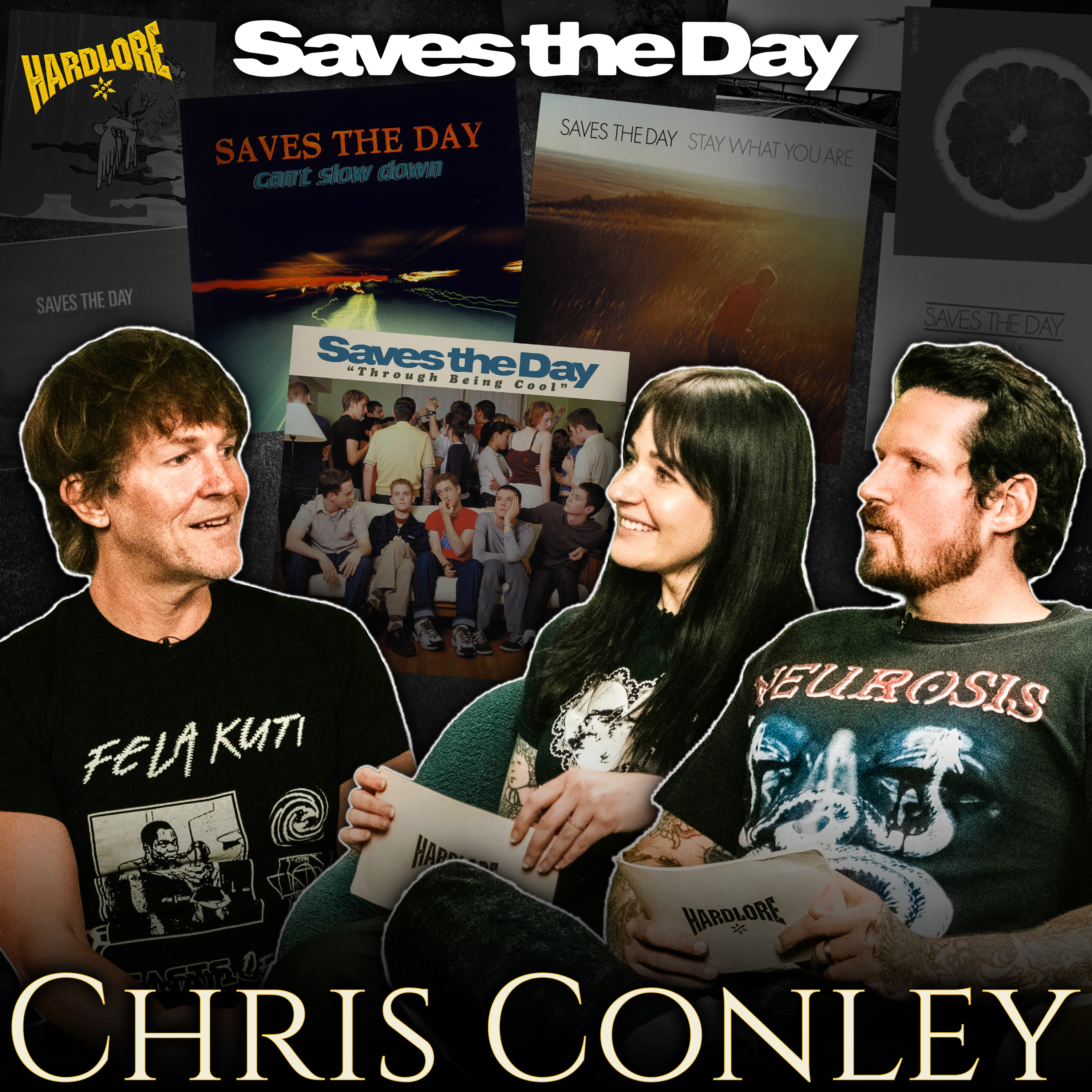
Hey everybody. Thank you so much for joining us this week for this highly anticipated long awaited deep dive into all things Saves the Day with vocalist Christopher Conley. Also joined by one of my best friends in the world, Dr. Britti Drake from Pity Sex. This is Chris's first interview in a long time and we get into the entire history of the band from kind of accidentally discovering punk as a child to discovering New Jersey melodic hardcore in particular, and then entering the stratosphere by the time Stay what yout Are comes out and into some dark days for both Saves the Day and Chris as well. This is truly a treasure trove of information for any fan of the band and I'm so honored to have been joined by my good friend Britti once again on the show for it. So please sit back, relax and clear three and a half hours out of your day for this incredible conversation with Chris Conley. Let's go.
- [00:59]
B
Hold on. Stop it.
- [01:23]
A
Hello, welcome. It's Hard Lore time. How you doing, Bo? We are here in Sunland California at the Pit recording studio for a very special episode today. I must first introduce my special guest co host of Pity Sex Procession and Medical Care for the mind, Dr. Brady Drake.
- [01:49]
C
Happy to be here.
- [01:49]
A
Thank you so much.
- [01:50]
C
So happy to be here. It's an honor.
- [01:52]
A
And our very special guest all the way from New Jersey and Chico, California, if you're okay with that.
- [02:00]
B
Yes, sir.
- [02:01]
A
Chico, California, by way of New Jersey, a vocalist and songwriter that has meant so much to this show and to both of the my late co host and I. Please welcome from saves the day Mr. Chris Conley.
- [02:16]
B
I'm very, very happy to be here and feel very grateful to be here.
- [02:21]
A
As do we. Beautiful, beautiful stuff. You know, I know so little about you and I've been listening to you sing and play music for so long. So let's take it all the way to the beginning. Tell me about young Chris in New Jersey growing up and finding music.
- [02:38]
B
Okay, Young Chris, New Jersey. I started out and I liked sports and I played baseball and soccer and then I was totally obsessed with that until I was about 13. And then I got really into Led Zeppelin.
- [02:57]
A
What record got you?
- [02:58]
B
The one that got me was Led Zeppelin 4. Yeah, I remember listening to it just over and over again on this little discman that I had. And I would like. Oh, this is before you flip things. I would kept rewinding Stairway to Heaven. This one part where the drums come in songs.
- [03:16]
A
Pretty good.
- [03:16]
B
It's a cool song and it goes it there's like where he enters on the drum fill so simply just goes crack down. And I would just. I don't know what it was doing to me, but I was so excited. And I had like a light bulb and I was on a road trip with my dad. And I looked over, I said, dad, I want to play the drums. And he said, okay, we could talk about that when we get home. Then we got home though, and he said, I've been thinking about it and I think it's a little loud for the neighborhood, so I'll buy you an acoustic guitar. And that was really cool of him.
- [03:46]
A
Yeah.
- [03:47]
B
The school I went to, Princeton Day School from kindergarten to 12th grade. In first grade, they made every kid pick an instrument. And so I picked the cello because I liked the way it sounded. I didn't like the way any of the other instruments sounded because it was
- [04:01]
A
guitar esque in some way.
- [04:02]
B
Well, I didn't know till later it was cool because Jimmy Page like uses the cello bow, right? So there's like a dots being connected before. I haven't the soul. He said the soul is more powerful than the mind.
- [04:14]
A
It always is.
- [04:15]
B
Killer quote. Thanks, man.
- [04:17]
A
Thank you.
- [04:18]
B
Scientist drop in science. And so I played cello in the school orchestra for. For seven years. And that was really cool. And the cool thing about that school is that they taught you through Suzuki method, which is this method. Have you heard of that?
- [04:34]
C
I haven't.
- [04:35]
B
It's a method where they don't let you learn how to read music. So you. They'd send you home with little cassette tapes and it would be like a Bach or Mozart, like simple melody. But you had to learn it by ear.
- [04:48]
A
So we've been practicing the Suzuki method our whole life.
- [04:50]
C
We have. Yeah.
- [04:51]
B
Yeah. Seriously. It's just training your ear.
- [04:53]
A
Wow.
- [04:54]
B
And then they put little star stickers on the like fretboard. I don't know if they call it a fretboard on a cello. The neck. And then so that's how you know, oh. Like you find the note positions on a cello. Red star one. Ah. And it was like, okay, that's that note. So I did that. I didn't love doing it, but I did that for seven years. And then I got into this classic rock music and I was like, oh my God. So the day my dad bought me this classical guitar, things kind of made sense already. And so the first day I was writing riffs on was like Jimmy Page would write like. And a lot of that classic rock stuff is literally just one note at a time. It's like riffs. And so I could do that already one note at a time.
- [05:39]
A
You were hitting Red Star 1, Yellow Star 3.
- [05:42]
B
Now, on the guitar. On the guitar. It's like the dots that. You were talking about that in your episode.
- [05:47]
A
Yes, it was.
- [05:47]
B
So that's how I understood it at first. And then a lot of the other riffs were very simple. It was like power chords. So, like Led Zeppelin's doing power chords. So you only need two notes now, but you could play everything.
- [06:01]
A
Yeah.
- [06:02]
B
And. And then I very quickly got two books of music. I got a 12 bar blues. A book of 12 bars blues. You teach yourself bar chords. And that was fortuitous because one of the hardest things is bar chords. So it started to develop my muscles right away.
- [06:23]
C
How old were you?
- [06:24]
B
I was 13. And so I also bought the book for Led Zeppelin 4 at the Music store. And so the first thing I did was teach myself Stairway to Heaven. And it was just like, awesome.
- [06:40]
A
So you were fulfilling the Guitar center prophecy. Yeah, right away.
- [06:44]
B
100%. Wayne's world knows Stairway.
- [06:48]
A
You ever see the original? Because in the theatrical cut of Wayne's World, it's not. They don't put the Stairway audio in there. It's something else.
- [06:56]
B
Oh, they couldn't afford it.
- [06:57]
A
They couldn't afford it. But there's a weird TV cut where you hear him do the boom, boom, boom, boom. How does that lead to punk and hardcore and whatever. Whatever alternative underground music that comes first for you.
- [07:10]
B
It's all because of my very friend Brian Newman, who was also the first drummer of Saves the Day. The only other original member of Saves the Day, he played on the demo and the first album through Stay what yout Are.
- [07:25]
C
Right.
- [07:25]
B
He was our drummer. And Brian and our friend Justin, they had been playing music together because Brian played drums and Justin played guitar. And they were playing together since seventh grade. And they would come into. We all went to the same school together in Princeton. They would come into the cafeteria with like an actual boombox like that you'd hold on your shoulder and they'd play these cassettes of songs they had written in their basement.
- [07:52]
A
And you can't believe it.
- [07:54]
B
Well, before. Before this summer that I learned to play guitar, there wasn't a lot of crossover. Like, I was still sports guy and baseball and soccer. Baseball. Well, at school I was captain of the football team.
- [08:08]
A
Oh, shit.
- [08:09]
B
But I wasn't that good. I was just like kind of big when I was younger and various ups and downs with that along the way. But I wasn't very, very tall. By the time it came to this era.
- [08:22]
A
This jacks then?
- [08:24]
B
No, because you're fucking jacked now. Thanks, dude. Crushing. I tell my wife, she makes me work hard and I'm so glad for it.
- [08:30]
A
Good.
- [08:31]
B
Because it changed my life in so many ways. But there wasn't a lot of crossover at our school with like, jocks and like, they were like rocker kids kind of. I don't know how to describe them, but they were like, like what, a few years later would be like skateboarding kids.
- [08:46]
A
Okay.
- [08:46]
B
Yeah, but skateboarding wasn't really a thing around this time. It was starting to creep in. But those guys were. And so. But when I came back from the summer of seventh grade, after seventh grade, over the summer, I learned guitar. And when I came back to school in eighth grade, Brian, like within the first week was like, hey, I heard that you learned to play guitar over the summer. You should totally come jam with us. And that was it. And so I went over and started playing with them. Brian already loved Rage against the Machine. It's like the first song I tried to write for our first band practice. He would. He still makes fun of me for it. It was like a Rage against the Machine ripoff song with the worst rap lyrics of all time.
- [09:31]
A
But you're writing lyrics.
- [09:33]
B
Writing lyrics and riffs after the summer.
- [09:36]
A
Great.
- [09:36]
B
You know, I was writing songs the first day I got a guitar.
- [09:40]
A
It's insane.
- [09:40]
B
And I don't know where that came from, but it was just so fun straight off the bat. Just like playing with toys kind of.
- [09:47]
A
Yeah.
- [09:47]
B
And so. Yeah. And so then every single weekend we would go to Brian's parents house and we would play in the basement every weekend. So this became my entire life. And Brian knew all the. All the cool bands. And the reason that there was a crossover starting that year was they also were making like covers of Black Sabbath.
- [10:07]
C
Cool.
- [10:08]
B
And since I was a classic rock guy, they were like, oh, let's play some of that stuff too. And then some of the bands that were coming along at that time were totally inspired by classic rock. Like Rage against the Machine, for example. My friend Joe, who taught me a bunch about guitar, pointed out to me one day, he's like, if you take away the vocals, it's Led Zeppelin. And I was obsessed with Led Zeppelin. I was like full blown obsessed with Led Zeppelin. That was the whole reason I played music was Led Zeppelin. And. And then bands like Smashing Pumpkins, they were like wearing paisley shirts and stuff
- [10:45]
A
and they were dominating the airwaves.
- [10:48]
B
Yeah.
- [10:48]
A
Inescapable.
- [10:49]
B
That became my new obsession with Smashing Pumpkins. And because I had before that, I had like Jimi Hendrix posters on my wall. And I was like obsessed with the 60s. I took a whole course on the 60s and seventh grade and it was just like I was full blown watching Woodstock, the movie, like, every single day. And then so the bands coming along in the 90s were, I didn't realize, had grown up listening to those records. So there was like crossover and. But yeah, so then we were just off to the races and playing every single weekend. Brian, then he was at the Princeton Record Exchange one day, which is a really cool record store in our town. And there was like a flyer on the bulletin board where it was like, do you like these bands? We need a drummer. And he liked all those bands. It was like Rage against the Machine and Helmet and stuff. Like that stuff we were starting to see on mtv. We didn't know that those bands were an evolution of hardcore. So Brian takes, pulls the thing off and he goes and he gets the gig playing with this band called A Nation in Transit in Trenton, New Jersey. And so he would come back from practices with those guys and they were like, way older. They were in high school and we were still middle school. And they would be showing him hardcore records. And that's how he found out that Rage against the Machine was like. Had come out of hardcore.
- [12:18]
A
So he hears Inside out and hardcore
- [12:20]
B
he hears inside Out. And so then like, Inside out is like one of my favorite hardcore bands. But I found out about it through Rage against the Machine.
- [12:30]
A
And then do you then realize that New Jersey has this incredible wealth of hardcore and post hardcore and melodic hardcore bands.
- [12:38]
B
A few years later, we were old enough to start going to shows. But first we were just kids playing shows. And so we didn't. We weren't old enough to be part of that scene or even know about that scene. So we were playing like the June Fet. It was like. It was like a fair during the summer in Princeton. Chili, cook off, that kind of thing. And then now they got Boys to
- [13:03]
A
Men and Smash Mouth, you know, sign
- [13:07]
B
me up, I want to go to that show. And they were like, in Princeton, they would have these cool events where they would, like, shut down the main street and there'd be like all these little, like, vendors and stuff. And we would play. I don't know how we got these gigs. Like, Brian was always out there hustling. He had like the DIY handbook kind of thing, like, or back in the van or get in the van or whatever that Henry Rollins was. He was like, all about it. His dream was, I'm gonna be in a band.
- [13:36]
A
This is Brian.
- [13:36]
B
This is Brian Newman. He's the guy that said, I heard you learned how to play guitar. Come jam and, like. And then he also is the guy that found out about hardcore.
- [13:45]
A
Right, Right.
- [13:46]
B
And then we both found out about punk rock around the same time. Because this is before we knew there was a scene in New Jersey. This was ninth grade. He won a radio contest, two tickets to go to City Gardens in Trenton, New Jersey, which is like a legendary venue to go see the Offspring.
- [14:08]
C
Okay.
- [14:09]
B
And we were like, we did not like the Offspring. Sorry, guys. Didn't like the Offspring. Still could. There's. You know, that Self Esteem song's pretty cool, I don't think.
- [14:21]
A
Pretty Fly for a White Guy comes on and you go, oh, geez.
- [14:25]
C
That other one, too, right?
- [14:26]
A
This one.
- [14:26]
C
I don't know.
- [14:27]
A
There's a couple riffs.
- [14:28]
B
I feel bad about it. Our old drummer, Pete, wound up in their band years later. And no disrespect, because I guess they came from underground music, too. But we went to see them because he won the free tickets.
- [14:40]
A
Sure.
- [14:41]
B
So our parents, like, drop us off at City Gardens, and it's this, like, super ratty, almost dangerous feeling club. And we're, like, 13. We're, like, probably 14 years old at this point.
- [14:52]
A
Sick of it all. City Gardens. Look it up.
- [14:55]
B
Yeah.
- [14:55]
A
Legendary video.
- [14:56]
B
Yeah. Really? Like, right after this time, Brian gets into bands like that. So this is the first night that we discover punk rock. He wins these tickets. And Offspring was just like an MTV band.
- [15:06]
A
Yeah.
- [15:07]
B
And so we go. And the first band up is Sheer Terror. And so we.
- [15:14]
A
So Sheer Terror is the first hardcore band you ever see?
- [15:16]
C
Yeah. Is that your first hardcore show?
- [15:18]
B
Yes. And this is, like. I didn't even know the word hardcore or. And I knew a punk was like Sex Pistols.
- [15:25]
A
Okay. Leather jacket spikes.
- [15:28]
B
But the next band up. And I'm right in the front row, so you're right.
- [15:32]
A
Front row. Sheer Terror.
- [15:34]
B
Yeah. And it was scary. Yeah, dude. It was scary. They were brutal, and it was awesome. Like, we liked music with an edge, and it was.
- [15:42]
A
And they have tons of melody baked in as well, so there's something for. For the Led Zeppelin kid.
- [15:48]
B
That's. And that's something I always needed was. Was melody. It was like. That was the through line for me.
- [15:53]
A
Okay.
- [15:54]
B
And, like, I wound up liking the bands that would sing more than Scream.
- [15:57]
A
Sure.
- [15:58]
B
But I. But I still. I still like it all. But the very next band up is Rancid.
- [16:03]
C
Wow.
- [16:04]
B
And I was just like, this is
- [16:06]
A
the best band I've ever heard.
- [16:07]
B
This is the best band I've ever heard. Yeah.
- [16:09]
A
And what year would this be?
- [16:10]
B
This was 94.
- [16:11]
A
So right before Outcome of the Wolves is that post. Let's go.
- [16:15]
B
This is right after. Let's go.
- [16:16]
C
Wow.
- [16:17]
B
So they're playing like radio.
- [16:18]
A
Lars is freshly in the band.
- [16:20]
B
Lars is right in front of me and I've never seen anything like this in my life. And Tim is like over here in Matt Friedman. And they're like feet away. And they look insane. They look like they're the whole punk.
- [16:35]
A
They look like comic book characters.
- [16:36]
B
They look like comic book characters with the mohawks and the plaid pants and spiky leather everything. And we were just like, oh my God. But the songs were so good. So meanwhile, by the time Offspring's on, we're already in the back, ready to go. And they.
- [16:51]
A
I saw Ransom.
- [16:51]
B
We just didn't even care about them anyway. And they made fun of Green Day at one point by playing like a funny version of Basket Case. And. And that's where like f these guys. That's not cool because Green Day is awesome. Yeah, but. So then. But lives had been changed because the very next day, the three of us, this was Brian and Justin and. And me all there together. And the very next day we went and bought hair dye.
- [17:19]
C
What color?
- [17:20]
B
Green. Neon green.
- [17:22]
C
Excellent.
- [17:22]
A
Classic.
- [17:23]
B
And Justin literally shaved his head into a mohawk and with Elmer's glue spiked it up like three feet high. And he started wearing plaid pants. And I started wearing like chains and like weird like thrift store blazers. Or before I could go to thrift stores, I'd find like weird clothes in my parents closet that were like my grandparents clothes.
- [17:45]
C
You were Grandpa Core.
- [17:47]
B
Grandpa Core.
- [17:47]
C
Before it was cool.
- [17:49]
B
I didn't even know that was a thing. That's awesome.
- [17:51]
A
Yeah. Before it was never cool, you know?
- [17:53]
B
Well, before apparently too, the. The New York Dolls would wear like granny stuff. That's what they looked insane.
- [18:01]
A
So you're doing blazers, plaid pants. You're punk now.
- [18:04]
B
Yes, punk overnight.
- [18:06]
A
Right.
- [18:07]
B
And then all the teachers were super worried about us. Yeah.
- [18:12]
C
Did you have to go like talk to somebody?
- [18:13]
B
Had to talk to somebody. And they're like, I don't think this school is for you anymore.
- [18:18]
A
No way. Yeah.
- [18:19]
B
Was it a private school?
- [18:21]
C
Okay.
- [18:22]
B
And my mom wrote this guy, I don't want to say his name, but wrote this man Like a 15 page letter, like, Christopher's such a good student and blah, blah, blah.
- [18:30]
A
Were you a good student?
- [18:31]
B
And. Yeah, and then. And then. But all these other kids are bad kids and blah, blah, blah. And the guy. Shut up. And then he actually had to hand me the graduation thing later. And I was the guy that gave the speech at graduation. So that's like. My mom loves that. My mom. We didn't have grades like that, so my peers picked me to talk at the thing. So my mom was really stoked that this guy had to hand me the thing. She's got a picture framed.
- [18:57]
A
Yeah.
- [18:57]
C
I love that.
- [18:58]
A
Wow, that's awesome.
- [18:58]
C
I love a petty parent, you know?
- [19:00]
A
Oh, yeah.
- [19:00]
B
Oh, yeah. When your kid is, like, being mistreated just because he's different.
- [19:05]
C
Yeah.
- [19:06]
B
But, yeah. So that was it, though. Rancid.
- [19:08]
A
Okay.
- [19:09]
B
And then.
- [19:09]
C
That's so awesome.
- [19:10]
A
I have a little word association thing here.
- [19:13]
B
Okay.
- [19:14]
A
That I think would be a good icebreaker for us to just get to know your stance on New Jersey hardcore and post hardcore and stuff. I'm gonna say a band name, and you tell me the first word that comes to mind.
- [19:27]
C
Any word.
- [19:27]
B
Okay.
- [19:28]
A
And this is called the New Jersey Rorschach Test.
- [19:30]
B
So sick.
- [19:31]
A
The first band, Rorschach.
- [19:33]
B
Is that really a band?
- [19:34]
C
Yeah.
- [19:34]
B
I don't know that.
- [19:35]
A
Okay. Fury of Five.
- [19:38]
B
I. They're, like, angry.
- [19:40]
A
Yeah.
- [19:41]
B
And that was never my thing. Like, the angrier stuff.
- [19:45]
A
Okay.
- [19:46]
B
I liked more the sadder or, like, reaching for, like, something better.
- [19:52]
A
Okay.
- [19:53]
B
Aspiration.
- [19:54]
A
They've got that in there. Listen, it's. It's buried in there. But you.
- [19:57]
B
The Thursday guys I was just on tour with, they were showing me some crazy videos of Fury of Five.
- [20:03]
A
I think he invented the greatest mosh move of all time. It's named after him.
- [20:08]
C
Would you demonstrate it?
- [20:09]
A
I can't do it right now.
- [20:10]
C
Would you please?
- [20:10]
A
No, no, no. I'll. Here it is. It's called the Stickman. It is the greatest.
- [20:19]
B
Wait.
- [20:19]
C
Yeah.
- [20:19]
B
Steve was telling me about Stickman.
- [20:21]
A
It's. It's a windmill where your whole body's spinning and your arms keep spinning.
- [20:26]
B
Oh. I fully got punched in the face by that 10,000.
- [20:30]
A
So he invented. You know, he invented that Turning Point.
- [20:34]
B
Turning Point was a little before my time, so I. By the time we heard about them in the scene, because it was so, like, straight edge. They were called Burning Joint. And this is before, like, smoking pot was cool.
- [20:47]
A
Wow.
- [20:47]
B
Yeah.
- [20:48]
C
Interesting. I would never associate that.
- [20:51]
B
E Town Concrete Etown was along those lines of Fury of Five as well.
- [20:56]
A
A lot of melody, though.
- [20:57]
C
But you got a lot of rap, too.
- [20:58]
B
Yeah, a lot of rap.
- [20:59]
C
I know you were into Rap.
- [21:01]
B
I did. You know, I. Well, I. I was. And I am. And that. I think that was. They didn't grab me as much as our. Our early guitar player. Justin was super into them. Yeah.
- [21:15]
A
That's awesome.
- [21:15]
B
He'd like a little more of the angry stuff.
- [21:18]
A
Dead Guy.
- [21:20]
B
Love Dead Guy. So incredible. Steve Evitz. New record, Steve. Yes.
- [21:24]
A
He did it again.
- [21:25]
B
He's. Yeah, that. And we got to see that band at the local, like, hardcore venue. It was called the Princeton Arts Council. And this is where hardcore bands would come and play. And it was, like, right down the street from our high school, so you could walk there. And I saw Dead Guy. Like, I was, like, feet from them. Like. Like Rancid. And they were so good and so heavy.
- [21:48]
C
Yep.
- [21:49]
A
Love it. Here's a big one. Lifetime.
- [21:53]
B
Lifetime is still, to this day, one of the most important bands to me. And I remember the moment when Brian got me into them, too, because I been off on this rancid kick for so long. And I was writing songs that sounded like Rancid and, like, Screeching Weasel and Green Day and Jawbreaker. And he was like, I gotta get Chris to start writing different kinds of songs. I really. I really want him to start writing these hardcore songs, but he doesn't like anything I'm showing him. And then one day, he was like, wait, this band. This band. Lifetime has this song that kind of sounds like Screeching Weasel. And so he played me. The gym is neutral territory. And it kind of has this part toward the end that's, like, a little bit, like, pop punky. But then the lyrics were along the lines of things that I was really enjoying at the time. And then I wound up around that time becoming incredibly sad, too, in Life and Jawbreaker and Lifetime then were. The lyrics were so incredible. Like, I would just be reading the lyrics of, like, 24 hour revenge therapy and Lifetime's hello Bastards and, like, wearing the booklets to dust because the lyrics were just, like, speaking to me. And so it's. Lyrically, Lifetime is. I just feel like it's, like, poetry.
- [23:15]
C
Agreed.
- [23:16]
B
And the songs are so cool. Like, very few bands were doing stuff with the two guitars in. In my opinion, that. Well, like, I really liked Aerosmith, too, when I was in my classic rock phase. And the way they use two guitars, it was just so cool.
- [23:31]
A
It's not just rhythm and lead.
- [23:32]
B
Yeah. Lifetime had just two, like, incredible guitars going on every moment of every song.
- [23:39]
A
Okay.
- [23:40]
B
I love them so much.
- [23:41]
C
We should talk more about them.
- [23:42]
A
We will. There's a lot we're gonna get into this.
- [23:44]
C
I have more. More questions. Yeah.
- [23:46]
B
A lot more to say about Lifetime.
- [23:48]
A
The Misfits.
- [23:49]
B
I love the Misfits.
- [23:51]
A
Less enthusiastic than Lifetime.
- [23:53]
B
Yeah. I mean, they don't. They don't speak to me, like, emotionally, but I love the songs, and I just love their whole thing, and I think they're just like.
- [24:03]
A
There's no better thing.
- [24:04]
B
Cool band. Yeah. Cool singing, cool compositions. I like that song. I think it's called she.
- [24:10]
A
Yeah.
- [24:11]
B
I like the original version of it. Has, like, keyboards.
- [24:14]
A
Yeah, that's the. It sounds insane inch version.
- [24:18]
B
I love it so much.
- [24:20]
A
He didn't have a guitar that day.
- [24:22]
B
Not even.
- [24:22]
C
No.
- [24:23]
B
Wow.
- [24:23]
A
Yeah, it's all sync piano. Thursday.
- [24:27]
B
I love Thursday so much, I could cry. I love them so much. I mean, I think they're one of the coolest bands on the planet. And I know from what I've seen of live shows, they're one of the best live bands out there. And just. They care so much. Their songs are so cool. Their musicianship is just next level. I think Jeff is, like, a fucking street poet.
- [24:50]
C
Yeah.
- [24:51]
B
Like, we're, like, lucky to have him in our generation.
- [24:54]
C
Great writer all around.
- [24:56]
B
Incredible writer all around. His book is amazing. He's working on a new one, and I like. I look up to them so much. I admire them so much. We played Jeff's basement. This was, like, New Year's Eve, 98 into 99. And I didn't know that years later we'd be on tour with Thursday. But I think he had just started the group, and he was such a seminal part of, like, the New Jersey scene. He was always putting on shows, and he's just a very special person. They're all so special. And what's crazy is, like, Tucker and I met before music through this mutual friend, Brandon, because we were, like, skateboarding in Princeton.
- [25:44]
A
That's a good guy.
- [25:45]
B
And Brandon was sharing stories the other day, we were all in. In Brooklyn, and he was sharing stories of, like, the origin story of me learning to play guitar and the origin story of Tucker playing drums. And he was there the moment Tucker first got behind a drum kit. And if you haven't had him on here, that'd be.
- [26:03]
A
Yeah, that's. That's. That's coming for sure.
- [26:05]
B
That'd be a great story.
- [26:07]
C
A good word.
- [26:07]
A
Yeah.
- [26:07]
B
Okay. I surely will.
- [26:09]
A
Here we go. Right?
- [26:10]
B
I love him so much.
- [26:11]
A
My Chemical Romance.
- [26:12]
B
I love my chem. I love, love My Chemical Romance. I think they're, like, larger than life itself and, like, such awesome people. And like, what they've done for music is amazing.
- [26:27]
A
Crazy.
- [26:27]
B
Their music is so good.
- [26:30]
C
Timeless.
- [26:30]
B
Timeless music. And like incredible performances. Like, I cannot filling stadiums now. Yeah, it's crazy. Yeah. Brian Newman and I actually went to the MetLife show when they played Giant Stadium. And we were like standing down on the floor watching Thursday. And then it was Death Cab and then Mike Ham and we were just in the middle of this giant filled stadium and we were talking about playing shows in basements down the. Down the freeway, like down in. Over in New Brunswick. And then it's all like evolved into this and it just absolutely blew our minds. And they. They shredded a stadium. Like they've played so well. And like, have you seen the stadium show?
- [27:15]
C
I wish. I tried to get tickets.
- [27:18]
B
Yeah.
- [27:18]
C
Are they in the Turnstile of emo
- [27:22]
A
of 2000s New Jersey emo?
- [27:25]
C
Yeah.
- [27:26]
A
Yeah. Everybody in the genre is like, man. Good for them.
- [27:29]
C
And like, good.
- [27:29]
B
Like mad respect and no bigger band.
- [27:32]
A
Yeah, true. Yeah, very true. Floor punch.
- [27:36]
B
I love floor punch, man. We used to play shows with floor punch all the time. I don't know how much they liked us because, like, in the early days we'd catch a lot of flack for sounding like lifetime and for singing because at that point in time, you didn't. It was like you screamed and like shouted.
- [27:54]
A
But as a sports guy.
- [27:55]
B
As a sports guy, you gotta kind
- [27:57]
A
of dig floor poachers thing, you know?
- [27:59]
B
I never put two and two together. Yeah, yeah, dude.
- [28:02]
A
Big sports guys.
- [28:03]
B
Yeah, big sports guys.
- [28:04]
A
Final band would be Mouthpiece.
- [28:07]
B
Mouthpiece. I love Mouthpiece. That was the first hardcore show I saw in New. In New Jersey after that City Gardens thing. Years later when we started going to Princeton Arts Council for shows. Mouthpiece was the first hardcore band I saw. They were like the Beatles or something in. In New Jersey, like. Or like what I. What I imagine youth of today shows were like. Because they were like. The entire room was going absolutely crazy all the way to the back and there was a wall of people trying to get on the stage taller than the band on the stage.
- [28:42]
A
So you're seeing that in real time too. And just being like, oh, this is hardcore, basically.
- [28:47]
B
Yes. And it was amazing. And because of the Princeton Arts Council scene, you could stick around and meet your favorite bands. And so our guitar player, Justin, this is before Saves the Day, we had like. We always had bands, the three of us. Brian Justin and I always had bands. We would change the name all the time. And then Brian Justin befriended Sean McGrath from Mouthpiece because he would just hang around the Shows. And then Sean was so cool. He would just talk to people and get to know people, and you could, like, talk to these bandmates that, like, seem like these, like, larger than life people. And then amazingly, one day, this is 1997, we'd saved up all our money from six months of shows so we could have $500 to spend one day with Steve Evitz at Tracks east. Because Steve Evitz produced all of our favorite records. And we called up Brian, called up the studio, and he was like, can we book a day with Steve? And they're like, sure, $500. So we saved up for six months and it was finally the day. And we go in and our bass player didn't show up because he had a crew meet. You know, like, crew.
- [30:05]
C
No, I don't. Oh, sports. Got it.
- [30:07]
B
Sports guy.
- [30:08]
C
Got it.
- [30:09]
B
He had a crew meet. And his dad was like, you can't go to that recording session because you need to get a scholarship for college.
- [30:15]
A
Did he get a crew?
- [30:16]
B
He showed it to college. Yeah, I think he's doing, like, really well now.
- [30:19]
C
Okay, good for him.
- [30:20]
B
Yeah.
- [30:21]
A
In. In sailing or in, like, venture capitalism.
- [30:25]
C
Okay.
- [30:25]
B
And so hurrah.
- [30:27]
A
Yeah, but so. But he ain't on the same day.
- [30:30]
B
He didn't have a bass player. Right. So, like, I. I played the bass on the demo, but Justin thought, oh, I'll call sean. Because Sean McGrath lives in New Brunswick, which is right down. He was going to Rutgers. He lived in New Brunswick right down the road, essentially, and just to see if he wanted to hang out. But it turns out Sean came. Came down and he was like, these songs are really cool. You guys could totally play hardcore shows. Your band name is a little weird. And that would look so weird on a flyer.
- [31:01]
A
This is Seffler.
- [31:02]
B
This is Seffler, which is a made up name that came out of like a typo in typing class when we had to learn how to use computers in seventh grade. Eighth grade. Eighth grade. But so Sean said, this is really cool. You guys could totally play hardcore shows. But the name is weird. And I always thought Saves the Day would be a cool name for a band. So he just suggested it like that right there in the control room. But by the end of the day, he was also like, I'll play bass in your band. Wow. And this is like, crazy because he was in mouthpiece. And so Sean also had a.
- [31:39]
A
This is Paul McCartney of New Jersey hardcore.
- [31:41]
B
It is Paul McCartney of. It is.
- [31:43]
A
Yeah.
- [31:44]
B
And we were like, what.
- [31:45]
C
What's the age difference?
- [31:46]
B
He's at Rutgers He's a Rutgers, So he's like, 21 at this point, probably. And we're. That. On that day, I. Let's see. Brian and I were 17 years old,
- [31:57]
C
so that feels like a big difference.
- [31:58]
B
It was a huge difference. He was, like an adult. He's like a grown man. And. Yeah, and he was in this huge band, and he also had a side band, a side project called Hands Tied. Yeah. And Hands Tied had put out a 7 inch on equal vision Records.
- [32:14]
A
Here we go.
- [32:15]
B
So we made that recording that day and that. We changed our name in the control room to Saves the Day that day with Steve Evitz and with Sean in the control room. So we left the recording session that day with the tape that said Saves the Day demo. And Sean, because he had, like, all these connections in hardcore, was like, let's. Let's play a show next weekend. My friend's putting on a show at Rutgers.
- [32:41]
A
And was Seppler playing out and about?
- [32:44]
B
Seffler was playing every weekend. We'd play, like, basements or backyards or something like that, or these, like, street events.
- [32:50]
C
What kind of. Oh, so it was, like, not punk shows. It was like.
- [32:54]
B
It was like punk town meetings. Some pop. Pop punk.
- [32:58]
C
Okay.
- [32:59]
B
Bands that, like, would. Would all gather in a garage on a Saturday and play to, like, five people.
- [33:05]
C
Yeah.
- [33:06]
B
And so we would do that. We were playing with the band called Shower with Goats Sometimes, which is, like a random. And then a band called Secondhand. We would play shows with Secondhand all the time. And it would be like, oh, we got a gig at a coffee shop. Are we gonna. A show at the pizza parlor? We're gonna play on the curb outside of.
- [33:29]
A
But it's not till Paul McCartney joins your van. And then. Yeah, that's like, hey, you could just play hardcore.
- [33:35]
B
Yeah, we. And we did. And it was like, the very next weekend, after the Saves the Day demo, we had a show at Rutgers, and we were gonna open for MC Light, of all people. She didn't show up. And it was this, like, indoor place. They had this all these, like, bouncy houses and stuff set up kind of like a fair.
- [33:56]
C
Can't get away from the fairs.
- [33:57]
B
Can't get away from the fairs. So it was a seamless transition.
- [34:01]
A
Okay, Fair, neat.
- [34:03]
B
The stage was, like, 20ft high, like a massive arena. And we, like, played. And it was so weird because, like, no one was watching us there. Just walking around with cotton candy and whatnot. But then Sean was like, hey, my friends at Ignite are playing a show down the street in New Brunswick.
- [34:20]
C
Same night.
- [34:21]
B
Same night, same day. It was like the sun was still out and it was like matinee. And so Ignite was in town from California. And we loved Ignite. We were like, are you serious? And Sean was like, yeah, they're gonna let us hop on their equipment and play four songs before they. They go on.
- [34:37]
A
This would be 90, 1997.
- [34:41]
B
Okay, yeah, April of 1997.
- [34:43]
A
Did Floorpunch play this show?
- [34:45]
B
Floorpunch might have played that show. I don't remember who was opening up.
- [34:49]
A
I'll check the book.
- [34:50]
B
But it was. It was New Brunswick and it was in a venue. I can't remember the name, but it was like kind of partly underground, but partly like street level. And the sun was coming in and there it was like packed like 300 people in this tiny space. And like Ignite was. All the bands were set up in the middle on the floor and there's no stage at all. And we like hopped on their gear and played these severely out of tune guitars. We played songs from the demo and we had these demo cassettes that we would sell for a dollar. And like right away people started buying them and immediately recognized that it sounded like lifetime. So we start catching flack from day one. But also people would buy it and like Benny from Gaslight Anthem was in the scene back then. And also Ben from Armor for Sleep was always around gave supporter and his brother Ricky. They were like already part of this scene.
- [35:44]
C
So cool. I did not. I want to talk about that later.
- [35:47]
B
Yeah. And so right away this like little scene was. We were getting accepted and like allowed to play shows.
- [35:58]
A
Sure.
- [35:59]
B
And this is so much because of Sean. And that all goes back to Mouthpiece.
- [36:03]
C
Wow, that's so cool. I mean, that is the classic, like punk hardcore experience. It is like you have your old head, who's three years older than you at the time, and then now, you know, maybe a little bit older now, but yeah, and then you just kind of get this in.
- [36:20]
A
You entered. You were playing outside of any world. There was no, like, scene. And now you're here.
- [36:26]
B
There was. And we were in the scene and
- [36:27]
A
you're in a few of them kind of. Because the lifetime people are accepting it and rejecting it. Some of the hardcore people are accepting
- [36:35]
B
it was more like the hardcore people liked it a little bit.
- [36:38]
C
Yeah.
- [36:39]
B
Because there wasn't a lot of singing, but like. But the songs had a little bit of an edge. I mean, it was fast, melodic hardcore, but then there it was. Catchy.
- [36:48]
A
Well, what I want. So when you go Back to the first. The two Seffler things. It's like the first. The demo sounds more like stay what you are or something, you know? Then like, cancel down.
- [37:02]
B
Like the Saves the Day demo?
- [37:04]
A
No, the Seffler demo.
- [37:05]
B
The tape.
- [37:06]
A
Yeah.
- [37:07]
B
With the old man on.
- [37:08]
A
Yeah.
- [37:08]
B
Holy shit.
- [37:09]
A
Like that. Like.
- [37:09]
B
Like, wow.
- [37:10]
A
Tempos and rhythmics, like you're doing more of a stable.
- [37:14]
B
It's like a Smashing Pumpkins kind of thing.
- [37:16]
C
Yeah, that makes sense. Yes. Yeah.
- [37:20]
A
And then in 13 hours of everything.
- [37:23]
B
Right.
- [37:23]
A
It's fast.
- [37:24]
B
Full blown rancid, though.
- [37:26]
A
And you're doing. But it's like. I hear, like, hr.
- [37:29]
B
There was one song on that where that was the transition between the punk rock thing in melodic hardcore and Brian had gotten me into Lifetime. And there's a song on the actual 7 inch called I think I'll Quit. And when we did the Saves, the Ups and downs B sides, I wanted to put that song on it. But I was at some sort of place in my life where I didn't listen to the final track listing when I got the test pressing. But I had written the liner notes and I was like, this was the Seffler song that sounded like Lifetime. But when I.
- [38:04]
A
You thought it would be on there.
- [38:05]
B
When I finally listened to it, it was one of the songs that sounded like rancid. And I was like, whoops, that is not the one that I thought was gonna be on there. But there was one song on that 7 inch that was like, totally what Savesay was about to start.
- [38:20]
A
You're Seffler when you enter the studio with Steve Evitz. Your saves the day when you leave.
- [38:25]
B
Yeah.
- [38:26]
A
You save up all your shekels to do this one day thing with demo with Steve, which a lot of those songs are on Can't Slow down, which is aw. But you also start a very long relationship with Steve Evitz.
- [38:39]
B
Yes.
- [38:39]
A
How has that grown over time?
- [38:41]
B
Oh, I'm so grateful. I mean, we're making the new Saves a Day album with Steve.
- [38:45]
C
Yeah.
- [38:46]
B
We've already recorded three songs. And so, like, working with him again is like, oh, my God. It's like coming home.
- [38:52]
A
Yeah.
- [38:53]
B
And I feel so lucky because he's a really special person, but he's incredibly talented as an engineer and he's so gifted as a producer. And he and I see exactly eye to eye on music. So it's like the melding of the minds. And he was also there since literally day one of Saves the Day. And at that point, I had only been playing guitar four years when we made that Demo. So like, I was limited and I could do maybe three notes at a time. It went from one note to two notes to three notes and then you
- [39:27]
A
can only do one more than that. So you did good.
- [39:29]
B
Yeah. Well, with bar chords. With bar chords, then if you use some open strings.
- [39:34]
A
Showing off.
- [39:34]
B
Yeah. He was seeing my evolution.
- [39:37]
A
Cool.
- [39:37]
B
And then he was recognizing like, kind of how I was blossoming as a songwriter by the time we did through Being Cool. I'll never forget there was a part where I was singing the melody at the end of rock's Tonic Juice Magic. It's like a refrain that keeps repeating. And he's like, this is really reminding me of the Beatles. And I was like, what? Really? And at that time I appreciated the Beatles, but I wasn't as obsessed as I would be soon enough. And as it turns out, the second to last day of recording through Being Cool, I was driving to the studio and reaching around behind my seat in the car for a tape to listen to. And I used to drive our friends around so people would leave tapes in there. And I pulled out one of the Beatles. Red or blue ones. That's like all their hits from the later half of their career. I was like, cool. Yeah. And I hadn't heard that half. I had heard like, I want to hold your hand. And I was like, it's cool. And then I popped that in there on the way to go meet Steve at the studio and. Yeah.
- [40:38]
A
Maxwell Silver Hammer.
- [40:39]
B
Yeah. And like Fields forever. And. And I was just like, whoa, this is so cool. So I immediately went and like gushed about it to him and he's like, beatles are my favorite band. And that day we drove to Wawa and he showed me that in his CD changer at the car. He had five CDs and four out of the five were the Beatles. And he's like, check it out. You, like turn the. The knob to the left and you. And you hear just the background vocals and like a ride symbol.
- [41:07]
A
Oh, yeah, right.
- [41:08]
B
There's the bass guitar and the lead vocal. And so it was just blowing my mind from day one. And like I even thought at that
- [41:15]
A
the snare is like over there.
- [41:17]
B
Totally.
- [41:18]
A
Yeah. So weird.
- [41:19]
B
In the other town.
- [41:19]
A
Yeah. His studio just burned down. Yeah.
- [41:22]
B
It's really sad.
- [41:23]
A
Very sad. If you haven't seen the GoFundMe yet, check that out.
- [41:27]
B
Yes, please help Steve. I mean, he's a legend, but he's also just like top level human with the heart of gold.
- [41:34]
A
I've never met him, but big fan of his Work, which we'll get to in a minute. So you record this demo. Sean sends it to evr. Equal Vision Records, which is.
- [41:45]
B
They actually heard about it, word of mouth.
- [41:48]
C
Nice.
- [41:48]
B
And then called Sean because we were playing hardcore shows now every weekend. And Steve Reddy called Sean and he was like, hey, I hear you're playing with these kids from New Jersey. And I heard the tapes really good. I want to come see you guys. So he came to see us play in Pennsylvania one day. We were playing with, I think, floor punch and 10 yard fight. And Steve watched the show and he was like, really cool. And he's like, yeah, we should talk. And then he called us like a week later, and he's like, I want to make a record. Or he said, I want to take you guys out to dinner. And then at the dinner, he said, yeah, I think we should make a record. And we just couldn't believe it.
- [42:30]
A
And does Equal Vision mean anything to you? Like, are you a Shelter guy? Youth of Today guy.
- [42:36]
B
You know, Massive Shelter fan.
- [42:38]
C
Same.
- [42:39]
B
Yeah, I love Shelter. And they were like one of those bands that were singing and, like, evolving the scene. And the guys had showed me Youth of today. And I did like Youth of Today. But I really liked the ep, the Disengage, Modern Love Story and Envy. I love.
- [42:58]
A
So you're a Walter era guy.
- [43:00]
B
I'm a Walter era guy. That makes sense because Walter's very melodic and the way he writes guitar parts is just infinitely inspirational to me. So by the time we made the first Saves the Day album, it all begins with an homage to Start Today. It's a new direction. It starts like.
- [43:18]
A
Oh, yeah.
- [43:19]
B
And that's tip of the hat to Walter.
- [43:21]
C
Yeah.
- [43:21]
A
Well, let's talk about it. Can't Slow Down. Landmark debut lp, Some would call it. Some. One of us would call it. Two of Us would call it. Recorded during winter break your senior year of high school.
- [43:32]
B
Yes. Yes.
- [43:33]
A
So you're doing this. All this stuff we've talked about. He's in high school the whole time.
- [43:37]
B
Yes.
- [43:38]
C
So cool.
- [43:39]
A
Which is so cool.
- [43:40]
B
This was like June, that was junior year when we met Steve. And he's like, let's make a record.
- [43:45]
A
So these kids from New Jersey is not derogatory.
- [43:48]
B
You're literally actual children. Yeah, yeah, Sir. I thought it turned her off, but, yeah, the actual kids from New Jersey. And yeah. And then Steve was like, let's make a record. And they wanted us to sign this contract, but my mom is a judge and she read it. She's like, you guys can't sign this yet. So it took like a long time to line up recording. And finally my mom was like, why don't you guys just go do it in winter break and I'll pay for it. And then when you guys get the contract settled, like, the label, Equal Vision could pay me back.
- [44:24]
C
Good deal.
- [44:24]
B
So she did just that.
- [44:26]
C
Nice.
- [44:27]
B
We spent eight days in December of 1997 at Track Steve.
- [44:32]
A
Steve Allen, Duchess Mastering, Alan. So to the hard lore listeners that don't know what that means, that's the producer of Satisfaction, is the Death of Desire and the mastering engineer of Five Deadly Venoms doing Can't Slow Down. Pretty cool.
- [44:49]
B
I mean, couldn't believe it. Like, we'd be. Brian and I'd be driving home after like a day at the studio with like raw rough mixes off the board, and we just couldn't believe, like how awesome it sounded. We were just so stoked. Couldn't believe we got to make a whole record with Steve. Cause we'd spent one day with him that was totally life changing.
- [45:10]
A
And is he being cool? Is he like, psyched to have you back and see you grow?
- [45:14]
B
He's psyched to have us back.
- [45:15]
A
Okay.
- [45:16]
B
And excited to make a record together. You know, he didn't. I don't think he knew, like, how much it would evolve from album one to album two. But we were already just like really, really hit it off. Really good friends right away. And I think. I think he was impressed with us as kids.
- [45:35]
A
Yeah.
- [45:36]
C
Yeah.
- [45:36]
A
You know, high school kids playing. Doing this record is like pretty objectively insane, you know?
- [45:42]
C
Yeah.
- [45:43]
B
Well, he taught us so much about being a recording artist. I don't think that's something I would have understood if I didn't get like a lot of hands on experience with like, really talented.
- [45:54]
C
In terms of what's the distinction?
- [45:56]
A
Tuning and tuning.
- [45:58]
B
Tuning is pretty big.
- [45:59]
A
Yeah.
- [45:59]
C
Yeah. You do have to tune.
- [46:00]
B
He literally taught me how to tune a guitar, like properly so that it wouldn't go out of tune as much and like how to sit, to like hold the, the neck so it wouldn't bend and whatnot, stuff like that. But then he would also point out to me, like, do you hear that snare in that fill? Like, try to play with that snare.
- [46:18]
A
Yeah.
- [46:19]
B
And that helped me like, lock in as like a tight guitar player. The syncopation and if you're live, it's just all energy and it doesn't. I don't. The details like that don't matter. You don't. Not zooming in on like, hit with that kick drum and you're, you're like,
- [46:33]
A
this record is fast.
- [46:34]
B
Yes.
- [46:35]
A
And that's, that's what you want at the time. You're. You're chasing.
- [46:39]
B
That's what we want. Yes. It was the melodic hardcore thing. It was Lifetime and Gorilla Biscuits.
- [46:45]
C
Wow.
- [46:45]
B
Yeah.
- [46:46]
C
Yeah. Are you. You're only performing as a vocalist at this time?
- [46:50]
B
At that time, I was only singing in the band because we'd become this hardcore band. We saw all the other bands have like free floating singers.
- [46:58]
C
Yeah.
- [46:58]
B
So Brian was like, you should do that. And then you can like go and like.
- [47:02]
A
It's part of the show.
- [47:03]
B
Everybody on stage. Yeah. And that was cool. And I was nervous doing it, but it was, it was cool to do. Then when we went to record the album, I played like the majority of the guitars still for. For the first album, and I played about half the bass, but that was really just because we had to get things done in a short amount of time.
- [47:21]
A
Is there any contention with whoever's playing guitar in the band at the time?
- [47:26]
B
Definitely. Justin, that original friend of ours, he only played one little guitar part on that album and then just quit the band because he was like, this is not cool. And it wasn't. But we wouldn't have gotten the record done.
- [47:39]
C
Yeah, it's tough when you're 17.
- [47:42]
B
It was tough. And I mean, in hindsight, I wouldn't do that again. I would just let everybody can, like struggle through it. And Steve's such a good producer. He could have. I mean, he. At this point, he could probably could have coached someone through it. But this is recording to tape.
- [48:01]
C
Right. You couldn't just punch it in.
- [48:02]
B
So there's no Pro tools.
- [48:04]
A
But it's like there's another side that's like, why not make the best record possible? And why would the guy who wrote everything not be that solution, you know?
- [48:12]
B
Yeah, I mean, there was just talk, talk of that when we were preparing to record the album. Like, Steve, being a producer is very aware of how much time things are going to take. And having he worked with like young bands sometimes it's like really difficult because being a recording artist is so different from being alive, you know, just performer.
- [48:34]
C
Yeah.
- [48:34]
B
And he could tell from the demo, when we did the demo, he could tell that I could like, play the parts and stuff.
- [48:40]
A
How do you look back on the songs on Can't Slow Down?
- [48:43]
B
No, I really like the songs. We. We played a bunch of them at LDB recently and that was like so much fun. And we, we did a whole tour Of. Well, it wasn't a whole tour. It was, like, select shows in select cities. Just a few years ago, when the album turned 25 and we played our other album in Reverie, had turned 20. And those were such cool shows, because years later, when we did in Reverie, people were like, they've changed so much. Yeah. And some people were not into that. But then at these shows, years later, it's all just saves the day music. And surprisingly, it worked so well in Reverie.
- [49:24]
A
And Cancel Down.
- [49:24]
B
Yeah, we came out, we opened within Reverie, the whole album, and then we went into deciding from Cancel down, and it was like, some of my favorite shows. It was so fun. So playing those songs on Can't Slow down still is so fun.
- [49:38]
A
It takes time for people to get it, you know?
- [49:40]
C
Well, also, you do seem to have fun when you play old songs. Like, a lot of bands kind of are like, oh, we'll play it for the fans. But by the way, I was at that show and the one in la, or it was Anaheim, maybe.
- [49:52]
B
Anaheim House of Blues. Oh, yeah. Anaheim House of Blues.
- [49:54]
C
Yeah. Yeah, I was at that show. Incredible.
- [49:56]
B
That was so fun.
- [49:57]
C
Yeah, I had so much fun. Yeah. And it was incredible. And it felt like. Yeah, they flowed right into each other. The energy didn't.
- [50:07]
B
Oh, thank you.
- [50:07]
C
Didn't feel like it changed significantly. Like, the energy increased. Wasn't that also the night where there was, like, a technical thing happening?
- [50:14]
B
Yes. It was so crazy. Our friend brought a crystal skull backstage, and, man, and the energy went bonkers.
- [50:21]
A
Like an Indiana Jones one.
- [50:23]
B
Like in Indiana Jones.
- [50:24]
C
Yeah.
- [50:25]
B
And the energy went bonkers, and nobody could figure out what was going on for an hour. They couldn't figure it out. And then she left, and it all worked again.
- [50:31]
A
Oh, the crystal skull.
- [50:33]
B
We joke about it all the time.
- [50:34]
C
It was really cool, though, because, like, we were waiting, and I was like, this is gonna be, like, this is gonna be, like, the real fans up front.
- [50:44]
A
King Reverie, start to finish.
- [50:45]
C
Yeah. Well, not only that, it took a while. I had to go to bed. I was like, I got work tomorrow. I'm staying up. But we were waiting around, and it was like, me and my best friend, who is also a huge Saves a Day fan, Mike was there, and I met, like.
- [51:04]
A
Are you talking about Dom?
- [51:05]
C
Yeah, Dom. Yeah. And I also met somebody. I think I met, like, a couple of other people that I'm still friends with. Waiting at that. Like, waiting for you all to start. And then it was just like the, you know, started. And, yeah, the vibes were Just perfect.
- [51:21]
B
Oh, that's awesome. I'm so happy to hear that. That's. Yeah, that's how it felt too for us. We were so eager to play and then when we finally got out there, it was just like shot out of a cannon.
- [51:30]
C
Yeah, I prefer it, actually. I want.
- [51:32]
B
I want this event.
- [51:33]
C
I want this event.
- [51:34]
A
You don't know when it's coming.
- [51:35]
B
We're going to Axl Rose at every show from here on out.
- [51:38]
A
Pardon this interruption. I need to talk to you for three minutes.
- [51:42]
B
I got you for three minutes.
- [51:43]
A
About the incredible sponsors for today's episode. Up first is Guilty Party, the greatest menswear store in North America, possibly the world. And you know we're all about independently owned friend owned businesses on the show. And this store is co owned by Champ from foundation. So you're supporting this. This is hardcore for hardcore. You know, get some. Get the jeans I'm wearing in this episode, the Studio D1002. In fact, let's talk about the Alden Indies. These are the boots I've been wearing on the past four, I don't know, five weeks of this show at this point. And everybody asks every week, where do you get these boots? And I got them from Guilty Party. Let me tell you about these boots. Let me give you the backstory of these boots. They're called the Alden Indy because when Harrison Ford was cast as Indiana Jones, many don't know this. He was a professional carpenter before his career in American Graffiti and Star wars and Indiana Jones. So the man knew his way around a boot. Right? So when he was cast as Indiana Jones and the costume designer set him up to be wearing red wings in the movie, he specifically asked for his Alden's, this legendary silhouette that has now since been renamed the Indy in tribute of the character. It's my favorite boot ever. I wear them damn near every day. Go get 10% off right now of those boots or damn near anything on the site with code. Hardlore. Guiltyparty. Co. This episode is also brought to you by Mills Vintage, the greatest archive and store for vintage hardcore metal or punk shirts on the whole of the Internet. Millsvintageusa.com I bet you wanted that Neurosis shirt I'm wearing, huh? You were too slow. You gotta be quicker than that. I got it first. He put another one up yesterday. Somebody else got it. It wasn't me. I bet they used Code Hard lore. That could have been you. And maybe it was you. If you like hardcore, you like metal, you like punk music, and you browse the front page of the store, you're gonna find something you can't get anywhere else and that you simply must have. And if you use code Hard Lore, you're going to get 10% off site wide. If you want to trade or get rid of your old shirts, send him a message on Instagram or go see him in person in New York and LA at Varsity. He'll treat you right, give you a fair price, and know much more about whatever you're trying to trade than most other people would. That's millsvintageusa.com, code hard lore. This episode is also brought to you by Guitar Sanctuary. For the very first time on this show, we are proud to say we are working hand in hand with local independent music stores around the country. Guitar Sanctuary is located in McKinney, Texas, about 45 minutes outside of Dallas, which is right where my dad lives. This is close to home. Not only do they carry brand new dunnables, ESPs, ding walls, PRs, but you can get all your amps there as well. Mesa Dark Glass, Soldana. They've got a used boutique guitar amp section that is constantly updating with new rare amps. They've got pre owned pedals that go fast and also restock constant. And if you're feeling crazy, open up Geo's Vault and see some of the rarest, craziest vintage used guitars you've ever seen. Dunnables are also out of stock all over the country and the world right now and Guitar Sanctuary has a few. We must keep independent music stores alive and you can start today by going to guitarsanctuary.com back to the episode. Here's an interesting question. What's your favorite fret?
- [55:08]
B
Favorite fret? The first one that comes to mind is the third fret.
- [55:12]
C
Great.
- [55:12]
B
On the E. Yeah. On the E class you get G and C there.
- [55:16]
C
That was. The next question is what is your favorite chord?
- [55:20]
B
I mean the first one that comes to mind is G. Okay, but how
- [55:24]
A
do you feel about F sharp?
- [55:25]
B
I love F sharp.
- [55:26]
A
It's a good one.
- [55:27]
B
Love F sharp. F sharp minor 7. Come on. F sharp dominant 7. I like G major 7 a lot. I like this weird chord and in that zone it's, it's a C sharp minor 7, but it has a flat 5 and it sounds really cool after the G. And then you put the low E in there and it's just a really. That's probably my favorite chord.
- [55:56]
C
Okay, I'm gonna need to be tabbed
- [55:58]
A
out minor seventh with the fifth flat five.
- [56:02]
B
So it's like. I think some people call that a half diminished.
- [56:05]
A
Okay, that sounds cool.
- [56:06]
B
But the theory and stuff I learned on the job, like as I went along. So this is years after the three. You could tell years after the three notes.
- [56:15]
C
Yeah. Yeah. Well, and also, you probably weren't allowed to learn to read music at that time.
- [56:20]
B
Exactly. They didn't teach me how to learn to read.
- [56:22]
C
Did you learn since then?
- [56:25]
B
My daughter knows how to read music.
- [56:27]
C
Oh, really?
- [56:28]
B
She played piano like forever.
- [56:31]
A
She don't rock with Suzuki like us.
- [56:32]
B
She didn't rock with Suzuki though. She learned tradish.
- [56:35]
C
You know what, though? I do know how to read.
- [56:37]
A
Oh, you do?
- [56:38]
B
That's so cool.
- [56:39]
C
Only because I had to learn for bands, so I don't know how. And I learned bass clef. So like I learned for trombone. I was not into STA though. Just very clear.
- [56:49]
A
That's true.
- [56:50]
B
You didn't have a checkered past.
- [56:51]
C
I did not. I was. I missed that boat. But yeah, I do know bass clef. And I know a little treble clef because I also played the. The flute.
- [56:57]
B
So that's so cool. She's got.
- [56:58]
A
She does have checkered past in that.
- [57:00]
C
I know that one. I quit because there were. I won't talk about it.
- [57:03]
A
Too much drama.
- [57:04]
C
There's too many women. Just kidding. I'm kidding. I wasn't good at it. I just want. I wanted to be the. The very best.
- [57:11]
A
I got you, you know, I do know.
- [57:13]
C
Yeah. You get it.
- [57:14]
B
I admire that very much. People that can read music, it's.
- [57:16]
A
Yeah. It blows my mind.
- [57:17]
B
I just can't do it. I tried.
- [57:19]
C
I don't know how to play the guitar. Like, I just.
- [57:22]
B
I'm just like.
- [57:22]
C
There's a dot.
- [57:24]
A
We gotta talk about the. We'll get. We'll fix that. I don't think.
- [57:28]
C
I think it better not to know.
- [57:29]
A
Okay.
- [57:29]
B
Yeah. There are many approaches.
- [57:31]
C
Yeah, exactly. Suzuki is one of them. I'm doing my own Suzuki totally.suzuki lyrics
- [57:38]
A
on Cancel It Out. As a former 17 year old frontman out of high school, to me you're like the Michael Jordan of teenage lyricists.
- [57:51]
B
Wow. Thank you.
- [57:52]
A
And I don't understand how you did this so young.
- [57:55]
B
Well, that. That year when I was 17, it was the first year in school that you could take electives.
- [58:01]
C
Did you take poetry?
- [58:02]
B
I took poetry and I took philosophy.
- [58:05]
C
Oh my God.
- [58:06]
B
And so right away I had like a great awakening because up till that point I was very disgruntled teen angst. I didn't want to go to school and then I took those two classes, and I was like, wow. I don't know. It was like a light bulb.
- [58:22]
A
Interesting.
- [58:23]
C
Was your teacher in your poetry class, like, significant to.
- [58:27]
B
She is. I was thinking about this the other day. I was thinking, wow, Judy Michaels is, like, a main reason why my lyrics are the way they are.
- [58:35]
A
Does she know? Does she have any idea?
- [58:37]
B
I don't know if she has any idea that later on that I would go on to write lyrics for a band called Saves the Day. But that was the year we started the band. And that year, when I. As I was learning to write poetry, she recognized I had a talent for it.
- [58:54]
A
Yeah.
- [58:55]
B
And so she. She promoted me to be part of this thing called the Governor's School in New Jersey, which is this thing. Like, if you got in, it was like. Like, I don't know if it would be called Gifted Kids, but kids that were, like, good at what they did. Like, it would be artists or dancers or mathematicians or poets or actors. You could go to school for a whole summer at the College of New Jersey and take college classes. And so she said, let's put together a packet of Chris's poetry and see if he gets in. And I got into this Governor School, and I went to the creative writing program, and there was, like, 10 of us. We learned from, like, the most amazing teachers every day. And we had so many writing projects. Like, we even wrote, like, plays there and short stories and poems. And then that summer, I actually also won the Governor's Medal.
- [59:46]
A
Hey, all right.
- [59:47]
C
Yeah, you are. You have accolades. Yeah.
- [59:49]
A
You're accoladed.
- [59:50]
B
Wow.
- [59:51]
C
I also think it's so cool. Like, I love hearing that there was a natural talent and that you worked at it. Because when I think about your lyrics, I'm like, I wish I wrote that every time. And by the way, I did write it when I. When in college, I took a class where I had to fill out a journal every. Every week and had to fill it up. And so I didn't do it the whole time because I waited until the very end, and I was like, I can just write out Saves the Day lyrics all night.
- [60:21]
A
So I just.
- [60:22]
C
It did not. They didn't have to read it. You just had to fill the pages. I wrote out Saves the Day lyrics just.
- [60:27]
B
Oh, my God, that's amazing.
- [60:28]
C
To finish this journal project. So I did write it.
- [60:30]
B
That's so cool.
- [60:32]
A
Congrats on writing.
- [60:33]
C
Thank you so much. But, yeah, I always think about, like, how cool it is, you know, when people really work at their craft, like, I think there's something really nice about being naturally gifted in something, and obviously, you do have a natural gift for it.
- [60:48]
A
Yeah. You're writing songs Day one of guitar owners.
- [60:50]
B
Yeah.
- [60:50]
C
I mean, but also, I think it's. It's really important for people to know that you have to work at these things and you can improve. And it takes. Takes having mentors and, like, being interested in philosophy to. To really be able to put it all together.
- [61:03]
B
That's such a good point. And I'm only realizing this now, in this very moment. I had to do it for homework and assignments and all the way through nyu. Lyrics for Saves a Day songs would be just plucked out of homework assignments and crowbarred into hardcore songs, punk songs, Crowbar. So, like, emo songs were just, like, lyrics that I would write in school, and I had to do it every day. But I'm so. I'm so glad that I learned that, too. Like, having to work on it, because that was something Judy Michaels had us do. You had to write every single day.
- [61:42]
C
And you didn't just plagiarize like I did.
- [61:46]
B
No. But you know what? I'll tell you I did do? In sophomore year, we had to do a book report after summer of a book we read. But I chose to do it on a poetry book called 24 Hour Revenge Therapy by Blake Schwarzenbach.
- [62:01]
C
Beautiful.
- [62:02]
B
And the teacher was like, this seems like really good poetry. So I wrote my book report on the lyrics for 24 Hour Adventure as if it were a book of poems. Very cool.
- [62:13]
C
Also, is that teacher still around?
- [62:15]
B
Your original poetry teacher, Judy Michaels? I should check in, because I was just thinking about her the other day. She has written several books of poems on her own.
- [62:26]
A
Shout out, Judy Michaels.
- [62:27]
C
Well, I always think it'd be kind of cool to, like, write a quick letter, you know, like, hey, just want to let you know how.
- [62:32]
B
This is. It should.
- [62:34]
C
Judy.
- [62:34]
A
This is it.
- [62:35]
B
I definitely should do that. And she also said. Gave me the best advice ever. And sometimes I'll tell other writers, like, if you're in, like, a writer's block. She just said, let yourself write crap.
- [62:48]
A
You gotta write that.
- [62:49]
B
Let yourself write. Absolute bullshit.
- [62:52]
C
Yeah.
- [62:52]
B
Because then you're not, like, criticizing yourself as you're going. Yeah, because that can create the block. So that's such. It's so simple. But that also helps with the, like, doing the craft all the time. So. So this method that she taught us was stream of consciousness. So, like, every single class started with 20 minutes of stream of consciousness. And so she said, let your Pen start and do not take it off the page. And that was, like, really cool. And so then I'd be over there in Princeton in, like, coffee shops over there, sitting there, doing that. And she taught us how to, like, open your ears up and just listen to what's going on around you.
- [63:29]
C
And I also love the idea of, like, just get rid of the criticism by maybe even intentionally writing crap. Like, I know somebody who her way of writing is to say, I'm gonna write a bad song.
- [63:42]
B
I love that.
- [63:43]
C
Yeah, I'm gonna intentionally write a bad song. And she has p pulled from those bad songs some really cool stuff.
- [63:48]
B
I just wind up surprising yourself. I had to do that too. Like, I did get a writer's block thing, and I had to force myself to write a song every single day. And I said, even if I don't like it and I think it's awful, just finish it. And then by the end of three months, I had 86 songs.
- [64:04]
C
And there's got to be some really good stuff in there.
- [64:06]
B
Yeah. I started to pull material out that became this three album arc out of. Out of that.
- [64:11]
A
We'll get there.
- [64:12]
C
We'll get there.
- [64:12]
A
Yeah. I saw Zach Kregers, the director of Weapons and Barbarian, talk about his script writing method, where the first draft he writes from the perspective of, like, a little troll. And he's like, the fucking little troll is just going to write this script, and then I'll go through and correct it.
- [64:32]
B
Wow.
- [64:33]
A
Like, this dickhead is going to do this draft and I got to go through and clean her up.
- [64:38]
B
I love it.
- [64:39]
A
It's. It's genius. And it's so simple. Cancel down is done. You, Steve and Allen finished this thing. How do you feel about initially hearing the master back for the first time? How does EVR react to it? And then how did the people react to it?
- [64:55]
B
Everybody liked it up until probably the people, the label. We liked it. Steve and Allen liked it. Like, we couldn't believe how good it sounds. You take the Saves the Day demo and every recording we'd made up to that point, and it was like, made in a bedroom somewhere in the demo. We only spent one day on it. Now all of a sudden, it sounds like it's like a real album.
- [65:14]
A
Yeah.
- [65:15]
B
So we were so stoked. And then right away when it came out, there was a lot of just this sounds like lifetime. So it was just day one.
- [65:22]
C
That was dope. Like, what a compliment, right?
- [65:24]
B
In hindsight, but people can be mean. And I was so, like, insecure that it was like, it was difficult, but then, you know, there would be some people that liked it. So, like, we went on our first tour right after high school with Bane. Yes. It was like, so awesome. EVR put both of us on tour and it worked really well in that, like, Bain could see that we were hardcore kids that were really trying hard. And even if, like, let's say there were 50 people at the show and only eight of them were like, they sound pretty cool. You know, we were like working really hard to do it. And so they appreciated us as like earnest kids. And then we were out there on a whole US tour together. And it was their first US tour and they wound up really liking us as a band and the music. And so they told all of their friends back home in Massachusetts, buy this record when it comes out.
- [66:24]
A
So this is before the record comes out.
- [66:26]
B
It hadn't even been released when we started the tour. It wasn't out and by the time we got toward the end, it had come out mid August.
- [66:33]
A
Is this your first US Tour as a human being as well? Yeah, my first US tour was with Bank. Not even ever in my life.
- [66:40]
B
That's so cool.
- [66:42]
A
Here we go.
- [66:43]
B
Dude, that's really, really cool. When was that?
- [66:45]
A
That was 2010.
- [66:47]
B
Oh my God, that's so awesome.
- [66:49]
C
Timeless. Also during when that is being released. Is this your first time, like, and you're traveling. Is this your first time traveling the country?
- [66:59]
B
Yeah, first. First full blown tour. And before that we had done a lot of traveling on the east coast. So we go up to like as far as like Boston and down as far as like somewhere in Virginia, let's say. And we would like on the weekends we would go and try to do little journeys with like other local bands.
- [67:20]
C
Sure.
- [67:21]
B
And. And so we knew what like being on the road was.
- [67:25]
C
Sure.
- [67:25]
B
And vans breaking down and you know, before cell phones, like actually finding your way to a place on the map.
- [67:32]
C
Yeah.
- [67:32]
B
And then payphones. Yeah. And then. But yeah, that was the first full tour.
- [67:38]
A
It seems like the joy and splendor you discovered on that on those early tours is like, what, through being cool?
- [67:44]
B
Is it partially about dude 100, which is cool. It was like such a joyous experience and like such an adventure.
- [67:52]
C
So even before that you had spent a lot of time in like, you know, most of your time in New Jersey, but not really spent time on the West. Had you ever been to the west coast for anything?
- [67:59]
B
I had been to the. I had been to California one time when I was 10 years old with my dad and my Friend. And we went to visit my cousin who lived. They lived in Oakland, so I had a couple cousins in Oakland, and my uncle and aunt lived there. And then we went to Colorado, and then we drove back into Winnebago. So I had done, like, a Winnebago trip.
- [68:20]
C
Oh, cool. So you.
- [68:22]
B
Road trip.
- [68:22]
A
So on that tour, do you find the record. Does the record come out during the tour?
- [68:27]
B
Yeah.
- [68:28]
A
Is there a difference before and after? And do you find hardcore kids connecting with what you're doing?
- [68:33]
B
So only because Bane was so cool that they told all their friends back home, like, go buy the record when it comes out. The only time on that tour where it seemed like there were a couple shows where, like, one person would be singing, we're like, whoa. And you're like, in Indianapolis. And it was crazy.
- [68:50]
A
That is crazy.
- [68:51]
C
Great feeling.
- [68:52]
B
It is. It's really cool. But then by the time we got to the final show in Worcester at the Space, all of Bain's friends were there, and they knew every single song, and they went absolutely bananas. I'll never forget it. It was the first time people went crazy at a Saves a Day show, and it was all hardcore dudes and dudettes, like, just in the pit going crazy, walking on each other's heads.
- [69:17]
A
It's the dream.
- [69:18]
B
And just stage diving and, like, fist pointing and singing, like, loud and.
- [69:24]
A
So you can still visualize that because that's the first time.
- [69:26]
B
Yes. And then that was, like, that spot became, like, our home away from home. When every time we played the space, it would be special and we would do, like, special shows there. Like, I think the first time we ever played some of our acoustic material was there. But, like, we were so welcomed by that scene. They were, like, very open to us doing different things. Like, for example, having an acoustic EP there. For some reason, the, like, hardcore scene was, like, super into it.
- [69:53]
C
Oh, yeah. I mean, I feel like also around that time, not even just around that time in general, we yearn for it a little bit. Like, there's like a. We yearn for the soft, sad music as much as the. You know, to sort of, like, round out the music taste. Also on Can't Slow down, there is an acoustic song, right?
- [70:12]
B
And that's where it came from because people wound up liking that song.
- [70:15]
C
I love that song.
- [70:17]
A
And then I read that an EVR
- [70:18]
B
employee was like, Sean Valenson had Immigrant Son, his record label, and he was like, you guys should do a whole 7 inch of acoustic songs. And we were like, cool. And so we did that. It was the first thing we did when our friend Eben joined the band. And this is like January, February of 1999. So I'd been writing all those songs while I was at my first semester of NYU right after that Bane tour.
- [70:42]
A
And that was recorded at a place called Shoulder to the Wheel.
- [70:47]
B
That was what we called my mom's basement studio.
- [70:49]
C
Oh, wait, so you're. Wait, your mother, who was a judge, also had a basement?
- [70:55]
B
She had a basement. And it wasn't like a studio like this, but I had a Roland, Tascam Roland, whatever they were called a Roland, like 16 channel recorder.
- [71:06]
A
Okay.
- [71:07]
B
And so. And I had like a couple microphones. And so we recorded it just in my mom's basement. And that's where we were practicing at that point.
- [71:15]
C
So your parents were pretty cool with the music? My mom, aside from the drums?
- [71:20]
B
Yeah. Yeah. My dad bought me my first guitar and then I think he never expected me to want to like, let's say, stop going to school to pursue it. And that was very strange for him. Also when I was like into punk rock and all of a sudden I have spiky hair and like my hair is changing color every month. He was really unsure about that.
- [71:42]
C
It was. Gave pause.
- [71:43]
B
Yes. So. But my parents were split up and so like my mom was always just super supportive. My dad was supportive, but like worried about it, I think. But my mom was over there like paying for our first album.
- [71:57]
C
Yeah.
- [71:58]
B
And like I'll get paid back from the label. She also found this attorney to help with the record deal to like make sure that it was airtight. Cause I was gonna have to be signing something and she wouldn't let me sign it unless it was good.
- [72:14]
A
Right.
- [72:14]
B
You know, so she's like. So she knows that I'm about to get into something that's like could swallow up, you know, I could get swallowed up in the stream of this stuff.
- [72:24]
A
Now you're at. But you're at NYU while this is happening. Yeah, well, but I guess slightly after. Right.
- [72:29]
B
It was the, the contract stuff started when we were still in high school, so.
- [72:33]
A
But are you. But then you. You have this record coming. You signed at evr, and then you still decide to go to college. Are you at college every day? Just like, get me out of here, I gotta play.
- [72:43]
B
No, I really liked college and there's no way I ever could have thought that I was gonna be a musician.
- [72:50]
A
Really. Even while kinda successfully pursuing it.
- [72:54]
B
Well, at this time we just had Can't Slow down out.
- [72:57]
A
Yeah.
- [72:58]
B
And that was like miraculous, but not that Many people seemed to like it. Like, Worcester was the one place where people liked it. What about the cult following in New Jersey? It was a little bit like, who are these kids? Kids that sound like Lifetime.
- [73:10]
C
Okay. I mean, that kind of makes sense.
- [73:12]
B
But there were like, a small group of people like Gabe Supporta and Ben from Armor for Sleep. They were like, super awesome friends that were fans and at every show and they're like, we love the demo tape and we like, can't slow down. And they were really encouraging. But it wasn't until so then that. That year at nyu, we would go off and play, like every weekend we go play shows. Just like we used to go up to Boston, go down to Virginia, stuff like that. And then we did a winter tour with Fast Break. Who is the band? You're just Fast Broken Far side.
- [73:48]
A
Wow.
- [73:48]
B
Just.
- [73:48]
C
Wow.
- [73:49]
B
Just hardcore stuff.
- [73:50]
C
That would be a shame.
- [73:51]
B
And then we got to go on tour with. With Snap Case and buried it a lot. Buried alive.
- [73:57]
C
Wow.
- [73:58]
B
This is.
- [73:58]
A
This is all canceled.
- [73:59]
C
Welcomed in.
- [74:00]
B
Yes, we got welcome. We started to get welcomed in live.
- [74:04]
A
Joe would save the day.
- [74:05]
B
Fucking got along great. Yeah. It was like everybody got. And I think everybody was, like, astonished at how little and young we were.
- [74:12]
A
Yeah, they were probably excited about.
- [74:14]
B
They kind of like, just like, good job.
- [74:16]
A
Yeah. And it's cool that kids. Any kids that want to play fast are cool.
- [74:22]
B
And you're, like, really earnest about it. You know, there's something that ties you together with other musicians and people on the scene and. But we would be playing these shows on the weekends. I'd be coming back to school, working my ass off. Yeah. And I got really good grades. I didn't let that, like, slide. Because I assume you're the only guy
- [74:40]
A
ever to make both work.
- [74:42]
B
Well, I assume that would be Only guy. Yeah. Geez.
- [74:46]
A
Only guy.
- [74:48]
B
I would love to hear all about that, too. That's. So. It's.
- [74:51]
C
So what was your major in college?
- [74:53]
B
I was only there for a year, so I didn't have to declare yet, but it would have been. The one class I liked the most was psychology. And I was going to take creative writing classes at nyu, but they didn't offer that as a major. So I was thinking about going over to Tisch at nyu where you could do more like screenplay writing and stuff like that. I liked writing short stories and poems and plays and stuff.
- [75:16]
A
Hell, yeah.
- [75:17]
B
So. But I assumed that that would. I would just continue on at school. But then at the same time that year, I was writing the songs that would become through Being Cool. And by the time spring semester was over, we had our time booked to record the second album with Steve Evitz. And this time we had 11 days to do it instead of eight.
- [75:39]
A
Huge difference.
- [75:42]
B
It was a big difference. And I actually wound up blowing my voice out during that recording. So we wound up having to book two half days. And one of those days is the day where I found the Beatles and Steve and I bonded because it was just me and him on those half days.
- [75:56]
A
Sure.
- [75:57]
B
And when we went in to record through Being Cool, that's when we were like, holy shit, this is, like, really good. Like, you could just feel it. Like, I mean, Steve was stoked. We were stoked. We had, like, with Eben in the band at this point. Like, the bass, his musicality is so much.
- [76:18]
A
The bass is crazy.
- [76:20]
B
It's insane.
- [76:21]
C
Yeah.
- [76:21]
B
I mean, he's a genius musician. And, like, him playing on the songs that I had been writing, and when we would all play them together, you could feel something.
- [76:34]
A
And, like, he leveled them up in a way where that had never happened for the band.
- [76:38]
B
He leveled them up. I feel like if we had made Can't Slow down with Evan, it would have been, like, more. More interesting. I played half the bass on Can't Slow down, and I just like, shotgun the riffs. And there's not a lot of melody on the bass lines. Levin came along, and he played with his fingers, too, so it's a whole different sound.
- [76:57]
A
Before we go too far into through being cool, let's wrap up. Cancel down with a little bow. Real quick, a couple questions. Is there a song or part on this record that, upon revisiting, impresses you that Young Chris wrote?
- [77:17]
B
Well, that's such a cool question. What's cool that I find singing the songs now is I connect with them more deeply now than I did before. And it's the weirdest thing. It's as if some of the lyrics were written for me now.
- [77:33]
C
Yeah.
- [77:33]
B
To be singing them and, like, welling up from deep within the song Jody comes to mind. Like, when I sing that song, I'm just like. This song just says everything to me. Like, how I feel deep inside. And then the first song, though, that came to mind when you started to ask the question was Houses and Billboards. And it's the final part of the song where it's like the outro. It's like, I remember when we sat on the step watching the moon chase the sky. Back to that whole part. I love that part so much. Like, those are still some of my Favorite lyrics I've ever written.
- [78:11]
A
Wow.
- [78:12]
B
And the melody and the guitar part and it's, like, all slow and everything, and I just like it a lot.
- [78:17]
A
What's your favorite song on record?
- [78:19]
C
Blindfolded.
- [78:20]
B
Oh, cool. Yeah, I hear that well a lot. I just did this acoustic tour with Thursday, and that one got requested a lot, and it's very fun to play.
- [78:31]
C
Yeah, I had a really strong connection to it when I was being rejected by somebody I had a crush on.
- [78:37]
B
Oh, for sure.
- [78:39]
C
Multiple times.
- [78:40]
A
That'll do it.
- [78:41]
C
I know. He rejected me a lot.
- [78:42]
A
Oh, it's a single. He.
- [78:44]
C
Yeah, it's okay. He's doing fine.
- [78:47]
A
He's bald, and you're married, and he's right in there.
- [78:51]
C
No, but I. I felt so connected to the lyrics of, like. Of just feeling like, you know, I wanted to take him onto a bridge.
- [78:59]
B
Okay,
- [79:02]
C
but the blindfolded part. Yeah. Well, the whole song, it just really resonated with me back then, still. Now I can still connect to those feelings.
- [79:11]
B
That's so cool. I appreciate that so much. And I also love those. Those, like. Or some of the early Saves Day lyrics have really, like, weirdly romantic notions to them. Like, take you blindfolded, dancing onto bridges, and then the person says they don't want to be with you, and then you're like, why?
- [79:30]
A
I wanted to blindfold you?
- [79:32]
B
Well, that's like.
- [79:33]
A
You don't like that?
- [79:34]
B
Oh, it's like. That's like a romantic gesture, you know, Flying some blindfold somebody to go like, surprise. There's cake. Everybody's waiting.
- [79:41]
A
Of course.
- [79:41]
B
That kind of thing. Look, we're having a dance on the bridge. Yeah, it's more like that.
- [79:46]
C
I always interpreted a part of it being like, I don't want you to see what I look like.
- [79:51]
B
That's.
- [79:51]
C
That's good.
- [79:52]
B
Because then it's like all I have are these, like, scars. Bloodied scars. I'm too scarred and bloody to be. So I had acne when I was pretty young, right when you'd usually get it, but it never went away. Like, I still have acne really bad. And so I just. When I sing that. Those lines now, I still feel that same, like, teenage feeling of just not wanting to look in the mirror.
- [80:16]
C
I. I remember I had acne, and it definitely hit the. Like, my face will lose these scars.
- [80:24]
A
Yeah, like, that was another one from an acne perspective.
- [80:27]
B
That's what that was. A hundred percent, dude.
- [80:29]
A
How cool is that?
- [80:29]
C
For sure. Yeah. Yeah.
- [80:31]
A
Your metaphorical meaning for these words was the actual meaning.
- [80:34]
B
The actual Meaning.
- [80:36]
A
Yeah, mine would be always technical feet tall.
- [80:37]
B
Oh, sick banger. I love playing that one too.
- [80:40]
A
And even though I was a tall kid, that. That made me feel tall.
- [80:46]
B
That's so sick. Being tall. That must be so awesome.
- [80:50]
A
It has its perks, but, you know, when somebody taller walks in, it's like the. Is this, you know, show off?
- [80:59]
B
I'd love to know what that's like.
- [81:02]
A
I'll lift you up and spin you.
- [81:04]
B
Okay, that's perfect.
- [81:05]
A
Something dark sided must have happened between 1998 and 1999, because now as through Being Cool is coming, you're obsessed with water. This guy named Nick. You hate this guy. And it sounds like you went through, like a Shakespearean heartbreak of some kind, which would all manifest in your second lp through being cool.
- [81:29]
B
Yes.
- [81:30]
A
How is this all, like, real things happening in your life at the time?
- [81:35]
B
Well, it's all real emotions that are really happening. And then like, that guy Nick was a roommate of mine and he's a relatively nice person. Like, I would find out like later when he started coming to our band's shows. But at the time, in the context of, like, why I felt so awkward at that time, like, I was. I just got started going to nyu and they put me in a dorm with five sophomores who were all friends. They all chose to live together. And I was this one weirdo kid that was the freshman. And so they were kind of like standoffish toward me, but in our. In this, like, small living space and just got kind of weird feelings, like, were in the air. Could feel some weird feelings toward me in the air. And it's New York and there's kind of a vibe in New York sometimes if you're, like, weird and you don't fit in. So it felt weird in my own living environment, like in my actual living space, I felt unwanted. And then I also had, like, severe health problems at the time, like my Crohn's. I have Crohn's disease. And it was, like, really, really bad. I just gotten off that first tour with Bain, so I also had, you know, my high school girlfriend who we were, like, in love, you know, but then I was like, gone all the time and I was in New York City, so I'd be riding the trains back and forth on the weekends to go see her. And so you're riding on the train, like next to the river, so there's a lot of water you're seeing, and you're across water from the person that you love. So there's a lot of That I also grew up like going to down the shore in New Jersey. Like my mom grew up at the shore. So I spent a lot of time at the shore. And I remember at the shore, like, I was always like a heavier kid. So like, if I was had to be in a bathing suit, I get teased. And so now, yeah, so like, I don't know. And I was on swim team with our friend Brandon, who also knows Tucker that I was talking about earlier. But I'd be like the one kid that was just like tormented. You go and like have a swim meet at some other school or some other like group or country club or something. And there was just like relentlessly torturing me. And it was absolutely.
- [84:05]
A
So this is all informing through being cool.
- [84:08]
B
This is all that water. I don't know why the water, emotions and whatnot is coming up.
- [84:12]
A
There's so much water on this.
- [84:14]
B
My life is changing so much at this point. Whereas we'd just gone on tour, I left high school, My girlfriend was across the river. And I was also feeling like this fish out of water at NYU for the first year. Thank God. Brian was also there, but he was in a different dorm and he's very easily social, so he's like had fast friends and stuff. And I was just like this awkward kid. And so I think a lot of that stuff from when I was growing up where I was ostracized for just being teased for being looking different. It was something I couldn't change. But I was like brutally be teased for it. So like, that was an awful feeling that I don't think will ever go away.
- [84:55]
A
Sure.
- [84:55]
B
But so all of that was starting to come up again as I was also writing lyrics. And like, I had only taken that poetry class like two years before through being cool. So I was also like, when you put the pen to the paper, sometimes like things start coming out. So like, I didn't ever do therapy at this point. Years later, my band would force me into therapy because it was, you know, important.
- [85:18]
A
That's good.
- [85:19]
B
But the pen to paper thing was like starting to allow emotions to come through that had been building up for a long time. That's why some of the Saves the Day lyrics are so intense and so bleak.
- [85:33]
A
Digging out eyes, choking, that kind of thing.
- [85:36]
B
Because it's like, you know, if you think like, I'm just want to tear my heart out, you know, just saying it kind of is a release.
- [85:44]
C
Yeah.
- [85:45]
B
So then I'm. But then I'm learning how to like put it into these images and like I can let these emotions go through my pen. And so, like, a lot of stuff that was pent up from being just that one kid that happened to get teased, it was all coming out in those. In those early lyrics. So I had a lot of, like, therapy that I was going through as I was writing those early records.
- [86:06]
A
It's a lot to get. Get through, but it also provides this, like, catharsis.
- [86:12]
B
Finally, finally, like, I could finally. Oh, and it was like, fun to the writing the lyrics was fun. So it was like this incredible outlet where, like, powerful emotions were being. Were now released and going in a healthy way into the lyrics. And it wasn't until years later where people would be like, are you all right? And I was like, what do you mean? Your lyrics are fucked up? And I was like, holy.
- [86:43]
C
You didn't realize.
- [86:44]
B
I didn't realize. And I mean, I'm an extremely oblivious person. And it's like, weird to me that, like, I wasn't thinking about it.
- [86:55]
A
But you're connected to hardcore music where you can say whatever you want and it's fine. So are you even thinking about, like, oh, this isn't crazy me?
- [87:02]
C
I'm just the receptivity of it, like how people would receive it or think about it.
- [87:06]
B
And you listen to like, put on terror now and. And it's like brutal. Like, the lyrics are like brutal. Pain, agony.
- [87:13]
C
Yeah.
- [87:13]
B
So I love that about hardcore. It's like an expression of this, like, deep level of discontent and. Or alienation or something. And unity through.
- [87:24]
A
Yeah, it's like joint alienation.
- [87:25]
B
Wouldn't that be nice?
- [87:27]
A
Yeah.
- [87:27]
B
And then all my heroes were writing these sad songs too. Like Ari Katz's lyrics from Lifetime. Extremely sad. And he seems like he might have been a little bit of a loner as well. And then Blake Schwarzenbach writing for Jawbreaker, his lyrics are like, extremely sad. And you hear about some of the things that happened in his life and you're like, damn, he's like an incredible poet. I mean, I could never pray to write lyrics as good as so many.
- [87:57]
C
So many lyrics.
- [87:58]
B
Yes. Prolific.
- [87:59]
A
Truly.
- [88:00]
B
And then. I know, I know he's a controversial figure, but Morrissey at the time writing Smith's lyrics.
- [88:08]
C
Oh, yeah.
- [88:08]
B
Was like, really incredible to me as well.
- [88:12]
A
And Morrissey solo.
- [88:13]
B
Morrissey solo as well. Because it's. I always reference this lyric. You know, if a 10 trunk, 10 ton truck killed the both of us to die by your side Is such a heavenly way to die Such a
- [88:22]
A
heavenly way to die.
- [88:23]
C
Yeah.
- [88:23]
B
I mean, what are we doing if not you know, you couldn't write something better, in my opinion. And then I was also really into this Joanie Mitchell album called Blue. And it's like, really confessional. Lyrics are, like, very confessional. And they're like. They sound kind of like a journal, but they're very poetic. And her melody, the way she stuck them into her melodies was so cool.
- [88:46]
A
This is all kind of.
- [88:47]
B
That's all peripherally, like, the lyrical DNA of Saves the Day.
- [88:51]
C
Are you also writing the melody? Like, are you picking the. The. The songs? This is stuff that you had already written. So how are you, like, sort of, like, fitting it to the melody?
- [89:01]
B
I'd crowbar it in there, and I would drive. I would write the. The riffs on the. On an acoustic guitar, and then I would record it onto a cassette tape. And then I would drive around listening to the acoustic guitar, and I'd be writing just riffing melodies on top of that as I'm driving around.
- [89:21]
A
Just humming. A humming.
- [89:22]
B
Yeah, just humming. A humming. A humming. Huh? And then once I knew how the song went, then I would take the, like, lyrics from. Or what were going to be lyrics from homework assignments or just journal writing. Stream of consciousness. And I'd have all my favorite lines underlined, and then I would just, like, stick it in there.
- [89:41]
A
Interesting. So you were. Poetry turned into riffs, and that turned into songs.
- [89:48]
B
It was all, like, simultaneously happening, very cool. In a parallel fashion. And. And then, like, all assembled together.
- [89:56]
A
Is there a song on through Being Cool that provided kind of an individual aha. Moment of like, oh, this record is awesome.
- [90:06]
B
When we were in the studio, first it was Hollyhock's Forget Me Nuts.
- [90:10]
C
I'm so glad you said that.
- [90:12]
B
Yeah. It was just like, we put that song together, like, we were finishing it, and we were just like, holy. That was literally the moment where Brian and I turned to each other and go, we have to take a year off school.
- [90:23]
A
Yeah.
- [90:24]
B
So we're gonna be the big. Immediately we knew we're gonna defer next year, and we're just gonna tour.
- [90:29]
C
Yeah.
- [90:30]
B
Because we've been doing these. We did the Bane tour, then we were doing weekend shows, and we did the. The winter tour with Fast Break and Far side. Then we did Snap Case and Buried Alive. And then we made this record, and we were like, we have to do this.
- [90:42]
A
Yeah.
- [90:42]
B
So then we just went for it.
- [90:44]
A
Does EVR agree?
- [90:45]
B
Yeah, EVR was, like, so stoked. The only thing they weren't sure about with that record was the artwork. Because the artwork is this, like, tongue in Cheek. Yeah, it's. But I think at that time in the hardcore scene was like, who the fuck are these guys? And I had nothing to do with it. I felt awkward even being there because I had, like, horrible acne that day because I had to be on steroids for my Crohn's disease. And my face was just fucked. And they couldn't even put enough makeup on me to make me look normal. I just was like, I don't know why I'm here. And this is so awkward. But the guy. Two of the guys in the band were actual photographers. David Soloway and Brian Newman. They were photographers, like, at. Like, academically.
- [91:26]
A
Wow.
- [91:26]
B
Like, at school, they spent time. I would always go find them in the dark room at our high school. And then they went on to do it in college as well. And these guys were, like, serious artists. They really were. And they're talking about, like, all their ideas for this next record. And they loved this guy, David LaChapelle, who had put together these.
- [91:45]
C
Yeah.
- [91:45]
B
Incredible photo spreads that kind of looked like a movie still frame. And they concocted this whole idea.
- [91:55]
A
So you were not part of the decision for the. The Couch album cover?
- [91:58]
B
Nope. I was just like, they just told me, you know, where. When are we going to be? Where? And I was just in agony. Just didn't want to be looked at at all that day. And it was like. Couldn't have been a worse day for that.
- [92:10]
A
That just, like, kind of describes the record, too.
- [92:12]
B
Absolutely.
- [92:13]
A
Like, that emotion is in the photo, though.
- [92:16]
B
Absolutely. Yeah. And. And just so much of the inner just, like, struggle was, like, in the music, but. But also, like you had noticed earlier, like, there's so much joy from this, like, adventure of touring for the first time, and there's all this excitement about how life is suddenly new. Yeah. And that's also in the record Shoulder
- [92:37]
A
to the Wheel single.
- [92:39]
B
So it's like, if I. If I pick another song, it would be Shoulder to the Wheel. We knew, like, this is different. And this is. This is cool. So we got asked to be on a compilation. I think it was something out of Long Island, I can't remember. But we got asked to be part of this compilation, and we did a new song for it, and it was Shoulder to the Wheel. And so we got to record that song way before we made the record. And it was like. It was really cool. I mean, it was like, this is different than Cancel It Down.
- [93:09]
C
Yeah.
- [93:09]
B
And it was not. And it was like the pop. It was like pop rock. And there's A funny story about why it's mid tempo as well. So there's a couple songs on Can't Slow down like always 10ft tall and the Choke and like, the outro of houses and billboards and they're like, slower mid tempo. And when we went on tour with Bane, the guys in the band, we came home and the guys are like, dude, we don't want to play this fast shit anymore. Like, we like it when it's mid tempo like that. It feels good when it's mid tempo. Please stop writing fast songs. They sat me down at the dinner table.
- [93:47]
A
And is this. Is this Brian? Because this mostly.
- [93:50]
B
I don't think Brian spearheaded this. This. I think he's the only one. It was the string player. What? And they were like, dude, it's. I don't want to mute so fast Anymore. And I was like, what are you talking about? But at the same time, I was like, well, I loved the choke and always 10ft tall. And there's like, the beginning of Sometimes New Jersey's, like, really groovy riff. And I was like, well, I mean, I love Jawbreaker. I love Hot Water music. And at that time, we had also gotten into the Foo Fighters record Color and the Shape, and then the Refused record the Shape of Punk to Come, and we were blasting those records on tour. And so, like, the mid tempo thing was starting to be more of what we actually listened to in the van, which is probably partially why those guys were like, slow down ironically. And so that was. So then when we did Shoulder to the Wheel, that was part of this new, like, mid tempo thing.
- [94:47]
A
Okay, let's try it.
- [94:48]
B
And it was, like, really cool. Yeah, and the guys liked it a lot. And. And, yeah, and I liked it more. And then. And then it was like, for through being cool. Well, we still need a couple fast songs because, like, we can't just have no fast songs. But right away, the band was evolving by leaps and bounds. And, like, some of the guys in the band were aware that that would alienate people. And so I wrote you Vandal, and then the guitar player, Ted, and I wrote the second fast song on the record, do youo Know what I Love the Most? He came up with these riffs, and then I wrote the rest of it. And those two songs are kind of like the futuristic version of Can't Slow down songs.
- [95:30]
C
Wow.
- [95:30]
B
So they're still fast, but.
- [95:32]
A
And this is the. These are the guys who were who stayed in the band after the Can Slow down touring cycle.
- [95:39]
B
Yeah.
- [95:39]
A
So you're kind of Wanting to make them happy.
- [95:41]
B
Ted. Ted, who joined for Through Being Cool. He was our roadie on the Bane tour.
- [95:47]
C
Nice.
- [95:48]
B
So he was our guitar tech on the Bane tour. But then all the guitar player threatened to quit somewhere in Indianapolis. He's like, I'm flying home. And I was like, ted, let's learn these songs. So Ted started to learn to play the songs. And that's how Ted became the guitar player.
- [96:09]
A
Crazy.
- [96:10]
B
So then we also had our friend David Soloway join and he joined after Can't Slow Down. He joined for Through Being Cool as well. So we got kind of a brand new lineup. It was just me and Brian. And then Eben had joined because we. We poached Eben so bad. You can't do this, but when you have somebody like Eben d' Amico just like right there, you gotta. You gotta text him on AIM or whatever. I messaged him on aim. I was like, will you join our band?
- [96:38]
C
What was his screen name?
- [96:39]
B
I forget. I wish I remembered. But I. I remember writing him in my dorm at nyu and he's like. He's like, yeah, let me, let me get back to you. And you talked to his girlfriend. She was like, you got to do it. He was in this band called Yearly that we used to play shows with. And they. They, after Eben left, became the Strider. Emo stuff.
- [97:00]
A
Yeah.
- [97:00]
B
Off my radar. Yeah. But. But yeah, then we had that lineup. And that lineup was the same for the next record State you are, which
- [97:06]
A
is the first time. And was that. Is that the.
- [97:10]
B
I think it's the only Time saves the Day had the same lineup because after that it would either be like a new drummer, new bass player, new guitar player, like, coming and going.
- [97:18]
A
So you mentioned the discomfort of just taking the album cover photo alone. Shoulder to the Wheel had a music video.
- [97:27]
B
Yes.
- [97:27]
A
How was that experience for you for the first time?
- [97:29]
B
Well, they had a good idea to do that. They hired the guy, Darren. I forget his last name. I'm sorry. But he did the Blink 182 video for Dammit and Equal Vision said, we know this guy Darren, and he did this cool video for Blink 182. And I liked that song. Dammit it. I. I didn't have the album, but I like that song. And so I was like, really? We get to make a music video with that guy? Like, that's so cool. But they had a good idea to do it. They. They said, let's just throw a house party and play like with all of our friends. And that was a. That was a Setting that was very familiar to us. Like, those were the shows that we played before we like blew up. We played that exact room, like crammed full of our comfortable in there. And we were just having a fun time. All this stuff. There's like scenes of me out in the car and whatnot. I was definitely nervous for all that. But the director was so nice. The whole team was so nice. And they were like, just lean your head against the window or something. I was like.
- [98:28]
A
And you're still just singing at this point?
- [98:30]
B
Still just singing at that point, yeah.
- [98:32]
A
Do you consider Saves the Day at this time pop punk?
- [98:37]
C
No.
- [98:38]
B
At that time, the word emo was being tossed around. So at first on Can't Slow down and the demo, people referred to us as New Jersey melodic hardcore.
- [98:49]
A
Right.
- [98:49]
C
Okay.
- [98:50]
B
In the vein of Mouthpiece and Lifetime
- [98:52]
A
on this, we actually just found this flyer for. For the show. The shout out to Max to Maxine from. From New Jersey.
- [99:00]
B
Thank you.
- [99:00]
A
Flyer. Here it is.
- [99:02]
B
H2O. Yeah. 25 to life. 10 yard fret incense saves the day.
- [99:07]
A
X Mouthpiece.
- [99:08]
B
Holy mackerel. That's absolutely incredible.
- [99:12]
A
25 to life. What are your thoughts on 25 to life?
- [99:14]
C
Dude.
- [99:15]
B
Such legends. The thing was like, Rick would be out there.
- [99:21]
A
Yeah.
- [99:23]
B
Selling a bootleg version of your demo or your album for cheaper than you were.
- [99:28]
A
Yeah.
- [99:29]
B
And you're like, come on, Rick. He's like, what do you want from me? It was just. It was just funny. Like, so, so funny. Like, I play chess with Brian Newman, the original drummer, every single day on chess.com, the app. And my little picture for the avatar is Rick to Life. Wow. Yeah.
- [99:49]
A
That's a guy that most people would not even know is on your radar. Yeah.
- [99:53]
B
He's like just such a character. He's a guy.
- [99:56]
C
Yeah.
- [99:57]
A
Truly out of his fucking mind now.
- [99:59]
B
Have you seen the Rick to Life on a Horse?
- [100:01]
C
Of course.
- [100:03]
A
The URL check out. It's Rick to Life on a horse dot com.
- [100:06]
B
Change your life.
- [100:07]
A
So I asked that because as time has passed, pop punk just kind of is what it is. And now with the benefit of hindsight through. Being cool is like the rain and blood of pop punk.
- [100:23]
B
Really? Yeah. To me, I wouldn't.
- [100:25]
A
To Brittany.
- [100:26]
C
I know I'm a pop punk or I guess an emo truther. I don't know.
- [100:31]
A
I just. It is what it is.
- [100:33]
C
It for sure is.
- [100:34]
B
I totally get that.
- [100:35]
A
It's object. Like when you hear a pop punk band, it's gonna sound more like Saves the Day or through being Cool than.
- [100:43]
C
It depends. I Mean, I totally get so many different sub genres. Colin's having a hard time with this.
- [100:48]
B
I like that. I think this isn't my world, you know? Yeah.
- [100:53]
A
So it's like I. I think I get to be more objective. No, you probably do back up and go.
- [100:59]
C
It's political. It's a little political here because like, Like, I mean, we've got big feelings on what emo is. I mean, there's the like classic, like was started in DC Comics, but that
- [101:12]
A
was when they stopped playing fast.
- [101:14]
C
No, for sure, for sure.
- [101:15]
A
Same day as playing fast.
- [101:16]
C
No, still playing fast.
- [101:17]
B
Still playing fast. Still playing fast.
- [101:18]
A
Still punk in a pop way. Well.
- [101:20]
C
And I would even contend that the Blink 182 self title is an emo record. So, I mean, so then there you go. We're getting a little mixed up here.
- [101:27]
A
So you're saying I'm right.
- [101:28]
C
You might be right.
- [101:29]
B
Well, it's also where things are starting to cross over and cross pollinate a little bit.
- [101:35]
C
Yeah.
- [101:36]
B
And. And that's an exciting time. It's like I remember when some of the hardcore bands started to become melodic. And like, I remember when Brian told me that he had seen H2O at the Princeton Arts Council and he was like so stoked because they were singing these amazing melodies and he's like. They come out and sing this like five part harmony or is what he said to start the set and. And then we like. I absolutely fell in love with that H2O record. And. And that makes sense because I liked Lifetime and I like Gorilla Biscuits. Sure. Yeah. And even stuff like on the Edge of like Screaming. Like Refused is like really melodic. Yeah, but Refused is one of those cool bands where they're like in between. Yeah. I wouldn't.
- [102:25]
A
I don't know that I would call. I would call that more kind of post.
- [102:29]
C
They're kind of there. Yeah. And they're also kind of their own thing, I feel like.
- [102:33]
A
Have you kept up with like. Are you aware of Saves the Day's influence on like, what has become of modern day pop punk?
- [102:42]
B
I meet bands that say they started their band because it saves the day and it's. It's really cool. It's usually bands that are like hardcore adjacent or like emo.
- [102:52]
C
Yeah.
- [102:53]
B
And I haven't met that many pop punk bands that are like through being Cool, but I'm probably just not traveling in the right circles.
- [103:01]
A
Maybe after this. Yeah, but like bands like Tidal Fight and the Story so Far, like their earlier materials, like, you can definitely trace that back to the store.
- [103:11]
B
I Only know because we spent a whole summer on tour with Stories so far parked next to them on Warped Tour one year. And so we became fast friends and they told us that the influence that it had on them. Them. But I don't know if I heard their music like, out in the wild. If I would have thought that I would have.
- [103:29]
A
I do. When you're in the wild and you see a shirt, the shirt that says Defend Pop Punk, do you feel positive or negative about that or neutral? Neutral is also.
- [103:39]
B
I feel more on the side of neutral and also more on the side of, like, whose feelings are getting hurt here. Like, I don't know if anybody wanted to call us anything. I don't know how much.
- [103:50]
C
Much.
- [103:50]
B
It's not my business. But like, I was also an early adopter of the label Emo because of where I. I knew where it was coming from. And, like, that.
- [103:59]
A
We're down with that.
- [104:00]
B
I like it because, like, when I first heard of Emo, it was Sunny Day Real Estate, Embrace and Rites of Spring. And I was just like, this shit is hard. Yeah, Emo was hard.
- [104:11]
A
Yeah, yeah. It was emotional. Doesn't mean soft.
- [104:14]
B
Yeah. And then. And then Lifetime was still a melodic hardcore band, but, like, they're super emo.
- [104:20]
C
Oh, for sure.
- [104:21]
B
And. And so, like, I wear. I definitely wear it like a badge of honor, badge of pride.
- [104:26]
C
I remember when I was. Had to be evaluated because I was arrested. It's a long story.
- [104:32]
A
Great.
- [104:32]
B
I heard the story.
- [104:33]
C
Okay. You know, they. She was like, you look a little goth. And I was like, I'm emo, but not the emo you think it is.
- [104:40]
B
Like, that's so interesting because goth is a total precursor in the end 80s of emo.
- [104:46]
A
Totally.
- [104:46]
B
Like, the Cure is so emo. Maybe the first.
- [104:49]
C
She might have actually been goth. Like, this might. This might have been interest.
- [104:54]
A
No, but I was like, you remind me of Susie.
- [104:57]
C
I was like, listen, I have to
- [104:58]
A
tell you the whole history.
- [104:59]
C
I have to tell you the whole history here. Like, this is. It was like catching her up and she's like, okay, so are you going to kill anyone? I'm like, no. But, yeah, no, I can kind of understand, like, it's. It. You can either be like a truther or also I think you can sort of be a little bit of both.
- [105:19]
B
Mike Chem is like a total crossover, for sure.
- [105:22]
C
Yeah.
- [105:22]
B
They're kind of like gothy.
- [105:24]
A
They're now they're the Slayer of Emo,
- [105:27]
C
some would say, or turnstile. Like I said earlier, the turnstile of Emo.
- [105:32]
A
Love turnstile Banned from the back porch.
- [105:36]
B
Yes.
- [105:36]
A
This is in drop D. It is
- [105:38]
B
in drop D. Why?
- [105:40]
A
And why is this so hard compared to the rest of the record?
- [105:45]
B
That was me being obsessed with Refused.
- [105:49]
C
Wow.
- [105:49]
B
That's like a hundred percent me trying to do, like, a Refused kind of vibe.
- [105:53]
A
Triplets and shit. Yeah.
- [105:55]
B
Well, and also the metal aspect, like, Through Being Cool has so much metal guitar and that's all Master of Puppets.
- [106:04]
C
Oh.
- [106:05]
B
Like, so I was super into Refused and super into Master of Puppets. Metallica. And, like, Metallica's riffs were so uber melodic. Yeah. And emotional.
- [106:17]
A
That's classical.
- [106:18]
B
Yeah. Yeah. And coming from the classical background and Learning Stairway Day One.
- [106:22]
A
Yeah.
- [106:23]
B
That was, like, right up my alley.
- [106:26]
A
Refused and Metallica.
- [106:28]
B
Refused a Metallic.
- [106:29]
C
What a combo.
- [106:30]
A
Yeah. It's crazy. Can't Slow down comes out and you say it's kind of. Kind of lukewarm everywhere but Worcester.
- [106:35]
B
Yep.
- [106:37]
A
How about Through Being Cool? What's the response?
- [106:39]
B
Okay, Through Being Cool is a different story. Because that was, like, straight away, like, a phenomenon.
- [106:45]
C
Okay.
- [106:45]
B
It was like. And I don't think it, like, sold that many records in, like, the industry, but what it did in the scene was palpable. It was like people knew about it and there were more people packing out the shows. Whereas, like, if we toured, if we played on Can't Slow down, it was, like, to 50 people, tops. And now we're playing to, like, maybe, let's say 200 people sometimes in, like, really packed tiny rooms, and everyone's going absolutely bananas.
- [107:16]
A
Like, this is kind of all around
- [107:18]
B
the country, all over the place.
- [107:19]
A
Wow.
- [107:20]
B
And there was never any bad shows. Like, people were super, super excited.
- [107:25]
A
So this is working or.
- [107:27]
B
It worked. It worked really well. Like, beyond anybody's wildest imagination. And Brian and I had taken the year off nyu, and I haven't gone back to school. And that's all because that album just, like, launched this whole wave and, like, lit a spark and. Yeah. And you could feel it then. And, like, when we play those songs now, we did the 25th anniversary of it. Like, I just still like playing that record from start to finish.
- [107:55]
C
Yeah.
- [107:56]
A
It's so. It's so easy to get through, you know?
- [107:58]
B
Thank you so much.
- [107:59]
A
Easy. Listen.
- [108:00]
B
Thank you so much. I just did a bunch of those songs on this tour with. Through with Thursday Acoustic. And they're, like, super fun Acoustic. Yeah, they've got. They're like. They've got it. It's just a cool thing.
- [108:12]
C
It's cool. They translate to acoustic.
- [108:14]
B
I wouldn't expect it Me neither. And, like, there's a lot of cool
- [108:17]
A
bass stuff, a lot of cool drum stuff.
- [108:19]
B
Yeah.
- [108:20]
A
That so percussively not having that.
- [108:23]
B
Totally. And then, like. Yeah, the core of the song is still kind of cool. Like, stripped down to, like, a campfire performance. Someone actually requested Band from the Back Porch. Actually two different times. It was requested on the tour, and it was from Thursday's really young fans. So these are people that are just finding this scene of music, and they're like 13 or something, and they, like, requested that song. And I was like, amazing. I played acoustic, and it somehow worked
- [108:51]
A
with the Palmutes and the tribute.
- [108:53]
C
You hadn't practiced it, that one.
- [108:56]
B
I played it in Chicago for the first time, and our bass player Rodrigo was there, and I was like, okay, I guess I'm just gonna wing it and learn this on the spot. I hadn't played it acoustic.
- [109:05]
C
I have nightmares about that. Oh, that is a nightmare that I have.
- [109:09]
B
Me too. But one of the things is I make so many mistakes that I'm just, like, up there. Like. Like, oh, it happened again. Like, I forgot the words and I blew it again.
- [109:18]
C
Oh, I love that, though. That's like my favorite stage presence. Like, yeah, Yeah. I actually don't know what I'm doing.
- [109:25]
B
I have no idea. And I'm just trying to have fun. Yeah.
- [109:28]
C
I'm human. I like. I make mistakes, but I also like the idea of, like, yeah, I'm winging this for you.
- [109:35]
B
Yeah, yeah, absolutely. I'll give it a shot. Yeah, I might fuck this up.
- [109:39]
A
I love that. I prefer that over perfection.
- [109:42]
B
Polish.
- [109:43]
A
Coming from a laptop.
- [109:44]
B
Yeah.
- [109:45]
A
Tours on through. Being cool. Any that come to mind. And, like, like you said, you're playing all over the country. It's going really well. Is there a specific tour with a specific lineup that you remember as being kind of the one?
- [109:57]
B
Yes. H2O. Kill your idols. They took us on to H2O, took us on tour, and it changed everything.
- [110:04]
A
Wow.
- [110:05]
B
For us, because now we're playing to, like, 400 people.
- [110:07]
C
So still hardcore bands?
- [110:08]
B
Hardcore, Absolutely. It was hardcore up until on that same record, the next band that I can remember really changing our lives was Face to Face.
- [110:17]
C
Oh, amazing.
- [110:18]
B
So now they're in there. They were, like, our heroes too. Like, Big Choice is one of my favorite records ever. And so now we're on tour with Face To Face, and things were just, like, stair stepping up and up. And by that time when we were on tour with Face To Face, they were really good at finding young bands that were cool. And happening and bringing them all together. So now we're on tour with. With Alkaline Trio and we're on tour with Newfound Glory and we're on tour with Hot Rod Circuit and all these bands that eventually would become the Vagrant Records thing.
- [110:49]
A
Yeah, big time.
- [110:50]
B
That scene is starting to come together. And oddly enough, on one of the Face to Face tours, they brought out as an opener, this little band, some 41.
- [110:59]
C
Oh.
- [111:00]
B
And like, there's no way you could predict that six months later they'd be on trl.
- [111:04]
A
Yeah.
- [111:05]
B
Because you're like, this is wild. They're. They're rapping, they're getting out from behind the drum kit and all, coming in front and doing this coordinated dance thing. And coming from the scene of hardcore, that wouldn't work. It was like we had no idea what we were witnessing.
- [111:19]
C
Yeah.
- [111:20]
B
But then the masses enjoyed that thoroughly. And I'll tell you what. I think it's that song Split Lip or something like that.
- [111:26]
C
Is it Fat Lip?
- [111:27]
B
Yeah, Yeah, I heard that recently because my. My wife likes that. That stuff a lot. So I'll hear it. I'll hear it and I'll be like, that song's catchy.
- [111:36]
A
Yeah, no, it's a catchy song. I can see why they. Why they got over the first stark difference in the tone of your voice comes on. Stay what you are. Are you experiencing, like, vocal conditioning for the first time on this throughout?
- [111:51]
B
Yeah, there was some of that on the Through Being Cool tour. Cause I had blown my voice out tracking Third Engine on Through Being Cool and. And lost my voice completely. And we had to book those two extra days like a week later. And so that was starting to become an issue. And I had to learn how to warm up and everything and take care of my voice a little bit. Oh, another band, this is kind of related. That changed our lives touring on through Being cool. But they're not. The guys to learn how to sing from was hot water music.
- [112:18]
C
Oh, why not? Why not?
- [112:19]
B
Because they shred their vocals and I don't know how they can do it.
- [112:24]
C
And they still produce it every night.
- [112:25]
B
Every night. And like. And they. They changed our lives. The sweetest guys ever. And taught us how to. How to like, treat other bands on tour. So then we went on tour with some of the other bigger bands and they weren't as cool as hot water. You were like, okay, this. There's a very. There's a specific difference. Yeah.
- [112:42]
A
And then you remember, I still have hot water music. I still know what I can be.
- [112:45]
B
We were Always like that, you know? But meanwhile, I was having trouble with my voice and. And that was an awful feeling. Any singer that struggles, it's a big problem for me. Yeah. You were talking about maybe that one time when you were recording and you couldn't get back to the whole album. I mean, that is absolute agony. That's like my stress dream.
- [113:06]
A
Mine too.
- [113:07]
B
Yeah.
- [113:08]
A
And I think the stress causes it.
- [113:12]
B
Yeah, it really does.
- [113:13]
A
The.
- [113:14]
B
The like being so pent up and tight because. So much tension. Yeah. And then when you're singing, it's tighter and whatnot. So I had to learn a lot. I had to learn a lot of techniques to try to take care of it and so. But also that. That final few days of through being cool when I discovered the Beatles. Yeah, that changed my life too, because then all of a sudden, the melodies that are, like, floating into my head are, like, more intricate. And so now I'm gonna have to figure out how to sing that.
- [113:47]
C
Yeah.
- [113:47]
A
Big time.
- [113:48]
B
So technique.
- [113:49]
A
So you have to drop the key.
- [113:52]
B
We. Well, we started to drop the key once we. We put out stay what you are. And we had some success and they asked us to play TV shows. And I went up there scared out of my mind that, like, something's gonna happen with my voice. So the first time we played this Craig Kilbourne show.
- [114:08]
A
Yeah.
- [114:08]
B
And that was in standard tuning. And it was like I was stressed out the whole day. So then when we got asked to do Conan, that's the first time we ever tuned down a half step. Just way better.
- [114:20]
A
Really.
- [114:20]
B
Yeah. Do you do that to the still sing? Yeah, we tune down to E flat now. And even some songs I'll still write in standard, record in standard and nail take for, like, the take that's gonna go out into the world.
- [114:32]
A
I think Bad Religion's live tuning is deep.
- [114:36]
B
There's no point, you know? Yeah, totally. I was doing that on the acoustic tour, like, one night. It would be a little hard, and I was like, like, wait, nobody else is here. I could just change the key.
- [114:45]
A
It does trick the brain a little bit sometimes.
- [114:47]
B
Totally does. So much muscle memory.
- [114:50]
A
So much muscle memory.
- [114:51]
B
And I'm like a crazy person at home, like, taking care of my voice, singing the same song I've sung a thousand times for a million more times, you know? And then. So when something changes like that, all of a sudden I can't remember words.
- [115:05]
C
Yeah, well, that makes sense why sometimes you forget the words. Acoustics.
- [115:10]
B
Yes, exactly. Change one little circumstance.
- [115:13]
A
So through being cool, you look at positively and Even. Even with. Despite the. The darkness and. And an intensity of the lyrics, that's. That's something that took time to even click with you. That's a positive experience for you.
- [115:28]
B
100. Super, super positive. And touring on it was like so much fun.
- [115:34]
A
So things are going up, you're looking.
- [115:36]
C
You're not going back to nyu.
- [115:38]
B
Not going back to nyu. And then Vagrant Records called us the first day through Being Cool was out and said, we want to sign you guys. And so that started like this whole experience of meeting different labels. And then a lot of labels would be like, you guys are going to be the next Blink182 or you're going to be this or you're going to be that. But Vagrant was a logical step from Equal Vision because it felt more family and like oriented.
- [116:03]
A
Yeah. When you look at the discographies and the time, it like almost feels like a side step with more money.
- [116:11]
B
100%, which is good. That's exactly what it was. It was a comfortable step for us and all these bands that we had been on tour with, like there was this little scene forming. Like a bunch of the bands we played the Crazy Fest dates with, they were now like getting swooped up by Vagrant Records, like the Get Up Kids and stuff like that. And also another guy I had met along the way was in the span Further Seems forever. He started a project called Dashboard Confessional. Now Chris, I love it.
- [116:38]
C
Just pretending like we don't know who that is.
- [116:40]
B
Chris is like swept up into this whole scene. And that's all. That's all starting. So that was all happening for us during the through Being Cool touring and for everybody else, wherever they were. And it was all happening at once.
- [116:53]
A
Yeah. I think the Vagrant looking back, it's like it explodes when you get there. Yeah, it's happening.
- [116:59]
B
All these bands get there at the same time.
- [117:01]
A
Yeah.
- [117:02]
B
Because I mean, Rich Egan just had his ear to the ground. And John Cohen, they just knew what they were doing over there. And boom. Voila.
- [117:10]
A
Before Stay what yout are, in 2000, you recorded a song for a comp called Sell My Old Clothes. I'm off the Hill.
- [117:19]
B
Yes. With Steve Evitz.
- [117:21]
A
This guy's favorite Saves the Day song.
- [117:23]
B
No way. Amazing.
- [117:25]
C
My niece's favorite song.
- [117:27]
B
Ever.
- [117:27]
C
So cool. Yes.
- [117:28]
A
Bo and Birdie's niece absolutely love this song.
- [117:30]
C
I. I covered the song as well.
- [117:32]
B
That is True Love that song. That was the second song I was playing on this Thursday run every night.
- [117:38]
A
How'd that go?
- [117:39]
B
Awesome. It's like really cool.
- [117:40]
A
People know that. People love that one.
- [117:42]
B
People love it.
- [117:43]
A
Good song.
- [117:44]
B
And it's a song I don't always get to sing when. When the band comes through. We don't always do it. So I was able to ask people like, who. Who's seen Saves the day before? And then I'd say, I'm gonna sing a special song for you. That's. That don't always get to do with the band, but.
- [117:56]
A
And they shriek and scream.
- [117:58]
B
People were stoked. Yes. Fun.
- [117:59]
A
Good. So it's a world, kind of a whirlwind of success. Vagrant comes calling. You decide that's the move. And now it's time for stay what you are.
- [118:09]
B
Yes.
- [118:10]
A
And you really can slow down after all. Let me tell you.
- [118:12]
B
No, this is. Yeah. This. No more fast stuff.
- [118:16]
A
And that's. You're okay with that? You're at peace with that?
- [118:19]
B
Oh, yeah. I was so into the Beatles at the. This point that it was like. That's, like. That was. I was writing just my dream songs.
- [118:27]
C
Like, Beatles mania was happening. That's interesting. I. I would have assumed that it was, like, in Reverie moment with the Beatles.
- [118:33]
B
That was. I was even deeper in.
- [118:35]
C
Okay, okay.
- [118:36]
B
But then also getting into Elliott Smith and the. And Beach Boys and whatnot. Oh. So. And Pixies, oddly enough, for In Reverie. So, like, a lot more of the background vocals and different instrumentation.
- [118:49]
C
Okay. But you're already into it for super
- [118:52]
B
obsessed with the Beatles. Yeah.
- [118:54]
A
Does the growth feel, like, rapid at the time? Is it scary or is it just like, man, this is awesome?
- [119:03]
B
It was totally awesome. And we were all just having so much fun with it. And, like, as a band, we were so stoked and very adventurous, and no one was, like, holding me back as a songwriter. They were just, like, into it. And so much of that is Brian Newman. He's just, like, such a champion of my songwriting, and he always has been. And, like, I mean, he's, like, really the reason that my life is what it is.
- [119:30]
C
He was, like, a turning point for you.
- [119:32]
B
He. A hundred percent. I mean, he's a real burning joint for you. Yeah, he's. He's like. He was just always, like, urging me onward, you know? And, like.
- [119:43]
A
And you guys are still close today.
- [119:44]
B
Yep. We still play chess.
- [119:46]
C
Yeah.
- [119:48]
B
Yes. And who wins a lot? He wins every time. I beat him once.
- [119:52]
A
Hey.
- [119:53]
C
And I love that you keep trying.
- [119:55]
B
Oh, yeah. Yeah. It's like life. It's, like, failing along the way, but learning as you go.
- [120:00]
C
I love it.
- [120:00]
B
Yeah.
- [120:01]
A
Okay. Now you decide to Play guitar. And is that because of the touring
- [120:05]
B
after Stay what yout Are going into making in Reverie.
- [120:09]
A
Okay.
- [120:10]
B
I decided to play guitar again because I had learned all these cool chords in the interim between Stay what you are and Reverie. Rob Schnaf, our producer on Stay what youe Are, he had done a lot of the Elliot Smith stuff. So he could see that, like, I was stretching for things that I could hear, but my hands would be doing this. And he's like, I see what you're doing there. Can I show you what you're doing?
- [120:35]
C
He was like, transposing it for you.
- [120:37]
B
He was like, you see that note up here? If you play that note, it's the same note over here on the guitar. Now you can your fingers.
- [120:46]
A
That's the root. And it sounds crazy.
- [120:48]
B
And then he taught me, like, how chords are built. He's like, you have your root note, and then on top of that you have a major third or a minor third. And he showed me what that was, and it made sense. Then on top of that note, you have a major third or a minor third on top of that note. And that made all made sense in the blink of an eye. I was like, oh, my God. I just understood it. And I was like. I was just amazed and excited and like, it was a whole new world. It was that moment in wizard of Oz where everything was in color.
- [121:17]
A
I had the same revelation with piano. With the fit. Finding the fit.
- [121:21]
B
Oh, so cool.
- [121:22]
A
Because it's always twinkle, twinkle.
- [121:25]
B
Oh, cool. I'm gonna go home and check that out.
- [121:27]
A
The fifth is always the second twinkle.
- [121:29]
B
Oh, I like that.
- [121:29]
A
And then you do the third or the fourth from there.
- [121:32]
B
Oh, neat.
- [121:33]
A
And it blew my mind. It was like, oh, I can do. This is my domain now.
- [121:37]
B
You totally just blew my mind.
- [121:38]
A
It's corre.
- [121:38]
B
Crazy, dude.
- [121:39]
A
Give it a shot.
- [121:40]
B
That's so sick.
- [121:42]
A
This record opens with a song called at your funeral.
- [121:46]
B
Yes.
- [121:48]
A
Masterpiece.
- [121:49]
B
Thank you.
- [121:50]
A
Of course. Verse, mini chorus, verse, chorus, verse, double chorus.
- [121:57]
B
Yes. Yes.
- [121:59]
A
How good did you feel after writing that and hearing it recorded?
- [122:02]
B
It went through some changes too, because there's like an earlier version of that song where it wasn't going to open the album. And it was like madness. It was like slightly different how it was arranged. And then we got to it. That got to that point along the way because we spent a long time demoing that album because at first we thought we were ready to go with the record. And we called up Steve Evitz and he was like, off in Brazil with Sepultura.
- [122:28]
C
Oh, cool.
- [122:29]
B
And we were like, sick dude. But, like, when can we record? And he's like, it's not going to be for the, like, six months or something. And he had to do like, Hate Breed or something else classic. And so we were like, well, we. We're like ready to go right now. So.
- [122:43]
A
So that's the reason Steve didn't do
- [122:45]
B
this record, essentially, yeah. Wow. Otherwise Always never would have not worked with Steve to use a double negative. And so because of that, though, and the label Vagrant was stoked and they were, like, itching to go too. They're like, let's start talking to other producers. And so we went through this thing of listening to other producers and meeting other producers. And I didn't. I mean, I liked some of the producers along the way, but I didn't click with any of them until we met with Rob Schnaf. And I had heard Elliot Smith in the van because the guys, Brian and David, really liked Elliot Smith. And our friend pj, who would drive around with us, they loved Elliot Smith. And so we would be playing Elliot Smith in the. The van all the time. And I liked it, but I wasn't, like, as obsessed with it as they were. Years later, I would totally fall in love with it. But that's why those guys were excited to meet Rob Schnaf. When Rob Schnaf came up on a list, they're like, holy shit. He's the guy that discovered Elliot Smith. We have to go meet him. And then when we met him, it was a really funny story because he'd been out all night the night before with Guided By Voices. And he was like the most hungover human you've ever met in your life. And he was just looking at us like this. Like, he bit. I think he had sunglasses on, like up to here.
- [124:05]
A
So he was seeing. Nobody wasn't seeing you.
- [124:07]
B
And we were like little kids to him. But he told me later, I got on the phone with him, he told me later, he said, I was interested in working with you because I listened to the first two records and I was amazed by how much you grew from the first album to the second album. And then. And then he heard the demos for Stay what you are. And he said, I hear what you're doing. And he immediately started talking to me about guitar over the phone. And he was telling me about this jazz guitar player, I want to say, Pat Matheny. That's probably. Might not even be a real name. It might not be the right person, but it's this Guy who learned jazz had an accident or surgery or something, Forgot his memories, forgot how to play guitar. And then like relearned guitar. And as when he relearned guitar, he figured out that he could play every single chord without moving his hands, just by changing one half note at a time. And Rob was telling me this over the phone. And this is before he showed me that major third, minor third, minor third. And. But because he could already tell that I was growing exponentially and. But he was, he knew I was like this, this kid coming out of punk rock and hardcore and I didn't know what I was doing. And so he, he, he could see this potential. And so then we picked him to work with. And that was like another life changing experience. But long, long, long story. Long this, along that. The course of many months of finding a new producer. The songs went through many changes.
- [125:42]
A
So we were the original composition of that. How was at your funeral different?
- [125:47]
B
I have a version of it. I think it's actually coming out on the like 25th anniversary. There's like demos of the earlier versions of the songs and different songs and stuff. I want to say it started with drums, maybe even. And it wasn't like that.
- [126:03]
C
I feel like that would be like an alternate universe, you know, it's very
- [126:07]
B
much an alternate universe version of the song.
- [126:09]
C
Yeah.
- [126:10]
B
And then we were like. I mean, to be perfectly frank, we were smoking a lot of pot at this point. Pot. And like, my mom thought that we had a vase in the basement. And she was telling her friends about this crazy vase she found one day. And they're like, ermini, that's a bomb.
- [126:31]
A
She sickened.
- [126:32]
B
So no, she was like, she laughed. She was like. I thought that was the funniest thing because she let us hang out in the basement, like, be ourselves and stuff. And it was a safe environment. And like, you know, years later, this would be considered a legal activity by legal age.
- [126:48]
A
So.
- [126:49]
B
Yeah, she was a judge, so. But everything was fine.
- [126:54]
A
Yeah.
- [126:55]
B
And, and, but so we really influenced
- [126:58]
A
say what you are.
- [127:00]
B
Yes. Like starting with. Through being cool. There was a lot of that happening. And then, you know, I mean, just like being totally honest.
- [127:12]
A
Yeah.
- [127:13]
B
You know, smoking a lot of pot and playing guitar was like, very fun to do.
- [127:18]
C
Sure.
- [127:18]
B
And I was definitely doing that all the time.
- [127:22]
A
Okay.
- [127:23]
B
And then we also got into psychedelics and stuff. And so it was like, you're getting
- [127:29]
A
in your later Beatles bag here.
- [127:30]
B
The later Beatles bag. And like. And so things were expanding and growing exponentially. And it was like. It was. We were just all on this wavelength together, growing. And we, you know, we'd have some like fun night and then we'd go play the song again and there'd be a bunch more delay on the guitar stuff like that.
- [127:53]
A
Now the tone of your voice changing, is this intentional in the beginning or is this something that naturally occurs through touring?
- [128:01]
B
That was all totally just along the way of like growing as a live singer. My voice was changing, the melodies were more complex, so I was trying to hit the notes differently and that was all a natural progression all the way through. In Reverie where people think my voice changed a lot, that was all a very natural progression for me. And I didn't ever really think about it until In Reverie came out and people were like, whoa, you sound way different. And I was like, huh, it does sound very different. It happens.
- [128:31]
A
If you listen to any singer, any especially hardcore metal where you have, have you start more aggressive because you don't know what you're doing. The more you figure out what to do, you lose some of the like teenage luster.
- [128:44]
B
And I was feeling differently. So I'd been like my, I was growing just as a human being in my consciousness and ever so slightly more mature and less angsty. And that was going to wind up being a a hundred year journey as well. But at this point in time there was no angst in me at all. So I was floating on cloud nine. And so the singing is just like I'm on cloud nine.
- [129:15]
A
This Stay what you are still sits as your essential album on Apple Music. It's the top of your. It's the top of your popular releases on Spotify.
- [129:25]
B
I'd have to agree with that, that.
- [129:27]
A
I mean, how does its impact resonate with you 25 years later?
- [129:31]
B
Oh man, I'm so proud of that record and so grateful for it. And I mean I think it's such a cool album. I mean I'm. I love the songs and I love the lyrics. And that's when things got like really dark in an existential manner. Because actually touring on through Being Cool, we'd had this near death experience where we flipped our van and like immediately woke up and thought like had this feeling that we were going to die and then like we, everything went motionless and we were like not dead and then got out and like everything was brighter, everything was more vivid and like you could hear birds in the trees and stuff and people talk about that. But that was a real thing where
- [130:16]
A
I've been feeling that all month.
- [130:19]
B
Totally. Like things can just disappear and it makes Life very precious and it's also super scary. And so it was like went from writing songs about my girlfriend being across the. Across the river to then just being like on the other side of the edge of like life and death and like it just puts life in perspective and I was just, just scared in writing about it. And so stay what you are is also like super dark in a new way. Yeah. And then that would be a whole other journey that like I'm still on. Just moment to moment.
- [130:57]
C
Yeah.
- [130:57]
B
Just white knuckling life. Just as I think we all do.
- [131:02]
A
Yeah, of course you have to. That's how you live.
- [131:04]
B
It's just living and learning human existence.
- [131:07]
A
How do you compare Chris Conley today to the 21, 20 year old guy on Stay what yout Are?
- [131:14]
B
Oh man, I love that guy so much. I. I miss him too. Cause he was like innocent and. But like there was so much in store for him that he was just not prepared for. I was just not prepared for that experience. Like post stay what you are and then going into In Reverie and I didn't realize how psychologically up I was until my band recognized it. This is when we were touring on In Reverie because you could see it and clearly in the lyrics. Like I was just out there on tour with Thursday all by myself with the guitar and the words and I was like, this is the darkest shit I've. This is so scary. These words are so scary. And so I kind of like for self care, like have to care for myself in the moment and like give myself a break. Like I don't know what's going on like everybody else today. Yeah. I mean it's like daily struggle, like daily effort to just try to like just keep moving through life and hoping to make it better and then better for others and everything. But my band recognized I was fucked up. Super fucked up. We started to get huge and all of a sudden you're on television and I don't want to even be seen by my friends. And I'm like, I don't want to look at myself in the mirror. And so. And then we were starting to do these huge tours with like Weezer in these. That's the first time we went in an arena. An arena. And then we went on tour with green day and blink 182 and that
- [132:55]
A
was like, that's as big as it gets.
- [132:57]
B
Biggest tour ever of that summer. And that was like so cool because the bands were so cool to us and those shows were really good. And thankfully at that time I Had gotten my, like, chemistry a little better because I had to be on all this medicine for Crohn's disease. That was, like, really me up. And we didn't realize until after the fact that some of these medicines can, like, really mess your brain up. Like steroids and stuff. It's like. I don't know if you've ever been on them, but it can be, like,
- [133:26]
C
make you a totally different person sometimes.
- [133:29]
B
Brutal. Yeah.
- [133:30]
A
When I was in fourth grade, I had to take them, and I gained, like, 45 pounds. And, yeah, three days I ate. I ate 12 cans of Chef Boyardeep Ferroni, and in two days. And I was a different person. Yeah. Yeah. Stay away from Chef Boyardee before.
- [133:44]
C
And anxious, too. They can make you incredibly anxious.
- [133:47]
B
Yeah, I was, like, just shattered. Like a shattered piece of glass. But trying to keep myself together and then having to go and play these huge shows. And it was the Weezer tour, really was hard because I was on these medicine. I was on this medicine that was really messing me up. I didn't know what was going on, but I had to stay in my bunk all day long in this dark, like, coffin, like, space all day long. And then I had to go out on stage, and I dreaded it so much. Just being in front of people and, like.
- [134:15]
A
And you're. This is, like you're at the pinnacle of what you're trying to do.
- [134:18]
C
Big success.
- [134:19]
A
We're in an arena, and you're miserable.
- [134:21]
B
I'm absolutely miserable. And at that time, Brian had left the band.
- [134:25]
A
That's tough.
- [134:26]
C
So he was kind of like, your.
- [134:27]
B
I lost. He was my guy.
- [134:29]
C
Yeah.
- [134:29]
B
And, like. And without Brian, it was, like, really lonely for a long time. And, like, I loved my band members, but, like, I don't think they really knew what to do with me as I got more and more depressed and more, like, just isolated in darkness. And then finally, thank God, my band members finally were like, dude, we have to have an ultimatum talk. And it was like, no more band or you have to go to therapy. And this was after in Reverie, So this is, like, around 2004. And thank God they did that. I was so angry, though.
- [135:06]
A
I mean, of course I was.
- [135:07]
B
So intervention you.
- [135:09]
C
You know, Was it about the ultimatum or how did you feel about therapy at that time?
- [135:13]
B
I didn't want to go at all. It was like, I. I didn't. I didn't want to go. But the thing that they did that was really wise was they found this guy that was a Buddhist in Chico and they knew, like, oh, Chris is into all this spiritual stuff. And so they knew that I would get along with him, and I really did. And he saved my life completely. For the first time, he got me into mindfulness and meditation and paying attention to your breathing. Because I remember one time I was talking to him about something I was, like, spinning out about. It was, like, really fucked up and anxiety and depression and everything just barely hanging together. And he just went, how's your breathing? And it was completely unrelated to whatever I thought what the problem was. And I was kind of mad about that too. I was like, dude, I need to, like, talk about this thing. He's like, how's your breathing? Have you checked in with it? I had never, believe it or not, I had never once in my life checked in with my breathing.
- [136:18]
A
Why would you think to.
- [136:20]
B
Nobody tells you as a singer, I
- [136:21]
C
could imagine you might, right?
- [136:23]
B
Yeah. And even. Even in that context, I'd never, like, gotten into breath control or anything. I was just, like, pushing air and then. But immediately I started to check in with it. I remember it felt really good. Like, right away, he's like, where do you feel it in your. In your body? And I could feel it, like, right here, kind of in the space of my heart. And it just felt really good.
- [136:46]
A
It's making me aware of it right now in a weird way.
- [136:50]
B
You can. Then you can have a little anxiety with it because it's also focusing your concentration and your consciousness into like, a pinpoint. And that's trippy too. So you're just, like, more self aware, and that's like tripping on acid. So, like. But then he got me into this book called Jack Kornfield, A Path with Heart, A Path with Heart. And that was a really important book for me. And then my daughter's granddad on her mom's side got me this book called Breathe, you're Alive by Thich Nhat Hanh. And those two books, it was like, thank the sweet Lord, because those two books was exactly what I needed. I felt like I was drowning in the ocean. And then I finally had a raft. And it was simple too, because the raft was just in my own body, just breathing. And then Path with Heart was just awesome thing that, like, led you through how to, like, be mindful of, like, your. Your. All of your experiences as they rise and fall. And just. I'm just so eternally grateful. The band finally recognized, like, you're not well. And they sent me to the right guy. And I love music so much. I wasn't Gonna give up on that.
- [138:09]
C
Yeah.
- [138:10]
B
And so that was amazing because, I mean, within the first, like month of meditating, I had some incredible realizations. Like, I would have to lock myself in a dark room and force myself to stay in there for an hour. And it was like brutal, brutal agony. People don't like being alone sometimes. And like, I grew up as an only child, so that wasn't an issue. But I was having a lot going on in my head.
- [138:38]
C
And a lot of you are alone with your thoughts.
- [138:40]
B
Alone with my thoughts. And my emotions were so overwhelming that I felt like I was drowning. And then. But I had this new technique of like paying attention to my breath and naming whatever was in my head. Like, acknowledging. Breathing in. I'm aware that I'm freaking out, you know, breathing out. I'm aware that I want to, you know, tear my heart out of my chest. You know, I was just toeing the line, like every moment, just saying to myself, breathing in, I'm aware of this. Breathing out, I'm aware of this. And I was locked in this room. And like right away, within a month, it was like, holy shit. Everything is just happening in my head. That was crazy to realize because I was walking around with like, we had become this really big band and suddenly people are saying like harsh things. You know, the criticism is like very hard. Like, you'll read the 10,000 comments that are nice in the one, the one breaks you. But people at this time, we were big enough band and because we came from the hardcore scene, people could just walk up to you, like they have access to you. I don't think this happens to like Third Eye Blind. Sure. People just walk up to you and just say how they feel. Like, I don't really like this or that. And I was just like, I'm sorry. Such like a insecure. And I had grown up the one kid that was teased. But now this was like global scale, such a big level. I just wasn't prepared.
- [140:05]
C
I don't think there is a way to be prepared either. I mean, it's just so painful to have access. Not only people have access to you, but you have access to them in a way that you don't always want.
- [140:15]
A
Yeah, in a way that I really don't want.
- [140:17]
B
Just wanted. I just wanted.
- [140:19]
A
Community is great.
- [140:20]
C
Yeah, yeah.
- [140:21]
A
But there's that whole like. And this is like pre Internet, you'd have to write a letter, you know.
- [140:26]
C
Yeah, yeah.
- [140:27]
A
It's just post Internet, like hatred.
- [140:29]
B
And the people would stick around the shows just to say that they don't like the new one, you know what I mean? And, yeah, so.
- [140:36]
A
But it's interesting how internal all these realizations are for you when, like, you've been writing about these feelings the whole time.
- [140:46]
B
Yes. And now they were so intense that I couldn't just tiptoe around life with them. They were smothering me. Like, they were holding me down. And I was wrecked, you know? I was, like, shattered at the peak
- [140:59]
A
of what you're trying to do.
- [141:00]
B
I was a shattered human being and, like, just a shell of a person. And, like, I could barely get through each day, you know, So I really needed these tools. But that early realization, oh, my God, like, all of those negative things that I'm thinking are me thinking them.
- [141:19]
C
Yeah.
- [141:20]
B
And somebody might say something to you, but after they walk away, that echo is all your head. And I was like, this is fucking crazy.
- [141:28]
A
And then this is during your essential album, you know?
- [141:32]
B
Yeah, well, yeah, it was. And, well, this was after In Reverie. Okay, so this was. That was, like, my favorite one to write at that time. But then people were like, oh, it's so different. We're gonna come tell you.
- [141:44]
A
Sure, sure.
- [141:45]
C
Oh, so they gave you that. Yeah, they gave you your feedback.
- [141:48]
B
Yeah, yeah, yeah. All the way through. Stay what you are. It was like Cloud 9.
- [141:53]
C
You had the one critical comment. Really?
- [141:56]
B
There wasn't a single critical comment, believe it or not. I mean, since the early days of, like, hardcore people saying, you sound like lifetime. But then Bane took us under their wing, and then it was. All the bands took us under their wing. This was the next step was after Reverie came out.
- [142:14]
C
Then.
- [142:14]
B
Then it was like, Screeching Halt. I'm glad I went through all this.
- [142:17]
A
Yeah, yeah, you have. You have to.
- [142:19]
B
Yeah. I wouldn't change anything.
- [142:20]
C
I also love In Reverie. That's an incredible record. So much also came to it in a. After loving your other music, and not on the same timeline, though, but, like, loving your other music, but the things that people had showed me. So starting with, like, can't slow down and so on. And then came to In Reverie. Initially, I was like, yeah, I like it. It's. But it's different. It is different. And now I think it's probably one of my favorites.
- [142:48]
B
Oh, that's so cool.
- [142:50]
C
I feel like it is one of those records. And these are this. Every band worth anything has this record where things change so much that people initially view it one way, and then over time, there's a group of people that are like, wait, that's actually Some of their best material, like one of my favorite. I feel like that's true for a lot of incredible bands that have longevity. I've seen that for a lot of people. Love that record.
- [143:14]
B
As soon as you said that, I thought of like all these examples of bands that I love that did that too.
- [143:18]
C
Yeah.
- [143:19]
B
Like I was standing in line for Dear U and took time off of high school to go stand in line. And I didn't like it at first, but six months later, favorite record.
- [143:28]
C
And now everybody loves that record. Yeah, yeah, yeah. And I also think it's such a testament to the importance of like keeping on going 100%.
- [143:36]
B
Yeah. And that was Rob Schnaf. Because I remember when the album first came out, the first week, DreamWorks had bought the album from Vagrant. We made it for Vagrant, but DreamWorks came in and bought it. And the first week they put it out, the radio directors at the time said, we love the band, but this album doesn't fit the format. So let's hear the next one.
- [143:59]
A
And this is like a week after it came out.
- [144:01]
B
This was. Yeah. So the album came out on a Tuesday and I got that call on Friday and I was just like. And then the A and R guy, Luke Wood, was.
- [144:09]
A
How do you not lose your mind?
- [144:10]
C
Yeah.
- [144:10]
B
He's like, I think we need to start thinking about the next album. And in my mind, I was just so excited about this new album. And so it was definitely just a crushing blow. But at the same time, then I got to go through all of these changes that were eventually going to be so important that, you know, if I just continued to like soar into the clouds, I don't know if life would feel so real or something that hadn't been so hard. Fought my peace of mind, which I'm very grateful for. Like, I feel like I. I can trust it.
- [144:39]
A
In Reverie, like you mentioned, DreamWorks buys it from Vagrant. So you're now working with a literal major label for the first time.
- [144:48]
B
Yeah.
- [144:49]
A
How is that experience?
- [144:50]
B
At least in the beginning, it was amazing. And it was only. It was short lived because they came in when we were mixing the album because Rob Schnaf was like, these. These songs are really, really cool. This is like a different level of music. We should really have some labels come in and check it out, just see what they say. And all these labels started to come in and they all flipped out over the band. I mean, we were a big band at that time. And it's, you know, the. It sounds like it's A well done record. And these were. These were people that worked at labels that Rob knew and respected. They also, like, appreciated good, good, good music.
- [145:29]
A
Yeah.
- [145:31]
B
And so they got it, you know, and they were like, this is really cool. And we want Saves the Day. So there's like a bidding war. But the people at DreamWorks were like, the most into it and also the coolest people that we connected with. Luke Wood is really cool guy and he's played in bands and everything.
- [145:50]
A
He signed AFI to dreamworks as well.
- [145:53]
B
Signed afi.
- [145:54]
A
Well documented at this point. And Jimmy Eat World, Jim Eat World, Rollins band is on DreamWorks at the time.
- [146:00]
B
Yep.
- [146:01]
A
It seems like a cool place.
- [146:02]
B
Copper Roach, I think.
- [146:04]
A
Alien Ant Farm.
- [146:05]
B
Alien Ant Farm.
- [146:06]
C
Well, can't forget them.
- [146:07]
B
Yeah. And so. But we. We really liked them. And it's. Since Rob was like, you guys should do this, we were like, okay, let's take the next, like, logical step. And I want it to be in a. You know, I think Walter referred to it as world domination when he was talking about into it into another.
- [146:24]
A
That was the goal. Yeah.
- [146:25]
B
World domination.
- [146:26]
A
But are you into another guy?
- [146:28]
B
Yeah, definitely. We. We like, we like them in our band.
- [146:32]
A
That's the best band of all time.
- [146:33]
C
Mike's a huge fan as well.
- [146:35]
B
Oh, so sick.
- [146:36]
C
I can see him right now. He's so excited.
- [146:40]
B
Quick side note. The newest Saves the Day song is called Invader. And that all came together because Arun had written this riff that Rodrigo said when he heard it that sounds like, into it into another. Arun told me that and I said, you gotta send it to me. And so then we wrote the whole song around that. But so they're still inspiring us. But we took this next logical step and we were on DreamWorks. They signed it. As we were mixing the album, they signed us and bought the record.
- [147:10]
A
So they liked it. That's the. Like, they loved it. They bought it from the label that was already paying.
- [147:16]
B
Yeah. And we got like, a good contract. They were super into the band.
- [147:20]
C
Did your mom look at the contract at that point?
- [147:22]
B
I think she probably did.
- [147:25]
C
Nice.
- [147:25]
B
At this point, we had like a normal, like, entertainment lawyer.
- [147:29]
C
Oh, that makes sense. But. But you gotta get your mom's. Okay.
- [147:32]
A
Mom's gotta.
- [147:32]
B
Oh, yeah.
- [147:33]
A
You know, Judge.
- [147:34]
B
Yeah.
- [147:35]
C
Entertainment lawyer. Yeah. Everyone knows.
- [147:38]
A
Everybody knows.
- [147:39]
B
That was such a cool opportunity. And then right away they started working on, like, the lead up to releasing it. And this was only like a few months long. I wanna say. I don't think we were on been DreamWorks for that long, because I want to say we finished the record in like February or something or of 2003. And then the album came out in September and then it was like over that Friday.
- [148:06]
A
That's. Yeah. Which is. So the record comes out. You play on Jimmy Kimmel.
- [148:11]
B
Yeah. That was cool.
- [148:12]
A
You have your biggest.
- [148:14]
B
Really?
- [148:14]
A
That sounds awesome.
- [148:16]
B
Jimmy Kimmel was so cool. That guy is so friggin nice. And like, such a normal guy. And his girlfriend at the time was Sarah Silverman. And they like, had us come back to their green room afterwards and they just fully hung out with us for like an hour. Just hanging out, like, just talking, like easy. It wasn't like entertainment. It wasn't like the biz or anything. Sure. And just super cool people. It was awesome. And like, the south park guys were on that night.
- [148:48]
C
That's cool.
- [148:48]
B
And that my daughter would be so stoked to hear about later in life. She'd be like, no way. I was like, totally way.
- [148:57]
A
And then you have your biggest hometown headlining show ever. And then you get this phone call.
- [149:02]
B
The phone call. That's. It was like that day, I want to say, we played New Jersey. And it was that the day of that show. So that was a surreal day.
- [149:09]
C
Yikes.
- [149:10]
B
And that was like, yeah, those definitely tanking. My energy was like. I was already just like, spinning out.
- [149:17]
C
Yeah.
- [149:17]
B
So that was like. That was the beginning of this weird, like, juxtaposition of, like, things are really good, but things are not really good at the same time.
- [149:27]
C
Yeah.
- [149:28]
B
And just especially internally, I just wasn't prepared for this experience.
- [149:32]
A
And then Interscope absorbs DreamWorks.
- [149:34]
B
Literally. It was like a month later, we were on tour in Europe. Europe. And I got the phone call. Hey, Luke called. And it was like, hey, David Geffen sold the whole label to Interscope. And so every band's gone except you guys. And like, afi. I think maybe Jim Eat World. Brand new. I forget some. There were like five bands that wound up on Interscope and everyone else was dropped. And we were like, oh, my God, in heavens. We, like, we just put out an album like a month before. And we know how labels work. Like, they're working on releasing albums months in advance. And if they get a band who just put a record out and it didn't connect at radio, they're already on to, like, the next thing that they've been promoting for like, six months or something. And we really liked everybody at Interscope, but we also knew that we had met with them beforehand and decided to go with DreamWorks.
- [150:27]
A
Same story as AFI.
- [150:29]
B
Yeah. And so then we were like, okay, we don't want to be here, here. And they were so cool. They let us out of our contract. Wow. It was, like, absolutely amazing. And then it was finally, like, I could wash up on shore and, like, put myself together a little bit. But right around that time, I got married and I. We were about to have a baby in 2005, so. Got pregnant in 2004. And so that was starting to become something that would just, like, save my life. Like, being a dad is, like, that was my number one priority from right from the moment one. And then it was like, all this other stuff was totally not as important. So even though I was going through massive heartache and my mind was shattered, I was gonna put myself back together because I'm a dad. There was no way I was gonna let myself fall to pieces. And so that's when I started doing all the hard work in therapy and stuff. But we didn't get to enjoy that experience of being on a major. It was just this small window and
- [151:39]
A
then vanished throughout the ups and downs of all this. Now you're back on Vagrant.
- [151:46]
B
Yes. We felt like we were back home.
- [151:48]
A
Okay. And then this is time to do the deep cuts.
- [151:53]
B
Ups and downs. Yeah. Yeah. So our manager, Rich Egan, was like, let's put out the B sides record. And that was good because we had all that material.
- [152:00]
A
Yeah.
- [152:00]
B
We had the two songs we had on the Vagrant comps. Some L Close, Muffet Heaven and A Dragon. D flat. Both of those have been recorded with Steve Evitz. And those were, like, in between Through Being Cool and Stay what you Are. Those were the two songs we recorded to prove to Vagrant that we were going to be a good band after Through Being Cool. And it's like, okay, cool. This is going to work out. And then the first song on that was a song we finished that was a B side from Stay what yout Are that didn't get on the albums
- [152:27]
A
called, which is crazy because it's off.
- [152:29]
C
It's such an incredible song.
- [152:31]
B
That was my favorite song, I think, writing the album before we got to California. And then I wrote Cars and Calories and Certain Tragedy. Like the first week we were in California. And then when we put the whole album together, Ups and Downs just didn't fit. Imagine if I went back in time, I could convince Rob this song definitely. Because I thought it was going to be the second song on the album or maybe the first song.
- [152:54]
A
Wow.
- [152:55]
C
Now that's another alternate dimension that we could be living in.
- [152:59]
B
Yeah.
- [152:59]
A
And 11 songs is so weird.
- [153:02]
B
It is.
- [153:02]
A
You could have had 12.
- [153:04]
B
Could have had 12. But Rob was really good with, like, the moment of an album, the time it would take. And he grew up listening to vinyl and he's like, I love it when I can, like, put a record on and, you know, 20 minutes later I'm done with my coffee and, like, go to work.
- [153:21]
A
He's got.
- [153:21]
B
And you listen to a whole side.
- [153:22]
C
Sure.
- [153:23]
B
Something like that.
- [153:25]
A
So I think insides to this day.
- [153:28]
B
Yeah, I think insides as well.
- [153:30]
C
I never thought insides. Never? Always. Never. I. In fact, I. When people would say B sides, I was like, what does that mean?
- [153:36]
B
Like, oh, yeah, I never.
- [153:38]
C
I just never. I. I knew where it came from, but I was like, but the B side's always really good, you know, because
- [153:45]
A
track six has to feel like a new beginning.
- [153:47]
C
I agree.
- [153:49]
A
Track 5 has to feel like kind
- [153:50]
B
of a half epic closer.
- [153:52]
A
Yes.
- [153:52]
B
I don't know.
- [153:53]
C
I think the closer that I was
- [153:54]
A
like, no, you never. You've never had to think this way.
- [153:57]
C
No, it's true. I never had a record player or
- [154:00]
B
cassettes when I was a kid. It was cassettes.
- [154:03]
C
Yeah, we did have one. We had a tape player, but it was like Michael Bolton, so we weren't.
- [154:09]
B
Yeah, just a different album.
- [154:10]
A
You never even make it to side
- [154:11]
C
B. Yeah, well, maybe. But yes, we can continue.
- [154:15]
B
Sure.
- [154:17]
A
That's good to know. I mean, I feel like track listing in general is kind of in. In the streaming era is a lost art because you have to front load bangers. Right, right, right. And you can't. The epic closer is, like, not an option anymore.
- [154:31]
B
I still do it, though.
- [154:32]
A
You love an epic closure, and thank God for that.
- [154:35]
B
I'll never not think in, like, album format for sure. And, like, how things are sequenced.
- [154:40]
A
There's one time where you broke that sequence. And we're gonna get there and it's. That's the craziest thing you've ever done, and it's the best thing you've ever done. I think it's coming up soon. Sound the alarm. You built a studio at this point?
- [154:55]
B
Yes, because we were about to have our daughter and I didn't want to travel and be away for, like, three months. And Steve Evitz, we finally could work with Steve again because Steve was free
- [155:09]
A
this time, so he wasn't free for In Reverie either.
- [155:12]
B
No, this time. That time, we wanted to work with Rob again.
- [155:16]
A
That's fair.
- [155:17]
B
The time we did sound the alarm. Now Rob was busy, so immediately called Steve again. Like, I was in Fragile Place too. So it Was like, I only wanted to be with somebody that I felt comfortable with and everything. And I loved. I just was so excited to work with Steve again.
- [155:31]
A
Yeah.
- [155:31]
B
So Steve came to visit us in Chico and we were like jamming on the songs out at this rehearsal space out by the airport. And I had just bought a house for. To raise my daughter, so had enough space to raise a family. And I also had been looking for a place that had like a guest house or I wanted a basement, but they don't do basements in California.
- [155:58]
C
Right?
- [155:59]
A
They really don't.
- [155:59]
B
So I found a place with a small little guest house. It was called a mother in law unit.
- [156:04]
C
That's what they call them out here.
- [156:05]
B
Yeah. And so I was like, I gotta put her somewhere. Yeah, I can have a studio out there at some point. But Steve came to hang out with us and he was like, why don't we just build the studio in there right now?
- [156:15]
A
Now.
- [156:16]
B
So we just made the studio right then. It was like more of a makeshift studio at that point in time. It was still like more of like a garage feel. But we were also. We got these amazing plans drawn up from our friend Mark Hudson, who's also co produced several of our records. He's incredible. He's like an incredible audiophile engineer, like, genius. And he designed this space. We had a guy. I make the garage into a live room that like, sounds way bigger than you'd imagine. Like, it's not that much bigger than this room. And then Steve just like had a bunch of gear shipped up and we made a record. And like, I was a brand new dad and my daughter was always in those, like, headphones.
- [157:03]
A
Big yellow ones, Big red ones. Oh, the big red ones. Oh, Different.
- [157:08]
B
Different time back then.
- [157:09]
A
Now this is like the most aggressive material sense through being cool. Is that intentional kind of as a response?
- [157:18]
B
Well, there's like maybe a song on Stay what yout Are like as your ghost takes Flight. That one, I think could have been on Sound the Alarm. But then there's also stuff on Sound the Alarm, like a song like don't know why that could have been on in Reverie. And another thing that I. That had happened naturally as an evolution as a musician. So I had gone through this enormous explosion of knowledge with the guitar. And that came to fruition. Like the peak of that was on in Reverie where I had all these chords and everything, and everything's all crazy chords. But then I came to a point where I was really, really interested in the intricacies of song structure and I was like, if I use the cool chord at the exact right moment, it's so much cooler.
- [158:07]
A
Yeah.
- [158:08]
B
And so I was, like, really psyched on simplicity and complexity at the same time.
- [158:13]
A
You can't neither matter without the other.
- [158:16]
B
Yeah, that's so true. That's a really good way of putting it. That's so cool.
- [158:20]
A
When you're doing some complex shit and you finally hit the open three, it's like jaw dropping.
- [158:26]
C
That's the galaxy brain.
- [158:28]
A
Yeah.
- [158:28]
B
Yeah, that's cool.
- [158:29]
A
By removing the whole galaxy, you know?
- [158:32]
C
Yeah.
- [158:32]
A
It's unbelievable.
- [158:33]
B
And I was also going through so much emotional turmoil and that. Those. Those. Those three records that came out of that experience.
- [158:39]
A
Yeah.
- [158:40]
B
Like I was saying earlier, I went through this block after Reverie was this block. And I was like, I didn't like anything I wrote, but then I had to learn, let myself write crap musically, you know? So I was like, okay, I'm gonna write a song every day. And after three months, I had 86 songs, and I wound up liking, like, a ton of them. But I was going through all this therapy, too, and I was learning about my, like, how much was in my head. And so I was like, okay, well, I'm just gonna point the light in there and I'm just gonna write about what's going on in there. And so the whole, like, the first line of sound, the alarm, is like, burning the door in the back of my mind. Because these thoughts, you know, that would, like, appear in the back of your head. Yeah, that's what I was now focusing on through meditation. And, like, I had to be aware of them or otherwise they would take hold. And suddenly my body would be clenched around this emotion, and before I would know it, I'd be, like, seized in anxiety. So I had to stay on top of the thoughts. And so I was just my journal and my Judith, my Judy Michaels, like, just let it come out, just stream of consciousness and just like. And so now I was like. All this shit that was in my head from, like, 20 some odd years of growing up and not knowing how to process emotions and being that lonely kid. Like, it was all coming. Coming up. And. And so I was. But it became cool because I could. I was like, oh, I could just let these out in lyrics. It's the same thing I was doing before. But the. But the emotions were so much more raw because this was all stuff buried under the surface that, like, I didn't even know was down there until I got into meditation. And I remember the moment where it was like, I Had this visual as I was breathing in a room, and I had a visual of, like, clear ocean, like, with clear blue sky. And in the middle is this giant iceberg. And I knew it was an iceberg of frozen tears that had never been cried. And I saw it for an instant, and I just dissolved into a pool of tears and cried for, like, hours and hours and hours. And I knew as I was crying that these were all tears that I had never cried along the way away. So they were like. It was like 20. 20 years of. Of tears.
- [161:00]
A
Wow.
- [161:01]
B
And so, so much was coming out. And I was like, I don't know why I've. I'm unafraid to share those things. But, like, that was also. My technique of survival is, like, writing it down through the pen. I could at least write it. And at the same time, I was into the blues. I got really into how and Wolf and, like, Robert Johnson and Jimmy Reed and stuff. Like that was, like, really simple lyrics about really pretty dark things. These guys were writing about very hard times, but making it sound fun somehow.
- [161:38]
C
Yeah, it's like the juxtaposition feels really beautiful. Yeah.
- [161:41]
B
Oh, and that's what. That's when I was like, okay, phew. I get where I'm going with all this stuff.
- [161:49]
A
And I got all normal things to feel when you. When you spent your life making art.
- [161:53]
B
Yeah. Yeah. And I feel so lucky to get to do art as, you know, like, to pursue it. And that's all because even through up highs and lows and stuff, it's so hard as an artist, you know, I was like, I need to go back to school, and I'm gonna get a job. And my mom was like, no.
- [162:10]
A
Fuck, yeah.
- [162:10]
B
I mean, she's the. She's the hardest one. Well, she's good. Yeah, she's. Ever since we made our first saves a day T shirt T shirt, I have literally never seen her in anything but saves the day merch. Except if she has to go to, like, a wedding.
- [162:24]
C
That is so beautiful. I was going to ask if she came to your shows. And, like, I was envisioning, like, my mom would come to our shows wearing the shirt. Yeah, she would wear the shirt.
- [162:33]
B
That's the best.
- [162:34]
C
Would your mom wear it to your
- [162:37]
B
everything or just shirt? She. Yeah, she probably wore them under that. Under the.
- [162:42]
C
Under the gavel.
- [162:43]
B
Okay.
- [162:43]
C
Under the robe.
- [162:46]
A
Tried in Princeton. Just anywhere in New Jersey. There's a chance it was done to you. And it saves the day shirt.
- [162:53]
C
That's so cool, though.
- [162:54]
B
Yeah. But she, like, made sure that I continued even though when I. And thank God, because through the therapy of the art, I was able to, like, get to some stuff that was down there.
- [163:06]
A
And you have the idea for the sound the Alarm under the Boards, Daybreak trilogy, just from these 86 demos.
- [163:13]
B
It was. Well, I didn't understand it at first, but I had all these songs come out. And so as you're put. Trying to put together, like, an album,
- [163:22]
A
you're saying that as if it's, like, autonomous. It is like you turn your brain off and then there's 86 songs.
- [163:28]
B
Well, there's a lot of. A lot of. That is so certain techniques that I enjoy. And I'm lucky, too, because this happens to me. Me was I'll just have a melody float into my head or some sort of musical motif, and I'll go and I'll hum it into a voice memo, and then I'll be like, oh, that's. That's a guitar riff. And then I'll find it on the guitar. I'm like, whoa, that's so cool, dude. I didn't think of it.
- [163:56]
C
I feel like it just comes to you.
- [163:57]
B
I did not. It did.
- [163:58]
C
Yeah.
- [163:59]
B
I did not consciously think of it.
- [164:01]
C
And so it's, like, placed in your. You, like, gathered it from the universe. Yeah, yeah. You received it.
- [164:07]
B
Yeah, exactly. And so part of it is, like, that's, like, my personal favorite thing about getting to be an artist is like, that relationship with whatever that ineffable thing is, like, is. I don't even. I don't even understand it. But I'm here for the ride. And, like, I. I'm bow down and I want to. I'll do anything it tells me to do. I'll even write a. An album called In Reverie and have everyone hate it.
- [164:32]
A
I mean, there's.
- [164:33]
C
Initially.
- [164:34]
A
Yeah, yeah, you can't. I. I find nothing happens when I try to go there, you know, But I'm like, I'm gonna sit down, write a banger. It's the worst shit ever.
- [164:44]
C
No, the best idea, but that could
- [164:46]
B
be cool, too, is let yourself write.
- [164:48]
A
Yeah.
- [164:48]
B
Like a consciously crap.
- [164:49]
A
And I do that, and I know it sucks. So then I go, all right, I guess I'm waiting. This is the good one comes to me.
- [164:55]
B
And then you might have something that floats in later.
- [164:57]
C
Yeah. Yeah.
- [164:58]
B
And I learned a long time ago, thank God for the iPhone, because I used to have, like, all these, like, recording gadgets. It was like. Like a miniature recording studio, like, everywhere I went. And I would have backpacks, and it Was like just in case, just. Cuz I knew if something floated into my head, I'd be so upset if I didn't get myself up and record it in the night, I would forget it by morning time.
- [165:20]
C
I try. I have done that in dreams though. Like I record it in my dream. I'm awake in the dream and then I wake up.
- [165:27]
A
I've forgotten.
- [165:28]
B
Those are some of the best ones that are gone forever.
- [165:31]
C
But then I wonder if I am just less critical in my dreams. Like, am I actually that amazing of a writer in my dreams or am I just less critical? Because my.
- [165:41]
B
No, I think they're. It's special.
- [165:43]
C
Maybe it is both. I just.
- [165:45]
A
Somebody should say two things can be true.
- [165:47]
B
Yeah.
- [165:47]
C
Dialectical.
- [165:49]
A
Come on. So under the Boards is chapter two of this trilogy.
- [165:53]
B
But the first, the first song I wrote for out of this mess of. Of songs that was coming out of me is the second to last song on under the Boards. That's the very first song. It's called Whoa. That was the first song I wrote after In Reverie. Wow.
- [166:09]
A
And you're like, this is gonna be.
- [166:10]
B
If you listen to it, unbelievable.
- [166:12]
A
For the next record.
- [166:13]
B
I didn't know at that time because that was like. When you go to put together the sequence of an album, it's important.
- [166:19]
C
Yeah.
- [166:19]
B
You're like, okay, well here are all these songs. But like these 13 somehow work really well all together.
- [166:26]
A
And you have this one, you go, I'm not here yet.
- [166:28]
C
Yet.
- [166:28]
B
And like that one doesn't fit. And then by the time it's the next one, I'm like, oh my God, all of these fit together. And that like that was the first song that came out.
- [166:36]
C
Yeah.
- [166:36]
B
And I'm like, by the time I got to the third one, I already knew at that point that there was this big thing getting worked on. And I had like a chart of all the lyrics and I had like different colored markers and I was like making connections with themes and drawing lines and notes and stuff. And understanding it as I was going.
- [166:55]
A
Whoa is also like, like very heavy musically compared to.
- [166:59]
B
If you listen to it. Knowing that it was the first song that broke through.
- [167:03]
A
That makes sense.
- [167:04]
B
It sounds like it's like symbols Smash
- [167:07]
C
exploded out of you.
- [167:08]
B
It exploded out of me. And it was the most incredible release.
- [167:13]
C
Yeah.
- [167:14]
B
Cuz after this dark time it was like, oh, why am I even here? It was, it was. It was so. I love. I love that song. And to me it's like a very dark song. But it's so optimistic to me because that was one of the ones where I was teaching myself to keep going.
- [167:32]
A
How much touring are you doing for Sound the Alarm and under the Boards?
- [167:36]
B
I think. Well, Sound the Alarm, we were doing a decent amount. We went on tour with Senses Fail and it was supposed to be say Anything but they dropped off and it was a manual. I think it was that tour maybe.
- [167:48]
A
What does that look like compared to what was happening from like Stay with you and In Reverie?
- [167:53]
B
So at that point it was like, you know, we were touring with like Blink 182 and Green Day and Weezer. Now we were just back to doing club shows. You know, we weren't going to be like the biggest band in the world. But that was okay. I was, I mean, stoked to keep playing. And then we got to do things like Warp Tour. We had done only like bits and pieces of Warped Tour. But then after Sound the Alarm we did the whole summer and it was so much fun. Some people don't like it. I love the it. We did two full Warp tours and Time of My Life both times. And that was really cool. Cuz then you're with a community of like minded people, family and friends. I was on tour with Bouncing Souls. I like couldn't believe it. And. And what was cool too is at this point you're on tour with like 50 bands. Like it was neat. You'd look into the wings and like all these band members were coming to watch us play.
- [168:51]
A
They know all the words.
- [168:52]
B
That was cool. And they'd be like looking at like what are we playing? And like asking me about the chords and stuff. And like that was cool. So like that very early on in that new chapter of like post, like massive success, that became a real lifeline and also very valuable. Like I treasured those moments where like a musician I respected would say, I love what you're doing. And so then it was like that was kind of like gold in my heart essentially. And I'd be like so grateful.
- [169:25]
A
And you're 10 years out from Cancel it out at this point. So yeah, you're approaching. I mean that's. That's five generations of bands coming and going.
- [169:34]
B
Yeah.
- [169:35]
A
So you're approaching like legacy status, especially in the Warped Tour world that is like so founded on now what you were doing on through being cool and
- [169:46]
B
stay what you are.
- [169:47]
A
So there's all these bands coming up where they find they were like saves the days. I'm like, oh fuck. You're now seeing the fruits of your labor in other people's music as well. And they're talking to you about it. That's got to be cool.
- [169:59]
B
It was really, really cool. It was like, this is wild. It was like, this is wild because like, that's where we came from is just loving these bands that inspired us to do what we, we did and like worshiping them. Like they're like larger than life and like, and meet so meaningful in our lives. And to be able to be that, it's like mind boggling. To be able to be that for someone is like just crazy, just really cool.
- [170:29]
A
And that brings us to daybreak. My God, seventh LP opens with an 11 minute opus that might. Might be the best thing you've ever written.
- [170:41]
C
Thank you.
- [170:42]
A
Of course, we're big Daybreak heads here.
- [170:44]
B
Oh, thank you.
- [170:45]
A
And it sounds like. And like of these 86 songs you wrote, there's five songs in this one song.
- [170:52]
B
Yes.
- [170:53]
A
What is the story to Daybreak? The song.
- [170:56]
B
Yes. So those were like five different songs that had come out in that first like 86 song, like expression. And they were some of my favorite ones. But you can kind of tell those are like really poppy, like happier sounding songs. And on those first two records, I wasn't feeling that way. I wasn't there yet, but like Daybreak came out, you know, maybe four years after under the Boards. And I was like feeling better. I'd done a lot of therapy at this point point, and I was actually feeling better. And I'll never forget this moment of like inspiration. It was just like a light bulb moment. I was sitting there playing guitar and like one song after another fused together. And I was just like watching it happen. And they just sat there. I was fully in, like from behind the driver's seat just like watching it happen and going like, holy, holy shit. And the whole song, like all 11 minutes, all the songs in the order that they wound up fused together in just came out. And I had never thought of it that way before, so it was just something took hold of me and did it on its own. And I was like, that's so cool. And that's got to open the album.
- [172:18]
C
Whoa. I hear, I've heard for like, like about this specific situation. I think I have some fake lore because I had heard something about like the, you know, the label was like, it can only be this number of songs. And so you were like, let's put these five songs together. That was the lore that I had heard.
- [172:39]
B
Oh, I love that. I love fake lore.
- [172:40]
A
Fake lore is awesome. It makes the real lore hit so much harder.
- [172:44]
B
So true. Okay then. So Cool.
- [172:46]
A
What's what? What's so cool is chapter five on. This is the easiest three minute radio hit that you've written since at your funeral, maybe. And like, it would have been anti art for you to rip that out of this.
- [173:04]
B
Oh, right.
- [173:05]
A
And put it out on its own.
- [173:06]
B
Yeah.
- [173:07]
A
And you follow that instinct. And I just think that, like, this song existing is a testament to, like, your love for the craft.
- [173:16]
B
Thank you, man. Yeah, I. I feel like that too. It's only cool in its context. It's cooler in its context than any of the songs plucked out.
- [173:25]
A
I wouldn't say it's only cool. That's thing is, like, every chapter is so cool.
- [173:29]
B
Thank you.
- [173:30]
A
But it's so much cooler together.
- [173:31]
B
Thank you so much. That was like, that was a real labor of love putting that song together. And like, that was also where I was fully aware of this whole, like three album arc that was going on.
- [173:44]
C
Yeah.
- [173:45]
B
And that's when I had that chart like Charlie from It's Always Sunny and I was like, holy.
- [173:51]
A
Yeah.
- [173:51]
B
My mom framed that for me and that's.
- [173:55]
A
Oh, you actually have the chart.
- [173:57]
B
Yeah, she framed it for me. One and I. And I gave that to my wife. It's in her office. But that was like one of the most. Maybe the most fun I've ever had as a songwriter. Was like, working on that. That song.
- [174:10]
A
You can tell.
- [174:11]
B
Thank you so much.
- [174:12]
A
And what is it like after? After. When did you start sounding alarm? You know, when did these 86 songs start getting ready?
- [174:20]
B
That 86 song period started in 2004.
- [174:23]
A
So this is a seven years later. Seven year journey.
- [174:27]
B
Yeah.
- [174:27]
A
To finish this triptych of catharsis.
- [174:30]
B
Yes. That's a good way of describing it.
- [174:32]
A
How does that feel?
- [174:33]
B
It felt. It felt so great being done. And like the final song, as. As the outro of the final song ends, it just like felt so right and like, just immediate tears of like, relief and like, gratitude. So that's all that mattered. Even though, you know, when it comes out, people are like, you know, I. You know, I wanted more that, you know. So it's like always the critics that stay on the mind and.
- [175:00]
A
Are you still reading that by this time?
- [175:02]
B
I wasn't reading. I wasn't ne. I never read. Read anything. But sometimes people will make the insensitive mistake of telling me. Yeah. And I'm like, I did not want to know that unless it's good.
- [175:15]
A
Yeah.
- [175:17]
C
I. I will say I have always had the perception that people love that album.
- [175:24]
B
Yeah. I think, I think our fans really Liked it. And there's, like, this one guy that wrote about it. And. And I still.
- [175:32]
C
I don't know that review. I just. There always is one guy.
- [175:35]
B
I still love him. It's just one of those things that hurts.
- [175:38]
C
Yeah. Yeah.
- [175:39]
A
We've all got one. Yeah.
- [175:41]
B
It was like. It wasn't even, like a disparaging review. It was just like, I wanted more out of this record, but you see, and I'm still feeling it. So, like, it's. Yeah, It Hurts came up.
- [175:55]
C
Yeah.
- [175:56]
B
Years later.
- [175:56]
A
Yeah.
- [175:57]
B
That's something people realize when they say things like that.
- [176:01]
C
Yeah.
- [176:01]
B
No, because, like, I'm like, well, where is your album? And I'm not going to say anything mean about it.
- [176:06]
A
That. That, to me, is the, like, why journalism can't be where it stops and ends. Because the 99.99. Morrissey's the only journalist who's really taken that and been like, I know what I'm talking about. Trust me.
- [176:22]
B
Yeah. Here are my records.
- [176:23]
A
Here's this. Everybody else has never really made.
- [176:27]
C
Made.
- [176:28]
A
And if they did, it probably sucks.
- [176:30]
B
It's a weird aspect of the culture and now.
- [176:33]
A
But it's part of the Internet.
- [176:34]
B
On the Internet, it's like everyone's just sharing their opinions.
- [176:37]
C
Yeah.
- [176:37]
B
I get. Human beings are opinionated, but, like, you know, I get. It's not only that I was teased growing up, because I've met other people that were teased a lot that turned mean. But, like, my. My parents always said, if you have nothing nice to say, don't say it. I think that's pretty cool.
- [176:54]
A
Classic.
- [176:54]
B
Yeah.
- [176:55]
A
Classic bar, even.
- [176:56]
C
I think it's fine to, like, constructive feedback. I don't want it, personally.
- [177:04]
B
Don't tell me, hey, can you give me some.
- [177:07]
C
I don't want it. But I still. I'm cool with somebody having constructive feedback on something that I've done privately. Privately. But I also don't want them to write about it on Crate. Like, I don't want some person that I. Crate's brewery. I'm like, well, you're. You know, you haven't given me anything constructive. Like, you've just said it's mid, which is not helpful. So, anyway, I think there is a place for criticism when it comes from, like, these are the things that could be improved or whatever. But so many people think that just saying something is mid is like a useful critique.
- [177:44]
A
Hate is so interesting. Yeah. And that's the thing.
- [177:49]
B
It's very. It's very strange.
- [177:51]
A
You can't escape. And it's. It. It's captivating.
- [177:53]
B
Haters. Haters gonna hate.
- [177:55]
A
They are. And then people are gonna go, oh, what did he hate? I gotta hear it, you know, I gotta hear why he ate it.
- [178:01]
C
Well, and I say if you don't have haters, it's because nobody's heard what
- [178:05]
B
you're doing as soon as you put it out there. That's so true. Polarizing.
- [178:10]
C
Yeah.
- [178:11]
A
Eighth album, self titled.
- [178:13]
C
Yes.
- [178:14]
A
This big beautiful grapefruit feels like a metaphor for. Complete. For the relief from finishing this triptych.
- [178:23]
B
Is it a grapefruit? It's a grapefruit. Okay. Yeah, it's a grapefruit. That's it.
- [178:27]
A
Not a big fruit guy.
- [178:28]
B
I don't really know about. I'm not a fruit guy. No, that's. That's an homage to the Velvet Underground album cover Andy Warhol did of the banana.
- [178:40]
C
Ah, very cool. Also other fruit.
- [178:43]
A
That's fruit.
- [178:43]
C
Famously a fruit. Yes. My niece had that poster. We lived together. My niece lived with us.
- [178:50]
A
The niece that loves.
- [178:51]
C
The niece that loves saves the day. And she had that poster hanging up in her.
- [178:55]
B
Oh, so sick.
- [178:56]
C
In her bedroom.
- [178:57]
B
The grapefruit one or the.
- [178:58]
C
The grapefruit. Oh, wow.
- [178:59]
B
Amazing. That was a cool poster.
- [179:01]
C
Yeah.
- [179:02]
B
So I remember we did Warped Tour that summer and Equal Vision had printed out those posters and you could see it from halfway across the parking lot. It was amazing.
- [179:12]
A
Yeah, it is a gorgeous, huge.
- [179:15]
B
It's my favorite color of that version of the album is the print because I don't know why this is. But on the digital versions they say they can't replicate that particular color. So like on itunes and Spotify or Apple Music and Spotify, it's more like red. Almost as red as the inside of the grapefruit. But on the printed version it's that like neon orange.
- [179:39]
C
Yeah, I love that color. That's the color of my car. In fact, it is the color of my car.
- [179:44]
B
If you see her around and you can tell who.
- [179:47]
C
Yeah. Across the parking lot, you really can't.
- [179:51]
A
How does Equal vision get back in the picture?
- [179:54]
B
So Equal Vision. We're always still connected to them and loved them the whole time. Always. Just like just total respect and admiration, appreciation and love and gratitude the whole time to everybody. There, there. And never. I wouldn't ever say we lost touch. And. And then when it came time to put out the self titled record, I think we had been on hand, not hands. Razor and tie. Razor and tie. Equal Vision. We had done the recording for the self titled, I think with this like self funded, like. What do they call that? It Wasn't like Patreon done.
- [180:38]
C
Yeah, that was the original.
- [180:40]
B
I'm pretty sure that was the record we did like that.
- [180:43]
A
Okay.
- [180:44]
B
So then they like bought it when it was done. I could, I could be wrong. I think that's what it was. But it was like once we needed a real home for that record, it was, that was a no brainer. And like, I just love Equal Vision so much. I still cannot believe that we get to be on Equal Vision.
- [181:02]
A
Yeah.
- [181:03]
B
And what's interesting about our journey is we start with Equal Vision. We go through this whole evolution of like the slightly bigger indie label at the time and then the major label and then through some, a couple stages coming back down and being at a label that we started on. And to me like that is the full circle, like journey of like maybe a kid going to college and then and realizing like, I'm so lucky to have grown up where I did. And thank God, like mom and dad still love us and so like, thank God Equal Vision is still such a perfect home for us. I feel so lucky and I just think they're such a cool label. And now I look over it and I'm like label mates with like Quicksand and like Hot Water Music and like this is wild. That's like something like if you told the younger me I was someday going to be on a label with Hot Water Music and Quicksand, I would have exploded. We wanted to be on Revelation, you know, back in the day.
- [182:09]
A
And Equal Vision was like next best thing kind of in the 90s.
- [182:13]
B
Well what we want, we want it to be on any label. But we sent our tape to every single label and Revelation was like the dream. But every single label said this sounds like lifetime. Every label, Jade Tree Rev, at least they responded. That's not Victory Doghouse. Like every label passed on us except Equal Vision. So it all goes back to the connection with Sean McGrath from Mouthpiece and Hands Tied and Steve Reddy had taken a chance on him and then through him took a chance on these kids from New Jersey. So like it's just crazy to be back all together again. And so we're really excited to be making all of our records with them from here on out.
- [182:59]
A
How was the five year gap between the self titled and nine spent?
- [183:04]
B
It doesn't feel like that long. Cause also I was like a dad on the side when I'm home. Mute Saves the Day's the side. So like when I'm home it's just full time dad. And also when I'm on the Road. Because thank God, by the time my daughter's around, there's FaceTime and everything.
- [183:20]
C
Yeah.
- [183:20]
B
So I'd read her Harry Potter every night and we'd spend time together and then when I'd come home, we. We would like finish one of the books and then get home and we'd have like family movie and stuff. But so all those, all those years were happening quickly. But I guess at that time, in between those two records, that was when her mom and I had split up.
- [183:44]
A
Up.
- [183:45]
B
So those were like lost years in the wilderness of like just the loneliest man in North America. And. But just like on the job as dad and like taking my daughter to school and making lunches and music was always on the side. And so it was really like just raising her. And so. Because we did the like, sometimes with me, sometimes with her mom thing and so. And. But it was like split time. But we also lived very close to one another, so we were like streets away. So I would go take her to school, pick her up. You know, I was doing a lot of the. On the job, on the ground, daily things that had to get done.
- [184:31]
A
Sure.
- [184:32]
B
So that her mom could continue some. Some higher education. And then also I was like the luckiest guy because I love, love being dad so much. And I was just like full blown dad mode. Just. That was everything to me. And so like, those years in between there. I don't. I mean, it's a little bit blur. Blur, like. Yeah. And then when we went to make the. The next album 9, the world had started to get really gnarly because a certain someone was about to get elected president. And you could just feel in the air that people were unhappy no matter what who you are. There was unhappiness in the air. And so I was like, well, I'm really lucky because I'm happy. And I've also written every song. I want to write about the. The system of things. Like all the Saves the Day politics are in the lyrics already and in such a way that I want to say them. And I'm not. I don't need to broadcast it any further than that. So I started. I already said what I wanted to say about the world.
- [185:45]
A
Yeah.
- [185:47]
B
And so I was like, okay, well, I want to write something joyous. And the thing I feel so lucky to do is I. My life as a musician has been like the luckiest thing in the world. And I want to write the story of Saves the Day as an album, so just as an expression of joy. So I felt like this is Important right now just for me as an artist, I want to write about joy. So. And that was the thing I was most happy about. And then there's a. There's a section on the second half of that record. It's all one song that was like my. The longer version of the Daybreak 29. 29, yeah. So I was like, how cool would it be if a whole outside of an album was one song? And I'll make it nine different songs and it'll tie into the ninth album idea. And I love the Beatles and number nine and who knows what that's all about. But there's a section on that song 29 that's all about my daughter. And so because at that point, the second half 29, that's like about my life going back to the beginning of my life. Like waking up to being alive through hearing my heartbeat like the, like a drum in my head. And then hearing birds outside the windows. And then the blue sky like this electric blue sky. And then hearing the radio by the side of my parents bedroom and then my like interest in music carrying me through this adventure of life. So I kind of wrote my own personal life story on that song 29. But within the whole story of Saves the Day, within the album, that's the whole story of Saves the Day. But so I was also working on all that in between. Self titled and.
- [187:31]
A
Oh, very interesting.
- [187:32]
B
Yeah.
- [187:33]
A
And if that like as of now, there's no more Saves the day music. The 29 song feels like at this point like the closing remarks of the band almost.
- [187:45]
B
It felt like that as I was making them, I was like, this is definitely the end of a certain chapter of the band. You know, I definitely feel a little bit resurrected and refreshed and renewed. So like the new stuff, being back with Steve Evitz is also very symbolic. So like this renewed life that we're all feeling together and the renewed life that I'm feeling and I have a renewed ability to carry on in the world. And this is so much because I met my wife Angie at a tough time for myself and the world was a tough time. And she was just like, I'm not going to accept you just being this like broken person. And she like just picked me up off the floor and like just didn't let me wallow and just didn't let me sink. And like I'm so grateful because like she completely saved my life and then she got me interested in. Well it wasn't even me interested at first. She just was not gonna let me Just destroy myself. And I didn't want to lose her. And so I wasn't gonna do that on my own. I was gonna keep myself afloat so I could be a dad. Yeah, that's not a great example to set for anyone, but, like, my daughter was already in college now. Now. And it's not as if I Not on the job as a dad, but it's a very different thing when. Now, oh, great. Now I can sink into depression because, like, yeah, that's not good for me.
- [189:23]
A
No. Or substances or anything.
- [189:26]
B
I had severe problems. I mean, I just want to be completely honest. Had just severe problems with drugs and alcohol. And so Angie has a lot of experience with that in her family as well, and she could recognize what was going on with me. And she was like, fuck no, dude. And she just picked me up and just, like, kicked me into the street and got me moving. And she knew, like, how to get me from point A to point Z when I was, like, kicking and screaming. I didn't want to do it. When we first started exercising together, oh, man, she could. She could tell you some stories. I was. Was disagreeable to be around. It was not fun.
- [190:09]
A
I don't want to work out.
- [190:11]
B
I didn't want to do anything. Like, I didn't want to do anything at all. And it was like I had, like, I had really, like, fallen so low that, like, picking myself up was, like, painful. And I even mean physically painful. And, like, I'm not even kidding that she had to pick me up off the floor and. But I didn't want to lose her, like I said, so it was like, very clear. The same way when my daughter was born, it was like, okay, okay, I'm going to hold myself together, do all this therapy, you know, and, like, keep myself going, and I'm going to show up and be the best fucking dad I can possibly be. And my daughter's great, and, you know, I dug as deep as I possibly could dig to do that. And then I was. I needed a wake up call. And she came along and because I loved her so much and I didn't want to lose her, she was like, like, okay, buddy, these are all deal breakers. And I need. I needed that. I wasn't gonna do it. And I was probably honestly, like, I would have wound up drinking myself to death. And then I was, like, too deep into some really bad, like, tendencies that I couldn't get myself out of, like just dependency and whatnot. And I don't think I would have understood that if I hadn't been in a place where, like, I'm fucked up and rock bottom. Rock bottom. And. But. But Angie was there, and she also said, I won't be there. I will not stand for this.
- [191:44]
C
Yeah.
- [191:44]
B
And so that was like, okay, well, I'm gonna do this because I love you, and I. I don't want to lose you. I don't want to have a life without you.
- [191:54]
C
It's striking that you've had. Had that pivot point for music. Your daughter and now your wife.
- [192:04]
B
Yeah. Yeah. Thank you. It's. It's. I mean, I feel grateful for all those things. Yeah. You know, and, like. And my. My parents. I don't. I'm an only child, and I didn't want to let them down either. That's, you know, my mom being so supportive the whole way. Like, there were a couple moments where I was like, I just can't fuck this up any further.
- [192:22]
A
You want her to be proud of those saves the day shirts that she never takes off?
- [192:25]
B
She always was. And I was like, why are you.
- [192:28]
C
You.
- [192:28]
B
Like, I'm such a fuck up. And she believed in me somehow. And, like. Like, there's the beginning of that daybreak song. Somehow you love me. And that's just feeling like I should just disappear and the world would be better off without me. But then you're lucky sometimes, you know, to have those people in. In your life or, like, forces around you that are lifting you up or pointing your head in the right direction at the right moment. Moment. And you finally see the light. You finally see that sign you needed to see.
- [193:01]
A
And some people don't get that, you know?
- [193:06]
B
Yeah. I mean, I've had infinite chances, and, like, I'm just so sick of blowing it. So it's. You know, I feel like my life can be an example of, like, you. If you really want to put yourself together, you can. From the low at the lowest point, but. And you should.
- [193:25]
A
Everybody should. There's no.
- [193:27]
B
Well, I think a lot of it.
- [193:28]
A
Always an answer.
- [193:30]
B
I had to become comfortable and, like, clear with myself and honest that, like, so much of things going wrong were all my fault. And, like, there's. If I look back over my life, it's all. I don't know why I couldn't change earlier, but, like, I couldn't. And. And I even tried along the way, and it just. It was like. It was like this strange fruit maturing on the vine, and it just took a really, really long time. And, like, I don't know. It's an acquired taste, but thank God my My wife wants me around and.
- [194:10]
A
Yeah.
- [194:11]
C
Yeah.
- [194:11]
A
My family wanting to be around for. Supersedes anybody wanting you to be around, you know?
- [194:18]
B
Well, I think it's for them, you know, like, if I were in a vacuum, it's like, I would have. I would not be. I would be. It would be dark in there.
- [194:27]
C
You can't do it alone.
- [194:29]
B
Yeah.
- [194:29]
C
Yeah. And. And I mean, anybody who's like, I. Like we were saying earlier, anyone who's done anything worth anything up along the way and, you know, like, pulling yourself up is really hard without. Without that support.
- [194:44]
B
Yeah. I couldn't have done it. There's no way. Yeah, I would. I wouldn't have. I would have kept myself together as much as I needed to. Yeah. For, like, my daughter and, like, my family.
- [194:56]
C
Yeah.
- [194:56]
B
But then. But then Angie was like. She pointed me in the right direction and thank God, because I appreciate life so much and more than I ever thought I could. And I just want to be helpful and, like, I just want to continue to grow and keep getting better.
- [195:15]
C
Does it feel like that is sort of the next chapter for Safe Sedan?
- [195:20]
B
Yes, actually. Well, yeah, the. The next album, I have this whole concept for it already, and I don't want to talk about it too much, but it is about living through a dark world.
- [195:32]
C
Yeah.
- [195:32]
B
And, like, holding on to hope.
- [195:35]
C
Yeah.
- [195:36]
B
So important. And then the final song is. Is about her and just how she saved me. Yeah. It's like. And, yeah. One should be so lucky.
- [195:48]
C
Yeah. And it's so. It's so hard to write that. You know, sometimes I think it's hard to write any. Anything worth it, but it's really hard to write a song that captures the hope piece. Like, I think we all can connect to the doom gloom and have those moments, and those are important songs to write. But I. I think it's really hard to write a song or even just like, create art that inspires hope.
- [196:14]
A
Yeah.
- [196:15]
B
Yeah, that's. That's. I like that you put it that way. Those are the. My favorite things. Like. Like, even going back to start today, you know, like, that record is so aspirational. It is.
- [196:27]
C
Yeah.
- [196:27]
B
You know, and like, the scene at that time from when I was a little. I was only seven when that came out, but I gathered that it was, like, a lot more angry. And then Walter was like, we could be better.
- [196:39]
C
Yeah.
- [196:40]
B
And I'm like, he said that that's. That is the guy right there. That is the guy. And that's the goal.
- [196:45]
C
Yeah.
- [196:45]
B
Onward and upward.
- [196:47]
C
And. And somebody who has. Yeah, he has Definitely inspired a lot of people. Yeah.
- [196:53]
B
Yeah. It's incredible. He's alike. He's a light. He's a beacon of light in our lives.
- [196:58]
C
But it's so cool to see, like, he inspired you and you've inspired so many people. And I really like this, you know, the framing of trying to instill more inspiration and, like, support each other. Because, yes, music is one of those things that saved you. One of those things. But really, it's the community. It's the people. It's like, you know, there's something really beautiful about that. That.
- [197:24]
B
Absolutely. Oh, my gosh. Like, talking about existing in a vacuum and it being dark in there.
- [197:31]
C
Yeah.
- [197:31]
B
And the warmth of your friends, the warmth of the community, and the warmth of the support and love that we all get to feel when we're at a show together. We all love this record together. I mean, that is, like, something to live for.
- [197:44]
C
It is. It's truly. I. Sometimes I talk to people who are like, how do you know that the. All these people, like, you know, because they'd moved across the country and I'm like, music, like, what do you mean? It's music. And we go to a show together, and I. There's nothing better than that feeling of loving the same thing together. Yeah.
- [198:04]
B
Nailed it.
- [198:09]
C
Truly, though, I mean, even just thinking about all of the people who you've brought together and who you've inspired, I think it's really great to be able to share that back with you.
- [198:24]
B
Thank you so much. It all goes back to Walter.
- [198:28]
A
It always does.
- [198:31]
C
This guy, I will say I did write a paper on him when I was in high school.
- [198:36]
B
Incredible.
- [198:37]
C
And I told him that recently.
- [198:39]
A
Musically or physically?
- [198:40]
C
Musically.
- [198:42]
A
So that brings us. We're, you know, we're nearing the end here.
- [198:45]
C
Yeah.
- [198:46]
A
And I gotta know, you've alluded to a few. What are your four favorite hardcore records of all time?
- [198:53]
C
We gotta know.
- [198:54]
B
Okay, this could be a little. A little contentious.
- [198:59]
C
It always is.
- [198:59]
A
Not possible.
- [199:00]
B
Okay. Cause I want to slap one on there that I'm not sure will be qualified.
- [199:04]
A
I'll let you know.
- [199:05]
B
Okay. Well, start today.
- [199:08]
C
Beautiful.
- [199:09]
B
Hands down. Incredible. Okay. My number one is hello Bastards by lifetime.
- [199:16]
C
Fuck yeah, New Jersey.
- [199:17]
A
What are you gonna do? You based your life on it?
- [199:22]
B
Still is. Like, when I put that on, I'm like, well, this is my favorite.
- [199:27]
C
Yeah.
- [199:27]
B
Like, that comes on in the gym and I'm just like. I could lift a thousand pounds.
- [199:32]
A
I could see. I can tell.
- [199:35]
B
And I'm like, crying tears of joy now.
- [199:37]
C
Hell yeah.
- [199:39]
B
Okay, so refused Shape of punk to come to me is a hardcore record.
- [199:44]
C
Sure.
- [199:45]
B
Because it comes out of the world of hardcore. And I found out about it on tour with these hardcore bands and they're like, check these guys out. These guys were on Equal Vision Records. Right. And then you listen to it and it's like. Sounds like it's from the future. So I like it because hardcore, also true spirit of it is like, it's adventurous music. It doesn't play by any rules. And it celebrates like freedom and individuality amongst this. In this collective, like you support one another, growing and evolving. Like Start Today is about evolution. So I like that and I hope it can go on the list. If not, I have alternatives.
- [200:24]
A
Mr. Brett, put it on there. I'm not. Who am I to. Who am I? You know?
- [200:28]
B
So the fourth one for me that I'm only going to mention because I'm not sure it would be considered hardcore. But my. One of my favorites from back then by far. Still one of my favorites is Dagnasty. Can I say.
- [200:39]
C
Oh, it.
- [200:40]
A
For sure it does.
- [200:41]
B
Okay.
- [200:41]
C
Yeah.
- [200:41]
B
That could be an asterisk though, because there's one that meant even, even more to me in high school. But there's an asterisk on this one because it's an ep.
- [200:50]
A
No, that's fine.
- [200:51]
B
Inside out. No. Spiritual surrender.
- [200:54]
C
Boom.
- [200:55]
A
Certified,
- [200:58]
B
period.
- [200:59]
A
Command P. Print it out. Okay. Outstanding. Chris Conley's top four. What do you think?
- [201:06]
C
I approve. I approve.
- [201:08]
A
You did good.
- [201:08]
B
All right. I was like really worried about am I going to get objective? Okay, that's cool. That's so. That's so much the spirit of hardcore, I think.
- [201:19]
A
100%.
- [201:20]
B
There's all these bands and they can. There's like a similarity that connects everybody together in the community. But then also you can have bands that are just different.
- [201:27]
C
Hell yeah.
- [201:28]
B
And they're still embraced. And that was the story of Saves the day.
- [201:31]
C
Yeah. Even when I put angel dust on mine and you were like, reference the famous. The famous justice twice tweet of like, if I'm playing an acoustic guitar, that's hardcore.
- [201:41]
A
If I'm playing a banjo, that's hardcore.
- [201:42]
B
100. That's a sick quote.
- [201:45]
A
Yeah.
- [201:45]
C
Yeah, that's hardcore. Yeah, it's true.
- [201:48]
B
It's true. This is like living, breathing hardcore. You breathe the same air as him. You're breathing hardcore air.
- [201:54]
C
It's true.
- [201:55]
A
Well said. And that's our time today.
- [201:58]
B
We're so grateful to be here with you.
- [202:00]
A
So are we.
- [202:01]
B
This is a real pleasure. And it's just beyond an honor. Honor and this is so cool what you guys are doing. And, like, this is such a cool scene of music, and you're helping it so much, and I know. I just feel tremendous gratitude.
- [202:16]
A
Thank you, Chris. Thank you for coming on. Thank you all for joining us once again.
- [202:19]
B
And thank you, everyone.
- [202:20]
A
What a journey it's been. Thank you, Britti.
- [202:22]
C
Thank you.
- [202:23]
B
Thank you. Pretty amazing.
- [202:25]
A
Agree.
- [202:26]
B
Incredible.
- [202:27]
C
Really big shoes to fill.
- [202:28]
A
Yeah, the biggest.
- [202:30]
C
Yeah.
- [202:30]
B
This is really special being here with you, too, for this episode, and really special. And I feel like I love Beau so much, and we're at a special person, so this is an incredible moment.
- [202:44]
A
He loved you, man. Yeah, he was a save. He was like, day one saves his day guy.
- [202:49]
C
Yeah.
- [202:50]
A
So this is a. This would have been a special one for him. It is a special one for him.
- [202:54]
B
Yeah.
- [202:54]
A
He's here because he's right there. Chris Conley. Saves the Day. Saves the day LP10.
- [203:00]
B
Visit us all.
- [203:01]
A
Come visit Chris. He's out in Chico.
- [203:03]
B
He'd love to see you open doors.
- [203:06]
A
Saves the day LP10 coming soon on Equal Vision Records. Yet to be titled. You heard a little bit about Today. Can't wait to hear it. Thank you so much.
- [203:16]
B
Thank you so much. Thank you, Brady.
- [203:19]
A
And I'll see you all next week. Bye.