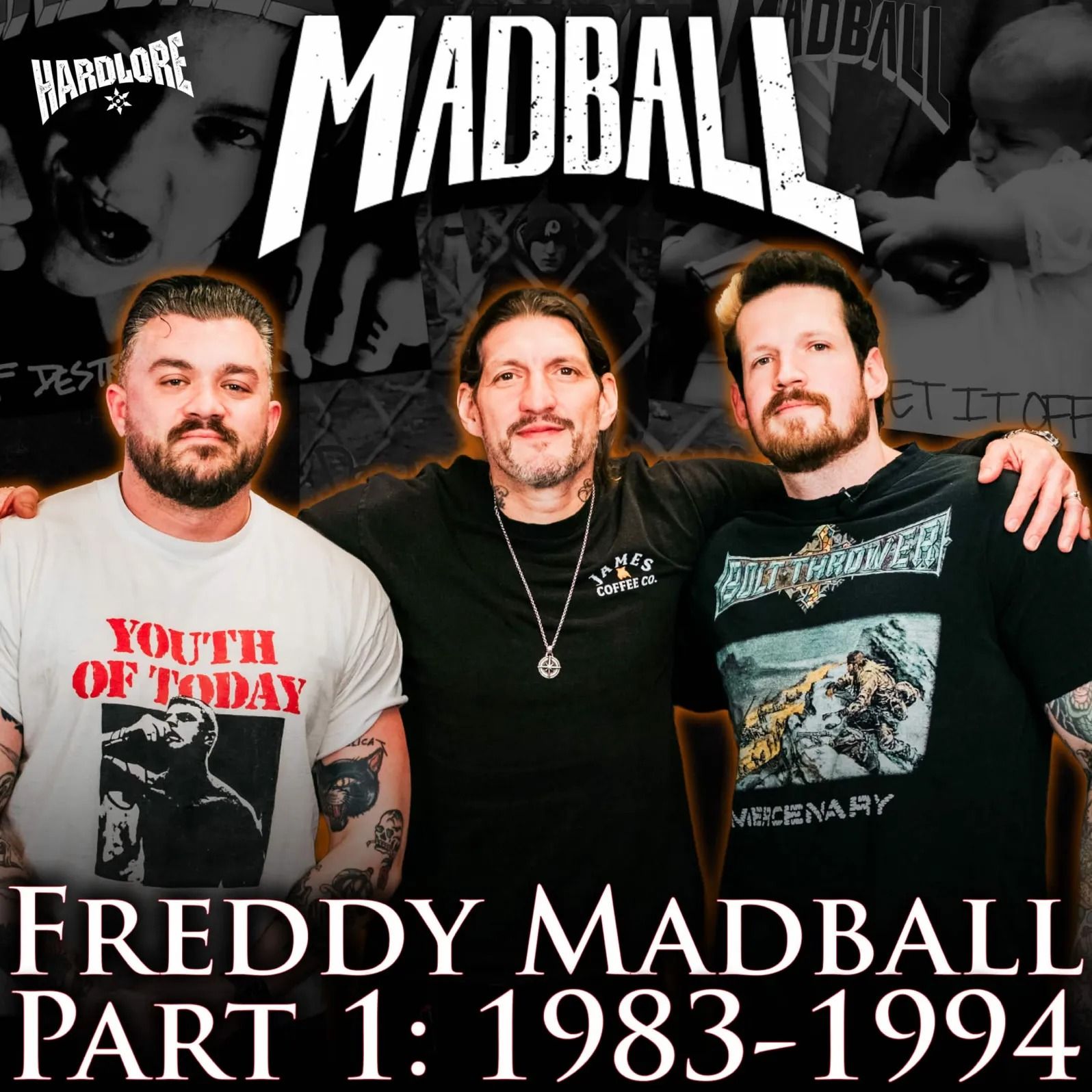
Loading summary
Transcript1,325 lines
- [00:00]
Colin
So you brought up Vinny being an encouraging figure in your life. He gave you the name madball.
- [00:06]
Freddie Mad Ball
That's correct. Tell me, Vinny being Vinny, you know,
- [00:09]
Colin
was it based off the toy or the sock with.
- [00:13]
Freddie Mad Ball
I don't want to say that exactly, but could very well have been strong influenced by that.
- [00:18]
Colin
That's funnier because that stigma, watching tv, seeing this toy and being like that reminds me of Freddy.
- [00:24]
Freddie Mad Ball
There's another component to it. It's. I do have a little bit of a temper as an 11 year old. You know, only if I'm agitated, like, if you bring it out, if you got me going, I could be a mad ball.
- [00:58]
Colin
Hello, welcome. It's hard lore time. How you doing, Bo?
- [01:00]
Craig
I'm doing great, Colin. Where are we today?
- [01:02]
Colin
We are at Blackheart Barber Company in Nashville, Tennessee, for one of the most monumental days in the history of our sport. Here we have maybe the definitive hardcore frontman. Realistically, this is a true lifer of the genre. One of our most anticipated guests of all time.
- [01:29]
Craig
Someone on the immediate list.
- [01:30]
Colin
In the beginning, like, the show started, it was like, well, if we could get Freddie one day, that'd be great. Many call him the chosen one. Please, everyone welcome New York's own Freddie Mad Ball.
- [01:41]
Freddie Mad Ball
Thank you. Thank you, guys. The chosen one.
- [01:44]
Colin
The chosen one.
- [01:44]
Freddie Mad Ball
Wow. That's the first.
- [01:46]
Colin
The new king right here, as some would say.
- [01:48]
Freddie Mad Ball
That's awesome.
- [01:50]
Colin
How you doing?
- [01:50]
Freddie Mad Ball
Thank you, guys. Appreciate it. Thanks for the kind words. Of course. Doing great. Doing great.
- [01:53]
Craig
Yeah. Nashville.
- [01:55]
Colin
Nashville, Tennessee?
- [01:55]
Freddie Mad Ball
Yeah, man. How long I've been here? A few years now.
- [01:58]
Craig
Cool.
- [01:59]
Freddie Mad Ball
Yeah. You dig it? Yeah, I dig it. I really do. Actually. A lot of cool people I've come across, people from like, back east, from west coast that I know, like. Yeah, make. Making a lot of good connections here with good people. And it's like. Yeah, I love it.
- [02:15]
Colin
Is it the centrality of it all in terms of being a traveling guy?
- [02:19]
Freddie Mad Ball
Yeah, yeah. A few things, you know, cost of living and we had some. My wife has some family out here. I got a couple of very close friends that ended up making their way out here. So there were a few things that kind of drew us to this area.
- [02:36]
Colin
Sure.
- [02:38]
Freddie Mad Ball
But I love it. Beautiful. So far. So far, so good.
- [02:41]
Colin
Was it hard to leave New York?
- [02:43]
Freddie Mad Ball
Well, actually, I'm glad you mentioned that because I actually was in Florida for a bunch of years in between New York and here.
- [02:50]
Colin
Interesting. So you went Florida, New York Florida or New Jersey? Florida. New York, Florida.
- [02:55]
Freddie Mad Ball
Yes. Yes. My whole life has been between New York and Florida. Jersey. A little jersey sprinkled in there, of course. So this is the first place that's not on the East Coast.
- [03:06]
Craig
Sure.
- [03:07]
Freddie Mad Ball
That's not New York or Florida.
- [03:08]
Colin
Okay.
- [03:09]
Freddie Mad Ball
So it's new. It's a new experience for sure.
- [03:11]
Colin
Well, Nashville, you got Freddie.
- [03:12]
Freddie Mad Ball
Now you're. Yeah, yeah, it's on. But, yeah, Florida's always been in the mix since my childhood. And yeah, I was there for a lot of years. My kids were born there and so I was raising my family there. And then now we're here.
- [03:28]
Colin
Well, before we get into Freddie Madball, I think we have to start with Agnostic Fred. And, you know, we say the Chosen One because you're a very unique case where normally we ask guests, how did you find music? How did you find hardcore music when your case. Hardcore found you very young? So tell us about finding hardcore at 7 years old through your brother Roger and Agnostic Front.
- [03:57]
Freddie Mad Ball
Agnostic Fred. That's awesome. You guys do your homework.
- [04:00]
Colin
Come on.
- [04:00]
Freddie Mad Ball
Yeah, man. I don't know that very many people have even brought that up ever an interview. So that, that's. That was. That was good. Yes. I was Agnostic Fred before I was Mad Ball. I mean. Yeah, it's. It's funny because like you said, hardcore found me. I didn't come from, like, metal or punk, which is typically, you know, like the case with people. You know, even like my brother and Vinny, they come from punk.
- [04:34]
Colin
Yeah. I think your brother's quote of, like, never trust a hardcore kid who didn't come from punk.
- [04:39]
Freddie Mad Ball
Didn't come from punk. Yeah. And like, Yeah, I mean, that's how he found hardcore. Being in the punk scene and then stumbled upon this new thing and then boom. So for me, it was never. It wasn't any of that. I wasn't a metalhead and I wasn't a punk rocker. I just. The first, like, you know, heavy style music that I discovered was Agnostic Front, Victim Pain, actually United Blood before that. And I mean, yeah, you know, you hear rock stuff or like. Or even like heavier stuff like, you know, Iron Maiden or, you know, Black Sabbath or, like those kind of names, those big names. Of course I had heard of those bands, you know, and I maybe even knew some songs, but it wasn't what I was into.
- [05:29]
Craig
Yeah, it wasn't your thing.
- [05:30]
Freddie Mad Ball
It wasn't my thing. I loved all music, like, as a kid. I mean, I was big into hip hop as a kid, like, still am huge. You know, like, that was like a big thing for me, you know, from like, long as I Can remember. So the first heavy music that I got into that really got immersed into was hardcore. Yes. And it was obviously Gnostic Front.
- [05:53]
Craig
So some. Some people flip through records and they find a Metallica record or something. Might find like, I don't know, a Bad Brains record at best.
- [06:01]
Colin
You know, that's best case scenario created
- [06:03]
Craig
in a lab find like the purest
- [06:06]
Colin
form, the golden egg.
- [06:07]
Freddie Mad Ball
I was lucky. I mean, you know, like my. I have other siblings and like there were like all kinds of records in my house. So like there'd be like a random like Led Zeppelin record or like, and then there'd be sitting right next to like a salsa record. Because I'm Latin, you know, like my mom's Cuban, my dad's Colombian. So like heavily. You know, there's always been like a lot of Latin music in my house. Different styles, a lot of salsa. But like, that was always big and I always liked it. It wasn't like, oh, I hate my parents music. I enjoyed the music. And then there'd be like my sister stuff, like random disco and like 80s pop. And then there'd be like heavier stuff. There'd be such an eclectic variety of like, music.
- [06:52]
Colin
But it wasn't your cool, tattooed older
- [06:54]
Freddie Mad Ball
brother, you know, and then you pull out the gatefold. Victim in pain. And it was like, that was the hard stuff, you know? And then like, I mean, does it get any better, Roger?
- [07:04]
Colin
No, it does not. Right, so Roger's your half brother?
- [07:08]
Freddie Mad Ball
He is.
- [07:09]
Colin
Did you guys grow up together?
- [07:11]
Freddie Mad Ball
We did.
- [07:12]
Craig
We.
- [07:12]
Freddie Mad Ball
We never really use the term half brother with. So it's Roger, my brother Rudy, and my sister Myra.
- [07:20]
Colin
Okay.
- [07:21]
Freddie Mad Ball
They're all. Roger's like 12 years older. Rudy's like 10, 11 years old. You know, they're all just like. There's like a 10 year gap between us at least. And so they're all. They were all born in Cuba.
- [07:39]
Craig
That's right.
- [07:39]
Freddie Mad Ball
My mom's first marriage when she was like 16. Crazy. And so they're all Cuban.
- [07:47]
Colin
So the whole family is first generation American?
- [07:49]
Freddie Mad Ball
I am. Well, I'm. Yeah, whatever you would consider me second or like, I'm the first one in my entire family born in America. Right?
- [07:56]
Craig
Yeah, yeah.
- [07:57]
Freddie Mad Ball
So whatever. That would be first or second. But yeah, they're all born in Cuba. They're all Cubans.
- [08:02]
Colin
Wow.
- [08:04]
Freddie Mad Ball
And so my mom came over with three little kids and then she met my dad in New Jersey.
- [08:09]
Colin
Okay.
- [08:10]
Freddie Mad Ball
And then her and Roger's dad split up. My dad came into the picture. He was younger than their dad. My dad's Younger than my mom. And yeah, then a whole other chapter started and I was born and here we are. But yeah, we never spoke like my little half brother or anything like that because I, I was like the baby to them. Like, you know, they took care of me. They were like, oh, you know, like
- [08:40]
Colin
12 years is a big gap. Yeah, that's, that's like a, that's a part time caretaker.
- [08:44]
Freddie Mad Ball
Yeah. My mom was going to have like. My mom miscarried a bunch of times before me and after me. Oh, wow. So they were always expecting this little brother or sister that was like, when is this thing coming? Like, when's this little. When's this little kid coming? And so every time she would like miscarry or whatever, be like. And then finally I came. So it was like a big deal when I came into the picture.
- [09:10]
Colin
You're a celebration, really.
- [09:12]
Freddie Mad Ball
You know, it happened. And then after me, my mom tried again with my dad and she could never make it happen again. She lost twins in one of those. Either before or after me lost twins as well. So. Yeah, it's sad, but it's brutal. It is what it is.
- [09:27]
Craig
Yeah.
- [09:28]
Freddie Mad Ball
I made it through somebody.
- [09:29]
Colin
You did, you did. We're glad he did.
- [09:31]
Craig
It was this time period when you're. When you first see that victim in pain of the United Blood ep. Is this. You're in New Jersey at the time or were you?
- [09:39]
Freddie Mad Ball
I'm in Florida at the time. Yeah. I was born in Jersey and we relocated to Florida when I was about four or five years old. Young. And yeah, my grandfather went to Florida and my dad followed him. They wanted, they went, they wanted sunshine and like tropical because. Cause that's kind of the climate where they come from.
- [10:00]
Craig
Of course.
- [10:01]
Colin
So. But Roger stays in New York or
- [10:03]
Freddie Mad Ball
Roger stays in New York. Roger's not having it. He's like, I'm not going to Florida. He's like, he's older. Like what, 16, 17, like a kid. But in those days he was older.
- [10:14]
Colin
So how does it come that he goes, okay, you're gonna come to New York for a trip, vacation or something? Just to visit.
- [10:22]
Freddie Mad Ball
Yeah.
- [10:23]
Colin
How does Agnostic Front get presented to you as a thing that.
- [10:26]
Freddie Mad Ball
Firstly in New York.
- [10:27]
Colin
Okay.
- [10:27]
Freddie Mad Ball
Yeah.
- [10:28]
Colin
Because he just wants to bring you around.
- [10:30]
Freddie Mad Ball
Yeah. They hadn't toured yet, so would have been about 82, 83. That was my introduction. So it was like. I forget how I made my. I think I do remember how I made my way to New York. I went to visit an aunt in New Jersey in Patterson, and I have a Lot of family still in the New Jersey area. My family's like, like again, between New Jersey and like, Florida, South Florida. And some are sprinkled in New York. But so for one reason or another, I ended up in New Jersey visiting my aunt, my aunt and my uncle. I had a bunch of uncles there, cousins, some my age, some a little younger. And Roger picks me up in New Jersey because he's living in the city at this point. And, you know, he's my big brother, so he wants to hang out with me, of course. And that's how I get introduced to the scene at the time, which was based mostly really in like, Lower east side, like, Alphabet City area. And then my whole world, just, like, I just got exposed to like, this whole world, which was like,
- [11:45]
Colin
very different in its infancy.
- [11:47]
Freddie Mad Ball
In its infancy.
- [11:48]
Craig
And also in a setting, early 80s Lower east side. What was that like?
- [11:53]
Freddie Mad Ball
Wow. Especially for a child, just like how the pictures depict it, it's like crazy. You know, some places look like third world country, like war zone. And then, you know, I mean, there's always. There was always an element of like, a lot of cool art. I mean, you know, East Village, Lower east side, Alphabet City, you know, it was like a hub for artists. So it was like music, art, this, that. So there's always that element sprinkled in there, you know. But, yeah, a lot of crazy, a lot of drugs, like, you know, people nodding out, a lot of weird. But, you know, they tried to insulate me as best they could. They took care of me. You know, they did make me panhandle a couple times.
- [12:39]
Colin
But, I mean, I'll forgive him.
- [12:42]
Freddie Mad Ball
I'll forgive him for that. I'll give. I'll give him a pass. But, yeah, it was like, you know, my brother and Ray B's and Vinny and like that whole Jimmy and like that whole original first generation New York hardcore guys, like, they all like, you know. Yeah. I mean, I was like, hey, look at this little kid, you know, so they took me around and I went to a seven.
- [13:03]
Colin
So they're psyched to have you around?
- [13:05]
Freddie Mad Ball
They were psyched to have me around.
- [13:06]
Colin
Okay.
- [13:06]
Freddie Mad Ball
Yeah. I mean, otherwise my brother would have just kicked me, you know, brought me back to my aunt's house and been like, all right, we had fun. Took him for an ice cream. Here he goes.
- [13:15]
Colin
I think madwall's whole existence is like, proof that your brother loves you in a way. Like, especially in the early.
- [13:22]
Freddie Mad Ball
I question that sometimes, but you're right.
- [13:25]
Colin
If you really break it down, we'll get There.
- [13:28]
Craig
But.
- [13:28]
Freddie Mad Ball
So what was that? Or he's a mad scientist.
- [13:30]
Colin
Right.
- [13:31]
Freddie Mad Ball
And he was experimenting. I think it's a bit of both.
- [13:33]
Craig
I said made in the lab.
- [13:35]
Colin
I can see that. Yeah, I can see that. And there's. We'll get there in just a second. I don't. Do you, like. Do you remember much from your life from 7 to 11 years old? Yeah, I don't remember much. There's not. Outside of, like, a couple action figures I was excited about and bands I started to like. In your case, you have all these photos and videos popping up of you as a little kid on stage. How vivid is all of that to you still?
- [13:59]
Freddie Mad Ball
I mean, I'm with you. Like, my memory's not great like that. Like, you know, I know people that have, like, photographic memories. And, like, you know, it's more vague, but the pictures do help me, like, remind me of a scenario or situation. Yes, the pictures are great. Like, when I come across those pictures, I could sort of transport myself to that time period and remember almost even what I was smelling at the time.
- [14:29]
Craig
Like, you know, it's so funny you said that. Cause I was gonna say, you'll see an old picture and you will remember how that bar smelled on stage.
- [14:35]
Colin
Smell.
- [14:35]
Freddie Mad Ball
Yeah. Or the house that we know was like a squat, you know, and it had, like, a distinct odor. Not necessarily a bad one, just like a squatty odor.
- [14:42]
Colin
Unique.
- [14:43]
Freddie Mad Ball
Like, whatever that is.
- [14:44]
Colin
100%.
- [14:45]
Freddie Mad Ball
And so, like, pictures are great for that, you know, Like. Yeah, people are lucky nowadays to have just like, photographs of their whole entire life from beginning to end. Cause it's just gonna be like. Yeah, I'm not gonna forget anything.
- [14:56]
Craig
Yeah. Cause otherwise, we just had books, like
- [14:59]
Colin
a photo album, and those are gone.
- [15:00]
Craig
And that's it.
- [15:00]
Colin
You lose those in the fire every time.
- [15:02]
Freddie Mad Ball
Oh, yeah. Oh, yeah.
- [15:03]
Colin
Do you recall your first time singing on stage?
- [15:06]
Freddie Mad Ball
Well, there's that picture of it which reminds me of how I felt. Sure. And you could see my face in it. And I'm terrified. So.
- [15:14]
Colin
Yeah.
- [15:15]
Freddie Mad Ball
And I remember being nervous, but I remember also having the desire to do it, you know, so it was like, I'm scared. I'm scared, but I'm gonna do it. You know, I'm like. I'm not. You know, like.
- [15:26]
Craig
And you were surely influenced and encouraged by your brother. Yeah, Roger can do it.
- [15:32]
Freddie Mad Ball
I can do this for sure. I mean, you know, you always look up to your big brothers and, you know, in, like, so many ways. And. Yeah, I was. I was learning the songs. I was starting to, like, Mouth the songs and be like, okay, yeah. I mean, they're simple songs. And, and. And then it was my brother. But I also have to credit Vinnie because I think he also caught me, like, kind of singing it. Singing like one of the songs and being like, oh, the kid knows the songs, you know, And I think.
- [16:02]
Colin
And that's so him spending time with him.
- [16:05]
Freddie Mad Ball
Yeah, yeah. Come on, kid. He's always.
- [16:06]
Colin
He's scouting. I'm still the kids, okay.
- [16:09]
Freddie Mad Ball
I'm a half a century old, but I'm the kid. Trust. Trust me.
- [16:13]
Colin
Okay.
- [16:14]
Freddie Mad Ball
So he's, you know, I think he kind of looked at my brother and it was like. I don't know if they spoke about it or if it was just kind of like they spoke with their eyes, like. Or, you know, but then it was just like somehow, some way, they just kind of. We're like, go ahead, do it.
- [16:28]
Colin
So did you get the bug from that first time?
- [16:31]
Freddie Mad Ball
I think so, yeah. I would say. I would say, yeah.
- [16:35]
Colin
So you brought up Vinnie being an encouraging figure in your life. He gave you the name Mad Ball.
- [16:41]
Freddie Mad Ball
That's correct.
- [16:42]
Colin
Tell me.
- [16:42]
Craig
Yeah, that's correct. That was one of my.
- [16:45]
Freddie Mad Ball
Vinnie being Vinnie, you know, he might have been influenced by other things that were going on in the 80s at that time and, you know, like watching a lot of TV in Mott street, at the Mott street apartment, you know,
- [17:02]
Colin
so was it based off the toy or the sock?
- [17:06]
Freddie Mad Ball
I don't want to say that exactly, but could very well have been strongly, slowly inspired by that.
- [17:12]
Colin
That's funnier because that stigma, watching tv, seeing this toy and being like that reminds me of Fred.
- [17:17]
Freddie Mad Ball
Well, picture him watching, like, whatever he's watching, you know, regular tv.
- [17:22]
Colin
That's funny already.
- [17:23]
Freddie Mad Ball
That's funny already. Just chilling out and, you know, talking to the tv.
- [17:27]
Craig
Yeah.
- [17:28]
Freddie Mad Ball
And then, you know, you know, that's happening. I mean, I've seen it.
- [17:31]
Colin
Sure.
- [17:32]
Freddie Mad Ball
So I love you, Stiggy. And then like a commercial comes on and it's like, mad ball. Mad Ball, right. So it was, I think, more that than the actual. Like, it was just the sound of it reminded him of me somehow.
- [17:48]
Craig
Wow.
- [17:48]
Freddie Mad Ball
I was kind of a Mad ball. Like, I kind of like there's another component to it. It's, you know, I do have a little bit of a temper and, you know, only if I'm agitated, like, if you bring it out.
- [18:03]
Colin
And as an 11 year old.
- [18:05]
Freddie Mad Ball
Yeah.
- [18:06]
Colin
Wow.
- [18:06]
Freddie Mad Ball
And so I think, like, sometimes for like, tour fun, they would, like, piss me off just to see how I'd
- [18:16]
Colin
react regular Old scrappy dude.
- [18:18]
Freddie Mad Ball
This is the mad scientist.
- [18:19]
Colin
Okay.
- [18:20]
Freddie Mad Ball
And so I think they would like, poke at me and like, not Vinnie. Vinnie was cool, but like, you know, my brother and a few other people would like. I think they just, you know, like, they'd get bored, get you wound up. Like, let's. Let's mess with the kid and see what he does.
- [18:33]
Colin
Why not mess with the kid and then.
- [18:35]
Freddie Mad Ball
And cut to me throwing rocks at the van and like, really, I'd get like, enraged.
- [18:41]
Colin
Okay.
- [18:41]
Craig
You know, I would have assumed that the. The band name came from a billiard ball, a mad ball, you know, and
- [18:50]
Freddie Mad Ball
one would sort of fitting later on in life.
- [18:53]
Craig
It's funny that it's almost like.
- [18:55]
Freddie Mad Ball
Almost.
- [18:56]
Craig
It's actually. It's very wholesome.
- [18:58]
Freddie Mad Ball
Yeah. The way it actually came about. Yeah, yeah, no, it's a little more. A little more wholesome. Exactly. Like you said. But it was a combo of like Vinny's imagination and my temperament.
- [19:12]
Craig
Sure.
- [19:12]
Freddie Mad Ball
When I got messed with.
- [19:13]
Craig
Sure.
- [19:14]
Freddie Mad Ball
Otherwise I was pretty chill kid, I think. But if you got me going, I could be a mad ball.
- [19:20]
Colin
Okay.
- [19:21]
Freddie Mad Ball
And one day he was just like, mad ball, mad ball. You know, and then I had shaved my head, so, you know, the whole look. Yeah, it was like, it just. Yeah, it just became mad ball.
- [19:31]
Colin
There's a difference between finding something peripherally at 7 years old or your brother showing you something that's kind of like, okay, cool. And then it. Becoming a lifestyle community. How. How strong was that feeling for you at between 7 and 11 years old to be like, okay, this is. This is the place I want to be. This is my thing.
- [19:52]
Freddie Mad Ball
Super strong.
- [19:52]
Colin
Okay. Immediately.
- [19:54]
Freddie Mad Ball
Especially that age range, because there was a time where I sort of fell out of hardcore. That. That's later. But, you know, 7 to 12, 13ish. Yeah. I was like, you know, I just became immersed in it and then, like, I just. I was bummed to go to Florida. Like, when I would have to go back to Florida, I was bummed. I was like, I just want to be in New York. Like, I don't like, had met such cool people. Something about the living outside of the norm really spoke to me. The music clearly resonated with me because otherwise I just wouldn't have even, you know, like. Cause people, you have to remember, like every single thing your older sibling plays for you. You're not gonna necessarily like that. You know what I mean? Like, you could also.
- [20:46]
Colin
The one you like, you are going to remember forever.
- [20:49]
Freddie Mad Ball
You know, you could put something on and go, that's not My thing, man. That's not my bag. I'll. I'm over here. Yeah, but when it speaks to you and it resonates with you, it could change your life. Clearly it did. And that was like what early AF records did for me. But yeah, man, those, that, that range, I was like all about it and in that range.
- [21:09]
Craig
Sorry to interrupt. In that range. Are you living with Roger?
- [21:13]
Freddie Mad Ball
No, no, I'm living with my family and.
- [21:16]
Craig
But I mean, when you're in New York, when you visited.
- [21:18]
Freddie Mad Ball
Yeah, I mean, like, even when I'd be visiting, you know, like sometimes, like, it'd be like, oh, I'm going to go visit my family in New Jersey and you know, responsible adults and like my cousins and like. But I was always looking for an excuse to like, go get over. Let's go, you know, go hang with my brother.
- [21:39]
Colin
Like when you get home to Florida, other. Is there like a single other hardcore kid? No. You're an outcast at home, dying to get back, boiling away.
- [21:52]
Freddie Mad Ball
I can remember going to school the first time I shaved my head and people looking at me weird. They're like, what the hell?
- [22:00]
Craig
Yeah.
- [22:01]
Freddie Mad Ball
You know, and it was just like, you know. Cause I had like, I don't know, whatever haircut you have at that time in like the 80s or the 80s, like some kind of whack haircut. And like, I was like, screw this, shave my head. You know, my mom was bummed. Oh, you beautiful hair.
- [22:15]
Craig
You know, you do have beautiful.
- [22:17]
Colin
George's hair.
- [22:17]
Freddie Mad Ball
Oh, thanks, man. Appreciate that. But you know, moms, yeah, of course, they're beautiful hair. And I'm like. And then I forget, like, I might have had like, I don't know what, some kind of AF shirt on. And like, I was just dressed. I wasn't like outlandish. It wasn't like I had like five color hair. And like really, really trying to like be shocking. But whatever I was wearing was shocking to those people.
- [22:48]
Colin
I mean, was the word skinhead subversive to the average person in 1983, 84.
- [22:54]
Freddie Mad Ball
I mean, sadly, that word was like, negative. Sure. You know, like, it wasn't the skinhead. Like already. Yeah, already. Like early 80s already. Like the. It was, it was more subversive. But the people that did know immediately thought that for some reason. And like, I'm like so Agnostic Front. That's not the skinhead that I know. I'm like, I'm in New York with like black skins and Latin and like every Jewish. Like, yeah, it's like, that's not the World that I'm a part of, you
- [23:33]
Colin
know, was there part of it? So like Agnostic front using the word skinhead when it's like a dirty word even in the time.
- [23:40]
Freddie Mad Ball
Pretty brave.
- [23:41]
Colin
Is it kind of like a fuck you to kind of. Okay, kind of.
- [23:45]
Freddie Mad Ball
I mean, they're pretty punk. Right. And pretty like fu. So like, I mean, I think they were just flying the flag of what they were. They were New York skins.
- [23:54]
Craig
Yeah.
- [23:55]
Colin
It was genuine, authentic.
- [23:57]
Freddie Mad Ball
Yeah. From them. But you know, I don't even think they realized until they started touring how bad that climate was as far as like it becoming more political and then like the right, you know, wing and Nazi skin, like all that element. I think they really started to see that more as they traveled. And I saw some of it as well.
- [24:20]
Colin
Sure.
- [24:20]
Freddie Mad Ball
Because I was there, you know, with them. So I was like, yeah, this is. Yeah, I can. You know, it's kind of wild.
- [24:27]
Colin
How are you getting into non all ages shows at the time?
- [24:32]
Craig
That's a great question.
- [24:33]
Freddie Mad Ball
Great question. I think they snuck me into. It was either a seven or CBs. Well, a seven maybe. Didn't need to because a seven show started at like one in the morning or something like crazy like that. And it was like more wild style, like run by the kids. Sure.
- [24:51]
Colin
We've been in there recently and it's tiny.
- [24:54]
Craig
Dijon took us after we had the day with Vinnie. And it's so small, but he took us in the back where they have all the stuff still.
- [24:59]
Freddie Mad Ball
Yeah. Very cool, but super small scene. You know, back then if you see
- [25:04]
Colin
a little kid, you'd know there's a little kid in there that's not sneaking in. Yeah, for sure.
- [25:07]
Craig
Like you're still sneaking into a child.
- [25:09]
Freddie Mad Ball
Yeah. I don't know. Like, I don't remember how I know that. Seabees was bad. They were strict.
- [25:15]
Colin
Really?
- [25:15]
Freddie Mad Ball
Oh yeah. Oh, yeah.
- [25:17]
Colin
Was it. Was it. When did it become Seabees and not Hilly's on the Bowery? Was it. Was that like. Was it already before my time?
- [25:24]
Freddie Mad Ball
Yeah, that's before my time.
- [25:25]
Colin
Okay.
- [25:26]
Freddie Mad Ball
Vinnie would be a better person.
- [25:28]
Colin
He said he went there when it was still hill. He's.
- [25:30]
Freddie Mad Ball
Oh yeah, Vinnie. Yeah, Vinnie Vinny. Yeah, that's his. That's his.
- [25:33]
Colin
Yeah, big time.
- [25:34]
Freddie Mad Ball
That's his thing. Yeah. He'd tell you about Maxis, Kansas. He would tell you about all that old like where punk was transitioning into hardcore. By the time I went, there was already CBs.
- [25:44]
Craig
Okay.
- [25:44]
Freddie Mad Ball
But the Sunday matinees were probably just starting.
- [25:48]
Craig
Okay.
- [25:48]
Freddie Mad Ball
Or hadn't hadn't hit their stride yet, you know what I mean?
- [25:52]
Colin
Of course.
- [25:54]
Freddie Mad Ball
But I had to be. We had to talk to them about me being in there. And they didn't necessarily sneak me in, but I could only go do a song and leave. And I had to be escorted in and escorted out by either Big Charlie, who was like old school security guy there, great guy, rest in peace, Big Charlie. Or like Ray B's, or like one of the guys.
- [26:23]
Craig
Would you just hang out outside then?
- [26:25]
Freddie Mad Ball
Yeah, so I would just be hanging out. Like my brother would have his van out there, doors open, people hanging. I mean, that was kind of a thing anyways, like at CBs, like people really like to hang out outside. Cause in there it's all dingy and dark. So you really only went in when the show was happening. The real, the cool part was the hang outside.
- [26:47]
Colin
I mean, you know, to this day,
- [26:50]
Freddie Mad Ball
whether you drank, didn't drink, didn't matter. Like everyone hung out, talked to each other. You know, you had the straight edge faction, you had the drinkers, you had this didn't matter. You know, everyone respected each other, knew each other. And like. So yeah, I'd hang out in the van until it was like, you know, I was allowed to go in. And sometimes I'd extend my time inside. I'd cheat and be like, they're not saying anything. And then eventually someone would be like, hey, you gotta get your brother outta here. He's not supposed to be in here.
- [27:16]
Colin
And is that for like liability reasons on their end?
- [27:19]
Freddie Mad Ball
Exactly.
- [27:19]
Colin
It's interesting that they cared about that really, considering everything else about it.
- [27:23]
Freddie Mad Ball
And there was a bunch of 16 year olds in there. So it's like, I mean, yeah, I mean, I guess there's a difference. Like, yeah, 11, 16, was there a
- [27:29]
Colin
single other 11 year old present, like even in the community at the time,
- [27:34]
Freddie Mad Ball
you know, the chosen one? Not that I can remember.
- [27:37]
Colin
You're Luke Skyler.
- [27:38]
Freddie Mad Ball
I can remember. No, like, no. I think I was like one of the younger. There were a lot of young people on the scene, but no one as young as me. No, not that I can remember.
- [27:47]
Craig
You mentioned that you were a hip hop head.
- [27:49]
Freddie Mad Ball
Yes, very much.
- [27:50]
Craig
That's not so much a genre that we know all that much about. Were you into hip hop at that time?
- [27:56]
Freddie Mad Ball
Yeah.
- [27:56]
Craig
Was hip hop. I don't even really know when hip hop really like took off. I know it being New York, hip
- [28:01]
Freddie Mad Ball
hop and hardcore are kind of almost the same age. I think, like, I think hip hop may have come like punk Maybe just before, like, hardcore the way we know it, but similar in age. I mean, obviously, hip hop's trajectory is like. It's pop.
- [28:19]
Colin
Yeah. That's just pop music.
- [28:20]
Craig
Yeah. But who were some of the artists that.
- [28:24]
Freddie Mad Ball
I mean, I loved? Like, you know, we had, like, in my house, there were, like, Curtis Blow records, which is, like, super old, which was kind of like before my time, but I still was, like, I liked it. We had Sugar Hill Gang Records, Grandmaster Flash. We had, like, all those old records. But the stuff that I started to like, kind of like on my own was like, Slick Rick and Doug E. Fresh had this. Had a record that had, like. I guess it'd be like an ep. It had, like, just a couple of songs on it. And it was called the Show. And so it had, like, Lottie Dottie on the other side. It was like the B side. And that was like. I think I even bought that record with my own money. Or, like, my own money.
- [29:08]
Craig
Yeah.
- [29:09]
Colin
From the fan handling that they made.
- [29:11]
Freddie Mad Ball
Yeah, exactly. Yeah. Right. So, yeah, stuff like that. And then, of course, like, Run dmc, LL Cool J. Like, the names that everyone, you know,
- [29:21]
Craig
but in their infancy as far as, like.
- [29:24]
Freddie Mad Ball
Yeah. You know, now. License to Ill, when it first dropped. Beastie Boys, first record. You know those guys. For me, I love that record.
- [29:32]
Colin
Were those guys around when you were first coming around?
- [29:35]
Freddie Mad Ball
I didn't know them super well, but my brother Vinny, those guys know those guys. Yes.
- [29:40]
Craig
Okay.
- [29:41]
Colin
Was there a bit of like, oh, these guys are taking off now, too cool type thing? Or was that, like.
- [29:46]
Freddie Mad Ball
I never got that vibe. And Jimmy was. Especially Jimmy, you know, I'm talking about, you know, Jimmy from Murphy's Law. Yeah, of course. Anytime I say Jimmy, there's only one Jimmy.
- [29:56]
Colin
Okay.
- [29:56]
Freddie Mad Ball
There's many Jimmies, but there's only, you
- [29:58]
Colin
know, in your world.
- [29:58]
Freddie Mad Ball
Yeah, he was tight with them.
- [30:01]
Colin
Okay.
- [30:03]
Freddie Mad Ball
They brought out Murphy's Law on their first big arena tour.
- [30:06]
Craig
Oh, shit. I didn't know that.
- [30:08]
Freddie Mad Ball
In America, for the License to Ill album, which is basically where they just popped off, they took off right after that. And, I mean, they were already doing arenas on, like, their first tour. So that just goes to show you where they were headed. And I thought it was super cool that they brought out Murphy's Law. It's awesome. Cause, like, Murphy's Law meant a lot to New York hardcore. But, like, in the big picture, they weren't like some big band.
- [30:35]
Craig
Yeah.
- [30:36]
Freddie Mad Ball
So I thought it was really cool.
- [30:37]
Craig
I know one of them. I forget which. Beastie Boy also played bass For Chrome X a couple times too. Like later on or mid. I know I forget which one.
- [30:46]
Freddie Mad Ball
Try to think about that.
- [30:47]
Craig
You know, the first time I ever played New York, we went to Flight Club, the shoe store, early 2000s. Grandmaster Flash walked in, dropped like 10 grand on shoes. In 2003.
- [31:01]
Colin
Money, you know, that's like.
- [31:02]
Freddie Mad Ball
He's half a million age as well, too.
- [31:04]
Craig
He's like in crazy parked, came in, just bought a bunch of shit, had it put in his car and left. And it was like the coolest thing I've ever seen.
- [31:10]
Colin
Real New York moment.
- [31:11]
Freddie Mad Ball
Yeah.
- [31:12]
Colin
What were. So Agnostic Front pulls you in. Murphy's Law is around. What were other hardcore bands you connected to at that time that were kind of popping off?
- [31:22]
Craig
Yeah, what demos?
- [31:24]
Colin
Like, yeah, your brother's in Agnostic Front, and that's. That's going to get you there. But finding this collective of other bands is what's gonna keep you there.
- [31:33]
Freddie Mad Ball
Pretty much anyone that played with af, I. You know, I just, at that time, I just loved the culture, you know. Like, you're a sponge.
- [31:45]
Craig
You're just so good.
- [31:46]
Freddie Mad Ball
Yeah. And I'm not like, you know, I wish I should have been better about this, but like, I'm not like a great historian of the core of the culture, you know. Like, I don't have like every 7 inch. I don't have like. I couldn't name you every single band, you know, but, you know, all the New York bands, obviously, classic bands, War Zone this, you know, like all those bands. I mean, goes without saying, sick of it all, you know, I liked it all, you know, and, and, and obviously my world grew bigger as time went on and I got to travel and meet other bands from other places. But yeah, Anyone that like AF toured with or anyone that played CBs when I was there, I just was hungry to like, absorb whatever was going on, you know, And I really, you know, as I got older then I started to find the stuff that really, really, you know, connected. Affected. Affected me, which was like, you know, bright side, from Killing Time and like certain Sheer Terror records and like, you know, even like the first CRO Magsquirrel, you know, like, you know, those things are like, impactful to like, I think
- [33:09]
Colin
anyone in the hardcore. Pretty much the landmark.
- [33:11]
Freddie Mad Ball
Those were important records for me that I kind of started to find, you know, my own taste. Yeah.
- [33:19]
Colin
And those you're. You're 15 when those are coming out and that there's a big difference between the thing you hear at 7 years
- [33:26]
Freddie Mad Ball
old when you're a kid, you kind of don't know. You just kind of see who you see and like, you're just like, cool, cool, cool. Well, I mean, I was on tour with GBH with af and I just. They were just such cool guys and I just loved them. Just based on like.
- [33:41]
Colin
He was nice to me.
- [33:42]
Craig
I like his band.
- [33:43]
Freddie Mad Ball
It was just cool, cool English dudes and like, you know, I didn't know that they were going to be this like legendary, you know, British punk.
- [33:53]
Colin
Sure.
- [33:55]
Freddie Mad Ball
Kind of hardcoreish band too, because they're like super influential to hardcore. You know, like GBH discharge, like those kind of heavy punk bands, I think influence early hardcore.
- [34:08]
Colin
Everything comes from somewhere.
- [34:09]
Freddie Mad Ball
Yeah, yeah, yeah.
- [34:10]
Craig
One thing that surprised both of us when we were talking and when we spent the day with Vinnie and something that I heard you say, we. We played a fest together somewhere in Europe maybe two years ago now. Bad Religion was also playing. We played a fest. Brutal Assault or something. The one with all the big excavators.
- [34:28]
Freddie Mad Ball
Okay.
- [34:28]
Craig
You know the one.
- [34:29]
Freddie Mad Ball
Okay. And I think I know where you might be going with this, and I'm happy you're asking this if it's what
- [34:33]
Craig
I think you just said. We got hardcore royalty in the house.
- [34:36]
Freddie Mad Ball
Yeah.
- [34:37]
Craig
And I want to. I want everybody to give it up and make sure you watch Bad Religion.
- [34:40]
Freddie Mad Ball
Yeah.
- [34:41]
Craig
And this was years before we talked to Vinnie, before I knew that that Bad Religion, I wouldn't have guessed, would be an influential band.
- [34:51]
Freddie Mad Ball
Yeah.
- [34:52]
Craig
To the guys in New York, to the East Coast.
- [34:56]
Freddie Mad Ball
Well, specifically, like my brother. I remember my brother wearing a Bad Religion shirt in the early 80s. Like he would play. He would play shows with like this old Bad Religion shirt on the United
- [35:08]
Colin
Blood 7 inch coat.
- [35:10]
Freddie Mad Ball
Maybe you're right. Yes. And like, I think he, like, you know. Yeah. Everyone back then would like bedazzle their shirt, like cut it off, like, you know. And which is happens now too. Right. You know, sometimes you want to just, you know, cut the sleeves off. Nothing wrong with that.
- [35:22]
Colin
Hey, you're preaching to conduct.
- [35:24]
Freddie Mad Ball
Yeah. You know what I mean? You might want to trim the bottom of it 100%. It happens. So I remember that symbol like, you
- [35:32]
Colin
know, there's nothing wrong very vividly.
- [35:34]
Freddie Mad Ball
Like that logo is very much like. But I was watching that interview with Brett.
- [35:41]
Craig
Yeah.
- [35:42]
Freddie Mad Ball
And I want to preface what I'm going to say with this. I have so much respect for Brett because we were on Epitaph briefly. It was sort of an unfortunate thing because it was, I think, one of our stronger records. But we didn't really get to push it the way it deserved to be pushed. And a lot of that had to do with me. I got into some legal stuff. You know, at this point, I'm older, and I'm getting into all kind of street shenanigans, dumb stuff. And so I got myself in a bad situation, and, you know, I got locked up briefly, did a little skid bid, blah, blah, blah. And it hindered that push. And then I was excited to revisit the opportunity. And then we lost the guys that were the lineup at the time, so it was just, like, a mess.
- [36:45]
Colin
Sure.
- [36:46]
Freddie Mad Ball
Just to give you a little context about hold it down, about why that was never really pushed so hard. But fast forward to, I don't know, a few years back. Brett. I asked. I asked Brett for the album straight up. And because I was like, you know, it's like. It's sort of like living in, like, obscurity in a way, at, like, Epitaph. And I asked him for the record. And Tim is a friend of mine from Rancid. And so Tim was like, oh, man, Brett's cool. You know, just. Just talk to him, and I'll give. I'll put a good word in. And, I mean, I know Brett, but, like, not super well. He's not my homie. Like that. And all it really took was a phone call and a couple of emails, and he let me have that record, which is unbelievable.
- [37:45]
Colin
Insane.
- [37:45]
Craig
He. He's a, like, a genuine punk dude.
- [37:49]
Freddie Mad Ball
That is the most punk thing that was like, no red tape, no bs. He was just like, yeah, Freddie, you deserve it. You know? You deserve it. Like, you know, he understood. I mean, it wasn't like, it's something that's making him a bunch of money
- [38:06]
Colin
anyway, but, I mean, still, that does not happen.
- [38:08]
Freddie Mad Ball
But the money thing is irrelevant because there are people who will, like, hold on to stuff, even if it's not making them any money. They just want to have ownership of it.
- [38:17]
Colin
Because it could.
- [38:17]
Craig
Cause it could. Yeah, some days.
- [38:18]
Freddie Mad Ball
Cause you never know, you could go
- [38:19]
Colin
in a movie or something.
- [38:20]
Freddie Mad Ball
You never know, the band could pop off later in the game. And now that record has a lot more value. And not to get too much into the business of things. And I don't want to put anyone's business out there, but I just want to thank Brett because. And I've never had the opportunity to publicly thank him for being, like, a standup dude, for being, like, a real guy. Even on our level, like, even on the DIY underground level of music, people still play that industry card, people are still very business and very industry, and he was not that way. He was like, say less.
- [38:58]
Colin
Here you go. Yeah, that's not a thing. Here, take your album. Take your masterpiece back for free. Dude, it's crazy.
- [39:07]
Freddie Mad Ball
Crazy. Yeah, crazy. I'm forever, like, eternally grateful to Brett for that. So I want to pray preface that. Now moving on to the Bad Religion thing. I remember on the interview, we were like, oh, it was like, my favorite hardcore band of all time. That is not exactly accurate. Great band. Iconic, legendary. If there's a hall of fame for, like, punk hardcore bands, they belong in it, like, among others.
- [39:35]
Colin
Agreed.
- [39:36]
Freddie Mad Ball
But I have to give the greatest hardcore band of all time title to af. I'd have to be. And I think that's where the message was a little mixed, because I was shouting out af, but I also shouted out Bad Religion in the same breath. So I was saying best hardcore band in the world, Agnostic Front. But there's a lot of hardcore royalty in the house. Bad Religion in the house. And so there was, like, something that was, like. Not to say that. Not that there's anything wrong with, like, hey, all love and respect to Bad Religion as well, you know, but, you
- [40:06]
Craig
know, it was still.
- [40:07]
Freddie Mad Ball
AF always gets that.
- [40:08]
Craig
Yeah. And we agree.
- [40:09]
Colin
I agree. We've said that.
- [40:11]
Craig
But even with that and then with talking to Vinny and realizing that they were that influential of a bit.
- [40:16]
Freddie Mad Ball
Oh, yeah.
- [40:17]
Craig
It's just not something that I ever really put to paper that I thought about. So, yeah, it was cool to. To. To see that from both his generation and your generation. You know, I mean, that. That the respect is there.
- [40:29]
Freddie Mad Ball
I mean, those guys know better than I do. But, like, Cali dc, even, like, Negative Approach, which is one of my favorites. Super influential. But, like, I feel like with that first generation, they were all influencing each other.
- [40:46]
Craig
Yeah, yeah, yeah.
- [40:47]
Freddie Mad Ball
So, like, who came first? I don't know. You know, Bad Brains or somebody out west. I mean, it's hard to say.
- [40:53]
Craig
Sure.
- [40:54]
Freddie Mad Ball
It's all, like, late 70s, same time,
- [40:56]
Colin
and it's so fast.
- [40:57]
Freddie Mad Ball
And even if you think about United Blood. Yeah, that's like 81, 82.
- [41:01]
Colin
Sure.
- [41:01]
Freddie Mad Ball
So it's like they're not far behind. AF is right there. Right there, you know, and they're unique, so everyone's unique. No one sounds like Bad Brain. No one sounds like Bad Religion. No one sounds like af. No one sounds like Calls for Alarm. You know what I mean? Like, all these bands.
- [41:13]
Colin
So it's like little Pivot here. You mentioned Chrome Mags earlier.
- [41:17]
Freddie Mad Ball
Yeah.
- [41:17]
Colin
I've always wondered, was there ever like a silent kind of rivalry between AF and the CRO mags of like, who's the king in New York here? Who's the band in New York?
- [41:30]
Freddie Mad Ball
I would. I mean, it's funny because they all sort of came up like. I remember when I first went to New York, Harley was very much a part of that original squad. And I know John was around as well, but for some reason I don't remember him in the mix as much. Maybe he was going through some stuff at the time, so he was a little out of the mix.
- [41:50]
Colin
But Harley was also once the 12
- [41:52]
Freddie Mad Ball
year old kid at the show, right? Yeah. He's the original punk, like 12 year old kid before me, before my time. And I give him that. But Harley was part of that original squad of guys in the early 80s that I, you know, met that I, you know, when I became indoctrinated and became like, you know, immersed in this, Harley was there for sure. And they were homies. But I think by the mid-80s there was some weirdness with the camps. I'm not gonna lie. I'm not gonna. I'm not. It's not for me to really tell AF story. I hope you interview my brother.
- [42:26]
Colin
I would die.
- [42:28]
Craig
That's another one of these.
- [42:29]
Freddie Mad Ball
Say the word, I'll make it happen.
- [42:30]
Craig
It's another one of the I make
- [42:31]
Freddie Mad Ball
it happen minute we get off of this. And it's. I think it's important for the culture. 100 which. Which is what you guys do. And I appreciate that, man. You guys cover the culture in a great way. So. Yeah.
- [42:43]
Colin
Thank you.
- [42:43]
Freddie Mad Ball
Salute to you guys. He'll tell you probably.
- [42:47]
Colin
Okay.
- [42:47]
Freddie Mad Ball
More in depth, those things. But coming. There was, there was, there was some. There was some unspoken maybe, like, because
- [42:57]
Colin
you don't see a lot of old flyers with both bands on it.
- [43:00]
Freddie Mad Ball
No, they don't play together. Yeah, yeah. It's weird.
- [43:03]
Craig
It's very interesting.
- [43:03]
Freddie Mad Ball
It's a good, It's a good observation. And you're right. It was sort of like it became different camps. Yeah. Let's just say that.
- [43:11]
Craig
Yeah.
- [43:11]
Freddie Mad Ball
And people had different intentions and you
- [43:14]
Colin
know, we'll talk to Roger.
- [43:17]
Craig
And now it's over 40 years ago.
- [43:19]
Freddie Mad Ball
Yeah. Yeah. For real? Yeah, yeah, for real.
- [43:21]
Craig
So.
- [43:22]
Freddie Mad Ball
But you can't deny, like Age of Quirrel.
- [43:25]
Colin
One of the best.
- [43:25]
Freddie Mad Ball
Undeniable.
- [43:26]
Colin
One of the best.
- [43:26]
Freddie Mad Ball
Yeah.
- [43:27]
Craig
So you turn 12 years old.
- [43:29]
Freddie Mad Ball
Yeah.
- [43:29]
Craig
And somebody says to you, hey, let's make a band.
- [43:34]
Colin
Rod, your brother and Stigma.
- [43:35]
Craig
Your brother and Stigma say, let's Michael
- [43:38]
Colin
Jackson esque, really, but it's.
- [43:41]
Craig
It's. Is it. Hey, do you want to record something? Like, how does that. How does Ball of Destruction?
- [43:47]
Freddie Mad Ball
I forget how the. The exact conversation went, but it happened pretty organically. Just because by this point, it became a tradition of sorts for me to come up and sing a song with AF anytime I was with them. So, you know, I'm getting older. I'm getting a little more comfortable. I mean, I'm still like a kid. I'm shy. But I think I graduated from doing, like, it's my Life, which was easy enough.
- [44:17]
Craig
Which is an Animals cover.
- [44:18]
Freddie Mad Ball
An Animals cover, yes.
- [44:21]
Craig
Those are our guys.
- [44:22]
Freddie Mad Ball
I love the Animals, dude.
- [44:23]
Craig
They're awesome.
- [44:23]
Freddie Mad Ball
They're one of the best. And they're like fans of the Animals.
- [44:26]
Craig
They're like bad boys, you know, like, they were.
- [44:28]
Colin
They were the naughty be.
- [44:30]
Freddie Mad Ball
And I mean, the name. Does it get better?
- [44:33]
Colin
So that should be the Animal.
- [44:35]
Freddie Mad Ball
Yeah, yeah, No, I love that. And I. You know, that was one of those ones where, like, you go back and get into it after the fact.
- [44:41]
Craig
Yeah, absolutely.
- [44:42]
Freddie Mad Ball
Because, like, Vinnie, that's his era, like, he grew up with the Animals. Like, he loves all that stuff, hence why he hijacked that little segment of the song.
- [44:51]
Craig
But
- [44:53]
Freddie Mad Ball
then you start to learn, like, oh, and then. Oh, yeah. I mean, I went retroactively, went back with a lot of music and like, Psycho.
- [45:00]
Craig
Sure.
- [45:00]
Freddie Mad Ball
I mean, you know, I love old news. I love all kinds of stuff. But anyway, not to veer from the question, so that was my first song. And then Last Blind justice, the end of Blind justice into Last Warning became my thing. Like when, you know, the end of Blind justice starts coming, you know, where you get those last lines that build up.
- [45:24]
Colin
And then all of us weren't.
- [45:25]
Freddie Mad Ball
The mic would be. The mic would be handed to me and then. And I don't know how that came to be, but I guess I liked those songs and I was just like, yeah.
- [45:33]
Colin
You know, but also the symbolism of a little kid saying, there's no justice, there's justice.
- [45:38]
Freddie Mad Ball
There's no justice. It's just us. That was my lines. Yeah.
- [45:40]
Craig
It's amazing.
- [45:41]
Freddie Mad Ball
Yeah. That was the seed planted for Mad Ball right there. And then all of Last Warning.
- [45:46]
Craig
Yeah.
- [45:46]
Freddie Mad Ball
And so I would do that anytime I was with them.
- [45:51]
Colin
Which, like, Last Warning is one of the biggest, like, mouthfuls.
- [45:54]
Freddie Mad Ball
Oh, my God.
- [45:55]
Colin
On the record. But having that inclination of, like, fitting all that and figuring that out as an 11 year old, if I were your older brother, I'd also be like, this Kid's singing for a band. So how does that become.
- [46:09]
Freddie Mad Ball
I mean, I guess they recognize something that I was able to like, do it. Yeah. And. And stay on time. So. Yeah, that was. That was simply it. Like I would just do these songs with them wherever I was, you know, be it Florida or New York CBs. I think I even sung those songs on like a live at CBs recording or one of those live at CBs. It was one of those deals where I got brought.
- [46:33]
Colin
First one.
- [46:33]
Freddie Mad Ball
Yeah, yeah, I sang. And then they were like, get him out of here. Because it was like the craziest show ever.
- [46:40]
Colin
Sure.
- [46:40]
Freddie Mad Ball
It was like just people, like, just like everywhere. Like you couldn't barely see the band, you know, it's like wild.
- [46:46]
Colin
So is it. Is. Is Mad Ball like a cheat code? Like he's the singer of the band. You gotta. He can't. You can't kick him out. He's the singer.
- [46:56]
Freddie Mad Ball
He's gotta be in here first. I mean, maybe Mad Ball is Mad Ball.
- [47:02]
Colin
Exactly. That's true.
- [47:04]
Craig
But did Mad Ball perform officially before anything was recorded?
- [47:09]
Freddie Mad Ball
Yeah, yeah, officially. Unofficially, there was an AF show where a couple guys didn't make it.
- [47:19]
Colin
Craig.
- [47:20]
Freddie Mad Ball
Craig and I think Steve Martin.
- [47:26]
Colin
That makes sense.
- [47:27]
Freddie Mad Ball
And so I don't know why that is, but they didn't make it to this show. A New Rochelle. And my brother, being a guy who thinks on his feet, you know, picks up a bass, was like, well, I'll play bass, you play dead. We'll do Mad Ball. Because Mad Ball idea concept was already there.
- [47:46]
Craig
It was in the lab.
- [47:47]
Freddie Mad Ball
It was in the lab. I can't even. I don't remember if we had recorded Ball destruction yet or not.
- [47:52]
Colin
I don't think you had. Probably not the time of the show.
- [47:56]
Freddie Mad Ball
But the seed was like, we were already talking about.
- [47:59]
Colin
And it's all AF songs. Which is. Which is amazing. Which is the funniest part.
- [48:03]
Freddie Mad Ball
Yeah, it was, it was. It was more novelty than original. Sure.
- [48:06]
Colin
Okay.
- [48:07]
Freddie Mad Ball
Let's just say that.
- [48:08]
Craig
Sure.
- [48:08]
Freddie Mad Ball
But yeah, Roger picked up the bass, Vinnie had the guitar, Will and I sang the older songs and show went off, you know, like the people that were there to see af, I mean, I'm sure they were bummed, but they made the most of it. And it was cool. Like, from what I remember, it was like the reception was like, positive.
- [48:31]
Craig
Who is not like in a non derogatory way at all? You're kind of this mascot for the
- [48:36]
Freddie Mad Ball
youth of this culture, you know, I don't take offense to it at all. I mean, I feel like I was the mascot until Mad Ball. So, like, Agnostic Fred was the mascot. Yeah. Right. And like, at first I was agnostic. Like, you know, like, you know, when you're a kid, especially a rebellious one like myself, you kind of want your own identity. But I didn't mind it because it was like, yeah, I mean, these are my. These are my. This is my family. And like, yeah, yeah, I'm with them all the time. Yeah, I'm an agnostic friend. Okay. I'm cool with it. Like, I can take it.
- [49:07]
Craig
I'm named after the coolest band in the world.
- [49:10]
Colin
Yeah, I am a.
- [49:11]
Freddie Mad Ball
All right, I'll accept it. I'll accept it. But then Mad Ball, when Vinnie christened me Mad Ball, that felt like my own identity in a way. Like, that felt like, okay, now I'm not Agnostic Fred. Now I'm just this other. And I didn't initially like madball the nickname. I was like Mad Ball, like, what? You know, and you know, I was like. I was like a little bit like, not feeling it at first. And then it just. They were relentless with it. They just. That's all they called me, you know, Vinnie, my brother Craig, the whole whoever was around at that time, that became my nickname. And so there, boom. Then between that, I guess my personality and then also the fact that I was singing with af, they were like, dude, like, we gotta do a seven inch with you singing like old AF songs and just see what happens.
- [50:04]
Colin
So you said it was more novelty than serious, but, like, it's serious enough where that they're taking time out of their lives to record this record with. With you singing. So they took it somewhat seriously.
- [50:19]
Freddie Mad Ball
Yeah, yeah. I mean, I never viewed it that way, but yeah, I mean, you're right. I mean, they could have just been like, ah, just talked about it and
- [50:26]
Craig
just lies only kind of thing.
- [50:29]
Freddie Mad Ball
This would. This could have been cool or would be cool, but like, just like, eh, we don't have time for that. Yeah, it's true. They did take time out. I mean, it was awesome that they did that and that they, you know, viewed me in a way where, like, okay, I think. I think this kid can pull it off. That's definitely, you know, a good feeling.
- [50:49]
Colin
Yeah.
- [50:49]
Freddie Mad Ball
And obviously it was fun to do.
- [50:52]
Craig
Yeah.
- [50:53]
Freddie Mad Ball
Because I knew a lot of old AF songs. So just being around them and you know, even songs, these are songs, some of them were never, never made it to United Blood, maybe made it to their set, maybe not. But like, they were floating around all you Know, and so we just kind of like brought him back to life.
- [51:12]
Craig
And it's like a proof of concept B side record or something.
- [51:15]
Colin
Yeah, it's such an interesting.
- [51:17]
Craig
And that's you on the COVID That's
- [51:18]
Freddie Mad Ball
me on the COVID Yeah. And so we. Yeah, we just went. We just went with it. And yeah, it was just like. We took a picture and like it all just happened sort of organically and fast and just like the songs were already there so there was no writing really necessary. And yeah, the recording was like a 2, 2 track live at Don Fury's. So it was not nothing super technical or like no. Like 50 passes on vocals. To get like a take is just like go.
- [51:50]
Colin
Oh, you ripped it live. Straight.
- [51:51]
Freddie Mad Ball
I ripped it live. Yeah, you.
- [51:55]
Craig
Now obviously you're very young on this recording.
- [51:57]
Freddie Mad Ball
Yeah.
- [51:57]
Craig
So you sound young. You sound. For sure, you sound young. Yeah, you eventually. And we'll get there. But you eventually have a very distinct voice. You know, you have your style, your voice. Were you trying to do that voice? But you were young, so you were just going for it.
- [52:11]
Freddie Mad Ball
Okay, I was just yelling. I was just yelling. That's what I knew how to do. I was like, okay, yell and make sure that you don't fumble the words.
- [52:21]
Craig
Perfect.
- [52:22]
Colin
And you did. Pardon this interruption. We promise. It's important. You know, we don't want to interrupt this episode with one of the greats of all time. But this episode was brought to you by two very important entities that we gotta talk to you about real quick. Give us a minute, maybe two minutes, maybe three minutes. Firstly, this episode is brought to you by the great Dunnable Guitars. The guitars and basses for heavy music in general used by not only me, but many of your favorite artists. Sanguisugaba, Power Trip, Primitive Man, Mongrel. Way More.
- [52:57]
Craig
Dunnable offers options for anybody who wants to do anything with a guitar. Particularly tune low and play slow.
- [53:04]
Colin
You know what I mean?
- [53:05]
Craig
They got 25 and a half inch scale. They got baritones, bass, sixes, seven strings. All the things you might need. Might want to play low and heavy.
- [53:14]
Colin
That's right. And you can either find or build your dream guitar in the Dunnable USA custom shop or check out a more affordable, essential Dunnable De.
- [53:28]
Craig
Oh yeah.
- [53:29]
Colin
Whether you're. Whether you're in C sharp like me or drop a like crowbar, Dunnable is truly the heavy instrument of your dreams.
- [53:40]
Craig
That's right.
- [53:40]
Colin
Be on the lookout with your local Dunnable dealer for the upcoming Cryptid series. You know we love our Cryptids. These are upgraded USA Dunnables that are only available from Dunnable dealers. Check them out. Isn't that insane?
- [53:54]
Craig
That's crazy.
- [53:54]
Colin
But right now, you can head over to Dunnable Guitars, use code hard lore and get 15% off a guitar.
- [54:01]
Freddie Mad Ball
15.
- [54:02]
Craig
15% off a guitar.
- [54:04]
Colin
Quit fucking around, okay? While the world goes to shit and everything is a billion dollars, these beautiful guitars somehow become more affordable thanks to Dunnable and thanks to us. Check it out. Right now. This episode is also brought to you by the great Mills Vintage. The best selection in the world. And you can quote me of vintage hardcore metal and punk T shirts. Every day I'm rocking something for Mills or something I want to sell to Mills, because you could do that. You can go see him, trade him your stuff, sell him your stuff. He'll sell it back to me. Hopefully he sells it back to you before I have to get it. It's a vicious cycle, but it's a beautiful cycle nonetheless.
- [54:51]
Craig
That's right. You can visit both locations of Varsity and Mills in. Would you call it Los Angeles?
- [54:57]
Colin
Oh, yeah.
- [54:58]
Craig
And New York City. Go in there, see what they got. Go to the website, see what they got. See what he's had before. Consider what you got. You might be able to trade, you might be able to sell. You can reel, you can deal.
- [55:08]
Colin
He also just got back from Tokyo, so I'm sure he's coming back with some crazy heat. So go to mills, vintageusa.com right now. Use code hardware. You're gonna get 10% off. Probably the coolest shirt you've ever seen in your life. The one you've been looking for your entire life. There's mad ball shirts in there right now. Just pick it up, use code hard lore, get 10% off. And enjoy this episode. Ball of destruction.
- [55:31]
Freddie Mad Ball
Yeah.
- [55:32]
Colin
Eight songs, five minutes, 48 seconds.
- [55:36]
Freddie Mad Ball
That long?
- [55:36]
Craig
Yeah.
- [55:38]
Colin
One of the greatest hardcore seven inches of all time to this day.
- [55:41]
Freddie Mad Ball
Thank you.
- [55:42]
Colin
And you're a literal child. Literal child.
- [55:45]
Freddie Mad Ball
Any.
- [55:45]
Colin
Any fond memories of the actual recording process? Were you there when they did the music as well?
- [55:50]
Freddie Mad Ball
Oh, yeah, yeah. We all did it in the same room.
- [55:52]
Craig
It was live.
- [55:53]
Freddie Mad Ball
It was live.
- [55:53]
Colin
Just straight up.
- [55:54]
Freddie Mad Ball
Yeah, it was live. It was like. Yeah, it was a lot of fun memories because it happened down the block from Vinnie's house. So. You know Don Fury Studios was on
- [56:03]
Colin
Spring in the cellar, right?
- [56:05]
Craig
Stomp on the thing.
- [56:06]
Freddie Mad Ball
Yeah. In the basement. Yeah, it was on Spring, I guess. And like, right in that area, like right in Vinnie's neighborhood, which you guys have. Have been to. And. Yeah, I mean, you know, we go get sandwiches at Parisi's, like, you know, the neighborhood stuff. So we were in the neighborhood, so it was very comfortable. And then, like, backups were done by, I think, like, Mark. Super Touch and. Which is a band that, like, you know, back. You know. You guys know Super Touch. You guys know your stuff. Craig, of course, did backups. I think that was it. I think it was like two people and then like, maybe some of the other guys. But, like. Yeah, it was just fun. It was just, like, fun quick. We. We hit it pretty quick. Like, we, like, didn't take too long. Like, we nailed it.
- [56:54]
Craig
And it was just. Was it just a feeling of, like, that's going to be cool.
- [56:57]
Freddie Mad Ball
Yeah, it was awesome. I mean, I was like, oh, man. I'm like, I'm going to actually be on, like, a recording.
- [57:02]
Craig
Yeah.
- [57:02]
Freddie Mad Ball
This is wild. When you're 12, you know, I mean, it's not real until you get the thing. Yeah.
- [57:06]
Craig
And the.
- [57:07]
Freddie Mad Ball
The logo idea, the.
- [57:08]
Craig
Or it's orange, I think, on the original.
- [57:10]
Freddie Mad Ball
Yeah.
- [57:11]
Craig
Where did that.
- [57:11]
Freddie Mad Ball
Who made it?
- [57:12]
Craig
Where that come from? I can't remember because it's as iconic as any other.
- [57:16]
Colin
Yeah, it's one of the greatest.
- [57:19]
Freddie Mad Ball
I can't remember where we got that font. Yeah, man. I have to ask my brother.
- [57:23]
Craig
I didn't know.
- [57:24]
Freddie Mad Ball
You're gonna have to ask my brother.
- [57:27]
Craig
I didn't know if it was a sports font or, like.
- [57:29]
Colin
Yeah, it was clearly hand drawn. It looks hand drawn.
- [57:32]
Freddie Mad Ball
It just worked, you know, like when we were coming up, you know, I mean, the picture was taken by Amy, who was mother of my. Of Roger's first. First child. They were never married, but they were together a long time. She was in a band called Nausea.
- [57:47]
Colin
Oh, hell yeah.
- [57:48]
Freddie Mad Ball
Yeah, of course. So she was a photographer, like, on the side, like, you know, so, like, she did that picture and I think all the pictures on there maybe. Maybe hers. But, man, that is such a good question about the logo.
- [58:06]
Craig
Oh, it's all good.
- [58:07]
Freddie Mad Ball
That logo is still important to us. It's the one that's our logo.
- [58:10]
Colin
Yes. For real. But we do know that Steve Hughie did the iconic MAD Ball itself.
- [58:17]
Freddie Mad Ball
Yeah, yeah. The version that's closest to what it is. For sure.
- [58:22]
Colin
Sure.
- [58:22]
Freddie Mad Ball
For sure.
- [58:24]
Colin
Is that something you were ever told to stop using legally because of the toy?
- [58:30]
Freddie Mad Ball
No.
- [58:31]
Craig
Okay.
- [58:32]
Freddie Mad Ball
No.
- [58:33]
Colin
So free reign on the MAD Ball. That guy, he can be a bad guy.
- [58:36]
Freddie Mad Ball
Not that I can remember. Not that I can remember. Cause it seems like I feel like I would remember something like that if it was, like a massive thing where it Was like, oh, don't do that. Yeah. I think it was just different enough where, like. And maybe it's good for the toy. Maybe they didn't care enough, you know? So it was like, yeah, some hardcore band.
- [58:55]
Craig
Did you ever, ever have one?
- [58:56]
Colin
I wish I never had one. Yeah. No.
- [58:58]
Freddie Mad Ball
So maybe I feel like I did.
- [58:59]
Craig
Did you?
- [59:00]
Freddie Mad Ball
I think I did after the fact. I think I grabbed a couple after the fact. But, like, I wasn't into them.
- [59:06]
Colin
Sure.
- [59:06]
Freddie Mad Ball
Before. But yeah, the logo, man. I'm gonna have to really.
- [59:11]
Colin
It's a great. It's one of the best.
- [59:12]
Freddie Mad Ball
Something to do with that as well. Howie Abrams. Because that record went to In Effect shirt. I. I pass on to you guys. And I'm sure they had something to do with helping with the layout and stuff. Howie was very. Howie Abrams. I have to mention him because he was an A R at In Effect. And he was my brother's go to guy. And he was the one that Roger presented Ball of Destruction to him. Like, hey, I got this cool thing that we recorded. What do you think? And In Effect was this new label under Relativity or under. Under something. There were some umbrella label under something bigger. They were like, here's this crazy thing with my little brother and how he absolutely loved it. He could have said, this is a piece of. And excuse my language.
- [60:09]
Craig
No, no.
- [60:11]
Freddie Mad Ball
But he was like, all about it. And he went on to sign us to Roadrunner as well.
- [60:17]
Craig
Okay, there we go.
- [60:19]
Freddie Mad Ball
So I gotta mention Howie because historically speaking, he's very, very instrumental in Mad
- [60:26]
Craig
Ball Team Mad Ball.
- [60:27]
Freddie Mad Ball
And the reason I mentioned him is that he would probably have a good idea of, like, how we came up with that font with that logo. Because he was part of the In Effect squad that put together the ball destruction thing. I think the lettering, though, is mine. I'm pretty sure it's my scribble. The Ball destruction.
- [60:44]
Colin
Okay.
- [60:44]
Craig
What is.
- [60:45]
Freddie Mad Ball
And that's it. On a lot of records. Set it off as me.
- [60:47]
Craig
Yeah.
- [60:49]
Freddie Mad Ball
A lot of times where you see, like, the, you know, it written out. Drop Mini suckers is me. So. Yeah. Like, which is a fun fact.
- [60:56]
Craig
That's awesome.
- [60:57]
Colin
That's a great fact.
- [60:58]
Craig
No idea. Ball of Destruction. What did. Did that mean something? Did it sound cool?
- [61:02]
Freddie Mad Ball
It just. I think it was. Came out of Vinny's mind or something. I don't know. It's another one of those, like, Vinnie Creations, maybe Vinnie and Roger. What? Yeah, I was like, what do we call it? Mad Ball. Okay. We had. My head. We had the name of the band because it's my nickname. Okay. We got the band. What do we call the record? And I think probably Vinny was like, yeah, Ball of Destruction. You know, and it was like, yep, makes complete sense.
- [61:28]
Colin
Yeah.
- [61:28]
Craig
So I'm really. The nickname came before the band.
- [61:32]
Colin
Yes.
- [61:32]
Craig
Yeah, for sure. That just Dawn.
- [61:34]
Colin
Yeah.
- [61:34]
Craig
Yeah.
- [61:34]
Colin
Wow. He is mad.
- [61:36]
Craig
He is mad Ball.
- [61:36]
Freddie Mad Ball
Yeah.
- [61:37]
Colin
That's what the band.
- [61:37]
Freddie Mad Ball
Also, that's why when you asked me that question about can the band exist without the name, I said, well, I mean, technically it can, but I am mad Ball. It would be like Danzig Kicking, Dancing, like, I mean. Yeah.
- [61:49]
Colin
So these Ball of Destruction has multiple songs on it that you're still playing 40 years later?
- [61:54]
Freddie Mad Ball
Yes, sir.
- [61:55]
Colin
Pretty unbelievable. Who else can say? You and the Rolling Stones and Agnostic.
- [62:02]
Craig
Yeah.
- [62:02]
Freddie Mad Ball
Yeah. I mean, I really guess they're timeless.
- [62:06]
Colin
Yeah. Well said.
- [62:07]
Freddie Mad Ball
Yeah, I mean, I, you know, they're. They're ridiculous, but timeless.
- [62:13]
Craig
Yeah.
- [62:13]
Colin
I really like the idea of you saying hardcore lives on this record.
- [62:19]
Freddie Mad Ball
Yeah.
- [62:19]
Colin
Was like, almost prophetic in a way, because hardcore in general is so young that there's almost no need to declare that it lives. But you putting that message out there that early as just like a mantra almost ensures that it always would. Like, you're at 12 years old going, yeah, hardcore, live this new thing, currently lives, and now you have a thing to say to keep it alive forever.
- [62:47]
Freddie Mad Ball
Yep.
- [62:47]
Colin
And then it's now.
- [62:48]
Freddie Mad Ball
I don't know, like, I mean, that was definitely, like, an ad lib on my part. Really? Yeah. Yeah. I don't think anyone told me to say that. I just, like, yelled it out.
- [63:01]
Colin
Wow.
- [63:02]
Freddie Mad Ball
And, yeah, I mean, you know, I still use it as a hashtag. Yeah. It's an album, you know, just to kind of like. I don't know, it's like, you know, our scenes always, like, fighting to be heard, fighting to be noticed. So, you know, it was one of those kind of statements. And I feel. I still feel like that today, you know, it's like, you know, you have all this, you know, all this stuff that was influenced by hardcore in the music world, so. And it's still like, some people don't know where it came from kind of, you know, so, like, I don't know, that sentiment, that feeling, that, like, underdog kind of feeling has always been there from jumping.
- [63:43]
Colin
Yeah.
- [63:43]
Freddie Mad Ball
It's crazy, you know, like, no one knew my brother's band. Like, I couldn't tell people, like, yeah, I was hanging out with a Nazi front. Who.
- [63:50]
Craig
Yeah. What's that?
- [63:51]
Freddie Mad Ball
What's that?
- [63:51]
Colin
Which is not the case anymore.
- [63:53]
Freddie Mad Ball
What's that? Not even. Who's that? What is that? What's that name? That's a weird name. You know, like, so, yeah, it's always like, yeah, hardcore lives, you know, rooting on the. Rooting for the culture. Yeah.
- [64:06]
Colin
You talked about It's My Life earlier. I think that and Crucified are the songs that are like permanently coursing through both bands and, like being reused. Like the part you use Crucified and the breakdown of Crucified is in like three different records or something.
- [64:26]
Freddie Mad Ball
Oh, yeah.
- [64:27]
Colin
It's everywhere.
- [64:27]
Craig
It's kind of bold, Thrower esque.
- [64:28]
Colin
Yeah, it is.
- [64:29]
Freddie Mad Ball
We should do it live. We should do a portion of it live.
- [64:33]
Craig
We're gonna get there. We're gonna get to one.
- [64:35]
Colin
We'll get there.
- [64:35]
Craig
An Iron Cross cover it is, right?
- [64:37]
Freddie Mad Ball
Yep.
- [64:38]
Craig
And yeah, I. I remember. I remember getting into into Mad Ball. I'm sure it was. Set it off. The first thing I found, which obviously we're going to get there too. But I remember thinking like, they. They do this part a lot. You know what I mean? Not understanding. That's like, yeah, this, this. That's kind of the point. Yeah, it's fully aware of it.
- [64:58]
Freddie Mad Ball
I agree.
- [64:58]
Craig
That's always stuck with me.
- [65:00]
Freddie Mad Ball
It's cool.
- [65:00]
Colin
Who's. Whose idea was that for? I guess just like permanently adopting Crucified as the whole camp's anthem.
- [65:10]
Freddie Mad Ball
Well, we kind of stopped it, especially when AF came back into the fold. But for us, we always did little things as an homage to af, like when we started playing. Because you have to remember that when Mad Ball actually became an actual band, not just a novelty of like, hey, here's this cool 7 inch with this little kid. Cool, cool, cool. It was that. Nothing wrong with that. It was awesome. Something I'm extremely proud of. But we weren't like actively touring and stuff, you know, that didn't come until like the early 90s and really until after dropping Many Suckers, which I'm sure we're going to talk about, but we're almost there.
- [65:53]
Craig
Just about.
- [65:54]
Freddie Mad Ball
But no, no, yeah. No, no, I'm not rushing. But what were we saying? So. So, yeah, there was always like, AF
- [66:03]
Colin
is a part of the band.
- [66:05]
Freddie Mad Ball
AF's a part of our lineage. Whether you like, you know, whether we like it or not. You know, AF's. That's our lineage. That's where we were born. Out of that, you know, family. And like, we were always proud of that.
- [66:21]
Colin
Sure.
- [66:21]
Freddie Mad Ball
It wasn't like I was trying to like, oh, I need my own space, my own Identity. I don't want to be like, you know, people get, you know, go that route where it's like, you know, I think we eventually did that organically anyway, just because I have a different personality than my brother. I have a different things to say. I have, you know, like my own, you know, I'm my own person. So that happened organically. And even stylistically, we're very different from AF big time. But back then, we wanted to keep AF's name. Kind of like the hardcore lives. Things like, you know, we. We felt like, oh, man, where's. Where's it. Where's hardcore going? It's. I think it might fade out already, you know, Already. And so AF decides to take a break. And so we would incorporate AF things into our set. We always covered Friend or Foe. We did parts of Crucified, like we're talking about always. There was always AF in the mix. And, you know, my, my, my band was the last lineup, the last Agnostic Front lineup, so it just naturally made sense to always keep it in the family. But we stopped doing Friend or Foe. We stopped doing Crucified, a lot of AF related stuff.
- [67:35]
Colin
When they came, it's my life kind of became yours.
- [67:38]
Freddie Mad Ball
It's ours.
- [67:38]
Colin
Yeah.
- [67:39]
Freddie Mad Ball
Sorry, af.
- [67:39]
Colin
Yeah.
- [67:40]
Freddie Mad Ball
And sorry Animals too, by the way. Thanks. Thank you very much.
- [67:43]
Craig
We are two guys who love to know stuff. We love. We love the nod, we love the references.
- [67:50]
Freddie Mad Ball
Cheers. So.
- [67:51]
Craig
So, you know, knowing that that was, that. That's not like, I don't know, let's play an AF song.
- [67:57]
Freddie Mad Ball
It's like.
- [67:58]
Craig
No, we're gonna play our. The anthem, like you called it is very, very.
- [68:01]
Freddie Mad Ball
Yeah, that was purposeful. No, we, we wanted to keep, you know, if we were going to be the next generation coming.
- [68:06]
Colin
Yeah.
- [68:07]
Freddie Mad Ball
And, and, and, and the flag or the baton was handed to us, that we were going to make sure that we represented them in some way.
- [68:14]
Craig
Do you feel as though you're like a second generation punk hardcore kid?
- [68:19]
Freddie Mad Ball
I feel like I'm a third generation,
- [68:21]
Craig
but because there's a group of four and then like your brother and Vinnie and then you.
- [68:26]
Freddie Mad Ball
They're first for sure. Pioneers. My brother and them always say that I was grandfathered into the first generation just because I was there. I was present, you were there, so there's proof. One could argue that I'm grandfathered into the first generation. Second gen, to me is like, sick of it all. Killing time. I don't know how you guys.
- [68:50]
Colin
No, no, no, you nailed it.
- [68:52]
Freddie Mad Ball
Evaluating that. That's just me, which is monumental stuff. And then I think we came after that, obviously, you know, like, even though Ball of Destruction existed at the same time that bright side existed.
- [69:08]
Craig
Yeah.
- [69:10]
Freddie Mad Ball
It was not like a serious. Like, it was. It was serious, but not. You know what I mean? It was like a thing, but it was not an active, you know.
- [69:18]
Colin
Sure.
- [69:19]
Freddie Mad Ball
CB Sunday matinee band or, like, touring band, you know, that came later.
- [69:24]
Colin
So as Ball of Destruction is happening,
- [69:27]
Freddie Mad Ball
they were doing Liberty and Justice. I was. I was there. And I know that very well because I was. I was there while they recorded Liberty and Justice. Wow. I went up to Ithaca, New York, with my brother.
- [69:38]
Colin
And were you.
- [69:39]
Freddie Mad Ball
When you played the gun, by the way, how did you.
- [69:40]
Colin
You did, yeah. Wow.
- [69:42]
Craig
Hard Lord.
- [69:43]
Colin
When you heard the kind of sonic departure of Cause for Alarm, were you into that as of. Just as a fan of the band?
- [69:51]
Freddie Mad Ball
It was different, for sure. But I could appreciate some. Some of the elements of it for. I didn't hate it. I didn't hate it. I was big, big, big Victim in Pain guy. More so than United Blood. Victim in Pain still, when I hear the first chord, makes my hair, the hairs on my arms stand up still to this day. And so that was like, you know, United Blood's great, but Victim of Pain was like, you know, the record.
- [70:23]
Colin
I mean, that's the New York hardcore lp.
- [70:26]
Freddie Mad Ball
That's the New York hardcore. And obviously this is biased because, you know, that's my family and that's. I came up with those guys in that camp directly. So it's a very biased statement, but
- [70:36]
Craig
we can validate them.
- [70:39]
Freddie Mad Ball
And I feel like a lot of people, especially New York people, but even east coast or even even some west coast people. I mean, like, I feel like a lot of people would like back me on. On that.
- [70:50]
Colin
They won't. We did. We held the tournament for this very thing.
- [70:54]
Freddie Mad Ball
Thank God. So cost for a lot's great, though. Yeah. Like, I have no issues with cost for Alarm. Like, production's a little weird to me. My brother's voice was a departure from what I was used to.
- [71:07]
Colin
That was where it kind of became that.
- [71:09]
Freddie Mad Ball
That kind of voice that kind of freaked me out a little bit. I was like. At first, I was like, what happened with the Victim of Pain voice? You know? But, you know, as you've seen, it
- [71:21]
Colin
just kind of happens.
- [71:21]
Freddie Mad Ball
It happens, man. It happens. And, you know, there's some great songs on Cause For Alarm, and it definitely influenced a lot of people.
- [71:30]
Colin
Oh, yeah.
- [71:31]
Freddie Mad Ball
That record, ourselves included. I don't know, maybe more people than Victim and Pain in a way because it was crossing over
- [71:40]
Colin
something that I think we have to talk about, just to talk about the full lineage of Mad Ball. The lyrics, the album titles, the merch is dms. When did that become kind of a central part of the Mad Ball story in your life?
- [71:55]
Freddie Mad Ball
Dms? Yeah, well, it, you know, it predates me, right? Being a part of it.
- [72:00]
Craig
Sure.
- [72:03]
Freddie Mad Ball
But when I, when I permanently moved to New York as a young guy, 16 years old, I linked up with a group of guys that were like in my age range, you know, because prior to that I was always with older dudes. I was always with Stigma and Roger. Even like Will and Matt. They're not like crazy older than me, but they're still older guys.
- [72:35]
Colin
Sure.
- [72:36]
Freddie Mad Ball
Like, you know, Will is like always like a big brother to me. Like, Will had no shame about like bringing me out and hanging with me and like he was super cool, like for being like a guy who was like, you know, out on the town and like a little older. Like, you know, I don't know about like bringing this little 12 year old, 11, 10, whatever, you know, I met, I've known will since I'm 9, 10 years old, whatever. He never made me feel like that. He was always cool about bringing me around. So Will, Matty, you know, I had. Those guys are my friends, you know, they're closer in age to me than Roger. But I didn't have like a group that was like, that were my friends, my own friends, you know, not just Roger's friends that I met through him or whatever, you know. And then like, that's when I started meeting like Toby H2O and like, he became my friend outside of that circle. Even though, yeah, he knew af. He was with Sick of It all camp. But like, we just kind of hit it off on our, on our own. And then like he introduced me to Isaac and then I met Isaac and then Isaac introduced me to Hoya and then Narc and then you know, those became my boys, they became my friends. They were still maybe a little bit older than me, but still like close enough in age where like. And there were a lot of commonalities. Like we all liked hip hop fashion wise. We all kind of dressed a little bit like urban or thuggish, you know, but still we were hardcore kids. Yeah. And we all had that in common. Like we'd be wearing Carhartt or whatever was stylish at the time, but we were hardcore kids.
- [74:10]
Craig
Sure.
- [74:11]
Freddie Mad Ball
And so there were a lot of things that we had in common. Obviously the main threat of it Was hardcore because we did meet essentially through that vehicle, but like, that was pretty much it. So I organically became friends with these group of people and then they just so happened to be a part of this family of sorts, this brotherhood of sorts. And I naturally fit in. I naturally fit in. I always had that kind of thing anyways. Like, even prior to that, I had a group of friends in Florida and we had like a crew. It was completely unrelated to hardcore. It was like, like more like street level stuff, but like nothing to do with hardcore. But we had our own crew and we had letters and we, you know, So I don't know, I was always kind of like, like gravitated towards like, you know, brotherhood thing.
- [75:04]
Craig
Sure.
- [75:05]
Freddie Mad Ball
And then we found that it with, you know, with each other in, like through the music and then through just the friendship and then like hanging out, like, you know, then it became a thing where like we would all hang out, meet, you know, in the LES or meet on Avenue A, St. Mark's and like, we'd meet there like all the time and hang and get to know each other and get into stuff good and bad.
- [75:27]
Colin
Yeah, sure. So it was just a. Hey, you're in the family thing type thing.
- [75:31]
Freddie Mad Ball
Yeah, yeah, yeah, yeah, yeah, yeah. I mean, it eventually grew and whatever. That's a whole other thing. But yeah, I was accepted into the family very early on and there weren't a lot of us at that time. And it was also going through a transitional period because there was a regime or a generation prior to that and a lot of weird stuff happened and guys went here, there, everywhere, you know, because like I said, the crew itself predates me by, you know, by a little bit. I mean, still, you know, now, I mean, being a part of that since I was 16, you know, since 92 or whatever. It's a long time.
- [76:14]
Colin
Yeah.
- [76:15]
Freddie Mad Ball
But it existed a few years before me and. But it was splintered. It was kind of like, you know, two factions and one became obsolete. And so, yeah, I naturally fell into that, that, that, that. That extended family. And the rest is the rest.
- [76:39]
Colin
Big part of the.
- [76:39]
Freddie Mad Ball
Kind of part of Mad Ball too. Because I dropped dropping many.
- [76:43]
Craig
Exactly. It goes on to influence the name of the.
- [76:46]
Freddie Mad Ball
Yeah.
- [76:46]
Craig
Of a couple records.
- [76:47]
Colin
We're almost there. We're almost there.
- [76:48]
Freddie Mad Ball
It's your fan. You know, it's a family. It's the family.
- [76:51]
Colin
I got you.
- [76:51]
Freddie Mad Ball
It's the family.
- [76:52]
Craig
It's just so, like Colin was saying, so kind of integral with the identity
- [76:56]
Freddie Mad Ball
of the band that it would feel so.
- [76:59]
Craig
Yeah, it would Feel odd to just not even.
- [77:01]
Freddie Mad Ball
No, I'm glad you brought it up. And I had not. No issues at all with that. I mean, it really, you know, I never considered it a gang or anything like that. It's, it's, it's. You know, I mean, we always, we dealt with a lot throughout the years. You know, we had our share of trouble from past stuff, stuff that you know, we were a part of. But like, I never wanted to, like, you know, just calling it a gang to me sort of diminishes what it meant to me or what it means for some of us. It's like family more than, than just like, hey, you know, just some random crew. Anyone can come up, look at the Alphabet, grab a couple few letters and come up with a crew.
- [77:50]
Colin
It's like straight edge, you know, you can be drug free, but you can't be straight edge if you're not part of the culture.
- [77:56]
Freddie Mad Ball
Right, right. Yeah, yeah. And exactly. And it's an important, you know, it's definitely became something important to us, especially being a young guy, you know, I'm trying to, you know, find myself, trying to figure things out. I'm in this big city, sure I have big brothers and sisters that are looking out for me here and there,
- [78:18]
Craig
but you need yours.
- [78:19]
Freddie Mad Ball
But I'm trying to find my own way, you know, and my brother told me very early on when I moved in with him, he's like, I can't afford to support you. I vouch for you to come here and live with me, but we're living in a squat. I'm not like, he's not Mick Jagger, you know, like, we're not like, no one's rich.
- [78:41]
Colin
Yeah.
- [78:42]
Freddie Mad Ball
He's like, you're gonna have to make your way. And he instilled a good work ethic in me because I got a job like, right after he said that. And then, you know, I always had a job for years.
- [78:52]
Craig
What was that first job?
- [78:53]
Freddie Mad Ball
I worked at San Loco, a taco place, a Mexican joint. Very. Anyone that lived in that? Yeah, I believe so. They ended up opening like three or four of them. Like, they blew up.
- [79:04]
Colin
All right.
- [79:05]
Freddie Mad Ball
But my brother knew the owner and Daryl, great guy, and I needed a job. And so, like, I like, went in there and like, I worked the cash register. Like, I, I like, that was my first job ever.
- [79:17]
Colin
It was cool.
- [79:18]
Freddie Mad Ball
Yeah, it was cool. It was wild. It was open till four in the morning and it was on like, right off of St. Mark's on like first or second. So, like, you saw the wildest stuff.
- [79:27]
Colin
Yeah.
- [79:28]
Freddie Mad Ball
You know, bums coming in, bleeding. A guy came in bleeding, and I just left. I was like, don't get that on me, bro. I went out, looked for, like, a. Like a big stick. Like, I just wanted distance. I was like, I'm gonna clunk this guy with this stick. And it didn't. I mean, he ended up, you know, we ended up getting him out of there. But, like, you'd see the wildest stuff at, like, 2, 3, 4 in the morning in the city.
- [79:49]
Craig
Yeah.
- [79:50]
Freddie Mad Ball
Drunk idiots. I mean, you name it, you know. So it was a learning experience, to say the least, that job.
- [79:55]
Craig
But a good lesson.
- [79:57]
Freddie Mad Ball
Yeah.
- [79:57]
Craig
To, you know, stay like, yeah, you got to work. It's not a free ride in any sort.
- [80:01]
Freddie Mad Ball
Yeah. And the hardcore stuff certainly wasn't going to pay the bills. Right. And that came later anyway, you know, like, I had the job before we were actively doing shows and stuff, so. Yeah, no, my brother told me early on, like, you're gonna have to, you know, like, man up saying that it's not a free ride, saying that you
- [80:18]
Craig
were living in a squat and that. What was. I'm sorry, what was his partner's name from nausea.
- [80:22]
Freddie Mad Ball
Amy.
- [80:23]
Craig
Amy, yeah. Took that picture. It reminded me of one of my favorite pictures of your brother where he's holding, like, a submachine gun. It's in the squat. Like, that's, like, the caption is always, like, in where they lived. And I just. Like, you said that, and I was looking at that photo.
- [80:39]
Freddie Mad Ball
Oh, yeah. I mean, you know, you're living in, like, a kind of wild place, you know, like. Like A, B, C. You know, you're in, like, the Alphabet. Alphabet City's no joke.
- [80:48]
Colin
Right.
- [80:48]
Freddie Mad Ball
If you know anything about, like, you know, that area of New York, you know, especially when you get to Avenue D, the projects down there, and Avenue D is a whole other thing. You don't really go to Avenue D unless you know people or, like, you know. Yeah, it can get crazy down that way.
- [81:08]
Colin
There's a lot going on.
- [81:09]
Craig
When did that change?
- [81:10]
Freddie Mad Ball
It's different now. I think D is still kind of like, you better be careful. But, like, I mean, gentrification and, like, New York in general has. Has. Has started to morph into, like, a safer place, which is not necessarily a
- [81:25]
Colin
bad thing, I guess, but an expensive place.
- [81:27]
Freddie Mad Ball
Much an expensive thing, for sure. I mean, I saw it a lot. It was already happening, I think, in the 80s, but even when I moved there in the 90s, early, very early 90s, I saw it because I saw it happening.
- [81:38]
Craig
Was that Giuliani. Is that who.
- [81:39]
Freddie Mad Ball
Like, this was pre Giuliani? So I think when I moved there
- [81:42]
Craig
was it Koch, but there was a big, like.
- [81:46]
Freddie Mad Ball
I don't know, like, I forget who was the mayor, but it was pre Giuliani. But then Giuliani came in, cleaned up and cleaned up. Yeah, yeah.
- [81:54]
Colin
I've always been curious, just from the other perspective, what were your thoughts on the Krishna stuff happening in hardcore early on and throughout the 90s? It was such a big thing.
- [82:08]
Freddie Mad Ball
Yeah, it was a thing.
- [82:09]
Craig
It's a mystery to us.
- [82:10]
Freddie Mad Ball
I mean, you know, like, I respect, like, anyone's, like, spiritual connections or, like, religion or whatever. Like, I'm cool with that. Like, I. I mean, like, you know, like, I'm always like, hey, you do you, man. If you feel like that's your thing, you know, I never had an issue with it. I mean, I thought, you know.
- [82:31]
Colin
I mean.
- [82:31]
Freddie Mad Ball
Yeah, it was definitely a big part of the scene. Like, you know, you had that faction. You know, it's nothing that.
- [82:37]
Colin
And they had some good.
- [82:38]
Freddie Mad Ball
I was attracted to personally, but I know a lot of guys that were like, you know, into that whole scene and, like. Yeah, to each his own, you know.
- [82:50]
Craig
So you just kind of saw it from afar, like, huh? Yeah, yeah.
- [82:53]
Freddie Mad Ball
It's like, this is an interesting aspect to this whole hardcore thing, but you have so many different things, you know, like, you had, like, the street element, which was us.
- [83:04]
Colin
Yeah.
- [83:05]
Freddie Mad Ball
You know, like, we, like I said, we were like these thuggish kind of, you know, kids that loved hip hop, but also were hardcore kids. So, like, you have that element, right? And then you have, like, Krishna and then you have straight edge. And you had like, just the old school, the elders who were just like, we're probably looking at everyone like, what's going on?
- [83:22]
Colin
You guys are all crazy.
- [83:22]
Freddie Mad Ball
What's happening?
- [83:23]
Colin
Were you ever straight Edge?
- [83:25]
Freddie Mad Ball
No.
- [83:26]
Colin
Nice.
- [83:26]
Freddie Mad Ball
No, no. Always respected it, though. I always. I always had friends that were, like, I said, I was very close with Toby for a lot of years. You know, I mean, he's still my friend, but. And he was always straight edge.
- [83:40]
Craig
Always.
- [83:41]
Freddie Mad Ball
And there were always a couple of guys like that that hung out with us and, like, they just didn't drink, didn't get into that kind of stuff. You know, they would mix it up with us if they needed to, but, like, they didn't drink, they didn't do drugs.
- [83:55]
Craig
Sure.
- [83:55]
Freddie Mad Ball
I totally, totally respect that.
- [83:58]
Colin
Awesome.
- [83:59]
Freddie Mad Ball
Yeah, I thought it was cool. I was like, good, man. Good for you.
- [84:01]
Colin
It's great.
- [84:02]
Freddie Mad Ball
Yeah, I Love it. No, it's. It's. Yeah. I mean, I encourage that. I want that for my kids.
- [84:06]
Colin
Oh, yeah, yeah.
- [84:07]
Freddie Mad Ball
You know, like. You know what I mean? Like, that's what my dad. I enjoy my couple of drinks. I'm not a big. Like, I'm not into drugs. Like, I'm not a drug guy. Like, I just enjoy my sip on a little something here and there. But, like, yeah, I encourage it. I encourage it.
- [84:21]
Colin
Matt Henderson enters the band.
- [84:24]
Freddie Mad Ball
Okay.
- [84:25]
Colin
And is such a big part of what would become the Mad Ball sound
- [84:30]
Freddie Mad Ball
New York, sound the new.
- [84:32]
Colin
Well said Freddie. How does he get involved? And when do you guys start putting together the first fully original Mad Ball material?
- [84:41]
Freddie Mad Ball
He joined af. People are gonna be like, is this an interview about Agnostic Front? Is it. By the way, you have to. It's a family and they're dying. I'm sure they'll be time enough for. For Mad Ball anyway.
- [84:52]
Colin
Yeah, we're getting there.
- [84:54]
Freddie Mad Ball
Again, there's such a direct connection and lineage that it has to be, you know, talked about. But Matt joined AF right before One Voice, which I think is after Victim of Pain, a very important Agnostic Front record. Where was he?
- [85:15]
Craig
Who found him?
- [85:16]
Freddie Mad Ball
Roger.
- [85:17]
Craig
You just found him?
- [85:18]
Freddie Mad Ball
Yeah, I think Blind Approach, Matty's band played a show at af, maybe in New York, Minneapolis. It could be both. It could be both. And Roger immediately. Roger's good scout for talent, I gotta say. I gotta give him that. You know, he's a nut. He's a mad scientist. But he's a good scout for stuff because he. He recruited Will Shepler, who was also a very important drummer to. At least for me, again, Bias, because Will is my. My brother. But very important drummer for New York Hardcore, I think. I mean, if you ever hear Anthem that beginning. Yeah, that's. That's Will. So he recruited Will, he recruited Matt and. And Craig and. And Vinnie recruited him. But. But. So really, yeah, Vinny's got it all. Puppet Vinny's got it all. That's it. Vinnie wins. But, yeah, he saw something in him and then called him up. And I'll let him. If you ever interview him, I'll let him tell his. His own story better than I could tell it. But that's how we, you know, Matt was in the mix because AF was sort of like, what are we. Are we going to continue? Are we not going to do this anymore? And then we decided to do the. I was at this point living in New York, living on 10th Street. Squat between B and C, shout out to 10th street squat. We decided to do Ball Dropping Many Suckers. It was just kind of like, well, you're here, you're living here. Remember that madball thing? And my nickname is still Mad Ball. I mean, literally all my homies that I talked about called me Mad Ball, you know, before the band was established, really, you know, like Toby Isaac, all these guys called me Mad Ball. That was like how I was introduced to people, you know, this is Mad Ball. What's up, man? How you doing? You know? So, like. Yeah, so. Well, we might as well try something else. Roger had some music. Matty Henderson had a couple riffs that were not afraid, you know, not4af. And just started compiling these songs at the 10th Street Squad in that, you know, like, just getting together. Roger had a big booklet of lyrics. This is before I even knew how to write lyrics. And just started going through the lyrics and like, oh, this could be a song. And then Drop Many Suckers came together.
- [87:55]
Colin
So Roger.
- [87:56]
Freddie Mad Ball
It was Roger and Matty. I gotta attribute. I gotta attribute that music to them.
- [88:03]
Colin
Wow.
- [88:04]
Freddie Mad Ball
And even lyrically to them, you know. Yeah. I mean, like, you know, the right. Maybe some of the aesthetics I can give myself a little credit for and maybe editing a little bit because there was some, like, stuff there where it was like, my brother was writing goofy lyrics and, like, purposefully, you know, like a little like. Like on top. On the nose. Like a little like, like. Oh. Like on purpose. And. And. And so I was like, maybe change that word there. Maybe change that word there. But I didn't really know song structures, lyric writing. I didn't know that too well at that time.
- [88:44]
Colin
It's coming soon.
- [88:45]
Freddie Mad Ball
So that was where Matty came in.
- [88:47]
Craig
Ball of destruction 89.
- [88:49]
Freddie Mad Ball
Yeah.
- [88:50]
Craig
Which came out. I guess you would have been like
- [88:52]
Freddie Mad Ball
13, 14 by that time. By that time.
- [88:54]
Craig
This is 92. Yep. Big vocal change.
- [88:58]
Freddie Mad Ball
Yeah.
- [88:58]
Craig
You. You grew up literally in between.
- [89:01]
Freddie Mad Ball
Puberty happens. Yeah, it helps.
- [89:03]
Colin
It helps a lot.
- [89:04]
Craig
This is. This is where I think you sound like you. Where Mad Ball sounds like Mad Ball. You know what I mean?
- [89:10]
Freddie Mad Ball
Because starting for sure. Yeah.
- [89:12]
Craig
And we have, like, full fledged Mad Ball classics. What I would consider classics. Spit on your grave Never had it across your face. These are songs that are like the second they start, you know, exactly like, I know this song. You know what I mean?
- [89:25]
Colin
You can hear them this year, wherever Madwell's on.
- [89:30]
Craig
How was the reception?
- [89:31]
Freddie Mad Ball
Hardcore was in a weird place. And that's a great question, because I think a lot of people think because we sort of were handed the baton and endorsed and sort of co signed by the OGs that it was automatically gonna pop off for Mad Ball. And that wasn't really the case.
- [89:55]
Craig
You kind of had something to prove
- [89:57]
Freddie Mad Ball
because we had to prove ourselves. Yeah. So I wish it were a little easier, but it wasn't that easy. And like, the timing of it was weird because like I said, hardcore right at 92 was like having a dip, a downward, you know, trajectory. And like AF was thinking about what they're going to do. My brother's thinking about a whole other career and like there's all this other stuff happening. So it wasn't probably. Probably wasn't the best time to start a hardcore band. We did have the co sign of the OGs and we did have the players.
- [90:34]
Craig
Yeah.
- [90:34]
Freddie Mad Ball
I had a hell of a squad.
- [90:36]
Craig
You really did.
- [90:37]
Freddie Mad Ball
By default. I had a great squad. I had Will and Matty and Vinnie, you know, Vinnie's personality, everyone, you know, I mean, I had a hell of a squad. And Roger was playing bass at that time, so. Yeah, it wasn't easy. It was received better in Europe already. Right away already. But still not what you would think. Still not what you.
- [90:59]
Colin
Well, it's. You're right. Hardcore is in such an interesting place because this is like the Victory Records era starting. Earth crisis, integrity, just pre it. Yeah, right, right. Like this is that the 90s, what the 90s would become is starting to happen and like Mad Ball is the like continuation of the 80s and like the. The spirit of hardcore.
- [91:25]
Freddie Mad Ball
Yeah. You don't have like crown of thorns 25 VOD. Like. Like May exist in some form. Not really, though. I think they're. They're. They're. This is pre them becoming bands. But then soon after they pop onto
- [91:38]
Colin
the scene, it's like, who knows what would have happened had dropping many suckers specifically not come out, you know?
- [91:45]
Freddie Mad Ball
Yeah, I don't. I really. Yeah. Who knows is right, man. I mean, we like what we put together.
- [91:53]
Colin
Yeah.
- [91:54]
Freddie Mad Ball
Like, we thought it was cool. Like, even though, like I was a little bit. Like, some of the lyrics were like, it's not what I would have written, but I don't know how to write, so.
- [92:02]
Colin
Sure.
- [92:02]
Freddie Mad Ball
Yeah. Right. Hey.
- [92:04]
Craig
Yeah, I was gonna ask.
- [92:05]
Colin
So on the COVID you see here is Freddie and three guys who aren't in the band.
- [92:14]
Craig
Is that true?
- [92:15]
Freddie Mad Ball
Yeah, that's a fact. That's a fact.
- [92:18]
Colin
Just guys.
- [92:18]
Craig
Holy shit.
- [92:19]
Colin
And I think that's another secret testament to you being Mad Ball, which is interesting. Who are these guys and who took this photo?
- [92:29]
Freddie Mad Ball
Well, that's Hoya. Right there.
- [92:33]
Colin
Right here.
- [92:34]
Freddie Mad Ball
Pre Mad Ball. He was just my homie at the time. That's Isaac and that's Narc. Wow. In the back.
- [92:41]
Craig
That's hard lore on what we're talking about.
- [92:44]
Freddie Mad Ball
I think there's a back picture of us as well.
- [92:46]
Craig
Or it might be in the.
- [92:47]
Freddie Mad Ball
Or inside, maybe if you look at it. If there's another picture of us walking down the street, I'll give you another piece of lore. Oh, no, there's not. Maybe not. Well, there's another where you can tell Price it's not on that. That should have been a gatefold that. We gotta. We gotta figure that out. Yeah, we'll start talking about that.
- [93:01]
Colin
Third press.
- [93:02]
Freddie Mad Ball
Who.
- [93:03]
Craig
Who took the picture?
- [93:03]
Freddie Mad Ball
You remember Amy?
- [93:05]
Craig
Amy took it.
- [93:05]
Colin
Okay. Wow.
- [93:06]
Craig
So cool. Amy, that she's. This.
- [93:08]
Freddie Mad Ball
Yeah, because she's still in our. In the mix. Like, she. You know, I lived with Roger and Amy in the squat, so. And then eventually I had my own spot in there. I got my. You know, I was able to, like, acquire a place.
- [93:21]
Craig
How does that work? In a squat?
- [93:23]
Freddie Mad Ball
It's pretty wild style.
- [93:25]
Craig
You just take.
- [93:25]
Freddie Mad Ball
Well.
- [93:26]
Craig
Or you. Diploma.
- [93:27]
Freddie Mad Ball
Not really. You know. You know, you get to know the community and then you work your way in. And then, you know, it was a lot of fam. There were families in there. It wasn't like it was cool. But this one in particular that I ended up in, we did kind of sort of take it, but it was because someone had taken it from a good person, so we usurped it back.
- [93:49]
Craig
Robin Hood, you know?
- [93:50]
Freddie Mad Ball
Yeah, we. Robin Hood that. Robin hooded that one.
- [93:53]
Craig
So the framing Amy did on that picture, she's good. It's awesome. Good.
- [94:00]
Freddie Mad Ball
I think it still works.
- [94:01]
Colin
It still works. So that's the squat.
- [94:04]
Freddie Mad Ball
That was a big empty, like, lot next to the squat.
- [94:08]
Colin
Okay.
- [94:09]
Freddie Mad Ball
So the building that I live in is attached to that picture right there. And there were these big gates, and someone owned that lot and would randomly park their cars there or do whatever with that lot, but we somehow got in there, crept in there or something and took that picture. And Amy. Yeah, she caught a good angle. She did do that. And the street angle, which I don't know why it's not there.
- [94:30]
Colin
Third press.
- [94:31]
Freddie Mad Ball
The reason I bring that up is because you mentioned Steve Huey before. Steve Huey is in the street shot.
- [94:38]
Colin
Awesome.
- [94:38]
Freddie Mad Ball
So. And Narc, my buddy Narc, who's one of my very close friends, is Steve Huey's brother. His younger brother. He's more my age. Steve's a little older, but Steve was In the street shot. So if you ever see the original, it's me and those same guys. And there's an additional guy that's Steve Huey.
- [94:58]
Colin
Awesome. Wow. I love it.
- [94:59]
Freddie Mad Ball
Yeah.
- [95:00]
Colin
So Ball of Destruction, One of the greatest hardcore 7 inches of all time. Drop many suckers. One of the greatest hardcore 7 inches of all time.
- [95:07]
Freddie Mad Ball
You're too kind.
- [95:08]
Colin
No, no, no, it's real. Don Fury. Did he do.
- [95:11]
Freddie Mad Ball
He did this one as well.
- [95:12]
Colin
Okay.
- [95:13]
Freddie Mad Ball
Yeah.
- [95:13]
Colin
Tell me about working with Don.
- [95:14]
Freddie Mad Ball
He's a. He's a funny guy, man. He's. He's.
- [95:16]
Craig
He's.
- [95:17]
Freddie Mad Ball
He's. He's an interesting dude, man. Yeah, he was. You know, he did a lot of. Say what you want about him, but he did a lot of classic New York hardcore stuff, man. Like, his name is, like, very important to the culture. Yeah, it was kind of similar to the first one. We kind of just went in there and like, banged it out. Like, we had these songs, ran through them. I think we went to, like, Gray Area or whatever, whatever studio we went to and, like, rehearsed the stuff. And I figured out the cadence of, like, how I was going to do it. I will say that I think I was, like, a little bit self conscious about the fact that the first one, I was a little kid and sounded like a little kid. So I think I purposely tried to sound older.
- [96:02]
Craig
Sure. Compensate a little.
- [96:04]
Freddie Mad Ball
On Dropping Many Suckers, I did a little, you know, like, I kind of like, you know, I mean, it's my voice, it's my tone. There's no effects on it. It's very, you know, basic recording. But I did sort of try to, like, bring out this heaviness to try to. Cause I still had that complex of, like, well, I'm a kid, so I need to sound like a man.
- [96:27]
Colin
And there is that feeling when you're a kid of like, I can't wait to be grown and do whatever I want and do this. Take this around the world. And then you look back and you're like, man, I really wish I just appreciated being a kid.
- [96:39]
Freddie Mad Ball
Exactly, Exactly. When you get to this stage, then you're like, it's cool being a kid. But, yeah, I did a little bit of that on that record, but same kind of deal. Recording was, like, quick and, yeah, it was fun, you know, this time, different players for backups and different guys showing up at the studio. Now we're in the early 90s, so. But time Fury's, the studio itself didn't change much.
- [97:05]
Colin
Okay.
- [97:06]
Freddie Mad Ball
It didn't change.
- [97:06]
Colin
The sound did. Yeah.
- [97:08]
Freddie Mad Ball
Sound did sounds. Yeah, I agree. I agree. The sound got a little better.
- [97:11]
Colin
Sounds great.
- [97:11]
Craig
It also has. There's some B sides and unreleased stuff that was on, like, the. The triple B re release with what. Ready to Fight is on it. I think. I think Friend or Foe.
- [97:24]
Freddie Mad Ball
Yeah, those are all. There's a few other version of it, yeah. Oh, yeah.
- [97:28]
Craig
And.
- [97:29]
Freddie Mad Ball
Yeah.
- [97:29]
Colin
What was this? Was the session more than the six songs or something that are on the.
- [97:34]
Freddie Mad Ball
Probably. Probably. We probably recorded a few more and then just used. Narrowed it down to the ones that ended up on there. But it wasn't like this big, like, hey, mad boy. Like, it wasn't like this big announcement went out in New York. Like, here's this new bay. Like, it. Like, I can remember our first show. It was, like, early on, it was, like, bad. Like, we played this show at NYU and it was like, maybe 50 people there. Really? And it was like, wow, this is gonna be rough. Like, we did not inherit AF's fan base.
- [98:12]
Colin
Interesting.
- [98:12]
Freddie Mad Ball
Like, you know, initially, sure. I think eventually we started to get some of those guys, like, when they took. No, some of the older school took notice, you know, that started happening, you know, when like, Wetlands came in and. And Coney island and CB still was in the mix and the shows started to come back up. Then people started to take notice of us. But those first. First shows right after we dropped that were rough.
- [98:40]
Colin
Did you tour around the country on this?
- [98:43]
Freddie Mad Ball
No, we went to South America.
- [98:47]
Colin
Okay.
- [98:49]
Freddie Mad Ball
Randomly got invited to go Buenos Aires.
- [98:52]
Colin
How does that happen in 1990?
- [98:54]
Freddie Mad Ball
I don't even remember. Like, someone called us, like, hey, you know, they love you out here. I'm like, what? Like, yeah, like, who? What? And I thought it was cool because I'm, you know, that's my ethnicity, you know, Like, I'm Latin. Like, so I'm like, oh, wow. In South America. Really? And so somehow someone got us in touch with someone and, like, they were, like, they were into Dropping many Suckers out there. How did we even get there? I don't know. Somebody came to New York and, like, found it and, like, brought it out there. And so we did a version out there where, like, I did an interview with someone in Argentina and I'm speaking in Spanish, and they put it on, like, this South American version of Dropping Many Suckers.
- [99:36]
Craig
Oh, cool.
- [99:38]
Freddie Mad Ball
And just, I guess, to kind of connect with the people because no one spoke English, but then there was a connection because, like, oh, they speak Spanish. Boom. Go to Buenos Aires. And it's like a whole other world compared to New York, completely packed club, really. People losing their minds. By then, Hoya was in the band. Yeah. Roger was trying to figure out his life, and you can ask him what he was doing, but we needed a bass player. And it wasn't like he left us dry, hanging dry. It was just kind of like, I'm gonna do my thing. We should probably get a young guy. You should probably get something. And naturally, I look into my pool of friends.
- [100:26]
Craig
You look at the album cover.
- [100:28]
Freddie Mad Ball
Yeah. I'm like, well, he plays bass. He was in a band called Demise. And, you know, and Viz is still active at the time.
- [100:35]
Colin
Yeah, they're back. They're back now, which is crazy.
- [100:37]
Freddie Mad Ball
Yeah. Yeah, exactly.
- [100:38]
Craig
Wow.
- [100:39]
Freddie Mad Ball
But they were active, but not, you know. And then Hoya jumped all over the opportunity and boom. And so his first trip and my first trip overseas was Argentina. You know what? I will say there was one tour before that. Mad Ball opened up for Agnostic Front in Europe on a whole tour.
- [101:02]
Colin
So this is how you discovered that drop of many suckers before Hoya. Okay.
- [101:06]
Freddie Mad Ball
Roger on base.
- [101:07]
Craig
Okay.
- [101:08]
Freddie Mad Ball
And dropping many suckers made the rounds a little bit out there, but not. We had it with us. We were, like, selling it.
- [101:16]
Colin
Okay.
- [101:17]
Freddie Mad Ball
On the road.
- [101:18]
Craig
Yeah.
- [101:19]
Freddie Mad Ball
And, like, hustling it, you know? And people did not know Mad Ball out there. Some did from Ball of Destruction, but. But it wasn't like an overwhelming reaction when we played. It was nothing like that.
- [101:32]
Craig
But did you then watch AF in Europe and go, we need to, like, coming here consistently is something is a goal. Like, that's this. This seems to work.
- [101:44]
Freddie Mad Ball
I could definitely see that there was something happening there and it was something important. And AF obviously got a different reaction, but that was only, like, their second time going there. So we went with them. We went with them on their, like, second trip.
- [102:02]
Colin
That's crazy Europe.
- [102:03]
Freddie Mad Ball
Maybe third. Maybe third.
- [102:05]
Craig
Was that a van Van tour in Europe? Do you remember?
- [102:10]
Freddie Mad Ball
It was a tour in a 60s. Old. 60s tour bus.
- [102:16]
Craig
Oh, like. Like almost famous.
- [102:18]
Freddie Mad Ball
Like the old ass wild tour bus. Like, someone like, I. I think Mad, like, secured this, like, tour bus that we would sometimes have to push to get it started. Yeah. It was wild. Okay. Wild days.
- [102:33]
Colin
So downhill was a good.
- [102:34]
Freddie Mad Ball
Yeah, yeah. That was always a good. That was always good.
- [102:37]
Craig
Let me ask you, Mad Ball is. Is headlining Buenos Aires.
- [102:43]
Freddie Mad Ball
Yeah. You have
- [102:47]
Craig
14 minutes of music at this point.
- [102:49]
Freddie Mad Ball
Yeah. We have Ball destruction and. And. And dropping many suckers.
- [102:52]
Craig
Yeah.
- [102:53]
Colin
How full Agnostic Front set.
- [102:55]
Freddie Mad Ball
How.
- [102:55]
Craig
How long is the headlining set for Mabo? Like, what do you. At this time?
- [103:01]
Freddie Mad Ball
I Mean, we would add like, like. Like, we would add AF stuff for sure. Just add stuff crucified, you know, all the classics like that. Okay. And then all ball destruction.
- [103:12]
Craig
Because to go to such.
- [103:13]
Freddie Mad Ball
I'm trying to remember if we had any Set it off songs when we went out there like, that we were starting to write. Maybe, maybe not. I mean, we might have had like a song or two that we were starting to put together, but yeah, it was really just older material that we had to. That we had to, like, make the most of it. Yeah, yeah. And we did. We made the most of it. We made the most of it. I mean. But, yeah, that was the first time we got a reaction where we were like, whoa, people like us, you know? Cause even in Italy, I remember we played like Rome on that tour. And I remember the whole tour was like a bum out for us. Oh, my God, this is brutal, dude. Like, I'm out there trying to get in people's faces. I'm going out into the crowd. I'm doing everything possible to get a reaction. And it's rough and there would be times where I can get them going. But for some reason, when we got to Italy or like, I'm pretty sure it was Rome, it was like an explosion for Mad Ball. And I was like, oh, what's this about? Like, this is different.
- [104:18]
Colin
That's just some Italian guy.
- [104:20]
Freddie Mad Ball
Yeah. Like bringing the record like this right off the way, you know, like the Italians, they were feeling us and. Yeah. And then next time I felt that same thing was like when we went to Buenos Aires. Unbelievable. And that was just. They're still one of the best. That place is still one of the best places to play in the world for us.
- [104:40]
Craig
No, kid.
- [104:41]
Freddie Mad Ball
Those people have tremendous amounts of passion. Yeah, they do hardcore.
- [104:47]
Colin
Gotta go.
- [104:48]
Freddie Mad Ball
They do hardcore.
- [104:48]
Craig
I've never been.
- [104:49]
Freddie Mad Ball
They do hardcore. Right.
- [104:50]
Colin
Okay, good to know. Now it's time.
- [104:52]
Craig
It's time. Okay, the big one.
- [104:54]
Colin
We have to set it off now. 1994, you have to. The debut Mad Ball LP. Following up one of the. Sorry. Following up two of the greatest hardcore EPs of all time with one of the greatest hardcore LPs of all time. Tell me about putting this together. This is album one.
- [105:14]
Freddie Mad Ball
You know, Howie Abrams. We're playing shows around town at this point with Dropping Many Suckers. And Howie maybe went to a show or heard that. I was like back at it with Matt Ball, you know, after he had put out Ball of Destruction. And yeah, he sort of was like, are you gonna. Are you doing this again? I'm like, yeah. I mean, we're, like, kind of serious. Like, I don't know. I mean, as serious as one could be at that point.
- [105:49]
Craig
Yeah. Cause you don't know.
- [105:50]
Freddie Mad Ball
We don't know. We don't know. Like, you know, like, the AF guys that are in my band are not even sure if they want to keep doing music at this point because they had done some. A lot of touring with af, you know, and some of it was great and fun and whatever, but, like, it's not the most lucrative thing and whatever. And guys are getting older anyway, so the guys are like, yeah, I'm kind of serious. Everyone's kind of playing it by ear. Like, we're going to be as serious about this as it allows us to be. Howie comes into the picture and offers us a deal with Roadrunner.
- [106:26]
Colin
Three albums.
- [106:28]
Freddie Mad Ball
Yeah. Maybe a million. I don't know, like, at that point, like, what that contract said, Like, I still don't know what that contract says, but, like, no, yeah, three. Yeah, yeah. We were down for three.
- [106:38]
Craig
And that's a big deal.
- [106:40]
Freddie Mad Ball
That's a big deal.
- [106:40]
Craig
That's a big deal.
- [106:41]
Freddie Mad Ball
That's a big deal. Especially being a band that's not really. Like, we're not popping up, you know, like, nowadays you got bands that are, like. Even without an album are, like, hyped and are popping. So, like, I can see a label approaching them and going, like, yo, you're the hot thing. Yeah, but we weren't really the hot thing. But the scene itself was sort of weird, so it wasn't necessarily our fault either, but it was like. It was just a weird time, so. But we were going for it and playing and trying to build it back up, and other new bands were coming out, starting to pop up. And so he saw something in us again, you know, he saw something in us again and was like, hey, I'm. I'm starting to. I'm. I'm A and R at Roadrunner now. And at that time, we just knew Roadrunner was like Sepultura type O negative. Like, all this stuff that's like, compare compared to our world.
- [107:41]
Craig
Foreign and huge.
- [107:42]
Colin
But then Biohazard and Life of Agony were simultaneous with this. So it's like this hardcore boom is happening. Happening.
- [107:48]
Freddie Mad Ball
Yeah. Biohazard were having a moment. Like, Biohazard was the one band that for sure, like, in the early 90s, like, especially 94 were having a moment, but they were transcending everything. Your regular hardcore scene.
- [108:01]
Colin
Right.
- [108:02]
Freddie Mad Ball
Even if they come from the scene. And my brother was close with, like, Evan. And like so like we knew the biohazard camp.
- [108:09]
Craig
Were you in the punishment video?
- [108:10]
Freddie Mad Ball
We went to all those videos. Like I wasn't that guy that was trying to get my, my face in the mix a lot. Cuz there's some guys out there that were like really like feeling themselves. They really wanted to be seen and that's fine. Yeah, that wasn't my bag, but I was there. If I'm not in the shot, I'm. It's because I'm behind the scene. Like I'll let those guys, I'll let all the, you know, let them have their moment. But I'm in like a scene where like I think it's like me and Kevin from Bulldoze. Rest in peace. At like somebody jumps on the Brooklyn Bridge. And like I go like that because like they jump on my head.
- [108:45]
Craig
It's like the coolest part of the best part.
- [108:48]
Freddie Mad Ball
Well yeah, I'm one of the guys going ah, don't kill me. You know, like. But, you know, but no, but we were dancing. Like we were dancing on the bridge, you know. And by dancing I mean, you know what I mean?
- [108:58]
Colin
Oh yeah. Which we should talk about.
- [109:00]
Craig
Let's wait.
- [109:01]
Colin
Yeah, let's get there.
- [109:02]
Freddie Mad Ball
So it's like me, Kevin, probably SOB minus, you know, like all, you know, that, that whole squad. It's awesome. And that was I think the only shot I came out in maybe.
- [109:16]
Craig
But there is a picture with the dogs and the band.
- [109:19]
Freddie Mad Ball
Yeah, there's.
- [109:20]
Craig
There's a picture and you, I think you can see you. I, I pretty much see everybody.
- [109:25]
Freddie Mad Ball
Yeah, yeah, yeah, yeah, yeah. We were there. They invited us because you know, they were doing this whole style that was very like, you know, connected to the streets, you know, urban Brooklyn, you know, and they're from Brooklyn. They weren't being disingenuous. Disingenuous. They were like legit from Brooklyn. But I think they also knew that we were like actively running around in the streets. We were like the hoodlums running around. So like they. And we were from the sea.
- [109:58]
Craig
Yeah.
- [109:58]
Freddie Mad Ball
And they know people. We all knew each other. So naturally.
- [110:02]
Craig
Yeah.
- [110:02]
Freddie Mad Ball
They invite us to be a part of that whole movement.
- [110:06]
Colin
Yes.
- [110:07]
Freddie Mad Ball
You know, I don't want to say to give it credibility because they had their own credibility, but they gave it a little more.
- [110:12]
Colin
What's interesting is like they're not dms. The music video is DMS kinda.
- [110:20]
Freddie Mad Ball
There were a couple of crews in there because at the time some of the guys weren't necessarily us, they were like byb. They had their own, like, Brooklyn thing and, you know, and then some of them are old Sunset.
- [110:31]
Craig
Sunset Crew.
- [110:33]
Freddie Mad Ball
You know, Sunset Crew. Sunset Skins. Some of them became. I think they called it Byb, Right? It was called Boneyard Boys or something. Yeah, I think it was Byb. It was like Saab and a couple of those guys. Eventually, over time, a lot of that morphed into.
- [110:50]
Craig
Sure, sure.
- [110:52]
Freddie Mad Ball
We absorbed a lot of Gotcha just because. Just by natural order. Of.
- [110:57]
Colin
Of course.
- [110:57]
Freddie Mad Ball
Of course. But.
- [110:58]
Craig
So are you seeing. Would you have gone. You probably would have. I'm gonna ask anyway. Would you have gone with the Roadrunner thing if you didn't see Biohazard as, like, hey, they.
- [111:08]
Freddie Mad Ball
Yeah, I would have totally gone with it. Yeah.
- [111:10]
Colin
Okay.
- [111:10]
Freddie Mad Ball
Yeah. Because we had no other. We didn't have many options. There were not a lot of people knocking at our door to, like, put stuff out. It just so happened that the one that did knock on our door was
- [111:21]
Colin
a big one, Was the biggest one.
- [111:24]
Freddie Mad Ball
I mean, wreckage put out that drop of many suckers. And they were just kind of like, what did they put out? I don't know. Like, look it up. Like, Google it. I don't, like.
- [111:31]
Colin
Like, check the discogs.
- [111:33]
Freddie Mad Ball
I don't know, like, what they put out. So they weren't like a Victory or whatever other labels at that time, but Roadrunner. But Roadrunner was a big deal, and it was on the strength of. On the strength of Howie and he saw us play and he thought he was impressed by the show or something. Something. And he was, like, happy to see that I had given it another go after Ball of Destruction. And, yeah, at that point, like, he invited us to the Office, I think on Broadway at the time. And we sat with him and he talked about, like, are you guys gonna, like, tour? And, you know, all these questions, and we're like, well, I mean, yeah, we're willing to, you know, like, I mean, I'm a kid, so I don't care. Yeah, I think I'm still in high school at the time or something, so I'm like, yeah, I don't care. I don't care about school now.
- [112:21]
Colin
360 deals were common at the time. Was that something you guys had?
- [112:25]
Freddie Mad Ball
We didn't do a 360 deal.
- [112:26]
Craig
Okay, good for you.
- [112:27]
Colin
Which. Which to the people not in the.
- [112:30]
Freddie Mad Ball
We didn't do a 360 deal. What we did was a merch deal with them. Okay, 360. Oh, yeah, go ahead. I'm sorry.
- [112:35]
Colin
360 deal is basically, you're salaried by the label. And if you're. If you're sales exceed that salary, you don't get that, the label does.
- [112:46]
Freddie Mad Ball
It's a bad deal.
- [112:47]
Craig
It's bad.
- [112:48]
Freddie Mad Ball
In my personal opinion. I don't. You know. And there's people that have taken that deal even now.
- [112:53]
Colin
Oh yeah.
- [112:53]
Freddie Mad Ball
Bands that have taken that deal and bands that are successful, that have had success, that have taken that deal. And the good thing about success, I guess, is that, you know, and when I mean success, I mean, you know, numbers and all that stuff, the good thing about that is that you can leverage. You can leverage that and renegotiate a deal. So there's always that. But we didn't do 360. We did a like four or five album thing. And part of it was you sort of weren't forced to sign the Blue Grape, but you were encouraged to sign a Merch deal as well. You did one we did with Blue Grape. Blue Grape was attached to Roadrunner at the time and they were doing everybody's merch.
- [113:42]
Colin
I don't. I have a lot of old Mad Ball shirts.
- [113:45]
Freddie Mad Ball
Yeah, we have some Blue Grape ones floating around. Really? Yeah, yeah, we were with Blue Grape. Yeah. Another funny thing is we were on Rush management. Rush. The Rush management, Like the hip Hop Rush label. Yeah, yeah. Also to do with Roadrunner and those relationships.
- [113:58]
Craig
Yeah, yeah.
- [113:59]
Colin
How long?
- [114:00]
Freddie Mad Ball
Rest in peace to Scott. But yeah.
- [114:03]
Colin
How long was Mad Ball a Blue Grape in? Because that, like I.
- [114:06]
Freddie Mad Ball
A little bit first. Early on. Early on.
- [114:08]
Colin
That is fascinating.
- [114:10]
Freddie Mad Ball
Yeah. And I feel like it was part of the deal and we didn't care or know any better. So we were just like, yeah, sure, somebody cares about us. Somebody, you know, wants to put out an album. But let's go.
- [114:23]
Colin
Does the Merch deal is that just like you're still hands on in designing and producing?
- [114:29]
Freddie Mad Ball
Yeah, we definitely had say, like aesthetically speaking, for sure.
- [114:37]
Colin
Sure.
- [114:37]
Freddie Mad Ball
We would be like, I don't like that. I don't like that. You know, I've always been very much like that always mattered to me.
- [114:44]
Craig
Good.
- [114:45]
Colin
You could tell. I mean, it's some of the greatest. Like, it's still the, the like the
- [114:49]
Craig
Mad Ball long sleeve.
- [114:50]
Colin
The blueprint for hardcore merchandise is you go and you look up old Mad Ball stuff and you go, okay, okay, good. I got an idea. Now,
- [114:58]
Freddie Mad Ball
I shouldn't say me, it mattered to all of us, like as a band, as collective, as a group.
- [115:02]
Craig
But being Mad Ball and being the guy who's obviously still. Yeah, I mean, it's all there.
- [115:07]
Freddie Mad Ball
The name, my name Whatever. Yeah, sure. My brand or whatever. So, yeah, it's important. It was always important for it to, like, come across. I mean, there was shirts that I hated, that people love now.
- [115:22]
Colin
Yeah. They're worth a thousand dollars.
- [115:24]
Craig
Yeah.
- [115:24]
Freddie Mad Ball
You know about that. And I was like, I never liked that design. I was like, that design sucked. Like, I hated it so bad, and I let it ride. And one. One, we called one, like, the chicken bone shirt, where it just looked like these splintered bones and it made, like, the.
- [115:39]
Colin
I know that one.
- [115:40]
Freddie Mad Ball
And people love that shirt.
- [115:42]
Craig
Yeah.
- [115:43]
Colin
It's worth a lot of money. Go to millsvintage.com so it just goes to show you.
- [115:48]
Freddie Mad Ball
Maybe I know what I'm doing, maybe I don't. Maybe I don't know what I'm talking about. But back to the thing. Yeah. We were a blue. Great band.
- [115:55]
Colin
Interesting.
- [115:55]
Freddie Mad Ball
As part of that initial signing.
- [115:57]
Colin
For the whole time.
- [115:59]
Freddie Mad Ball
No, no, no, no, no. I feel like at some point we got off Blue Grape, or it was like partially Blue Grape. And then we kind of did our own thing in Europe with someone else maybe.
- [116:14]
Colin
I think all my, like, set it off. Mad ball stuff is screen stars, tags.
- [116:19]
Freddie Mad Ball
I have screen stars and toll tags.
- [116:21]
Colin
Did you care about that at the time? Were you like, I want the screen stars blank?
- [116:25]
Freddie Mad Ball
No. That's a thing now, though. I know for sure.
- [116:27]
Craig
Big time.
- [116:28]
Freddie Mad Ball
I know that for sure. Yeah. I know that. Even just seeing, like, a blue grape tag or whatever money, it's like, that's dollar signs. That's a big deal. Yeah. So now we didn't. We didn't know. We didn't. I mean, we were stylish in our own way. Like, in our own rugged way. So we were like. We knew what we liked, but we didn't care about, like, what. Who made the shirt kind of thing. Like, so much, like, that wasn't that big of a deal.
- [116:54]
Colin
So who is writing Set it off musically?
- [116:59]
Freddie Mad Ball
Okay, so part of Set it off comes from Drop Many Suckers.
- [117:04]
Craig
Sure.
- [117:05]
Freddie Mad Ball
So we naturally were like, well, we need to do some of those songs again.
- [117:09]
Craig
Absolutely.
- [117:10]
Freddie Mad Ball
Because we didn't think a lot of, you know, like, not a lot of people heard Drop Many Suckers. I mean, let's be honest, you know,
- [117:17]
Craig
so spit on your grave Never had it cross your face.
- [117:20]
Freddie Mad Ball
So we, like, automatically, like, hijacked part of that. And then that gives us somebody to
- [117:26]
Colin
the record and the production quality. Why would you not want.
- [117:31]
Freddie Mad Ball
Yeah, let's do this on this preservation, you know? And then the writing was Matt Henderson, of course. Hoya comes into the Mix. He starts bringing in riffs. Naturally. Willie's doing his Willie thing, of course. Right.
- [117:49]
Colin
And on Set it off is like, Shoot.
- [117:51]
Freddie Mad Ball
Yeah.
- [117:52]
Colin
Iconic.
- [117:53]
Craig
Yeah.
- [117:54]
Freddie Mad Ball
Yeah. I think Set it off and drop and demonstrate my style were maybe two of Willie's best drumming records, period. Sorry, Willie. Not to take away anything from the AF records, but I think Akeem really stepped outside of his own box.
- [118:14]
Craig
Yeah, it's a totally different feel. It's a different rhythm, different feel.
- [118:17]
Colin
And they're genre defining. It's not just that they're like band defining or person defining.
- [118:21]
Freddie Mad Ball
I mean, and he was on classic AF records. So, like, he's not some slouch. Will Shepler we're talking about, you know,
- [118:27]
Colin
he's doing it again.
- [118:28]
Freddie Mad Ball
He's, you know, came in on Liberty and Justice and for AF and then was through the rest of. So, yeah, he, he, he really. He really did his thing. I would say the majority of the riffs are Maddie and Hoya, for sure.
- [118:45]
Craig
Are you fully taking over lyrics?
- [118:47]
Freddie Mad Ball
I fully take over lyrics, barring a few songs. That's where I started to learn how to write lyrics. And. And I, and I did that. Like, I wanted to do that. I was like, okay, I'm not, you know, I gotta speak for myself at this point. Like, I can't let other people write for me.
- [119:05]
Colin
Yeah.
- [119:06]
Freddie Mad Ball
Like we're dropping Many Suckers or Ball of Destruction, which was. Weren't my lyrics at all.
- [119:10]
Craig
And for people following along at home, this is 94. So you're 18? 19.
- [119:15]
Freddie Mad Ball
Yeah, 94. Yeah, exactly.
- [119:18]
Craig
I mean. Yeah, that's daunting for any age. But, you know, it's. That's a. Yeah, it's.
- [119:24]
Freddie Mad Ball
So the Roadrunner record, the first.
- [119:27]
Craig
Yeah.
- [119:28]
Freddie Mad Ball
I still cringe at some of the lyrics I wrote, but it was also honest and raw and real. And that's all we could ever, you know, that's all you could ever. You know. I mean, that's one thing that you're never gonna not get from madball. I mean, it's honest, it's real, comes from a real place, real experiences.
- [119:47]
Colin
Yeah.
- [119:48]
Freddie Mad Ball
And that's what I was writing, you know, and then there were a couple songs that I didn't write. Set it off was written by Hoya. Lyrics.
- [120:00]
Colin
Wow.
- [120:00]
Freddie Mad Ball
Yeah.
- [120:01]
Colin
Holy shit.
- [120:02]
Freddie Mad Ball
So I gotta credit him for that. I may have thrown my own little accents and cadence and maybe a word or two here and there, but, like, that was his song. I think that was a song he had been holding on to for a long time because he was very excited to show Us that song. And then it became. Set it off track. One
- [120:22]
Craig
hell of a song.
- [120:24]
Colin
I remember he posted a video like a reel explaining how he used to write riffs and he would loop hip hop drum beats like, yeah, yeah, yeah, yeah.
- [120:35]
Freddie Mad Ball
Like on YouTube or something or like wherever he is. Yeah, he definitely had his own program of how he did things. Matty was definitely, definitely the lead guy.
- [120:46]
Craig
Yeah.
- [120:47]
Freddie Mad Ball
The most accomplished, experienced, you know, older. Well, him and Willie are same age, but like, you know, the older guy in our camp at this point. I mean, Vinnie's in the camp, of course.
- [121:01]
Craig
Yeah.
- [121:01]
Freddie Mad Ball
But Vinnie's just like the overseer. Like, he's just like not let you kids do your thing. I mean, you know, when it's time to hit the stage, I'm gonna do my.
- [121:10]
Colin
He's happy to be there, you're happy to have him.
- [121:11]
Freddie Mad Ball
He's happy to be there, and we're happy to have him. We got that endorsement from the Godfather. Yes. And Vinnie loves madball.
- [121:20]
Colin
He really does.
- [121:22]
Freddie Mad Ball
Legit to this day. I mean, I know. I know him since I'm a kid. He's like a. He's like a older brother to me. We're like family and all that. There's that, but doesn't mean he has to like Mad Ball as much as he does. He genuinely always believed in Mad Ball, but genuinely loves it. So he's cheering us on and the whole thing. But Matty's lead, and Matty knows song structure. He knows, you know, he's sort of like the producer, you know, built in producer.
- [121:53]
Craig
Yeah.
- [121:54]
Freddie Mad Ball
And he's even taking whatever hoy is bringing to the table, and he's loving it, but he's also putting it into the format that makes sense.
- [122:02]
Craig
Processing it a little bit.
- [122:03]
Colin
I'm hearing literally producing.
- [122:04]
Freddie Mad Ball
Yeah, producing, and I'm hearing it all. And he was even helping me with lyrical, like, setting apart choruses versus verses. And it's funny because I know this stuff so well now, but like, back then I was just so green and like, I was like, you know, I was like. But I. I started to figure it out pretty quick and Matt did like the stuff I was writing. He did like a lot of the, you know, the spirit of what I was writing and stuff. So he just kind of helped me, like, clean it up.
- [122:34]
Craig
Yeah.
- [122:35]
Freddie Mad Ball
And formulate things. And so Matty was really the. The. The producer. The built in producer and a lot of, you know, obviously a songwriter. And Hoya as well. I. I wrote most of the lyrics, maybe a couple of songs. I didn't but yeah, then that. That was. That was how it started to come together. I think we went to, like, at that point, we were going to maybe the music building in, like, midtown Manhattan.
- [123:01]
Colin
The music.
- [123:02]
Freddie Mad Ball
The music building. Yeah. I feel like the lore is Madonna was there and, like, lived there or something. Like, you know, squatted there, but, like, wrote some stuff there. I don't know. Like, a bunch of bands were in and out of there. It was like. It was like a thing. But we knew a band that had a spot there, so we, like, bought into their spot. Yeah. Bought some time. And I could be wrong. It might be Gray Area. There were a few places that we would rehearse at. There was, like, this crazy downstairs basement spot. I think it was Gray Area. And there were various rehearsal spots, but the music building really stands out to me. And just put them together, man. Just started, like, you know, like, someone would bring a riff, you know, either Maddie, Hoya, whatever, and then just build on that riff. And they were like, you know, the songs just started to come together and, you know, that's how all those newer songs came to be. And lyrics sort of came on top.
- [123:57]
Colin
Okay. Yeah.
- [123:58]
Freddie Mad Ball
Of course, nothing came. Lyric. Lyric first. It was more. Okay, that's the way I hear this. Yeah.
- [124:04]
Colin
Yeah.
- [124:05]
Freddie Mad Ball
Nowadays I do. I have. I like, you know, more involved in writing. So, like, I'll. I'll get. Like. A chorus can influence a riff totally.
- [124:15]
Craig
Yeah. A phrase.
- [124:16]
Freddie Mad Ball
Yeah. You know, but back then, it was all, like. I was very reliant on, you know, what I heard to inspire me.
- [124:24]
Craig
Is it you who says, we don't fake it? We just take it?
- [124:28]
Freddie Mad Ball
Okay. So that was probably my idea, from my idea to use that sample.
- [124:36]
Craig
Oh, I saw. I always. The rumor was that it was you.
- [124:39]
Freddie Mad Ball
No, that was Will Shepler. Wow. Yeah. Will had the deepest voice of all of us. Speaking voice. Did you know that?
- [124:48]
Colin
No.
- [124:48]
Freddie Mad Ball
Will Shepler had the dark, the deepest speaking voice. I loved that movie. American Me at the time.
- [124:55]
Colin
Yeah.
- [124:56]
Freddie Mad Ball
It was a classic. And I mean, I saw it in real time at the movie theater. I was like, wow, this is. This is dope, you know, and then. So I obviously borrowed from that. With all respect. Yeah, of course. You know, and there were lines that resonated with. With me and my friends and, like, how we were living as well. So it wasn't like, you know what I mean, we were faking the funk. It was. It was, you know, stuff that was relatable to our lifestyle. So I had the idea to use a sample, but it wasn't Translating on the thing. And then there was also the clearance stuff and whatever else possibly. So we had Willie do it in the studio.
- [125:39]
Colin
That's the way.
- [125:39]
Freddie Mad Ball
Killed it.
- [125:40]
Colin
Yeah, he really did.
- [125:41]
Freddie Mad Ball
Okay, that works. Boom.
- [125:42]
Craig
Wow. Iconic with the street noise and everything. The squirrel noise.
- [125:47]
Freddie Mad Ball
Yep. I forgot. Whose idea was to do. Yeah, we all kind of collaborated on, like, Whose idea was to, like, do, like, the.
- [125:54]
Colin
But.
- [125:54]
Freddie Mad Ball
But the New York feel, to have, like, the street sounds and like, all that.
- [125:59]
Craig
Yeah, we're gonna get to a couple of them.
- [126:01]
Colin
Oh, yeah. Real quick.
- [126:03]
Craig
One more thing about your voice, specifically on this record. Oh, no, no, no.
- [126:06]
Freddie Mad Ball
I don't love it.
- [126:07]
Craig
It was a rumor when I was young, like, like in high school. And it's probably when I discovered this record that you whisper yelled it. Yeah. I knew this wasn't gonna be true. But it's one of those things I wanna point out.
- [126:21]
Freddie Mad Ball
I've never whispered, whisper yelled anything. I don't even know what that is.
- [126:25]
Craig
Yeah, it would be like.
- [126:26]
Freddie Mad Ball
That's like an oxymoron. It would be like to whisper, yell, operate between the lines. Oh, God, no. Hey, great to hear. But I don't love my vocals on that album. I'll say that. I'm sorry to say that quickly.
- [126:41]
Craig
Yeah, I do.
- [126:42]
Freddie Mad Ball
As long as you guys and whoever else out there likes it. I think it was the effect that they put on it.
- [126:49]
Colin
Whatever. Compression and compression.
- [126:51]
Freddie Mad Ball
Whatever Jamie Lock put on it at the time.
- [126:54]
Colin
Let's talk. Jamie Lock.
- [126:55]
Freddie Mad Ball
Yeah.
- [126:57]
Colin
First of three records with Jamie.
- [126:58]
Freddie Mad Ball
Yeah.
- [126:59]
Colin
Tell me about working with him and dialing in.
- [127:02]
Craig
What?
- [127:02]
Freddie Mad Ball
Nice guy. Very nice guy. Very. Like. How do I say this without sounding offensive? I mean, this in the best way, but very, like, Scottish, squarish looking guy. Like, not the guy you would think was doing a mad ball record and.
- [127:21]
Colin
And crafting the mad ball sound.
- [127:23]
Freddie Mad Ball
Yeah, yeah. Like regular dude glasses. Like, very regular dude.
- [127:30]
Colin
Okay.
- [127:30]
Freddie Mad Ball
But clearly, yeah, genius. Like, behind the boards and, like, was, like. Knew his stuff. I mean, he had worked, I think, at Normandy. That's how we met. Jamie was af, I think worked with him in some capacity at Normandy.
- [127:51]
Colin
Did he do one voice?
- [127:52]
Freddie Mad Ball
He was involved in one voice, I think. I think he was involved in one voice. He was technically not the guy that was supposed to do one voice, but something happened and then, like, Jamie came in the mix with other people. Don Fury was producing on that too, but I was there. I was in and out of there when they were doing one voice. I remember popping in. I don't know if I did backups or not, but I remember when they were recording that, but Jamie came from that Normandy camp and then we somehow. I don't know if Matty stayed in touch with him or whatever, but, like we got in touch with Jamie and he got on board with our stuff and then so we were working with him at whatever studio he was working out of. So, like one of them was like Michael Johnson's studio in. In like mass area. Funny enough, we've never recorded an album in New York.
- [128:50]
Colin
Interesting.
- [128:50]
Freddie Mad Ball
Really? Yeah. How crazy is that?
- [128:53]
Colin
You could amend that. It's never too late.
- [128:55]
Freddie Mad Ball
Yeah.
- [128:56]
Colin
Might be time.
- [128:59]
Freddie Mad Ball
We've already done. We have one about to drop, so. Maybe the next one. Maybe the next one.
- [129:04]
Colin
All right.
- [129:05]
Freddie Mad Ball
But album 11, I don't know why. I don't know why that is.
- [129:09]
Colin
Well, I just imagine getting around the city with instruments is hard enough.
- [129:13]
Craig
Dude, there's a. There's like a home video of Warzone going to a show and Ray's going around picking everybody up.
- [129:19]
Freddie Mad Ball
Yeah.
- [129:19]
Craig
And it's like VHS camera, like in a van. It looks like the biggest nightmare.
- [129:24]
Colin
It's insane.
- [129:24]
Freddie Mad Ball
Oh, it's a nightmare. That's. Yeah, the city could be a nightmare.
- [129:28]
Craig
Speaking of.
- [129:29]
Freddie Mad Ball
Yeah.
- [129:29]
Craig
New York City is my favorite hardcore breakdown of all time. Yeah, that song is, I think, my favorite Mad Ball song.
- [129:38]
Colin
I may agree.
- [129:39]
Craig
And I think it is like the rawest vulnerable and I mean that in like a complimentary way.
- [129:47]
Freddie Mad Ball
Yeah. Thank you.
- [129:47]
Craig
And just. Just one of like a blueprint of how I think a song should go. Truly, it's one of my favorite songs.
- [129:56]
Freddie Mad Ball
Appreciate that.
- [129:57]
Craig
Did you write those lyrics?
- [129:58]
Freddie Mad Ball
Yes, I did. Yeah, yeah, yeah, yeah, yeah.
- [130:00]
Craig
That's great.
- [130:01]
Freddie Mad Ball
Yeah, for sure.
- [130:02]
Colin
You've encapsulated the hardship of early 90s New York, hardcore New York City in the hardest song on the album. Tell us about that song. We love it so much.
- [130:12]
Freddie Mad Ball
Yeah, it was just the vibe of the song. I can't remember who wrote the riffs. Like, it was probably a collaboration of Matty and Hoya, riff wise. But the vibe of it, you guys know, because you both write songs and you're both in bands and you're musicians and. And so sometimes a song has a vibe that brings you somewhere and that's. I'll ultimately like. Especially when you're writing to music, how you hear, you know, like, you like how it starts. Well, I just envisioned the first lines, you know, starts. See, I see it every day, you know, and I like. Then I went from there, you know, so it was like. It was the vibe of the music that set the tone for the Music informed the story.
- [131:11]
Craig
Was the. The weapon at the beginning of the song sampled?
- [131:16]
Freddie Mad Ball
Yeah, probably.
- [131:17]
Colin
That's cool.
- [131:18]
Freddie Mad Ball
Yeah.
- [131:18]
Colin
You stopped playing this for a long time.
- [131:21]
Freddie Mad Ball
Did we?
- [131:22]
Colin
Throughout my entire youth.
- [131:23]
Freddie Mad Ball
Did we.
- [131:24]
Colin
I would go. I went to.
- [131:26]
Freddie Mad Ball
It's back on, so I'm good.
- [131:28]
Colin
Thank God.
- [131:28]
Craig
Thank God.
- [131:29]
Colin
I was always there. And it'd be like, this is the time. They're playing at this time.
- [131:33]
Freddie Mad Ball
I'm so happy.
- [131:34]
Colin
I'd be stretching. I'd be ready.
- [131:37]
Freddie Mad Ball
Okay.
- [131:37]
Colin
But I'm glad it's back.
- [131:38]
Freddie Mad Ball
It's back.
- [131:39]
Colin
I think it's gotta stay back.
- [131:40]
Freddie Mad Ball
Yeah. You know, I forgot why we stopped doing. Might have been one of those things where, like, we. We were personally feeling like it wasn't connecting. And you have that.
- [131:51]
Colin
Yeah, yeah.
- [131:51]
Freddie Mad Ball
You know, there's songs that I personally would want to play, and it just never clicks live. So it's like, all right, I guess we gotta, you know, toss that one to the side.
- [132:02]
Colin
I don't think that's the case with that one anymore.
- [132:04]
Freddie Mad Ball
No, no. And we brought it back. And then since we brought it back, I feel like it connects with people a little better.
- [132:11]
Colin
Big time.
- [132:12]
Craig
The vocal cadence to the verse, are you. Did you come up with how that fit?
- [132:20]
Freddie Mad Ball
I did. It's like a. Remember, perfect. Yeah.
- [132:24]
Craig
I truly think it's like, a perfect song.
- [132:26]
Freddie Mad Ball
Yeah. I mean. And, you know, my cadence was always subconsciously or consciously influenced by hip hop.
- [132:37]
Craig
Yeah, you can definitely feel it in that song. So you're in the pocket, You're. You're having syllables turn around on the riffs, you know.
- [132:44]
Freddie Mad Ball
Reality. Yeah, yeah, yeah. I mean, I never quite went the rap rock route, thankfully.
- [132:50]
Craig
But, yeah, I think thankfully is right.
- [132:53]
Freddie Mad Ball
I definitely have to attribute some influence to, like, just. Because that's all I listened to in the 90s. I was like. I was such a poser with hardcore. I listened to hip hop the whole time, though. But, no, no, I. I did listen to my share of hardcore as well. Of course. Of course. But, yeah, it definitely helped.
- [133:14]
Colin
I mean, it gave you a unique perspective. Help me understand.
- [133:16]
Freddie Mad Ball
Yeah, it gave me. Yeah, it did. It gave me a unique. Unique writing style, I guess you could say. I guess, yeah.
- [133:22]
Colin
Lockdown.
- [133:23]
Craig
Yeah.
- [133:24]
Colin
Were you. Was this a story about a personal experience or are you singing about Roger or somebody else?
- [133:31]
Freddie Mad Ball
Lockdown. I'm trying to think of the lyrics. I'm trying to scan through the lyrics in my head right now. It wasn't. It wasn't me. Because
- [133:38]
Colin
I've done no wrong. I'm an innocent man.
- [133:40]
Freddie Mad Ball
Yeah, you don't Give a fuck. Yeah. It wasn't about me personally, it was about a couple of guys. It was influenced, let's say. Sorry I'm messing with this mic. I hope I'm not messing that up. It was influenced by people in our camp, you know, friends that had gotten into some trouble and like, you know, all that. So yeah, I probably pulled from that, you know, at that point, at that stage in the game, I just wanted to write about real stuff. Whether it was like our own experience, like what we were day to day stuff like living in the city at that time, like running around doing what we were doing or if I could pull from someone close to us their experience, then I would do that.
- [134:34]
Colin
Write what you know is like the best advice.
- [134:36]
Freddie Mad Ball
Yeah. I think. Especially when you don't know what the hell you're doing.
- [134:38]
Colin
Sure.
- [134:40]
Craig
Sorry.
- [134:41]
Freddie Mad Ball
Yep.
- [134:41]
Craig
As I said before, we are guys who love to know things and we love nods and we love just whatever references to other things that you kind of have to be in the know about. Whatever. CTYC rip.
- [134:54]
Freddie Mad Ball
Yeah.
- [134:54]
Craig
Is one of the coolest. I've talked about this on the show. Yeah, Crazy is one of the coolest. Just like a nod to another band and to another crew into this group of people.
- [135:05]
Freddie Mad Ball
Yeah.
- [135:05]
Craig
From a different part of. Of the country. Where does Colt is life and ctyc, like when did you meet them? How does that work into the Mad Ball like lore?
- [135:18]
Freddie Mad Ball
I want to say I met them on a tour with AF where I had to fill in for my brother. There was an Agnostic Front tour where I had to. It was like, I guess you could say my training ground for Mad Ball. It was in 92. Maybe prior to that. Somewhere like that. Maybe around close. You know, it's all like the time's all crazy. It's like it's. But those years, these years are really busy. 92, 93. Like those. That time frame. But it was Obituary, Agnostic Front, Malevolent Creation and Cannibal Corpse. And Agnostic Front and Obituary were co headlining. But I think Obituary was mostly headlining because it was mostly death metal tour. That's actually where I was introduced to Obituary. And I'm not a metal guy, like I said before, I don't come from metal or punk. I appreciate all music and I, you know, retroactively get to learn about stuff. And I think Obituary is one of the best metal, death metal, period, whatever you want to call it, of all time.
- [136:28]
Colin
Yeah.
- [136:28]
Freddie Mad Ball
Third top four of all time for me. You know, and that's me coming from like a. Not Metal, you know, I'm not a metal guy, but I really liked Obituary. After that tour, I had to sing. My brother had to go. Just a quick version of it. My brother had to go do have a surgery. Something happened, hernia, whatever it was, and he put me on the spot to sing. I didn't want to. I thought it was a big tour for them, and I didn't think that they would want to see a scrawny kid in place of my heavily tattooed brother. Who's a figure.
- [137:04]
Colin
Yeah.
- [137:05]
Freddie Mad Ball
In that world. Yeah. So I did it anyway because, you know, it's what we do. Family helps each other out. And ended up having fun. The band had fun. We made the most of it. And the first show or second show was Detroit, so talk about being put on the spot. You roll up to Detroit and there's all these hardcore dudes there tatted up, you know, Detroit had a look, you know, outside of New York, I would say visibly, like, aesthetically, like, hardness wise. Outside of New York, Detroit was a standout scene. Cause, like, New York was always known for, like, heavily tattooed chest tattoos and all that stuff. And, like, had a look like, they just had the look that matched the sound. Outside of that, I feel like Detroit was one of those places. Yeah. Face tattoos and, you know. So anyway, those guys all come out to see my brother in af, and they get me and, you know, and I was like, oh, how's this gonna go? And, you know, I hit it off. They were, like, very supportive, and, like, I hit it off with a few of them, and Ronnie, the original singer for Coldest Life, was one of them. We hit it off really well, Jeff, you know, all those guys. And then when madball came into the picture and we started touring, it just, like, was a natural. Oh, and I think Cold, His Life were invited to play an AF show at CBs, so it would have been. It would have been afraid. I think it was af. Marauder, Cold Is Life, Demise, and Mad Ball.
- [138:54]
Colin
Pretty good.
- [138:55]
Freddie Mad Ball
Yeah. Yeah, it was pretty cool. It was Marauder with Minus.
- [138:59]
Colin
Yeah.
- [139:00]
Craig
Wow.
- [139:01]
Freddie Mad Ball
It was Marauder with Minus. Hoya played with Demise,
- [139:06]
Colin
so that would have been like 93, 92 demo.
- [139:09]
Freddie Mad Ball
Yeah. And that's really where we hit it off.
- [139:12]
Colin
Okay.
- [139:13]
Freddie Mad Ball
They came to the city, so we met them in Detroit, but they came to the city. We hit it off. Couple. There was some tomfoolery that happened at a couple places here and there, but we really bonded, and we had a barbecue on Vinny's rooftop in Little Italy. There's pictures of that Floating around somewhere. And there's also a picture where they're all wearing Mad Ball shirts. Oh, I've seen. I think that's from that. Pretty sure that's from that. So obviously we bonded, we connected and I really, really. Ron and I became almost like, I guess what would be like pen pals almost like, you know, and he was, he was a, a hard dude, man. He was a, he was, he was, he was a real one and we just had a connection. And he would write me to this 10th street squat and I wrote him a couple times before.
- [140:13]
Craig
Yeah, of course.
- [140:14]
Freddie Mad Ball
Things. And so when he passed, it was like a, like, it was like, man, this. That sucks. Like somebody killed that dude. Like, he was a good dude, you know? And I mean, you know, you gotta understand, like, you live in a place like Detroit, you're in this certain element. Anything could happen at any time, you know. I know that well, you know, nearly lost my life on many occasions, so I understand. But it was like, it was like, damn, that hurt, man. I was just starting to get to know this guy. What a good dude. Like, it's, it sucked.
- [140:51]
Colin
And is this one of your first instances, like, personally with.
- [140:55]
Freddie Mad Ball
I think so. I think so. I think so. Yeah, it was. I hadn't lost many friends at that point. Point. And, and, and, and, or even lost many family members and you know, so yeah, it was a bum out. And so I did that as a tribute to Ronnie especially. But Ctyc, because, you know, those were the homies. I love it. We were like, you know, love it.
- [141:18]
Colin
Paying tribute down by Law music video. Oh my God, what a video. Stigma in the bandana.
- [141:25]
Freddie Mad Ball
No, classic.
- [141:26]
Colin
It's a sight to behold.
- [141:27]
Freddie Mad Ball
Classic.
- [141:27]
Colin
That's, that's, that's, that's good stuff.
- [141:29]
Freddie Mad Ball
You should have seen us in Europe. And you want to talk about bandanas and flannels.
- [141:34]
Colin
Stigma.
- [141:35]
Freddie Mad Ball
Oh, wow.
- [141:37]
Colin
Oh, who, who directed this music video?
- [141:42]
Freddie Mad Ball
True Stone.
- [141:43]
Colin
Drew Stone.
- [141:44]
Craig
Wow.
- [141:44]
Colin
Okay.
- [141:46]
Craig
Was this the first music video?
- [141:47]
Freddie Mad Ball
First, yeah.
- [141:48]
Colin
First is this like. So Roadrunners giving you the budget for a video.
- [141:53]
Craig
Oh, now.
- [141:55]
Freddie Mad Ball
Because we're like scrubs in that whole big thing, so. But let me know how he's doing. The best he can do for us. And Roadrunner was, you know, we can talk about it at some point, but they were a huge help for us in Europe.
- [142:07]
Craig
Yeah, yeah.
- [142:08]
Freddie Mad Ball
Because they're a European label essentially. But we didn't have a major budget. We had people that were going to bat for us. But Drew Stone at the time was popping off with the biohazard Stuff. Biohazard was definitely doing its thing. They were, like, separate from, like. They were like, their own thing. You know how, like, you have those bands that just do that. Like, they just. They're just them. They broke through, like, Biohazard, Hate Breed. Like, you have these bands that just. They transcend hardcore, and they just. And I want. And we all have our own lane, per se, but they just go somewhere else and then just like, you know. So Biohazard was doing a lot of videos, and Drew is a hardcore guy from the New York scene, old school, so. And he loved Mad Ball. He would, you know, he would come and see us at, like, Wetland, wherever. And so he said to us that he would. He had some leftover film or something from these random. All these various videos that he was doing for, like, Biohazard or whatever other big band he was doing, and that he would utilize some of that for us and, like, kind of do it on the arm, like, for nothing. And I think he did get money for the second one, which was Pride. But the first one, I think he just did it for love, out of love. And it was super gorilla, you know, in Vinny's neighborhood Alleyway. You saw it.
- [143:36]
Colin
Was the song, like, lyrically, is this about a real person or is this a metaphorical guy?
- [143:44]
Freddie Mad Ball
No, it's about. I'd say it's metaphorical, but also based on some real people. Okay. Yeah, yeah. Bit of both, you know, influence. Influence Inspired by actual events. Actual events.
- [144:02]
Colin
Okay.
- [144:03]
Craig
Why was this song chosen to be the video?
- [144:06]
Freddie Mad Ball
That's a good question. That's a good question, man. I honestly can't remember how we came to that. I don't know why. Maybe because we thought it was a little bit more mellow and palatable somehow to people because of the bounce of it could be, you know, hip hop, y. And like, maybe, you know, this is a way to, like, ease people in to this craziness that we do, which. What people? I don't know what we were thinking. Like, we weren't thinking, like, hey, we're going to be on mtv, whatever, but, like, was this. Which we did end up being on MTV actually, funny enough. But, yeah, I don't know what. I don't know. I can't remember exactly the thought process that went into us picking down by laws.
- [144:52]
Colin
Was the label maybe part of the decision?
- [144:54]
Freddie Mad Ball
Maybe, yeah, likely. Likely. And we. We respected, you know, because we were green. So we kind of were like. But it was also someone that we knew, Howie. So we're like, we trust you. Trust we trusted him. Yeah.
- [145:06]
Craig
Okay.
- [145:07]
Colin
Can you describe to me the feeling of just hearing, like getting the master back for set it off and hearing this start to finish, how you guys felt about it?
- [145:19]
Freddie Mad Ball
We thought it was definitely different than what was out there.
- [145:24]
Craig
Did you feel as though it was the.
- [145:27]
Freddie Mad Ball
I didn't love my voice, I didn't love my vocals, but I thought the production was solid. Yeah. Yeah. Especially for that time. You know, you're listening it. You're listening to it, you know, 90s with those ears.
- [145:41]
Craig
I mean, it's still. The snare drum on that.
- [145:43]
Freddie Mad Ball
It's still pretty solid. Right. I haven't listened to it in a long while. Is it still. Is this to hold up?
- [145:48]
Craig
I listened to hours of Bad Ball yesterday.
- [145:50]
Colin
Yeah.
- [145:50]
Craig
Let me tell you something.
- [145:51]
Freddie Mad Ball
Oh. Oh, cool.
- [145:51]
Colin
We've been in prep mode.
- [145:52]
Craig
We've been getting ready.
- [145:53]
Freddie Mad Ball
No, we were, we. We were happy, like, with the overall.
- [145:58]
Colin
Yeah, yeah.
- [145:59]
Freddie Mad Ball
I mean, everything from like, the aesthetics of it, like the, you know, even like the COVID to, like, everything. So we were, we were, we were. We were stoked. We were psyched about it.
- [146:08]
Colin
Who's that, baby?
- [146:10]
Freddie Mad Ball
No one that we know.
- [146:11]
Craig
Yeah, that's a old. Like, it's like every once in a while the full photo.
- [146:18]
Freddie Mad Ball
Yeah. The real photo comes out.
- [146:19]
Colin
Oh, really? My feed.
- [146:20]
Craig
Yeah. It's like.
- [146:21]
Freddie Mad Ball
It's like a coffee. He gave his daughter or son a gun for christening or something.
- [146:26]
Colin
And it's. It's.
- [146:28]
Freddie Mad Ball
Honestly, we found it.
- [146:29]
Colin
It's this unbelievable metaph. Your life.
- [146:31]
Freddie Mad Ball
Yeah. Oh, yeah. Funny, right?
- [146:33]
Colin
AF just set you on this path when you're seven.
- [146:36]
Freddie Mad Ball
And they gave me a gun.
- [146:37]
Colin
And they gave. And they gave you a gun.
- [146:39]
Craig
They gave you a microphone.
- [146:40]
Freddie Mad Ball
Yeah.
- [146:41]
Craig
There's another sample at the end, I believe. Made it by Top of the World.
- [146:45]
Freddie Mad Ball
Yeah.
- [146:46]
Craig
Right.
- [146:46]
Freddie Mad Ball
That was from.
- [146:48]
Craig
I always want to say it's Dr. Strange, love, but it's not Strange.
- [146:51]
Freddie Mad Ball
Cagney and Lacy.
- [146:53]
Craig
That's right.
- [146:54]
Freddie Mad Ball
James Cagney made him top of the world. White White, White Heat or Ryan or something. I don't know. One of those kind of old school gangster.
- [147:06]
Craig
Yeah, yeah, yeah.
- [147:07]
Freddie Mad Ball
That might have come. I forget who that might have been. Hoya, that. That thought of using that sample. Very nice.
- [147:13]
Craig
Public domain.
- [147:14]
Colin
He's done it again.
- [147:15]
Freddie Mad Ball
Public domain at that point. That might have been. That might have been his idea for that sample. But yeah, we just. We had these ideas to use these samples from things that we were like. You know, that thought made sense with like, the vibe and the lyrical content.
- [147:37]
Colin
Sure.
- [147:37]
Freddie Mad Ball
The whole thing.
- [147:39]
Colin
So when Hoya presents. Set it off. The song.
- [147:42]
Freddie Mad Ball
Yeah.
- [147:45]
Colin
Does that trigger any kind of emotion in you of like. Yeah, this is the one. Let's go. You've done it.
- [147:51]
Freddie Mad Ball
Yeah, we all thought it was dope.
- [147:52]
Colin
Okay.
- [147:53]
Freddie Mad Ball
Yeah, we all thought it was dope. I mean, I don't. I don't remember how much refining Maddie may have done to it, but he could answer that better. But I don't think it was much. It was like, you know, not to like. It was. It was like a fully realized song, actually, when it came. Like, even lyrics. So. Yeah. I mean, I give them all, you know, so hats off to him for that because that's hard to do big time. And really never really did that again after because, you know, you didn't need to really.
- [148:29]
Colin
That one.
- [148:29]
Freddie Mad Ball
Yeah. No, but you know what I mean? Like, not, like, to discredit, you know, I'm not. I'm not saying this in any kind of, like, negative way, but, like, you know, he. He was good at coming with riffs, but didn't always come with full songs.
- [148:43]
Craig
Sure.
- [148:43]
Freddie Mad Ball
Fully realized songs. And. And. And, I mean, maybe no one did at that time because, you know, maybe Matty. Yeah. You know, because he was the most accomplished. But, like, it was always, like, a mix of this riff that, riff this, that, and then Willie comes in, you know, and then I throw my thing on top. My kind of deal. So it's hard to come with a fully realized song, lyrics and all. And I think that was, like, maybe the first and only time that that happened for Hoya, but it was a hell of a song.
- [149:10]
Colin
Oh, yeah.
- [149:11]
Craig
You still play it? Yeah, still good.
- [149:12]
Freddie Mad Ball
It was a hell of a song. Yeah.
- [149:14]
Colin
How close are you and Roger during Set It Off? Is he part of the process at all? Is he there? Is he present for any of it?
- [149:25]
Freddie Mad Ball
He's. I mean, we're close. He's still. Pretty sure he's still living in New York because he went away for a bit to go do some, like. He went to, like, Harley Davidson school in, like, northern Florida for a little bit. But, like, I was just brief. Yeah, he's around. Yeah, he's around. He's around New York. He's kicking it around. He wasn't involved in, like, the writing process or anything like that. No, not so much. But cheering us on, as always.
- [149:52]
Colin
He hears about the Roadrunner contract.
- [149:54]
Freddie Mad Ball
Yeah. Oh, yeah, yeah, yeah. No, he's in the know for sure. He's in the know. He backs it.
- [149:58]
Colin
Okay.
- [149:59]
Freddie Mad Ball
He's. He's like, all four. He's, like, wanting me to, like, run with it. Because in his mind, I think at this point, he's done with music.
- [150:08]
Colin
Interesting.
- [150:09]
Freddie Mad Ball
I can't speak for him.
- [150:10]
Colin
Sure.
- [150:10]
Freddie Mad Ball
He'll. He'll elaborate, but that's my assessment. He's kind of like, okay, well, I've done this band since 80, whatever, 2:1.
- [150:20]
Colin
Hardcore's changed a lot.
- [150:21]
Freddie Mad Ball
Hardcore's changing, and it's always that and it's still that. And maybe I need to, like, secure some kind of, like, backup thing. And so that's what he went and did. But it brought him back in.
- [150:35]
Colin
Sure.
- [150:35]
Freddie Mad Ball
You know.
- [150:35]
Craig
Sure.
- [150:37]
Freddie Mad Ball
We assisted in that a little bit.
- [150:38]
Colin
Yeah. We're almost there. We're almost there. I wouldn't be sitting here talking to you without my older brother, you know, like, without him showing me.
- [150:48]
Freddie Mad Ball
Yeah.
- [150:49]
Colin
How has your relationship changed through the years? And, like, are you guys actively kind of pushing each other creatively?
- [150:57]
Freddie Mad Ball
Definitely. Always rooting each other on. Definitely. I don't know that we're pushing each other creatively, like, actively doing that, but maybe just by the fact that we're both active and doing our things. We are.
- [151:17]
Colin
Yeah.
- [151:18]
Freddie Mad Ball
You know what I mean? There's never competition, like, who's going to compete with af? No one. So that's out of the. But, you know, there's always, like, you know, everyone wants to do, you know, their thing at the highest level. Right. Whatever their thing is. So, yeah, they want that out of, you know, for themselves and I want that for them. They want that for us.
- [151:41]
Colin
Yeah. Is his approval more important than anybody's to you?
- [151:47]
Freddie Mad Ball
Maybe it's important for sure.
- [151:50]
Colin
Okay.
- [151:50]
Freddie Mad Ball
It's important for sure. I mean, ultimately, it's like the people that consume it and, like, want to be a part of the experience. That's a very important.
- [152:00]
Colin
Oh, yeah, that's number one universally, you
- [152:03]
Freddie Mad Ball
know what I mean? But obviously there's people like Roger, but other people, even friends that people that have been in this band. A perfect example is recently, like, Mitts. Mitts was a big part of our band for a lot of years, and he does it. Maybe doesn't get enough credit. Great guitar player, also a good songwriter, and he recently heard our new album and was floored by it and loved it. Not to, like, insert that, but I have to insert it because it touches on your point. And that approval meant more to me than if, like, a label guy would have said it's great because he lived in this band for 15, 14 or 15 years. We've written together, we've done albums together, and he's been removed from the band, not removed like I removed them. I'm saying he's been removed from the band setting. He retired, Whatever. But that approval meant a lot to me. So there's certain key people that really like them. Liking it is, like, almost more important than, like, if your label guy likes it or like, if. Whatever.
- [153:12]
Craig
Yeah, of course.
- [153:14]
Colin
And thus concludes part one of this incredible five hour conversation with the great Freddy Madball. Stick around next week when we talk about the New York hardcore documentary the Agnostic Front reunion. Demonstrate my style, hold it down, look my way and literally everything in between. And after. See you next week.