← Hasan Minhaj Doesn't Know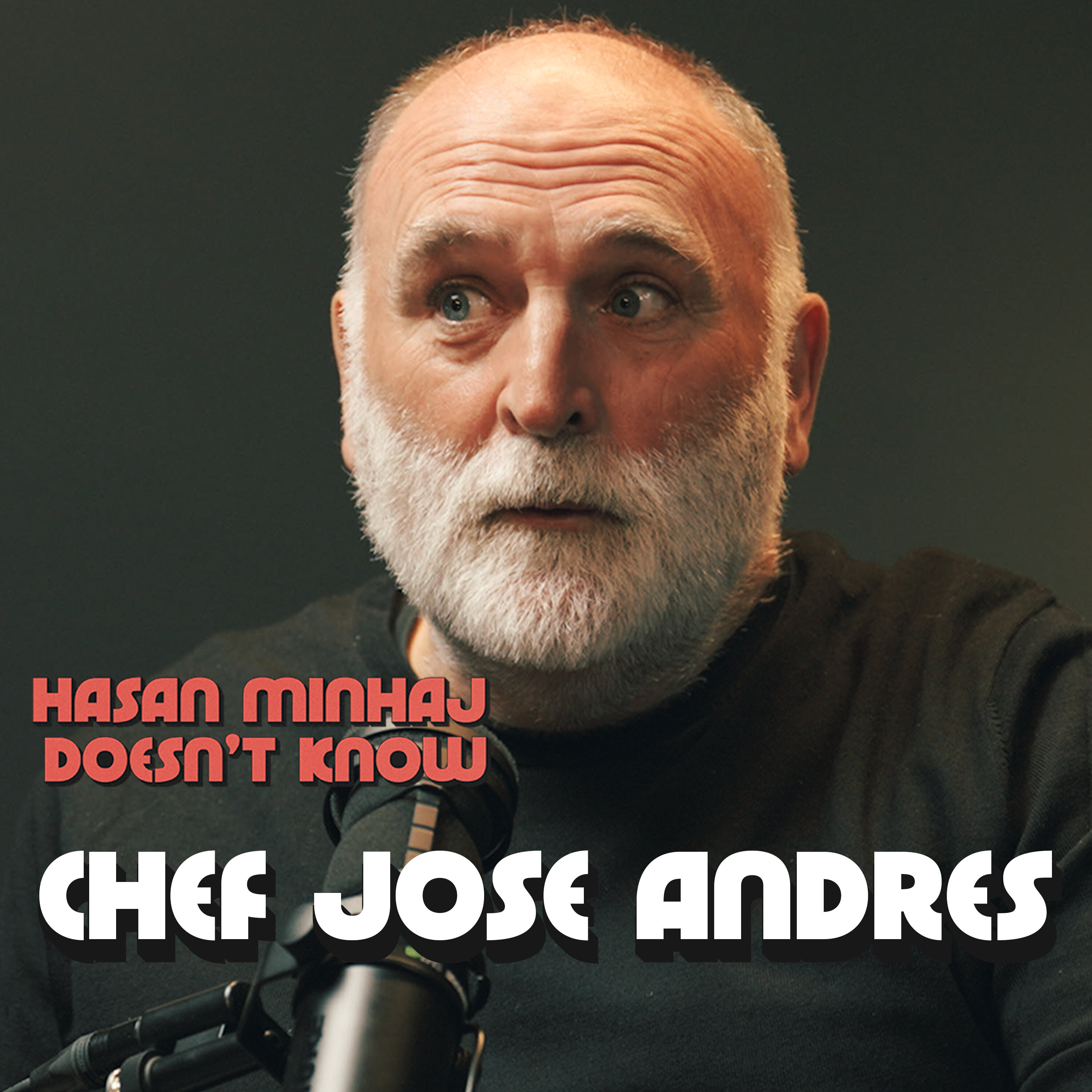
Loading summary
Transcript307 lines
- [00:02]
Chef Jose Andres
Lemonade.
- [00:06]
Unknown Host
I gotta say something, man. I gotta give you respect to a fellow hand talker. You use your hands a lot to talk. The Indians, Italians, and the Spanish, we love using our hands, so.
- [00:18]
Chef Jose Andres
But you know why?
- [00:19]
Unknown Host
Why is that?
- [00:20]
Chef Jose Andres
Because I don't think anybody can understand a word they say in English. So when I do hands.
- [00:27]
Unknown Host
Yes, yeah, yeah.
- [00:28]
Chef Jose Andres
It's almost like, you know, I don't know.
- [00:31]
Unknown Host
Yeah, yeah.
- [00:32]
Chef Jose Andres
I like my hands.
- [00:32]
Unknown Host
Yeah, yeah. You're painting sentences. Yeah. Let those limbs fly, baby. Chef Jose Andres is two amazing people combined. One is a humanitarian who co founded World Central Kitchen and fed millions of people around the world. And the other is a world famous chef with two Michelin stars who spearheaded the small plate movement. So basically, one day, Jose Andres helicoptering into a conflict zone, wading through rivers, just the realest shit imaginable, working with the most vulnerable people on planet earth. And then the next day, he will be cooking up snail caviar for some rich asshole. It is truly wild. So I talk with Chef Jose Andres about how he reconciles these two parts of his life. His new book, change the Recipe. And a question that I've struggled with as a husband, father, and just human being. How the hell do I cook an egg like a normal person? There's not a cuisine that you hate bad food. Okay, got it, got it.
- [01:34]
Chef Jose Andres
There's only two types of cooking. The good and the good or bad.
- [01:37]
Unknown Host
Okay, got it.
- [01:37]
Chef Jose Andres
I mean. And British chefs putting chorizo into paella, that's bad too.
- [01:42]
Unknown Host
No, no, that's very bad.
- [01:43]
Chef Jose Andres
No, that's terrible.
- [01:44]
Unknown Host
Yeah, that's horrific.
- [01:45]
Chef Jose Andres
I mean, Gordon Ramsay, really? No, no, Gordon, don't get into paella. Yeah, I don't mess with your fish and chips, you know, like. Yeah, yeah.
- [01:53]
Unknown Host
Why is. Why is that?
- [01:54]
Chef Jose Andres
Thank you. I don't know.
- [01:56]
Unknown Host
I'm going to start with a very difficult question. And I know your team is here and I don't want to get you nervous.
- [02:00]
Chef Jose Andres
Uh oh.
- [02:00]
Unknown Host
But this is very divisive. A lot of people fight about this on the Internet and I don't know if there's a resolution here, but Chef Jose Andres, please explain to me, how do you cook an egg?
- [02:11]
Chef Jose Andres
Oh my God. This is very controversial. You have to be more narrow in your questions. You are you too generic? I mean, how to cook the perfect egg. Okay, can you give me some guidance?
- [02:23]
Unknown Host
Do you want me to paint the scene for me? I'll paint. I'll tell you this.
- [02:25]
Chef Jose Andres
Yeah, Give me. Give me some extra information. Chad, GPT, please.
- [02:29]
Unknown Host
Okay, so this has been A huge point of tension in my marriage, in my marital household, the way I cook eggs.
- [02:36]
Chef Jose Andres
Oh, my God. And you are sharing this publicly with.
- [02:38]
Unknown Host
I'm sharing this publicly. She says I cook eggs like quote, an absolute psychopath because I constantly burn them.
- [02:45]
Chef Jose Andres
You burn an egg?
- [02:46]
Unknown Host
I burn eggs, yes.
- [02:47]
Chef Jose Andres
An egg that is 90 something percent water and you are able to burn it. You are a genius. You are not a psychopath. You are a genius.
- [02:55]
Unknown Host
Thank you, thank you, thank you for uplifting me, King.
- [02:57]
Chef Jose Andres
Keep going.
- [02:58]
Unknown Host
That's what. Okay, so what'll happen is I'm impatient, so I'll put it on medium high. I'll take out my pan and I'll either put olive oil or butter. I'll crack two eggs quickly. I'll haphazardly pull out any shells. I whisk it as fast as I possibly can. I've heard, I've seen stuff on the Internet said add a dash of milk to make the eggs a little bit more airy.
- [03:22]
Chef Jose Andres
If you are from northern India, you will add milk or.
- [03:25]
Unknown Host
Yeah, splash of milk and I'll put it in. And I think somewhere between me pouring it in and it being on high creates dinosaur level archaeology. Egg remains in the pan.
- [03:44]
Chef Jose Andres
Wow.
- [03:45]
Unknown Host
That burn the eggs and then massively up the pan.
- [03:49]
Chef Jose Andres
I need more information. The fire alarm goes on.
- [03:53]
Unknown Host
It has got. It has gone off. But. But not every.
- [03:56]
Chef Jose Andres
Not every time. Sometimes the fire alarm, sometimes it goes, oh my God, that bad. You need to change for a while. The way you do the eggs go the microwave way. You have an issue with the pan, probably from your childhood. We don't know. You're going to get one egg. You're going to get a big full spoon of mayo. You're going to put the mayo and the egg together, which it makes a lot of sense because it's egg on egg. Yeah. Plus the oil. Anyways, the oil you are putting on the pan and you're going to whisk a little bit salt.
- [04:28]
Unknown Host
Okay.
- [04:29]
Chef Jose Andres
You're gonna get a little glass ramekin or shallow plate. You're gonna put the egg right there. You're gonna put it in a microwave 45 to seconds to a minute and a half. And you're gonna see how that egg becomes an in between custard omelette scrambled eggs, which is gonna be without a doubt the best eggs in the history of your life. Your marriage will go back to be a perfect marriage.
- [04:56]
Unknown Host
Oh, amazing.
- [04:57]
Chef Jose Andres
Your wife will kiss you and who knows what else. I think this will be a new beginning for you.
- [05:03]
Unknown Host
You're A very interesting guy, man. Because you serve both the best and worst of humanity. What I mean by that is, one day you are through World Central Kitchen. You are helping feed people in active war zones. And then the next day, I see you and you're doing this. I mean, you're sipping honeydew out of a flower petal. This is some Roman Emperor, Caligula shit. So how do you. How do you reconcile that? Okay, chef, talk to me.
- [05:40]
Chef Jose Andres
I want to make sure that people know I had a couple of glasses of wine when that moment happened.
- [05:45]
Unknown Host
Okay, got it.
- [05:46]
Chef Jose Andres
It's what was in the label. Wine.
- [05:47]
Unknown Host
Got it.
- [05:48]
Chef Jose Andres
12 and a half percent alcohol.
- [05:49]
Unknown Host
Got it. No mushrooms.
- [05:50]
Chef Jose Andres
But you know what? You see me, there is a magnolia, a magnolia flower. I love magnolias because my mother bought a magnolia tree. Very small.
- [06:00]
Unknown Host
Yeah.
- [06:00]
Chef Jose Andres
There was a space for the magnolia tree or for us. I was obsessed with the aroma and the smell of the magnolia tree. So that moment I had, the magnolias were blooming. The smell was amazing. And nothing to me is more amazing and being in contact with nature than grabbing a magnolia with all their aroma and using the petals to be a vessel, in this case, for you to eat or to drink. And out of that moment, we created a dish.
- [06:29]
Unknown Host
Oh, no kidding.
- [06:30]
Chef Jose Andres
Yeah.
- [06:31]
Unknown Host
Okay.
- [06:31]
Chef Jose Andres
And we serve it a mini bar. So these moments were. This is from a show in Netflix, Chef's Table.
- [06:38]
Unknown Host
Yes.
- [06:38]
Chef Jose Andres
But this is the many different ways we can be very creative in the kitchen to feed the food well.
- [06:45]
Unknown Host
So I think the question that I'm trying to ask, and I'd love your insight on, is all jokes aside, that moment, it's so luxurious. Right. And you are doing something that is so kind of poetically beautiful. You have two Michelin stars. You've gotten two Michelin stars. So you've definitely seen the luxurious side of what food is. And you've also seen the utilitarian side of how important food is when you're serving people around the world, oftentimes after natural disasters or war. Right, but what does that taught you about humanity? Basically, you've. You've done the pretentious shit and the necessary shit. What does that say about all this? What have you learned from that? The high and the low.
- [07:28]
Chef Jose Andres
Well, to me, it's all the same. Obviously, one cost more than other.
- [07:34]
Unknown Host
Yes.
- [07:35]
Chef Jose Andres
And that's why we charge more.
- [07:36]
Unknown Host
Okay.
- [07:37]
Chef Jose Andres
In the worst moments of humanity, the best of humanity shows up. That's a lesson learned in the difficult places. And in the good moments, it's exactly the same. I may have few restaurants in Downtown. And they're doing very well. And I have very happy people and guests coming and coming back, but then not too far away from the same restaurant success in my same city where I live, it's families that they're having a hard time feeding their children right in the same place, not too far away from where I'm feeding the field. And so the big learning lesson is that enjoy every moment you have and don't feel guilty for going to expensive restaurant or opening a bottle of wine or, I don't know, go to a trip that has been the dream of your lifetime. Just enjoy every one of those seconds. But at the same time, I think it's okay if a part of your brain, it's engaged into understanding that there are others who are not having that same enjoy and opportunities you have. And it's okay that some people just try to build bridges in between. One is necessary. Nobody should feel guilty for drinking the champagne and the caviar. And also nobody should be feeling guilty if you don't find the time to go help others. Everybody will find their moment to contribute. Everybody contributes, even in ways they don't see. But for me, these will be the lessons learned using the worst moments of humanity. The best of humanity always shows up.
- [09:11]
Unknown Host
That's really beautiful. I mean, you've said that you serve the few and the many. We obviously know who the few are, right? The few are the few exclusive people that get to go to an amazing dining experience in one of your amazing restaurants. And then there's moments where you're helping the many, the needy, all of those people. But my question, Chef Jose Andres, is what about the big fat middle? I'm talking about fast casual. Yeah, that's something you don't serve.
- [09:37]
Chef Jose Andres
I try, but I fail. Yeah, even you could argue that they have restaurants back in the days. You know, I have restaurants that I had until very recently. I have Pepe, I have one in Disney. I had a food truck that there are sandwiches at $10, which are great sandwiches of my childhood all the way to minibar or E in Las Vegas at the Cosmopolitan, which is 3, $400ameal and everything in between. But the issue is that even that $10 sandwich that seems is good and is affordable. Well, $10, when you start adding the tax and the tip and the soda or the coffee or the tea or the wine becomes 15. $20.
- [10:24]
Unknown Host
Sure.
- [10:25]
Chef Jose Andres
And $20 for one meal every single day is expensive. It's expensive for middle America.
- [10:35]
Unknown Host
Yes.
- [10:35]
Chef Jose Andres
It's expensive for, of course, everyone around the world. So I think fast casual. I'm very lucky because in Washington, D.C. i've seen some of the best fast casuals in America that they born in America. In Washington.
- [10:47]
Unknown Host
Yeah.
- [10:48]
Chef Jose Andres
I'm talking places like sweet green. I'm talking places which I was very lucky to be an early.
- [10:53]
Unknown Host
So you're a sweet green fan?
- [10:54]
Chef Jose Andres
I was a super big sweet green.
- [10:56]
Unknown Host
Well, let's just. Why don't we test this premise right now?
- [10:58]
Chef Jose Andres
Uh. Oh.
- [10:58]
Unknown Host
I'm gonna test you on your fast casual knowledge. Cause you have exquisite taste, Chef.
- [11:05]
Chef Jose Andres
I don't go often, though.
- [11:06]
Unknown Host
No, no, no. But I need to know, do you condone or do you condemn? So Chef Jose Andres, here we go. Condone or condemn Chipotle. Go. Really?
- [11:17]
Chef Jose Andres
I like japot.
- [11:18]
Unknown Host
You don't feel like the quality's gone down?
- [11:20]
Chef Jose Andres
Okay, now you are being very picky.
- [11:22]
Unknown Host
You're accusing me of being pretentious, Mr. Murray.
- [11:25]
Chef Jose Andres
Yes, sir.
- [11:25]
Unknown Host
Okay, how about qdoba with a Q?
- [11:28]
Chef Jose Andres
I think they're okay. I. Yeah, keep going.
- [11:31]
Unknown Host
Okay. Chilies.
- [11:34]
Chef Jose Andres
Oof. Chilies.
- [11:37]
Unknown Host
You gotta make a choice, Chef.
- [11:39]
Chef Jose Andres
I mean, the edge counts. The edge?
- [11:42]
Unknown Host
There's no edge. The edge counts as a condemn. I think this one will push you over Chili's to go in the airport.
- [11:48]
Chef Jose Andres
Oh, yeah, that condemned. Yeah. I mean, because why you want to have somebody to eat something before going into the airport that has the name Chili's on it? I mean, it just sounds bad.
- [12:01]
Unknown Host
All of it is bad.
- [12:02]
Chef Jose Andres
Yeah. But I like the people of Chili's. I know people work in Chili's.
- [12:05]
Unknown Host
There's great people. We love the people.
- [12:06]
Chef Jose Andres
I know.
- [12:07]
Unknown Host
I'm talking about having a buffalo chicken wrap sitting there for three. Three days.
- [12:12]
Chef Jose Andres
Yeah. Yeah. Poor buffalo. Yeah. Yeah. Okay. Yeah. Chili, is they to go? Yeah.
- [12:20]
Unknown Host
Thank you. You heard it here first.
- [12:21]
Chef Jose Andres
Yeah.
- [12:21]
Unknown Host
Baja fresh.
- [12:23]
Chef Jose Andres
They are Baja. They're fresh. Yeah, I like Baja Fresh.
- [12:26]
Unknown Host
Okay. Panera bread.
- [12:27]
Chef Jose Andres
I think Panera did a great job.
- [12:29]
Unknown Host
I did too.
- [12:30]
Chef Jose Andres
I. I think they did a great job. I mean, my sandwiches are far away. Better. But they were so smart that they. I did a sandwich for them during the pandemic.
- [12:40]
Unknown Host
How do you feel about Jimmy John's?
- [12:41]
Chef Jose Andres
Jimmy John's are good.
- [12:42]
Unknown Host
Quiznos.
- [12:45]
Chef Jose Andres
I prefer Jimmy John's at Quiznos Fresh and Co. I've been in and out, but I've never ordered from them either, so I.
- [12:52]
Unknown Host
Take that as a condemnation.
- [12:54]
Chef Jose Andres
No, no. I have to do research and development.
- [12:57]
Unknown Host
Okay. I mean, how about here in New York City? La pen croix a debt La pein quanat quite.
- [13:05]
Chef Jose Andres
Yes. Your English is as good as mine. Right.
- [13:09]
Unknown Host
Yes.
- [13:10]
Chef Jose Andres
I think is a good. It's a good chain. They do a good job. Len, go to the end.
- [13:14]
Unknown Host
I've walked in and I've never bought anything. I've walked.
- [13:16]
Chef Jose Andres
Yeah, me too. But I think so.
- [13:18]
Unknown Host
I think that's a condemnation. How can we walk in, do an entire line?
- [13:23]
Chef Jose Andres
You are who you are. You're in charge of this podcast. Is this a podcast?
- [13:27]
Unknown Host
This is a podcast.
- [13:27]
Chef Jose Andres
And. And you know, you can say whatever you want, but me, I'm going to say whatever you want. I'm not. You said condone or. Or condemn, but I'm not lifting up my. In this one.
- [13:37]
Unknown Host
Okay. Just Salad. That's the name of the restaurant. Just Salad.
- [13:42]
Chef Jose Andres
Just Salad. I mean, a restaurant that has the name just. Yeah, it's like really, Really. I mean, it's like regular coffee.
- [13:50]
Unknown Host
Sure.
- [13:51]
Chef Jose Andres
You go. They charge you $8, and the coffee is regular. Excuse me, I want that excellent coffee. No, regular one. Hey, do you want regular milk? No, I want good milk.
- [14:01]
Unknown Host
But it's also. Have some confidence. Salad. Yeah, Just Salad.
- [14:04]
Chef Jose Andres
Yeah, salad.
- [14:04]
Unknown Host
There's so much more than that.
- [14:05]
Chef Jose Andres
Yeah, they are. I'm gonna condemn the name. The name. The name. I never ate, so. But the name condemned. Yeah.
- [14:12]
Unknown Host
Hey, we're salad.
- [14:13]
Chef Jose Andres
But listen, can I tell you one thing?
- [14:14]
Unknown Host
Tell me.
- [14:15]
Chef Jose Andres
I had a fast food restaurant called Beef Steak. I opened up to 10. I was even in Google. Yeah, I'm gonna try again. But I fell. And many of my people said that we fell because the name of a restaurant that was all about vegetables.
- [14:28]
Unknown Host
Yeah.
- [14:29]
Chef Jose Andres
The name was Beefsteak.
- [14:30]
Unknown Host
Oh, yeah. That is a little bit misleading.
- [14:33]
Chef Jose Andres
Yeah. But I was trying to be.
- [14:35]
Unknown Host
Oh, you're trying to be funny.
- [14:36]
Chef Jose Andres
Etchy.
- [14:37]
Unknown Host
Oh, edgy.
- [14:38]
Chef Jose Andres
And tomatoes. Beefsteak. Tomatoes and vegetables.
- [14:42]
Unknown Host
Oh, Chef, that wasn't a good idea.
- [14:43]
Chef Jose Andres
Oh, my God. I knew it. Okay. I condemn Beef Steak. The food was amazing.
- [14:50]
Unknown Host
The food was amazing.
- [14:50]
Chef Jose Andres
Amazing.
- [14:51]
Unknown Host
But the name.
- [14:51]
Chef Jose Andres
We had lines. I opened my first one in front of Sweet Green to go one on one competition.
- [14:58]
Unknown Host
And how do you feel about Sweet Green, Chef Jose Andres?
- [15:00]
Chef Jose Andres
I condone.
- [15:01]
Unknown Host
There we go.
- [15:02]
Chef Jose Andres
Ladies and gentlemen.
- [15:04]
Unknown Host
That's condone or condemn.
- [15:11]
C
Hey, Julia, Louis Dreyfus here. If you listen to me on my Wiser than Me podcast, you probably already know that I'm an investor and an evangelist for the mill food recycler. There are a lot of reasons to love mill, but for me, it's all about the impact. Keeping food out of the garbage is one of the most powerful things we can do to help the planet. Every single Day, we're talking banana peels, carrot tops, old takeout. When that stuff heads to the landfill, it becomes a huge driver of climate change. If you already compost, great. But of course, there's the smell, the flies, the running to the curb every day with a little leaking compost bag made of cornstarch. That's where mill comes in. It makes keeping food out of the trash as easy as dropping it in. It can handle nearly anything from a turkey carcass to like 20 avocado pits. It works automatically while you sleep. You can keep filling it for weeks and it never, ever smells. Mill makes dry, nutrient rich grounds that you can use in your garden, add to your compost, feed to your chickens, or mill can get them back to a small farm for you. But you kind of have to live with mill to really get it. And that's why they offer a risk free trial. Go to mill.com wiser for an exclusive offer.
- [16:25]
Unknown Host
I mean, this is a perfect segue to World Central Kitchen. So my wife and I, we've been fans for years. We have donated. We're very proud to support the work that you guys are doing. It's very important and necessary. Thank you. The overall gist of it for people that aren't familiar with World Central Kitchen is to provide basic needs and comfort in the most challenging parts of the world. That can be through war, conflict, natural disaster. And one of the things we're talking about is you've seen aid be given to some of the poorest countries in the world. But you were talking about this Chipotle card here in America. Does it make you sad to see food inequity here in America, which is literally one of the richest countries in the world?
- [17:10]
Chef Jose Andres
Yeah, yeah, obviously in America. But I can't say in Spain, the country I come from, I have dual citizenship in every rich country, but also in countries that technically are not so rich, but is full of rich cities with rich people. And their inequality sometimes is even bigger.
- [17:27]
Unknown Host
Right.
- [17:28]
Chef Jose Andres
I think inequality, when it's solvable, that's the sad part. Hunger is a problem that can be solved with commitment, with investment. Yeah. Not throwing money at the problem, but so, yeah, it makes me a little bit sad. Obviously, World Central Kitchen, we are not a hunger fighting organization. We are emergency food and water dash other things organization. But the truth is that in America, more than ever, I believe that nobody, nobody should be lacking access of food. Why? Because America exports food. America right now, with technology, good farming, good fishermen, good cattle ranchers, we produce more food than we need so it's great. So it doesn't make a lot of sense that sometimes it feels, we saw it during the pandemic that the people that feed America, at times they are not able to fit themselves. And this is a conundrum we need to solve because we'll be in the best interest of America. And therefore I can apply the same to every other country around the world.
- [18:40]
Unknown Host
Do you think, you know, especially living here in America, hunger is a policy choice. I mean, we saw this during the pandemic, especially that Covid child tax credit gave up to $3,000 per child. And according to one study, that brought down food insufficiency 26%. And so it's one of those things where clearly a very nominal amount of money could solve food insufficiency in the United States of America.
- [19:10]
Chef Jose Andres
The issue is that when our governments have this type of policies, as we saw during COVID that, that it showed that function is our government investing on their people. And who better than your government investing in you?
- [19:27]
Unknown Host
Yeah.
- [19:27]
Chef Jose Andres
In the same way you invest in your country and in your government.
- [19:30]
Unknown Host
Yeah.
- [19:31]
Chef Jose Andres
So at times we need the governments to invest in the people.
- [19:35]
Unknown Host
Yes.
- [19:35]
Chef Jose Andres
I mean, invest in the small and big companies equally. We, we want companies, businessmen to create jobs. We want everybody to do well. But a government must be there to invest in their people. And one great way to invest, I'm sure, is making sure that no child, elderly, which is one of the issues that nobody talks about, but the elders in America percentage are growing and growing. And we're going to have a lot of elderly people forgotten in cities and countryside, little towns across America, that the government is going to have to do more and we cannot forget them. This is one of the very big crises coming. But 100% agree government should invest in their people. And yes, what we saw in Covid was very smart. I love, I remember going to early March 2020 to White House and speaking to Ivanka Trump. Obviously this is an idea that has been put by other countries and even in America. And I love that the USDA, White House, other NGOs like ours, we did it on our own to put in boxes of food that we will be buying from farmers that didn't have restaurants to sell to that all of a sudden we will put these boxes together and we will have distribution in poor neighborhoods, put areas across America. This was a short term, smart decision and program to make sure that nobody will be going hungry in a moment like the pandemic. So you see, I love when Democrats and Republicans alike come with Ideas to transform problems into solutions.
- [21:18]
Unknown Host
Do you think it's something the public and voters want as well? Because I think if you said something like that food should be a human right, people would accuse you of being a socialist or a communist. You know what I mean? Something as simple as that would be. So I think in the America we.
- [21:33]
Chef Jose Andres
Live in, so polarizing name calling, name calling is such a simple way to submerge yourself in the very complicated issues. Right. And you could argue that, oh, if you give food for free, you are, you are a socialist or communist country. And then I will ask, are subsidies giving money to big companies? Right. Yeah.
- [22:00]
Unknown Host
So is that a social safety net or is that a business safety net?
- [22:03]
Chef Jose Andres
Yeah, it's not that. Socialism too, in a way. So me, I don't like, I, I don't like subsidies. I rather prefer that the market place itself in a pure, more capitalism. Sure way. So it's kind of very funny how words are used that without any context, they prove that they don't really understand the issue. In the same way we have fire fighter stations, because if it's a fire, then we want the fire to stop immediately. They are the same way. We have hospitals, as many places as we can. So if something happens, everybody can be receiving health care quick and fast and save lives in the same way we are describing these things and everybody will agree we need them. I would say that we will have to have mechanisms to make sure that the richest country in the history of puts food insecurity as one of the problems that we have no longer.
- [22:57]
Unknown Host
Right. Sure. That's the polio vaccine. This is not.
- [23:01]
Chef Jose Andres
And every American I speak, they will agree that every child in America should be fed, that every elderly in America should be fed. And the question will always be the same. Well, they should manage. They should work hard like I did. Okay, I get it. But there's a lot of people that work hard and things happen to them because life is like a lottery ticket. And sometimes people we warn with a winning ticket and other people don't even got one ticket. They don't even know it's a lottery. Therefore, we need to make sure that life is not a lottery ticket. We need to have systems that don't only fit people in their darkest moods in neat hours, but that gives them an opportunity to push them from the back, to give them win in the cells so they have opportunity to move forward. And I think, yes, food, Nobody should be food insecure in America, period.
- [23:52]
Unknown Host
What happened in your life that gave you this perspective? To not only give Domestically, but globally, because as you've seen in the world, there's a lot of this, hey buddy, we have enough problems in our own backyard. Hey, we need to take care of our own. There is this. You've seen the attack on usaid. There is this global isolationism that's happening both in the United States. We saw that in Europe. This is happening in many countries. How do you reconcile that? Because honestly, what you're doing with WCK is both a domestic kindness project, but a global kindness and humanitarian project.
- [24:29]
Chef Jose Andres
I hundred percent agree with the people that make statements, Jose. But we have a lot of people in it in America. Why America should be spending $1 to help people overseas. Number one, we need to make sure that everybody agrees that investing in Americans, Americans that are poor, Americans that are hungry is the right thing to do. And overall, I always believe that we have consensus that that's something we have to do. Even at the policy level, we've never achieved that yet. How it's possible that we have veterans that we send to wars and when they come back, we have veterans that they are homeless and they cannot feed their families. Obviously that's something that needs to be addressed. And non Republicans or Democrats sometimes come together with consensus to address it. But the issue of not helping others overseas when you are such a rich country is that that alone is not what is going to make you come up with policies and good ideas to improve America. Because politics is always on the way. Right now President Trump is saying America is falling apart. It's breaking down. Okay, that means a lot of things. Infrastructure. America is being lacking true investment in infrastructure that has not been things that they've not been repaired since 30, 40 years ago. More, it's smart that you will forever keep reinvesting in maintaining America, the leading country in the world. Politics gets in the way that we'll say, if this idea is coming from Democrats, I'm not going to support improving America at the logistical level. But then when you're in power all of a sudden, like we're going to be rebuilding America, why this cannot be happening all the time. And still I understand it'll be the disagreements of this. This is what it means to be a Democrat and this is what it means to be a Republican. What cannot be is that you only support what you support when you are in power. And I'm going to support sometimes whatever the other party doesn't support.
- [26:35]
Unknown Host
Yeah. And what you're talking about, food scarcity is not a partisan issue. It should never be a partisan issue.
- [26:41]
Chef Jose Andres
Because When I go through America, we have tornadoes right now. We've been having floodings, hurricanes. There is just people, people that need our help. People that don't want use that nonsense, fight sometimes about nothing. People just want solutions. Politicians coming together, building a smart policy that actually addresses the issues on the ground. And you know one thing, smart policy, my friend, is then good politics for everybody.
- [27:10]
Unknown Host
You have a new book called Change the Recipe. You write about what it means to be a humanitarian, what it means to help other people. This is a really beautiful quote from the book. It says, it always seems like philanthropy is about the redemption of the giver when it must be about the liberation of the receiver.
- [27:27]
Chef Jose Andres
This was said by a guy called Robert Egger, who founded DC Central Kitchen, an expert tender that thought that waste was wrong. And he opened on President Bush, Inauguration Day. He got a truck. He went around the different celebration parties, hotels, pick up the leftovers, brought them back to a kitchen, repackage and send the food to the homeless. That's the beginning of this essential kitchen. I've been part of that organization for over 30 years. I went as a cook and I became the chairman. Now I'm chairman emeritus. And this organization did something simple. Taking food that was about being to be waste. Taking people in the streets, cleaning them, giving them a chance to belong, training them to be cooks. They will be the ones cooking those unused leftover food. Then we will feed the homeless population. Amazing. So this phrase was given to me when I was 23, 24 by Robert Eger, the founder. Yeah. And this, in essence, is what we all need to do. Doing good. It's okay. But it's not enough anymore. We must do a smart good. Why? Because every day, since we have more NGOs, every time seems that the money we spend in philanthropy in America around the world keeps increasing.
- [28:55]
Unknown Host
Right.
- [28:55]
Chef Jose Andres
But every time since the the same problems always remain right there. More. Therefore, we need to start investing our philanthropy dollars in the same way we will do our investments to make money. The return on investment on the philanthropy side is that we create a better system around our cities and around the places we live. Therefore, we need to change the chip in how we invest our dollars in charity.
- [29:22]
Unknown Host
Is that what you mean by liberating the receiver totally? Meaning I have to make them whole. I have to really improve their. Their status in life versus I have to give charity because it's kind of this guilt tax that I pay.
- [29:36]
Chef Jose Andres
Correct. It's okay to give and feel good about it. Yeah. But I think everybody will be much more. Wow. Engaged.
- [29:46]
Unknown Host
Yeah.
- [29:46]
Chef Jose Andres
If they know that actually their $1, it really makes a big change in the life of somewhere. We need all to think harder when we give our money away. And we should be asking everybody, is this organization doing the best they can to solve the problems? Are the NGOs right now are going to be playing a huge work if FEMA goes away in the way, I think if certain government aid, food stamps disappears or is cut down, USAID is going to be millions in the planet earth that they're going to have a hard time feeding themselves without that aid at America, which by the way, I think is soft power, soft diplomacy, which I think has been such a good investment of America to gain goodwill around the world. If all this money goes away, we're going to see in America a lot of people, a lot of people in cities and rural America that they're going to be having a hard time to make it at the end of the month. Therefore, it's going to be the time that NGOs are going to have to be, if anything, covering that hole that the government is living, but will be also the moment. Are we using the money we have in the right way? Because this is a question. If one day they will give me or they will give you somebody a blank check to say end poverty and hunger in the world, sure we will know how to do it. That is the challenges too.
- [31:22]
Unknown Host
Got it.
- [31:22]
Chef Jose Andres
And what I'm doing right now, every time I go to the different places I go around the world in America, around the world is just learning. Everybody tells me, thank you for going help. I'm not going help. I'm going to learn. I'm going to learn. I'm going to listen, I'm going to watch to see how between governments, cities, mayors, private sector NGOs, everyday citizens, how together we can have the best policies that actually can eradicate food and poverty for the years to come.
- [31:52]
Unknown Host
In your travels around the world, what have you learned? What has been done ineffectively and where have you seen it been done effectively? Because for me, my duty is when I get the text, hey, will you donate? Here's the link. I pay it through just the guilt tax of like, I should, I have it, I should. But you've seen it on the ground. What have you seen that could be done better? What have you seen? Where?
- [32:15]
Chef Jose Andres
Oh, this is really one country that is very close to America and it's very sad to see the situation. It's Haiti, right? You have in the same island two countries. Dominican Republic, a beautiful place, beautiful country. And Haiti, which is a beautiful place and a beautiful country, but one sims is used at the bottom of the hole. And Dominican Republic is doing actually very well. They have their issues like every country. But Dominican Republic is a great country, same island. How we can have one country doing so well and another country doing so poorly. The history of Haiti will be one that I'm not gonna have the time to go into hundreds of years of all the things that happened to the poor Haitians. But in the earthquake of 2010, I was very proud of how America came to the rescue of Haiti and many other countries around the world. It's when I went there and I very much founded walls and dragician on the shoulders of poor prince in 2010. In 2010, where thousands died, hundreds of thousands of homes were destroyed and a lot of money came in. And I still look at Haiti today as a failed state 15 years later. Even when everybody seems was coming to. But let me tell you one of the little things, because I like to give details on things so we understand how sometimes if we don't give in the smart way, we destroy everything we're trying to achieve. America, the way we give hate is because we produce a lot of food. The government will buy food from our farmers, which actually is a good thing. Obviously American dollars. Buying food from American farmers is good. And that food is used for when there is famines around the world, emergencies. America will show goodwill. Donating food, all of that is great. But then 15 years later, we have vacations trying to come to America, coming from South America all the way to Mexico because they left their country, because they lost their jobs. What I mean with that? If I unite the last 15 years, we gave so much food for free that we put thousands of farmers out of business. Because nobody was buying from the rice and food produce that the own Haitian farmers were producing. In the process of doing good, sending food for free to Haiti, we collapse the farming economy of Haiti unknowingly, without.
- [34:51]
Unknown Host
Knowing the long term ramifications.
- [34:52]
Chef Jose Andres
And this keeps happening. And the issue here is like nothing is easy. That's why bickering and finger pointing is not the way forward blaming. But how do we learn that still we can be helping our farmers. But maybe instead of sending food, we send know how we send expertise of our farmers and we send maybe the expertise of our machinery to make the farmers in Haiti much more productive, to make the lands of Haiti able to feed a bigger percentage and creating jobs and prosperity within Haiti. Still you are investing money in your farmers. But instead of Goods you are sending. Know how?
- [35:35]
Unknown Host
It's a little bit of that saying, teach a man to fish and machinery.
- [35:38]
Chef Jose Andres
That Haiti doesn't produce. Still, you are helping America economy with American taxpayer dollars. But America really is helping a country like Haiti to actually have a future of prosperity. And in the process, you will have no Haitians coming to the shores of Florida and the southern border because they are doing well in their country. Nobody wants to leave the country. When mothers leave the country with three children in their arms is because they are really desperate. So let's make sure we put desperation away and we are able to invest in the future of the people with smarter ideas that actually have a chance, a chance to make those people and those lives and those countries better.
- [36:23]
Unknown Host
Are you a religious person?
- [36:27]
Chef Jose Andres
Okay, when I get in the plane, do I. Yeah, yeah. Do I. How you say that in English? The cross. Yeah.
- [36:33]
Unknown Host
You cross? I do, yeah.
- [36:35]
Chef Jose Andres
Do you know? But I. Obviously, I'm a Catholic boy. My wife is the one that takes me. I celebrate the tradition, but I celebrate also Jewish traditions. Why? I celebrate Muslim traditions. So I celebrate of every religion, tradition because I have friends from all those religions.
- [36:55]
Unknown Host
How do you have this? The reason why I'm asking is how do you have this natural tendency for good? For me as a Muslim, this is where we're similar with Catholics, that guilt is strong. So I. I do good because of that guilt. I. I know that eternal damnation is right there at the doorstep. So I'm like, okay, I better. I better do this right. But what was that moment in your life where you felt. You're talking about working at the DC Food Kitchen. You're talking about World Central Kitchen. These are. This is a life's work.
- [37:18]
Chef Jose Andres
Well, you know, Catholic boys, we are lucky because Sunday we go, we ask for forgiveness. Yeah.
- [37:23]
Unknown Host
This is where you guys are really lucky.
- [37:23]
Chef Jose Andres
Yeah. We pray two or three padres nuestros.
- [37:27]
Unknown Host
Amazing.
- [37:28]
Chef Jose Andres
And then we are absolved.
- [37:30]
Unknown Host
Clear your cookies and cash.
- [37:31]
Chef Jose Andres
Yeah, yeah, yeah.
- [37:32]
Unknown Host
The Internet browser history is Fridays, we're.
- [37:34]
Chef Jose Andres
Not supposed to eat meat. But, you know, in the old days, the church will take some. During Lent, you're not supposed to eat meat, but you give some money to the church in the old days, and now you can eat meat. So. Yeah, that's easy. Solutions to big spiritual problems. My mom was a nurse. My father was a nurse. The hospital emergency room, very, very often, every other week. Some days of the week will be the place that my brothers and I. We will be there waiting for my mother finish the shift or my father, and we will Be exchanged between father and mother waiting there in the emergency entrance of the hospital. I always was fascinated by all these nurses and doctors. Work they were doing for me was fascinating. That would be people coming in the ambulance and all these people just trying to help and doing good. I don't know. That was something like always. I saw. Yeah, a very good example in me.
- [38:31]
Unknown Host
I feel like generosity is one of those things that you either. It kind of comes from within.
- [38:36]
Chef Jose Andres
That's why in the pandemic, the first places I was going was hospitals make making sure that they were okay going hospitals bringing masks. Because we had a lot of masks involved. Central kitchen. I don't know why, but we had so many masks that all of a sudden we were like, why we have masks so many? Because we had some earthquakes and we had them, a lot of them, and we began giving them away when nobody seemed to have them. And I kept checking in India. I went to India and I checked. We were feeding 100 hospitals in India when India went down, like every country usually is. The moment that India went down during one month to month. So we went there. Hospitals for me, because my mom and my dad was always that place of goodness that, I don't know. I said, okay, I don't think I'm gonna be a doctor or a nurse like my father or my uncle. I always knew I liked to cook. And I guess that feeding people and watching how my father and mother and friends taking care of everybody in the hospitals, I think is what got in me. Okay, we can all help.
- [39:40]
Unknown Host
That's beautiful. I had the same experience. Seeing my father be very generous really shaped the way I look at charity and giving and all of that.
- [39:52]
Chef Jose Andres
The actions of all the people we have around us in our lives have a bigger impact, even the one we recognize sometimes it takes us many years to understand that somebody in our life had a huge influence on us. A teacher, a friend, somebody we read, somebody something we saw on tv. And this sometimes gets deep into our brain, gets deep into our soul, deep into our heart. And one day, like a mushroom coming out of a sport in the forest, just pops and then we go. Because that moment in life had this deep influence in us, all of us. So what I do is people that influenced me in this way early on in my life, like my mom, like my dad and others.
- [40:44]
Unknown Host
You have this moment at the end of the book. It's really beautiful, man. You include a eulogy to the seven colleagues of yours that were killed in Gaza. And I just want to show this quote. This was A really powerful quote that stuck with me. You write, food can never be a weapon of war. Humanitarians are never targets. They are the best of us running towards the danger as others run away. Every single civilian life is sacred and must never be treated as collateral damage.
- [41:16]
Chef Jose Andres
Yeah, obviously this last year, for me, it's been hard. No harder than the seven that lost their lives. Six non Palestinian, one Palestinian. But we've seen the many people in Ukraine that they are losing their lives just working in a hospital. We are seeing all the people suffering in Gaza, but we need to be recognizing the suffering of everybody. The attack that happened by Hamas in southern Israel was never supposed to happen. And that was brutal. And those people suffer. I remember the first thing we did, we opened Wolsen Dragician operation in southern Israel and then northern Israel, feeding the people of the kibbutz that they were so tragically wounded with so many deaths and then all the hostages taken at the same time. We began doing exactly the same in Gaza. I had people that were questioning why we were in Israel, including members of Wilson Ragichen. Why are we helping the people of Israel? Well, the answer was simple, because the people needed our help. Then I had people that began questioning what we were feeding people in Gaza. And the question, the answer was simple. Because the people of Gaza need us to be next to them. And at the end, this is what this conveys. What is good for me must be good for you equally. This is not about I the person. This is about we, the people, all the people. It's not us versus you. So the people of Israel have the right to live in peace and the people of Palestine equally, and giving the respect they reserve and giving the same opportunities everybody else have, Israelis or anybody else. And obviously the hostages need to be released yesterday. Again, when you put those simple phrases and you take Israelis or Palestinians or Ukrainians or any kind or Lebanese, everybody should, everybody agrees. Everybody should live life in peace and prosperity. Everybody should be living without fear of bombing or attacks. Everybody should be living not in fear that you will be adopted by Russian troops, children from Ukraine that they were taken, or Israelis or Palestinians being taken. Everybody, everybody should be living with hope and prosperity. And if we agree on that, why we cannot come very quickly to build longer tables to build a better world. The issue is that when people and politicians began, they are my enemy, it's no future with them. Then is when the problem begins. But I had so many people in Israel and I had so many people in Palestine that they will tell me, Jose, I would love to go. Israelis, tell me, I would love to go with you guys to Palestine. And Palestinians, tell me, I would love to go to the kibbutz and Khalifa people to show them that we have no beef with them. These were mothers, women in real time, telling you, I want to build a better world. This is not right. What they're doing to us is not right. And what we're doing to them is not right. My God, I wish those women were the ones in power.
- [44:49]
Unknown Host
As a. As a chef and a humanitarian. What has it been like seeing food being used as a weapon in war? Do you see that? Do you see it?
- [45:02]
Chef Jose Andres
Well, I see it. Obviously, the right of food and water to any civilian is, as I said here, is unnegotiable. And obviously, when that happens, in the situations that happens in Palestine right now, our kitchens are running out of food because Israel has decided that food should not go in. I don't think that's the best way forward because Palestine and Israelis must live sooner or later in peace and prosperity. They are supposed to be the partners of Israel in the Middle east to build a better world. So people are going to you like it or not. And being your partners, you cannot just leave them hungry. Like, this is Hunger Games. When Russia did the blockade of food in the Black Sea, in Ukraine, the issue was that many countries that were expecting the grain from Ukraine were going to go hungry. So the blockade of Russia, in a very way, was putting many countries around the world in need of the grain from Ukraine in a very dangerous zone on top of Ukrainian farmers not making a living. So it's many situations that we've seen through history that, yes, the hunger, the food becomes kind of a weapon. We need to make sure that, if anything, food is what brings everybody together. Everybody should have the right to a plate of food to live in peace. And I will never support, obviously, ever, when in a way, food is being used as a weapon in the red, but a weapon. Nobody should ever go hungry.
- [46:55]
Unknown Host
I'm gonna end with something a little bit lighter.
- [46:58]
Chef Jose Andres
I thought this was going.
- [46:59]
Unknown Host
No, this was.
- [47:00]
Chef Jose Andres
You thought this stuff was more funny fun podcast.
- [47:02]
Unknown Host
I mean, we. We started.
- [47:04]
Chef Jose Andres
He used to be a comedian.
- [47:05]
Unknown Host
I caught.
- [47:06]
Chef Jose Andres
He used to be a comedian. What's going on here now?
- [47:09]
Unknown Host
Now I'm here to solve you. You dressed.
- [47:11]
Chef Jose Andres
We dressed too dark today.
- [47:13]
Unknown Host
And look at me. Look at the way I'm sitting. I'm. I'm really serious here.
- [47:16]
Chef Jose Andres
And you're.
- [47:16]
Unknown Host
You're full, man.
- [47:17]
Chef Jose Andres
Spreading here because I'm injured.
- [47:20]
Unknown Host
Oh, this is an injury?
- [47:21]
Chef Jose Andres
Yeah. Okay.
- [47:23]
Unknown Host
This whole time I thought this was a power move.
- [47:24]
Chef Jose Andres
No, A power move. What? Power move, Power move. I thought I would be hitting your knees.
- [47:29]
Unknown Host
That was two Michelin stars. I'm putting my leg up here.
- [47:32]
Chef Jose Andres
Okay, sorry. Can we repeat the podcast, please?
- [47:35]
Unknown Host
Okay.
- [47:36]
Chef Jose Andres
Hmdk.
- [47:37]
Unknown Host
Hmdk. Hasamanhaj doesn't know. I'm turning to you because, you know, you got a new cooking show coming. You have two shows coming out, so you have a new cooking competition show called yes, Chef. With your co.
- [47:47]
Chef Jose Andres
Yes, Chef.
- [47:48]
Unknown Host
Yes, Chef.
- [47:48]
Chef Jose Andres
Can you say it in English? No, I'm joking.
- [47:52]
Unknown Host
Seashell, yeah?
- [47:54]
Chef Jose Andres
Yes, Chef. Yeah.
- [47:56]
Unknown Host
Martha Stewart.
- [47:57]
Chef Jose Andres
April 28. April 28, 10pm 10pm after the boys Forest Gump. My life is Forrest Gump.
- [48:07]
Unknown Host
Okay, what do you mean by that?
- [48:08]
Chef Jose Andres
Well, because I didn't even want to do more tv.
- [48:11]
Unknown Host
Okay.
- [48:11]
Chef Jose Andres
And at the end, I ended with a show, prime time, being co host, co judge, co Everything.
- [48:20]
Unknown Host
Yes.
- [48:21]
Chef Jose Andres
In a show in very much prime time in national television.
- [48:25]
Unknown Host
Okay. Now, have you seen the bear?
- [48:27]
Chef Jose Andres
Yeah.
- [48:27]
Unknown Host
Okay. This is not. You and Martha aren't having a mental breakdown in the show, right?
- [48:31]
Chef Jose Andres
No, but the chefs sometimes are. Okay. Martha and I, I think it's fun show. We. We seem to agree even when we disagree with each other.
- [48:45]
Unknown Host
Okay.
- [48:47]
Chef Jose Andres
Oh, what a lady. Martha Stewart, Sure. She's one of. She's one of the best.
- [48:51]
Unknown Host
She give you any stock tips?
- [48:56]
Chef Jose Andres
Yeah, we talk about it. Oh, incredible.
- [48:58]
Unknown Host
We talk about it offline as well.
- [48:59]
Chef Jose Andres
We. Yeah, we talk about it. It's a moment that is very fun in the show.
- [49:04]
Unknown Host
Oh, really? You actually do talk about it on air.
- [49:07]
Chef Jose Andres
She. She's a lady.
- [49:09]
Unknown Host
She certainly.
- [49:10]
Chef Jose Andres
She's been a friend for many years. But we spent a very intense month filming. But was great. We finished filming and. Okay, where are we going, Jose? Like, I'm tired. We film tomorrow at 8am Again, she'll go out to a sushi place, to a cocktail place. I'm like, martha, who. Who are you?
- [49:29]
Unknown Host
Who are you? I believe it, though.
- [49:30]
Chef Jose Andres
Who are you? What? What? You know what you're smoking? I say nothing. I say, okay, I get it. But she's so full of life and intensity. So, yeah, the show is good.
- [49:42]
Unknown Host
Okay, now let me ask you. This is the last one at Netflix.
- [49:46]
Chef Jose Andres
I have a show on Netflix.
- [49:46]
Unknown Host
You have a show on Netflix?
- [49:47]
Chef Jose Andres
Chef's table.
- [49:48]
Unknown Host
Chef's Table. But my last question, you've been such a great guest, obviously a great sport. You're very funny. But as a whole, are chefs doing okay?
- [50:04]
Chef Jose Andres
Are they all right?
- [50:05]
Unknown Host
Because basically, the way I watch the bear I'm like, are you guys all right? And this is coming from a comedian. I think you guys are going to a pretty dark place. We need to have some fucked up shit as well.
- [50:12]
Chef Jose Andres
We need to understand that in the mind of a chef, the responsibility everybody has when Everybody comes at 7pm and everybody wants to come at the same time and everybody wants to order the food at the same time, and that's a matter how many weeks and months we work on the menu. Every one of you want a different thing out of the beautiful menu we brought for you. Okay, garlic shrimp. Really? With no garlic and no shrimp? Really? I mean, you want to kick that person out of the restaurant?
- [50:39]
Unknown Host
Uhhuh.
- [50:43]
Chef Jose Andres
I want rice, 20 vegetable rice. I don't want the 20 best. Can you come up with other 20 vegetable? What? Who are you?
- [50:54]
Unknown Host
Uhhuh. You've said this before to customers.
- [50:57]
Chef Jose Andres
No, but you felt it. Yeah. And when everything goes at once, kitchens can be very intense. But obviously the bird is everything that happens in the lifetime of a restaurant very condensed into a show. My God. If every restaurant was running like the heavy moments at the Bear, my God. But yeah, cooking has been. Restaurant life has been a heavy, a heavy, difficult profession. But listen, I can say the same about being a minor. You put your life at risk every day in America and around the world, it's more difficult professions. But restaurants are beautiful. The people that work in the restaurants are the best of the people in the pandemic. I was very, very proud that actually restaurants we shut down for business in the sense of every day opening our doors. But the restaurants, many of them working with Bolson, Dragician or on their own, they were feeding the local hospitals, local homeless shelters. So I was very proud how my profession, in a very difficult moment, just came together to become the smarter solution at the time to take care of the short term needs of the communities. So, yeah, restaurant business, the question is this. I mean, close to 40 years, very soon in the restaurant business, and you asked me if you could choose again, will you choose that same profession?
- [52:21]
Unknown Host
What's the answer?
- [52:22]
Chef Jose Andres
And the answer will be yes. Totally has given me so much. The next place I want to cook, I would love to cook in the space station. And make your omelet, please. We'll call it your name in the space station. We've already made it. On Earth is this amazing. Jim Sears is this amazing scientist that came up with the first kitchen that you will be able to cook in the moon in Mars, or in the space station in Gravity Zero. And it's a kitchen that moves at up to 14g speed because food floats. So you need to put centrifugation forces to make sure that the foot attaches to the edge of this pan. And then you cook food that is like a circle. So the omelette I made the other day is like a circle. Oh, beautiful. The cornbread is a circle with a hole in the middle. That will be the future of food. The future of food in Spain will be a beautiful circle that maybe we need to transform into heart to say, food is love, food is future. But that's all I have to say about this.
- [53:34]
Unknown Host
That's beautiful. Well, Chef Jose Andres, thank you for joining us. It was an honor.
- [53:38]
Chef Jose Andres
Thank you for having me.
- [53:39]
Unknown Host
I can't wait to have your egg in space.
- [53:40]
Chef Jose Andres
Yeah. Next time. Yeah. You come with me.
- [53:43]
Unknown Host
Okay.
- [53:43]
Chef Jose Andres
But first, I need to make sure I can go. I need to get in shape.
- [53:46]
Unknown Host
Okay. I'll be your plus one.
- [53:47]
Chef Jose Andres
But, yeah, I want to go to the space station or to the moon.
- [53:50]
Unknown Host
Let's do it.
- [53:51]
Chef Jose Andres
Or maybe Mars. Mars is far.
- [53:53]
Unknown Host
Okay.
- [53:54]
Chef Jose Andres
Yeah.
- [53:54]
Unknown Host
Mars a little bit far.
- [53:55]
Chef Jose Andres
Yeah. The space station will be me and you.
- [53:57]
Unknown Host
We'll go to the moon.
- [53:58]
Chef Jose Andres
Yeah.
- [53:58]
Unknown Host
There we go.
- [53:59]
Chef Jose Andres
And I have enough fat in my body I can last probably to, I don't know the next.
- [54:05]
Unknown Host
I'm not trying to die. I'm not trying to die, though.
- [54:07]
Chef Jose Andres
Let's live. Let's live. Okay, let's go.
- [54:10]
Unknown Host
Ladies and gentlemen, Jose Andres.
- [54:11]
Chef Jose Andres
Let's make X.
- [54:12]
Unknown Host
Yes.
- [54:13]
Chef Jose Andres
Let's cook egg.