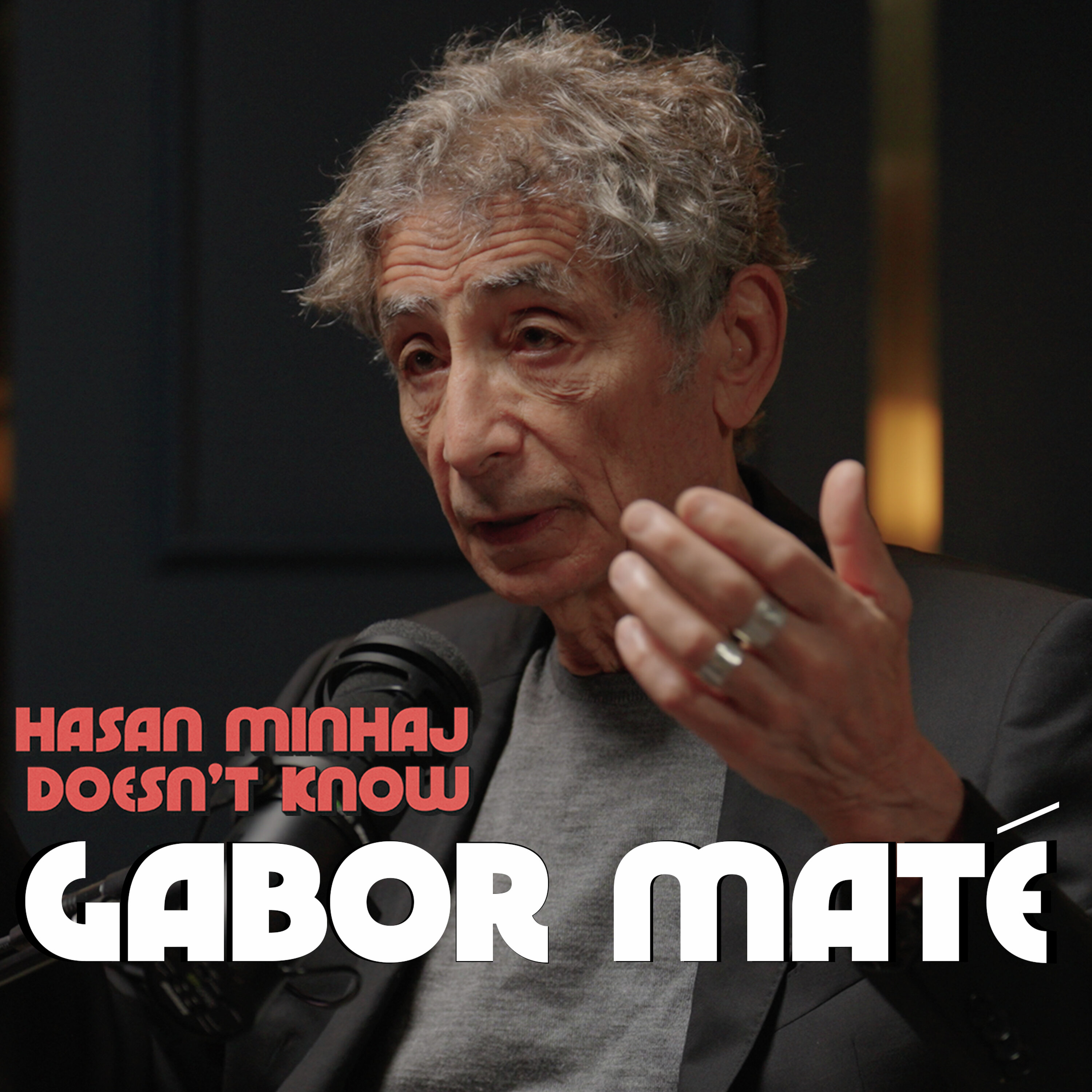
Loading summary
Transcript452 lines
- [00:02]
Gabor Maté
Lemonade.
- [00:06]
Hasan Minhaj
I would bite.
- [00:07]
Gabor Maté
You'd bite yourself?
- [00:08]
Hasan Minhaj
I would bite other kids.
- [00:09]
Unknown
Okay. Yes. Yeah.
- [00:10]
Hasan Minhaj
I would feel threatened and I would bite them usually on the forearm or upper arm where it's kind of fleshy and doughy. I would say, oh, there's some babka. And then bam. And I'd hit him. Top two teeth, bottom teeth. And I was a biter. I'm 39 years old. I almost never bite people now.
- [00:26]
Gabor Maté
I'm relieved to hear that.
- [00:27]
Hasan Minhaj
Yeah. I haven't bitten my sister in two years.
- [00:29]
Gabor Maté
Oh, that's great.
- [00:30]
Hasan Minhaj
At least.
- [00:31]
Gabor Maté
Congratulations.
- [00:32]
Unknown
When I first decided to create this podcast, Gabor Mate was at the top of my interview wish list. I mean, he's the best. He is a best selling author and a leading voice in rethinking how we approach healing, connecting the dots between addiction, trauma and childhood. But I honestly don't know if what you're about to watch is an interview.
- [00:54]
Hasan Minhaj
Or a therapy session on me. I went into this wanting his thoughts.
- [00:59]
Unknown
On a few big questions, like how people use their past trauma as an excuse to not own their own bullshit, and his assessment on what's unfolding right now in Gaza. But it got very personal very quickly. I mean, he literally diagnoses me with add within 29 seconds of this interview and it just drills deeper and deeper.
- [01:22]
Hasan Minhaj
Into my soul from there.
- [01:23]
Unknown
And look, he's not the first person.
- [01:26]
Hasan Minhaj
To call me emotionally immature, but he is the first person to do it.
- [01:29]
Unknown
To my face on camera.
- [01:33]
Gabor Maté
So.
- [01:36]
Hasan Minhaj
Enjoy.
- [01:39]
Unknown
Hurry.
- [01:39]
Gabor Maté
Right away. No delay. Stop there.
- [01:42]
Unknown
Make your daddy glad you have had.
- [01:45]
Hasan Minhaj
Such a bad Gabor. I want to start with a question that I think if you were able to answer, my friends, family and colleagues would be so happy to know the answer to this question, which is, why am I always late?
- [01:56]
Gabor Maté
Well, let me ask you this question.
- [01:58]
Unknown
Sure.
- [01:58]
Gabor Maté
In school.
- [01:59]
Unknown
Yes.
- [02:00]
Gabor Maté
Do you have trouble paying attention?
- [02:01]
Unknown
Correct.
- [02:02]
Gabor Maté
Okay. Do you tend to lose things?
- [02:04]
Unknown
Yes.
- [02:05]
Gabor Maté
Do you find it easy to get be disorganized?
- [02:07]
Hasan Minhaj
100%.
- [02:07]
Gabor Maté
Okay. You probably qualify for this diagnosis called attention deficit disorder, which is the topic of my first book, Scattered Minds, after I was diagnosed with it. And being late is one of the aspects of it. And what it is is a lack of time, maturity. Like in Scattered Minds, my book on ADHD, I describe how it's 5 minutes to 8 o', clock, but. And I have to be somewhere at 8.
- [02:31]
Unknown
Yes.
- [02:32]
Gabor Maté
But at 5 I still think I have an eternity in front of me.
- [02:36]
Hasan Minhaj
This has been my problem since I was a child.
- [02:37]
Gabor Maté
Yes, because your time sense didn't Develop early.
- [02:40]
Unknown
Correct.
- [02:41]
Gabor Maté
So that's why you're always late. And I can also tell you why your time sense didn't develop early.
- [02:45]
Hasan Minhaj
Why is that?
- [02:46]
Gabor Maté
You see, kids don't have a time sense. To a baby, a present moment is eternity.
- [02:50]
Unknown
Yes.
- [02:51]
Gabor Maté
You can't say to a one year old, you'll have dinner in five minutes, all they're eating is there's no dinner, five minutes is eternity. Time sense has to develop, the brain has to develop. And for brain development you need certain conditions. Here's what I can tell you. Without knowing anything about your specific history, there's two things that are true about you.
- [03:14]
Unknown
Okay.
- [03:14]
Gabor Maté
One is you're highly sensitive.
- [03:15]
Unknown
Yes.
- [03:16]
Gabor Maté
The other is when you were small, an infant, even during the pregnancy, your parents were stressed.
- [03:21]
Hasan Minhaj
How did you know this?
- [03:22]
Gabor Maté
Because that's why you have adhd, because you're tuning out. And your lack of development of time sense has to do with the stress in your environment. And more genetically sensitive infants are, the more they pick up on their parents stresses. And that actually interferes with the brain development of certain circuits. It's really that simple. It's not a disease that you inherit. It's actually a response to, of sensitive infants to a stressed environment.
- [03:50]
Hasan Minhaj
When I have something important to do, I will immediately find something not important to do.
- [03:54]
Gabor Maté
Yeah.
- [03:55]
Hasan Minhaj
So I'll be like, oh my God, I have to organize this drawer right now.
- [03:57]
Gabor Maté
Yeah.
- [03:58]
Hasan Minhaj
Or I'll be like, I saw an Instagram ad about jogging pants. I really need jogging pants. I should probably buy them now.
- [04:03]
Gabor Maté
Yeah.
- [04:04]
Hasan Minhaj
Or I'll get mad at myself and go, you know what? Grow a fucking pair and do the hard thing right now. But before you do that hard thing, should probably go to the bathroom.
- [04:11]
Gabor Maté
Yeah.
- [04:13]
Hasan Minhaj
Why am I procrastinating?
- [04:15]
Gabor Maté
Well, again, procrastination is another trait.
- [04:17]
Unknown
Yes.
- [04:18]
Gabor Maté
Associated with the syndrome called adhd. And typically we put off things until the very last minute.
- [04:26]
Unknown
Yes.
- [04:26]
Gabor Maté
And then we do do this rush to get it done. Like I, I, I never in, in university when I did my undergraduate training before I went to medical school.
- [04:36]
Unknown
Yeah.
- [04:37]
Gabor Maté
I never began an essay until the night before it was due and I'd be up all night writing it. Again, it has to do with time sense and it has to do with lack of motivation. Now things that you're highly motivated to do. I doubt that you procrastinate very much.
- [04:53]
Hasan Minhaj
I'll do it immediately.
- [04:53]
Gabor Maté
So ADHD is really a question of motivation and there are certain circuits in the brain to do with motivation and that has to develop again, like all circuits, nobody is Born with a developed brain, the motivation circuits have to develop. They run on a chemical called dopamine. Dopamine is essential for a sense of vitality, for curiosity, for seeking. And when you put under high pressure, there's high dopamine levels, and then you get more really motivated. So you're waiting for that dopamine hit before you get down to doing what you need to do. It's a matter of how environment shapes brain physiology.
- [05:33]
Hasan Minhaj
Now, just to have some polite pushback, do I really have ADD or do I have a childlike sense of wonder?
- [05:39]
Gabor Maté
Why is there a contradiction? People with ADHD tend to be more playful, more curious.
- [05:47]
Unknown
Yes.
- [05:49]
Gabor Maté
In some. Some ways more emotionally alive. And they tend to become comedians. I mean, but I've seen about probably 90% of comedians could be diagnosed with ADHD because you got this brain that jumps all over the place.
- [06:00]
Unknown
Right.
- [06:00]
Gabor Maté
Which is the essence of comedy.
- [06:02]
Unknown
Yes.
- [06:02]
Gabor Maté
You know, so that just about every comedian I've ever met, I could diagnose within the split second. With adhd, I think we have ADD.
- [06:11]
Hasan Minhaj
And many of us, unfortunately have clinical depression as well. That's what gives us a very dark sense of humor. But I want to go down this a little bit with you, which is.
- [06:21]
Unknown
I will also be late to things.
- [06:23]
Hasan Minhaj
That I care about. And there's a form of. Even as an adult, I'm 39 years old, I am aware that, oh, my God, I'm about to be late. I've been late for dates with my wife. I've been late for pickup of parents or children. There is this. What is underneath this lack of understanding of time or procrastination? I have a theory, and I'd love for you to unpack it. I think at the core of it, there's something that I want to do. And as an adult now, I know the path to it will either be painful or humiliating.
- [07:03]
Gabor Maté
Well, let me put it in more simple terms, if I may. There's two things going on for you now, you know, you can agree with this or not. I'm giving you my view, you know, laying down the law here.
- [07:15]
Unknown
Sure, sure.
- [07:17]
Gabor Maté
There's two things going on. You really don't have a good time sense.
- [07:21]
Hasan Minhaj
I have a horrible time sense.
- [07:23]
Gabor Maté
If there's 10 minutes left, it's not here yet. So it's not happening yet. So that's what I mentioned before.
- [07:27]
Hasan Minhaj
Absolutely.
- [07:28]
Gabor Maté
The other is you're emotionally immature in the sense that emotionally, you know, you can be intellectually very advanced. It's the law of uneven development. Some aspects of our personalities and our brains can develop highly, but others be underdeveloped and there's a lack of responsibility there. Like. Like if you really perceive yourself as responsible and other people's experience mattered to you as much as you, you'd be there on time. And I promise you, if I called you up and said, hassan, I have a billion dollars for you, if you get here at 5 minutes to 8 o', clock, you'd be there at 6 minutes to 8 o'.
- [08:13]
Unknown
Clock.
- [08:13]
Hasan Minhaj
I'll be there at 7:30. Are you kidding me?
- [08:14]
Gabor Maté
Yeah, yeah, because you'd really care. And by the way, I'm the same. All my life, I've always been late to some. So I'm not criticizing you or anybody else.
- [08:25]
Hasan Minhaj
You did call me emotionally undeveloped, but.
- [08:27]
Gabor Maté
I'm calling myself emotionally developed in that same sense.
- [08:30]
Unknown
Okay, great.
- [08:30]
Gabor Maté
You know, so appreciate that, brother. I'm not here to point fingers at anybody. I'm talking about the dynamic of what's underneath it. There's a certain degree of lack of maturation, you know, which has got its charming aspects. You get to be playful and kind of childlike in a lot of ways. But it also leaves you with lack of responsibility.
- [08:49]
Unknown
Yeah.
- [08:49]
Gabor Maté
And again, I'm telling you, you're perfectly capable of being on time if you're motivated enough. If I promised you a billion dollars, you'd be there. When you're still pursuing the relationship with your wife and you're deeply in love with her and you're not romantic phase. Were you ever late?
- [09:02]
Hasan Minhaj
I was still late.
- [09:03]
Unknown
Yeah.
- [09:04]
Hasan Minhaj
I've always been late. This is why. I mean, she's a ride or die and. Really? Yeah.
- [09:07]
Gabor Maté
Yeah.
- [09:07]
Hasan Minhaj
You know how the state says she should get half?
- [09:09]
Gabor Maté
I'm like, yeah, it's a lack of. It' lack of discipline.
- [09:11]
Unknown
Yeah.
- [09:12]
Gabor Maté
You know, and. And I don't mean.
- [09:13]
Hasan Minhaj
And then I hate myself. I actually start to hate myself.
- [09:15]
Gabor Maté
Well, that's. It creates a very bad see that I would talk to you about. Because if I told you that, look, I have this issue with being late, would you call me despicable?
- [09:31]
Hasan Minhaj
No, but I would say it's okay to hate yourself.
- [09:33]
Gabor Maté
Why is it okay to hate yourself?
- [09:34]
Hasan Minhaj
I don't know. I think it's an Indian thing. I think there's an Indian thing to it, which is you should be mad at yourself.
- [09:40]
Gabor Maté
Should you hate anybody?
- [09:42]
Hasan Minhaj
I mean, depends on what they did.
- [09:43]
Gabor Maté
Should you hate me if I'm late?
- [09:45]
Hasan Minhaj
I shouldn't hate you.
- [09:46]
Unknown
You're too. You're too sweet. Yeah.
- [09:48]
Gabor Maté
Why should you hate yourself?
- [09:49]
Hasan Minhaj
I think it's it comes from a place of. You keep doing this to yourself, man. So you're, you're not a serious person.
- [09:55]
Gabor Maté
See, there's two ways you can approach that. One is you keep doing this, you're not a serious person and you're smart.
- [10:05]
Hasan Minhaj
Enough to know that you're not supposed to be doing this.
- [10:06]
Gabor Maté
All these judgments.
- [10:07]
Unknown
Yeah.
- [10:08]
Gabor Maté
So that's one way to approach it is with self judgment.
- [10:10]
Unknown
Yeah.
- [10:11]
Gabor Maté
And by the way, that goes along with adhd. As somebody once said, I'm sorry is the commonest phrase in the ADHD vocabulary.
- [10:19]
Hasan Minhaj
Oh my God, I say sorry all the time. Yeah, Yeah, I let it fly.
- [10:21]
Gabor Maté
Like you might really want to read my book, Scattered Minds. Okay.
- [10:25]
Hasan Minhaj
Because I've just gotten to myth of Normal. I gotta go back to the deep cut of Scattered Minds. So let's start with Scattered Minds.
- [10:29]
Gabor Maté
Go to Scattered Minds. That was published 26 years ago and two years ago it became a New York Times bestseller. But what was it going to say? So you could do that self critical, self hating, self judging thing where you get curious, not why am I doing this, but why am I doing this? Actually, I'm well intentioned, I'm intelligent, capable, capable, I care about people. I wonder why I keep doing this. And so that self curiosity and self exploration is the alternative.
- [11:04]
Hasan Minhaj
Where did that, where did that self curiosity take you on your mystery to finding out why you were late to things?
- [11:10]
Gabor Maté
Well, look, I began my own first, my own journey of self discovery because my life wasn't working. I was successful physician, newspaper writer, father, respected. And I was depressed and I was always late and I was disorganized and I had sensed that I had a, a deep potential that I haven't come near to expressing. But I had no idea why not. So I had to start asking, well, what's going on here? What's going on here? And that took me deeply into the literature of child development and psychological unfoldment.
- [11:49]
Unknown
Right.
- [11:49]
Hasan Minhaj
And you've talked about this in your work of this changing the frame from what's wrong with you to what happened to you?
- [11:55]
Gabor Maté
Exactly.
- [11:56]
Hasan Minhaj
That question in of itself is a bit offensive.
- [11:59]
Gabor Maté
Why?
- [12:00]
Unknown
What happened to you?
- [12:02]
Hasan Minhaj
You can see how that just the framing of that. What happened, dude, what happened to you? That is kind of offensive.
- [12:05]
Gabor Maté
Yeah, but you see, the, the offensiveness is not in the words, it's in the tone. You can say what happened to you or you could say what did happen to you? Is that the same?
- [12:18]
Hasan Minhaj
No, those are two, two very different tones.
- [12:20]
Gabor Maté
So the one is a judgment and a rejection. The Other is a, is a real inquiry. I'm talking about genuine inquiry. And I'm advising anybody who hates themselves that what they need to do if they really want to get to know is not to accuse themselves but to be curious. There's always a reason. There's always a reason. And that reason is always rooted in a person's life experience and their multi generational background.
- [12:49]
Hasan Minhaj
So if behavior is connected to our past, and I, and I, and I do see the intellectual argument in that, but aren't some people just.
- [12:59]
Gabor Maté
No, we have to distinguish between. A lot of people do bad stuff.
- [13:06]
Unknown
Yes.
- [13:07]
Gabor Maté
A lot of people are cruel or selfish.
- [13:10]
Unknown
Yeah, sure.
- [13:11]
Gabor Maté
Or aggressive.
- [13:12]
Unknown
Yeah.
- [13:12]
Gabor Maté
Narcissistic. But that's not who they are. The Buddha said 2500 years ago that with our minds we create the world so that the minds with which we perceive the world, that's the world that we live in.
- [13:26]
Unknown
Yeah.
- [13:27]
Gabor Maté
So if somebody said the world is a horrible place where it's dog eat dog, everyone against everybody else. Your friends want your house, they want your wealth, they want your wife, and these are your friends, how would that person have to behave, do you think? If that's the world they lived in.
- [13:48]
Hasan Minhaj
I mean, I think they would have to behave in a way that's very similar to the way Machiavelli is telling to. You'd have to behave selfishly, you'd have to be duplicitous, you'd have to do a lot of.
- [14:00]
Gabor Maté
You have to be aggressive.
- [14:01]
Hasan Minhaj
Aggressive?
- [14:01]
Unknown
Yeah.
- [14:01]
Gabor Maté
You'd have to be grandiose, make yourself big so that other people would be afraid of you.
- [14:05]
Unknown
Yeah.
- [14:06]
Gabor Maté
You have to be suspicious. You'd be President of the United States. Because it was Donald Trump that said wrote those words in his autobiography, the Art of the Deal, I quoted verbatim. Okay. Now, a few days ago in Washington D.C. i happened to meet his niece Mary Trump, who's a psychologist and she's written a book on the Trump family where she describes what happened in the Trump family. Donald Trump was not born aggressive, grandiose, selfish, self aggrandizing, suspicious. He was born an infant, ready for love, needing love, needing acceptance, needing validation. But he was born into a family where according to the psychologist niece Mary Trump, if you read her book, the father, Fred from the senior was a sociopath who treated kids, his kids, horribly. Her own father, Donald Trump's brother Fred Jr. Became an alcoholic and dragged himself to death by the time he was in his early 40s. Donald adapted to those same circumstances by becoming grandiose, selfish, aggressive, developing these World views, that the world is a horrible place and that's the world that he lives in. He couldn't help it. It's really interesting. People accuse him of lying. Half the time. I don't think he's lying. His biographer or his co writer, Tony Schwartz, who wrote a deal with him, he says that Trump actually has a mind that says if something should be true, it is true.
- [15:47]
Hasan Minhaj
A reality distortion field.
- [15:49]
Gabor Maté
Yeah, yeah. Now, you know, I write a biography of Hitler, same thing. And Hitler had a horrible childhood. So when you say somebody is an asshole. No, I don't think anybody is. That people develop certain coping patterns. And I'm not saying this to excuse anything or to justify anything. I'm just asking what is the source of the personality and what is the source of the people's behaviors? Those behaviors are just manifestations of life experience.
- [16:22]
Unknown
And.
- [16:22]
Gabor Maté
And look, do you ever had a puppy dog? Have you ever had a dog?
- [16:27]
Hasan Minhaj
Indians don't really do dogs, but yes, we had a bunny rabbit for a bit and it shit everywhere and we had to get it out. But. But my wife loved the. The rabbit and my kids love the rabbit, but it was shitting everywhere and I couldn't take it anymore.
- [16:37]
Gabor Maté
Okay, fair enough.
- [16:38]
Unknown
Yeah.
- [16:39]
Gabor Maté
Well, now anybody who's ever had a puppy dog.
- [16:41]
Unknown
Yes.
- [16:41]
Gabor Maté
Will tell you how you treat that puppy, will determine how that dog's gonna be for the rest of his life. You beat them, you starve them, or you are capricious towards them, they're going to be suspicious, worried, maybe aggressive, maybe scared. If you grow a tree, don't you know that whether you give enough irrigation, sunlight, minerals in the soil, that'll determine how that tree will develop? It's the same thing with human beings. We're born with certain needs, essential needs, and how those needs are frustrated or devastated or met will largely determine how we develop.
- [17:24]
Hasan Minhaj
You know, you're a very interesting person, Gabor. You naturally are incredibly gentle, kind, affable. But even the way you're describing the world is from a very beautiful, curious perspective. At the same time, one of the things I think about now that I'm a father of two, I have a seven year old, and I have a five year old.
- [17:45]
Gabor Maté
Yeah.
- [17:46]
Hasan Minhaj
And I think about this lesson that my parents have told me in some words and I kind of agree with, which is, I'm not trying to prepare you for the way the world should be. I'm trying to prepare you for the way the world is.
- [17:57]
Unknown
Yeah.
- [17:58]
Hasan Minhaj
And in here, in New York City, sometimes you have to be just judgmental. For me, it's three buckets. If I'm on the train, you're one of three buckets. Number one, you're a ride or die Number one. Number two, you're an acquaintance. Number three, you're shady.
- [18:11]
Gabor Maté
Well, being alert to the environment and being aware of the realities that you face doesn't have to change your personality and who you are. Explain that to me. Well, those are just normal responses to the situation. If I was. If I happen to be walking in a on ground, there's a lot of snakes. I might have to be very careful where I put my foot.
- [18:38]
Unknown
Yes.
- [18:39]
Gabor Maté
That doesn't change who I am. That just means in certain situation I have to be alert and aware. That's what you're describing.
- [18:44]
Unknown
Yeah.
- [18:44]
Gabor Maté
Being on the train and discussing people. But it doesn't have to make you a bad person, you know. By the way, thanks very much for your kind words about me, about being gentle and so on. You should ask my wife. You know, there's all. There's always the I present in public and what I'm able to say genuinely.
- [19:01]
Hasan Minhaj
Oh yeah, yeah.
- [19:01]
Gabor Maté
Then there's the degree to which I'm able to manifest that in honesty.
- [19:05]
Hasan Minhaj
I think every afterword of every book should just be written by the family of the author.
- [19:09]
Gabor Maté
You're totally right.
- [19:11]
Unknown
Too many choices can make decisions feel impossible. Like picking what to eat on a giant menu or choosing which of my children to kiss goodnight. Paralysis by analysis. You get it. The same applies if you're a business owner who is hiring. It can be overwhelming to have too many candidates to sort through, but you're in luck. ZipRecruiter now gives you the power to proactively find and connect with the best candidates quickly.
- [19:36]
Hasan Minhaj
How?
- [19:37]
Unknown
Through their innovative resume database. Right now, you can try it for free@ziprecruiter.com Hussa ZipRecruiter's resume database uses advanced filtering to find the most compatible applicants for your open positions. You can immediately unlock the contact info on your top choices, skip the candidate overload. Instead, streamline your hiring with ZipRecruiter. See why 4 out of 5 employers who post on ZipRecruiter get a quality candidate within the first day. Just go to this exclusive web ziprecruiter.com Hasan H A S A N Go right now to try it for free. Again, that's ZipRecruiter.com Hasan ZipRecruiter the smartest way to hire My summer soundtrack is playing through JLab headphones and speakers. Whether you're doing a workout, chilling by the pool or cleaning the house while listening to your favorite podcast. Which I hope is this one, but it's probably something related to true crime Find the perfect sound with JLab this summer I've been digging the JBuds Lux over ear headphones. They come in sage green, mauve, cloud white or classic graphite shout out to HP pencils. They fold up nicely for easy storage, and they have active noise canceling.
- [20:53]
Hasan Minhaj
My kids hate to see these coming.
- [20:55]
Unknown
JLab also just introduced their new summer speaker series. They have something for everyone. Their small Pot party speakers are super portable which makes it perfect for beach picnics. On the other end of the spectrum is their Epic party speaker. It delivers 360 degree sound for unforgettable summer parties. I'm looking at you frat bros, but.
- [21:17]
Hasan Minhaj
I'm not making direct eye contact. You scare me.
- [21:20]
Unknown
Go to jlab.com and use code HASAN for 15% off your order today. Or just look for the blue box at retailers everywhere. That's code H A S A n Hasan for 15% off@jlab.com let's talk about.
- [21:34]
Hasan Minhaj
This big topic when it comes to therapy, which is the fine line between unpacking the trauma of your past versus taking responsibility for your there's no versus.
- [21:46]
Gabor Maté
It's the same. See the if I say stuff happened to me, yeah. Which it did, it happened to me.
- [21:55]
Unknown
Yeah. Yeah.
- [21:56]
Gabor Maté
Therefore I'm a victim and I can't help it.
- [21:58]
Unknown
Yeah. Yeah.
- [21:59]
Gabor Maté
Then I'm taking no responsibility.
- [22:01]
Hasan Minhaj
But Gabor, in your book the Myth of Normal, you wrote about being annoyed at your wife for not picking you up from the airport and how this pain was rooted in your abandonment as a child. Yes, during World War II. And you wrote, there comes a point when Hitler made me do it won't fly.
- [22:17]
Gabor Maté
That's the whole point.
- [22:18]
Hasan Minhaj
So what is the line between personal responsibility of you giving your wife some latitude versus blaming it on what happened to you as a child?
- [22:30]
Gabor Maté
I'm not interested in the word blame at all. Just blame bores the hell out of me. I just want to know what happened and if I understand that my sense of abandonment with my wife, that shows up in my relationship, which is kind of a tendency of mine, and then my reactive withdrawal and into solemnness and distancing, which is my particular relationship style, is rooted in some deep childhood experience of being given away by my mother and getting the sense of abandonment. That doesn't absolve me of responsibility. It gives me the responsibility of making the distinction that what can I do to Liberate myself from the impact of the fact of the past so I'm not imposing it on my wife and my environment. So knowing the past gives me a sense of responsibility and actually enables me to be in the present. And as friend and colleague and teacher of mine, Peter Levine says, trauma represents the tyranny of the past. And the whole point is to liberate ourselves from the tyranny of the past so that we're not affected, we're not under the influence, we're not dominated by the impact of what happened to us in our formative years. So that recognizing all that is taking responsibility. It's my responsibility to be in the present, but I can do that much better if I understand where those influences came from.
- [23:59]
Hasan Minhaj
So what am I supposed to do? Am I supposed to remember the past or what you're talking about? Or am I supposed to actually shake the Etch A Sketch and just be totally present and. And say that the past doesn't define me? Recently, I'll tell you this interesting story. I'm about to do the show on PBS called Finding youg Roots.
- [24:16]
Gabor Maté
Okay?
- [24:17]
Hasan Minhaj
And they gave me old photographs of my family. My mother has given me old photographs of my. My grandparents and my great grandparents in India. And just looking at the photos moved me to tears. Yes, but this, this idea, this philosophy of looking at these traumatic events and your trauma doesn't define you. To me. There's a. There's an implication, or you're implying, hey, you have to let that go.
- [24:43]
Gabor Maté
Let me ask you, did your family go through that terrible partition and all the violence and.
- [24:48]
Unknown
Yes.
- [24:48]
Hasan Minhaj
Of 1947.
- [24:49]
Unknown
Yes.
- [24:49]
Gabor Maté
On both sides. Mass killings of Muslims, rapes, and all Hindus, you know. Okay, well, first of all, trauma is multi generational. Okay? It's passed on from one generation to the next. Not because we mean to, but because we do. It's just like. It's a theme that runs through the generations. And I passed my traumas on to my kids. I didn't mean to, but I did. Your parents did. They didn't mean to. Your adhd. A legacy of trauma is a legacy of stress. When you're, you know. No, formulate your question again because I really want to answer it. It's an important one. I just want to make sure exactly what you're asking.
- [25:28]
Hasan Minhaj
Yeah, I think what I'm trying to.
- [25:30]
Unknown
Say is.
- [25:33]
Hasan Minhaj
So often the thing I love about my children, and when I really see my children or when I'm on stage and I'm really connected to the audience, I'm actually In the present.
- [25:50]
Gabor Maté
Totally.
- [25:50]
Hasan Minhaj
I'm not defined by your Hassan Minhaj. You were born September 23, 1985. You were born in Sacramento, California. You're from an Indian American. Muslim. I am just in this moment, in this period of time. I am with Dr. Gabor, mate. The time is 10:20, and I am having the time of my life. And I'm not bound by any weight of the past.
- [26:12]
Gabor Maté
I get it.
- [26:13]
Hasan Minhaj
There's a part of me that's like, on some level, don't we need to forget the past to move forward or at least forgive what that was? To move forward.
- [26:25]
Gabor Maté
So here's how I understand what I just heard you say.
- [26:28]
Unknown
Yeah.
- [26:29]
Gabor Maté
When you're on stage, connecting with an audience.
- [26:33]
Unknown
Yeah.
- [26:34]
Gabor Maté
You're in a genuine state of flow, what they call state of flow.
- [26:37]
Unknown
Yes.
- [26:38]
Gabor Maté
And.
- [26:39]
Hasan Minhaj
And I'm not defined by the worst thing that's happened to me or the worst things that have happened to my parents.
- [26:43]
Gabor Maté
No, you're totally in the present.
- [26:45]
Hasan Minhaj
Yeah, I'm totally in the present.
- [26:46]
Gabor Maté
Yeah. So you're not defined by the tyranny of the past at that point.
- [26:50]
Unknown
Yeah, totally.
- [26:52]
Gabor Maté
You're open now. Flow is an interesting word because at that point you would probably agree, although your personality and your knowledge and your width and your mind certainly helps you. But there's something flowing through you.
- [27:09]
Unknown
Yes.
- [27:10]
Gabor Maté
You're not creating it as such. You're the vehicle for creation.
- [27:14]
Unknown
Yeah.
- [27:14]
Gabor Maté
Would that be accurate?
- [27:15]
Unknown
Correct.
- [27:16]
Gabor Maté
Okay.
- [27:16]
Unknown
It feels like magic.
- [27:17]
Gabor Maté
Yeah. Well, it's the same way when I'm on stage and I'm talking to an audience. Like, I'll be talking to 3,500 people here in New York tonight. Believe me. I'll be in a state of flow.
- [27:27]
Unknown
Yeah.
- [27:27]
Gabor Maté
And I'll be present next morning with my wife.
- [27:33]
Hasan Minhaj
Oh, no, don't say it.
- [27:34]
Gabor Maté
Don't say it. I might not be that state of flow.
- [27:36]
Hasan Minhaj
Oh, no.
- [27:37]
Gabor Maté
You know, so there's something happens with people that have that sensitivity and that creativity, and that's where art actually comes from. And when there's something greater that moves through you, that's not defined by the past. So that's true. And, you know, part of my problem is that I love that state so much. It tends to be a bit addictive to go there.
- [28:05]
Unknown
Sure.
- [28:06]
Gabor Maté
And not to deal so much with the messy, nitty gritty reality of everyday life.
- [28:10]
Unknown
Yeah.
- [28:11]
Gabor Maté
Which is a lot more full of stumbles and blockages.
- [28:15]
Hasan Minhaj
Yeah. And just traffic and responsibility.
- [28:17]
Gabor Maté
Yeah.
- [28:17]
Unknown
Yeah.
- [28:18]
Gabor Maté
And the laundry. And the laundry.
- [28:19]
Hasan Minhaj
Totally. Bureaucracy, nonsense, all that stuff.
- [28:22]
Gabor Maté
Totally. But I get it. And that's a gift that you have, you know, so.
- [28:27]
Hasan Minhaj
But I also want to hold both of us accountable. Here is at what point does character come into play? I'll give you an example.
- [28:32]
Unknown
Yeah.
- [28:32]
Hasan Minhaj
You know, you hear this often, specifically with guys and their dads. You know, my dad had a temper. You know, he was like a rice cooker that could explode. Many dads had this. And there's two types of children. There are some people that that temper gets retweeted, and there's other kids where like, I will not blow up. I will not be that person. But I feel that Tasmanian devil of dad inside of me.
- [29:01]
Gabor Maté
Well, first of all, I was one of those dads. My son Daniel, with whom I wrote the Myth of Normal.
- [29:07]
Unknown
Yeah.
- [29:08]
Gabor Maté
He actually writes in the book that growing up with me or not found he was like, when the floor wasn't the floor, you never knew when the safety and the security would disappear and the floor would just open up because there would be these emotional explosions, you know. But what do you mean by character?
- [29:30]
Hasan Minhaj
Character means there is a choice you can make to break the cycle. You have your wits about you. You have agency. You know what you're doing. This is why I sometimes go into the self hatred thing. Come on, man. You know what you're doing. This is me talking to myself. I'm not talking to anybody else.
- [29:46]
Gabor Maté
Do you know something? I've had the experience of going to a rage, watching myself going into a rage, knowing that it wasn't right and I had no power not to go into it at the same time. Now, I'm not making excuses. It's my responsibility.
- [30:02]
Unknown
Yeah.
- [30:03]
Gabor Maté
And I know the harmful impact on the people around me. But here's what happens. There is a part of the brain, the prefrontal cortex, the gray matter right here in the front. And then here's another part here called the orbitofrontal cortex, which is next to the eye socket. It's like right here, when people go, somebody's local. That's what they're pointing at.
- [30:26]
Hasan Minhaj
Oh, they're pointing to this. The upper right.
- [30:27]
Gabor Maté
Yeah. The job of this part here, amongst others, is what's called response flexibility. That when something happens, I have the flexibility. So if my wife doesn't show up at the airport to pick me up, I could respond with rage and, you know, disappointment and a sense of abandonment. Or I could say, oh, that's disappointing. Too bad, I'll take a taxi home, you know, that's called a response flexibility. This part here, impulse control. When an impulse arises, I don't have to act it out. I could say, oh, I'm feeling anger, but I don't have to act out the anger.
- [31:03]
Unknown
Sure.
- [31:04]
Gabor Maté
You know, and the impulse regulation. Now, in certain people, these circuits don't develop as well as they should. Number one.
- [31:13]
Unknown
Yeah.
- [31:13]
Gabor Maté
And number two, at that moment, the deeper, emotion laden, defensive and aggressive circuits of the brain take over. So when you say somebody lost it, you know, I just lost it. What did they lose? They lost impulse regulation and response flexibility. Those are trauma effects.
- [31:33]
Unknown
But.
- [31:33]
Gabor Maté
But no, no, no. Here's what I want to say.
- [31:35]
Unknown
Sure, sure.
- [31:36]
Gabor Maté
That's not an excuse.
- [31:37]
Unknown
Yeah.
- [31:38]
Gabor Maté
I'm not here to excuse anything. But I'm saying is, if you realize that about that it's your job to go to work to grow up. And growing up, I don't mean as a moral imperative. I mean get into therapy. Do something to develop these circuits. Do something so that you can be a responsible human being. That's totally on me. So I can't use the past as an excuse, but I can understand the past to know what I have to overcome.
- [32:02]
Hasan Minhaj
I think, Gabor, and I mean this as someone who's a fan of your work, I think zoom therapy is overrated. And I know you're a therapist, but because it's passive, you need to be active. I'll give you another example. When I was a kid, my cousins will tell you this. My cousins and other friends that I went to school with. I was a smaller kid, and I would sometimes get bullied.
- [32:21]
Gabor Maté
Yeah.
- [32:21]
Hasan Minhaj
And I would bite. So my cousins have told me this. My sisters told me this.
- [32:25]
Gabor Maté
When you were little. Bite.
- [32:26]
Hasan Minhaj
You said I would bite other kids.
- [32:27]
Unknown
Okay. Yes. Yeah.
- [32:28]
Hasan Minhaj
I would feel threatened and I would bite them, usually on the forearm or upper arm where it's kind of fleshy and doughy. I would say, oh, there's some babka. And then bam. And I hit him. Top two teeth, bottom teeth. And I was a biter. I'm 39 years old. I almost never bite people now.
- [32:44]
Gabor Maté
Am I relieved to hear that?
- [32:45]
Unknown
Yeah.
- [32:46]
Hasan Minhaj
I haven't bitten my sister in two years.
- [32:47]
Gabor Maté
Oh, that's great.
- [32:48]
Hasan Minhaj
At least.
- [32:49]
Gabor Maté
Congratulations.
- [32:50]
Hasan Minhaj
What I'm trying to say is I made a choice to not bite. At some point, I had to say, I'm not biting.
- [32:57]
Gabor Maté
At a point when you had the maturity to make the choice.
- [33:00]
Unknown
Yes.
- [33:01]
Hasan Minhaj
Let's talk about that then. What is the age of. Come on, man, this isn't serious. You're being unserious. You have to grow up. Well, I totally own what you're saying. You're like, Hasan, you're being emotionally.
- [33:10]
Gabor Maté
And by the way, let's just go back to your biting.
- [33:12]
Unknown
Yeah.
- [33:12]
Gabor Maté
If you're a small kid being bullied.
- [33:15]
Unknown
Yeah.
- [33:15]
Gabor Maté
Can you see how biting might be a totally natural response?
- [33:19]
Hasan Minhaj
Oh, I totally got why I did it.
- [33:21]
Gabor Maté
Yeah, it was. It's a natural, preventive, defensive response. And it's an explanation. It's also an expression of your own frustration. You know, a more interesting question is, when you're bullied, who did you talk to about it?
- [33:36]
Unknown
Nobody.
- [33:37]
Gabor Maté
Three. Nobody, Right?
- [33:39]
Unknown
Yeah. Yeah.
- [33:39]
Gabor Maté
That's where your trauma was. If your kids were bullied, who would you want them to talk to?
- [33:45]
Hasan Minhaj
Hopefully me.
- [33:46]
Gabor Maté
If you found out that your kids were bullied and they suffered and they didn't talk to you, how would you explain that?
- [33:53]
Hasan Minhaj
Can you ask me the question again? I'm sorry?
- [33:55]
Gabor Maté
I'm asking a question. And I know this is a hard one, and this is typical when people's minds go offline. Because if it's a painful one, if your kids were bullied and they suffered humiliation, shame, pain, fear.
- [34:09]
Unknown
Yeah, of course. Yeah.
- [34:10]
Gabor Maté
And they did not talk to you about it, how would you explain why my kids are not talking to me?
- [34:15]
Hasan Minhaj
Oh, I couldn't explain. I'd be very hurt. I'd be sad that they didn't tell me.
- [34:18]
Gabor Maté
Yes. But I'm not asking you how you'd feel. I'm asking you how would you explain why they're not talking to you?
- [34:23]
Hasan Minhaj
Probably because on some level, I have not created a channel for them to talk to me. Or they're processing. They don't have.
- [34:31]
Gabor Maté
They don't feel safe with you.
- [34:33]
Hasan Minhaj
Yeah, they don't feel.
- [34:33]
Gabor Maté
Yeah, they don't. They don't trust you.
- [34:36]
Unknown
Yeah.
- [34:36]
Gabor Maté
What's it like for a kid not to feel safe and trust with the parents? What's it like for kid.
- [34:41]
Hasan Minhaj
It must be terrifying. Yeah, it's terrifying.
- [34:43]
Gabor Maté
That was your childhood.
- [34:45]
Hasan Minhaj
You know, my parents listen to this podcast. They're not gonna be happy with this.
- [34:48]
Gabor Maté
Well, your parents did their best. Yeah, they did their trauma. I did my best with my kids. I'm telling to you. I'm telling to your parents, and your parents are probably close to my age. I don't know, but yeah, they're a little bit.
- [34:59]
Hasan Minhaj
Yeah, they're around your age.
- [35:00]
Unknown
Yeah.
- [35:00]
Gabor Maté
Yeah. The appearance of Hassan, you did your best. That was your best because of the traumas that you had undergone.
- [35:08]
Unknown
Sure.
- [35:08]
Gabor Maté
So there's nobody. Nobody's being blamed here. But what I'm saying is that there was a trauma there for you. Of not having that safety and security. And when you talk about therapy, it's actually about understanding all that stuff, but not just understanding it. Working it through the body so that it doesn't dominate you anymore.
- [35:35]
Unknown
Yeah.
- [35:35]
Hasan Minhaj
You understand right now, though, Gabor, there's two major camps here when it comes to parents and forgiving parents.
- [35:42]
Gabor Maté
Yeah.
- [35:42]
Hasan Minhaj
And I'll tell you what the two camps are.
- [35:43]
Unknown
Yeah.
- [35:44]
Hasan Minhaj
And this really is the Democratic and Republican party of. Of parent therapy. Okay. There's two camps. There's number one. And this has been a huge movement, Radical transparency. Talk to your parents at Thanksgiving, tell them how you feel, tell them what happened, and bring receipts. And then there's another camp, which is your parents did their best. Live and let live. But I have a lot of friends and I did go to therapy. And this is where the therapist did lead me down the wrong path, where she said, unload the clip and just go rat a tap, tap. Dad, you're always late. Dad, you're a psycho. Mom. How many times have I told you the iPad goes here. Dad stopped texting me. Hi, this is dad. The whole thing.
- [36:32]
Gabor Maté
Well, look, if you're presenting with two bad choices, then there's gonna be no way out. But that's. I don't see it as split into those two camps. One or the other. And there's no other reality.
- [36:43]
Hasan Minhaj
I think radical transparency and demanding mea culpas from a 76 year old with a hip replacement is the equivalent of you pulling out a tommy gun and shooting up an old man.
- [36:53]
Gabor Maté
My son Daniel and I are writing a new book. It's called hello again. A Fresh start for parents and adult Children. It's got nothing to do with demanding me of colpus. It's got nothing to do with taking a machine gun and shooting some semiciro hip replacement. It's got to do with each partner, each person understanding their own role in the relationship and their own responsibility in the relationship. Your healing does not depend on blaming your parents. It does depend on understanding what happened to you. But understanding what happened to you doesn't mean blaming your parents. Fact is, you were bullied and there's nobody for you to talk to about it. That's deeply painful. And that happened in your family. Or virgin. But I'm not blaming your parents. Your parents did their best. It's for your parents, should they choose to. Yes, to recognize what happened and to say, you know, Hassan, that was reality. That was our reality.
- [37:54]
Unknown
Right.
- [37:54]
Gabor Maté
But your healing doesn't depend on them. Them acknowledging anything.
- [37:57]
Unknown
Yeah.
- [37:58]
Gabor Maté
You don't depend on them for your healing. That's totally your responsibility. So I don't see this dichotomy really between the two.
- [38:05]
Hasan Minhaj
You're saying both things can exist at the same time. They did their best.
- [38:08]
Gabor Maté
Yeah.
- [38:08]
Hasan Minhaj
And. And by their best, then, as children do we owe them some gratitude for doing their best? I mean, that's quite the effort. If you were in the gym and you did your best, your personal best on bench press, you see, deserve some credit.
- [38:21]
Gabor Maté
I'm not interested in owing. Owing is like a should that you lay on. So I don't tell anybody what they should do. I'm saying that when somebody recognizes that, yes, my parents really had issues that prevented them from seeing who I was, from supporting me the way I needed to support it. So here's the thing. I would ask you, are you the same person now that you were 30 years ago?
- [38:45]
Hasan Minhaj
That's a complicated answer. I would say yes and no. In some ways, people who grew up with me are like, you're the same guy I grew up with.
- [38:52]
Gabor Maté
Yeah, yeah.
- [38:53]
Hasan Minhaj
And in other ways, I'm a very, you know, different person.
- [38:57]
Gabor Maté
So you've been able to grow.
- [38:58]
Hasan Minhaj
Yeah, I've been able to grow and change.
- [38:59]
Gabor Maté
Now, the more you're able to grow and the less you are effect, the less you are under the effect of the past, the more gratitude will naturally arise. So I'm not saying to anybody you should be grateful. There's no point me telling anybody how they should feel. But I'm saying that gratitude. I can tell. I can tell you a quick encapsulated story if you like.
- [39:20]
Hasan Minhaj
If we're not pressed for time, please share the story.
- [39:22]
Gabor Maté
I'm not pressed for time.
- [39:23]
Unknown
Okay, great.
- [39:24]
Gabor Maté
So this story of my own infancy, where I'm 11 months of age and my mother gives me to a total stranger, Right.
- [39:31]
Hasan Minhaj
This is during World War II.
- [39:32]
Gabor Maté
During Second World War, Nazi occupied Hungary, severe vicious anti Semitism, threat of genocide. And I'm sick and I'm hungry and my mother just can't keep me alive. So she gives me to a stranger in the street who takes me to some relatives living on relatively better circumstances. And they look after me now. All my life I've had this deep sense of resentment, of the unfairness of life. Why did this have to happen to me? And I've had a lot of mother anger because the infant who's given to a stranger, it doesn't matter how, what the motives are, just perceives themselves as being abandoned. There's no other way the infant can see themselves.
- [40:23]
Unknown
Yeah.
- [40:24]
Gabor Maté
Deep sense of Abandonment that shows up 50 years later in my relationship with my wife. Okay, that's a really tragic story on the one hand, or I could look at it this way. Think of the amount of love it would have taken on the part of a 24 year old mother to give their infant after her own parents had been killed in Auschwitz and her husband is away in forced labor and she doesn't know if he's dead or alive but the husband and she's got this infant. The infinite love would have taken on my mother to give me to a stranger to save my life. The love of the universe that shows up in this Christian woman who takes this Jewish infant and conveys him to these relatives. The love of the universe that's manifested in his relatives living under terrible circumstances. Than to take in this sick baby and to look after me so I could look upon the same story as a one of bitter unfair cruelty. Or I could say, look at all the love that's in it these days. I'm really aware of the gratitude for.
- [41:37]
Hasan Minhaj
All the love at its core. Essence. What do people need?
- [41:40]
Gabor Maté
Well, it depends on what stage. So here's what children need. Children need unconditional, secure attachments where they're welcomed in the world for exactly who they are. Not because they're cute, cuddly and compliant or competitive, but because they are, period within unconditional love. Unconditional love.
- [42:04]
Hasan Minhaj
I accept you as is totally as you are. And there's no amount of Kuman or piano.
- [42:09]
Gabor Maté
No.
- [42:10]
Hasan Minhaj
Or accomplishment.
- [42:11]
Gabor Maté
No, it's got nothing with accomplishment. It's got to do with being, you know, and it's interesting.
- [42:15]
Hasan Minhaj
So what you're talking about is inalienable human. A human right to love.
- [42:19]
Gabor Maté
Exactly.
- [42:20]
Hasan Minhaj
And to be loved totally.
- [42:21]
Gabor Maté
Which is actually a need of the human child just as much as oxygen is.
- [42:25]
Unknown
Okay.
- [42:26]
Gabor Maté
Okay. Secondly, rest. So the child doesn't have to work to make the relationship with the parent work. If your father's an alcoholic, for example. Very often children get to be the peacemakers in a family.
- [42:39]
Unknown
Yes.
- [42:39]
Gabor Maté
Now they have to work to make the relationship work. That's devastating for the child's development. Thirdly, I mentioned, human beings are born with this whole set of emotions, this circuitry, anger, fear, seeking, playfulness, lust, fear, grief. The human child has to be able to experience those emotions when life demands it.
- [43:04]
Unknown
Yes.
- [43:04]
Gabor Maté
And to be able to express them and to have those emotions understood, accepted and validated by the parents.
- [43:10]
Unknown
Yeah.
- [43:10]
Gabor Maté
So these are some of the needs of children. Adults need more. They do need a sense of belonging, a sense of meaning, a sense of purpose, a sense of value that has got nothing to do with how successful they are or how pretty they are or how much they please or don't please other people. So we do have a sense of belonging, of acceptance, of meaning, of purpose. These are human needs. Frustrate these human needs, you're going to get all kinds of dysfunctional behaviors. And in the United States right now, for example, there's been this every year in the United States last few years running. Twice as many people a year die of drug overdoses as Americans who died in Vietnam, Iraq, and Afghan wars put together.
- [44:02]
Unknown
Wow.
- [44:03]
Hasan Minhaj
So you're talking about the overdose on fentanyl and opioids and all those things.
- [44:08]
Gabor Maté
These have been called deaths of despair. And what's happened is that. And this is recognized, I think, on all sides. Young men in the States have lost their sense of belonging and purpose and meaning because the industrial heartland has been hollowed out and now they have no sense of meaning and purpose. They turn in desperation to drugs or to radical politics, you know, and so people do need a sense of meaning, purpose, belonging. Take that away from them, you're going to get all kinds of dysfunction. So these are human needs.
- [44:45]
Unknown
Yeah.
- [44:45]
Gabor Maté
And everybody on all sides needs a sense of purpose, meaning, and acceptance and belonging. Sometimes we get them from the wrong sources.
- [44:57]
Unknown
This episode of Hasan Mithaj Doesn't Know is brought to you by booking.com booking. Yeah. No matter how large, small, or demanding your family is, booking.com will help you find the perfect place to stay. You'll have your pick of millions of vacation rentals and hotels across the United States of America.
- [45:16]
Hasan Minhaj
I am on record saying my parents are welcome to live with me eventually, but unfortunately they thought that meant joining us on vacations now.
- [45:25]
Unknown
So my family is looking for options with an in law suite for mom and dad.
- [45:30]
Hasan Minhaj
Also on our list, a backyard. My kids love the space to play.
- [45:35]
Unknown
But mostly we can't trust them with ice cream inside. Finally, it needs to be pet friendly.
- [45:41]
Hasan Minhaj
My daughter's bunny, Maximo, wants to see.
- [45:43]
Unknown
The world and find himself.
- [45:45]
Hasan Minhaj
Yeah, I know it's a lot, but.
- [45:47]
Unknown
I'll compromise on the kitchen.
- [45:48]
Hasan Minhaj
Let's be real. Your boy can barely operate a microwave.
- [45:50]
Unknown
And if our particular family can find our Perfect stay on booking.com anyone can find exactly what you're booking for. Booking.com, booking. Yeah, book today on the site or in the app.
- [46:04]
Hasan Minhaj
I want to talk about something that's really interesting about the mind, body, connection, but specifically with intuition.
- [46:10]
Gabor Maté
Yeah.
- [46:10]
Hasan Minhaj
People love your Work because they go, oh my God. Dr. Gabor, mate is saying I should trust my gut. It's scientifically connected to my head, I should trust my heart. But when do we delineate between your intuition being something that is telling you the right thing or your intuition is anxiety and self doubt and self sabotage?
- [46:32]
Gabor Maté
Well, those things are not intuition. Those things are emotional dynamics based on confusion and trauma.
- [46:39]
Hasan Minhaj
But sometimes you have anxiety reflux in your gut.
- [46:41]
Gabor Maté
Oh, yeah. It shows up in the gut all the time. Comes up here, it shows up in the same area, but it doesn't feel the same. Like when you have a strong gut feeling about something, there's a kind of certain knowledge about it and a certain degree of ease about it. When you're having a strong emotion, there's usually perturbation and tension around it. So I'd say that on the body level, you can tell the difference by what you're experiencing inside. So the spiritual teacher Eckhart Tolle, who lives in Vancouver like I do, he says, and I've learned a lot from his work, he says somewhere that emotions are the body's reaction to the mind.
- [47:24]
Unknown
Yeah.
- [47:25]
Gabor Maté
Whereas gut feelings of the body's reaction to the external environment. So that without gut feelings, animals don't survive, do they?
- [47:33]
Unknown
Sure.
- [47:33]
Gabor Maté
And human beings evolved in nature.
- [47:35]
Unknown
Yeah.
- [47:35]
Gabor Maté
And for millions of years and hundreds of thousands of years, until a blink of an eyeball, we all lived in nature. So gut feelings were essential for survival. And they just tell us, is it safe? Is it not safe? Emotions are more complex and emotions are very much affected by what we believe and our perceptions and our, and our past dynamics. And so they're not the same as gut feelings. So it can be confusing. But when I work with people on this question of gut feelings versus emotions, I just direct them back into the body and say, let's see, what's the body experience here? If there's a gut feeling, there's going to be a kind of a calm knowing about it. If there is a strong emotion, it's going to be tense. That's the big difference.
- [48:23]
Unknown
Got it?
- [48:24]
Hasan Minhaj
So when it's self doubt, self sabotage, I'm not good at this. I'm not worthy. You know, you're going to fuck this up. You know, this isn't going to go well. That isn't your gut talking, that's your anxiety.
- [48:35]
Gabor Maté
Not at all. That's your anxiety.
- [48:36]
Hasan Minhaj
So even if you feel it in your body, that's something else though.
- [48:39]
Gabor Maté
You're always going to feel it in your body because emotions are Literally physiological things. There's no mind, body separation. You see, it's not possible to have an emotion without your body being involved.
- [48:51]
Hasan Minhaj
What's a tool people can use to determine what part of their body's talking to them? Because sometimes when I woke up this morning, my lower back was hurting. But that might just be my back telling me I'm old.
- [49:03]
Gabor Maté
It could be a number of things. Could be that you have a bad mattress, but sure, that's what I'm saying.
- [49:09]
Hasan Minhaj
How do you determine? But this is a key.
- [49:12]
Gabor Maté
Well. Well, if something. If something is chronic, it keeps showing up. There's usually something going on. Interesting. You shouldn't mention back pain. There used to be a back specialist here in New York. Yeah, his name was John Sarno. S A R, N O. He's no longer alive. He died not that long ago in his 90s. And Larry David and a whole lot of other people swear by him because he was a back specialist. And he saved thousands of people from back surgery because he pointed out that the chronic back pain was the result, I would also say, of unresolved emotion, particularly repressed anger. And so that muscles tighten and blood supply gets cut off. It's not that the back pain was imagined, but that the source of it wasn't the physical X ray findings or mechanical but repressed emotion. So somebody with chronic back pain, I'd want to talk to him about what's happening to them emotionally. And Sarno, who's written a number of books and a lot of very famous people swear by him, his point of view was much the same as mine. The difference is he was a back specialist, I was a general physician. So I looked at all manner of illness and all kinds of chronic conditions as related to people's emotional lives. He specifically looked at people's back pain. But we came to the same conclusion. So if you had chronic back pain, I don't want to talk to you about what's going on in your life.
- [50:34]
Hasan Minhaj
You're a trauma expert. And one of the things that I think is so interesting is that you not only talk about personal trauma, but you've also been very outspoken about political trauma.
- [50:45]
Unknown
Oh, yeah.
- [50:46]
Hasan Minhaj
When we think about politics and what we're seeing right now in the United States and in the Middle east, how would you diagnose what's happening and the trauma that has happened in the Middle east, in that region, in the United States, involvement in that region?
- [50:57]
Gabor Maté
I've said this publicly before. I went in my bed Till I was 13 years of age. And when I was 8 years old or 9. I remember my mother taking me to a psychologist and a psychologist took a history of my infancy and early childhood. And I remember him saying this. I was in the room when he said this to my mother. And he said, ma', am, if the only problem, based on what happened to him as an infant, if the only problem this boy has is that he wets his bed, you'll be very fortunate.
- [51:31]
Unknown
Oh, wow.
- [51:32]
Gabor Maté
Now, as my family could tell you, that's not the only problem I have.
- [51:38]
Unknown
Sure.
- [51:38]
Hasan Minhaj
That was the beginning.
- [51:39]
Gabor Maté
No. I first visited Gaza in 1992. 1991, in the West bank in 2004, there was a study of Gaza children that appeared in an international psychiatric journal. If anybody thinks that history began on October 7, 2023, they need to know this. In 2004, there was a study in the Journal of Psychiatry about Gazan children. This is two years before Hamas took power in Gaza. 2.5% of those kids had no traumatic symptoms. Large number had severe post traumatic symptoms. They wet their beds like I did. They were aggressive towards their parents, died, nightmares, depression, anxiety. Based on the collective trauma that has been imposed on the Palestinian people in the name of my people, the Jewish people. And then I visited the West bank in 2022 to work, to do a workshop, a trauma workshop for young women being tortured in Israeli prisons. And the mass torture of thousands of Palestinian prisoners has been documented by Israeli Physicians for Human Rights, by betselam, the Israeli human rights organization, by the United nations, by all kinds of other international humanitarian organizations. This is all before October 7, 2023. So the Palestinian people, now there's no arguing about Jewish trauma. I mean, my people were horribly traumatized, as the whole world knows, as they should know, not just in the Second World War, but of course, even before. No, we've transposed that trauma onto the Palestinians. We continue to. And in my adult life, in my conscious life, I've never seen anything as horrible as what is inflicted on the Gazan people right now and on the Palestinian people. It's almost every day that some Palestinian kid gets killed by Israeli forces. Not in Gaza, in the West Bank. It's never reported in the Western press. So what's happening is a horrible collective traumatization. I recently read, wrote, wrote a forward for a new book by a Palestinian psychiatrist, Dr. Salma Jabar. And she used to be head of psychiatry for Palestine. And I wrote the forward for her book, which is coming out very soon. In her book, Dr. Jabbar writes, how do I diagnose and deal with the suicidal depression of an 81 year old man who comes to me with the suicidal depression because the home that he built with his own hands 20 years ago, now they're forcing him to demolish with his own hands. What do I do? Give him Prozac. So what we're talking about here is an almost unprecedented, massive traumatization of a whole people which is cheered on by the west and not even reported on a daily basis. It's the worst thing I've seen in my whole life. It breaks my heart every day.
- [55:14]
Hasan Minhaj
I grew up in Northern California during the war on terror. In the Sacramento community there were a lot of Afghani refugees that came and Iraqi refugees that came as a byproduct of the Iraq and Afghanistan war. And a lot of those kids were teenagers or even younger than me. And they came from deep and deeply traumatic experiences from war. And I would oftentimes think to myself, well, where will the trauma and how do we fix this trauma or how do we heal this trauma? Based on the work that you've done and what you've seen, are you optimistic about the future? What can be done so that this trauma does not continue or the trauma is healed?
- [56:02]
Gabor Maté
When I was in Palestine three years ago and Emory wants to. There's a film called where the Olive Trees Weep that's available online where I'm briefly featured doing this particular workshop with traumatized women. But when I was there three years ago, and just to give credit where credit is due, I was there because of the support of Israeli Jewish psychologists. So there were Israeli Jews who wanted to help the Palestinians and wanted to help this healing work to them. So I'm not making this a Jewish versus Muslim or Jewish versus Palestinian issue. I'm making this a human issue. Human beings on both sides. Unfortunately, one side wields all the power and has intentions that are nefarious as far as I'm concerned. But I was told that there's no Post Traumatic stress disorder here because the trauma is never post, it's ongoing. And it is that film that won the Academy Award, no Other Land for best documentary, which shows the daily assaults on the dignity and the possessions in their lives of Palestinians by Israeli settlers in the Israeli army in the West Bank. You probably heard that the Palestinian director was attacked a few weeks ago, lynched basically outside his own home and then arrested by the Israel army for protecting himself from these settlers. So how do you heal trauma in the midst of the trauma? It's almost impossible for me.
- [57:36]
Hasan Minhaj
I want and my intention in my prayers always is an end to suffering.
- [57:41]
Gabor Maté
Yeah.
- [57:43]
Hasan Minhaj
And I have had a very tough time in my spiritual practice to try to reconcile the suffering that one experiences in their own life. But now the. The information overload that you feel.
- [57:59]
Gabor Maté
Yeah.
- [57:59]
Hasan Minhaj
And so much of adult life and modern adult life is witnessing and making sense of profound injustice.
- [58:05]
Gabor Maté
Absolutely.
- [58:06]
Hasan Minhaj
And human suffering. And I had this really powerful conversation with my dad, and this is why, you know, I know he'll be listening to the podcast, because they watch everything. I give them so much credit. They did their best, and they gave me everything they possibly could.
- [58:19]
Gabor Maté
Yes, they did.
- [58:20]
Hasan Minhaj
But my dad said something that was just so beautiful that I. That stuck with me. And I'd love your take on it, is. He says, and this is what helps him sleep at night when he watches the news and sees everything that's happening, and he sees the injustices that are happening around the world, in many regions around the world is. He said, he goes, hasan, I notice your generation is obsessed with this idea of justice, of absolute justice, but he says, that's going to be impossible in this physical realm. Absolute justice is only possible in the hereafter, in the spiritual realm, with God. And that helps him go to sleep at night.
- [59:01]
Unknown
Yeah.
- [59:02]
Hasan Minhaj
And I've. I found some profound truth in that as well. How do we even do the Microsoft Excel accounting of all the suffering and trauma, well, humanity has endured?
- [59:15]
Gabor Maté
It's a beautiful statement by. By your dad, except I can't go there because I don't have a worldview that gives me an afterlife. Okay.
- [59:24]
Unknown
So.
- [59:24]
Gabor Maté
So let me give you my secular version. My secular version of it. So this morning I'm reading the Guardian newspaper. It's about Ukrainian young men who enlist for the war to protect their homeland. And this one Ukrainian man says, young man says, when somebody kills your brother, don't you want to take revenge? When somebody wants to steal your land, don't you want to fight back? Now, we write out about the Ukrainians, but we don't write out about the Palestinians, even though they're defending their land. And they have been, and they've been killed in large numbers for decades now. Profoundly unjust. Now, how do we deal with that? Well, there was a great Jewish sage that lived about 100 years before Jesus, and he said about the task of healing the world, and he said.
- [60:19]
Unknown
The.
- [60:19]
Gabor Maté
Task is not yours to finish, but neither are you free not to take part in it. In other words, the task of righting this world, of promoting justice, it's a sacred calling that's with us through eternity. And how I Make peace with it is not like you that who bless him believes in his afterlife. Everything's gonna be okay. The way I deal with it is while I'm here, am I contributing to that task that's not mys to finish. It's not gonna be done in my lifetime. But it's something I can contribute to and we can all contribute to it. So that's how I deal with it.
- [61:04]
Hasan Minhaj
And even if you suffer through it, will you?
- [61:06]
Gabor Maté
Well, it's suffering, as the Buddha pointed out, is part of life. So it's a question of how we respond to that suffering, you know, and so in that sense, I'm with your dad. Like he's talking about something long term.
- [61:20]
Hasan Minhaj
Yeah, well, my dad is and I give him a lot of credit, which is human beings are deeply flawed and the period of times that we live through are incredibly finite.
- [61:32]
Unknown
Yeah.
- [61:33]
Hasan Minhaj
And only God or some higher power, Yahweh Bhagwan, whatever you want to call it, can really do the Microsoft Excel spreadsheet and really give the true justice PNL and serve it. And that's what what gives him peace.
- [61:50]
Gabor Maté
I get it. And I would also say that to go back to the earlier part of our conversation, when you're on stage.
- [61:56]
Unknown
Yeah.
- [61:57]
Gabor Maté
That's what's showing up. Is something much greater than you are.
- [62:02]
Unknown
Sure.
- [62:02]
Gabor Maté
That just flowing through you.
- [62:05]
Hasan Minhaj
This has been a really beautiful conversation. Dr. Gabor, mate, you are 81 years old, correct? Yeah, I'm 39 years old. Do you have any final words of wisdom to impart? People that are my age, that are in the middle of their life, what the second half looks like and what a meaningful second half of life should.
- [62:24]
Gabor Maté
Be at your age. I had not yet begun the self examination that you've already begun. So I congratulate you on that. I would say look to the inside as much as you look to the outside. So whatever you're responding to, whether it's your son's behavior or the injustice in the world out there, or whatever challenges you may experience professionally or personally, look inward as much as you look outward. And the truth is always going to be inside you. If you have the means of finding it so that there's a lot of truth that you carry, let it unfold, but it takes attention.
- [63:09]
Hasan Minhaj
Dr. Gabor, mate, thank you so much for your time.
- [63:11]
Gabor Maté
Well, absolutely, my pleasure. Thank you.
- [63:13]
Unknown
I appreciate you.
- [63:14]
Gabor Maté
Yeah.
- [63:21]
Unknown
If you haven't subscribed to Lemonada Premium yet, now's the perfect time because guess what? You can listen completely ad free. Plus you'll unlock exclusive bonus content, like Halle Berry on how to be a good partner during menopause or Mehdi Hassan on the dumbing down of media clips you won't hear anywhere else. Just tap that subscribe button on Apple Podcasts or head to lemonadapremium.com to subscribe on any other app that's lemonadapremium.com don't miss out.