Loading summary
Transcript207 lines
- [00:00]
Hassan
ICE recently admitted to detaining immigrant children longer than the recommended limit. This past August to September, ICE held about 400 children for over 20 days. Advocates reported conditions such as contaminated food, lack of medical care, and insufficient legal counsel. I read about this nightmare on Ground News, which is today's sponsor. Ground News shows a breakdown of publications reporting on a story, including a factuality score in which way each publisher tends to lean politically. It is not about completely eliminating bias here, folks. It's about trying to make you aware of the potential biases of different publications so you can consider them as you analyze an event or the issue. I was at least glad to see that 98% of the 69 publications reporting on this story were rated high factuality because the last thing we need is more misinformation on this issue. Use the link in the description or go to groundnews.com hustle to get 40% off the ground News Vantage plan, the same one that we use right here on HMDK. My discount makes it just 5 bucks a month for unlimited access. Let's cut through the noise together@ground news.com Hussen Valentine's Day has become quite the racket. Ladies and gentlemen. I want to celebrate with my boo. But I don't want a mandatory eight course tasting menu. Especially as someone with dietary restrictions. I'm looking at you, pork and alcohol. That is why I am making Bina dinner this year for Valentine's Day and it's never been easier. Now that I can use Whole Foods as my one stop shop. Whole Foods has anything you could possibly want for a romantic meal. Fresh herbs, sustainably wild, caught or responsibly farmed seafood, and antibiotic free steaks. Because nothing is more romantic than antibiotic free steaks. And don't skip dessert. This is arguably the whole point of the entire holiday. They've got heart shaped cakes and my favorite chocolate covered strawberries. Plus I can get my girl a bouquet of flowers. They even have arrangements in vases already. Are you hearing this? They're in vases. I don't have to arrange the flowers or go to multiple stores. It's the perfect way for us busy professionals to be thoughtful or for lazy people to seem thoughtful. Taste the love all month at Whole Foods Market and Happy Valentine's Day.
- [02:05]
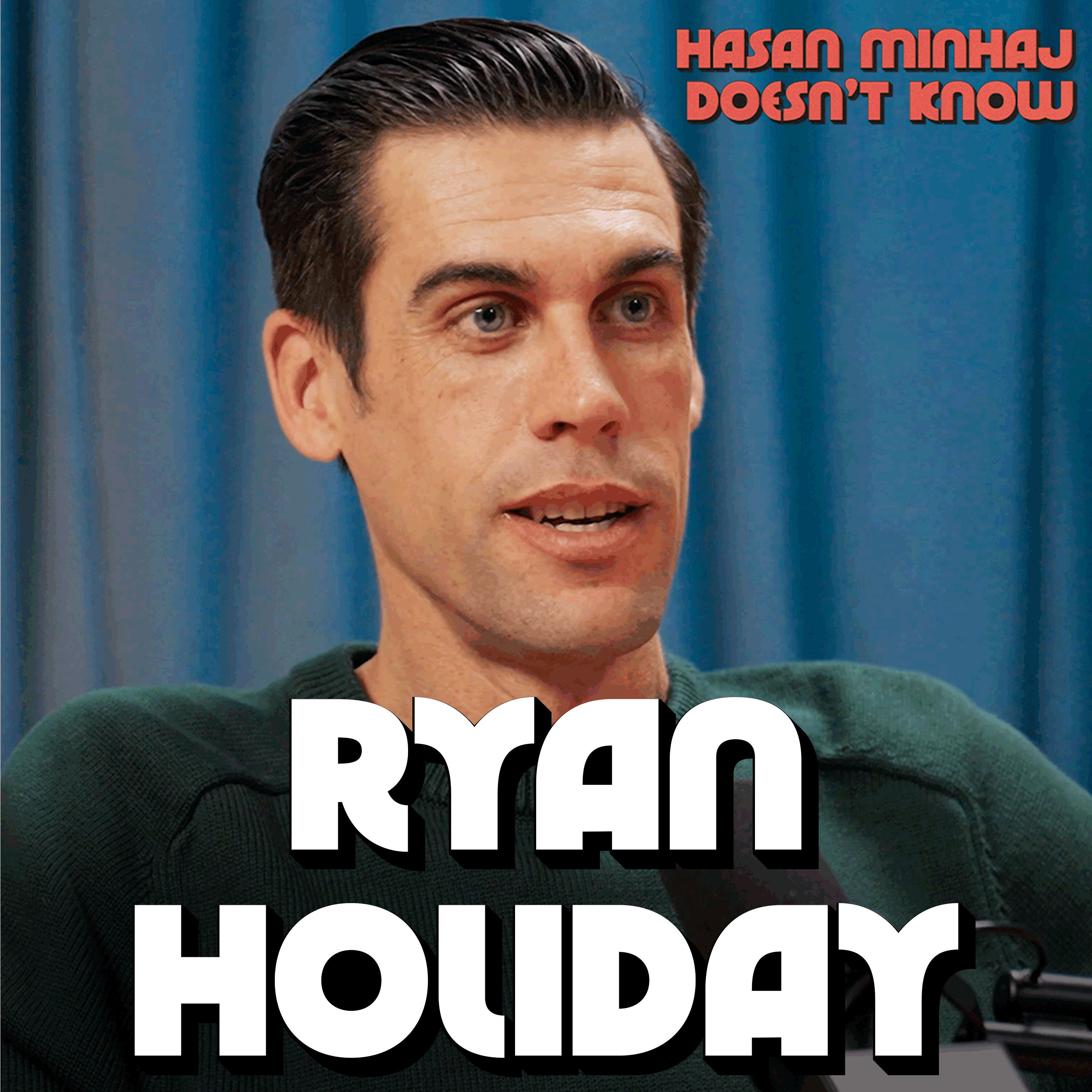
Ryan Holiday
Lemonade. Do you have an audience or does the audience have you? And I'm very reluctant to not say things that I think for fear of losing some of that audience. Now obviously I understand. You know, I mostly talk about ancient philosophy and I'm not Weighing in on daily policy issues, because that's not what people come to me for. But the idea that you could follow a philosophy built around courage and discipline and justice and wisdom and then not comment on, you know, violations of the basic social contract.
- [02:47]
Hassan
Yeah.
- [02:47]
Ryan Holiday
You know, historically, that's what the Stoics did. And it felt. It feels gross to me to only talk about the marketable elements of the philosophy and to shy away from the others because it might be bad for business.
- [03:01]
Hassan
We all know someone who has found their Zen and has become completely insufferable. You know this person? They're dropping Inspo quotes into Slack. Every minor inconvenience becomes a chance to rise above. Every conversation with them incites violence in your heart. The core of most of these ideologies, Stoicism. An ancient philosophy focused on principles like radical acceptance in letting go of material wealth, which can be a thoughtful perspective on inner peace or a cope for unemployment. But look, I was curious to learn more, so I sat down with one of the most popular proponents of stoicism, Ryan Holiday. He has written 10 books about stoicism, and like all great influential figures of our time, he has a podcast, the Daily Stoic. Ryan and I talked about his first book. Trust me, I'm lying. On his years as a marketing rage baiter.
- [03:49]
Ryan Holiday
You know, like, computer hackers will sometimes, like, hack into stuff and then be like, here's how I did it. You should fix this. Yes, none of that really happened.
- [03:56]
Hassan
How his disillusionment with that path led him to Stoicism.
- [03:59]
Ryan Holiday
I mean, I think I learned. I didn't want to be that.
- [04:02]
Hassan
Why the philosophy is resonating so strongly with men.
- [04:05]
Ryan Holiday
I mean, the Roman Empire for most dudes is the Roman Empire.
- [04:08]
Hassan
In his new book, Wisdom Takes Work, which is about cultivating wisdom through things like reading and experience, which I gotta say, Ryan, that is offensive. You're telling me you cannot podcast or YouTube your way into enlightenment? I'm skeptical.
- [04:23]
Ryan Holiday
Hurry.
- [04:24]
Hassan
Right away. No delay. Stop there. Make your daddy glad. You have had such a bad day. You are best known for popularizing contemporary Stoicism, and a big part of modern stoicism is pithy quotes.
- [04:39]
Ryan Holiday
Yes.
- [04:39]
Hassan
Things like, no man is free who is not a master of himself. I love that shit. Like, I genuinely do.
- [04:47]
Ryan Holiday
Sure.
- [04:47]
Hassan
So we're gonna play a simple game. I am going to read you a quote from one of these 12 philosophers. You tell me who said it.
- [04:56]
Ryan Holiday
Okay.
- [04:56]
Hassan
However, there is a catch. Some of these are from Kanye west.
- [05:00]
Ryan Holiday
So will I know it by the virulent anti Semitism, I mean, you're gonna.
- [05:05]
Hassan
Have to navigate this yourself. Are you ready?
- [05:07]
Ryan Holiday
Yes.
- [05:07]
Hassan
Okay, let's go with number one. The happiness of your life depends upon the quality of your thoughts.
- [05:14]
Ryan Holiday
Marcus Aurelius.
- [05:15]
Hassan
Classic. If a man knows not to which port he sails, no wind is favorable.
- [05:20]
Ryan Holiday
Seneca.
- [05:21]
Hassan
We suffer more in imagination than reality. Giving up is harder than trying.
- [05:27]
Ryan Holiday
That sounds like Kanye.
- [05:28]
Hassan
Kanye West. Our work is never done.
- [05:31]
Ryan Holiday
Kanye.
- [05:32]
Hassan
Kanye. Correct the fates, guide the willing and drag the unwilling.
- [05:36]
Ryan Holiday
Ooh. Cleanthes.
- [05:37]
Hassan
If you accomplish something good with hard work, the labor passes quickly, but the good endures.
- [05:42]
Ryan Holiday
Musonius. Rufus.
- [05:43]
Hassan
Oh, my God. I am a Nazi.
- [05:46]
Ryan Holiday
Ooh.
- [05:48]
Hassan
Just really, really think about this one.
- [05:50]
Ryan Holiday
Yeah, that sounds like Anya.
- [05:52]
Hassan
Why did stoicism speak to you at a particular period of time in your life?
- [05:57]
Ryan Holiday
I think it spoke to me for the reason it speaks to a lot of young men, which is, you know, how to be a person, how to live a good life, but also an interesting life. How to deal with setbacks and how to be resilient, how to sort of take these feelings and this energy inside you and direct it properly. That's not what they talk about in school, and it's not even really what they talk about in church anymore. Right. And so stoicism, or ancient philosophy as a framework for living, a way to design your life, I think that it was addressing a big hole in my upbringing, and I think it. That's historically what, like, imagine.
- [06:47]
Hassan
But what was happening in your life that you didn't get from dad, Coaches, the church, cousins, teachers, and more? So both me And Ryan were NorCal kids.
- [06:56]
Ryan Holiday
Yes.
- [06:56]
Hassan
So what was not happening at Granite Bay that needed to be filled here? Cause, by the way, you know, dad didn't hug me. That part of the algorithm, that is. That's catnip to me.
- [07:05]
Ryan Holiday
Yeah, yeah. And I wouldn't. My dad never hugged me, but, like, I wasn't getting that sort of guidance about, like, this is how to be a man. This is how to be a person. This is like, this is what we do. This is what we don't do. There's just kind of this assumption that you'll, like. You'll pick it up as you go. You know, there isn't. There isn't, like, a tradition. There's no, you know, like, there's no sort of. This is the coming of age thing. This is what we do when, you know, you turn 13 in our culture. Right. There wasn't any of that. And so I think you went to church, right? I did. I grew up Catholic until We moved across town.
- [07:43]
Hassan
So you have mass, you have church.
- [07:45]
Ryan Holiday
Was too far away.
- [07:46]
Hassan
Okay, but were you baptized and all that stuff?
- [07:49]
Ryan Holiday
Yeah, I'm a confirmed Catholic. So I do think Stoicism resonated in a way, because the teachings of Stoicism and Catholicism are pretty. They share the same cardinal virtues. Like cardinal comes from the Latin cardos, which means pivotal. And so courage, discipline, justice, wisdom. Those are the virtues that Zeno lays down in the fourth century B.C. that also, you know, are inscribed in every Catholic Church.
- [08:17]
Hassan
And what was it about specifically, those teachings that resonated with you more than, say, Old Testament, New Testament, that stuff? Because a lot of this stuff predates the Bible.
- [08:25]
Ryan Holiday
Yeah, I mean, what I think is interesting about the Stoics and a lot of philosophy is they're making a rational argument. They're not saying, hey, do this or don't do this or you'll end up in hell. I think fundamentally Stoicism is saying, don't do this because your life will be a form of hell. Right. Like, to not be in control of yourself. To. Like the quote you mentioned from Musonius Rufus, he says, you know, if you do something easy in the pursuit of pleasure, the pleasure goes by quickly, but the shame endures. And then he says, but if you do something hard in pursuit of something good, the labor passes quickly, but the good endures. That is, I think that overlaps with the sort of Christian teachings, but nowhere are they saying, like, also God will be mad at you. Also you will rot in hell.
- [09:16]
Hassan
What they're trying to do is. Are you saying basically, it grapples with physical reality on earth as we see it, feel it, and experience it?
- [09:26]
Ryan Holiday
Yeah, I think it's making relatively rational argument, a logical argument for why some things are good and some things are bad.
- [09:35]
Hassan
How do you think it's so popular right now with titans of industry? You'll. You'll hear that Bill Clinton loves meditations. He'll read it every year, he revisits it.
- [09:45]
Ryan Holiday
That's not new. I mean, first off, Stoicism was popular in the ancient world with the quote, unquote elites. Right. This is. This is what you would send your son or daughter. Musonius Rufus writes this fascinating essay 2000 years ago about how the question is, should women be taught philosophy? And then the other essay is like, is virtue the same in a man as in a woman? And his argument, by the way, is.
- [10:09]
Hassan
He writing New York Times op eds?
- [10:11]
Ryan Holiday
Yes, yes. Hot takes. But he's saying, yeah, ultimately, virtue is virtue. It doesn't know Gender. So the stoics are grappling with, sadly, some of the same things we're still grappling with today. But the argument then was like, this is what you want to teach young people so they can grow up to be not just good people, but contributors and leaders in society. So I think it's sort of relevance with those people today shouldn't surprise us. I think it's more interesting that your sort of regular folks are interested in it. And that probably says something about what a train wreck the world is right now. It's probably not. Stoicism is not resurgent and popular because everything's amazing and going super well. Right.
- [11:00]
Hassan
It's perhaps a guidebook or a handbook to the craziness that people are experiencing in their day to day lives.
- [11:06]
Ryan Holiday
Yeah. Like Cato's in the fall of the Roman Republic, Marcus Rus is in the decline and fall of the Roman Empire. Zeno is there when the sort of world created by Alexander the Great is falling apart. So, you know, it's popular again, you know, in the Renaissance, the Enlightenment, the age of revolutions, you know, the American Civil War. It's popular when shit feels like it's coming apart.
- [11:34]
Hassan
So stoicism, from what I understand, is not a partisan philosophy, but it most recently has been hijacked by different partisan groups. And I wanted to talk to you about that because you're someone who is tried to research stoicism, dare I say stoically, you know, like, hey, let me be cool, calm and collected and write about what these men were teaching. And you're a big reason why stoicism became so popular. But there's also been a huge rise of what I call brocism. Yes, the manosphere loves this shit. If you just go to Twitter right now and you type in any of these names from the quiz. Oh my God, yeah. The accounts that are reposting them, you know, I don't know if they're people that I would want to be like per se.
- [12:18]
Ryan Holiday
Which is weird because when I went to my publisher in 2012 and I was like, hey, I want to write about this obscure school of ancient philosophy.
- [12:24]
Hassan
Yeah, yeah.
- [12:25]
Ryan Holiday
They were not like, oh, that'll crush it with dudes. Like, this is all an interesting turn of events for you. For me too.
- [12:33]
Hassan
Really?
- [12:34]
Ryan Holiday
I mean, I mean, I understood and thought it could be popular, but I didn't think that it would be this enormous.
- [12:41]
Hassan
You didn't think nerdy tech titans wouldn't read this stuff and be like, I could be Gerard Butler in 300. There is something about that idea of.
- [12:51]
Ryan Holiday
Like, I mean, the Roman Empire for most dudes is the Roman Empire, but.
- [12:55]
Hassan
Ryan, now it's Michael Jordan, last shot, Marcus Aurelius quote, Kobe Bryant, final game, Marcus Aurelius quote. Like, this is now a cottage industry. But it's something you talk about in the new book, and I'd love to ask you, what is the main difference between stoicism and broicism, in your opinion?
- [13:12]
Ryan Holiday
There seems to be this tendency to look at the cardinal virtues of stoicism, which are courage, discipline, justice, and wisdom, and be like, I don't have to bother with the third one. Right. Like, I like courage. That's cool. I like self discipline. I like moderation. I like resilience. And then obviously, you know, reading and learning and being smart, that's all cool. But you're telling me that I have to ascribe to a certain list of ethics that I have to give a shit about other human beings. I don't like that. And I get it. I mean, my primary and initial interest in stoicism is what can it do for me, right? Like, how can it make me better, stronger, faster, smarter? I get it. That's. When you're 19, that's what's going to be interesting to you. But, like, the thing Marcus really talks about most in meditations, like the phrase that appears the most is not, you know, like destroying your enemies or, you know, mastering your emotions or, you know, being super productive. It's. He uses the Greek phrase. He's writing in Greek, but the phrase for the common good, which he refers to 80 times in meditation. So it was inherently a philosophy about our obligations and our responsibility to and with other people. And so broicism to me is stoicism, when you. When you remove any of the moral elements. So it's this recipe for being a better sociopath, and in some cases, I think being a better psychopath. And that's, you know, whatever. Whatever Pete Hegseth thinks stoicism is, is not what I. Sure.
- [14:55]
Hassan
I don't know if you've seen Bobby Kennedy Jr. He was banging out pull ups with Mr. Duffy, just like, hey, this is how we're gonna fix infrastructure in this country.
- [15:04]
Ryan Holiday
Sure.
- [15:04]
Hassan
This is how we make people healthy again. You need to bang out 20 pull ups right now.
- [15:07]
Ryan Holiday
Yes.
- [15:08]
Hassan
And there's a lot of people that go, you know what? Marcus Aurelius was a dictator, though.
- [15:11]
Ryan Holiday
Sure.
- [15:12]
Hassan
At night he writes in his journal, wastes no more time arguing about what a good man should be. Be one. But the next morning, he's just out here butchering people and I'm sure denying them basic human rights and. Or democratic rights.
- [15:26]
Ryan Holiday
This is the. This is where, you know, studying the past requires putting on your sort of big boy pants. You know, there's a Jeffersonian element to it. Sure. Like, all men are created equal is a beautiful sentence that he didn't fully believe.
- [15:42]
Hassan
Yeah.
- [15:42]
Ryan Holiday
But we can take it literally, and we can sort of try to get a bit. A little bit closer to it. Like, there's a passage in the beginning of Meditations where Marx Ruiz thanks one of his friends for introducing him to Stoicism. And he says, you know, he's like, for introducing me to Helvetius and Cassius and all these different Stoics. And he says, because the Stoics conceived of, you know, a world of equal rights and personal liberty, where rulers respect the rights of their subjects. And he's describing a beautiful world which the Roman Empire was not remotely like. Right. But that idea, again, it's Jeffersonian in another way. That is the world that inspires the founders 2,000 years later to take a big step towards getting to the ideals of the Roman Republic and the sort of classical virtue. So they're certainly not perfect. And we could list the. The innumerable flaws of the. Of the Stoics. And I have no problem. I have no problem holding Seneca both up as a inspiring, heroic figure and a tragic, disgusting hypocrite. And I think that's perfectly acceptable to do.
- [17:08]
Hassan
A lot of misguided men oftentimes treat stoicism like, hey, nothing can hurt you if you don't feel anything. And you have said many times that stoicism is about actually feeling everything.
- [17:19]
Ryan Holiday
Yeah.
- [17:20]
Hassan
But not being controlled by it.
- [17:21]
Ryan Holiday
Sure.
- [17:22]
Hassan
Do you worry that Stoicism is now being weaponized to be basically sociopathic instead of empathetic?
- [17:32]
Ryan Holiday
Well, Elon Musk, who. Who follows the Daily Stoic on Twitter, which is a weird thing to say. You know, he gave that interview with Rogan where he says, you know, like, empathy is going to be the downfall of Western civilization. And there is this sort of backlash against empathy, as if. As if the problem with our society is that we care too much about other people and not that millions of people are suffering and struggling and, you know, sort of kicked around by society. So I do think there is this sort of backlash. But it's funny. So, okay, so a couple years ago, Mark Zuckerberg's sister, who is a classicist, wrote this book that was very critical of Stoicism, and she sort of laid at the feet of stoic philosophy and some of the. The sort of great Western classics, like all these problems with masculinity and culture and whatever. And I was like, I'm not sure this obscure philosophy is the main culprit for why we've got more sociopaths and psychopaths and assholes today. Like, to me, when I look at our culture and I go, why are people so cruel and awful to each other? I go, I think in the Zuckerberg family, that call might be coming from inside the house. I think social media is a much bigger problem. And we have also just a run of just horrendous exemplars of what behavior should be. You know what I mean? And so I think there's a lot like, I feel like, sure, is there a problem that some people are misusing stoicism? But also people misuse Buddhism and Confucianism and Christianity too. I would say, like, even the people that even know that Stoicism exists is a minuscule fraction of the general population. I don't think that's our big problem in the world. And if anything, many, many, many thousands and millions of people have been positively influenced by the philosophy, and that sort of gets ignored.
- [19:25]
Hassan
One of the critiques that I actually read that I tried to unpack, a lot of times, people love stoicisms. Encouragement of radical acceptance. Hey, the lot in life that you are given, stop trying to fight it. Stop trying to change the cards that were dealt to you. This is the world as it is. This is your life as it is, and make the most of it. And the critique that I read was kind of bumping. Hey, that is bumping up against social justice. The desire to improve your lot in life, not only for yourself, but for others as well and for society at large. And even the pursuit of that in and of itself, even if it fails for women's suffrage or, you know, the civil rights movement, that is a long struggle that you may not be able to accomplish in your life. And I, I saw the kind of critique of stoicism to be somewhat valid of. Hey, I'm not going to just sit here and accept this. How, how do you process that as someone who's actually researched it? Because there's many different ways to look at it.
- [20:30]
Ryan Holiday
I think there are a couple ways to look at it. So, number one, we should understand and give ourselves as a society some credit for inventing and then fulfilling the idea that there is such a thing as agency and change. Right? Like, for most of human history, the world was what it was, and it was unchangeable and inalterable. And it's always been this way, and it always will be this way. Like, you know, Gandhi invents the idea effectively. He's influenced by Tolstoy and Thoreau, but he invents the idea of nonviolent social change. That wasn't that long ago, right, that he did that. The idea of a society or an economic system or a world where the profession your parents were born into does not become your profession, that you can change, you can move, you can. Like all these. This is. These are advancements that we make as a world, right? And it was in many ways inconceivable in the ancient world that that was such a thing. Like, Epictetus is a slave. He doesn't say anywhere in his writings that, like, slavery is bad and unjust.
- [21:42]
Hassan
And in my lifetime or in my children's lifetime, this will be abolished because.
- [21:46]
Ryan Holiday
It was just like an accepted part of reality that, like, if one country or one army conquers you, then they sell all the people into slavery, and that's. Those are the breaks, right? And conversely, it doesn't seem to occur to Marcus Aurelius that he doesn't have to be the emperor. Like, it was this idea that, like, hey, this is the role that you were chosen for. Your job is to do that as best you can.
- [22:10]
Hassan
Do you feel like Stoicism is a call for action or inaction? Because that's really what I was trying to say of the critique of Stoicism vis a vis its ability to inspire you for justice or change.
- [22:22]
Ryan Holiday
I think ultimately it is a call to action, because when we look at who the Stoics were compared to the other schools at this time, so the two rival schools in the ancient world are the Epicureans and the Stoics. And the Epicureans basically believed, like, work on yourself. They retreat to the garden, they pursue pleasure, by their own definition of that. And they sort of say, don't bother yourself. Don't be made unhappy by the complicated dysfunctional world of politics and business and culture. And the Stoics are basically saying, well, if we cede the field, who's going to run those things? So the Stoics get involved in public life. They are involved in politics, they serve in the military, they run businesses. They speak out about the injustices of their time. So I think historically, the example of the Stoics is to get involved, to be in the arena, literally and figuratively. And I think that is the tradition that the American founders were inspired by that. I remain inspired by that. It is a philosophy, ultimately of action. Is there some sense of limitations of how much we can change or actually affect things? Sure, but that didn't seem to stop them from trying.
- [23:47]
Hassan
I'm frankly unnerved. It's already February, but at least I'm literally glowing. That's right, my healthy habits are finally starting to stick, mostly thanks to Huell. H U E L Listen, I'm the only guy who runs on espresso and only espresso until around 2pm When I realize I forgot to eat and I am scaring my employees. Since I've started keeping Huell Black Edition around, I have been a lot less caffeinated and a little less psycho. On the days I'm sprinting out the door, I grab Huel's Ready to Drink bottle. It is a complete meal. 35 grams of protein, 7 grams of fiber, 27 essential vitamins and minerals, no artificial sweeteners, and it's under five bucks, which is kind of amazing. And I know what you're thinking, but what does it taste like? The answer is really good. The chocolate peanut butter flavor. Mwah. Then on days when I want something more customizable, I use the Black Edition powder. I'll blend it with ice and milk if I'm feeling a smoothie moment, or I'll just shake it with water. The powder has even more protein, 40 grams, and the same complete nutrition. It's nice to have a different vibe sometimes. Get Huel today with my exclusive offer of 15% off online with my code hassan15@huel.com hassan15 it's my insurance policy against chaotic days. Folks, there is a reason why dating apps ask you so many questions. You got to gather copious intel before you boo someone up. I get it. There is treachery in these streets. The same goes if you are hiring. You definitely want to address key questions first to see if someone could be the right person for your role. And that is why you need ZipRecruiter when you post your job, ZipRecruiter suggests screening questions at the top to help you hone in on top candidates faster. And today you can try it for free@ziprecruiter.com Husn Speaking of finding your match, ZipRecruiter's matching technology finds you candidates that check all your boxes instantaneously. There is a reason ZipRecruiter is the number one rated hiring site based on G2. You ask key questions and hire faster with ZipRecruiter 4 out of 5 employers who post on ZipRecruiter get a quality candidate within the first day. Try it for free at ZipRecruiter.com Husson that is ZipRecruiter.com Husn meet your match on ZipRecruiter this episode of HMDK is brought to you by Booking.com I love to travel, but I can't say that it's easy. My family has never been described as low maintenance. We all have different ideas of relaxing. What is fun for my 70 year old parents is the opposite of what is fun for my younger cousins. Thankfully, booking.com offers a wide array of hotels and vacation rentals across the United States. So there is something for everyone, even those who are impossible to please. I'm talking about you dad. Whether you're booking for yourself or your picky parents or da boys group chat, you can find exactly what you are booking for. For example, my number one request at a hotel or a rental is a sauna. Now I will settle for a steam room, but I gotta sweat out my demons. Speaking of, my kids appreciate a touch of whimsy. A cute window seat to read on, a water slide in the pool. A massive pile of construction dirt next door. They're not picky. Dare I say if we can find our Perfect stay on booking.com anyone can find exactly what you are booking for@booking.com booking. Yeah. Book today on the site or in the app. So let's go back. Obviously people have probably read your most current books that I think are defining stoicism and modern life. But there was a book. Let's go back to your 2012 book. Trust me, I'm lying. Okay, now that's a book not about my standup comedy. This is a book about media misinformation and specifically media in the blog era.
- [27:13]
Ryan Holiday
Yeah.
- [27:13]
Hassan
Which I think is so quaint and cute. When you think about Tumblr era, I.
- [27:17]
Ryan Holiday
Don'T think TikTok even existed.
- [27:19]
Hassan
TikTok did not exist. Yeah, it was. I call it, you know Tumblr era web 1.0 and kind of nascent slash new web 2.0 media. You have rewritten the forward to this book twice. Yeah, because you have said the far right has used some of the lessons in this book and you've said, quote I began to get emails from some of the most notorious media trolls in the world, including members of the so called alt right about how the book was their bible and how they used it to get attention.
- [27:48]
Ryan Holiday
I know it's Crazy. Well, so Michael Lewis, I've heard him say that people come up to him and they go, liars. Poker's why I worked on Wall, why I work on Wall Street. And he's like, the whole point of that book was to, like, not work on Wall Street.
- [28:00]
Hassan
Right.
- [28:00]
Ryan Holiday
And so I was trying to write what I thought was sort of an expose of this fucked up, Crazy worlds. And I think I was more right than I knew at the time. I mean, I basically wrote a book about fake news and, like, actual fake news in 20, 2012. Sure. And how sort of the. The vulnerabilities and the interdependence of these different kinds of media outlets all sort of feed off of each other and that it would. It would create some real problems for us as a society. I did not think that all of those trends would get unimaginably worse and that people would. Not only bad people would use it to do bad things, but no one would really fix or address any of the. I feel like, you know, like, computer hackers will sometimes, like, hack into stuff and then be like, here's how I did it. You should fix this.
- [28:55]
Hassan
Yes.
- [28:55]
Ryan Holiday
None of that really happened.
- [28:57]
Hassan
You thought it would be a user manual to be like, hey, I basically jailbreaked the modern media ecosystem.
- [29:04]
Ryan Holiday
Yeah.
- [29:04]
Hassan
You guys should have a software update.
- [29:06]
Ryan Holiday
Yes.
- [29:06]
Hassan
With major patches and fixes.
- [29:08]
Ryan Holiday
Yes.
- [29:09]
Hassan
That way this improves.
- [29:11]
Ryan Holiday
Yes.
- [29:11]
Hassan
Do you think you were naive to think that or you were like, hey, I'm just telling the story of what.
- [29:17]
Ryan Holiday
I think I was. I think I was a little naive. I think I thought it would be more positively received by the media, who mostly sort of told me I was wrong and that I was like, a bad actor. And. Yeah, I just. I also thought maybe, like, consumer habits would change. Like, it's interesting. We talk about fake news as something that's done to us as opposed to us creating the demand for fake news. Right, Right. Like, we are the fake news we.
- [29:47]
Hassan
Want or our desire to consume salacious clickbaity things.
- [29:51]
Ryan Holiday
Yeah. I was reading some sort of propaganda expert and they were saying, you know, the point of misinformation is not to, like, put new ideas in your head. It's to tell you what you already want to believe. It's to provide, like, great example. Okay. Donald Trump, indisputably guilty and responsible for what happens on January 6th. Right. Attempts to a coup, Attempts to overthrow the election. This horrendous riot happens. People die. Our nation's capital is covered in feces and Confederate flags. It's a horrendous moment. So you can look at that and go, this is where it ends. This was horrible. We've all been misled. Or you know, if you're a supporter, we've been misled, this stops. We're going to change. And then there's the human part of someone that goes, well, that makes me very uncomfortable. This is classic cognitive dissonance, right. I don't want it, have to accept that I fell for a con, that I was misled, that I was complicit in this happening. So the market, that is the human, the human nature looks for a way to not have to do that. So Donald Trump capitalist, goes, it was antifa, right. And starts to put out various excuses or explanations for what happened that don't require you to wrestle with the horror of what happened. Right. Like when people are in cults and the cult says, hey, the world is going to end on January 1st, and then January 1st comes along and the world doesn't end. You have two options. I'm an idiot, I fell for a cult, let's get out of the cult, or the cult leader saved us.
- [31:43]
Hassan
You gotta double down on the cult.
- [31:44]
Ryan Holiday
It didn't end, let's double down. And so I think what we've not fully grappled with is the way that this bad information is responding to the latent demand and the desire for that version of events or the worlds to be true. And so there are certain people who decide to meet that need as opposed to going, hey, that's not what we do here.
- [32:11]
Hassan
If you were to update the forward for a third time, what would you include in this updated forward?
- [32:16]
Ryan Holiday
Well, I was going to ask you because you, you told me I should do this at some point.
- [32:21]
Hassan
Yes.
- [32:21]
Ryan Holiday
I don't know how much, I don't know how much to preserve the book as a document from the era and period it was, and then how much to update and change it, you know, So I mean, I think I would talk about the world of. Look, you've got Neil Postman right there. Neil Postman's idea was that the dominant cultural medium determines the level of discourse that we're going to be able to have. And his argument was, when he was writing this in the 80s, that we had officially transitioned away from a sort of print and word based world to.
- [32:56]
Hassan
A visual, visual media based world, the.
- [32:58]
Ryan Holiday
World of mainstream network television and maybe a little bit of cable.
- [33:02]
Hassan
Yeah. So he's referring to Neil Postman's Amusing Ourselves to Death, which was written in 1985.
- [33:07]
Ryan Holiday
Yeah. One of the most present Amazing books ever written about media. You know, I was writing, as you said, mostly about the blog world and the social media world was pictures on Instagram and tweets on Twitter and basically Huffington Post. Yes.
- [33:24]
Hassan
Kind of clickbait, big thumbnail driven articles.
- [33:28]
Ryan Holiday
And video would be like long form YouTube potentially. Yeah. But now we exist in a world perhaps the majority of people are not even. They're not listening to this, they're not even watching the whole thing. They're watching clips of it on social media. They're having little sips of it, the whole drink. How does a world of instant and unlimited video change our understanding of media and create sort of vulnerabilities? And then I would layer on top of that obviously what AI is able to do, like a world of slope.
- [34:03]
Hassan
I mean, let's connect this. This book was written in 1985. Amusing ourselves to death. You wrote, trust me, I'm lying in 2012. And then you did interviews about the book with journalists. Let's take a look at one of these quotes where you talked about the degradation of journalism and citizen journalism. Very early on in this Web 2.0 world, there was this attitude of citizen journalism. We're changing the media. Everything is different now. The truth well out. This is the future, and the future is always better. And I very much bought into that. Then I saw how it worked and I had to come to terms with the difference between perception and reality. What's so crazy is when I read this, I read this interview that you had in 2012, all of these buzzwords are still used right now of like, we can't trust legacy media. Citizen journalism will be the breakthrough. And here we are 13 years later. How do you feel about what you were trying to tell this person in this interview?
- [34:53]
Ryan Holiday
I mean, I wish I was wrong, you know, like I would have liked that book to have become horribly out of date and proven irrelevant by subsequent events. But if anything, it's worse and we're more dependent and vulnerable to the things that I'm talking about. And yeah, now we're entering this world where in many cases some of the same entrepreneurs from that era are running these huge AI companies or are very bullish on whether it's AI or crypto. You talked about good faith, bad faith, the assumption that Silicon Valley entrepreneurs are acting in good faith. I don't know how many times we have to be disabused of that notion to get with the program.
- [35:46]
Hassan
I want to show you something else from the interview which is really interesting. What about traditional newsprint media the online cycle drives the offline cycle. The old media system is not going to run a story based on anonymous tip from a random person in the way that Gawker might. But they do report about what the blogosphere is chatting about. That's something I exploit pretty often. Is this a new phenomenon? What really drove me to write this book is that there's a bunch of parallels between today and where journalism was 100 to 120 years ago. The economics then were that you didn't subscribe to a newspaper. You bought it on the street corner every day, and you bought the one that had the best headline. So what I thought was really interesting about this is in 2012, you were making a connection to something that happened almost a century before of people yelling on a street corner. Extra, extra. Read all about it. Here's a salacious thing that'll probably get you, too. Click like or subscribe. Yeah, we're having this conversation now, 13 years later.
- [36:34]
Ryan Holiday
Yeah.
- [36:35]
Hassan
So what's Ryan Holiday's philosophy on all of this? And what's the stoic philosophy on all of this? Because it sounds like for the past century or so, news and media has been kind of a tool to deceive or mislead, you know?
- [36:51]
Ryan Holiday
Did you read the Jungle? No. You didn't read the Jungle up in Sinclair's the Jungle? No, we read it in high school. But it's an expose of the meatpacking industry, the primary muckraking text that leads to a lot of the reforms in the Progressive Era. What people don't know is the book he writes after that is called the Brass Check. And it's an expose of journalism in that era. And back then, the media barons, the newspaper barons, were indistinguishable from the cattle barons and the meatpacking barons. They had a commercial product that they tried to make as cheaply as possible and sold to as many people as possible. And he was talking about the vulnerabilities of. There's another journalism critic in the early years of the 20th century goes, basically, America is a country ruled by public opinion, Right? That's how we pick our representative. So whatever determines or influences public opinion is what actually rules America. And so, yeah, you Flash forward to 2025, and the Chinese government owns TikTok and Elon Musk owns Twitter. And who's sitting in the front row at the inauguration? It's. It's the attention merchants and barons, Right? And so those devices, the people who control those algorithms basically rule not the country directly, but they rule what the country thinks and they can turn up the volume on this or that. And that has an immense effect on what we see, what we believe, how we relate to each other, the problems we tackle, the problems we don't tackle.
- [38:34]
Hassan
But it's pretty Orwellian. Meaning, like the Capitol controls the means of the information that you're getting.
- [38:41]
Ryan Holiday
It's understanding ultimately that media is kind of a like, trust. Truth. Information is in some ways a public good. Right. And people have the ability. There's this famous editorial cartoon from back then newspaper baron, like dropping poison in an. In an aquifer, like in. In the. Where we get our water. And then that affects everyone.
- [39:03]
Hassan
And.
- [39:04]
Ryan Holiday
And so, yeah, we have these, These forces and these individuals in some cases that affect our understanding of truth or not.
- [39:11]
Hassan
So just so I understand. So is the stoic philosophy and is the Ryan Holiday philosophy, just don't fuck with the news?
- [39:17]
Ryan Holiday
It's not that you don't fuck with the news, but our obligation is to be informed citizens. Right. I just think people wrongly assume that watching daily news or consuming daily news is the best way to be an informed citizen.
- [39:33]
Hassan
Are you basically saying that the drugs are the same, but they've now been synthesized to this Heisenberg blue level? That the streets have not tasted this type of.
- [39:44]
Ryan Holiday
Yes.
- [39:44]
Hassan
Unique mdma.
- [39:46]
Ryan Holiday
There is a potency to it that is very difficult to resist and, you know, is all the more attractive, I think.
- [39:56]
Hassan
Was there a specific straw that broke the camel's back in that era of your life that you realized you're like, I. I can't be a part of this. I'll give you an example. I used to be a part of a show. You don't have to look it up. It's called MTV's Disaster Date, where basically a bunch of comedians go on these blind dates with people and you have to alienate people to get them to leave the date as quickly as possible. I remember midway through filming whatever season of the show I was on, it's like 2010, 2011, I was like, I don't want to do comedy this way.
- [40:25]
Ryan Holiday
Yeah. So I read this book by Bud Shulberg. It's called the Harder They Fall, and it's about a corrupt political. It's about a corrupt, like, press agent. Yeah. Like a boxing promoter who's, like, gets sort of sucked into some business with the mob. He's propping up this, like, fighter that they're going to bet against. Again, the timelessness of these things, right? Like manipulating the media to exploit the gambling market. This is exactly where we Are now. And I read this, and at the end of it, he sort of has this epiphany. He says, I realized you can't deal in filth and not become the thing you touch.
- [41:03]
Hassan
Oh, man.
- [41:03]
Ryan Holiday
And I go, ugh. You know, it just hit me, and I. I highlighted it. And when people would ask me, you know, why'd you write, trust me, I'm lying? And why'd you leave American Apparel? Why'd you leave this world behind? You know, I'd go, well, I read this book, and it changed my life. And finally, I was like someone. I was thinking about it, and I go, when did I. When did I read that book? And I bought it on Amazon. So I looked at my Amazon receipts. I read this book in 2009.
- [41:32]
Hassan
Oh, wow. So it was, like, before you even started working there.
- [41:35]
Ryan Holiday
I mean, very early or.
- [41:37]
Hassan
Yeah, you were earlier.
- [41:39]
Ryan Holiday
The epiphany, the story, the Road to Damascus moment is usually retconned. You know, like, that's not. I worked for years doing. I did things that I shouldn't have done way longer than I should have. I knew better. But there is this. You know the word disintegrated, right? Disintegrated, which would mean, like, we tend to. See, disintegrated means, like, disintegrated in the air. Came apart in the air. But this word of being, this idea of. I don't think we have a good enough word for being not integrated. I guess we could say compartmentalized. But, like, I had an understanding.
- [42:15]
Hassan
Yeah.
- [42:16]
Ryan Holiday
But that didn't match my actions, and I couldn't bring it into my life. And so I think that's more common than. Than we want to admit, because we want to have this story.
- [42:28]
Hassan
And the path maybe was nonlinear of, like, when do I act on this? How do I act on this? And what is my next step?
- [42:33]
Ryan Holiday
You're right. Yes.
- [42:34]
Hassan
Yeah.
- [42:34]
Ryan Holiday
And so, like, you look back and you go, I should have done it sooner. But then, you know, Taleb says the greatest addiction in the world is a salary. You know, you don't want to. You don't want to leave a sure thing for a not sure thing. And your identity gets tied up in stuff, and you. You do things longer than you should.
- [42:58]
Hassan
One of the things the Stoics talk about a lot is understanding what you can control and what you cannot control. And you went head to head with one of the things the Stoics would tell you you simply cannot control, which is your parents. You tried to change your family. I have been saying this. For a long time. I truly believe I cannot change the world, because I can't even change my dad.
- [43:19]
Ryan Holiday
Mm.
- [43:19]
Hassan
Okay. You wrote two letters to your dad. Both times Donald Trump won. It was a letter to your dad. It's available on your website. It's still up there.
- [43:28]
Ryan Holiday
Yeah.
- [43:29]
Hassan
It's basically a letter to dad, dad, comma, please don't vote for Donald Trump. Here's why. Why did you write these letters, and did you really think your dad was gonna change?
- [43:38]
Ryan Holiday
I don't know. There's a couple layers of naivete there. One, which is I was. I had a column for the observer at the time, which was owned by the Kushner family, and I thought they would publish said letter, and I had. I could. No one had ever edited or had anything to say about any of my columns up until that one. Yeah. And I remember being so surprised. Like, it was just a. You have these moments where you kind of think the world is fair and just and everyone's on the same page, and then you. You bump into real power or how things really work, and you go, oh, I was an idiot. What did I think? But I ended up publishing it elsewhere, and it sort of went viral, and it was a big thing. Look, how much was I trying to change my dad's mind? I don't know. And I don't honestly know who he ended up voting for, but what I was trying to do in that piece is make an argument, which, again, now feels a little quaint, which is like, if you grew up and your parents were conservative or Republican, you were taught certain values, they told you they believed these things because certain things were true and important. Right. And come 2015, 2016, I think a lot of us came face to face with the uncomfortable and undeniable reality that all that was bullshit, and they didn't actually mean it. They just really don't like liberals and liberal values, you know? Got it. And so I was trying. I was trying to contrast all the things that I was taught by my parents that I thought we all agreed on, and contrast them with the ugly picture that is Donald Trump not only.
- [45:25]
Hassan
Taken that letter by putting it in the blockchain, but you've also been pretty public in your Instagram and in your TikToks when you're at speaking engagements and you talk about the Trump administration's cruelty and specifically cruelty to immigrants and migrants and people seeking asylum or refugee status. And I remember there was a caption in one of your posts where you said, look, if I lose followers because of this that's fine, but I just don't derive any joy or meaning from people that get off on this type of cruelty. What were you basically trying to say in those posts? What are you trying to communicate to people that follow your work? And why make that kind of very public fissure documented?
- [46:06]
Ryan Holiday
I don't know if I'm trying to make a public fissure, but I do feel like the obligation. Do you have an audience or does the audience have you? And I'm very reluctant to not say things that I think for fear of losing some of that audience. Now, obviously, I understand. I mostly talk about ancient philosophy, and I'm not weighing in on daily policy issues because that's not what people come to me for. But the idea that you could follow a philosophy built around courage and discipline and justice and wisdom and then not comment on violations of the basic social contract when your country's talking about. Not like, if we should or shouldn't round up 10 million people and ship them somewhere, but, like, how much it's gonna cost. You're in a place where I think you are obligated to say something. And, like, I feel like historically that's what the stoics did. And it felt. It feels gross to me to only talk about the marketable elements of the philosophy and to shy away from the others because it might be bad for business.
- [47:29]
Hassan
So was also part of it putting in the blockchain? Hey, I am not like Magadad. And here's why.
- [47:36]
Ryan Holiday
I guess I think I was just saying, like, here's. This is what I'm. This is what I'm feeling. This is what I'm struggling with. This is what I think needs to be said. And then you do. Stoicism does help you as a creative because, like, you don't control how it lands with the audience. And I don't control whether that hurts my dad's feelings and pisses him off. I don't control whether, to this day, people, you know, how could you do that? How could you say that? You know, whatever. How could you embarrass your parents or whatever? It's like, I think you probably understand this with your comedy. Like, there is a part of you that you have to turn off to be able to do the thing. Like, if you never wanted to offend or reveal, you couldn't do what you do.
- [48:17]
Hassan
A common criticism of stoicism is that it's judged based on its worst adherence. Hey, look at these psychos that quote Marcus Aurelius. Therefore, stoicism is bad. And I Think it's wrong to judge people by the worst adherence. Trust me, as a Muslim, I get it. There are people that have hijacked a faith that I find to be incredibly beautiful and beneficial to me. Who in your life is practicing stoicism in the best possible way?
- [48:45]
Ryan Holiday
Oh, that's a good question. That's a good question. I mean, I think most of our grandparents sort of embody this sort of colloquial stoicism in a way that's sort of getting it right.
- [49:03]
Hassan
Is it because they're wiser? Because they're old? You know, I have this theory about people that are just so old and weak that they can't be angry anymore?
- [49:09]
Ryan Holiday
Yes.
- [49:10]
Hassan
They need to be judged by what they were doing at 35, not what they're doing at 85.
- [49:14]
Ryan Holiday
I think. I think that's fair.
- [49:15]
Hassan
I'm like, you're nice because you don't have energy to be an asshole.
- [49:19]
Ryan Holiday
Or they've come face to face with it's true real acceptance.
- [49:25]
Hassan
I don't know, man. I feel like there's just no lead in the pencil. There's no testosterone left in them to scream.
- [49:32]
Ryan Holiday
Yeah.
- [49:33]
Hassan
And so now that every grandpa is like cute and quaint, but Fox News.
- [49:38]
Ryan Holiday
Grandpas, they're not so quaint and cute. You could still be a lot of energy.
- [49:44]
Hassan
I bet if you were an alien and you were to go visit George W. Bush while he's doing watercolor paintings, you'd be like, this guy's really nice.
- [49:51]
Ryan Holiday
Yeah.
- [49:52]
Hassan
You wouldn't be like, this was the mastermind behind the war on terror and probably has between him, Cheney and Rumsfeld a million plus bodies on his head.
- [50:00]
Ryan Holiday
Yeah.
- [50:01]
Hassan
You would not think war criminal. You'd be like, this is an old, somewhat stupid, possibly illiterate man that's painting.
- [50:09]
Ryan Holiday
Yes.
- [50:10]
Hassan
Maybe he has dementia.
- [50:11]
Ryan Holiday
Right.
- [50:12]
Hassan
And I think that's a byproduct of him just being old.
- [50:16]
Ryan Holiday
Yeah. It's hard to hold people accountable for horrible things they did a long time. Like, if you ever see even some of these, like, they'll find. They'll find like some Nazi war criminal. And it's like, you know, he's a 98 year old man. Yeah.
- [50:28]
Hassan
He's at Kroger's and he's just like bagging his groceries.
- [50:31]
Ryan Holiday
Right. And then you put him on trial and it. But yeah, it's tough. I don't know. I don't know if there's anyone. I'm like, hey, this is the modern embodiment of stoicism. I think it's an ideal we aspire to.
- [50:45]
Hassan
I think for me, what it's about, the people that I. That have moved me is the people that have shown courage, bravery, and real value and ethics when they had leverage.
- [50:59]
Ryan Holiday
Yes.
- [51:00]
Hassan
I think that's what I mean. All jokes aside, when I'm like, you know, grandpa is a stoic now because he literally is on the verge of death and doesn't have the energy to be an asshole. Really what I'm referring to is those people that are in the prime years of their life. They have the ability to be cheap, be short, be curt, be cruel, be mean, not tip the waiter.
- [51:19]
Ryan Holiday
Yeah.
- [51:20]
Hassan
Be bristly. And they don't. And I believe character is revealed when you have the leverage and you still move ethically and decently.
- [51:32]
Ryan Holiday
Yeah. I wrote this piece once, and the title was you are what you won't do for money. And I think your point about it's what you do or don't do when you have leverage is very revealing. And it's very hard for people to say no to a lot of money, especially when the only risk is maybe some negative opinion.
- [52:02]
Hassan
I want to talk about your new book for a second. It's called Wisdom takes work. You've said this was the hardest to write of the four books. Why is that?
- [52:10]
Ryan Holiday
Well, each one is harder than the last one because you're trying to do better. But I think it's. I mean, it's hard to write a book about wisdom and in your late 30s and not feel like a douche. So that was challenging. Like you're writing about a thing that you definitely don't have, and to think you have it is to prove you definitely don't have it. Right. So I think it's just challenging because also of the virtues, I think it's the hardest to define, like, what is wisdom? How do you get it?
- [52:40]
Hassan
What do you think it is?
- [52:42]
Ryan Holiday
I think it's a lot of things. Right. I don't think it's one thing. It's obviously not just intelligence. It's obviously not just experience. It's obviously creativity and insight. I think there's an element of cleverness to it. There's an element of perspective to it. I think it's this range of attributes. I think what I'm trying to say in the book that I think we can all agree on is that you're not born with it and it doesn't occur easily. It's something that takes a long time to acquire, and that there is also effectively an infinite amount of it. So it's not like a thing that you ever arrive at. And that's one of the things that wisdom does teach you is, like, how little you know. Like, that's Socrates is told by the oracle that, you know, he's the wisest man in Athens. And he wrestles with what that means. And then he realizes that it's because he doesn't think that he's wise, that makes him wiser than his countrymen.
- [53:48]
Hassan
How do you talk about stoicism with your children? Because they live in an incredibly modern world filled with tablets, news, and devices. Because really, what I'm trying to get at that I think to be that I think is really interesting, is that how does stoicism grapple with paradox? So, for example, the world they live in, social media, the Internet and the news, is simultaneously meaningless and deeply meaningful. Like, the president will tell you what is going to happen in the lives of Americans via social media, but then he'll also simultaneously be like, I still hate Rosie o'. Donnell. Sure, one of these things is deeply meaningful. Hey, ICE agents are being deployed in Los Angeles. I will bring in the National Guard. That's going to affect a lot of people's lives. And then his critique of Rosie o' Donnell is fundamentally meaningless.
- [54:45]
Ryan Holiday
Yeah.
- [54:46]
Hassan
How does stoicism grapple with that paradox?
- [54:50]
Ryan Holiday
I mean, personally, I try to shield my kids from that mess as much as possible. I'm not sure they need to, to know any of that yet. But part of wisdom to me is dealing with complexity and contradiction and paradox, tension like that. Ideas are in tension with each other. Fitzgerald's line was, the mark of genius is to be able to have two contradictory thoughts in your head at the same time, which is both, I think, a mark of wisdom and a mark of stupidity. Right. So even itself, that mark, that remark has, like, an element of paradox in it. Yeah, yeah. And so how do you, how do you explain complicated things to your kids? Because there is this part of them that always will, like, well, why? Why, what about this? Like, they want it to be simple because they want to be able to wrap their heads around it. And I do try to just go, I don't, I don't know. It's complicated. Like, it, it, it doesn't make it. I try, I, I, when my son points out things that don't make sense, I try to be like, you're right, it doesn't make any sense. Some shit just doesn't make sense. And that we have to figure out how to just live in a world where things don't make any fucking sense.
- [56:02]
Hassan
How do you make sense of the idea that you make money off of preaching stoicism and anti materialism, meaning you get material good and benefit for yourself and the people you love from something that kind of tells you to disconnect from that stuff?
- [56:20]
Ryan Holiday
Yeah, well, I don't see myself as a preacher. I, I identify as a writer. And it just. That role in the modern world also requires you to do other forms of communication. But this was a question in the ancient world too. Seneca says there's nothing that says a philosopher can't make money or be rich. He says, so long as your money is not stained by blood. Which was a rich thing to say for a dude who made his money working for Nero. So I feel like as long as it's an honest exchange of value, I don't have a problem with it. But the stoics weren't anti materialist in the way that the cynics were necessarily. I think the idea was if you need it, if you need to live a certain lifestyle, that's a vulnerability and a problem. But if you have the stuff and you don't stake your self worth on it, there's no problem. I don't see any benefit to being underpaid for my work. That doesn't feel like it's proving any philosophical point.
- [57:35]
Hassan
How are you protecting yourself from the ego inflation of success?
- [57:39]
Ryan Holiday
I try to live a normal person life. I don't live in New York, I don't live in la. I don't go to parties. I live on a dirt road in rural Texas, you know, and so I try to live like a regular life where I show up and do a job every day as opposed to like being a person, you know, like being a role, if that makes sense. I don't know how. It's not for me to say whether I'm doing a good job of it or not, but I think, I think I'm doing all right.
- [58:13]
Hassan
This is great. Ryan Holiday, ladies and gentlemen. Have you subscribed to Lemonada Premium yet? You can listen completely ad free and get access to exclusive bonus content you won't hear anywhere else. Like my discussion with Malala on how therapy changed her life. Or my convo with Mel Robbins on how her let them theory applies to parenting tap. Subscribe on Apple Podcasts or head to lemonadapremium.com to sign up on any app that's lemonadapremium.com.