Podcast
Headless Deep Dive Podcast
Hosted by HeadlessDeepDive.substack.com · EN
Exploring the intersection of the Headless Way with the worlds of Philosophy, Science, and Religion. I like to use Artificial Intelligence to reflect back to us what humanity looks like from another point of view. This podcast is a feed of the Deep Dive podcast generated by Google's Notebook LM customized with handpicked content just for the Headless Deep dive audience.
headlessdeepdive.substack.com
headlessdeepdive.substack.com
12episodes
Episodes
Newest firstAll episodes
Rovelli: There is No Hard Problem of Consciousness
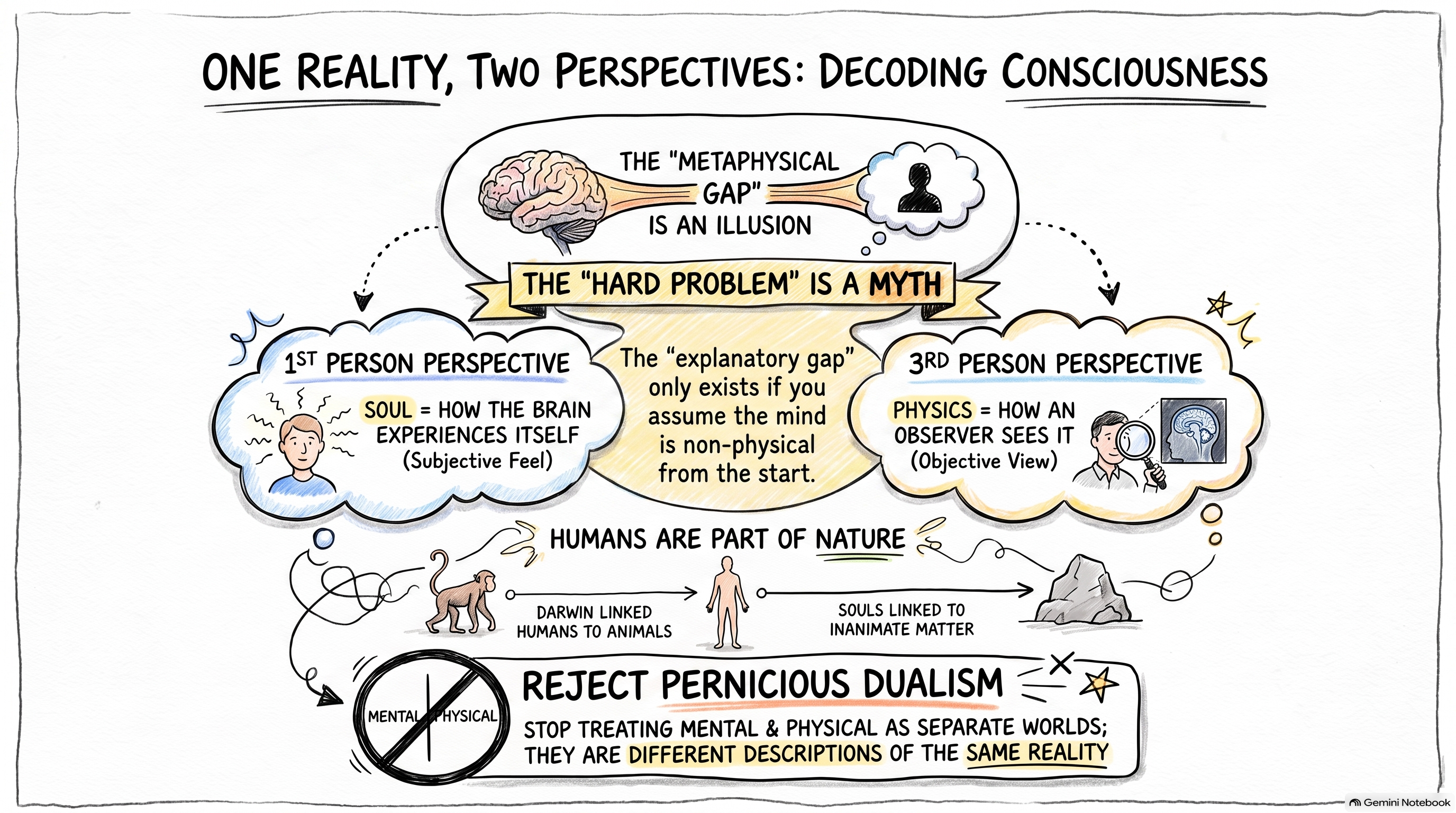
5d ago00:05:55Tap to summarizeToday we look at Carlo Rovelli’s article, There Is No Hard Problem of Consciousness. Rovelli says that David Chalmer’s “hard problem of consciousness”, is rooted in our resistance to letting go of our ingrained notion of a separate soul and the attempt to describe a first person experience in a third person objective manner. This is very much in line with Douglas Harding’s refutation of the so called “hard problem”. Harding also recognized that the third person experience is appearing in the first person experience. Harding described how other people appear to us in our first person experience and we appear in their first person experience, saying “your mind is my body, and my mind is your body”.Both Rovelli and Harding view the hard problem as a misguided attempt to combine two incommensurate perspectives of the same world. I like the simplicity of that. It means there is no “problem” to solve, there is just different perspectives to enjoy. This is a public episode. If you would like to discuss this with other subscribers or get access to bonus episodes, visit headlessdeepdive.substack.com
Transcribe →
Arnold Zuboff - Finding Myself
May 400:20:44Tap to summarizeArnold Zuboff is a philosopher and the creator of Universalism, which is the idea that there is only one “I”, only one subject and that subject is the “I” in every conscious experience. Zuboff writes about this at length in his book entitled Finding Myself - Beyond the False Boundaries of Personal Identity.In the same way that there is only one novel called “Moby Dick” yet there are multiple books which contain that novel as a physical instantiation of the tale by Herman Melville, Zuboff argues that although there are many beings which can instantiate the contents of a conscious experience, there is only one subject of experience only one I. He appeals to the immediacy of experience. There is only one “here”, there is only one “now”, even though we can look back on many “there”s and “then”s. Douglas Harding had a similar point of view saying that the “I am” is “first person, singular, present tense”. One of the experiments of the Headless Way is called the “No-head Circle”. A group of friends gathers in a circle with arms around each other, facing inwards towards the center of the circle. Looking down, one sees all the separate feet, and legs. Following them up we see separate torsos. Follow them up even further though while still looking down, we see that the many separate bodies fade out and merge into the one singular first-person experience of looking down. The many bodies appear in the one consciousness. This is a public episode. If you would like to discuss this with other subscribers or get access to bonus episodes, visit headlessdeepdive.substack.com
Transcribe →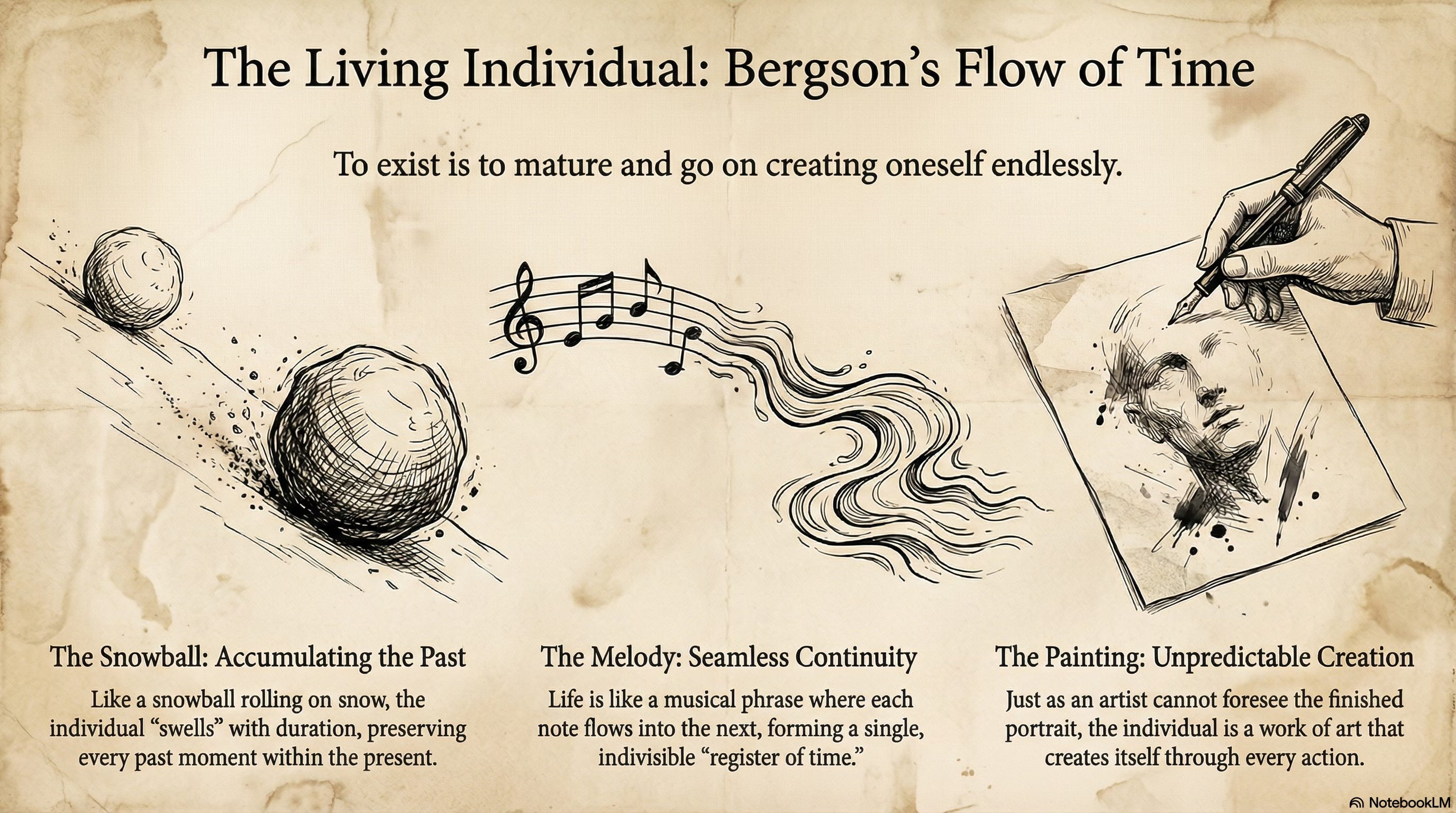
Henri Bergson - Creative Evolution
Feb 2400:18:47Tap to summarizeWhen we look back at our lives, we experience a highlight reel of sorts, all the memorable good and bad experiences and this cinematic metaphor extends into thinking of ourselves as a fixed snapshot: I’m angry, I’m happy, etc. Henri Bergson reminds us that we are not a finished product, we are a process. We are not snapshots, we are a continuing ever-changing flow of experience. In his book Creative Evolution, Bergson uses many metaphors to snap us out of this fixed and separated mindset:* A snowball “continually swelling with the duration which it accumulates”* A "bud" sprouted from its parents, remaining united to the "totality of living beings by invisible bonds"* An embroidery canvas passed from ancestor to descendant; as the "ancestor passes on" the canvas, each descendant adds their own "original embroidery" to the shared historyand my favorite:* A musical theme existing as a whole despite its variations. The individual represents a unique expression of the broader current of life. This is a public episode. If you would like to discuss this with other subscribers or get access to bonus episodes, visit headlessdeepdive.substack.com
Transcribe →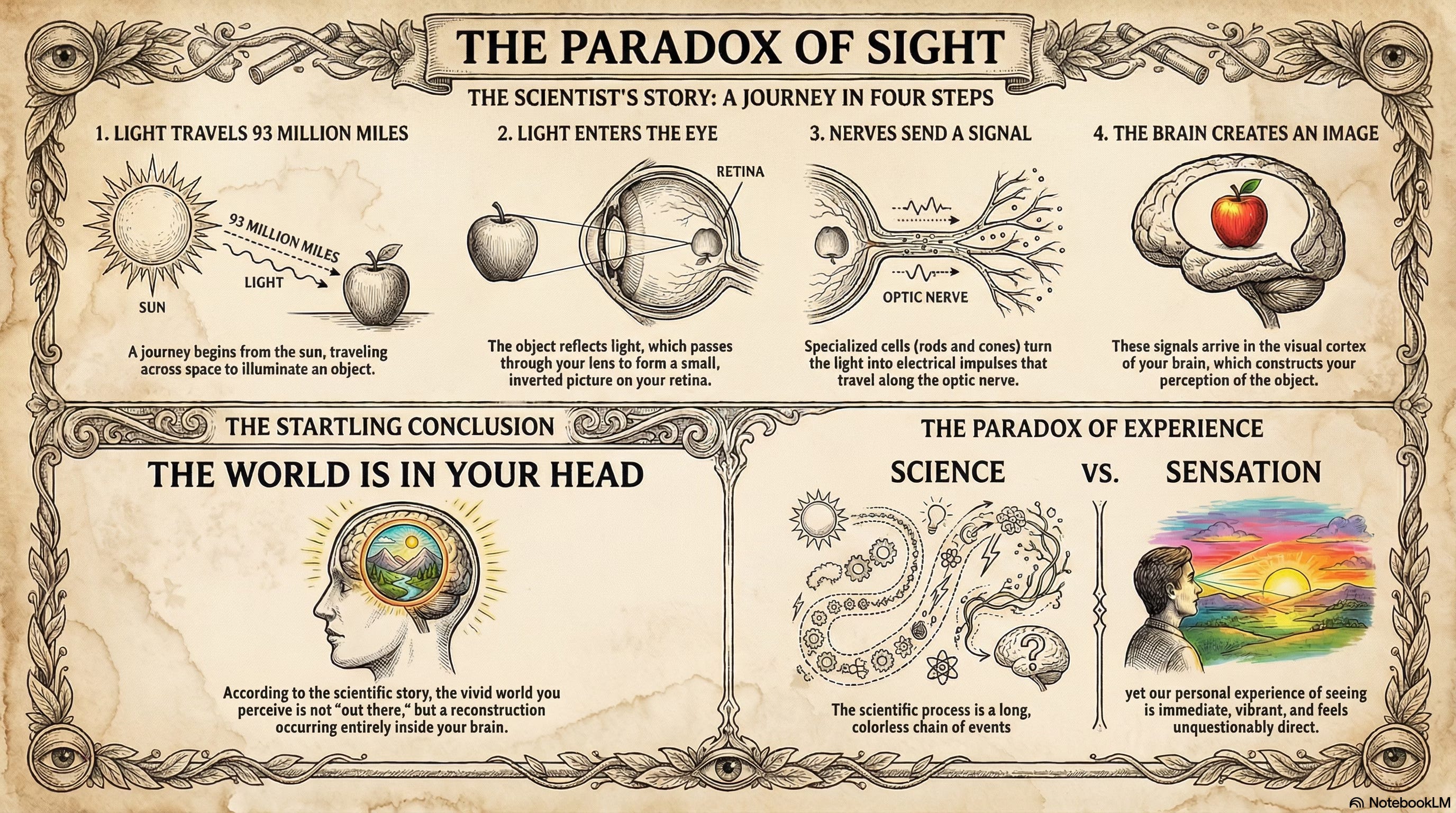
Hierarchy of Heaven and Earth - Chapter Two
Jan 500:10:45Tap to summarizeIn today’s episode we continue with Chapter Two of The Hierarchy of Heaven and Earth by Douglas Harding. In this chapter, Harding tackles the paradox of experience. We experience the world via sights, sounds and feelings, and in that way the world is “in us”. On the other hand, science explains how the world comes to be experienced through a long complicated chain of events spanning millions of miles and involving an “immense herd of blind and tethered animals” (i.e. the cells of my eye).As we saw in the last episode, focused on Chapter One, the answer to this paradox is two-fold. For myself, I am the openness, the empty capacity for the world to appear in. For the scientist, I am a complex perception machine, just another thing in the world. I view these as two aspects of the same reality. I don’t feel I have to choose one over the other. Rather I can just marvel in the both/and nature of being me. This is a public episode. If you would like to discuss this with other subscribers or get access to bonus episodes, visit headlessdeepdive.substack.com
Transcribe →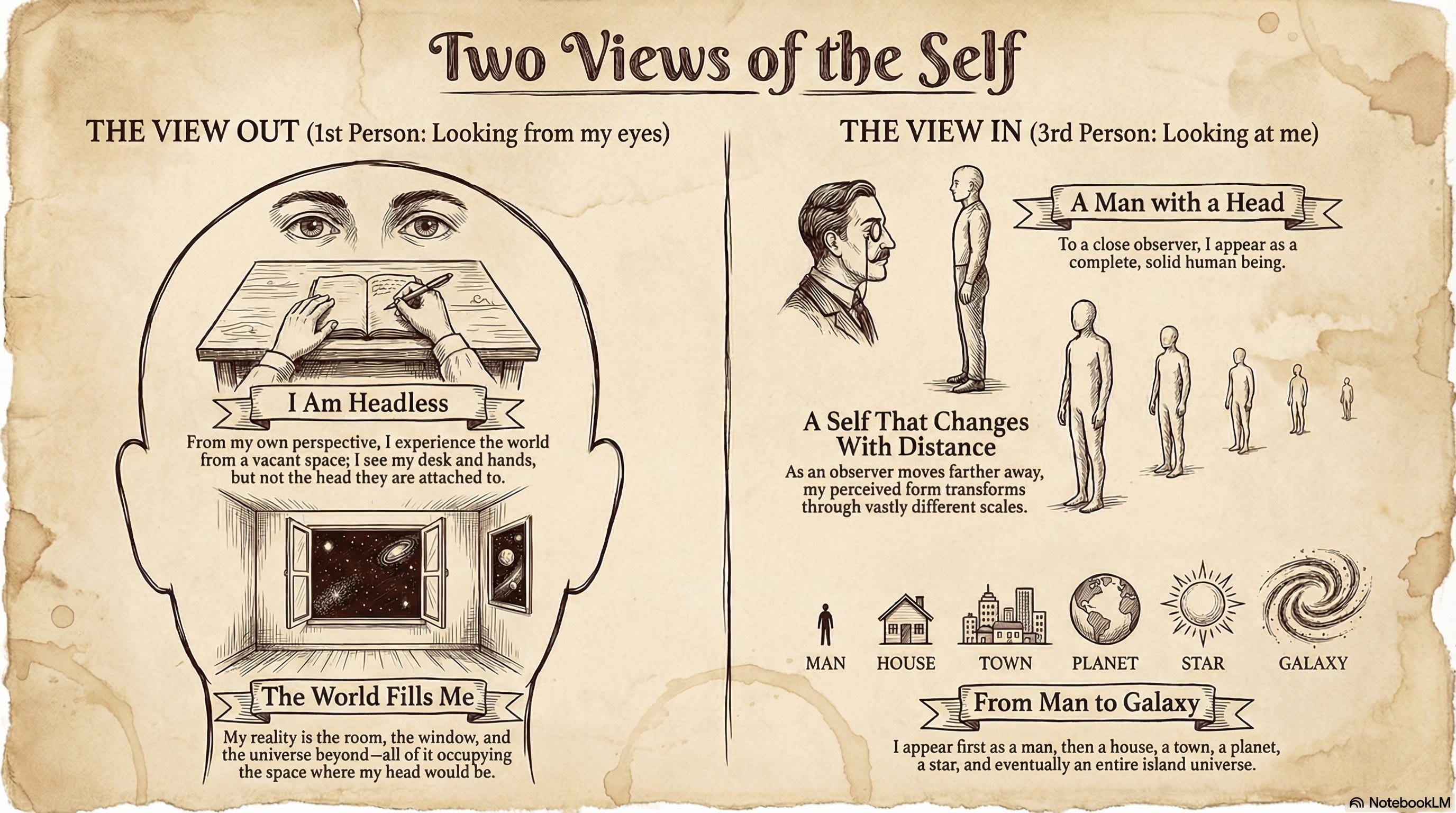
Hierarchy Of Heaven and Earth - Chapter One
Dec 2600:11:19Tap to summarizeToday, we go back to the roots of the Headless Deep Dive and look at chapter one of Douglas Harding’s book: The Hierarchy of Heaven and Earth. There is a fantastic new-ish website which serves as an archive for much of Douglas’s material, where this chapter can be found among many other things like his original handwritten notes, and various photos, etc. The Hierarchy of Heaven and Earth, is Douglas Harding’s philosophical masterpiece where he seeks to answer the question “What am I”? Chapter One of the book gives us the simple, yet not intuitive, two-fold answer. What I am for myself is wide open capacity for all the sights, sounds, feelings, thoughts and emotions that fill my first-person point of view. What I am for others depends on the range of that other observer. At a certain range I am a person. Closer up, I am cells and molecules. Further away I am a town, a country, a planet, a star or a galaxy. We spend so much time in our youth learning to be a member of the human club, that we forgot that is only one of the clubs we could belong to. Looking out at the night sky and pointing at Andromeda, I see my multi-layered self and can identify any of those layers with the same open center. I can identify my human self with that pointing hand I see, my earthly self with the moon I see, my solar self with the other stars I see and my Milky-way self with Andromeda. This is a public episode. If you would like to discuss this with other subscribers or get access to bonus episodes, visit headlessdeepdive.substack.com
Transcribe →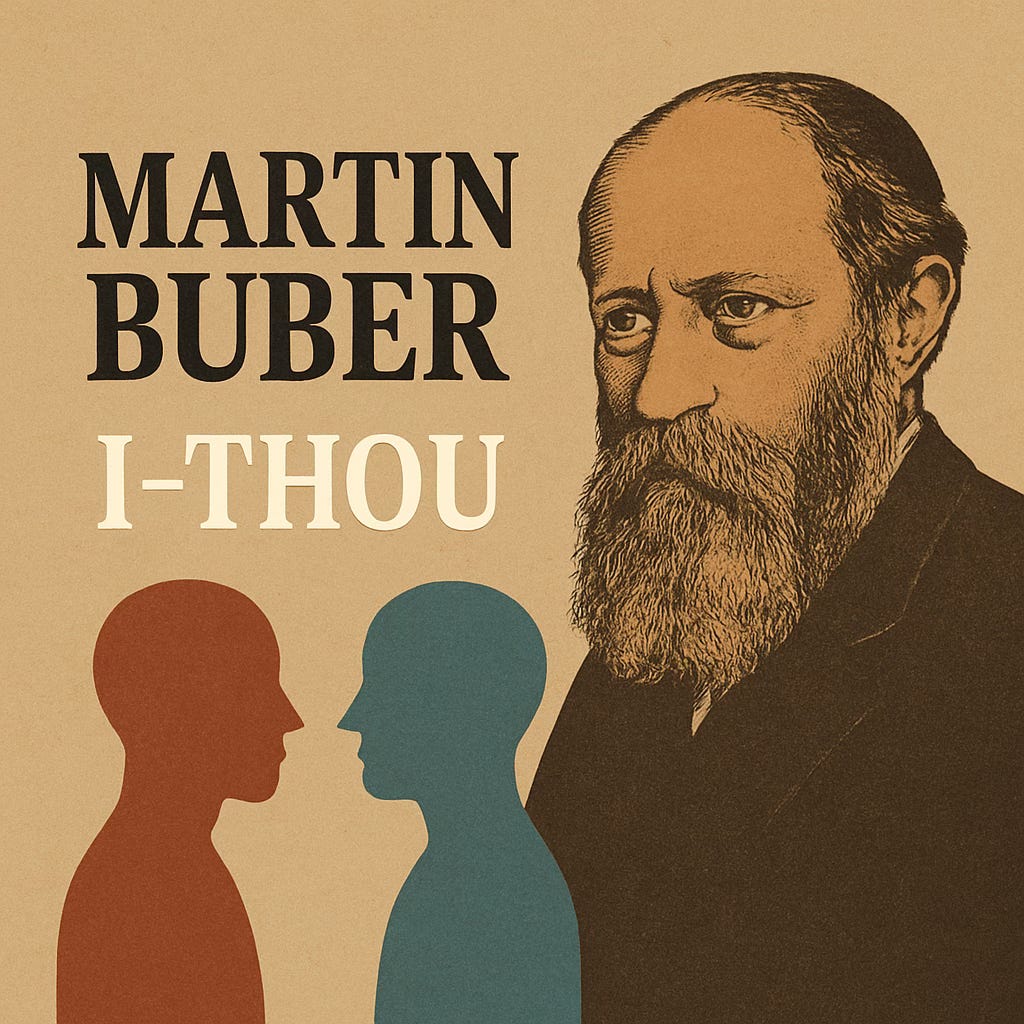
Martin Buber - I and Thou
Oct 1100:05:50Tap to summarizeMartin Buber’s I and Thou is the topic of this week’s Headless Deep Dive. In this classic work of philosophy, Buber explains that we have a two-fold existence. First there is the world of “I-Thou” relationship. This is the world of being here now, meeting the world in mutual relation, which makes it clear to us that “I am”. Then there is the world of “I-It”. This is the world of living in the past, experiencing a world of separateness and objectification, which makes us feel like another thing among things.Both these worlds are a necessary part of being human, but we can easily get lost in the I-It way of experiencing the world. Fear not, all is not lost. Buber points out that we can use the power of “reversal” to look back to our being at center and come out of the past, come out of our thoughts, and into the now. This resonates deeply with the Headless Way experiments of Douglas Harding, where we direct our attention back to the place we are looking out of, back to where the sense of “I am” meets the world with no dividing line between I and Thou.So do you experience the world, or do you meet it? This is a public episode. If you would like to discuss this with other subscribers or get access to bonus episodes, visit headlessdeepdive.substack.com
Transcribe →
Brentyn Ramm - Body, Self and Others
Sep 2300:22:27Tap to summarizeBuilding on the last episode where we explored the thoughts of Merleau-Ponty, in today’s episode we look at this fabulous article by philosopher and researcher Brentyn Ramm entitled Body, Self and Others: Harding, Sartre and Merleau-Ponty on Intersubjectivity in which Ramm tackles the differing ways Maurice Merleau-Ponty, Jean Paul Satre, and Douglas Harding all address the topic of intersubjectivity.I love the way this paper looks at the problem of how it is that we all have our own private view of the world and yet we all agree at some level about what is happening “out there”. In this paper, Ramm walks thru Merleau-Ponty’s views on the merged body-subject where subject and body are inseparable, the notion of Sartre's “Look” where our own self-consciousness comes from the gaze of others, and (my personal favorite) Harding’s explanation that “mind” is the view-out and “body” is the view-in.By walking through some of Harding’s experiments, Ramm also shows the reader how to see for themselves that the view-out is nothing but spaciousness encompassing the whole world, while simultaneously the view-in from another’s perspective is a small and limited body (at least at the range of a few feet or so). I find this to be an elegant solution to the mind-body problem — there is no problem. We don’t have to solve the question of how a “mind” can spring up from a “body” when we realize that mind and body are two different points of view on the same phenomenon. Or as Douglas Harding puts it: My mind is your body, and my body is your mindI hope you enjoy listening to this one and follow along with the experiments to see for yourself whether this is true for you. This is a public episode. If you would like to discuss this with other subscribers or get access to bonus episodes, visit headlessdeepdive.substack.com
Transcribe →
Merleau-Ponty - The Visible and the Invisible
Sep 100:13:29Tap to summarizeFrench philosopher Maurice Merleau-Ponty was working on a book tentatively titled “The Visible and the Invisible” at the time of his death in 1961. Merleau-Ponty points out that even the simple statement “the world is what we see” leads to a “labyrinth of difficulties and contradictions” about what we mean by the difference between us and the world or what exactly seeing is. In exploring this topic, Merleau-Ponty adopts a similar first-person science perspective as Douglas Harding. For instance, notice that the world is not a static thing but rather it is a moving world. Merleau-Ponty wrestles with the paradox of being in the world and yet having the world is in him. He even has a Harding-like experiment with his right hand touching his left hand then realizing that the left hand feels in the opposite direction. Each hand feels “the world” out there as an internal sensation and thus the world is somehow in both hands — a private yet shared world.I find that it is these sorts of paradoxes that dissolve the certainty and solidity of being a certain human seeing the world in a certain way and then having to reconcile it with others who see the world differently. The beauty is that we all share the mystery of being, but none of us is in the position to say how the world truly is. This is a public episode. If you would like to discuss this with other subscribers or get access to bonus episodes, visit headlessdeepdive.substack.com
Transcribe →
Seth - The sense of "me"
Aug 10, 202500:15:02Tap to summarizeDouglas Harding says that what I am is two fold. Who I am for others depends on the range of the observer. Who I am for myself is wide open awareness. In today’s episode, we look at a paper by Anil Seth and Manos Tsakiris titled “Being a beast machine: the somatic basis of selfhood” where they explore who I “think” am, or more specifically the model of “me” that I predict that I am.The parts of this that stand out to me are that I don’t perceive a given world and passively take it in as it is. I predict what the world will be and then adjust my predictions constantly. Similarly, I don’t “have” a self that I’m sensing, I’m predicting a self as a way of regulating the many processes involved in staying alive as an organism. In this way the sense of “self” is like other senses, it is something I am predicting will occur and I’m constantly experiencing the prediction.The feeling of being "me" is what I think it would feel like if I actually were a "me", whatever that is. This is a public episode. If you would like to discuss this with other subscribers or get access to bonus episodes, visit headlessdeepdive.substack.com
Transcribe →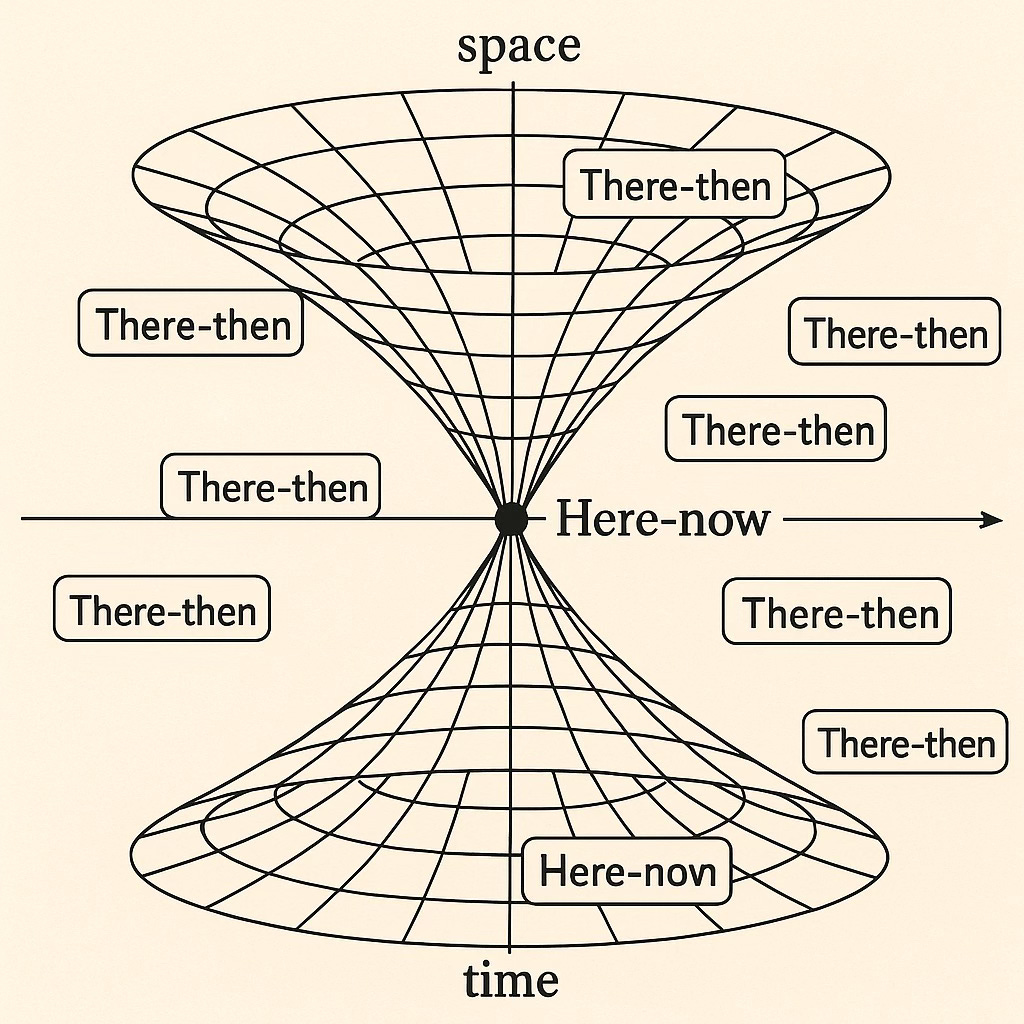
Bertrand Russell - The ABC's of Relativity
May 26, 202500:13:06Tap to summarizeIn the ABC’s of Relativity, Bertrand Russell explains the strange world of Einstein’s general relativity. One of the most interesting aspects of the theory is not that “everything is relative” in the sense of there being no way to be certain of anything or to discuss anything concretely, it is that everything is relative to a well defined frame of reference. In general relativity there are not separate dimensions of space and time but rather one has to consider a combined fabric of spacetime. A frame of reference in spacetime is a particular here and a particular now, which we could think of as “here-now”. I think this concept coincides very well with Douglas Harding’s concept of the “centre”. The center of our experience is a particular here-now. As persons, I have a here-now and you have a here-now. They are so similar that we can agree on what is “there” and “then” but this is just relative to our frame of reference moving together on this earth. You could say that, as Earth, we all have the same here-now and in that way we are all one at center. “There” and “then” are relative to a certain “here-now”. Douglas Harding talks about an object of our awareness being “there” from “here”. In Harding’s language, the “view out” is unique to each center, to each “here-now” while the “view in” is what we share since there is nothing (no-thing) here to compare to any other view in. The unique “view out” also implies that we are, as some spiritual traditions believe, co-creators of our own universes. When I look out at the world, “there” and “then”, I am really looking at “my” world. I am looking at the ever changing world as seen from the never changing here-now that I Am. As Ram Das says, “Be here-now”. This is a public episode. If you would like to discuss this with other subscribers or get access to bonus episodes, visit headlessdeepdive.substack.com
Transcribe →