Loading summary
Transcript239 lines
- [00:06]
Jonathan Goldstein
Pushkin. Hello, I'd like to welcome to the show Jackie Cohen. Bye bye, Jackie.
- [00:18]
Etta Ehrlich
Bye bye.
- [00:19]
Jonathan Goldstein
Now, it's a new season. I'm with a new company, Pushkin Industries, and I thought it might be nice for you to, you know, tell everyone how much the show has meant to you.
- [00:30]
Etta Ehrlich
Can you see the look on my face right now?
- [00:32]
Jonathan Goldstein
We're on the telephone.
- [00:33]
Etta Ehrlich
Can you imagine what kind of look I have on my face right now?
- [00:35]
Jonathan Goldstein
Ecstasy.
- [00:36]
Etta Ehrlich
Disgust.
- [00:37]
Jonathan Goldstein
Heavyweight is back. Mamala. They thought we were down for the count.
- [00:40]
Gregor
Can I hang up now?
- [00:41]
Jonathan Goldstein
But what's this? Oh, oh. With a right and a left. Heavyweight's back pushing it with Pushkin Mamela. Pushkin Industries.
- [00:50]
Gregor
Okay, I got it. I gotta go.
- [00:52]
Jonathan Goldstein
Okay, you go with that. Bye. Bye. From Pushkin Industries. Hey, guys, I'm Jonathan Goldstein, and this is Heavyweight. Today's episode, Etta, right after the break. This is an Iheart podcast.
- [01:26]
T-Mobile Advertiser
In today's super competitive business environment, the edge goes to those who push harder, move faster, and. And level up every tool in their arsenal. T Mobile knows all about that. They're now the best network, according to the Experts@ookla Speedtest. And they're using that network to launch Super Mobile. The first and only business plan to combine intelligent performance, built in security, and seamless satellite coverage. That's your business. Supercharged. Learn more@supermobile.com Seamless coverage with compatible devices in most outdoor areas in the US where you can see the sky. Best network, based on analysis by Ookla of Speedtest Intelligence Data 1H 2025.
- [02:11]
Manny
Why are TSA rules so confusing?
- [02:14]
Gregor
You got a hoodie on. Take it off.
- [02:16]
Manny
I'm Manny.
- [02:17]
Gregor
I'm Noah.
- [02:17]
Dimitri
This is Devin.
- [02:18]
Manny
And we're best friends and journalists with a new podcast called no Such Thing, where we get to the bottom of questions like that. Why are you screaming at me? I can't expect. What to do now? If the rule was the same, Go off on me. I deserve it, you know?
- [02:31]
Jonathan Goldstein
Lock him up.
- [02:32]
Manny
Listen to no Such thing on the iHeartrad, Apple Podcasts or wherever you get your podcasts.
- [02:38]
Gregor
No such thing.
- [02:47]
Dimitri
All right, you ready? You're rolling. You got levels?
- [02:49]
Jonathan Goldstein
Me. Me. Ma.
- [02:50]
Dimitri
Moo. Okay, go.
- [02:52]
Jonathan Goldstein
This is Gregor. You might know him from such previous episodes as Gregor. Gregor is one of my oldest friends, and today he's coming to me with a problem.
- [03:03]
Dimitri
I'll take it from the top. Okay, so I have two parents, Milton and Etta.
- [03:09]
Jonathan Goldstein
Etta and Milton are both pushing 90. And Gregor's problem is that they refuse to move out of their House. It's the same three story Victorian Gregor grew up in. He was 12 when the family first moved in. He still remembers the excitement as they unloaded boxes from the moving truck or moving trucks.
- [03:32]
Dimitri
You know, normal people move with like a big giant 18 wheeler moving truck. I believe when we moved, we had six moving trucks.
- [03:39]
Jonathan Goldstein
One for the family's belongings, the other five for the collections. Some people collect coins, some people collect comic books. Gregor's mother, Etta, collects collections.
- [03:52]
Dimitri
She has like maybe 200 egg beaters. Antique egg beaters she has. Do you know what a bisquenader is?
- [04:01]
Jonathan Goldstein
No.
- [04:02]
Dimitri
In occupied Japan, people bought these little figurines where the head would wobble back.
- [04:07]
Jonathan Goldstein
And forth like a bobble headed doll.
- [04:08]
Dimitri
Something like that. Anyway, she probably has 2,000 bisquenters.
- [04:12]
Jonathan Goldstein
Then there are the 19th century weaving looms, the handmade baskets, the medieval scythes. Etta Ehrlich is an artist and her collections are the source of her inspiration. Etta sees beauty in everything, and in her hands, everything becomes art. She'll sculpt lint from the dryer. She'll put googly eyes on a splatter of dried bird poop.
- [04:34]
Dimitri
My mother has been unbelievably prolific in making art for like the last 35 years to a degree, where now the living room is like full to the brim with a million pieces of art. And every week she probably makes five or ten more pieces of art.
- [04:49]
Jonathan Goldstein
None of this would be a problem, except that a large cluttered house is becoming increasingly dangerous for Gregor's elderly parents.
- [04:57]
Dimitri
I fear the more conventional fears. I fear my mother falling down a flight of stairs, or my father. I mean, there's all kinds of dark things that can happen in a house full of staircases.
- [05:07]
Jonathan Goldstein
And so Gregor wants to move his parents into a smaller apartment, something more manageable. That's his plan?
- [05:14]
Etta Ehrlich
Yeah, that's his plan. But that's not my plan.
- [05:18]
Jonathan Goldstein
This is.
- [05:19]
Etta Ehrlich
Etta, the practical thing is we can't be in the house too much longer. I'm 88. Yeah, but to move out of the house isn't simply a question of selling the furniture. It's. My God, what do we do with all this?
- [05:37]
Jonathan Goldstein
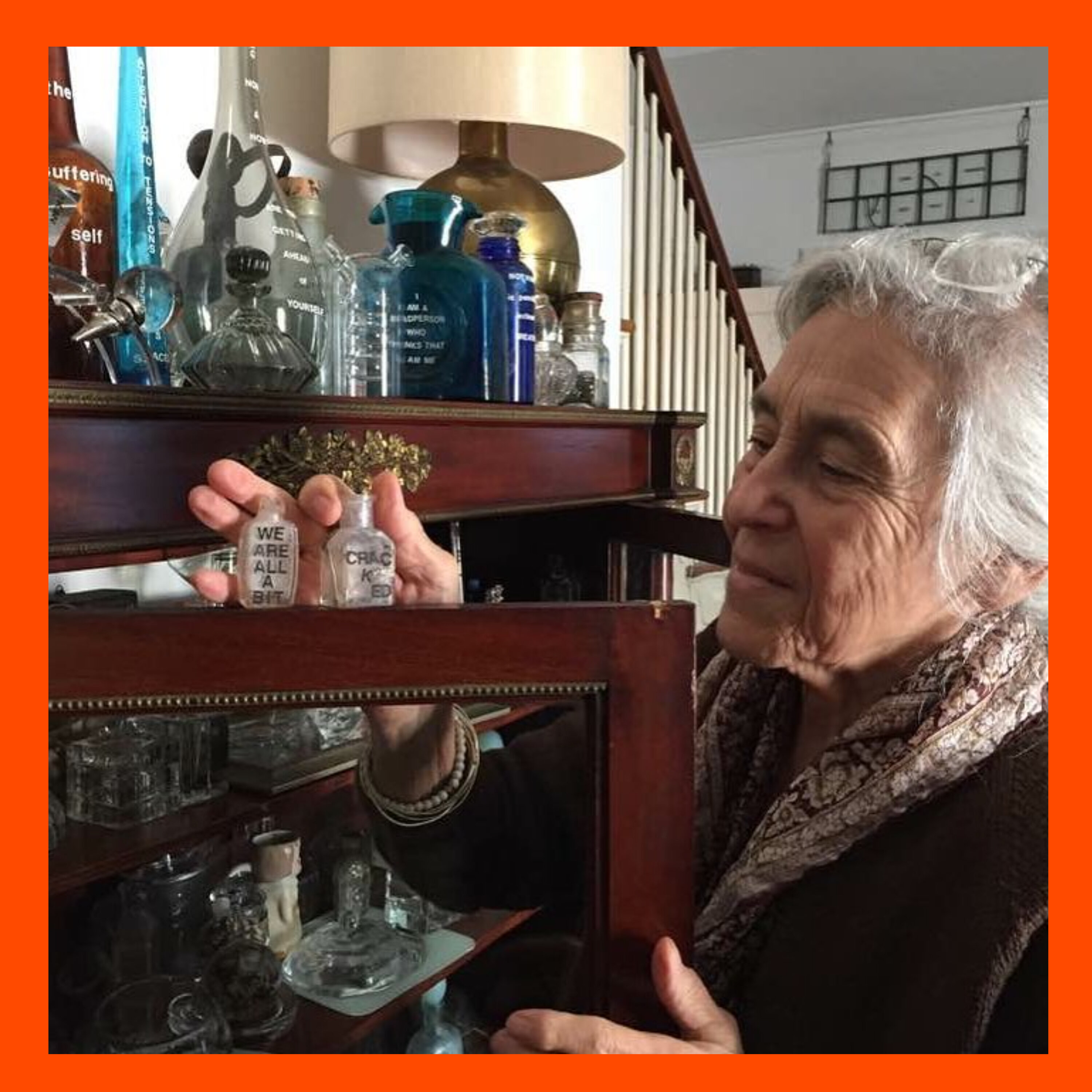
All this, all the collections is what's keeping Etta in the house. And of all her many collections, of all her milking stools and antique rolling pins, it's her collection of fragile, colorful bottles that is perhaps the biggest impediment to moving. By Gregor's estimate, Etta has thousands. Wine bottles, perfume bottles, old decanters, bottles washed up from the bottom of the ocean. As well as being an artist, Etta is a Buddhist and her bottles are not just bottles, but a series of meditations. Because on each of the bottles, in fancy fonts and careful calligraphy, Etta places a message in the form of a Zen like riddle.
- [06:19]
Etta Ehrlich
I turn my noose to tightropuse and madly dance upon it. Isn't that gorgeous? That's very nice, but how's about this one? It's a black bottle with gold calligraphy and it has the first letter shows. Oh, breath. Somebody blowing a breath. Do you see it?
- [06:38]
Jonathan Goldstein
It really does look like a breath is blowing. That's by design.
- [06:40]
Etta Ehrlich
There you go. There you go. You want me to give that away for nothing?
- [06:48]
Jonathan Goldstein
Other inscriptions are stop schlepping your old being into the future. Or we cling to illusions of control. After hearing a few, I start to recognize a theme. All the bottles bear messages imploring one to let go. Yet Etta is incapable of letting go of the very bottles doing the imploring or much of anything else. There is a little bit of a paradox or there's something to kind of be struggling with here.
- [07:16]
Etta Ehrlich
You're very, very sharp. That is exactly, exactly true. These works which talk about being stuck with the grasping level, I suffer from that.
- [07:32]
Gregor
I could leave tomorrow.
- [07:34]
Jonathan Goldstein
This is Gregor's dad, Milt. If the taxi pulled up right now, you would jump in.
- [07:40]
Gregor
I'm ready to go. Yeah, I'll stop you there. He's never taken a taxi in his.
- [07:44]
Jonathan Goldstein
Life, but if I pulled up, I.
- [07:45]
Gregor
Think he'd get it. Uber duber. I don't get attached to furniture and bottles and stuff. Oh, just reinforce that point that while my father made posit that he's a daoist and not attached to anything, he is very much complicit, relentlessly bringing home the raw material through which my mother, you know, turns the art out.
- [08:07]
Jonathan Goldstein
When was the last time you brought something home, Milt?
- [08:11]
Gregor
Yesterday. I'm always interested in what she's doing, and I often find the raw materials walking around in the woods or anywhere. Find stuff. Her only requirement is if I find something, it has to have what she calls charm.
- [08:27]
Jonathan Goldstein
As for Milt, what he's charmed by, exceedingly charmed by, is Etta. Milt is a poet, and after over 60 years of marriage, he still writes poems about her, rhapsodizing about the way she creates art or cooks or the way she dances. Milt says he can watch Etta dance all night. He just doesn't understand her being so chained to her belongings.
- [08:51]
Etta Ehrlich
I'm stuck. But I am not coming up with a solution that's any better, am I?
- [08:58]
Jonathan Goldstein
Yeah.
- [08:59]
Etta Ehrlich
You know, except dying.
- [09:03]
Jonathan Goldstein
That's not a solution.
- [09:04]
Etta Ehrlich
No, it's not a solution for Greg. He's left holding the whole thing.
- [09:10]
Jonathan Goldstein
Of Milton Etta's three kids, Gregor is perhaps the one most ready to serve the child. His parents hand a to do list when he comes to visit.
- [09:19]
Etta Ehrlich
I mean, he talks mean, and that's because he has meanness in him. I'm not saying he doesn't, but he's also a very kind, giving, generous, loving person.
- [09:31]
Jonathan Goldstein
Yes, he is. Yeah.
- [09:32]
Etta Ehrlich
Yeah. Don't tell him I said so.
- [09:41]
Dimitri
Inaction is a choice. Not doing anything. Something's bound to happen sooner or later and just sort of watch the second hand sweep around the clock face until somebody's dead is the most passive and weakest possible way to exist and die. It just feels like, you know, the Damoclean sword of mortality is coming. And all we're going to do is sit here and watch Rachel Maddow until it cuts our head off.
- [10:07]
Jonathan Goldstein
And so, because Edda can't let go, Gregor wants my help in pulling off a most extravagant workaround. One that will allow Etta to both keep her stuff and still move out. The plan of action that Gregor wants to present to her.
- [10:22]
Dimitri
What if you don't get rid of your possessions and we make a museum of your stuff?
- [10:30]
Jonathan Goldstein
Gregor explains to me the details. It seems that in the 1960s, Etta and Milt bought a 200-year-old farmhouse with no running water or indoor plumbing. Gregor's plan is to convert the barn into the Etta B. Ehrlich Museum. Convincing one's mother to downsize by way of a feral farmhouse museum that by Greger's own admission is probably a breeding ground for the hantavirus. Has all the makings of a classic cockamamie scheme. But this is just the begin.
- [11:12]
Gregor
Foreign.
- [11:17]
T-Mobile Advertiser
Super competitive business environment. The edge goes to those who push harder, move faster, and level up every tool in their arsenal. T Mobile knows all about that. They're now the best network according to the experts at Ookla speed test. And they're using that network to launch Super Mobile. The first and only business plan to combine intelligent performance, built in security and seamless satellite coverage. With Super Mobile, your performance, security and coverage are supercharged. With a network that adapts in real time, your business stays operating at peak capacity even in times of high demand. With built in security on the first nationwide 5G advanced network, you keep private Data private for you, your team, your clients. And with seamless coverage from the world's largest satellite to mobile Constellation, your whole team can text and stay updated even when they're off the grid. That's your business. Supercharged. Learn more@supermobile.com seamless coverage with compatible devices in most outdoor areas in the US where you can see the sky. Best network based on analysis by Ookla of Speed Test Intelligence Data 1H 2025.
- [12:33]
Manny
Imagine that you're on an airplane and all of a sudden you hear this.
- [12:37]
Etta Ehrlich
Attention passengers.
- [12:38]
Jonathan Goldstein
The pilot is having an emergency and we need someone, anyone to land this plane.
- [12:45]
Manny
Think you could do it? It turns out that nearly 50% of men think that they could land the plane with the help of air traffic control. And they're saying like, okay, pull this. Until this, pull that, turn this. It's just I can do my eyes closed. I'm Manny.
- [12:59]
Jonathan Goldstein
I'm Noah.
- [13:00]
Dimitri
This is Devin.
- [13:01]
Manny
And on our new show, no Such Thing, we get to the bottom of questions like these. Join us as we talk to the leading expert on overconfidence.
- [13:10]
T-Mobile Advertiser
Those who lack expertise lack the expertise.
- [13:13]
Jonathan Goldstein
They need to recognize that they lack expertise.
- [13:16]
Manny
And then as we try the whole thing out for real. Wait, what? Oh, that's the Runway. I'm looking at this thing.
- [13:23]
Jonathan Goldstein
See?
- [13:24]
Manny
Listen to no Such thing on the iHeartRadio app, Apple Podcasts, or wherever you get your podcasts.
- [13:33]
Jonathan Goldstein
For his plan to build a museum to work, Gregor will need his siblings on board. So as his emotional envoy, I begin by phoning his sister Lexi. Lexi is the level headed one of the three, and I want to get her read on the plan. I mean, is it realistic that he'll be able to turn the barn into a museum like that? Perhaps this plan is a bit half baked, but I figure I might have more luck getting Gregor's brother Dimitri on board. Dimitri's never been afraid of a scheme that runs a little pink on the inside, so I give him a call. We haven't spoken since I moved from New York, where Dimitri lives, to Minnesota.
- [14:20]
Gregor
I hate to see a Minneapolis area code when you call. It makes me sad your business doesn't.
- [14:27]
Jonathan Goldstein
Bring you to Minnesota.
- [14:28]
Gregor
I'm guessing it does sometimes. I interviewed Prince for a cover story. Everyone warned me to be very careful with Prince. He's very touchy.
- [14:35]
Jonathan Goldstein
Dimitri is a personal trainer who's kickboxed his way across Thailand. Also a journalist who interviews celebrities.
- [14:41]
Gregor
So I went there, waited all day for the interview.
- [14:44]
Jonathan Goldstein
And a musician who had a song go platinum six times in Belgium was.
- [14:48]
Gregor
Like, hey, you want to jam? And I was like, okay. So I wound up actually jamming with Larry, Graham, and Prince for, like, 20 minutes.
- [14:59]
Jonathan Goldstein
What?
- [15:00]
Gregor
That was one sentence.
- [15:03]
Jonathan Goldstein
Before Dimitri can launch into his next sentence, I jump in. So your brother Gregor.
- [15:09]
Gregor
Yeah, I'm familiar with it.
- [15:10]
Jonathan Goldstein
He has this plan, which maybe you're also familiar with. When I'm finished rehashing Gregor's museum plan, Dimitri offers a laundry list of issues.
- [15:20]
Gregor
There's a 99 to 100% chance of getting Lyme disease walking out of your part of the barn because it's high grass, a lot of deer getting poison ivy. So there's also, like, horrible black mold because, as you know, the farmhouse burned down when my albino baker friend Theo stayed there and lit a fire, and the roof and the whole house burned down.
- [15:38]
Jonathan Goldstein
And along with his friend Theo's trouble, there was also his friend Sonam's trouble in that cursed place.
- [15:43]
Gregor
My friend, who spent 25 years as a Buddhist monk under the Dalai Lama, had to use a broom to fight off a very large raccoon that was in the house and was, like, growling at us like a. Just horrifying.
- [15:53]
Jonathan Goldstein
But for Dimitri, even more daunting than the rabid raccoons is changing his mother's mind on the matter. Whenever he's tried to clear space in his parents home, it refills overnight, suggesting Etta's problem can't be solved by physical means. Instead, he thinks the problem has to be attacked at its psychological root. She needs to learn how to let go. And for this, Dimitri has just the solution.
- [16:19]
Gregor
Well, maybe hypnosis. It stops her from smoking, which is probably a more powerful psychological and physical addiction than collecting things.
- [16:30]
Jonathan Goldstein
Etta was a pack a day smoker, a habit she hung onto for nearly 30 years.
- [16:35]
Gregor
Our friend, who was a hypnotist, said, oh, I can hypnotize you. And she went into the session thinking, this isn't gonna work. The whole time the hypnosis was going on, she was like, this isn't working. This isn't working. And then she walked out and never smoked again. He was an interesting person, too. His name was Saul Feldstein. He actually had one of his eyeballs was, like, hanging out of his head face. And it was like a sort of early commune hippie thing.
- [16:57]
Jonathan Goldstein
Having grown up on TV sitcoms of the 1970s, I'm well aware of the power of hypnosis hanging out of his face. Hypnosis gave Fred Flintstone the self control to stop eating brontosaurus burgers. It Gave the Fonz the confidence that jumped Snake Canyon on his motorcycle as a boy. I always wondered what it would feel like to have my full potential unlocked through the hypnotic arts hanging out of his face.
- [17:23]
Gregor
And he was very successful as a hypnotist.
- [17:27]
Jonathan Goldstein
Wow. Unlike building a museum, hypnosis requires neither time, effort, nor those awful stanchions that snap back with that loud thwacking sound that make everyone turn around and stare at you. Fully convinced that Saul Feldstein is the solution to all of our problems and that museums belong in a museum, Dimitri and I say our goodbyes.
- [17:58]
Dimitri
We're slating in on part two. Johnny discusses post talking to Dimitri. Here we go.
- [18:03]
Jonathan Goldstein
I need to tell Gregor that I like Dimitri's idea much better than his, but I need to tread lightly. From Cain and Abel to Stephen and Alec Baldwin. I know how competitive brothers can be. And unlike the Lord or Alexander Ray Baldwin Sr. I don't want to be seen playing favorites. Do you think you're that, like, hypnotism has a role in this?
- [18:28]
Dimitri
Well, I hear that, like, your voice went up an octave when we started talking about hypnotism and you got excited about hypnotism.
- [18:33]
Jonathan Goldstein
Well, Dimitri seemed to think that it could help.
- [18:37]
Dimitri
Okay, so the two of you should go see a movie together.
- [18:40]
Jonathan Goldstein
Going to movies is Gregor and my thing. Clearly, I'm arousing some jealousy. I need to keep my arguments away from Demetri and grounded in the merits of hypnotism. This whole barn thing as the symptom, but through hypnosis.
- [18:56]
Dimitri
Why are you saying it with, like, the weird accent on the word hypnosis?
- [19:00]
Jonathan Goldstein
I mean, do you think that hypnotism has something to offer here?
- [19:05]
Dimitri
My short answer would be, absolutely not. I think it's a waste of time. Hypnosis. Hypnosis. Hypnosis.
- [19:17]
Gregor
Hi, Johnny. How are you?
- [19:18]
Jonathan Goldstein
Hey, Dimitri. Hi. I've got your brother Gregor on the line with me.
- [19:23]
Dimitri
We've met.
- [19:24]
Jonathan Goldstein
Hi.
- [19:25]
Gregor
How are you?
- [19:26]
Jonathan Goldstein
Can you make the case to your brother?
- [19:28]
Gregor
Sure. I just think that, you know, there's no harm, there's certainly no nothing to lose. It takes 15 or 20 minutes. And she's proven that she's very susceptible to hypnotic suggestions. So why not try it?
- [19:39]
Dimitri
I agree with all those points. My main feeling is that getting someone to stop a behavior like smoking is much, much easier than getting someone to change their personality, which is harder to hypnotize someone out of.
- [19:50]
Gregor
That may be true. I wouldn't disagree. There.
- [19:52]
Jonathan Goldstein
Swept up in a wave of brotherly bonhomie. I decide it's a safe space to cautiously share my one secret boyhood longing. And along the way, I could get hypnotized that as something too.
- [20:05]
Dimitri
Yeah, a lot of stuff.
- [20:06]
Jonathan Goldstein
Yeah, and immediately regret it. What do you mean a lot of stuff?
- [20:10]
Gregor
I mean that smug smile they could work on.
- [20:12]
Dimitri
We could give you a whole brand new thing where you're like super charming all the time.
- [20:15]
Gregor
Being more able to look people in.
- [20:17]
Dimitri
The eye, not always hide behind a microphone.
- [20:20]
Gregor
Actually, you know, there is all joking aside, there is a new hypnosis that works on what's called voluntary baldness syndrome, where they realize that a lot of men are sort of doing it on purpose.
- [20:29]
Jonathan Goldstein
Why would someone do that on purpose?
- [20:32]
Gregor
Well, it's just that it turns out that hair loss is more of like an act of willful insolence, often and a cry for pity.
- [20:38]
Jonathan Goldstein
I used to love my hair.
- [20:40]
Gregor
Well, if you loved it so much, why did you get rid of it?
- [20:43]
Jonathan Goldstein
First of all, I find it offensive. And Gregor, chime in here because I'm sure you're equally offended.
- [20:48]
Dimitri
No, Dimitri used to be bald as an egg and then he willed it back on.
- [20:53]
Gregor
I think if you did at the same time with my mother, we can get a two for one deal.
- [20:56]
Dimitri
Package deal.
- [20:57]
Gregor
I'm just saying it's science. If you read the New England Journal of Medicine.
- [21:03]
Jonathan Goldstein
With Gregor and Dimitri aligned and friends again at my expense, I set out in search of the one eyed hippie hypnotist Saul Feldstein. But it turns out Saul died in 2019 at the age of 92. So I reach out to other hypnotists, all of whom pretty much hang up on me once I explain the project. So hypnotism is out, the museum is out. I'm stuck with my crap personality and Etta is stuck with her house full of crap. And Gregor is still at an impasse. But things are about to change. Coming up after the break, Etta's big night. You know what that guy said to me just now?
- [21:45]
Etta Ehrlich
This guy told me that I was beautiful.
- [21:48]
Dimitri
Well, you are. What's going on here?
- [22:02]
T-Mobile Advertiser
In today's super competitive business environment, the edge goes to those who push harder, move faster, and level up every tool in their arsenal. T Mobile knows all about that. They're now the best network according to the experts at Ookla Speed test. And they're using that network to launch Super Mobile, the first and only business plan to combine intelligent performance, built in security, and seamless satellite coverage. With Super Mobile, your performance, security and coverage are supercharged. With a network that adapts in real time, your business stays operating at peak capacity even in times of high demand. With built in security on the first nationwide 5G advanced network, you keep private data private for you, your team, your clients. And with seamless coverage from the world's largest satellite to mobile constellation, your whole team can text and stay updated even when they're off the grid. That's your business. Supercharged. Learn more@supermobile.com seamless coverage with compatible devices in most outdoor areas in the US where you can see the sky. Best network based on analysis by Ookla of Speed Test Intelligence Data 1H 2025.
- [23:17]
Manny
Imagine that you're on an airplane and all of a sudden you hear this.
- [23:21]
Etta Ehrlich
Attention passengers.
- [23:23]
Jonathan Goldstein
The pilot is having an emergency and we need someone, anyone, to land this plane.
- [23:29]
Manny
Think you could do it? It turns out that nearly 50% of men think that they could land the plane with the help of air traffic control. And they're saying like, okay, pull this. Until this, pull that, turn this. It's just I do my eyes closed. I'm Manny.
- [23:44]
Jonathan Goldstein
I'm Noah.
- [23:44]
Dimitri
This is Devin.
- [23:45]
Manny
And on our new show, no Such Thing, we get to the bottom of questions that like these. Join us as we talk to the leading expert on overconfidence.
- [23:54]
T-Mobile Advertiser
Those who lack expertise lack the expertise.
- [23:57]
Jonathan Goldstein
They need to recognize that they lack expertise.
- [24:01]
Manny
And then as we try the whole thing out for real. Wait, what? Oh, that's the run, right? I'm looking at this thing. See, listen to no Such thing on the iHeartRadio app, Apple Podcasts, or wherever you get your podcasts.
- [24:18]
Jonathan Goldstein
Gregor tells me that Etta has been offered a show at the Carter Burden Gallery in Manhattan. Etta is an outsider artist, so the offer of her own solo exhibition feels like. Finally, at the age of 88, she's being invited inside. The show with its formal invitations and coat check, feels like validation. It's the kind of opportunity Etta has always hoped for. And for Gregor, it feels like an opportunity for her pieces to find good homes outside her home. The show opens on March 21, 2019. Gregor and I make a plan to speak the morning after so he can tell me how it went. When we speak, what Gregor tells me is that things that night took a wild turn. Do you want to. Do you want to explain?
- [25:05]
Dimitri
Sure. I flew into town for my mom's art opening. Okay. We're here at the art opening. It's a pretty good crowd. Everyone's eating wine and cheese, and it's.
- [25:15]
Jonathan Goldstein
Great, but it's so loud.
- [25:19]
Dimitri
It was almost like a cartoon version of my mom's success story, in that, like, some stranger guy came up and was like, you're a beautiful woman.
- [25:26]
Gregor
You're beautiful. Thank you.
- [25:30]
Jonathan Goldstein
It's very nice to hear my age.
- [25:33]
Dimitri
Her ego was buffed from many sides. Everything going great. Hello.
- [25:38]
Jonathan Goldstein
Gregor's dad, Milt, on the other hand, wasn't having as good a time. He spent most of the evening in the corner, nibbling on crackers. At the end of the night, Gregor approached him.
- [25:50]
Dimitri
Well, Father, what'd you make it up?
- [25:51]
Gregor
Oh, it's very nice. A little bit exhausting.
- [25:57]
Dimitri
He seemed like even though he sometimes talks in a quiet voice, he was especially quiet, like I could hardly hear him.
- [26:05]
Jonathan Goldstein
On the drive home, Milt conked out. When the family couldn't rouse him, they realized he wasn't just sleeping, but completely unconscious. Etta began yelling, wailing Milt's name. He was driven to the hospital, where the EMTs lifted him onto a gurney. The doctors thought he might be having a stroke, but they couldn't say for sure. In the waiting room, Etta turned to Gregor and said, you might as well order the dumpsters right now. Meaning, you win. Empty out the house, because if Milt isn't coming back to it, that's it. How do you know when the Damoclean sword of mortality isn't just dangling above you, but actually falling? How do you know when it's time to pick up the remote, turn off Rachel Maddow, and finally act? The night, a milestone in Etta's career, was meant to symbolize a turning point, and it was just not the kind she was hoping for. Milt was eventually sent home from the hospital, but his clap signaled a change for Gregor, too. For so long, he'd been saying, maybe it's time. But maybe it was time to stop saying maybe.
- [27:25]
Etta Ehrlich
Hello?
- [27:26]
Jonathan Goldstein
Hi, It's Gregor and Jonathan.
- [27:28]
Etta Ehrlich
Oh, and I thought this was a scam call. How do you like that? How are you?
- [27:33]
Dimitri
Well, I wouldn't be so sure. It's not.
- [27:34]
Jonathan Goldstein
We haven't finished the call yet.
- [27:36]
Etta Ehrlich
Right. So what's the pitch?
- [27:39]
Dimitri
Johnny wanted to dredge up a bunch of painful family issues.
- [27:43]
Etta Ehrlich
Oh, sure. Why not? The painfuler, the better.
- [27:46]
Jonathan Goldstein
I want to talk with Etta about the night of the art opening and the way it affected her, thinking about remaining in the house.
- [27:53]
Etta Ehrlich
I won't be able to stay here alone. Either I will become ill or Milt will become ill, and I need somebody to help me. There is a new little piece in my head that says things are Going to change.
- [28:08]
Jonathan Goldstein
In the aftermath of the art show opening, as Etta's new reality sunk in, another plan began to take shape. One that Etta came up with. Her idea is to pair each of her message on a bottles with the right person. In this way, each one will find the right home.
- [28:25]
Etta Ehrlich
I now have a whole shelf full of stuff that I'm now earmarking to give away.
- [28:31]
Jonathan Goldstein
That's something that you've not normally done.
- [28:34]
Etta Ehrlich
No, I only gave very few things away, you know, to my best friend or to the kids or something like that. Very few. Very, very few.
- [28:47]
Jonathan Goldstein
You think it's at the beginning of something, more of this to come?
- [28:51]
Etta Ehrlich
Yeah, yeah. It has to be. It has to be. I take it very seriously. When I think of giving a person a bottle, I have to think, would it be good for that person?
- [29:03]
Dimitri
Okay, now we're rolling.
- [29:05]
Jonathan Goldstein
All right. A few weeks later, I call Gregor to see how Etta's bottle drive is coming along.
- [29:11]
Dimitri
So she called me this morning saying, I thought of the perfect person to give the perfect bottle to, but I'm afraid it's going to hurt his feelings. Okay, she wants to give you a bottle.
- [29:23]
Jonathan Goldstein
She wants to give. Okay, well, that. Wow, that's. That's really nice. Why? Why would that hurt my feelings?
- [29:31]
Dimitri
You know, if you give someone a bottle that says, like, I wish, like I was present, then it's sort of an implication that you're not present. You know what I mean? It could be interpreted sometimes as like a sort of a criticism. So I don't know how you'll take it.
- [29:45]
Jonathan Goldstein
Well, did she tell you what my bottle says?
- [29:48]
Dimitri
That's as much as I can say at this point, as much as I'm authorized to say.
- [29:57]
Jonathan Goldstein
Even though I should know better, know how Gregor will dangle this knowledge over my head like a cat dancer. My curiosity gets the better of me. And so I keep asking Gregor what the bottle says, which he uses as an opportunity to dissect my personality. All I can say, he says, is that it addresses some of your deep seated issues.
- [30:21]
Dimitri
Despite all your insights about other people, you sort of tend to remove yourself from the collective and put yourself in the position of, like, journalistic observer. When you have these insights, you know, your dime store insights, you bolt on at the end of things where you're like, maybe we all need someone to run to that Hallmarky nonsense that you tend to spout at the end of this. What are you, jerk?
- [30:41]
Jonathan Goldstein
You feel comfortable just saying something like that to someone, telling me about my dynasty?
- [30:45]
Dimitri
I knew you Were gonna take it the wrong way.
- [30:47]
Jonathan Goldstein
What's the right way to take that?
- [30:49]
Dimitri
I think sometimes you sort of make yourself resistant. Like, oh, I don't matter. I'm just the fly on the wall to watching the human condition. As you know, people live and die and suffer, and babies are born and old people lowered into the ground. Oh, when the dirt hits the coffin. That reminds me of my sponsor. I think you just. You use this thing to remove yourself from what's actually going on.
- [31:12]
Jonathan Goldstein
Okay. All right.
- [31:13]
Dimitri
You're like. You know what would really make this thing sing? Now, let me just get a shot of you throwing your art off the bridge. That's what we need to finish this.
- [31:24]
Jonathan Goldstein
Maybe Gregor thinks I'm being too prying with his mom, and this is just an expression of his protectiveness. So I apologize to him and tell him I'll try to be more respectful. It turns out that Gregor has little respect for my respect.
- [31:39]
Dimitri
Yeah. Hey, lady, I can be more respectful out there. Won't tell you to throw your stuff in the garbage. I'll tell you to throw it in the recycling bin. That way it don't wind up in no landfill. You understand? Very respectful. Like, we'll even separate out the green bottles from the clear glass. Very good.
- [32:04]
Jonathan Goldstein
Johnny, why would you even let me speak to your mother?
- [32:08]
Dimitri
I don't know. I mean, I thought maybe you could patch things up.
- [32:12]
Jonathan Goldstein
I don't know. Over the next couple years, Etta continues to slowly search out the right homes for her bottles. Whereas in the past, Etta was only able to give away a few, Gregor estimates that she hands out about a hundred. During this time, Milt is in and out of the hospital with cardiac issues ranging from fainting spells and high blood pressure to an actual heart attack. But then, in the summer of 2022, it's Etta who receives some bad news. Three years after Gregor and I first spoke, Gregor phones to tell me his mother has been diagnosed with brain cancer. The doctor found nine metastases in her brain. They went to three different hospitals in five days, and the consensus was that it wasn't a matter of months, but of weeks. In what felt like only days, Etta went from carrying laundry up the stairs to needing to be carried up the stairs herself. With Etta's illness, Gregor decides to move in, the whole family does, into the big packed house they grew up in. A hospital bed is set up on the main floor in Etta's old office, and Gregor wakes up at sunrise and sits at Etta's bedside in silence. He Speaks with her, makes her comfortable. He tells her it's okay to go, that everything is okay.
- [33:43]
Dimitri
And I stayed there for six weeks, eight weeks, and sort of did the bedside vigil. As she slowly died.
- [33:55]
Jonathan Goldstein
In those final weeks, Gregor saw a change come over Etta.
- [34:00]
Dimitri
In the years running up to her death. She would say things like, listen, there's a rolled up rug in the attic that's worth a lot of money. Make sure that they don't, you know, cheat you out of that one. That was always kind of a sort of joke, sort of real thing. But when the actual room of death and dying was happening, that stuff didn't really come up. It felt more like she was at peace with a lot of stuff and a lot of the stuff. She told me she would be laying there with her eyes shut, but smiling. And I'm like, you know, mom, what are you thinking about? And she was just. Just with her hand, she would indicate that she's, like, dancing by just flowing her hand in the air. It felt like a great death.
- [34:50]
Jonathan Goldstein
The words on the bottles had finally sunk in. In the end, Etta could dance out of the world gracefully. No grasping. It's the living who are left to grasp.
- [35:03]
Dimitri
Since my mom died, it feels like it's harder to throw things out than I thought.
- [35:10]
Jonathan Goldstein
This is Gregor's sister, Lexi, again. Like Etta, Lexi is an artist. And like Gregor, she's surprised by how after all the years trying to get her mom to let go of her stuff, she herself is finding it so hard to let go of that very same stuff.
- [35:26]
Dimitri
It just feels really hard to like her art. It feels. It's like a part of her.
- [35:31]
Jonathan Goldstein
Yeah, but it's not her. Yeah.
- [35:37]
Dimitri
I had an interesting conversation with my dad the other day, who is, of course, really, you know, grief stricken. And he was saying, why do people make art? And he thinks the reason people make art is so that they're not forgotten when they die. Like, you do something that remains in the world. I think of her a lot.
- [36:02]
Jonathan Goldstein
Do you still carry with you your mother's love? Do you feel it?
- [36:06]
Dimitri
I carry her with me. I mean, in the way that, you know, when I experience something, I can't help but hear my mother's voice making fun of me for my description of what I'm experiencing. I might be describing something, telling her about just some quotidian thing in the day. You know, this is a nice sunset, but it'd be nicer if that truck weren't backing up. And I can hear her being like, why are you so rotten, you know, what is wrong with you? I mean, that type of thing.
- [36:54]
Jonathan Goldstein
You can try to move your aging parents out of their house, you can treat death like a to do list with items to check off, but ultimately, you can't control how people live or die. Even after Etta's death, Milt remained in that very same house. It's Dimitri and his own family that move in so that Milt doesn't have to be alone. And over the next few years, Gregor, in fits and starts and with disregard for what anyone thinks, continues to work on the museum. Only it's become less about a full fledged museum open to the public, and more of just a place to honor his mom. And then one day, Gregor texts, saying he found a sealed box in the Victorian with my name on it written in Etta's hand. When the box arrives, I unravel what seems like yards and yards of bubble wrap. Edda had taken great care. The bottle is a beautiful blue, the blue of a childhood toy. It's curvaceous and feels good in my hand. Upon it, Etta laid out her words to me.
- [38:00]
Etta Ehrlich
I would love to live like a river flows, carried by the surprise of its own unfolding. See what I mean?
- [38:09]
Jonathan Goldstein
I do. But how dare she? I'm kidding. Cue the outro music. Cue the dime store insight. Whether it's to a museum in the wilds of upstate New York or to a landfill, none of us knows where we're flowing. In the face of that, we need to learn how to let go. My feeling about what comes after death is constantly changing. I don't have a spiritual practice, so all I have is a feeling. And my feeling today is that bodies are vessels, just like colorful bottles are vessels, just like podcasts and houses packed with stuff. And all of art is it's all just stuff. And stuff can be beautiful, but it's there to help us get closer to the non stuff. Because like the words Etta inscribed on one of her final bottles, all important, important matters are invisible.
- [39:50]
Manny
Now that the furniture's returning to its.
- [39:55]
Jonathan Goldstein
Goodwill home.
- [40:00]
Dimitri
Now that the last month's.
- [40:02]
Jonathan Goldstein
Rent is scheming with the damaged deposit, take this moment to decide if we meant it, if we tried.
- [40:15]
T-Mobile Advertiser
Or felt.
- [40:15]
Jonathan Goldstein
Around for far too much. From things that accidentally tied. This episode of Heavyweight was produced by Phoebe Flanagan and me, Jonathan Goldstein. Our senior producer is Kahlilah Holt, and our supervising producer is Stevie Lane. Editorial guidance from Emily Condon. Special thanks to Steve Marsh, Amy Gaines McQuaid and Sarah Nix. Our production counsel is Jake Flanagan. Emma Munger mixed the episode with original music by Christine Fellowes, John K. Sampson and Bobby Lord. Additional score by Boxwood Orchestra and Blue Dot Sessions. Our theme song is by the Weaker Thans, courtesy of Epitaph Records. Follow us on Instagram @H heavyweightpodcast or email us @H heavyweightushkin FM. And if you'd like your very own Etta B. Erlich original, her bottles can be found on her Instagram at Etta Baerlich. We'll be back next week with a new episode. Can you believe it? Back in the saddle, Hiding behind that mic. Oh, yeah. Oh, yeah. So I wanted to go through the entire thing just to make sure the fact and also make sure that the.
- [41:42]
Dimitri
Art that your mother made. She put bird poop with googly eyes. Is that correct?
- [41:46]
Jonathan Goldstein
She spelled it with two GS.
- [41:48]
Dimitri
Okay. How many times would you say you were rejected by girls in the dozens?
- [41:52]
Gregor
Is that correct?
- [41:56]
Manny
Why are TSA rules so confusing?
- [41:58]
Gregor
You got a hoodie on. Take it off.
- [42:00]
Manny
I'm Manny.
- [42:01]
Gregor
I'm Noah.
- [42:02]
Dimitri
This is Devin.
- [42:03]
Manny
And we're best friends and journalists with a new podcast called no Such Thing, where we get to the bottom of questions like that. Why are you screaming at me? I can't expect what to do now if the rule was the same, Go off on me. I deserve it.
- [42:16]
Jonathan Goldstein
You know, lock him up.
- [42:17]
Manny
Listen to no Such thing on the iHeartRadio app, Apple Podcasts, or wherever you get your podcasts.
- [42:23]
Gregor
No Such Thing.
- [42:26]
Jonathan Goldstein
This is an iHeart podcast.