Loading summary
Transcript193 lines
- [00:00]
Greta Cohen
This is an iHeart podcast.
- [00:04]
Jake Halpern
In today's super competitive business environment, the edge goes to those who push harder, move faster, and level up every tool in their arsenal. T Mobile knows all about that. They're now the best network according to the Experts@ookla Speedtest. And they're using that network to launch Super Mobile. The first and only business plan to combine intelligent performance, built in security and seamless satellite coverage. That's your business. Supercharged. Learn more@supermobile.com seamless coverage with compatible devices in most outdoor areas in the US where you can see the sky. Best business plan based on a combination of advanced network performance coverage layers and security features. Best network based on analysis by OOKLA of speed test intelligence data 1h 2025.
- [00:55]
Jonathan Goldstein
This is Michael Lewis from Against the Rules, the Big Short companion. This podcast is brought to you by FedEx the new power move. You know those people who show up late to meetings or events on purpose to make themselves look like they are so busy? That's really the old power move. The new power moves are calling out logistical problems before they arise or knowing every detail about your shipment every step of the way. FedEx the new power Move.
- [01:24]
Greta Cohen
This is Tim Harford from Cautionary Tales with Tim Harford.
- [01:28]
Jonathan Goldstein
It's 1972.
- [01:30]
Greta Cohen
A young British family is attempting to.
- [01:33]
Jonathan Goldstein
Sail around the world when disaster strikes. Their boat is hit by killer whales.
- [01:38]
Greta Cohen
And it sinks in seconds. All they have left is a life.
- [01:43]
Jonathan Goldstein
Raft and each other.
- [01:45]
Jake Halpern
How will they survive? The true story of a family's fight for survival hosted by Becky Milligan. This is Adrift, an Apple Original Podcast.
- [01:55]
Greta Cohen
Produced by Blanchard House.
- [01:57]
Jonathan Goldstein
Apple TV subscribers get special early access to the entire season.
- [02:02]
Greta Cohen
Follow and listen on Apple Podcasts.
- [02:11]
Jonathan Goldstein
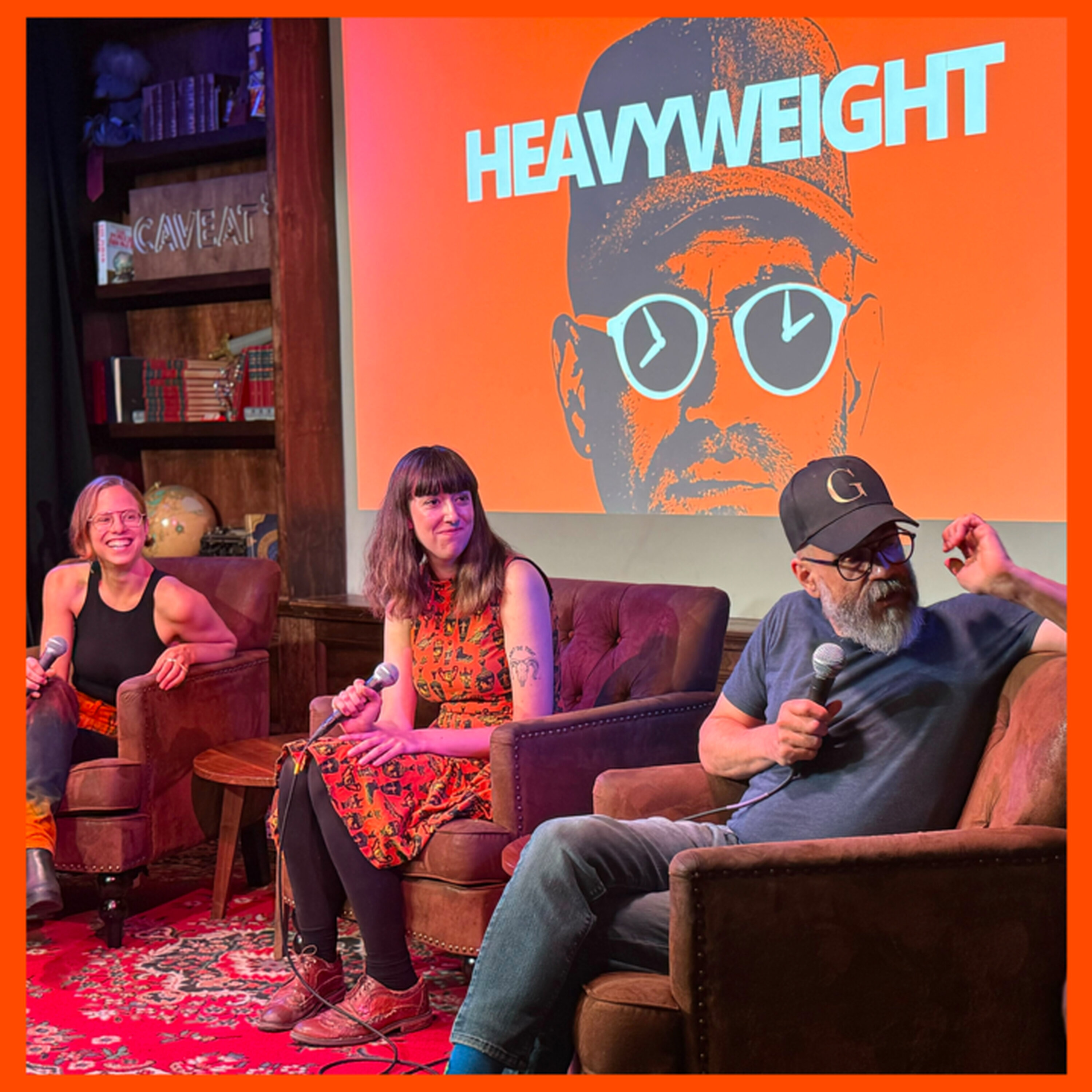
Pushkin In October, the Heavyweight gang gathered in New York City for a live event at Caveat on the Lower east side. If I may be so bold as to speak, on behalf of the crowd, the waitstaff, and Pushkin Industries as a whole, a lovely time was had by all. There was a wall to write down your regrets and a meet and greet where you could take a picture with yours truly.
- [02:43]
Stevie Lane
3, 2, 1.
- [02:44]
Jonathan Goldstein
Thank you. I feel like I'm smiling in all these pictures, but I'm not.
- [02:47]
Greta Cohen
So what you're doing is not quite a smile.
- [02:49]
Jonathan Goldstein
Feels like you're my soul animal. So good luck to your soul.
- [02:52]
Jake Halpern
Heavyweight.
- [02:53]
Jonathan Goldstein
The first episode came out when I was 12. Turning 22 next week now. I feel like I practically raised you if you weren't able to attend. Fear not. We've recorded the event so that you can still experience it at home, half undressed and drinking less expensive beverages through the miracle of Audio.
- [03:12]
Greta Cohen
Hi, everybody. Thank you so much for coming to this live event celebrating the launch of the new season of Heavyweights. We're so glad you're here. My name is Greta Cohen. I'm the CEO of Pushkin Industries. We are the audio network that is the home to Heavyweight, and we are so thrilled that they are part of our network. The new season is wonderful. I'm sure you've all been listening to it, and today you're in for a real treat. Later on, the producers of the show, Stevie Lane and Kahlilah Holt, will be coming on stage, and they're going to answer, along with Jonathan, some of your questions that you've submitted. But first, Jonathan will be joining us to do a live reading. He has asked me to read an introduction to this reading. Okay. Jonathan asked me to read this introduction to his reading of the Old Testament of Cain and Abel. For those of you heathens who have never cracked open a Bible or unscrolled a Torah, Cain and Abel were the sons of Adam and Eve. Adam and Eve lived in a beautiful garden called Eden, where they frolicked in the nude all day. But relax, back then, nudity was less a Rio de Janeiro, HBO after Dark thing and more a Nordic health spa thing filled with good, clean living and fruit platters. Also, everyone in Eden got to live forever and not have to go through painful childbirth or. Or work for a living. It was a pretty groovy trip until the whole tree of knowledge thing went down and Adam and Eve were expelled. Jonathan has here chosen to retell the story of Adam and Eve's kids, Cain and Abel, who were born after the expulsion as an illustration of the very first heavyweight, a heavyweight in which two beefing brothers are reconciled by the Lord. On heavyweight, the role of the Lord is played by Jonathan Goldstein. Ladies and gentlemen, Jonathan Goldstein.
- [05:25]
Jonathan Goldstein
Back in those first days, things changed very quickly. A new person being born meant there was a giant spike in the population for Cain, his younger brother. Abel's birth made the planet feel lopsided. He watched Eve bounce Abel in her lap and felt the Earth's gravity tilt in their direction. It pooled at the insides of his stomach and made him seasick. Years later, Adam and Eve would have many more children. But just then, there was only Cain and Abel, because there was nobody else. The brothers grew close. They played each other's stomachs like snare drums, cracked each other's knuckles as though they were cracking their own. They were different, though. Abel was a thinker. He thought about things. If he bit off his own pinky toe, would it grow back? Cain, on the other hand, was a doer. He'd reel back his fist and break a donkey's nose for the sheer thrill of it all. One day, when Adam and Eve thought the children were old enough, they sat them down and told them about the screw up. What does it mean to die? Asked Cain. We're not exactly sure, said Eve. But basically, one day, and this is not any day soon, we will no longer be. There was silence. Then Abel spoke up. If we won't be, he said, then we won't even know that we're not being. There will be no we to see that we can no longer be. Yes, I guess that's true, said their mother. Well put. Abel smiled and went back to mashing a mutton liver into pate. Cain, on the other hand, felt like a sharp plum pit had been forcefully lodged down his throat. All his life he had felt like himself that his face and fingers, that his thoughts were his own. Now he felt like they were someone else's, someone who could yank them away at any chosen moment. Until then, it had never crossed his mind that such a thing could even be possible. The brothers continued to live their lives, but all the while Cain felt a new sadness. It ate with him, worked with him, and in the morning it raised from his bed. With him dying. It just didn't make any sense. He knew this deep in his heart. He thought nothing was more important than making God change his mind. He began to take his sacrifices more seriously. They became elaborate and garish. They involved richly choreographed interpretive dances, colorful oblong facial masks, and the very best of his legumes. But God never answered. Cain started to change. When he got a splinter, he cursed the heavens all out of proportion. Back in the Garden of Eden, there were no splinters. He even started to resent his parents. He spoke of them as though they had gambled away his inheritance. If it hadn't been for Dum Dum number one, tempting Dum Dum number two, we'd be living in luxury. Cain tried to get Abel all worked up about the whole thing, too. But Abel had an easy come, easy go, we all have to die someday attitude that drove his brother nuts. Cain invented a game. He called it get the hell out of Eden. He always insisted on playing God. Get your naked asses out of here. Yelled God. What? But we just got here. Yelled Adam and Eve. Maybe there's some kind of mistake. The Lord does not make mistakes. God would then kick his brother, who would fall to the ground. Please, please have mercy on me. His brother would cry. Let's play something else. But God would only laugh. Abel also made sacrifices to God. Every week, he would choose the fattest sheep as an offering. Everything Abel did in life was for a reason. He ate so that he would not be hungry. He made clothes so that he would not be cold. But making sacrifices to God, he did it for reasons he could never know. He did it simply because he was told to. There was something about that that made him feel clean and deep. Adam and Eve made their sacrifices out of fear of being further punished. And Cain was pleading for answers and changes. But Abel fulfilled his obligation and walked away, expecting nothing from God. He was glad with the way things were. And God could not have helped liking that. Meanwhile, Cain decided to test out a new approach with the Lord. He believed that God would have greater respect for him if he did not kowtow. And he's going to kill us, he thought. He wanted God to understand that he couldn't walk all over people and then still have them come crawling back with their arms loaded with gifts. No, they had to get tough. So Cain's sacrifices grew lackadaisical. He didn't even bother to check if his gifts were being received. That would look like he was caving. Then one day, while Cain was lying in a field, Abel came running over. God spoke to me, cried Abel. Cain sat up and looked at his brother. What did he say? He said he was a great fan of my lamb chops. He told me to keep up the good work. Was my name mentioned? Asked Cain. It didn't come up. What was it like to hear his voice? Asked Cain. Look at me, said Abel. I'm still shaking. There was a certain pang that Cain started to feel. It was in his stomach. He felt the pang grow sharpest when he looked upon his brother. He could hardly speak with him without having to hunch over in pain. Since the world was still new and no one had yet felt this way, Cain did not know that it was jealousy he was feeling. Instead, he decided that his stomach no longer wanted to be his stomach. It wanted to escape his rib cage. It wanted to be Able's stomach. This was because he wanted to be able to. There was no shame in this. Being able meant being happy. Being Cain meant being wretched. He had a plan. He approached Abel with it. He decided to just spring it on him. I am no longer Cain, he said. I am now Abel. We are both able all right, said Abel. The two Abel's performed routines for the amusement of their brothers and sisters. How's that apple, Abel? It's fine, Abel. But then one day, Cain asked, if I am Abel, am I just as much able as you yourself are able? I suppose that's true, said Abel. Then before God, are we both not able? Asked Cain. Well, in the case of being before God, I think at that time I would be able and you would go back to being Cain. Cain's eyes lingered on his brother. He looked at this other Abel as standing in the way of who he was. He was Abel. He knew this in his heart. He simply wanted it more. Abel was among his flock. When Cain neared him. Slowly, Cain pulled out his rock. And slowly he lifted it into the air. This way God will have to show himself. This way God will have to stop playing possum and get directly involved. These were Cain's thoughts still, though there was no sign of God. He looked at the back of Abel's head. Then he looked into the sky. Just in case God was reading his mind. He thought to himself, I'm really, really going to do it. He brought his rock down onto his brother's head. He could hear no sound at all. Abel just toppled over. He toppled over the way he did everything. With an easygoing acceptance, he sank to the earth as though thinking, I must fall, so I will fall. I am falling. I have fallen here. It was death. Cain couldn't believe it. He'd been sure that at the last moment God would step in. He'd have thought only God could take a person's life. But it was as simple as killing a sheep. Abel, his eyes wide and unblinking, stared directly into the mystery of life and death. And he was not saying a word about any of it. The sheep continued to graze and the sun continued to shine. There were no bolts of lightning, no booming voice. From behind the clouds, life went on. That night, God appeared before Cain in a dream. Where is your brother? Asked God. It's always about my brother, said Cain. Do you ever ask where I am? No. That you don't think of. What have you done? Asked God. Am I my brother's keeper? Asked Cain. God did not answer. He just gave him a look. It made Cain feel naked and small. He then felt the finger of God upon his forehead. It sank through his head and into his brain where it spoke. The earth shall scorn you, said the voice from the finger. I shall scorn you. You will wander the earth and death will not come. There will be no escape. All will look upon you, and none will dare kill you, for they will know you by your mark. God withdrew his finger, leaving behind a fingerprint on Cain's forehead. It was shaped like a teardrop. At first, he tried to convince himself that the mark was to protect him, that he had a secret pact with God, that they understood each other. For a while, he would wake up in the morning and pretend to be immortal and famous. But he was not very good at pretending. As the centuries passed, Cain abandoned farming and roamed the earth. He walked with a sense of purpose, just in case anyone was watching. But in his heart, he knew he had nowhere to go. He became so lonely and full of regret that instead of fearing death, he became yearnful of it. He would chase after bears and they would scamper away. They haven't the guts, he'd say. Run, you little cowards, he'd call after the tigers. Look at me, he'd cry into the face of an alligator as he tried in vain to pry open its jaws. More centuries passed, and Cain's desire for death became nearly constant. He would think about Abel up in heaven, palling around with God, flying through the clouds on God's shoulders, while he was left to putz around for hundreds of years, begging his own children to drive sharpened branches through his heart. In life, Cain had been jealous of his brother, but it was in death that he became more jealous than he ever thought possible. Over time, Cain could no longer remember very much at all. Twenty years after the death of his brother. It seemed like it was only Yesterday, but after 200 years, it felt like something that might have happened in a dream. There were details he remembered that now seemed improbable, like the way he saw his brother's soul leave his body and the way he'd waved goodbye to him and winked. After 300 and 400 years, it all felt so long ago that who he was back then felt like someone else. When people he met asked him questions about the old days, he just made stuff up. We had wings, he said. After 500 years, his story was repeated so often that he only remembered the repeating, not the events themselves. It sounded like a fable, something that might have just as easily happened to a fox and a rabbit as to himself and his brother. He began to doubt everything. He even began to wonder whether he had actually ever heard God's voice, whether the mark on his forehead was the mark of God and not just another liver spot. Was this a part of the punishment, he wondered, to be left so uncertain of whether God really was, or whether God was only something inside his own Head. After 700 years, when he told the story to himself or heard it told by others, he felt nothing. He was too old to feel guilt or remorse or anything. He didn't even miss his brother anymore. He wanted nothing from God. He wanted nothing from the world. The world was what it was. He didn't need it to change. And in this way, he finally got his wish to be just like Abel. And then God let him die. Thank you. After the break, a Q and A with Stevie, Kahlilah and me. But first, our producer Phoebe headed to the Wall of Regrets to see what regrets were trending.
- [17:37]
Greta Cohen
Can I ask you about your regret?
- [17:39]
Kahlilah Holt
I just really regret not going to.
- [17:41]
Greta Cohen
See the catacombs when I was in Paris.
- [17:44]
Kahlilah Holt
I really like skulls and I wish.
- [17:46]
Jonathan Goldstein
I caught I regret that I didn't.
- [17:48]
Kahlilah Holt
Pay enough in contact with certain friends of mine who were like religious and.
- [17:52]
Stevie Lane
Are now getting married.
- [17:53]
Kahlilah Holt
So I'm not getting invited to the weddings. And God, do I want to be at the weddings just because I really like weddings. Do you guys mind just reading these.
- [18:01]
Stevie Lane
Aloud for me like some of the.
- [18:02]
Jonathan Goldstein
Ones that you're looking at? Yeah not finding a therapist, saying no to a freezum.
- [18:08]
Kahlilah Holt
Not being more patient with my mother's cognitive decline, lacking patience with my brother's behavior than he died. How I said goodbye to my best friend before he died.
- [18:18]
Jonathan Goldstein
I wish I joined a band.
- [18:38]
Jake Halpern
In today's super competitive business environment, the edge goes to those who push harder, move faster and level up every tool in their arsenal. T Mobile knows all about that. They're now the best network according to the experts at an OOKLA speed test. And they're using that network to to launch Super Mobile, the first and only business plan to combine intelligent performance, built in security and seamless satellite coverage. With Super Mobile, your performance, security and coverage are supercharged. With a network that adapts in real time, your business stays operating at peak capacity even in times of high demand. With built in security on the first nationwide 5G advanced network, you keep private data private for you, your team, your your clients. And with seamless coverage from the world's largest satellite to mobile constellation, your whole team can text and stay updated even when they're off the grid. That's your business. Supercharged. Learn more@supermobile.com Seamless coverage with compatible devices in most outdoor areas in the US where you can see the sky. Best business plan based on a combination of advanced network performance, coverage layers and security features. Best network based on analysis By Ookla of Speedtest Intelligence data 1H 2025 hey, this is Sarah.
- [20:02]
Kahlilah Holt
Look, I'm standing out front of a.m. p.m. Right now and, well, you're sweet and all, but I found something more fulfilling, even kind of cheesy. But I like it. Sure, you met some of my dietary needs, but they've just got it all. So farewell o meal so long Use.
- [20:17]
Jake Halpern
Strange soggy Break up with bland breakfast.
- [20:20]
Jonathan Goldstein
And taste AMPM's bacon, egg and cheese.
- [20:22]
Jake Halpern
Biscuit made with K tree egg, smoked bacon and melty cheese on a buttery biscuit. Am P M. Too much?
- [20:28]
Jonathan Goldstein
Good stuff.
- [20:30]
Jake Halpern
I'm Jake Halpern, host of Deep Cover, a show about people who lead double lives. We're presenting a special series from Australia. It's all about a family who was conned by a charming American.
- [20:43]
Jonathan Goldstein
When you marry someone, you feel like you really know them. I was just gobsmacked as to what's going on here. Does the name Leslie Mnookian mean anything to you? Oh, you bet. Never forget her.
- [20:55]
Jake Halpern
Listen to Deep Cover presents Snowball. Wherever you get your podcasts.
- [21:05]
Greta Cohen
So now we are going to move into the Q and A portion of our event today. And I'd like to welcome to the stage Kahlilah Holt and Stevie Lane, the producers of the show.
- [21:25]
Jonathan Goldstein
Hi.
- [21:26]
Kahlilah Holt
Hello.
- [21:26]
Jonathan Goldstein
Hi, everybody.
- [21:27]
Kahlilah Holt
Hello. Hi, all.
- [21:30]
Greta Cohen
So we asked you questions that you wanted to hear the heavyweight team answer about the show and we got some. So many. I think we are also going to have a little bit of time today to do some audience Q and A. Kicking things off with our Q and A here. What does Jonathan and Jackie's off show relationship really look like?
- [21:53]
Jonathan Goldstein
Should I take this one?
- [21:55]
Kahlilah Holt
It's about you.
- [21:56]
Jonathan Goldstein
So, yeah. But you might have a more objective window. I don't know. I think it's a pretty accurate glimpse into our dynamic. We've been friends since childhood. She likes to laugh at me and hang up and I don't know, I.
- [22:15]
Kahlilah Holt
Mean, I mean, the first time I met Jackie, I remember we really bonded because over, like, she was like, isn't he annoying? And I was like, yeah. I feel like that made her like me.
- [22:26]
Stevie Lane
The first time I met Jackie, I was like, I want to be you.
- [22:29]
Jonathan Goldstein
When I grow up.
- [22:31]
Stevie Lane
She's very powerful. She's a very powerful person.
- [22:34]
Jonathan Goldstein
Yeah. And she's a really nice person, too. I mean, I just bring out the worst in her. It's not her fault. I don't think she's like, yeah, she's a doctor, she helps people, she does good works. And I Just bother her, you know. So I hope it's bringing some levity to her life, but truly, I don't know.
- [22:54]
Kahlilah Holt
But she was. For the people who don't know the.
- [22:56]
Jonathan Goldstein
Backstory, there is a backstory.
- [22:58]
Kahlilah Holt
Well, just that you went to school together and she was like a popular girl.
- [23:00]
Jonathan Goldstein
She was very popular, yeah. If you really want to go deep on the backstory. I did a story about our relationship on this American Life called the Allure of the Mean Friend. And I just talked to people about what Jackie Cohen meant in grade school and in junior high and she meant a lot. Yeah.
- [23:25]
Greta Cohen
What was the hardest episode to record and why? Slash, which call has made you the most nervous to dial?
- [23:33]
Kahlilah Holt
I was the most nervous calling sorority girls for Rose. They were very. I remember there was like a Facebook thread where they were like a sketchy sounding woman left us a message and I was like, I thought I sounded really nice and normal.
- [23:49]
Stevie Lane
I think for me it was very early when I just joined the show. And you guys were working on a story at the time and you were trying to find this a two or three fingered man who had hung up on you many times. And I was just like new and bright eyed and I was like, what can I do to help? And Jonathan was like, you could try calling this guy. And I called him and he told me he would find out where I lived and killed me.
- [24:17]
Jonathan Goldstein
Yeah, it was like a rite of passage. Like everybody who was new on the show had to call. His name is Carl. But yeah, that would have been a good story too.
- [24:27]
Stevie Lane
Yeah, the one where he finds me and murders me.
- [24:30]
Jonathan Goldstein
He threatened to kill me all. It's just. That's Carl.
- [24:33]
Kahlilah Holt
Then you've got a true crime series, you know.
- [24:36]
Stevie Lane
Yeah, it's true.
- [24:37]
Jonathan Goldstein
My hardest call was there was an episode where I was trying to find out about my psychiatrist that I had when I was a teenager and find out if she was a really good psychiatrist or you just don't know with a psychiatrist because it's so secret, sealed off, you know, you don't get. Or do you get Yelp ratings? Maybe now you do. Back then you didn't. And I remembered someone that used to be in the waiting room when I would leave. He was a professor I once had when I was in college and I thought maybe I can ask him. And so I had to call him and say, hey, I used to see you in the waiting room of my psychiatrist 30 odd years ago. That was very weird. That was. Even for me, that felt very weird. He had retired, he was living in Jamaica. That was a weird one.
- [25:23]
Greta Cohen
Who is a dream celebrity whose problem you'd want to solve?
- [25:26]
Stevie Lane
Stevie. So Sarah Jessica Parker is a fan of the show and all that I want is to reunite her with Kim Cattrall. And I email her agent every year when we're looking for stories. And I'm like just checking in, like wondering if Sarah has anybody she maybe like needs to reconcile with. Has she given it any thought so far? She's been too busy. But now that in just like that is over, I feel like she might have more time.
- [26:06]
Greta Cohen
Perfect time. Anybody else?
- [26:10]
Jonathan Goldstein
I don't know. Celebrities don't have problems, do they?
- [26:14]
Greta Cohen
Auggie has one.
- [26:16]
Kahlilah Holt
Oh, Augie do.
- [26:18]
Greta Cohen
Yeah.
- [26:18]
Kahlilah Holt
Who did you just say?
- [26:19]
Jonathan Goldstein
Oh, yeah. Kendrick Lamar and Drake. Augie is my son and he's a very big rap fan. He wants to see me reconcile.
- [26:28]
Kahlilah Holt
The whole would probably be huge numbers for us.
- [26:31]
Stevie Lane
I'm like, that's a great idea. Perfect for audio.
- [26:35]
Kahlilah Holt
Yeah. So good idea actually. Augie. We should pursue that.
- [26:39]
Jonathan Goldstein
I know. Like, why can't you fellas just. Because that whole super bowl thing was really out of hand. I mean that was, that was rough.
- [26:46]
Greta Cohen
We maybe have an opening for a new assistant producer.
- [26:49]
Kahlilah Holt
Augie looking.
- [26:51]
Jonathan Goldstein
Yeah. He's going to be nine, I should.
- [26:53]
Greta Cohen
Also say so part time.
- [26:56]
Kahlilah Holt
Yeah.
- [26:56]
Greta Cohen
He can balance it with school. Okay. Sometimes it seems like there's no progress or revelation to someone's journey until weeks or months later. How does the team maintain the morale to be discouraged and years.
- [27:09]
Kahlilah Holt
I mean, I think I am discouraged most of the time. I think I don't. Maintain the morale would be my answer.
- [27:17]
Jonathan Goldstein
Yeah.
- [27:18]
Stevie Lane
I sort of feel like, I think I have the attitude that just like, I just believe it actually will always work out because I think we've. There've been a lot of stories that we've thought were dead and then like years later something changes, we get back in touch, whatever, and then they end up happening. So I just, I think I just. It's blind optimism.
- [27:37]
Kahlilah Holt
I was going to say. I think Stevie brings the optimism for all of us.
- [27:41]
Jonathan Goldstein
Yeah. And you have your work cut out. Yeah. It's. I, for me it's desperation. It's always. That's what passes for hope, I think is the desperation.
- [27:52]
Greta Cohen
If you could expand any episode into a season long series, which one would you revisit and what avenues would you take to further explore within that story?
- [28:02]
Kahlilah Holt
Well, do you remember when we did that like two day Descent into Madness where we laid out that whole whiteboard?
- [28:09]
Jonathan Goldstein
Oh, yeah, yeah. Well, that. Yeah. Again, desperation. I mean, it came about the shorthand that we were using. We were going to S town. It.
- [28:17]
Kahlilah Holt
Yeah. We were like, this is going to be our S town.
- [28:19]
Jonathan Goldstein
This is going to be our S town.
- [28:20]
Stevie Lane
Also, S town just became a verb. It was like, we're going to S town this season.
- [28:24]
Jonathan Goldstein
Yeah. It just felt like none of our stories were working out, but we thought that, like, you're too young to get the reference to the Love Boat, but, like, where you're visiting different characters. Thank you. You know, like, we couldn't solve the story, but, like, maybe from week to week, we can drift from character to character and, like, keep working on them and, like, tangle them all up together.
- [28:45]
Stevie Lane
And nobody would notice that none of.
- [28:47]
Jonathan Goldstein
Them had just ended.
- [28:50]
Kahlilah Holt
But truly, we spent, like, I think, two whole days laying out, like, what the structure would look like. And then at the end of the two days, we were like, this is insane, and we just erased the whiteboard.
- [28:58]
Jonathan Goldstein
I think it might have been more than two days, really. It felt like a sizable chunk of time. Yeah. I don't know. There's, like, my friends. I don't know where they are. The Ehrlichs are here. Gregor and his. Yeah, you're right to gasp. And his brother Dimitri, and. I mean, I feel like we could do a season of just, like, called the Airlifts, where there would be so many good stories, you know? Yeah.
- [29:29]
Greta Cohen
At a time when people are increasingly concerned about privacy, how do you get people to speak to you and spill their hearts out on tape?
- [29:36]
Kahlilah Holt
Well, I have noticed a lot more people do the. I thought it was a scam, so I didn't answer you. And I don't know if people actually think we're running some elaborate, confusing scam or if that's kind of just like a shorthand for, like. I didn't want to respond to this.
- [29:50]
Jonathan Goldstein
Yeah. Because what kind of scam would it be? Really not a very good one. Like a real long con.
- [29:57]
Kahlilah Holt
Yeah. Yeah. And also, people don't answer the phone anymore. People will answer an unknown number, and I feel like that's changed, even just in the time we've been doing the show. Like, people used to pick up a lot more.
- [30:07]
Greta Cohen
Yeah.
- [30:09]
Stevie Lane
How do we convince them to talk once they do pick up the phone?
- [30:13]
Kahlilah Holt
My feeling is, like, people are either inclined to do it or not, and it doesn't matter that much what you say. Like, they kind of have already made up their mind.
- [30:20]
Jonathan Goldstein
That's true. Yeah. Have you ever actually convinced anybody, like, where they didn't?
- [30:25]
Kahlilah Holt
Not, like a hard no to a yes. I'VE had people who are on the fence, then they think about it and agree.
- [30:30]
Jonathan Goldstein
But have you the most was maybe, I don't know if you guys remember the story about sky who had her best friends, they wrote the F word on her garage door. I'm saying the F word because my son's here and it would excite him too much. And one of the girls who were a part of it, she didn't want to talk. And we spoke a lot. We had many conversations over several days. And eventually she agreed to do it. And she agreed to do it for a really nice reason. Like she wanted to show her daughter that it's okay. Like you could comp to something that you did that you're not proud of, you know. And that was really sweet.
- [31:12]
Stevie Lane
There was also Chris in the Barbara episodes, like when we. That was like a real. We did a two parter about Jonathan's mother in law's childhood friend. And in trying to find her, we ended up on the phone with someone she'd been briefly engaged to when she was younger. And at first, like he didn't want to talk to the. I mean, he was like threatening legal action. He was like, my daughter's a lawyer. Like, I'm going to come after you. I don't want him any part. Like it was. And it was very. I was producing Jonathan on the call and it was like I found it very scary having flashbacks to the Three Fingered man kind of vibe. And you just kind of kept him talking. Like that was the. You just kind of kept him talking. And I remember we got off the phone, I was like, what made you do that? And you were like, I just have the feeling that he actually wants to talk about this.
- [32:03]
Jonathan Goldstein
Yeah.
- [32:04]
Stevie Lane
And yeah, he called back and was like, yeah, I do want to talk about this.
- [32:08]
Jonathan Goldstein
So it was like, I don't know, it was like just. I felt like it was kind of like the phone call that he'd been waiting for for like 30 odd years or more. You know, it just, I don't know, it just had that kind of feeling to it.
- [32:21]
Greta Cohen
So I've been very excited to ask you guys this question. Who would play you in Heavyweight, the movie?
- [32:28]
Kahlilah Holt
I do have an answer to this, which is my stock answer to who would play me in a movie, which is Aubrey Plaza.
- [32:36]
Stevie Lane
Oh, that's so good.
- [32:39]
Jonathan Goldstein
I mean, I think, you know, in my mind I'm like a very lanky, tall, sort of like Johnny Knoxville type. But I know that it would end up being like Wallace Shawn who, you know, maybe a Paul Giametti. I don't know you.
- [33:00]
Stevie Lane
I really don't know. You might have to come back to me on this one.
- [33:05]
Greta Cohen
Okay, we'll come back to you on that.
- [33:07]
Stevie Lane
Hey everyone, it's me, Stevie. So this question continued to haunt me for weeks until I finally decided. Tilda Swinton. There's more Q and A coming up right after the break.
- [33:22]
Jake Halpern
In today's super competitive business environment, the edge goes to those who push harder, move faster, and level up every tool in their arsenal. T Mobile knows all about that. They're now the best network according to the experts at OOKLA Speed test. And they're using that network to launch Super Mobile. The first and only business plan to combine intelligent performance, built in security and seamless satellite coverage. With Super Mobile, your performance, security and coverage are supercharged. With a network that adapts in real time, your business stays operating at peak capacity and even in times of high demand. With built in security on the first nationwide 5G advanced network, you keep private data private for you, your team, your clients. And with seamless coverage from the world's largest satellite to mobile constellation, your whole team can text and stay updated even when they're off the grid. That's your business. Supercharged. Learn more@supermobile.com Seamless coverage with compatible devices in most outdoor areas in the US where you can see the sky. Best business plan based on a combination of advanced network performance, coverage layers and security features. Best network based on analysis by OOKLA of Speedtest Intelligence data 1H 2025. I'm Jake Halpern, host of Deep Cover, a show about people who lead double lives. We're presenting a special series from Australia. It's all about a family who was conned by a charming American.
- [34:58]
Jonathan Goldstein
When you marry someone, you feel like you really know them. I was just gobsmacked as to what's going on here. Does the name Leslie Mnookian mean anything to you? Oh, you bet. Never forget her.
- [35:10]
Jake Halpern
Listen to Deep Cover presents Snowball wherever you get your podcasts.
- [35:21]
Jonathan Goldstein
Our live event also featured a telephone. But unlike all those boring, ordinary telephones that only let you reach businesses, institutions and private residences, this telephone only allowed you to reach me, Jonathan Goldstein. And not even me, really, but my answering machine. When you picked up the receiver, you heard a message point prompting you to record your own heavyweight story. And you sure showed me, because record those stories you did. Hi, you've reached Jonathan Goldstein. I'm not at home right now because I'm in the middle of the live performance of a Lifetime but in the meantime, leave a message with your story. Don't overthink it. Just do the job. Do the job. Do the job. Don't say no. Say yes. I was ghosted by every single male member of my high school class. And I don't know if I did something. I thought all these people liked me. I certainly like them. Found out that my dad was married beforehand. It was an arranged marriage, so I'm Indian, and it's very unique or very rare to get divorced during an arranged marriage. Definitely caused rifts between my dad and the community.
- [36:33]
Kahlilah Holt
I would say that I'm not a very imaginative person. I enjoy logic. And I went to bed one night and I had a dream that my grandmother had died. Randomly told my friends at breakfast, and they were, like, just trying to do the Freudian thing of, like, what could that mean? And me sort of just blowing them off, being like, dreams don't mean anything. And then about four hours later, I received a call from my sister saying, hey, like, sorry to tell you, but Grandma died.
- [36:56]
Jonathan Goldstein
Hi, my name is Dimitri Ehrlich. My story is, once I was invited out to a bachelor party, and we went out in lower Manhattan to Chinatown, to a Chinese massage parlor, and we had wonderful foot massages. And you, Jonathan, were doing an incredible job of pretending that it was painful because it felt great in every way. So my question is, have you ever considered doing any theatrical acting, either in film or television or on stages? Because you're obviously quite a gifted thespian. Thank you. Oh, I'm Gregor's brother, by the way. And now back to the Q and A. Q and A stands for questions and answers.
- [37:36]
Greta Cohen
If Jonathan and Gregor could only listen to one Moby song on repeat during a road trip, which one would it be?
- [37:42]
Jonathan Goldstein
Well, Gregor, should we turn the house lights up? What would be the song? Gregor, please would you stand up so people can.
- [37:55]
Jake Halpern
I don't know where we're going on this road trip.
- [37:56]
Jonathan Goldstein
We have to figure out why we're on a road trip together. I don't know. Let's say we were gonna go to Frontier Town together. I don't know. Like something fun. I don't know. I can imagine fighting with you about the radio on a road trip. How about that for an answer? Like fighting over which Moby song we would listen to. Exactly. All the Moby's greatest hits. Moby's play. Moby, Moby, Moby. But you do listen to Moby songs now, right?
- [38:20]
Jake Halpern
I constant repeat.
- [38:21]
Jonathan Goldstein
All I listen to is Moby.
- [38:22]
Jake Halpern
Actually, I have a question for You.
- [38:24]
Jonathan Goldstein
Cause you said you were gonna take Q and A from the audience.
- [38:27]
Jake Halpern
Well, I was gonna ask was that.
- [38:28]
Jonathan Goldstein
All spontaneous stuff, that you guys were really just winging it, or did you already have your prefab, like. No, that was just off the cuff, like pretty jazz. Yeah. Improvise. Paul Giamatti. Nice zingers. Thank you. Was that your question or. Yeah, I was curious. More like maybe Stanley Tucci, you know? Okay. All right. Thank you. Yeah, that's very nice. Thank you. I like the sounds you're making of support. Thank you.
- [38:56]
Greta Cohen
Well, Gregor is correct. We are shifting into audience Q and A portion, so there are a couple of mics around.
- [39:04]
Jonathan Goldstein
Hi.
- [39:05]
Greta Cohen
I think I'm the biggest fan now. So, Jonathan, you recently had that episode about stopping drinking. And then because I'm your biggest fan of Heavyweight, you had that live event episode where they alluded to how you needed a drink before you spoke, how it would help you. So I was just wondering tonight what's going on and how it is.
- [39:28]
Jonathan Goldstein
I'm lit. I'm tanked. No. Yeah. This might be the first time I'm doing this. Yeah, it makes me a little nervous, but, yeah, I haven't had anything to drink and. Hi, Emma, by the way. Hi. Are you guys friends? Oh, you're just sitting beside each other. Emma mixes our episodes. She's the sound engineer and composes music. Emma Munger. Yeah, it's. Yeah, it was definitely in my thoughts because I used to really like to do that, to have a drink or two or three before talking and a couple afterwards. So, yeah, I'm just. I'm free balling it. I don't know. Yeah.
- [40:13]
Greta Cohen
Yeah. And it was definitely a nuanced view of stopping drinking. Like, is it better?
- [40:21]
Jonathan Goldstein
Yeah, it is some days. I was saying last night to my friend Alex, I was saying, I miss that feeling of, like, that everything is all right. Everything's going to be okay. You know what I mean? Which is like a little, like. But you got to figure it. Like, you have to manifest that. You have to figure out how to get that feeling on your own. You know, it's not real. So, yeah, I'm still working on that.
- [40:48]
Kahlilah Holt
And it is going to be all right.
- [40:49]
Jonathan Goldstein
Well, thank you. Thank you for saying that.
- [40:51]
Stevie Lane
Hi, everyone. I just want to reflect based off.
- [40:53]
Kahlilah Holt
Of that episode as well.
- [40:55]
Stevie Lane
I just recently lost a friend to alcoholism, and your episode was really touching because it was a way to externalize and even open up those conversations. And I sent it to our friends.
- [41:07]
Kahlilah Holt
Group, and it helped us a lot, too.
- [41:09]
Stevie Lane
So thank you for being honest and open.
- [41:11]
Jake Halpern
Thank you.
- [41:11]
Jonathan Goldstein
Thank you for saying that. That's really. That's encouraging to hear. Thank you. Yeah.
- [41:16]
Stevie Lane
My question is, I'm sure there's stories that are just in the vault still being worked on year after year. Can you share a little bit of what's currently still being in development or if there's a story that you really wish can have see the light of data at some point?
- [41:33]
Jonathan Goldstein
That's a good question. I don't know. Anything come to mind?
- [41:36]
Kahlilah Holt
I'm, like, scared to talk about any of them, though, because I'm afraid I'm gonna, like, doom them to never happen. But there are ones that I really.
- [41:44]
Jonathan Goldstein
You're hopeful about that I would, like, love.
- [41:47]
Kahlilah Holt
Yeah. If. Came back to life. Yeah.
- [41:50]
Jonathan Goldstein
Yeah. Sometimes you have, like, all the elements and it's very exciting, and then this one person doesn't want to talk and, you know, so it's a weird model to be basing things on that.
- [42:02]
Kahlilah Holt
But that's how I felt about why I'm, like, hedging a little bit is that's how I felt about the messenger, which is one we just did this season. Like, when we laid off from Spotify, I did not forward the emails to myself because I was like, this story's dead, so I don't need these. And then it came back to life. So.
- [42:15]
Jonathan Goldstein
Right. We never thought we'd get to talk to. If you listen to the episode, Pat Croce, who we needed to talk to, and it just seemed like he wasn't going to do it. And then.
- [42:23]
Kahlilah Holt
And Quincy had told us now.
- [42:24]
Jonathan Goldstein
Right.
- [42:25]
Kahlilah Holt
Yeah.
- [42:26]
Jonathan Goldstein
And then it was like a friend of a friend over dinner, and, you know, it was this true serendipity. We got really lucky. Yeah.
- [42:32]
Kahlilah Holt
Yeah. When you all are listening to recordings of yourselves doing interviews or having conversations with people, have you learned that you have certain conversational habits that you've tried.
- [42:43]
Greta Cohen
To alter or emphasize?
- [42:46]
Kahlilah Holt
That's a good question. I notice that I laugh when I'm nervous in the middle of things that are not funny. And that's something I've tried to stop, especially when I'm interviewing someone on a serious topic. Sometimes you ask a question and then you laugh when you're uncomfortable. And then when I'm cutting it, I'm like, what am I doing? So I've tried to stop doing that.
- [43:05]
Jonathan Goldstein
I'll just say I have the exact opposite problem. I can't laugh. Like, I. I wish I did laugh more easily, and I wish I had a free and easy laugh that told people like that's funny. That's great. Keep coming. You know, so I wish I had a little bit of that.
- [43:19]
Stevie Lane
I will pitch my voice up, especially when I'm calling people to interview them. And I, I hate it. I hate it so much. And when I listen back, it's like, hi, I'm Stevie. I'm calling from the podcast heavyweight. And like, it's like, it's very. And then like, the tape doesn't even sound like me. Like, the difference between the. That I'm really trying to work on.
- [43:41]
Kahlilah Holt
Not doing, but I do think it's encouraging. And something I learned from you, Jonathan, is whenever I do something really stupid and embarrassing in tape, rather than cutting it out and trying to hide it, I'm like, well, that's going to be front and center in the story.
- [43:56]
Jonathan Goldstein
You're. You're embarrassing yourself for a holiday. That's wonderful. Most people go through their lives just embarrassing themselves willy nilly for nothing.
- [44:06]
Kahlilah Holt
I know. But for me, it's for art. My question is, I've noticed a lot of the episodes feature interpersonal friendship relationships, focusing on really deep platonic relationships over years.
- [44:23]
Stevie Lane
So Howard and Gregor, and then when.
- [44:25]
Kahlilah Holt
You went to Pilates with your friend or things like that. And I just love that. What's your advice for friendship longevity?
- [44:37]
Jonathan Goldstein
You guys haven't lived long enough to answer that question.
- [44:40]
Stevie Lane
I don't have any friends.
- [44:45]
Jonathan Goldstein
I think it helps to be amused. And like I was saying, I'm not an easy laugh, but I do. Gregor really makes me laugh when he's busting my chops. If you get a kick out of that, then you're unstoppable. I mean, what's gonna happen, you know, what's gonna destroy you? Nothing.
- [45:00]
Kahlilah Holt
I say, I don't know that I have an answer. I mean, I'm very. I do have some long friendships, including my friend I went to Pilates with. But I'm like, I don't know why. I don't know why they're still my friends, but I'm grateful for it.
- [45:12]
Jonathan Goldstein
You're a good person is why.
- [45:14]
Kahlilah Holt
Oh, thanks, Charleston.
- [45:15]
Stevie Lane
Sure.
- [45:17]
Jonathan Goldstein
I didn't mean to, you know, bring the place down or anything. I have an adult contemporary side.
- [45:26]
Greta Cohen
Well, grab a drink, say hello and thank you again for coming.
- [45:34]
Jonathan Goldstein
And thank you for coming virtually. And thanks to everyone who made the show possible. That includes Phoebe Flanagan, Kira Posey, Tara Machado, Amy Hagedorn, Jordan McMillan, Eric Sandler, Sarah Bruge, and especially Morgan Ratner. Live sound mixing from the staff of Caveat and mixing for this broadcast version by Emma Munger. We'll be back next week with a brand new episode, an unlive episode. The regular old kind.
- [46:16]
Jake Halpern
Of. I'm Jake Halpern, host of Deep Cover, a show about people who lead double lives. We're presenting a special series from Australia. It's all about a family who was conned by a charming American.
- [46:32]
Jonathan Goldstein
When you marry someone, you feel like you really know them. I was just gobsmacked as to what's going on here. Does the name Leslie Mnookian mean anything to you? Oh, you bet. Never forget her.
- [46:44]
Jake Halpern
Listen to Deep Cover presents Snowball. Wherever you get your podcasts, this is.
- [46:51]
Greta Cohen
An I Heart podcast.