Loading summary
Transcript69 lines
- [00:00]
Nicole Lapin
I love hosting on Airbnb. It's a great way to bring in some extra cash. But I totally get it that it might sound overwhelming to start or even too complicated if, say, you want to put your summer home in Maine on Airbnb, but you live full time in San Francisco and you can't go to Maine every time you need to change sheets for your guests or something like that. If thoughts like these have been holding you back, I have great news for you. Airbnb has launched a Co host network, which is a network of high quality local co hosts with Airbnb experience that can take care of your home and your guests. Co hosts can do what you don't have time for, like managing your reservations, messaging your guests, giving support at the property, or even create your listing for you. I always want to line up a reservation for my house when I'm traveling for work, but sometimes I just don't get around to it because getting ready to travel always feels like a scramble so I don't end up making time to make my house look guest friendly. I guess that's the best way to put it. But I'm matching with a co host, so I can still make that extra cash while also making it easy on myself. Find a co host@airbnb.com host.
- [01:06]
Jason Pfeiffer
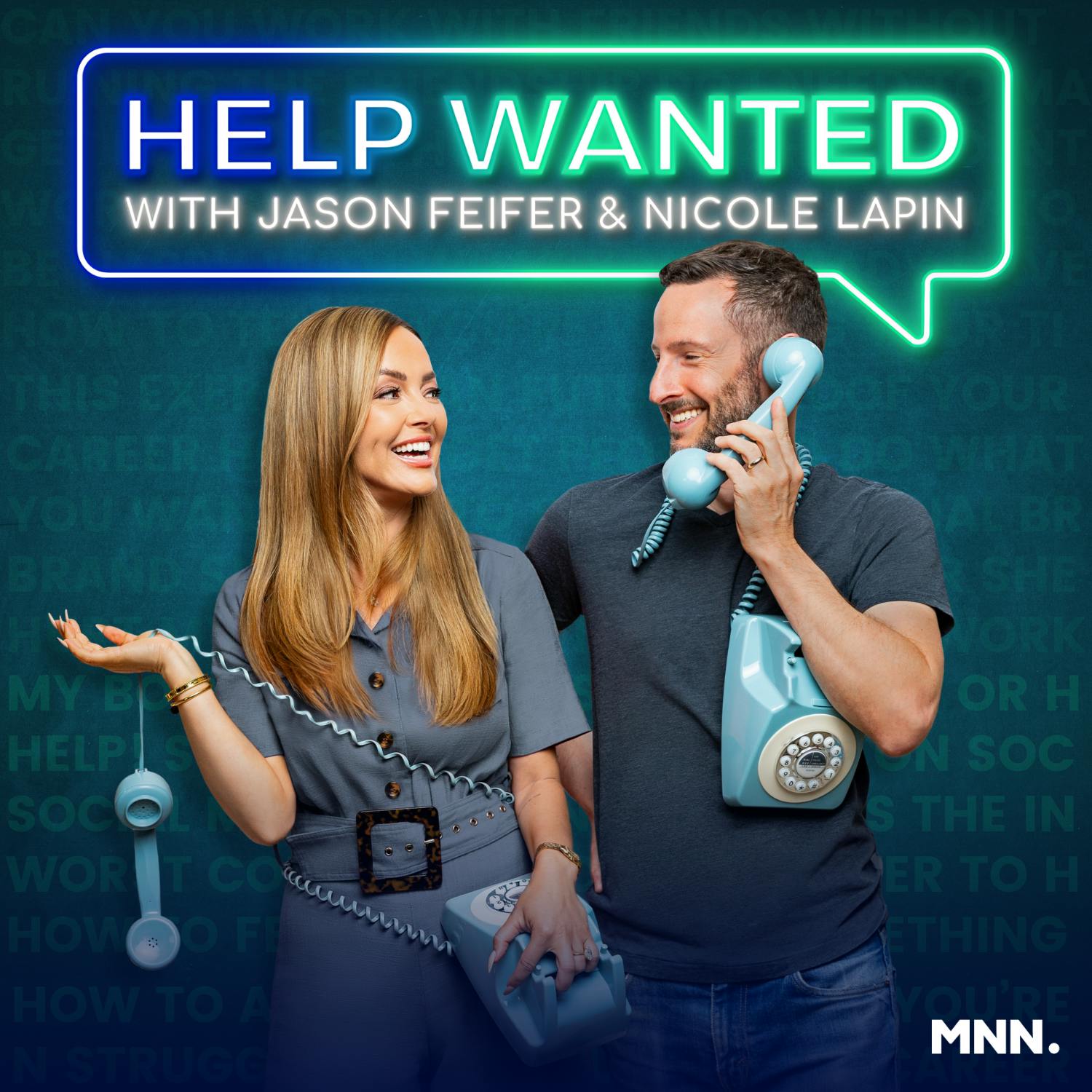
This is help Wanted, the show that makes your work work for you. I'm Jason Pfeiffer, editor in chief of.
- [01:12]
Nicole Lapin
Entrepreneur Magazine, and I'm money expert Nicole Lapin. On Tuesdays, Jason and I answer the helpline and help callers solve their work problems.
- [01:20]
Jason Pfeiffer
And on Thursdays, I give you one way to improve your work and build a career or company you love.
- [01:25]
Nicole Lapin
And it starts now. Okay, Jason, have you listened to my Funny Money segments on Money Rehab?
- [01:33]
Jason Pfeiffer
Yes, but I don't know what you're leading me into right now.
- [01:37]
Nicole Lapin
But you've seen the concept. True or false. I'm gonna catch you in this lie.
- [01:41]
Jason Pfeiffer
All right, I know that it exists, but I cannot think of what's happening right now. So tell me.
- [01:46]
Nicole Lapin
Okay, so in the segment, I give comedians bizarre headlines from the business news world, and they give me their take. It's hilarious. Because obviously their takes aren't practical advice. They're not experts, they're comedians. But you are an expert.
- [02:01]
Jason Pfeiffer
And questionably funny.
- [02:04]
Nicole Lapin
And questionably. I was about to say funny ish.
- [02:07]
Jason Pfeiffer
Okay, great. So this is going to be funny ish money. All right, so you're going to give me headlines from the news, and I'm going to give you my take, which is either going to be informed by reality, informed by a not particularly well honed sense of humor, or some combination thereof.
- [02:24]
Nicole Lapin
That's exactly what we were looking for. Wonderful. Okay, so you're in the fuddy money hot seat and I will give you some weird stories that are unfolding in the business news world right now.
- [02:35]
Jason Pfeiffer
Okay, great.
- [02:36]
Nicole Lapin
United Airlines aims to crack down on flight attendants who abuse sick time by requiring all flight attendants to submit a doctor's note in order to call in sick. Is this a bad look?
- [02:47]
Jason Pfeiffer
Well, on its face, yes. My guess though is that this is not some isolated situation, that there is some deeper cultural problem happening inside of United Airlines that is leading to flight attendants to abuse sick time. And I don't know what that is, but I think the lesson here for leaders, based on no other information than this one moment, but I've just seen this play out enough in different circumstances that the lesson here for leaders is that if your employees are abusing something in some way, it is likely because there is some deeper problem that you are not aware of or you are not addressing. Like problems don't just materialize out of nowhere and employees don't just suddenly start to act badly. It's because of some larger system problem. It reminds me of this conversation that I just had with this guy named Jeff Wetzler. His book is called Ask Tap into the Hidden Wisdom of People around you. Unexpected Breakthroughs in Leadership in Life. And the point that he makes is that leaders do not know how to ask the right questions that actually lead to the information that they need. And he, he opens the book by telling this story of when he was running this organization and they were doing some kind of summer program. And he had spent like the whole year preparing for this and having regular meetings with people. And it wasn't until just before the summer that he learned that one of the summer programs was completely unready. It was just non functional. And at first he was pissed at his team for not alerting him to this, but then he realized, no, wait a second, this is on me. Because I've been having these conversations with my team all year and they haven't told me this information, which means that I haven't asked the right questions and I haven't driven them to feel comfortable telling me what's actually wrong. So instead they all just kept telling me that things are okay and I didn't know anything until we smashed into the wall. And I see that play out a lot. I've been. I've been on the wrong side of this Many times where I've been in a situation where I'm on a team and the leader does not know that something is wrong, and the whole team does. And we don't know how to tell the leader because they're not creating the environment where we feel comfortable telling them. And so here we are, like sitting around talking about why this isn't going to work. The leader doesn't seem to know. And then of course, it doesn't work. And so what is happening at United Airlines? I have no idea. But I would bet that whoever came up with this policy needs to actually start asking some very different questions to drive towards what is actually wrong. That is actually creating the problem that they created a dumb policy to try to solve. This is a bandaid on a bigger issue, and it's a question of whether or not someone at United Airlines knows it. I know that I'm diagnosing this about United Airlines off of nothing. And as you and I talk, I'm about to get on a United Airlines flight tomorrow. So I hope that things are okay over there. But I would suggest somebody look into this.
- [05:42]
Nicole Lapin
Yes. Or they could just see like this spike of sick days when flight attendants had a day off in Hawaii or something like that. But if it is a failure of leadership not asking the right questions, I think that's a really interesting idea. How would you suggest they do that or like to foster an environment where people feel comfortable telling a leader bad news?
- [06:07]
Jason Pfeiffer
So it starts by creating open dialogue and making sure that nobody is ever, ever, ever punished or in any kind of bad situation for sharing hard truths. If you're asking people to tell you what's wrong and they ever feel like there is a risk of doing that, they will never do it. They'll never do it. So number one is you need to create the right culture. And that culture needs to go top to bottom. Like everybody in your organization needs to feel like sharing hard information is valued and never punished. And then number two is you need to establish with your team that you completely share their goals. Because I think that oftentimes teams don't feel like leaders share their goals, that leaders have some kind of other goals, or maybe they're not even sure what the leader's goals are. And so the leader and the team don't feel aligned on the correct, ultimate purpose of their work. And therefore the team is going to do one thing and the leader is going to do another thing. And therefore the team is not going to talk to the leader because the team doesn't know what the leader cares about or they think that they care about the wrong thing. To be a good leader is to be setting the mission and the purpose and the values of an organization and then making sure that everyone is aligned with them and everyone understands that you are aligned with them. And as a starting point, you can't have good dialogue without that. What do you think?
- [07:54]
Nicole Lapin
I'm into it. What would the fear of retribution be like? Why do you think employees or executives are scared to report up to who they report to leadership about issues? What's the fear? Getting fired? Getting.
- [08:13]
Jason Pfeiffer
I think that the primary fear is being viewed as the contrarian and the non supportive person in the organization. Like, okay, I will think of a unnamed leader here who I've worked with in my past just to tell you, like personal experience. And the personal experience is that you thrive inside that organization when the leader feels like you are aligned with their vision, that you support their vision, that you get it. And you become on the outs when the leader starts to distrust you because you don't share their vision. Now what do you do if that is the tone that is set? The answer is that you just start to become a yes person. Oh, leader. That's what you want us to do? Yeah, that's a great idea. That's a fantastic idea. Oh, I totally support that. Because that's the way in which you get rewarded. You have to remember what individual incentives are. A person in an organization's primary interest is in self preservation. So that's why somebody is in an organization is because they want to stay in the organization. So if you are in a shifting environment, the first thing that you think about is how do I preserve my place in this shifting environment? And if the leader has set incentives such that the way to preserve your place in a shifting environment is to align yourself with the leader, then you will just say yes to whatever the hell the leader has to say. That's what I did. My boss would tell me something and ask my opinion. And I knew the answer was, that's a great idea. Because to say otherwise is to have the boss step back and trust me less. And I know that that's not what the boss is thinking. Right? The boss was not thinking, I need to turn everybody into yes people. But that's what the boss was doing. And this is a classic mistake that leaders make. They create these environments where people are incentivized to agree. And if people are incentivized to agree, then they will agree to anything and they will never tell you what's actually Wrong because they're a afraid that their place in the organization will become jeopardized. That's what people are worried about. It's that simple. Right? This is why I always tell leaders that during great moments of change, you have to remember that the very first thing that everybody in your organization is thinking is, is this good or bad for me? And if you want to get your team to come along with any change, then the first thing you need to address is, this is good for you. And here's why. Like on an individual level, yes, you still have a place in this organization. Yes, we still value you. Yes, your skills are still useful. But they're going to be useful in this other way, in this other system, in this other way that we're going to organize. People need to see that. And if they don't see that, then they start to get scared. And when they're scared, they will do whatever it takes and they will follow any incentives to try to just hold onto their position. And that's the problem.
- [11:21]
Nicole Lapin
It's such a good point. I don't think the antidote is having people submit doctors notes when they're sick because that just creates more of an environment of fear. And let's say somebody is having a bad mental health day and they were maybe embarrassed to get a note for that or whatever it is. I don't want sick people around me and I don't want people that aren't their best around me. It's just, it's not worth it to just have the ceremonial but in the chair and they're not all there or they're spreading germs or a bad juju nobody wants that's even worse for business.
- [11:54]
Jason Pfeiffer
Nobody wants that. And that's why I think what we're seeing here at United is a symptom of a problem. And I just don't know what the problem is. But we could probably, we could make a logical backtracking. We could say, maybe the problem here is that United doesn't have enough staff and therefore there's less flexibility and everyone is getting pushed to the limit and there isn't enough vacation time. And also, if you take the vacation time because it's understaffed, everyone looks at you askance. They're like, well, you know, in a time like this, you're really taking a vacation. And so the only way that people can actually get a break is to start filing sick days. Now what's the real problem? I don't know. It could be anything. It could be that their hiring Practices are wrong and there's way too much churn. It could be that they're not paying their employees enough so people aren't sticking around like this. There's something is happening underneath this that's driving people to abuse sick time. And I don't know what it is, but I think that the leadership at United should figure it out.
- [12:48]
Nicole Lapin
Okay, next up, an elderly Missouri couple has filed a first lawsuit related to a recent listeria outbreak linked to Boar's Heads meats sliced at deli counters. The couple is seeking nearly $25,000 for injuries and damages for medical expenses and, quote, loss of enjoyment of life and, quote, damage to their marital relationship. Specifically. The husband is saying that when his wife became sick, she's doing better now, by the way, he, quote, lost Love Services Consortium, Comfort Instruction, Guidance, counsel and support of his spouse, which he would have received in the usual course of his married life.
- [13:33]
Jason Pfeiffer
What.
- [13:36]
Nicole Lapin
Is this Boarhead's problem?
- [13:40]
Jason Pfeiffer
Okay, first of all, you know, what is Boarhead's problem is the name Boar's Head. That name has always grossed me out. Like, I just imagine, like slices of a head of a boar. I don't want that in a sandwich. It's disgusting. But I feel like I'm misunderstanding this story a little bit. So. Okay. Elderly Missouri couple buys some Boar's Head deli meat. By the way, that's on you. Deli meat is disgusting, guys. Come on.
- [14:04]
Nicole Lapin
But she gets sick, and then he's the one that's saying that he has the damages because his wife gets sick and she is not there for him to take care of him, basically. So he's suing for damages, which is a super bizarre focus of this lawsuit.
- [14:20]
Jason Pfeiffer
It's an extremely weird focus of this lawsuit. I feel like some part of this is missing. And I don't understand. Is Boar's Head responsible for somebody getting sick from their food? Yeah, I would say yes. Why is it in this manner? That's really, really strange. We don't know what's going on here, but let us just make some assumptions. I would guess that this elderly man who normally enjoys the Love Services Consortium, Comfort Instruction, Guidance Counsel in support of his spouse, normally enjoys that. I would imagine that he didn't come up with this approach for a lawsuit. I would imagine that this is the creative work of some personal injury attorney. And this personal injury attorney is doing one of two things. Either is trying to find their way around some kind of legal protection that has been put in place in their state that would have otherwise made it harder to sue Boar's Head, or is just trying to find some way to increase the penalties. Because maybe the normal course of action here is less lucrative than suing for, if we can just say it one more time, loss of love, Services, consortium, comfort, instruction, guidance.
- [15:35]
Nicole Lapin
What does it mean? Consortium? It's consortium, right? Not consort. Consortium. Okay, so what does that even mean in this context?
- [15:42]
Jason Pfeiffer
C O N S O R T I U M For those trying to visualize this, this is like an SAT word. But yes, it is. It's like camaraderie or like an association, which typically is of several business companies, or the right of association and companionship with one's husband or wife.
- [16:01]
Nicole Lapin
Sentences are dear help wanted listeners.
- [16:04]
Jason Pfeiffer
Yeah, there's gotta be a lawyer who's listening to this right now screaming at us because we don't know the thing that they know. And I appreciate that. I think that the takeaway here is basically that there are a million ways to sue somebody and that the law, as is written, is almost less relevant than what can people get away with? And my guess is that this has nothing to do with whether or not a judge and jury would ever consider this to be a reasonable claim. And rather, is this just enough to get Boar's Head to fork over some kind of settlement. And my guess is that the answer is, yes, it will.
- [16:43]
Nicole Lapin
Yeah, I think that Boar's Head. I don't know what market cap this company has, but writing a 25k check for this to go away seems I would do if I was in charge of Boar's Head. They're not asking for millions of dollars here. They're asking for 25 grand, which, by the way, loss of love is priceless to me. And if I lost Consortium with my husband, yeah, I would value it much higher than that's true.
- [17:08]
Jason Pfeiffer
I think the next thing that should happen is that this woman should sue her husband for devaluing the Love Services Consortium, Comfort, Instruction, Guidance, counsel and support that she tends to give him. $25,000. Shit, if that's what I said that my relationship with my wife was worth, she'd kick me out.
- [17:29]
Nicole Lapin
Yeah, I agree. People can sue each other for anything in this country. It's really fucked up. And I had a crazy, crazy stalker for many, many years who just decided that his way to bother me was to sue me for weird, wild shit that, like, has no basis in reality. And because the justice system is this messed up, like, you have to respond to this stuff, like, even if it's cuckoo bananas, I don't know, there could be some Consortium law of some sort? I have no idea. But even if there wasn't, you could write down anything and sue somebody.
- [18:09]
Jason Pfeiffer
Yeah, I went through it for five years where a crazy, very wealthy person sued me and it went on forever because the court just doesn't care. The court, as far as I'm concerned, in allowing itself to be abused in the way that it is, actively incentivizes abuse. Because if you are a system that is easily abused and you don't fix that, then what you're telling people is the only way to properly use this service is to abuse it. That's it. That's what they're telling people. As far as I'm concerned, every judge in America is telling people to abuse the court system. I find that appalling. And I, I generally think that things that are happening with lawsuits are largely driven by people who are figuring out how to abuse the system because the system is not built to protect people. Which is why this whole thing is just going to end in some kind of settlement. Like with the Boar's Head thing. This is all about just throwing some crazy nonsense at Boris Head. Possibly the only reason. And this would mean that we're guilty of contributing to this right now by having this conversation. But possibly the lawyer who thought of this thought, I am going to come up with some crazy ass thing that is going to get a bunch of media attention that Boar's Head is going to hate. And then everyone's going to be talking about this and tying Boar's Head and then they're going to have to settle this as fast as possible. And then of course, here we are talking about it.
- [19:32]
Nicole Lapin
Should we get a cut?
- [19:33]
Jason Pfeiffer
Sure, sure. As long as it is not in the form of deli meat. If it's in the form of deli meat, I'm sending it back. It's full of listeria.
- [19:41]
Nicole Lapin
But you're right, the lawyers always win in this. Personal injury attorneys are on contingency. But. But they take, they have to take some big crazy swings in order to get something.
- [19:56]
Jason Pfeiffer
Stick around. Help wanted. We'll be right back.
- [20:01]
Nicole Lapin
Jason, have you ever overdrafted?
- [20:03]
Jason Pfeiffer
Hasn't everybody?
- [20:04]
Nicole Lapin
I mean, I certainly have. I famously overdrafted on a $7 latte and got hit with a $35 fee.
- [20:10]
Jason Pfeiffer
Oof. That's the worst.
- [20:12]
Nicole Lapin
The actual worst. But Jason, I do have a solution for this. It is chime. A Chime checking account has fee free overdraft up to 200 bucks and a whole bunch of other game changing features that I love, like chime Checking accounts have no maintenance fees and you can get paid up to two days early with direct deposit. You should check it out Jason. It's@chime.comm I am into it and you will love this. Chime is making it easier to support friends on their financial journey, and one of the ways that they're doing this is by allowing eligible members to give complimentary boosts to increase a friend's Spot Me limit. That means that you can help your friend's fee free overdraft limit. So if you need a hand, Jason, I got you.
- [20:53]
Jason Pfeiffer
Oof. Friends helping friends make progress. I love that.
- [20:55]
Nicole Lapin
I do too. So why not make your fall finances a little greener? Open your Chime account in just two minutes@chime.com MNN that's chime.com as in money News Network. Chime feels like progress. Banking services and debit card provided by the Bancorp, N A or Stride Bank NA members, FDIC SpotMe eligibility requirements and overdraft limits apply. Booths are available to eligible Chime members enrolled in Spotme and are subject to monthly limits. Terms and conditions apply. Go to chime.com disclosures for details. I love hosting on Airbnb. It's a great way to bring in some extra cash, but I totally get it that it might sound overwhelming to start or even too complicated. If, say you want to put your summer home in Maine on Airbnb but you live full time time in San Francisco and you can't go to Maine every time you need to change sheets for your guests or something like that. If thoughts like these have been holding you back, I have great news for you. Airbnb has launched a co Host Network which is a network of high quality local co hosts with Airbnb experience that can take care of your home and your guests. Co hosts can do what you don't have time for, like managing your reservations, messaging your guests, giving support at the property, or even create your listing for you. I always want to line up a reservation for my house when I'm traveling for work, but sometimes I just don't get around to it because getting ready to travel always feels like a scramble so I don't end up making time to make my house look guest friendly. I guess that's the best way to put it, but I'm matching with a co host so I can still make that extra cash while also making it easy on myself. Find a co host@airbnb.com host welcome back to Help Wanted.
- [22:26]
Jason Pfeiffer
Let's get to it. Lures always win all Right. What else we got?
- [22:31]
Nicole Lapin
Google pulled their AI Olympics ad out of rotation after significant backlash. One example of criticism, our friends at the Atlantic wrote about this in an article titled, quote, google wins the gold medal for worst Olympic ad. The commercial was about a young girl who loves one of Team USA's track and field stars and wants to write a letter to her. So her dad asks Google Gemini, Google's AI tool, to write the letter for her. Critics say that the fact that this ad has AI writing a letter, not this young girl, totally takes away from the sweetness of the story. And people are also asking, shouldn't this girl get the opportunity to express her own feelings? First of all, did you see the ad?
- [23:12]
Jason Pfeiffer
I did not, but this is a terrible idea for an ad. I wish I was in the room to tell people no. Did you see it?
- [23:18]
Nicole Lapin
I didn't see it. But also would have told them no. Yeah, AI writing tools are amazing. It's a whole other ball of wax. If you have kids, do it, too.
- [23:30]
Jason Pfeiffer
Yeah. Okay. I didn't see this ad. I'd never heard about this until you said it right now. But I will tell you what. I can speak from personal experience on, and that is writing fan letters to athletes. When I was a kid, I've done this, and I am here to tell you that the letter does not have to be that complicated. Whatever AI is going to write, the athlete is too much. Here's what I did, everybody. Nicole, I don't know. Do you know that I did this? Everybody who has kids and those kids are interested in sports, take note, because I'm about to tell you the greatest kid sports hack that I have. Truly didn't expect to get into this in this episode, but here it is. When I was a kid, I would go out and I would buy a pack of cards, like a pack of NBA cards or NFL cards, open the pack, Then I would write a fan letter, handwritten, no AI back in the 80s, I would handwrite a fan letter to every player whose card I got. So I would open up a pack and I would get. You know, this is, again, the 80s. I'd get a Glen Rice from the Miami Heat, and I would write Glenn Rice a handwritten fan letter. And it wasn't much because I still have one of these sitting around. So I know what I wrote. It wasn't much. It was like, hey, Glenn, you're my favorite player. I would often tell people that they were my favorite player. Wasn't always true. And in Glen Rice's case, I did really like Glenn Rice, you're my favorite player. The Miami Heater going all the way this year. Like I love watching you on tv. Can you please sign this card? And then I would include the card and I would include a self addressed stamped envelope and then I would mail this stuff to just the arena. It be like Glenn Rice, Miami Heat, Miami Arena, Miami, Florida. And I got back so many signed cards, so many from incredible players, legends. David Robinson, Kim Olajuwon, Bill Belichick back when he was a Browns coach. Now of course, he's legendary. I loved doing this and I think every kid should do some version of this. And you do not need AI or even a lot of words to do this. I think that the real mistake that Google made here is that they took something human and they replaced it with AI so that the thing that was most human about the experience was replaced. Whereas the thing that people are most excited about with AI is taking away the things that we don't think of as human so that we can do more human things. So people are most excited to bring AI into the workplace when AI takes away repetitive tasks that could be automated that don't really require a human so that the human can do more human things. I remember talking to a company called Appfolio once and they make property management software and their AI tools now make property management more efficient in a lot of ways, right? Like you don't have to now collect data in the same manual way. If you need to send an email to the building in six different languages based on people's native languages. You don't have to sit there and figure out the translation for it all. It'll just do it instantaneously so that and this is the message that they make so that property managers can do more of the thing that they love the most and that they are the most valuable in doing, which is personal interactions with tenants. So let the property managers offload all the work in which they were basically functioning as human computers so that they can do the human things, which is talking to other humans. That's where people love AI, where AI replaces the stuff that we didn't want to do anyway and that computers could do easily. But Google made the mistake of creating an example where the human part of the story, which was the child writing the athlete, got replaced by AI and that's why everyone was upset.
- [27:19]
Nicole Lapin
Something you said is similar to an idea that our producer Morgan had. That's a better use case potentially for this type of ad would maybe be if the little girl liked an athlete on a team that spoke a different language than she did. So she got it translated from, say, English to Spanish, and then got AI to support this human moment of connection that wouldn't have otherwise be possible. So AI is additive in this case and not reductive.
- [27:45]
Jason Pfeiffer
I love that because that accomplishes exactly the thing that I just talked about, which is that it facilitates more human connection rather than replaces it.
- [27:55]
Nicole Lapin
Bring it to the room, Google. Let MLM in.
- [27:59]
Jason Pfeiffer
Get in touch. We will remake all your ads.
- [28:03]
Nicole Lapin
All right. Heineken shares slid 10% after they did not see a boost in beer sales around European Soccer Championships. They blame the weather, everyone, they said, right? They said that rainy weather during the soccer championship series drove fewer people to stadiums. What would you recommend Heineken do so that they don't have this problem next year?
- [28:24]
Jason Pfeiffer
Control the weather. Are we able to do that yet? Sponsor games in stadiums with roofs? I don't know. Heineken sales slid 10%. They sponsored the European Soccer Championships. Was the sponsorship only visible to the people who were in the stands? Right.
- [28:45]
Nicole Lapin
Usually when I think of the sponsorship, they're just saying that they just didn't see the boost in beer sales that they wanted around their football championships. So they're just like blaming shit, which is, I'm assuming. Look, being a public company is really shitty job. Like, I don't. You couldn't pay me to do it. But you constantly have to see growth and more growth, right? And when you don't, you need a reason for that. And so maybe they were the same as last year, which maybe that's fine, but maybe they then projected it would be higher. So on Wall street, in life it's better to beat low expectations, as we know. And so they probably had higher expectations for this. Not necessarily saying that it's bad, but they didn't see it. And so for whatever reason, they are just like, it's the rain.
- [29:37]
Jason Pfeiffer
I see. Okay, as you were talking, I just looked up a little more of this story. So here's a quote from Heineken CEO Dolph Van Den Brink, which is really the only name for someone who is the CEO of Heineken is Dolph Van Den Brink. So thank you, Dolph. Dolph said, typically big sports events like the Euro cup have a positive impact on sales, but the weather has been significantly below long term averages and below last year, impacting our business. Okay, here is what that makes me think of. There is a lot of talk in business about whether or not you have built a sustainable, growing relationship with your audience. Because anybody can buy sales, right? Something that people should know if they don't is if you hear a company say, we have $10 million in revenue, that doesn't mean anything. They might have spent $20 million on marketing to get that $10 million in revenue. At which point that $10 million in revenue doesn't sound very good anymore. So anybody could buy sales. So the question really is, can you reduce your cost of acquisition of a customer and then increase the lifetime value of your customer? Which is to say, can you build long term relationships with your customers such that you don't have to rely upon as much marketing or as much event related when some other thing that we can't control happens? The thing that I would worry about over at Heineken, and I think the reason why investors probably just jumped out and this and the shares dropped by 10% is because if you're a beer company and the weather genuinely impacts beer sales that significantly, I would be worried that you do not have the long term relationship with your consumers that you need to and that those relationships are elsewhere. And if you're only top of mind to people when there's like a Euro cup happening, that's a scary place to be. I wouldn't want to be in that situation. I would want to be in the situation where I have an ongoing relationship where I am top of mind to my customer, that people are just buying me because they love me, not because they're reminded of me through some other event that I don't control. So it sounds to me like Heineken needs to be in a place where the weather doesn't matter to their sales. And if they can't get there, then Dolph has some work to do.
- [32:08]
Nicole Lapin
And I personally like. Well, not currently, but I like drinking on rainy days. Bringing this down to earth where we can relate to what you said is really interesting, is like owning that relationship with your customer. It made me think of platforms that you don't own. So whether it's this soccer championship that you're relying on, or for folks who are building small businesses or personal brands, those are platforms like TikTok and Instagram where you think you own them, but you don't. And so creating that relationship that's not dependent on either another company's platform or another whole football soccer championship is crucial.
- [32:49]
Jason Pfeiffer
It sounds like you dropped the ball. Hey.
- [32:51]
Nicole Lapin
Hey.
- [32:54]
Jason Pfeiffer
I didn't. I didn't promise that I would be funny.
- [32:56]
Nicole Lapin
I love it.
- [32:57]
Jason Pfeiffer
Yeah. Help Wanted is a production of Money News Network. Help Wanted is hosted by me Jason.
- [33:04]
Nicole Lapin
Pfeiffer and me, Nicole Lapin. Our executive producer is Morgan Lavoy. If you want some help, email our helpline at helpwanted@moneynewsnetwork. For the chance to have some of your questions answered on the show. And follow us on Instagram @moneynews and TikTok MoneyNews Network for exclusive content and to see our beautiful faces. Maybe a little dance?
- [33:24]
Jason Pfeiffer
Oh, I didn't sign up for that.
- [33:25]
Nicole Lapin
All right, well, talk to you soon. I love hosting on Airbnb. It's a great way to bring in some extra cash. But I totally get it that it might sound overwhelming to start or even too complicated if, say, you want to put your summer home in Maine on Airbnb, but you live full time in San Francisco and you can't go to Maine every time you need to change sheets for your guests or something like that. If thoughts like these have been holding you back, I have great news for you. Airbnb has launched a co host network, which is a network of high quality local co hosts with Airbnb experience that can take care of your home and your guests. Co hosts can do what you don't have time for, like managing your reservations, messaging your guests, giving support at the property, or even create your listing for you. I always want to line up a reservation for my house when I'm traveling for work, but sometimes I just don't get around to it because getting ready to travel always feels like a scramble so I don't end up making time to make my house look look guest friendly. I guess that's the best way to put it. But I'm matching with a co host so I can still make that extra cash while also making it easy on myself. Find a co host@airbnb.com host.